|
|

|
Source: Bosworth/Toller, page b0103, entry 11 View original page image as: [TIFF] [PNG] [View previous entry] [View next entry] |
[Comment on this entry] [View comments] |
The following entry has been hand-corrected once. |
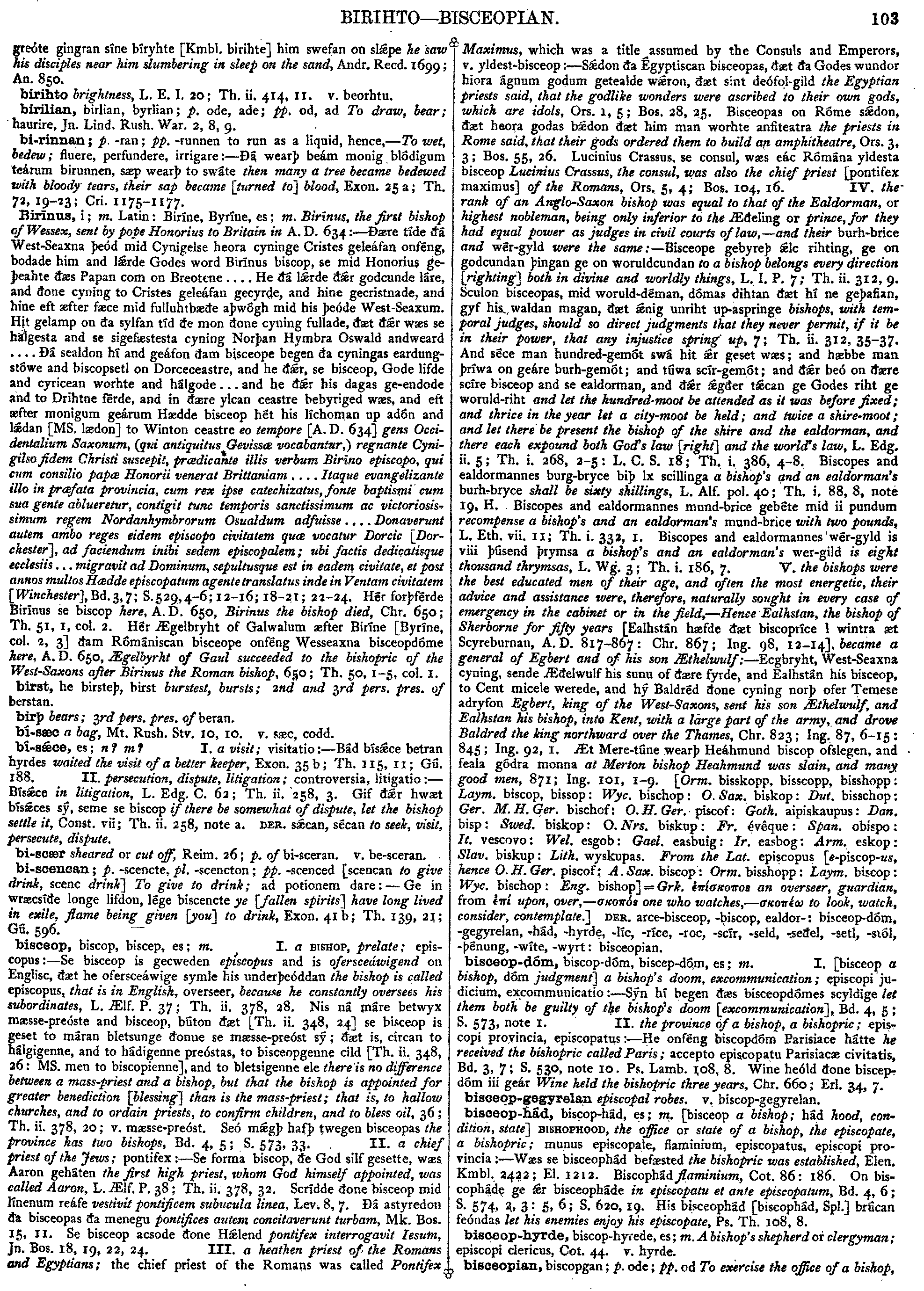
bisceop,
biscop,
biscep,
es;
m.
I.
a
BISHOP,
prelate;
episcopus
:--
Se
bisceop
is
gecweden
episcopus
and
is
ofersceáwigend
on
Englisc,
ðæt
he
ofersceáwige
symle
his
underþeóddan
the
bishop
is
called
episcopus,
that
is
in
English,
overseer,
because
he
constantly
oversees
his
subordinates,
L.
Ælf.
P.
37;
Th.
ii.
378,
28.
Nis
ná
máre
betwyx
mæsse-preóste
and
bisceop,
búton
ðæt
[Th.
ii.
348,
24]
se
bisceop
is
geset
to
máran
bletsunge
ðonne
se
mæsse-preóst
sý;
ðæt
is,
circan
to
hálgigenne,
and
to
hádigenne
preóstas,
to
bisceopgenne
cild
[Th.
ii.
348,
26:
MS.
men
to
biscopienne],
and
to
bletsigenne
ele
there
is
no
difference
between
a
mass-priest
and
a
bishop,
but
that
the
bishop
is
appointed
for
greater
benediction
[blessing]
than
is
the
mass-priest;
that
is,
to
hallow
churches,
and
to
ordain
priests,
to
confirm
children,
and
to
bless
oil,
36;
Th.
ii.
378,
20;
v.
mæsse-preóst.
Seó
m gþ
hafþ
twegen
bisceopas
the
province
has
two
bishops,
Bd.
4,
5;
S.
573,
33.
II.
a
chief
priest
of
the
Jews;
pontifex
:--
Se
forma
biscop,
ðe
God
silf
gesette,
wæs
Aaron
geháten
the
first
high
priest,
whom
God
himself
appointed,
was
called
Aaron,
L.
Ælf.
P.
38;
Th.
ii.
378,
32.
Scrídde
ðone
bisceop
mid
línenum
reáfe
vestivit
pontificem
subucula
linea,
Lev.
8,
7.
Ðá
astyredon
ða
bisceopas
ða
menegu
pontifices
autem
concitaverunt
turbam,
Mk.
Bos.
15,
11.
Se
bisceop
acsode
ðone
Hlend
pontifex
interrogavit
Iesum,
Jn.
Bos.
18,
19,
22,
24.
III.
a
heathen
priest
of
the
Romans
and
Egyptians;
the
chief
priest
of
the
Romans
was
called
Pontifex
Maximus,
which
was
a
title
assumed
by
the
Consuls
and
Emperors,
v.
yldest-bisceop
:--
Sdon
ða
Égyptiscan
bisceopas,
ðæt
ða
Godes
wundor
hiora
ágnum
godum
getealde
wron,
ðæt
sint
deófol-gild
the
Egyptian
priests
said,
that
the
godlike
wonders
were
ascribed
to
their
own
gods,
which
are
idols,
Ors.
1,
5;
Bos.
28,
25.
Bisceopas
on
Róme
sdon,
ðæt
heora
godas
bdon
ðæt
him
man
worhte
anfiteatra
the
priests
in
Rome
said,
that
their
gods
ordered
them
to
build
an
amphitheatre,
Ors.
3,
3;
Bos.
55,
26.
Lucinius
Crassus,
se
consul,
wæs
eác
Rómána
yldesta
bisceop
Lucinius
Crassus,
the
consul,
was
also
the
chief
priest
[pontifex
maximus]
of
the
Romans,
Ors.
5,
4;
Bos.
104,
16.
IV.
the
rank
of
an
Anglo-Saxon
bishop
was
equal
to
that
of
the
Ealdorman,
or
highest
nobleman,
being
only
inferior
to
the
Æðeling
or
prince,
for
they
had
equal
power
as
judges
in
civil
courts
of
law,-and
their
burh-brice
and
wér-gyld
were
the
same
:--
Bisceope
gebyreþ
lc
rihting,
ge
on
godcundan
þingan
ge
on
woruldcundan
to
a
bishop
belongs
every
direction
[righting]
both
in
divine
and
worldly
things,
L.
I.
P.
7;
Th.
ii.
312,
9.
Sculon
bisceopas,
mid
woruld-déman,
dómas
dihtan
ðæt
hí
ne
geþafian,
gyf
his
waldan
magan,
ðæt
nig
unriht
up-aspringe
bishops,
with
temporal
judges,
should
so
direct
judgments
that
they
never
permit,
if
it
be
in
their
power,
that
any
injustice
spring
up,
7;
Th.
ii.
312,
35-37.
And
séce
man
hundred-gemót
swá
hit
r
geset
wæs;
and
hæbbe
man
þríwa
on
geáre
burh-gemót;
and
túwa
scír-gemót;
and
ðr
beó
on
ðære
scíre
bisceop
and
se
ealdorman,
and
ðr
gðer
tcan
ge
Godes
riht
ge
woruld-riht
and
let
the
hundred-moot
be
attended
as
it
was
before
fixed;
and
thrice
in
the
year
let
a
city-moot
be
held;
and
twice
a
shire-moot;
and
let
there
be
present
the
bishop
of
the
shire
and
the
ealdorman,
and
there
each
expound
both
God's
law
[right]
and
the
world's
law,
L.
Edg.
ii.
5;
Th.
i.
268,
2-5:
L.
C.
S.
18;
Th.
i.
386,
4-8.
Biscopes
and
ealdormannes
burg-bryce
biþ
lx
scillinga
a
bishop's
and
an
ealdorman's
burh-bryce
shall
be
sixty
shillings,
L.
Alf.
pol.
40;
Th.
i.
88,
8,
note
19,
H.
Biscopes
and
ealdormannes
mund-brice
gebéte
mid
ii
pundum
recompense
a
bishop's
and
an
ealdorman's
mund-brice
with
two
pounds,
L.
Eth,
vii.
11;
Th.
i.
332,
1.
Biscopes
and
ealdormannes
wér-gyld
is
viii
þúsend
þrymsa
a
bishop's
and
an
ealdorman's
wer-gild
is
eight
thousand
thrymsas,
L.
Wg.
3;
Th.
i.
186,
7.
V.
the
bishops
were
the
best
educated
men
of
their
age,
and
often
the
most
energetic,
their
advice
and
assistance
were,
therefore,
naturally
sought
in
every
case
of
emergency
in
the
cabinet
or
in
the
field,-Hence
Ealhstan,
the
bishop
of
Sherborne
for
fifty
years
[Ealhstán
hæfde
ðæt
biscopríce
l
wintra
æt
Scyreburnan,
A.
D.
817-867:
Chr.
867;
Ing.
98,
12-14],
became
a
general
of
Egbert
and
of
his
son
Æthelwulf
:--
Ecgbryht,
West-Seaxna
cyning,
sende
Æðelwulf
his
sunu
of
ðære
fyrde,
and
Ealhstán
his
bisceop,
to
Cent
micele
werede,
and
hý
Baldréd
ðone
cyning
norþ
ofer
Temese
adryfon
Egbert,
king
of
the
West-Saxons,
sent
his
son
Æthelwulf,
and
Ealhstan
his
bishop,
into
Kent,
with
a
large
part
of
the
army,,
and
drove
Baldred
the
king
northward
over
the
Thames,
Chr.
823;
Ing.
87,
6-15:
845;
Ing.
92,
1.
Æt
Mere-túne
wearþ
Heáhmund
biscop
ofslegen,
and
feala
gódra
monna
at
Merton
bishop
Heahmund
was
slain,
and
many
good
men,
871;
Ing.
101,
1-9.
[Orm.
bisskopp,
bisscopp,
bisshopp:
Laym.
biscop,
bissop:
Wyc.
bischop:
O.
Sax.
biskop:
Dut.
bisschop:
Ger.
M.
H.
Ger.
bischof:
O.
H.
Ger.
piscof:
Goth.
aipiskaupus:
Dan.
bisp:
Swed.
biskop:
O.
Nrs.
biskup:
Fr.
évêque:
Span.
obispo:
It.
vescovo:
Wel.
esgob:
Gael.
easbuig:
Ir.
easbog:
Arm.
eskop:
Slav.
biskup:
Lith.
wyskupas.
From
the
Lat.
episcopus
[e-piscop-us,
hence
O.
H.
Ger.
piscof:
A.
Sax.
biscop:
Orm.
bisshopp:
Laym.
biscop:
Wyc.
bischop:
Eng.
bishop]
=
Grk.
&epsilon-tonos;
gþ
hafþ
twegen
bisceopas
the
province
has
two
bishops,
Bd.
4,
5;
S.
573,
33.
II.
a
chief
priest
of
the
Jews;
pontifex
:--
Se
forma
biscop,
ðe
God
silf
gesette,
wæs
Aaron
geháten
the
first
high
priest,
whom
God
himself
appointed,
was
called
Aaron,
L.
Ælf.
P.
38;
Th.
ii.
378,
32.
Scrídde
ðone
bisceop
mid
línenum
reáfe
vestivit
pontificem
subucula
linea,
Lev.
8,
7.
Ðá
astyredon
ða
bisceopas
ða
menegu
pontifices
autem
concitaverunt
turbam,
Mk.
Bos.
15,
11.
Se
bisceop
acsode
ðone
Hlend
pontifex
interrogavit
Iesum,
Jn.
Bos.
18,
19,
22,
24.
III.
a
heathen
priest
of
the
Romans
and
Egyptians;
the
chief
priest
of
the
Romans
was
called
Pontifex
Maximus,
which
was
a
title
assumed
by
the
Consuls
and
Emperors,
v.
yldest-bisceop
:--
Sdon
ða
Égyptiscan
bisceopas,
ðæt
ða
Godes
wundor
hiora
ágnum
godum
getealde
wron,
ðæt
sint
deófol-gild
the
Egyptian
priests
said,
that
the
godlike
wonders
were
ascribed
to
their
own
gods,
which
are
idols,
Ors.
1,
5;
Bos.
28,
25.
Bisceopas
on
Róme
sdon,
ðæt
heora
godas
bdon
ðæt
him
man
worhte
anfiteatra
the
priests
in
Rome
said,
that
their
gods
ordered
them
to
build
an
amphitheatre,
Ors.
3,
3;
Bos.
55,
26.
Lucinius
Crassus,
se
consul,
wæs
eác
Rómána
yldesta
bisceop
Lucinius
Crassus,
the
consul,
was
also
the
chief
priest
[pontifex
maximus]
of
the
Romans,
Ors.
5,
4;
Bos.
104,
16.
IV.
the
rank
of
an
Anglo-Saxon
bishop
was
equal
to
that
of
the
Ealdorman,
or
highest
nobleman,
being
only
inferior
to
the
Æðeling
or
prince,
for
they
had
equal
power
as
judges
in
civil
courts
of
law,-and
their
burh-brice
and
wér-gyld
were
the
same
:--
Bisceope
gebyreþ
lc
rihting,
ge
on
godcundan
þingan
ge
on
woruldcundan
to
a
bishop
belongs
every
direction
[righting]
both
in
divine
and
worldly
things,
L.
I.
P.
7;
Th.
ii.
312,
9.
Sculon
bisceopas,
mid
woruld-déman,
dómas
dihtan
ðæt
hí
ne
geþafian,
gyf
his
waldan
magan,
ðæt
nig
unriht
up-aspringe
bishops,
with
temporal
judges,
should
so
direct
judgments
that
they
never
permit,
if
it
be
in
their
power,
that
any
injustice
spring
up,
7;
Th.
ii.
312,
35-37.
And
séce
man
hundred-gemót
swá
hit
r
geset
wæs;
and
hæbbe
man
þríwa
on
geáre
burh-gemót;
and
túwa
scír-gemót;
and
ðr
beó
on
ðære
scíre
bisceop
and
se
ealdorman,
and
ðr
gðer
tcan
ge
Godes
riht
ge
woruld-riht
and
let
the
hundred-moot
be
attended
as
it
was
before
fixed;
and
thrice
in
the
year
let
a
city-moot
be
held;
and
twice
a
shire-moot;
and
let
there
be
present
the
bishop
of
the
shire
and
the
ealdorman,
and
there
each
expound
both
God's
law
[right]
and
the
world's
law,
L.
Edg.
ii.
5;
Th.
i.
268,
2-5:
L.
C.
S.
18;
Th.
i.
386,
4-8.
Biscopes
and
ealdormannes
burg-bryce
biþ
lx
scillinga
a
bishop's
and
an
ealdorman's
burh-bryce
shall
be
sixty
shillings,
L.
Alf.
pol.
40;
Th.
i.
88,
8,
note
19,
H.
Biscopes
and
ealdormannes
mund-brice
gebéte
mid
ii
pundum
recompense
a
bishop's
and
an
ealdorman's
mund-brice
with
two
pounds,
L.
Eth,
vii.
11;
Th.
i.
332,
1.
Biscopes
and
ealdormannes
wér-gyld
is
viii
þúsend
þrymsa
a
bishop's
and
an
ealdorman's
wer-gild
is
eight
thousand
thrymsas,
L.
Wg.
3;
Th.
i.
186,
7.
V.
the
bishops
were
the
best
educated
men
of
their
age,
and
often
the
most
energetic,
their
advice
and
assistance
were,
therefore,
naturally
sought
in
every
case
of
emergency
in
the
cabinet
or
in
the
field,-Hence
Ealhstan,
the
bishop
of
Sherborne
for
fifty
years
[Ealhstán
hæfde
ðæt
biscopríce
l
wintra
æt
Scyreburnan,
A.
D.
817-867:
Chr.
867;
Ing.
98,
12-14],
became
a
general
of
Egbert
and
of
his
son
Æthelwulf
:--
Ecgbryht,
West-Seaxna
cyning,
sende
Æðelwulf
his
sunu
of
ðære
fyrde,
and
Ealhstán
his
bisceop,
to
Cent
micele
werede,
and
hý
Baldréd
ðone
cyning
norþ
ofer
Temese
adryfon
Egbert,
king
of
the
West-Saxons,
sent
his
son
Æthelwulf,
and
Ealhstan
his
bishop,
into
Kent,
with
a
large
part
of
the
army,,
and
drove
Baldred
the
king
northward
over
the
Thames,
Chr.
823;
Ing.
87,
6-15:
845;
Ing.
92,
1.
Æt
Mere-túne
wearþ
Heáhmund
biscop
ofslegen,
and
feala
gódra
monna
at
Merton
bishop
Heahmund
was
slain,
and
many
good
men,
871;
Ing.
101,
1-9.
[Orm.
bisskopp,
bisscopp,
bisshopp:
Laym.
biscop,
bissop:
Wyc.
bischop:
O.
Sax.
biskop:
Dut.
bisschop:
Ger.
M.
H.
Ger.
bischof:
O.
H.
Ger.
piscof:
Goth.
aipiskaupus:
Dan.
bisp:
Swed.
biskop:
O.
Nrs.
biskup:
Fr.
évêque:
Span.
obispo:
It.
vescovo:
Wel.
esgob:
Gael.
easbuig:
Ir.
easbog:
Arm.
eskop:
Slav.
biskup:
Lith.
wyskupas.
From
the
Lat.
episcopus
[e-piscop-us,
hence
O.
H.
Ger.
piscof:
A.
Sax.
biscop:
Orm.
bisshopp:
Laym.
biscop:
Wyc.
bischop:
Eng.
bishop]
=
Grk.
&epsilon-tonos; &iota-tonos;
 oos
an
overseer,
guardian,
from
&epsilon-tonos;&iota-tonos;
upon,
over,-oós
one
who
watches,-o&epsilon-tonos;
oos
an
overseer,
guardian,
from
&epsilon-tonos;&iota-tonos;
upon,
over,-oós
one
who
watches,-o&epsilon-tonos; to
look,
watch,
consider,
contemplate.]
DER.
arce-bisceop,
-biscop,
ealdor-:
bisceop-dóm,
-gegyrelan,
,hád,
-hyrde,
-líc,
-ríce,
-roc,
-scír,
-seld,
-seðel,
-setl,
-stól,
-þénung,
-wíte,
-wyrt:
bisceopian.
to
look,
watch,
consider,
contemplate.]
DER.
arce-bisceop,
-biscop,
ealdor-:
bisceop-dóm,
-gegyrelan,
,hád,
-hyrde,
-líc,
-ríce,
-roc,
-scír,
-seld,
-seðel,
-setl,
-stól,
-þénung,
-wíte,
-wyrt:
bisceopian.
|
Source: Bosworth/Toller, page b0310, entry 27 View original page image as: [TIFF] [PNG] [View previous entry] [View next entry] |
[Comment on this entry] [View comments] |
The following entry has been hand-corrected once. |
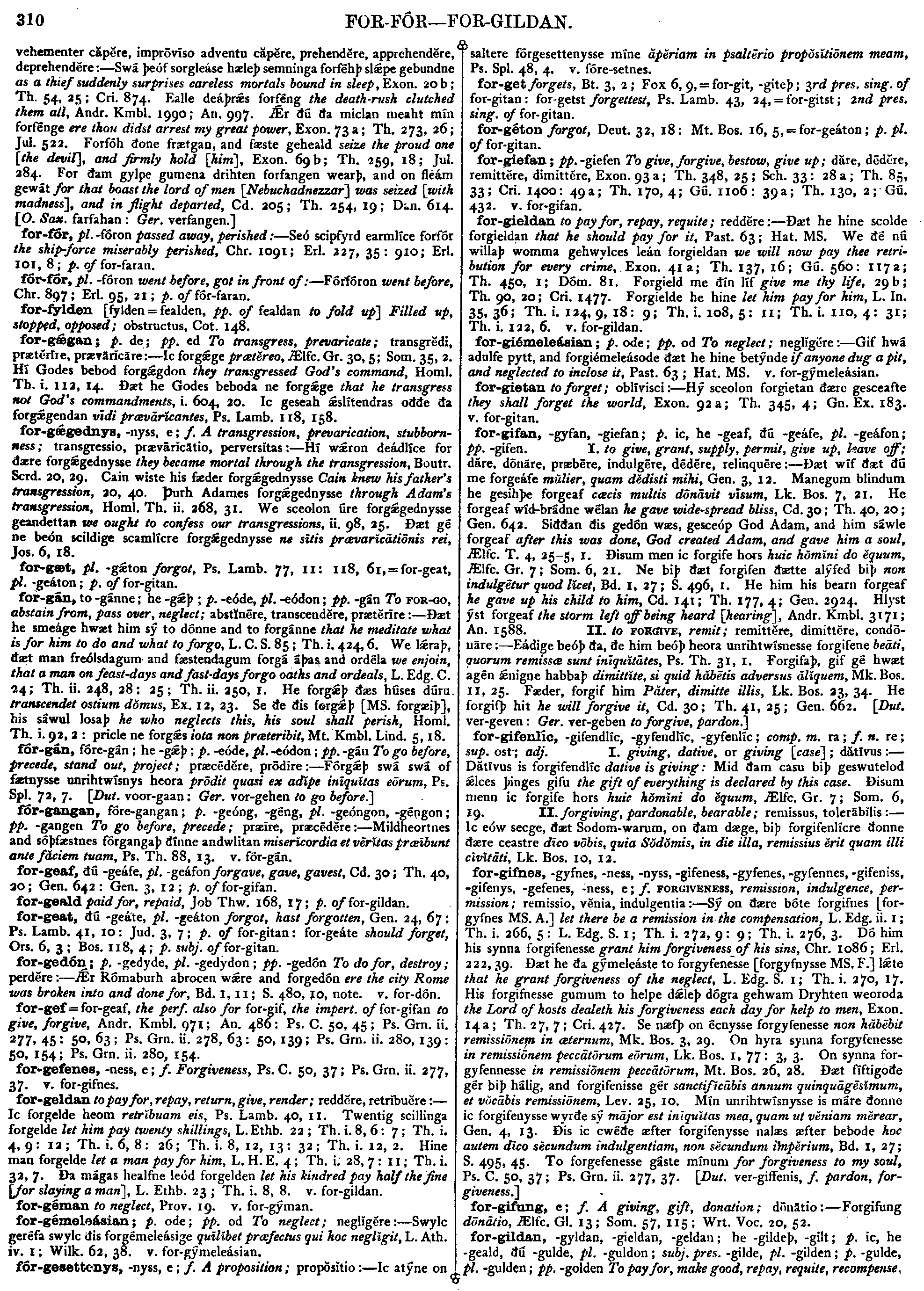
for-gifan,
-gyfan,
-giefan;
p.
ic,
he
-geaf,
ðú
-geáfe,
pl.
-geáfon;
pp.
-gifen.
I.
to
give,
grant,
supply,
permit,
give
up,
leave
off;
d re,
d
re,
d n
n re,
præb
re,
præb re,
indulgre,
dd
re,
indulgre,
dd re,
relinqure
:--
Ðæt
wíf
ðæt
ðú
me
forgeáfe
m
re,
relinqure
:--
Ðæt
wíf
ðæt
ðú
me
forgeáfe
m lier,
quam
ddisti
mihi,
Gen.
3,
12.
Manegum
blindum
he
gesihþe
forgeaf
cæcis
multis
dnvit
v
lier,
quam
ddisti
mihi,
Gen.
3,
12.
Manegum
blindum
he
gesihþe
forgeaf
cæcis
multis
dnvit
v sum,
Lk.
Bos.
7,
21.
He
forgeaf
wíd-brádne
wélan
he
gave
wide-spread
bliss,
Cd.
30;
Th.
40,
20;
Gen.
642.
Siððan
ðis
gedón
wæs,
gesceóp
God
Adam,
and
him
sáwle
forgeaf
after
this
was
done,
God
created
Adam,
and
gave
him
a
soul,
Ælfc.
T.
4,
25-5,
1.
Ðisum
men
ic
forgife
hors
huic
h
sum,
Lk.
Bos.
7,
21.
He
forgeaf
wíd-brádne
wélan
he
gave
wide-spread
bliss,
Cd.
30;
Th.
40,
20;
Gen.
642.
Siððan
ðis
gedón
wæs,
gesceóp
God
Adam,
and
him
sáwle
forgeaf
after
this
was
done,
God
created
Adam,
and
gave
him
a
soul,
Ælfc.
T.
4,
25-5,
1.
Ðisum
men
ic
forgife
hors
huic
h m
m ni
do
quum,
Ælfc.
Gr.
7;
Som.
6,
21.
Ne
biþ
ðæt
forgifen
ðætte
alýfed
biþ
non
indulgtur
quod
lcet,
Bd.
1.
27;
S.
496,
1.
He
him
his
bearn
forgeaf
he
gave
up
his
child
to
him,
Cd.
141;
Th.
177,
4;
Gen.
2924.
Hlyst
ýst
forgeaf
the
storm
left
of
being
heard
[hearing],
Andr.
Kmbl.
3171;
An.
1588.
II.
to
FORGIVE,
remit;
remittre,
dimittre,
condnre
:--
Eádige
beóþ
ða,
ðe
him
beóþ
heora
unrihtwísnesse
forgifene
beti,
quorum
remissæ
sunt
inquttes,
Ps.
Th.
31,
1.
Forgifaþ,
gif
gé
hwæt
agén
nigne
habbaþ
dimittte,
si
quid
hbtis
adversus
lquem,
Mk.
Bos.
11,
25.
Fæder,
forgif
him.
Pter,
dimitte
illis,
Lk.
Bos.
23,
34.
He
forgifþ
hit
he
will
forgive
it,
Cd.
30;
Th.
41,
25;
Gen.
662.
[Dut.
ver-geven:
Ger.
ver-geben
to
forgive,
pardon.]
ni
do
quum,
Ælfc.
Gr.
7;
Som.
6,
21.
Ne
biþ
ðæt
forgifen
ðætte
alýfed
biþ
non
indulgtur
quod
lcet,
Bd.
1.
27;
S.
496,
1.
He
him
his
bearn
forgeaf
he
gave
up
his
child
to
him,
Cd.
141;
Th.
177,
4;
Gen.
2924.
Hlyst
ýst
forgeaf
the
storm
left
of
being
heard
[hearing],
Andr.
Kmbl.
3171;
An.
1588.
II.
to
FORGIVE,
remit;
remittre,
dimittre,
condnre
:--
Eádige
beóþ
ða,
ðe
him
beóþ
heora
unrihtwísnesse
forgifene
beti,
quorum
remissæ
sunt
inquttes,
Ps.
Th.
31,
1.
Forgifaþ,
gif
gé
hwæt
agén
nigne
habbaþ
dimittte,
si
quid
hbtis
adversus
lquem,
Mk.
Bos.
11,
25.
Fæder,
forgif
him.
Pter,
dimitte
illis,
Lk.
Bos.
23,
34.
He
forgifþ
hit
he
will
forgive
it,
Cd.
30;
Th.
41,
25;
Gen.
662.
[Dut.
ver-geven:
Ger.
ver-geben
to
forgive,
pardon.]
|
Source: Bosworth/Toller, page b0314, entry 4 View original page image as: [TIFF] [PNG] [View previous entry] [View next entry] |
[Comment on this entry] [View comments] |
The following entry has been hand-corrected once. |
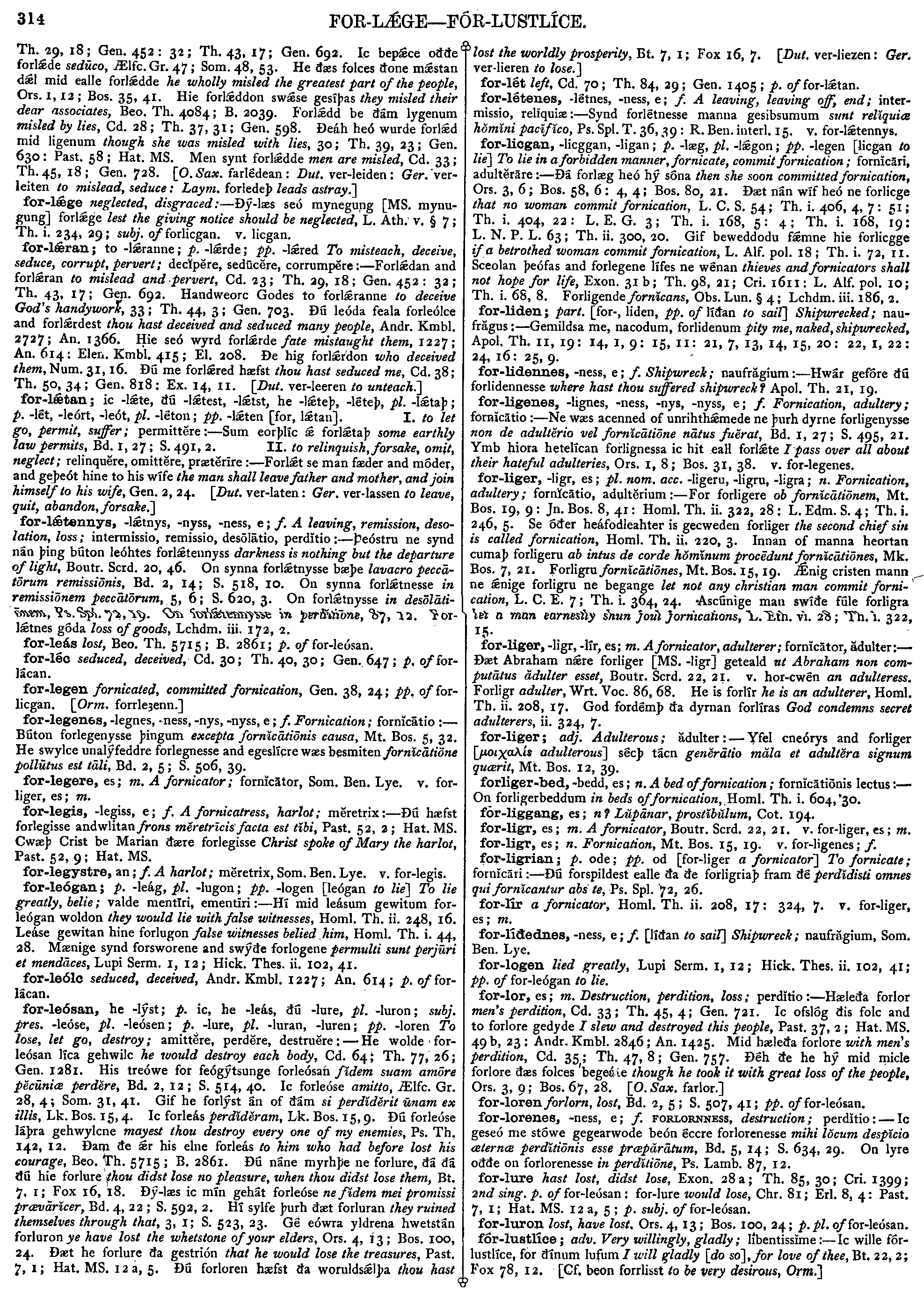
for-ltan;
ic
-lte,
ðú
-ltest,
-ltst,
he
-lteþ,
-léteþ,
pl.
-ltaþ;
p.
-lét,
-leórt,
-leót,
pl.
-léton;
pp.
-lten
[for,
ltan].
I.
to
let
go,
permit,
suffer;
permittre
:--
Sum
eorþlíc
forltaþ
some
earthly
law
permits,
Bd.
1,
27;
S.
491,
2.
II.
to
relinquish,
forsake,
omit,
neglect;
relinqure,
omittre,
prætrre
:--
Forlt
se
man
fæder
and
móder,
and
geþeót
hine
to
his
wífe
the
man
shall
leave
father
and
mother,
and
join
himself
to
his
wife,
Gen.
2,
24.
[Dut.
ver-laten:
Ger.
ver-lassen
to
leave,
quit,
abandon,
foresake.]
|
Source: Bosworth/Toller, page b0408, entry 15 View original page image as: [TIFF] [PNG] [View previous entry] [View next entry] |
[Comment on this entry] [View comments] |
The following entry has been hand-corrected once. |
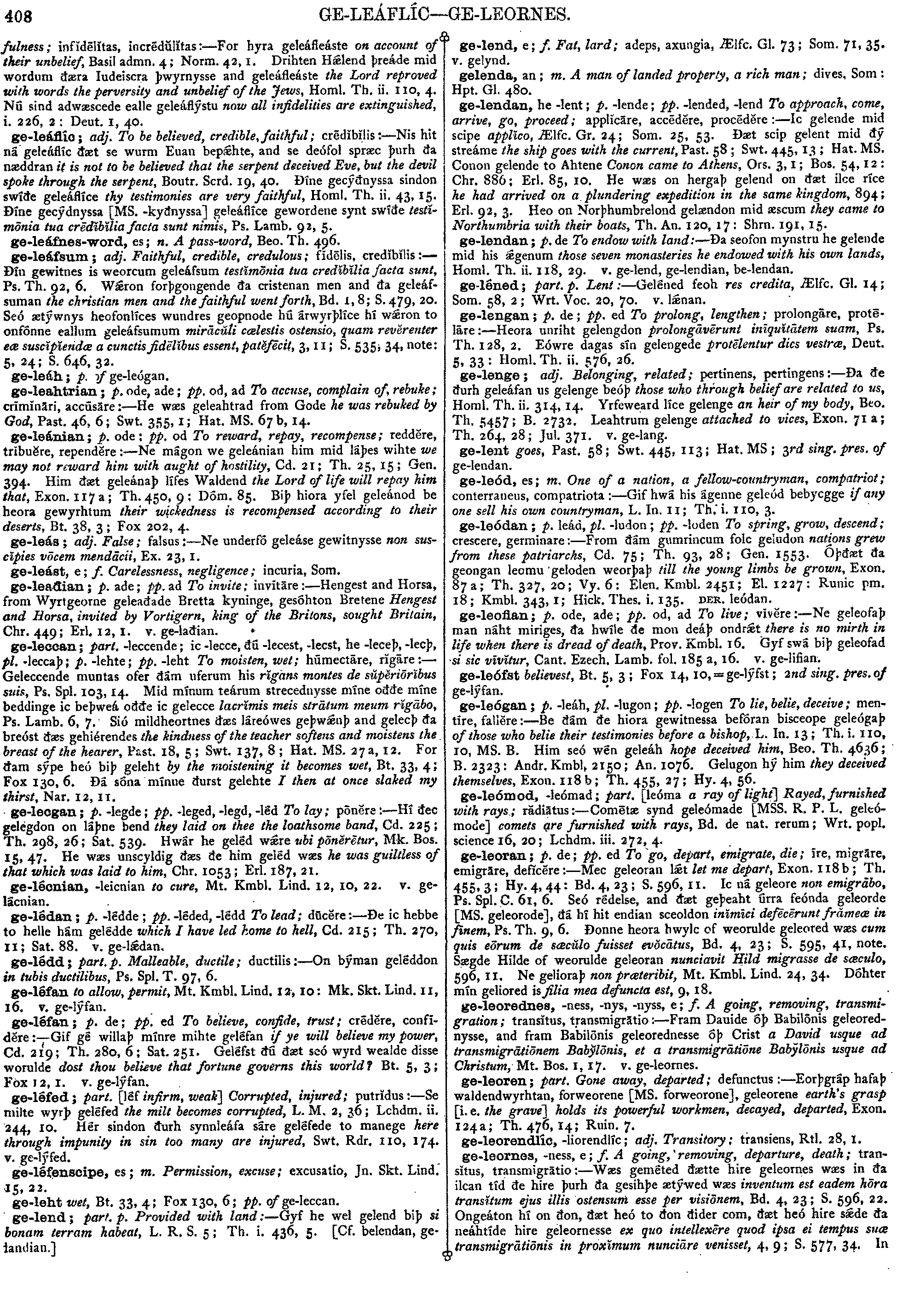
ge-léfan to allow, permit, Mt. Kmbl. Lind. 12, 10 : Mk. Skt. Lind. 11, 16. v. ge-lýfan.
|
Source: Bosworth/Toller, page b0412, entry 2 View original page image as: [TIFF] [PNG] [View previous entry] [View next entry] |
[Comment on this entry] [View comments] |
The following entry has been hand-corrected once. |
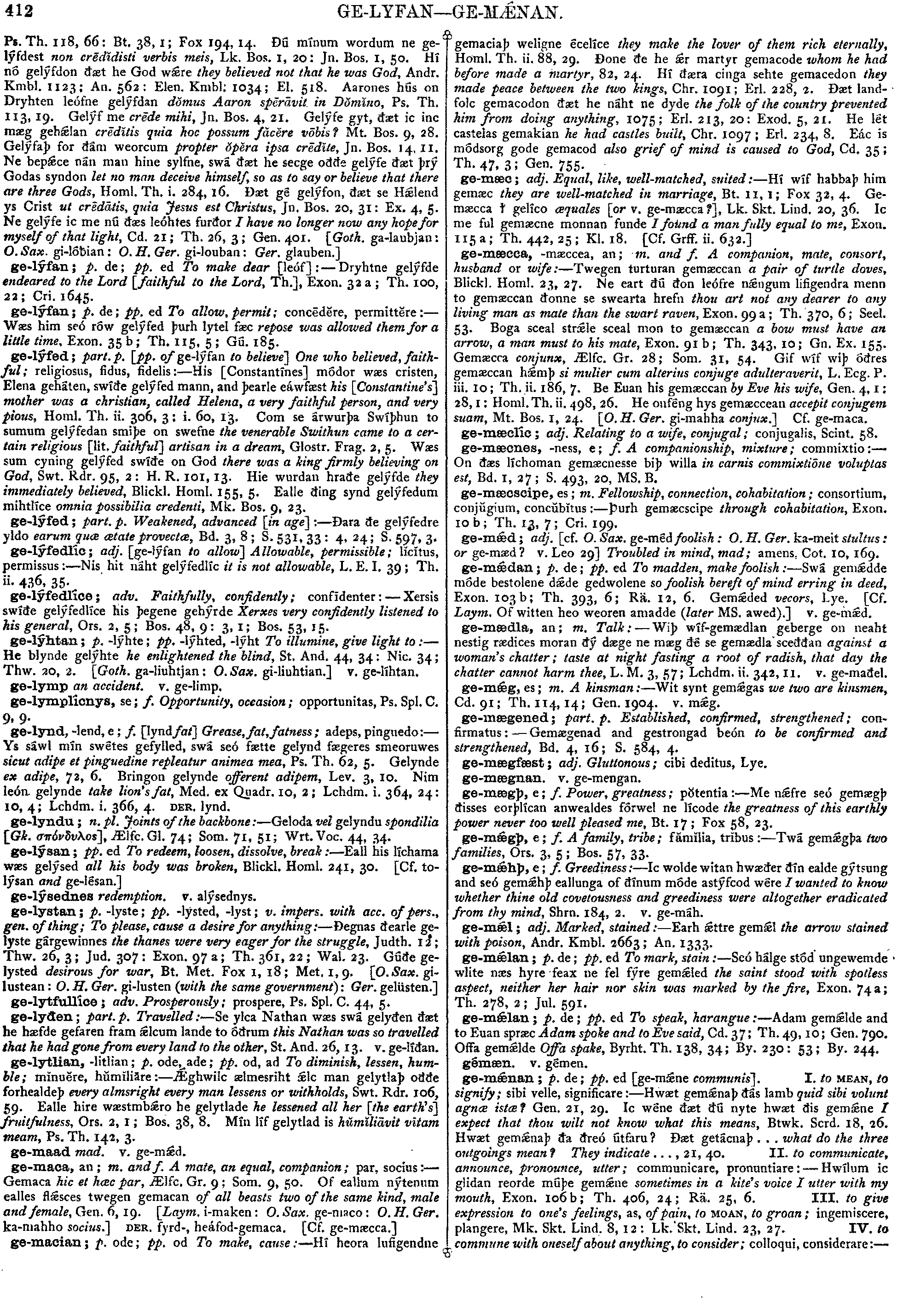
ge-lýfan;
p.
de;
pp.
ed
To
allow,
permit;
concdre,
permittre
:--
Wæs
him
seó
rów
gelýfed
þurh
lytel
fæc
repose
was
allowed
them
for
a
little
time,
Exon.
35
b;
Th.
115,
5;
Gú.
185.
|
Source: Bosworth/Toller, page b0453, entry 15 View original page image as: [TIFF] [PNG] [View previous entry] [View next entry] |
[Comment on this entry] [View comments] |
The following entry has been hand-corrected once. |
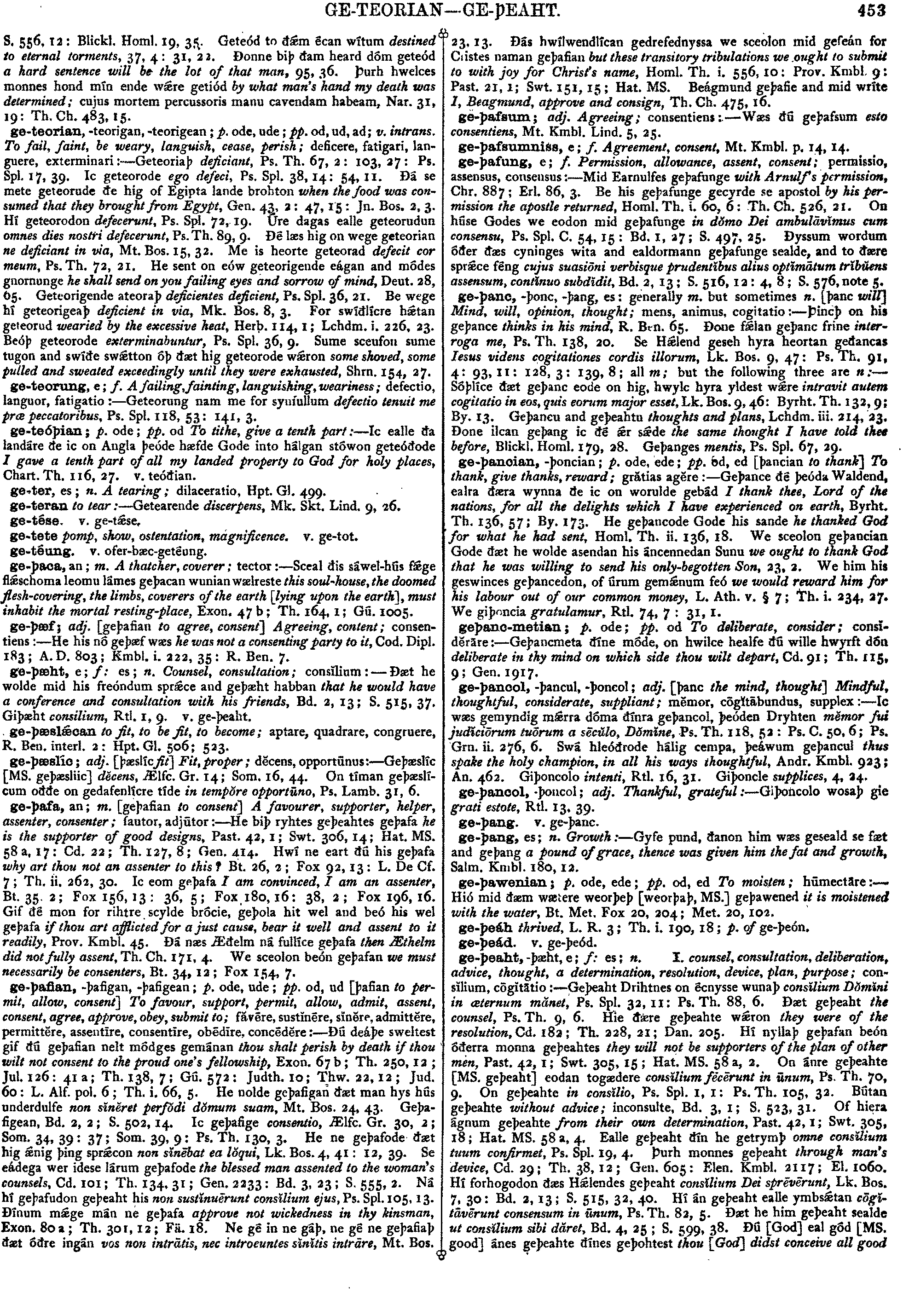
ge-þafian,
-þafigan,
-þafigean;
p.
ode,
ude;
pp.
od,
ud
[þafian
to
permit,
allow,
consent]
To
favour,
support,
permit,
allow,
admit,
assent,
consent,
agree,
approve,
obey,
submit
to;
fvre,
sustnre,
snre,
admittre,
permittre,
assentre,
consentre,
obdre,
concdre
:--
Ðú
deáþe
sweltest
gif
ðú
geþafian
nelt
módges
gemánan
thou
shalt
perish
by
death
if
thou
wilt
not
consent
to
the
proud
one's
fellowship,
Exon.
67
b;
Th.
250,
12;
Jul.
126:
41
a;
Th.
138,
7;
Gú.
572:
Judth.
10;
Thw.
22,
12;
Jud.
60:
L.
Alf.
pol.
6;
Th.
i.
66,
5.
He
nolde
geþafigan
ðæt
man
hys
hús
underdulfe
non
snret
perfdi
dmum
suam,
Mt.
Bos.
24,
43.
Geþafigean,
Bd.
2,
2;
S.
502,
14.
Ic
geþafige
consentio,
Ælfc.
Gr.
30,
2;
Som.
34,
39:
37;
Som.
39,
9:
Ps.
Th.
130,
3.
He
ne
geþafode
ðæt
hig
nig
þing
sprcon
non
snbat
ea
lqui,
Lk.
Bos.
4,
41:
12,
39.
Se
eádega
wer
idese
lárum
geþafode
the
blessed
man
assented
to
the
woman's
counsels,
Cd.
101;
Th.
134,
31;
Gen.
2233:
Bd.
3,
23;
S.
555,
2.
Ná
hí
geþafudon
geþeaht
his
non
sustnurunt
conslium
ejus,
Ps.
Spl.
105,
13.
Ðínum
mge
mán
ne
geþafa
approve
not
wickedness
in
thy
kinsman,
Exon.
80
a;
Th.
301,
12;
Fä.
18.
Ne
gé
in
ne
gáþ,
ne
gé
ne
geþafiaþ
ðæt
óðre
ingán
vos
non
intrtis,
nec
introeuntes
sntis
intrre,
Mt.
Bos.
23,
13.
Ðás
hwílwendlícan
gedrefednyssa
we
sceolon
mid
gefeán
for
Cristes
naman
geþafian
but
these
transitory
tribulations
we
ought
to
submit
to
with
joy
for
Christ's
name,
Homl.
Th.
i.
556,
10:
Prov.
Kmbl.
9:
Past.
21,
1;
Swt.
151,
15;
Hat.
MS.
Beágmund
geþafie
and
mid
wríte
I,
Beagmund,
approve
and
consign,
Th.
Ch.
475,
16.
|
Source: Bosworth/Toller, page b0515, entry 16 View original page image as: [TIFF] [PNG] [View previous entry] [View next entry] |
[Comment on this entry] [View comments] |
The following entry has been hand-corrected once. |
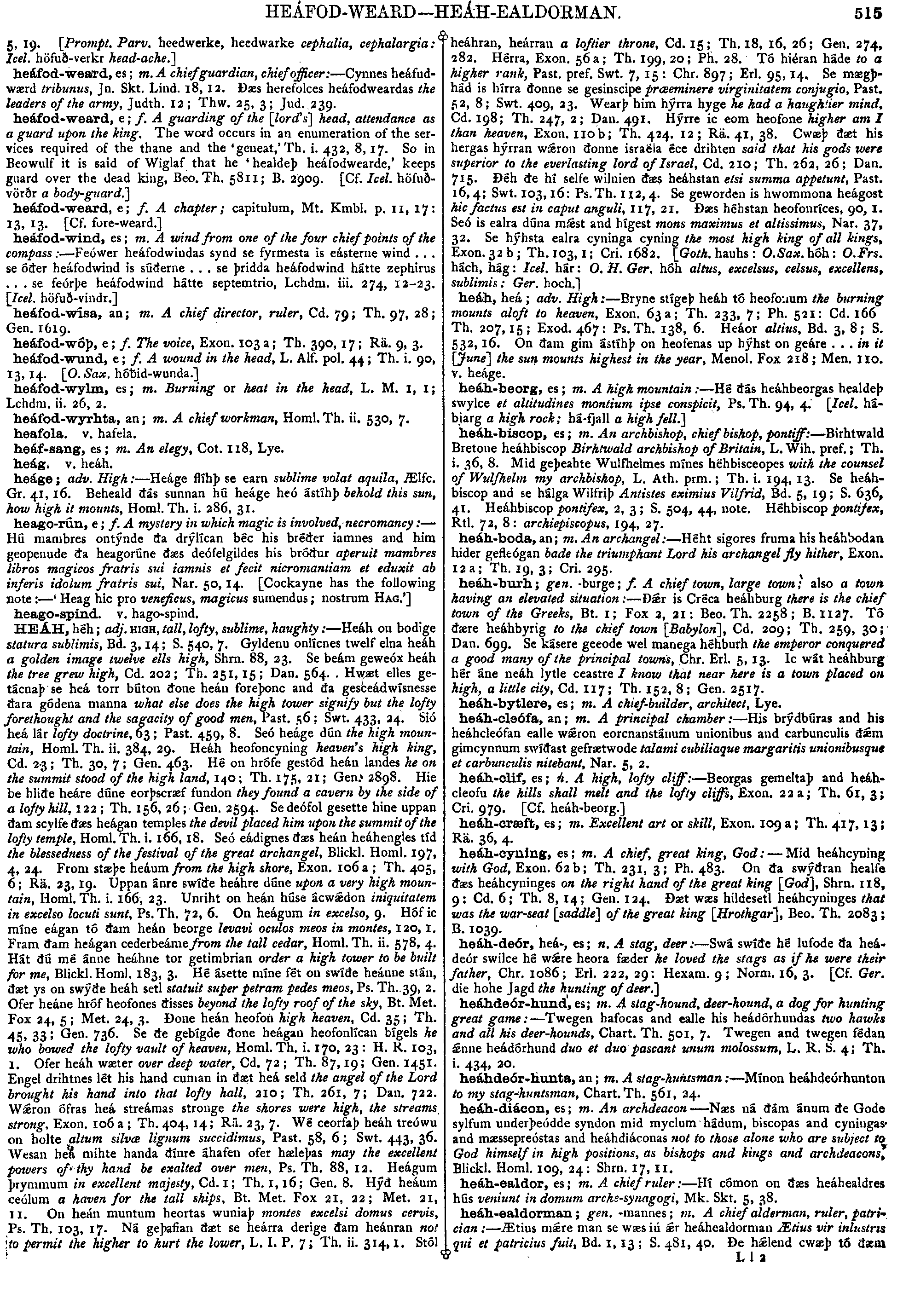
HEÁH,
héh;
adj.
HIGH,
tall,
lofty,
sublime,
haughty
:--
Heáh
on
bodige
statura
sublimis,
Bd.
3,
14;
S.
540,
7.
Gyldenu
onlícnes
twelf
elna
heáh
a
golden
image
twelve
ells
high,
Shrn.
88,
23.
Se
beám
geweóx
heáh
the
tree
grew
high,
Cd.
202
;
Th.
251,
15;
Dan.
564.
Hwæt
elles
getácnaþ
se
heá
torr
búton
ðone
heáh
foreþonc
and
ða
gesceádwísnesse
ðara
gódena
manna
what
else
does
the
high
tower
signify
but
the
lofty
forethought
and
the
sagacity
of
good
men,
Past.
56;
Swt.
433,
24.
Sió
heá
lár
lofty
doctrine,
63;
Past.
459,
8.
Seó
heáge
dún
the
high
mountain,
Homl.
Th.
ii.
384,
29.
Heáh
heofoncyning
heaven's
high
king,
Cd.
23;
Th.
30,
7;
Gen.
463.
Hé
on
hrófe
gestód
heán
landes
he
on
the
summit
stood
of
the
high
land,
140:
Th.
175,
21;
Gen.
2898.
Hie
be
hliðe
heáre
dúne
eorþscræf
fundon
they
found
a
cavern
by
the
side
of
a
lofty
hill,
122;
Th.
156,
26;
Gen.
2594.
Se
deófol
gesette
hine
uppan
ðam
scylfe
ðæs
heágan
temples
the
devil
placed
him
upon
the
summit
of
the
lofty
temple,
Homl.
Th.
i.
166,
18.
Seó
eádignes
ðæs
heán
heáhengles
tíd
the
blessedness
of
the
festival
of
the
great
archangel,
Blickl.
Homl.
197,
4,
24.
From
stæþe
heáum
from
the
high
shore,
Exon.
106
a;
Th.
405,
6;
Rä.
23,
19.
Uppan
ánre
swíðe
heáhre
dúne
upon
a
very
high
mountain,
Homl.
Th.
i.
166,
23.
Unriht
on
heán
húse
ácwdon
iniquitatem
in
excelso
locuti
sunt,
Ps.
Th.
72,
6.
On
heágum
in
excelso,
9.
Hóf
ic
míne
eágan
tó
ðam
heán
beorge
levavi
oculos
meos
in
montes,
120,
1.
Fram
ðam
heágan
cederbeáme
from
the
tall
cedar,
Homl.
Th.
ii.
578,
4.
Hát
ðú
mé
ánne
heáhne
tor
getimbrian
order
a
high
tower
to
be
built
for
me,
Blickl.
Homl.
183,
3.
Hé
ásette
míne
fét
on
swíðe
heánne
stán,
ðæt
ys
on
swýðe
heáh
setl
statuit
super
petram
pedes
meos,
Ps.
Th.
39,
2.
Ofer
heáne
hróf
heofones
ðisses
beyond
the
lofty
roof
of
the
sky,
Bt.
Met.
Fox
24,
5;
Met.
24,
3.
Ðone
heán
heofon
high
heaven,
Cd.
35;
Th.
45,
33;
Gen.
736.
Se
ðe
gebígde
ðone
heágan
heofonlícan
bígels
he
who
bowed
the
lofty
vault
of
heaven,
Homl.
Th.
i.
170,
23:
H.
R.
103,
1.
Ofer
heáh
wæter
over
deep
water,
Cd.
72;
Th.
87,
19;
Gen.
1451.
Engel
drihtnes
lét
his
hand
cuman
in
ðæt
heá
seld
the
angel
of
the
Lord
brought
his
hand
into
that
lofty
hall,
210;
Th.
261,
7;
Dan.
722.
Wron
ófras
heá
streámas
stronge
the
shores
were
high,
the
streams,
strong,
Exon.
106
a;
Th.
404,
14;
Rä.
23,
7.
Wé
ceorfaþ
heáh
treówu
on
holte
altum
silvæ
lignum
succidimus,
Past.
58,
6;
Swt.
443,
36.
Wesan
heá
mihte
handa
ðíne
áhafen
ofer
hæleþas
may
the
excellent
powers
of
thy
hand
be
exalted
over
men,
Ps.
Th.
88,
12.
Heágum
þrymmum
in
excellent
majesty,
Cd.
1;
Th.
1,
16;
Gen.
8.
Hýð
heáum
ceólum
a
haven
for
the
tall
ships,
Bt.
Met.
Fox
21,
22;
Met.
21,
11.
On
heán
muntum
heortas
wuniaþ
montes
excelsi
domus
cervis,
Ps.
Th.
103,
17.
Ná
geþafian
ðæt
se
heárra
derige
ðam
heánran
not
to
permit
the
higher
to
hurt
the
lower,
L.
I.
P.
7;
Th.
ii.
314,
1.
Stól
heáhran,
heárran
a
loftier
throne,
Cd.
15;
Th.
18,
16,
26;
Gen.
274,
282.
Hérra,
Exon.
56
a;
Th.
199,
20;
Ph.
28.
Tó
hiéran
háde
to
a
higher
rank,
Past.
pref.
Swt.
7,
15:
Chr.
897;
Erl.
95,
14.
Se
mægþ-hád
is
hírra
ðonne
se
gesinscipe
præeminere
virginitatem
conjugio,
Past.
52,
8;
Swt.
409,
23.
Wearþ
him
hýrra
hyge
he
had
a
haughtier
mind,
Cd.
198;
Th.
247,
2;
Dan.
491.
Hýrre
ic
eom
heofone
higher
am
I
than
heaven,
Exon.
110
b;
Th.
424,
12;
Rä.
41,
38.
Cwæþ
ðæt
his
hergas
hýrran
wron
ðonne
israela
éce
drihten
said
that
his
gods
were
superior
to
the
everlasting
lord
of
Israel,
Cd.
210;
Th.
262,
26;
Dan.
715.
Ðéh
ðe
hí
selfe
wilnien
ðæs
heáhstan
etsi
summa
appetunt,
Past.
16,
4;
Swt.
103,16:
Ps.
Th.
112,
4.
Se
geworden
is
hwommona
heágost
hic
factus
est
in
caput
anguli,
117,
21.
Ðæs
héhstan
heofonríces,
90,
1.
Seó
is
ealra
dúna
mst
and
hígest
mons
maximus
et
altissimus,
Nar,
37,
32.
Se
hýhsta
ealra
cyninga
cyning
the
most
high
king
of
all
kings,
Exon.
32
b;
Th.
103,
1;
Cri.
1682.
Goth.
hauhs:
O.
Sax.
hóh:
O.
Frs.
hách,
hág:
Icel.
hár:
O.
H.
Ger.
hóh
altus,
excelsus,
celsus,
excellens,
sublimis:
Ger.
hoch.]
|
Source: Bosworth/Toller, page b0526, entry 54 View original page image as: [TIFF] [PNG] [View previous entry] [View next entry] |
[Comment on this entry] [View comments] |
The following entry has been hand-corrected once. |
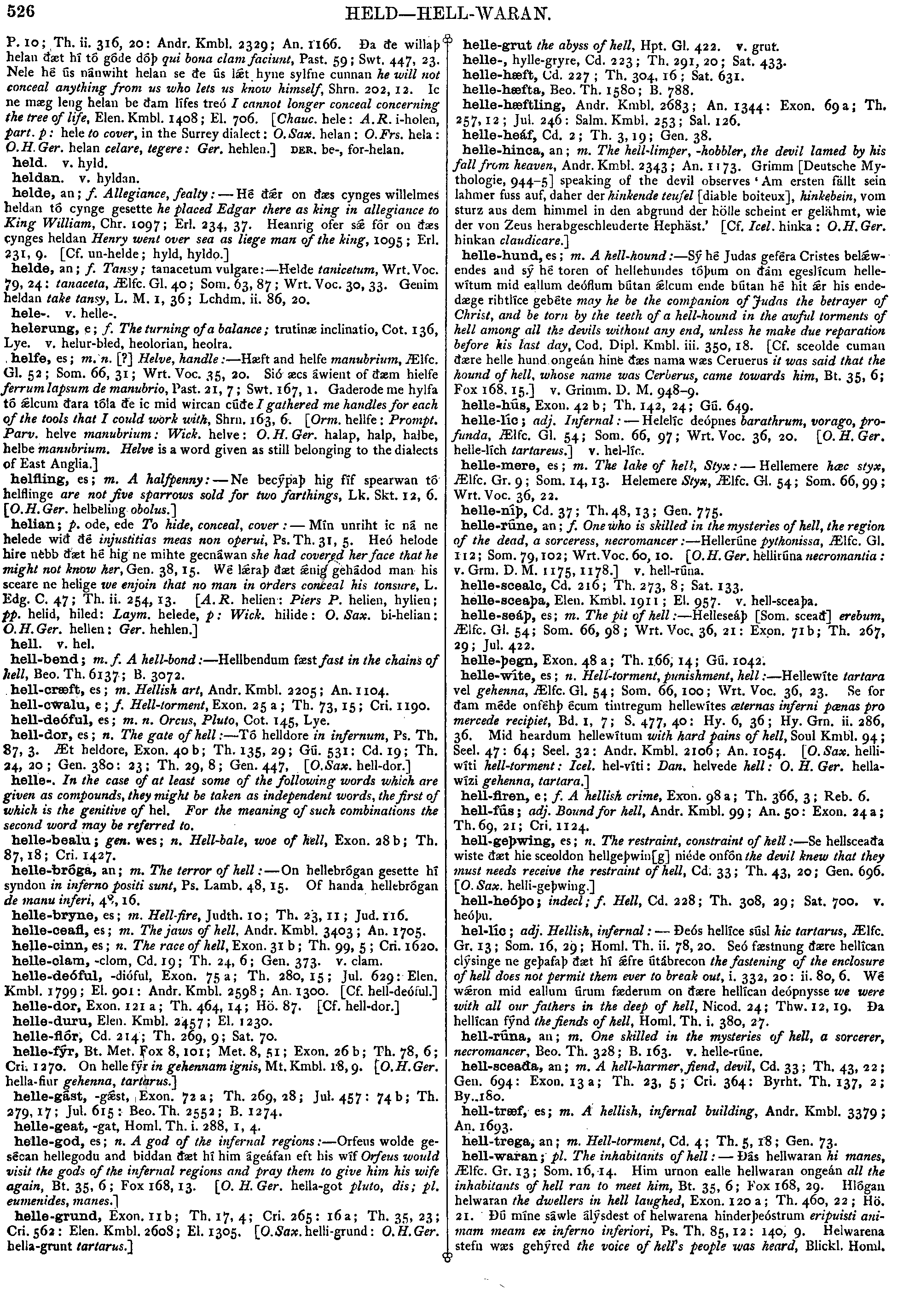
hel-líc;
adj.
Hellish,
infernal
:--
Ðeós
hellíce
súsl
hic
tartarus,
Ælfc.
Gr.
13;
Som.
16,
29;
Homl.
Th.
ii.
78,
20.
Seó
fæstnung
ðære
hellícan
clýsinge
ne
geþafaþ
ðæt
hí
fre
útábrecon
the
fastening
of
the
enclosure
of
hell
does
not
permit
them
ever
to
break
out,
i.
332,
20:
ii.
80,
6.
Wé
wron
mid
eallum
úrum
fæderum
on
ðære
hellícan
deópnysse
we
were
with
all
our
fathers
in
the
deep
of
hell,
Nicod.
24;
Thw.
12,
19.
Ða
hellícan
fýnd
the
fiends
of
hell,
Homl.
Th.
i.
380,
27.
|
Source: Bosworth/Toller, page b0586, entry 3 View original page image as: [TIFF] [PNG] [View previous entry] [View next entry] |
[Comment on this entry] [View comments] |
The following entry has been hand-corrected once. |
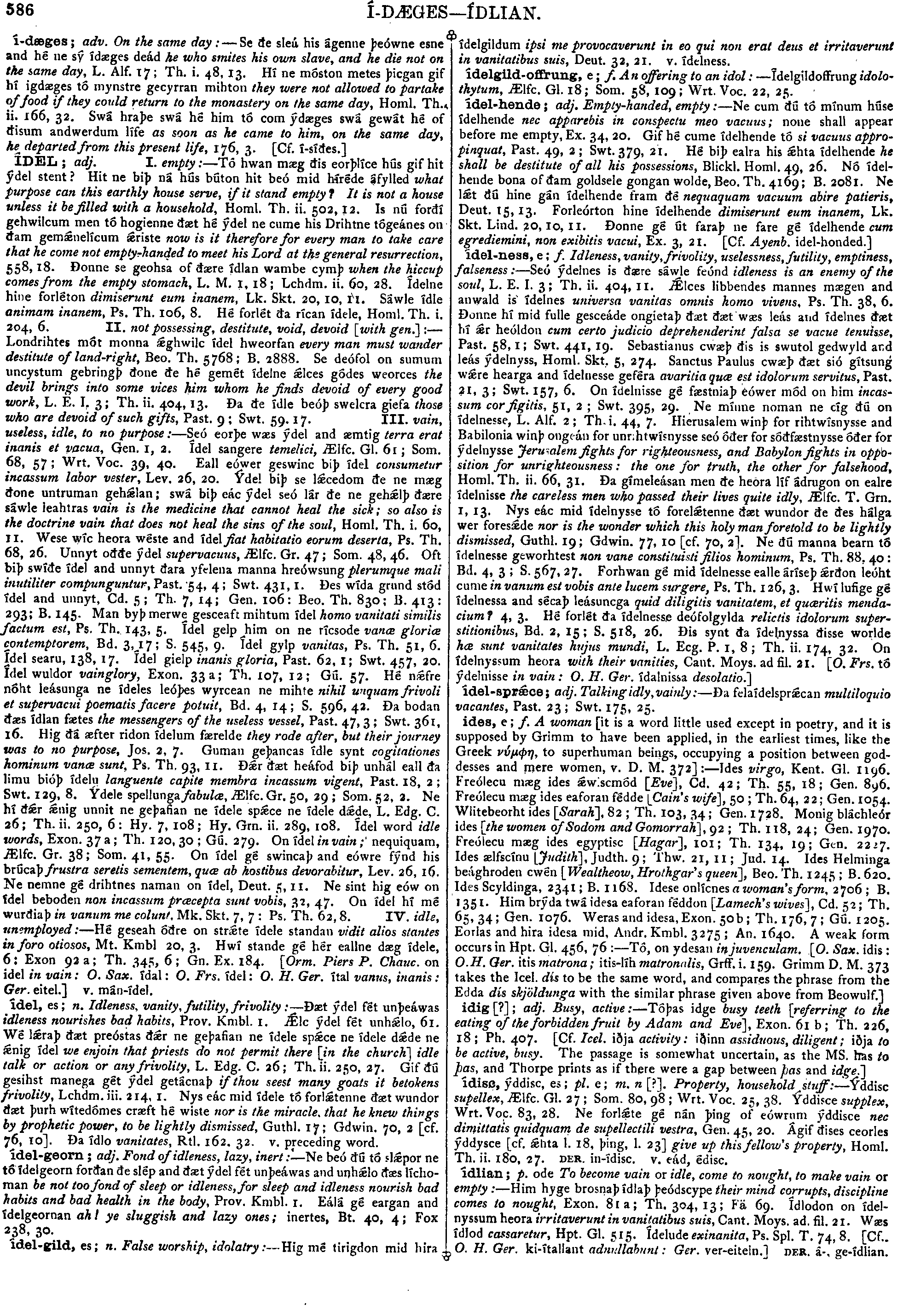
ídel,
es;
n.
Idleness,
vanity,
futility,
frivolity
:--
Ðæt
ýdel
fét
unþeáwas
idleness
nourishes
bad
habits,
Prov.
Kmbl.
1.
Æ-acute;lc
ýdel
fét
unhlo,
61.
Wé
lraþ
ðæt
preóstas
ðr
ne
geþafian
ne
ídele
spce
ne
ídele
dde
ne
nig
ídel
we
enjoin
that
priests
do
not
permit
there
[in
the
church]
idle
talk
or
action
or
any
frivolity,
L.
Edg.
C.
26;
Th.
ii.
250,
27.
Gif
ðú
gesihst
manega
gét
ýdel
getácnaþ
if
thou
seest
many
goats
it
betokens
frivolity,
Lchdm.
iii.
214,
1.
Nys
eác
mid
ídele
tó
forltenne
ðæt
wundor
ðæt
þurh
wítedómes
cræft
hé
wiste
nor
is
the
miracle,
that
he
knew
things
by
prophetic
power,
to
be
lightly
dismissed,
Guthl.
17;
Gdwin.
70,
2
[cf.
76,
10].
Ða
ídlo
vanitates,
Rtl.
162.
32.
v.
preceding
word.
|
Source: Bosworth/Toller, page b0613, entry 2 View original page image as: [TIFF] [PNG] [View previous entry] [View next entry] |
[Comment on this entry] [View comments] |
The following entry has been hand-corrected once. |
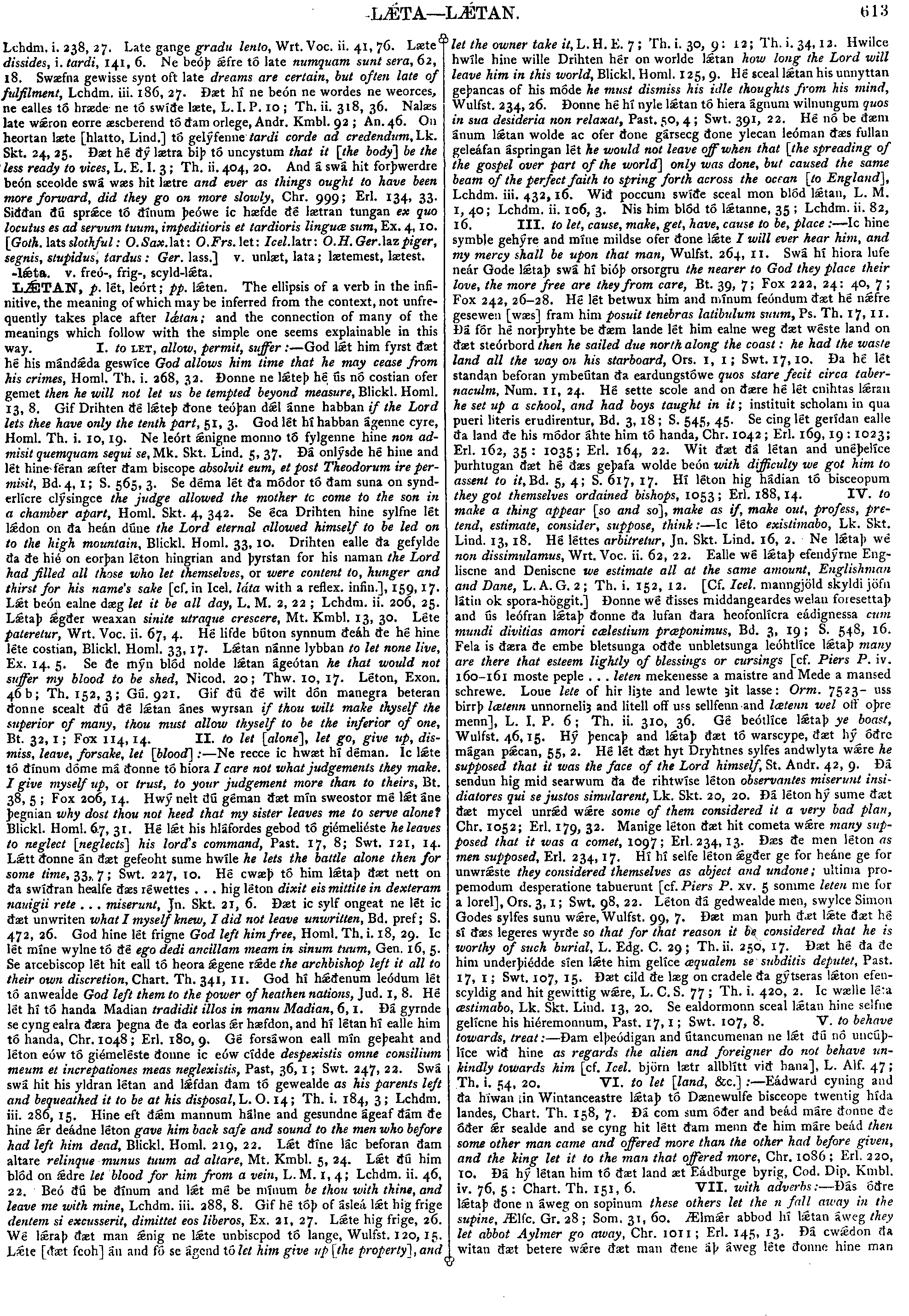
LÆ-acute;TAN,
p.
lét,
leórt;
pp.
lten.
The
ellipsis
of
a
verb
in
the
infinitive,
the
meaning
of
which
may
be
inferred
from
the
context,
not
unfrequently
takes
place
after
ltan;
and
the
connection
of
many
of
the
meanings
which
follow
with
the
simple
one
seems
explainable
in
this
way.
I.
to
LET,
allow,
permit,
suffer
:--
God
lt
him
fyrst
ðæt
hé
his
mándda
geswíce
God
allows
him
time
that
he
may
cease
from
his
crimes,
Homl.
Th.
i.
268,
32.
Ðonne
ne
lteþ
hé
ús
nó
costian
ofer
gemet
then
he
will
not
let
us
be
tempted
beyond
measure,
Blickl.
Homl.
13,
8.
Gif
Drihten
ðé
lteþ
ðone
teóþan
dl
ánne
habban
if
the
Lord
lets
thee
have
only
the
tenth
part,
51,
3.
God
lét
hí
habban
ágenne
cyre,
Homl.
Th.
i.
10,
19.
Ne
leórt
nigne
monno
tó
fylgenne
hine
non
admisit
quemquam
sequi
se,
Mk.
Skt.
Lind.
5,
37.
Ðá
onlýsde
hé
hine
and
lét
hine
féran
æfter
ðam
biscope
absolvit
eum,
et
post
Theodorum
ire
permisit,
Bd.
4,
1;
S.
565,
3.
Se
déma
lét
ða
módor
tó
ðam
suna
on
synderlícre
clýsingce
the
judge
allowed
the
mother
to
come
to
the
son
in
a
chamber
apart,
Homl.
Skt.
4,
342.
Se
éca
Drihten
hine
sylfne
lét
ldon
on
ða
heán
dúne
the
Lord
eternal
allowed
himself
to
be
led
on
to
the
high
mountain,
Blickl.
Homl.
33,
10.
Drihten
ealle
ða
gefylde
ða
ðe
hié
on
eorþan
léton
hingrian
and
þyrstan
for
his
naman
the
Lord
had
filled
all
those
who
let
themselves,
or
were
content
to,
hunger
and
thirst
for
his
name's
sake
[cf.
in
Icel.
láta
with
a
reflex.
infin.],
159,
17.
Lt
beón
ealne
dæg
let
it
be
all
day,
L.
M.
2,
22;
Lchdm.
ii.
206,
25.
Ltaþ
gðer
weaxan
sinite
utraque
crescere,
Mt.
Kmbl.
13,
30.
Léte
pateretur,
Wrt.
Voc.
ii.
67,
4.
Hé
lifde
búton
synnum
ðeáh
ðe
hé
hine
léte
costian,
Blickl.
Homl.
33,
17.
Ltan
nánne
lybban
to
let
none
live,
Ex.
14,
5.
Se
ðe
mýn
blód
nolde
ltan
ágeótan
he
that
would
not
suffer
my
blood
to
be
shed,
Nicod.
20;
Thw.
10,
17.
Léton,
Exon.
46
b;
Th.
152,
3;
Gú.
921.
Gif
ðú
ðé
wilt
dón
manegra
beteran
ðonne
scealt
ðú
ðé
ltan
ánes
wyrsan
if
thou
wilt
make
thyself
the
superior
of
many,
thou
must
allow
thyself
to
be
the
inferior
of
one,
Bt.
32,
1;
Fox
114,
14.
II.
to
let
[alone],
let
go,
give
up,
dismiss,
leave,
forsake,
let
[blood]
:--
Ne
recce
ic
hwæt
hí
déman.
Ic
lte
tó
ðínum
dóme
má
ðonne
tó
hiora
I
care
not
what
judgements
they
make.
I
give
myself
up,
or
trust,
to
your
judgement
more
than
to
theirs,
Bt.
38,
5;
Fox
206,
14.
Hwý
nelt
ðú
géman
ðæt
mín
sweostor
mé
lt
áne
þegnian
why
dost
thou
not
heed
that
my
sister
leaves
me
to
serve
alone?
Blickl.
Homl.
67,
31.
Hé
lt
his
hláfordes
gebod
tó
giémeliéste
he
leaves
to
neglect
[neglects]
his
lord's
command,
Past.
17,
8;
Swt.
121,
14.
Ltt
ðonne
án
ðæt
gefeoht
sume
hwíle
he
lets
the
battle
alone
then
for
some
time,
33,
7;
Swt.
227,
10.
Hé
cwæþ
tó
him
ltaþ
ðæt
nett
on
ða
swíðran
healfe
ðæs
réwettes
...
hig
léton
dixit
eis
mittite
in
dexteram
nauigii
rete
...
miserunt,
Jn.
Skt.
21,
6.
Ðæt
ic
sylf
ongeat
ne
lét
ic
ðæt
unwriten
what
I
myself
knew,
I
did
not
leave
unwritten,
Bd.
pref;
S.
472,
26.
God
hine
lét
frigne
God
left
him
free,
Homl.
Th.
i.
18,
29.
Ic
lét
míne
wylne
tó
ðé
ego
dedi
ancillam
meam
in
sinum
tuum,
Gen.
16,
5.
Se
arcebiscop
lét
hit
eall
tó
heora
gene
rde
the
archbishop
left
it
all
to
their
own
discretion,
Chart.
Th.
341,
11.
God
hí
hðenum
leódum
lét
tó
anwealde
God
left
them
to
the
power
of
heathen
nations,
Jud.
1,
8.
Hé
lét
hí
tó
handa
Madian
tradidit
illos
in
manu
Madian,
6,
1.
Ðá
gyrnde
se
cyng
ealra
ðæra
þegna
ðe
ða
eorlas
r
hæfdon,
and
hí
létan
hí
ealle
him
tó
handa,
Chr.
1048;
Erl.
180,
9.
Gé
forsáwon
eall
mín
geþeaht
and
léton
eów
tó
giémeléste
ðonne
ic
eów
cídde
despexistis
omne
consilium
meum
et
increpationes
meas
neglexistis,
Past,
36,
1;
Swt.
247,
22.
Swá
swá
hit
his
yldran
létan
and
lfdan
ðam
tó
gewealde
as
his
parents
left
and
bequeathed
it
to
be
at
his
disposal,
L.
O.
14;
Th.
i.
184,
3;
Lchdm.
iii.
286,
15.
Hine
eft
ðm
mannum
hálne
and
gesundne
ágeaf
ðám
ðe
hine
r
deádne
léton
gave
him
back
safe
and
sound
to
the
men
who
before
had
left
him
dead,
Blickl.
Homl.
219,
22.
Lt
ðíne
lác
beforan
ðam
altare
relinque
munus
tuum
ad
altare,
Mt.
Kmbl.
5,
24.
Lt
ðú
him
blód
on
dre
let
blood
for
him
from
a
vein,
L.
M.
1,
4;
Lchdm.
ii.
46,
22.
Beó
ðú
be
ðínum
and
lt
mé
be
mínum
be
thou
with
thine,
and
leave
me
with
mine,
Lchdm.
iii.
288,
8.
Gif
hé
tóþ
of
ásleá
lt
hig
frige
dentem
si
excusserit,
dimittet
eos
liberos,
Ex.
21,
27.
Lte
hig
frige,
26.
Wé
lraþ
ðæt
man
nig
ne
lte
unbiscpod
tó
lange,
Wulfst.
120,
15.
Lte
[ðæt
feoh]
án
and
fó
se
ágend
tó
let
him
give
up
[the
property],
and
let
the
owner
take
it,
L.
H.
E.
7;
Th.
i.
30,
9:
12;
Th.
i.
34,
12.
Hwilce
hwíle
hine
wille
Drihten
hér
on
worlde
ltan
how
long
the
Lord
will
leave
him
in
this
world,
Blickl.
Homl.
125,
9.
Hé
sceal
ltan
his
unnyttan
geþancas
of
his
móde
he
must
dismiss
his
idle
thoughts
from
his
mind,
Wulfst.
234,
26.
Ðonne
hé
hí
nyle
ltan
tó
hiera
ágnum
wilnungum
quos
in
sua
desideria
non
relaxat,
Past.
50,
4;
Swt.
391,
22.
Hé
nó
be
ðæm
ánum
ltan
wolde
ac
ofer
ðone
gársecg
ðone
ylecan
leóman
ðæs
fullan
geleáfan
áspringan
lét
he
would
not
leave
off
when
that
[the
spreading
of
the
gospel
over
part
of
the
world]
only
was
done,
but
caused
the
same
beam
of
the
perfect
faith
to
spring
forth
across
the
ocean
[to
England],
Lchdm.
iii.
432,
16.
Wið
poccum
swíðe
sceal
mon
blód
ltan,
L.
M.
1,
40;
Lchdm.
ii.
106,
3.
Nis
him
blód
tó
ltanne,
35;
Lchdm.
ii.
82,
16.
III.
to
let,
cause,
make,
get,
have,
cause
to
be,
place
:--
Ic
hine
symble
gehýre
and
míne
mildse
ofer
ðone
lte
I
will
ever
hear
him,
and
my
mercy
shall
be
upon
that
man,
Wulfst.
264,
11.
Swá
hí
hiora
lufe
neár
Gode
ltaþ
swá
hí
bióþ
orsorgru
the
nearer
to
God
they
place
their
love,
the
more
free
are
they
from
care,
Bt.
39,
7;
Fox
222,
24:
40,
7;
Fox
242,
26-28.
Hé
lét
betwux
him
and
mínum
feóndum
ðæt
hé
nfre
gesewen
[wæs]
fram
him
posuit
tenebras
latibulum
suum,
Ps.
Th.
17,
11.
Ðá
fór
hé
norþryhte
be
ðæm
lande
lét
him
ealne
weg
ðæt
wéste
land
on
ðæt
steórbord
then
he
sailed
due
north
along
the
coast:
he
had
the
waste
land
all
the
way
on
his
starboard,
Ors.
1,
1;
Swt.
17,
10.
Ða
hé
lét
standan
beforan
ymbeútan
ða
eardungstówe
quos
stare
fecit
circa
tabernaculm,
Num.
11,
24.
Hé
sette
scole
and
on
ðære
hé
lét
cnihtas
lran
he
set
up
a
school,
and
had
boys
taught
in
it;
instituit
scholam
in
qua
pueri
literis
erudirentur,
Bd.
3,
18;
S.
545,
45.
Se
cing
lét
gerídan
ealle
ða
land
ðe
his
módor
áhte
him
tó
handa,
Chr.
1042;
Erl.
169,
19:
1023;
Erl.
162,
35:
1035;
Erl.
164,
22.
Wit
ðæt
ðá
létan
and
unéþelíce
þurhtugan
ðæt
hé
ðæs
geþafa
wolde
beón
with
difficulty
we
got
him
to
assent
to
it,
Bd.
5,
4;
S.
617,
17.
Hí
léton
hig
hádian
tó
bisceopum
they
got
themselves
ordained
bishops,
1053;
Erl.
188,
14.
IV.
to
make
a
thing
appear
[so
and
so],
make
as
if,
make
out,
profess,
pretend,
estimate,
consider,
suppose,
think
:--
Ic
léto
existimabo,
Lk.
Skt.
Lind.
13,
18.
Hé
léttes
arbitretur,
Jn.
Skt.
Lind.
16,
2.
Ne
ltaþ
wé
non
dissimulamus,
Wrt.
Voc.
ii.
62,
22.
Ealle
wé
ltaþ
efendýrne
Engliscne
and
Deniscne
we
estimate
all
at
the
same
amount,
Englishman
and
Dane,
L.
A.
G.
2;
Th.
i.
152,
12.
[Cf.
Icel.
manngjöld
skyldi
jöfn
látin
ok
spora-höggit.]
Ðonne
wé
ðisses
middangeardes
welan
foresettaþ
and
ús
leófran
ltaþ
ðonne
ða
lufan
ðara
heofonlícra
eádignessa
cum
mundi
divitias
amori
cælestium
præponimus,
Bd.
3,
19;
S.
548,
16.
Fela
is
ðæra
ðe
embe
bletsunga
oððe
unbletsunga
leóhtlíce
ltaþ
many
are
there
that
esteem
lightly
of
blessings
or
cursings
[cf.
Piers
P.
iv.
160-161
moste
peple
...
leten
mekenesse
a
maistre
and
Mede
a
mansed
schrewe.
Loue
lete
of
hir
li te
and
lewte
it
lasse:
Orm.
7523-
uss
birrþ
lætenn
unnorneli
and
litell
off
uss
sellfenn
and
lætenn
wel
off
oþre
menn],
L.
I.
P.
6;
Th.
ii.
310,
36.
Gé
beótlíce
lætaþ
ye
boast,
Wulfst.
46,
15.
Hý
þencaþ
and
ltaþ
ðæt
tó
warscype,
ðæt
hý
óðre
mágan
pcan,
55,
2.
Hé
lét
ðæt
hyt
Dryhtnes
sylfes
andwlyta
wre
he
supposed
that
it
was
the
face
of
the
Lord
himself,
St.
Andr.
42,
9.
Ðá
sendun
hig
mid
searwum
ða
ðe
rihtwíse
léton
observantes
miserunt
insidiatores
qui
se
justos
simularent,
Lk.
Skt.
20,
20.
Ðá
léton
hý
sume
ðæt
ðæt
mycel
unrd
wre
some
of
them
considered
it
a
very
bad
plan,
Chr.
1052;
Erl.
179,
32.
Manige
léton
ðæt
hit
cometa
wre
many
supposed
that
it
was
a
comet,
1097;
Er1.234,
13.
Ðæs
ðe
men
léton
as
men
supposed,
Erl.
234,
17.
Hí
hí
selfe
léton
gðer
ge
for
heáne
ge
for
unwrste
they
considered
themselves
as
abject
and
undone;
ultima
propemodum
desperatione
tabuerunt
[cf.
Piers
P.
xv.
5
somme
leten
me
for
a
lorel],
Ors.
3,
1;
Swt.
98,
22.
Léton
ðá
gedwealde
men,
swylce
Simon
Godes
sylfes
sunu
wre.
Wulfst.
99,
7.
Ðæt
man
þurh
ðæt
lte
ðæt
hé
sí
ðæs
legeres
wyrðe
so
that
for
that
reason
it
be
considered
that
he
is
worthy
of
such
burial,
L.
Edg.
C.
29;
Th.
ii.
250,
17.
Ðæt
hé
ða
ðe
him
underþiédde
síen
lte
him
gelíce
æqualem
se
subditis
deputet,
Past.
17,
1;
Swt.
107,
15.
Ðæt
cild
ðe
læg
on
cradele
ða
gýtseras
lton
efenscyldig
and
hit
gewittig
wre,
L.
C.
S.
77;
Th.
i.
420,
2.
Ic
wælle
léta
æstimabo,
Lk.
Skt.
Lind.
13,
20.
Se
ealdormonn
sceal
ltan
hine
selfne
gelícne
his
hiéremonnum,
Past.
17,
1;
Swt.
107,
8.
V.
to
behave
towards,
treat
:--
Ðam
elþeódigan
and
útancumenan
ne
lt
ðú
nó
uncúþlíce
wið
hine
as
regards
the
alien
and
foreigner
do
not
behave
unkindly
towards
him
[cf.
Icel.
björn
lætr
allblítt
við
hana],
L.
Alf.
47;
Th.
i.
54,
20.
VI.
to
let
[land,
&c.]
:--
Eádward
cyning
and
ða
híwan
in
Wintanceastre
ltaþ
tó
Dænewulfe
bisceope
twentig
hída
landes,
Chart.
Th.
158,
7.
Ðá
com
sum
óðer
and
beád
máre
ðonne
ðe
óðer
r
sealde
and
se
cyng
hit
létt
ðam
menn
ðe
him
máre
beád
then
some
other
man
came
and
offered
more
than
the
other
had
before
given,
and
the
king
let
it
to
the
man
that
offered
more,
Chr.
1086;
Erl.
220,
10.
Ðá
hý
létan
him
tó
ðæt
land
æt
Eádburge
byrig,
Cod.
Dip.
Kmbl.
iv.
76,
5:
Chart.
Th.
151,
6.
VII.
with
adverbs
:--
Ðás
óðre
ltaþ
ðone
n
áweg
on
sopinum
these
others
let
the
n
fall
away
in
the
supine,
Ælfc.
Gr.
28;
Som.
31,
60.
Ælmr
abbod
hí
ltan
áweg
they
let
abbot
Aylmer
go
away,
Chr.
1011;
Erl.
145,
13.
Ðá
cwdon
ða
witan
ðæt
betere
wre
ðæt
man
ðene
áþ
áweg
léte
ðonne
hine
man
sealde
...
Ðá
lét
hé
ðone
áþ
áweg
then
the
witan
said
that
it
would
be
better
that
the
oath
should
be
dispensed
with
than
that
it
should
be
taken
...
Then
he
omitted
the
oath,
Chart.
Th.
289,
24-30.
Æt
ealre
ðære
hergunge
and
æt
eallum
ðám
hearmum
ðe
r
ðam
gedón
wre
r
ðæt
friþ
geset
wre
man
eall
onweig
lte
and
nán
man
ðæt
ne
wræce
ne
bóte
ne
bidde
as
regards
all
the
harrying
and
all
the
injuries
that
were
done
before
the
peace
was
made,
let
it
all
be
dismissed,
and
let
no
man
avenge
it
or
ask
for
compensation,
L.
Eth.
ii.
6;
Th.
i.
288,
3.
Petrus
cnucode
óþ
ðæt
hí
hine
inn
léton
Peter
knocked
until
they
let
him
in,
Homl.
Th.
i.
382,
23.
Hé
lt
him
eáþelíce
ymbe
ðæt
he
takes
it
easily,
Wulfst.
298,
30:
Homl.
Skt.
4,
342.
[Goth.
létan:
O.
Sax.
látan:
O.
Fries.
léta:
Icel.
láta:
O.
H.
Ger.
lázan.]
DER.
á-,
for-,
ge-,
of-,
on-,
tó-
ltan.
te
and
lewte
it
lasse:
Orm.
7523-
uss
birrþ
lætenn
unnorneli
and
litell
off
uss
sellfenn
and
lætenn
wel
off
oþre
menn],
L.
I.
P.
6;
Th.
ii.
310,
36.
Gé
beótlíce
lætaþ
ye
boast,
Wulfst.
46,
15.
Hý
þencaþ
and
ltaþ
ðæt
tó
warscype,
ðæt
hý
óðre
mágan
pcan,
55,
2.
Hé
lét
ðæt
hyt
Dryhtnes
sylfes
andwlyta
wre
he
supposed
that
it
was
the
face
of
the
Lord
himself,
St.
Andr.
42,
9.
Ðá
sendun
hig
mid
searwum
ða
ðe
rihtwíse
léton
observantes
miserunt
insidiatores
qui
se
justos
simularent,
Lk.
Skt.
20,
20.
Ðá
léton
hý
sume
ðæt
ðæt
mycel
unrd
wre
some
of
them
considered
it
a
very
bad
plan,
Chr.
1052;
Erl.
179,
32.
Manige
léton
ðæt
hit
cometa
wre
many
supposed
that
it
was
a
comet,
1097;
Er1.234,
13.
Ðæs
ðe
men
léton
as
men
supposed,
Erl.
234,
17.
Hí
hí
selfe
léton
gðer
ge
for
heáne
ge
for
unwrste
they
considered
themselves
as
abject
and
undone;
ultima
propemodum
desperatione
tabuerunt
[cf.
Piers
P.
xv.
5
somme
leten
me
for
a
lorel],
Ors.
3,
1;
Swt.
98,
22.
Léton
ðá
gedwealde
men,
swylce
Simon
Godes
sylfes
sunu
wre.
Wulfst.
99,
7.
Ðæt
man
þurh
ðæt
lte
ðæt
hé
sí
ðæs
legeres
wyrðe
so
that
for
that
reason
it
be
considered
that
he
is
worthy
of
such
burial,
L.
Edg.
C.
29;
Th.
ii.
250,
17.
Ðæt
hé
ða
ðe
him
underþiédde
síen
lte
him
gelíce
æqualem
se
subditis
deputet,
Past.
17,
1;
Swt.
107,
15.
Ðæt
cild
ðe
læg
on
cradele
ða
gýtseras
lton
efenscyldig
and
hit
gewittig
wre,
L.
C.
S.
77;
Th.
i.
420,
2.
Ic
wælle
léta
æstimabo,
Lk.
Skt.
Lind.
13,
20.
Se
ealdormonn
sceal
ltan
hine
selfne
gelícne
his
hiéremonnum,
Past.
17,
1;
Swt.
107,
8.
V.
to
behave
towards,
treat
:--
Ðam
elþeódigan
and
útancumenan
ne
lt
ðú
nó
uncúþlíce
wið
hine
as
regards
the
alien
and
foreigner
do
not
behave
unkindly
towards
him
[cf.
Icel.
björn
lætr
allblítt
við
hana],
L.
Alf.
47;
Th.
i.
54,
20.
VI.
to
let
[land,
&c.]
:--
Eádward
cyning
and
ða
híwan
in
Wintanceastre
ltaþ
tó
Dænewulfe
bisceope
twentig
hída
landes,
Chart.
Th.
158,
7.
Ðá
com
sum
óðer
and
beád
máre
ðonne
ðe
óðer
r
sealde
and
se
cyng
hit
létt
ðam
menn
ðe
him
máre
beád
then
some
other
man
came
and
offered
more
than
the
other
had
before
given,
and
the
king
let
it
to
the
man
that
offered
more,
Chr.
1086;
Erl.
220,
10.
Ðá
hý
létan
him
tó
ðæt
land
æt
Eádburge
byrig,
Cod.
Dip.
Kmbl.
iv.
76,
5:
Chart.
Th.
151,
6.
VII.
with
adverbs
:--
Ðás
óðre
ltaþ
ðone
n
áweg
on
sopinum
these
others
let
the
n
fall
away
in
the
supine,
Ælfc.
Gr.
28;
Som.
31,
60.
Ælmr
abbod
hí
ltan
áweg
they
let
abbot
Aylmer
go
away,
Chr.
1011;
Erl.
145,
13.
Ðá
cwdon
ða
witan
ðæt
betere
wre
ðæt
man
ðene
áþ
áweg
léte
ðonne
hine
man
sealde
...
Ðá
lét
hé
ðone
áþ
áweg
then
the
witan
said
that
it
would
be
better
that
the
oath
should
be
dispensed
with
than
that
it
should
be
taken
...
Then
he
omitted
the
oath,
Chart.
Th.
289,
24-30.
Æt
ealre
ðære
hergunge
and
æt
eallum
ðám
hearmum
ðe
r
ðam
gedón
wre
r
ðæt
friþ
geset
wre
man
eall
onweig
lte
and
nán
man
ðæt
ne
wræce
ne
bóte
ne
bidde
as
regards
all
the
harrying
and
all
the
injuries
that
were
done
before
the
peace
was
made,
let
it
all
be
dismissed,
and
let
no
man
avenge
it
or
ask
for
compensation,
L.
Eth.
ii.
6;
Th.
i.
288,
3.
Petrus
cnucode
óþ
ðæt
hí
hine
inn
léton
Peter
knocked
until
they
let
him
in,
Homl.
Th.
i.
382,
23.
Hé
lt
him
eáþelíce
ymbe
ðæt
he
takes
it
easily,
Wulfst.
298,
30:
Homl.
Skt.
4,
342.
[Goth.
létan:
O.
Sax.
látan:
O.
Fries.
léta:
Icel.
láta:
O.
H.
Ger.
lázan.]
DER.
á-,
for-,
ge-,
of-,
on-,
tó-
ltan.
| Result Page: |  |
Previous | 1 2 3 4 5 | Next |  |
Germanic Lexicon Project (main page)
This search system was written by
Sean Crist
Please consider
volunteering
to correct the data in these online dictionaries.
No rights reserved. Feel free to use these data in any way you please.