|
|

|
Source: Cleasby/Vigfusson, page b0137, entry 2 View original page image as: [TIFF] [PNG] [View previous entry] [View next entry] |
[Comment on this entry] [View comments (3)] |
The following entry has been hand-corrected once. |
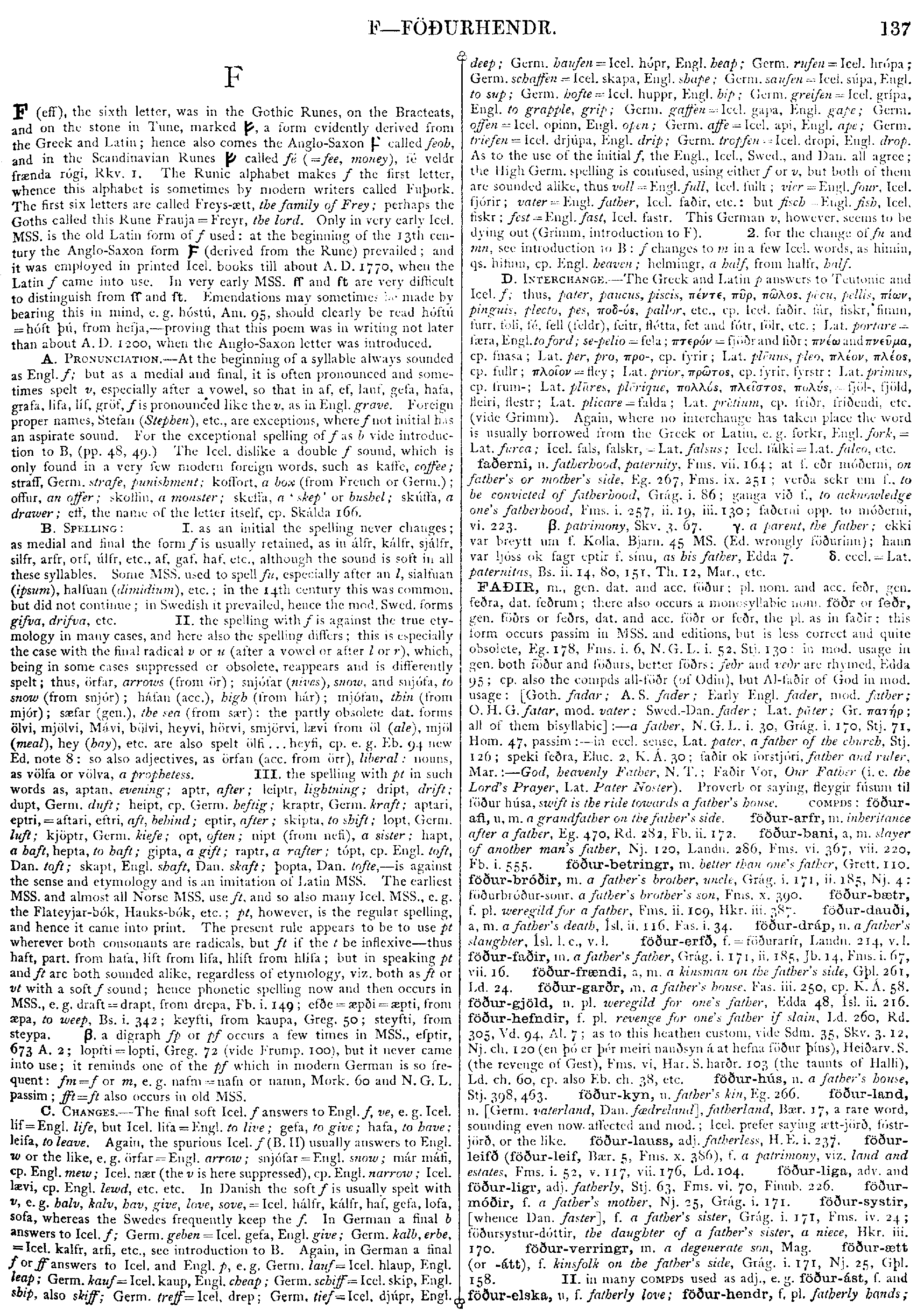
F
(eff),
the
sixth
letter,
was
in
the
Gothic
Runes,
on
the
Bracteats,
and
on
the
stone
in
Tune,
marked
RUNE,
a
form
evidently
derived
from
the
Greek
and
Latin;
hence
also
comes
the
Anglo-Saxon
RUNE
called
feoh,
and
in
the
Scandinavian
Runes
RUNE
called
fé
(=fee,
money),
fé
veldr
frænda
rógi,
Rkv.
I.
The
Runic
alphabet
makes
f
the
first
letter,
whence
this
alphabet
is
sometimes
by
modern
writers
called
Fuþork.
The
first
six
letters
are
called
Freys-ætt,
the
family
of
Frey;
perhaps
the
Goths
called
this
Rune
Frauja
=
Freyr,
the
lord.
Only
in
very
early
Icel.
MSS.
is
the
old
Latin
form
of
f
used:
at
the
beginning
of
the
13th
century
the
Anglo-Saxon
form
RUNE
(derived
from
the
Rune)
prevailed;
and
it
was
employed
in
printed
Icel.
books
till
about
A.
D.
1770,
when
the
Latin
f
came
into
use.
In
very
early
MSS.
ff
and
ft
are
very
difficult
to
distinguish
from
ff
and
ft.
Emendations
may
sometimes
be
made
by
bearing
this
in
mind,
e.
g.
hóstú,
Am.
95,
should
clearly
be
read
hóftú
=
hóft
þú,
from
hefja,
--
proving
that
this
poem
was
in
writing
not
later
than
about
A.
D.
1200,
when
the
Anglo-Saxon
letter
was
introduced.
A.
PRONUNCIATION.
--
At
the
beginning
of
a
syllable
always
sounded
as
Engl.
f;
but
as
a
medial
and
final,
it
is
often
pronounced
and
sometimes
spelt
v,
especially
after
a
vowel,
so
that
in
af,
ef,
lauf,
gefa,
hafa,
grafa,
lifa,
líf,
gröf,
f
is
pronounced
like
the
v,
as
in
Engl.
grave.
Foreign
proper
names,
Stefan
(Stephen),
etc.,
are
exceptions,
where
f
not
initial
has
an
aspirate
sound.
For
the
exceptional
spelling
of
f
as
b
vide
introduction
to
B,
(pp.
48,
49.)
The
Icel.
dislike
a
double
f
sound,
which
is
only
found
in
a
verv
few
modern
foreign
words,
such
as
kaffe,
coffee;
straff,
Germ,
strafe,
punishment;
koffort,
a
box
(from
French
or
Germ.);
offur,
an
offer;
skoffin,
a
monster;
skeffa,
a
'skep'
or
bushel;
skúffa,
a
drawer;
eff,
the
name
of
the
letter
itself,
cp.
Skálda
166.
B.
SPELLING:
I.
as
an
initial
the
spelling
never
changes;
as
medial
and
final
the
form
f
is
usually
retained,
as
in
álfr,
kálfr,
sjálfr,
silfr,
arfr,
orf,
úlfr,
etc.,
af,
gaf,
haf,
etc.,
although
the
sound
is
soft
in
all
these
syllables.
Some
MSS.
used
to
spell
fu,
especially
after
an
l,
sialfuan
(ipsum),
halfuan
(dimidium),
etc.;
in
the
14th
century
this
was
common,
but
did
not
continue;
in
Swedish
it
prevailed,
hence
the
mod.
Swed.
forms
gifva,
drifva,
etc.
II.
the
spelling
with
f
is
against
the
true
etymology
in
many
cases,
and
here
also
the
spelling
differs;
this
is
especially
the
case
with
the
final
radical
v
or
u
(after
a
vowel
or
after
l
or
r),
which,
being
in
some
cases
suppressed
or
obsolete,
reappears
and
is
differently
spelt;
thus,
örfar,
arrows
(from
ör);
snjófar
(nives),
snow,
and
snjófa,
to
snow
(from
snjór);
háfan
(acc.),
high
(from
hár);
mjófan,
thin
(from
mjór);
sæfar
(gen.),
the
sea
(from
sær):
the
partly
obsolete
dat.
forms
ölvi,
mjölvi,
Mávi,
bölvi,
heyvi,
hörvi,
smjörvi,
lævi
from
öl
(ale),
mjöl
(meal),
hey
(hay),
etc.
are
also
spelt
ölfi
...
heyfi,
cp.
e.
g.
Eb.
94
new
Ed.
note
8:
so
also
adjectives,
as
örfan
(acc.
from
örr),
liberal:
nouns,
as
völfa
or
völva,
a
prophetess.
III.
the
spelling
with
pt
in
such
words
as,
aptan,
evening;
aptr,
after;
leiptr,
lightning;
dript,
drift;
dupt,
Germ.
duft;
heipt,
cp.
Germ.
heftig;
kraptr,
Germ.
kraft;;
aptari,
eptri,
=
aftari,
eftri,
aft,
behind;
eptir,
after;
skipta,
to
shift;
lopt,
Germ.
luft;
kjöptr,
Germ.
UNCERTAIN;
opt,
often;
nipt
(from
nefi),
a
sister;
hapt,
a
haft,
hepta,
to
haft;
gipta,
a
gift;
raptr,
a
rafter;
tópt,
cp.
Engl.
toft,
Dan.
toft;
skapt,
Engl.
shaft,
Dan.
skaft;
þopta,
Dan.
tofte,
--
is
against
the
sense
and
etymology
and
is
an
imitation
of
Latin
MSS.
The
earliest
MSS.
and
almost
all
Norse
MSS.
use
ft,
and
so
also
many
Icel.
MSS.,
e.
g.
the
Flateyjar-bók,
Hauks-bók,
etc.;
pt,
however,
is
the
regular
spelling,
and
hence
it
came
into
print.
The
present
rule
appears
to
be
to
use
pt
wherever
both
consonants
are
radicals,
but
ft
if
the
t
be
inflexive
--
thus
haft,
part.
from
hafa,
líft
from
lifa,
hlíft
from
hlífa;
but
in
speaking
pt
and
ft
are
both
sounded
alike,
regardless
of
etymology,
viz.
both
as
ft
or
vt
with
a
soft
f
sound;
hence
phonetic
spelling
now
and
then
occurs
in
MSS.,
e.
g.
draft
--
drapt,
from
drepa,
Fb.
i.
149;
efðe
=
æpði
=
æpti,
from
æpa,
to
weep,
Bs.
i.
342;
keyfti,
from
kaupa,
Greg.
50;
steyfti,
from
steypa.
 .
a
digraph
fp
or
pf
occurs
a
few
times
in
MSS.,
efptir,
673
A.
2;
lopfti
=
lopti,
Greg.
72
(vide
Frump.
100),
but
it
never
came
into
use;
it
reminds
one
of
the
pf
which
in
modern
German
is
so
frequent:
fm
--
f
or
m,
e.
g.
nafm
--
nafn
or
namn,
Mork.
60
and
N.
G.
L.
passim;
fft=ft
also
occurs
in
old
MSS.
C.
CHANGES.
--
The
final
soft
Icel.
f
answers
to
Engl.
f,
ve,
e.
g.
Icel.
líf
=
Engl.
life,
but
Icel.
lifa
=
Engl.
to
live;
gefa,
to
give;
hafa,
to
have;
leifa,
to
leave.
Again,
the
spurious
Icel.
f
(B.
II)
usually
answers
to
Engl.
w
or
the
like,
e.
g.
örfar
=
Engl.
arrow;
snjófar
=
Engl.
snow;
már
náfi,
cp.
Engl.
mew;
Icel.
nær
(the
v
is
here
suppressed),
cp.
Engl.
narrow;
Icel.
lævi,
cp.
Engl.
lewd,
etc.
etc.
In
Danish
the
soft
f
is
usually
spelt
with
v,
e.
g.
halv,
kalv,
hav,
give,
love,
sove,
--
Icel.
hálfr,
kálfr,
haf,
gefa,
lofa,
sofa,
whereas
the
Swedes
frequently
keep
the
f.
In
German
a
final
b
answers
to
Icel.
f;
Germ.
geben
=
Icel.
gefa,
Engl.
give;
Germ.
kalb,
erbe,
=
Icel.
kalfr,
arfi,
etc.,
see
introduction
to
B.
Again,
in
German
a
final
f
or
ff
answers
to
Icel.
and
Engl.
p,
e.
g.
Germ.
lauf
=Icel.
hlaup,
Engl.
leap;
Germ.
kauf
=
Icel.
kaup,
Engl.
cheap;
Germ.
schiff
=
Icel.
skip,
Engl.
ship,
also
skiff;
Germ.
treff
=
Icel.
drep;
Germ.
tief
=
Icel.
djúpr,
Engl.
deep;
Germ.
haufen
=
Icel.
hópr,
Engl.
heap;
Germ.
rufen
=
Icel.hrópa;
Germ.
schaffen
=
Icel.
skapa,
Engl.
shape;
Germ.
saufen
=
Icel.
súpa,
Engl.
to
sup;
Germ.
UNCERTAIN
=
Icel.
huppr,
Engl.
hip;
Germ.
greifen
=
Icel.
grípa,
Engl.
to
grapple,
grip;
Germ.
gaffen
=
Icel.
gapa,
Engl.
gape;
Germ.
offen
=
Icel.
opinn,
Engl.
open;
Germ.
affe
=
Icel.
api,
Engl.
ape;
Germ.
triefen
=
Icel.
drjúpa,
Engl.
drip;
Germ.
tropfen
=
Icel.
dropi,
Engl.
drop.
As
to
the
use
of
the
initial
f,
the
Engl.,
Icel.,
Swed.,
and
Dan.
all
agree;
the
High
Germ.
spelling
is
confused,
using
either
f
or
v,
but
both
of
them
are
sounded
alike,
thus
voll
=
Engl.
full,
Icel.
fullr;
vier
=
Engl.
four,
Icel.
fjórir;
vater
=
Engl.
father,
Icel.
faðir,
etc.:
but
fisch
=
Engl.
fish,
Icel.
fiskr;
fest
=
Engl.
fast,
Icel.
fastr.
This
German
v,
however,
seems
to
be
dying
out
(Grimm,
introduction
to
F).
2.
for
the
change
of
fn
and
mn,
see
introduction
to
B:
f
changes
to
m
in
a
few
Icel.
words,
as
himin,
qs.
hiffin,
cp.
Engl.
heaven;
helmingr,
a
half,
from
halfr,
half.
D.
INTERCHANGE.
--
The
Greek
and
Latin
p
answers
to
Teutonic
and
Icel.
f;
thus,
pater,
paucus,
piscis,
GREEK,
GREEK,
GREEK,
pecu,
pellis,
GREEK,
pinguis,
plecto,
pes,
GREEK,
pallor,
etc.,
cp.
Icel.
faðir,
fár,
fiskr,
fimm,
furr,
foli,
fé,
fell
(feldr),
feitr,
flétta,
fet
and
fótr,
fólr,
etc.;
Lat.
portare
=
færa,
Engl.
to
ford;
se-pelio
=
fela;
GREEK
=
fjóðr
and
fiðr;
GREEK
and
GREEK,
cp.
fnasa;
Lat.
per,
pro,
GREEK
cp.
fyrir;
Lat.
pl
.
a
digraph
fp
or
pf
occurs
a
few
times
in
MSS.,
efptir,
673
A.
2;
lopfti
=
lopti,
Greg.
72
(vide
Frump.
100),
but
it
never
came
into
use;
it
reminds
one
of
the
pf
which
in
modern
German
is
so
frequent:
fm
--
f
or
m,
e.
g.
nafm
--
nafn
or
namn,
Mork.
60
and
N.
G.
L.
passim;
fft=ft
also
occurs
in
old
MSS.
C.
CHANGES.
--
The
final
soft
Icel.
f
answers
to
Engl.
f,
ve,
e.
g.
Icel.
líf
=
Engl.
life,
but
Icel.
lifa
=
Engl.
to
live;
gefa,
to
give;
hafa,
to
have;
leifa,
to
leave.
Again,
the
spurious
Icel.
f
(B.
II)
usually
answers
to
Engl.
w
or
the
like,
e.
g.
örfar
=
Engl.
arrow;
snjófar
=
Engl.
snow;
már
náfi,
cp.
Engl.
mew;
Icel.
nær
(the
v
is
here
suppressed),
cp.
Engl.
narrow;
Icel.
lævi,
cp.
Engl.
lewd,
etc.
etc.
In
Danish
the
soft
f
is
usually
spelt
with
v,
e.
g.
halv,
kalv,
hav,
give,
love,
sove,
--
Icel.
hálfr,
kálfr,
haf,
gefa,
lofa,
sofa,
whereas
the
Swedes
frequently
keep
the
f.
In
German
a
final
b
answers
to
Icel.
f;
Germ.
geben
=
Icel.
gefa,
Engl.
give;
Germ.
kalb,
erbe,
=
Icel.
kalfr,
arfi,
etc.,
see
introduction
to
B.
Again,
in
German
a
final
f
or
ff
answers
to
Icel.
and
Engl.
p,
e.
g.
Germ.
lauf
=Icel.
hlaup,
Engl.
leap;
Germ.
kauf
=
Icel.
kaup,
Engl.
cheap;
Germ.
schiff
=
Icel.
skip,
Engl.
ship,
also
skiff;
Germ.
treff
=
Icel.
drep;
Germ.
tief
=
Icel.
djúpr,
Engl.
deep;
Germ.
haufen
=
Icel.
hópr,
Engl.
heap;
Germ.
rufen
=
Icel.hrópa;
Germ.
schaffen
=
Icel.
skapa,
Engl.
shape;
Germ.
saufen
=
Icel.
súpa,
Engl.
to
sup;
Germ.
UNCERTAIN
=
Icel.
huppr,
Engl.
hip;
Germ.
greifen
=
Icel.
grípa,
Engl.
to
grapple,
grip;
Germ.
gaffen
=
Icel.
gapa,
Engl.
gape;
Germ.
offen
=
Icel.
opinn,
Engl.
open;
Germ.
affe
=
Icel.
api,
Engl.
ape;
Germ.
triefen
=
Icel.
drjúpa,
Engl.
drip;
Germ.
tropfen
=
Icel.
dropi,
Engl.
drop.
As
to
the
use
of
the
initial
f,
the
Engl.,
Icel.,
Swed.,
and
Dan.
all
agree;
the
High
Germ.
spelling
is
confused,
using
either
f
or
v,
but
both
of
them
are
sounded
alike,
thus
voll
=
Engl.
full,
Icel.
fullr;
vier
=
Engl.
four,
Icel.
fjórir;
vater
=
Engl.
father,
Icel.
faðir,
etc.:
but
fisch
=
Engl.
fish,
Icel.
fiskr;
fest
=
Engl.
fast,
Icel.
fastr.
This
German
v,
however,
seems
to
be
dying
out
(Grimm,
introduction
to
F).
2.
for
the
change
of
fn
and
mn,
see
introduction
to
B:
f
changes
to
m
in
a
few
Icel.
words,
as
himin,
qs.
hiffin,
cp.
Engl.
heaven;
helmingr,
a
half,
from
halfr,
half.
D.
INTERCHANGE.
--
The
Greek
and
Latin
p
answers
to
Teutonic
and
Icel.
f;
thus,
pater,
paucus,
piscis,
GREEK,
GREEK,
GREEK,
pecu,
pellis,
GREEK,
pinguis,
plecto,
pes,
GREEK,
pallor,
etc.,
cp.
Icel.
faðir,
fár,
fiskr,
fimm,
furr,
foli,
fé,
fell
(feldr),
feitr,
flétta,
fet
and
fótr,
fólr,
etc.;
Lat.
portare
=
færa,
Engl.
to
ford;
se-pelio
=
fela;
GREEK
=
fjóðr
and
fiðr;
GREEK
and
GREEK,
cp.
fnasa;
Lat.
per,
pro,
GREEK
cp.
fyrir;
Lat.
pl nus,
pleo,
GREEK,
GREEK,
cp.
fullr;
GREEK
=
fley;
Lat.
prior,
GREEK,
cp.
fyrir,
fyrstr:
Lat.
primus,
cp.
frum-;
Lat.
pl
nus,
pleo,
GREEK,
GREEK,
cp.
fullr;
GREEK
=
fley;
Lat.
prior,
GREEK,
cp.
fyrir,
fyrstr:
Lat.
primus,
cp.
frum-;
Lat.
pl res,
plrique,
GREEK,
GREEK,
GREEK
=
fjöl-,
fjöd,
fleiri,
flestr;
Lat.
plicare
=
falda;
Lat.
prtium,
cp.
friðr,
fríðendi,
etc.
(vide
Grimm).
Again,
where
no
interchange
has
taken
place
the
word
is
usually
borrowed
from
the
Greek
or
Latin,
e.
g.
forkr,
Engl.
fork
=
Lat.
furca;
Icel.
fals,
falskr
=
Lat.
falsus;
Icel.
fálki
=
Lat.
falco,
etc.
faðerni,
n.
fatherhood,
paternity,
Fms.
vii.
164;
at
f.
eðr
móðerni,
on
father's
or
mother's
side,
Eg.
267,
Fms.
ix.
251;
verða
sekr
um
f.,
to
be
convicted
of
fatherhood,
Grág.
i.
86;
ganga
við
f.,
to
acknowledge
one's
fatherhood,
Fms.
i.
257,
ii.
19,
iii.
130;
faðerni
opp.
to
móðerni,
vi.
223.
.
patrimony,
Skv.
3.
67.
res,
plrique,
GREEK,
GREEK,
GREEK
=
fjöl-,
fjöd,
fleiri,
flestr;
Lat.
plicare
=
falda;
Lat.
prtium,
cp.
friðr,
fríðendi,
etc.
(vide
Grimm).
Again,
where
no
interchange
has
taken
place
the
word
is
usually
borrowed
from
the
Greek
or
Latin,
e.
g.
forkr,
Engl.
fork
=
Lat.
furca;
Icel.
fals,
falskr
=
Lat.
falsus;
Icel.
fálki
=
Lat.
falco,
etc.
faðerni,
n.
fatherhood,
paternity,
Fms.
vii.
164;
at
f.
eðr
móðerni,
on
father's
or
mother's
side,
Eg.
267,
Fms.
ix.
251;
verða
sekr
um
f.,
to
be
convicted
of
fatherhood,
Grág.
i.
86;
ganga
við
f.,
to
acknowledge
one's
fatherhood,
Fms.
i.
257,
ii.
19,
iii.
130;
faðerni
opp.
to
móðerni,
vi.
223.
.
patrimony,
Skv.
3.
67.
 .
a
parent,
the
father;
ekki
var
breytt
um
f.
Kolla,
Bjarn.
45
MS.
(Ed.
wrongly
föðurinn);
hann
var
ljóss
ok
fagr
eptir
f.
sínu,
as
his
father,
Edda
7.
.
a
parent,
the
father;
ekki
var
breytt
um
f.
Kolla,
Bjarn.
45
MS.
(Ed.
wrongly
föðurinn);
hann
var
ljóss
ok
fagr
eptir
f.
sínu,
as
his
father,
Edda
7.
 .
eccl.
=
Lat.
paternitas,
Bs.
ii.
14,
80,
151,
Th.
12,
Mar.,
etc.
FAÐIR,
m.,
gen.
dat.
and
acc.
föður:
pl.
nom.
and
acc.
feðr,
gen.
feðra,
dat.
feðrum;
there
also
occurs
a
monosyllabic
nom.
föðr
or
feðr,
gen.
föðrs
or
feðrs,
dat.
and
acc.
föðr
or
feðr,
the
pl.
as
in
faðir;
this
form
occurs
passim
in
MSS.
and
editions,
but
is
less
correct
and
quite
obsolete,
Eg.
178,
Fms.
i.
6,
N.
G.
L.
i.
52,
Stj.
130:
in
mod.
usage
in
gen.
both
föður
and
föðurs,
better
föðrs:
feðr
nd
veðr
are
rhymed,
Edda
95;
cp.
also
the
compds
all-föðr
(of
Odin),
but
Al-faðir
of
God
in
mod.
usage:
[Goth,
fadar;
A.
S.
fader;
Early
Engl.
fader,
mod.
father;
O.
H.
G.
fatar,
mod.
vater;
Swed.-Dan.
fader;
Lat.
p
.
eccl.
=
Lat.
paternitas,
Bs.
ii.
14,
80,
151,
Th.
12,
Mar.,
etc.
FAÐIR,
m.,
gen.
dat.
and
acc.
föður:
pl.
nom.
and
acc.
feðr,
gen.
feðra,
dat.
feðrum;
there
also
occurs
a
monosyllabic
nom.
föðr
or
feðr,
gen.
föðrs
or
feðrs,
dat.
and
acc.
föðr
or
feðr,
the
pl.
as
in
faðir;
this
form
occurs
passim
in
MSS.
and
editions,
but
is
less
correct
and
quite
obsolete,
Eg.
178,
Fms.
i.
6,
N.
G.
L.
i.
52,
Stj.
130:
in
mod.
usage
in
gen.
both
föður
and
föðurs,
better
föðrs:
feðr
nd
veðr
are
rhymed,
Edda
95;
cp.
also
the
compds
all-föðr
(of
Odin),
but
Al-faðir
of
God
in
mod.
usage:
[Goth,
fadar;
A.
S.
fader;
Early
Engl.
fader,
mod.
father;
O.
H.
G.
fatar,
mod.
vater;
Swed.-Dan.
fader;
Lat.
p ter;
Gr.
GREEK
all
of
them
bisyllabic]
:--
a
father,
N.
G.
L.
i.
30,
Grág.
i.
170,
Stj.
71,
Hom.
47,
passim
:--
in
eccl.
sense,
Lat.
pater,
a
father
of
the
church,
Stj.
126;
speki
feðra,
Eluc.
2,
K.
Á.
30;
faðir
ok
forstjóri,
father
and
ruler,
Mar.
:--
God,
heavenly
Father,
N.
T.;
Foðir
Vor,
Our
Father
(i.
e.
the
Lord's
Prayer,
Lat.
Pater
Noster).
Proverb
or
saying,
fleygir
fúsum
til
föður
húsa,
swift
is
the
ride
towards
a
father's
house.
COMPDS:
föður-afi,
u,
m.
a
grandfather
on
the
father's
side.
föður-arfr,
m.
inheritance
after
a
father,
Eg.
470,
Rd.
282,
Fb.
ii.
172.
föður-bani,
a,
m.
slayer
of
another
man's
father,
Nj.
120,
Landn.
286,
Fms.
vi.
367,
vii.
220,
Fb.
i.
555.
Föður-betringr,
m.
better
than
one's
father,
Grett.
110.
föður-bróðir,
m.
a
father's
brother,
uncle,
Grág;.
i.
171,
ii.
185,
Nj.
4:
föðurbróður-sonr,
a
father's
brother's
son,
Fms.
x.
390.
föður-bætr,
f.
pl.
weregild
for
a
father,
Fms.
ii.
109,
Hkr.
iii.
387.
föður-dauði,
a,
m.
a
father's
death,
Ísl.
ii.
116,
Fas.
i.
34.
föður-dráp,
n.
a
father's
slaughter,
Ísl.
l.
c.,
v.
l.
föður-erfð,
f.
=
föðurarfr,
Landn.
214,
v.
l.
föður-faðir,
m.
a
father's
father,
Grág.
i.
171,
ii.
185,
Jb.
14,
Fms.
i.
67,
vii.
16.
föður-frændi,
a,
m.
a
kinsman
on
the
father's
side,
Gþl.
261,
Ld.
24.
föður-garðr,
m.
a
father's
house,
Fas.
iii.
250,
cp.
K.
Á.
58.
föður-gjöld,
n.
pl.
weregild
for
one's
father,
Edda
48,
Ísl.
ii.
216.
föður-hefndir,
f.
pl.
revenge
for
one's
father
if
slain,
Ld.
260,
Rd.
305,
Vd.
94,
Al.
7;
as
to
this
heathen
custom,
vide
Sdm.
35,
Skv.
3.
12,
Nj.
ch.
120
(en
þó
er
þér
meiri
nauðsyná
at
hefna
föður
þíns),
Heiðarv.
S.
(the
revenge
of
Gest),
Fms.
vi,
Har.
S.
harðr.
103
(the
taunts
of
Halli),
Ld.
ch.
60,
cp.
also
Eb.
ch.
38,
etc.
föður-hús,
n.
a
father's
house,
Stj.
398,
463.
föður-kyn,
n.
father's
kin,
Eg.
266.
föður-land,
n.
[Germ.
vaterland,
Dan.
fædreland],
fatherland,
Bær.
17,
a
rare
word,
sounding
even
now
affected
and
mod.;
Icel.
prefer
saying
ætt-jörð,
fóstr-jörð,
or
the
like.
föður-lauss,
adj.
fatherless,
H.
E.
i.
237.
föður-leifð
(föður-leif,
Bær.
5,
Fms.
x.
386),
f.
a
patrimony,
viz.
land
and
estates,
Fms.
i.
52,
v.
117,
vii.
176,
Ld.
104.
föður-liga,
adv.
and
föður-ligr,
adj.
fatherly,
Stj.
63,
Fms.
vi.
70,
Finnb.
226.
föður-móðir,
f.
a
father's
mother,
Nj.
25,
Grág.
i.
171.
föður-systir,
[whence
Dan.
faster],
f.
a
father's
sister,
Grág.
i.
171,
Fms.
iv.
24;
füðursystur-dóttir,
the
daughter
of
a
father's
sister,
a
niece,
Hkr.
iii.
170.
föður-verringr,
m.
a
degenerate
son,
Mag.
föður-ætt
(or
-átt),
f.
kinsfolk
on
the
father's
side,
Grág.
i.
171,
Nj.
25,
Gþl.
158.
II.
in
many
COMPDS
used
as
adj.,
e.
g.
föður-ást,
f.
and
föður-elska,
u,
f.
fatherly
love;
föður-hendr,
f,
pl.
fatherly
ter;
Gr.
GREEK
all
of
them
bisyllabic]
:--
a
father,
N.
G.
L.
i.
30,
Grág.
i.
170,
Stj.
71,
Hom.
47,
passim
:--
in
eccl.
sense,
Lat.
pater,
a
father
of
the
church,
Stj.
126;
speki
feðra,
Eluc.
2,
K.
Á.
30;
faðir
ok
forstjóri,
father
and
ruler,
Mar.
:--
God,
heavenly
Father,
N.
T.;
Foðir
Vor,
Our
Father
(i.
e.
the
Lord's
Prayer,
Lat.
Pater
Noster).
Proverb
or
saying,
fleygir
fúsum
til
föður
húsa,
swift
is
the
ride
towards
a
father's
house.
COMPDS:
föður-afi,
u,
m.
a
grandfather
on
the
father's
side.
föður-arfr,
m.
inheritance
after
a
father,
Eg.
470,
Rd.
282,
Fb.
ii.
172.
föður-bani,
a,
m.
slayer
of
another
man's
father,
Nj.
120,
Landn.
286,
Fms.
vi.
367,
vii.
220,
Fb.
i.
555.
Föður-betringr,
m.
better
than
one's
father,
Grett.
110.
föður-bróðir,
m.
a
father's
brother,
uncle,
Grág;.
i.
171,
ii.
185,
Nj.
4:
föðurbróður-sonr,
a
father's
brother's
son,
Fms.
x.
390.
föður-bætr,
f.
pl.
weregild
for
a
father,
Fms.
ii.
109,
Hkr.
iii.
387.
föður-dauði,
a,
m.
a
father's
death,
Ísl.
ii.
116,
Fas.
i.
34.
föður-dráp,
n.
a
father's
slaughter,
Ísl.
l.
c.,
v.
l.
föður-erfð,
f.
=
föðurarfr,
Landn.
214,
v.
l.
föður-faðir,
m.
a
father's
father,
Grág.
i.
171,
ii.
185,
Jb.
14,
Fms.
i.
67,
vii.
16.
föður-frændi,
a,
m.
a
kinsman
on
the
father's
side,
Gþl.
261,
Ld.
24.
föður-garðr,
m.
a
father's
house,
Fas.
iii.
250,
cp.
K.
Á.
58.
föður-gjöld,
n.
pl.
weregild
for
one's
father,
Edda
48,
Ísl.
ii.
216.
föður-hefndir,
f.
pl.
revenge
for
one's
father
if
slain,
Ld.
260,
Rd.
305,
Vd.
94,
Al.
7;
as
to
this
heathen
custom,
vide
Sdm.
35,
Skv.
3.
12,
Nj.
ch.
120
(en
þó
er
þér
meiri
nauðsyná
at
hefna
föður
þíns),
Heiðarv.
S.
(the
revenge
of
Gest),
Fms.
vi,
Har.
S.
harðr.
103
(the
taunts
of
Halli),
Ld.
ch.
60,
cp.
also
Eb.
ch.
38,
etc.
föður-hús,
n.
a
father's
house,
Stj.
398,
463.
föður-kyn,
n.
father's
kin,
Eg.
266.
föður-land,
n.
[Germ.
vaterland,
Dan.
fædreland],
fatherland,
Bær.
17,
a
rare
word,
sounding
even
now
affected
and
mod.;
Icel.
prefer
saying
ætt-jörð,
fóstr-jörð,
or
the
like.
föður-lauss,
adj.
fatherless,
H.
E.
i.
237.
föður-leifð
(föður-leif,
Bær.
5,
Fms.
x.
386),
f.
a
patrimony,
viz.
land
and
estates,
Fms.
i.
52,
v.
117,
vii.
176,
Ld.
104.
föður-liga,
adv.
and
föður-ligr,
adj.
fatherly,
Stj.
63,
Fms.
vi.
70,
Finnb.
226.
föður-móðir,
f.
a
father's
mother,
Nj.
25,
Grág.
i.
171.
föður-systir,
[whence
Dan.
faster],
f.
a
father's
sister,
Grág.
i.
171,
Fms.
iv.
24;
füðursystur-dóttir,
the
daughter
of
a
father's
sister,
a
niece,
Hkr.
iii.
170.
föður-verringr,
m.
a
degenerate
son,
Mag.
föður-ætt
(or
-átt),
f.
kinsfolk
on
the
father's
side,
Grág.
i.
171,
Nj.
25,
Gþl.
158.
II.
in
many
COMPDS
used
as
adj.,
e.
g.
föður-ást,
f.
and
föður-elska,
u,
f.
fatherly
love;
föður-hendr,
f,
pl.
fatherly
|
Source: Cleasby/Vigfusson, page b0143, entry 2 View original page image as: [TIFF] [PNG] [View previous entry] [View next entry] |
[Comment on this entry] [View comments] |
The following entry has been hand-corrected once. |
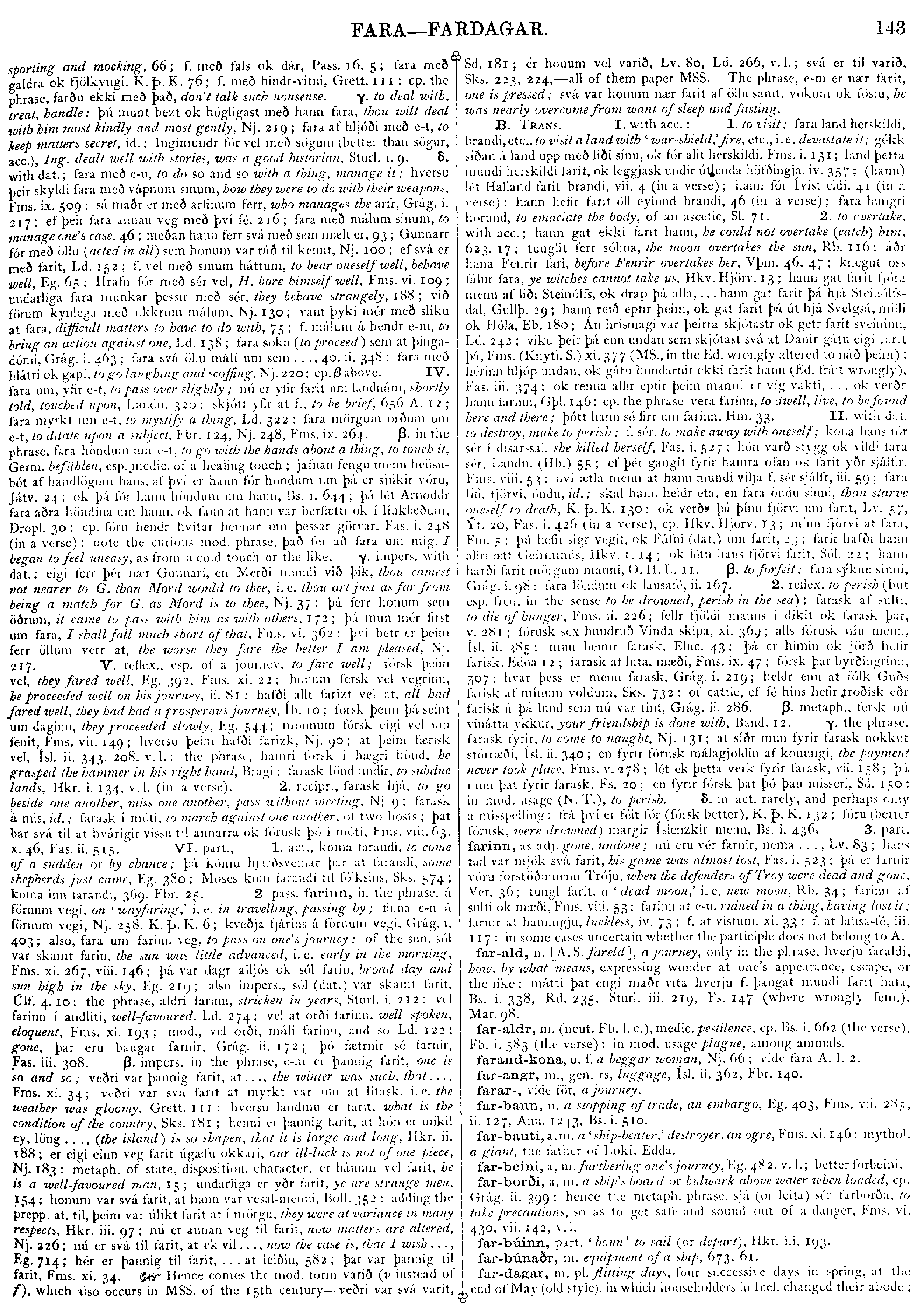
B.
TRANS.
I.
with
acc.:
1.
to
visit;
fara
land
herskildi,
brandi,
etc.,
to
visit
a
land
with
'war-shield,'
fire,
etc.,
i.e.
devastate
it;
gékk
siðan
á
land
upp
með
liði
sínu,
ok
fór
allt
herskildi,
Fms.
i.
131;
land
þetta
mundi
herskildi
farit,
ok
leggjask
undir
útlenda
höfðingja,
iv.
357;
(hann)
lét
Halland
farit
brandi,
vii.
4
(in
a
verse);
hann
fór
lvist
eldi,
41
(in
a
verse);
hann
hefir
farit
öll
eylönd
brandi,
46
(in
a
verse);
fara
hungri
hörund,
to
emaciate
the
body,
of
an
ascetic,
Sl.
71.
2.
to
overtake,
with
acc.;
hann
gat
ekki
farit
hann,
he
could
not
overtake
(catch)
him,
623.
17;
tunglit
ferr
sólina,
the
moon
overtakes
the
sun,
Rb.
116;
áðr
hana
Fenrir
fari,
before
Fenrir
overtakes
her,
Vþm.
46,
47;
knegut
oss
fálur
fara,
ye
witches
cannot
take
us,
Hkv.
Hjörv.
13;
hann
gat
farit
fjóra
menn
af
liði
Steinólfs,
ok
drap
þá
alla,
...
hann
gat
farit
þá
hjá
Steinólfsdal,
Gullþ.
29;
hann
reið
eptir
þeim,
ok
gat
farit
þá
út
hjá
Svelgsá,
milli
ok
Hóla,
Eb.
180;
Án
hrísmagi
var
þeirra
skjótastr
ok
getr
farit
sveininn,
Ld.
242;
viku
þeir
þá
enn
undan
sem
skjótast
svá
at
Danir
gátu
eigi
farit
þá,
Fms.
(Knytl.
S.)
xi.
377
(MS.,
in
the
Ed.
wrongly
altered
to
náð
þeim);
hérinn
hljóp
undan,
ok
gátu
hundarnir
ekki
farit
hann
(Ed.
fráit
wrongly),
Fas.
iii.
374;
ok
renna
allir
eptir
þeim
manni
er
víg
vakti,
...
ok
verðr
hann
farinn,
Gþl.
146:
cp.
the
phrase,
vera
farinn,
to
dwell,
live,
to
be
found
here
and
there;
þótt
hann
sé
firr
um
farinn,
Hm.
33.
II.
with
dat.
to
destroy,
make
to
perish;
f.
sér,
to
make
away
with
oneself;
kona
hans
fór
sér
í
dísar-sal,
she
killed
herself,
Fas.
i.
527;
hón
varð
stygg
ok
vildi
fara
sér,
Landn.
(Hb.)
55;
ef
þér
gangit
fyrir
hamra
ofan
ok
farit
yðr
sjálfir,
Fms.
viii.
53;
hví
ætla
menn
at
hann
mundi
vilja
f.
sér
sjálfr,
iii.
59;
fara
lífi,
fjörvi,
öndu,
id.;
skal
hann
heldr
eta,
en
fara
öndu
sinni,
than
starve
oneself
to
death,
K.
Þ.
K.
130;
ok
verðr
þá
þínu
fjörvi
um
farit,
Lv.
57,
Ýt.
20,
Fas.
i.
426
(in
a
verse),
cp.
Hkv.
Hjörv.
13;
mínu
fjörvi
at
fara,
Fm.
5;
þú
hefir
sigr
vegit,
ok
Fáfni
(dat.)
um
farit,
23;
farit
hafði
hann
allri
ætt
Geirmímis,
Hkv.
1.
14;
ok
létu
hans
fjörvi
farit,
Sól.
22;
hann
hafði
farit
mörgum
manni,
O.
H.
L.
11.
.
to
forfeit;
fara
sýknu
sinni,
Grág.
i.
98;
fara
löndum
ok
lausafé,
ii.
167.
2.
reflex.
to
perish
(but
esp.
freq.
in
the
sense
to
be
drowned,
perish
in
the
sea);
farask
af
sulti,
to
die
of
hunger,
Fms.
ii.
226;
fellr
fjöldi
manns
í
díkit
ok
farask
þar,
v.
281;
fórusk
sex
hundruð
Vinda
skipa,
xi.
369;
alls
fórusk
níu
menn,
Ísl.
ii.
385;
mun
heimr
farask,
Eluc.
43;
þá
er
himin
ok
jörð
hefir
farisk,
Edda
12;
farask
af
hita,
mæði,
Fms.
ix.
47;
fórsk
þar
byrðingrinn,
307;
hvar
þess
er
menn
farask,
Grág.
i.
219;
heldr
enn
at
fólk
Guðs
farisk
af
mínum
völdum,
Sks.
732:
of
cattle,
ef
fé
hins
hefir
troðisk
eðr
farisk
á
þá
lund
sem
nú
var
tínt,
Grág.
ii.
286.
.
metaph.,
fersk
nú
vinátta
ykkur,
your
friendship
is
done
with,
Band.
12.
.
the
phrase,
farask
fyrir,
to
come
to
naught,
Nj.
131;
at
síðr
mun
fyrir
farask
nokkut
stórræði,
Ísl.
ii.
340;
en
fyrir
fórusk
málagjöldin
af
konungi,
the
payment
never
took
place,
Fms.
v.
278;
lét
ek
þetta
verk
fyrir
farask,
vii.
158;
þá
mun
þat
fyrir
farask,
Fs.
20;
en
fyrir
fórsk
þat
þó
þau
misseri,
Sd.
150:
in
mod.
usage
(N.
T.),
to
perish.
.
in
act.
rarely,
and
perhaps
only
a
misspelling:
frá
því
er
féit
fór
(fórsk
better),
K.
Þ.
K.
132;
fóru
(better
fórusk,
were
drowned)
margir
Íslenzkir
menn,
Bs.
i.
436.
3.
part.
farinn,
as
adj.
gone,
undone;
nú
eru
vér
farnir,
nema
...,
Lv.
83;
hans
tafl
var
mjök
svá
farit,
his
game
was
almost
lost,
Fas.
i.
523;
þá
er
farnir
vóru
forstöðumenn
Tróju,
when
the
defenders
of
Troy
were
dead
and
gone,
Ver.
36;
tungl
farit,
a
'dead
moon,'
i.e.
new
moon,
Rb.
34;
farinn
af
sulti
ok
mæði,
Fms.
viii.
53;
farinn
at
e-u,
ruined
in
a
thing,
having
lost
it;
farnir
at
hamingju,
luckless,
iv.
73;
f.
at
vistum,
xi.
33;
f.
at
lausa-fé;.
iii.
117:
in
some
cases
uncertain
whether
the
participle
does
not
belong
to
A.
|
Source: Cleasby/Vigfusson, page b0144, entry 50 View original page image as: [TIFF] [PNG] [View previous entry] [View next entry] |
[Comment on this entry] [View comments] |
The following entry has been hand-corrected once. |
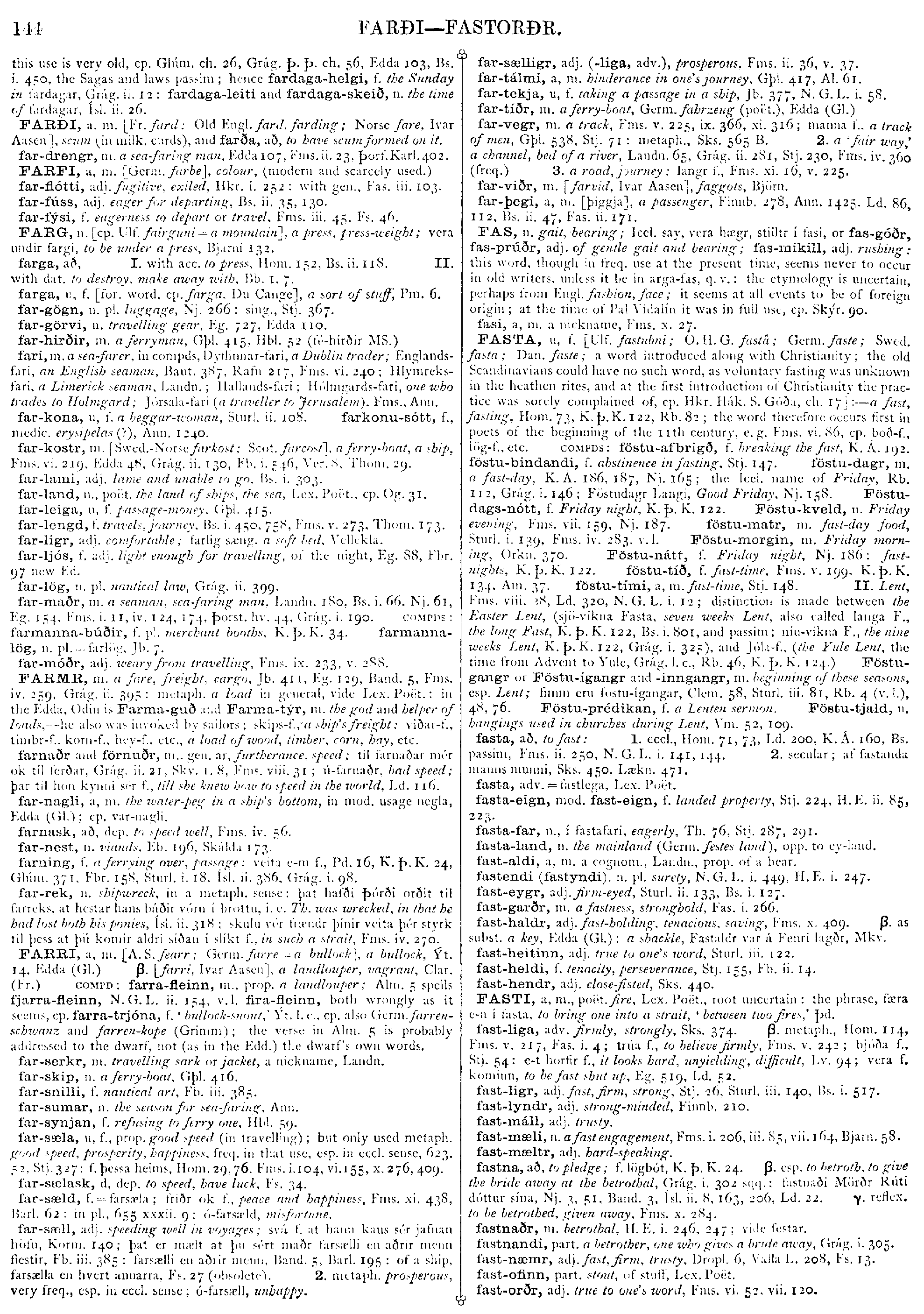
FAS, n. gait, bearing; Icel. say, vera hægr, stilltr í fasi, or fas-góðr, fas-prúðr, adj. of gentle gait and bearing; fas-mikill, adj. rushing: this word, though in freq. use at the present time, seems never to occur in old writers, unless it be in arga-fas, q.v.: the etymology is uncertain, perhaps from Engl. fashion, face; it seems at all events to be of foreign origin; at the time of Pal Vídalín it was in full use, cp. Skýr. 90.
|
Source: Cleasby/Vigfusson, page b0149, entry 17 View original page image as: [TIFF] [PNG] [View previous entry] [View next entry] |
[Comment on this entry] [View comments] |
The following entry has been hand-corrected once. |
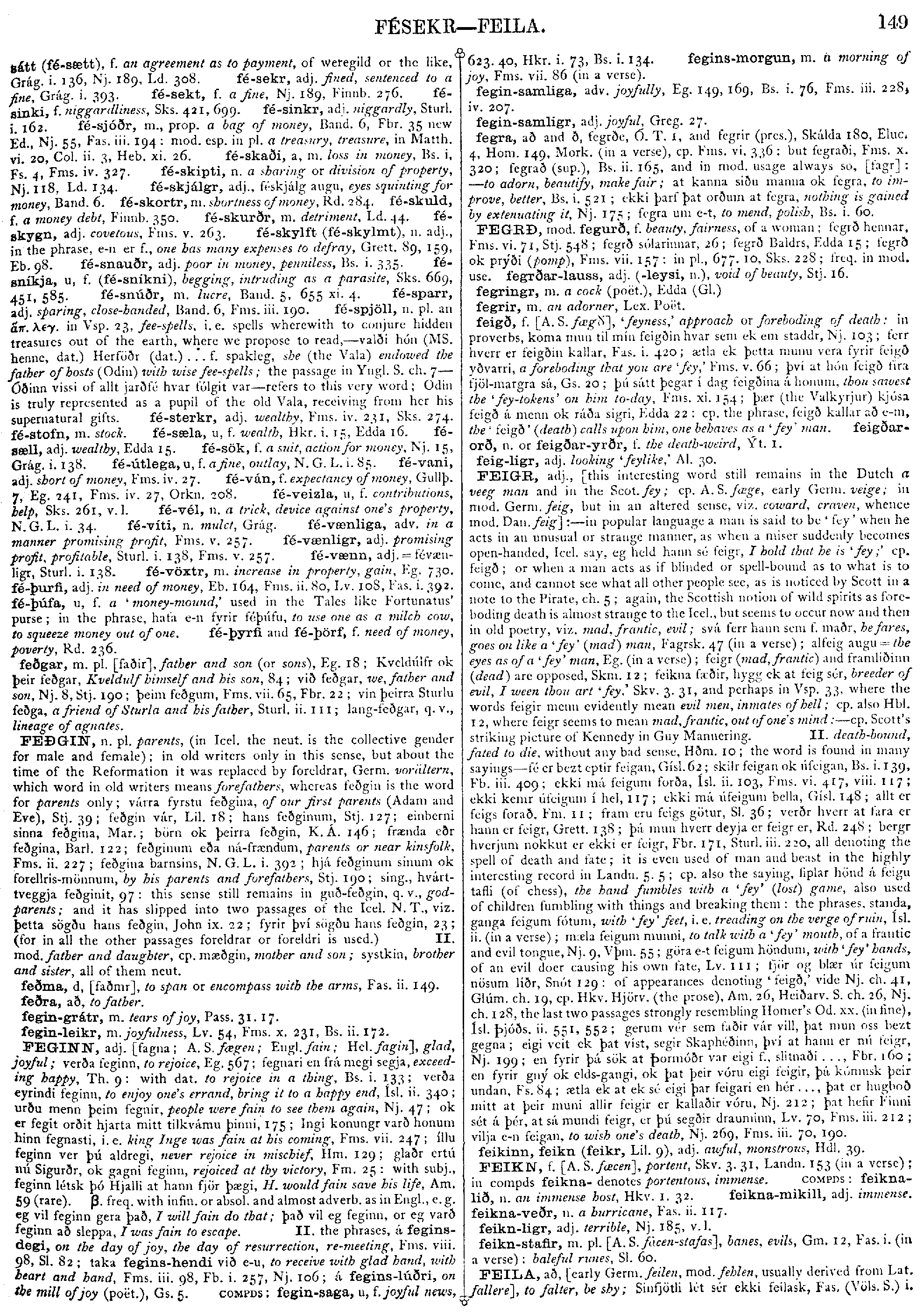
FEIGR, adj., [this interesting word still remains in the Dutch a veeg man and in the Scot. fey; cp. A. S. fæge, early Germ. veige; in mod. Germ. feig, but in an altered sense, viz. coward, craven, whence mod. Dan. feig] :-- in popular language a man is said to be 'fey' when he acts in an unusual or strange manner, as when a miser suddenly becomes open-handed, Icel. say, eg held hann sé feigr, I hold that he is 'fey;' cp. feigð; or when a man acts as if blinded or spell-bound as to what is to come, and cannot see what all other people see, as is noticed by Scott in a note to the Pirate, ch. 5; again, the Scottish notion of wild spirits as foreboding death is almost strange to the Icel., but seems to occur now and then in old poetry, viz. mad, frantic, evil; svá ferr hann sem f. maðr, he fares, goes on like a 'fey' (mad) man, Fagrsk. 47 (in a verse); alfeig augu = the eyes as of a 'fey' man, Eg. (in a verse); feigr (mad, frantic) and framliðinn (dead) are opposed, Skm. 12; feikna fæðir, hygg ek at feig sér, breeder of evil, I ween thou art 'fey,' Skv. 3. 31, and perhaps in Vsp. 33, where the words feigir menn evidently mean evil men, inmates of hell; cp. also Hbl. 12, where feigr seems to mean mad, frantic, out of one's mind :-- cp. Scott's striking picture of Kennedy in Guy Mannering. II. death-bound, fated to die, without any bad sense, Hðm. 10; the word is found in many sayings -- fé er bezt eptir feigan, Gísl. 62; skilr feigan ok úfeigan, Bs. i. 139, Fb. iii. 409; ekki má feigum forða, Ísl. ii. 103, Fms. vi. 417, viii. 117; ekki kemr úfeigum í hel, 117; ekki má úfeigum bella, Gísl. 148; allt er feigs forað, Fm. 11; fram eru feigs götur, Sl. 36; verðr hverr at fara er hann er feigr, Grett. 138; þá mun hverr deyja er feigr er, Rd. 248; bergr hverjum nokkut er ekki er feigr, Fbr. 171, Sturl. iii. 220, all denoting the spell of death and fate; it is even used of man and beast in the highly interesting record in Landn. 5. 5; cp. also the saying, fiplar hönd á feigu tafli (of chess), the hand fumbles with a 'fey' (lost) game, also used of children fumbling with things and breaking them: the phrases, standa, ganga feigum fótum, with 'fey' feet, i.e. treading on the verge of ruin, Ísl. ii. (in a verse); mæla feigum munni, to talk with a 'fey' mouth, of a frantic and evil tongue, Nj. 9, Vþm. 55; göra e-t feigum hondum, with 'fey' hands, of an evil doer causing his own fate, Lv. 111; fjör og blær úr feigum nösum líðr, Snót 129: of appearances denoting 'feigð,' vide Nj. ch. 41, Glúm. ch. 19, cp. Hkv. Hjörv. (the prose), Am. 26, Heiðarv. S. ch. 26, Nj. ch. 128, the last two passages strongly resembling Homer's Od. xx. (in fine), Ísl. Þjóðs. ii. 551, 552; gerum vér sem faðir vár vill, þat mun oss bezt gegna; eigi veit ek þat víst, segir Skaphéðinn, því at hann er nú feigr, Nj. 199; en fyrir þá sök at Þormóðr var eigi f., slitnaði ..., Fbr. 160; en fyrir gný ok elds-gangi, ok þat þeir vóru eigi feigir, þá kómusk þeir undan, Fs. 84; ætla ek at ek sé eigi þar feigari en hér ..., þat er hugboð mitt at þeir muni allir feigir er kallaðir vóru, Nj. 212; þat hefir Finni sét á þér, at sá mundi feigr, er þú segðir drauminn, Lv. 70, Fms. iii. 212; vilja e-n feigan, to wish one's death, Nj. 269, Fms. iii. 70, 190.
|
Source: Cleasby/Vigfusson, page b0158, entry 5 View original page image as: [TIFF] [PNG] [View previous entry] [View next entry] |
[Comment on this entry] [View comments] |
The following entry has been hand-corrected once. |
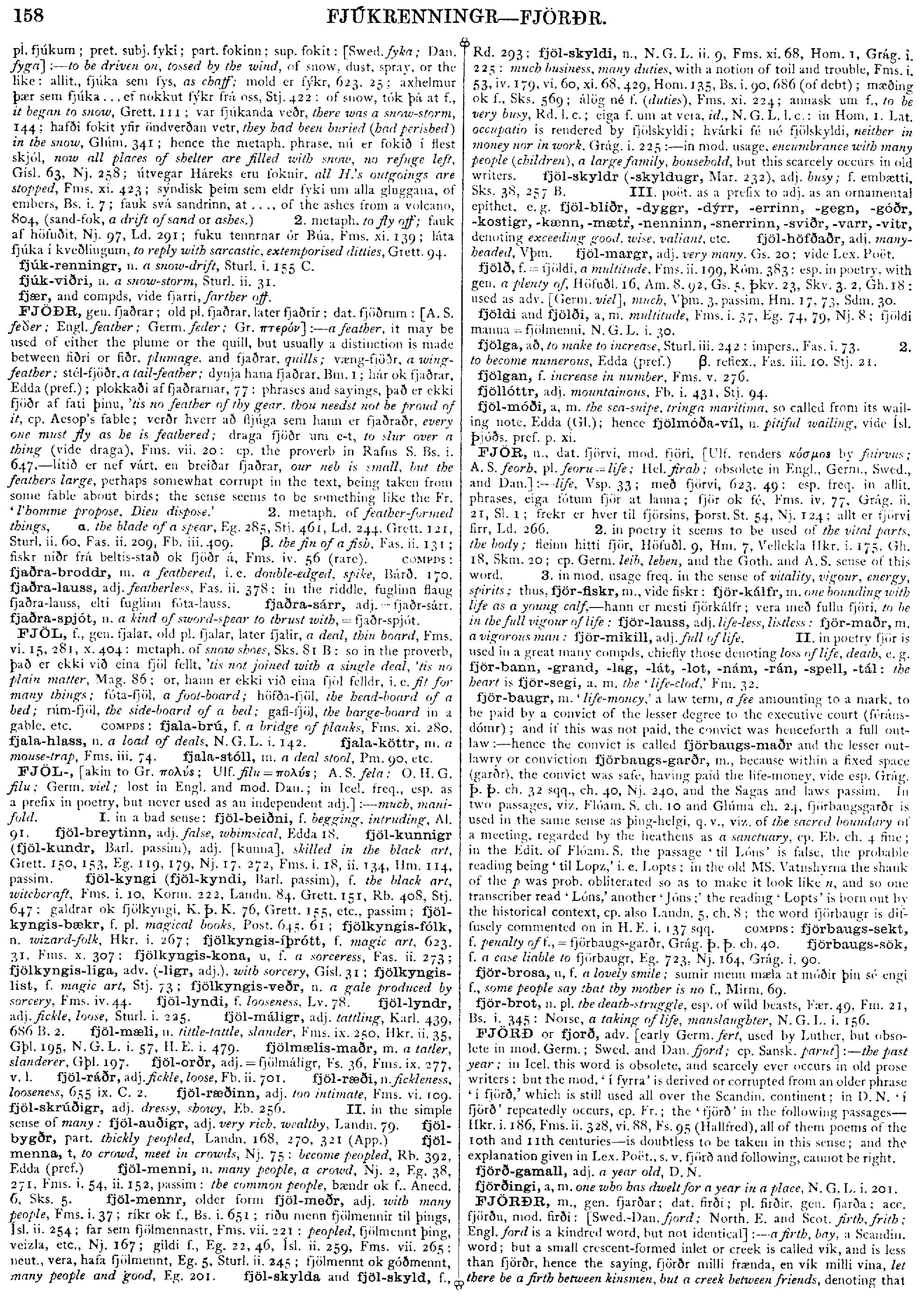
FJÖÐR,
gen.
fjaðrar;
old
pl.
fjaðrar,
later
fjaðrir;
dat.
fjöðrum:
[A.
S.
feðer;
Engl.
feather;
Germ.
feder;
Gr.
GREEK]
:--
a
feather,
it
may
be
used
of
either
the
plume
or
the
quill,
but
usually
a
distinction
is
made
between
fiðri
or
fiðr,
plumage,
and
fjaðrar,
quills;
væng-fjöðr,
a
wing-feather;
stél-fjöðr,
a
tail-feather;
dynja
hana
fjaðrar,
Bm.
1;
hár
ok
fjaðrar,
Edda
(pref.);
plokkaði
af
fjaðrarnar,
77:
phrases
and
sayings,
það
er
ekki
fjöðr
af
fati
þínu,
'tis
no
feather
of
thy
gear,
thou
needst
not
be
proud
of
it,
cp.
Aesop's
fable;
verðr
hverr
að
fljúga
sem
hann
er
fjaðraðr,
every
one
must
fly
as
he
is
feathered;
draga
fjöðr
um
e-t,
to
slur
over
a
thing
(vide
draga),
Fms.
vii.
20:
cp.
the
proverb
in
Rafns
S.
Bs.
i.
647,
--
lítið
er
nef
várt,
en
breiðar
fjaðrar,
our
neb
is
small,
but
the
feathers
large,
perhaps
somewhat
corrupt
in
the
text,
being
taken
from
some
fable
about
birds;
the
sense
seems
to
be
something
like
the
Fr.
'l'homme
propose,
Dieu
dispose.'
2.
metaph.
of
feather-formed
things,
 .
the
blade
of
a
spear,
Eg.
285,
Stj.
461,
Ld.
244,
Grett.
121,
Sturl.
ii.
60,
Fas.
ii.
209,
Fb.
111.
409.
.
the
fin
of
a
fish,
Fas.
ii.
131;
fiskr
niðr
frá
beltis-stað
ok
fjöðr
á,
Fms.
iv.
56
(rare).
COMPDS:
fjaðra-broddr,
m.
a
feathered,
i.e.
double-edged,
spike,
Bárð.
170.
fjaðra-lauss,
adj.
featherless,
Fas.
ii.
378;
in
the
riddle,
fuglinn
flaug
fjaðra-lauss,
elti
fuglinn
fóta-lauss.
fjaðra-sárr,
adj.
=
fjaðr-sárr.
fjaðra-spjót,
n.
a
kind
of
sword-spear
to
thrust
with,
=
fjaðr-spjót.
.
the
blade
of
a
spear,
Eg.
285,
Stj.
461,
Ld.
244,
Grett.
121,
Sturl.
ii.
60,
Fas.
ii.
209,
Fb.
111.
409.
.
the
fin
of
a
fish,
Fas.
ii.
131;
fiskr
niðr
frá
beltis-stað
ok
fjöðr
á,
Fms.
iv.
56
(rare).
COMPDS:
fjaðra-broddr,
m.
a
feathered,
i.e.
double-edged,
spike,
Bárð.
170.
fjaðra-lauss,
adj.
featherless,
Fas.
ii.
378;
in
the
riddle,
fuglinn
flaug
fjaðra-lauss,
elti
fuglinn
fóta-lauss.
fjaðra-sárr,
adj.
=
fjaðr-sárr.
fjaðra-spjót,
n.
a
kind
of
sword-spear
to
thrust
with,
=
fjaðr-spjót.
|
Source: Cleasby/Vigfusson, page b0161, entry 37 View original page image as: [TIFF] [PNG] [View previous entry] [View next entry] |
[Comment on this entry] [View comments] |
The following entry has been hand-corrected once. |
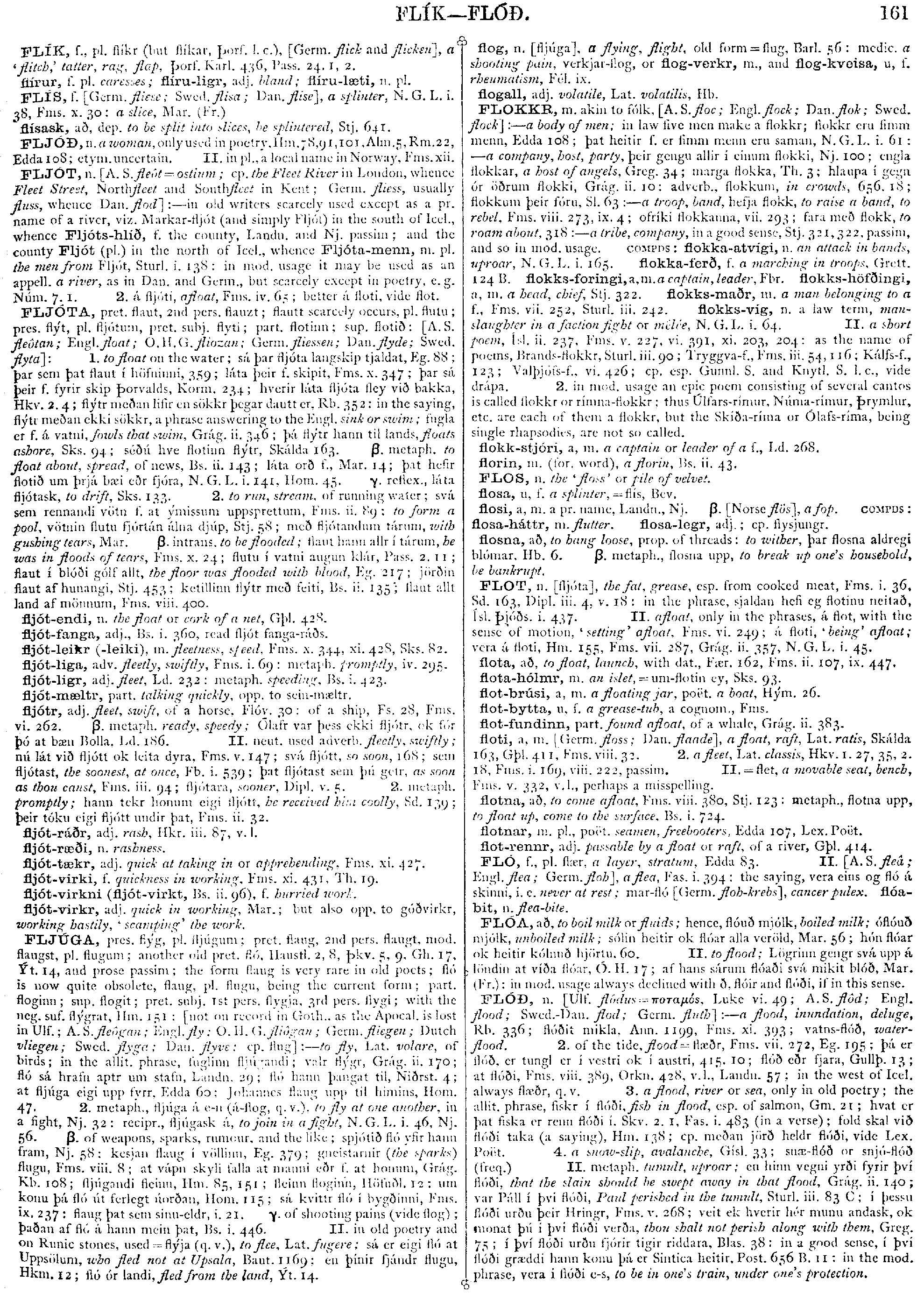
floti, a, m. [Germ. floss; Dan. flaade], a float, raft, Lat. ratis, Skálda 163, Gþl. 411, Fms. viii. 32. 2. a fleet, Lat. classis, Hkv. 1. 27, 35, 2. 18, Fms. i. 169, viii. 222, passim. II. = flet, a movable seat, bench, Fms. v. 332, v.l., perhaps a misspelling.
|
Source: Cleasby/Vigfusson, page b0163, entry 36 View original page image as: [TIFF] [PNG] [View previous entry] [View next entry] |
[Comment on this entry] [View comments] |
The following entry has been hand-corrected once. |
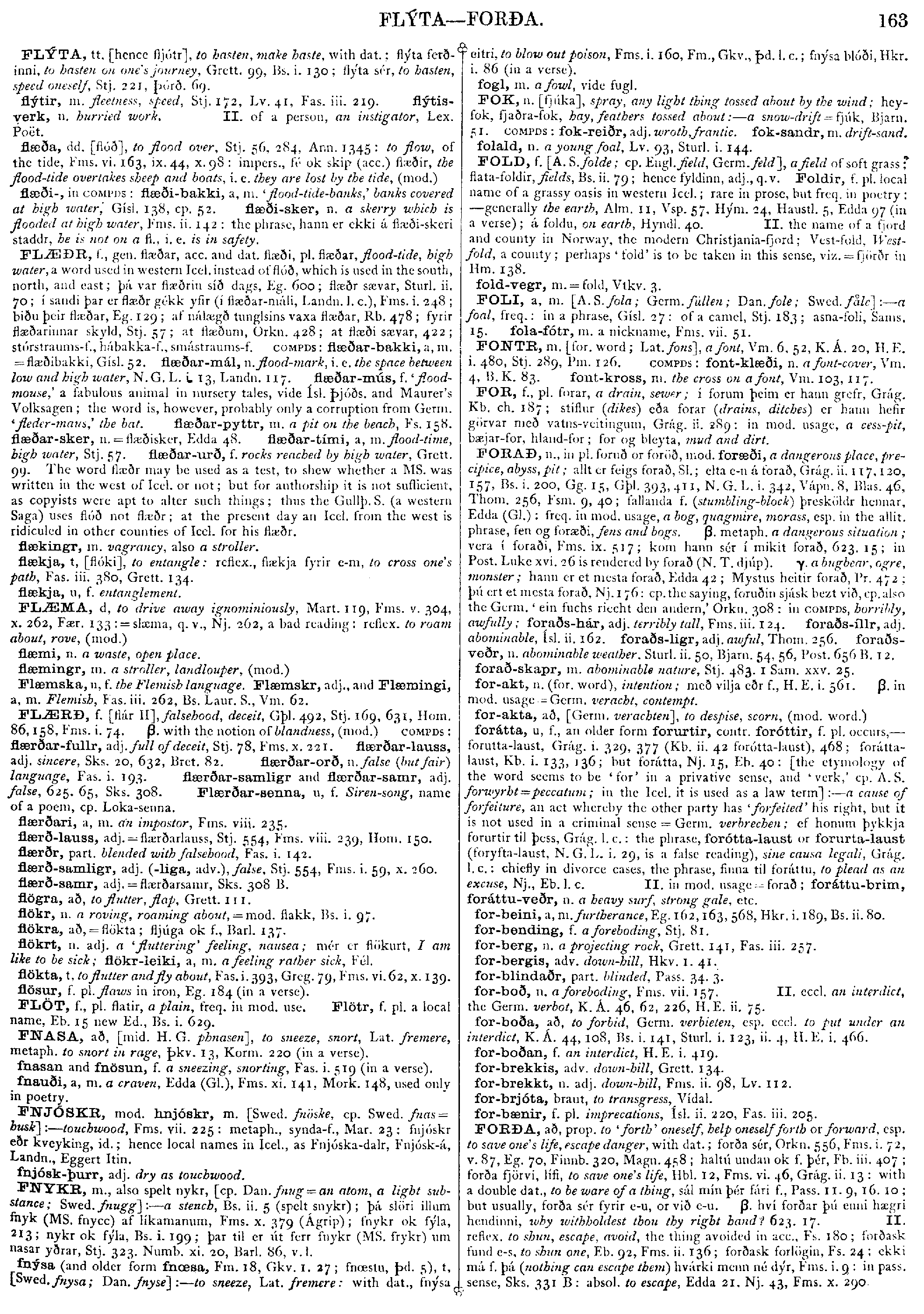
FOLD, f. [A. S. folde; cp. Engl. field, Germ. feld], a field of soft grass; flata-foldir, fields, Bs. ii. 79; hence fyldinn, adj., q.v. Foldir, f. pl. local name of a grassy oasis in western Icel.; rare in prose, but freq. in poetry: -- generally the earth, Alm. 11, Vsp. 57, Hým. 24, Haustl. 5, Edda 97 (in a verse); á foldu, on earth, Hyndl. 40. II. the name of a fjord and county in Norway, the modern Christjania-fjord; Vest-fold, West-fold, a county; perhaps 'fold' is to be taken in this sense, viz. = fjörðr in Hm. 138.
|
Source: Cleasby/Vigfusson, page b0166, entry 3 View original page image as: [TIFF] [PNG] [View previous entry] [View next entry] |
[Comment on this entry] [View comments] |
The following entry has been hand-corrected once. |
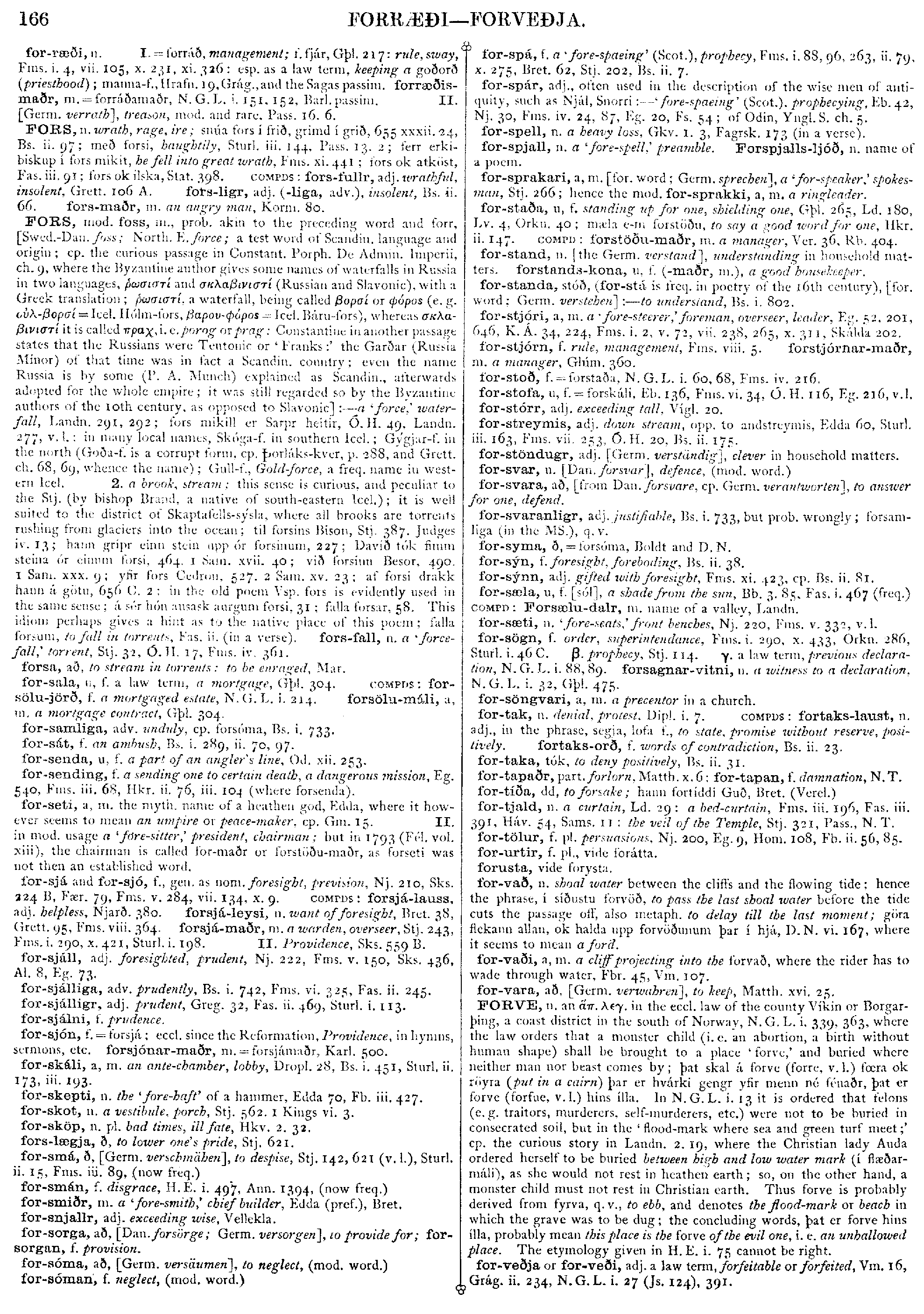
FORS, mod. foss, m., prob. akin to the preceding word and forr, [Swed.-Dan. foss, North. E. force; a test word of Scandin. language and origin; cp. the curious passage in Constant. Porph. De Admin. Imperii, ch. 9, where the Byzantine author gives some names of waterfalls in Russia in two languages, GREEK and GREEK (Russian and Slavonic), with a Greek translation; GREEK, a waterfall, being called GREEK or GREEK (e.g. GREEK = Icel. Hólm-fors, GREEK = Icel. Báru-fors), whereas GREEK it is called GREEK, i.e. porog or prag: Constantine in another passage states that the Russians were Teutonic or 'Franks:' the Garðar (Russia Minor) of that time was in fact a Scandin. country; even the name Russia is by some (P. A. Munch) explained as Scandin., afterwards adopted for the whole empire; it was still regarded so by the Byzantine authors of the 10th century, as opposed to Slavonic] :-- a 'force,' waterfall, Landn. 291, 292; fors mikill er Sarpr heitir, Ó. H. 49, Landn. 277, v.l.: in many local names, Skóga-f. in southern Icel.; Gýgjar-f. in the north (Goða-f. is a corrupt form, cp. Þorláks-kver, p. 288, and Grett. ch. 68, 69, whence the name); Gull-f., Gold-force, a freq. name in western Icel. 2. a brook, stream; this sense is curious, and peculiar to the Stj. (by bishop Brand, a native of south-eastern Icel.); it is well suited to the district of Skaptafells-sýsla, where all brooks are torrents rushing from glaciers into the ocean; til forsins Bison, Stj. 387. Judges iv. 13; hann grípr einn stein upp ór forsinum, 227; Davíð tók fimm steina ór einum forsi, 464. 1 Sam. xvii. 40; við forsinn Besor, 490. 1 Sam. xxx. 9; yfir fors Cedron, 527. 2 Sam. xv. 23; af forsi drakk hann á götu, 656 C. 2: in the old poem Vsp. fors is evidently used in the same sense; á sér hón ansask aurgum forsi, 31; falla forsar, 58. This idiom perhaps gives a hint as to the native place of this poem; falla forsum, to fall in torrents, Fas. ii. (in a verse). fors-fall, n. a 'forcefall,' torrent, Stj. 32, Ó. H. 17, Fms. iv. 361.
|
Source: Cleasby/Vigfusson, page b0169, entry 7 View original page image as: [TIFF] [PNG] [View previous entry] [View next entry] |
[Comment on this entry] [View comments] |
The following entry has been hand-corrected once. |
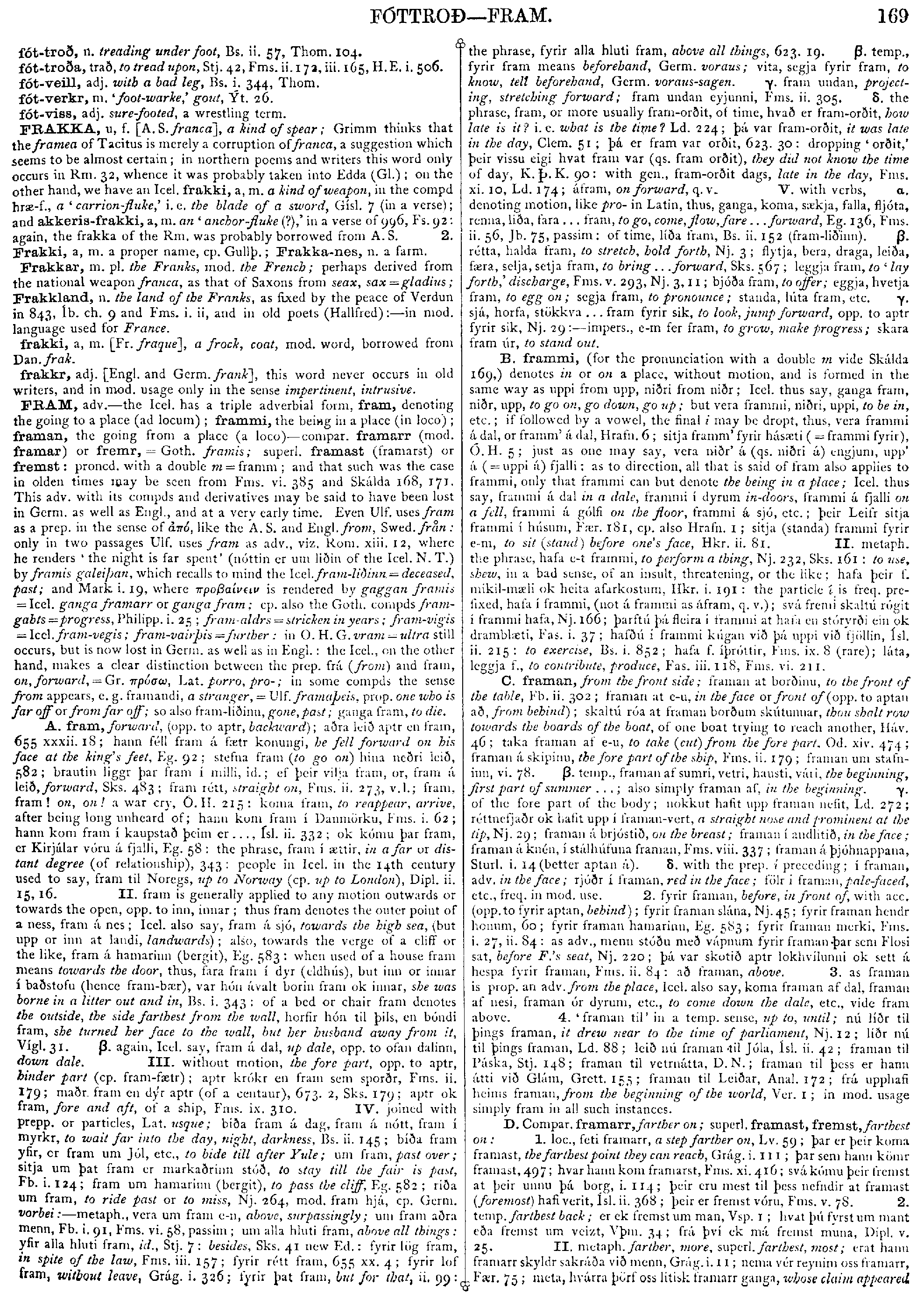
Frakkar, m. pl. the Franks, mod. the French; perhaps derived from the national weapon franca, as that of Saxons from seax, sax = gladius; Frakkland, n. the land of the Franks, as fixed by the peace of Verdun in 843, Íb. ch. 9 and Fms. i. ii, and in old poets (Hallfred) :-- in mod. language used for France.
|
Source: Cleasby/Vigfusson, page b0175, entry 25 View original page image as: [TIFF] [PNG] [View previous entry] [View next entry] |
[Comment on this entry] [View comments] |
The following entry has been hand-corrected once. |
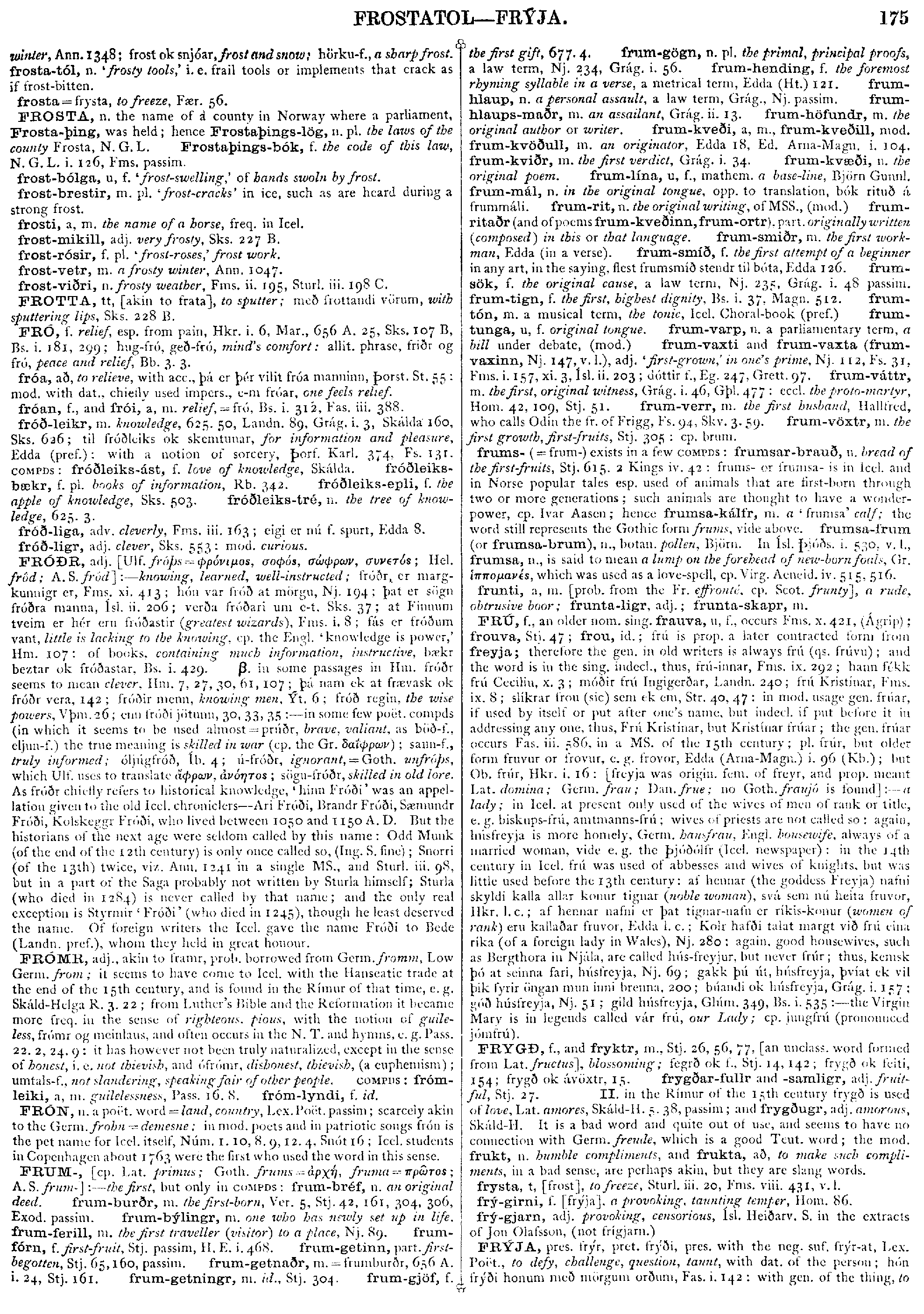
FRYGÐ, f., and fryktr, m., Stj. 26, 56, 77, [an unclass. word formed from Lat. fructus], blossoming; fegrð ok f., Stj. 14, 142; frygð ok feiti, 154; frygð ok ávöxtr, 15. frygðar-fullr and -samligr, adj. fruitful, Stj. 27. II. in the Rímur of the 15th century frygð is used of love, Lat. amores, Skáld-H. 5. 38, passim; and frygðugr, adj. amorous, Skáld-H. It is a bad word and quite out of use, and seems to have no connection with Germ. freude, which is a good Teut. word; the mod. frukt, n. humble compliments, and frukta, að, to make such compliments, in a bad sense, are perhaps akin, but they are slang words.
| Result Page: |  |
Previous | 26 27 28 29 30 31 32 33 34 35 36 37 38 39 40 41 42 43 44 | Next |  |
Germanic Lexicon Project (main page)
This search system was written by
Sean Crist
Please consider
volunteering
to correct the data in these online dictionaries.
No rights reserved. Feel free to use these data in any way you please.