|
|

|
Source: Bosworth/Toller, page b0263, entry 14 View original page image as: [TIFF] [PNG] [View previous entry] [View next entry] |
[Comment on this entry] [View comments] |
The following entry has been hand-corrected once. |
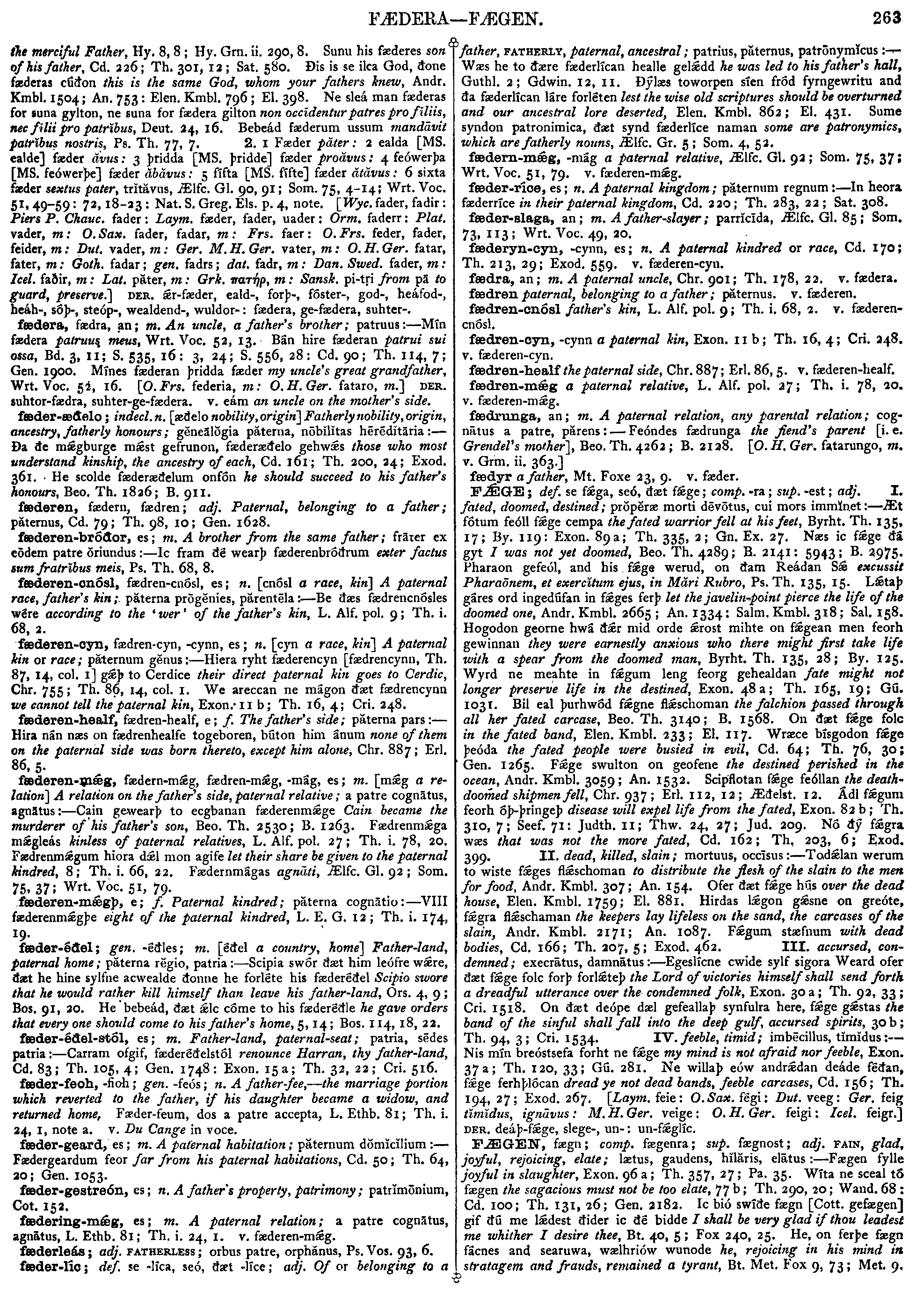
fæder-gestreón,
es;
n.
A
father's
property,
patrimony;
patr m
m nium,
Cot.
152.
nium,
Cot.
152.
|
Source: Cleasby/Vigfusson, page b0004, entry 1 View original page image as: [TIFF] [PNG] [View previous entry] [View next entry] |
[Comment on this entry] [View comments (1)] |
The following entry has been hand-corrected once. |
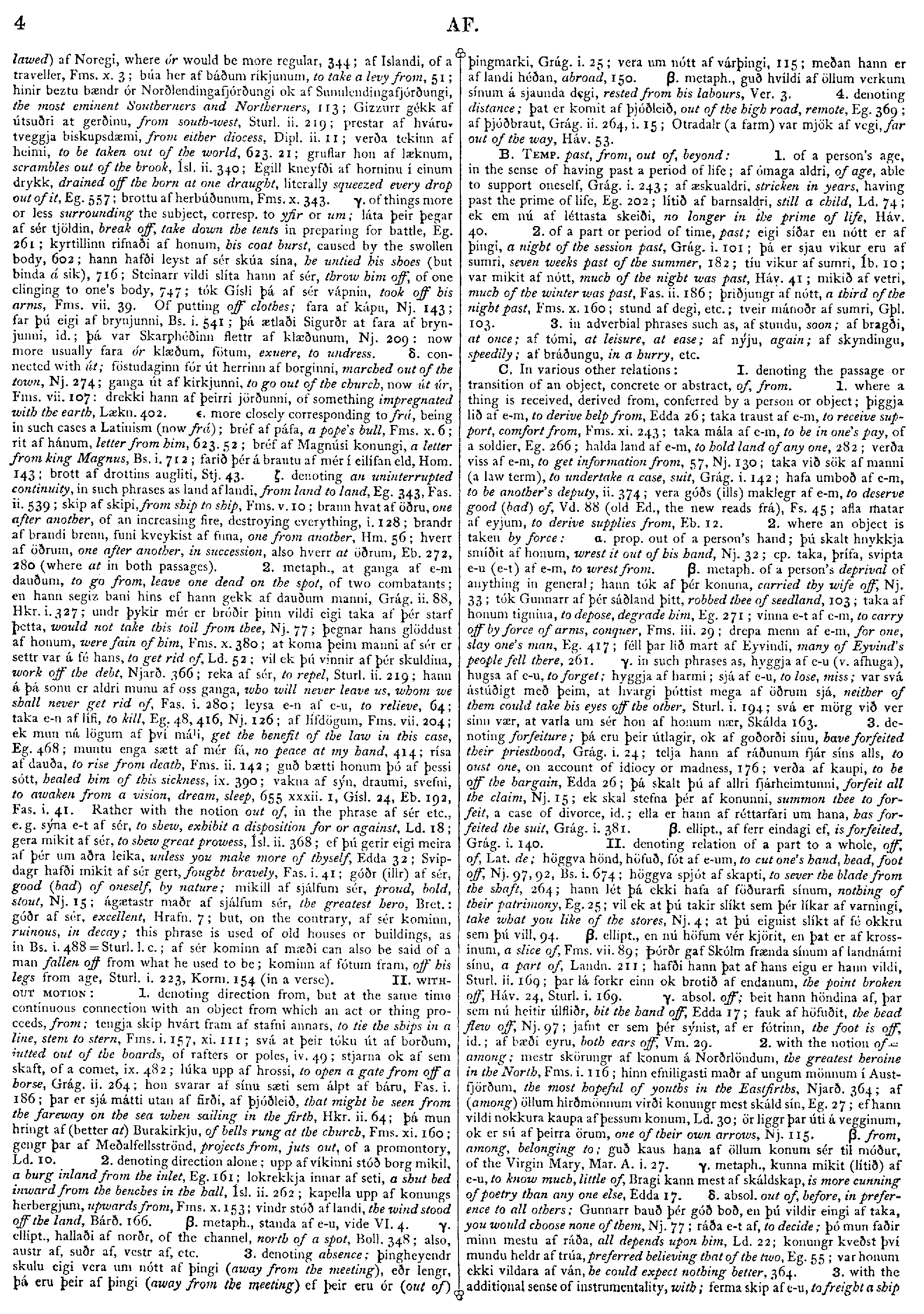
lawed)
af
Noregi,
where
ór
would
be
more
regular,
344;
af
Islandi,
of
a
traveller,
Fms.
x.
3;
búa
her
af
báðum
ríkjunum,
to
take
a
levy
from,
51;
hinir
beztu
bændr
ór
Norðlendingafjórðungi
ok
af
Sunnlendingafjórðungi,
the
most
eminent
Southerners
and
Northerners,
113;
Gizzurr
gékk
af
útsuðri
at
gerðinu,
from
south-west,
Sturl.
ii.
219;
prestar
af
hváru-
tveggja
biskupsdæmi,
from
either
diocess,
Dipl.
ii.
11;
verða
tekinn
af
heimi,
to
be
taken
out
of
the
world,
623.
21;
gruflar
hon
af
læknum,
scrambles
out
of
the
brook,
Ísl.
ii.
340;
Egill
kneyfði
af
horninu
í
einum
drykk,
drained
off
the
horn
at
one
draught,
literally
squeezed
every
drop
out
of
it,
Eg.
557;
brottuaf
herbúðunurn,
Fms.
x.
343.
 of
things
more
or
less
surrounding
the
subject,
corresp.
to
yfir
or
um;
láta
þeir
þegar
af
sér
tjöldin,
break
off,
take
down
the
tents
in
preparing
for
battle,
Eg.
261;
kyrtillinn
rifnaði
af
honum,
his
coat
burst,
caused
by
the
swollen
body,
602;
hann
hafði
leyst
af
sér
skúa
sína,
he
untied
his
shoes
(but
binda
á
sik),
716;
Steinarr
vildi
slíta
hann
af
sér,
throw
him
off,
of
one
clinging
to
one's
body,
747;
tók
Gísli
þá
af
sér
vápnin,
took
off
his
arms,
Fms.
vii.
39.
Of
putting
off
clothes;
fara
af
kápu,
Nj.
143;
far
þú
eigi
af
brynjunni,
Bs.
i.
541;
þá
ætlaði
Sigurðr
at
fara
af
bryn-
junni,
id.;
þá
var
Skarphóðinn
flettr
af
klæðunum,
Nj.
209:
now
more
usually
fara
or
klæðum,
fötum,
exuere,
to
undress.
of
things
more
or
less
surrounding
the
subject,
corresp.
to
yfir
or
um;
láta
þeir
þegar
af
sér
tjöldin,
break
off,
take
down
the
tents
in
preparing
for
battle,
Eg.
261;
kyrtillinn
rifnaði
af
honum,
his
coat
burst,
caused
by
the
swollen
body,
602;
hann
hafði
leyst
af
sér
skúa
sína,
he
untied
his
shoes
(but
binda
á
sik),
716;
Steinarr
vildi
slíta
hann
af
sér,
throw
him
off,
of
one
clinging
to
one's
body,
747;
tók
Gísli
þá
af
sér
vápnin,
took
off
his
arms,
Fms.
vii.
39.
Of
putting
off
clothes;
fara
af
kápu,
Nj.
143;
far
þú
eigi
af
brynjunni,
Bs.
i.
541;
þá
ætlaði
Sigurðr
at
fara
af
bryn-
junni,
id.;
þá
var
Skarphóðinn
flettr
af
klæðunum,
Nj.
209:
now
more
usually
fara
or
klæðum,
fötum,
exuere,
to
undress.
 .
con-
nected
with
út;
föstudaginn
for
út
herrinn
af
borginni,
marched
out
of
the
town,
Nj.
274;
ganga
út
af
kirkjunni,
to
go
out
of
the
church,
now
út
úr,
Fms.
vii.
107:
drekki
hann
af
þeirri
jörðunni,
of
something
impregnated
with
the
earth,
Laekn.
402.
.
con-
nected
with
út;
föstudaginn
for
út
herrinn
af
borginni,
marched
out
of
the
town,
Nj.
274;
ganga
út
af
kirkjunni,
to
go
out
of
the
church,
now
út
úr,
Fms.
vii.
107:
drekki
hann
af
þeirri
jörðunni,
of
something
impregnated
with
the
earth,
Laekn.
402.
 .
more
closely
corresponding
to
frá,
being
in
such
cases
a
Latinism
(now
frá);
bréf
af
páfa,
a
pope's
bull,
Fms.
x.
6;
rit
af
hánum,
letter
from
him,
623.
52;
bréf
af
Magnúsi
konungi,
a
letter
from
king
Magnus,
Bs.
i.
712;
farið
þér
á
brautu
af
mér
í
eilífan
eld,
Hom.
143;
brott
af
drottins
augliti,
Stj.
43.
.
more
closely
corresponding
to
frá,
being
in
such
cases
a
Latinism
(now
frá);
bréf
af
páfa,
a
pope's
bull,
Fms.
x.
6;
rit
af
hánum,
letter
from
him,
623.
52;
bréf
af
Magnúsi
konungi,
a
letter
from
king
Magnus,
Bs.
i.
712;
farið
þér
á
brautu
af
mér
í
eilífan
eld,
Hom.
143;
brott
af
drottins
augliti,
Stj.
43.
 .
denoting
an
uninterrupted
continuity,
in
such
phrases
as
land
aflandi,
from
land
to
land,
Eg.
343,
Fas.
ii.
539;
skip
af
skipl.
from
ship
to
ship,
Fms.
v.
10;
brann
hvat
af
öðru,
one
after
another,
of
an
increasing
fire,
destroying
everything,
i.
128;
brandr
af
brandi
brenn,
funi
kveykist
af
funa,
one
from
another,
Hm.
56;
hverr
af
öðrum,
one
after
another,
in
succession,
also
hverr
at
öðrum,
Eb.
272,
280
(where
at
in
both
passages).
2.
metaph.,
at
ganga
af
e-m
dauðum,
to
go
from,
leave
one
dead
on
the
spot,
of
two
combatants;
en
hann
segiz
bani
hins
ef
hann
gekk
af
dauðum
manni,
Grág.
ii.
88,
Hkr.
1.
327;
undr
þykir
mér
er
bróðir
þinn
vildi
eigi
taka
af
þér
starf
þetta,
would
not
take
this
toil
from
thee,
Nj.
77;
þegnar
hans
glöddust
af
honum,
were
fain
of
him,
Fms.
x.
380;
at
koma
þeim
manni
af
sér
er
settr
var
á
fé
hans,
to
get
rid
of,
Ld.
52;
vil
ek
þú
vinriir
af
þér
skuldina,
work
off
the
debt,
Njarð.
366;
reka
af
sér,
to
repel,
Sturl.
ii.
219;
hann
á
þá
sonu
er
aldri
munu
af
oss
ganga,
who
will
never
leave
us,
whom
we
shall
never
get
rid
of,
Fas.
i.
280;
leysa
e-n
af
e-u,
to
relieve,
64;
taka
e-n
af
lífi,
to
kill,
Eg.
48,
416,
Nj.
126;
af
lífdögum,
Fms.
vii.
204;
ek
mun
ná
lögum
af
því
???,
get
the
benefit
of
the
law
in
this
case,
Eg.
468;
muntu
enga
sætt
af
mér
fá,
no
peace
at
my
hand,
414;
rísa
af
dauða,
to
rise
from
death,
Fms.
ii.
142;
guð
bætti
honum
þó
af
þessi
sótt,
healed
him
of
this
sickness,
ix.
390;
vakna
af
sýn,
draumi,
svefni,
to
awaken
from
a
vision,
dream,
sleep,
655
xxxii.
I,
Gísl.
24,
Eb.
192,
Fas.
i.
41.
Rather
with
the
notion
out
of,
in
the
phrase
af
sér
etc.,
e.
g.
sýna
e-t
af
scr,
to
shew,
exhibit
a
disposition
for
or
against,
Ld.
18;
gera
mikit
af
sér,
to
shew
great
prowess,
Ísl.
ii.
368;
éf
þú
gerir
eigi
meira
af
þér
um
aðra
leika,
unless
you
make
more
of
thyself,
Edda
32;
Svip-
dagr
hafði
mikit
af
sér
gert,
fought
bravely,
Fas.
i.
41;
góðr
(illr)
af
sér,
good
(bad)
of
oneself,
by
nature;
mikill
af
sjálfum
sér,
proud,
bold,
stout,
Nj.
15;
ágætastr
maðr
af
sjálfum
sér,
the
greatest
hero,
Bret.:
góðr
af
ser,
excellent,
Hrafn.
7;
but,
on
the
contrary,
af
sér
kominn,
ruinous,
in
decay;
this
phrase
is
used
of
old
houses
or
buildings,
as
in
Bs.
i.
488
=
Sturl.
l.
c.;
af
sér
kominn
af
mæði
can
also
be
said
of
a
man
fallen
off
from
what
he
used
to
be;
kominn
af
fotum
fram,
off
his
legs
from
age,
Sturl.
i.
223,
Korm.
154
(in
a
verse).
II.
WITH-
OUT
MOTION:
1.
denoting
direction
from,
but
at
the
same
time
continuous
connection
with
an
object
from
which
an
act
or
thing
pro-
ceeds,
from;
tengja
skip
hvárt
fram
af
stafni
annars,
to
tie
the
ships
in
a
line,
stem
to
stern,
Fms.
i.
157,
xi.
111;
svá
at
þeir
tóku
út
af
borðum,
jutted
out
of
the
boards,
of
rafters
or
poles,
iv.
49;
stjarna
ok
af
sem
skaft,
of
a
comet,
ix.
482;
lúka
upp
af
hrossi,
to
open
a
gate
from
off
a
horse,
Grág.
ii.
264;
hon
svarar
af
sínu
sæti
sem
álpt
af
baru,
Fás.
i.
186;
þar
er
sjá
mátti
utau
af
firði,
af
þjóðleið,
that
might
be
seen
from
the
fareway
on
the
sea
when
sailing
in
the
firth,
Hkr.
ii.
64;
þá
mun
hringt
af
(better
at)
Burakirkju,
of
bells
rung
at
the
church,
Fms.
xi.
160;
gengr
þar
af
Meðalfellsströnd,
projects
from,
juts
out,
of
a
promontory,
Ld.
10.
2.
denoting
direction
alone;
upp
af
víkinni
stóð
borg
mikil,
a
burg
inland
from
the
inlet,
Eg.
161;
lokrekkja
innar
af
seti,
a
shut
bed
inward
from
the
benches
in
the
hall,
Ísl.
ii.
262;
kapella
upp
af
konungs
herbergjum,
upwards
from,
Fms.
x.
153;
vindr
stóð
af
landi,
the
wind
stood
off
the
land,
Bárð.
166.
.
denoting
an
uninterrupted
continuity,
in
such
phrases
as
land
aflandi,
from
land
to
land,
Eg.
343,
Fas.
ii.
539;
skip
af
skipl.
from
ship
to
ship,
Fms.
v.
10;
brann
hvat
af
öðru,
one
after
another,
of
an
increasing
fire,
destroying
everything,
i.
128;
brandr
af
brandi
brenn,
funi
kveykist
af
funa,
one
from
another,
Hm.
56;
hverr
af
öðrum,
one
after
another,
in
succession,
also
hverr
at
öðrum,
Eb.
272,
280
(where
at
in
both
passages).
2.
metaph.,
at
ganga
af
e-m
dauðum,
to
go
from,
leave
one
dead
on
the
spot,
of
two
combatants;
en
hann
segiz
bani
hins
ef
hann
gekk
af
dauðum
manni,
Grág.
ii.
88,
Hkr.
1.
327;
undr
þykir
mér
er
bróðir
þinn
vildi
eigi
taka
af
þér
starf
þetta,
would
not
take
this
toil
from
thee,
Nj.
77;
þegnar
hans
glöddust
af
honum,
were
fain
of
him,
Fms.
x.
380;
at
koma
þeim
manni
af
sér
er
settr
var
á
fé
hans,
to
get
rid
of,
Ld.
52;
vil
ek
þú
vinriir
af
þér
skuldina,
work
off
the
debt,
Njarð.
366;
reka
af
sér,
to
repel,
Sturl.
ii.
219;
hann
á
þá
sonu
er
aldri
munu
af
oss
ganga,
who
will
never
leave
us,
whom
we
shall
never
get
rid
of,
Fas.
i.
280;
leysa
e-n
af
e-u,
to
relieve,
64;
taka
e-n
af
lífi,
to
kill,
Eg.
48,
416,
Nj.
126;
af
lífdögum,
Fms.
vii.
204;
ek
mun
ná
lögum
af
því
???,
get
the
benefit
of
the
law
in
this
case,
Eg.
468;
muntu
enga
sætt
af
mér
fá,
no
peace
at
my
hand,
414;
rísa
af
dauða,
to
rise
from
death,
Fms.
ii.
142;
guð
bætti
honum
þó
af
þessi
sótt,
healed
him
of
this
sickness,
ix.
390;
vakna
af
sýn,
draumi,
svefni,
to
awaken
from
a
vision,
dream,
sleep,
655
xxxii.
I,
Gísl.
24,
Eb.
192,
Fas.
i.
41.
Rather
with
the
notion
out
of,
in
the
phrase
af
sér
etc.,
e.
g.
sýna
e-t
af
scr,
to
shew,
exhibit
a
disposition
for
or
against,
Ld.
18;
gera
mikit
af
sér,
to
shew
great
prowess,
Ísl.
ii.
368;
éf
þú
gerir
eigi
meira
af
þér
um
aðra
leika,
unless
you
make
more
of
thyself,
Edda
32;
Svip-
dagr
hafði
mikit
af
sér
gert,
fought
bravely,
Fas.
i.
41;
góðr
(illr)
af
sér,
good
(bad)
of
oneself,
by
nature;
mikill
af
sjálfum
sér,
proud,
bold,
stout,
Nj.
15;
ágætastr
maðr
af
sjálfum
sér,
the
greatest
hero,
Bret.:
góðr
af
ser,
excellent,
Hrafn.
7;
but,
on
the
contrary,
af
sér
kominn,
ruinous,
in
decay;
this
phrase
is
used
of
old
houses
or
buildings,
as
in
Bs.
i.
488
=
Sturl.
l.
c.;
af
sér
kominn
af
mæði
can
also
be
said
of
a
man
fallen
off
from
what
he
used
to
be;
kominn
af
fotum
fram,
off
his
legs
from
age,
Sturl.
i.
223,
Korm.
154
(in
a
verse).
II.
WITH-
OUT
MOTION:
1.
denoting
direction
from,
but
at
the
same
time
continuous
connection
with
an
object
from
which
an
act
or
thing
pro-
ceeds,
from;
tengja
skip
hvárt
fram
af
stafni
annars,
to
tie
the
ships
in
a
line,
stem
to
stern,
Fms.
i.
157,
xi.
111;
svá
at
þeir
tóku
út
af
borðum,
jutted
out
of
the
boards,
of
rafters
or
poles,
iv.
49;
stjarna
ok
af
sem
skaft,
of
a
comet,
ix.
482;
lúka
upp
af
hrossi,
to
open
a
gate
from
off
a
horse,
Grág.
ii.
264;
hon
svarar
af
sínu
sæti
sem
álpt
af
baru,
Fás.
i.
186;
þar
er
sjá
mátti
utau
af
firði,
af
þjóðleið,
that
might
be
seen
from
the
fareway
on
the
sea
when
sailing
in
the
firth,
Hkr.
ii.
64;
þá
mun
hringt
af
(better
at)
Burakirkju,
of
bells
rung
at
the
church,
Fms.
xi.
160;
gengr
þar
af
Meðalfellsströnd,
projects
from,
juts
out,
of
a
promontory,
Ld.
10.
2.
denoting
direction
alone;
upp
af
víkinni
stóð
borg
mikil,
a
burg
inland
from
the
inlet,
Eg.
161;
lokrekkja
innar
af
seti,
a
shut
bed
inward
from
the
benches
in
the
hall,
Ísl.
ii.
262;
kapella
upp
af
konungs
herbergjum,
upwards
from,
Fms.
x.
153;
vindr
stóð
af
landi,
the
wind
stood
off
the
land,
Bárð.
166.
 .
metaph.,
stauda
af
e-u,
vide
VI.
4.
.
ellipt.,
hallaði
af
norðr,
of
the
channel,
north
of
a
spot,
Boll.
348;
also,
austr
af,
suðr
af,
vestr
af,
etc.
3.
denoting
absence;
þingheyendr
skulu
eigi
vera
um
nótt
af
þingi
(away
from
the
meeting),
eðr
lengr,
þá
eru
þeir
af
þingi
(away
from
(be
meeting)
ef
þeir
eru
or
(out
of)
þingmarki,
Grág.
i.
25;
vera
um
nótt
af
várþingi,
115;
meðan
hann
er
af
landi
héðan,
abroad,
150.
.
metaph.,
gud
hvíldi
af
öllum
verkum
sínum
á
sjaunda
degi,
rested
from
his
labours,
Ver.
3.
4.
denoting
distance;
þat
er
komit
af
þjóðleið,
out
of
the
high
road,
remote,
Eg.
369;
af
þjóðbraut,
Grág.
ii.
264,
i.
15;
Otradalr
(a
farm)
var
mjök
af
vegi,
far
out
of
the
way,
Háv.
53.
B.
TEMP,
past,
from,
out
of,
beyond:
1.
of
a
person's
age,
in
the
sense
of
having
past
a
period
of
life;
af
ómaga
aldri,
of
age,
able
to
support
oneself,
Grág.
i.
243;
af
aeskualdri,
stricken
in
years,
having
past
the
prime
of
life,
Eg.
202;
lítið
af
barnsaldri,
still
a
child,
Ld.
74;
ek
em
nú
af
léttasia
skeiði,
no
longer
in
the
prime
of
life,
Háv.
40.
2.
of
a
part
or
period
of
time,
past;
eigi
síðar
en
nótt
er
af
þingi,
a
night
of
the
session
past,
Grág.
i.
101;
þá
er
sjau
vikur
eru
af
sumri,
seven
weeks
past
of
the
summer,
182;
tíu
vikur
af
sumri,
Íb.
10;
var
mikit
af
nótt,
much
of
the
night
was
past,
Háv.
41;
mikið
af
vetri,
much
of
the
winter
was
past,
Fas.
ii.
186;
þriðjungr
af
nótt,
a
third
of
the
night
past,
Fms.
x.
160;
stund
af
degi,
etc.;
tveir
mánoðr
af
sumri,
Gþl.
103.
3.
in
adverbial
phrases
such
as,
af
stundu,
soon;
af
bragði,
at
once;
af
tómi,
at
leisure,
at
ease;
af
nýju,
again;
af
skyndingu,
speedily;
af
bráðungu,
in
a
hurry,
etc.
C.
In
various
other
relations:
I.
denoting
the
passage
or
transition
of
an
object,
concrete
or
abstract,
of,
from.
1.
where
a
thing
is
received,
derived
from,
conferred
by
a
person
or
object;
þiggja
lið
af
e-m,
to
derive
help
from,
Edda
26;
taka
traust
af
e-m,
to
receive
sup-
port,
comfort
from,
Fms.
xi.
243;
taka
mála
af
e-m,
to
be
in
one's
pay,
of
a
soldier,
Eg.
266;
halda
land
af
e-m,
to
hold
land
of
any
one,
282;
verða
viss
af
e-m,
to
get
information
from,
57,
Nj.
130;
taka
við
sök
af
manni
(a
law
term),
to
undertake
a
case,
suit,
Grág.
i.
142;
hafa
umboð
af
e-m,
to
be
another's
deputy,
ii.
374;
vera
góðs
(ills)
maklegr
af
e-m,
to
deserve
good
(bad)
of,
Vd.
88
(old
Ed.,
the
new
reads
frá),
Fs.
45;
afla
matar
af
eyjum,
to
derive
supplies
from,
Eb.
12.
2.
where
an
object
is
taken
by
force:
.
metaph.,
stauda
af
e-u,
vide
VI.
4.
.
ellipt.,
hallaði
af
norðr,
of
the
channel,
north
of
a
spot,
Boll.
348;
also,
austr
af,
suðr
af,
vestr
af,
etc.
3.
denoting
absence;
þingheyendr
skulu
eigi
vera
um
nótt
af
þingi
(away
from
the
meeting),
eðr
lengr,
þá
eru
þeir
af
þingi
(away
from
(be
meeting)
ef
þeir
eru
or
(out
of)
þingmarki,
Grág.
i.
25;
vera
um
nótt
af
várþingi,
115;
meðan
hann
er
af
landi
héðan,
abroad,
150.
.
metaph.,
gud
hvíldi
af
öllum
verkum
sínum
á
sjaunda
degi,
rested
from
his
labours,
Ver.
3.
4.
denoting
distance;
þat
er
komit
af
þjóðleið,
out
of
the
high
road,
remote,
Eg.
369;
af
þjóðbraut,
Grág.
ii.
264,
i.
15;
Otradalr
(a
farm)
var
mjök
af
vegi,
far
out
of
the
way,
Háv.
53.
B.
TEMP,
past,
from,
out
of,
beyond:
1.
of
a
person's
age,
in
the
sense
of
having
past
a
period
of
life;
af
ómaga
aldri,
of
age,
able
to
support
oneself,
Grág.
i.
243;
af
aeskualdri,
stricken
in
years,
having
past
the
prime
of
life,
Eg.
202;
lítið
af
barnsaldri,
still
a
child,
Ld.
74;
ek
em
nú
af
léttasia
skeiði,
no
longer
in
the
prime
of
life,
Háv.
40.
2.
of
a
part
or
period
of
time,
past;
eigi
síðar
en
nótt
er
af
þingi,
a
night
of
the
session
past,
Grág.
i.
101;
þá
er
sjau
vikur
eru
af
sumri,
seven
weeks
past
of
the
summer,
182;
tíu
vikur
af
sumri,
Íb.
10;
var
mikit
af
nótt,
much
of
the
night
was
past,
Háv.
41;
mikið
af
vetri,
much
of
the
winter
was
past,
Fas.
ii.
186;
þriðjungr
af
nótt,
a
third
of
the
night
past,
Fms.
x.
160;
stund
af
degi,
etc.;
tveir
mánoðr
af
sumri,
Gþl.
103.
3.
in
adverbial
phrases
such
as,
af
stundu,
soon;
af
bragði,
at
once;
af
tómi,
at
leisure,
at
ease;
af
nýju,
again;
af
skyndingu,
speedily;
af
bráðungu,
in
a
hurry,
etc.
C.
In
various
other
relations:
I.
denoting
the
passage
or
transition
of
an
object,
concrete
or
abstract,
of,
from.
1.
where
a
thing
is
received,
derived
from,
conferred
by
a
person
or
object;
þiggja
lið
af
e-m,
to
derive
help
from,
Edda
26;
taka
traust
af
e-m,
to
receive
sup-
port,
comfort
from,
Fms.
xi.
243;
taka
mála
af
e-m,
to
be
in
one's
pay,
of
a
soldier,
Eg.
266;
halda
land
af
e-m,
to
hold
land
of
any
one,
282;
verða
viss
af
e-m,
to
get
information
from,
57,
Nj.
130;
taka
við
sök
af
manni
(a
law
term),
to
undertake
a
case,
suit,
Grág.
i.
142;
hafa
umboð
af
e-m,
to
be
another's
deputy,
ii.
374;
vera
góðs
(ills)
maklegr
af
e-m,
to
deserve
good
(bad)
of,
Vd.
88
(old
Ed.,
the
new
reads
frá),
Fs.
45;
afla
matar
af
eyjum,
to
derive
supplies
from,
Eb.
12.
2.
where
an
object
is
taken
by
force:
 .
prop.
out
of
a
person's
hand;
þú
skalt
hnykkja
smíðit
af
honum,
wrest
it
out
of
his
hand,
Nj.
32;
cp.
taka,
þrífa,
svipta
e-u
(e-t)
af
e-m,
to
wrest
from.
.
metaph.
of
a
person's
deprival
of
anything
in
general;
hann
tók
af
þér
konuna,
carried
thy
wife
off,
Nj.
33;
tók
Gunnarr
af
þér
sáðland
þitt,
robbed
thee
of
seedland,
103;
taka
af
honum
tignina,
to
depose,
degrade
him,
Eg.
271;
vinna
e-t
af
e-m,
to
carry
off
by
force
of
arms,
conquer,
Fms.
iii.
29;
drepa
menu
af
e-m,
for
one,
slay
one's
man,
Eg.
417;
fell
þar
lið
mart
af
Eyvindi,
many
of
Eyvind's
people
fell
there,
261.
.
in
such
phrases
as,
hyggja
af
e-u
(v.
afhuga),
hugsa
af
e-u,
to
forget;
hyggja
af
harmi;
sjá
af
e-u,
to
lose,
miss;
var
svá
ástúðigt
með
þeim,
at
livargi
þóttist
mega
af
öðrum
sjá,
neither
of
them
could
take
his
eyes
off
the
other,
Sturl.
i.
194;
svá
er
mörg
við
ver
sinn
vær,
at
varla
um
sér
hon
af
hoiuun
nær,
Skálda
163.
3.
de-
noting
forfeiture;
þá
eru
þeir
útlagir,
ok
af
goðorði
sínu,
have
forfeited
their
priesthood,
Grág.
i.
24;
telja
hann
af
ráðunum
fjár
síns
alls,
to
oust
one,
on
account
of
idiocy
or
madness,
176;
verða
af
kaupi,
to
be
off
the
bargain,
Edda
26;
þá
skalt
þú
af
allri
fjárheimtunni,
forfeit
all
the
claim,
Nj.
15;
ek
skal
stefna
þér
af
konunni,
summon
thee
to
for-
feit,
a
case
of
divorce,
id.;
ella
er
hann
af
rettarfari
um
hana,
has
for-
feited
the
suit,
Grág.
i.
381.
.
ellipt.,
af
ferr
eindagi
ef,
is
forfeited,
Grág.
i.
140.
II.
denoting
relation
of
a
part
to
a
whole,
off,
of,
Lat.
de;
höggva
hönd,
höfuð,
fót
af
e-um,
to
cut
one's
hand,
head,
foot
off,
Nj.
97,
92,
Bs.
i.
674;
höggva
spjót
af
skapti,
to
sever
the
blade
from
the
shaft,
264;
hann
lét
þá
ekki
hafa
af
föðurarfi
sínum,
nothing
of
their
patrimony,
Eg.
25;
vil
ek
at
þú
takir
slíkt
sem
þér
líkar
af
varningi,
take
what
you
like
of
the
stores,
Nj.
4;
at
þú
eignist
slíkt
af
fé
okkru
sem
þú
vili,
94.
.
ellipt.,
en
nú
höfum
vér
kjörit,
en
þat
er
af
kross-
inum,
a
slice
of,
Fms.
vii.
89;
þórðr
gaf
Skólm
frænda
sínum
af
landnámi
sínu,
a
part
of,
Landn.
211;
hafði
hann
þat
af
hans
eigu
er
hann
vildi,
Sturl.
ii.
169;
þar
lá
forkr
einn
ok
brotið
af
endanum,
the
point
broken
off,
Háv.
24,
Sturl.
i.
169.
.
absol.
off;
beit
hann
höndina
af,
þar
sem
nú
heitir
úlfliðr,
bit
the
hand
off,
Edda
17;
fauk
af
höfuðit,
the
head
flew
off,
Nj.
97;
jafnt
er
sem
þér
synist,
af
er
fótrinn,
the
foot
is
off,
id.;
af
bæði
eyru,
both
ears
off,
Vm.
29.
2.
with
the
notion
of
--
among;
mestr
skörungr
af
konum
á
Norðrlöndum,
the
greatest
heroine
in
the
North,
Fms.
i.
116;
hinn
efniligasti
maðr
af
ungum
mönnum
í
Aust-
fjörðum,
the
most
hopeful
of
youths
in
the
Eastfirths,
Njarð.
364;
af
(among)
öllurn
hirðmönnuni
virði
konungr
mest
skáld
sín,
Eg.
27;
ef
hann
vildi
nokkura
kaupa
af
þessum
konum,
Ld.
30;
ör
liggr
þar
útiá
vegginum,
ok
er
sú
af
þeirra
örum,
one
of
their
own
arrows,
Nj.
115.
.
from,
among,
belonging
to;
guð
kaus
hana
af
ollum
konum
sér
til
móður,
of
the
Virgin
Mary,
Mar.
A.
i.
27.
.
metaph.,
kunna
mikit
(lítið)
af
e-u,
to
know
much,
little
of,
Bragi
kann
mest
af
skáldskap,
is
more
cunning
of
poetry
than
any
one
else,
Edda
17.
.
absol.
out
of,
before,
in
prefer-
ence
to
all
others;
Gunnarr
bauð
þér
góð
boð,
en
þú
vildir
eingi
af
taka,
you
would
choose
none
of
them,
Nj.
77;
ráða
e-t
af,
to
decide;
þó
mun
faðir
minn
mestu
af
ráða,
all
depends
upon
him,
Ld.
22;
konungr
kveðst
því
mundu
heldr
af
trúa,
preferred
believing
that
of
the
two,
Eg.
55;
var
honum
ekki
vildara
af
ván,
he
could
expect
nothing
better,
364.
3.
with
the
additional
sense
of
instrumentality,
with;
ferma
skip
af
e-u,
to
freight
a
.
prop.
out
of
a
person's
hand;
þú
skalt
hnykkja
smíðit
af
honum,
wrest
it
out
of
his
hand,
Nj.
32;
cp.
taka,
þrífa,
svipta
e-u
(e-t)
af
e-m,
to
wrest
from.
.
metaph.
of
a
person's
deprival
of
anything
in
general;
hann
tók
af
þér
konuna,
carried
thy
wife
off,
Nj.
33;
tók
Gunnarr
af
þér
sáðland
þitt,
robbed
thee
of
seedland,
103;
taka
af
honum
tignina,
to
depose,
degrade
him,
Eg.
271;
vinna
e-t
af
e-m,
to
carry
off
by
force
of
arms,
conquer,
Fms.
iii.
29;
drepa
menu
af
e-m,
for
one,
slay
one's
man,
Eg.
417;
fell
þar
lið
mart
af
Eyvindi,
many
of
Eyvind's
people
fell
there,
261.
.
in
such
phrases
as,
hyggja
af
e-u
(v.
afhuga),
hugsa
af
e-u,
to
forget;
hyggja
af
harmi;
sjá
af
e-u,
to
lose,
miss;
var
svá
ástúðigt
með
þeim,
at
livargi
þóttist
mega
af
öðrum
sjá,
neither
of
them
could
take
his
eyes
off
the
other,
Sturl.
i.
194;
svá
er
mörg
við
ver
sinn
vær,
at
varla
um
sér
hon
af
hoiuun
nær,
Skálda
163.
3.
de-
noting
forfeiture;
þá
eru
þeir
útlagir,
ok
af
goðorði
sínu,
have
forfeited
their
priesthood,
Grág.
i.
24;
telja
hann
af
ráðunum
fjár
síns
alls,
to
oust
one,
on
account
of
idiocy
or
madness,
176;
verða
af
kaupi,
to
be
off
the
bargain,
Edda
26;
þá
skalt
þú
af
allri
fjárheimtunni,
forfeit
all
the
claim,
Nj.
15;
ek
skal
stefna
þér
af
konunni,
summon
thee
to
for-
feit,
a
case
of
divorce,
id.;
ella
er
hann
af
rettarfari
um
hana,
has
for-
feited
the
suit,
Grág.
i.
381.
.
ellipt.,
af
ferr
eindagi
ef,
is
forfeited,
Grág.
i.
140.
II.
denoting
relation
of
a
part
to
a
whole,
off,
of,
Lat.
de;
höggva
hönd,
höfuð,
fót
af
e-um,
to
cut
one's
hand,
head,
foot
off,
Nj.
97,
92,
Bs.
i.
674;
höggva
spjót
af
skapti,
to
sever
the
blade
from
the
shaft,
264;
hann
lét
þá
ekki
hafa
af
föðurarfi
sínum,
nothing
of
their
patrimony,
Eg.
25;
vil
ek
at
þú
takir
slíkt
sem
þér
líkar
af
varningi,
take
what
you
like
of
the
stores,
Nj.
4;
at
þú
eignist
slíkt
af
fé
okkru
sem
þú
vili,
94.
.
ellipt.,
en
nú
höfum
vér
kjörit,
en
þat
er
af
kross-
inum,
a
slice
of,
Fms.
vii.
89;
þórðr
gaf
Skólm
frænda
sínum
af
landnámi
sínu,
a
part
of,
Landn.
211;
hafði
hann
þat
af
hans
eigu
er
hann
vildi,
Sturl.
ii.
169;
þar
lá
forkr
einn
ok
brotið
af
endanum,
the
point
broken
off,
Háv.
24,
Sturl.
i.
169.
.
absol.
off;
beit
hann
höndina
af,
þar
sem
nú
heitir
úlfliðr,
bit
the
hand
off,
Edda
17;
fauk
af
höfuðit,
the
head
flew
off,
Nj.
97;
jafnt
er
sem
þér
synist,
af
er
fótrinn,
the
foot
is
off,
id.;
af
bæði
eyru,
both
ears
off,
Vm.
29.
2.
with
the
notion
of
--
among;
mestr
skörungr
af
konum
á
Norðrlöndum,
the
greatest
heroine
in
the
North,
Fms.
i.
116;
hinn
efniligasti
maðr
af
ungum
mönnum
í
Aust-
fjörðum,
the
most
hopeful
of
youths
in
the
Eastfirths,
Njarð.
364;
af
(among)
öllurn
hirðmönnuni
virði
konungr
mest
skáld
sín,
Eg.
27;
ef
hann
vildi
nokkura
kaupa
af
þessum
konum,
Ld.
30;
ör
liggr
þar
útiá
vegginum,
ok
er
sú
af
þeirra
örum,
one
of
their
own
arrows,
Nj.
115.
.
from,
among,
belonging
to;
guð
kaus
hana
af
ollum
konum
sér
til
móður,
of
the
Virgin
Mary,
Mar.
A.
i.
27.
.
metaph.,
kunna
mikit
(lítið)
af
e-u,
to
know
much,
little
of,
Bragi
kann
mest
af
skáldskap,
is
more
cunning
of
poetry
than
any
one
else,
Edda
17.
.
absol.
out
of,
before,
in
prefer-
ence
to
all
others;
Gunnarr
bauð
þér
góð
boð,
en
þú
vildir
eingi
af
taka,
you
would
choose
none
of
them,
Nj.
77;
ráða
e-t
af,
to
decide;
þó
mun
faðir
minn
mestu
af
ráða,
all
depends
upon
him,
Ld.
22;
konungr
kveðst
því
mundu
heldr
af
trúa,
preferred
believing
that
of
the
two,
Eg.
55;
var
honum
ekki
vildara
af
ván,
he
could
expect
nothing
better,
364.
3.
with
the
additional
sense
of
instrumentality,
with;
ferma
skip
af
e-u,
to
freight
a
|
Source: Cleasby/Vigfusson, page b0024, entry 32 View original page image as: [TIFF] [PNG] [View previous entry] [View next entry] |
[Comment on this entry] [View comments] |
The following entry has been hand-corrected once. |
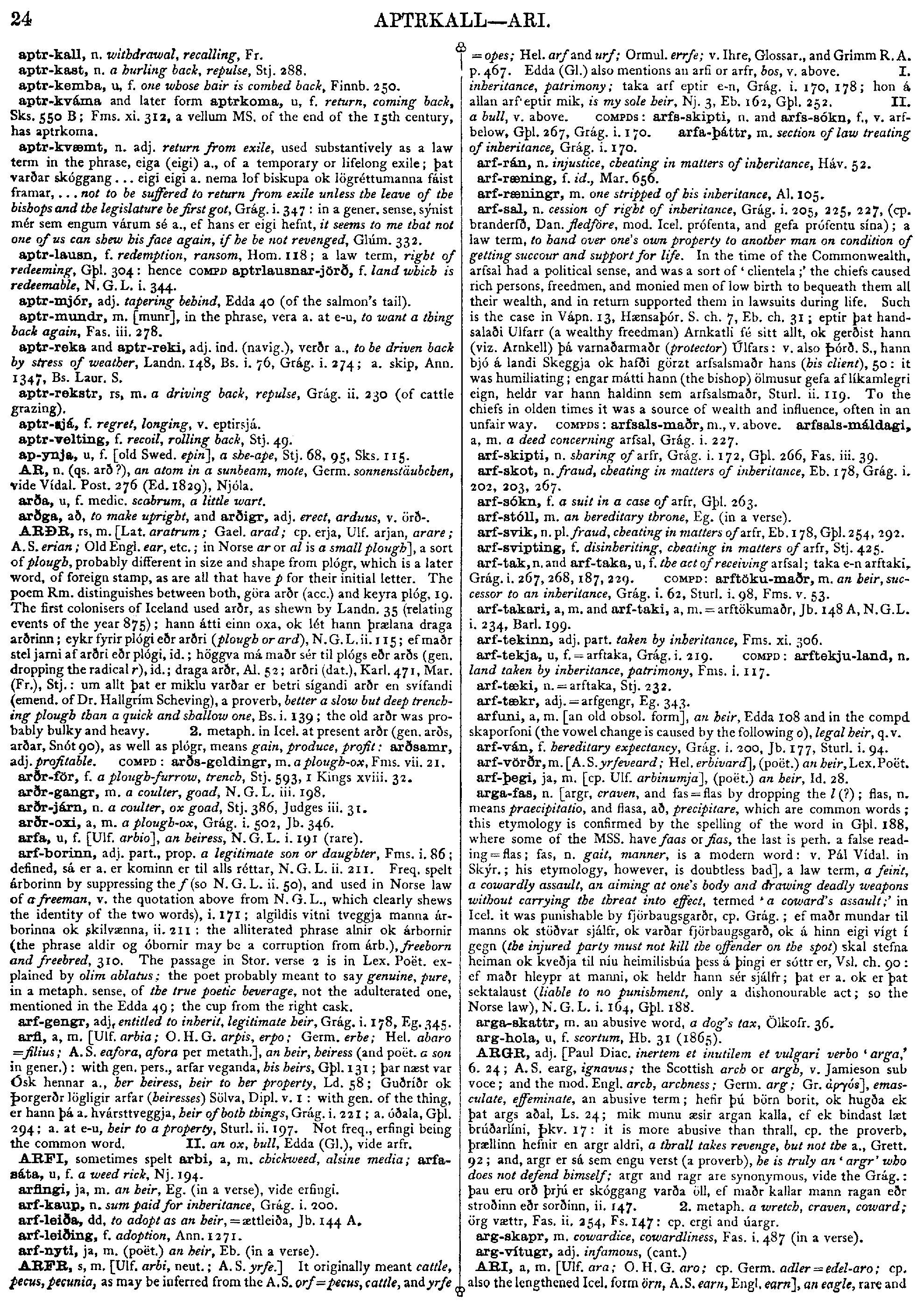
ARFR, s, m. [Ulf. arbi, neut.; A. S. yrfe.] It originally meant cattle, pecus, pecunia, as may be inferred from the A. S. orf = pecus, cattle, and yrfe = opes; Hel. arf and urf; Ormul. errfe; v. Ihre, Glossar., and Grimm R. A. p. 467. Edda (Gl.) also mentions an arfi or arfr, bos, v. above. I. inheritance, patrimony; taka arf eptir e-n, Grág. i. 170, 178; hon á allan arf eptir mik, is my sole heir, Nj. 3, Eb. 162, Gþl. 252. II. a bull, v. above. COMPDS: arfa-skipti, n. and arfs-sókn, f., v. arf- below, Gþl. 267, Grág. i. 170. arfa-þáttr, m. section of law treating of inheritance, Grág. i. 170.
|
Source: Cleasby/Vigfusson, page b0024, entry 46 View original page image as: [TIFF] [PNG] [View previous entry] [View next entry] |
[Comment on this entry] [View comments] |
The following entry has been hand-corrected once. |
arf-tekja, u, f. = arftaka, Grág. i. 219. COMPD: arftekju-land, n. land taken by inheritance, patrimony, Fms. i. 117.
|
Source: Cleasby/Vigfusson, page b0119, entry 26 View original page image as: [TIFF] [PNG] [View previous entry] [View next entry] |
[Comment on this entry] [View comments] |
The following entry has been hand-corrected once. |
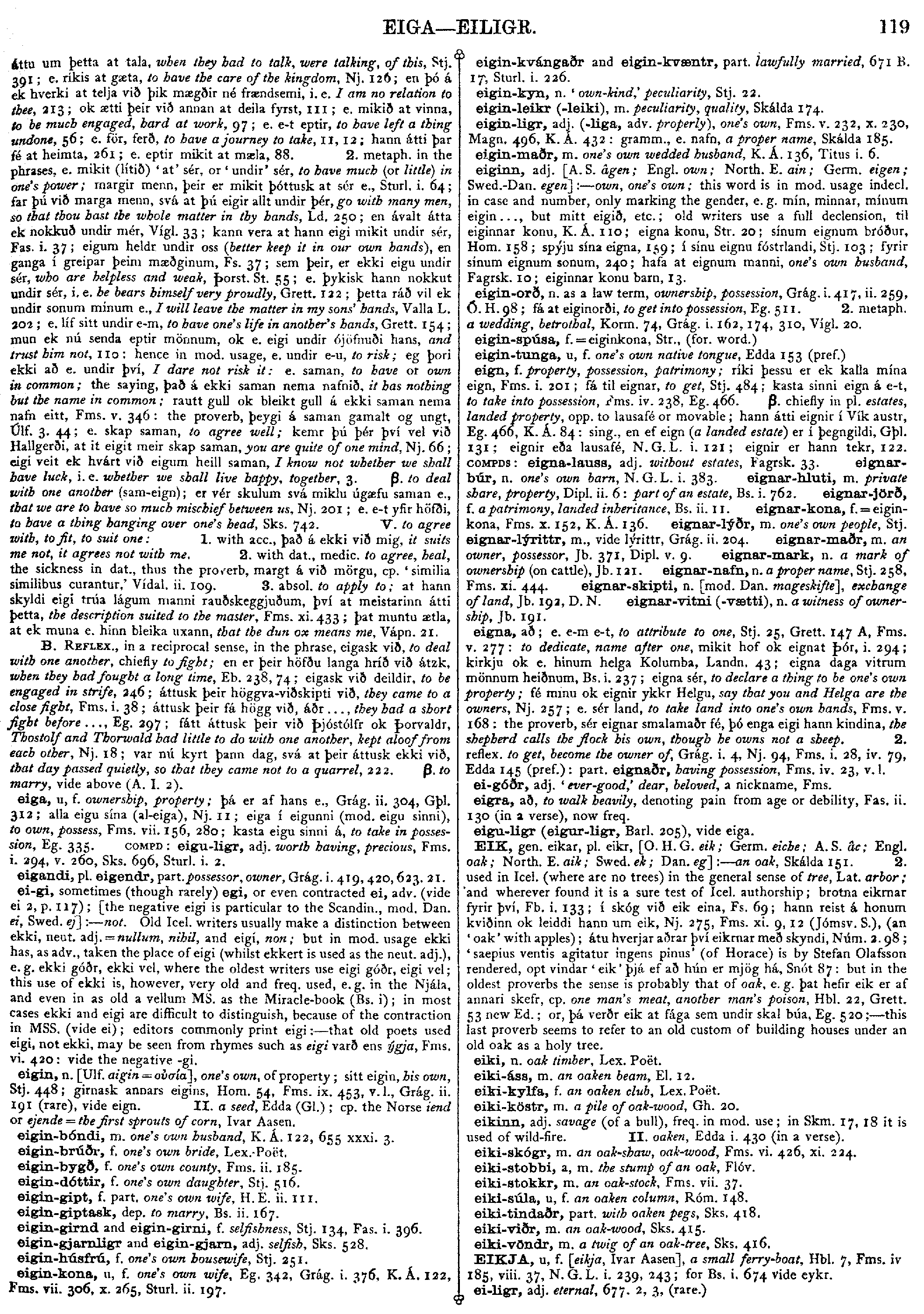
eign,
f.
property,
possession,
patrimony;
ríki
þessu
er
ek
kalla
mína
eign,
Fms.
i.
201;
fá
til
eignar,
to
get,
Stj.
484;
kasta
sinni
eign
á
e-t,
to
take
into
possession,
Fms.
iv.
238,
Eg.
466.
.
chiefly
in
pl.
estates,
landed
property,
opp.
to
lausafé
or
movable;
hann
átti
eignir
í
Vík
austr,
Eg.
466,
K.
Á.
84:
sing.,
en
ef
eign
(a
landed
estate)
er
í
þegngildi,
Gþl.
131;
eignir
eða
lausafé,
N.
G.
L.
i.
121;
eignir
er
hann
tekr,
122.
COMPDS:
eigna-lauss,
adj.
without
estates,
Fagrsk.
33.
eignar-búr,
n.
one's
own
barn,
N.
G.
L.
i.
383.
eignar-hluti,
m.
private
share,
property,
Dipl.
ii.
6:
part
of
an
estate,
Bs.
i.
762.
eignar-jörð,
f.
a
patrimony,
landed
inheritance,
Bs.
ii.
11.
eignar-kona,
f.
=
eiginkona,
Fms.
x.
152,
K.
Á.
136.
eignar-lýðr,
m.
one's
own
people,
Stj.
eignar-lýrittr,
m.,
vide
lýrittr,
Grág.
ii.
204.
eignar-maðr,
m.
an
owner,
possessor,
Jb.
371,
Dipl.
v.
9.
eignar-mark,
n.
a
mark
of
ownership
(on
cattle),
Jb.
121.
eignar-nafn,
n.
a
proper
name,
Stj.
258,
Fms.
xi.
444.
eignar-skipti,
n.
[mod.
Dan.
mageskifte],
exchange
of
land,
Jb.
192,
D.
N.
eignar-vitni
(-vætti),
n.
a
witness
of
ownership,
Jb.
191.
|
Source: Cleasby/Vigfusson, page b0131, entry 79 View original page image as: [TIFF] [PNG] [View previous entry] [View next entry] |
[Comment on this entry] [View comments] |
The following entry has been hand-corrected once. |
ERFÐ,
f.
[(Germ.
erbe],
inheritance;
for
the
etymology
vide
arfr;
the
law
distinguishes
between
frænd-erfð,
family
inheritance,
and
út-erfð,
alien
inheritance,
N.
G.
L.
ii.
146;
within
the
frænd-erfð
the
law
records
thirteen
degrees
of
kin,
Gþl.
232-242,
N.
G.
L.
i.
49,
Jb.
128
sqq.,
Grág.
i.
170.
sqq.:
special
kinds
of
'út-erfð'
are,
brand-erfð
(q.v.).
gest-erfd,
skip-erfð,
gjaf-erfð,
land-erfð,
félaga-erfð,
litla-erfð,
leysings-erfð,
N.
G.
L.
i.
50:
again,
in
mod.
usage
erfð
implies
the
notion
of
a
family,
and
út-erfð,
út-arfar
are
used
of
distant
kinsfolk,
inheritance
in
a
different
line,
or
the
like;
vide
Grág.,
Nj.,
and
the
Sagas
freq.
.
inheriting,
succession,
Gþl.
48-55.
COMPDS:
erfða-bálkr,
m.
the
section
of
law
treating
of
inheritance.
Ann.
1273.
erfða-einkunn,
f.
an
hereditary
mark
(on
cattle),
Grág.
ii.
304.
erfða-fé,
n.
an
heirloom,
inheritance,
Grág.
i.
206.
erfða-goðorð,
n.
hereditary
priesthood,
Sturl.
i.
198.
erfðá-land,
n.
patrimony,
land
of
inheritance,
Stj.
50,
66,
Orkn.
126,
Fms.
iv.
224,
vi.
20.
erfða-maðr,
m.
an
heir,
Js.
38.
erfða-mark,
n.
=
erfða-einkunn,
Grág.
i.
422,
423.
erfða-mál,
n.
a
lawsuit
as
to
inheritance,
Nj.
6,
92.
erfða-partr,
m.
share
of
inheritance,
Stj.
110.
erfða-skipan,
f.
a
law,
ordinance
of
inheritance,
N.
G.
L.
i.
49.
erfða-staðr,
m.
hereditary
estates,
used
in
a
special
sense
of
church
demesnes
held
by
lay
impropriators,
vide
Arna
S.,
Bs.
i.
794.
erfða-tal,
n.
the
section
of
law
respecting
inheritance,
Gþl.
55.
erfða-úmagi,
a,
m.
an
'úmagi'
having
an
inherited
right
to
support,
Grág.
i.
134,
237.
erfða-öldr,
n.
[Dan.
arveöl],
a
funeral
feast,
N.
G.
L.
i.
432.
|
Source: Cleasby/Vigfusson, page b0137, entry 2 View original page image as: [TIFF] [PNG] [View previous entry] [View next entry] |
[Comment on this entry] [View comments (3)] |
The following entry has been hand-corrected once. |
F
(eff),
the
sixth
letter,
was
in
the
Gothic
Runes,
on
the
Bracteats,
and
on
the
stone
in
Tune,
marked
RUNE,
a
form
evidently
derived
from
the
Greek
and
Latin;
hence
also
comes
the
Anglo-Saxon
RUNE
called
feoh,
and
in
the
Scandinavian
Runes
RUNE
called
fé
(=fee,
money),
fé
veldr
frænda
rógi,
Rkv.
I.
The
Runic
alphabet
makes
f
the
first
letter,
whence
this
alphabet
is
sometimes
by
modern
writers
called
Fuþork.
The
first
six
letters
are
called
Freys-ætt,
the
family
of
Frey;
perhaps
the
Goths
called
this
Rune
Frauja
=
Freyr,
the
lord.
Only
in
very
early
Icel.
MSS.
is
the
old
Latin
form
of
f
used:
at
the
beginning
of
the
13th
century
the
Anglo-Saxon
form
RUNE
(derived
from
the
Rune)
prevailed;
and
it
was
employed
in
printed
Icel.
books
till
about
A.
D.
1770,
when
the
Latin
f
came
into
use.
In
very
early
MSS.
ff
and
ft
are
very
difficult
to
distinguish
from
ff
and
ft.
Emendations
may
sometimes
be
made
by
bearing
this
in
mind,
e.
g.
hóstú,
Am.
95,
should
clearly
be
read
hóftú
=
hóft
þú,
from
hefja,
--
proving
that
this
poem
was
in
writing
not
later
than
about
A.
D.
1200,
when
the
Anglo-Saxon
letter
was
introduced.
A.
PRONUNCIATION.
--
At
the
beginning
of
a
syllable
always
sounded
as
Engl.
f;
but
as
a
medial
and
final,
it
is
often
pronounced
and
sometimes
spelt
v,
especially
after
a
vowel,
so
that
in
af,
ef,
lauf,
gefa,
hafa,
grafa,
lifa,
líf,
gröf,
f
is
pronounced
like
the
v,
as
in
Engl.
grave.
Foreign
proper
names,
Stefan
(Stephen),
etc.,
are
exceptions,
where
f
not
initial
has
an
aspirate
sound.
For
the
exceptional
spelling
of
f
as
b
vide
introduction
to
B,
(pp.
48,
49.)
The
Icel.
dislike
a
double
f
sound,
which
is
only
found
in
a
verv
few
modern
foreign
words,
such
as
kaffe,
coffee;
straff,
Germ,
strafe,
punishment;
koffort,
a
box
(from
French
or
Germ.);
offur,
an
offer;
skoffin,
a
monster;
skeffa,
a
'skep'
or
bushel;
skúffa,
a
drawer;
eff,
the
name
of
the
letter
itself,
cp.
Skálda
166.
B.
SPELLING:
I.
as
an
initial
the
spelling
never
changes;
as
medial
and
final
the
form
f
is
usually
retained,
as
in
álfr,
kálfr,
sjálfr,
silfr,
arfr,
orf,
úlfr,
etc.,
af,
gaf,
haf,
etc.,
although
the
sound
is
soft
in
all
these
syllables.
Some
MSS.
used
to
spell
fu,
especially
after
an
l,
sialfuan
(ipsum),
halfuan
(dimidium),
etc.;
in
the
14th
century
this
was
common,
but
did
not
continue;
in
Swedish
it
prevailed,
hence
the
mod.
Swed.
forms
gifva,
drifva,
etc.
II.
the
spelling
with
f
is
against
the
true
etymology
in
many
cases,
and
here
also
the
spelling
differs;
this
is
especially
the
case
with
the
final
radical
v
or
u
(after
a
vowel
or
after
l
or
r),
which,
being
in
some
cases
suppressed
or
obsolete,
reappears
and
is
differently
spelt;
thus,
örfar,
arrows
(from
ör);
snjófar
(nives),
snow,
and
snjófa,
to
snow
(from
snjór);
háfan
(acc.),
high
(from
hár);
mjófan,
thin
(from
mjór);
sæfar
(gen.),
the
sea
(from
sær):
the
partly
obsolete
dat.
forms
ölvi,
mjölvi,
Mávi,
bölvi,
heyvi,
hörvi,
smjörvi,
lævi
from
öl
(ale),
mjöl
(meal),
hey
(hay),
etc.
are
also
spelt
ölfi
...
heyfi,
cp.
e.
g.
Eb.
94
new
Ed.
note
8:
so
also
adjectives,
as
örfan
(acc.
from
örr),
liberal:
nouns,
as
völfa
or
völva,
a
prophetess.
III.
the
spelling
with
pt
in
such
words
as,
aptan,
evening;
aptr,
after;
leiptr,
lightning;
dript,
drift;
dupt,
Germ.
duft;
heipt,
cp.
Germ.
heftig;
kraptr,
Germ.
kraft;;
aptari,
eptri,
=
aftari,
eftri,
aft,
behind;
eptir,
after;
skipta,
to
shift;
lopt,
Germ.
luft;
kjöptr,
Germ.
UNCERTAIN;
opt,
often;
nipt
(from
nefi),
a
sister;
hapt,
a
haft,
hepta,
to
haft;
gipta,
a
gift;
raptr,
a
rafter;
tópt,
cp.
Engl.
toft,
Dan.
toft;
skapt,
Engl.
shaft,
Dan.
skaft;
þopta,
Dan.
tofte,
--
is
against
the
sense
and
etymology
and
is
an
imitation
of
Latin
MSS.
The
earliest
MSS.
and
almost
all
Norse
MSS.
use
ft,
and
so
also
many
Icel.
MSS.,
e.
g.
the
Flateyjar-bók,
Hauks-bók,
etc.;
pt,
however,
is
the
regular
spelling,
and
hence
it
came
into
print.
The
present
rule
appears
to
be
to
use
pt
wherever
both
consonants
are
radicals,
but
ft
if
the
t
be
inflexive
--
thus
haft,
part.
from
hafa,
líft
from
lifa,
hlíft
from
hlífa;
but
in
speaking
pt
and
ft
are
both
sounded
alike,
regardless
of
etymology,
viz.
both
as
ft
or
vt
with
a
soft
f
sound;
hence
phonetic
spelling
now
and
then
occurs
in
MSS.,
e.
g.
draft
--
drapt,
from
drepa,
Fb.
i.
149;
efðe
=
æpði
=
æpti,
from
æpa,
to
weep,
Bs.
i.
342;
keyfti,
from
kaupa,
Greg.
50;
steyfti,
from
steypa.
.
a
digraph
fp
or
pf
occurs
a
few
times
in
MSS.,
efptir,
673
A.
2;
lopfti
=
lopti,
Greg.
72
(vide
Frump.
100),
but
it
never
came
into
use;
it
reminds
one
of
the
pf
which
in
modern
German
is
so
frequent:
fm
--
f
or
m,
e.
g.
nafm
--
nafn
or
namn,
Mork.
60
and
N.
G.
L.
passim;
fft=ft
also
occurs
in
old
MSS.
C.
CHANGES.
--
The
final
soft
Icel.
f
answers
to
Engl.
f,
ve,
e.
g.
Icel.
líf
=
Engl.
life,
but
Icel.
lifa
=
Engl.
to
live;
gefa,
to
give;
hafa,
to
have;
leifa,
to
leave.
Again,
the
spurious
Icel.
f
(B.
II)
usually
answers
to
Engl.
w
or
the
like,
e.
g.
örfar
=
Engl.
arrow;
snjófar
=
Engl.
snow;
már
náfi,
cp.
Engl.
mew;
Icel.
nær
(the
v
is
here
suppressed),
cp.
Engl.
narrow;
Icel.
lævi,
cp.
Engl.
lewd,
etc.
etc.
In
Danish
the
soft
f
is
usually
spelt
with
v,
e.
g.
halv,
kalv,
hav,
give,
love,
sove,
--
Icel.
hálfr,
kálfr,
haf,
gefa,
lofa,
sofa,
whereas
the
Swedes
frequently
keep
the
f.
In
German
a
final
b
answers
to
Icel.
f;
Germ.
geben
=
Icel.
gefa,
Engl.
give;
Germ.
kalb,
erbe,
=
Icel.
kalfr,
arfi,
etc.,
see
introduction
to
B.
Again,
in
German
a
final
f
or
ff
answers
to
Icel.
and
Engl.
p,
e.
g.
Germ.
lauf
=Icel.
hlaup,
Engl.
leap;
Germ.
kauf
=
Icel.
kaup,
Engl.
cheap;
Germ.
schiff
=
Icel.
skip,
Engl.
ship,
also
skiff;
Germ.
treff
=
Icel.
drep;
Germ.
tief
=
Icel.
djúpr,
Engl.
deep;
Germ.
haufen
=
Icel.
hópr,
Engl.
heap;
Germ.
rufen
=
Icel.hrópa;
Germ.
schaffen
=
Icel.
skapa,
Engl.
shape;
Germ.
saufen
=
Icel.
súpa,
Engl.
to
sup;
Germ.
UNCERTAIN
=
Icel.
huppr,
Engl.
hip;
Germ.
greifen
=
Icel.
grípa,
Engl.
to
grapple,
grip;
Germ.
gaffen
=
Icel.
gapa,
Engl.
gape;
Germ.
offen
=
Icel.
opinn,
Engl.
open;
Germ.
affe
=
Icel.
api,
Engl.
ape;
Germ.
triefen
=
Icel.
drjúpa,
Engl.
drip;
Germ.
tropfen
=
Icel.
dropi,
Engl.
drop.
As
to
the
use
of
the
initial
f,
the
Engl.,
Icel.,
Swed.,
and
Dan.
all
agree;
the
High
Germ.
spelling
is
confused,
using
either
f
or
v,
but
both
of
them
are
sounded
alike,
thus
voll
=
Engl.
full,
Icel.
fullr;
vier
=
Engl.
four,
Icel.
fjórir;
vater
=
Engl.
father,
Icel.
faðir,
etc.:
but
fisch
=
Engl.
fish,
Icel.
fiskr;
fest
=
Engl.
fast,
Icel.
fastr.
This
German
v,
however,
seems
to
be
dying
out
(Grimm,
introduction
to
F).
2.
for
the
change
of
fn
and
mn,
see
introduction
to
B:
f
changes
to
m
in
a
few
Icel.
words,
as
himin,
qs.
hiffin,
cp.
Engl.
heaven;
helmingr,
a
half,
from
halfr,
half.
D.
INTERCHANGE.
--
The
Greek
and
Latin
p
answers
to
Teutonic
and
Icel.
f;
thus,
pater,
paucus,
piscis,
GREEK,
GREEK,
GREEK,
pecu,
pellis,
GREEK,
pinguis,
plecto,
pes,
GREEK,
pallor,
etc.,
cp.
Icel.
faðir,
fár,
fiskr,
fimm,
furr,
foli,
fé,
fell
(feldr),
feitr,
flétta,
fet
and
fótr,
fólr,
etc.;
Lat.
portare
=
færa,
Engl.
to
ford;
se-pelio
=
fela;
GREEK
=
fjóðr
and
fiðr;
GREEK
and
GREEK,
cp.
fnasa;
Lat.
per,
pro,
GREEK
cp.
fyrir;
Lat.
pl nus,
pleo,
GREEK,
GREEK,
cp.
fullr;
GREEK
=
fley;
Lat.
prior,
GREEK,
cp.
fyrir,
fyrstr:
Lat.
primus,
cp.
frum-;
Lat.
pl
nus,
pleo,
GREEK,
GREEK,
cp.
fullr;
GREEK
=
fley;
Lat.
prior,
GREEK,
cp.
fyrir,
fyrstr:
Lat.
primus,
cp.
frum-;
Lat.
pl res,
plrique,
GREEK,
GREEK,
GREEK
=
fjöl-,
fjöd,
fleiri,
flestr;
Lat.
plicare
=
falda;
Lat.
prtium,
cp.
friðr,
fríðendi,
etc.
(vide
Grimm).
Again,
where
no
interchange
has
taken
place
the
word
is
usually
borrowed
from
the
Greek
or
Latin,
e.
g.
forkr,
Engl.
fork
=
Lat.
furca;
Icel.
fals,
falskr
=
Lat.
falsus;
Icel.
fálki
=
Lat.
falco,
etc.
faðerni,
n.
fatherhood,
paternity,
Fms.
vii.
164;
at
f.
eðr
móðerni,
on
father's
or
mother's
side,
Eg.
267,
Fms.
ix.
251;
verða
sekr
um
f.,
to
be
convicted
of
fatherhood,
Grág.
i.
86;
ganga
við
f.,
to
acknowledge
one's
fatherhood,
Fms.
i.
257,
ii.
19,
iii.
130;
faðerni
opp.
to
móðerni,
vi.
223.
.
patrimony,
Skv.
3.
67.
.
a
parent,
the
father;
ekki
var
breytt
um
f.
Kolla,
Bjarn.
45
MS.
(Ed.
wrongly
föðurinn);
hann
var
ljóss
ok
fagr
eptir
f.
sínu,
as
his
father,
Edda
7.
.
eccl.
=
Lat.
paternitas,
Bs.
ii.
14,
80,
151,
Th.
12,
Mar.,
etc.
FAÐIR,
m.,
gen.
dat.
and
acc.
föður:
pl.
nom.
and
acc.
feðr,
gen.
feðra,
dat.
feðrum;
there
also
occurs
a
monosyllabic
nom.
föðr
or
feðr,
gen.
föðrs
or
feðrs,
dat.
and
acc.
föðr
or
feðr,
the
pl.
as
in
faðir;
this
form
occurs
passim
in
MSS.
and
editions,
but
is
less
correct
and
quite
obsolete,
Eg.
178,
Fms.
i.
6,
N.
G.
L.
i.
52,
Stj.
130:
in
mod.
usage
in
gen.
both
föður
and
föðurs,
better
föðrs:
feðr
nd
veðr
are
rhymed,
Edda
95;
cp.
also
the
compds
all-föðr
(of
Odin),
but
Al-faðir
of
God
in
mod.
usage:
[Goth,
fadar;
A.
S.
fader;
Early
Engl.
fader,
mod.
father;
O.
H.
G.
fatar,
mod.
vater;
Swed.-Dan.
fader;
Lat.
p
res,
plrique,
GREEK,
GREEK,
GREEK
=
fjöl-,
fjöd,
fleiri,
flestr;
Lat.
plicare
=
falda;
Lat.
prtium,
cp.
friðr,
fríðendi,
etc.
(vide
Grimm).
Again,
where
no
interchange
has
taken
place
the
word
is
usually
borrowed
from
the
Greek
or
Latin,
e.
g.
forkr,
Engl.
fork
=
Lat.
furca;
Icel.
fals,
falskr
=
Lat.
falsus;
Icel.
fálki
=
Lat.
falco,
etc.
faðerni,
n.
fatherhood,
paternity,
Fms.
vii.
164;
at
f.
eðr
móðerni,
on
father's
or
mother's
side,
Eg.
267,
Fms.
ix.
251;
verða
sekr
um
f.,
to
be
convicted
of
fatherhood,
Grág.
i.
86;
ganga
við
f.,
to
acknowledge
one's
fatherhood,
Fms.
i.
257,
ii.
19,
iii.
130;
faðerni
opp.
to
móðerni,
vi.
223.
.
patrimony,
Skv.
3.
67.
.
a
parent,
the
father;
ekki
var
breytt
um
f.
Kolla,
Bjarn.
45
MS.
(Ed.
wrongly
föðurinn);
hann
var
ljóss
ok
fagr
eptir
f.
sínu,
as
his
father,
Edda
7.
.
eccl.
=
Lat.
paternitas,
Bs.
ii.
14,
80,
151,
Th.
12,
Mar.,
etc.
FAÐIR,
m.,
gen.
dat.
and
acc.
föður:
pl.
nom.
and
acc.
feðr,
gen.
feðra,
dat.
feðrum;
there
also
occurs
a
monosyllabic
nom.
föðr
or
feðr,
gen.
föðrs
or
feðrs,
dat.
and
acc.
föðr
or
feðr,
the
pl.
as
in
faðir;
this
form
occurs
passim
in
MSS.
and
editions,
but
is
less
correct
and
quite
obsolete,
Eg.
178,
Fms.
i.
6,
N.
G.
L.
i.
52,
Stj.
130:
in
mod.
usage
in
gen.
both
föður
and
föðurs,
better
föðrs:
feðr
nd
veðr
are
rhymed,
Edda
95;
cp.
also
the
compds
all-föðr
(of
Odin),
but
Al-faðir
of
God
in
mod.
usage:
[Goth,
fadar;
A.
S.
fader;
Early
Engl.
fader,
mod.
father;
O.
H.
G.
fatar,
mod.
vater;
Swed.-Dan.
fader;
Lat.
p ter;
Gr.
GREEK
all
of
them
bisyllabic]
:--
a
father,
N.
G.
L.
i.
30,
Grág.
i.
170,
Stj.
71,
Hom.
47,
passim
:--
in
eccl.
sense,
Lat.
pater,
a
father
of
the
church,
Stj.
126;
speki
feðra,
Eluc.
2,
K.
Á.
30;
faðir
ok
forstjóri,
father
and
ruler,
Mar.
:--
God,
heavenly
Father,
N.
T.;
Foðir
Vor,
Our
Father
(i.
e.
the
Lord's
Prayer,
Lat.
Pater
Noster).
Proverb
or
saying,
fleygir
fúsum
til
föður
húsa,
swift
is
the
ride
towards
a
father's
house.
COMPDS:
föður-afi,
u,
m.
a
grandfather
on
the
father's
side.
föður-arfr,
m.
inheritance
after
a
father,
Eg.
470,
Rd.
282,
Fb.
ii.
172.
föður-bani,
a,
m.
slayer
of
another
man's
father,
Nj.
120,
Landn.
286,
Fms.
vi.
367,
vii.
220,
Fb.
i.
555.
Föður-betringr,
m.
better
than
one's
father,
Grett.
110.
föður-bróðir,
m.
a
father's
brother,
uncle,
Grág;.
i.
171,
ii.
185,
Nj.
4:
föðurbróður-sonr,
a
father's
brother's
son,
Fms.
x.
390.
föður-bætr,
f.
pl.
weregild
for
a
father,
Fms.
ii.
109,
Hkr.
iii.
387.
föður-dauði,
a,
m.
a
father's
death,
Ísl.
ii.
116,
Fas.
i.
34.
föður-dráp,
n.
a
father's
slaughter,
Ísl.
l.
c.,
v.
l.
föður-erfð,
f.
=
föðurarfr,
Landn.
214,
v.
l.
föður-faðir,
m.
a
father's
father,
Grág.
i.
171,
ii.
185,
Jb.
14,
Fms.
i.
67,
vii.
16.
föður-frændi,
a,
m.
a
kinsman
on
the
father's
side,
Gþl.
261,
Ld.
24.
föður-garðr,
m.
a
father's
house,
Fas.
iii.
250,
cp.
K.
Á.
58.
föður-gjöld,
n.
pl.
weregild
for
one's
father,
Edda
48,
Ísl.
ii.
216.
föður-hefndir,
f.
pl.
revenge
for
one's
father
if
slain,
Ld.
260,
Rd.
305,
Vd.
94,
Al.
7;
as
to
this
heathen
custom,
vide
Sdm.
35,
Skv.
3.
12,
Nj.
ch.
120
(en
þó
er
þér
meiri
nauðsyná
at
hefna
föður
þíns),
Heiðarv.
S.
(the
revenge
of
Gest),
Fms.
vi,
Har.
S.
harðr.
103
(the
taunts
of
Halli),
Ld.
ch.
60,
cp.
also
Eb.
ch.
38,
etc.
föður-hús,
n.
a
father's
house,
Stj.
398,
463.
föður-kyn,
n.
father's
kin,
Eg.
266.
föður-land,
n.
[Germ.
vaterland,
Dan.
fædreland],
fatherland,
Bær.
17,
a
rare
word,
sounding
even
now
affected
and
mod.;
Icel.
prefer
saying
ætt-jörð,
fóstr-jörð,
or
the
like.
föður-lauss,
adj.
fatherless,
H.
E.
i.
237.
föður-leifð
(föður-leif,
Bær.
5,
Fms.
x.
386),
f.
a
patrimony,
viz.
land
and
estates,
Fms.
i.
52,
v.
117,
vii.
176,
Ld.
104.
föður-liga,
adv.
and
föður-ligr,
adj.
fatherly,
Stj.
63,
Fms.
vi.
70,
Finnb.
226.
föður-móðir,
f.
a
father's
mother,
Nj.
25,
Grág.
i.
171.
föður-systir,
[whence
Dan.
faster],
f.
a
father's
sister,
Grág.
i.
171,
Fms.
iv.
24;
füðursystur-dóttir,
the
daughter
of
a
father's
sister,
a
niece,
Hkr.
iii.
170.
föður-verringr,
m.
a
degenerate
son,
Mag.
föður-ætt
(or
-átt),
f.
kinsfolk
on
the
father's
side,
Grág.
i.
171,
Nj.
25,
Gþl.
158.
II.
in
many
COMPDS
used
as
adj.,
e.
g.
föður-ást,
f.
and
föður-elska,
u,
f.
fatherly
love;
föður-hendr,
f,
pl.
fatherly
ter;
Gr.
GREEK
all
of
them
bisyllabic]
:--
a
father,
N.
G.
L.
i.
30,
Grág.
i.
170,
Stj.
71,
Hom.
47,
passim
:--
in
eccl.
sense,
Lat.
pater,
a
father
of
the
church,
Stj.
126;
speki
feðra,
Eluc.
2,
K.
Á.
30;
faðir
ok
forstjóri,
father
and
ruler,
Mar.
:--
God,
heavenly
Father,
N.
T.;
Foðir
Vor,
Our
Father
(i.
e.
the
Lord's
Prayer,
Lat.
Pater
Noster).
Proverb
or
saying,
fleygir
fúsum
til
föður
húsa,
swift
is
the
ride
towards
a
father's
house.
COMPDS:
föður-afi,
u,
m.
a
grandfather
on
the
father's
side.
föður-arfr,
m.
inheritance
after
a
father,
Eg.
470,
Rd.
282,
Fb.
ii.
172.
föður-bani,
a,
m.
slayer
of
another
man's
father,
Nj.
120,
Landn.
286,
Fms.
vi.
367,
vii.
220,
Fb.
i.
555.
Föður-betringr,
m.
better
than
one's
father,
Grett.
110.
föður-bróðir,
m.
a
father's
brother,
uncle,
Grág;.
i.
171,
ii.
185,
Nj.
4:
föðurbróður-sonr,
a
father's
brother's
son,
Fms.
x.
390.
föður-bætr,
f.
pl.
weregild
for
a
father,
Fms.
ii.
109,
Hkr.
iii.
387.
föður-dauði,
a,
m.
a
father's
death,
Ísl.
ii.
116,
Fas.
i.
34.
föður-dráp,
n.
a
father's
slaughter,
Ísl.
l.
c.,
v.
l.
föður-erfð,
f.
=
föðurarfr,
Landn.
214,
v.
l.
föður-faðir,
m.
a
father's
father,
Grág.
i.
171,
ii.
185,
Jb.
14,
Fms.
i.
67,
vii.
16.
föður-frændi,
a,
m.
a
kinsman
on
the
father's
side,
Gþl.
261,
Ld.
24.
föður-garðr,
m.
a
father's
house,
Fas.
iii.
250,
cp.
K.
Á.
58.
föður-gjöld,
n.
pl.
weregild
for
one's
father,
Edda
48,
Ísl.
ii.
216.
föður-hefndir,
f.
pl.
revenge
for
one's
father
if
slain,
Ld.
260,
Rd.
305,
Vd.
94,
Al.
7;
as
to
this
heathen
custom,
vide
Sdm.
35,
Skv.
3.
12,
Nj.
ch.
120
(en
þó
er
þér
meiri
nauðsyná
at
hefna
föður
þíns),
Heiðarv.
S.
(the
revenge
of
Gest),
Fms.
vi,
Har.
S.
harðr.
103
(the
taunts
of
Halli),
Ld.
ch.
60,
cp.
also
Eb.
ch.
38,
etc.
föður-hús,
n.
a
father's
house,
Stj.
398,
463.
föður-kyn,
n.
father's
kin,
Eg.
266.
föður-land,
n.
[Germ.
vaterland,
Dan.
fædreland],
fatherland,
Bær.
17,
a
rare
word,
sounding
even
now
affected
and
mod.;
Icel.
prefer
saying
ætt-jörð,
fóstr-jörð,
or
the
like.
föður-lauss,
adj.
fatherless,
H.
E.
i.
237.
föður-leifð
(föður-leif,
Bær.
5,
Fms.
x.
386),
f.
a
patrimony,
viz.
land
and
estates,
Fms.
i.
52,
v.
117,
vii.
176,
Ld.
104.
föður-liga,
adv.
and
föður-ligr,
adj.
fatherly,
Stj.
63,
Fms.
vi.
70,
Finnb.
226.
föður-móðir,
f.
a
father's
mother,
Nj.
25,
Grág.
i.
171.
föður-systir,
[whence
Dan.
faster],
f.
a
father's
sister,
Grág.
i.
171,
Fms.
iv.
24;
füðursystur-dóttir,
the
daughter
of
a
father's
sister,
a
niece,
Hkr.
iii.
170.
föður-verringr,
m.
a
degenerate
son,
Mag.
föður-ætt
(or
-átt),
f.
kinsfolk
on
the
father's
side,
Grág.
i.
171,
Nj.
25,
Gþl.
158.
II.
in
many
COMPDS
used
as
adj.,
e.
g.
föður-ást,
f.
and
föður-elska,
u,
f.
fatherly
love;
föður-hendr,
f,
pl.
fatherly
|
Source: Cleasby/Vigfusson, page b0157, entry 1 View original page image as: [TIFF] [PNG] [View previous entry] [View next entry] |
[Comment on this entry] [View comments] |
The following entry has been hand-corrected once. |
sólu
fjarri,
Vsp.
44;
hvárt
sem
eru
nær
kirkju
eða
fjarri
kirkju-garði,
far
from
the
churchyard,
K.
Þ.
K.
28;
standa
f.
e-m,
to
stand
far
from
one;
hamingjan
stóð
honum
eigi
fjarri,
Al.
82;
stóðtu
mér
þá
fjarri,
Nj.
19;
útibúr
þat
er
first
var
húsum,
farthest
from
the
houses,
168;
hvar
fjarri
öðrum
mönnum,
quite
far
from
other
men,
Grett.
127;
þeim
mönnum
er
first
bygðu
megin-héruðum,
who
lived
farthest
from
the
chief
counties,
Fms.
iv.
144;
í
þat
horn
lands
síns
er
first
er
lýrittar-vörn
hans,
Grág.
ii.
224;
þóttusk
þeir
bazt
hafa
er
first
vóru
þeirra
samgangi,
the
farther
off
the
better,
Glúm.
380;
svá
hátt
at
þó
mátti
heyra
gerla
þótt
þeir
væri
firr,
Nj.
118;
þó
at
skip
leggi
firr
búð
(dat.)
en
svá,
Grág.
i.
91;
eigi
firr
garði
en
í
örskots-helgi,
82;
far
þú
firr
sundi,
begone
from
the
sound,
Hbl.
54;
farit
firr
húsi,
Am.
37;
the
phrase,
ganga
e-m
hendi
firr,
to
go
out
of
one's
hand,
be
lost,
Rd.
283,
Grett.
(in
a
verse);
þykki
mér
hann
jafnan
betri
firr
mér
en
nær,
Fms.
iv.
330;
hvárt
þat
er
nær
honum
eða
firr,
Rb.
38,
(mod.,
nær
eða
fjær);
með
hramminum
þeim
er
firr
var
berginu,
Grett.
101;
firr
meir,
farther
aloof;
bónda-múgrinn
sat
firr
meir,
Fms.
i.
280;
ok
því
firr
meir,
at
...,
and
so
much
more
aloof,
in
order
that
...,
Sks.
365:
in
the
proverb,
allt
er
fjörvi
firr,
all
is
farther
than
life,
i.e.
life
is
the
nearest,
dearest
thing,,
Ld.
266,
(or,
fé
er
fjörvi
firr);
at
firr,
much
less,
Eg.
ch.
14;
þótt
hann
sé
firr
farinn,
though
be
be
far
away,
Hm.
33.
II.
metaph.,
taka
e-u
fjarri,
to
take
a
thing
far,
i.e.
to
take
it
coolly,
deny
it
flatly;
Ormr
tók
því
ekki
fjarri,
Fms.
i.
209;
þeir
tóku
því
ekki
fjarri,
229;
ek
ætla
þat
nú
eigi
fjarri,
well,
I
think
it's
not
far
wrong,
Nj.
248:
with
dat.,
ok
er
þat
ekki
fjarri
hennar
skapi,
'tis
not
far
from
her
mind,
49;
þat
er
fjarri
skapi
föður
míns,
Lv.
87;
þú
talar
þat
eigi
fjarri
réttu,
thou
sayest
what
is
not
far
from
right,
Fms.
ii.
14;
eigi
fjarri
því
at
lengd,
i.e.
about
so
long
a
time,
Bs.
i.
61;
ferr
eigi
fjarri
getu
minni,
Fms.
iv.
312,
vi.
104;
the
phrase,
fjarri
fer
því,
it
'fares'
far
from
that,
i.e.
far
from
it,
by
no
means;
ok
er
því
fjarri
orðit
er
ek
vilda
at
væri,
it
is
far
from
what
I
had
wished
for,
Valla
L.
221;
nú
sé
ek
eigi
at
mér
mætti
firr
um
fara
en
þér,
now
I
see
not
how
I
can
fare
worse
than
thou,
Grett.
150.
.
far
from,
bereft
of;
fjarri
feðr-munum,
bereft
of
my
patrimony,
Fm.
8;
fjarri
vinum,
friendless,
Sighvat;
fjarri
augum
sem
menjum,
bereft
of
eyes
and
treasures,
i.e.
losing
both
life
and
money,
Akv.
27.
|
Source: Cleasby/Vigfusson, page b0177, entry 4 View original page image as: [TIFF] [PNG] [View previous entry] [View next entry] |
[Comment on this entry] [View comments] |
The following entry has been hand-corrected once. |
frænd-leifð, f. patrimony, inheritance, Fms. iv. 79, Stj. 600.
|
Source: Cleasby/Vigfusson, page b0381, entry 33 View original page image as: [TIFF] [PNG] [View previous entry] [View next entry] |
[Comment on this entry] [View comments] |
The following entry has not been hand-corrected. However, the page is reserved and someone is correcting it. |
LEIF, f., pl. leifar, [Ulf. laib a, Mark viii. 8]: I. sing, a ' leav- ing, ' patrimony, inheritance, of an estate: freq. in Norse and Dan. local names, Haders-lev, Snolde-löv, = Höðrs-leif, Snjalls-leif, but obsolete and not used in Icel.; cp. leifð. II. pl. leifar, leavings, remnants, esp. of food; hann blótaði forsinn, skyldi bera leifar allar í forsinn, Landn. 291; varga leifar, Gkv.; sjö karfir með afgangs-leifar, Mark viii. 8; en er þeir vóru mettir, þá hirði Arnljótr leifar þeirra, Ó. H. 153, passim. 2. metaph. effects; ilia gefa ills ráðs leifar, Nj.
| Result Page: | 1 2 | Next |  |
Germanic Lexicon Project (main page)
This search system was written by
Sean Crist
Please consider
volunteering
to correct the data in these online dictionaries.
No rights reserved. Feel free to use these data in any way you please.