|
|

|
Source: Cleasby/Vigfusson, page b0423, entry 4 View original page image as: [TIFF] [PNG] [View previous entry] [View next entry] |
[Comment on this entry] [View comments] |
The following entry has been hand-corrected once. |
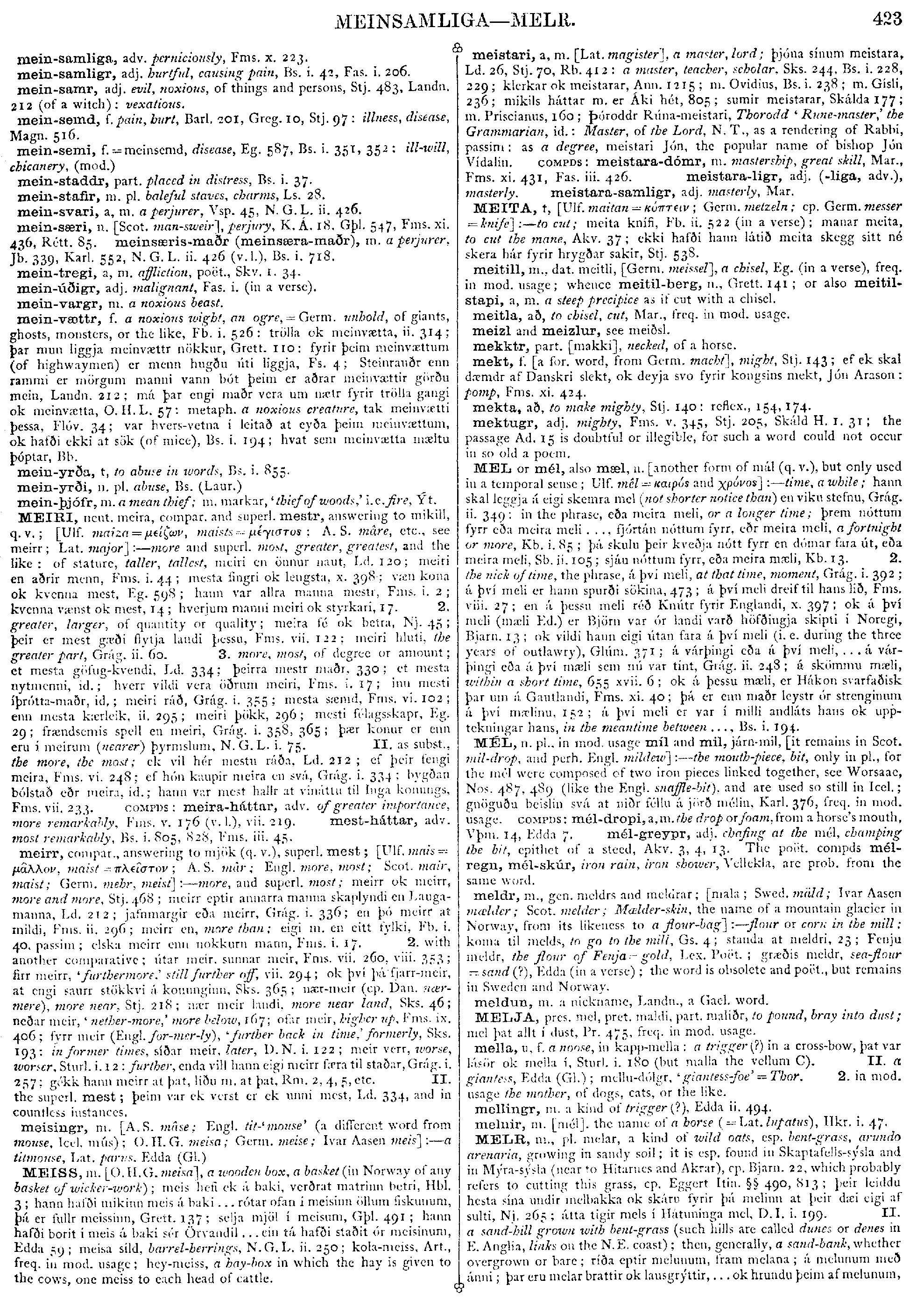
mein-semd, f. pain, hurt, Barl. 201, Greg. 10, Stj. 97: illness, disease, Magn. 516.
|
Source: Cleasby/Vigfusson, page b0439, entry 6 View original page image as: [TIFF] [PNG] [View previous entry] [View next entry] |
[Comment on this entry] [View comments] |
The following entry has been hand-corrected once. |
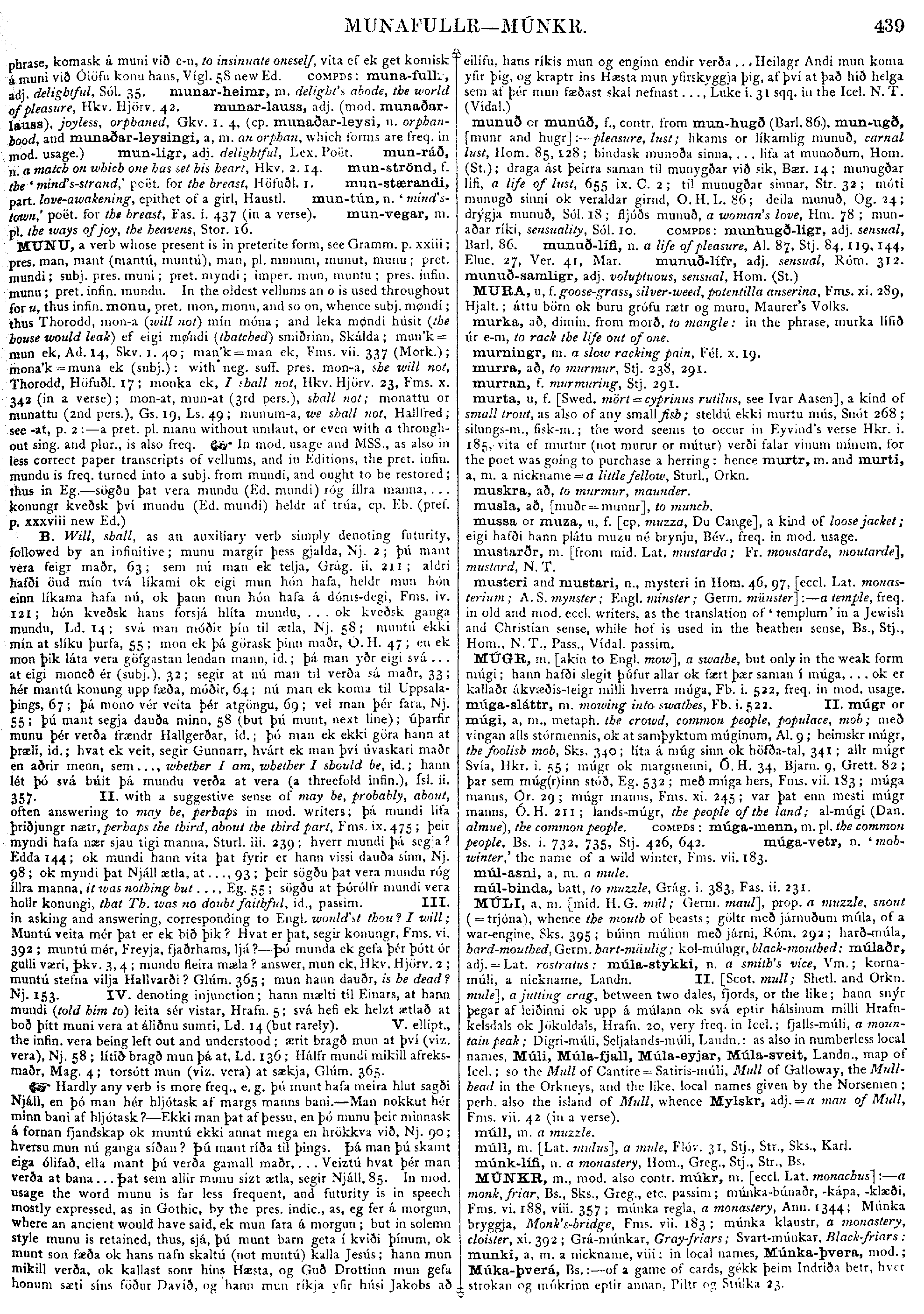
murningr, m. a slow racking pain, Fél. x. 19.
|
Source: Cleasby/Vigfusson, page b0453, entry 9 View original page image as: [TIFF] [PNG] [View previous entry] [View next entry] |
[Comment on this entry] [View comments] |
The following entry has been hand-corrected once. |
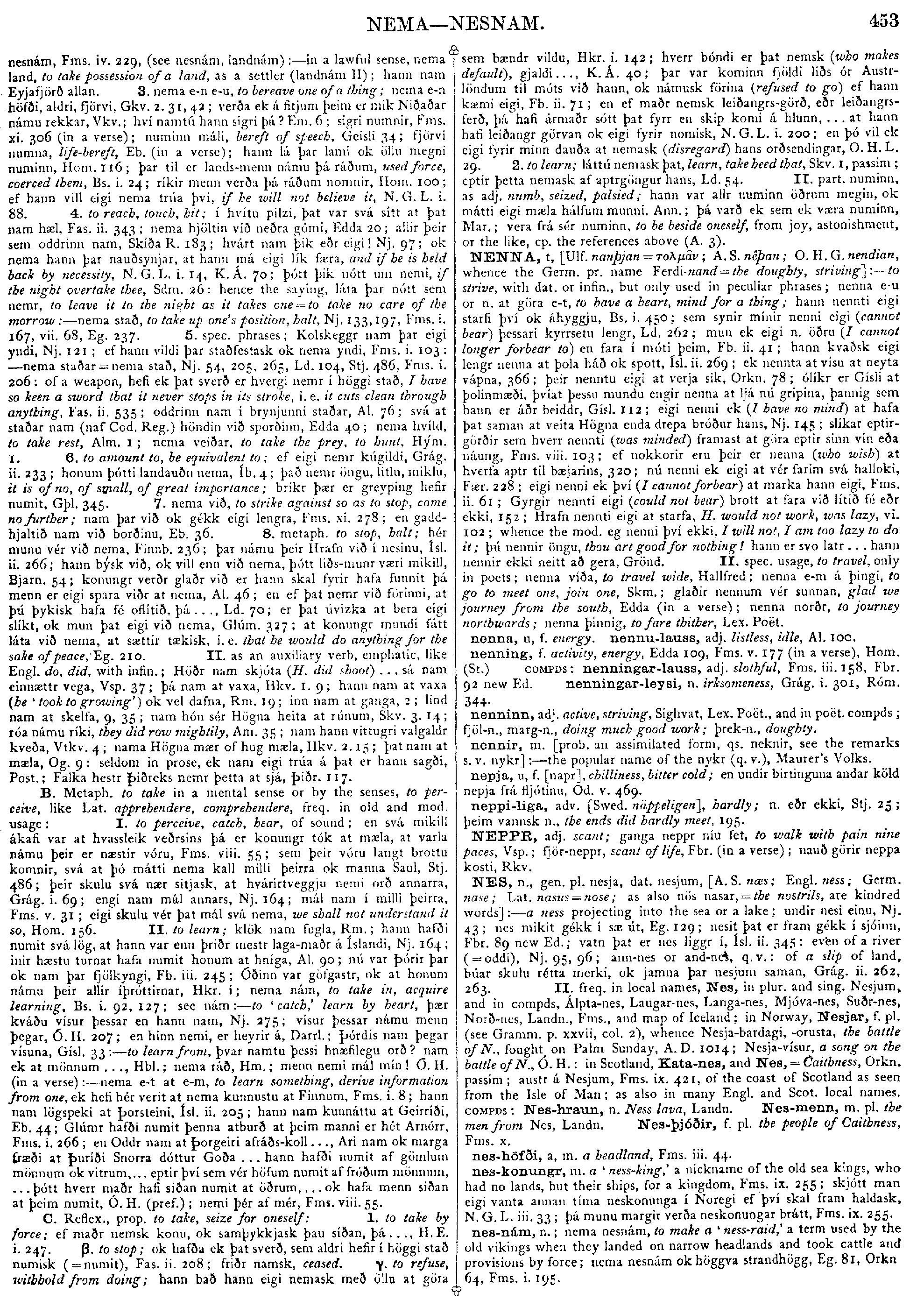
NEPPR, adj. scant; ganga neppr níu fet, to walk with pain nine paces, Vsp.; fjör-neppr, scant of life, Fbr. (in a verse); nauð görir neppa kosti, Rkv.
|
Source: Cleasby/Vigfusson, page b0459, entry 43 View original page image as: [TIFF] [PNG] [View previous entry] [View next entry] |
[Comment on this entry] [View comments] |
The following entry has been hand-corrected once. |
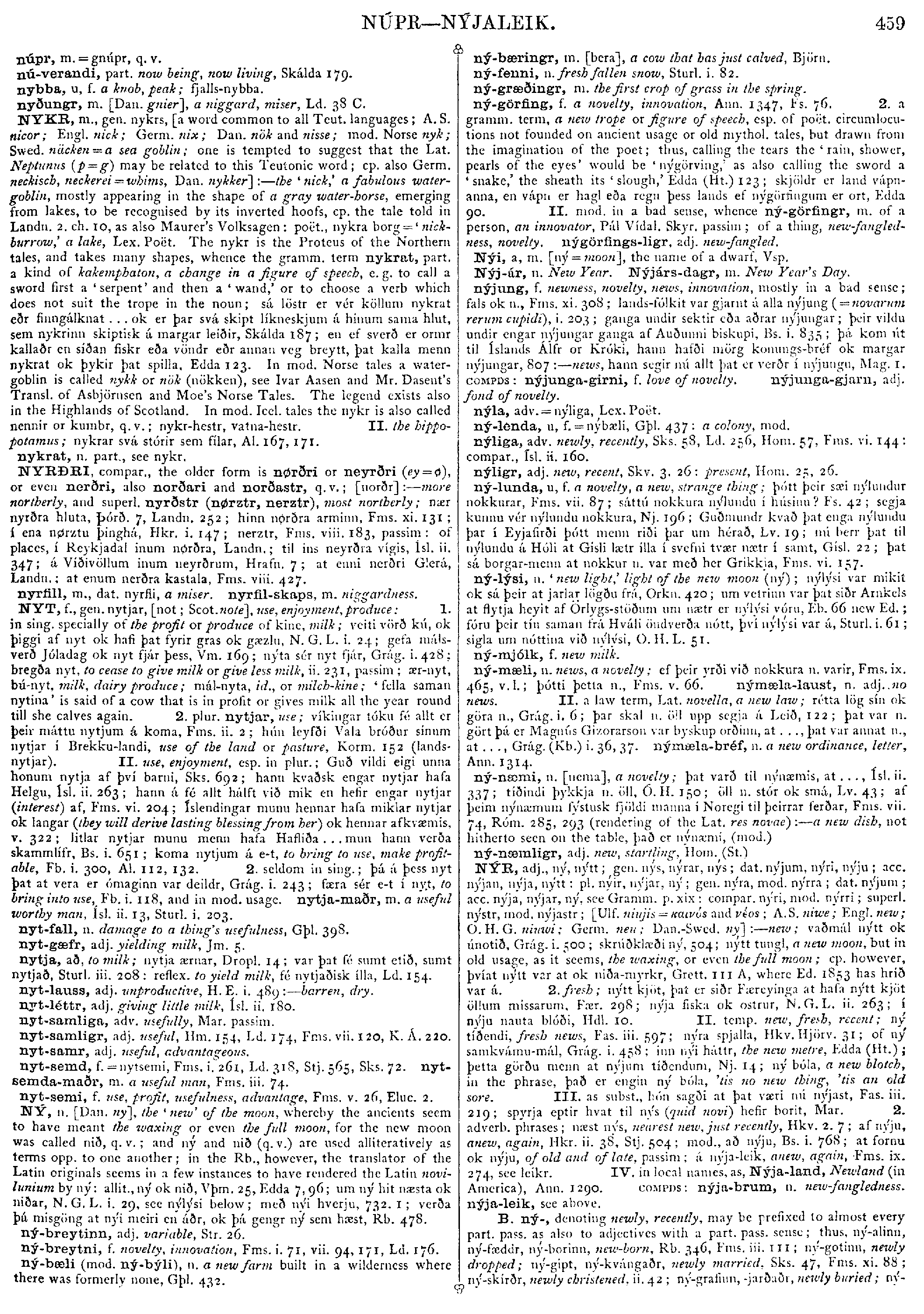
NÝRA, n., pl. nýru, gen. nýrna; [Scot. neirs; Germ. nieren; Dan. nyre; Gr. GREEK] :-- the kidneys, Stj. 310, passim: poët., haf-nýra, a pearl, Lex. Poët. COMPDS: nýrna-mör, m. kidney fat, in beasts. nýrna-verkr, m., medic. 'kidney -work,' pain in the kidneys, Ann. 1426.
|
Source: Cleasby/Vigfusson, page b0464, entry 38 View original page image as: [TIFF] [PNG] [View previous entry] [View next entry] |
[Comment on this entry] [View comments] |
The following entry has been hand-corrected once. |
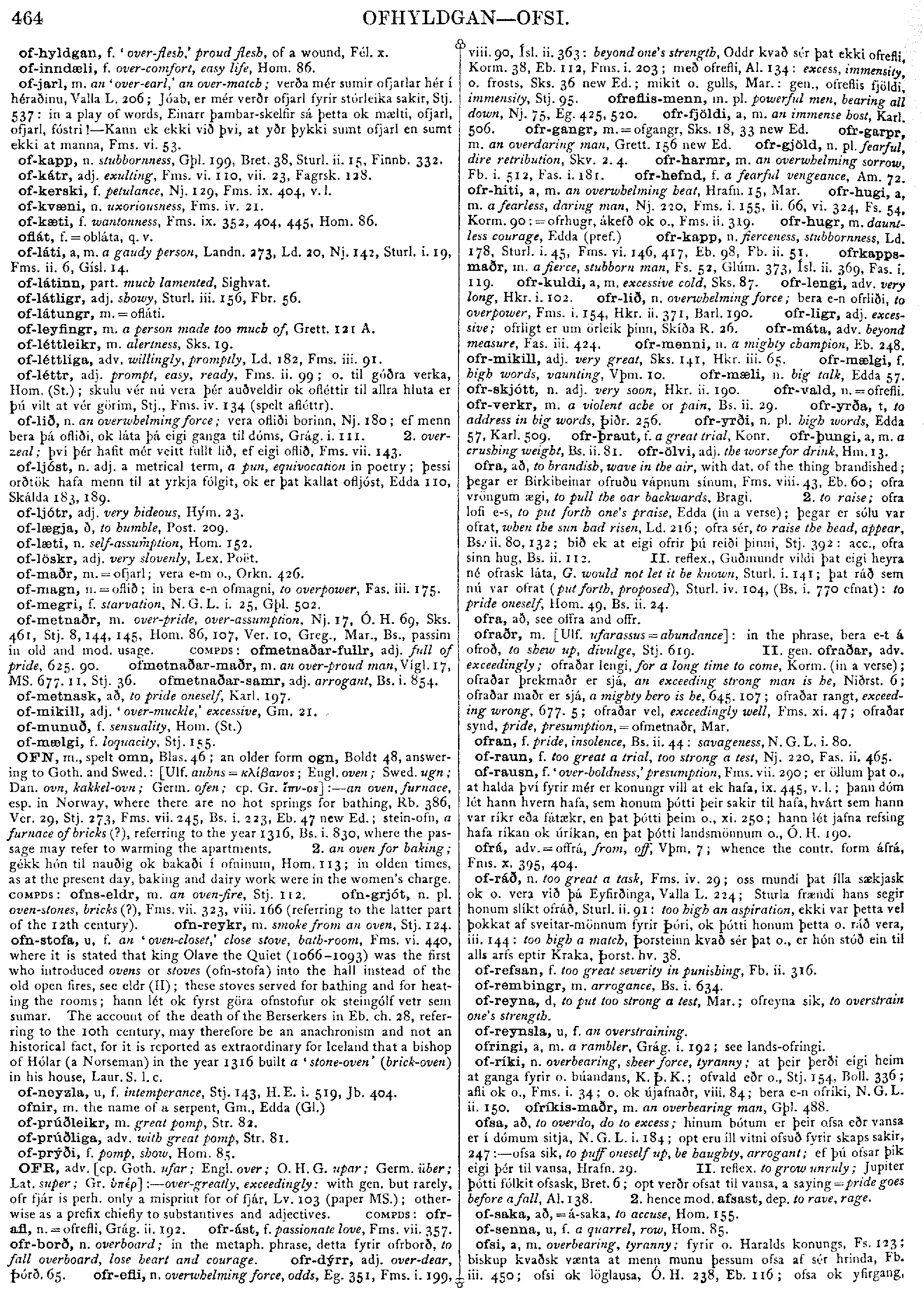
OFR, adv. [cp. Goth. ufar; Engl. over; O.H.G. upar; Germ. über; Lat. super; Gr. GREEK] :-- over-greatly, exceedingly: with gen. but rarely, ofr fjár is perh. only a misprint for of fjár, Lv. 103 (paper MS.); otherwise as a prefix chiefly to substantives and adjectives. COMPDS: ofr-afl, n. = ofrefli, Grág. ii. 192. ofr-ást, f. passionate love, Fms. vii. 357. ofr-borð, n. overboard; in the metaph. phrase, detta fyrir ofrborð, to fall overboard, lose heart and courage. ofr-dýrr, adj. over-dear, Þórð. 65. ofr-efli, n. overwhelming force, odds, Eg. 351, Fms. i. 199, viii. 90, Ísl. ii. 363: beyond one's strength, Oddr kvað sér þat ekki ofrefli Korm. 38, Eb. 112, Fms. i. 203; með ofrefli, Al. 134: excess, immensity o. frosts, Sks. 36 new Ed.; mikit o. gulls, Mar.: gen., ofreflis fjöldi, immensity, Stj. 95. ofreflis-menn, m. pl. powerful men, bearing all down, Nj. 75, Eg. 425, 520. ofr-fjöldi, a, m. an immense host, Karl. 506. ofr-gangr, m. = ofgangr, Sks. 18, 33 new Ed. ofr-garpr, m. an overdaring man, Grett. 156 new Ed. ofr-gjöld, n. pl. fearful, dire retribution, Skv. 2. 4. ofr-harmr, m. an overwhelming sorrow, Fb. i. 512, Fas. i. 181. ofr-hefnd, f. a fearful vengeance. Am. 72. ofr-hiti, a, m. an overwhelming heat, Hrafn. 15, Mar. ofr-hugi, a, m. a fearless, daring man, Nj. 220, Fms. i. 155, ii. 66, vi. 324, Fs. 54, Korm. 90: = ofrhugr, ákefð ok o., Fms. ii. 319. ofr-hugr, m. dauntless courage, Edda (pref.) ofr-kapp, n. fierceness, stubbornness, Ld. 178, Sturl. i. 45, Fms. vi. 146, 417, Eb. 98, Fb. ii. 51. ofrkapps-maðr, m. a fierce, stubborn man, Fs. 52, Glúm. 373, Ísl. ii. 369, Fas. i. 119. ofr-kuldi, a, m. excessive cold, Sks. 87. ofr-lengi, adv. very long, Hkr. i. 102. ofr-lið, n. overwhelming force; bera e-n ofrliði, to overpower, Fms. i. 154, Hkr. ii. 371, Barl. 190. ofr-ligr, adj. excessive; ofrligt er um örleik þinn, Skíða R. 26. ofr-máta, adv. beyond measure, Fas. iii. 424. ofr-menni, n. a mighty champion, Eb. 248. ofr-mikill, adj. very great, Sks. 141, Hkr. iii. 65. ofr-mælgi, f. high words, vaunting, Vþm. 10. ofr-mæli, n. big talk, Edda 57. ofr-skjótt, n. adj. very soon, Hkr. ii. 190. ofr-vald, n. = ofrefli. ofr-verkr, m. a violent ache or pain, Bs. ii. 29. ofr-yrða, t, to address in big words, Þiðr. 256. ofr-yrði, n. pl. high words, Edda 57, Karl. 509. ofr-þraut, f. a great trial, Konr. ofr-þungi, a, m. a crushing weight, Bs. ii. 81. ofr-ölvi, adj. the worse for drink, Hm. 13.
|
Source: Cleasby/Vigfusson, page b0465, entry 36 View original page image as: [TIFF] [PNG] [View previous entry] [View next entry] |
[Comment on this entry] [View comments] |
The following entry has been hand-corrected once. |
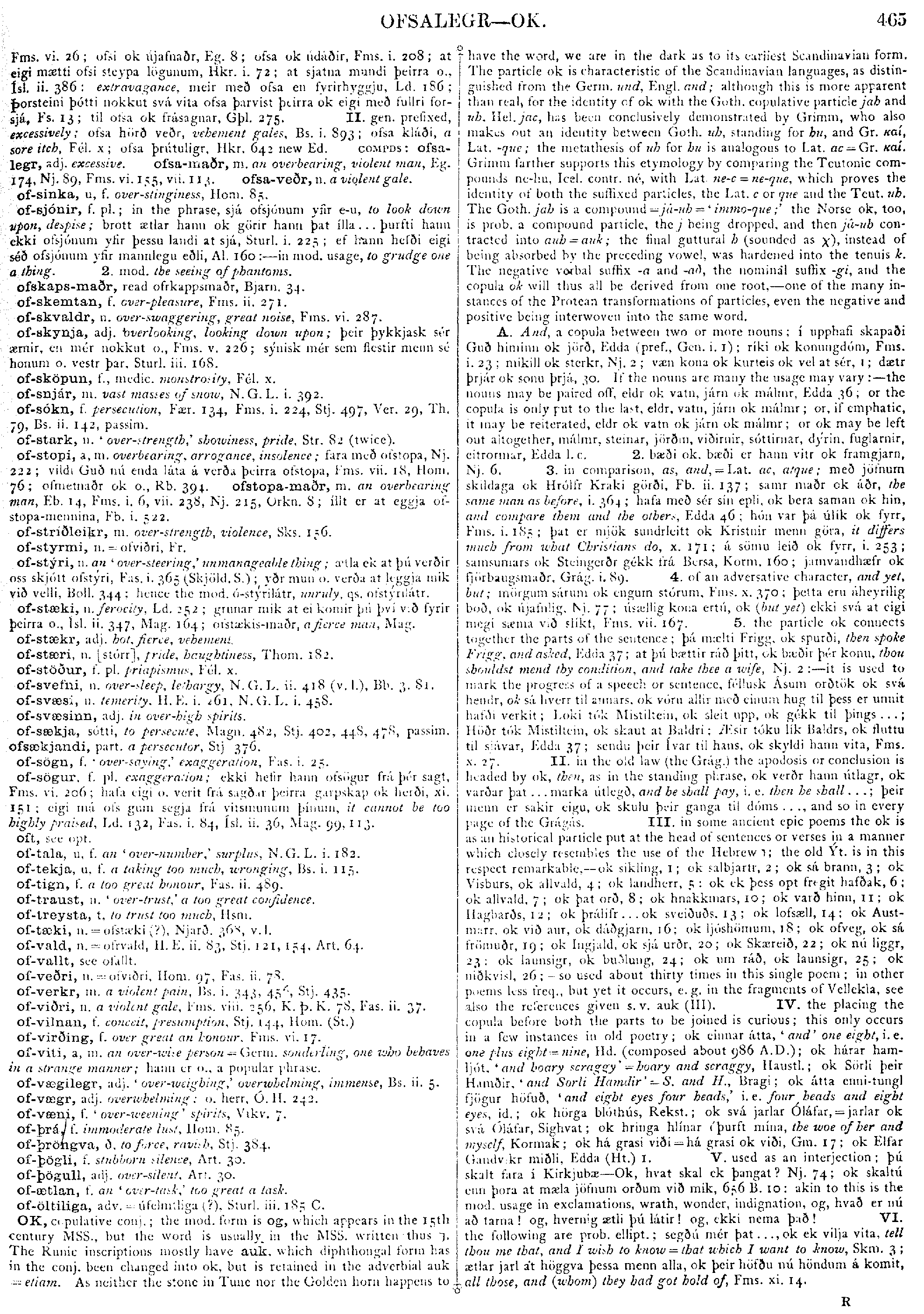
of-verkr, m. a violent pain, Bs. i. 343, 456, Stj. 435.
|
Source: Cleasby/Vigfusson, page b0470, entry 16 View original page image as: [TIFF] [PNG] [View previous entry] [View next entry] |
[Comment on this entry] [View comments] |
The following entry has been hand-corrected once. |
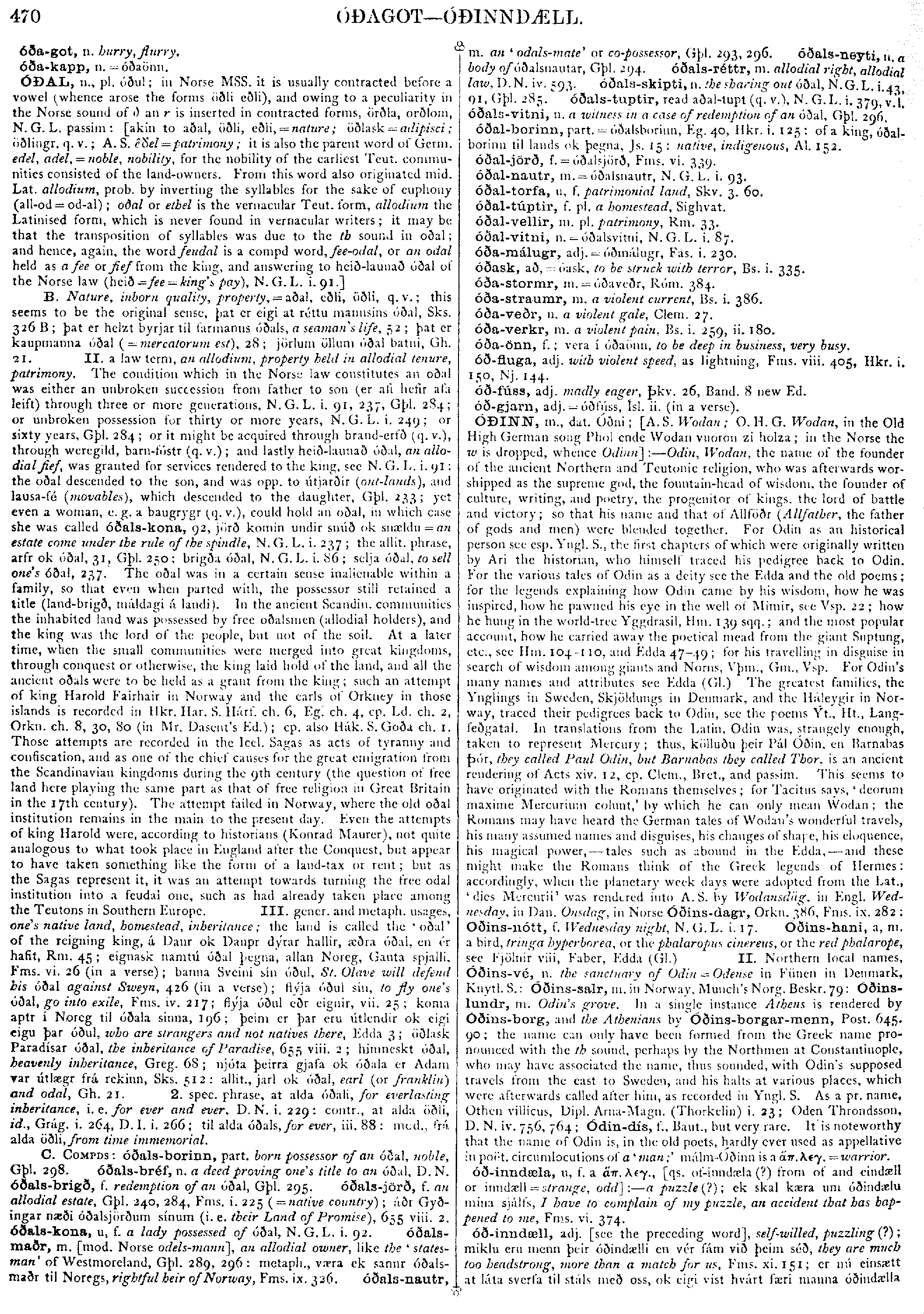
óða-verkr, m. a violent pain, Bs. i. 259, ii. 180.
|
Source: Cleasby/Vigfusson, page b0474, entry 2 View original page image as: [TIFF] [PNG] [View previous entry] [View next entry] |
[Comment on this entry] [View comments] |
The following entry has been hand-corrected once. |
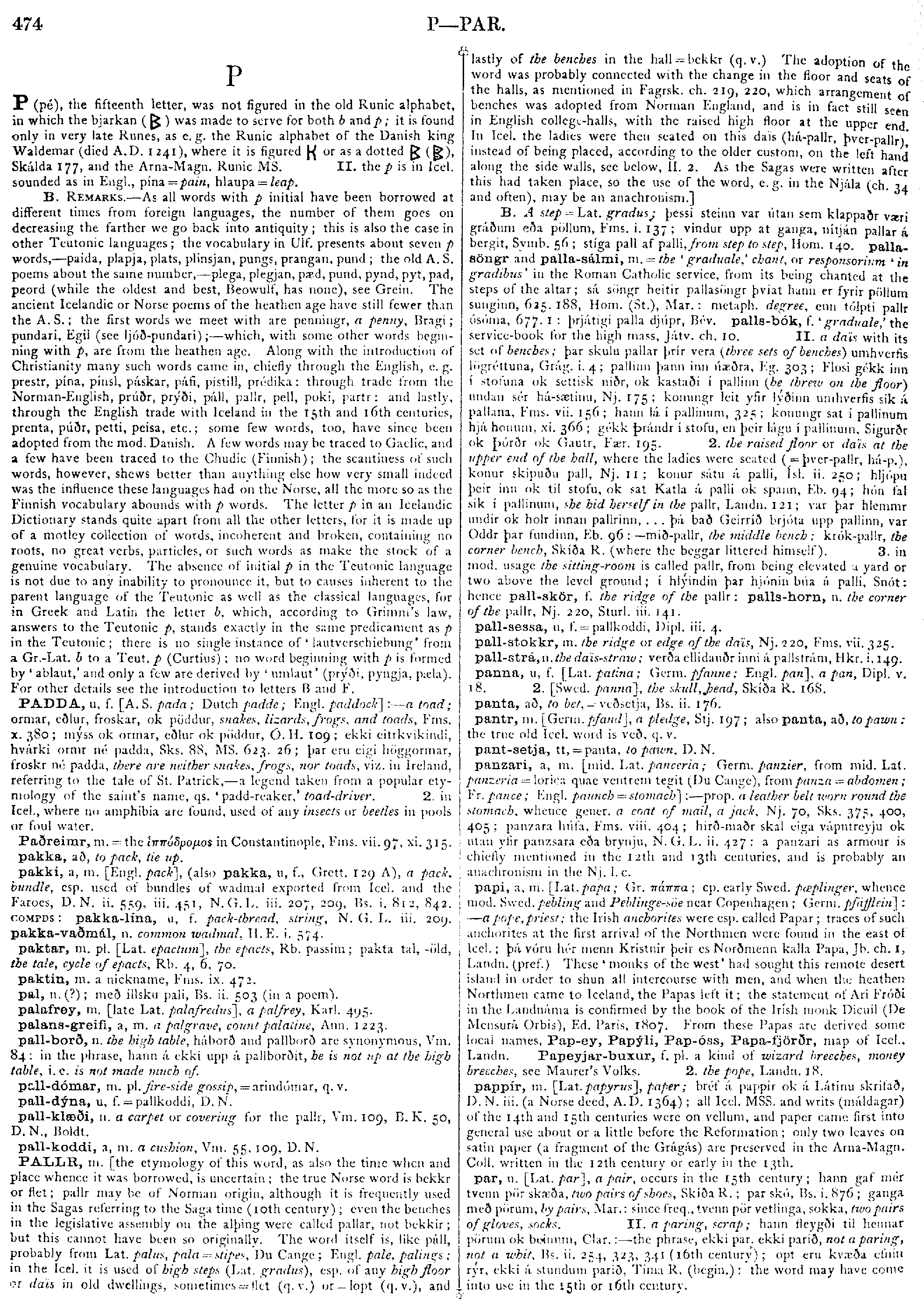
P (pé), the fifteenth letter, was not figured in the old Runic alphabet, in which the bjarkan (RUNE) was made to serve for both b and p; it is found only in very late Runes, as e.g. the Runic alphabet of the Danish king Waldemar (died A.D. 1241), where it is figured RUNE or as a dotted RUNE (RUNE), Skálda 177, and the Arna-Magn. Runic MS. II. the p is in Icel. sounded as in Engl., pína = pain, hlaupa = leap. B. REMARKS. -- As all words with p initial have been borrowed at different times from foreign languages, the number of them goes on decreasing the farther we go back into antiquity; this is also the case in other Teutonic languages; the vocabulary in Ulf. presents about seven p words, -- paida, plapja, plats, plinsjan, pungs, prangan, pund; the old A.S. poems about the same number, -- plega, plegjan, pæd, pund, pynd, pyt, pad, peord (while the oldest and best, Beowulf, has none), see Grein. The ancient Icelandic or Norse poems of the heathen age have still fewer than the A.S.; the first words we meet with are penningr, a penny, Bragi; pundari, Egil (see ljóð-pundari); -- which, with some other words beginning with p, are from the heathen age. Along with the introduction of Christianity many such words came in, chiefly through the English, e.g. prestr, pína, pínsl, páskar, páfi, pistill, prédika: through trade from the Norman-English, prúðr, prýði, páll, pallr, pell, poki, partr: and lastly, through the English trade with Iceland in the 15th and 16th centuries, prenta, púðr, petti, peisa, etc.: some few words, too, have since been adopted from the mod. Danish. A few words may be traced to Gaelic, and a few have been traced to the Chudic (Finnish); the scantiness of such words, however, shews better than anything else how very small indeed was the influence these languages had on the Norse, all the more so as the Finnish vocabulary abounds with p words. The letter p in an Icelandic Dictionary stands quite apart from all the other letters, for it is made up of a motley collection of words, incoherent and broken, containing no roots, no great verbs, particles, or such words as make the stock of a genuine vocabulary. The absence of initial p in the Teutonic language is not due to any inability to pronounce it, but to causes inherent to the parent language of the Teutonic as well as the classical languages, for in Greek and Latin the letter b, which, according to Grimm's law, answers to the Teutonic p, stands exactly in the same predicament as p in the Teutonic; there is no single instance of 'lautverschiebung' from a Gr.-Lat. b to a Teut. p (Curtius): no word beginning with p is formed by 'ablaut,' and only a few are derived by 'umlaut' (prýði, pyngja, pæla). For other details see the introduction to letters B and F.
|
Source: Cleasby/Vigfusson, page b0477, entry 19 View original page image as: [TIFF] [PNG] [View previous entry] [View next entry] |
[Comment on this entry] [View comments] |
The following entry has been hand-corrected once. |
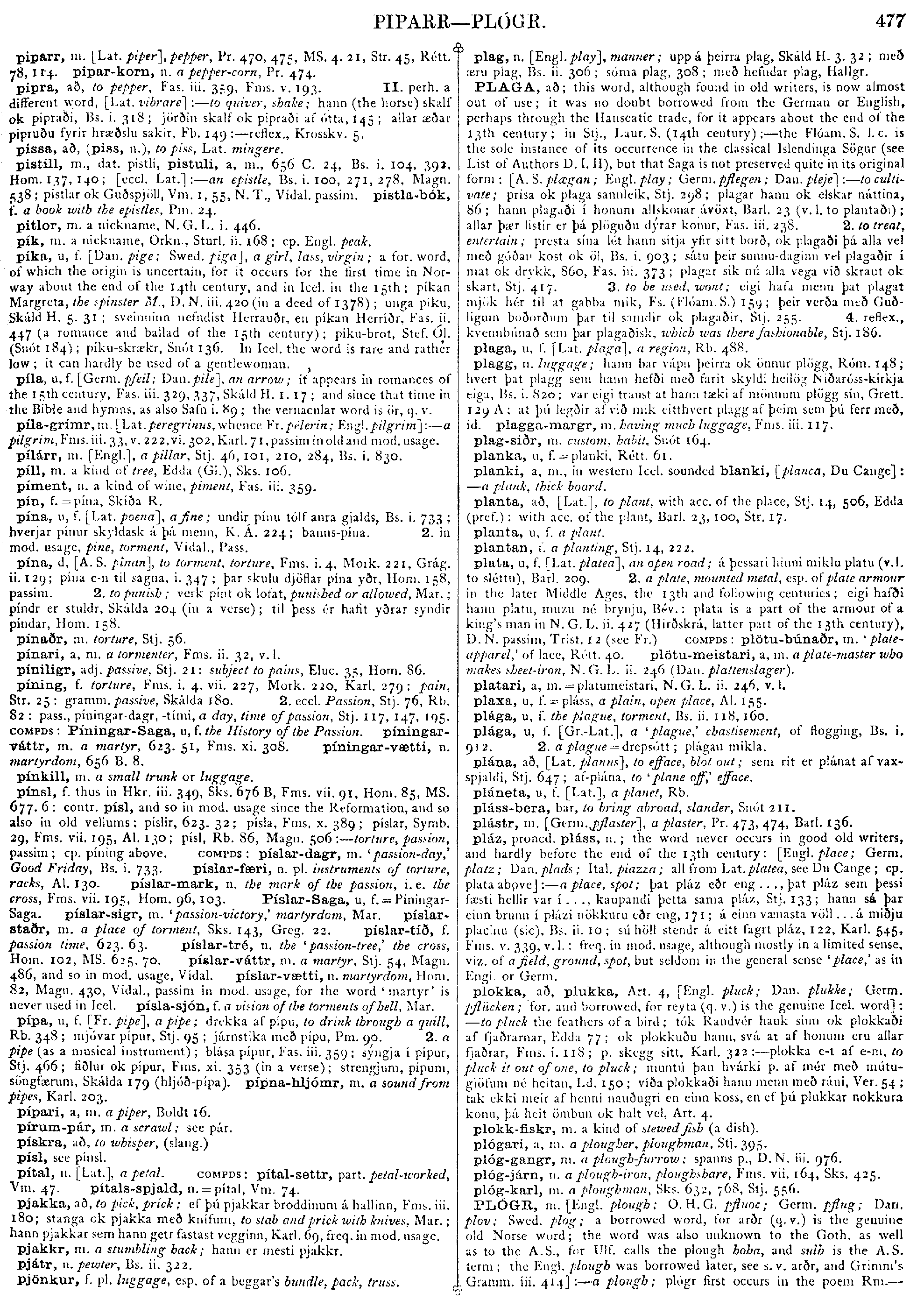
píning, f. torture, Fms. i. 4, vii. 227, Mork. 220, Karl. 279: pain, Str. 25: gramm. passive, Skálda 180. 2. eccl. Passion, Stj. 76, Rb. 82: pass., píningar-dagr, -tími, a day, time of passion, Stj. 117, 147, 195. COMPDS: Píningar-Saga, u, f. the History of the Passion. píningar-váttr, m. a martyr, 623. 51, Fms. xi. 308. píningar-vætti, n. martyrdom, 656 B. 8.
|
Source: Cleasby/Vigfusson, page b0484, entry 19 View original page image as: [TIFF] [PNG] [View previous entry] [View next entry] |
[Comment on this entry] [View comments] |
The following entry has been hand-corrected once. |
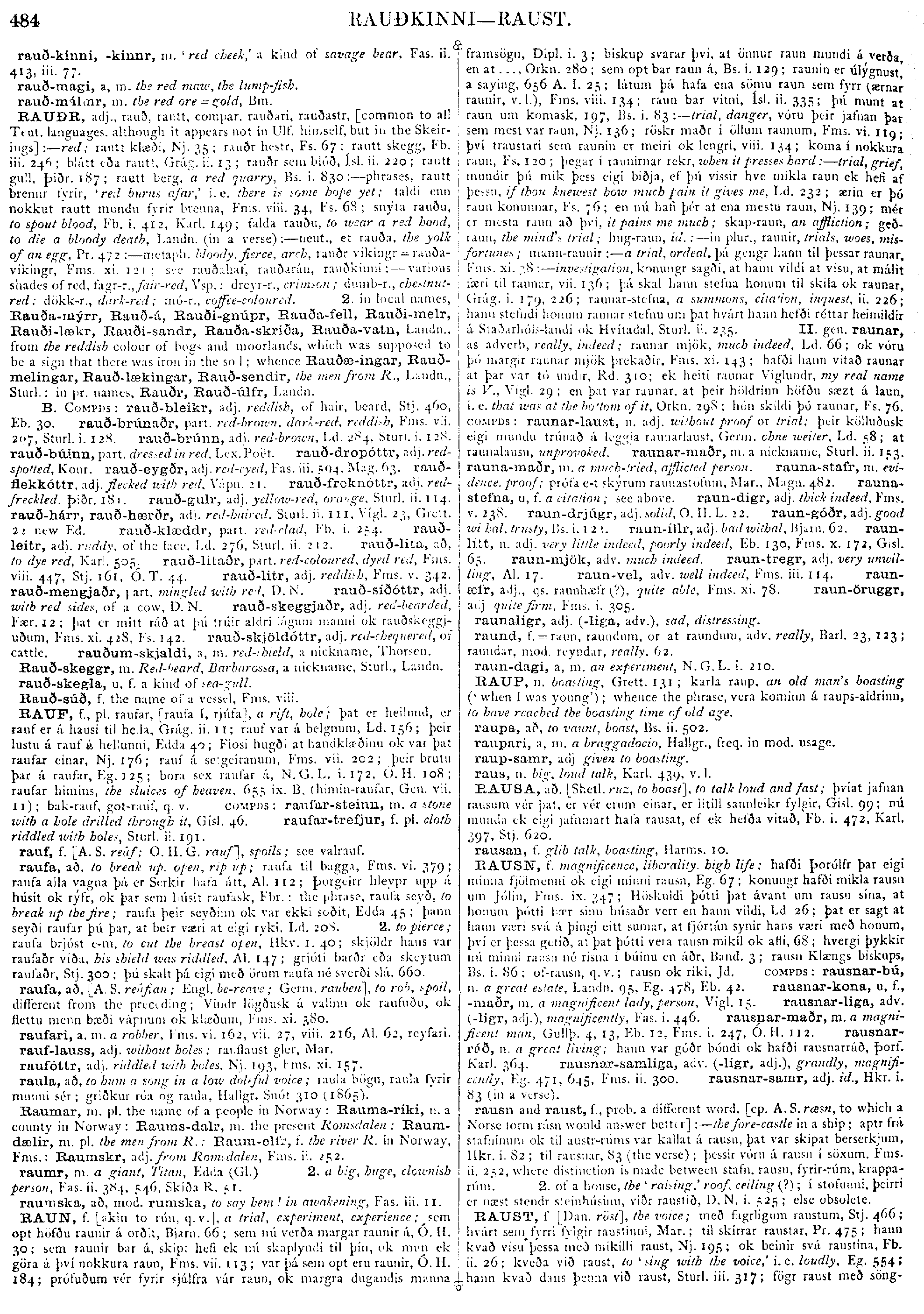
RAUN, f. [akin to rún, q.v.], a trial, experiment, experience; sem opt höfðu raunir á orðit, Bjarn. 66; sem nú verða margar raunir á, Ó.H. 30; sem raunir bar á, skipt hefi ek nú skaplyndi til þín, ok mun ek göra á því nokkura raun, Fms. vii. 113; var þá sem opt eru raunir, Ó.H. 184; prófuðum vér fyrir sjálfra vár raun, ok margra dugandis manna.; framsögn, Dipl. i. 3; biskup svarar því, at önnur raun mundi á verða en at ..., Orkn. 280; sem opt bar raun á, Bs. i. 129; raunin er úlýgnust, a saying, 656 A.I. 25; látum þá hafa ena sömu raun sem fyrr (ærnar raunir, v.l.), Fms. viii. 134; raun bar vitni, Ísl. ii. 335; þú munt at raun um komask, 197, Bs. i. 83 :-- trial, danger, vóru þeir jafnan þar sem mest var raun, Nj. 136; röskr maðr í öllum raunum, Fms. vi. 119 því traustari sem raunin er meiri ok lengri, viii. 134; koma í nokkura raun, Fs. 120; þegar í raunirnar rekr, when it presses hard :-- trial, grief mundir þú mik þess eigi biðja, ef þú vissir hve mikla raun ek hefi af þessu, if thou knewest how much pain it gives me, Ld. 232; ærin er þó raun konunnar, Fs. 76; en nú hafi þér af ena mestu raun, Nj. 139; mér er mesta raun að því, it pains me much; skap-raun, an affliction; geð-raun, the mind's trial; hug-raun, id. :-- in plur., raunir, trials, woes, misfortunes; mann-raunir :-- a trial, ordeal, þá gengr hann til þessar raunar Fms. xi. 38 :-- investigation, konungr sagði, at hann vildi at vísu, at málit færi til raunar, vii. 136; þá skal hann stefna honum til skila ok raunar, Grág. i. 179, 226; raunar-stefna, a summons, citation, inquest, ii. 226; hann stefndi honum raunar stefnu um þat hvárt hann hefði réttar heimildir á Staðarhóls-landi ok Hvítadal, Sturl. ii. 235. II. gen. raunar, as adverb, really, indeed; raunar mjök, much indeed, Ld. 66; ok vóru þó margir raunar mjök þrekaðir, Fms. xi. 143; hafði hann vitað raunar at þar var tó undir, Rd. 310; ek heiti raunar Víglundr, my real name is V., Vígl. 29; en þat var raunar, at þeir höldrinn höfðu sæzt á laun, i.e. that was at the bottom of it, Orkn. 298; hón skildi þó raunar, Fs. 76. COMPDS: raunar-laust, n. adj. without proof or trial; þeir kölluðusk eigi mundu trúnað á leggja raunarlaust. Germ. ohne weiter, Ld. 58; at raunalausu, unprovoked. raunar-maðr, m. a nickname, Sturl. ii. 153. rauna-maðr, m. a much-tried, afflicted person. rauna-stafr, m. evidence, proof; prófa e-t skýrum raunastöfum, Mar., Magn. 482. rauna-stefna, u, f. a citation; see above. raun-digr, adj. thick indeed, Fms. v. 238. raun-drjúgr, adj. solid, O.H.L. 22. raun-góðr, adj. good withal, trusty, Bs. i. 122. raun-íllr, adj. bad withal, Bjarn. 62. raun-lítt, n. adj. very little indeed, poorly indeed, Eb. 130, Fms. x. 172, Gísl. 65. raun-mjök, adv. much indeed. raun-tregr, adj. very unwilling, Al. 17. raun-vel, adv. well indeed, Fms. iii. 114. raun-æfr, adj., qs. raunhæfr(?), quite able, Fms. xi. 78. raun-öruggr, adj. quite firm, Fms. i. 305.
| Result Page: |  |
Previous | 13 14 15 16 17 18 19 20 21 22 23 24 25 | Next |  |
Germanic Lexicon Project (main page)
This search system was written by
Sean Crist
Please consider
volunteering
to correct the data in these online dictionaries.
No rights reserved. Feel free to use these data in any way you please.