|
|

Tip: In the search results, you can click on any word or abbreviation for more information.
|
Source: Bosworth/Toller, page b0522, entry 24 View original page image as: [TIFF] [PNG] [View previous entry] [View next entry] |
[Comment on this entry] [View comments] |
The following entry has been hand-corrected once. |
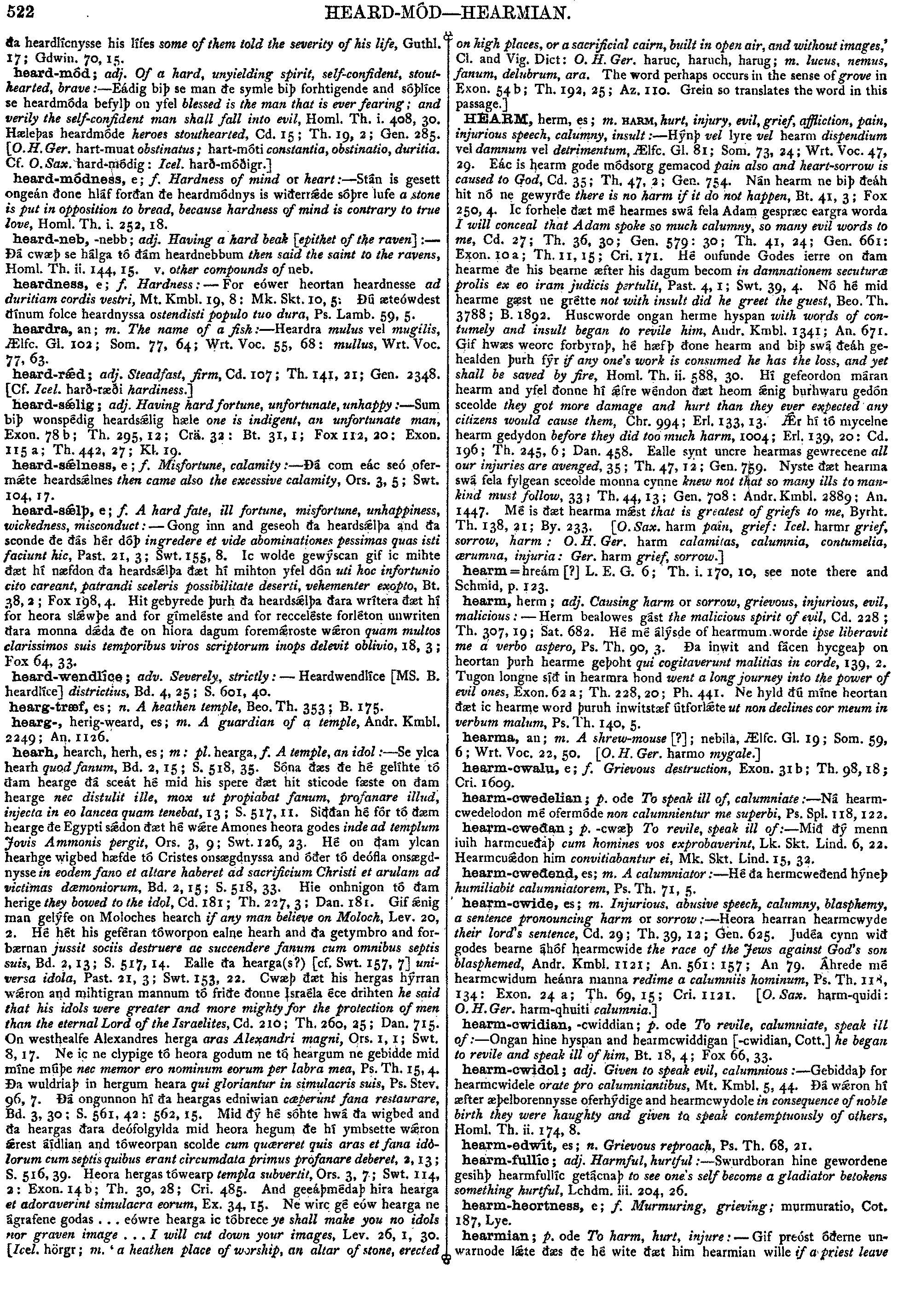
hearm-cwidol;
adj.
Given
to
speak
evil,
calumnious
:--
Gebiddaþ
for
hearmcwidele
orate
pro
calumniantibus,
Mt.
Kmbl.
5,
44.
Ðá
w ron
hí
æfter
æþelborennysse
oferhýdige
and
hearmcwydole
in
consequence
of
noble
birth
they
were
haughty
and
given
to
speak
contemptuously
of
others,
Homl.
Th.
ii.
174,
8.
ron
hí
æfter
æþelborennysse
oferhýdige
and
hearmcwydole
in
consequence
of
noble
birth
they
were
haughty
and
given
to
speak
contemptuously
of
others,
Homl.
Th.
ii.
174,
8.
|
Source: Bosworth/Toller, page b0545, entry 2 View original page image as: [TIFF] [PNG] [View previous entry] [View next entry] |
[Comment on this entry] [View comments] |
The following entry has been hand-corrected once. |
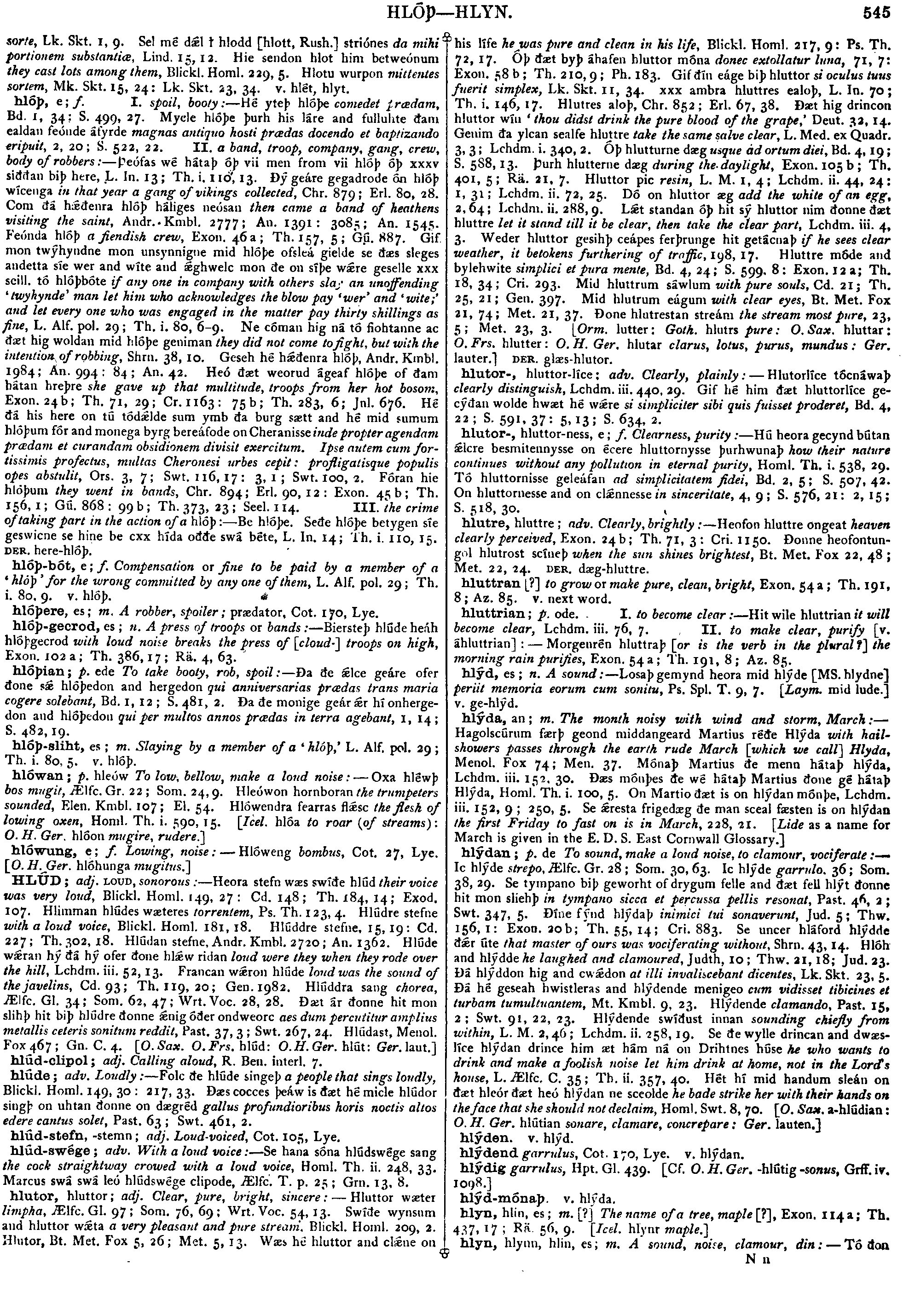
hlóþ,
e;
f.
I.
spoil,
booty
:--
Hé
yteþ
hlóþe
comedet
prædam,
Bd.
1.
34:
S.
499,
27.
Mycle
hlóþe
þurh
his
láre
and
fulluhte
ðam
ealdan
feónde
áfyrde
magnas
antiquo
hosti
prædas
docendo
et
baptizando
eripuit,
2,
20;
S.
522,
22.
II.
a
band,
troop,
company,
gang,
crew,
body
of
robbers:
--
Þeófas
wé
hátaþ
óþ
vii
men
from
vii
hlóþ
óþ
xxxv
siððan
biþ
here,
L.
In.
13;
Th.
i.
101,
13.
Ðý
geáre
gegadrode
on
hlóþ
wícenga
in
that
year
a
gang
of
vikings
collected,
Chr.
879;
Erl.
80.
28.
Com
ðá
hðenra
hlóþ
háliges
neósan
then
came
a
band
of
heathens
visiting
the
saint,
Andr.
Kmbl.
2777;
An.
1391:
3085;
An.
1545.
Feónda
hlóþ
a
fiendish
crew,
Exon.
46
a;
Th.
157,
5;
Gú.
887.
Gif
mon
twýhyndne
mon
unsynnigne
mid
hlóþe
ofsleá
gielde
se
ðæs
sleges
andetta
síe
wer
and
wíte
and
ghwelc
mon
ðe
on
síþe
wre
geselle
xxx
scill.
tó
hlóþbóte
if
any
one
in
company
with
others
slay
an
unoffending
'twyhynde'
man
let
him
who
acknowledges
the
blow
pay
'wer'
and
'wite;'
and
let
every
one
who
was
engaged
in
the
matter
pay
thirty
shillings
as
fine,
L.
Alf.
pol.
29;
Th.
i.
80,
6-9.
Ne
cóman
hig
ná
tó
fiohtanne
ac
ðæt
hig
woldan
mid
hlóþe
geniman
they
did
not
come
to
fight,
but
with
the
intention
of
robbing,
Shrn.
38,
10.
Gesch
hé
hðenra
hlóþ,
Andr.
Kmbl.
1984;
An.
994:
84;
An.
42.
Heó
ðæt
weorud
ágeaf
hlóþe
of
ðam
hátan
hreþre
she
gave
up
that
multitude,
troops
from
her
hot
bosom,
Exon.
24
b;
Th.
71,
29;
Cr.
1163:
75
b;
Th.
283,
6;
Jnl.
676.
Hé
ðá
his
here
on
tú
tódlde
sum
ymb
ða
burg
sætt
and
hé
mid
sumum
hlóþum
fór
and
monega
byrg
bereáfode
on
Cheranisse
inde
propter
agendam
prædam
et
curandam
obsidionem
divisit
exercitum.
Ipse
autem
cum
fortissimis
profectus,
multas
Cheronesi
urbes
cepit:
profligatisque
populis
opes
abstulit,
Ors.
3,
7;
Swt.
116,
17:
3,
1;
Swt.
100,
2.
Fóran
hie
hlóþum
they
went
in
bands,
Chr.
894;
Erl.
90,
12:
Exon.
45
b;
Th.
156,
1;
Gú.
868:
99
b;
Th.
373,
23;
Seel.
114.
III.
the
crime
of
taking
part
in
the
action
of
a
hlóþ
:--
Be
hlóþe.
Seðe
hlóþe
betygen
síe
geswicne
se
hine
be
cxx
hída
oððe
swá
béte,
L.
In.
14;
Th.
i.
110,
15.
DER.
here-hlóþ.
|
Source: Bosworth/Toller, page b0576, entry 1 View original page image as: [TIFF] [PNG] [View previous entry] [View next entry] |
[Comment on this entry] [View comments] |
The following entry has been hand-corrected once. |
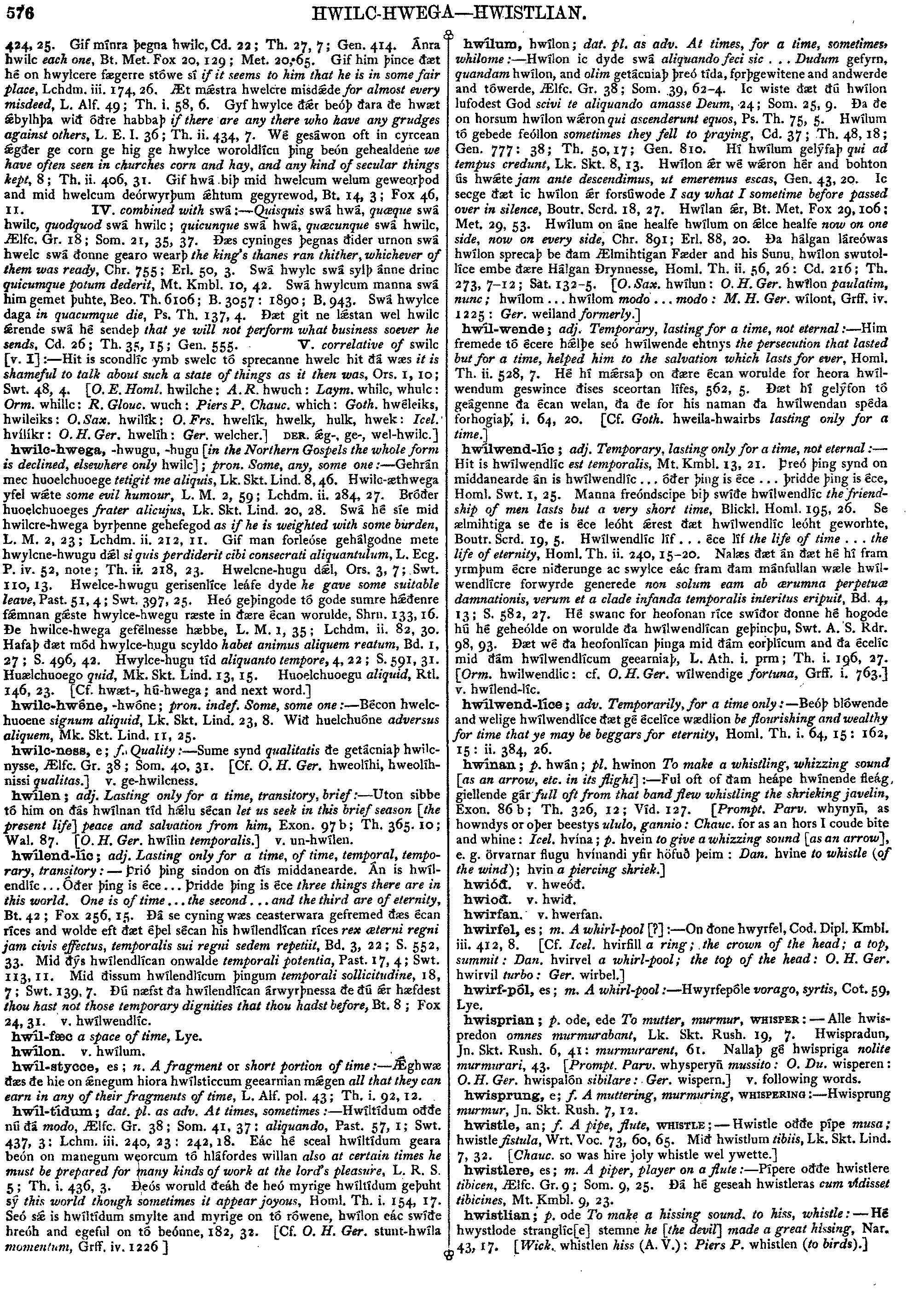
424,
25.
Gif
mínra
þegna
hwilc,
Cd.
22;
Th.
27,
7;
Gen.
414.
Ánra
hwilc
each
one,
Bt.
Met.
Fox
20,
129;
Met.
20,
65.
Gif
him
þince
ðæt
hé
on
hwylcere
fægerre
stówe
sí
if
it
seems
to
him
that
he
is
in
some
fair
place,
Lchdm.
iii.
174,
26.
Æt
mstra
hwelcre
misdde
for
almost
every
misdeed,
L.
Alf.
49;
Th.
i.
58,
6.
Gyf
hwylce
ðr
beóþ
ðara
ðe
hwæt
bylhþa
wið
óðre
habbaþ
if
there
are
any
there
who
have
any
grudges
against
others,
L.
E.
I.
36;
Th.
ii.
434,
7.
Wé
gesáwon
oft
in
cyrcean
gðer
ge
corn
ge
hig
ge
hwylce
woroldlícn
þing
beón
gehealdene
we
have
often
seen
in
churches
corn
and
hay,
and
any
kind
of
secular
things
kept,
8;
Th.
ii.
406,
31.
Gif
hwá
biþ
mid
hwelcum
welum
geweorþod
and
mid
hwelcum
deórwyrþum
htum
gegyrewod.
Bt.
14,
3;
Fox
46,
11.
IV.
combined
with
swá
:--
Quisquis
swá
hwá,
quæque
swá
hwilc,
quodquod
swá
hwilc;
quicunque
swá
hwá,
quæcunque
swá
hwilc,
Ælfc.
Gr.
18;
Som.
21,
35,
37.
Ðæs
cyninges
þegnas
ðider
urnon
swá
hwelc
swá
ðonne
gearo
wearþ
the
king's
thanes
ran
thither,
whichever
of
them
was
ready,
Chr.
755;
Erl.
50,
3.
Swá
hwylc
swá
sylþ
ánne
drinc
quicumque
potum
dederit,
Mt.
Kmbl.
10,
42.
Swá
hwylcum
manna
swá
him
gemet
þuhte,
Beo.
Th.
6106;
B.
3057:
1890;
B.
943.
Swá
hwylce
daga
in
quacumque
die,
Ps.
Th.
137,
4.
Ðæt
git
ne
lstan
wel
hwilc
rende
swá
hé
sendeþ
that
ye
will
not
perform
what
business
soever
he
sends,
Cd.
26;
Th.
35,
15;
Gen.
555.
V.
correlative
of
swilc
[v.
I]
:--
Hit
is
scondlíc
ymb
swelc
tó
sprecanne
hwelc
hit
ðá
wæs
it
is
shameful
to
talk
about
such
a
state
of
things
as
it
then
was,
Ors.
1,
10;
Swt.
48,
4.
[O.
E.
Homl.
hwilche:
A.
R.
hwuch:
Laym.
whilc,
whulc:
Orm.
whillc:
R.
Glouc.
wuch:
Piers
P.
Chauc.
which:
Goth.
hwéleiks,
hwileiks:
O.
Sax.
hwilík:
O.
Nrs.
hwelík,
hwelk,
hulk,
hwek:
Icel.
hvílíkr:
O.
H.
Ger.
hwelíh:
Ger.
welcher.]
DER.
g-,
ge-,
wel-hwilc.
|
Source: Bosworth/Toller, page b0578, entry 15 View original page image as: [TIFF] [PNG] [View previous entry] [View next entry] |
[Comment on this entry] [View comments] |
The following entry has been hand-corrected once. |
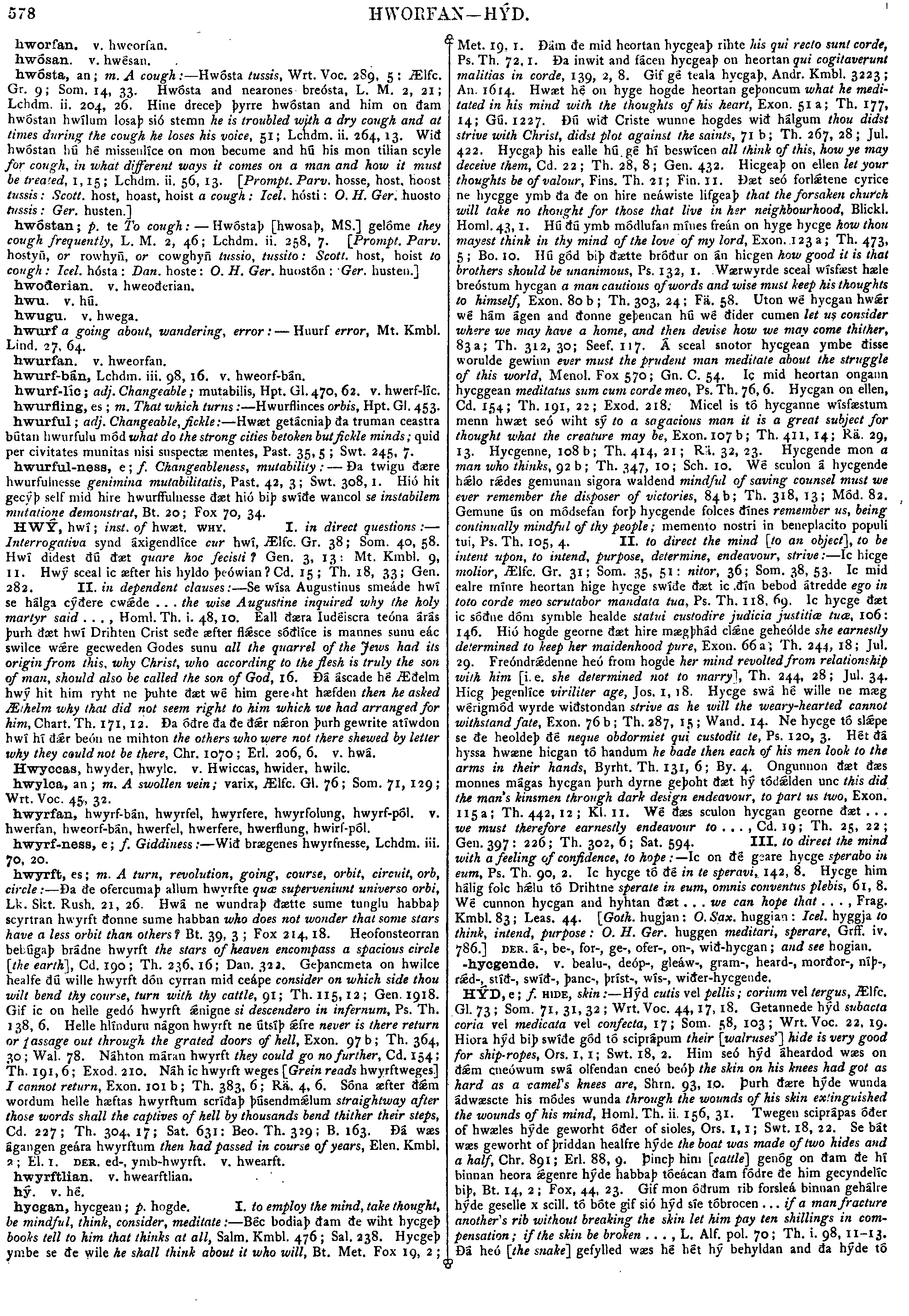
HWÝ,
hwí;
inst.
of
hwæt.
WHY.
I.
in
direct
questions
:--
Interrogativa
synd
áxigendlíce
cur
hwí,
Ælfc.
Gr.
38;
Som.
40,
58.
Hwí
didest
ðú
ðæt
quare
hoc
fecisti?
Gen.
3,
13:
Mt.
Kmbl.
9,
11.
Hwý
sceal
ic
æfter
his
hyldo
þeówian?
Cd.
15;
Th.
18,
33;
Gen.
282.
II.
in
dependent
clauses
:--
Se
wísa
Augustinus
smeáde
hwí
se
hálga
cýðere
cwde
...
the
wise
Augustine
inquired
why
the
holy
martyr
said
...,
Homl.
Th.
i.
48,
10.
Eall
ðæra
Iudéiscra
teóna
árás
þurh
ðæt
hwí
Drihten
Crist
seðe
æfter
flsce
sóðlíce
is
mannes
sunu
eác
swilce
wre
gecweden
Godes
sunu
all
the
quarrel
of
the
Jews
had
its
origin
from
this,
why
Christ,
who
according
to
the
flesh
is
truly
the
son
of
man,
should
also
be
called
the
son
of
God,
16.
Ðá
áscade
hé
Æðelm
hwý
hit
him
ryht
ne
þuhte
ðæt
we
him
gereaht
hæfden
then
he
asked
Æthelm
why
that
did
not
seem
right
to
him
which
we
had
arranged
for
him,
Chart.
Th.
171,
12.
Ða
oðre
ða
ðe
ðr
nron
þurh
gewrite
atíwdon
hwí
hí
ðr
beón
ne
mihton
the
others
who
were
not
there
shewed
by
letter
why
they
could
not
be
there,
Chr.
1070;
Erl.
206,
6.
v.
hwá.
|
Source: Bosworth/Toller, page b0578, entry 20 View original page image as: [TIFF] [PNG] [View previous entry] [View next entry] |
[Comment on this entry] [View comments] |
The following entry has been hand-corrected once. |
hwyrft,
es;
m.
A
turn,
revolution,
going,
course,
orbit,
circuit,
orb,
circle
:--
Ða
ðe
ofercumaþ
allum
hwyrfte
quæ
superveniunt
universo
orbi,
Lk.
Skt.
Rush.
21,
26.
Hwá
ne
wundraþ
ðætte
sume
tunglu
habbaþ
scyrtran
hwyrft
ðonne
sume
habban
who
does
not
wonder
that
some
stars
have
a
less
orbit
than
others?
Bt.
39,
3;
Fox
214,
18.
Heofonsteorran
bebúgaþ
brádne
hwyrft
the
stars
of
heaven
encompass
a
spacious
circle
[the
earth],
Cd.
190;
Th.
236,
16;
Dan.
322.
Geþancmeta
on
hwilce
healfe
ðú
wille
hwyrft
dón
cyrran
mid
ceápe
consider
on
which
side
thou
wilt
bend
thy
course,
turn
with
thy
cattle,
91;
Th.
115,
12;
Gen.
1918.
Gif
ic
on
helle
gedó
hwyrft
nigne
si
descendero
in
infernum,
Ps.
Th.
138,
6.
Helle
hlínduru
nágon
hwyrft
ne
útsíþ
fre
never
is
there
return
or
passage
out
through
the
grated
doors
of
hell,
Exon.
97
b;
Th.
364,
30;
Wal.
78.
Náhton
máran
hwyrft
they
could
go
no
further,
Cd.
154;
Th.
191,
6;
Exod.
210.
Náh
ic
hwyrft
weges
[Grein
reads
hwyrftweges]
I
cannot
return,
Exon.
101
b;
Th.
383,
6;
Rä.
4,
6.
Sóna
æfter
ðm
wordum
helle
hæftas
hwyrftum
scríðaþ
þúsendmlum
straightway
after
those
words
shall
the
captives
of
hell
by
thousands
bend
thither
their
steps,
Cd.
227;
Th.
304,
17;
Sat.
631:
Beo.
Th.
329;
B.
163.
Ðá
wæs
ágangen
geára
hwyrftum
then
had
passed
in
course
of
years,
Elen.
Kmbl.
2;
El.
1.
DER.
ed-,
ymb-hwyrft.
v.
hwearft.
|
Source: Bosworth/Toller, page b0599, entry 17 View original page image as: [TIFF] [PNG] [View previous entry] [View next entry] |
[Comment on this entry] [View comments] |
The following entry has been hand-corrected once. |
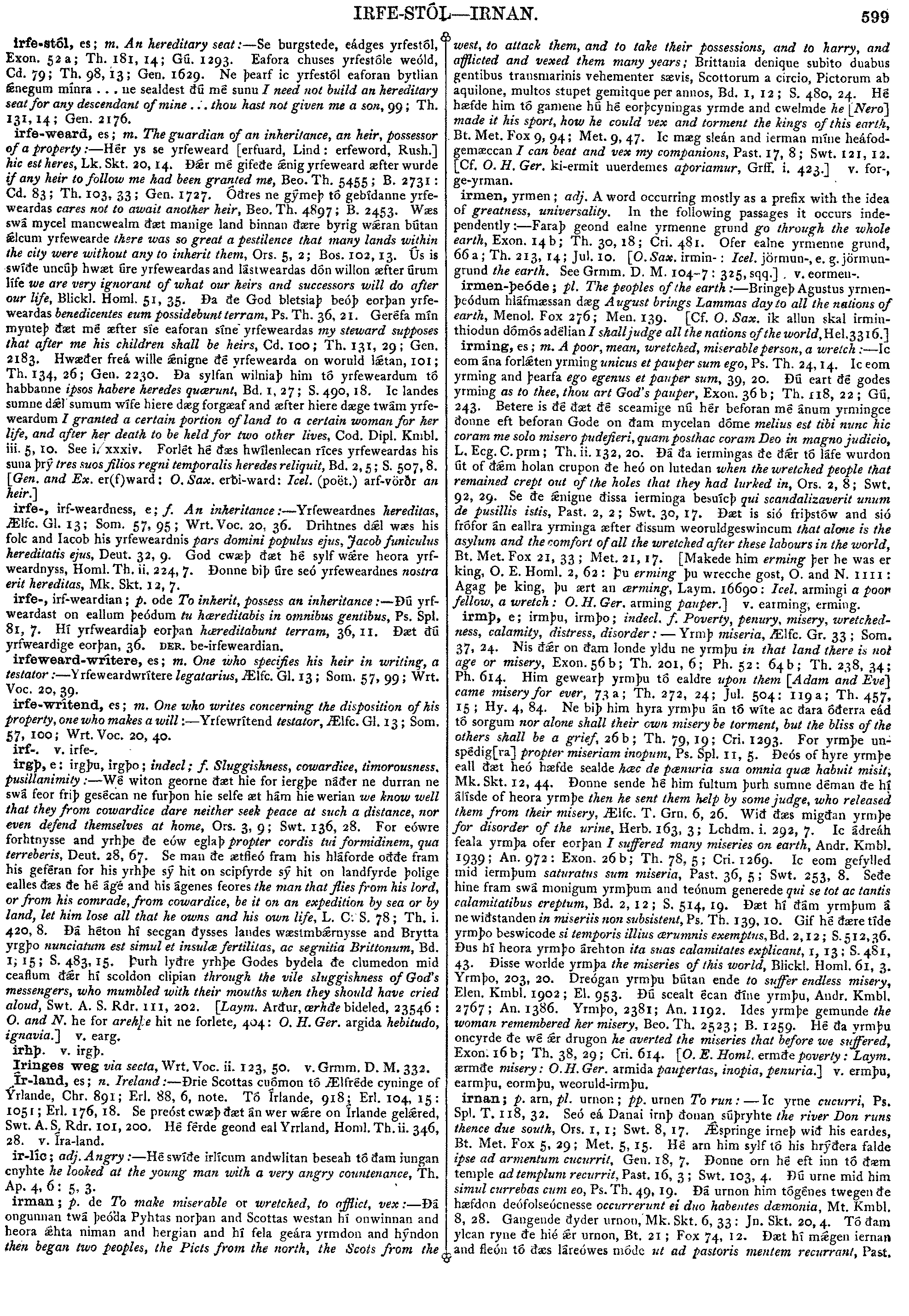
irmþ,
e;
irmþu,
irmþo;
indecl.
f.
Poverty,
penury,
misery,
wretchedness,
calamity,
distress,
disorder
:--
Yrmþ
miseria,
Ælfc.
Gr.
33
;
Som.
37,
24.
Nis
ðr
on
ðam
londe
yldu
ne
yrmþu
in
that
land
there
is
not
age
or
misery,
Exon.
56
b;
Th.
201,
6;
Ph.
52
:
64
b;
Th.
238,
34;
Ph.
614.
Him
gewearþ
yrmþu
tó
ealdre
upon
them
[Adam
and
Eve]
came
misery
for
ever,
73
a;
Th.
272,
24;
Jul.
504;
119
a;
Th.
457,
15
;
Hy.
4,
84.
Ne
biþ
him
hyra
yrmþu
án
tó
wíte
ac
ðara
óðerra
eád
tó
sorgum
nor
alone
shall
their
own
misery
be
torment,
but
the
bliss
of
the
others
shall
be
a
grief,
26
b
;
Th.
79,
19;
Cri.
1293.
For
yrmþe
unspédig[ra]
propter
miseriam
inopum,
Ps.
Spl.
11,
5.
Ðeós
of
hyre
yrmþe
eall
ðæt
heó
hæfde
sealde
hæc
de
pænuria
sua
omnia
quæ
habuit
misit,
Mk.
Skt.
12,
44.
Ðonne
sende
hé
him
fultum
þurh
sumne
déman
ðe
hí
álísde
of
heora
yrmþe
then
he
sent
them
help
by
some
judge,
who
released
them
from
their
misery,
Ælfc.
T.
Grn.
6,
26.
Wið
ðæs
migðan
yrmþe
for
disorder
of
the
urine,
Herb.
163,
3;
Lchdm.
i.
292,
7.
Ic
ádreáh
feala
yrmþa
ofer
eorþan
I
suffered
many
miseries
on
earth,
Andr.
Kmbl.
1939;
An.
972
:
Exon.
26
b;
Th.
78,
5;
Cri.1269.
Ic
eom
gefylled
mid
iermþum
saturatus
sum
miseria,
Past.
36,
5
;
Swt.
253,
8.
Seðe
hine
fram
swá
monigum
yrmþum
and
teónum
generede
qui
se
tot
ac
tantis
calamitatibus
ereptum,
Bd.
2,
12;
S.
514,
19.
Ðæt
hí
ðám
yrmþum
á
ne
wiðstanden
in
miseriis
non
subsistent,
Ps.
Th.
139,
10.
Gif
hé
ðære
tíde
yrmþo
beswicode
si
temporis
illius
ærumnis
exemptus,
Bd.
2,
12;
S.
512,
36.
Ðus
hí
heora
yrmþo
árehton
ita
suas
calamitates
explicant,
1,
13;
S.
481,
43.
Ðisse
worlde
yrmþa
the
miseries
of
this
world,
Blickl.
Homl.
61,
3.
Yrmþo,
203,
20.
Dreógan
yrmþu
bútan
ende
to
suffer
endless
misery,
Elen.
Kmbl.
1902
;
El.
953.
Ðú
scealt
écan
ðíne
yrmþu,
Andr.
Kmbl.
2767;
An.
1386.
Yrmþo,
2381;
An.
1192.
Ides
yrmþe
gemunde
the
woman
remembered
her
misery,
Beo.
Th.
2523;
B.
1259.
Hé
ða
yrmþu
oncyrde
ðe
wé
r
drugon
he
averted
the
miseries
that
before
we
suffered,
Exon.
16
b;
Th.
38,
29;
Cri.
614.
[O.
E.
Homl.
ermðe
poverty
:
Laym.
ærmðe
misery
:
O.
H.
Ger.
armida
paupertas,
inopia,
penuria.]
v.
ermþu,
earmþu,
eormþu,
weoruld-irmþu.
|
Source: Bosworth/Toller, page b0605, entry 1 View original page image as: [TIFF] [PNG] [View previous entry] [View next entry] |
[Comment on this entry] [View comments] |
The following entry has been hand-corrected once. |
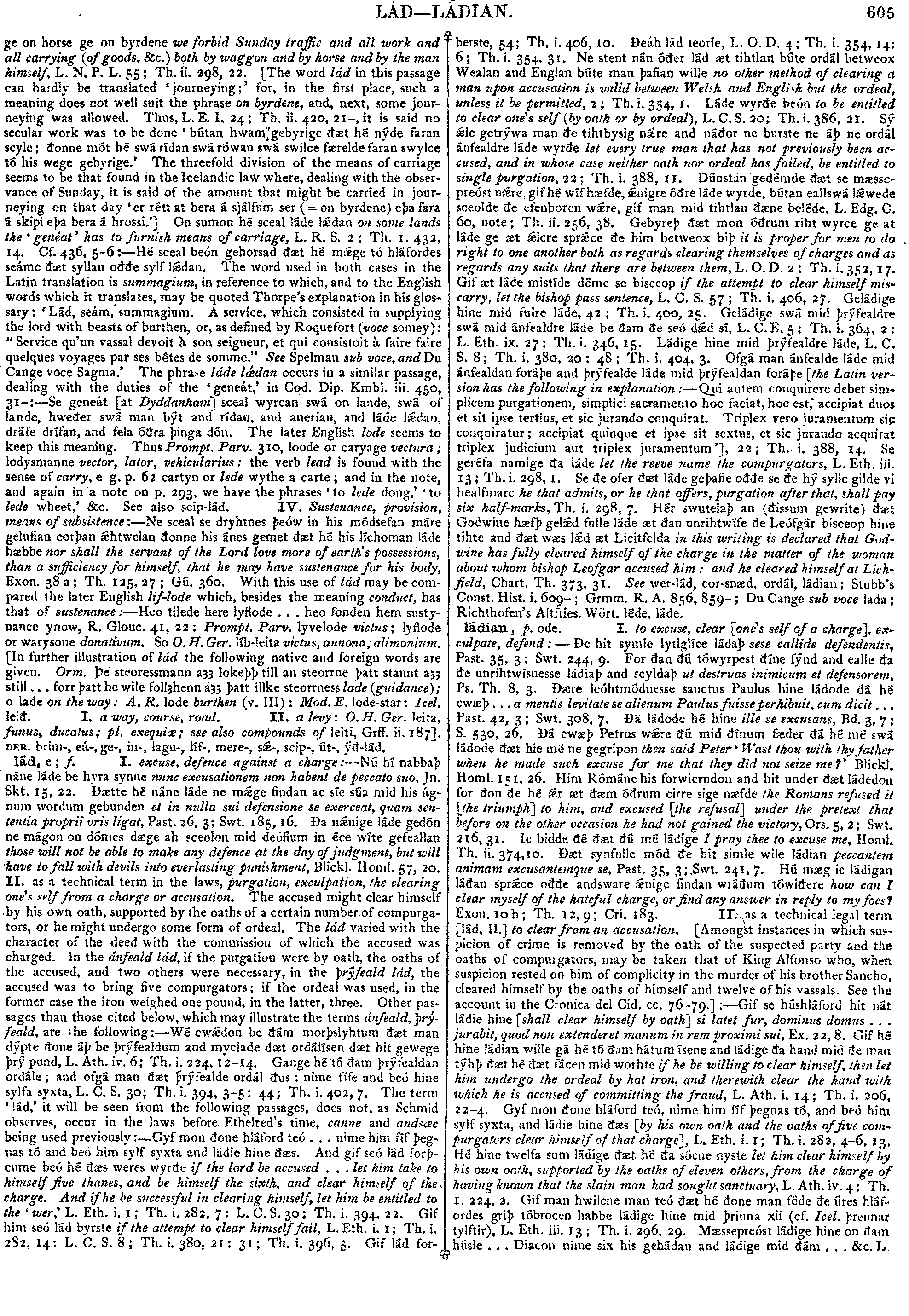
lád,
e;
f.
I.
excuse,
defence
against
a
charge
:--
Nú
hí
nabbaþ
náne
láde
be
hyra
synne
nunc
excusationem
non
habent
de
peccato
suo,
Jn.
Skt.
15,
22.
Ðætte
hé
náne
láde
ne
mge
findan
ac
síe
súa
mid
his
ágnum
wordum
gebunden
et
in
nulla
sui
defensione
se
exerceat,
quam
sententia
proprii
oris
ligat,
Past.
26,
3;
Swt.
185,
16.
Ða
nnige
láde
gedón
ne
mágon
on
dómes
dæge
ah
sceolon
mid
deóflum
in
éce
wíte
gefeallan
those
will
not
be
able
to
make
any
defence
at
the
day
of
judgment,
but
will
have
to
fall
with
devils
into
everlasting
punishment,
Blickl.
Homl.
57,
20.
II.
as
a
technical
term
in
the
laws,
purgation,
exculpation,
the
clearing
one's
self
from
a
charge
or
accusation.
The
accused
might
clear
himself
by
his
own
oath,
supported
by
the
oaths
of
a
certain
number
of
compurgators,
or
he
might
undergo
some
form
of
ordeal.
The
lád
varied
with
the
character
of
the
deed
with
the
commission
of
which
the
accused
was
charged.
In
the
ánfeald
lád,
if
the
purgation
were
by
oath,
the
oaths
of
the
accused,
and
two
others
were
necessary,
in
the
þrýfeald
lád,
the
accused
was
to
bring
five
compurgators;
if
the
ordeal
was
used,
in
the
former
case
the
iron
weighed
one
pound,
in
the
latter,
three.
Other
passages
than
those
cited
below,
which
may
illustrate
the
terms
ánfeald,
þrýfeald,
are
the
following
:--
Wé
cwdon
be
ðám
morþslyhtum
ðæt
man
dýpte
ðone
áþ
be
þrýfealdum
and
myclade
ðæt
ordálísen
ðæt
hit
gewege
þrý
pund,
L.
Ath.
iv.
6;
Th.
i.
224,
12-14.
Gange
hé
tó
ðam
þrýfealdan
ordále;
and
ofgá
man
ðæt
þrýfealde
ordál
ðus:
nime
fífe
and
beó
hine
sylfa
syxta,
L.
C.
S.
30;
Th.
i.
394,
3-5:
44;
Th.
i.
402,
7.
The
term
'lád,'
it
will
be
seen
from
the
following
passages,
does
not,
as
Schmid
observes,
occur
in
the
laws
before
Ethelred's
time,
canne
and
andsæc
being
used
previously
:--
Gyf
mon
ðone
hláford
teó
...
nime
him
fíf
þegnas
tó
and
beó
him
sylf
syxta
and
ládie
hine
ðæs.
And
gif
seó
lád
forþcume
beó
hé
ðæs
weres
wyrðe
if
the
lord
be
accused
...
let
him
take
to
himself
five
thanes,
and
be
himself
the
sixth,
and
clear
himself
of
the
charge.
And
if
he
be
successful
in
clearing
himself,
let
him
be
entitled
to
the
'wer,'
L.
Eth.
i.
1;
Th.
i.
282,
7:
L.
C.
S.
30;
Th.
i.
394,
22.
Gif
him
seó
lád
byrste
if
the
attempt
to
clear
himself
fail,
L.
Eth.
i.
1;
Th.
i.
282,
14:
L.
C.
S.
8;
Th.
i.
380,
21:
31;
Th.
i.
396,
5.
Gif
lád
forberste,
54;
Th.
i.
406,
10.
Ðeáh
lád
teorie,
L.
O.
D.
4;
Th.
i.
354,
14:
6;
Th.
i.
354,
31.
Ne
stent
nán
óðer
lád
æt
tihtlan
búte
ordál
betweox
Wealan
and
Englan
búte
man
þafian
wille
no
other
method
of
clearing
a
man
upon
accusation
is
valid
between
Welsh
and
English
but
the
ordeal,
unless
it
be
permitted,
2;
Th.
i.
354,
1.
Láde
wyrðe
beón
to
be
entitled
to
clear
one's
self
(by
oath
or
by
ordeal),
L.
C.
S.
20;
Th.
i.
386,
21.
Sý
lc
getrýwa
man
ðe
tihtbysig
nre
and
náðor
ne
burste
ne
áþ
ne
ordál
ánfealdre
láde
wyrðe
let
every
true
man
that
has
not
previously
been
accused,
and
in
whose
case
neither
oath
nor
ordeal
has
failed,
be
entitled
to
single
purgation,
22;
Th.
i.
388,
11.
Dúnstan
gedémde
ðæt
se
mæssepreóst
nre,
gif
hé
wíf
hæfde,
nigre
óðre
láde
wyrðe,
bútan
eallswá
lwede
sceolde
ðe
efenboren
wre,
gif
man
mid
tihtlan
ðæne
beléde,
L.
Edg.
C.
60,
note;
Th.
ii.
256,
38.
Gebyreþ
ðæt
mon
óðrum
riht
wyrce
ge
at
láde
ge
æt
lcre
sprce
ðe
him
betweox
biþ
it
is
proper
for
men
to
do
right
to
one
another
both
as
regards
clearing
themselves
of
charges
and
as
regards
any
suits
that
there
are
between
them,
L.
O.
D.
2;
Th.
i.
352,
17.
Gif
æt
láde
mistíde
déme
se
bisceop
if
the
attempt
to
clear
himself
miscarry,
let
the
bishop
pass
sentence,
L.
C.
S.
57;
Th.
i.
406,
27.
Geládige
hine
mid
fulre
láde,
42;
Th.
i,
400,
25.
Geládige
swá
mid
þrýfealdre
swá
mid
ánfealdre
láde
be
ðam
ðe
seó
dd
sí,
L.
C.
E.
5;
Th.
i.
364,
2:
L.
Eth.
ix.
27;
Th.
i.
846,
15.
Ládige
hine
mid
þrýfealdre
láde,
L.
C.
S.
8;
Th.
i.
380,
20:
48;
Th.
i.
404,
3.
Ofgá
man
ánfealde
láde
mid
ánfealdan
foráþe
and
þrýfealde
láde
mid
þrýfealdan
foráþe
[the
Latin
version
has
the
following
in
explanation
:--
Qui
autem
conquirere
debet
simplicem
purgationem,
simplici
sacramento
hoc
faciat,
hoc
est,
accipiat
duos
et
sit
ipse
tertius,
et
sic
jurando
conquirat.
Triplex
vero
juramentum
sic
conquiratur;
accipiat
quinque
et
ipse
sit
sextus,
et
sic
jurando
acquirat
triplex
judicium
aut
triplex
juramentum'],
22;
Th.
i.
388,
14.
Se
geréfa
namige
ða
láde
let
the
reeve
name
the
compurgators,
L.
Eth.
iii.
13;
Th.
i.
298,
1.
Se
ðe
ofer
ðæt
láde
geþafie
oððe
se
ðe
hý
sylle
gilde
vi
healfmarc
he
that
admits,
or
he
that
offers,
purgation
after
that,
shall
pay
six
half-marks,
Th.
i.
298,
7.
Hér
swutelaþ
an
(ðissum
gewrite)
ðæt
Godwine
hæfþ
geld
fulle
láde
æt
ðan
unrihtwífe
ðe
Leófgár
bisceop
hine
tihte
and
ðæt
wæs
lád
æt
Licitfelda
in
this
writing
is
declared
that
Godwine
has
fully
cleared
himself
of
the
charge
in
the
matter
of
the
woman
about
whom
bishop
Leofgar
accused
him:
and
he
cleared
himself
at
Lichfield,
Chart.
Th.
373,
31.
See
wer-lád,
cor-snæd,
ordál,
ládian;
Stubb's
Const.
Hist.
i.
609-;
Grmm.
R.
A.
856,
859-;
Du
Cange
sub
voce
lada;
Richthofen's
Altfries.
Wört.
léde,
láde.
|
Source: Bosworth/Toller, page b0605, entry 2 View original page image as: [TIFF] [PNG] [View previous entry] [View next entry] |
[Comment on this entry] [View comments] |
The following entry has been hand-corrected once. |
ládian,
p.
ode.
I.
to
excuse,
clear
[one's
self
of
a
charge],
exculpate,
defend
:--
Ðe
hit
symle
lytiglíce
ládaþ
sese
callide
defendentis,
Past.
35,
3;
Swt.
244,
9.
For
ðan
ðú
tówyrpest
ðíne
fýnd
and
ealle
ða
ðe
unrihtwísnesse
ládiaþ
and
scyldaþ
ut
destruas
inimicum
et
defensorem,
Ps.
Th.
8,
3.
Ðære
leóhtmódnesse
sanctus
Paulus
hine
ládode
ðá
hé
cwæþ
...
a
mentis
levitate
se
alienum
Paulus
fuisse
perhibuit,
cum
dicit
...
Past.
42,
3;
Swt.
308,
7.
Ðá
ládode
hé
hine
ille
se
excusans,
Bd.
3,
7;
S.
530,
26.
Ðá
cwæþ
Petrus
wre
ðú
mid
ðínum
fæder
ðá
hé
mé
swá
ládode
ðæt
hie
mé
ne
gegripon
then
said
Peter
'Wast
thou
with
thy
father
when
he
made
such
excuse
for
me
that
they
did
not
seize
me?'
Blickl.
Homl.
151,
26.
Him
Rómáne
his
forwierndon
and
hit
under
ðæt
ládedon
for
ðon
ðe
hé
r
æt
ðæm
óðrum
cirre
sige
næfde
the
Romans
refused
it
[the
triumph]
to
him,
and
excused
[the
refusal]
under
the
pretext
that
before
on
the
other
occasion
he
had
not
gained
the
victory,
Ors.
5,
2;
Swt.
216,
31.
Ic
bidde
ðé
ðæt
ðú
mé
ládige
I
pray
thee
to
excuse
me,
Homl.
Th.
ii.
374,
10.
Ðæt
synfulle
mód
ðe
hit
simle
wile
ládian
peccantem
animam
excusantemque
se,
Past.
35,
3;
Swt.
241,
7.
Hú
mæg
ic
ládigan
láðan
sprce
oððe
andsware
nige
findan
wráðum
tówiðere
how
can
I
clear
myself
of
the
hateful
charge,
or
find
any
answer
in
reply
to
my
foes?
Exon.
l0
b;
Th.
12,
9;
Cri,
183.
II.
as
a
technical
legal
term
[lád,
II.]
to
clear
from
an
accusation.
[Amongst
instances
in
which
suspicion
of
crime
is
removed
by
the
oath
of
the
suspected
party
and
the
oaths
of
compurgators,
may
be
taken
that
of
King
Alfonso
who,
when
suspicion
rested
on
him
of
complicity
in
the
murder
of
his
brother
Sancho,
cleared
himself
by
the
oaths
of
himself
and
twelve
of
his
vassals.
See
the
account
in
the
Cronica
del
Cid.
cc.
76-79.]:
Gif
se
húshláford
hit
nát
ládie
hine
[shall
clear
himself
by
oath]
si
latet
fur,
dominus
domus
...
jurabit,
quod
non
extenderet
manum
in
rem
proximi
sui,
Ex.
22,
8.
Gif
hé
hine
ládian
wille
gá
hé
tó
ðam
hátum
ísene
and
ládige
ða
hand
mid
ðe
man
týhþ
ðæt
hé
ðæt
fácen
mid
worhte
if
he
be
willing
to
clear
himself,
then
let
him
undergo
the
ordeal
by
hot
iron,
and
therewith
clear
the
hand
with
which
he
is
accused
of
committing
the
fraud,
L.
Ath.
i.
14;
Th.
i.
206,
22-4.
Gyf
mon
ðone
hláford
teó,
nime
him
fíf
þegnas
tó,
and
beó
him
sylf
syxta,
and
ládie
hine
ðæs
[by
his
own
oath
and
the
oaths
of
five
compurgators
clear
himself
of
that
charge],
L.
Eth.
i.
1;
Th.
i.
282,
4-6,
13.
Hé
hine
twelfa
sum
ládige
ðæt
hé
ða
sócne
nyste
let
him
clear
himself
by
his
own
oath,
supported
by
the
oaths
of
eleven
others,
from
the
charge
of
having
known
that
the
slain
man
had
sought
sanctuary,
L.
Ath.
iv.
4;
Th.
1.
224,
2.
Gif
man
hwilcne
man
teó
ðæt
hé
ðone
man
féde
ðe
úres
hláfordes
griþ
tóbrocen
habbe
ládige
hine
mid
þrinna
xii
(cf.
Icel.
þrennar
tylftir),
L.
Eth.
iii.
13;
Th.
i.
296,
29.
Mæssepreóst
ládige
hine
on
ðam
húsle
...
Diacon
nime
six
his
gehádan
and
ládige
mid
ðám
...
&c.
L.
Eth.
ix.
19-27;
Th.
i.
344,
346:
L.
C.
E.
5;
Th.
i.
362,
364.
Bútan
hé
hine
ládian
mge
ðæt
hé
him
nán
fácn
on
nyste
unless
he
can
clear
himself
from
the
charge
of
having
known
of
any
fraud
in
the
man,
L.
Ath.
iv.
4;
Th.
i.
224,
6.
Bútan
hé
hine
ládian
durre
be
ðæs
flýman
were
[the
degree
of
lád
to
be
determined
by
the
status
of
the
fugitive)
ðæt
hé
hine
flýman
nyste,
i.
20;
Th.
i.
210,
13.
Ládián
be
ðæs
cynges
wergilde
oððe
mid
þrýfealdan
ordále,
L.
Eth.
v.
30;
Th.
i.
312,
6.
Ládian
be
ðam
deópestan
áþe
oððe
mid
þrífealdan
ordále,
vi.
37;
Th.
i.
324,
18.
Gif
mon
cyninges
þegn
beteó
manslihtes,
gif
hé
hine
ládian
dyrre,
dó
hé
ðæt
mid
xii
cyninges
þegnum,
L.
A.
G.
3;
Th.
i.
154,
6.
Gif
se
hláford
hine
ládian
wylle
mid
twám
gódum
þegenum,
L.
Eth.
iii.
4;
Th.
i.
294,
12.
DER.
á-,
be-,
ge-ládian;
see
previous
word.
|
Source: Bosworth/Toller, page b0613, entry 2 View original page image as: [TIFF] [PNG] [View previous entry] [View next entry] |
[Comment on this entry] [View comments] |
The following entry has been hand-corrected once. |
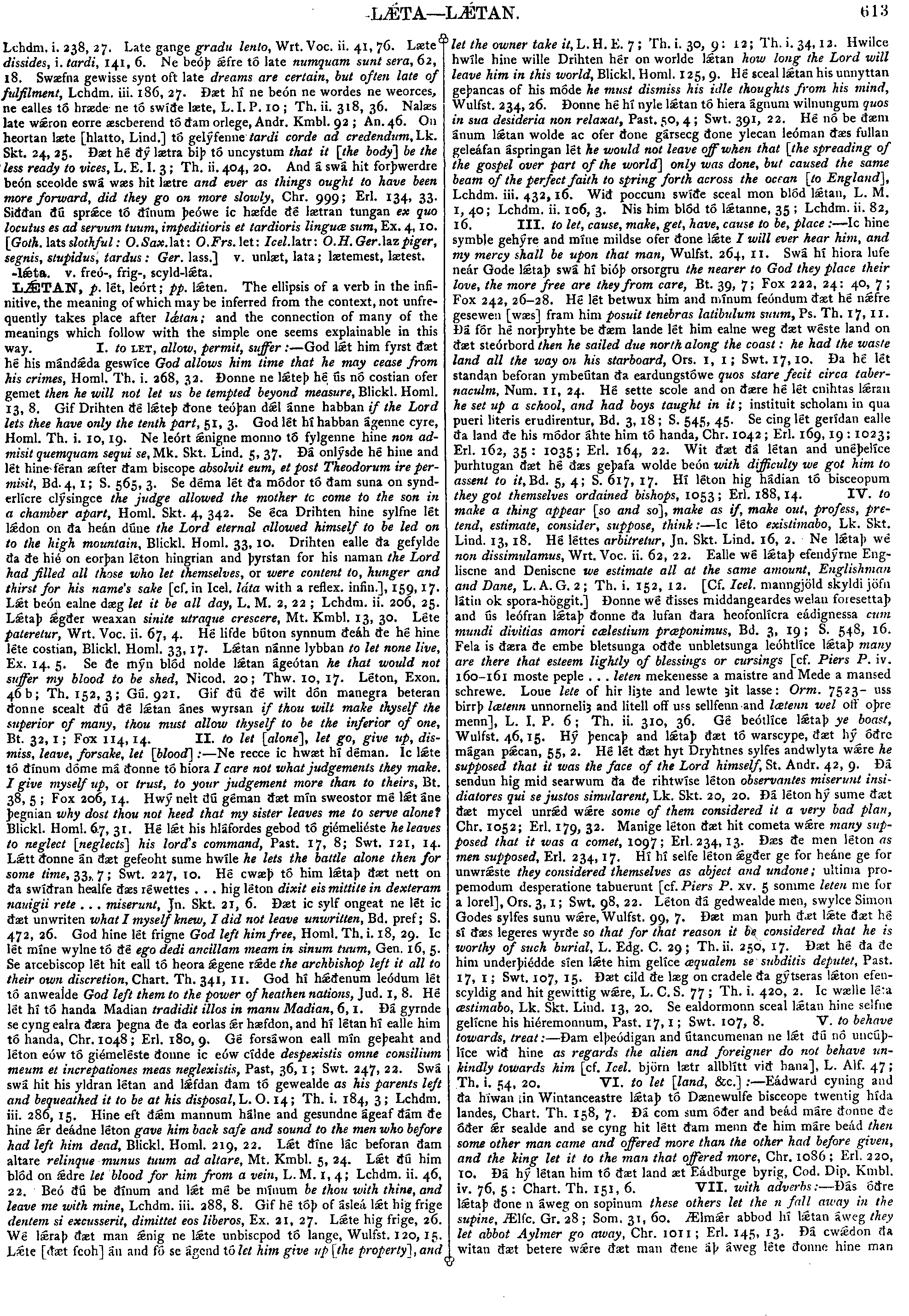
LÆ-acute;TAN,
p.
lét,
leórt;
pp.
lten.
The
ellipsis
of
a
verb
in
the
infinitive,
the
meaning
of
which
may
be
inferred
from
the
context,
not
unfrequently
takes
place
after
ltan;
and
the
connection
of
many
of
the
meanings
which
follow
with
the
simple
one
seems
explainable
in
this
way.
I.
to
LET,
allow,
permit,
suffer
:--
God
lt
him
fyrst
ðæt
hé
his
mándda
geswíce
God
allows
him
time
that
he
may
cease
from
his
crimes,
Homl.
Th.
i.
268,
32.
Ðonne
ne
lteþ
hé
ús
nó
costian
ofer
gemet
then
he
will
not
let
us
be
tempted
beyond
measure,
Blickl.
Homl.
13,
8.
Gif
Drihten
ðé
lteþ
ðone
teóþan
dl
ánne
habban
if
the
Lord
lets
thee
have
only
the
tenth
part,
51,
3.
God
lét
hí
habban
ágenne
cyre,
Homl.
Th.
i.
10,
19.
Ne
leórt
nigne
monno
tó
fylgenne
hine
non
admisit
quemquam
sequi
se,
Mk.
Skt.
Lind.
5,
37.
Ðá
onlýsde
hé
hine
and
lét
hine
féran
æfter
ðam
biscope
absolvit
eum,
et
post
Theodorum
ire
permisit,
Bd.
4,
1;
S.
565,
3.
Se
déma
lét
ða
módor
tó
ðam
suna
on
synderlícre
clýsingce
the
judge
allowed
the
mother
to
come
to
the
son
in
a
chamber
apart,
Homl.
Skt.
4,
342.
Se
éca
Drihten
hine
sylfne
lét
ldon
on
ða
heán
dúne
the
Lord
eternal
allowed
himself
to
be
led
on
to
the
high
mountain,
Blickl.
Homl.
33,
10.
Drihten
ealle
ða
gefylde
ða
ðe
hié
on
eorþan
léton
hingrian
and
þyrstan
for
his
naman
the
Lord
had
filled
all
those
who
let
themselves,
or
were
content
to,
hunger
and
thirst
for
his
name's
sake
[cf.
in
Icel.
láta
with
a
reflex.
infin.],
159,
17.
Lt
beón
ealne
dæg
let
it
be
all
day,
L.
M.
2,
22;
Lchdm.
ii.
206,
25.
Ltaþ
gðer
weaxan
sinite
utraque
crescere,
Mt.
Kmbl.
13,
30.
Léte
pateretur,
Wrt.
Voc.
ii.
67,
4.
Hé
lifde
búton
synnum
ðeáh
ðe
hé
hine
léte
costian,
Blickl.
Homl.
33,
17.
Ltan
nánne
lybban
to
let
none
live,
Ex.
14,
5.
Se
ðe
mýn
blód
nolde
ltan
ágeótan
he
that
would
not
suffer
my
blood
to
be
shed,
Nicod.
20;
Thw.
10,
17.
Léton,
Exon.
46
b;
Th.
152,
3;
Gú.
921.
Gif
ðú
ðé
wilt
dón
manegra
beteran
ðonne
scealt
ðú
ðé
ltan
ánes
wyrsan
if
thou
wilt
make
thyself
the
superior
of
many,
thou
must
allow
thyself
to
be
the
inferior
of
one,
Bt.
32,
1;
Fox
114,
14.
II.
to
let
[alone],
let
go,
give
up,
dismiss,
leave,
forsake,
let
[blood]
:--
Ne
recce
ic
hwæt
hí
déman.
Ic
lte
tó
ðínum
dóme
má
ðonne
tó
hiora
I
care
not
what
judgements
they
make.
I
give
myself
up,
or
trust,
to
your
judgement
more
than
to
theirs,
Bt.
38,
5;
Fox
206,
14.
Hwý
nelt
ðú
géman
ðæt
mín
sweostor
mé
lt
áne
þegnian
why
dost
thou
not
heed
that
my
sister
leaves
me
to
serve
alone?
Blickl.
Homl.
67,
31.
Hé
lt
his
hláfordes
gebod
tó
giémeliéste
he
leaves
to
neglect
[neglects]
his
lord's
command,
Past.
17,
8;
Swt.
121,
14.
Ltt
ðonne
án
ðæt
gefeoht
sume
hwíle
he
lets
the
battle
alone
then
for
some
time,
33,
7;
Swt.
227,
10.
Hé
cwæþ
tó
him
ltaþ
ðæt
nett
on
ða
swíðran
healfe
ðæs
réwettes
...
hig
léton
dixit
eis
mittite
in
dexteram
nauigii
rete
...
miserunt,
Jn.
Skt.
21,
6.
Ðæt
ic
sylf
ongeat
ne
lét
ic
ðæt
unwriten
what
I
myself
knew,
I
did
not
leave
unwritten,
Bd.
pref;
S.
472,
26.
God
hine
lét
frigne
God
left
him
free,
Homl.
Th.
i.
18,
29.
Ic
lét
míne
wylne
tó
ðé
ego
dedi
ancillam
meam
in
sinum
tuum,
Gen.
16,
5.
Se
arcebiscop
lét
hit
eall
tó
heora
gene
rde
the
archbishop
left
it
all
to
their
own
discretion,
Chart.
Th.
341,
11.
God
hí
hðenum
leódum
lét
tó
anwealde
God
left
them
to
the
power
of
heathen
nations,
Jud.
1,
8.
Hé
lét
hí
tó
handa
Madian
tradidit
illos
in
manu
Madian,
6,
1.
Ðá
gyrnde
se
cyng
ealra
ðæra
þegna
ðe
ða
eorlas
r
hæfdon,
and
hí
létan
hí
ealle
him
tó
handa,
Chr.
1048;
Erl.
180,
9.
Gé
forsáwon
eall
mín
geþeaht
and
léton
eów
tó
giémeléste
ðonne
ic
eów
cídde
despexistis
omne
consilium
meum
et
increpationes
meas
neglexistis,
Past,
36,
1;
Swt.
247,
22.
Swá
swá
hit
his
yldran
létan
and
lfdan
ðam
tó
gewealde
as
his
parents
left
and
bequeathed
it
to
be
at
his
disposal,
L.
O.
14;
Th.
i.
184,
3;
Lchdm.
iii.
286,
15.
Hine
eft
ðm
mannum
hálne
and
gesundne
ágeaf
ðám
ðe
hine
r
deádne
léton
gave
him
back
safe
and
sound
to
the
men
who
before
had
left
him
dead,
Blickl.
Homl.
219,
22.
Lt
ðíne
lác
beforan
ðam
altare
relinque
munus
tuum
ad
altare,
Mt.
Kmbl.
5,
24.
Lt
ðú
him
blód
on
dre
let
blood
for
him
from
a
vein,
L.
M.
1,
4;
Lchdm.
ii.
46,
22.
Beó
ðú
be
ðínum
and
lt
mé
be
mínum
be
thou
with
thine,
and
leave
me
with
mine,
Lchdm.
iii.
288,
8.
Gif
hé
tóþ
of
ásleá
lt
hig
frige
dentem
si
excusserit,
dimittet
eos
liberos,
Ex.
21,
27.
Lte
hig
frige,
26.
Wé
lraþ
ðæt
man
nig
ne
lte
unbiscpod
tó
lange,
Wulfst.
120,
15.
Lte
[ðæt
feoh]
án
and
fó
se
ágend
tó
let
him
give
up
[the
property],
and
let
the
owner
take
it,
L.
H.
E.
7;
Th.
i.
30,
9:
12;
Th.
i.
34,
12.
Hwilce
hwíle
hine
wille
Drihten
hér
on
worlde
ltan
how
long
the
Lord
will
leave
him
in
this
world,
Blickl.
Homl.
125,
9.
Hé
sceal
ltan
his
unnyttan
geþancas
of
his
móde
he
must
dismiss
his
idle
thoughts
from
his
mind,
Wulfst.
234,
26.
Ðonne
hé
hí
nyle
ltan
tó
hiera
ágnum
wilnungum
quos
in
sua
desideria
non
relaxat,
Past.
50,
4;
Swt.
391,
22.
Hé
nó
be
ðæm
ánum
ltan
wolde
ac
ofer
ðone
gársecg
ðone
ylecan
leóman
ðæs
fullan
geleáfan
áspringan
lét
he
would
not
leave
off
when
that
[the
spreading
of
the
gospel
over
part
of
the
world]
only
was
done,
but
caused
the
same
beam
of
the
perfect
faith
to
spring
forth
across
the
ocean
[to
England],
Lchdm.
iii.
432,
16.
Wið
poccum
swíðe
sceal
mon
blód
ltan,
L.
M.
1,
40;
Lchdm.
ii.
106,
3.
Nis
him
blód
tó
ltanne,
35;
Lchdm.
ii.
82,
16.
III.
to
let,
cause,
make,
get,
have,
cause
to
be,
place
:--
Ic
hine
symble
gehýre
and
míne
mildse
ofer
ðone
lte
I
will
ever
hear
him,
and
my
mercy
shall
be
upon
that
man,
Wulfst.
264,
11.
Swá
hí
hiora
lufe
neár
Gode
ltaþ
swá
hí
bióþ
orsorgru
the
nearer
to
God
they
place
their
love,
the
more
free
are
they
from
care,
Bt.
39,
7;
Fox
222,
24:
40,
7;
Fox
242,
26-28.
Hé
lét
betwux
him
and
mínum
feóndum
ðæt
hé
nfre
gesewen
[wæs]
fram
him
posuit
tenebras
latibulum
suum,
Ps.
Th.
17,
11.
Ðá
fór
hé
norþryhte
be
ðæm
lande
lét
him
ealne
weg
ðæt
wéste
land
on
ðæt
steórbord
then
he
sailed
due
north
along
the
coast:
he
had
the
waste
land
all
the
way
on
his
starboard,
Ors.
1,
1;
Swt.
17,
10.
Ða
hé
lét
standan
beforan
ymbeútan
ða
eardungstówe
quos
stare
fecit
circa
tabernaculm,
Num.
11,
24.
Hé
sette
scole
and
on
ðære
hé
lét
cnihtas
lran
he
set
up
a
school,
and
had
boys
taught
in
it;
instituit
scholam
in
qua
pueri
literis
erudirentur,
Bd.
3,
18;
S.
545,
45.
Se
cing
lét
gerídan
ealle
ða
land
ðe
his
módor
áhte
him
tó
handa,
Chr.
1042;
Erl.
169,
19:
1023;
Erl.
162,
35:
1035;
Erl.
164,
22.
Wit
ðæt
ðá
létan
and
unéþelíce
þurhtugan
ðæt
hé
ðæs
geþafa
wolde
beón
with
difficulty
we
got
him
to
assent
to
it,
Bd.
5,
4;
S.
617,
17.
Hí
léton
hig
hádian
tó
bisceopum
they
got
themselves
ordained
bishops,
1053;
Erl.
188,
14.
IV.
to
make
a
thing
appear
[so
and
so],
make
as
if,
make
out,
profess,
pretend,
estimate,
consider,
suppose,
think
:--
Ic
léto
existimabo,
Lk.
Skt.
Lind.
13,
18.
Hé
léttes
arbitretur,
Jn.
Skt.
Lind.
16,
2.
Ne
ltaþ
wé
non
dissimulamus,
Wrt.
Voc.
ii.
62,
22.
Ealle
wé
ltaþ
efendýrne
Engliscne
and
Deniscne
we
estimate
all
at
the
same
amount,
Englishman
and
Dane,
L.
A.
G.
2;
Th.
i.
152,
12.
[Cf.
Icel.
manngjöld
skyldi
jöfn
látin
ok
spora-höggit.]
Ðonne
wé
ðisses
middangeardes
welan
foresettaþ
and
ús
leófran
ltaþ
ðonne
ða
lufan
ðara
heofonlícra
eádignessa
cum
mundi
divitias
amori
cælestium
præponimus,
Bd.
3,
19;
S.
548,
16.
Fela
is
ðæra
ðe
embe
bletsunga
oððe
unbletsunga
leóhtlíce
ltaþ
many
are
there
that
esteem
lightly
of
blessings
or
cursings
[cf.
Piers
P.
iv.
160-161
moste
peple
...
leten
mekenesse
a
maistre
and
Mede
a
mansed
schrewe.
Loue
lete
of
hir
li te
and
lewte
it
lasse:
Orm.
7523-
uss
birrþ
lætenn
unnorneli
and
litell
off
uss
sellfenn
and
lætenn
wel
off
oþre
menn],
L.
I.
P.
6;
Th.
ii.
310,
36.
Gé
beótlíce
lætaþ
ye
boast,
Wulfst.
46,
15.
Hý
þencaþ
and
ltaþ
ðæt
tó
warscype,
ðæt
hý
óðre
mágan
pcan,
55,
2.
Hé
lét
ðæt
hyt
Dryhtnes
sylfes
andwlyta
wre
he
supposed
that
it
was
the
face
of
the
Lord
himself,
St.
Andr.
42,
9.
Ðá
sendun
hig
mid
searwum
ða
ðe
rihtwíse
léton
observantes
miserunt
insidiatores
qui
se
justos
simularent,
Lk.
Skt.
20,
20.
Ðá
léton
hý
sume
ðæt
ðæt
mycel
unrd
wre
some
of
them
considered
it
a
very
bad
plan,
Chr.
1052;
Erl.
179,
32.
Manige
léton
ðæt
hit
cometa
wre
many
supposed
that
it
was
a
comet,
1097;
Er1.234,
13.
Ðæs
ðe
men
léton
as
men
supposed,
Erl.
234,
17.
Hí
hí
selfe
léton
gðer
ge
for
heáne
ge
for
unwrste
they
considered
themselves
as
abject
and
undone;
ultima
propemodum
desperatione
tabuerunt
[cf.
Piers
P.
xv.
5
somme
leten
me
for
a
lorel],
Ors.
3,
1;
Swt.
98,
22.
Léton
ðá
gedwealde
men,
swylce
Simon
Godes
sylfes
sunu
wre.
Wulfst.
99,
7.
Ðæt
man
þurh
ðæt
lte
ðæt
hé
sí
ðæs
legeres
wyrðe
so
that
for
that
reason
it
be
considered
that
he
is
worthy
of
such
burial,
L.
Edg.
C.
29;
Th.
ii.
250,
17.
Ðæt
hé
ða
ðe
him
underþiédde
síen
lte
him
gelíce
æqualem
se
subditis
deputet,
Past.
17,
1;
Swt.
107,
15.
Ðæt
cild
ðe
læg
on
cradele
ða
gýtseras
lton
efenscyldig
and
hit
gewittig
wre,
L.
C.
S.
77;
Th.
i.
420,
2.
Ic
wælle
léta
æstimabo,
Lk.
Skt.
Lind.
13,
20.
Se
ealdormonn
sceal
ltan
hine
selfne
gelícne
his
hiéremonnum,
Past.
17,
1;
Swt.
107,
8.
V.
to
behave
towards,
treat
:--
Ðam
elþeódigan
and
útancumenan
ne
lt
ðú
nó
uncúþlíce
wið
hine
as
regards
the
alien
and
foreigner
do
not
behave
unkindly
towards
him
[cf.
Icel.
björn
lætr
allblítt
við
hana],
L.
Alf.
47;
Th.
i.
54,
20.
VI.
to
let
[land,
&c.]
:--
Eádward
cyning
and
ða
híwan
in
Wintanceastre
ltaþ
tó
Dænewulfe
bisceope
twentig
hída
landes,
Chart.
Th.
158,
7.
Ðá
com
sum
óðer
and
beád
máre
ðonne
ðe
óðer
r
sealde
and
se
cyng
hit
létt
ðam
menn
ðe
him
máre
beád
then
some
other
man
came
and
offered
more
than
the
other
had
before
given,
and
the
king
let
it
to
the
man
that
offered
more,
Chr.
1086;
Erl.
220,
10.
Ðá
hý
létan
him
tó
ðæt
land
æt
Eádburge
byrig,
Cod.
Dip.
Kmbl.
iv.
76,
5:
Chart.
Th.
151,
6.
VII.
with
adverbs
:--
Ðás
óðre
ltaþ
ðone
n
áweg
on
sopinum
these
others
let
the
n
fall
away
in
the
supine,
Ælfc.
Gr.
28;
Som.
31,
60.
Ælmr
abbod
hí
ltan
áweg
they
let
abbot
Aylmer
go
away,
Chr.
1011;
Erl.
145,
13.
Ðá
cwdon
ða
witan
ðæt
betere
wre
ðæt
man
ðene
áþ
áweg
léte
ðonne
hine
man
sealde
...
Ðá
lét
hé
ðone
áþ
áweg
then
the
witan
said
that
it
would
be
better
that
the
oath
should
be
dispensed
with
than
that
it
should
be
taken
...
Then
he
omitted
the
oath,
Chart.
Th.
289,
24-30.
Æt
ealre
ðære
hergunge
and
æt
eallum
ðám
hearmum
ðe
r
ðam
gedón
wre
r
ðæt
friþ
geset
wre
man
eall
onweig
lte
and
nán
man
ðæt
ne
wræce
ne
bóte
ne
bidde
as
regards
all
the
harrying
and
all
the
injuries
that
were
done
before
the
peace
was
made,
let
it
all
be
dismissed,
and
let
no
man
avenge
it
or
ask
for
compensation,
L.
Eth.
ii.
6;
Th.
i.
288,
3.
Petrus
cnucode
óþ
ðæt
hí
hine
inn
léton
Peter
knocked
until
they
let
him
in,
Homl.
Th.
i.
382,
23.
Hé
lt
him
eáþelíce
ymbe
ðæt
he
takes
it
easily,
Wulfst.
298,
30:
Homl.
Skt.
4,
342.
[Goth.
létan:
O.
Sax.
látan:
O.
Fries.
léta:
Icel.
láta:
O.
H.
Ger.
lázan.]
DER.
á-,
for-,
ge-,
of-,
on-,
tó-
ltan.
te
and
lewte
it
lasse:
Orm.
7523-
uss
birrþ
lætenn
unnorneli
and
litell
off
uss
sellfenn
and
lætenn
wel
off
oþre
menn],
L.
I.
P.
6;
Th.
ii.
310,
36.
Gé
beótlíce
lætaþ
ye
boast,
Wulfst.
46,
15.
Hý
þencaþ
and
ltaþ
ðæt
tó
warscype,
ðæt
hý
óðre
mágan
pcan,
55,
2.
Hé
lét
ðæt
hyt
Dryhtnes
sylfes
andwlyta
wre
he
supposed
that
it
was
the
face
of
the
Lord
himself,
St.
Andr.
42,
9.
Ðá
sendun
hig
mid
searwum
ða
ðe
rihtwíse
léton
observantes
miserunt
insidiatores
qui
se
justos
simularent,
Lk.
Skt.
20,
20.
Ðá
léton
hý
sume
ðæt
ðæt
mycel
unrd
wre
some
of
them
considered
it
a
very
bad
plan,
Chr.
1052;
Erl.
179,
32.
Manige
léton
ðæt
hit
cometa
wre
many
supposed
that
it
was
a
comet,
1097;
Er1.234,
13.
Ðæs
ðe
men
léton
as
men
supposed,
Erl.
234,
17.
Hí
hí
selfe
léton
gðer
ge
for
heáne
ge
for
unwrste
they
considered
themselves
as
abject
and
undone;
ultima
propemodum
desperatione
tabuerunt
[cf.
Piers
P.
xv.
5
somme
leten
me
for
a
lorel],
Ors.
3,
1;
Swt.
98,
22.
Léton
ðá
gedwealde
men,
swylce
Simon
Godes
sylfes
sunu
wre.
Wulfst.
99,
7.
Ðæt
man
þurh
ðæt
lte
ðæt
hé
sí
ðæs
legeres
wyrðe
so
that
for
that
reason
it
be
considered
that
he
is
worthy
of
such
burial,
L.
Edg.
C.
29;
Th.
ii.
250,
17.
Ðæt
hé
ða
ðe
him
underþiédde
síen
lte
him
gelíce
æqualem
se
subditis
deputet,
Past.
17,
1;
Swt.
107,
15.
Ðæt
cild
ðe
læg
on
cradele
ða
gýtseras
lton
efenscyldig
and
hit
gewittig
wre,
L.
C.
S.
77;
Th.
i.
420,
2.
Ic
wælle
léta
æstimabo,
Lk.
Skt.
Lind.
13,
20.
Se
ealdormonn
sceal
ltan
hine
selfne
gelícne
his
hiéremonnum,
Past.
17,
1;
Swt.
107,
8.
V.
to
behave
towards,
treat
:--
Ðam
elþeódigan
and
útancumenan
ne
lt
ðú
nó
uncúþlíce
wið
hine
as
regards
the
alien
and
foreigner
do
not
behave
unkindly
towards
him
[cf.
Icel.
björn
lætr
allblítt
við
hana],
L.
Alf.
47;
Th.
i.
54,
20.
VI.
to
let
[land,
&c.]
:--
Eádward
cyning
and
ða
híwan
in
Wintanceastre
ltaþ
tó
Dænewulfe
bisceope
twentig
hída
landes,
Chart.
Th.
158,
7.
Ðá
com
sum
óðer
and
beád
máre
ðonne
ðe
óðer
r
sealde
and
se
cyng
hit
létt
ðam
menn
ðe
him
máre
beád
then
some
other
man
came
and
offered
more
than
the
other
had
before
given,
and
the
king
let
it
to
the
man
that
offered
more,
Chr.
1086;
Erl.
220,
10.
Ðá
hý
létan
him
tó
ðæt
land
æt
Eádburge
byrig,
Cod.
Dip.
Kmbl.
iv.
76,
5:
Chart.
Th.
151,
6.
VII.
with
adverbs
:--
Ðás
óðre
ltaþ
ðone
n
áweg
on
sopinum
these
others
let
the
n
fall
away
in
the
supine,
Ælfc.
Gr.
28;
Som.
31,
60.
Ælmr
abbod
hí
ltan
áweg
they
let
abbot
Aylmer
go
away,
Chr.
1011;
Erl.
145,
13.
Ðá
cwdon
ða
witan
ðæt
betere
wre
ðæt
man
ðene
áþ
áweg
léte
ðonne
hine
man
sealde
...
Ðá
lét
hé
ðone
áþ
áweg
then
the
witan
said
that
it
would
be
better
that
the
oath
should
be
dispensed
with
than
that
it
should
be
taken
...
Then
he
omitted
the
oath,
Chart.
Th.
289,
24-30.
Æt
ealre
ðære
hergunge
and
æt
eallum
ðám
hearmum
ðe
r
ðam
gedón
wre
r
ðæt
friþ
geset
wre
man
eall
onweig
lte
and
nán
man
ðæt
ne
wræce
ne
bóte
ne
bidde
as
regards
all
the
harrying
and
all
the
injuries
that
were
done
before
the
peace
was
made,
let
it
all
be
dismissed,
and
let
no
man
avenge
it
or
ask
for
compensation,
L.
Eth.
ii.
6;
Th.
i.
288,
3.
Petrus
cnucode
óþ
ðæt
hí
hine
inn
léton
Peter
knocked
until
they
let
him
in,
Homl.
Th.
i.
382,
23.
Hé
lt
him
eáþelíce
ymbe
ðæt
he
takes
it
easily,
Wulfst.
298,
30:
Homl.
Skt.
4,
342.
[Goth.
létan:
O.
Sax.
látan:
O.
Fries.
léta:
Icel.
láta:
O.
H.
Ger.
lázan.]
DER.
á-,
for-,
ge-,
of-,
on-,
tó-
ltan.
|
Source: Bosworth/Toller, page b0621, entry 21 View original page image as: [TIFF] [PNG] [View previous entry] [View next entry] |
[Comment on this entry] [View comments] |
The following entry has been hand-corrected once. |
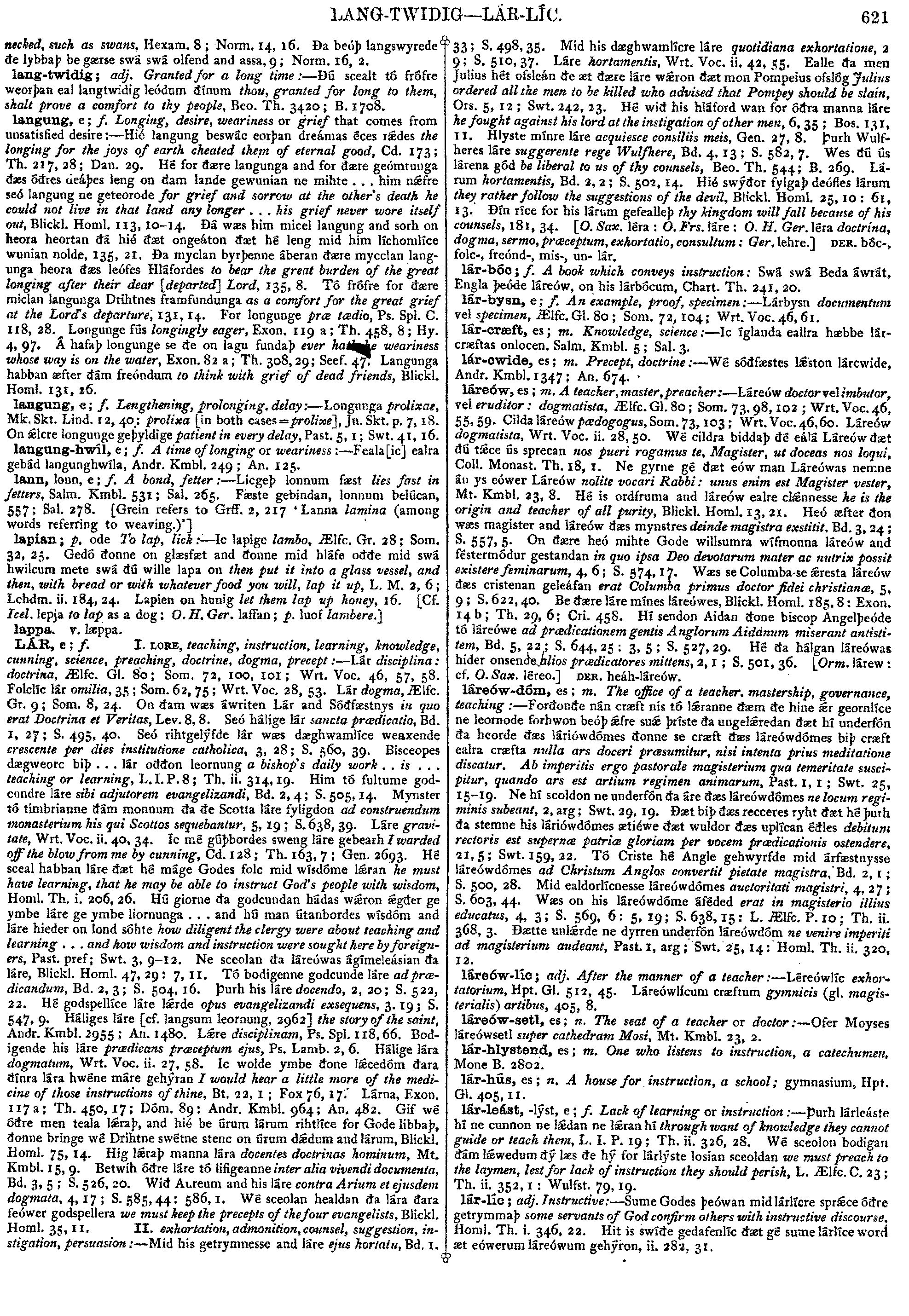
lár-líc;
adj.
Instructive
:--
Sume
Godes
þeówan
mid
lárlícre
sprce
óðre
getrymmaþ
some
servants
of
God
confirm
others
with
instructive
discourse,
Homl.
Th.
i.
346,
22.
Hit
is
swíðe
gedafenlíc
ðæt
gé
sume
lárlíce
worst
æt
eówerum
láreówum
gehýron,
ii.
282,
31.
| Result Page: |  |
Previous | 1 2 3 4 5 6 7 8 9 10 11 12 13 14 | Next |  |
Germanic Lexicon Project (main page)
This search system was written by
Sean Crist
Please consider
volunteering
to correct the data in these online dictionaries.
No rights reserved. Feel free to use these data in any way you please.