|
|

|
Source: Cleasby/Vigfusson, page b0036, entry 2 View original page image as: [TIFF] [PNG] [View previous entry] [View next entry] |
[Comment on this entry] [View comments] |
The following entry has been hand-corrected once. |
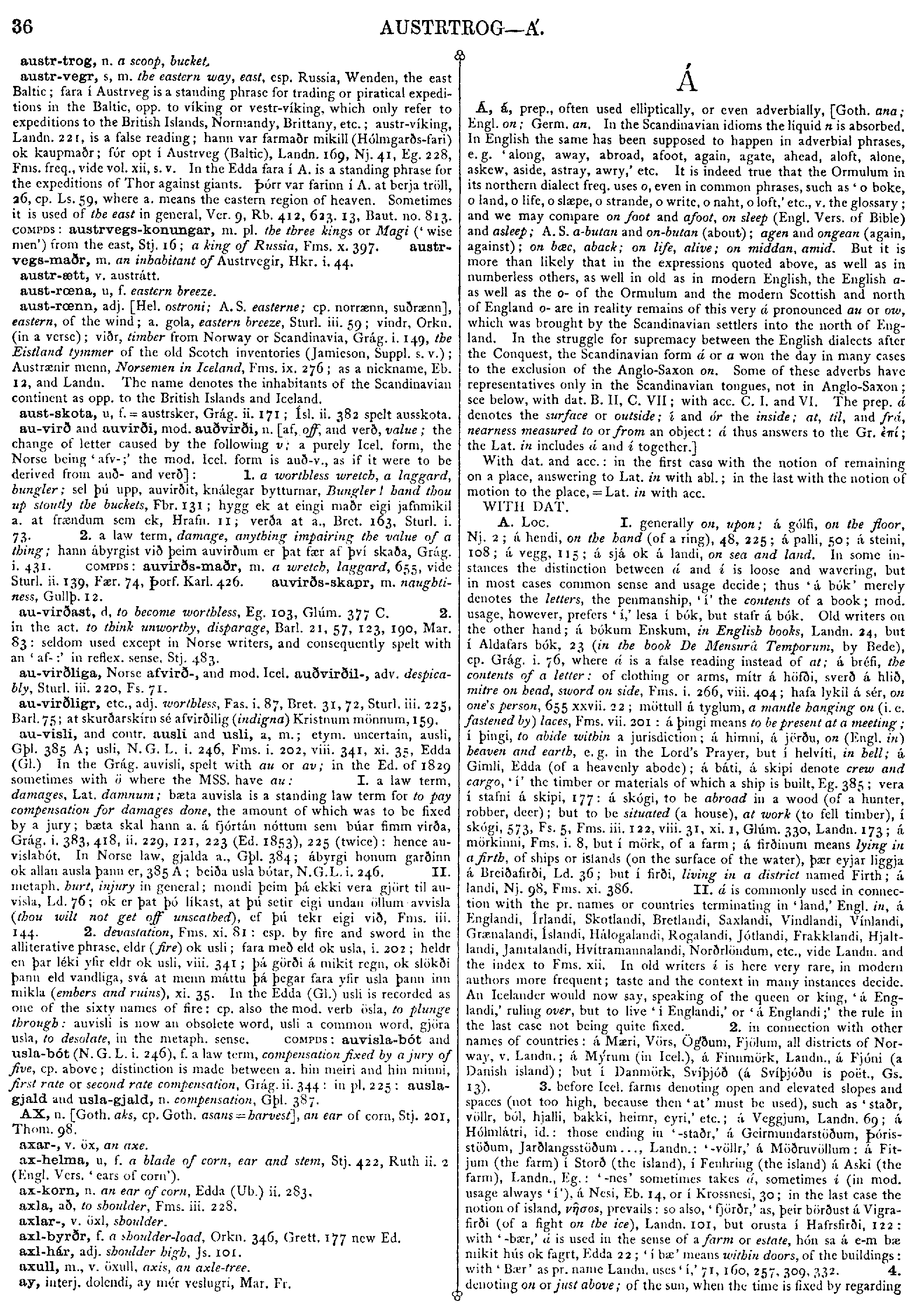
austr-vegr, s, m. the eastern way, east, esp. Russia, Wenden, the east Baltic; fara í Austrveg is a standing phrase for trading or piratical expeditions in the Baltic, opp. to víking or vestr-víking, which only refer to expeditions to the British Islands, Normandy, Brittany, etc.; austr-víking, Landn. 221, is a false reading; hann var farmaðr mikill (Hólmgarðs-fari) ok kaupmaðr; fór opt í Austrveg (Baltic), Landn. 169, Nj. 41, Eg. 228, Fms. freq., vide vol. xii, s. v. In the Edda fara í A. is a standing phrase for the expeditions of Thor against giants, Þórr var farinn í A. at berja tröll, 26, cp. Ls. 59, where a. means the eastern region of heaven. Sometimes it is used of the east in general, Ver. 9, Rb. 412, 623. 13, Baut. no. 813. COMPDS: austrvegs-konungar, m. pl. the three kings or Magi ('wise men') from the east, Stj. 16; a king of Russia, Fms. x. 397. austrvegs-maðr, m. an inhabitant of Austrvegir, Hkr. i. 44.
|
Source: Cleasby/Vigfusson, page b0036, entry 5 View original page image as: [TIFF] [PNG] [View previous entry] [View next entry] |
[Comment on this entry] [View comments] |
The following entry has been hand-corrected once. |
aust-rœnn, adj. [Hel. ostroni; A. S. easterne; cp. norrænn, suðrænn], eastern, of the wind; a. gola, eastern breeze, Sturl. iii. 59; vindr, Orkn. (in a verse); viðr, timber from Norway or Scandinavia, Grág. i. 149, the Eistland tymmer of the old Scotch inventories (Jamieson, Suppl. s. v.); Austrænir menn, Norsemen in Iceland, Fms. ix. 276; as a nickname, Eb. 12, and Landn. The name denotes the inhabitants of the Scandinavian continent as opp. to the British Islands and Iceland.
|
Source: Cleasby/Vigfusson, page b0039, entry 1 View original page image as: [TIFF] [PNG] [View previous entry] [View next entry] |
[Comment on this entry] [View comments] |
The following entry has not been hand-corrected. However, the page is reserved and someone is correcting it. |
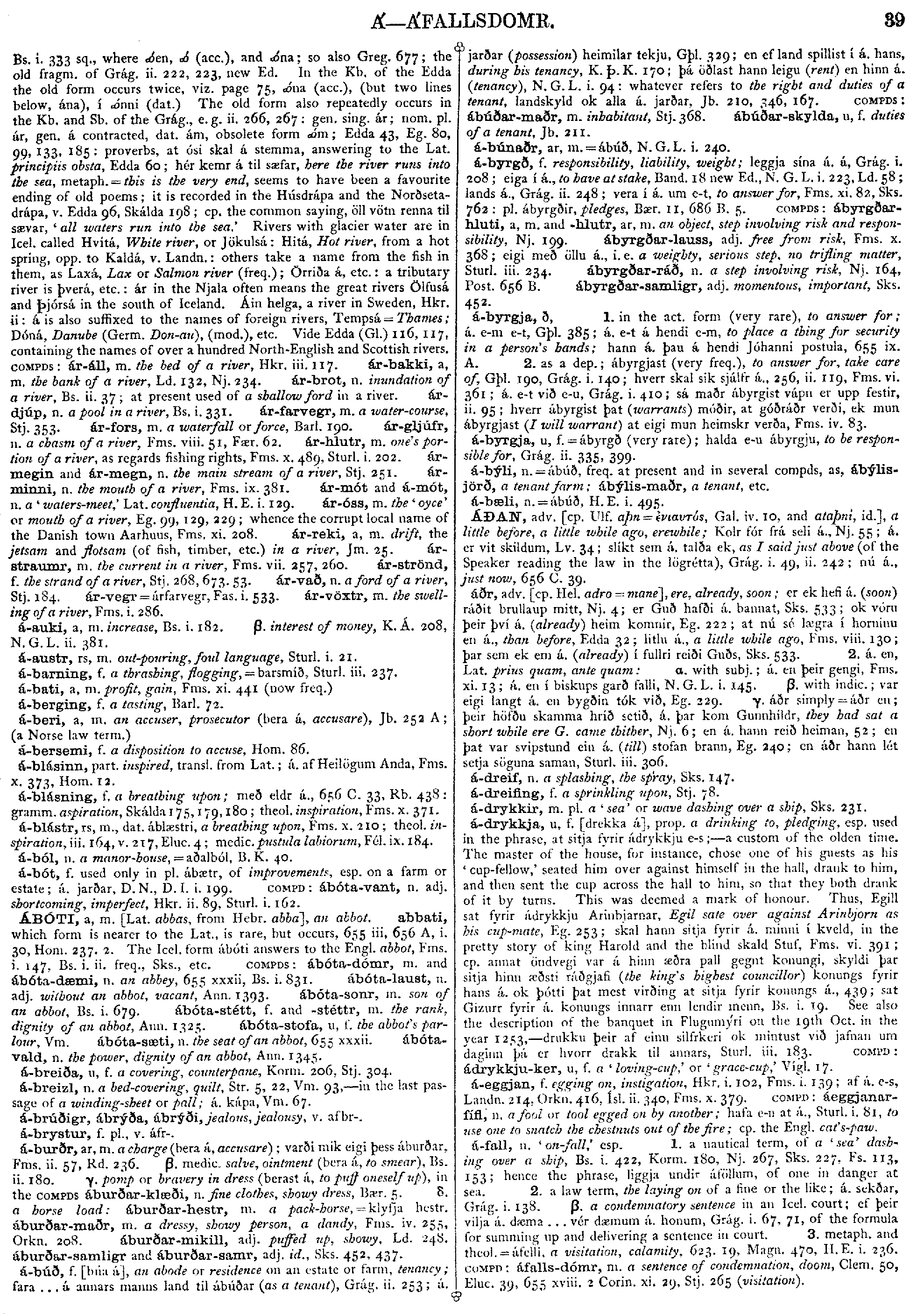
Bs. i. 333 sq., where den, ai (acc.), and tona; so also Greg. 677; the old fragm. of Grág. ii. 222, 223, new Ed. In the Kb. of the Edda the old form occurs twice, viz. page 75) *ona (acc.), (but two lines below, ána), í cónni (dat.) The old form also repeatedly occurs in the Kb. and Sb. of the Grág., e. g. ii. 266, 267: gen. sing, ár; nom. pi ar, gen. á contracted, dat. am, obsolete form com; Edda 43, Eg. 80, 99i ifå' l&5 '• proverbs, at ósi skal á stemma, answering to the Lat. principiis obsta, Edda 60; her kemr á til sæfar, here the riverrun s int o the s ea, metaph. = thi s is the very end, seems to have been a favourite ending of old poems; it is recorded in the Húsdrápa and the Norðseta- drápa, v. Edda 96, Skálda 198; cp. the common saying, oil vötn renna til sævar, ' all waters run into ike sea, ' Rivers with glacier water are in Icel. called Hvítá, White river, or Jökulsá: Hitá, Hot river, from a hot spring, opp. to Kaldá, v. Landn.: others take a name from the fish in them, as Laxá, Lax or Salmon river (freq.); Örriða á, etc.: a tributary river is þverá, etc.: ár in the Njala often means the great rivers Ölfusá and Þjórsá in the south of Iceland. Áin helga, a river in Sweden, Hkr. ii: á is also suffixed to the names of foreign rivers, Tempsá = Thames; Dóná, Danube (Germ. Don-au), (mod.), etc. Vide Edda (Gl.) 116, 117, containing the names of over a hundred North-English and Scottish rivers. COMPDS: ár-áll, m. tie bed of a river, Hkr. iii. 117. ar-bakki, a, m. the bank of a river, Ld. 132, Nj. 234. ar-brot, n. inundation of a river, Bs. ii. 37; at present used of a s hallow ford in a river. ar- djúp, n. a pool in a river, Bs. i. 331. ar-farvegr, m. a water-course, Stj. 353- ar-fors, m. a waterfall or force, Bad. 190. ár-gljúfr, n. a chasm of a river, Fms. viii. 51, Fær. 62. ár-hlutr, m. one's por- tion of a river, as regards fishing rights, Fms. x. 489, Sturl. i. 202. ár- megin and ar-megn, n. the ma in stream of a river, Stj. 251. ár- minni, n. the mouth of a river, Fms. ix. 381. ár-mót and á-mót, n. a ' waters-meet, ' Lat. cottfluentia, H. E. i. 129. ár-óss, m. the ' oyce' or mouth of a river, Eg. 99, 129, 229; whence the corrupt local name of the Danish town Aarhuus, Fms. xi. 208. ar-reki, a, m. drift, the jetsam and flotsam (of fish, timber, etc.) in a river, Jm. 25. ár- straumr, m. the current in n river, Fms. vii. 257, 260. ár-strönd, f. the strand of a river, Stj. 268, 673. 53. ár-vað, n. aford of a river, Stj. 184. ár-vegr = árfarvegr, Fas. i. 533. ár-vöxtr, m. the swell- ing of a river, Fms. i. 286.
|
Source: Cleasby/Vigfusson, page b0041, entry 62 View original page image as: [TIFF] [PNG] [View previous entry] [View next entry] |
[Comment on this entry] [View comments] |
The following entry has been hand-corrected once. |
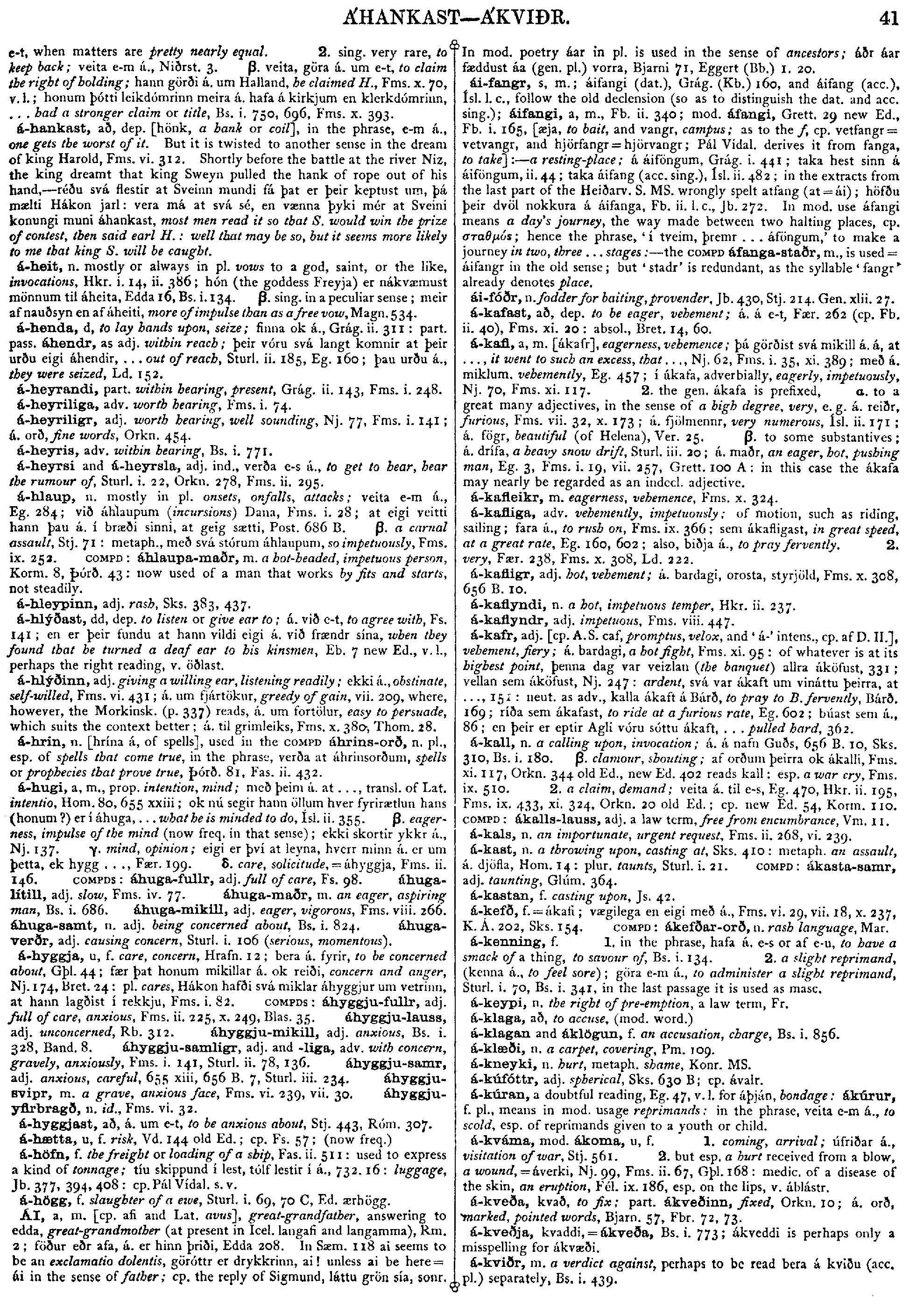
á-leiðis,
adv.
on
the
right
path,
opp.
to
afleiðis;
(leið)
snúa
e-m
á.,
metaph.,
655
xiii.
B;
snú
þeim
á.
er
þú
hefir
áðr
vilta,
id.
 forwards,
onwards;
fóru
á.
til
skipa,
Fms.
1.
136;
snúa
ferð
á.,
to
go
on
(now,
halda
áfram),
Korm.
232,
K.
Þ,
K.
94
B:
metaph.,
koma
e-u
á.,
to
bring
a
thing
about,
Hkr.
i.
169,
iii.
104;
koma
e-u
til
á.,
id.,
Fas.
i.
45
(corrupt
reading);
snúa
e-u
á.,
to
improve,
Bs.
i.
488;
víkja
á.
með
e-m,
to
side
with,
Sturl.
Iii.
91.
forwards,
onwards;
fóru
á.
til
skipa,
Fms.
1.
136;
snúa
ferð
á.,
to
go
on
(now,
halda
áfram),
Korm.
232,
K.
Þ,
K.
94
B:
metaph.,
koma
e-u
á.,
to
bring
a
thing
about,
Hkr.
i.
169,
iii.
104;
koma
e-u
til
á.,
id.,
Fas.
i.
45
(corrupt
reading);
snúa
e-u
á.,
to
improve,
Bs.
i.
488;
víkja
á.
með
e-m,
to
side
with,
Sturl.
Iii.
91.
|
Source: Cleasby/Vigfusson, page b0046, entry 4 View original page image as: [TIFF] [PNG] [View previous entry] [View next entry] |
[Comment on this entry] [View comments] |
The following entry has been hand-corrected once. |
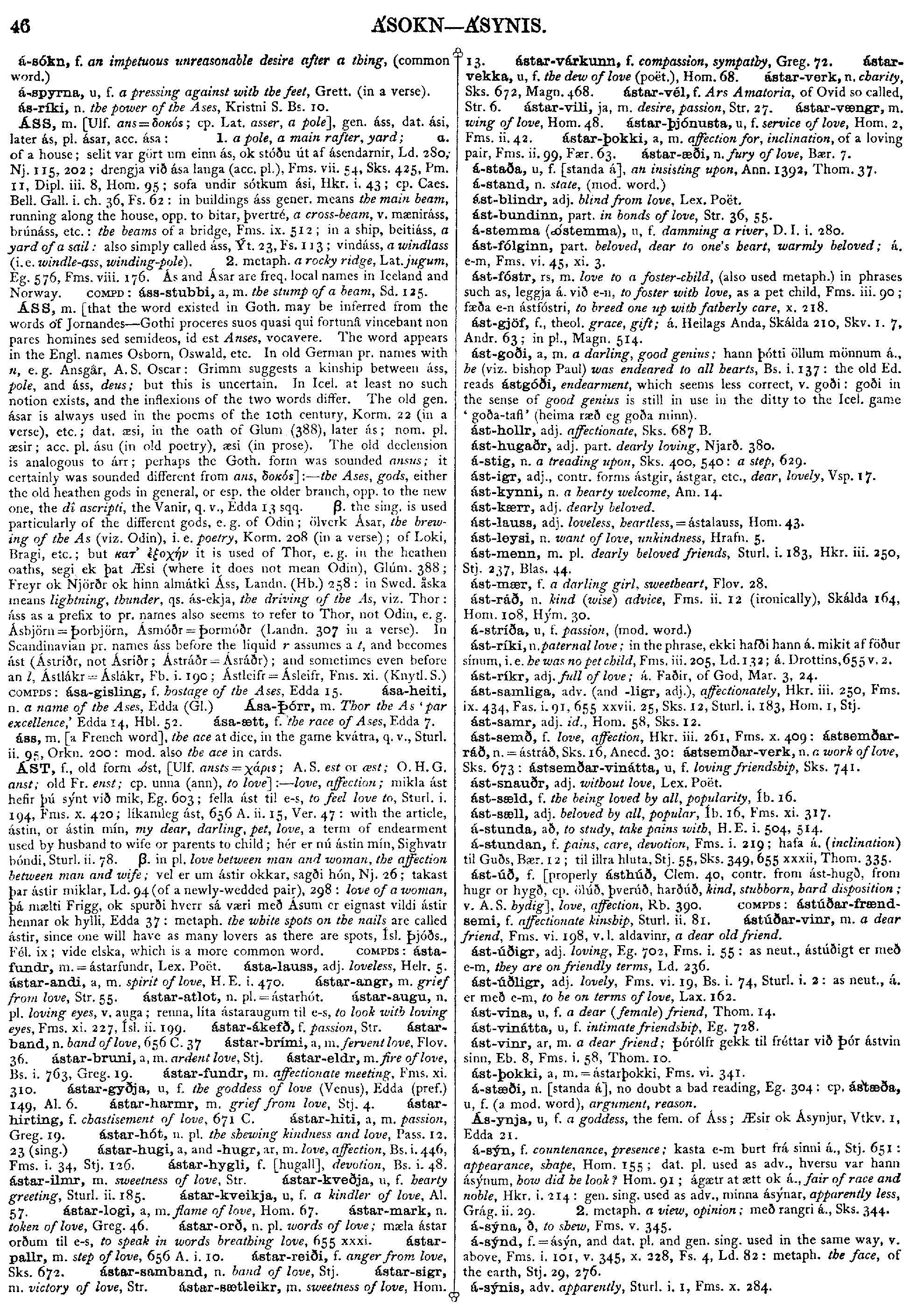
ÁSS,
m.
[Ulf.
ans
=
GREEK;
cp.
Lat.
asser,
a
pole],
gen.
áss,
dat.
ási,
later
ás,
pl.
ásar,
acc.
ása:
1.
a
pole,
a
main
rafter,
yard;
 .
of
a
house;
selit
var
gört
um
einn
as,
ok
stóðu
út
af
ásendarnir,
Ld.
280;
Nj.
115,
202;
drengja
við
ása
langa
(acc.
pl.),
Fms.
vii.
54,
Sks.
425,
Pm.
11,
Dipl.
iii.
8,
Hom.
95;
sofa
undir
sótkum
ási,
Hkr.
i.
43;
cp.
Caes.
Bell.
Gall.
5.
ch.
36,
Fs.
62:
in
buildings
áss
gener.
means
the
main
beam,
running
along
the
house,
opp.
to
bitar,
þvertré,
a
cross-beam,
v.
mæniráss,
brúnáss,
etc.:
the
beams
of
a
bridge,
Fms.
ix.
512;
in
a
ship,
beitiáss,
a
yard
of
a
sail:
also
simply
called
áss,
Ýt.
23,
Fs.
113;
vindáss,
a
windlass
(i.
e.
windle-ass,
winding-pole).
2.
metaph.
a
rocky
ridge,
Lat.
jugum,
Eg.
576,
Fms.
viii.
176.
Ás
and
Ásar
are
freq.
local
names
in
Iceland
and
Norway.
COMPD:
áss-stubbi,
a,
m.
the
stump
of
a
beam,
Sd.
125.
.
of
a
house;
selit
var
gört
um
einn
as,
ok
stóðu
út
af
ásendarnir,
Ld.
280;
Nj.
115,
202;
drengja
við
ása
langa
(acc.
pl.),
Fms.
vii.
54,
Sks.
425,
Pm.
11,
Dipl.
iii.
8,
Hom.
95;
sofa
undir
sótkum
ási,
Hkr.
i.
43;
cp.
Caes.
Bell.
Gall.
5.
ch.
36,
Fs.
62:
in
buildings
áss
gener.
means
the
main
beam,
running
along
the
house,
opp.
to
bitar,
þvertré,
a
cross-beam,
v.
mæniráss,
brúnáss,
etc.:
the
beams
of
a
bridge,
Fms.
ix.
512;
in
a
ship,
beitiáss,
a
yard
of
a
sail:
also
simply
called
áss,
Ýt.
23,
Fs.
113;
vindáss,
a
windlass
(i.
e.
windle-ass,
winding-pole).
2.
metaph.
a
rocky
ridge,
Lat.
jugum,
Eg.
576,
Fms.
viii.
176.
Ás
and
Ásar
are
freq.
local
names
in
Iceland
and
Norway.
COMPD:
áss-stubbi,
a,
m.
the
stump
of
a
beam,
Sd.
125.
|
Source: Cleasby/Vigfusson, page b0046, entry 5 View original page image as: [TIFF] [PNG] [View previous entry] [View next entry] |
[Comment on this entry] [View comments (1)] |
The following entry has been hand-corrected once. |
ÁSS,
m.
[that
the
word
existed
in
Goth,
may
be
inferred
from
the
words
of
Jornandes--Gothi
proceres
suos
quasi
qui
fortunâ
vincebant
non
pares
homines
sed
semideos,
id
est
Anses,
vocavere.
The
word
appears
in
the
Engl.
names
Osborn,
Oswald,
etc.
In
old
German
pr.
names
with
n,
e.
g.
Ansgâr,
A.
S.
Oscar:
Grimm
suggests
a
kinship
between
áss,
pole,
and
áss,
deus;
but
this
is
uncertain.
In
Icel.
at
least
no
such
notion
exists,
and
the
inflexions
of
the
two
words
differ.
The
old
gen.
asar
is
always
used
in
the
poems
of
the
10th
century,
Korm.
22
(in
a
verse),
etc.;
dat.
æsi,
in
the
oath
of
Glum
(388),
later
ás;
nom.
pl.
æsir;
acc.
pl.
ásu
(in
old
poetry),
æsi
(in
prose).
The
old
declension
is
analogous
to
árr;
perhaps
the
Goth,
form
was
sounded
ansus;
it
certainly
was
sounded
different
from
ans,
GREEK]:--the
Ases,
gods,
either
the
old
heathen
gods
in
general,
or
esp.
the
older
branch,
opp.
to
the
new
one,
the
dî
ascripti,
the
Vanir,
q.
v.,
Edda
13
sqq.
.
the
sing,
is
used
particularly
of
the
different
gods,
e.
g.
of
Odin;
ölverk
Ásar,
the
brewing
of
the
As
(viz.
Odin),
i.
e.
poetry,
Korm.
208
(in
a
verse);
of
Loki,
Bragi,
etc.;
but
GREEK
it
is
used
of
Thor,
e.
g.
in
the
heathen
oaths,
segi
ek
þat
Æsi
(where
it
does
not
mean
Odin),
Glúm.
388;
Freyr
ok
Njörðr
ok
hinn
almátki
Áss,
Landn.
(Hb.)
258:
in
Swed.
åska
means
lightning,
thunder,
qs.
ás-ekja,
the
driving
of
the
As,
viz.
Thor:
áss
as
a
prefix
to
pr.
names
also
seems
to
refer
to
Thor,
not
Odin,
e.
g.
Ásbjörn
=
Þorbjörn,
Asmóðr
=
Þormóðr
(Landri.
307
in
a
verse).
In
Scandinavian
pr.
names
áss
before
the
liquid
r
assumes
a
t,
and
becomes
ást
(Ástríðr,
not
Ásríðr;
Ástráðr
=
Ásráðr);
and
sometimes
even
before
an
l,
Ástlákr
--
Áslákr,
Fb.
i.
190;
Ástleifr
--
Ásleifr,
Fms.
xi.
(Knytl.
S.)
COMPDS:
ása-gisling,
f.
hostage
of
the
Ases,
Edda
15.
ása-heiti,
n.
a
name
of
the
Ases,
Edda
(Gl.)
Ása-Þorr,
m.
Thor
the
As
'par
excellence,'
Edda
14,
Hbl.
52.
ása-ætt,
f.
the
race
of
Ases,
Edda
7.
|
Source: Cleasby/Vigfusson, page b0048, entry 17 View original page image as: [TIFF] [PNG] [View previous entry] [View next entry] |
[Comment on this entry] [View comments] |
The following entry has been hand-corrected once. |
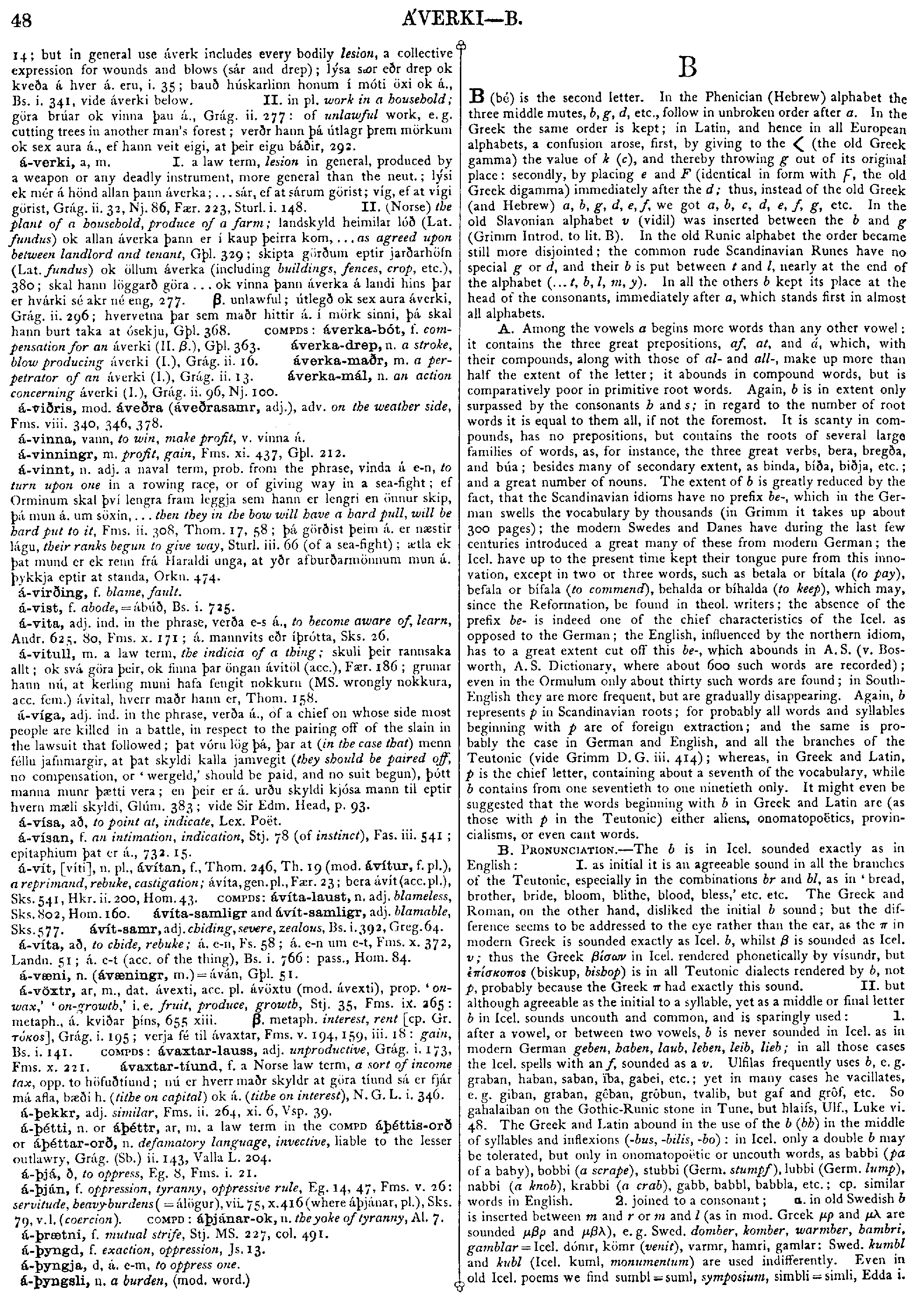
á-vöxtr,
ar,
m.,
dat.
ávexti,
acc.
pl.
ávöxtu
(mod.
ávexti),
prop.
'on-wax,'
'on-growth,'
i.e.
fruit,
produce,
growth,
Stj.
35,
Fms.
ix.
265:
metaph.,
á.
kviðar
þíns,
655
xiii.
.
metaph.
interest,
rent
[cp.
Gr.
GREEK],
Grág.
i.
195;
verja
fé
til
ávaxtar,
Fms.
v.
194,
159,
iii.
18:
gain,
Bs.
i.
141.
COMPDS:
ávaxtar-lauss,
adj.
unproductive,
Grág.
i.
173,
Fms.
x.
221.
ávaxtar-tíund,
f.
a
Norse
law
term,
a
sort
of
income
tax,
opp.
to
höfuðtíund;
nú
er
hverr
maðr
skyldr
at
göra
tíund
sá
er
fjár
má
afla,
bæði
h.
(tithe
on
capital)
ok
á.
(tithe
on
interest),
N.
G.
L.
i.
346.
|
Source: Cleasby/Vigfusson, page b0050, entry 7 View original page image as: [TIFF] [PNG] [View previous entry] [View next entry] |
[Comment on this entry] [View comments] |
The following entry has been hand-corrected once. |
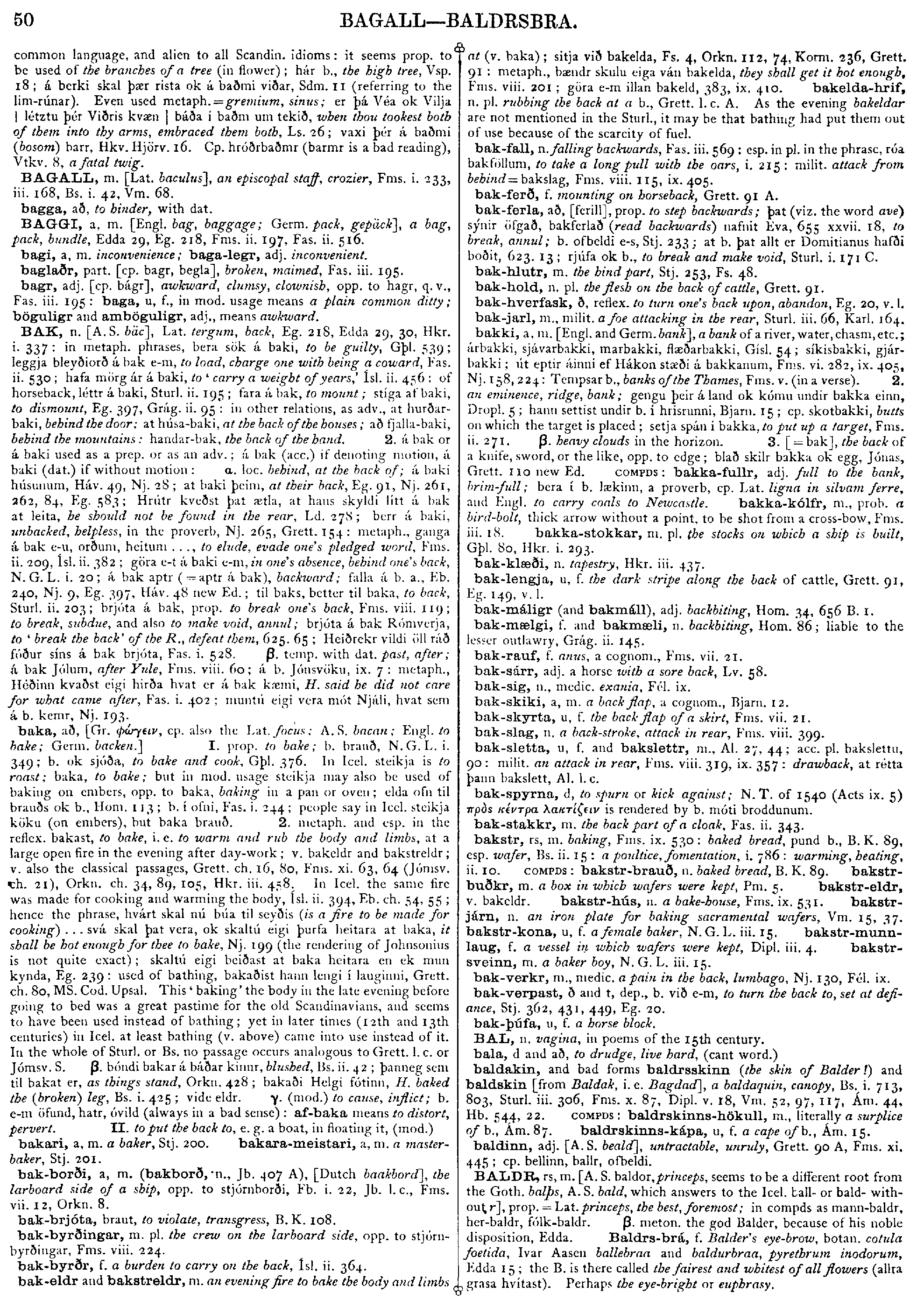
bagr, adj. [cp. bágr], awkward, clumsy, clownish, opp. to hagr, q. v., Fas. iii. 195: baga, u, f., in mod. usage means a plain common ditty; böguligr and amböguligr, adj., means awkward.
|
Source: Cleasby/Vigfusson, page b0050, entry 9 View original page image as: [TIFF] [PNG] [View previous entry] [View next entry] |
[Comment on this entry] [View comments] |
The following entry has been hand-corrected once. |
baka,
að,
[Gr.
GREEK,
cp.
also
the
Lat.
focus;
A.
S.
bacan;
Engl.
to
bake;
Germ.
backen.]
1.
prop.
to
bake;
b.
brauð,
N.
G.
L.
i.
349;
b.
ok
sjóða,
to
bake
and
cook,
Gþl.
376.
In
Icel.
steikja
is
to
roast;
baka,
to
bake;
but
in
mod.
usage
steikja
may
also
be
used
of
baking
on
embers,
opp.
to
baka,
baking
in
a
pan
or
oven;
elda
ofn
til
brauðs
ok
b.,
Hom.
113;
b.
í
ofni,
Fas.
i.
244;
people
say
in
Icel.
steikja
köku
(on
embers),
but
baka
brauð.
2.
metaph.
and
esp.
in
the
reflex.
bakast,
to
bake,
i.
e.
to
warm
and
rub
the
body
and
limbs,
at
a
large
open
fire
in
the
evening
after
day-work;
v.
bakeldr
and
bakstreldr;
v.
also
the
classical
passages,
Grett.
ch.
16,
80,
Fms.
xi.
63,
64
(Jómsv.
ch.
21),
Orkn.
ch.
34,
89,
105,
Hkr.
iii.
458.
In
Icel.
the
same
fire
was
made
for
cooking
and
warming
the
body,
Ísl.
ii.
394,
Eb.
ch.
54,
55;
hence
the
phrase,
hvárt
skal
nú
búa
til
seyðis
(is
a
fire
to
be
made
for
cooking)
...
svá
skal
þat
vera,
ok
skaltú
eigi
þurfa
heitara
at
baka,
it
shall
be
hot
enough
for
thee
to
bake,
Nj.
199
(the
rendering
of
Johnsonius
is
not
quite
exact);
skaltú
eigi
beiðast
at
baka
heitara
en
ek
mun
kynda,
Eg.
239:
used
of
bathing,
bakaðist
hann
lengi
í
lauginni,
Grett.
ch.
80,
MS.
Cod.
Upsal.
This
'baking'
the
body
in
the
late
evening
before
going
to
bed
was
a
great
pastime
for
the
old
Scandinavians,
and
seems
to
have
been
used
instead
of
bathing;
yet
in
later
times
(12th
and
13th
centuries)
in
Icel.
at
least
bathing
(v.
above)
came
into
use
instead
of
it.
In
the
whole
of
Sturl.
or
Bs.
no
passage
occurs
analogous
to
Grett.
l.
c.
or
Jómsv.
S.
.
bóndi
bakar
á
báðar
kinnr,
blushed,
Bs.
ii.
42;
þanneg
sem
til
bakat
er,
as
things
stand,
Orkn.
428;
bakaði
Helgi
fótinn,
H.
baked
the
(broken)
leg,
Bs.
i.
425;
vide
eldr.
 .
(mod.)
to
cause,
inflict;
b.
e-m
öfund,
hatr,
óvild
(always
in
a
bad
sense):
af-baka
means
to
distort,
pervert.
II.
to
put
the
back
to,
e.
g.
a
boat,
in
floating
it,
(mod.)
.
(mod.)
to
cause,
inflict;
b.
e-m
öfund,
hatr,
óvild
(always
in
a
bad
sense):
af-baka
means
to
distort,
pervert.
II.
to
put
the
back
to,
e.
g.
a
boat,
in
floating
it,
(mod.)
|
Source: Cleasby/Vigfusson, page b0050, entry 11 View original page image as: [TIFF] [PNG] [View previous entry] [View next entry] |
[Comment on this entry] [View comments] |
The following entry has been hand-corrected once. |
bak-borði, a, m. (bakborð, m., Jb. 407 A), [Dutch baakbord], the larboard side of a ship, opp. to stjórnborði, Fb. i. 22, Jb. l. c., Fms. vii. 12, Orkn. 8.
| Result Page: |  |
Previous | 1 2 3 4 5 6 7 8 9 10 11 12 13 | Next |  |
Germanic Lexicon Project (main page)
This search system was written by
Sean Crist
Please consider
volunteering
to correct the data in these online dictionaries.
No rights reserved. Feel free to use these data in any way you please.