|
|

|
Source: Cleasby/Vigfusson, page b0101, entry 39 View original page image as: [TIFF] [PNG] [View previous entry] [View next entry] |
[Comment on this entry] [View comments] |
The following entry has not been hand-corrected. However, the page is reserved and someone is correcting it. |
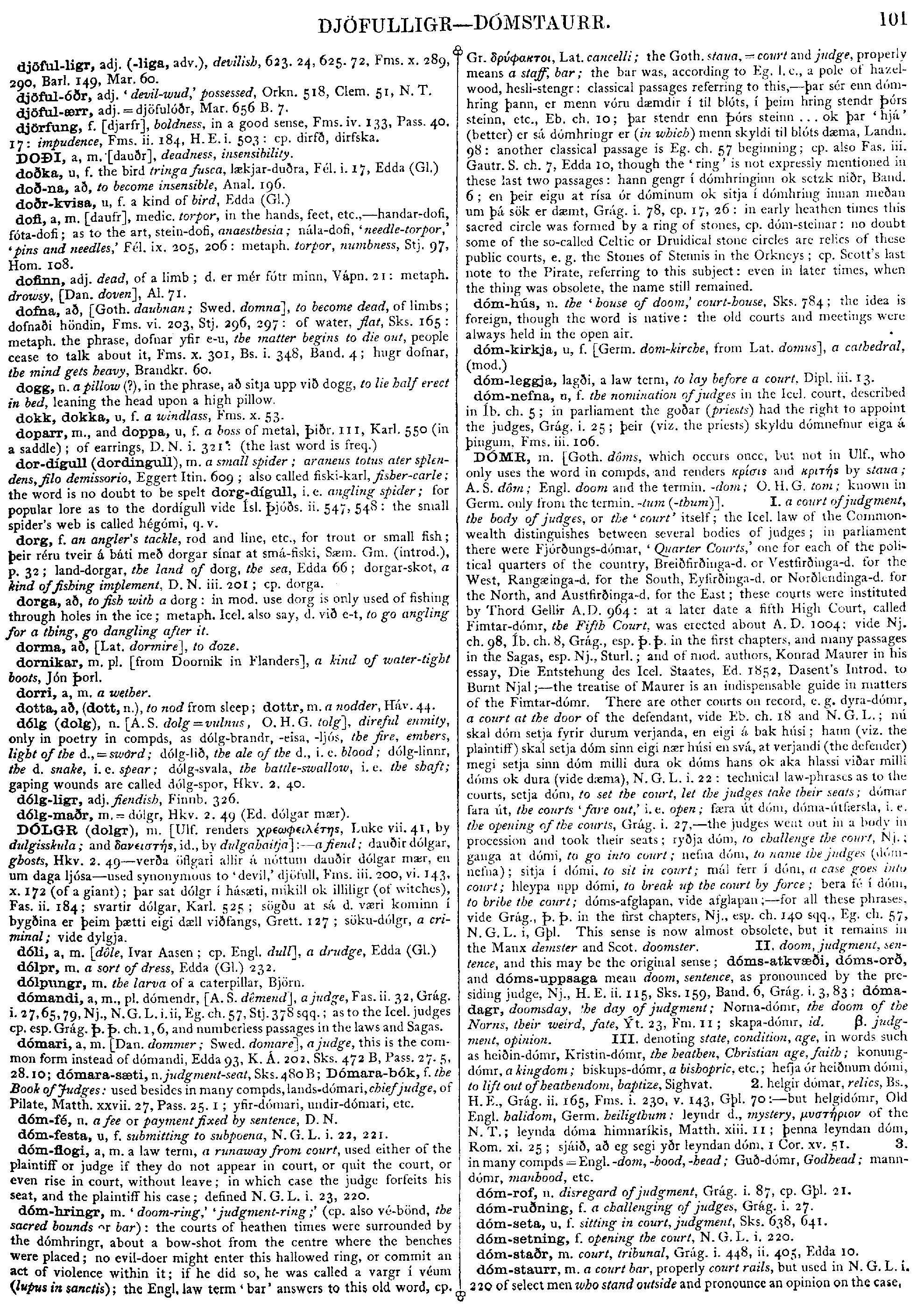
DÓMR, in. [Goth, dams, which occurs once, but not in Ulf., vvho only uses the word in compds, and renders Kpiais and Kptrris by siaua; A. S. dôm; F, ngl. d oow and the termin. -dom; O. H. G. torn; known in Germ, only from the termin. -turn (-thum)'] . I. a court of judgment, the body of judges, or the 'court' itself; the Icel. law of the Common- wealth distinguishes between several bodies of judges; in parliament there were Fjórðungs-dómar, ' Quarter Courts, ' one for each of the poli- tical quarters of the country, Breiðfirðinga-d. or Vesttirðinga-d. for the West, Rangaeinga-d. for the South, Eyiîrðinga-d. or Norðlendinga-d. lor the North, and Austfirðinga-d. for the East; these courts were instituted by Thord Gellir A. D. 964: at a later date a fifth High Court, called Fimtar-domr, the Fifth Court, was erected about A. D. 1004; vide Nj. ch. 98, íb. ch. 8, Grág., esp. f). fx in the first chapters, and many passages in the Sagas, esp. Nj., Sturl.; and of mod. authors, Konrad Maurer in his essay, Die Entstehung des Icel. Staates, Ed. 1852, Dasent's Introd. to Burnt Njal; -- the treatise of Maurer is an indispensable guide in matters of the Fimtar-domr. There are other courts on record, e. g. dyra-dómr, a court at the door of the defendant, vide Eb. ch. 18 and N. G. L.; mi skal dóm setja fyrir durum verjanda, en eigi á. bak hnsi; hann (viz. the plaintiff) skal setja dóm sinn eigi nær húsi en svá, at verjandi (the defender) megi setja sinn dóm milli dura ok dóms hans ok aka hlassi viðar milli dóms ok dura (vide dæma), N. G. L. i. 22: technical law-phrases as to the courts, setja dom, to set the court, let the judges take their seats; durmr fara lit, the courts 'fare out, ' i. e. open; faera lit dom, dúma-iitfærsla, i. e. the opening of the courts, Grug. i. 27, -- the judges went out in a body in procession and took their seats; ryðja dóm, to challenge the court, Nj.; ganga at dúmi, to go info court; nefna dom, to name the judges (iK'. ui- nefna); sitja í dómi, t o s it in court; múl ferr í dom, a case goes into court; hleypa upp dómi, to break up the court by force; bera K i dóm, to bribe the court; dóms-afglapan, vide afglapan; -- for all these phrase?, vide Grág., |x þ. in the first chapters, Nj., esp. ch. 140 sqq., Eg. ch. 57, N. G. L. i, Gþl. This sense is now almost obsolete, but it remains in the Manx demster and Scot, dooinster. II. doom, judgment, sen- tence, and this may be the original sense; dóms-atkvæði, dóms-orð, and dóms-uppsaga mean doom, sentence, as pronounced by the pre- siding judge, Nj., H. E. ii. 115, Sks. 159, Band. 6, Grág. i. 3, 83; dóma- dagr, doomsday, 'he day of judgment; Norna-dómr, the doom of the Norns, their weird, fate, Ýt. 23, Fm. 11; skapa-dómr, id. (3. judg- ment, opinion. III. denoting s t a te, condition, age, in words such as heiðin-dómr, Kristin-dómr, the heathen, Christian age, faith; konung- domr, a kingdom; biskups-dómr, a bishopric, etc.; hefja ór heiðnum dómi, to lift out of heathendom, baptize, Sighvat. 2. helgir dómar, relics, Bs., H. F, ., Grág. ii. 165, Fms. i. 230, v. 143, Gpl. 70 :-- but helgidómr, Old Engl. halidom, Germ, heiligthum: leyndr d., mystery, fjiiaTrjpl. ov of the N. T.; leynda donia hirnnarikis, Matth. xiii. ii; þenna leyndan dom, Rom. xi. 25; sjáið, að eg segi yðr leyndan dom, í Cor. xv. 51. 3. in many compds = Engl. -dom, -hood, -head; Guð-dómr, Godhead; mann- dómr, manhood,
|
Source: Cleasby/Vigfusson, page b0101, entry 43 View original page image as: [TIFF] [PNG] [View previous entry] [View next entry] |
[Comment on this entry] [View comments] |
The following entry has not been hand-corrected. However, the page is reserved and someone is correcting it. |
dóm-setning, f. opening the court, N. G. L. i. 220.
|
Source: Cleasby/Vigfusson, page b0111, entry 15 View original page image as: [TIFF] [PNG] [View previous entry] [View next entry] |
[Comment on this entry] [View comments] |
The following entry has been hand-corrected once. |
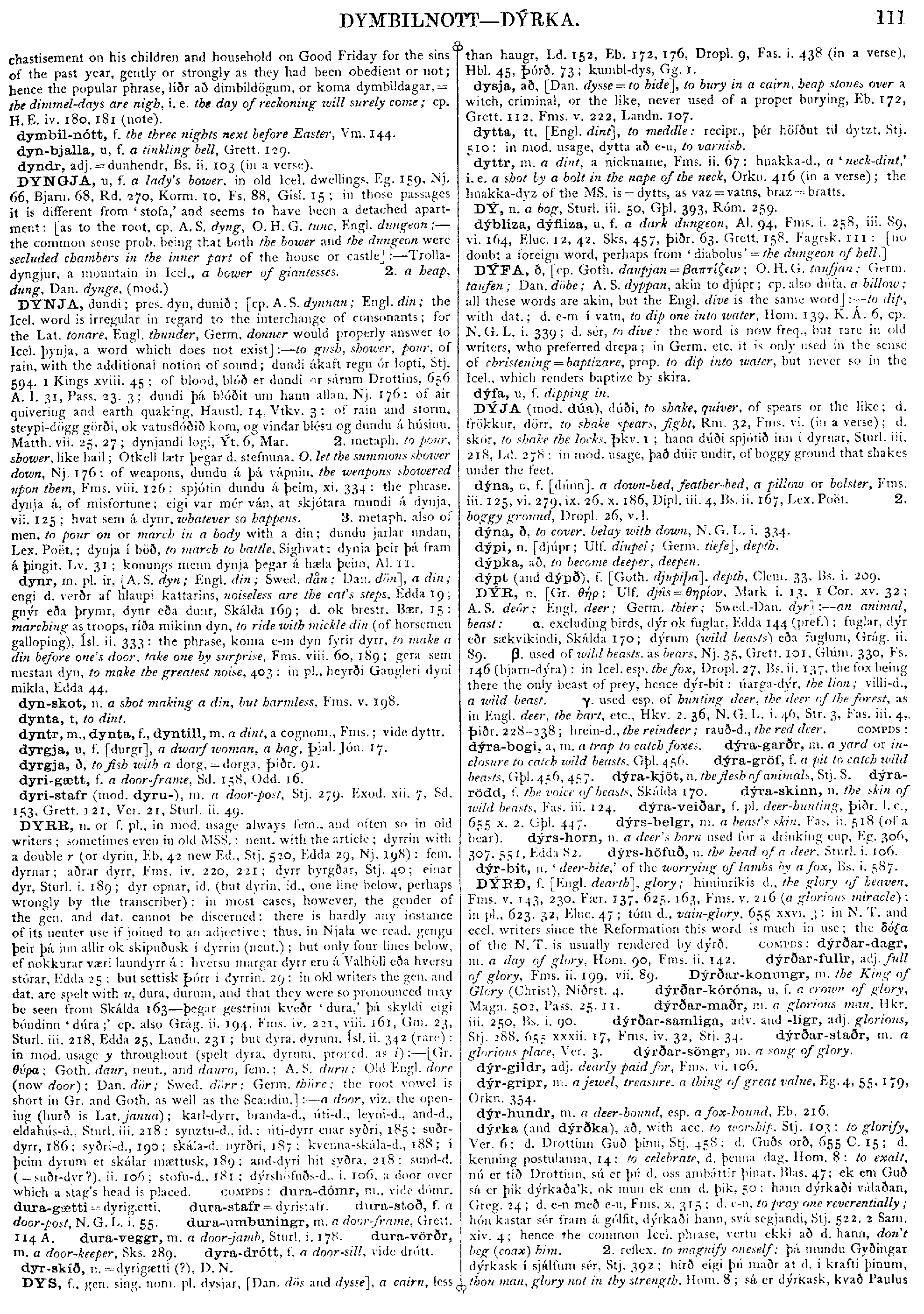
DYRR, n. or f. pl., in mod. usage always fem., and often so in old writers; sometimes even in old MSS.: neut. with the article; dyrrin with a double r (or dyrin, Kb. 42 new Ed., Stj. 520, Edda 29, Nj. 198): fem. dyrnar; aðrar dyrr, Fms. iv. 220, 221; dyrr byrgðar, Stj. 40; einar dyr, Sturl. i. 189; dyr opnar, id. (but dyrin, id., one line below, perhaps wrongly by the transcriber): in most cases, however, the gender of the gen. and dat. cannot be discerned: there is hardly any instance of its neuter use if joined to an adjective; thus, in Njala we read, gengu þeir þá inn allir ok skipnðusk í dyrrin (neut.); but only four lines below, ef nokkurar væri laundyrr á: hversu margar dyrr eru á Valhöll eða hversu stórar, Edda 25; but settisk Þórr í dyrrin, 29: in old writers the gen. and dat. are spelt with u, dura, durum, and that they were so pronounced may be seen from Skálda 163--þegar gestrinn kveðr 'dura,' þá skyldi eigi bóndinn 'dúra;' cp. also Grág. ii. 194, Fms. iv. 221, viii. 161, Gm. 23, Sturl. iii. 218, Edda 25, Landn. 231; but dyra, dyrum, Ísl. ii. 342 (rare): in mod. usage y throughout (spelt dyra, dyrum, proncd. as i) :-- [Gr. GREEK; Goth. daur, neut., and dauro, fem.; A. S. duru; Old Engl. dore (now door); Dan. dör; Swed. dörr: Germ. thüre: the root vowel is short in Gr. and Goth. as well as the Scandin.] :-- a door, viz. the opening (hurð is Lat. janua); karl-dyrr, branda-d., úti-d., leyni-d., and-d., eldahús-d., Sturl. iii. 218: synztu-d., id.: úti-dyrr enar syðri, 185; suðr-dyrr, 186; syðri-d., 190; skála-d. nyrðri, 187; kvenna-skála-d., 188; í þeim dyrum er skálar mættusk, 189; and-dyri hit syðra, 218; sund-d. (= suðr-dyr?), ii. 106; stofu-d., 181; dýrshöfuðs-d., i. 106, a door over which a stag's head is placed. COMPDS: dura-dómr, m., vide dómr. dura-gætti = dyrigætti. dura-stafr = dyristafr. dura-stoð, f. a door-post, N. G. L. i. 55. dura-umbuningr, m. a door-frame. Grett. 114 A. dura-veggr, m. a door-jamb, Sturl. i. 178. dura-vörðr, m. a door-keeper, Sks. 289. dyra-drótt, f. a door-sill, vide drótt.
|
Source: Cleasby/Vigfusson, page b0126, entry 1 View original page image as: [TIFF] [PNG] [View previous entry] [View next entry] |
[Comment on this entry] [View comments] |
The following entry has not been hand-corrected. However, the page is reserved and someone is correcting it. |
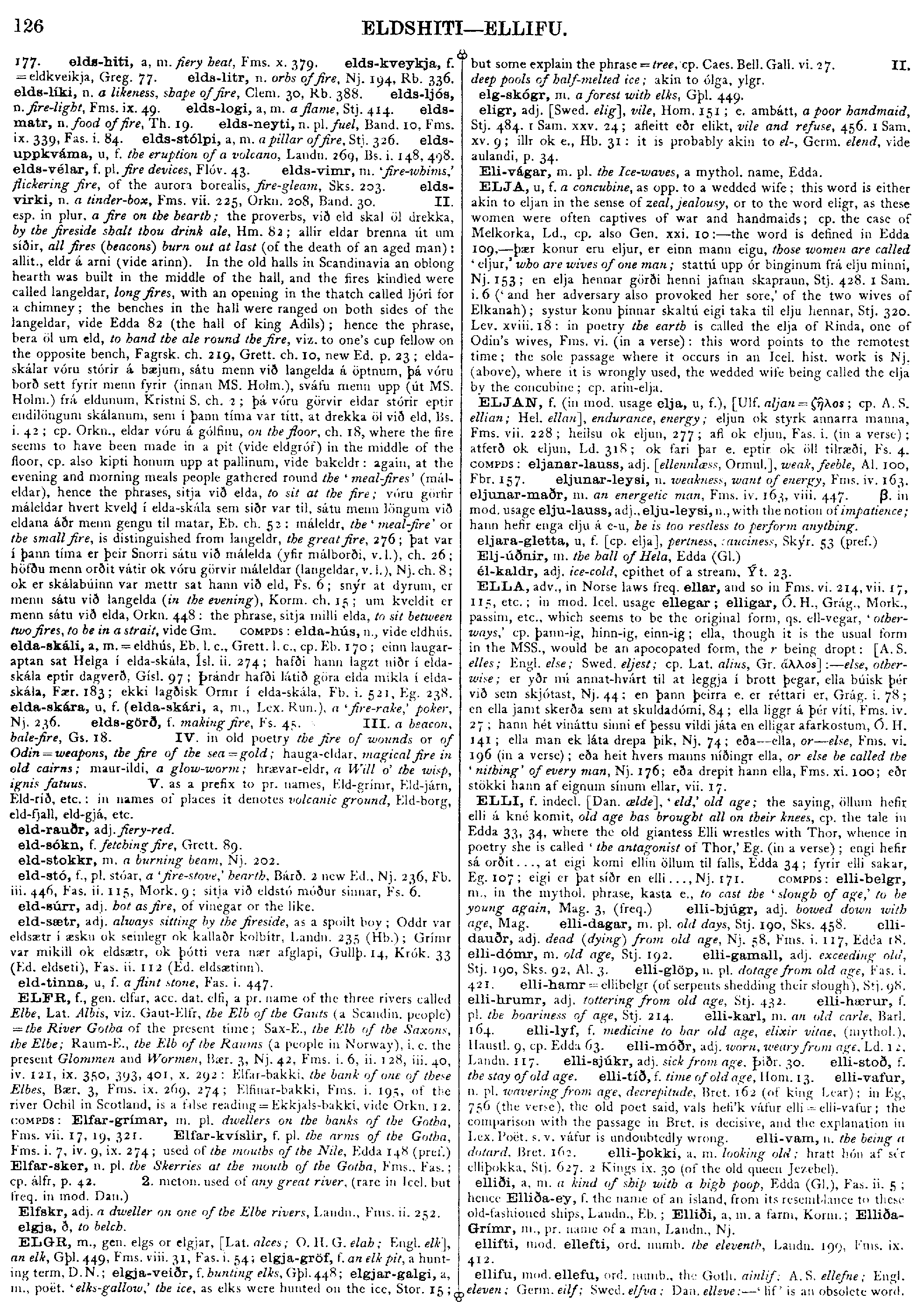
177- elds-hiti, a, m. fiery beat, Fms. x. 379. elds-kveykja, f. = eldkveikja, Greg. 77. elds-litr, n. orbs of fire, Nj. 194, Rb. 336. elds-MM, n. a likeness, shape of fire, Clem. 30, Rb. 388. elds-ljós, n. fire-light, Fms. ix. 49. elds-logi, a, m. aflame, Stj. 414. elds- matr, n. /oo d of fire, Th. 19. elds-neyti, n. pl. fuel, Band. 10, Fms. ix. 339, Fas. i. 84. elds-stólpi, a, m. a pillar of fire, Stj. 326. elds- uppkváma, u, f. the eruption of a volcano, Landn. 269, Bs. i. 148, 498. elds-velar, f. pl. ^î re de-vices, Flóv. 43. elds-vimr, m. 'fire-whims, ' flickering fire, of the aurora borealis, fire-gleam, Sks. 203. elds- virki, n. a tinder-box, Fms. vii. 225, Orkn. 208, Band. 30. II. esp. in plur. a fire on the hearth; the proverbs, við eld skal ol drekka, by the fireside sbalt tbou drink ale, Hm. 82; allir eldar brenna út um síðir, all fires (beacons') burn out at last (of the death of an aged man): allit., eldr á ami (vide arinn). In the old halls in Scandinavia an oblong hearth was built in the middle of the hall, and the fires kindled were called langeldar, long fires, with an opening in the thatch called ljuri for a chimney; the benches in the hall were ranged on both sides of the langeldar, vide Edda 82 (the hall of king Adils); hence the phrase, bera ol um eld, to hand the ale round the fire, viz. to one's cup fellow on the opposite bench, Fagrsk. ch. 219, Grett. ch. 10, new Ed. p. 23; elda- skálar vóru stórir á bæjuni, sátu menu við langelda á öptnuin, þá voru borð sett fyrir menn fyrir (inrian MS. Holm.), sváfu menu upp (ut MS. Holm.) frá eldunurn, Kristni S. ch. 2; þá vóru görvir eldar stórir eptir endilonguni skalanum, sem í þann tínia var titt, at drekka öl við eld, Bs. i. 42; cp. Orkn., eldar vóru á gólfinu, on the floor, ch. 18, where the fire seems to have been made in a pit (vide eldgróf) in the middle of the floor, cp. also kipti honum upp at pallinum, vide bakeldr: again, at the evening and morning meals people gathered round the 'meal-fires' (m;d- eldar), hence the phrases, sitja við elda, t o s it at the fire; vóru görrir máleldar hvert kveli] í elda-skúla sern siðr var til, sátu menn löngum við eldana áðr menn gengu til matar, Eb. ch. 52: maleldr, the' meal-fire' or the small fire, is distinguished from laugeldr, the great fire, 276; þat var í þann tíma er þeir Snorri sátu við málelda (yfir málborði, v. 1.), ch. 26; höfðu menn orðit vátir ok vóru görvir máleldar (langeldar, v. 1.), Nj. ch. 8; ok er skálabúinn var mettr sat hann við eld, Fs. 6; snýr at dyruin, er menn sátu við langelda (i n the evening), Korm. ch. 15; um kveldit er menn sátu við elda, Orkn. 448: the phrase, sitja milli elda, to sit between two fires, to be in a strait, vide Gin. COMPDS: elda-hús, n., vide eldhiis. elda-skali, a, m. = eldhús, Eb. 1. c., Grett. 1. c., cp. Eb. 170; einn laugar- aptan sat Helga í elda-skála, Ísl. ii. 274; hafði hann lagzt uiðr í elcla- skála eptir dagverð. Gísl. 97; þrándr hafði látið gora elda mikla í elda- skála, Fzr. 183; ekki lagðisk Ormr í elda-skála, Fb. i. 521, Eg. 238. elda-skára, u, f. (elda-skári, a, m., Lex. Run.), a 'fire-rake, ' poker, Nj. 236. elds-görð, f. making fire, Fs. 45. III. a beacon, bale-fire, Gs. 18. IV. in old poetry the fire of wounds or of Odin = weapons, the fire of the sea = gold; hauga-eldar, magical fire in old cairns; maur-ildi, a glow-worm; hraevar-eldr, a Will o' the wisp, ignis fatuus. V. as a prefix to pr. names, Kld-grinir, Kld-járn, Kld-ríð, etc.: in names of places it denotes volcanic ground, Kld-borg, eld-fjall, eld-gjá, etc.
|
Source: Cleasby/Vigfusson, page b0159, entry 1 View original page image as: [TIFF] [PNG] [View previous entry] [View next entry] |
[Comment on this entry] [View comments] |
The following entry has been hand-corrected once. |
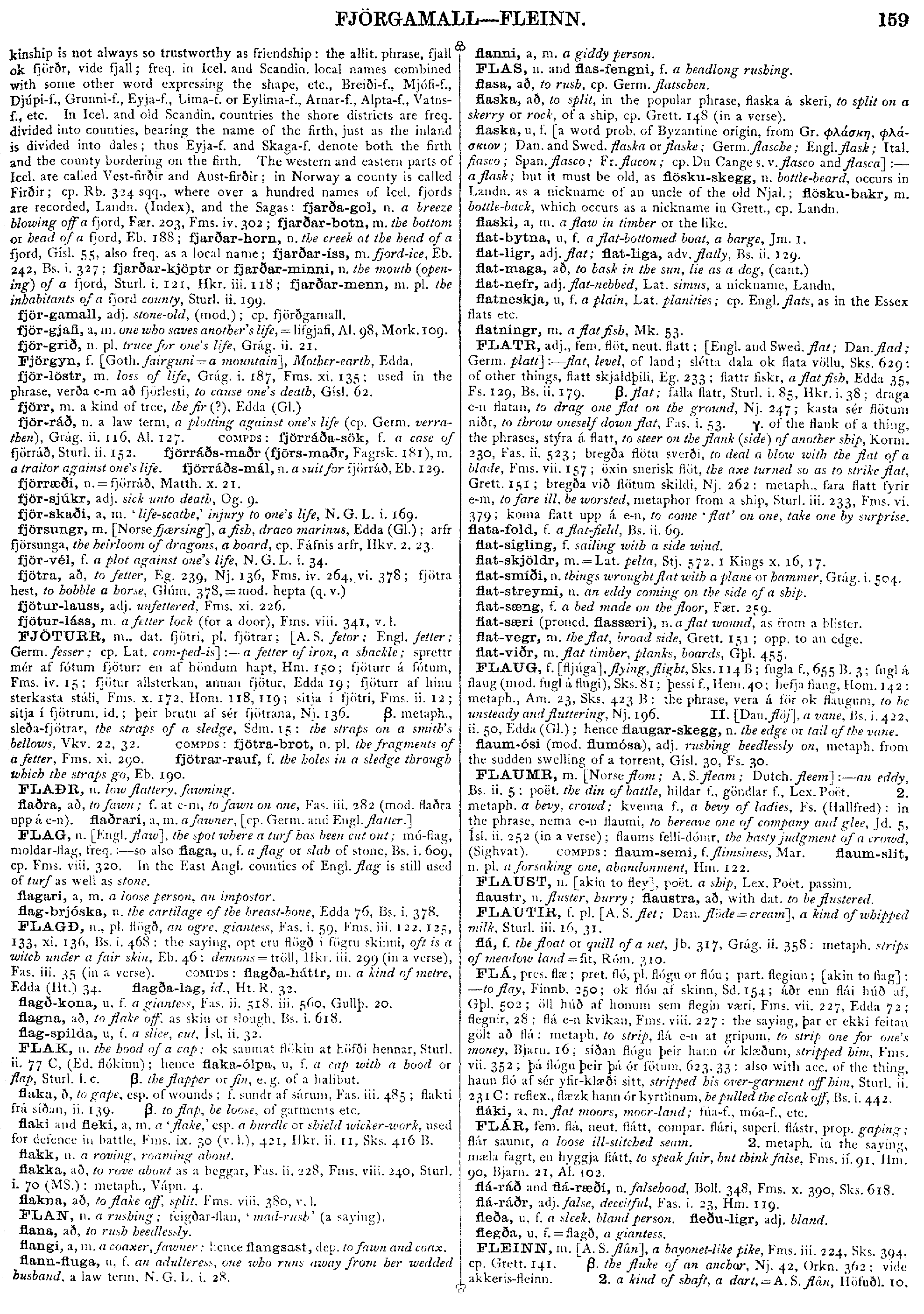
kinship is not always so trustworthy as friendship: the allit. phrase, fjall ok fjörðr, vide fjall; freq. in Icel. and Scandin. local names combined with some other word expressing the shape, etc., Breiði-f., Mjófi-f., Djúpi-f., Grunni-f., Eyja-f., Lima-f. or Eylíma-f., Arnar-f., Alpta-f., Vatns-f., etc. In Icel. and old Scandin. countries the shore districts are freq. divided into counties, bearing the name of the firth, just as the inland is divided into dales; thus Eyja-f. and Skaga-f. denote both the firth and the county bordering on the firth. The western and eastern parts of Icel. are called Vest-firðir and Aust-firðir; in Norway a county is called Firðir; cp. Rb. 324 sqq., where over a hundred names of Icel. fjords are recorded, Landn. (Index), and the Sagas: fjarða-gol, n. a breeze blowing off a fjord, Fær. 203, Fms. iv. 302; fjarðar-botn, m. the bottom or head of a fjord, Eb. 188; fjarðar-horn, n. the creek at the head of a fjord, Gísl. 55, also freq. as a local name; fjarðar-íss, m. fjord-ice, Eb. 242, Bs. i. 327; fjarðar-kjöptr or fjarðar-minni, n. the mouth (opening) of a fjord, Sturl. i. 121, Hkr. iii. 118; fjarðar-menn, m. pl. the inhabitants of a fjord county, Sturl. ii. 199.
|
Source: Cleasby/Vigfusson, page b0180, entry 8 View original page image as: [TIFF] [PNG] [View previous entry] [View next entry] |
[Comment on this entry] [View comments] |
The following entry has been hand-corrected once. |
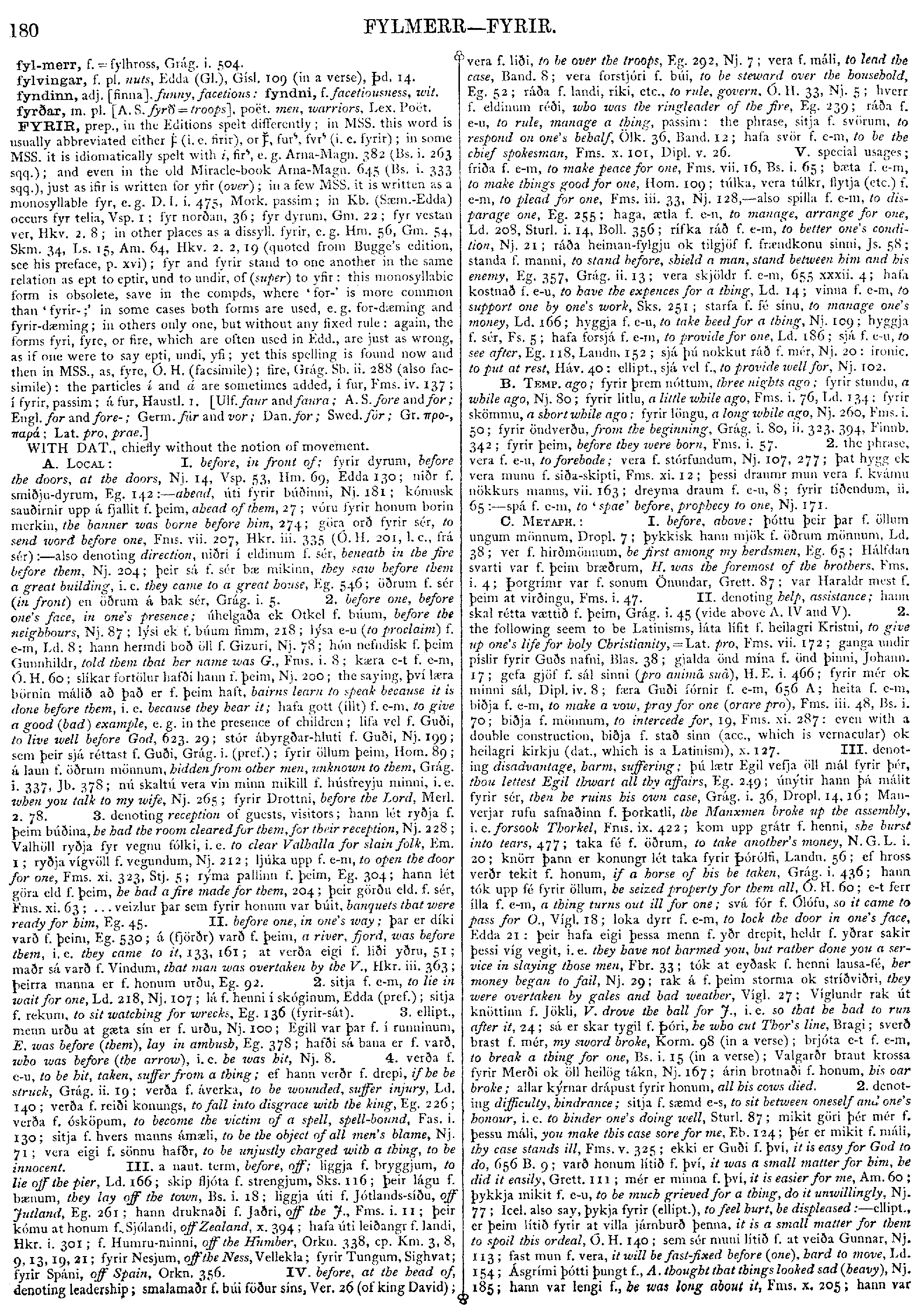
A. LOCAL: I. before, in front of; fyrir dyrrin, Nj. 198; láta síga brýnn f. brár, Hkv. Hjörv. 19; halda f. augu sér, to hold (one's hands) before one's eyes, Nj. 132; leggja sverði fyrir brjóst e-m, to thrust a sword into his breast, 162, Fs. 39. 2. before one, before a court; stefna e-m f. dómstól, Fms. xi. 444; ganga, koma f. e-n, to go, come before one, Fms. i. 15, Eg. 426, Nj. 6, 129, passim; fyrir augu e-s, before one's eyes, Stj. 611. 3. before, so as to shield; hann kom skildinum f. sik, he put the shield before him, Nj. 97, 115; halda skildi f. e-n, a duelling term, since the seconder had to hold one's shield, Ísl. ii. 257. 4. joined to adverbs such as fram, aptr, út, inn, ofan, niðr, austr, vestr, suðr, norðr, all denoting direction; fram f., forward; aptr f., backward, etc.; hann reiddi öxina fram f. sik, a stroke forward with the axe, Fms. vii. 91; hann hljóp eigi skemra aptr en fram fyrir sik, Nj. 29; þótti honum hann skjóta brandinum austr til fjallanna f. sik, 195; komask út f. dyrr, to go outside the door, Eg. 206 :-- draga ofan f. brekku, to drag over the hill, Ld. 220; hrinda f. mel ofan, to thrust one over the gravel bank, Eg. 748; hlaupa f. björg, to leap over a precipice, Eb. 62, Landn. 36; elta e-n f. björg, Grág. ii. 34; hlaupa (kasta) f. borð, to leap (throw) overboard, Fms. i. 178, Hkr. iii. 391, Ld. 226; síga (to be hauled) niðr f. borgar-vegg, 656 C. 13, Fms. ix. 3; hlaupa niðr f. stafn, Eg. 142; niðr f. skaflinn, Dropl. 25; fyrir brekku, Orkn. 450, Glúm. 395 (in a verse). II. in one's way, crossing one's way; þeir stefndu f. þá, Fms. ix. 475; ríða á leið f. þá, to ride in their way, so as to meet them, Boll. 348; hlaupa ofan f. þá, Nj. 153; vóru allt komin f. hann bréf, letters were come before him, in his way, Fms. vii. 207; þeir felldu brota f. hann, viz. they felled trees before him, so as to stop him, viii. 60, ix. 357; leggja bann f. skip, to lay an embargo on a ship, Ld. 166. III. round, off a point; fyrir nesit, Nj. 44; út f. Holm, out past the Holm, Fms. vii. 356: esp. as a naut. term, off a point on the shore, sigla f. England, Norðyrnbraland, Þrasnes, Spán, to sail by the coast of, stand off England, Northumberland, ... Spain, Orkn. 338, 340, 342, 354; fyrir Yrjar, Fms. vii. (in a verse); fyrir Siggju, Aumar, Lista, Edda 91 (in a verse); er hann kom f. Elfina, when be came off the Gotha, Eg. 80; leggja land f. skut, to lay the land clear of the stern, i.e. to pass it, Edda l.c.; göra frið f. land sitt, to pacify the land from one end to another, Ld. 28; fyrir uppsprettu árinnar, to come to (round) the sources of the river, Fms. iii. 183; fyrir garðs-enda, Grág. ii. 263; girða f. nes, to make a wall across the ness, block it up, cp. Lat. praesepire, praemunire, etc., Grág. ii. 263; so also binda f. op, poka, Lat. praeligare, praestringere; hlaða f. gat, holu, to stop a hole, opening; greri f. stúfinn, the stump (of the arm or leg) was healed, closed, Nj. 275; skjóta slagbrandi f. dyrr, to shoot a bolt before the door, to bar it, Dropl. 29; láta loku (lás) f. hurð, to lock a door, Gísl. 28; setja innsigli f. bréf, to set a seal to a letter, Dipl. i. 3: ellipt., setr hón þar lás fyrir, Ld. 42, Bs. i. 512. 2. along, all along; f. endilanga Danmörk, f. endilangan Noreg, all along Denmark, Norway, from one end to the other, Fms. iv. 319, xi. 91, Grett. 97 :-- öx álnar f. munn, an axe with an ell-long edge, Ld. 276; draga ör f. ödd, to draw the arrow past the point, an archer's term, Fms. ii. 321. IV. with verbs, fyrir ván komit, one is come past hope, all hope is gone, Sturl. i. 44, Hrafn. 13, Fms. ii. 131; taka f. munn e-m, to stop one's mouth; taka f. háls, kverkar, e-m, to seize one by the throat, etc.; taka mál f. munn e-m, 'verba alicujus praeripere,' to take the word out of one's mouth, xi. 12; taka f. hendr e-m, to seize one's hands, stop one in doing a thing, Eb. 124; mod., taka fram f. hendrnar á e-m.
|
Source: Cleasby/Vigfusson, page b0201, entry 18 View original page image as: [TIFF] [PNG] [View previous entry] [View next entry] |
[Comment on this entry] [View comments] |
The following entry has not been hand-corrected. However, the page is reserved and someone is correcting it. |
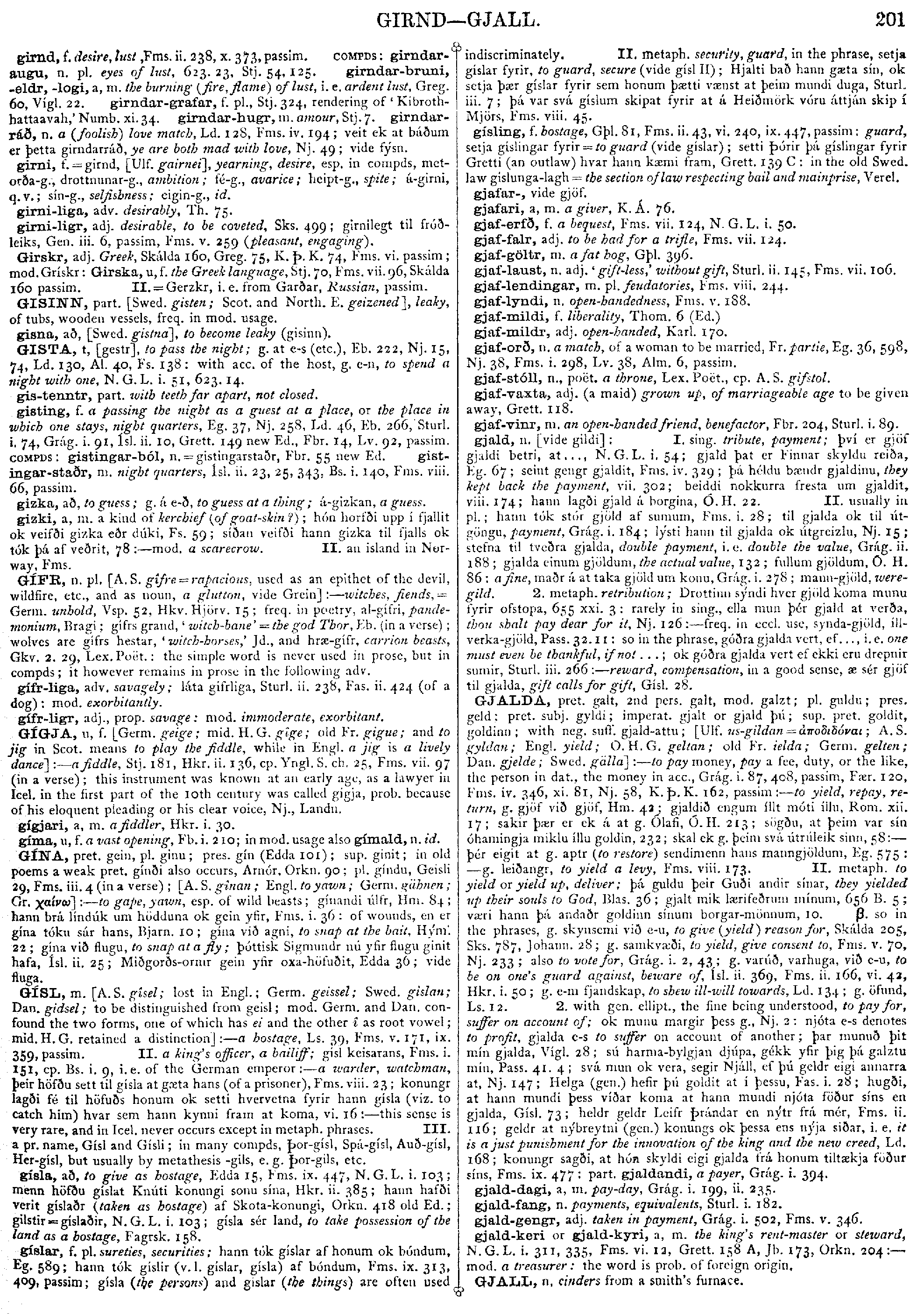
gíma, u, f. a vast opening, F'b. i. 210; in mod. usage also gimald, n. id.
|
Source: Cleasby/Vigfusson, page b0205, entry 31 View original page image as: [TIFF] [PNG] [View previous entry] [View next entry] |
[Comment on this entry] [View comments] |
The following entry has been hand-corrected once. |
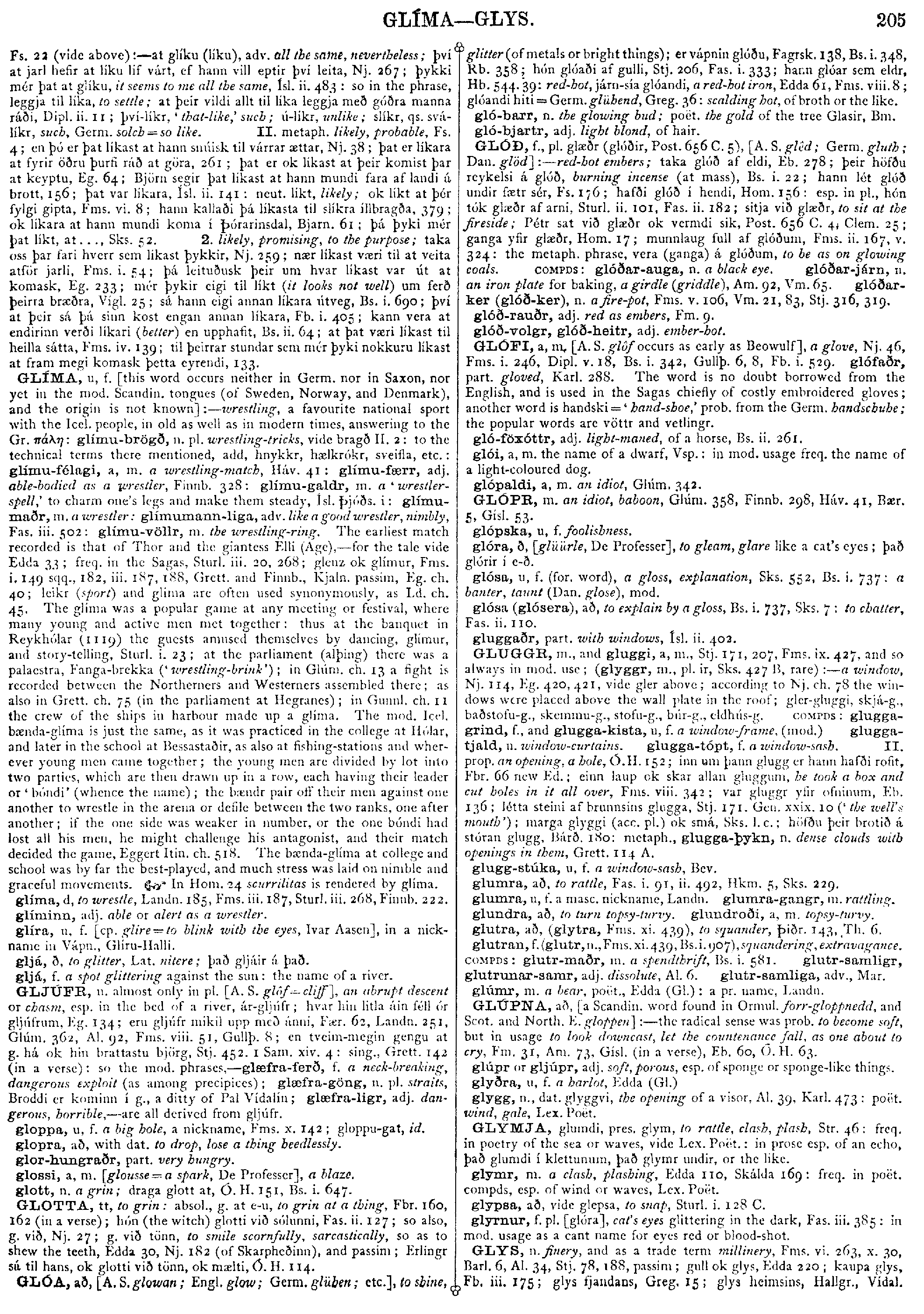
GLUGGR, m., and gluggi, a, m., Stj. 171, 207, Fms. ix. 427, and so always in mod. use; (glyggr, m., pl. ir, Sks. 427 B, rare) :-- a window, Nj. 114, Eg. 420, 421, vide gler above; according to Nj. ch. 78 the windows were placed above the wall plate in the roof; gler-gluggi, skjá-g., baðstofu-g., skemmu-g., stofu-g., búr-g., eldhús-g;. COMPDS: glugga-grind, f., and glugga-kista, u, f. a window-frame, (mod.) glugga-tjald, n. window-curtains. glugga-tópt, f. a window-sash. II. prop. an opening, a hole, Ó. H. 152; inn um þann glugg er hann hafði rofit, Fbr. 66 new Ed.; einn laup ok skar allan gluggum, he took a box and cut holes in it all over, Fms. viii. 342; var gluggr yfir ofninum, Eb. 136; létta steini af brunnsins glugga, Stj. 171. Gen. xxix. 10 ('the well's mouth'); marga glyggi (acc. pl.) ok smá, Sks. l.c.; höfðu þeir brotið á stóran glugg, Bárð. 180: metaph., glugga-þykn, n. dense clouds with openings in them, Grett. 114 A.
|
Source: Cleasby/Vigfusson, page b0205, entry 42 View original page image as: [TIFF] [PNG] [View previous entry] [View next entry] |
[Comment on this entry] [View comments] |
The following entry has been hand-corrected once. |
glygg, n., dat. glyggvi, the opening of a visor. Al. 39, Karl. 473: poët. wind, gale, Lex. Poët.
|
Source: Cleasby/Vigfusson, page b0216, entry 11 View original page image as: [TIFF] [PNG] [View previous entry] [View next entry] |
[Comment on this entry] [View comments] |
The following entry has been hand-corrected once. |
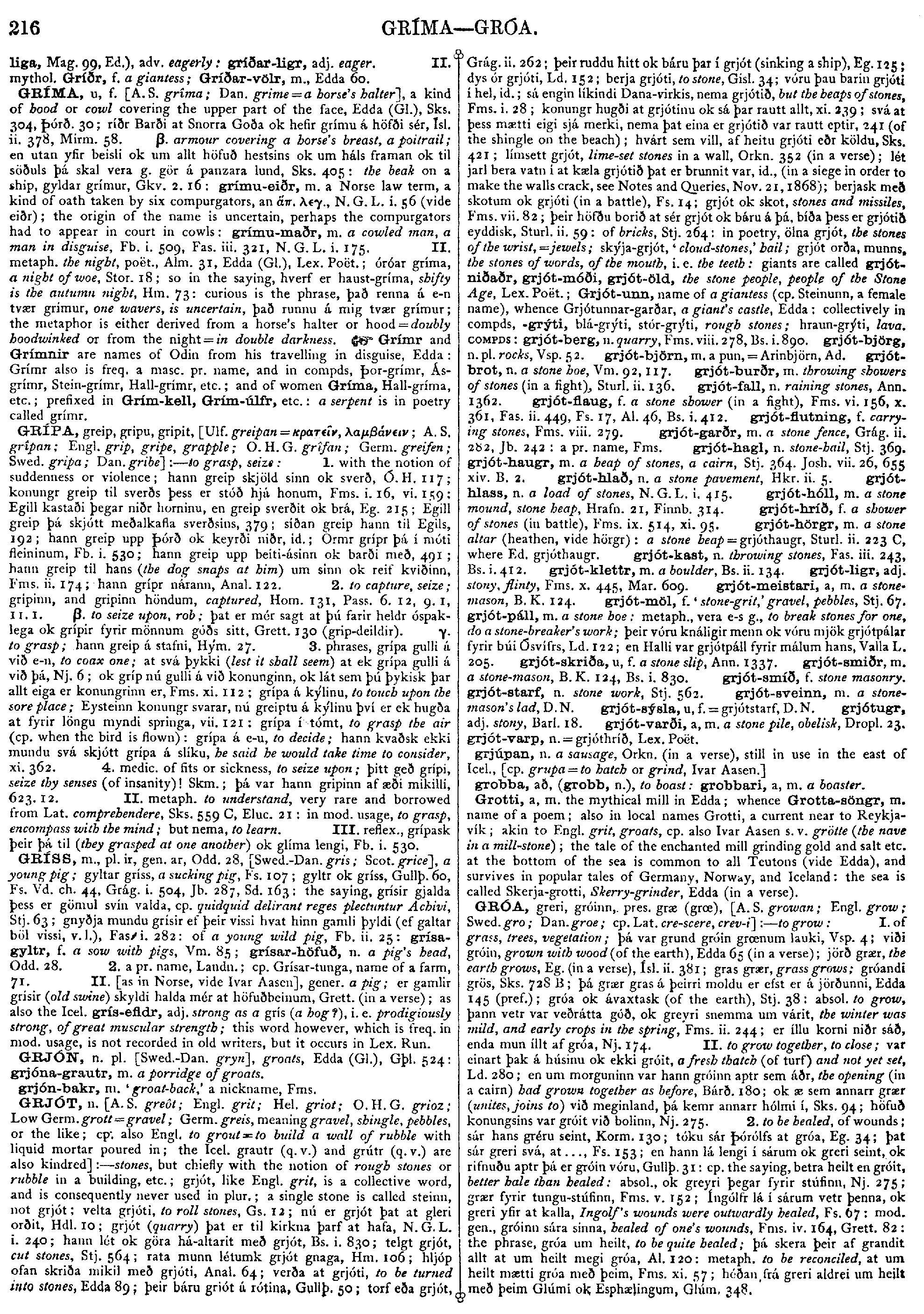
GRÓA, greri, gróinn, pres. græ (grœ), [A. S. growan; Engl. grow; Swed. gro; Dan. groe; cp. Lat. cre-scere, crev-i] :-- to grow: I. of grass, trees, vegetation; þá var grund gróin grœnum lauki, Vsp. 4; viði gróin, grown with wood (of the earth), Edda 65 (in a verse); jörð grær, the earth grows, Eg. (in a verse), Ísl. ii. 381; gras grær, grass grows; gróandi grös, Sks. 728 B; þá grær gras á þeirri moldu er efst er á jörðunni, Edda 145 (pref.); gróa ok ávaxtask (of the earth), Stj. 38: absol. to grow, þann vetr var veðrátta góð, ok greyri snemma um várit, the winter was mild, and early crops in the spring, Fms. ii. 244; er íllu korni niðr sáð, enda mun íllt af gróa, Nj. 174. II. to grow together, to close; var einart þak á húsinu ok ekki gróit, a fresh thatch (of turf) and not yet set, Ld. 280; en um morguninn var hann gróinn aptr sem áðr, the opening (in a cairn) had grown together as before, Bárð. 180; ok æ sem annarr grær (unites, joins to) við meginland, þá kemr annarr hólmi í, Sks. 94; höfuð konungsins var gróit við bolinn, Nj. 275. 2. to be healed, of wounds; sár hans gréru seint, Korm. 130; tóku sár Þórólfs at gróa, Eg. 34; þat sár greri svá, at ..., Fs. 153; en hann lá lengi í sárum ok greri seint, ok rifnuðu aptr þá er gróin vóru, Gullþ. 31: cp. the saying, betra heilt en gróit, better hale than healed: absol., ok greyri þegar fyrir stúfinn, Nj. 275; grær fyrir tungu-stúfinn, Fms. v. 152; Íngólfr lá í sárum vetr þenna, ok greri yfir at kalla, Ingolf's wounds were outwardly healed, Fs. 67: mod. gen., gróinn sára sinna, healed of one's wounds, Fms. iv. 164, Grett, 82: the phrase, gróa um heilt, to be quite healed; þá skera þeir af grandit allt at um heilt megi gróa, Al. 120: metaph. to be reconciled, at um heilt mætti gróa með þeim, Fms. xi. 57; héðan frá greri aldrei um heilt með þeim Glúmi ok Esphælingum, Glúm. 348.
| Result Page: |  |
Previous | 1 2 3 4 5 6 7 8 | Next |  |
Germanic Lexicon Project (main page)
This search system was written by
Sean Crist
Please consider
volunteering
to correct the data in these online dictionaries.
No rights reserved. Feel free to use these data in any way you please.