|
|

Tip: In the search results, you can click on any word or abbreviation for more information.
|
Source: Bosworth/Toller, page d0083, entry 17 View original page image as: [TIFF] [PNG] [View previous entry] [View next entry] |
[Comment on this entry] [View comments] |
The following entry has been hand-corrected once. |
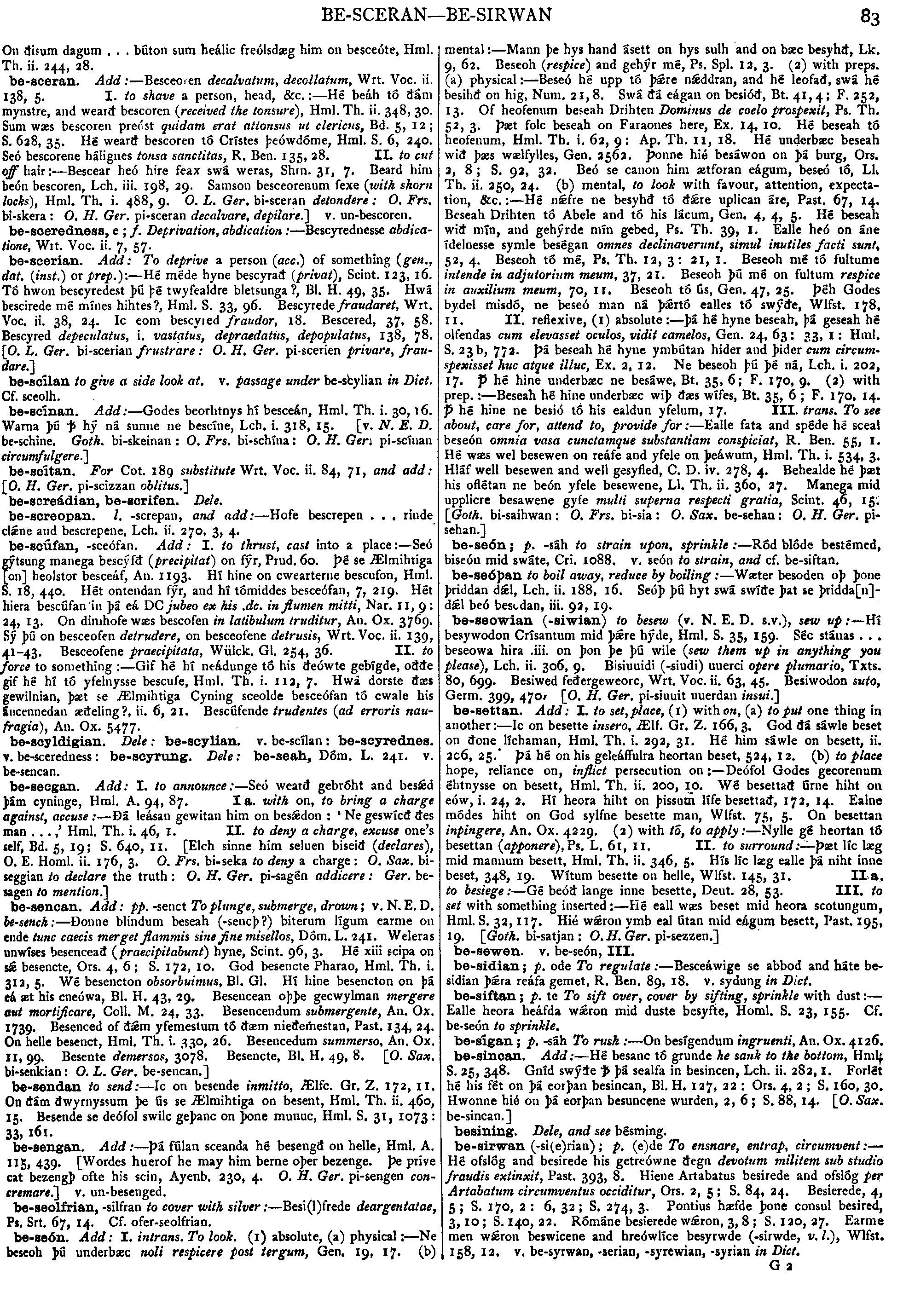
be-seón.
Add:
I.
intrans.
To
look.
(1)
absolute,
(a)
physical
:--
Ne
beseoh
þú
underbæc
noli
respicere
post
tergum,
Gen.
19,
17.
(b)
mental
:--
Mann
þe
hys
hand
ásett
on
hys
sulh
and
on
bæc
besyhð,
Lk.
9,
62.
Beseoh
(respice)
and
gehýr
mé,
Ps.
Spl.
12,
3.
(2)
with
preps.
(a)
physical
:--
Beseó
hé
upp
tó
þ re
nddran,
and
hé
leofað,
swá
hé
besihð
on
hig,
Num.
21,
8.
Swá
ðá
eágan
on
besióð,
Bt.
41,
4;
F.
252,
13.
Of
heofenum
beseah
Drihten
Dominus
de
coelo
prospexit,
Ps.
Th.
52,
3.
þæt
folc
beseah
on
Faraones
here,
Ex.
14,
10.
Hé
beseah
tó
heofenum,
Hml.
Th.
i.
62,
9:
Ap.
Th.
11,
18.
Hé
underbæc
beseah
wið
þæs
wælfylles,
Gen.
2562.
þonne
hié
besáwon
on
þá
burg,
Ors.
2,
8
;
S.
92,
32.
Beó
se
canon
him
ætforan
eágum,
beseó
tó,
LK
Th.
ii.
250,
24.
(b)
mental,
to
look
with
favour,
attention,
expectation,
&c.
:--
Hé
nfre
ne
besyhð
to
ðre
uplican
are,
Past.
67,
14.
Beseah
Drihten
tó
Abele
and
tó
his
lácum,
Gen.
4,
4,
5.
Hé
beseah
wið
mín,
and
gehýrde
mín
gebed,
Ps.
Th.
39,
1.
Ealle
heó
on
áne
ídelnesse
symle
beségan
omnes
declinaverunt,
simul
inutiles
facti
sunt
52,
4.
Beseoh
tó
mé,
Ps.
Th.
12,
3:
21,
1.
Beseoh
mé
tó
fultume
intende
in
adjutorium
meum,
37,
21.
Beseoh
þi
mé
on
fultun.
respice
in
auxilium
meum,
70,
11,
Beseoh
tó
ús,
Gen.
47,
25.
þéh
Godes
bydel
misdó,
ne
beseó
man
ná
þrtó
ealles
tó
swýðe,
Wlfst.
178,
11.
II.
reflexive,
(1)
absolute
:--
þá
hé
hyne
beseah,
þá
geseah
hé
olfendas
cum
elevasset
oculos,
vidit
camelos.
Gen.
24,
63:
33,
1:
Hml.
S.
23
b,
772.
Þá
beseah
hé
hyne
ymbútan
hider
and
þider
cum
circum-spexisset
huc
atque
illuc,
Ex.
2,
12.
Ne
beseoh
þú
þe
ná,
Lch.
i.
202,
17.
re
nddran,
and
hé
leofað,
swá
hé
besihð
on
hig,
Num.
21,
8.
Swá
ðá
eágan
on
besióð,
Bt.
41,
4;
F.
252,
13.
Of
heofenum
beseah
Drihten
Dominus
de
coelo
prospexit,
Ps.
Th.
52,
3.
þæt
folc
beseah
on
Faraones
here,
Ex.
14,
10.
Hé
beseah
tó
heofenum,
Hml.
Th.
i.
62,
9:
Ap.
Th.
11,
18.
Hé
underbæc
beseah
wið
þæs
wælfylles,
Gen.
2562.
þonne
hié
besáwon
on
þá
burg,
Ors.
2,
8
;
S.
92,
32.
Beó
se
canon
him
ætforan
eágum,
beseó
tó,
LK
Th.
ii.
250,
24.
(b)
mental,
to
look
with
favour,
attention,
expectation,
&c.
:--
Hé
nfre
ne
besyhð
to
ðre
uplican
are,
Past.
67,
14.
Beseah
Drihten
tó
Abele
and
tó
his
lácum,
Gen.
4,
4,
5.
Hé
beseah
wið
mín,
and
gehýrde
mín
gebed,
Ps.
Th.
39,
1.
Ealle
heó
on
áne
ídelnesse
symle
beségan
omnes
declinaverunt,
simul
inutiles
facti
sunt
52,
4.
Beseoh
tó
mé,
Ps.
Th.
12,
3:
21,
1.
Beseoh
mé
tó
fultume
intende
in
adjutorium
meum,
37,
21.
Beseoh
þi
mé
on
fultun.
respice
in
auxilium
meum,
70,
11,
Beseoh
tó
ús,
Gen.
47,
25.
þéh
Godes
bydel
misdó,
ne
beseó
man
ná
þrtó
ealles
tó
swýðe,
Wlfst.
178,
11.
II.
reflexive,
(1)
absolute
:--
þá
hé
hyne
beseah,
þá
geseah
hé
olfendas
cum
elevasset
oculos,
vidit
camelos.
Gen.
24,
63:
33,
1:
Hml.
S.
23
b,
772.
Þá
beseah
hé
hyne
ymbútan
hider
and
þider
cum
circum-spexisset
huc
atque
illuc,
Ex.
2,
12.
Ne
beseoh
þú
þe
ná,
Lch.
i.
202,
17.
 hé
hine
underbæc
ne
besáwe.
Bt.
35,
6;
F.
170,
9.
(2)
with
prep.
:--
Beseah
hé
hine
underbæc
wiþ
ðæs
wífes.
Bt.
35,
6
;
F.
170,
14.
hé
hine
ne
besió
tó
his
ealdun
yfelum,
17.
III.
trans.
To
see
about,
care
for,
attend
to,
provide
for
:--
Ealle
fata
and
spéde
hé
sceal
beseón
omnia
vasa
cunctamque
substantiam
conspiciat,
R.
Ben.
55,
1.
Hé
wæs
wel
besewen
on
reáfe
and
yfele
on
þeáwum,
Hml.
Th.
i.
534,
3.
Hláf
well
besewen
and
well
gesyfled,
C.
D.
iv.
278,
4.
Behealde
hé
þæt
his
oflétan
ne
beón
yfele
besewene,
Ll.
Th.
ii.
360,
27.
Manega
mid
upplicre
besawene
gyfe
multi
superna
respecti
gratia,
Scint.
46,
15;
[Goth.
bi-saihwan
:
O.
Frs.
bi-sia
:
O.
Sax.
be-sehan:
O.
H.
Ger.
pi
hé
hine
underbæc
ne
besáwe.
Bt.
35,
6;
F.
170,
9.
(2)
with
prep.
:--
Beseah
hé
hine
underbæc
wiþ
ðæs
wífes.
Bt.
35,
6
;
F.
170,
14.
hé
hine
ne
besió
tó
his
ealdun
yfelum,
17.
III.
trans.
To
see
about,
care
for,
attend
to,
provide
for
:--
Ealle
fata
and
spéde
hé
sceal
beseón
omnia
vasa
cunctamque
substantiam
conspiciat,
R.
Ben.
55,
1.
Hé
wæs
wel
besewen
on
reáfe
and
yfele
on
þeáwum,
Hml.
Th.
i.
534,
3.
Hláf
well
besewen
and
well
gesyfled,
C.
D.
iv.
278,
4.
Behealde
hé
þæt
his
oflétan
ne
beón
yfele
besewene,
Ll.
Th.
ii.
360,
27.
Manega
mid
upplicre
besawene
gyfe
multi
superna
respecti
gratia,
Scint.
46,
15;
[Goth.
bi-saihwan
:
O.
Frs.
bi-sia
:
O.
Sax.
be-sehan:
O.
H.
Ger.
pi sehan.]
|
Source: Bosworth/Toller, page d0137, entry 26 View original page image as: [TIFF] [PNG] [View previous entry] [View next entry] |
[Comment on this entry] [View comments] |
The following entry has been hand-corrected once. |
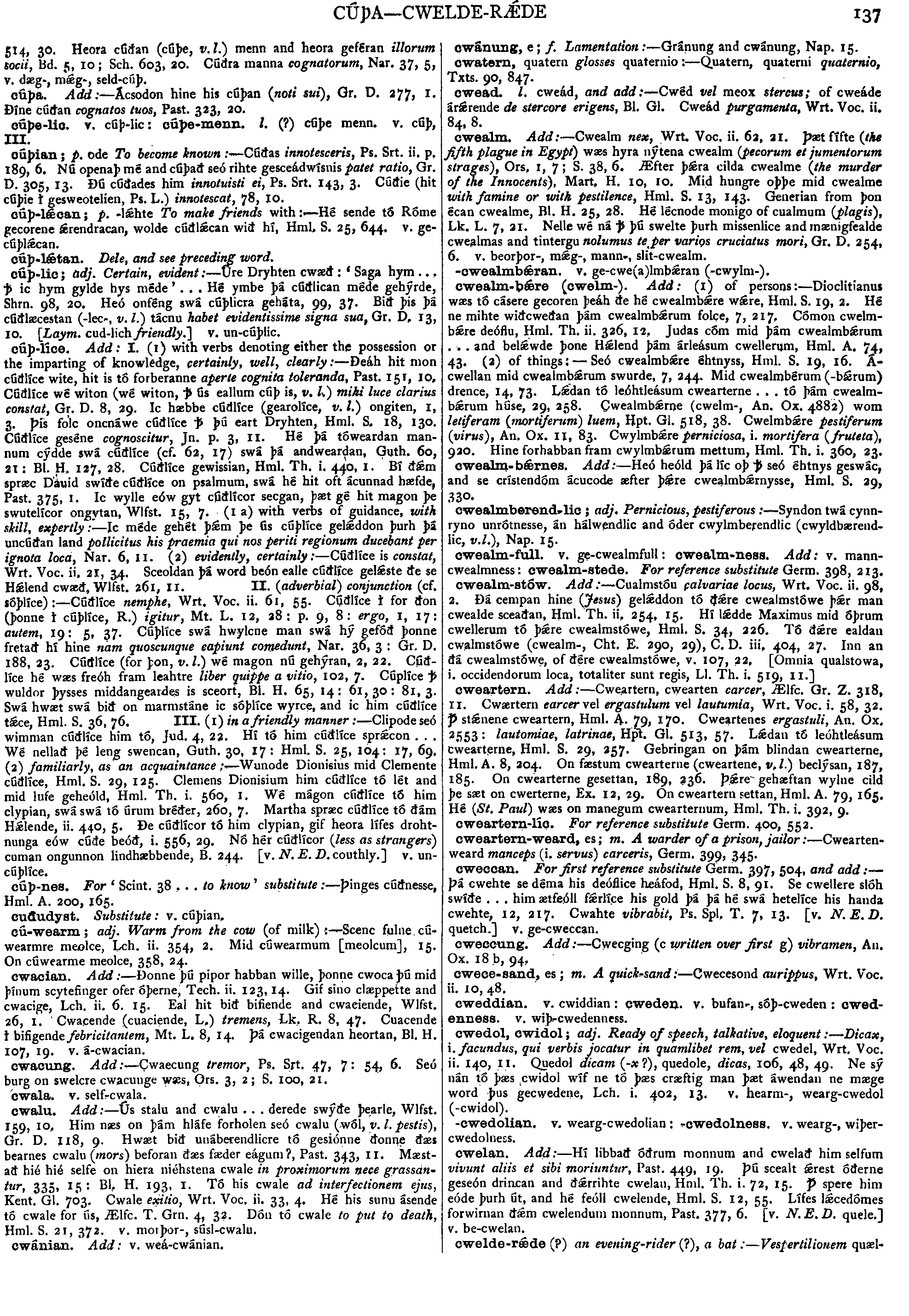
cwealm-stów.
Add:--Cualmstón
calvariae
locus,
Wrt.
Voc.
ii.
98,
2.
Ðá
cempan
hine
(Jesus
gelddon
tó
ðre
cwealmstówe
þr
man
cwealde
sceaðan,
Hml.
Th.
ii.
254,
15.
Hí
ldde
Maximus
mid
óþrum
cwellerum
tó
þre
cwealmstówe,
Hml.
S.
34,
226.
Tó
ðre
ealdan
cwalmstówe
(cwealm-,
Cht.
E.
290,
29),
C.
D.
iii.
404,
27.
Inn
an
ðá
cwealmstówe,
of
ðére
cwealmstówe,
v.
107,
22.
[Omnia
qualstowa,
i.
occidendorum
loca,
totaliter
sunt
regis,
Ll.
Th.
i.
519,
11.]
|
Source: Bosworth/Toller, page d0144, entry 2 View original page image as: [TIFF] [PNG] [View previous entry] [View next entry] |
[Comment on this entry] [View comments] |
The following entry has been hand-corrected once. |
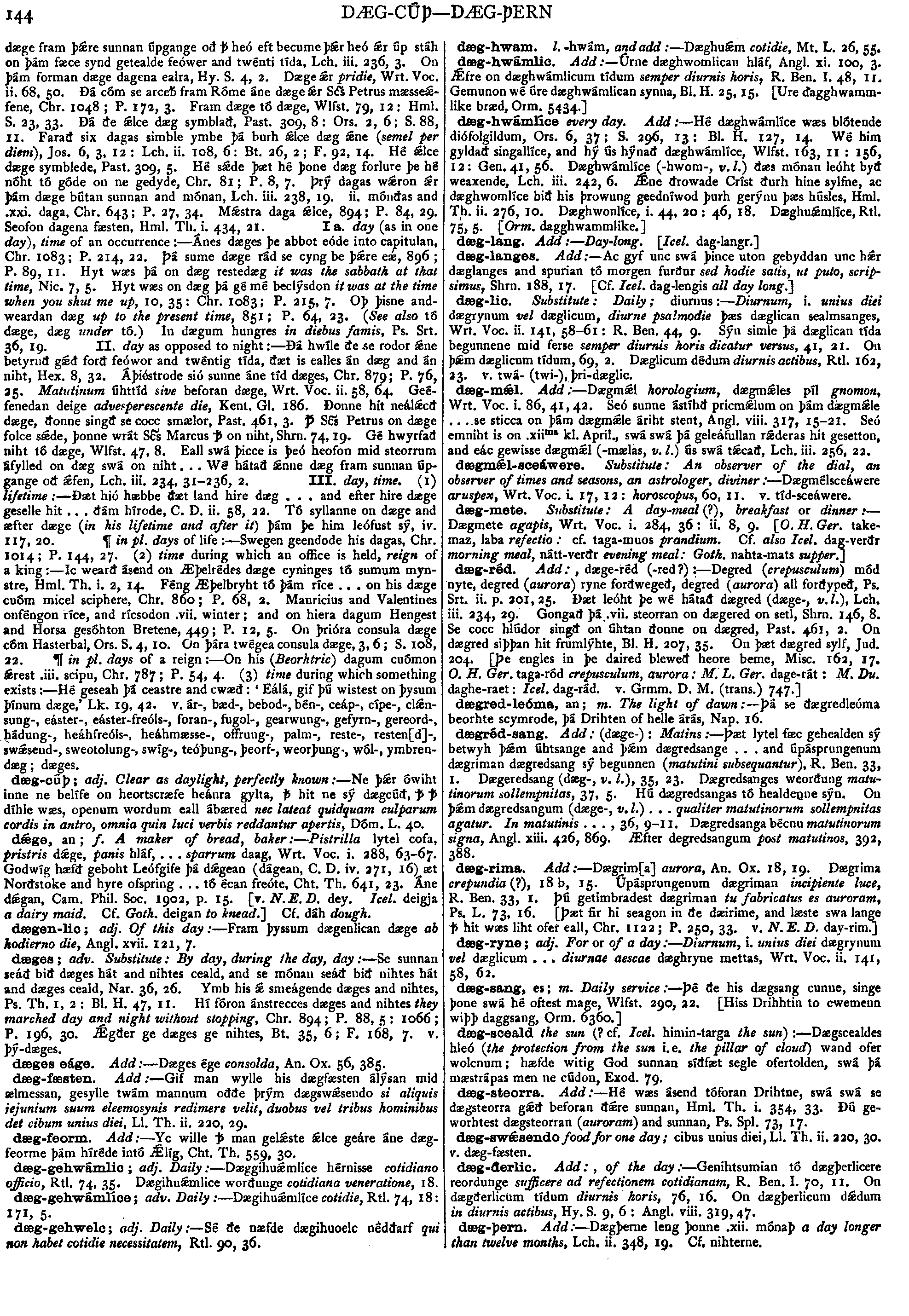
dæg-cúþ;
adj.
Clear
as
daylight,
perfectly
known:--Ne
þr
ówiht
inne
ne
belífe
on
heortscræfe
heánra
gylta,
hit
ne
sý
dægcúð,
díhle
wæs,
openum
wordum
eall
ábæred
nec
lateat
quidquam
culparum
cordis
in
antro,
omnia
quin
luci
verbis
reddantur
apertis,
Dóm.
L.
40.
|
Source: Bosworth/Toller, page d0152, entry 7 View original page image as: [TIFF] [PNG] [View previous entry] [View next entry] |
[Comment on this entry] [View comments] |
The following entry has been hand-corrected once. |
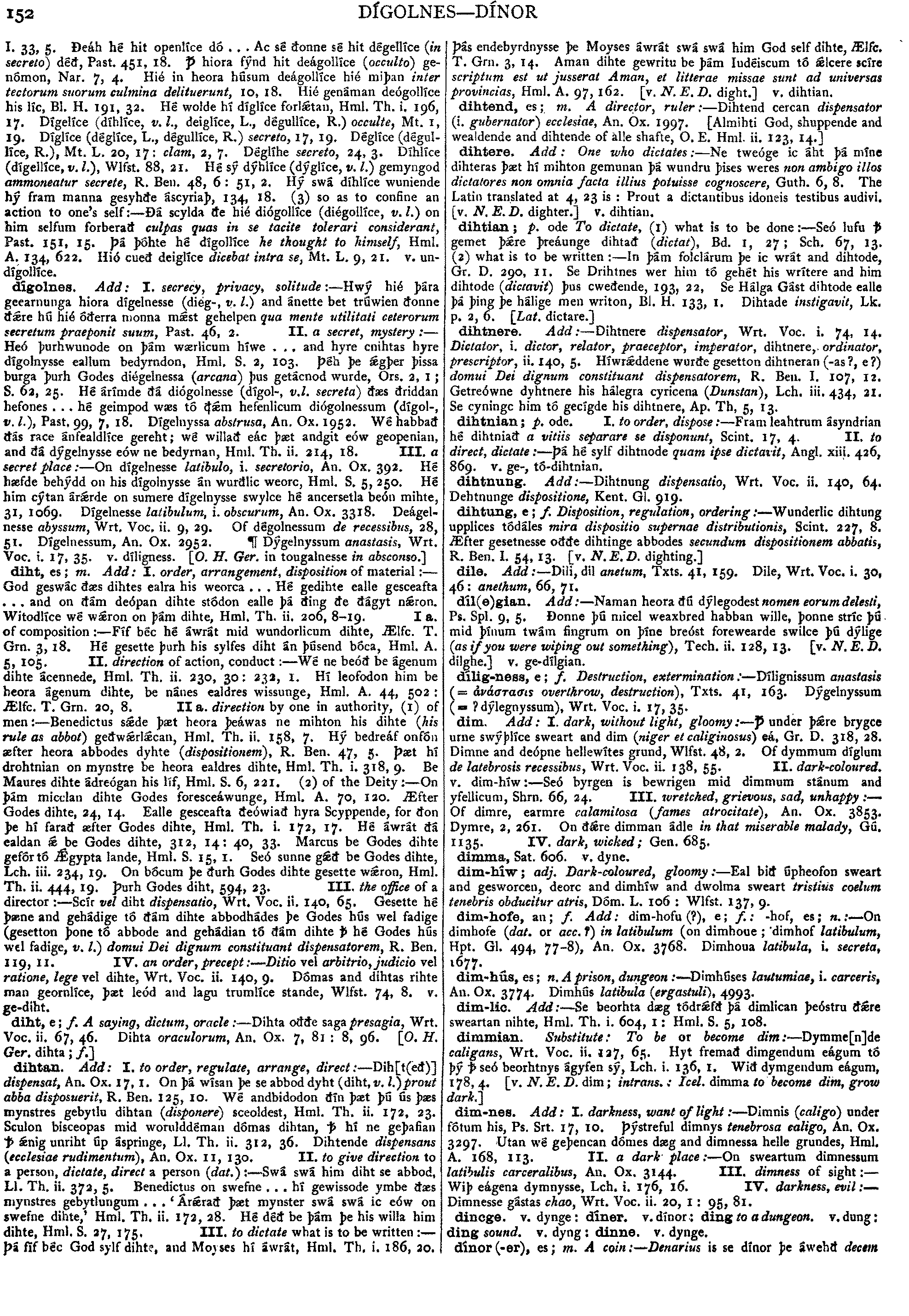
dihtere. Add: One who dictates:--Ne tweóge ic áht þá míne dihteras þæt hí mihton gemunan þá wundru þises weres non ambigo illos dictatores non omnia facta illius potuisse cognoscere, Guth. 6, 8. The Latin translated at 4, 23 is: Prout a dictantibus idoneis testibus audivi. [v. N. E. D. dighter.] v. dihtian.
|
Source: Bosworth/Toller, page d0157, entry 18 View original page image as: [TIFF] [PNG] [View previous entry] [View next entry] |
[Comment on this entry] [View comments] |
The following entry has been hand-corrected once. |
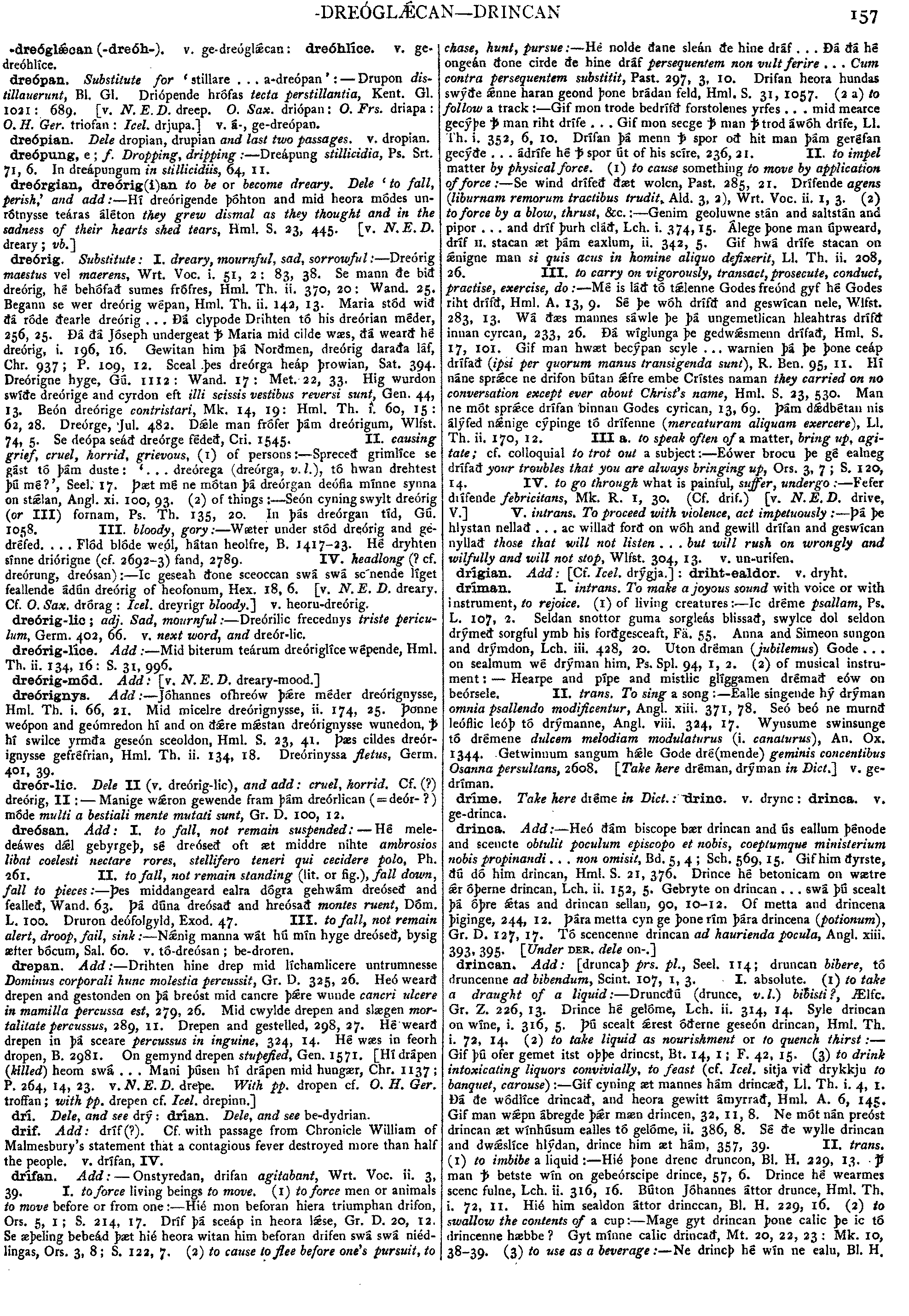
dríman.
I.
intrans.
To
make
a
joyous
sound
with
voice
or
with
instrument,
to
rejoice.
(1)
of
living
creatures:--Ic
dréme
psallam,
Ps.
L.
107,
2.
Seldan
snottor
guma
sorgleás
blissað,
swylce
dol
seldon
drýmeð
sorgful
ymb
his
forðgesceaft,
Fä.
55.
Anna
and
Simeon
sungon
and
drýmdon,
Lch.
iii.
428,
20.
Uton
dréman
(jubilemus)
Gode
.
.
.
on
sealmum
wé
drýman
him,
Ps.
Spl.
94,
1,
2.
(2)
of
musical
instrument:--Hearpe
and
pípe
and
mistlic
glíggamen
drémað
eów
on
beórsele.
II.
trans.
To
sing
a
song:--Ealle
singende
hý
drýman
omnia
psallendo
modificentur,
Angl.
xiii.
371,
78.
Seó
beó
ne
murnð
leóflic
leóþ
tó
drýmanne,
Angl.
viii.
324,
17.
Wynsume
swinsunge
tó
drémene
dulcem
melodiam
modulaturus
(i.
canaturus),
An.
Ox.
1344.
Getwinnum
sangum
hle
Gode
dré(mende)
geminis
concentibus
Osanna
persultans,
2608.
[Take
here
dréman,
drýman
in
Dict.]
v.
gedríman.
|
Source: Bosworth/Toller, page d0171, entry 15 View original page image as: [TIFF] [PNG] [View previous entry] [View next entry] |
[Comment on this entry] [View comments] |
The following entry has been hand-corrected once. |
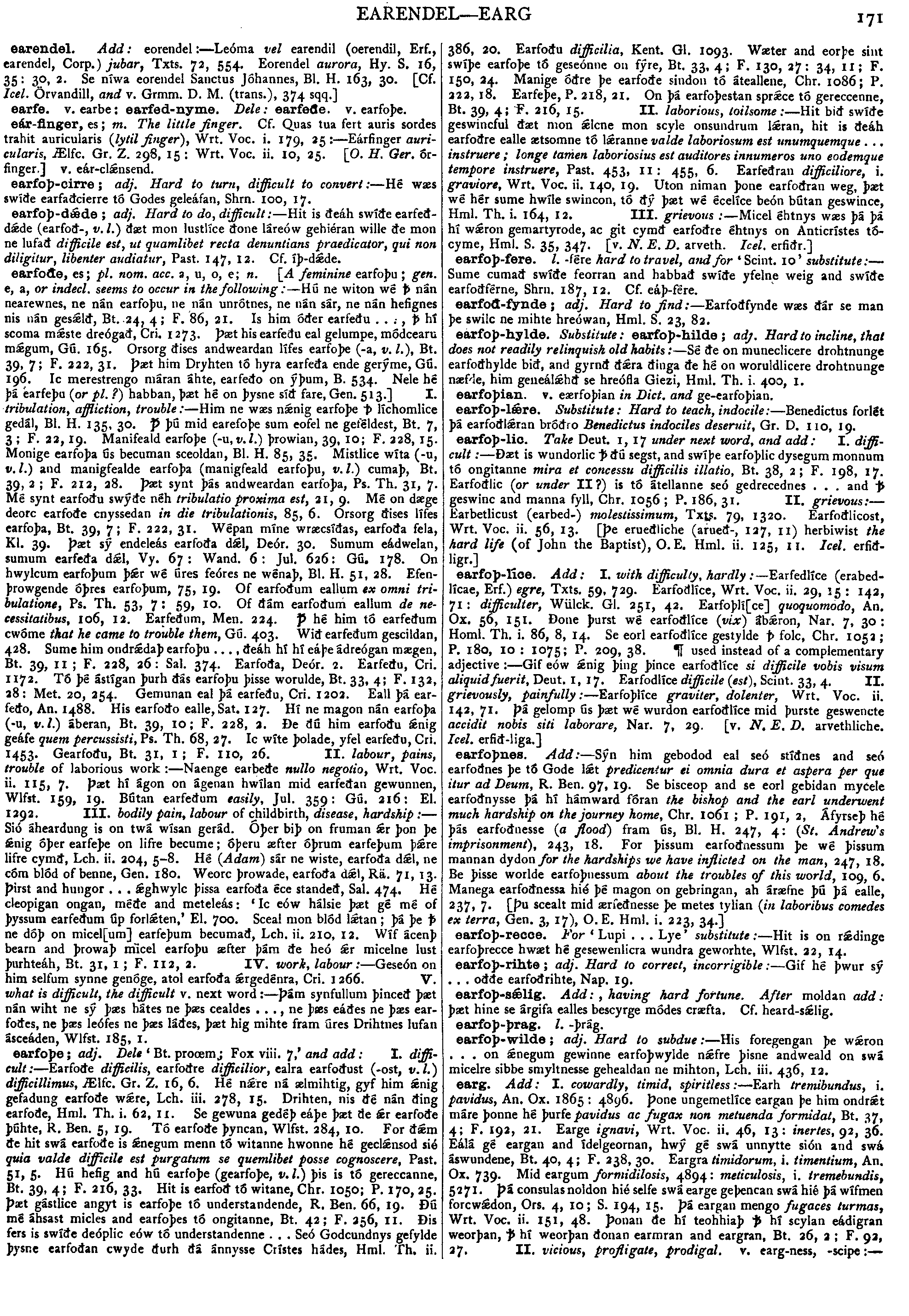
earfoþnes.
Add:--Sýn
him
gebodod
eal
seó
stíðnes
and
seó
earfoðnes
þe
tó
Gode
lt
predicentur
ei
omnia
dura
et
aspera
per
que
itur
ad
Deum,
R.
Ben.
97,
19.
Se
bisceop
and
se
eorl
gebidan
mycele
earfoðnysse
þá
hí
hámward
fóran
the
bishop
and
the
earl
underwent
much
hardship
on
the
journey
home,
Chr.
1061;
P.
191,
2.
Áfyrseþ
hé
þás
earfoðnesse
(a
flood)
fram
ús,
Bl.
H.
247,
4:
(St.
Andrew's
imprisonment),
243,
18.
For
þissum
earfoðnessum
þe
wé
þissum
mannan
dydon
for
the
hardships
we
have
inflicted
on
the
man,
247,
18.
Be
þisse
worlde
earfoþnessum
about
the
troubles
of
this
world,
109,
6.
Manega
earfoðnessa
hié
þé
magon
on
gebringan,
ah
áræfne
þú
þá
ealle,
237,
7.
[Þu
scealt
mid
ærfeðnesse
þe
metes
tylian
(in
laboribus
comedes
ex
terra,
Gen.
3,
17),
O.
E.
Hml.
i.
223,
34.]
|
Source: Bosworth/Toller, page d0186, entry 41 View original page image as: [TIFF] [PNG] [View previous entry] [View next entry] |
[Comment on this entry] [View comments] |
The following entry has been hand-corrected once. |
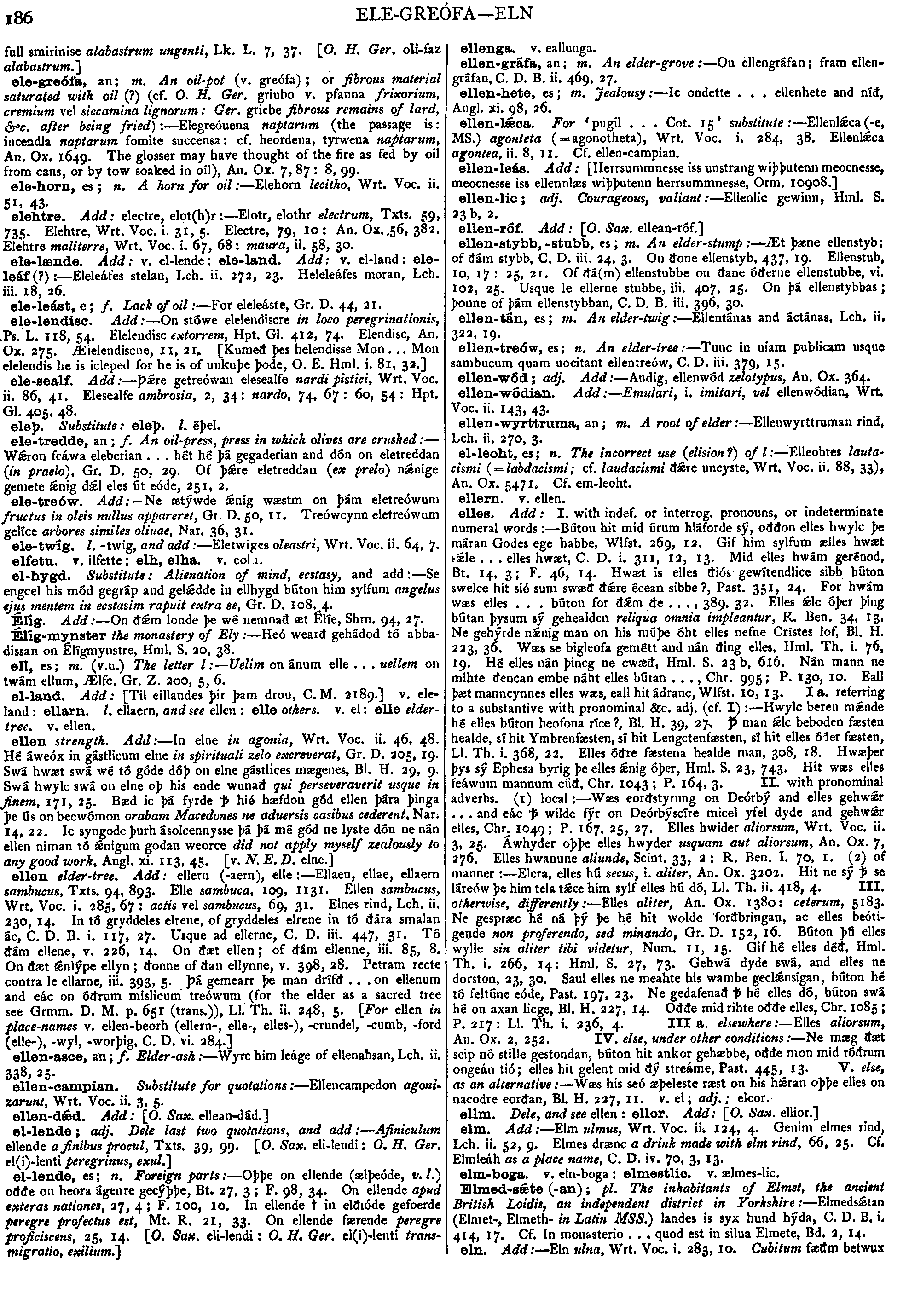
elles.
Add:
I.
with
indef.
or
interrog.
pronouns,
or
indeterminate
numeral
words:--Búton
hit
mid
úrum
hláforde
sý,
oððon
elles
hwylc
þe
máran
Godes
ege
habbe,
Wlfst.
269,
12.
Gif
him
sylfum
ælles
hwæt
sle
.
.
.
elles
hwæt,
C.
D.
i.
311,
12,
13.
Mid
elles
hwám
gerénod,
Bt.
14,
3;
F.
46,
14.
Hwæt
is
elles
ðiós
gewítendlice
sibb
búton
swelce
hit
sié
sum
swæð
ðre
écean
sibbe?,
Past.
351,
24.
For
hwám
wæs
elles
.
.
.
búton
for
ðm
ðe
.
.
.,
389,
32.
Elles
lc
óþer
þing
bútan
þysum
sý
gehealden
reliqua
omnia
impleantur,
R.
Ben.
34,
13,
Ne
gehýrde
nnig
man
on
his
múþe
óht
elles
nefne
Crístes
lof,
Bl.
H.
223,
36.
Wæs
se
bigleofa
gemétt
and
nán
ðing
elles,
Hml.
Th.
i.
76,
19.
Hé
elles
nán
þincg
ne
cwð,
Hml.
S.
23
b,
616.
Nán
mann
ne
mihte
ðencan
embe
náht
elles
bútan
.
.
.,
Chr.
995;
P.
130,
10.
Eall
þæt
manncynnes
elles
wæs,
eall
hit
ádranc,
Wlfst.
10,
13.
I
a.
referring
to
a
substantive
with
pronominal
&c.
adj.
(cf.
I):--Hwylc
beren
mnde
hé
elles
búton
heofona
ríce?,
Bl.
H.
39,
27.
Þ-bar;
man
lc
beboden
fæsten
healde,
sí
hit
Ymbrenfæsten,
sí
hit
Lengctenfæsten,
sí
hit
elles
óðer
fæsten,
Ll.
Th.
i.
368,
22.
Elles
óðre
fæstena
healde
man,
308,
18.
Hwæþer
þys
sý
Ephesa
byrig
þe
elles
nig
óþer,
Hml.
S.
23,
743.
Hit
wæs
elles
feáwum
mannum
cúð,
Chr.
1043;
P.
164,
3.
II.
with
pronominal
adverbs.
(1)
local:--Wæs
eorðstyrung
on
Deórbý
and
elles
gehwr
.
.
.
and
eác
wilde
fýr
on
Deórbýscíre
micel
yfel
dyde
and
gehwr
elles,
Chr.
1049;
P.
167,
25,
27.
Elles
hwider
aliorsum,
Wrt.
Voc.
ii.
3,
25.
Áwhyder
oþþe
elles
hwyder
usquam
aut
aliorsum,
An.
Ox.
7,
376.
Elles
hwanune
aliunde,
Scint.
33,
2:
R.
Ben.
I.
70,
1.
(2)
of
manner:--Elcra,
elles
hú
secus,
i.
aliter,
An.
Ox.
3202.
Hit
ne
sý
se
láreów
þe
him
tela
tce
him
sylf
elles
hú
dó,
Ll.
Th.
ii.
418,
4.
III.
otherwise,
differently:--Elles
aliter,
An.
Ox.
1380:
ceterum,
5183.
Ne
gespræc
hé
ná
þý
þe
hé
hit
wolde
forðbringan,
ac
elles
beótigende
non
proferendo,
sed
minando,
Gr.
D.
152,
16.
Búton
þú
elles
wylle
sin
aliter
tibi
videtur,
Num.
11,
15.
Gif
hé
elles
déð,
Hml.
Th.
i.
266,
14:
Hml.
S.
27,
73.
Gehwá
dyde
swá,
and
elles
ne
dorston,
23,
30.
Saul
elles
ne
meahte
his
wambe
geclnsigan,
búton
hé
tó
feltúne
eóde,
Past.
197,
23.
Ne
gedafenað
hé
elles
dó,
búton
swá
hé
on
axan
licge,
Bl.
H.
227,
14.
Oððe
mid
rihte
oððe
elles,
Chr.
1085;
P.
217:
Ll.
Th.
i.
236,
4.
III
a.
elsewhere:--Elles
aliorsum,
An.
Ox.
2,
252.
IV.
else,
under
other
conditions:--Ne
mæg
ðæt
scip
nó
stille
gestondan,
búton
hit
ankor
gehæbbe,
oððe
mon
mid
róðrum
ongeán
tió;
elles
hit
gelent
mid
ðý
streáme,
Past.
445,
13.
V.
else,
as
an
alternative:--Wæs
his
seó
æþeleste
ræst
on
his
hran
oþþe
elles
on
nacodre
eorðan,
Bl.
H.
227,
11.
v.
el;
adj.;
elcor.
|
Source: Bosworth/Toller, page d0189, entry 12 View original page image as: [TIFF] [PNG] [View previous entry] [View next entry] |
[Comment on this entry] [View comments] |
The following entry has been hand-corrected once. |
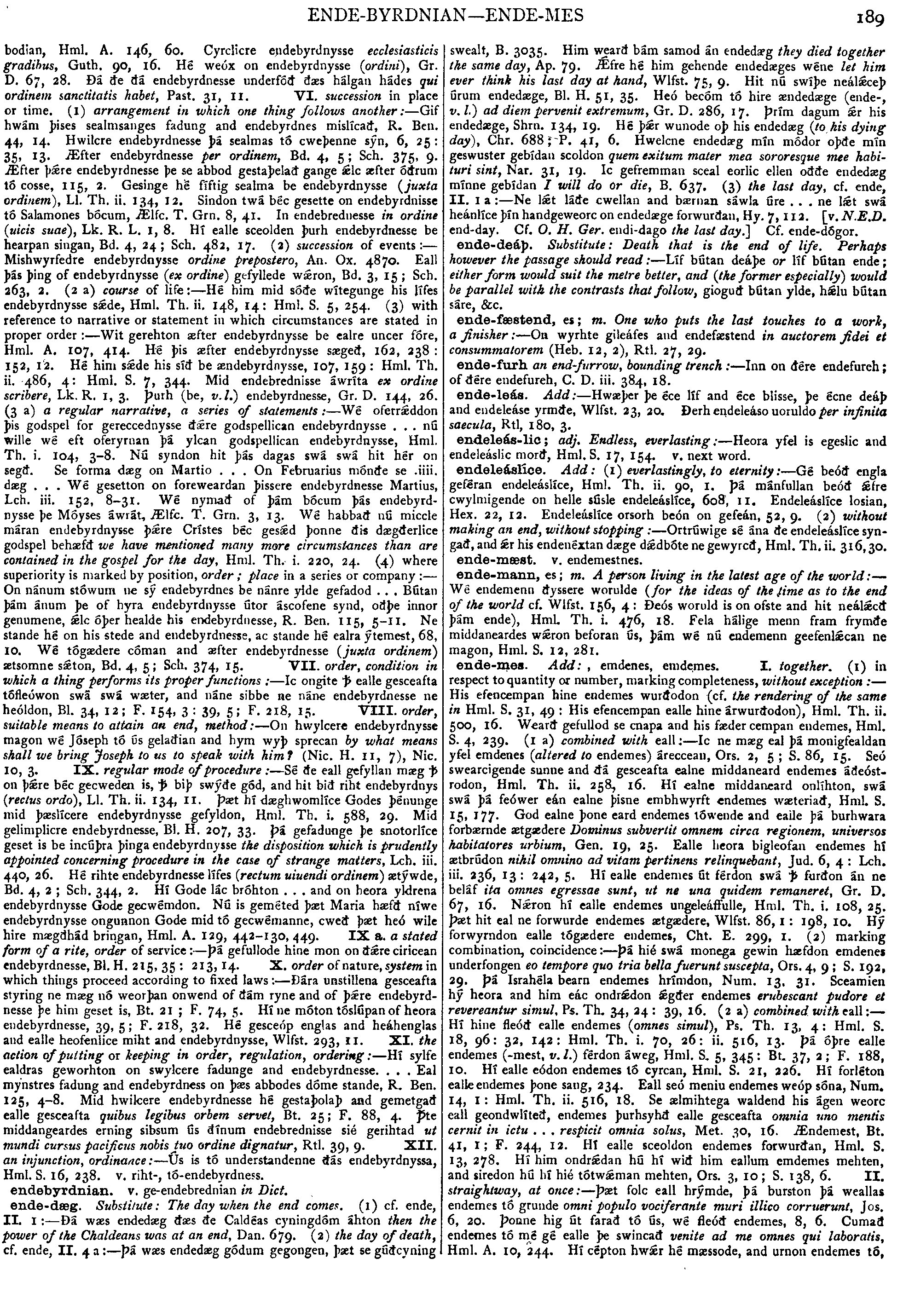
ende-mes.
Add:
,
emdenes,
emdemes.
I.
together.
(1)
in
respect
to
quantity
or
number,
marking
completeness,
without
exception
:--
His
efencempan
hine
endemes
wurðodon
(cf.
the
rendering
of
the
same
in
Hml.
S.
31,
49
;
His
efencempan
ealle
hine
árwurðodon),
Hml.
Th.
ii.
500,
16.
Wearð
gefullod
se
cnapa
and
his
fæder
cempan
endemes,
Hml.
S.
4,
239.
(1
a)
combined
with
eall
:--
Ic
ne
mæg
eal
þá
monigfealdan
yfel
emdenes
(altered
to
endemes)
árecceau,
Ors.
2,
5
;
S.
86,
15.
Seó
swearcigende
sunne
and
ðá
gesceafta
ealne
middaneard
endemes
áðeóstrodon,
Hml.
Th.
ii.
258,
16.
Hí
ealne
middaneard
onlíhton,
swá
swá
þá
feówer
eán
ealne
þisne
embhwyrft
endemes
wæteriað,
Hml.
S.
15,
177.
God
ealne
þone
eard
endemes
tówende
and
eaile
þá
burhwara
forbærnde
ætgædere
Dominus
subvertit
omnem
circa
regionem,
universos
habitatores
urbium,
Gen.
19,
25.
Ealle
heora
bigleofan
endemes
hí
ætbrúdon
nihil
omnino
ad
vitam
pertinens
relinquebant,
Jud.
6,
4
:
Lch.
iii.
236,
13
:
242,
5.
Hí
ealle
endemes
út
férdon
swá
furðon
án
ne
beláf
ita
omnes
egressae
sunt,
ut
ne
una
quidem
remaneret,
Gr.
D.
67,
16.
Nron
hí
ealle
endemes
ungeleáffulle,
Hml.
Th.
i.
108,
25.
Þæt
hit
eal
ne
forwurde
endemes
ætgædere,
Wlfst.
86,
1:
198,
10.
Hý
forwyrndon
ealle
tógædere
endemes,
Cht.
E.
299,
1.
(2)
marking
combination,
coincidence
:--
Þá
hié
swá
monega
gewin
hæfdon
emdenes
underfongen
eo
tempore
quo
tria
bella
fuerunt
suscepta,
Ors.
4,
9;
S.
192,
29.
Þá
Israhéla
bearn
endemes
hrímdon,
Num.
13,
31.
Sceamien
hý
heora
and
him
eác
ondrdon
gðer
endemes
erubescant
pudore
et
revereantur
simul,
Ps.
Th.
34,
24
:
39,
16.
(2
a)
combined
with
eall
:--
Hí
hine
fleóð
ealle
endemes
(omnes
simul),
Ps.
Th.
13,
4:
Hml.
S.
18,
96:
32,
142:
Hml.
Th.
i.
70,
26:
ii.
516,
13.
Þá
óþre
ealle
endemes
(-mest,
v.
l.
)
férdon
áweg,
Hml.
S.
5,
345:
Bt.
37,
2;
F.
188,
10.
Hí
ealle
eódon
endemes
tó
cyrcan,
Hml.
S.
21,
226.
Hí
forléton
ealle
endemes
þone
sang,
234.
Eall
seó
meniu
endemes
weóp
sóna,
Num.
14,
1:
Hml.
Th.
ii.
516,
18.
Se
ælmihtega
waldend
his
ágen
weorc
eall
geondwlíteð,
endemes
þurhsyhð
ealle
gesceafta
omnia
uno
mentis
cernit
in
ictu
.
.
.
respicit
omnia
solus,
Met.
30,
16.
Ændemest,
Bt.
41,
1;
F.
244,
12.
Hí
ealle
sceoldon
endemes
forwurðan,
Hml.
S.
13,
278.
Hí
him
ondrdan
hú
hí
wið
him
eallum
emdemes
mehten,
and
siredon
hú
hí
hié
tótwman
mehten,
Ors.
3,
10
;
S.
138,
6.
II.
straightway,
at
once
:--
Þæt
folc
eall
hrýmde,
þá
burston
þá
weallas
endemes
tó
grunde
omni
populo
vociferante
muri
illico
corruerunt,
Jos.
6,
20.
Þonne
hig
út
farað
tó
ús,
wé
fleóð
endemes,
8,
6.
Cumað
endemes
tó
mé
gé
ealle
þe
swincað
venite
ad
me
omnes
qui
laboratis,
Hml.
A.
10,
244.
Hí
cépton
hwr
hé
mæssode,
and
urnon
endemes
tó,
|
Source: Bosworth/Toller, page d0196, entry 14 View original page image as: [TIFF] [PNG] [View previous entry] [View next entry] |
[Comment on this entry] [View comments] |
The following entry has been hand-corrected once. |
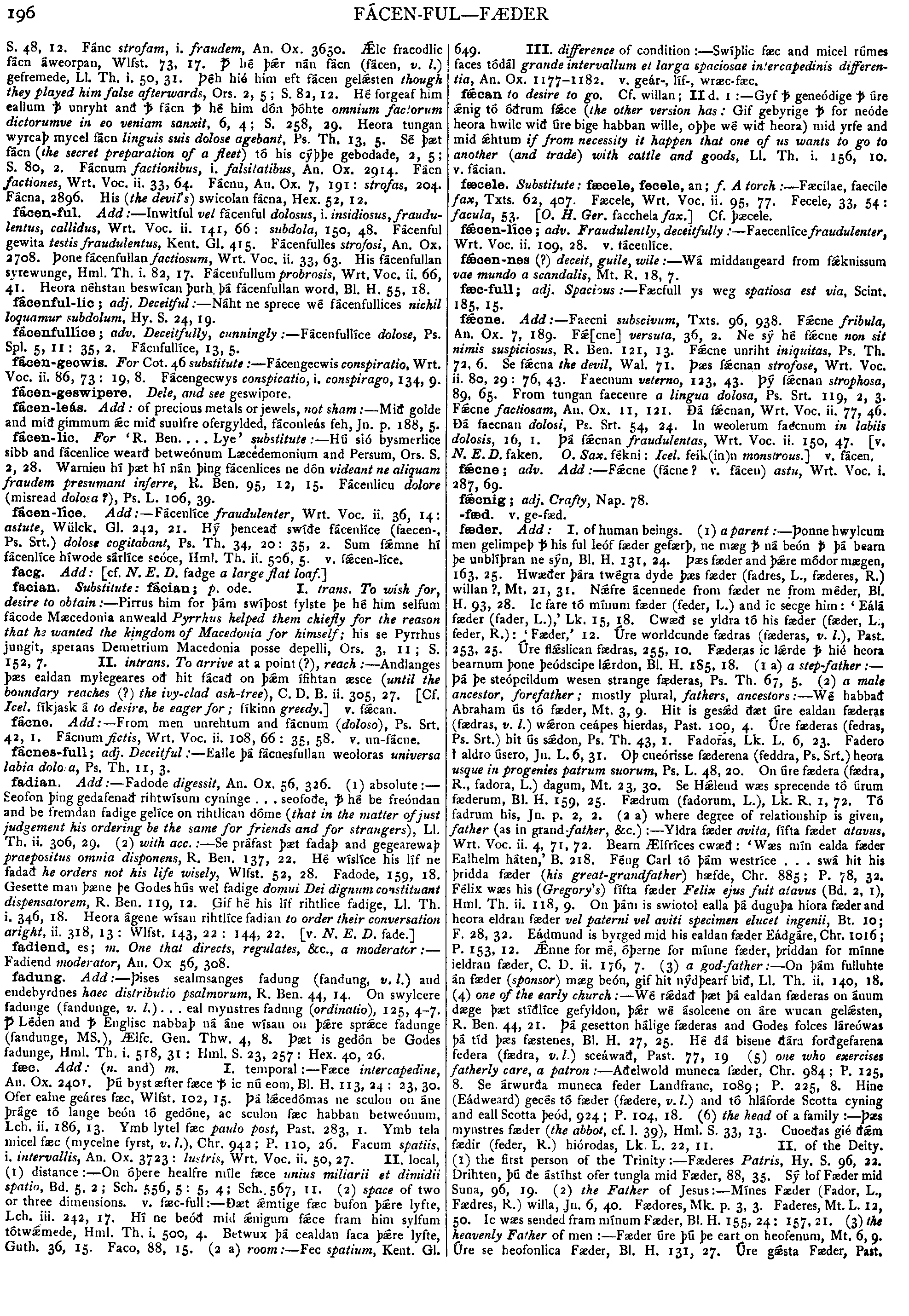
fadian.
Add
:--
Fadode
digessit,
An.
Ox.
56,
326.
(1)
absolute
:--
Seofon
þing
gedafenað
rihtwísum
cyninge
.
.
.
seofoðe,
hé
be
freóndan
and
be
fremdan
fadige
gelíce
on
rihtlican
dóme
(that
in
the
matter
of
just
judgement
his
ordering
be
the
same
for
friends
and
for
strangers),
Ll.
Th.
ii.
306,
29.
(2)
with
acc.:--
Se
práfast
þæt
fadaþ
and
gegearewaþ
praepositus
omnia
disponens,
R.
Ben.
137,
22.
Hé
wíslíce
his
líf
ne
fadað
he
orders
not
his
life
wisely,
Wlfst.
52,
28.
Fadode,
159,
18.
Gesette
man
þæne
þe
Godes
hús
wel
fadige
domui
Dei
dignum
constituant
dispensatorem,
R.
Ben.
119,
12.
Gif
hé
his
líf
rihtlice
fadige,
Ll.
Th.
i.
346,
18.
Heora
ágene
wísan
rihtlíce
fadian
to
order
their
conversation
aright,
ii.
318,
13
:
Wlfst.
143,
22
:
144,
22.
[v.
N.
E.
D.
fade.]
|
Source: Bosworth/Toller, page d0206, entry 7 View original page image as: [TIFF] [PNG] [View previous entry] [View next entry] |
[Comment on this entry] [View comments] |
The following entry has been hand-corrected once. |
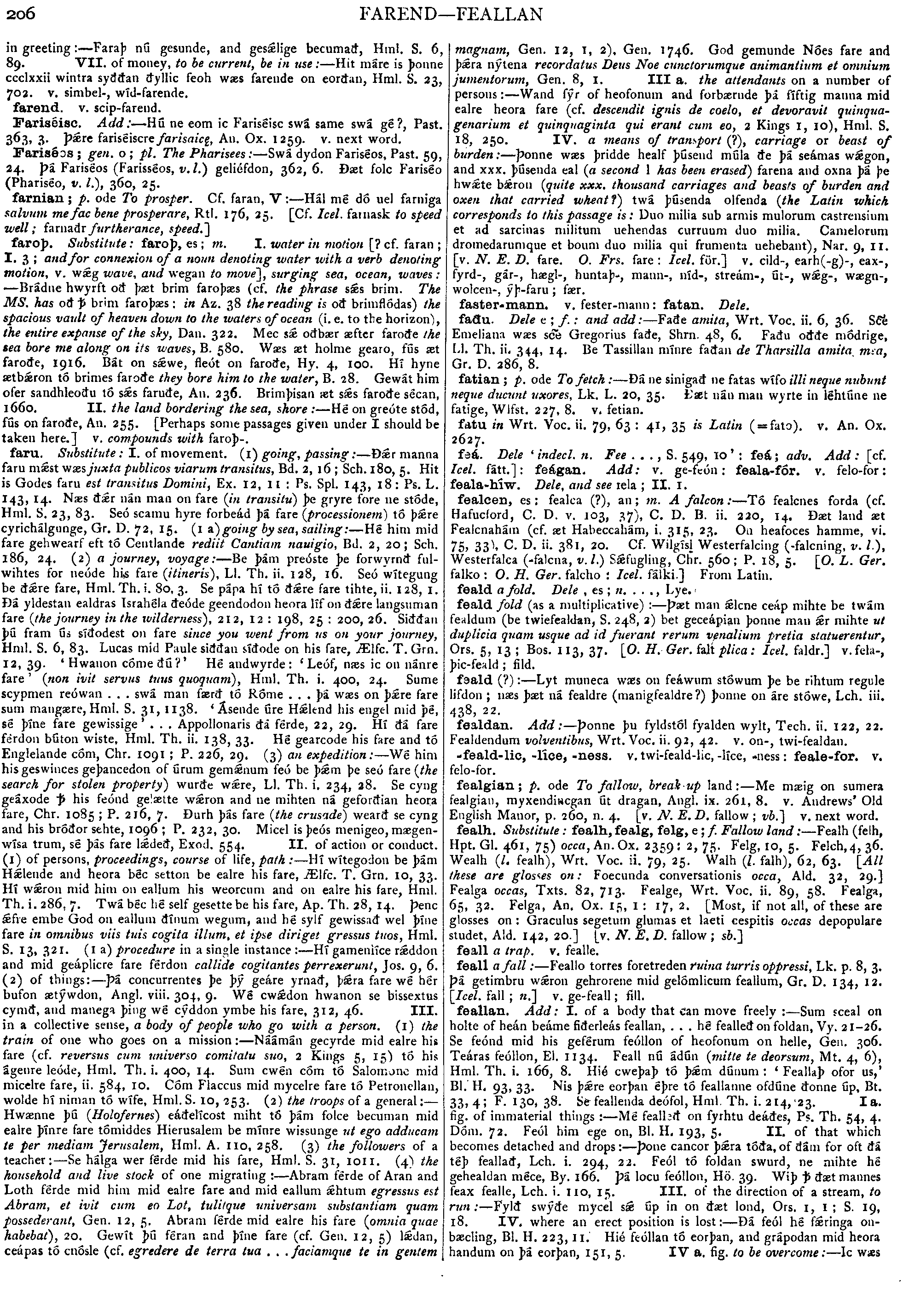
faru.
Substitute:
I.
of
movement.
(1)
going,
passing
:--
Ðr
manna
faru
mst
wæs
juxta
publicos
viarum
transitus,
Bd.
2,
16
;
Sch.
180,
5.
Hit
is
Godes
faru
est
transitus
Domini,
Ex.
12,
11
:
Ps.
Spl.
143,
18
:
Ps.
L.
143,
14.
Næs
ðr
nán
man
on
fare
(in
transitu)
þe
gryre
fore
ne
stóde,
Hml.
S.
23,
83.
Seó
scamu
hyre
forbeád
þá
fare
(processionem)
tó
þre
cyrichálgunge,
Gr.
D.
72,
15.
(1
a)
going
by
sea,
sailing
:--
Hé
him
mid
fare
gehwearf
eft
tó
Centlande
rediit
Cantiam
nauigio,
Bd.
2,
20;
Sch.
186,
24.
(2)
a
journey,
voyage
:--
Be
þám
preóste
þe
forwyrnð
fulwihtes
for
neóde
his
fare
(itineris),
Ll.
Th.
ii.
128,
16.
Seó
wítegung
be
ðre
fare,
Hml.
Th.
i.
80,
3.
Se
pápa
hí
tó
ðre
fare
tihte,
ii.
128,
1.
Ðá
yldestan
ealdras
Israhéla
ðeóde
geendodon
heora
líf
on
ðre
langsuman
fare
(the
journey
in
the
wilderness),
212,
12
:
198,
25
:
200,
26.
Siððan
þú
fram
ús
síðodest
on
fare
since
you
went
from
us
on
your
journey,
Hml.
S.
6,
83.
Lucas
mid
Paule
siððan
síðode
on
his
fare,
Ælfc.
T.
Grn.
12,
39.
"
Hwanon
cóme
ðú?"
Hé
andwyrde:
"
Leóf,
næs
ic
on
nánre
fare
"
(non
ivit
servus
tuus
quoquam),
Hml,
Th.
i.
400,
24.
Sume
scypmen
reówan
.
.
.
swá
man
færð
tó
Róme
.
.
.
þá
wæs
on
þre
fare
sum
mangære,
Hml.
S.
31,
1138.
"
Ásende
úre
Hlend
his
engel
mid
þé,
sé
þíne
fare
gewissige
"
.
.
.
Appollonaris
ðá
férde,
22,
29.
Hí
ðá
fare
férdon
búton
wiste,
Hml.
Th.
ii.
138,
33.
Hé
gearcode
his
fare
and
tó
Englelande
cóm,
Chr.
1091
;
P.
226,
29.
(3)
an
expedition
:--
Wé
him
his
geswinces
geþancedon
of
úrum
gemnum
feó
be
þm
þe
seó
fare
(the
search
for
stolen
property)
wurðe
wre,
Ll.
Th.
i.
234,
28.
Se
cyng
geáxode
his
feónd
gelætte
wron
and
ne
mihten
ná
geforðian
heora
fare,
Chr.
1085
;
P.
216,
7.
Ðurh
þás
fare
(the
crusade)
wearð
se
cyng
and
his
bróðor
sehte,
1096;
P.
232,
30.
Micel
is
þeós
menigeo,
mægenwísa
trum,
sé
þás
fare
ldeð,
Exod.
554.
II.
of
action
or
conduct.
(1)
of
persons,
proceedings,
course
of
life,
path
:--
Hí
wítegodon
be
þám
Hlende
and
heora
béc
setton
be
ealre
his
fare,
Ælfc.
T.
Grn.
10,
33.
Hí
wron
mid
him
on
eallum
his
weorcum
and
on
ealre
his
fare,
Hml.
Th.
1.
286,
7.
Twá
béc
hé
self
gesettebe
his
fare,
Ap.
Th.
28,
14.
Þenc
fre
embe
God
on
eallum
ðínum
wegum,
and
hé
sylf
gewissað
wel
þíne
fare
in
omnibus
viis
tuis
cogita
illum,
et
ipse
diriget
gressus
tuos,
Hml.
S.
13,
321.
(1
a)
procedure
in
a
single
instance
:--
Hí
gameniíce
UNCERTAIN
rddon
and
mid
geáplicre
fare
férdon
callide
cogitantes
perrexerunt,
Jos.
9,
6.
(2)
of
things
:--
Þá
concurrentes
þe
þý
geáre
yrnað,
þra
fare
wé
hér
UNCERTAIN
bufon
ætýwdon,
Angl.
viii.
304,
9.
Wé
cwdon
hwanon
se
bissextus
cymð,
and
manega
þing
wé
cýddon
ymbe
his
fare,
312,
46.
III.
in
a
collective
sense,
a
body
of
people
who
go
with
a
person.
(1)
the
train
of
one
who
goes
on
a
mission
:--
Náámán
gecyrde
mid
ealre
his
fare
(cf.
reversus
cum
universo
comitatu
suo,
2
Kings
5,
15)
tó
his
ágenre
leóde,
Hml.
Th.
i.
400,
14.
Sum
cwén
cóm
tó
Salomone
mid
micelre
fare,
ii.
584,
10.
Cóm
Flaccus
mid
mycelre
fare
tó
Petronellan,
wolde
hí
niman
tó
wífe,
Hml.
S.
10,
253.
(2)
the
troops
of
a
general
:--
Hwænne
þú
(Holofernes)
eáðelícost
miht
tó
þám
folce
becuman
mid
ealre
þínre
fare
tómiddes
Hierusalem
be
mínre
wissunge
ut
ego
adducam
te
per
mediam
Jerusalem,
Hml.
A.
110,
258.
(3)
the
followers
of
a
teacher
:--
Se
hálga
wer
férde
mid
his
fare,
Hml.
S.
31,
1011.
(4)
the
household
and
live
stock
of
one
migrating
:--
Abram
férde
of
Aran
and
Loth
férde
mid
him
mid
ealre
fare
and
mid
eallum
htum
egressus
est
Abram,
et
ivit
cum
eo
Lot,
tulitque
universam
substantiam
quam
possederant,
Gen.
12,
5.
Abram
férde
mid
ealre
his
fare
(omnia
quae
habebat),
20.
Gewít
þú
féran
and
þíne
fare
(cf.
Gen.
12,
5)
ldan,
ceápas
tó
cnósle
(cf.
egredere
de
terra
tua
.
.
.
faciamque
te
in
gentem
magnam,
Gen.
12,
1,
2),
Gen.
1746.
God
gemunde
Nóes
fare
þra
nýtena
recordatus
Deus
Noe
cunctorumque
animantium
et
omnium
jumentorum,
Gen.
8,
1.III
a.
the
attendants
on
a
number
of
persons
:--
Wand
fýr
of
heofonum
and
forbærnde
þá
fiftig
manna
mid
ealre
heora
fare
(cf.
descendit
ignis
de
coelo,
et
devoravit
quinquagenarium
et
quinquaginta
qui
erant
cum
eo,
2
Kings
1,
10),
Hml.
S.
18,
250.
IV.
a
means
of
transport
(?),
carriage
or
beast
of
burden
:--
Þonne
wæs
þridde
healf
þúsend
múla
ðe
þá
seámas
wgon,
and
xxx.
þúsenda
eal
(a
second
l
has
been
erased)
farena
and
oxna
þá
þe
hwte
bron
(quite
xxx.
thousand
carriages
and
beasts
of
burden
and
oxen
that
carried
wheat?)
twá
þúsenda
olfenda
(the
Latin
which
corresponds
to
this
passage
is:
Duo
milia
sub
armis
mulorum
castrensium
et
ad
sarcinas
militum
uehendas
curruum
duo
milia.
Camelorum
dromedarumque
et
bourn
duo
milia
qui
frumenta
uehebant),
Nar.
9,
11.
[v.
N.
E.
D.
fare.
O.
Frs.
fare
:
Icel.
för.]
v.
cild-,
earh(-g)-,
eax-,
fyrd-,
gár-,
hægl-,
huntaþ-,
mann-,
níd-,
streám-,
út-,
wæ-acute;g-,
wægn-,
wolcen-,
ýþ-faru
;
fær.
| Result Page: |  |
Previous | 4 5 6 7 8 9 10 11 12 13 14 15 16 17 18 19 | Next |  |
Germanic Lexicon Project (main page)
This search system was written by
Sean Crist
Please consider
volunteering
to correct the data in these online dictionaries.
No rights reserved. Feel free to use these data in any way you please.