|
|

Tip: In the search results, you can click on any word or abbreviation for more information.
|
Source: Cleasby/Vigfusson, page b0021, entry 24 View original page image as: [TIFF] [PNG] [View previous entry] [View next entry] |
[Comment on this entry] [View comments] |
The following entry has been hand-corrected once. |
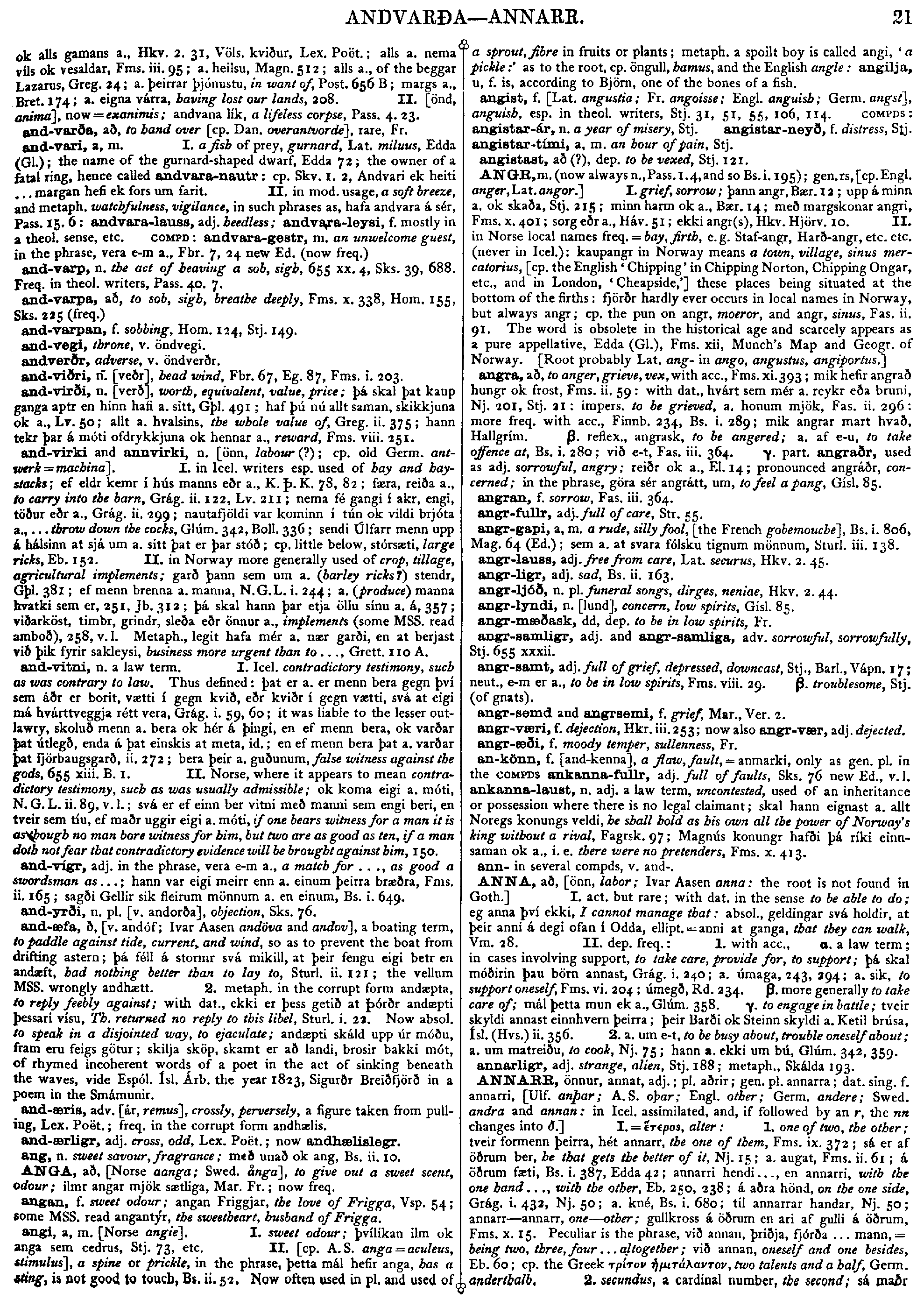
ANGR, m. (now always n., Pass. 1. 4, and so Bs. i. 195); gen.rs, [cp. Engl. anger, Lat. angor.] I. grief, sorrow; þann angr, Bær. 12; upp á minn a. ok skaða, Stj. 215; minn harm ok a., Bær. 14; með margskonar angri, Fms.x.401; sorg eðr a., Háv. 51; ekki angr(s), Hkv. Hjörv. 10. II. in Norse local names freq. = bay, firth, e. g. Staf-angr, Harð-angr, etc. etc. (never in Icel.): kaupangr in Norway means a town, village, sinus mer- catorius, [cp. the English 'Chipping' in Chipping Norton, Chipping Ongar, etc., and in London, 'Cheapside,'] these places being situated at the bottom of the firths: fjörðr hardly ever occurs in local names in Norway, but always angr; cp. the pun on angr, moeror, and angr, sinus, Fas. ii. 91. The word is obsolete in the historical age and scarcely appears as a pure appellative, Edda (Gl.), Fms. xii, Munch's Map and Geogr. of Norway. [Root probably Lat. ang- in ango, angustus, angiportus.]
|
Source: Cleasby/Vigfusson, page b0023, entry 6 View original page image as: [TIFF] [PNG] [View previous entry] [View next entry] |
[Comment on this entry] [View comments] |
The following entry has been hand-corrected once. |
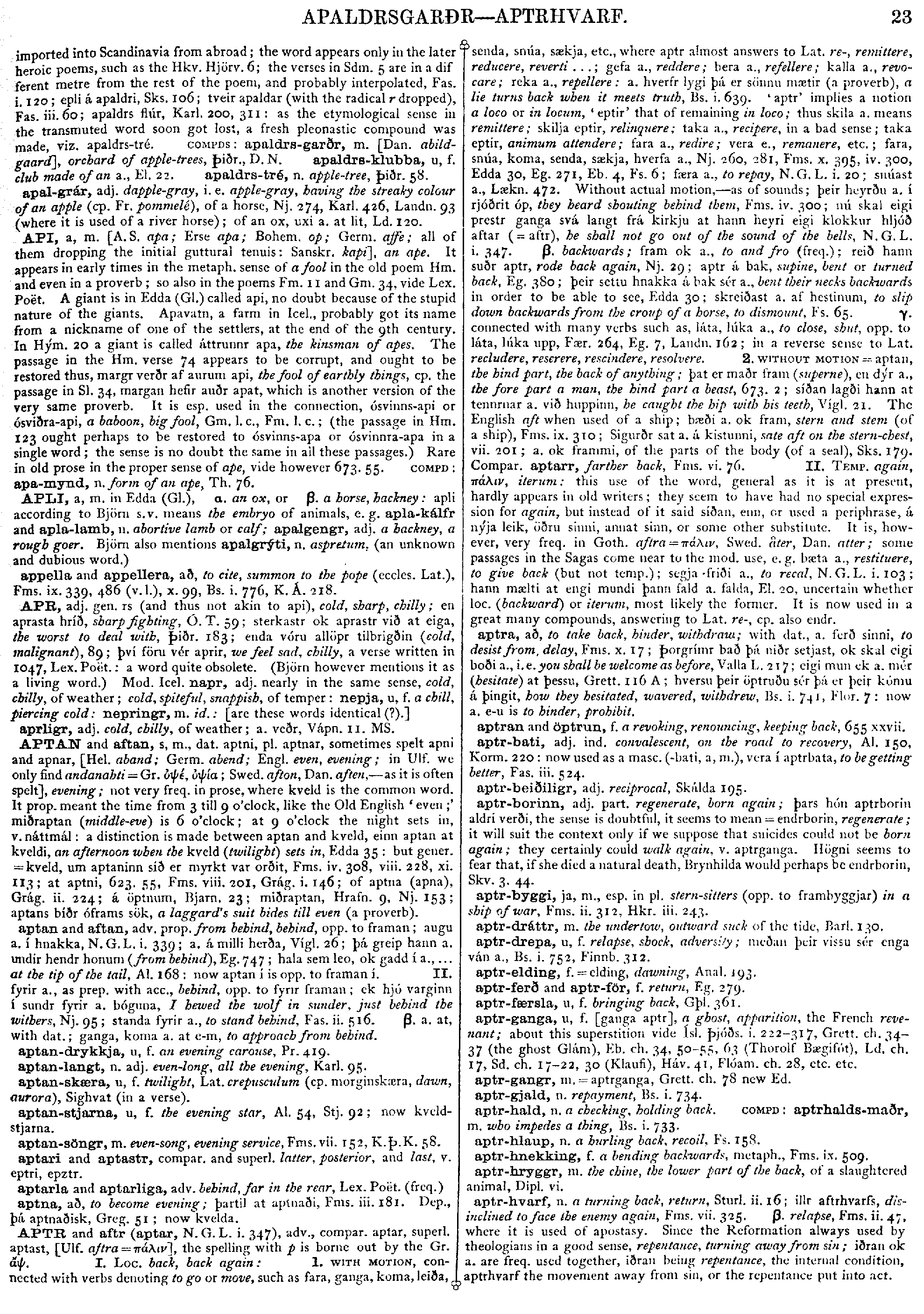
APR, adj. gen. rs (and thus not akin to api), cold, sharp, chilly; en aprasta hríð, sharp fighting, Ó. T. 59; sterkastr ok aprastr við at eiga, the worst to deal with, Þiðr. 183; erida vóru allöpr tilbrigðin (cold, malignant), 89; því föru vér aprir, we feel sad, chilly, a verse written in 1047, Lex. Poët.: a word quite obsolete. (Björn however mentions it as a living word.) Mod. Icel. napr, adj. nearly in the same sense, cold, chilly, of weather; cold, spiteful, snappish, of temper: nepja, u, f. a chill, piercing cold: nepringr, m. id.: [are these words identical (?).]
|
Source: Cleasby/Vigfusson, page b0029, entry 1 View original page image as: [TIFF] [PNG] [View previous entry] [View next entry] |
[Comment on this entry] [View comments] |
The following entry has been hand-corrected once. |
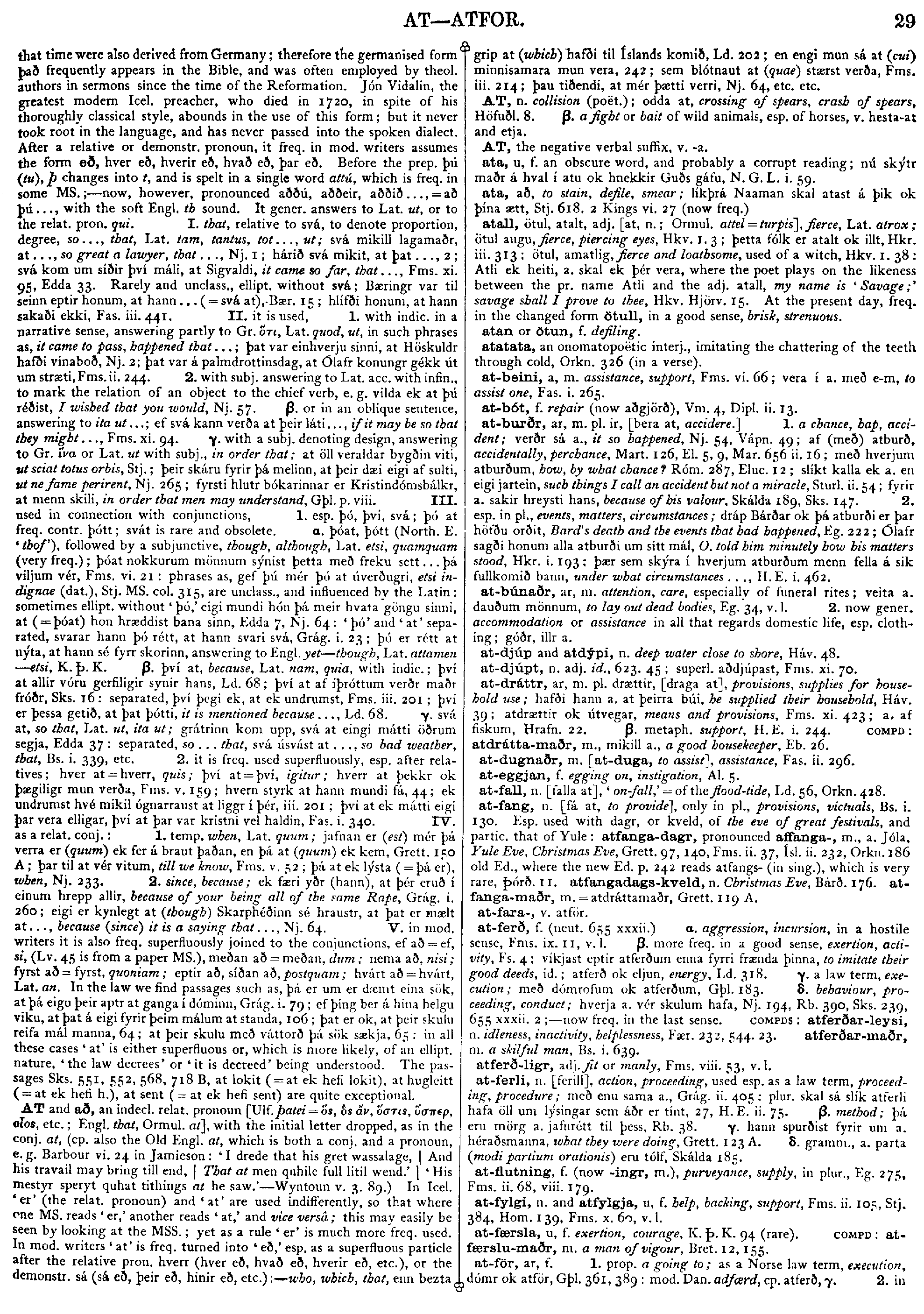
that
time
were
also
derived
from
Germany;
therefore
the
germanised
form
það
frequently
appears
in
the
Bible,
and
was
often
employed
by
theol.
authors
in
sermons
since
the
time
of
the
Reformation.
Jón
Vidalin,
the
greatest
modern
Icel.
preacher,
who
died
in
1720,
in
spite
of
his
thoroughly
classical
style,
abounds
in
the
use
of
this
form;
but
it
never
took
root
in
the
language,
and
has
never
passed
into
the
spoken
dialect.
After
a
relative
or
demonstr.
pronoun,
it
freq.
in
mod.
writers
assumes
the
form
eð,
hver
eð,
hverir
eð,
hvað
eð,
þar
eð.
Before
the
prep,
þú
(t
u),
þ
changes
into
t,
and
is
spelt
in
a
single
word
attú,
which
is
freq.
in
some
MS.;
--
now,
however,
pronounced
aððú,
aððeir,
aððið
...,
=
að
þú...,
with
the
soft
Engl.
th
sound.
It
gener.
answers
to
Lat.
ut,
or
to
the
relat.
pron.
qui.
I.
that,
relative
to
svá,
to
denote
proportion,
degree,
so...,
that,
Lat.
tam,
tantus,
to
t...,
-ut;
svá
mikill
lagamaðr,
at...,
sogr
eat
a
lawyer,
that...,
Nj.
I;
hárið
svá
mikit,
at
þat...,
2;
svá
kom
um
síðir
því
máli,
at
Sigvaldi,
it
came
so
far,
that...,
Fms.
xi.
95,
Edda
33.
Rarely
and
unclass.,
ellipt.
without
svá;
Bæringr
var
til
seinn
eptir
honum,
at
hann
...
(=
svá
at),
-Bær.
15;
hlífði
honum,
at
hann
sakaði
ekki,
Fas.
iii.
441.
II.
it
is
used,
1.
with
indic,
in
a
narrative
sense,
answering
partly
to
Gr.
GREEK
Lat.
quod,
ut,
in
such
phrases
as,
it
came
topass,
happened
that...;
þat
var
einhverju
sinni,
at
Höskuldr
hafði
vinaboð,
Nj.
2;
þat
var
á
palmdrottinsdag,
at
Ólafr
konungr
gékk
út
um
stræti,
Fms.
ii.
244.
2.
with
subj.
answering
to
Lat.
acc.
with
infin.,
to
mark
the
relation
of
an
object
to
the
chief
verb,
e.
g.
vilda
ek
at
þú
réðist,
I
wished
that
yon
-would,
Nj.
57.
 .
or
in
an
oblique
sentence,
answering
to
ita
ut...;.;
ef
svá
kann
verða
at
þeir
láti...,
if
it
may
be
so
that
they
might...,
Fms.
xi.
94.
.
or
in
an
oblique
sentence,
answering
to
ita
ut...;.;
ef
svá
kann
verða
at
þeir
láti...,
if
it
may
be
so
that
they
might...,
Fms.
xi.
94.
 with
a
subj.
denoting
design,
answering
to
GREEK
or
Lat.
ut
with
subj.,
in
order
that;
at
öll
veraldar
bygðin
viti,
ut
sciat
totus
orbis,
Stj.;
þeir
skáru
fyrir
þá
melinn,
at
þeir
dæi
eigi
af
sulti,
ut
ne
fame
perirent,
Nj.
265;
fyrsti
hlutr
bókarinnar
er
Kristindómsbálkr,
at
menn
skili,
in
order
that
men
may
understand,
Gþl.
p.
viii.
III.
used
in
connection
with
conjunctions,
1.
esp.
þó,
því,
svá;
þó
at
freq.
contr.
þótt;
svát
is
rare
and
obsolete.
a.
þóat,
þótt
(North.
E.
'thof'),
followed
by
a
subjunctive,
though,
although,
Lat.
etsi,
quamquam
(very
freq.);
þóat
nokkurum
mönnum
sýnist
þetta
með
freku
sett...
þá
viljum
vér,
Fms.
vi.
21:
phrases
as,
gef
þú
mér
þó
at
úverðugri,
etsi
indignae
(dat.),
Stj.
MS.
col.
315,
are
unclass.,
and
influenced
by
the
Latin:
sometimes
ellipt.
without'
þó,
'
eigi
mundi
hón
þá
meir
hvata
göngu
sinni,
at
(=
þóat)
hon
hraeddist
bana
sinn,
Edda
7,
Nj.
64:
'
þó'
and
'
at'
sepa-
rated,
svarar
hann
þó
rétt,
at
hann
svari
svá,
Grág.
i.
23;
þó
er
rétt
at
nýta,
at
hann
sé
fyrr
skorinn,
answering
to
Engl.
yet
--
though,
Lat.
attamen
--
etsi,
K.
þ.
K.
.
því
at,
because,
Lat.
nam,
quia,
with
indic.;
því
at
allir
vóru
gerfiligir
synir
hans,
Ld.
68;
því
at
af
íþróttum
verðr
maðr
fróðr,
Sks.
16:
separated,
því
þegi
ek,
at
ek
undrumst,
Fms.
iii.
201;
því
er
þessa
getið,
at
þat
þótti,
it
i
s
mentioned
because
...,
Ld.
68.
.
svá
at,
so
that,
Lat.
ut,
ita
ut;
grátrinn
kom
upp,
svá
at
eingi
mátti
öðrum
segja,
Edda
37:
separated,
so
...
that,
svá
úsvúst
at
...,
so
bad
weather,
that,
Bs.
i.
339,
etc.
2.
it
is
freq.
used
superfluously,
esp.
after
rela-
tives;
hver
at
=
hverr,
quis;
því
at
=
því,
igitur;
hverr
at
þekkr
ok
þægiligr
mun
verða,
Fms.
v.
159;
hvern
stvrk
at
hann
mundi
fá,
44;
ek
undrumst
hvé
mikil
ógnarraust
at
liggr
í
þér,
iii.
201;
því
at
ek
mátti
eigi
þar
vera
elligar,
því
at
þar
var
kristni
vel
haldin,
Fas.
i.
340.
IV.
as
a
relat.
conj.:
1.
temp,
when,
Lat.
quum;
jafnan
er
(est)
mér
þá
verra
er
(quum)
ek
fer
á
braut
þaðan,
en
þá
at
(quum)
ek
kem,
Grett.
150
A;
þar
til
at
vér
vitum,
till
we
know,
Fms.
v.
52;
þá
at
ek
lýsta
(=
þá
er),
when,
Nj.
233.
2.
since,
because;
ek
færi
yðr
(hann),
at
þér
eruð
í
einum
hrepp
allir,
because
of
your
being
all
of
the
same
Rape,
Grág.
i.
260;
eigi
er
kynlegt
at
(though)
Skarphéðinn
sé
hraustr,
at
þat
er
mælt
at...,
because
(since)
it
is
a
saying
that...,
Nj.
64.
V.
in
mod.
writers
it
is
also
freq.
superfluously
joined
to
the
conjunctions,
ef
að
=
ef,
si,
(Lv.
45
is
from
a
paper
MS.),
meðan
að
=
meðan,
dum;
nema
að,
nisi;
fyrst
að
=
fyrst,
quoniam;
eptir
að,
síðan
að,
postquam;
hvárt
að
=
hvárt,
Lat.
an.
In
the
law
we
find
passages
such
as,
þá
er
um
er
dæmt
eina
sök,
at
þá
eigu
þeir
aptr
at
ganga
í
dóminn,
Grág.
i.
79;
ef
þing
ber
á
hina
helgu
viku,
at
þat
á
eigi
fyrir
þeim
málum
at
standa,
106;
þat
er
ok,
at
þeir
skulu
reifa
mál
manna,
64;
at
þeir
skulu
með
váttorð
þá
sök
sækja,
65:
in
all
these
cases
'
at'
is
either
superfluous
or,
which
is
more
likely,
of
an
ellipt.
nature,
'the
law
decrees'
or
'it
is
decreed'
being
understood.
The
pas-
sages
Sks.
551,
552,
568,
718
B,
at
lokit
(=
at
ek
hefi
lokit),
at
hugleitt
(=
at
ek
hefi
h.),
at
sent
(=
at
ek
hefi
sent)
are
quite
exceptional
with
a
subj.
denoting
design,
answering
to
GREEK
or
Lat.
ut
with
subj.,
in
order
that;
at
öll
veraldar
bygðin
viti,
ut
sciat
totus
orbis,
Stj.;
þeir
skáru
fyrir
þá
melinn,
at
þeir
dæi
eigi
af
sulti,
ut
ne
fame
perirent,
Nj.
265;
fyrsti
hlutr
bókarinnar
er
Kristindómsbálkr,
at
menn
skili,
in
order
that
men
may
understand,
Gþl.
p.
viii.
III.
used
in
connection
with
conjunctions,
1.
esp.
þó,
því,
svá;
þó
at
freq.
contr.
þótt;
svát
is
rare
and
obsolete.
a.
þóat,
þótt
(North.
E.
'thof'),
followed
by
a
subjunctive,
though,
although,
Lat.
etsi,
quamquam
(very
freq.);
þóat
nokkurum
mönnum
sýnist
þetta
með
freku
sett...
þá
viljum
vér,
Fms.
vi.
21:
phrases
as,
gef
þú
mér
þó
at
úverðugri,
etsi
indignae
(dat.),
Stj.
MS.
col.
315,
are
unclass.,
and
influenced
by
the
Latin:
sometimes
ellipt.
without'
þó,
'
eigi
mundi
hón
þá
meir
hvata
göngu
sinni,
at
(=
þóat)
hon
hraeddist
bana
sinn,
Edda
7,
Nj.
64:
'
þó'
and
'
at'
sepa-
rated,
svarar
hann
þó
rétt,
at
hann
svari
svá,
Grág.
i.
23;
þó
er
rétt
at
nýta,
at
hann
sé
fyrr
skorinn,
answering
to
Engl.
yet
--
though,
Lat.
attamen
--
etsi,
K.
þ.
K.
.
því
at,
because,
Lat.
nam,
quia,
with
indic.;
því
at
allir
vóru
gerfiligir
synir
hans,
Ld.
68;
því
at
af
íþróttum
verðr
maðr
fróðr,
Sks.
16:
separated,
því
þegi
ek,
at
ek
undrumst,
Fms.
iii.
201;
því
er
þessa
getið,
at
þat
þótti,
it
i
s
mentioned
because
...,
Ld.
68.
.
svá
at,
so
that,
Lat.
ut,
ita
ut;
grátrinn
kom
upp,
svá
at
eingi
mátti
öðrum
segja,
Edda
37:
separated,
so
...
that,
svá
úsvúst
at
...,
so
bad
weather,
that,
Bs.
i.
339,
etc.
2.
it
is
freq.
used
superfluously,
esp.
after
rela-
tives;
hver
at
=
hverr,
quis;
því
at
=
því,
igitur;
hverr
at
þekkr
ok
þægiligr
mun
verða,
Fms.
v.
159;
hvern
stvrk
at
hann
mundi
fá,
44;
ek
undrumst
hvé
mikil
ógnarraust
at
liggr
í
þér,
iii.
201;
því
at
ek
mátti
eigi
þar
vera
elligar,
því
at
þar
var
kristni
vel
haldin,
Fas.
i.
340.
IV.
as
a
relat.
conj.:
1.
temp,
when,
Lat.
quum;
jafnan
er
(est)
mér
þá
verra
er
(quum)
ek
fer
á
braut
þaðan,
en
þá
at
(quum)
ek
kem,
Grett.
150
A;
þar
til
at
vér
vitum,
till
we
know,
Fms.
v.
52;
þá
at
ek
lýsta
(=
þá
er),
when,
Nj.
233.
2.
since,
because;
ek
færi
yðr
(hann),
at
þér
eruð
í
einum
hrepp
allir,
because
of
your
being
all
of
the
same
Rape,
Grág.
i.
260;
eigi
er
kynlegt
at
(though)
Skarphéðinn
sé
hraustr,
at
þat
er
mælt
at...,
because
(since)
it
is
a
saying
that...,
Nj.
64.
V.
in
mod.
writers
it
is
also
freq.
superfluously
joined
to
the
conjunctions,
ef
að
=
ef,
si,
(Lv.
45
is
from
a
paper
MS.),
meðan
að
=
meðan,
dum;
nema
að,
nisi;
fyrst
að
=
fyrst,
quoniam;
eptir
að,
síðan
að,
postquam;
hvárt
að
=
hvárt,
Lat.
an.
In
the
law
we
find
passages
such
as,
þá
er
um
er
dæmt
eina
sök,
at
þá
eigu
þeir
aptr
at
ganga
í
dóminn,
Grág.
i.
79;
ef
þing
ber
á
hina
helgu
viku,
at
þat
á
eigi
fyrir
þeim
málum
at
standa,
106;
þat
er
ok,
at
þeir
skulu
reifa
mál
manna,
64;
at
þeir
skulu
með
váttorð
þá
sök
sækja,
65:
in
all
these
cases
'
at'
is
either
superfluous
or,
which
is
more
likely,
of
an
ellipt.
nature,
'the
law
decrees'
or
'it
is
decreed'
being
understood.
The
pas-
sages
Sks.
551,
552,
568,
718
B,
at
lokit
(=
at
ek
hefi
lokit),
at
hugleitt
(=
at
ek
hefi
h.),
at
sent
(=
at
ek
hefi
sent)
are
quite
exceptional
|
Source: Cleasby/Vigfusson, page b0031, entry 45 View original page image as: [TIFF] [PNG] [View previous entry] [View next entry] |
[Comment on this entry] [View comments] |
The following entry has been hand-corrected once. |
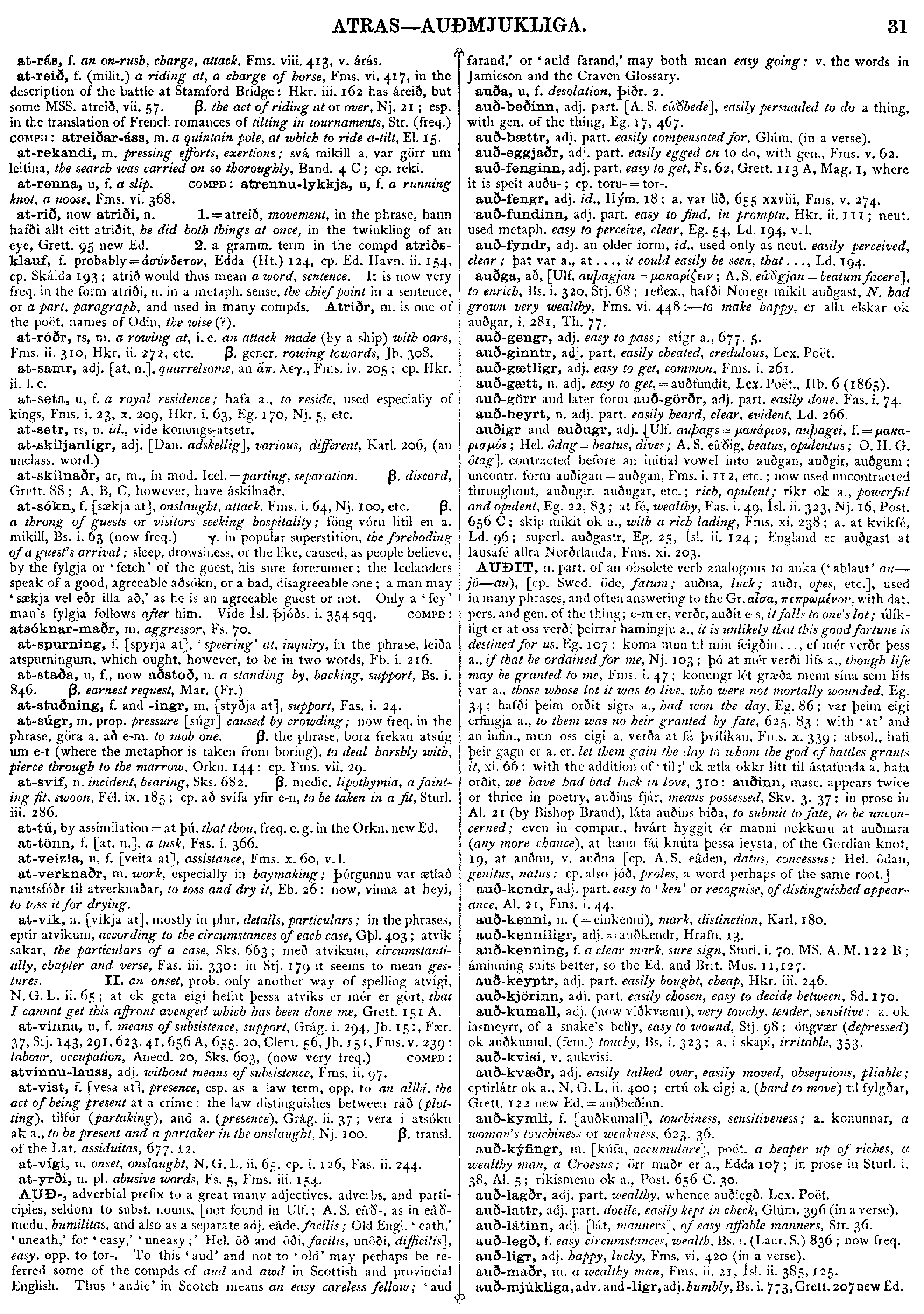
AUÐIT, n. part. of an obsolete verb analogous to auka ('ablaut' an -- jó -- au), [cp. Swed. öde, fatum; auðna, luck; auðr, opes, etc.], used in many phrases, and often answering to the Gr. GREEK, with dat. pers. and gen. of the thing; e-m er, verðr, auðit e-s, it falls to one's lot; úlíkligt er at oss verði þeirrar hamingju a., it is unlikely that this good fortune is destined for us, Eg. 107; koma mun til mín feigðin..., ef mér verðr þess a., if that be ordained for me, Nj. 103; þó at mér verði lífs a., though life may be granted to me, Fms. i. 47; konungr lét græða menn sína sem lífs var a., those whose lot it was to live, who were not mortally wounded, Eg. 34; hafði þeim orðit sigrs a., had won the day, Eg. 86; var þeim eigi erfingja a., to them was no heir granted by fate, 625. 83: with 'at' and an infin., mun oss eigi a. verða at fá þvílíkan, Fms. x. 339: absol., hafi þeir gagn er a. er, let them gain the day to whom the god of battles grants it, xi. 66: with the addition of 'til;' ek ætla okkr lítt til ástafunda a. hafa orðit, we have had bad luck in love, 310: auðinn, masc. appears twice or thrice in poetry, auðins fjár, means possessed, Skv. 3. 37: in prose in Al. 21 (by Bishop Brand), láta auðins bíða, to submit to fate, to be unconcerned; even in compar., hvárt hyggit ér manni nokkuru at auðnara (any more chance), at hann fái knúta þessa leysta, of the Gordian knot, 19, at auðnu, v. auðna [cp. A. S. eâden, datus, concessus; Hel. ôdan, genitus, natus: cp. also jóð, proles, a word perhaps of the same root.]
|
Source: Cleasby/Vigfusson, page b0032, entry 53 View original page image as: [TIFF] [PNG] [View previous entry] [View next entry] |
[Comment on this entry] [View comments] |
The following entry has been hand-corrected once. |
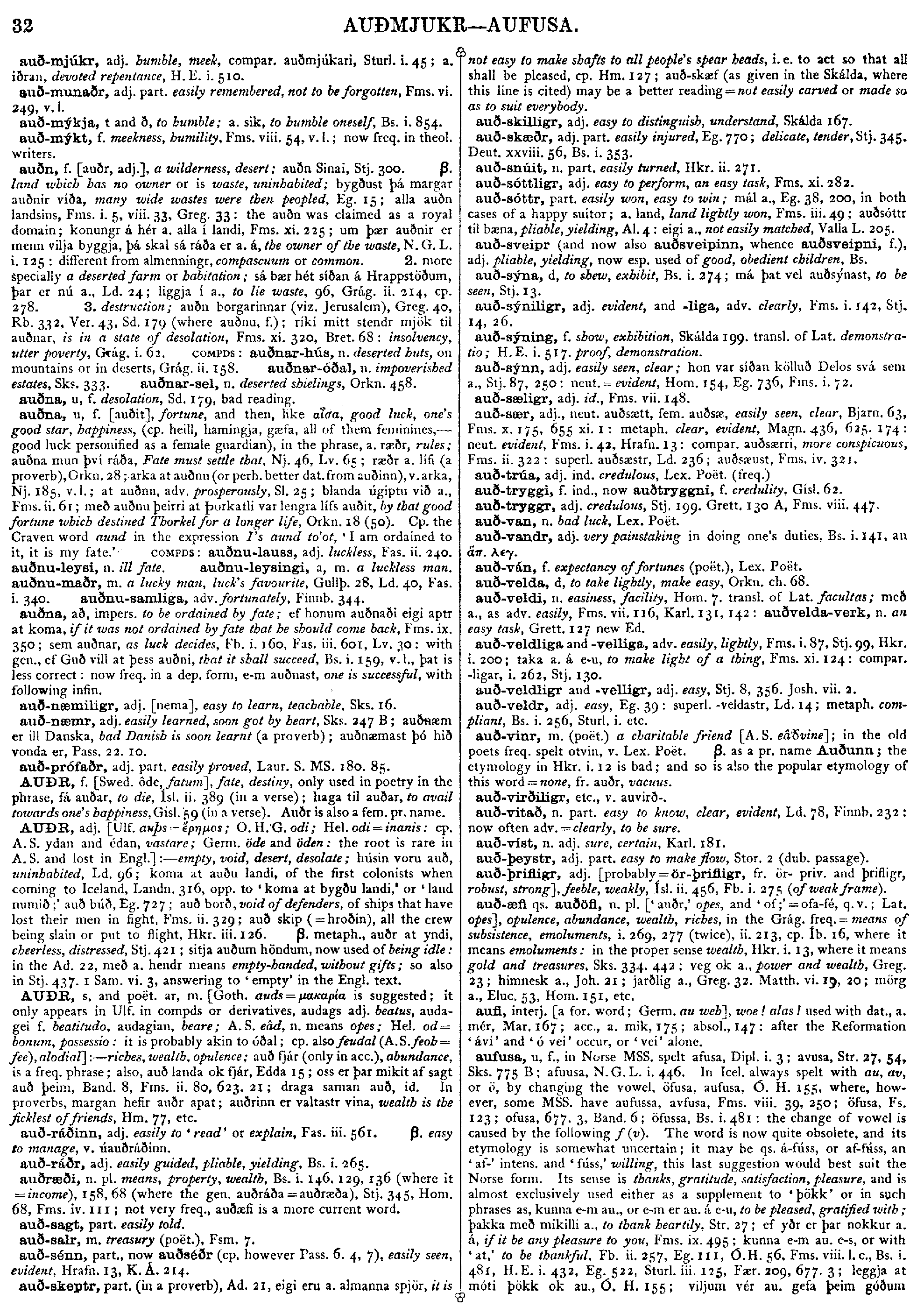
aufusa, u, f., in Norse MSS. spelt afusa, Dipl. i. 3; avusa, Str. 27, 54, Sks. 775 B; afuusa, N. G. L. i. 446. In Icel. always spelt with au, av, or ö, by changing the vowel, öfusa, aufusa, Ó. H. 155, where, however, some MSS. have aufussa, avfusa, Fms. viii. 39, 250; öfusa, Fs. 123; ofusa, 677. 3, Band. 6; öfussa, Bs. i. 481: the change of vowel is caused by the following f (v). The word is now quite obsolete, and its etymology is somewhat uncertain; it may be qs. á-fúss, or af-fúss, an 'af-' intens. and 'fúss,' willing, this last suggestion would best suit the Norse form. Its sense is thanks, gratitude, satisfaction, pleasure, and is almost exclusively used either as a supplement to 'þökk' or in such phrases as, kunna e-m au., or e-m er au. á e-u, to be pleased, gratified with; þakka með mikilli a., to thank heartily, Str. 27; ef yðr er þar nokkur a. á, if it be any pleasure to you, Fms. ix. 495; kunna e-m au. e-s, or with 'at,' to be thankful, Fb. ii. 257, Eg. 111, Ó. H. 56, Fms. viii. 1. c., Bs. i. 481, H. E. i. 432, Eg. 522, Sturl. iii. 125, Fær. 209, 677. 3; leggja at móti þökk ok au., Ó. H. 155; viljum vér au. gefa þeim góðum
|
Source: Cleasby/Vigfusson, page b0033, entry 3 View original page image as: [TIFF] [PNG] [View previous entry] [View next entry] |
[Comment on this entry] [View comments] |
The following entry has been hand-corrected once. |
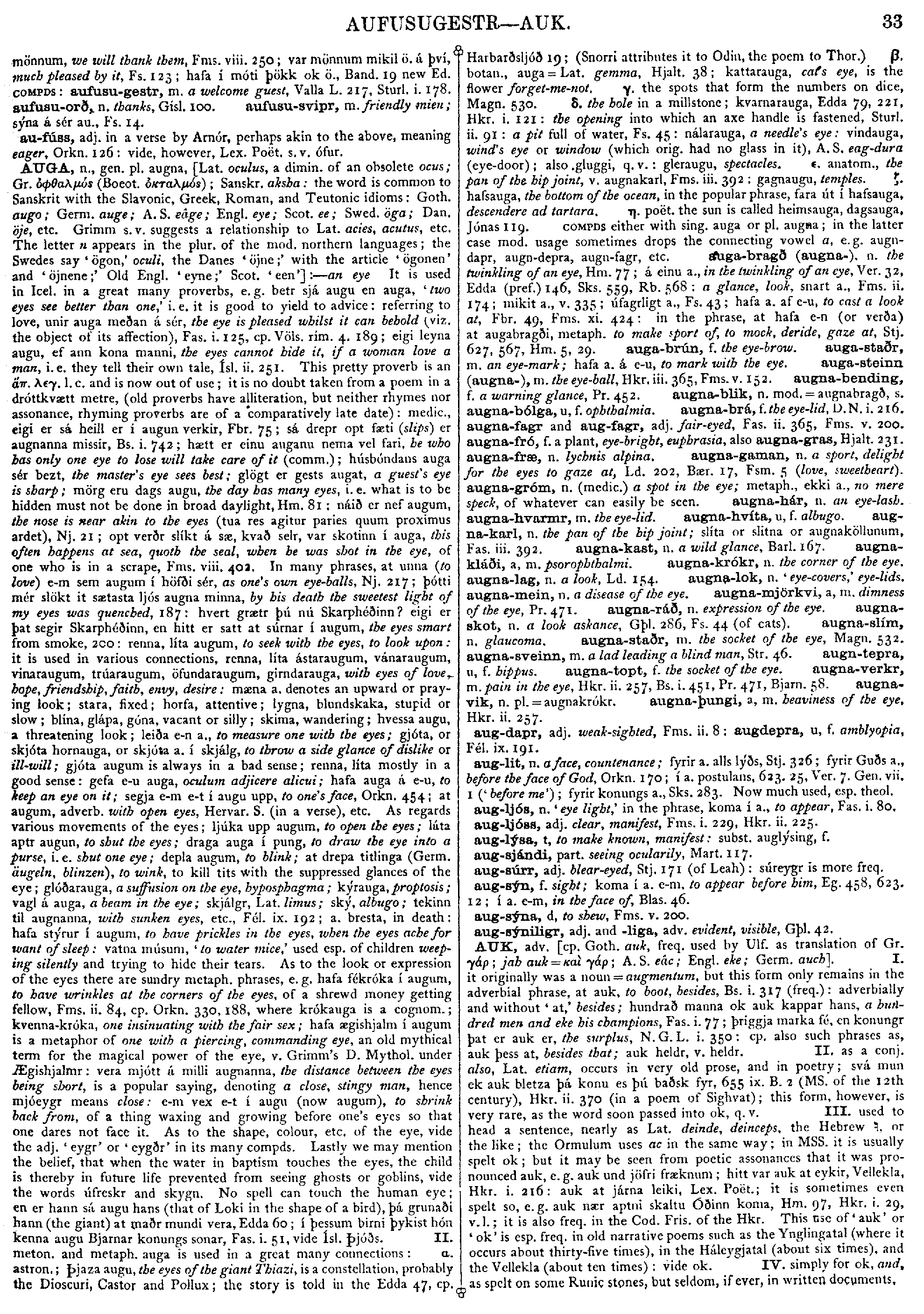
AUGA,
n.,
gen.
pl.
augna,
[Lat.
oculus,
a
dimin.
of
an
obsolete
ocus;
Gr.
GREEK
(Boeot.
GREEK);
Sanskr.
aksha:
the
word
is
common
to
Sanskrit
with
the
Slavonic,
Greek,
Roman,
and
Teutonic
idioms:
Goth.
augo;
Germ,
auge;
A.
S.
eâge;
Engl.
eye;
Scot.
ee;
Swed.
öga;
Dan.
öje,
etc.
Grimm
s.
v.
suggests
a
relationship
to
Lat.
acies,
acutus,
etc.
The
letter
n
appears
in
the
plur.
of
the
mod.
northern
languages;
the
Swedes
say
'ögon,'
oculi,
the
Danes
'öjne;'
with
the
article
'ögonen'
and
'öjnene;'
Old
Engl.
'eyne;'
Scot,
'een']
:--
an
eye
It
is
used
in
Icel.
in
a
great
many
proverbs,
e.
g.
betr
sjá
augu
en
auga,
'
two
eyes
see
better
than
one,'
i.
e.
it
is
good
to
yield
to
advice:
referring
to
love,
unir
auga
meðan
á
sér,
the
eye
is
pleased
whilst
it
can
behold
(viz.
the
object
of
its
affection),
Fas.
i.
125,
cp.
Völs.
rím.
4.
189;
eigi
leyna
augu,
ef
ann
kona
manni,
the
eyes
cannot
bide
it,
if
a
woman
love
a
man,
i.
e.
they
tell
their
own
tale,
Ísl.
ii.
251.
This
pretty
proverb
is
an
GREEK.
1.
c.
and
is
now
out
of
use;
it
is
no
doubt
taken
from
a
poem
in
a
dróttkvætt
metre,
(old
proverbs
have
alliteration,
but
neither
rhymes
nor
assonance,
rhyming
proverbs
are
of
a
comparatively
late
date):
medic.,
eigi
er
sá
heill
er
í
augun
verkir,
Fbr.
75;
sá
drepr
opt
fæti
(slips)
er
augnanna
missir,
Bs.
i.
742;
hætt
er
einu
auganu
nema
vel
fari,
he
who
has
only
one
eye
to
lose
will
take
care
of
it
(comm.);
húsbóndans
auga
sér
bezt,
the
master's
eye
sees
best;
glögt
er
gests
augat,
a
guest's
eye
is
sharp;
mörg
eru
dags
augu,
the
day
has
many
eyes,
i.
e.
what
is
to
be
hidden
must
not
be
done
in
broad
daylight,
Hm.
81;
náið
er
nef
augum,
the
nose
is
near
akin
to
the
eyes
(tua
res
agitur
paries
quum
proximus
ardet),
Nj.
21;
opt
verðr
slíkt
á
sæ,
kvað
selr,
var
skotinn
í
auga,
this
often
happens
at
sea,
quoth
the
seal,
when
he
was
shot
in
the
eye,
of
one
who
is
in
a
scrape,
Fms.
viii.
402.
In
many
phrases,
at
unna
(to
love)
e-m
sem
augum
í
höfði
sér,
as
one's
own
eye-balls,
Nj.
217;
þótti
mér
slökt
it
sætasta
ljós
augna
minna,
by
his
death
the
sweetest
light
of
my
eyes
was
quenched,
187:
hvert
grætr
þú
nú
Skarphéðinn?
eigi
er
þat
segir
Skarphéðinn,
en
hitt
er
satt
at
súrnar
í
augum,
the
eyes
smart
from
smoke,
200:
renna,
líta
augum,
to
seek
with
the
eyes,
to
look
upon:
it
is
used
in
various
connections,
renna,
líta
ástaraugum,
vánaraugum,
vinaraugum,
trúaraugum,
öfundaraugum,
girndarauga,
with
eyes
of
love,
hope,
friendship,
faith,
envy,
desire:
mæna
a.
denotes
an
upward
or
praying
look;
stara,
fixed;
horfa,
attentive;
lygna,
blundskaka,
stupid
or
slow;
blína,
glápa,
góna,
vacant
or
silly;
skima,
wandering;
hvessa
augu,
a
threatening
look;
leiða
e-n
a.,
to
measure
one
with
the
eyes;
gjóta,
or
skjóta
hornauga,
or
skjóta
a.
í
skjálg,
to
throw
a
side
glance
of
dislike
or
ill-will;
gjóta
augum
is
always
in
a
bad
sense;
renna,
líta
mostly
in
a
good
sense:
gefa
e-u
auga,
oculum
adjicere
alicui;
hafa
auga
á
e-u,
to
keep
an
eye
on
it;
segja
e-m
e-t
í
augu
upp,
to
one's
face,
Orkn.
454;
at
augum,
adverb.
with
open
eyes,
Hervar.
S.
(in
a
verse),
etc.
As
regards
various
movements
of
the
eyes;
ljúka
upp
augum,
to
open
the
eyes;
láta
aptr
augun,
to
shut
the
eyes;
draga
auga
í
pung,
to
draw
the
eye
into
a
purse,
i.
e.
shut
one
eye;
depla
augum,
to
blink;
at
drepa
titlinga
(Germ.
äugeln,
blinzen),
to
wink,
to
kill
tits
with
the
suppressed
glances
of
the
eye;
glóðarauga,
a
suffusion
on
the
eye,
hyposphagma;
kýrauga.
proptosis;
vagl
á
auga,
a
beam
in
the
eye;
skjálgr,
Lat.
limus;
ský,
albugo;
tekinn
til
augnanna,
with
sunken
eyes,
etc.,
Fél.
ix.
192;
a.
bresta,
in
death:
hafa
stýrur
í
augum,
to
have
prickles
in
the
eyes,
when
the
eyes
ache
for
want
of
sleep:
vatna
músum,
'to
water
mice,'
used
esp.
of
children
weep-
ing
silently
and
trying
to
hide
their
tears.
As
to
the
look
or
expression
of
the
eyes
there
are
sundry
metaph.
phrases,
e.
g.
hafa
fékróka
í
augum,
to
have
wrinkles
at
the
corners
of
the
eyes,
of
a
shrewd
money
getting
fellow,
Fms.
ii.
84,
cp.
Orkn.
330,
188,
where
krókauga
is
a
cognom.;
kvenna-króka,
one
insinuating
with
the
fair
sex;
hafa
ægishjalm
í
augum
is
a
metaphor
of
one
with
a
piercing,
commanding
eye,
an
old
mythical
term
for
the
magical
power
of
the
eye,
v.
Grimm's
D.
Mythol.
under
Ægishjalmr:
vera
mjótt
á
milli
augnanna,
the
distance
between
the
eyes
being
short,
is
a
popular
saying,
denoting
a
close,
stingy
man,
hence
mjóeygr
means
close:
e-m
vex
e-t
í
augu
(now
augum),
to
shrink
back
from,
of
a
thing
waxing
and
growing
before
one's
eyes
so
that
one
dares
not
face
it.
As
to
the
shape,
colour,
etc.
of
the
eye,
vide
the
adj.
'
eygr'
or
'
eygðr'
in
its
many
compds.
Lastly
we
may
mention
the
belief,
that
when
the
water
in
baptism
touches
the
eyes,
the
child
is
thereby
in
future
life
prevented
from
seeing
ghosts
or
goblins,
vide
the
words
úfreskr
and
skygn.
No
spell
can
touch
the
human
eye;
en
er
harm
sá
augu
hans
(that
of
Loki
in
the
shape
of
a
bird),
þá
grunaði
hann
(the
giant)
at
maðr
mundi
vera,
Edda
60;
í
bessum
birni
þykist
hón
kenna
augu
Bjarnar
konungs
sonar,
Fas.
i.
51,
vide
Ísl.
Þjóðs.
II.
meton.
and
metaph.
auga
is
used
in
a
great
many
connections:
 .
astron.;
þjaza
augu,
the
eyes
of
the
giant
Thiazi,
is
a
constellation,
probably
the
Dioscuri,
Castor
and
Pollux;
the
story
is
told
in
the
Edda
47,
cp.
Harbarðsljóð
19;
(Snorri
attributes
it
to
Odin,
the
poem
to
Thor.)
.
botan.,
auga
=
Lat.
gemma,
Hjalt.
38;
kattarauga,
cat's
eye,
is
the
flower
forget-me-not.
the
spots
that
form
the
numbers
on
dice,
Magn.
530.
.
astron.;
þjaza
augu,
the
eyes
of
the
giant
Thiazi,
is
a
constellation,
probably
the
Dioscuri,
Castor
and
Pollux;
the
story
is
told
in
the
Edda
47,
cp.
Harbarðsljóð
19;
(Snorri
attributes
it
to
Odin,
the
poem
to
Thor.)
.
botan.,
auga
=
Lat.
gemma,
Hjalt.
38;
kattarauga,
cat's
eye,
is
the
flower
forget-me-not.
the
spots
that
form
the
numbers
on
dice,
Magn.
530.
 .
the
hole
in
a
millstone;
kvarnarauga,
Edda
79,
221,
Hkr.
i.
121:
the
opening
into
which
an
axe
handle
is
fastened,
Sturl.
ii.
91:
a
pit
full
of
water,
Fs.
45:
nálarauga,
a
needle's
eye:
vindauga,
wind's
eye
or
window
(which
orig.
had
no
glass
in
it),
A.
S.
eag-dura
(eye-door);
also
gluggi,
q.
v.:
gleraugu,
spectacles.
.
the
hole
in
a
millstone;
kvarnarauga,
Edda
79,
221,
Hkr.
i.
121:
the
opening
into
which
an
axe
handle
is
fastened,
Sturl.
ii.
91:
a
pit
full
of
water,
Fs.
45:
nálarauga,
a
needle's
eye:
vindauga,
wind's
eye
or
window
(which
orig.
had
no
glass
in
it),
A.
S.
eag-dura
(eye-door);
also
gluggi,
q.
v.:
gleraugu,
spectacles.
 .
anatom.,
the
pan
of
the
hip
joint,
v.
augnakarl,
Fms.
iii.
392:
gagnaugu,
temples.
.
anatom.,
the
pan
of
the
hip
joint,
v.
augnakarl,
Fms.
iii.
392:
gagnaugu,
temples.
 .
hafsauga,
the
bottom
of
the
ocean,
in
the
popular
phrase,
fara
út
í
hafsauga,
descendere
ad
tartara.
.
hafsauga,
the
bottom
of
the
ocean,
in
the
popular
phrase,
fara
út
í
hafsauga,
descendere
ad
tartara.
 .
poët,
the
sun
is
called
heimsauga,
dagsauga,
Jónas
119.
COMPDS
either
with
sing.
auga
or
pl.
augna;
in
the
latter
case
mod.
usage
sometimes
drops
the
connecting
vowel
a,
e.
g.
augn-
dapr,
augn-depra,
augn-fagr,
etc.
auga-bragð
(augna-),
n.
the
twinkling
of
an
eye,
Hm.
77;
á
einu
a.,
in
the
twinkling
of
an
eye,
Ver.
32,
Edda
(pref.)
146,
Sks.
559,
Rb.
568:
a
glance,
look,
snart
a.,
Fms.
ii.
174;
mikit
a.,
v.
335;
úfagrligt
a.,
Fs.
43;
hafa
a.
af
e-u,
to
cast
a
look
at,
Fbr.
49,
Fms.
xi.
424:
in
the
phrase,
at
hafa
e-n
(or
verða)
at
augabragði,
metaph.
to
make
sport
of,
to
mock,
deride,
gaze
at,
Stj.
627,
567,
Hm.
5,
29.
auga-brun,
f.
the
eye-brow.
auga-staðr,
m.
an
eye-mark;
hafa
a.
á
e-u,
to
mark
with
the
eye.
auga-steinn
(augna-),
m.
the
eye-ball,
Hkr.
iii.
365,
Fms.
v.
152.
augna-bending,
f.
a
warning
glance,
Pr.
452.
augna-blik,
n.
mod.
=
augnabragð,
s.
augna-bólga,
u,
f.
ophthalmia.
augna-brá,
f.
the
eye-lid,
D.
N.
i.
216.
augna-fagr
and
aug-fagr,
adj.
fair-eyed,
Fas.
ii.
365,
Fms.
v.
200.
augna-fró,
f.
a
plant,
eye-bright,
euphrasia,
also
augna-gras,
Hjalt.
231.
augna-fræ,
n.
lychnis
alpina.
augna-gaman,
n.
a
sport,
delight
for
the
eyes
to
gaze
at,
Ld.
202,
Bær.
17,
Fsm.
5
(love,
sweetheart).
augna-gróm,
n.
(medic.)
a
spot
in
the
eye;
metaph.,
ekki
a.,
no
mere
speck,
of
whatever
can
easily
be
seen.
augna-hár,
n.
an
eye-lash.
augna-hvannr,
m.
the
eye-lid.
augna-hvita,
u,
f.
albugo.
augna-karl,
n.
the
pan
of
the
hip
joint;
slíta
or
slitna
or
augnaköllunum,
Fas.
iii.
392.
augna-kast,
n.
a
wild
glance,
Barl.
167.
augna-
kláði,
a,
m.
psorophthalmi.
augna-krókr,
n.
the
corner
of
the
eye.
augna-lag,
n.
a
look,
Ld.
154.
augna-lok,
n.
'eye-covers,'
eye-lids.
augna-mein,
n.
a
disease
of
the
eye.
augna-mjörkvi,
a,
m.
dimness
of
the
eye,
Pr.
471.
augna-ráð,
n.
expression
of
the
eye.
augna-
skot,
n.
a
look
askance,
Gþl.
286,
Fs.
44
(of
cats).
augna-slím,
n.
glaucoma.
augna-staðr,
m.
the
socket
of
the
eye,
Magn.
532.
augna-sveinn,
m.
a
lad
leading
a
blind
man,
Str.
46.
augn-tepra,
u,
f.
hippus.
augna-topt,
f.
the
socket
of
the
eye.
augna-verkr,
m.
pain
in
the
eye,
Hkr.
ii.
257,
Bs.
i.
451,
Pr.
471,
Bjarn.
58.
augna-
vik,
n.
pl.
=
augnakrókr.
augna-þungi,
a,
m.
heaviness
of
the
eye,
Hkr.
ii.
257.
.
poët,
the
sun
is
called
heimsauga,
dagsauga,
Jónas
119.
COMPDS
either
with
sing.
auga
or
pl.
augna;
in
the
latter
case
mod.
usage
sometimes
drops
the
connecting
vowel
a,
e.
g.
augn-
dapr,
augn-depra,
augn-fagr,
etc.
auga-bragð
(augna-),
n.
the
twinkling
of
an
eye,
Hm.
77;
á
einu
a.,
in
the
twinkling
of
an
eye,
Ver.
32,
Edda
(pref.)
146,
Sks.
559,
Rb.
568:
a
glance,
look,
snart
a.,
Fms.
ii.
174;
mikit
a.,
v.
335;
úfagrligt
a.,
Fs.
43;
hafa
a.
af
e-u,
to
cast
a
look
at,
Fbr.
49,
Fms.
xi.
424:
in
the
phrase,
at
hafa
e-n
(or
verða)
at
augabragði,
metaph.
to
make
sport
of,
to
mock,
deride,
gaze
at,
Stj.
627,
567,
Hm.
5,
29.
auga-brun,
f.
the
eye-brow.
auga-staðr,
m.
an
eye-mark;
hafa
a.
á
e-u,
to
mark
with
the
eye.
auga-steinn
(augna-),
m.
the
eye-ball,
Hkr.
iii.
365,
Fms.
v.
152.
augna-bending,
f.
a
warning
glance,
Pr.
452.
augna-blik,
n.
mod.
=
augnabragð,
s.
augna-bólga,
u,
f.
ophthalmia.
augna-brá,
f.
the
eye-lid,
D.
N.
i.
216.
augna-fagr
and
aug-fagr,
adj.
fair-eyed,
Fas.
ii.
365,
Fms.
v.
200.
augna-fró,
f.
a
plant,
eye-bright,
euphrasia,
also
augna-gras,
Hjalt.
231.
augna-fræ,
n.
lychnis
alpina.
augna-gaman,
n.
a
sport,
delight
for
the
eyes
to
gaze
at,
Ld.
202,
Bær.
17,
Fsm.
5
(love,
sweetheart).
augna-gróm,
n.
(medic.)
a
spot
in
the
eye;
metaph.,
ekki
a.,
no
mere
speck,
of
whatever
can
easily
be
seen.
augna-hár,
n.
an
eye-lash.
augna-hvannr,
m.
the
eye-lid.
augna-hvita,
u,
f.
albugo.
augna-karl,
n.
the
pan
of
the
hip
joint;
slíta
or
slitna
or
augnaköllunum,
Fas.
iii.
392.
augna-kast,
n.
a
wild
glance,
Barl.
167.
augna-
kláði,
a,
m.
psorophthalmi.
augna-krókr,
n.
the
corner
of
the
eye.
augna-lag,
n.
a
look,
Ld.
154.
augna-lok,
n.
'eye-covers,'
eye-lids.
augna-mein,
n.
a
disease
of
the
eye.
augna-mjörkvi,
a,
m.
dimness
of
the
eye,
Pr.
471.
augna-ráð,
n.
expression
of
the
eye.
augna-
skot,
n.
a
look
askance,
Gþl.
286,
Fs.
44
(of
cats).
augna-slím,
n.
glaucoma.
augna-staðr,
m.
the
socket
of
the
eye,
Magn.
532.
augna-sveinn,
m.
a
lad
leading
a
blind
man,
Str.
46.
augn-tepra,
u,
f.
hippus.
augna-topt,
f.
the
socket
of
the
eye.
augna-verkr,
m.
pain
in
the
eye,
Hkr.
ii.
257,
Bs.
i.
451,
Pr.
471,
Bjarn.
58.
augna-
vik,
n.
pl.
=
augnakrókr.
augna-þungi,
a,
m.
heaviness
of
the
eye,
Hkr.
ii.
257.
|
Source: Cleasby/Vigfusson, page b0034, entry 27 View original page image as: [TIFF] [PNG] [View previous entry] [View next entry] |
[Comment on this entry] [View comments] |
The following entry has been hand-corrected once. |
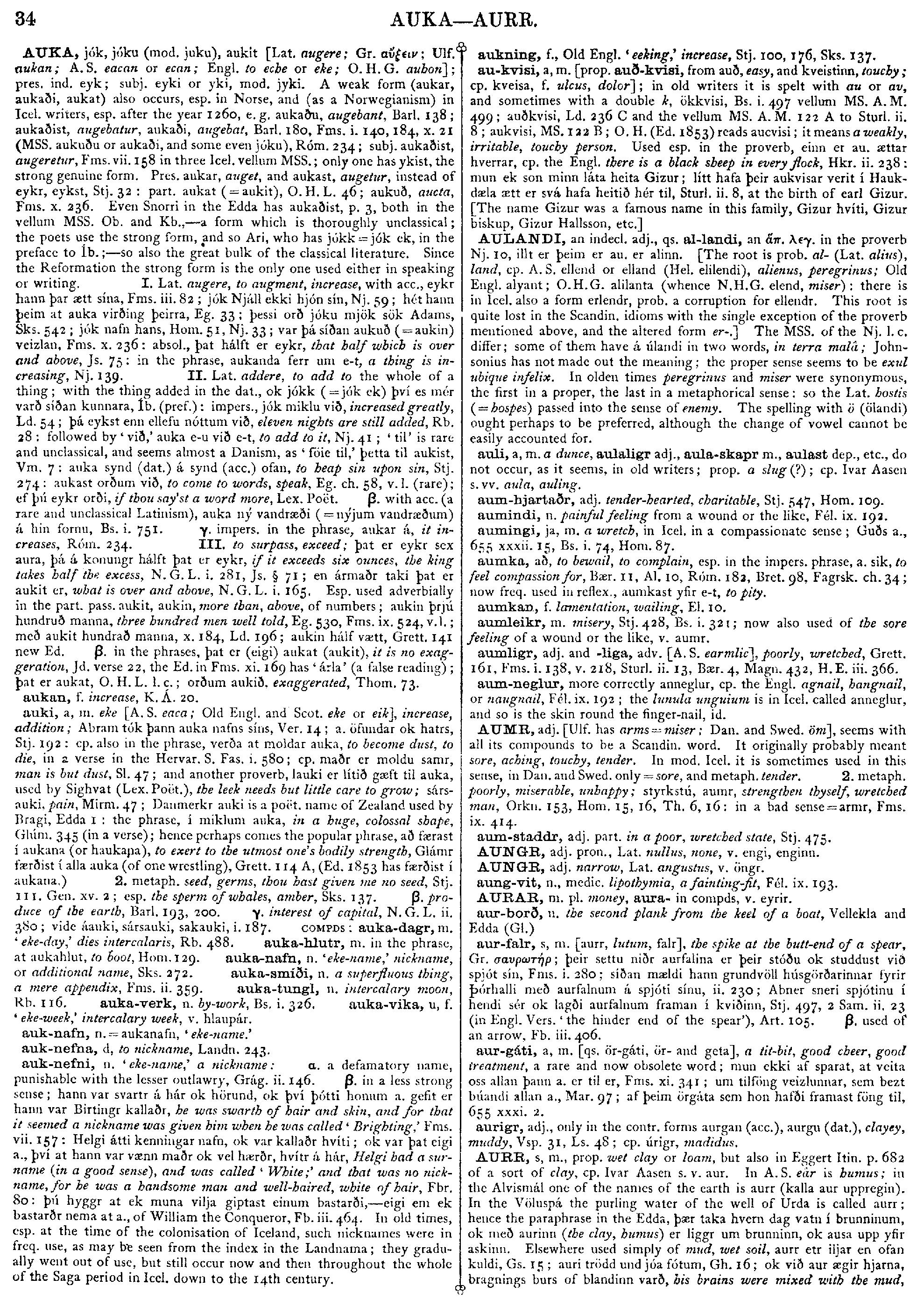
aur-gáti, a, m. [qs. ör-gáti, ör- and geta], a tit-bit, good cheer, good treatment, a rare and now obsolete word; mun ekki af sparat, at veita oss allan þann a. er til er, Fms. xi. 341; um tilföng veizlunnar, sem bezt búandi allan a., Mar. 97; af þeim örgáta sem hon hafði framast föng til, 655 xxxi. 2.
|
Source: Cleasby/Vigfusson, page b0036, entry 11 View original page image as: [TIFF] [PNG] [View previous entry] [View next entry] |
[Comment on this entry] [View comments] |
The following entry has been hand-corrected once. |
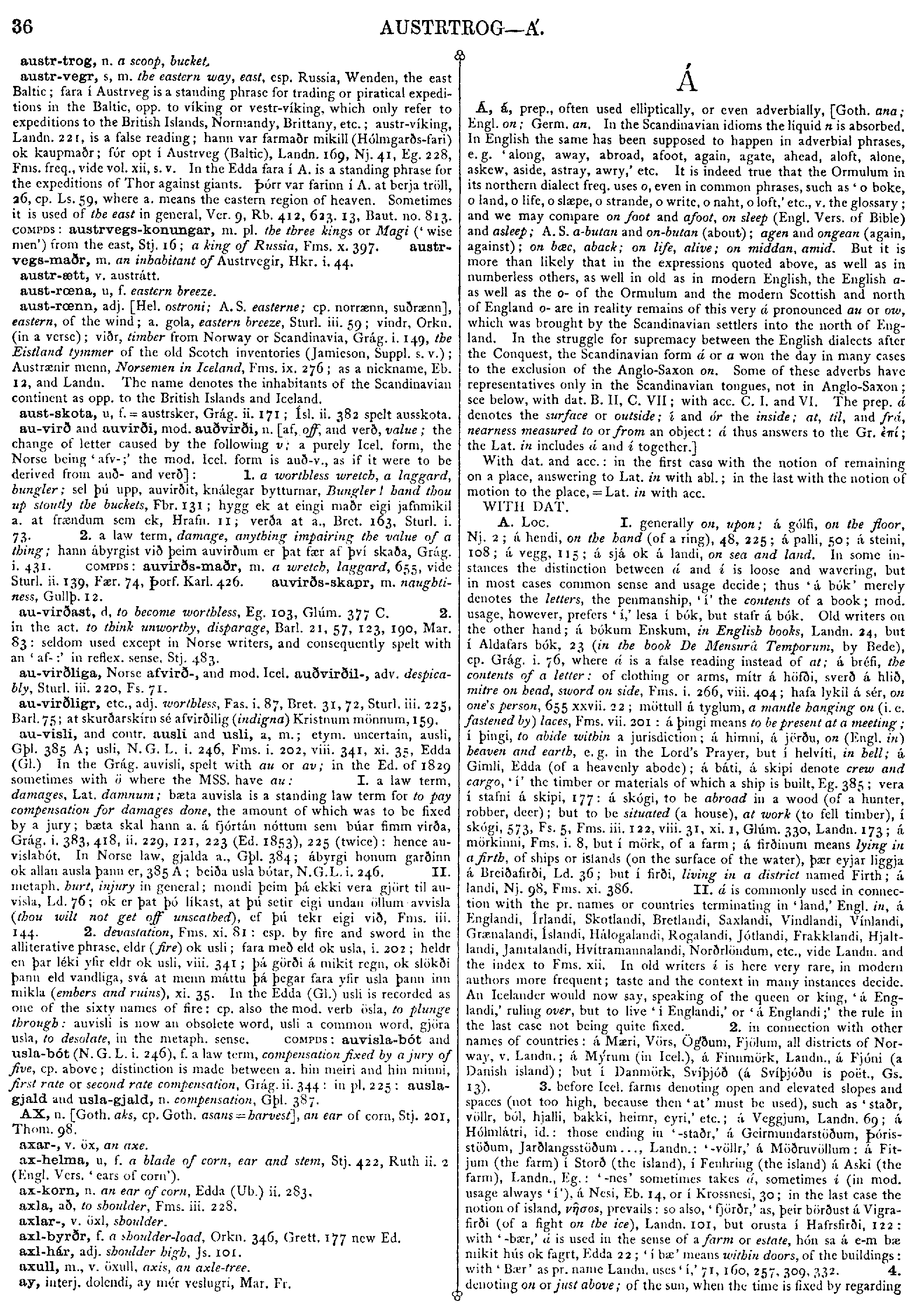
au-visli, and contr. ausli and usli, a, m.; etym. uncertain, ausli, Gþl. 385 A; usli, N. G. L. i. 246, Fms. i. 202, viii. 341, xi. 35, Edda (Gl.) In the Grág. auvisli, spelt with au or av; in the Ed. of 1829 sometimes with ö where the MSS. have au I. a law term, damages, Lat. damnum; bæta auvisla is a standing law term for to pay compensation for damages done, the amount of which was to be fixed by a jury; bæta skal hann a. á fjórtán nóttum sem búar fimm virða, Grág. i. 383, 418, ii. 229, 121, 223 (Ed. 1853), 225 (twice): hence auvislabót. In Norse law, gjalda a., Gþl. 384; ábyrgi honum garðinn ok allan ausla þann er, 385 A; beiða usla bótar, N. G. L. i. 246. II. metaph. hurt, injury in general; mondi þeim þá ekki vera gjört til auvisla, Ld. 76; ok er þat þó líkast, at þú setir eigi undan öllum avvisla (thou wilt not get off unscathed), ef þú tekr eigi við, Fms. iii. 144. 2. devastation, Fms. xi. 81: esp. by fire and sword in the alliterative phrase, eldr (fire) ok usli; fara með eld ok usla, i. 202; heldr en þar léki yfir eldr ok usli, viii. 341; þá görði á mikit regn, ok slökði þann eld vandliga, svá at menn máttu þá þegar fara yfir usla þann inn mikla (embers and ruins), xi. 35. In the Edda (Gl.) usli is recorded as one of the sixty names of fire: cp. also the mod. verb ösla, to plunge through: auvisli is now an obsolete word, usli a common word, gjöra usla, to desolate, in the metaph. sense. COMPDS: auvisla-bót and usla-bót (N. G. L. i. 246), f. a law term, compensation fixed by a jury of five, cp. above; distinction is made between a. hin meiri and hin minni, first rate or second rate compensation, Grág. ii. 344: in pl. 225: ausla-gjald and usla-gjald, n. compensation, Gþl. 387.
|
Source: Cleasby/Vigfusson, page b0039, entry 1 View original page image as: [TIFF] [PNG] [View previous entry] [View next entry] |
[Comment on this entry] [View comments] |
The following entry has not been hand-corrected. However, the page is reserved and someone is correcting it. |
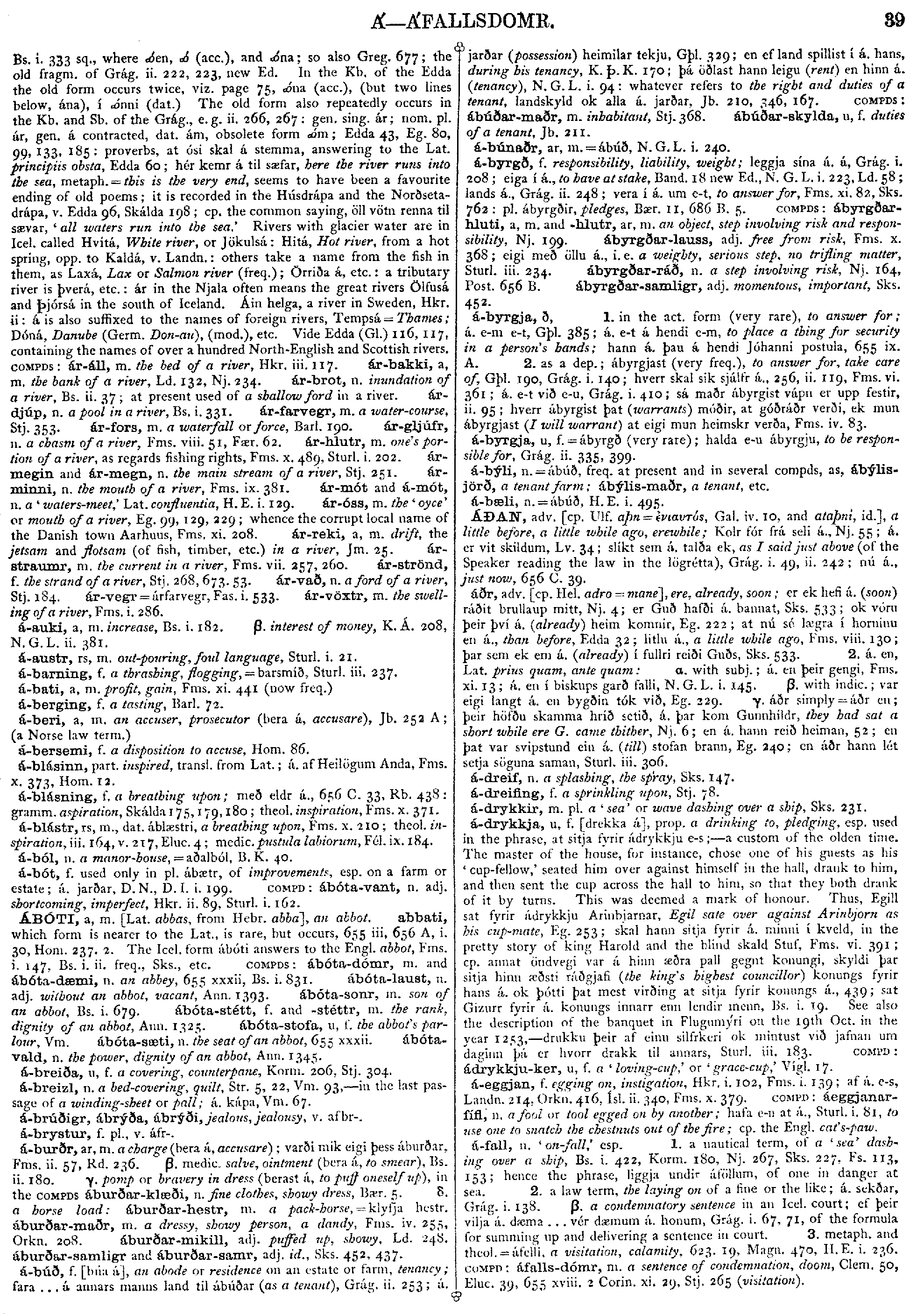
Bs. i. 333 sq., where den, ai (acc.), and tona; so also Greg. 677; the old fragm. of Grág. ii. 222, 223, new Ed. In the Kb. of the Edda the old form occurs twice, viz. page 75) *ona (acc.), (but two lines below, ána), í cónni (dat.) The old form also repeatedly occurs in the Kb. and Sb. of the Grág., e. g. ii. 266, 267: gen. sing, ár; nom. pi ar, gen. á contracted, dat. am, obsolete form com; Edda 43, Eg. 80, 99i ifå' l&5 '• proverbs, at ósi skal á stemma, answering to the Lat. principiis obsta, Edda 60; her kemr á til sæfar, here the riverrun s int o the s ea, metaph. = thi s is the very end, seems to have been a favourite ending of old poems; it is recorded in the Húsdrápa and the Norðseta- drápa, v. Edda 96, Skálda 198; cp. the common saying, oil vötn renna til sævar, ' all waters run into ike sea, ' Rivers with glacier water are in Icel. called Hvítá, White river, or Jökulsá: Hitá, Hot river, from a hot spring, opp. to Kaldá, v. Landn.: others take a name from the fish in them, as Laxá, Lax or Salmon river (freq.); Örriða á, etc.: a tributary river is þverá, etc.: ár in the Njala often means the great rivers Ölfusá and Þjórsá in the south of Iceland. Áin helga, a river in Sweden, Hkr. ii: á is also suffixed to the names of foreign rivers, Tempsá = Thames; Dóná, Danube (Germ. Don-au), (mod.), etc. Vide Edda (Gl.) 116, 117, containing the names of over a hundred North-English and Scottish rivers. COMPDS: ár-áll, m. tie bed of a river, Hkr. iii. 117. ar-bakki, a, m. the bank of a river, Ld. 132, Nj. 234. ar-brot, n. inundation of a river, Bs. ii. 37; at present used of a s hallow ford in a river. ar- djúp, n. a pool in a river, Bs. i. 331. ar-farvegr, m. a water-course, Stj. 353- ar-fors, m. a waterfall or force, Bad. 190. ár-gljúfr, n. a chasm of a river, Fms. viii. 51, Fær. 62. ár-hlutr, m. one's por- tion of a river, as regards fishing rights, Fms. x. 489, Sturl. i. 202. ár- megin and ar-megn, n. the ma in stream of a river, Stj. 251. ár- minni, n. the mouth of a river, Fms. ix. 381. ár-mót and á-mót, n. a ' waters-meet, ' Lat. cottfluentia, H. E. i. 129. ár-óss, m. the ' oyce' or mouth of a river, Eg. 99, 129, 229; whence the corrupt local name of the Danish town Aarhuus, Fms. xi. 208. ar-reki, a, m. drift, the jetsam and flotsam (of fish, timber, etc.) in a river, Jm. 25. ár- straumr, m. the current in n river, Fms. vii. 257, 260. ár-strönd, f. the strand of a river, Stj. 268, 673. 53. ár-vað, n. aford of a river, Stj. 184. ár-vegr = árfarvegr, Fas. i. 533. ár-vöxtr, m. the swell- ing of a river, Fms. i. 286.
|
Source: Cleasby/Vigfusson, page b0045, entry 7 View original page image as: [TIFF] [PNG] [View previous entry] [View next entry] |
[Comment on this entry] [View comments] |
The following entry has been hand-corrected once. |
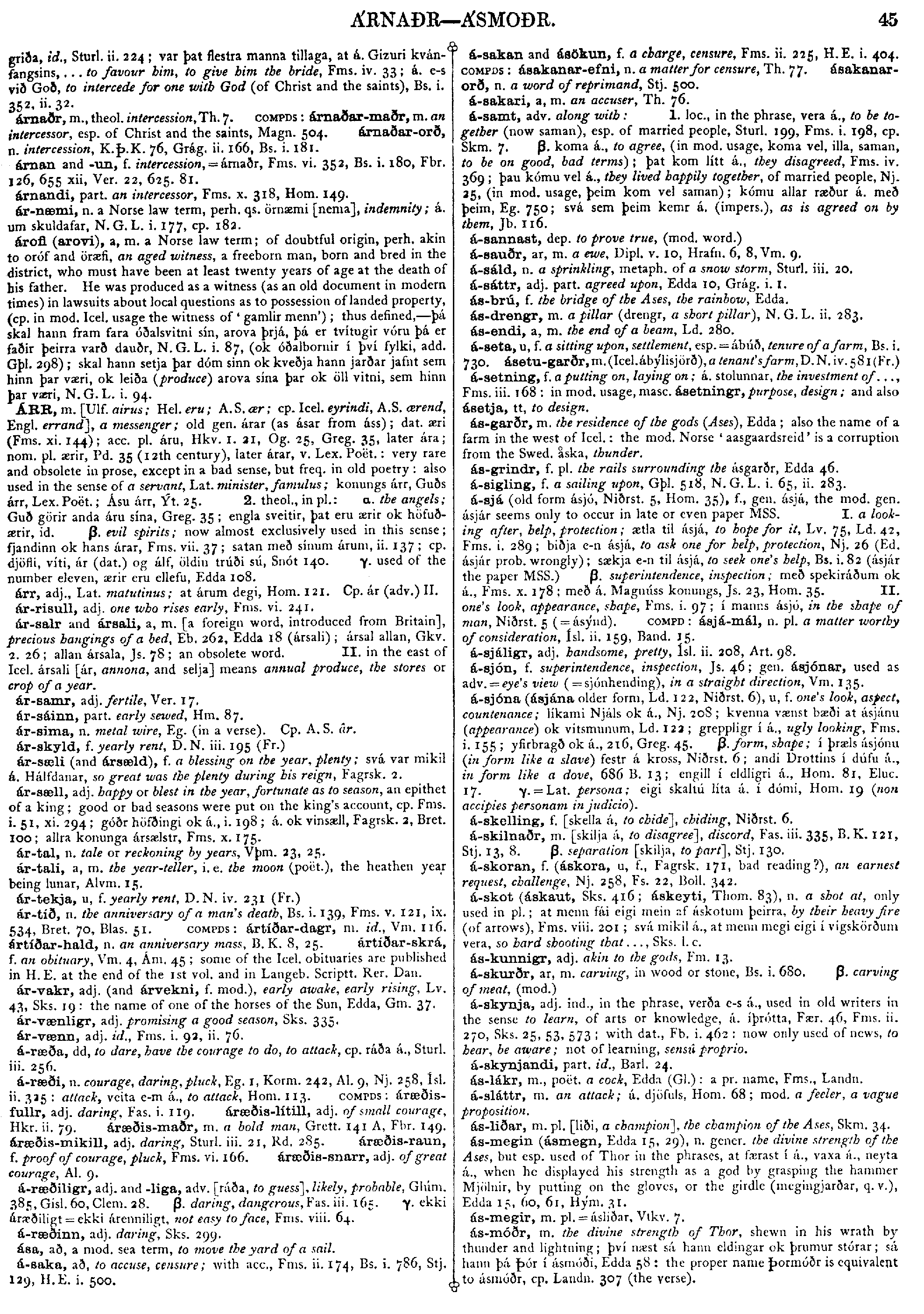
ÁRR,
m.
[Ulf.
airus;
Hel.
eru;
A.
S.
ar;
cp.
Icel.
eyrindi,
A.
S.
ærend,
Engl.
errand],
a
messenger;
old
gen.
árar
(as
ásar
from
áss);
dat.
æri
(Fms.
xi.
144);
acc.
pl.
áru,
Hkv.
1.
21,
Og.
25,
Greg.
35,
later
ára;
nom.
pl.
ærir,
Pd.
35
(12th
century),
later
árar,
v.
Lex.
Poët.:
very
rare
and
obsolete
in
prose,
except
in
a
bad
sense,
but
freq.
in
old
poetry:
also
used
in
the
sense
of
a
servant,
Lat.
minister,
famulus;
konungs
árr,
Guðs
árr,
Lex.
Poët.;
Ásu
úrr,
Ýt.
25.
2.
theol.,
in
pl.:
.
the
angels;
Guð
görir
anda
áru
sína,
Greg.
35;
engla
sveitir,
þat
eru
ærir
ok
höfuð-ærir,
id.
.
evil
spirits;
now
almost
exclusively
used
in
this
sense;
fjandinn
ok
hans
árar,
Fms.
vii.
37;
satan
með
sínum
árum,
ii.
137;
cp.
djöfli,
viti,
ár
(dat.)
og
álf,
öldin
trúði
sú,
Snót
140.
.
used
of
the
number
eleven,
ærir
eru
ellefu,
Edda
108.
| Result Page: |  |
Previous | 1 2 3 4 5 6 7 8 9 10 11 | Next |  |
Germanic Lexicon Project (main page)
This search system was written by
Sean Crist
Please consider
volunteering
to correct the data in these online dictionaries.
No rights reserved. Feel free to use these data in any way you please.