|
|

|
Source: Bosworth/Toller, page b0123, entry 30 View original page image as: [TIFF] [PNG] [View previous entry] [View next entry] |
[Comment on this entry] [View comments] |
The following entry has been hand-corrected once. |
brengnes, -ness, e; f. An offering; oblatio :-- Onsægednissa and brengnesse ðú nolde sacrificia et oblationem noluisti, Ps. Spl. T. 39, 9.
|
Source: Bosworth/Toller, page b0603, entry 7 View original page image as: [TIFF] [PNG] [View previous entry] [View next entry] |
[Comment on this entry] [View comments] |
The following entry has been hand-corrected once. |
idea
of
activity
we
pass
to
that
of
games,
playing,
dancing
&c.
;
and
so
Gothic
laiks
=
 o
o &omicron-tonos;s
in
Luke
xv.
25;
in
Icel.,
where
the
meaning
play,
sport
is
the
prevailing
one
(see
also
compounds
in
which
leik-
occurs),
leikr
is
used
of
dancing,
athletics,
various
games,
music,
as
in
strengleikr,
leika
=
to
play,
to
lake
in
the
dialect
of
the
North
of
England.
In
O.
H.
Ger.
the
application
is
generally
to
music,
leih,
leich
=
modus,
modulus,
carmen
versus,
but
in
rang-leih
=
wrestling
the
meaning
is
similar
to
the
Icelandic
(see
Grff.
ii.
152-3.)
And
just
as
plega
is
used,
by
itself
or
in
its
compounds,
of
war
and
battle,
so
in
the
Icelandic
poetry
we
have
Hildar
leikr,
sverða
leikr
=
battle
(see
Cl.
and
Vig.
Dict.
p.
382,
col.
2),
and
in
English
lác
could
be
applied
in
the
same
way.
But
in
the
latter
language
the
more
frequent
meanings
are
those
of
offering,
gift,
and
to
connect
these
with
the
preceding
ones
Grimm
notes
the
association
of
dancing
and
playing
with
offerings
and
sacrifices.
From
this
special,
meaning
of
offering
the
more
general
one
of
gift,
present
might
easily
come.
To
quote
his
words
'Das
wort
(lác)
scheint
einer
wurzel
mit
dem
goth.
laiks
(saltatio)
ahd.
leih
(ludus,
modus)
altn.
leikr,
ursprünglich
also
tanz
and
spiel,
die
das
oper
begleiteten,
allmählich
die
gabe
selbst
zu
bezeichnen,'
D.
M.
35.
The
passages
which
follow
will
shew
the
English
use
of
the
word.
I.
battle,
struggle
:--
Wíga
unlæt
láces
a
warrior
not
slow
to
fight
(referring
to
death
which
was
approaching
Guthlac),
Exon.
47
b;
Th.
164,
5;
Gú.
1007.
II.
an
offering,
sacrifice,
oblation
:--
Gode
onsægdnesse
tó
beranne
ðæs
hálgan
láces
ad
offerendas
Domino
victimas
sacræ
oblationis,
Bd.
4,
22;
S.
592,
26.
Hí
him
sculon
láces
lof
lustum
bringan
sacrificent
sacrificium
laudis,
Ps.
Th.
106,
21.
Ic
ðé
láces
lof
lustum
secge
tibi
sacrificabo
hostiam
laudis,
115,
7.
Ic
ðé
lustum
láce
cwéme
voluntarie
sacrificabo
tibi,
53,
6.
And
bærnon
uppan
ðam
weofode
drihtne
tó
láce
adolebuntque
super
altare
in
oblationem
domino,
Lev.
3,
5.
Offrian
tó
láce
to
offer
as
a
sacrifice,
Ælfc.
T.
Grn.
4,
27.
Hie
drihtne
lác
begen
brohton
they
both
brought
an
offering
to
the
Lord,
Cd.
47;
Th.
60,
2;
Gen.
975.
Se
rinc
Gode
lác
onsægde,
85;
Th.
107,
21;
Gen.
1792.
Onbleót
ðæt
lác
Gode,
142;
Th.
177,
21;
Gen.
2933.
Ðú
scealt
blótan
sunu,
and
leófes
lác
forbærnan,
and
mé
lác
bebeódan,
138;
Th.
173,
9;
Gen.
2858.
Ðú
ðínne
lác
offrige,
Homl.
Skt.
7,
119.
Þurh
lác
ðære
hálwendan
onsægdnesse
per
oblationem
hostiæ
salutaris,
Bd.
4,
22;
S.
592,
22.
Mára
is
allum
cwicum
lácum
and
sægdnissum
majus
est
holocaustomatibus
et
sacrificiis,
Mk.
Skt.
Rush
12,
33.
Æ-acute;nig
ðæra
þinga
ðe
gedwolgodum
tó
lácum
bet
&omicron-tonos;s
in
Luke
xv.
25;
in
Icel.,
where
the
meaning
play,
sport
is
the
prevailing
one
(see
also
compounds
in
which
leik-
occurs),
leikr
is
used
of
dancing,
athletics,
various
games,
music,
as
in
strengleikr,
leika
=
to
play,
to
lake
in
the
dialect
of
the
North
of
England.
In
O.
H.
Ger.
the
application
is
generally
to
music,
leih,
leich
=
modus,
modulus,
carmen
versus,
but
in
rang-leih
=
wrestling
the
meaning
is
similar
to
the
Icelandic
(see
Grff.
ii.
152-3.)
And
just
as
plega
is
used,
by
itself
or
in
its
compounds,
of
war
and
battle,
so
in
the
Icelandic
poetry
we
have
Hildar
leikr,
sverða
leikr
=
battle
(see
Cl.
and
Vig.
Dict.
p.
382,
col.
2),
and
in
English
lác
could
be
applied
in
the
same
way.
But
in
the
latter
language
the
more
frequent
meanings
are
those
of
offering,
gift,
and
to
connect
these
with
the
preceding
ones
Grimm
notes
the
association
of
dancing
and
playing
with
offerings
and
sacrifices.
From
this
special,
meaning
of
offering
the
more
general
one
of
gift,
present
might
easily
come.
To
quote
his
words
'Das
wort
(lác)
scheint
einer
wurzel
mit
dem
goth.
laiks
(saltatio)
ahd.
leih
(ludus,
modus)
altn.
leikr,
ursprünglich
also
tanz
and
spiel,
die
das
oper
begleiteten,
allmählich
die
gabe
selbst
zu
bezeichnen,'
D.
M.
35.
The
passages
which
follow
will
shew
the
English
use
of
the
word.
I.
battle,
struggle
:--
Wíga
unlæt
láces
a
warrior
not
slow
to
fight
(referring
to
death
which
was
approaching
Guthlac),
Exon.
47
b;
Th.
164,
5;
Gú.
1007.
II.
an
offering,
sacrifice,
oblation
:--
Gode
onsægdnesse
tó
beranne
ðæs
hálgan
láces
ad
offerendas
Domino
victimas
sacræ
oblationis,
Bd.
4,
22;
S.
592,
26.
Hí
him
sculon
láces
lof
lustum
bringan
sacrificent
sacrificium
laudis,
Ps.
Th.
106,
21.
Ic
ðé
láces
lof
lustum
secge
tibi
sacrificabo
hostiam
laudis,
115,
7.
Ic
ðé
lustum
láce
cwéme
voluntarie
sacrificabo
tibi,
53,
6.
And
bærnon
uppan
ðam
weofode
drihtne
tó
láce
adolebuntque
super
altare
in
oblationem
domino,
Lev.
3,
5.
Offrian
tó
láce
to
offer
as
a
sacrifice,
Ælfc.
T.
Grn.
4,
27.
Hie
drihtne
lác
begen
brohton
they
both
brought
an
offering
to
the
Lord,
Cd.
47;
Th.
60,
2;
Gen.
975.
Se
rinc
Gode
lác
onsægde,
85;
Th.
107,
21;
Gen.
1792.
Onbleót
ðæt
lác
Gode,
142;
Th.
177,
21;
Gen.
2933.
Ðú
scealt
blótan
sunu,
and
leófes
lác
forbærnan,
and
mé
lác
bebeódan,
138;
Th.
173,
9;
Gen.
2858.
Ðú
ðínne
lác
offrige,
Homl.
Skt.
7,
119.
Þurh
lác
ðære
hálwendan
onsægdnesse
per
oblationem
hostiæ
salutaris,
Bd.
4,
22;
S.
592,
22.
Mára
is
allum
cwicum
lácum
and
sægdnissum
majus
est
holocaustomatibus
et
sacrificiis,
Mk.
Skt.
Rush
12,
33.
Æ-acute;nig
ðæra
þinga
ðe
gedwolgodum
tó
lácum
bet ht
biþ
any
thing
that
is
appointed
to
false
gods
for
sacrifices,
Swt.
A.
S.
Rdr.
105,
30.
Nemme
hé
lufige
mid
lácum
ðone
ðe
gescóp
heofon
and
eorþan
unless
by
offerings
he
shew
his
love
to
him
that
created
heaven
and
earth,
Exon.
67
a;
Th.
249,
13;
Jul.
111.
Mid
háligra
lofsanga
lácum
cóman
with
offerings
of
holy
hymns
they
came,
Blickl.
Homl.
207,
9.
Gode
lác
onsægdon,
201,
13:
Guthl.
20;
Gdwin
32,
13.
On
ðám
lácum
geleáfsumra
fidelium
oblationibus,
Bd.
1,
27;
S.
488,
38.
Geoffrode
lác
obtulit
holocausta,
Gen.
8,
20.
Genimaþ
eów
lác
and
ingangaþ
on
his
wíctúnas
tollite
hostias
et
introite
in
atria
ejus,
Ps.
Th.
95,
8.
Seó
cwén
Sabæ
geseah
ða
lác
ðe
man
Gode
offrode
the
queen
of
Sheba
saw
the
offerings
that
were
made
to
God,
Homl.
Th.
ii.
584,
16.
Hé
fræt
fíftýne
men
and
óðer
swylc
út
offerede
láðlícu
lác
he
(Grendel)
devoured
fifteen
men
and
as
many
bore
away,
horrid
sacrifices,
Beo.
Th.
3172;
B.
1584.
III.
a
gift,
present,
grace,
favour,
service;
a
present
or
offering
of
words,
a
message
:--
Lác
munus,
Ælfc.
Gr.
9,
22;
Som.
12,
14.
Lác
munus
vel
zenia,
Ælfc.
Gl.
35;
Som.
62,
77;
Wrt.
Voc.
28,
55.
Lác
elogia,
i.e.
munus,
Wrt.
Voc.
ii.
143,
19:
29,
24:
xenium,
donum,
Hpt.
Gl.
496:
munificentia,
414.
Gúþlác
se
nama
ys
on
rómánisc
belli
munus,
Guthl.
2;
Gdwin
10,
23.
Leóht
wé
geseóþ
láce
lumen
videmus
muneris,
Hymn.
Surt.
43,
17,
Behátenre
fæderes
láce
promisso
Patris
munere,
95,
27.
Láce
eulogiæ,
benedictionis,
Hpt.
Gl.
496.
Tóforan
ðære
cynclícan
láce
ðe
hé
hire
geaf,
Homl.
Th.
ii.
584,
31.
Sende
tó
láce
sent
it
as
a
present,
Elen.
Kmbl.
2398;
El.
1200.
Hé
ðære
mægeþ
sceolde
láce
(acc.
fem.?)
geldan
láþspel
tó
sóþ
he
to
the
maiden
must
bring
the
message,
the
grievous
tale
too
true,
Exon.
52
a;
Th.
182,
28;
Gú.
1317.
Tíd
is
ðæt
ðú
fére
and
ða
rendu
eal
biþence
ófestum
lde
swá
ic
ðé
r
bibeád
lác
tó
leófre
time
is
that
thou
go
and
think
about
those
errands
[cf.
Th.
173,
24
sqq.
where
Guthlac
speaks
of
his
burial],
with
speed
bring,
as
I
before
bid
thee
[cf.
Th.
172,
31
sqq],
the
message
to
my
dear
sister,
51
b;
Th.
179,
35;
Gú.1272.
Heó
lác
weorðade
ðe
hire
brungen
wæs
she
honoured
the
gift
[the
nails
of
the
cross]
that
was
brought
her,
Elen.
Kmbl.
2272;
El.
1137.
Cwæþ
hé
his
sylfes
suna
syllan
wolde
...
Hie
ða
lác
hraðe
þégon
tó
þance
he
said
he
would
give
his
own
son
...
They
that
gift
soon
accepted
thankfully,
Andr.
Kmbl.
2224;
An.
1113.
Ða
hálgan
þrýnesse
georne
biddan
ðæt
heó
ðæt
lác
ðæt
hie
þurh
ðone
hálgan
heáhengel
rest
æteówde
mannum
wundorlíc
tácn
ðæt
hie
ðæt
mannum
tó
fylgenne
oncýðde
earnestly
to
entreat
the
holy
Trinity
that
the
grace
of
shewing
by
the
holy
archangel
a
wondrous
token
to
men,
that
that
it
would
make
known
to
men
for
their
guidance,
Blickl.
Homl.
205,
30.
Ðonne
onfóþ
hí
from
Gode
máran
méde
ðonne
hí
from
nigum
óðrum
lácum
dón
then
shall
they
receive
from
God
greater
reward
than
they
do
from
any
other
gifts,
45.
34.
Him
lácum
cwémaþ
dona
adducent,
Ps.
Th.
72,
10.
Lácum,
þeódgestreónum,
Beo.
Th.
86;
B.
43.
Him
eorla
hleó
gesealde
máþmas
xii.
het
hine
mid
ðæm
lácum
leóde
secean,
3740;
B.
1868.
Culufre
gewát
fleógan
eft
mid
lácum
hire
(the
olive
branch),
Cd.
72;
Th.
88,
28;
Gen.
1472.
Hí
geopenodon
heora
hordfatu
and
him
lác
geoffrodon
gold
and
récels
and
myrram
they
opened
their
treasures,
and
presented
unto
him
gifts;
gold,
and
frankincense,
and
myrrh
[Mt.
2,
11],
Homl.
Th
i.
78,
27.
Lác
gifan.
Exon.
100
b;
Th.
380,
2;
Rä.
1,
1.
Bringan
lác
and
luftácen
to
bring
gifts
and
love-tokens,
Beo.
Th.
3730;
B.
1863.
Lc
munera,
Ps.
Spl.
T.
14,
6.
IV.
medicine
:--
Heofendlícere
láe
[
=
heofenlícere
láce]
cælestis
medicinæ,
Hpt.
Gl.
415,
36.
Lác
medicamine,
507,
77.
Lác
medicamenti,
527,18.
[Laym.1st
MS.
lac,
2nd
MS.
lock
gift:
Orm.
lac
a
sacrifice,
offering
Gen.
a.
Ex.
loac;
Piers
P.
laik
a
game.]
v.
ag-,
fen-,
beadu-,
berne-,
brýd-,
cwic-,
feoht-,
freó-,
ge-,
hmed-,
heaðu-,
lyb-,
mæsse-,
reáf-,
s-,
scín-,
wed-,
wíf-,
wíte-lác.
It
also
occurs
in
proper
names,
e.g.
Gúþ-lác,
Hyge-lác.
ht
biþ
any
thing
that
is
appointed
to
false
gods
for
sacrifices,
Swt.
A.
S.
Rdr.
105,
30.
Nemme
hé
lufige
mid
lácum
ðone
ðe
gescóp
heofon
and
eorþan
unless
by
offerings
he
shew
his
love
to
him
that
created
heaven
and
earth,
Exon.
67
a;
Th.
249,
13;
Jul.
111.
Mid
háligra
lofsanga
lácum
cóman
with
offerings
of
holy
hymns
they
came,
Blickl.
Homl.
207,
9.
Gode
lác
onsægdon,
201,
13:
Guthl.
20;
Gdwin
32,
13.
On
ðám
lácum
geleáfsumra
fidelium
oblationibus,
Bd.
1,
27;
S.
488,
38.
Geoffrode
lác
obtulit
holocausta,
Gen.
8,
20.
Genimaþ
eów
lác
and
ingangaþ
on
his
wíctúnas
tollite
hostias
et
introite
in
atria
ejus,
Ps.
Th.
95,
8.
Seó
cwén
Sabæ
geseah
ða
lác
ðe
man
Gode
offrode
the
queen
of
Sheba
saw
the
offerings
that
were
made
to
God,
Homl.
Th.
ii.
584,
16.
Hé
fræt
fíftýne
men
and
óðer
swylc
út
offerede
láðlícu
lác
he
(Grendel)
devoured
fifteen
men
and
as
many
bore
away,
horrid
sacrifices,
Beo.
Th.
3172;
B.
1584.
III.
a
gift,
present,
grace,
favour,
service;
a
present
or
offering
of
words,
a
message
:--
Lác
munus,
Ælfc.
Gr.
9,
22;
Som.
12,
14.
Lác
munus
vel
zenia,
Ælfc.
Gl.
35;
Som.
62,
77;
Wrt.
Voc.
28,
55.
Lác
elogia,
i.e.
munus,
Wrt.
Voc.
ii.
143,
19:
29,
24:
xenium,
donum,
Hpt.
Gl.
496:
munificentia,
414.
Gúþlác
se
nama
ys
on
rómánisc
belli
munus,
Guthl.
2;
Gdwin
10,
23.
Leóht
wé
geseóþ
láce
lumen
videmus
muneris,
Hymn.
Surt.
43,
17,
Behátenre
fæderes
láce
promisso
Patris
munere,
95,
27.
Láce
eulogiæ,
benedictionis,
Hpt.
Gl.
496.
Tóforan
ðære
cynclícan
láce
ðe
hé
hire
geaf,
Homl.
Th.
ii.
584,
31.
Sende
tó
láce
sent
it
as
a
present,
Elen.
Kmbl.
2398;
El.
1200.
Hé
ðære
mægeþ
sceolde
láce
(acc.
fem.?)
geldan
láþspel
tó
sóþ
he
to
the
maiden
must
bring
the
message,
the
grievous
tale
too
true,
Exon.
52
a;
Th.
182,
28;
Gú.
1317.
Tíd
is
ðæt
ðú
fére
and
ða
rendu
eal
biþence
ófestum
lde
swá
ic
ðé
r
bibeád
lác
tó
leófre
time
is
that
thou
go
and
think
about
those
errands
[cf.
Th.
173,
24
sqq.
where
Guthlac
speaks
of
his
burial],
with
speed
bring,
as
I
before
bid
thee
[cf.
Th.
172,
31
sqq],
the
message
to
my
dear
sister,
51
b;
Th.
179,
35;
Gú.1272.
Heó
lác
weorðade
ðe
hire
brungen
wæs
she
honoured
the
gift
[the
nails
of
the
cross]
that
was
brought
her,
Elen.
Kmbl.
2272;
El.
1137.
Cwæþ
hé
his
sylfes
suna
syllan
wolde
...
Hie
ða
lác
hraðe
þégon
tó
þance
he
said
he
would
give
his
own
son
...
They
that
gift
soon
accepted
thankfully,
Andr.
Kmbl.
2224;
An.
1113.
Ða
hálgan
þrýnesse
georne
biddan
ðæt
heó
ðæt
lác
ðæt
hie
þurh
ðone
hálgan
heáhengel
rest
æteówde
mannum
wundorlíc
tácn
ðæt
hie
ðæt
mannum
tó
fylgenne
oncýðde
earnestly
to
entreat
the
holy
Trinity
that
the
grace
of
shewing
by
the
holy
archangel
a
wondrous
token
to
men,
that
that
it
would
make
known
to
men
for
their
guidance,
Blickl.
Homl.
205,
30.
Ðonne
onfóþ
hí
from
Gode
máran
méde
ðonne
hí
from
nigum
óðrum
lácum
dón
then
shall
they
receive
from
God
greater
reward
than
they
do
from
any
other
gifts,
45.
34.
Him
lácum
cwémaþ
dona
adducent,
Ps.
Th.
72,
10.
Lácum,
þeódgestreónum,
Beo.
Th.
86;
B.
43.
Him
eorla
hleó
gesealde
máþmas
xii.
het
hine
mid
ðæm
lácum
leóde
secean,
3740;
B.
1868.
Culufre
gewát
fleógan
eft
mid
lácum
hire
(the
olive
branch),
Cd.
72;
Th.
88,
28;
Gen.
1472.
Hí
geopenodon
heora
hordfatu
and
him
lác
geoffrodon
gold
and
récels
and
myrram
they
opened
their
treasures,
and
presented
unto
him
gifts;
gold,
and
frankincense,
and
myrrh
[Mt.
2,
11],
Homl.
Th
i.
78,
27.
Lác
gifan.
Exon.
100
b;
Th.
380,
2;
Rä.
1,
1.
Bringan
lác
and
luftácen
to
bring
gifts
and
love-tokens,
Beo.
Th.
3730;
B.
1863.
Lc
munera,
Ps.
Spl.
T.
14,
6.
IV.
medicine
:--
Heofendlícere
láe
[
=
heofenlícere
láce]
cælestis
medicinæ,
Hpt.
Gl.
415,
36.
Lác
medicamine,
507,
77.
Lác
medicamenti,
527,18.
[Laym.1st
MS.
lac,
2nd
MS.
lock
gift:
Orm.
lac
a
sacrifice,
offering
Gen.
a.
Ex.
loac;
Piers
P.
laik
a
game.]
v.
ag-,
fen-,
beadu-,
berne-,
brýd-,
cwic-,
feoht-,
freó-,
ge-,
hmed-,
heaðu-,
lyb-,
mæsse-,
reáf-,
s-,
scín-,
wed-,
wíf-,
wíte-lác.
It
also
occurs
in
proper
names,
e.g.
Gúþ-lác,
Hyge-lác.
|
Source: Bosworth/Toller, page b0741, entry 4 View original page image as: [TIFF] [PNG] [View previous entry] [View next entry] |
[Comment on this entry] [View comments] |
The following entry has been hand-corrected once. |
oflte,
-láte,
-léte,
an;
f.
I.
an
oblation,
offering
:--
Ofltan
oblationem,
Ps.
Spl.
C.
39,
9.
Oflátan
oblationes,
Ps.
Surt.
50,
21.
II.
a
sacramental
wafer
:--
Eal
ðæt
tó
húsle
gebirige,
ðæt
is,
clne
ofléte,
clne
wín,
and
clne
wæter,
L.
Edg.
C.
39;
Th.
ii.
252,
13.
Behealde
hé
ðæt
his
oflétan
ne
beón
ealdbacene,
L.
Ælfc.
C.
36;
Th.
ii.
360,
26.
Benedictus
ásende
áne
ofelétan,
and
hét
mid
ðære
mæssian,
Homl.
Th.
ii.
174,
26.
III.
a
wafer
like
the
sacramental
wafer
:--
Man
sceal
niman
.
vii.
lytle
ofltan
swylce
man
mid
ofraþ,
Lchdm.
iii.
42,
3.
[Erest
þat
husel
beð
ouelete
and
win,
O.
E.
Homl.
ii.
97,
33.
Icel.
obláta,
oblát
a
sacramental
wafer
:
O.
H.
Ger.
obláta
oblatio:
Ger.
oblate
wafer.
From
Mid.
Lat.
obl ta.]
ta.]
|
Source: Bosworth/Toller, page d0465, entry 7 View original page image as: [TIFF] [PNG] [View previous entry] [View next entry] |
[Comment on this entry] [View comments (2)] |
The following entry has been hand-corrected once. |
gifu.
Take
hire
geafu
in
Dict.
,
and
add:
acc.
gife,
gifu
:
gife,
an
(?);
f.
A
gift
:--
Gifu
donum,
datum
vel
donatum,
Wrt.
Voc.
i.
28,
57.
Twifealdre
gife
bino
munere,
ii.
126,
26.
Beneficium
freme,
i.
donum
gife,
125,
29.
I.
a
giving,
bestowal
:--
Dativus
is
forgyfendlic
:
mid
 m
casu
by
geswutelod
m
casu
by
geswutelod
 lces
inges
gifu,
Ælfc.
Gr.
Z.
22,
17.
Gefe
oncungo
gid
lces
inges
gifu,
Ælfc.
Gr.
Z.
22,
17.
Gefe
oncungo
gid e
w
e
w gratias
agimus,
Rtl.
36,
33.
I
a.
a
giving
by
the
Deity
:--
H
hié
onl
gratias
agimus,
Rtl.
36,
33.
I
a.
a
giving
by
the
Deity
:--
H
hié
onl hte
mid
his
þæs
Hlgan
Gstes
gife,
Bl.
H.
145,
7.
Gefe
gefes
donatione
gratie,
Rtl.
52,
10.
I
b.
as
a
legal
term,
gift,
transfer
of
property
:--
Hlfordes
gifu
þe
h
on
riht
ge
t
gifanne,
Ll.
Th.
i.
292,
16.
Riht
gifu,
422,
l
:
ii.
302,
7.
I
c.
a
giving
in
marriage,
a
wedding,
v.
gift
;
III.
2.
II.
habitual
giving,
munificence,
liberality.
Cf.
gifan
;
III
b
:--
Hwæt
wille
w
cweþan
be
þ
hte
mid
his
þæs
Hlgan
Gstes
gife,
Bl.
H.
145,
7.
Gefe
gefes
donatione
gratie,
Rtl.
52,
10.
I
b.
as
a
legal
term,
gift,
transfer
of
property
:--
Hlfordes
gifu
þe
h
on
riht
ge
t
gifanne,
Ll.
Th.
i.
292,
16.
Riht
gifu,
422,
l
:
ii.
302,
7.
I
c.
a
giving
in
marriage,
a
wedding,
v.
gift
;
III.
2.
II.
habitual
giving,
munificence,
liberality.
Cf.
gifan
;
III
b
:--
Hwæt
wille
w
cweþan
be
þ num
twm
sunum,
þ
sint
ealdormenn
and
gebeahteras
;
on
þm
is
swiotol
sió
gifu
and
ealla
þ
dugua
heora
fæder
and
heora
eldran
fæder,
sw
sw
geonge
men
magon
gelcoste
beón
ealdum
monnun
quid
dicam
liberos
consulares,
quorum
jam,
ut
in
id
aetatis
pueris,
vel
paterni,
vel
aviti
specimen
elucet
ingenii?,
Bt.
10
;
F.
28,
32.
Gyfe
munificentia,
i.
liberalitas,
An.
Ox.
2293.
Duguþgyfe,
gife,
cystinysse
munificentiam,
liberalitatem,
1183.
III.
what
is
given,
a
gift.
(l)
the
giver
a
person,
(a)
a
present
:--
Gifu
zenia,
Wrt.
Voc.
i.
21,
53.
Hig
worhton
him
ne
anlcnesse
.
.
.
and
þron
þus
writon
:
'
Ðs
gifu
sealde
seó
ceasterwaru
Apollonio,
'
Ap.
Th.
10,
14.
num
twm
sunum,
þ
sint
ealdormenn
and
gebeahteras
;
on
þm
is
swiotol
sió
gifu
and
ealla
þ
dugua
heora
fæder
and
heora
eldran
fæder,
sw
sw
geonge
men
magon
gelcoste
beón
ealdum
monnun
quid
dicam
liberos
consulares,
quorum
jam,
ut
in
id
aetatis
pueris,
vel
paterni,
vel
aviti
specimen
elucet
ingenii?,
Bt.
10
;
F.
28,
32.
Gyfe
munificentia,
i.
liberalitas,
An.
Ox.
2293.
Duguþgyfe,
gife,
cystinysse
munificentiam,
liberalitatem,
1183.
III.
what
is
given,
a
gift.
(l)
the
giver
a
person,
(a)
a
present
:--
Gifu
zenia,
Wrt.
Voc.
i.
21,
53.
Hig
worhton
him
ne
anlcnesse
.
.
.
and
þron
þus
writon
:
'
Ðs
gifu
sealde
seó
ceasterwaru
Apollonio,
'
Ap.
Th.
10,
14.
 is
heora
bwist.
.
.
gifa
and
wpnu
and
mete
.
.
.
,
Bt.
17;
F.
60,
4.
Gyfe,
lc
munuscula
(fructuum),
An.
Ox.
4503.
Se
ppa
sende
him
micla
gifa,
Chr.
885
;
P.
80,
7.
H
geáfon
him
myccla
geofa,
1075
;
P.
209,
30.
(b)
a
gift
to
a
divinity,
an
offering,
a
sacrifice
:--
S
þe
sellaþ
in
þre
geofu
(gefo,
L.
,
offrunge,
W.
S.
,
dono).
.
.
.
Hwæþer
mre
is
geofu
(gefe,
L.)
oþþe
wbed
te
hlgaþ
geofu
(
gefe,
L.)?,
Mt.
R.
23,
18,
19.
Corban
is
on
is
heora
bwist.
.
.
gifa
and
wpnu
and
mete
.
.
.
,
Bt.
17;
F.
60,
4.
Gyfe,
lc
munuscula
(fructuum),
An.
Ox.
4503.
Se
ppa
sende
him
micla
gifa,
Chr.
885
;
P.
80,
7.
H
geáfon
him
myccla
geofa,
1075
;
P.
209,
30.
(b)
a
gift
to
a
divinity,
an
offering,
a
sacrifice
:--
S
þe
sellaþ
in
þre
geofu
(gefo,
L.
,
offrunge,
W.
S.
,
dono).
.
.
.
Hwæþer
mre
is
geofu
(gefe,
L.)
oþþe
wbed
te
hlgaþ
geofu
(
gefe,
L.)?,
Mt.
R.
23,
18,
19.
Corban
is
on
 re
geeóde
gyfu
(geafa,
L.,
gefe,
R.),
Mk.
7,
II.
Crste
mon
brhte
gold
t
gefe,
Shrn.
48,
19.
Mildheortnisse
ic
willo
and
nis
geafo
(sacrificium),
Mt.
L.
9,
13.
te
saldon
geafa
(offrunge,
W.
S.)
ut
darent
hostiam,
Lk.
L.
2,
24.
Geafa
oblationem,
Rtl.
12,
15.
Hlige
gife
donaria
sancta,
i.
sacrificia,
Wrt.
Voc.
ii.
141,
79.
THORN;ancwurþe
gife
grata
libamina,
i.
hostia
(oblaturus),
An.
Ox.
367.
Gebrhton
hint
geafa
(lc,
R.,
W.
S.,
munera),
Mt.
L.
2,
ii.
(bb)
o
gift
to
a
temple
:--
Templ
geglenged
mid
gdum
gifum
(geafum,
L.,
geofum,
R.
,
donis),
Lk.
21,
5.
(c)
a
gift
to
a
woman
at
marriage,
a
dowry
(For
an
instance
of
such
a
gift
see
Cht.
Th.
312)
:--
Dos,
dotalis,
i.
wed,
gifu
vel
fædrenfeoh,
Wrt.
Voc.
ii.
141,
80.
Gife
dote,
71.
Brdlicere
gyfe
nuptiali
dote,
An.
Ox.
4552.
(d)
what
is
given
to
obtain
favour
or
to
avoid
injury,
in
a
bad
sense,
a
bribe
:--
Gefe
tbrt
donum
(hominis)
dilatat
(viam
ejus)
Kent.
Gl.
647.
Manega
giofa
(zelus
viri
non
suscipiet
pro
redemption)
dona,
plurima,
175.
(2)
the
giver
a
superhuman
power,
(a)
a
material
or
non-material
good
regarded
as
granted
by
a
higher
power
:--
W
wron
tende
grimlce
r
w
mihton
þs
gerna
spyrian,
ac
s
cm
hrædlce
fultum,
w
gelfa
of
heofenum,
sw
hit
rd
ys,
lc
æele
gife
nyer
sth
fram
þm
fæder
ealra
leóhta,
Angl.
viii.
313,
2.
Ð
mettas
e
God
gesceóp
t
etanne
monnum
m
e
Gode
oncia
mid
goodum
weorcum
his
giefa
(gifa,
v.
l.),
Past.
319,
3:
331,
8.
&U-long;re
Drihten
is
gemyndig
ealra
þra
gifena
þe
h
s
t
lteþ,
Bl.
H.
51,
24.
Geofena,
103,
26.
Hwæt
hæfst
æt
þm
gifum
þe
cwist
seó
wyrd
eów
gife,
Bt.
13;
F.
38,
4.

the
giver
a
personification
:--
Þ
miht
þæs
habban
þanc
þ
mnra
(Wisdom's)
gifa
wel
brce
.
.
.
Hæbbe
ic
þ
benumen
þnra
gifena
þra
þe
þ
from
m
cmon?,
Bt.
7,
3
;
F.
20,
12-15.
(b)
a
spiritual
benefit
:--
Þes
dæg
is
geweorþod
mid
manegum
godcundum
geofum,
næs
þra
gifena
ls
þonne
Drihtnes
rist,
and
eác
þonne
seó
gifu
þæs
Hlgan
Gstes,
Bl.
H.
133,
2-4.
Þurh
gife
æs
Hlgan
Gstes.
Ðeós
geofu
þurh
Drihtnes
miht
on
heora
heortan
legd
wes,
137,
3.
is
micel
gifo
h
gebt
o
æt
yfelan
ongitaþ
hyra
yfel,
Bt.
38,
3;
F.
202,
14.
Gif
þ
wistest
Godes
gyfe
(geafa,
L.,
donum)
.
.
.
þ
bde
hine
h
sealde
þ
lfes
wæter,
Jn.
4,
10.
Ealra
þra
gifa
be
h
middangearde
forgeaf
þurh
his
tcyme,
Bl.
H.
31,
29.
(c)
a
power
or
quality
miracu-lously
bestowed,
a
Christian
virtue
emanating
from
the
Holy
Ghost
:--
Wæs
sum
bror
þm
godcundlce
forgifen
wæs
seó
gyfu
t
singanne.
Bd.
4,
24
;
Sch.
480,
19.
Gyfe
munus
(virginale),
An.
Ox.
4210.
On
bc
gstlicra
sylena
re
geeóde
gyfu
(geafa,
L.,
gefe,
R.),
Mk.
7,
II.
Crste
mon
brhte
gold
t
gefe,
Shrn.
48,
19.
Mildheortnisse
ic
willo
and
nis
geafo
(sacrificium),
Mt.
L.
9,
13.
te
saldon
geafa
(offrunge,
W.
S.)
ut
darent
hostiam,
Lk.
L.
2,
24.
Geafa
oblationem,
Rtl.
12,
15.
Hlige
gife
donaria
sancta,
i.
sacrificia,
Wrt.
Voc.
ii.
141,
79.
THORN;ancwurþe
gife
grata
libamina,
i.
hostia
(oblaturus),
An.
Ox.
367.
Gebrhton
hint
geafa
(lc,
R.,
W.
S.,
munera),
Mt.
L.
2,
ii.
(bb)
o
gift
to
a
temple
:--
Templ
geglenged
mid
gdum
gifum
(geafum,
L.,
geofum,
R.
,
donis),
Lk.
21,
5.
(c)
a
gift
to
a
woman
at
marriage,
a
dowry
(For
an
instance
of
such
a
gift
see
Cht.
Th.
312)
:--
Dos,
dotalis,
i.
wed,
gifu
vel
fædrenfeoh,
Wrt.
Voc.
ii.
141,
80.
Gife
dote,
71.
Brdlicere
gyfe
nuptiali
dote,
An.
Ox.
4552.
(d)
what
is
given
to
obtain
favour
or
to
avoid
injury,
in
a
bad
sense,
a
bribe
:--
Gefe
tbrt
donum
(hominis)
dilatat
(viam
ejus)
Kent.
Gl.
647.
Manega
giofa
(zelus
viri
non
suscipiet
pro
redemption)
dona,
plurima,
175.
(2)
the
giver
a
superhuman
power,
(a)
a
material
or
non-material
good
regarded
as
granted
by
a
higher
power
:--
W
wron
tende
grimlce
r
w
mihton
þs
gerna
spyrian,
ac
s
cm
hrædlce
fultum,
w
gelfa
of
heofenum,
sw
hit
rd
ys,
lc
æele
gife
nyer
sth
fram
þm
fæder
ealra
leóhta,
Angl.
viii.
313,
2.
Ð
mettas
e
God
gesceóp
t
etanne
monnum
m
e
Gode
oncia
mid
goodum
weorcum
his
giefa
(gifa,
v.
l.),
Past.
319,
3:
331,
8.
&U-long;re
Drihten
is
gemyndig
ealra
þra
gifena
þe
h
s
t
lteþ,
Bl.
H.
51,
24.
Geofena,
103,
26.
Hwæt
hæfst
æt
þm
gifum
þe
cwist
seó
wyrd
eów
gife,
Bt.
13;
F.
38,
4.

the
giver
a
personification
:--
Þ
miht
þæs
habban
þanc
þ
mnra
(Wisdom's)
gifa
wel
brce
.
.
.
Hæbbe
ic
þ
benumen
þnra
gifena
þra
þe
þ
from
m
cmon?,
Bt.
7,
3
;
F.
20,
12-15.
(b)
a
spiritual
benefit
:--
Þes
dæg
is
geweorþod
mid
manegum
godcundum
geofum,
næs
þra
gifena
ls
þonne
Drihtnes
rist,
and
eác
þonne
seó
gifu
þæs
Hlgan
Gstes,
Bl.
H.
133,
2-4.
Þurh
gife
æs
Hlgan
Gstes.
Ðeós
geofu
þurh
Drihtnes
miht
on
heora
heortan
legd
wes,
137,
3.
is
micel
gifo
h
gebt
o
æt
yfelan
ongitaþ
hyra
yfel,
Bt.
38,
3;
F.
202,
14.
Gif
þ
wistest
Godes
gyfe
(geafa,
L.,
donum)
.
.
.
þ
bde
hine
h
sealde
þ
lfes
wæter,
Jn.
4,
10.
Ealra
þra
gifa
be
h
middangearde
forgeaf
þurh
his
tcyme,
Bl.
H.
31,
29.
(c)
a
power
or
quality
miracu-lously
bestowed,
a
Christian
virtue
emanating
from
the
Holy
Ghost
:--
Wæs
sum
bror
þm
godcundlce
forgifen
wæs
seó
gyfu
t
singanne.
Bd.
4,
24
;
Sch.
480,
19.
Gyfe
munus
(virginale),
An.
Ox.
4210.
On
bc
gstlicra
sylena
 gyfa
in
catalogo
charismatum,
342.
Gifena,
Wrt.
Voc.
ii.
80,
67.
Wtgan
.
.
.
mid
Hliges
Gstes
geofum
gehlgode,
Bl.
H.
161,
14.
.
.
.
Gifum,
165,
21.
(d)
a
natural
ability
or
faculty
:--
Æ-long;lc
cræft
hæfþ
his
sundorgife,
and
þ
gife
h
forgifþ
lcum
ra
e
hine
lufa,
Bt.
27,
2
;
F.
96,
31.
Ð
men
habbaþ
eall
w
r
ymbe
sprc-on,
and
eác
t
eácan
m
micle
gife
gesceádwsnesse,
41,
5;
F.
252,
29.
IV.
grace,
favour
:--
Oest,
gifu
gratia,
Wrt.
Voc.
ii.
40,
5.
Gefo
carissi,
70,
37.
(l)
grace,
benevolent
regard
of
the
Deity
:--
H
mihte
fre
englum
mra
gefeá
and
geofu
and
blis
geweorþan?,
Bl.
H.
123,
14.
Mi
Godes
geafa
Deo
donante,
Jn.
p.
187,
13.
Þ
gemtst
gife
(gyfe,
v.
l.
gratiam)
myd
Gode,
Lk.
l,
30:
Bl.
H.
7,
18.
Þurh
Godes
gife,
121,
10.
Him
ealle
þ
tweardan
þing
þurh
Godes
gifu
wron
gecdde,
Guth.
44,
25.
(2)
an
exceptional
favour,
privilege,
prerogative
:--
Synderlic
gifa
pr
gyfa
in
catalogo
charismatum,
342.
Gifena,
Wrt.
Voc.
ii.
80,
67.
Wtgan
.
.
.
mid
Hliges
Gstes
geofum
gehlgode,
Bl.
H.
161,
14.
.
.
.
Gifum,
165,
21.
(d)
a
natural
ability
or
faculty
:--
Æ-long;lc
cræft
hæfþ
his
sundorgife,
and
þ
gife
h
forgifþ
lcum
ra
e
hine
lufa,
Bt.
27,
2
;
F.
96,
31.
Ð
men
habbaþ
eall
w
r
ymbe
sprc-on,
and
eác
t
eácan
m
micle
gife
gesceádwsnesse,
41,
5;
F.
252,
29.
IV.
grace,
favour
:--
Oest,
gifu
gratia,
Wrt.
Voc.
ii.
40,
5.
Gefo
carissi,
70,
37.
(l)
grace,
benevolent
regard
of
the
Deity
:--
H
mihte
fre
englum
mra
gefeá
and
geofu
and
blis
geweorþan?,
Bl.
H.
123,
14.
Mi
Godes
geafa
Deo
donante,
Jn.
p.
187,
13.
Þ
gemtst
gife
(gyfe,
v.
l.
gratiam)
myd
Gode,
Lk.
l,
30:
Bl.
H.
7,
18.
Þurh
Godes
gife,
121,
10.
Him
ealle
þ
tweardan
þing
þurh
Godes
gifu
wron
gecdde,
Guth.
44,
25.
(2)
an
exceptional
favour,
privilege,
prerogative
:--
Synderlic
gifa
pr rogatiua,
An.
Ox.
2572.
(3)
in
a
theological
sense,
(a)
grace
in
contrast
with
law
:--
Æ-long;
wæs
geseald
þurh
Mysen,
and
gyfu
(gefo,
L.,
geofo.
R.,
gratia)
is
geworden
þurh
Hlend
Crst,
Jn.
l,
17.
W
under
gyfe
gesette
nos
sub
gratia
positi,
An.
Ox.
40,
9.
On
nwre
geleáfan
gyfe
w
gangaþ
in
noua
fidei
gratia
ambu-lamus,
25.
(b)
grace,
the
divine
influence
which
operates
in
men
to
sanctify
and
to
inspire
with
virtuous
impulses
:--
him
wre
from
Dryhtne
sylfum
heofonlic
gyfo
(gifu,
geofu,
gyfu,
v.
ll.)
forgyfen
caelestem
ei
a
Domino
concessam
esse
gratiam,
Bd.
4,
24;
Sch.
485,
12.
Seó
geofu
wæs
brht
for
þre
synne
þæs
restan
wfes.
.
.
.
Heó
wæs
mid
gife
ge-fylled,
and
seú
synn
wæs
dlegod,
Bl.
H.
5,
4,
Wæs
his
heorte
innan
þurh
Godes
gifu
onbryrdod,
þæt
h
wstenes
gewilnode,
Guth.
18,
24.
(b
b)
the
divine
grace
considered
as
a
permanent
force
:--
cild
weóx
and
Godes
gyfu
(geafa,
L.,
gefe,
R.)
wæs
on
him
puer
crescebat
et
gratia
Dei
erat
in
eo.
Lk.
2,
40.
Ð
cart
Drihtnes
gife
full,
Bl.
H.
141,
3.
Hl
wes
mid
gyfe
gefylled,
Lk.
I.
28.
Mid
godcundre
gyfe
gemred,
Bd.
4,
24;
Sch.
481,
l.
(4)
favoUNCERTAINr,
clemency,
remission
of
a
penalty
:--
Beó
h
his
inganges
scyldig,
and
þr
ne
beó
nn
gyfu,
Cht.
Th.
606,
22.

gifum,
t
gifes
gratis
:--
Gifum
gratis.
Ps.
Rdr.
34,
8.
T
gifes
gratis,
An.
Ox.
3069.
v.
ælmes-,
duguþ-,
eard-
(?),
gst-,
un-,
weorold-gifu.
rogatiua,
An.
Ox.
2572.
(3)
in
a
theological
sense,
(a)
grace
in
contrast
with
law
:--
Æ-long;
wæs
geseald
þurh
Mysen,
and
gyfu
(gefo,
L.,
geofo.
R.,
gratia)
is
geworden
þurh
Hlend
Crst,
Jn.
l,
17.
W
under
gyfe
gesette
nos
sub
gratia
positi,
An.
Ox.
40,
9.
On
nwre
geleáfan
gyfe
w
gangaþ
in
noua
fidei
gratia
ambu-lamus,
25.
(b)
grace,
the
divine
influence
which
operates
in
men
to
sanctify
and
to
inspire
with
virtuous
impulses
:--
him
wre
from
Dryhtne
sylfum
heofonlic
gyfo
(gifu,
geofu,
gyfu,
v.
ll.)
forgyfen
caelestem
ei
a
Domino
concessam
esse
gratiam,
Bd.
4,
24;
Sch.
485,
12.
Seó
geofu
wæs
brht
for
þre
synne
þæs
restan
wfes.
.
.
.
Heó
wæs
mid
gife
ge-fylled,
and
seú
synn
wæs
dlegod,
Bl.
H.
5,
4,
Wæs
his
heorte
innan
þurh
Godes
gifu
onbryrdod,
þæt
h
wstenes
gewilnode,
Guth.
18,
24.
(b
b)
the
divine
grace
considered
as
a
permanent
force
:--
cild
weóx
and
Godes
gyfu
(geafa,
L.,
gefe,
R.)
wæs
on
him
puer
crescebat
et
gratia
Dei
erat
in
eo.
Lk.
2,
40.
Ð
cart
Drihtnes
gife
full,
Bl.
H.
141,
3.
Hl
wes
mid
gyfe
gefylled,
Lk.
I.
28.
Mid
godcundre
gyfe
gemred,
Bd.
4,
24;
Sch.
481,
l.
(4)
favoUNCERTAINr,
clemency,
remission
of
a
penalty
:--
Beó
h
his
inganges
scyldig,
and
þr
ne
beó
nn
gyfu,
Cht.
Th.
606,
22.

gifum,
t
gifes
gratis
:--
Gifum
gratis.
Ps.
Rdr.
34,
8.
T
gifes
gratis,
An.
Ox.
3069.
v.
ælmes-,
duguþ-,
eard-
(?),
gst-,
un-,
weorold-gifu.
|
Source: Bosworth/Toller, page d0662, entry 30 View original page image as: [TIFF] [PNG] [View previous entry] [View next entry] |
[Comment on this entry] [View comments] |
The following entry has been hand-corrected once. |
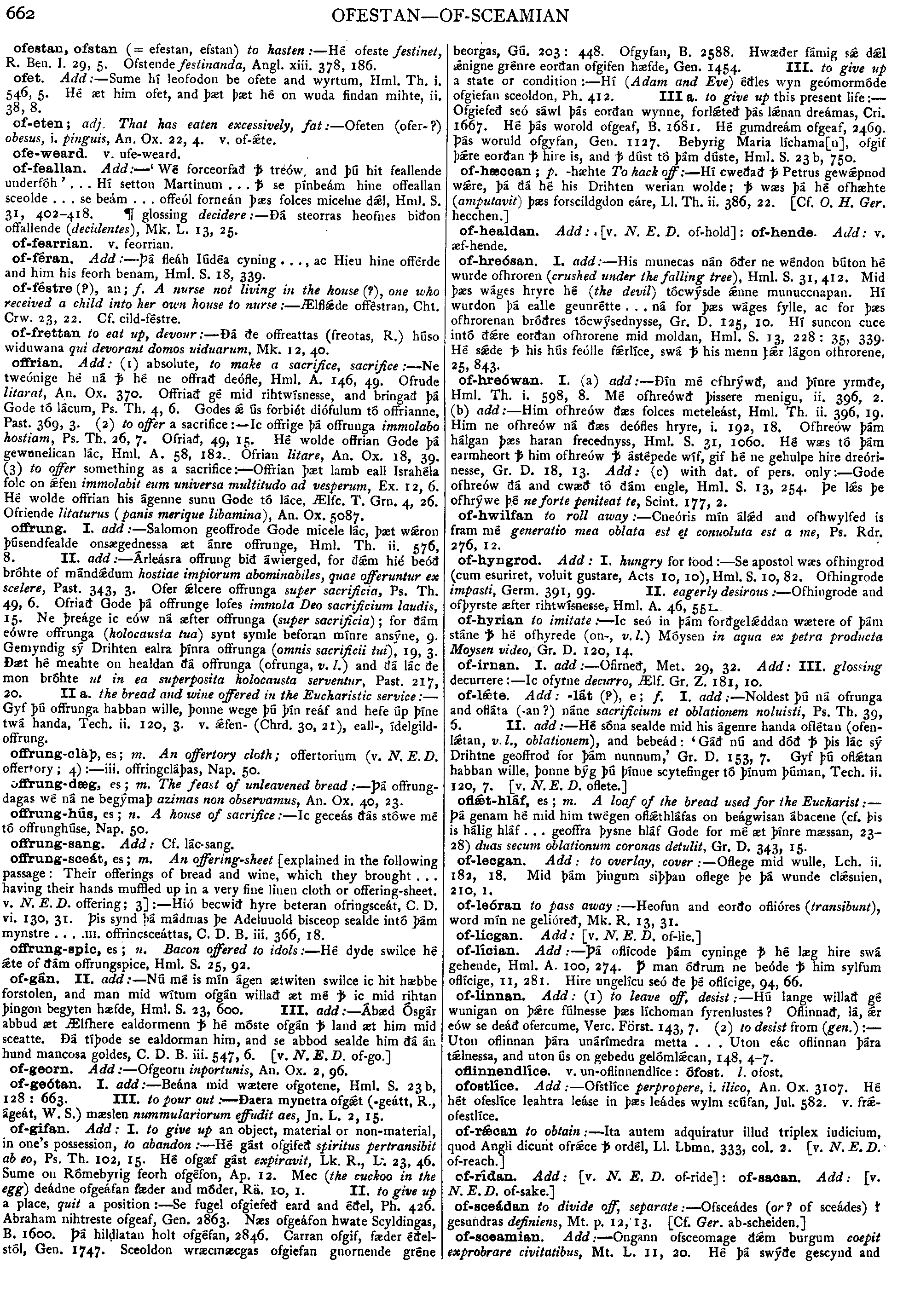
of-lte.
Add:
-lát
(?),
e
;
f.
I.
add
:--
Noldest
þú
ná
ofrunga
and
ofláta
(-an
?)
náne
sacrificium
el
oblationem
noluisti,
Ps.
Th.
39,
6.
II.
add
:--
Hé
sóna
sealde
mid
his
ágenre
handa
oflétan
(ofenltan,
v.
l.
,
oblationem),
and
bebeád:
'Gáð
nú
and
dóð
þis
lác
sý
Drihtne
geoffrod
for
þám
nunnum.'
Gr.
D.
153,
7.
Gyf
þú
ofltan
habban
wille,
þonne
býg
þú
þínne
scytefinger
tó
þínum
þúman,
Tech.
ii.
120,
7.
[v.
N.
E.
D.
oflete.]
Germanic Lexicon Project (main page)
This search system was written by
Sean Crist
Please consider
volunteering
to correct the data in these online dictionaries.
No rights reserved. Feel free to use these data in any way you please.