|
|

|
Source: Bosworth/Toller, page d0386, entry 11 View original page image as: [TIFF] [PNG] [View previous entry] [View next entry] |
[Comment on this entry] [View comments] |
The following entry has been hand-corrected once. |
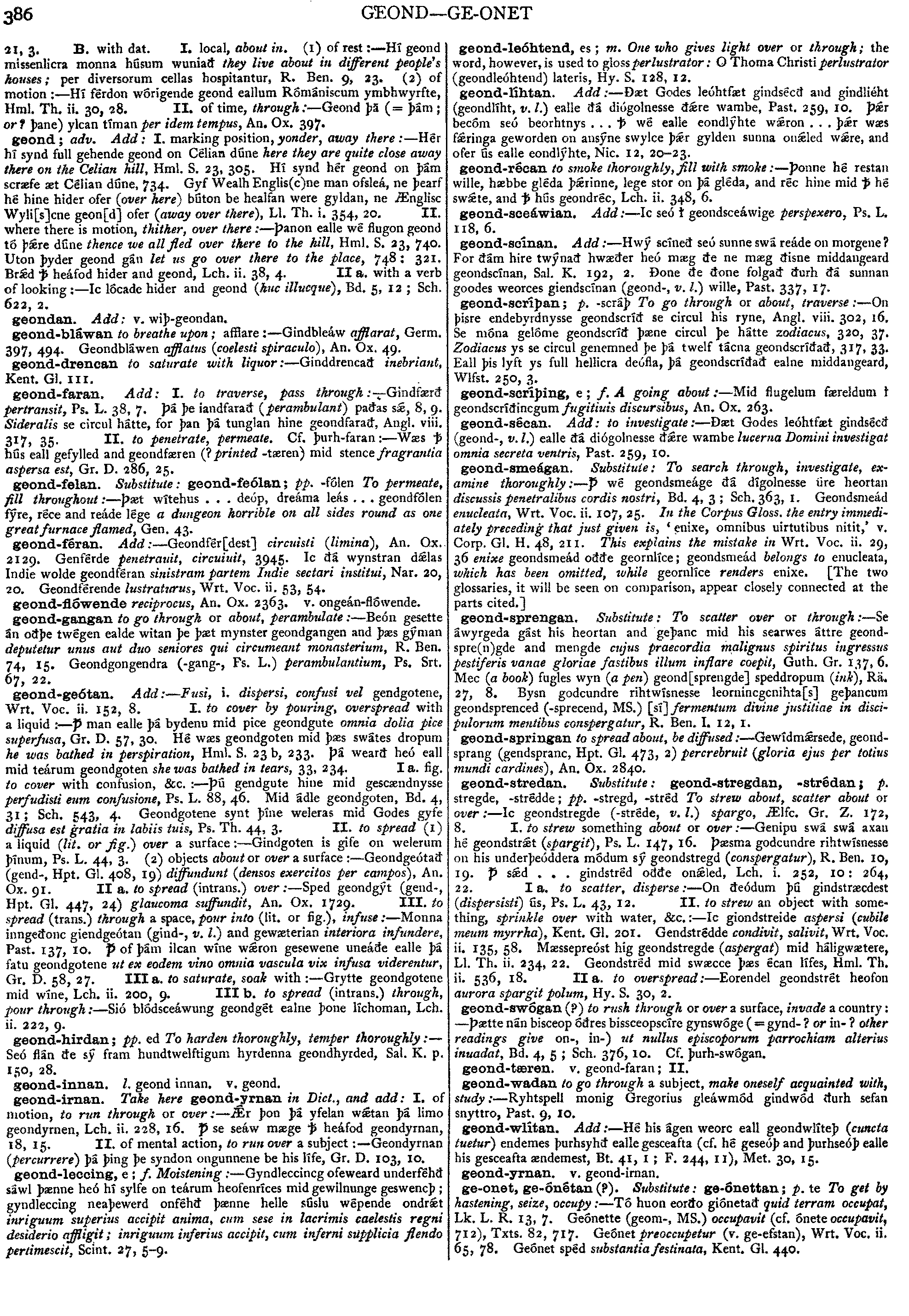
geond-geótan.
Add:--Fusi,
i.
dispersi,
confusi
vel
gendgotene,
Wrt.
Voc.
ii.
152,
8.
I.
to
cover
by
pouring,
overspread
with
a
liquid:--Þ-bar;
man
ealle
þá
bydenu
mid
pice
geondgute
omnia
dolia
pice
superfusa,
Gr.
D.
57,
30.
Hé
wæs
geondgoten
mid
þæs
swátes
dropum
he
was
bathed
in
perspiration,
Hml.
S.
23
b,
233.
Þá
wearð
heó
eall
mid
teárum
geondgoten
she
was
bathed
in
tears,
33,
234.
I
a.
fig.
to
cover
with
confusion,
&c.:--Þú
gendgute
hine
mid
gescændnysse
perfudisti
eum
confusione,
Ps.
L.
88,
46.
Mid
ádle
geondgoten,
Bd.
4,
31;
Sch.
543,
4.
Geondgotene
synt
þíne
weleras
mid
Godes
gyfe
diffusa
est
gratia
in
labiis
tuis,
Ps.
Th.
44,
3.
II.
to
spread
(1)
a
liquid
(lit.
or
fig.)
over
a
surface:--Gindgoten
is
gife
on
welerum
þínum,
Ps.
L.
44,
3.
(2)
objects
about
or
over
a
surface:--Geondgeótað
(gend-,
Hpt.
Gl.
408,
19)
diffundunt
(densos
exercitos
per
campos),
An.
Ox.
91.
II
a.
to
spread
(intrans.)
over:--Sped
geondgýt
(gend-,
Hpt.
Gl.
447,
24)
glaucoma
suffundit,
An.
Ox.
1729.
III.
to
spread
(trans.)
through
a
space,
pour
into
(lit.
or
fig.),
infuse:--Monna
inngeðonc
giendgeótan
(gind-,
v.
l.)
and
gewæterian
interiora
infundere,
Past.
137,
10.
Þ-bar;
of
þám
ilcan
wíne
w ron
gesewene
uneáðe
ealle
þá
fatu
geondgotene
ut
ex
eodem
vino
omnia
vascula
vix
infusa
viderentur,
Gr.
D.
58,
27.
III
a.
to
saturate,
soak
with:--Grytte
geondgotene
mid
wíne,
Lch.
ii.
200,
9.
III
b.
to
spread
(intrans.)
through,
pour
through:--Sió
blódsceáwung
geondgét
ealne
þone
líchoman,
Lch.
ii.
222,
9.
ron
gesewene
uneáðe
ealle
þá
fatu
geondgotene
ut
ex
eodem
vino
omnia
vascula
vix
infusa
viderentur,
Gr.
D.
58,
27.
III
a.
to
saturate,
soak
with:--Grytte
geondgotene
mid
wíne,
Lch.
ii.
200,
9.
III
b.
to
spread
(intrans.)
through,
pour
through:--Sió
blódsceáwung
geondgét
ealne
þone
líchoman,
Lch.
ii.
222,
9.
|
Source: Bosworth/Toller, page d0392, entry 1 View original page image as: [TIFF] [PNG] [View previous entry] [View next entry] |
[Comment on this entry] [View comments (1)] |
The following entry has been hand-corrected once. |
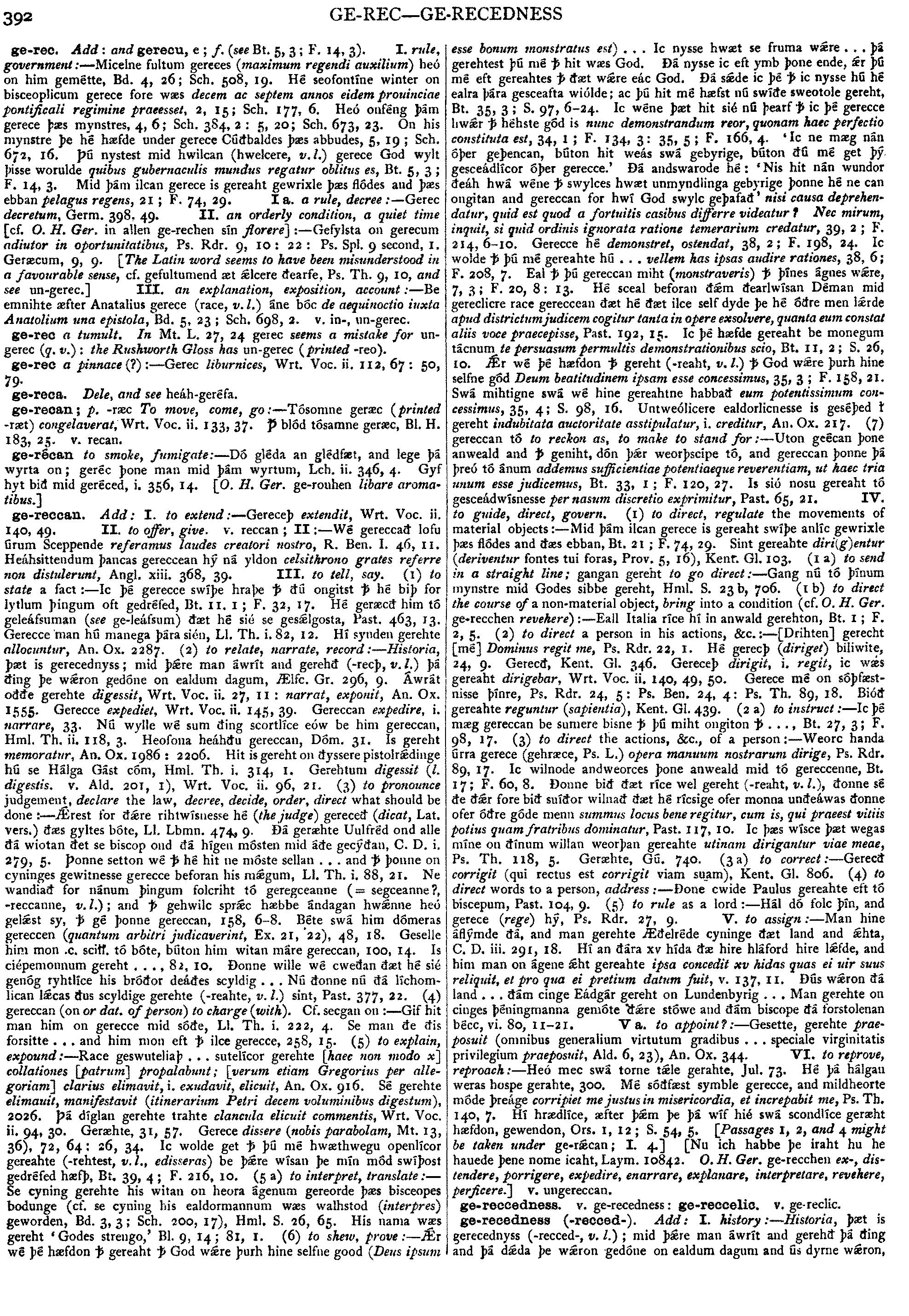
ge-rec.
Add:
and
gerecu,
e
;
f.
(
see
Bt.
5,
3;
F.
14,
3).
I.
rule,
government
:--
Micelne
fultum
gereces
(maximum
regendi
auxilium)
néo
on
him
gemétte,
Bd.
4,
26;
Sch.
508,
19.
He
seofontine
winter
on
bisceoplicum
gerece
fore
wæs
decem
ac
septem
annos
eidem
prouinciae
pontificali
regimine
praeesset,
2,
15;
Sch.
177,
6.
Heó
onféng
Þam
gerece
þæs
mynstres,
4,
6;
Sch.
384,
2
:
5,
20;
Sch.
673,
23.
On
his
mynstre
þe
hé
hæfde
under
gerece
cúðbaldes
þæs
abbudes,
5,
19
;
Sch.
672,
16.
Þú
nystest
mid
hwilcan
(hwelcere,
v.
l.)
gerece
God
wylt
þisse
worulde
quibus
gubernactulis
mundus
regatur
oblitus
es,
Bt.
5,
3
;
F.
14,
3.
Mid
þám
ilcan
gerece
is
gereaht
gewrixle
þæs
flódes
and
þæs
ebban
pelagus
regens,
21
;
F.
74,
29,
Ia.
a
rule,
decree
:--
Gerec
decretum,
Germ.
398,
49.
II.
an
orderly
condition,
a
quiet
time
[cf.
O.
H.
Ger.
in
allen
ge-rechen
sin
florere]
:--
Gefylsta
on
gerecum
ndiutor
in
oportunitatibus,
Ps.
Rdr.
9,
10
:
22
:
Ps.
Spl.
9
second,
l.
Geræcum,
9,
9.
[The
Latin
word
seems
to
have
been
misunderstood
in
a
favourable
sense,
cf.
gefultumend
æt
lcere
ðearfe.
Ps.
Th.
9,
10,
and
see
un-gerec.]
III.
an
explanation,
exposition,
account
:--
Be
emnihte
æfter
Anatalius
gerece
(race,
v.
l.)
áne
bóc
de
aequinoctio
iuxta
Anatolium
una
epislola,
Bd.
5,
23
;
Sch.
698,
2.
v.
in-,un-gerec.
ge-rec
a
tumult.
In
Mt.
L.
27,
24
gerec
seems
a
mistake
for
un-gerec
(q.
v.)
:
the
Rushworth
Gloss
has
un-gerec
(printed
-reo).ge-rec
a
pinnace
(?)
:--
Gerec
liburnices,
Wrt.
Voc.
ii.
112,
67:
50,
79
.ge-reca.
Dele,
and
see
heáh-geréfa.ge-recan;
ILLEGIBLE
-ræc
To
move,
come,
g
o
:--
Tósomne
geræc
(printed
-ræt)
congelaverat.
Wrt.
Voc.
ii.
133,
37.
ILLEGIBLE
blód
tósamne
geræc,
Bl.
H.
183,
25.
v.
recan.ge-récan
to
smoke,
fumigate
:--
Dó
gléda
an
glédfæt,
and
lege
þá
wyrta
on;
geréc
þone
man
mid
þám
wyrtum,
Lch.
ii.
346,
4.
Gyf
hyt
bið
mid
gereced,
i.
356,
14.
[O.
H.
Ger.
ge-rouhen
libare
aromatibus
.]ge-reccan.
Add:
I.
to
extend
:--
Gereceþ
extendit,
Wrt.
Voc.
ii.
140,
49.
II.
to
offer,
give.
v.
reccan
;
II
:--
Wé
gereccað
lofu
Úrum
Sceppende
referamus
laudes
creatori
nostro,
R.
Ben.
I.
46,
ii.
Heahsittendum
þancas
gereccean
hý
ná
yldon
celsithrono
grates
referre
non
distulerunt,
Angl.
xiii.
368,
39.
III.
to
tell,
say.
(1)
to
state
a
fact
:--
Ic
þé
gerecce
swíþe
hraþe
ILLEGIBLE
ðú
ongitst
ILLEGIBLE
hé
biþ
for
lytlum
þingum
oft
gedréfed,
Bt.
II.
I
;
F.
32,
17.
Hé
geræcð
him
tó
geleáfsuman
(see
ge-leáfsum)
ðæt
hé
sié
se
geslgosta,
Past.
463,
13.
Gerecce
man
hú
manega
þára
sién,
Ll.
Th.
i.
82,
12.
Hí
synden
gerehte
allocuntur,
An.
Ox.
2287.
(2)
to
relate,
narrate,
record
:--
Historia,
þæt
is
gerecednyss;
mid
þre
man
áwrít
and
gerehð
(-recþ,
v.
l.)
þá
ðing
þe
wron
gedóne
on
ealdum
dagum,
Ælfc.
Gr.
296,
9.
Áwrát
oððe
gerehte
digessit,
Wrt.
Voc.
ii.
27,
ii
:
narrat,
exponit,
An.
Ox.
1555.
Gerecce
expediet,
Wrt.
Voc.
ii.
145,
39.
Gereccan
expedire,
i.
narrare,
33.
Nú
wylle
wé
sum
ðing
scortlíce
eów
be
him
gereccan,
Hml.
Th.
ii.
118,
3.
Heofona
heáhðu
gereccan,
Dóm.
31.
Is
gereht
memoratur,
An.
Ox.
1986
:
2206.
Hit
is
gereht
on
ðyssere
pistolrdinge
hú
se
Hálga
Gást
óm,
Hml.
Th.
i.
314,
l.
Ge-ehtum
digessit
(l.
digestis.
v.
Aid.
201,
l),
Wrt.
Voc.
ii.
96,
21.
(3)
to
pronounce
judgement,
declare
the
law,
decree,
decide,
order,
direct
what
should
be
done
:--
Æ-acute;rest
for
ðre
rihtwísnesse
hé
(the
judge]
gereceð
(dicat,
Lat.
vers.
)
ðæs
gyltes
bote,
Ll.
Lbmn.
474,
9.
Ðá
geræhte
Uulfréd
ond
alle
ðá
wiotan
ðet
se
biscop
ond
ðá
hígen
mósten
mid
áðe
gecýðan,
C.
D.
i.
279
5.
þonne
setton
wé
hé
hit
ne
móste
sellan
.
.
.
and
ILLEGIBLE
þonne
on
cyninges
gewitnesse
gerecce
beforan
his
mgum,
Ll.
Th.
i.
88,
21.
Ne
wandiað
for
nánum
þingum
folcriht
tó
geregceanne
(=segclanne
?
,
-reccanne,
v.
l.
)
;
and
Þ
gehwilc
sprc
hæbbe
ándagan
hwnne
heó
gelst
sy,
ILLEGIBLE
gé
þonne
gereccan,
158,
6-8.
Béte
swá
him
dómeras
gereccen
(quantum
arbitri
judicaverint,
Ex.
21,
22),
48,
18.
Geselle
him
mon
.
c.
scitf.
tó
bóte,
búton
him
witan
máre
gereccan,
100,
14.
Is
ciépemonnum
gereht
.
.
.
,
82,
10,
Ðonne
wille
wé
cweðan
ðæt
hé
sié
genóg
ryhtlíce
his
bróðor
deáðes
scyldig
.
.
.
Nú
ðonne
nú
ðá
líchomlican
lcas
ðus
scyldige
gerehte
(-reahte,
v.
l.)
sint,
Past.
377,
22.
(4)
gereccan
(on
or
dat.
of
person)
to
charge
(with).
Cf.
secgan
on
:--
Gif
hit
man
him
on
gerecce
mid
sóðe,
Ll.
Th.
i.
222,
4.
Se
man
ðe
ðis
forsitte
.
.
.
and
him
mon
eft
þilce
gerecce,
258,
15.
(5)
to
explain,
expound
:--
Race
geswuteliaþ
.
.
.
sutelícor
gerehte
[haee
non
modo
x]
collationes
[patrum]
propalabnnt;
[verum
etiam
Gregorius
per
allegoriam]
clarius
elimavit,
i.
exudavit,
elicuit,
An.
Ox.
916.
Sé
gerehte
elimauit,
manifestavit
(itinerarium
Petri
decem
voluminibus
digestum),
2026.
Þá
diglan
gerehte
trahte
clancula
elicuit
commentis,
Wrt.
Voc.
ii.
94,
30.
Geræhte,
31,
57.
Gerece
dissere
(nobis
parabolam,
Mt.
13,
36),
72,
64:
26,
34.
Ic
wolde
get
þú
me
hwæthwegu
openlícor
gereahte
(-rehtest,
v.
l.
,
edisseras)
be
þre
wísan
þe
mín
mód
swíþost
gedréfed
hæfþ,
Bt.
39,
4
;
F.
216,
10.
(5
a)
to
interpret,
translate
:--
Se
cyning
gerehte
his
witan
on
heora
ágenum
gereorde
þæs
bisceopes
bodunge
(cf.
se
cyning
his
ealdormannum
wæs
walhstod
interpres
geworden,
Bd.
3,
3;
Sch.
200,
17,
Hml.
S.
26,
65.
His
nama
wæs
gereht
'Godes
strengo,
'
Bl.
9,
14;
81,
I.
(6)
to
shew,
prove
:--
Æ-acute;r
wé
þé
hæfdon
ILLEGIBLE
gereaht
ILLEGIBLE
God
wre
þurh
hine
selfne
good
(Deus
ipsum
esse
bonum
monsíratus
est)
.
.
.
Ic
nysse
hwæt
se
fruma
wre
.
.
.
þá
gerehtest
þú
mé
ILLEGIBLE
hit
wæs
God.
Ðá
nysse
ic
eft
ymb
þone
ende,
r
þú
mé
eft
gereahtes
ILLEGIBLE
ðæt
wre
eác
God.
Ðá
sde
ic
þé
ILLEGIBLE
ic
nysse
Hé
hé
ealra
þára
gesceafta
wiólde;
ac
þú
hit
me
hæfst
nú
swíðe
sweotole
gereht,
Bt.
35,
3
;
S.
97.
6-24.
Ic
wéne
þæt
hit
sié
nú
þearf
ILLEGIBLE
ic
þé
gerecce
liwr
ILLEGIBLE
héhste
gód
is
nunc
demonstrandum
reor,
quonam
haec
perfectio
constituta
est,
34,
l
;
F.
134,
3:
35,
5
;
F.
166,
4.
'Ic
ne
mæg
nán
óþer
geþencan,
búton
hit
weás
swá
gebyrige,
buton
ðú
mé
get
þý.
gesceádlícor
óþer
gerecce.
Ðá
andswarode
hé
:
'
Nis
hit
nán
wundor
ðeáh
hwá
wéne
ILLEGIBLE
swylces
hwæt
unmyndlinga
gebyrige
þonne
hé
ne
can
ongitan
and
gereccan
for
hwí
God
swylc
geþafað'
nisi
causa
deprehendatur,
quid
est
quod
a
fortuitis
casibus
differre
videatur
ILLEGIBLE
.(
Nec
mirum,
inquit,
si
quid
ordinis
ignorata
ratione
temerarium
credatur,
39,
2
;
F.
214,
6-10.
Gerecce
hé
demonstret,
ostendat,
38,
2;
F.
198,
24.
Ic
wolde
ILLEGIBLE
þú
mé
gereahte
hú
.
.
.
vellem
has
ipsas
audire
rationes,
38,
6;
F.
208,
7.
Eal
ILLEGIBLE
þú
gereccan
miht
monstraveris
ILLEGIBLE
þínes
ágnes
wre,
7,
3;
F.
20,
8:13.
Hé
sceal
beforan
ðm
ðearlwísan
Déman
mid
gereclicre
race
gereccean
ðæt
hé
ðæt
ilce
self
dyde
þe
hé
óðre
men
lrde
apud
districtum
judicem
cogitur
tanta
in
opere
exsolvere,
quanta
eum
constat
aliis
voce
praecepisse,
Past.
192,
15.
Ic
þé
hæfde
gereaht
be
monegum
tácnum
te
persuasum
permullis
demonstrationibus
scio,
Bt.
ll,
2;
S.
26,
10.
Æ-acute;r
wé
þé
hæfdon
gereht
(-reaht,
v.l.
)
God
wre
þurh
hine
selfne
gód
Deum
beatitudinem
ipsam
esse
concessimus,
35,
3
;
F.
158,
21.
Swá
mihtigne
swá
wé
hine
gereahtne
habbað
eum
potentissimum
concessimus,
35,
4;
S.
98,
16.
Untweólicere
ealdorlicnesse
is
geséþed
ILLEGIBLE
gereht
indubitata
auctoritate
asstipulatur,
i.
creditur,
An.
Ox.
217.
(7)
gereccan
tó
to
reckon
as,
to
make
to
stand
for
:--
Uton
geécan
þone
anweald
and
ILLEGIBLE
geniht,
dón
þr
weorþscipe
tó,
and
gereccan
þonne
þá
þreó
tó
ánum
addemus
sufficienliae
poten/iaeque
reverentiam,
ut
haec
tria
unum
esse
judicemus,
Bt.
33,
I;
F.
120,
27.
Is
sió
nosu
gereaht
tó
gesceádwísnesse
per
nasum
discretio
exprimitur,
Past.
65,
21.
IV.
to
guide,
direct,
govern.
(1)
to
direct,
regulate
the
movements
of
material
objects
:--
Mid
þám
ilcan
gerece
is
gereaht
swíþe
anlic
gewrixle
þæs
flódes
and
ðæs
ebban.
Bt.
21
;
F.
74,
29.
Sint
gereahte
diri(g)entur
(deriventur
fantes
tui
foras,
Prov.
5,
16),
Kent.
Gl.
103.
(l
a)
to
send
in
a
straight
line;
gangan
gereht
to
go
direct
:--
Gang
nú
tó
þínum
mynstre
mid
Godes
sibbe
gereht,
Hml.
S.
23
b,
706.
(l
b)
to
direct
the
course
of
a
non-material
object,
bring
into
a
condition
(cf.
O.
H.
Ger.
ge-recchen
revehere)
:--
Eall
Italia
ríce
hí
in
anwald
gerehton,
Bt.
I;
F.
2,
5.
(2)
to
direct
a
person
in
his
actions,
&
c.
:--
[Drihten]
gerecht
[mé]
Dominus
regit
me,
Ps.
Rdr.
22,
l.
Hé
gerecþ
(diriget)
biliwite,
24,
9.
Gerecð,
Kent.
Gl.
346.
Gereceþ
dirigit,
i.
regit,
ic
wæs
gereaht
dirigebar,
Wrt.
Voc.
ii.
140,
49,
50.
Gerece
me
on
sðþfæstnisse
þínre,
Ps.
Rdr.
24,
5:
Ps.
Ben.
24,
4:
Ps.
Th.
89,
18.
Bióð
gereahte
reguntur
(sapientia),
Kent.
Gl.
439.
(2
a)
to
instruct
:--
Ic
þé
mæg
gereccan
be
sumere
bisne
ILLEGIBLE
þú
miht
ongiton
ILLEGIBLE
.
.
.
,
Bt.
27,
3;
F.
98,
17.
(3)
to
direct
the
actions,
&
c.
,
of
a
person
:--
Weorc
handa
úrra
gerece
(gehræce,
Ps.
L.
)
opera
manuum
nostrarum
dirige,
Ps.
Rdr.
89,
17.
Ic
wilnode
andweorces
þone
anweald
mid
to
gereccenne,
Bt.
17;
F.
60,
8.
Ðonne
bið
ðæt
rice
wel
gereht
(-reaht,
v.
l.),
ðonne
sé
ðe
ðr
fore
bið
suíðor
wilnað
ðæt
hé
rícsige
ofer
monna
unðeáwas
ðonne
ofer
óðre
góde
menn
summus
locus
bene
regitur,
cum
is,
qui
praeest
vitiis
potius
quam
fratribus
dominatur,
Past.
117,
10.
Ic
þæs
wísce
þæt
wegas
mine
on
ðínum
willan
weorþan
gereahte
utinam
dirigantur
viae
meae,
Ps.
Th.
118,
5.
Geræhte
,
Gú.
740.
(33)
to
correct
:--
Gerecð
corrigit
(qui
rectus
est
corrigit
viam
suam),
Kent.
Gl.
806.
(4)
to
direct
words
to
a
person,
address
:--
Ðone
cwide
Paulus
gereahte
eft
to
biscepum,
Past.
104,
9.
(5)
to
rule
as
a
lord
:--
Hal
dó
folc
bin,
and
gerece
(rege)
hy.
Ps.
Rdr.
27,
9.
V.
to
assign
:--
Man
hine
áflýmde
ðá,
and
man
gerehte
Æðelréde
cyninge
ðæt
land
and
hta,
C.
D.
iii.
291,
18.
Hí
an
ðára
xv
hída
ðæ
hire
hlaford
hire
lfde,
and
him
man
on
ágene
ht
gereahte
ipsa
concedit
xv
hidas
quas
ei
uir
suus
reliquit,
el
pro
qua
ei
pretium
datum
fuit,
v.
137,
ii.
Ðús
wron
ðá
land
.
.
.
ðám
cinge
Eádgár
gereht
on
Lundenbyrig
.
.
.
Man
gerehte
on
cinges
þéningmanna
gemóte
ðre
stówe
and
ðám
biscope
ðá
forstolenan
bécc,
vi.
80,
11,21.
Va.
to
appoint?
:--
Gesette,
gerehte
prae-posuit
(omnibus
generalium
virtutum
gradibus
...
speciale
virginitatis
privilegium
praeposuit,
Aid.
6,
23),
An.
Ox.
344.
VI.
to
reprove,
reproach
:--
Heó
mec
swá
torne
tle
gerahte.
Jul.
73.
Hé
þá
hálgan
weras
hospe
gerahte,
300.
Mé
sóðfæst
symble
gerecce,
and
mildheorte
mode
þreáge
corripiet
me
Justus
in
misericordia,
et
increpabit
me,
Ps.
Th.
140,
7.
Hi
hrædlíce,
æfter
þm
þe
þá
wíf
hié
swá
scondlíce
geræht
hæfdon,
gewendon,
Ors.
1,
12;
S.
54,
5.
[Passages
I.
2,
and
4
might
be
taken
under
ge-rcan;
I.
4.]
[Nu
ich
habbe
þe
iraht
hu
he
hauede
þene
nome
icaht,
Laym.
10842.
O.
H.
Ger.
ge-recchen
ex-,
dis-tendere,
porrigere,
expedire,
enarrare,
explanare,
interpretare,
revehere,
perftcere.
]
v.
ungereccan.ge-reccedness.
v.
ge-recedness:
ge-reccelic.
v.
ge-reclic.ge-recedness
(-recced-).
Add:
I.
history
:--
Historia,
þæt
is
gerecednyss
(-recced-,
v.
l.)
;
mid
þre
man
áwrít
and
gerehð
þá
ðing
and
þá
dda
þe
wron
gedóne
on
ealdum
dagum
and
ús
dyrne
wron.
|
Source: Bosworth/Toller, page d0396, entry 1 View original page image as: [TIFF] [PNG] [View previous entry] [View next entry] |
[Comment on this entry] [View comments (3)] |
The following entry has been hand-corrected once. |
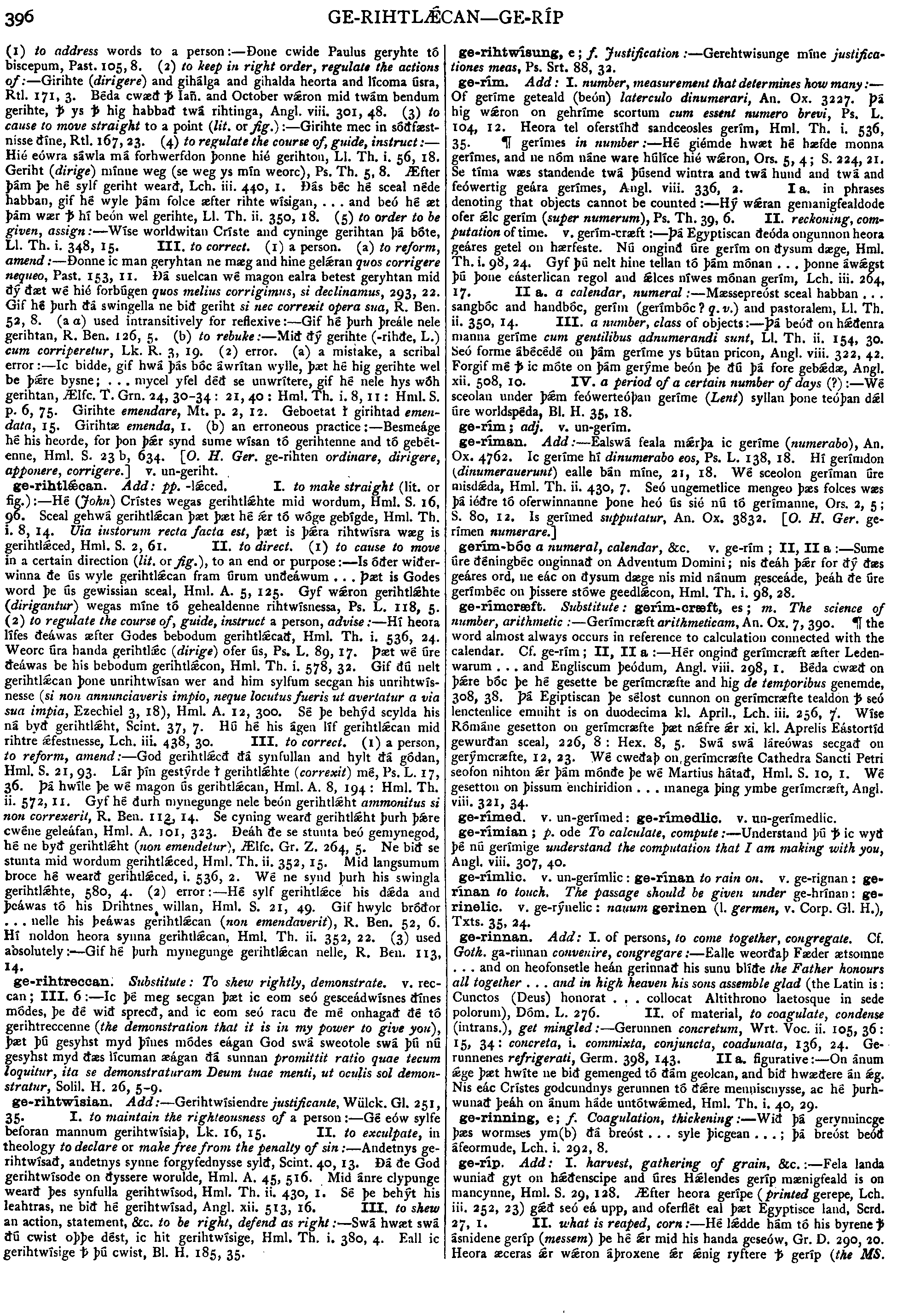
(l)
to
address
words
to
a
person
:--
Done
cwide
Paulus
geryhte
tó
biscepum,
Past.
105,
8.
(2)
to
keep
in
right
order,
regulate
the
actions
of
:--
Girihte
(dirigere)
and
gihálga
and
gihalda
heorta
and
Úcoma
úsra,
Rtl.
171,
3.
Béda
cwæð
ILLEGIBLE
lan.
and
October
wron
mid
twám
bendum
gerihte,
ILLEGIBLE
ys
ILLEGIBLE
hig
habbað
twá
rihtinga,
Angl.
viii.
301,
48.
(3)
to
cause
to
move
straight
to
a
point
(lit.
or
fig.)
:--
Girihte
mec
in
sáðfæstnisse
dine,
Rtl.
167,
23.
(4)
to
regulate
the
course
of,
guide,
instruct
:--
Hié
eówra
sáwla
má
forhwerfdon
þonne
hié
gerihton,
Ll.
Th.
i.
56,
18.
Geriht
(dirige)
míne
weg
(se
weg
ys
mín
weorc),
Ps.
Th.
5,
8.
Æ-acute;fter
þám
þe
hé
sylf
geriht
wearð,
Lch.
iii.
440,
l.
Ðas
bée
hé
sceal
néde
habban,
gif
hé
wyle
þám
folce
æfter
rihte
wisigan,
.
.
.
and
beó
hé
æt
þám
wær
ILLEGIBLE
hí
beón
wel
gerihte,
Ll.
Th.
ii.
350,
18.
(5)
to
order
to
be
given,
assign
:--
Wíse
worldwitan
Críste
and
cyninge
gerihtan
þá
bóte,
Ll.
Th.
i.
348,
15.
III.
to
correct.
(1)
a
person,
(a)
to
reform,
amend
:--
Ðonne
ic
man
geryhtan
ne
mæg
and
hine
gelran
quos
corrigere
nequeo,
Past.
153,
ii.
Ða
suelcan
wé
magon
ealra
betest
geryhtan
mid
ðý
ðæt
wé
hié
forbúgen
quos
melius
corrigimus,
si
declinamus,
293,
22.
Gif
hé
þurh
tfá
swingella
ne
bið
geriht
si
nec
correxit
opera
sua,
R.
Ben.
52
8.
(2a)
used
intransitively
for
reflexive
:--
Gif
hé
þurh
þreále
nele
gerihtan,
R.
Ben.
126,
5.
(b)
to
rebuke
:--
Mi
ðý
gerihte
(-rihðe,
L.
)
cum
corriperetur,
Lk.
R.
3,
19.
(2)
error,
(a)
a
mistake,
a
scribal
error
:--
Ic
bidde,
gif
hwá
þás
bóc
áwrítan
wyile,
þæt
hé
hig
gerihte
wel
be
þsére
bysne;
.
.
.
mycel
yfel
déð
se
unwrítere,
gif
he
nele
hys
wóh
gerihtan,
Ælfc.
T.
Grn.
24,
30-34
:
21,
40
:
Hml.
Th.
i.
8,
II:
Hml.
S.
p.
6,
75.
Girihte
emendare,
Mt.
p.
2,
12.
Geboetat
girihtad
emendata,
15.
Girihtæ
emenda,
I.
(b)
an
erroneous
practice
:--
Besmeáge
hé
his
heorde,
for
þon
þiér
synd
sume
wísan
tó
gerihtenne
and
tó
gebétenne,
Hml.
S.
23
b,
634.
[O.
H.
Ger.
ge-rihten
ordinare,
dirigere,
apponere,
corrigere.]
v.
un-geriht.ge-rihtlcan.
Add;
pp.
-laced.
I.
to
make
straight
(lit.
or
fig.
)
:--
Hé
(John)
Crístes
wegas
gerihtlhte
mid
wordum,
Hml.
S.
16,
96.
Sceal
gehwá
gerihtlcan
þæt
þæt
hé
r
tó
woge
gebígde,
Hml.
Th.
i.
8,
14.
via
iustorum
recta
facto,
est,
þæt
is
þra
rihtwísra
wæg
is
gerihtlced,
Hml.
S.
2,
61.
II.
to
direct.
(1)
to
cause
to
move
in
a
certain
direction
(lit.
or
fig.),
to
an
end
or
purpose
:--
Is
ððer
wiðerwinna
ðe
ús
wyle
gerihtlcan
fram
úrum
unðeáwum
.
.
.
Þát
is
Godes
word
þe
ús
gewissian
sceal,
Hml.
A.
5,
125.
Gyf
wsron
gerihtlhte
(dirigantur)
wegas
míne
tó
gehealdenne
rihtwísnessa,
Ps.
L.
118,
5.
(2)
to
regulate
the
course
of,
guide,
instruct
a
person,
advise
:--
Hí
heora
lífes
ðeáwas
æfter
Godes
bebodum
gerihtlcað,
Hml.
Th.
i.
536,
24.
Weorc
úra
handa
gerihtlc
(dirige)
ofer
ús,
Ps.
L.
89,
17.
Þæt
wé
úre
ðeáwas
be
his
bebodum
gerihtlcon,
Hml.
Th.
i.
578,
32.
Gif
dú
nelt
gerihtlcan
þone
unrihtwísan
wer
and
him
sylfum
secgan
his
unrihtwisnesse
(si
non
annunciaveris
impio,
neque
locutus
fueris
ut
averlatur
a
via
sua
impia,
Ezechiel
3,
18),
Hml.
A.
12,
300.
Sé
þe
behýd
scylda
his
ná
byð
gerihtlht,
Scint.
37,
7.
Hú
hé
his
ágen
líf
gerihtcan
mid
rihtre
festnesse,
Lch.
iii.
438,
30.
III.
to
correct.
(1)
a
person,
to
reform,
amend
:--
God
gerihtlcð
ðá
synfullan
and
hylt
ðá
gódan,
Hml.
S.
21,
93.
Lár
bin
gestyrde
t
gerihtlséhte
(correxit)
me,
Ps.
L.
17,
36.
pi
hwíle
þe
wé
magon
us
gerihtlcan,
Hml.
A.
8,
194
:
Hml.
Th.
ii.
572,
Gyf
he
durh
mynegunge
nele
beón
gerihtlht
ammonitus
si
non
correxerit,
R.
Ben.
ILLEGIBLE
,
14.
Se
cyning
wearð
gerihtlht
þurh
þre
cwéne
geleáfan,
Hml.
A.
101,
323.
Ðeáh
ðe
se
stunta
beó
gemynegod,
hé
ne
byð
gerihtlht
(non
emendetur],
Ælfc.
Gr.
Z.
264,
5.
Ne
bið
se
stunta
mid
wordum
gerihtlced,
Hml.
Th.
ii.
352,
15.
Mid
langsumum
broce
hé
wearð
gerihtlced,
i.
536,
2.
Wé
ne
synd
þurh
his
swingla
gerihtlhte,
580,
4.
(2)
error
:--
Hé
sylf
gerihtlce
his
dda
and
þawas
tó
his
Drihtnes
willan,
Hml.
S.
21,
49.
Gif
hwylc
brððor
.
.
.
nelle
his
þeáwas
gerihtlcan
(non
emendaverit),
R.
Ben.
52,
6.
Hí
noldon
heora
synna
gerihtlcan.
Hml.
Th.
ii.
352,
22.
(3)
used
absolutely
:--
Gif
hé
þurh
mynegunge
gerihtlcan
nelle,
R.
Ben.
113,
14.ge-rihtreccan.
Substitute:
To
shew
rightly,
demonstrate,
v.
reccan;
III.
6
:--
Ic
þé
meg
secgan
þæt
ic
eom
seó
gesceádwísnes
ðínes
modes,
þe
ðé
wið
sprecð,
and
ic
eom
seó
racu
ðe
mé
onhagað
ðé
tó
gerihtreccenne
(the
demonstration
that
it
is
in
my
power
to
give
you),
ðæt
þú
gesyhst
myd
ðínes
módes
eágan
God
swá
sweotole
swá
þú
nú
gesyhst
myd.
ðæs
lícuman
æágan
ðá
sunnan
promittit
ratio
quae
eccum
loquitur,
ita
se
demonstraturam
Deum
tuae
menti,
ut
oculis
sol
demonstratur,
Solil.
H.
26,
5-9.ge-rihtwísian.
Add
:--
Gerihtwisiendre
justficante,
Wülck.
Gl.
251,
35.
I.
to
maintain
the
righteousness
of
a
person
:--
Gé
eów
sylfe
beforan
mannum
gerihtwísiaþ,
Lk.
16,
15.
II.
to
exculpate,
in
theology
to
declare
or
make
free
from
the
penally
of
sin
:--
Andetnys
gerihtwísað,
andetnys
synne
forgyfednysse
sylð,
Scint.
40,
13.
Ðá
ðe
God
gerihtwisode
on
ðyssere
worulde,
Hml.
A.
45,
516.
Mid
ánre
clypunge
wearð
þes
synfulla
gerihtwísod,
Hml.
Th.
ii.
430,
l.
Sé
þe
behýt
his
leahtras,
ne
bið
hé
gerihtwísad,
Angl.
xii.
513,
16.
III.
to
shew
an
action,
statement,
&c.
to
be
right,
defend
as
right
:--
Swá
hwæt
swá
ðcwist
oþþe
dést,
ic
hit
gerihtwísige.
Hml,
Th.
i.
380,
4.
Eall
ic
gerihtwísige
1>
þú
cwist,
Bl.
H.
185,36.
ge-rihtwísung,
e;
f.
Justification
:--
Gerehtwisunge
mine
justificationes
meas,
Ps.
Srt.
88,
32.ge-rím.
Add:
I.
number,
measurement
that
determines
how
many
:--
Of
geríme
geteald
(beón)
laterculo
dinumerari,
An.
Ox.
3227.
pá
nig
wron
on
gehrime
scortum
cum
essene
numero
brevi,
Ps.
L.
104,
12.
Heora
tel
oferstíhð
sandceosles
gerlm,
Hml.
Th.
i.
536,
35.
gerimes
in
number
:--
Hé
giémde
hwæt
hé
hæfde
monna
gerímes,
and
ne
nóm
náne
ware
húlíce
hié
wron,
Ors.
5,
4;
S.
224,
21.
Se
tíma
wæs
standende
twá
þúsend
wintra
and
twá
hund
and
twá
and
feówertig
geára
gerímes,
Angl.
viii.
336,
2.
la.
in
phrases
denoting
that
objects
cannot
be
counted
:--
Hý
wran
gemanigfealdode
ofer
le
gerím
(super
numerum),
Ps.
Th.
39,
6.
II.
reckoning,
computation
of
time.
v.
gerím-cræft
:--
þá
Egyptiscan
ðeóda
ongunnon
heora
geáres
getel
on
hærfeste.
Nú
onginð
úre
gerím
on
ðysum
dæge,
Hml.
Th.
i.
98,
24.
Gyf
þú
nelt
hine
tellan
tó
þám
mónan
.
.
.
þonne
áwgst
þú
þone
eásterlican
regol
and
lces
níwes
mónan
gerím,
Lch.
iii.
264,
17.
II
a.
a
calendar,
numeral
:--
Mæssepreóst
sceal
habban
,
.
.
sangbóc
and
handbóc,
gerím
(gerímbóc
?
q.
v.
)
and
pastoralem,
Ll.
Th.
ii.
350,
14.
III.
a
number,
class
of
objects
:--
Þá
beóð
onhttenra
manna
geríme
cum
gentilibus
adnumerandi
sunt.
Ll.
Th.
ii.
154,
30.
Seó
forme
ábécédé
on
þám
geríme
ys
bútan
pricon,
Angl.
viii.
322,
42.
Forgif
mé
ILLEGIBLE
ic
mote
on
þám
gerýme
beón
þe
ðú
þá
fore
gebdæ,
Angl.
xii.
508,10.
IV.
a
period
of
a
certain
number
of
days
(?)
:--
We
sceolan
under
þm
feówerteóþan
geríme
(Lent)
syllan
þone
teóþan
dl
úre
worldspéda,
Bl.
H.
35,ge-rím;
adj.
v.
un-gerim.ge-ríman.
Add:
--
Ealswá
feala
mrþa
ic
geríme
(numerabo),
An.
Ox.
4762.
Ic
geríme
hí
dinumerabo
eos,
Ps.
L.
138,
18.
Hi
gerímdon
(dinumerauerunt)
ealle
bán
míne,
21,
18.
Wé
sceolon
geríman
úre
núsdda,
Hml.
Th.
ii.
430,
7.
Seó
ungemetlice
mengeo
þæs
folces
wæs
þá
iéðre
tó
oferwinnanne
þone
heó
ús
sié
nú
tó
gerímanne.
Ors.
2,
5;
S.
80,
12.
Is
gerímed
supputatur.
An.
Ox.
3832.
[O.
H.
Ger.
ge-rímen
numerare.]gerím-bóc
a
numeral,
calendar,
&
c.
v.
ge-rím
;
II,
II
a
:--
Sume
úre
ðéningbéc
onginnað
on
Adventum
Domini;
nis
ðeáh
þr
for
ðý
ðtes
geáres
ord,
lie
eác
on
ðysum
dæge
nis
mid
nánum
gesceáde,
þeáh
ðe
úre
gerímbéc
on
þissere
stówe
geedlcon,
Hml.
Th.
i.
98,
28.ge-rímcræft.
Substitute:
gerím-cræft,
es;
m.
The
science
of
number,
arithmetic
:--
Gerímcræft
arithmeticam.
An.
Ox.
7,
390.
the
word
almost
always
occurs
in
reference
to
calculation
connected
with
the
calendar.
Cf.
ge-rim;
II,
II
a
:--
Her
onginð
gerímcræft
æfter
Leden-warum
.
.
.
and
Engliscum
þeódum,
Angl.
viii.
298,
l.
Béda
cwæð
on
þre
bóc
þe
hé
gesette
be
gerímcræfte
and
hig
du
temporibus
genemde,
308,
38.
Þá
Egiptiscan
þe
sélost
cunnon
on
gerímcræfte
tealdón
seón
lenctenlice
emniht
is
on
duodecima
kl.
April.
,
Lch.
iii.
256,
7.
Wise
RÓmáne
gesetton
on
gerímcraefte
þæt
nfre
r
xi.
kl.
Aprelis
Eástortid
gewurðan
sceal,
226,
8
:
Hex.
8,
5.
Swá
swá
láreówas
secgað
on
gerýmcræfte,
12,
23.
Wé
cweðaþ
on,
gerímcræfte
Cathedra
Sancti
Petri
seofon
nihton
r
þám
mónðe
þe
wé
Martius
hátað,
Hml.
S.
10,
I.
Wé
gesetton
on
þissum
enchiridion
.
.
.
manega
þing
ymbe
gerímcræft,
Angi.
viii.
321,
34.ge-rímed.
v.
un-geríined:
ge-rímedlic.
v.
un-gerimedlic.ge-rímian
ILLEGIBLE
ode
To
calculate,
compute
:--
Understand
þú
ILLEGIBLE
ic
wyí
þé
nu
gerímige
understand
the
computation
that
I
am
making
with
you,
Angl.
viii.
307,
40.ge-rímlic.
v.
un-gerimlic:
ge-rínan
to
rain
on.
v.
ge-rignan
:
ge-rinan
to
touch.
The
passage
should
be
given
under
ge-brinan:
ge-rinelic.
v.
ge-rynelic
:
nauum
gerinen
(1.
germen,
v.
Corp.
Gl.
H.
),
Txts.
35,
24.ge-rinnan.
Add:
I.
of
persons,
to
came
together,
congregate.
Cf.
Goth.
ga-rinnan
convenire,
congregare
:--
Ealle
weorðaþ
Fæder
ætsomne
.
.
.
and
on
heofonsetle
heán
gerinnað
his
sunu
blíðe
the
Father
honours
all
together
.
.
.
and
in
high
heaven
his
sons
assemble
glad
(the
Latin
is:
Cunctos
Deus
honorat
.
.
.
collocat
Altithrono
laetosque
in
sede
poloruiu,
Dóm.
L.
276.
II.
of
material,
to
coagulate,
condense
(intrant.
),
get
mingled
:--
Gerunnen
concretum,
Wrt.
Voc.
ii.
105,
15,
34:
concreta,
i.
commixla,
conjuncta,
coadunala,
136,
24.
Ge-runnenes
refrigerati,
Germ.
398,
143.
II
a.
figurative
:--
On
ánum
ge
þæt
hwíte
ne
bið
gemenged
tó
ðám
geolcan,
and
bið
hwæðere
án
g.
Nis
eác
Crístes
godcundnys
gerunnen
tó
ðre
menniscnysse,
ac
hé
þurh-wunað
þeáh
on
ánum
háde
untðtwmed.
Hml.
Th.
i.
40,
29.ge-rinning,
e;
f.
Coagulation,
thickening
:--
Wið
þá
gerynnincge
þæs
wormses
ym(b)
ðá
breóst
.
.
.
syle
þicgean
.
.
.
;
þá
breóst
beóð
áfeormude,
Lch.
i.
292,
8.ge-ríp.
Add:
I.
harvest,
gathering
of
grain.
Sic.
:--
Fela
landa
wuniað
gyt
on
hðenscipe
and
fires
Hlendes
gertp
mænigfeald
is
on
mancynne,
Hml.
S.
29,
128.
Æfter
heora
geripe
(printed
gerepe,
Lch.
iii.
252,
23)
gð
seó
eá
upp,
and
oferflét
eal
þæt
Egyptisce
land,
Scrd.
27,
l.
II.
what
is
reaped,
corn
:--
Hé
ldde
hám
tó
his
byrene
ILEGIBLE
ásnidene
gertp
(messem
)
þe
hé
r
mid
his
handa
geseów,
Gr.
D.
290,
20.
Heora
æceras
r
wron
áþroxene
r
nig
ryftere
ILLEGIBLE
geríp
(
the
MS
|
Source: Bosworth/Toller, page d0397, entry 4 View original page image as: [TIFF] [PNG] [View previous entry] [View next entry] |
[Comment on this entry] [View comments (1)] |
The following entry has been hand-corrected once. |
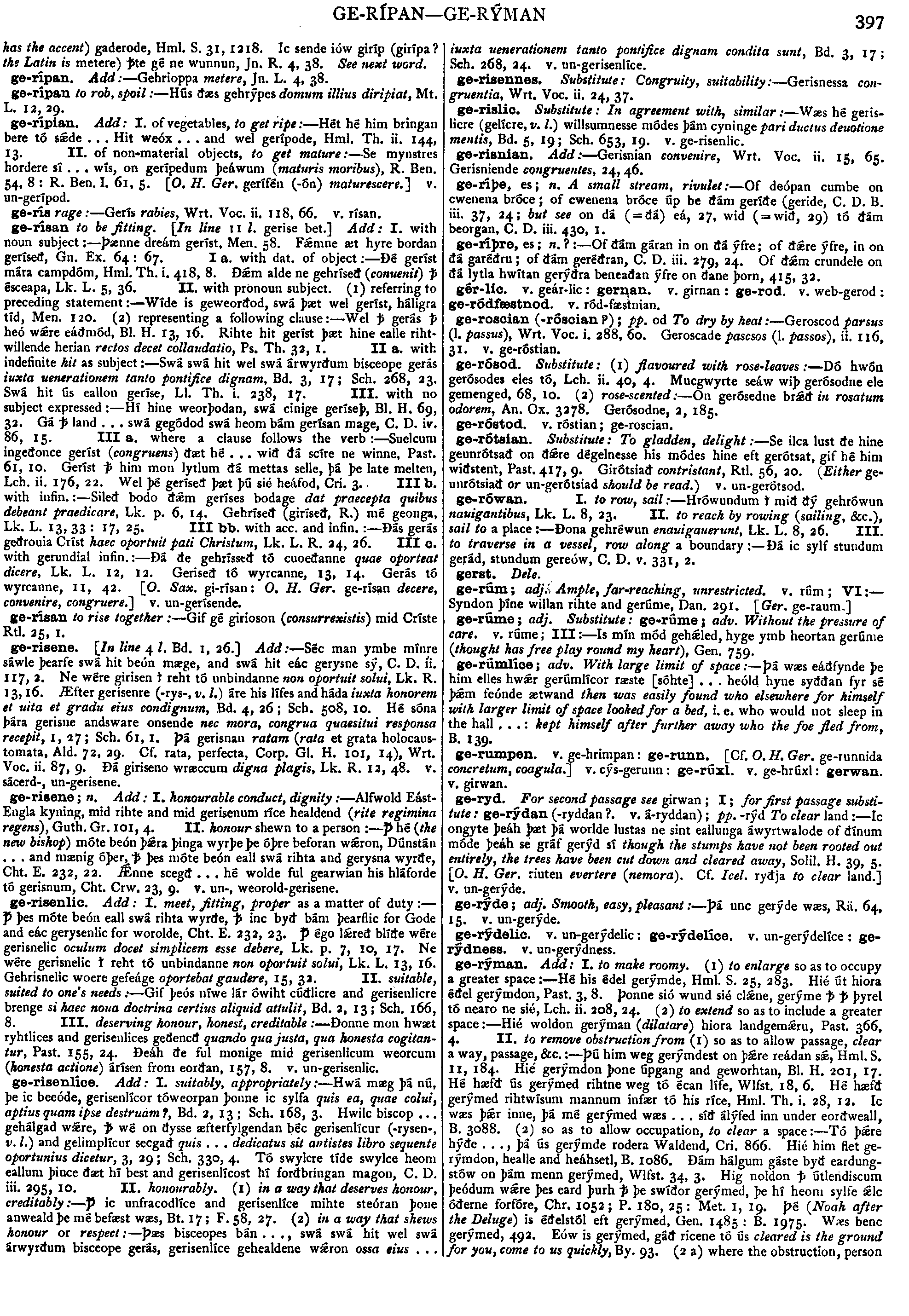
ge-rípian. Adrf: I. of vegetables, to get ripe: -- HSt he him bringan here to sséde . . . Hit weóx . . . and wel gerípode, Hml. Th. ii. 144, 13. II. of non-material objects , to get mature :-- Se mynstres hordere si. . . wis, on gerípedum þeáwum (maturis moribus), R. Ben. 54, 8 : R. Ben. I. 61, 5. [O. H. Ger. gerefen (-6n) maturescere. '] v.
|
Source: Bosworth/Toller, page d0400, entry 2 View original page image as: [TIFF] [PNG] [View previous entry] [View next entry] |
[Comment on this entry] [View comments] |
The following entry has been hand-corrected once. |
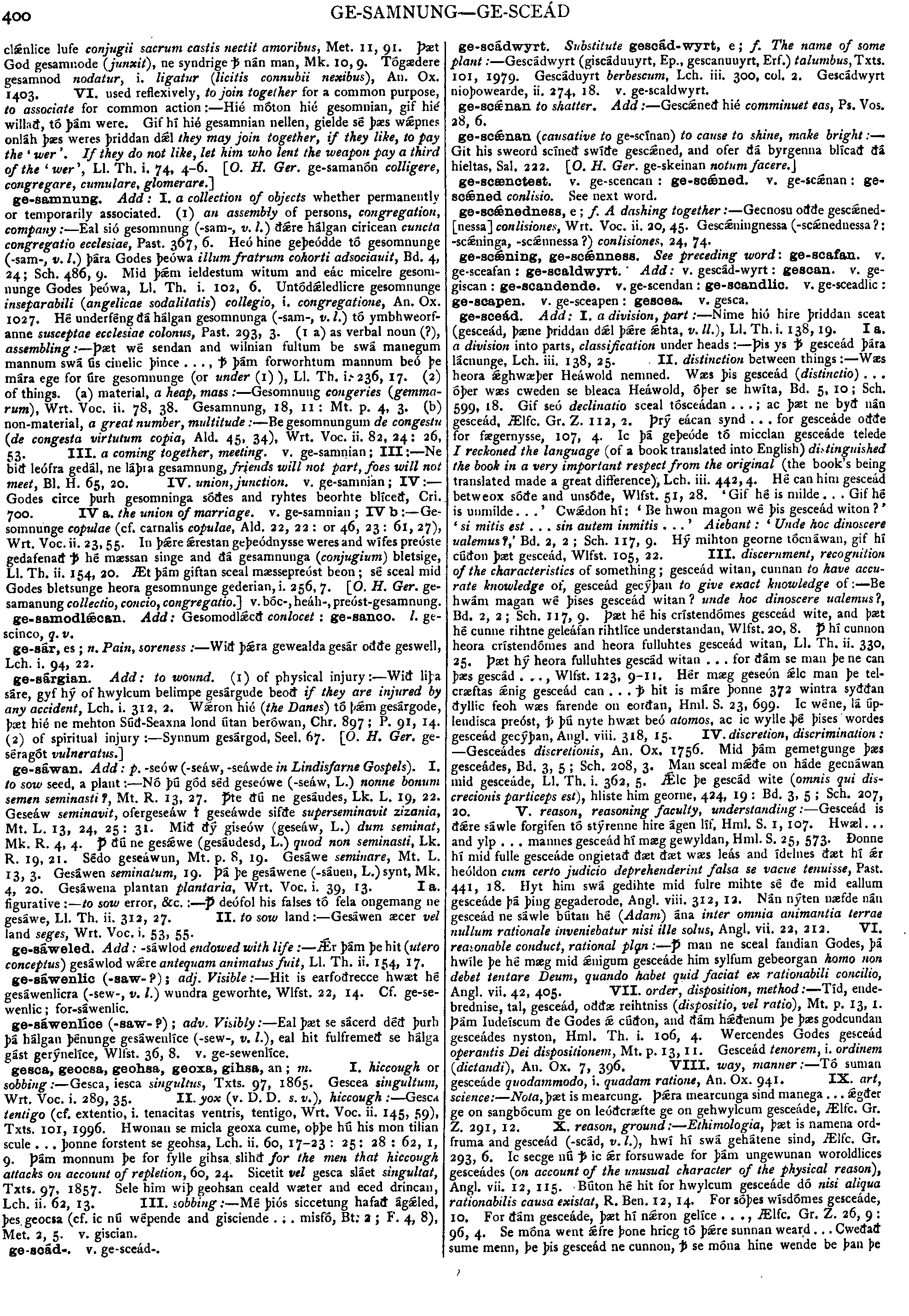
ge-samnung.
Add;
I.
a
collection
of
objects
whether
permanently
or
temporarily
associated.
(l)
an
assembly
of
persons,
congregation
company
:--
Eal
sió
gesomnung
(-sam-,
v.l.)
ðre
hálgan
ciricean
cuncto
congregatio
ecclesiae,
Past.
367,
6.
Heó
hine
geþeódde
tó
gesomnunge
(-sam-,
v.l.)
þára
Godes
þeówa
illum
fratrum
cohorti
adsociauit,
Bd.
4
24;
Sch.
486,
9.
Mid
þm
ieldestum
witum
and
eác
micelre
gesomnunge
Godes
þeówa,
Ll.
Th.
i.
102,
6.
Untðdledlicre
gesomnunge
inseparabili
(angelicae
sodalitatis)
collegio,
i.
congregatione,
An.
Ox
1027.
Hé
underféng
ðá
hálgan
gesomnunga
(-sam-,
v.l.)
tó
ymbhweorfanne
susceptae
ecclesiae
colonus,
Past.
293,
3.
(i
a)
as
verbal
noun
(?)
assembling
:--
Þæt
wé
sendan
and
wilnian
fultum
be
swá
manegum
mannum
swá
ús
cinelic
þince
.
.
.
,
 þám
forworhtum
mannum
beó
þe
mára
ege
for
úre
gesomnunge
(or
under
(I)
),
Ll.
Th.
Í.
236,
17.
(2)
of
things,
(a)
material,
a
heap,
mass
:--
Gesomnung
congeries
(gemmarum],
Wrt.
Voc.
ii.
78,
38.
Gesamnung,
18,
II
:
Mt.
p.
4,
3.
(b)
non-material,
a
great
number,
multitude
:--
Be
gesomnungum
de
congestu
(de
congesta
virtutum
copia,
Ald.
45,
34),
Wrt.
Voc.
ii.
82,
24:
26
53.
III.
a
coming
together,
meeting,
v.
ge-samnian;
III
:--
Ne
bið
leófra
gedál,
ne
láþra
gesamnung,
friends
will
not
part,
foes
will
no
meet,
Bl.
H.
65,
20.
IV.
union,
junction,
v.
ge-samnian;
IV
:--
Godes
circe
þurh
gesomninga
sóðes
and
ryhtes
beorhte
blíceð,
Cri
700.
IV
a.
the
union
of
marriage,
v.
ge-samnian
;
IV
b
:--
Gesomnunge
copulae
(cf.
carnalis
copulae,
Ald.
22,
22
:
or
46,
23
:
61,
27)
Wrt.
Voc.
ii.
23,
55.
In
þre
restan
geþeódnysse
weres
and
wífes
preóst.
gedafenað
hé
mæssan
singe
and
ðá
gesamnunga
(conjugium)
bletsige
Ll.
Th.
ii.
154,
20.
Æt
þám
giftan
sceal
mæssepreóst
beon;
sé
sceal
mic
Godes
bletsunge
heora
gesomnunge
gederian,
i.
256,
7.
[O.H.Ger.
ge-samanung
collectio,
concio,
congregatio.]
v.
bóc-,
heáh-,
preóst-gesamnung.
þám
forworhtum
mannum
beó
þe
mára
ege
for
úre
gesomnunge
(or
under
(I)
),
Ll.
Th.
Í.
236,
17.
(2)
of
things,
(a)
material,
a
heap,
mass
:--
Gesomnung
congeries
(gemmarum],
Wrt.
Voc.
ii.
78,
38.
Gesamnung,
18,
II
:
Mt.
p.
4,
3.
(b)
non-material,
a
great
number,
multitude
:--
Be
gesomnungum
de
congestu
(de
congesta
virtutum
copia,
Ald.
45,
34),
Wrt.
Voc.
ii.
82,
24:
26
53.
III.
a
coming
together,
meeting,
v.
ge-samnian;
III
:--
Ne
bið
leófra
gedál,
ne
láþra
gesamnung,
friends
will
not
part,
foes
will
no
meet,
Bl.
H.
65,
20.
IV.
union,
junction,
v.
ge-samnian;
IV
:--
Godes
circe
þurh
gesomninga
sóðes
and
ryhtes
beorhte
blíceð,
Cri
700.
IV
a.
the
union
of
marriage,
v.
ge-samnian
;
IV
b
:--
Gesomnunge
copulae
(cf.
carnalis
copulae,
Ald.
22,
22
:
or
46,
23
:
61,
27)
Wrt.
Voc.
ii.
23,
55.
In
þre
restan
geþeódnysse
weres
and
wífes
preóst.
gedafenað
hé
mæssan
singe
and
ðá
gesamnunga
(conjugium)
bletsige
Ll.
Th.
ii.
154,
20.
Æt
þám
giftan
sceal
mæssepreóst
beon;
sé
sceal
mic
Godes
bletsunge
heora
gesomnunge
gederian,
i.
256,
7.
[O.H.Ger.
ge-samanung
collectio,
concio,
congregatio.]
v.
bóc-,
heáh-,
preóst-gesamnung.
|
Source: Bosworth/Toller, page d0401, entry 3 View original page image as: [TIFF] [PNG] [View previous entry] [View next entry] |
[Comment on this entry] [View comments] |
The following entry has been hand-corrected once. |
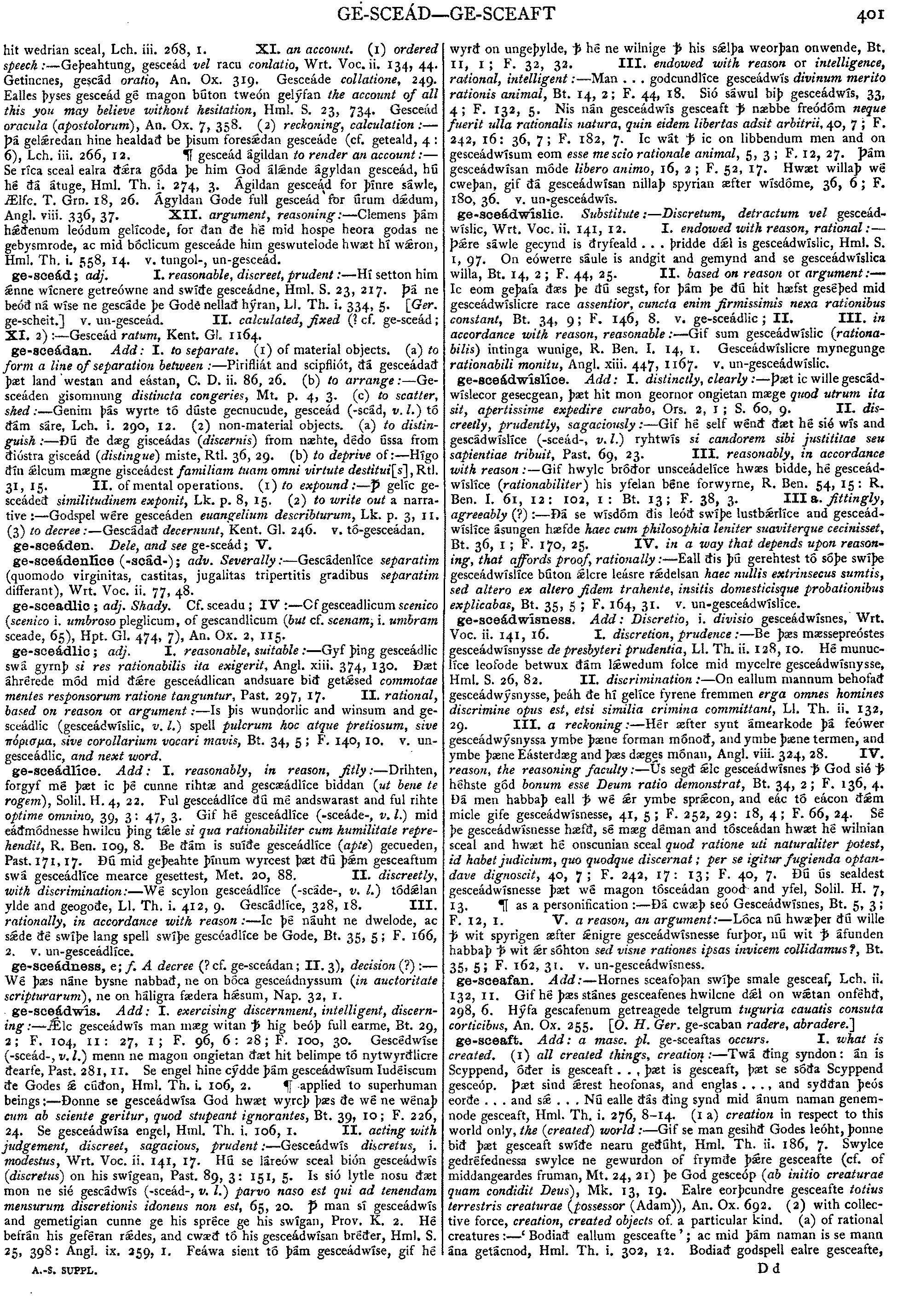
ge-sceádan.
Add:
I.
to
separate.
(l)
of
material
objects,
(a)
to
form
a
line
of
separation
between
:--
Pirifliát
and
scipfliót,
ðá
gesceádað
þæt
land
westan
and
eástan,
C.
D.
ii.
86,
26.
(b)
to
arrange
:--
Gesceáden
gisomnung
distincta
congeries,
Mt.
p.
4,
3.
(c)
to
scatter,
shed
:--
Genim
þás
wyrte
tó
dúste
gecnucude,
gesceád
(-scád,
v.l.)
tó
ðám
sáre,
Lch,
i.
290,
12.
(2)
non-material
objects,
(a)
to
distinguish
:--
Ðú
ðe
dæg
gisceádas
(discernis)
from
næhte,
dédo
ússa
from
ðióstra
gisceád
(distingue)
miste,
Rtl.
36,
29.
(b)
to
deprive
of
:--
Hígo
ðín
lcum
mægne
gisceádest
familiam
tuam
omni
virtute
destitui(s)],
Rtl.
31,
15.
II.
of
mental
operations.
(l)
to
expound
:--
Þ
UNCERTAIN
gelíc
ge-sceádeð
similitudinem
exponit,
Lk.
p.
8,
15.
(2)
to
write
out
a
narrative
:--
Godspel
wére
gesceáden
euangelium
describturum,
Lk.
p.
3,
ll.
(3)
to
decree:
--
Gescádað
decernunt,
Kent.
Gl.
246.
v.
tó-gesceádan
|
Source: Bosworth/Toller, page d0401, entry 15 View original page image as: [TIFF] [PNG] [View previous entry] [View next entry] |
[Comment on this entry] [View comments] |
The following entry has been hand-corrected once. |
ge-sceaft.
Add:
a
masc.
pl.
ge-sceaftas
occurs.
I.
what
is
created,
(l)
all
created
things,
creation
:--
Twá
ðing
syndon;
án
is
Scyppend,
óðer
is
gesceaft
.
.
.
þæt
is
gesceaft,
þæt
se
sóða
Scyppend
gesceóp.
Þæt
sind
rest
heofonas,
and
englas
.
.
.
,
and
syððan
þeós
eorðe
.
.
.
and
s.
.
.
Nú
ealle
ðás
ðing
synd
mid
ánum
naman
genemnode
gesceaft,
Hml.
Th.
i.
276,
8-14.
(l
a)
creation
in
respect
to
this
world
only,
the
(created)
world
:--
Gif
se
man
gesihð
Godes
leóht,
þonne
bið
þæt
gesceaft
swíðe
nearu
geðúht,
Hml.
Th.
ii.
186,
7.
Swylce
gedréfednessa
swylce
ne
gewurdon
of
frymðe
þre
gesceafte
(cf.
of
middangeardes
fruman,
Mt.
24,
21)
þe
God
gesceóp
(ab
initio
creaturae
quam
condidit
Deus),
Mk.
13,
19.
Ealre
eorþcundre
gesceafte
totius
terrestris
creaturae
(possessor
(Adam)),
An.
Ox.
692.
(2)
with
collective
force,
creation,
created
objects
of.
a
particular
kind,
(a)
of
rational
creatures
:--
'Bodiað
eallum
gesceafte';
ac
mid
þám
naman
is
se
mann
ána
getácnod,
Hml.
Th.
i.
302,
12.
Bodiað
godspell
ealre
gesceafte,
|
Source: Bosworth/Toller, page d0402, entry 15 View original page image as: [TIFF] [PNG] [View previous entry] [View next entry] |
[Comment on this entry] [View comments] |
The following entry has been hand-corrected once. |
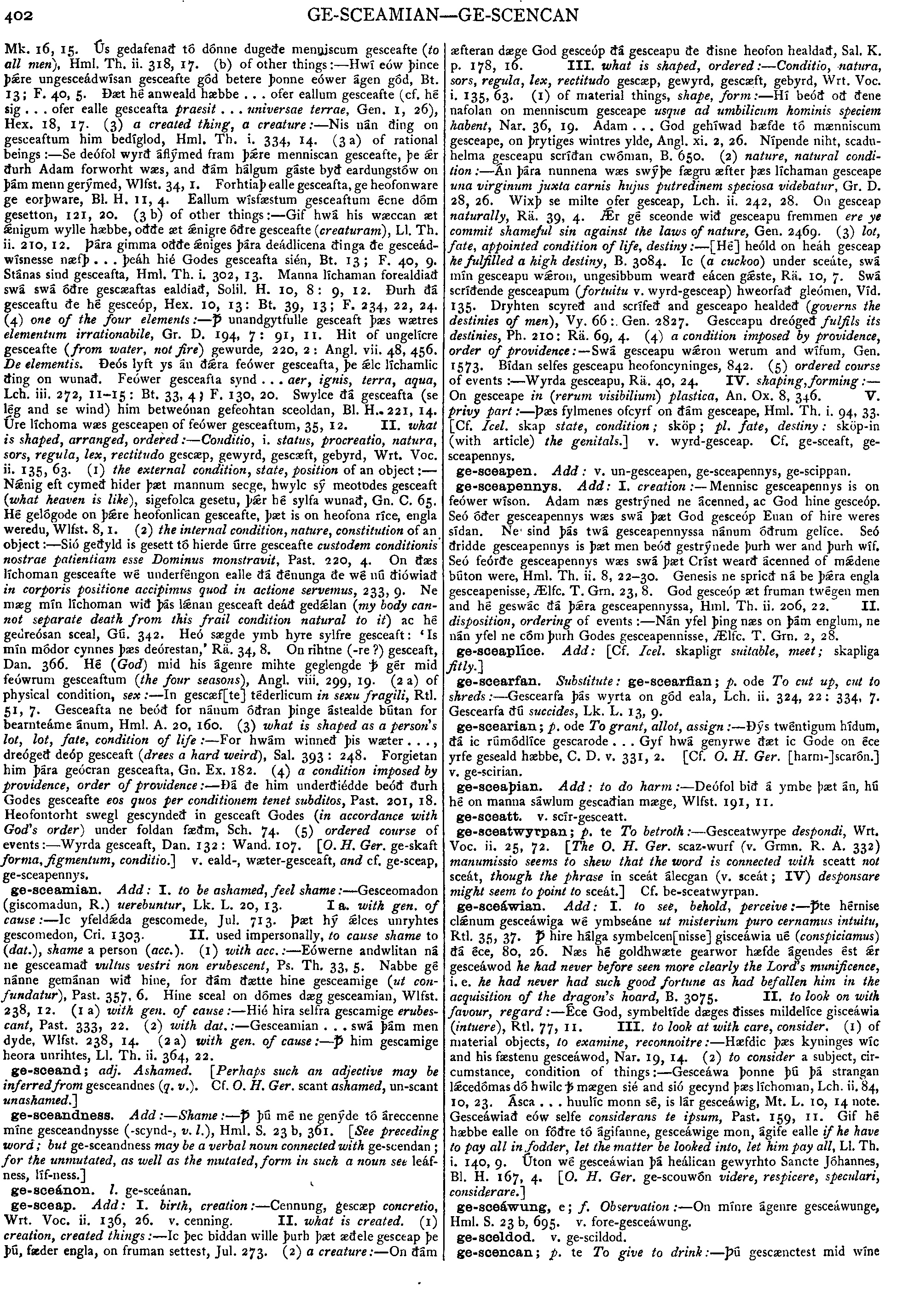
ge-sceáwian.
Add:
I.
to
see,
behold,
perceive
:--
Þ
UNCERTAINte
hérnise
clnum
gesceáwiga
wé
ymbseáne
ut
misterium
puro
cernamus
intuitu,
Rtl.
35,
37.
Þ
UNCERTAIN
hire
hálga
symbelcen[nisse]
gisceáwia
ué
(conspiciamus)
ðá
éce,
80,
26.
Næs
hé
goldhwæte
gearwor
hæfde
ágendes
ést
r
gesceáwod
he
had
never
before
seen
more
clearly
the
Lord's
munificence,
i.
e.
he
had
never
had
such
good
fortune
as
had
befallen
him
in
the
acquisition
of
the
dragon's
hoard,
B.
3075.
II.
to
look
on
with
favour,
regard
:--
Éce
God,
symbeltíde
dæges
ðisses
mildelíce
gisceáwia
(intuere),
Rtl.
77,
III.
to
look
at
with
care,
consider.
(l)
of
material
objects,
to
examine,
reconnoitre
:--
Hæfdic
þæs
kyninges
wíc
and
his
fæstenu
gesceáwod,
Nar.
19,
14.
(2)
to
consider
a
subject,
circumstance,
condition
of
things
:--
Gesceáwa
þonne
þú
þá
strangan
lcedómas
dó
hwilc
mægen
sié
and
sió
gecynd
þæs
líchoman,
Lch.
ii.
84,
10,
23.
Ásca
.
.
.
huulíc
monn
sé,
is
lár
gesceáwig,
Mt.
L.
10,
14
note.
Gesceáwiað
eów
selfe
considerans
te
ipsum,
Past.
159,
Gif
hé
hæbbe
ealle
on
fóðre
tó
ágifanne,
gesceáwige
mon,
ágife
ealle
if
he
have
to
pay
all
in
fodder,
let
the
matter
be
looked
into,
let
him
pay
all.
Ll.
Th.
i.
140,
9.
Úton
wé
gesceáwian
þá
heálican
gewyrhto
Sancte
Jóhannes,
Bl.
H.
167,
4.
[O.H.Ger.
ge-scouwón
videre,
respicere,
speculari,
considerare.
|
Source: Bosworth/Toller, page d0409, entry 14 View original page image as: [TIFF] [PNG] [View previous entry] [View next entry] |
[Comment on this entry] [View comments (1)] |
The following entry has been hand-corrected once. |
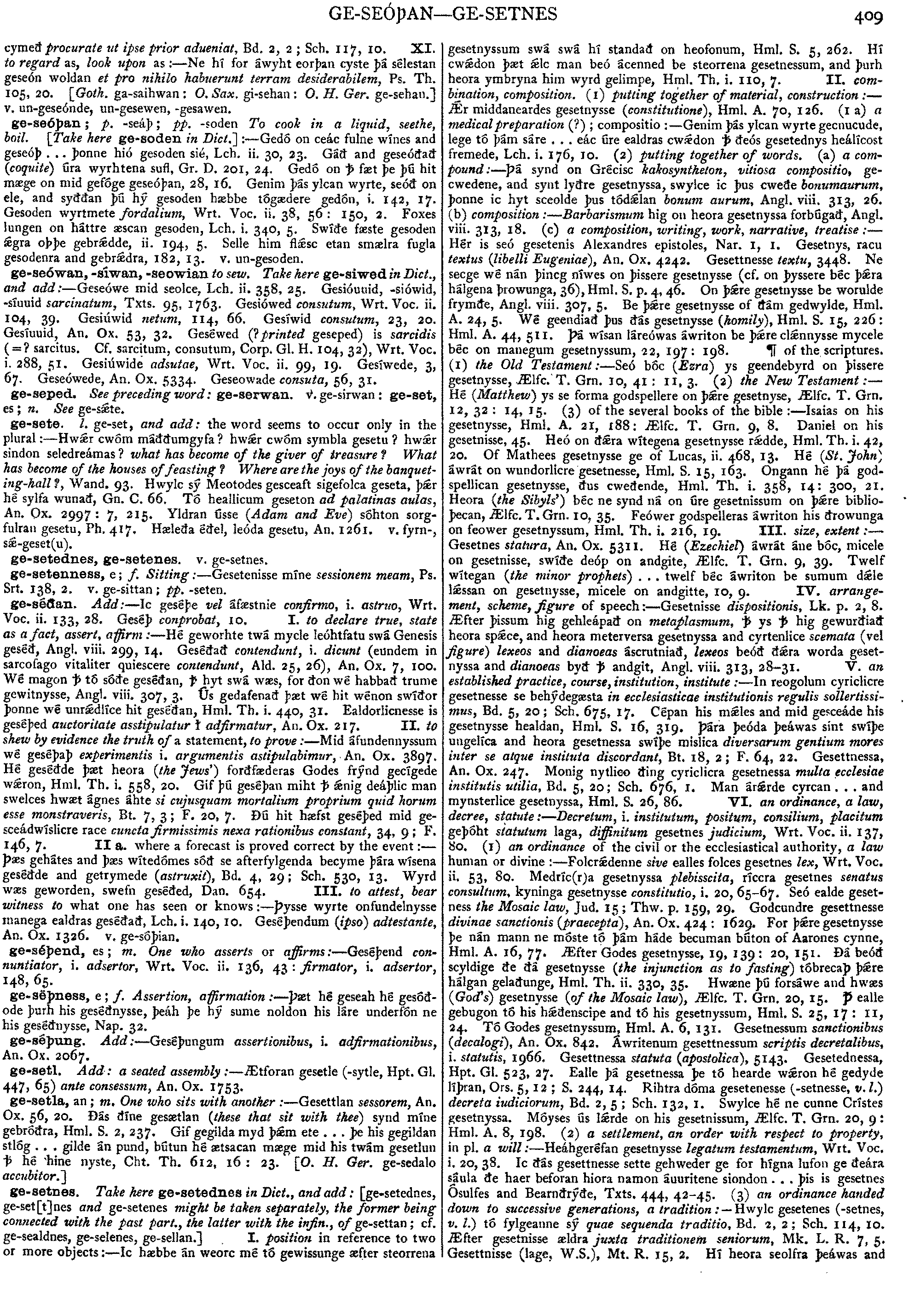
ge-setnes.
Take
here
ge-setednes
in
Dict.,
and
add:
[ge-setednes,
ge-set[t]nes
and
ge-setenes
might
be
taken
separately,
the
former
being
connected
with
the
past
part.,
the
latter
with
the
infin.
of
ge-settan;
cf.
ge-sealdnes,
ge-selenes,
ge-sellan.]
I.
position
in
reference
to
two
or
more
objects
:--
Ic
hæbbe
án
weorc
mé
tó
gewissunge
sefter
steorrena
gesetnyssum
swá
swá
hí
standað
on
heofonum.
Hml.
S.
5,
262.
Hí
cwdon
þæt
lc
man
beó
ácenned
be
steorrena
gesetnessum,
and
þurh
heora
ymbryna
him
wyrd
gelimpe,
Hml.
Th.
i.
110,
7.
II.
combination,
composition,
(i)
putting
together
of
material,
construction
:--
Æ-acute;r
middaneardes
gesetnysse
(constitutione),
Hml.
A.
70,
126.
(l
a)
a
medical
preparation
(?)
;
compositio
:--
Genim
þás
ylcan
wyrte
gecnucude,
lege
tó
þám
sáre
.
.
.
eác
úre
ealdras
cwdon
ðeós
gesetednys
heálícost
fremede,
Lch.
i.
176,
10.
(a)
putting
together
of
words,
(a)
a
compound
:--
Þá
synd
on
Grécisc
kakosynthelon,
vitiosa
compositio,
gecwedene,
and
synt
lyðre
gesetnyssa,
swylce
ic
þus
cweðe
bonumaurum,
þonne
ic
hyt
sceolde
þus
tódlan
bonum
aurum,
Angl.
viii.
313,
26.
(b)
composition
:--
Barbarismum
hig
on
heora
gesetnyssa
forbúgað,
Angl.
viii.
313,
18.
(c)
a
composition,
writing,
work,
narrative,
treatise
:--
Hér
is
seó
gesetenis
Alexandres
epistoles,
Nar.
I.
I.
Gesetnys,
racu
textus
(libelli
Eugeniae),
An.
Ox.
4242.
Gesettnesse
textu,
3448.
Ne
secge
wé
nán
þincg
níwes
on
þissere
gesetnysse
(cf.
on
þyssere
béc
þra
hálgena
þrowunga,
36),
Hml.
S.
p.
4,
46.
On
þre
gesetnysse
be
worulde
frymðe,
Angl.
viii.
307,
5.
Be
þre
gesetnysse
of
ðám
gedwylde,
Hml.
A.
24,
5.
Wé
geendiað
þus
ðás
gesetnysse
(homily),
Hml.
S.
15,
226:
Hml.
A.
44,
511.
Þá
wísan
láreówas
áwriton
be
þre
clnnysse
mycele
béc
on
manegum
gesetnyssum,
22,
197:
198.

of
the
scriptures,
(l)
the
Old
Testament
:--
Seó
bóc
(Ezra)
ys
geendebyrd
on
þissere
gesetnysse,
Ælfc.
T.
Grn.
lo,
41
:
Ii,
3.
(2)
the
New
Testament
:--
Hé
(Matthew)
ys
se
forma
godspellere
on
þaére
gesetnyse,
Ælfc.
T.
Grn.
12,
32
:
14,
15.
(3)
of
the
several
books
of
the
bible
:--
Isaias
on
his
gesetnysse,
Hml.
A.
21,
188:
Ælfc.
T.
Grn.
9,
8.
Daniel
on
his
gesetnisse,
45.
Heó
on
ðra
wítegena
gesetnysse
rdde,
Hml.
Th.
i.
42,
20.
Of
Mathees
gesetnysse
ge
of
Lucas,
ii.
468,
13.
Hé
(St.
John)
áwrát
on
wundorlicre
gesetnesse,
Hml.
S.
15,
163,
Ongann
hé
þá
godspellican
gesetnysse,
ðus
cweðende,
Hml.
Th.
i.
358,
14:
300,
21.
Heora
(the
Sibyls')
béc
ne
synd
ná
on
úre
gesetnissum
on
þre
biblioþecan,
Ælfc.
T.
Grn.
10,
35.
Feówer
godspelleras
áwriton
his
ðrowunga
on
feower
gesetnyssum,
Hml.
Th.
i.
216,
19.
III.
size,
extent
:--
Gesetnes
statura,
An.
Ox.
5311.
Hé
(Ezechiel)
áwrát
áne
bóc,
micele
on
gesetnisse,
swíðe
deóp
on
andgite,
Ælfc.
T.
Grn.
9,
39.
Twelf
wítegan
(the
minor
prophets)
.
.
.
twelf
béc
áwriton
be
sumum
dle
lssan
on
gesetnysse,
micele
on
andgitte,
10,
9.
IV.
arrangement,
scheme,
figure
of
speech
:--
Gesetnisse
dispositions,
Lk.
p.
2,
8.
Æfter
þissum
hig
gehleápað
on
metaplasmum,
ys
hig
gewurðiað
heora
spce,
and
heora
meterversa
gesetnyssa
and
cyrtenlice
scemata
(vel
figure)
lexeos
and
dianoeas
áscrutniað,
lexeos
beóð
ðra
worda
gesetnyssa
and
dianoeas
byð
andgit,
Angl.
viii.
313,
28-31.
V.
an
established
practice,
course,
institution,
institute
:--
In
reogolum
cyriclicre
gesetnesse
se
behýdegæsta
in
ecclesiasticae
institutionis
regulis
sollertissimus,
Bd.
5,
20;
Sch.
675,
17.
Cépan
his
mles
and
mid
gesceáde
his
gesetnysse
healdan,
Hml.
S.
16,
319.
Þára
þeóda
þeáwas
sint
swíþe
ungelíca
and
heora
gesetnessa
swíþe
mislica
diversarum
gentium
mores
inter
se
atque
instituta
discordant,
Bt.
18,
2;
F.
64,
22.
Gesettnessa,
An.
Ox.
247.
Monig
nytlico
ðing
cyriclicra
gesetnessa
multa
ecclesiae
institutis
utilia,
Bd.
5,
20;
Sch.
676,
1.
Man
árrde
cyrcan
.
.
.
and
mynsterlice
gesetnyssa,
Hml.
S.
26,
86.
VI.
an
ordinance,
a
law,
decree,
statute
:--
Decretum,
i.
institutum,
positum,
consilium,
placitum
geþóht
statutum
laga,
diffinitum
gesetnes
judicium,
Wrt.
Voc.
ii.
137,
80.
(l)
an
ordinance
of
the
civil
or
the
ecclesiastical
authority,
a
law
human
or
divine
:--
Folcrdenne
sive
ealles
folces
gesetnes
lex,
Wrt.
Voc.
ii.
53,
80.
Medríc(r)a
gesetnyssa
plebisscita,
ríccra
gesetnes
senatus
consultum,
kyninga
gesetnysse
constitutio,
i.
20,
65-67.
Seó
ealde
gesetness
the
Mosaic
law,
Jud.
15
;
Thw.
p.
159,
29.
Godcundre
gesettnesse
divinae
sanctionis
(praecepta),
An.
Ox.
424
:
1629.
For
þre
gesetnysse
þe
nán
mann
ne
móste
tó
þám
háde
becuman
búton
of
Aarones
cynne,
Hml.
A.
16,
77.
Æfter
Godes
gesetnysse,
19,
139
:
20,
151.
Ðá
beóð
scyldige
ðe
ðá
gesetnysse
(the
injunction
as
to
fasting)
tóbrecaþ
þre
hálgan
gelaðunge,
Hml.
Th.
ii.
330,
35.
Hwæne
þú
forsáwe
and
hwæs
(God's)
gesetnysse
(of
the
Mosaic
law),
Ælfc.
T.
Grn.
20,
15.
Þ
UNCERTAIN
ealle
gebugon
tó
his
hðenscipe
and
tó
his
gesetnyssum,
Hml.
S.
25,
17
:
Ii,
24.
Tó
Godes
gesetnyssum,
Hml.
A.
6,
131.
Gesetnessum
sanctionibus
(decalogi),
An.
Ox.
842.
Áwritenum
gesettnessum
scriptis
decretalibus,
i.
statutis,
1966.
Gesettnessa
statuta
(apostolica),
5143.
Gesetednessa,
Hpt.
Gl.
523,
27.
Ealle
þá
gesetnessa
þe
tó
hearde
wron
hé
gedyde
líþran.
Ors.
5,
12
;
S.
244,
14.
Rihtra
dóma
gesetenesse
(-setnesse,
v.l.)
decreta
iudiciorum,
Bd.
2,
5
;
Sch.
132,
l.
Swylce
hé
ne
cunne
Crístes
gesetnyssa.
Móyses
ús
lrde
on
his
gesetnissum,
Ælfc.
T.
Grn.
20,
9
:
Hml.
A.
8,
198.
(2)
a
settlement,
an
order
with
respect
to
property,
in
pl.
a
will
:--
Heáhgeréfan
gesetnysse
legatum
testamentum,
Wrt.
Voc.
i.
20,
38.
Ic
ðás
gesettnesse
sette
gehweder
ge
for
hígna
lufon
ge
ðeára
sáula
ðe
haer
beforan
hiora
namon
áuuritene
siondon
.
.
.
þis
is
gesetnes
Ósulfes
and
Bearnðrýðe,
Txts.
444,
42-45.
(3)
an
ordinance
handed
down
to
successive
generations,
a
tradition
:--
Hwylc
gesetenes
(-setnes,
v.l.)
tó
fylgeanne
sý
quae
sequenda
traditio,
Bd.
2,
2;
Sch.
114,
10.
Æfter
gesetnisse
ældra
juxta
traditionem
seniorum,
Mk.
L.
R.
7,
5.
Gesettnisse
(lage,
W.S.),
Mt.
R.
15,
2.
Hí
heora
seolfra
þeáwas
and
|
Source: Bosworth/Toller, page d0410, entry 3 View original page image as: [TIFF] [PNG] [View previous entry] [View next entry] |
[Comment on this entry] [View comments] |
The following entry has been hand-corrected once. |
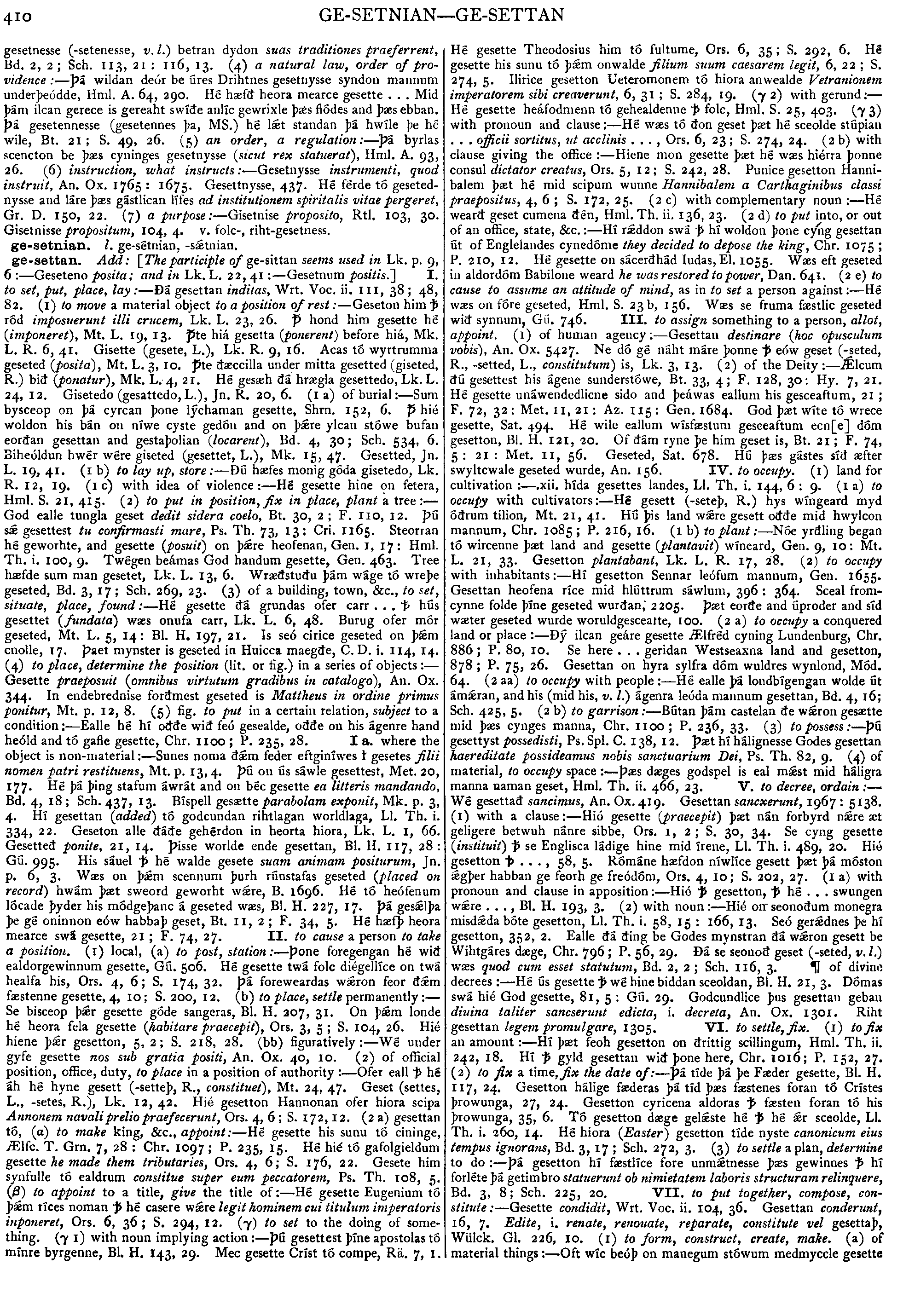
ge-settan.
Add:
[The
participle
of
ge-sittan
seems
used
in
Lk.
p.
9,
6
:--
Geseteno
posita;
and
in
Lk.
L.
22,
41
:--
Gesetnum
positis.]
I.
to
set,
put,
place,
lay
:--
Ðá
gesettan
inditas,
Wrt.
Voc.
ii.
111,
38
;
48,
82.
(l)
to
move
a
material
object
to
a
position
of
rest
:--
Geseton
him
ród
imposuerunt
illi
crucem,
Lk.
L.
23,
26.
Þ
UNCERTAIN
hond
him
gesette
hé
(imponeret),
Mt.
L.
19,
13.
Þ
UNCERTAINte
hiá
gesetta
(ponerent)
before
hiá,
Mk.
L.
R.
6,
41.
Gisette
(gesete,
L.
),
Lk.
R.
9,
16.
Acas
tó
wyrtrumma
geseted
(posita),
Mt.
L.
3,
10.
Þ
UNCERTAIN;te
ðæccilla
under
mitta
gesetted
(giseted,
R.)
bið
(ponatur),
Mk.
L.
4,
21.
Hé
gesæh
ðá
hrægla
gesettedo.
Lk.
L.
24,
12.
Gisetedo
(gesattedo,
L.),
Jn.
R.
20,
6.
(Ia)
of
burial
:--
Sum
bysceop
on
þá
cyrcan
þone
lýchaman
gesette.
Shrn.
152,
6.
Þ
UNCERTAIN
hié
woldon
his
bán
on
níwe
cyste
gedón
and
on
þre
ylcan
stówe
bufan
eorðan
gesettan
and
gestaþolian
(locarent),
Bd.
4,
30;
Sch.
534,
6.
Biheóldun
hwér
wére
giseted
(gesettet,
L.),
Mk.
15,
47.
Gesetted,
Jn.
L.
19,
41.
(i
b)
to
lay
up,
store
:--
Ðú
hæfes
monig
góda
gisetedo,
Lk.
R.
12,
19.
(i
c)
with
idea
of
violence
:--
Hé
gesette
hine
on
fetera,
Hml.
S.
21,
415.
(2)
to
put
in
position,
fix
in
place,
plant
a
tree
:--
God
ealle
tungla
geset
dedit
sidera
coelo,
Bt.
30,
2;
F.
110,
12.
Þú
sgesettest
tu
confirmasti
mare,
Ps.
Th.
73,
13:
Cri.
1165.
Steorran
hé
geworhte,
and
gesette
(posuit)
on
þre
heofenan,
Gen.
I.
17
:
Hml.
Th.
i.
100,
9.
Twégen
beámas
God
handum
gesette,
Gen.
463.
Tree
hæfde
sum
man
gesetet,
Lk.
L.
13,
6.
Wræðstuðu
þám
wáge
tó
wreþe
geseted,
Bd.
3,
17
;
Sch.
269,
23.
(3)
of
a
building,
town,
&c.,
to
set,
situate,
place,
found
:--
Hé
gesette
ðá
grundas
ofer
carr
.
.
.
hús
gesettet
(fundata)
wæs
onufa
carr,
Lk.
L.
6,
48.
Burug
ofer
mór
geseted.
Mt.
L.
5,
14:
Bl.
H.
197,
21.
Is
seó
cirice
geseted
on
þm
cnolle,
17.
Þaet
mynster
is
geseted
in
Huicca
maegðe,
C.
D.
i.
114,
14.
(4)
to
place,
determine
the
position
(lit.
or
fig.)
in
a
series
of
objects
:--
Gesette
praeposuit
(omnibus
virtutum
gradibus
in
catalogo),
An.
Ox.
344.
In
endebrednise
forðmest
geseted
is
Mattheus
in
ordine
primus
ponitur,
Mt.
p.
12,
8.
(5)
fig.
to
put
in
a
certain
relation,
subject
to
a
condition
:--
Ealle
heé
hí
oððe
wið
feó
gesealde,
oððe
on
his
ágenre
hand
heóld
and
tó
gafle
gesette,
Chr.
noo
;
P.
235,
28.
I
a.
where
the
object
is
non-material
:--
Sunes
noma
ðm
feder
eftginíwes
 gesetes
filii
nomen
patri
restituens,
Mt.
p.
13,
4.
Þú
on
ús
sáwle
gesettest.
Met.
20,
177.
Hé
þá
þing
stafum
áwrát
and
on
béc
gesette
ea
litteris
mandando,
Bd.
4,
18
;
Sch.
437,
13.
Bíspell
gesætte
parabolam
exponit,
Mk.
p.
3,
4.
Hí
gesettan
(added)
to
godcundan
rihtlagan
worldlaga,
Ll.
Th.
i.
334,
22.
Geseton
alle
ðáðe
gehérdon
in
heorta
hiora,
Lk.
L.
l,
66.
Gesetteð
ponite,
21,
14.
Þisse
worlde
ende
gesettan,
Bl.
H.
117,
28:
Gü.
995.
His
sáuel
hé
walde
gesete
suam
animam
positurum,
Jn.
p.
6,
3.
Wæs
on
þm
scennum
þurh
rúnstafas
geseted
(placed
on
record)
hwám
þæt
sweord
geworht
wre,
B.
1696.
Hé
tó
heofenum
lócade
þyder
his
módgeþanc
á
geseted
wæs,
Bl.
H.
227,
17.
Þá
geslþa
þe
gé
oninnon
eów
habbaþ
geset,
Bt.
11,
2;
F.
34,
5.
Hé
hæfþ
heora
mearce
swá
gesette,
21;
F.
74,
27.
II.
to
cause
a
person
to
take
a
position,
(l)
local,
(a)
to
post,
station
:--
Þone
foregengan
hé
wið
ealdorgewinnum
gesette,
Gü.
506.
Hé
gesette
twá
folc
diégellíce
on
twá
healfa
his,
Ors.
4,
6
;
S.
174,
32.
Þá
foreweardas
wron
feor
ðm
fæstenne
gesette,
4,
10;
S.
200,
12.
(b)
to
place,
settle
permanently
:--
Se
bisceop
þr
gesette
góde
sangeras,
Bl.
H.
207,
31.
On
þm
londe
hé
heora
fela
gesette
(habitare
praecepit),
Ors.
3,
5
;
S.
104,
26.
Hié
hiene
þr
gesetton,
5,
2;
S.
218,
28.
(bb)
figuratively
:--
Wé
under
gyfe
gesette
nos
sub
gratia
positi,
An.
Ox.
40,
10.
(2)
of
official
position,
office,
duty,
to
place
in
a
position
of
authority
:--
Ofer
eall
hé
áh
hé
hyne
gesett
(-setteþ,
R.,
constituet],
Mt.
24,
47.
Geset
(settes,
L.,
-setes,
R.),
Lk.
12,
42.
Hié
gesetton
Hannonan
ofer
hiora
scipa
Annonem
navali
prelio
praefecerunt,
Ors.
4,
6
;
S.
172,
12.
(2
a)
gesettan
tó,
(
gesetes
filii
nomen
patri
restituens,
Mt.
p.
13,
4.
Þú
on
ús
sáwle
gesettest.
Met.
20,
177.
Hé
þá
þing
stafum
áwrát
and
on
béc
gesette
ea
litteris
mandando,
Bd.
4,
18
;
Sch.
437,
13.
Bíspell
gesætte
parabolam
exponit,
Mk.
p.
3,
4.
Hí
gesettan
(added)
to
godcundan
rihtlagan
worldlaga,
Ll.
Th.
i.
334,
22.
Geseton
alle
ðáðe
gehérdon
in
heorta
hiora,
Lk.
L.
l,
66.
Gesetteð
ponite,
21,
14.
Þisse
worlde
ende
gesettan,
Bl.
H.
117,
28:
Gü.
995.
His
sáuel
hé
walde
gesete
suam
animam
positurum,
Jn.
p.
6,
3.
Wæs
on
þm
scennum
þurh
rúnstafas
geseted
(placed
on
record)
hwám
þæt
sweord
geworht
wre,
B.
1696.
Hé
tó
heofenum
lócade
þyder
his
módgeþanc
á
geseted
wæs,
Bl.
H.
227,
17.
Þá
geslþa
þe
gé
oninnon
eów
habbaþ
geset,
Bt.
11,
2;
F.
34,
5.
Hé
hæfþ
heora
mearce
swá
gesette,
21;
F.
74,
27.
II.
to
cause
a
person
to
take
a
position,
(l)
local,
(a)
to
post,
station
:--
Þone
foregengan
hé
wið
ealdorgewinnum
gesette,
Gü.
506.
Hé
gesette
twá
folc
diégellíce
on
twá
healfa
his,
Ors.
4,
6
;
S.
174,
32.
Þá
foreweardas
wron
feor
ðm
fæstenne
gesette,
4,
10;
S.
200,
12.
(b)
to
place,
settle
permanently
:--
Se
bisceop
þr
gesette
góde
sangeras,
Bl.
H.
207,
31.
On
þm
londe
hé
heora
fela
gesette
(habitare
praecepit),
Ors.
3,
5
;
S.
104,
26.
Hié
hiene
þr
gesetton,
5,
2;
S.
218,
28.
(bb)
figuratively
:--
Wé
under
gyfe
gesette
nos
sub
gratia
positi,
An.
Ox.
40,
10.
(2)
of
official
position,
office,
duty,
to
place
in
a
position
of
authority
:--
Ofer
eall
hé
áh
hé
hyne
gesett
(-setteþ,
R.,
constituet],
Mt.
24,
47.
Geset
(settes,
L.,
-setes,
R.),
Lk.
12,
42.
Hié
gesetton
Hannonan
ofer
hiora
scipa
Annonem
navali
prelio
praefecerunt,
Ors.
4,
6
;
S.
172,
12.
(2
a)
gesettan
tó,
( )
to
make
king,
&c.,
appoint
:--
Hé
gesette
his
sunu
tó
cininge,
Ælfc.
T.
Grn.
7,
28
:
Chr.
1097
;
P.
235,
15.
Hé
hié
tó
gafolgieldum
gesette
he
made
them
tributaries,
Ors.
4,
6;
S.
176,
22.
Gesete
him
synfulle
tó
ealdrum
constitue
super
eum
peccatorem,
Ps.
Th.
108,
5.
(
)
to
make
king,
&c.,
appoint
:--
Hé
gesette
his
sunu
tó
cininge,
Ælfc.
T.
Grn.
7,
28
:
Chr.
1097
;
P.
235,
15.
Hé
hié
tó
gafolgieldum
gesette
he
made
them
tributaries,
Ors.
4,
6;
S.
176,
22.
Gesete
him
synfulle
tó
ealdrum
constitue
super
eum
peccatorem,
Ps.
Th.
108,
5.
( )
to
appoint
to
a
title,
give
the
title
of
:--
Hé
gesette
Eugenium
tó
þm
ríces
noman
hé
casere
wre
legit
hominem
cui
titulum
imperatoris
inponeret,
Ors.
6,
36;
S.
294,
12.
(
)
to
appoint
to
a
title,
give
the
title
of
:--
Hé
gesette
Eugenium
tó
þm
ríces
noman
hé
casere
wre
legit
hominem
cui
titulum
imperatoris
inponeret,
Ors.
6,
36;
S.
294,
12.
( )
to
set
to
the
doing
of
something.
(
I)
with
noun
implying
action
:--
Þú
gesettest
þíne
apostolas
tó
mínre
byrgenne,
Bl.
H.
143,
29.
Mec
gesette
Críst
tó
compe,
Rä.
7,
Hé
gesette
Theodosius
him
tó
fultume,
Ors.
6,
35
;
S.
292,
6.
Hé
gesette
his
sunu
tó
þm
onwalde
filium
suum
caesarem
legit,
6,
22
;
S.
274,
5.
Ilirice
gesetton
Ueteromonem
tó
hiora
anwealde
Vetranionem
imperatorem
sibi
creaverunt,
6,
31
;
S.
284,
19.
(
2)
with
gerund
:--
Hé
gesette
heáfodmenn
tó
gehealdenne
folc,
Hml.
S.
25,
403.
(
3)
with
pronoun
and
clause
:--
Hé
wæs
tó
ðon
geset
þæt
hé
sceolde
stúpian
.
.
.
officii
sortitus,
ut
acclinis
.
.
.
,
Ors.
6,
23;
S.
274,
24.
(2
b)
with
clause
giving
the
office
:--
Hiene
mon
gesette
þæt
hé
wæs
hiérra
þonne
consul
dictator
creatus,
Ors.
5,
12
;
S.
242,
28.
Punice
gesetton
Hannibalem
þæt
hé
mid
scipum
wunne
Hannibalem
a
Carthaginibus
classi
praepositus,
4,
6
;
S.
172,
25.
(2
c)
with
complementary
noun
:--
Hé
wearð
geset
cumena
ðén,
Hml.
Th.
ii.
136,
23.
(2
d)
to
put
into,
or
out
of
an
office,
state,
&c.
:--
Hî
rddon
swá
hî
woldon
þone
cyíig
gesettan
út
of
Englelandes
cynedóme
they
decided
to
depose
the
king,
Chr.
1075
;
P.
210,
12.
Hé
gesette
on
sácerðhád
Iudas,
El.
1055.
Wæs
eft
geseted
in
aldordóm
Babilone
weard
he
was
restored
to
power,
Dan.
641.
(2
e)
to
cause
to
assume
an
attitude
of
mind,
as
in
to
set
a
person
against
:--
Hé
wæs
on
fóre
geseted.
Hml.
S.
23
b,
156.
Wæs
se
fruma
fæstlic
geseted
wið
synnum,
Gú.
746.
III.
to
assign
something
to
a
person,
allot,
appoint.
(l)
of
human
agency
:--
Gesettan
destinare
(hoc
opuscidum
vobis],
An.
Ox.
5427.
Ne
dó
gé
náht
máre
þonne
eów
geset
(-seted,
R.,
-setted,
L.,
constitutum)
is,
Lk.
3,
13.
(2)
of
the
Deity
:--
Æ-acute;lcum
ðú
gesettest
his
ágene
sunderstówe,
Bt.
33,
4;
F.
128,
30:
Hy.
7,
21.
Hé
gesette
unáwendedlicne
sido
and
þeáwas
eallum
his
gesceaftum,
21
;
F.
72,
32:
Met.
ii.
21:
Az.
115:
Gen.
1684.
God
þæt
wíte
tó
wrece
gesette.
Sat.
494.
Hé
wile
eallum
wísfæstum
gesceaftum
ecn[e]
dóm
gesetton.
Bl.
H.
121,
20.
Of
ðám
ryne
þe
him
geset
is,
Bt.
21;
F.
74,
5
:
21
:
Met.
II,
56.
Geseted,
Sae.
678.
Hú
þæs
gástes
síd
æfter
swyltcwale
geseted
wurde,
An.
156.
IV.
to
occupy,
(l)
land
for
cultivation
:--
.xii.
hîda
gesettes
landes,
Ll.
Th.
i.
144,
6:9.
(l
a)
to
occupy
with
cultivators
:--
Hé
gesett
(-seteþ.
R.)
hys
wíngeard
myd
óðrum
tilion,
Mt.
21,
41.
Hú
þis
land
wre
gesett
oððe
mid
hwylcon
mannum,
Chr.
1085
;
P.
216,
16.
(l
b)
to
plant
;
--
Nóe
yrðling
began
tó
wircenne
þæt
land
and
gesette
(plantavit)
wíneard,
Gen.
9,
10:
Mt.
L.
21,
33.
Gesetton
plantabant,
Lk.
L.
R.
17,
28.
(2)
to
occupy
with
inhabitants
:--
Hí
gesetton
Sennar
leófum
mannum,
Gen.
1655.
Gesettan
heofena
ríce
mid
hlúttrum
sáwlum,
396
:
364.
Sceal
fromcynne
folde
þíne
geseted
wurðan,
2205.
Þæt
eorðe
and
úproder
and
síd
wæter
geseted
wurde
woruldgesceatte,
100.
(2
a)
to
occupy
a
conquered
land
or
place
:--
Ðý
ilcan
geáre
gesette
Ælfréd
cyning
Lundenburg,
Chr.
886
;
P.
80,
10.
Se
here
.
.
.
geridan
Westseaxna
land
and
gesetton,
878
;
P.
75,
26.
Gesettan
on
hyra
sylfra
dóm
wuldres
wynlond,
Mod.
64.
(2
aa)
to
occupy
with
people
:--
Hé
ealle
þá
londbígengan
wolde
út
ámran,
and
his
(mid
his,
v.l.)
ágenra
leóda
mannum
gesettan,
Bd.
4,
16;
Sch.
425,
5.
(2
b)
to
garrison
:--
Bútan
þám
castelan
ðe
wron
gesætte
mid
þæs
cynges
manna,
Chr.
iioo
;
P.
236,
33.
(3)
to
possess
:--
Þú
gesettyst
possedisti,
Ps.
Spl.
C.
138,
12.
Þæt
hí
hálignesse
Godes
gesettan
haereditaie
possideamus
nobis
sanctuarium
Dei,
Ps.
Th.
82,
9.
(4)
of
material,
to
occupy
space
:--
þæs
dæges
godspel
is
eal
mst
mid
háligra
manna
naman
geset,
Hml.
Th.
ii.
466,
23.
V.
to
decree,
ordain
:--
Wé
gesettað
sancimus,
An.
Ox.
419.
Gesettan
sancxerunt,
1967
:
5138.
(l)
with
a
clause
:--
Hió
gesette
(praecepit)
þæt
nán
forbyrd
nre
æt
geligere
betwuh
nánre
sibbe,
Ors.
l,
2
;
S.
30,
34.
Se
cyng
gesette
(instituit)
se
Englisca
ládige
hine
mid
írene,
Ll.
Th.
i.
489,
20.
Hié
gesetton
.
.
.
,
58,
5.
Rómáne
hæfdon
níwlíce
gesett
þæt
þá
móston
gþer
habban
ge
feorh
ge
freódóm,
Ors.
4,
10;
S.
202,
27.
(l
a)
with
pronoun
and
clause
in
apposition
:--
Hié
gesetton,
hé
.
.
.
swungen
wre
.
.
.
,
Bl.
H.
193,
3.
(2)
with
noun
:--
Hié
on
seonoðum
monegra
misdda
bóte
gesetton,
Ll.
Th.
i.
58,
15
:
166,
13.
Seó
gerdnes
þe
hí
gesetton,
352,
2.
Ealle
ðá
ðing
be
Godes
mynstran
ðá
wron
gesett
be
Wihtgáres
dæge,
Chr.
796;
P.
56,
29.
Ðá
se
seonoð
geset
(-seted,
v.l.)
wæs
quod
cum
esset
statutum,
Bd.
2,
2
;
Sch.
116,
3.

of
divine
decrees
:--
Hé
ús
gesette
;
wé
hine
biddan
sceoldan,
Bl.
H.
21,
3.
Dómas
swá
hié
God
gesette,
81,
5
:
Gú.
29.
Godcundlice
þus
gesettan
geban
diuina
taliter
sancserunt
edicta,
i.
decreta,
An.
Ox.
1301.
Riht
gesettan
legem
promulgare,
1305.
VI.
to
settle,
fix.
(l)
to
fix
an
amount
:--
Hí
þæt
feoh
gesetton
on
ðrittig
scillingum,
Hml.
Th.
ii.
242,
18.
Hí
gyld
gesettan
wið
þone
here,
Chr.
1016;
P.
152,
27.
(2)
to
fix
a
time,
fix
the
date
of
:--
Þá
tíde
þá
þe
Fæder
gesette,
Bl.
H.
117,
24.
Gesetton
hálige
fæderas
þá
tíd
þæs
fæstenes
foran
tó
Crístes
þrowunga,
27,
24.
Gesetton
cyricena
aldoras
fæsten
foran
tó
his
þrowunga,
35,
6.
Tó
gesetton
dæge
gelste
hé
hé
r
sceolde,
Ll.
Th.
i.
260,
14.
Hé
hiora
(Easter)
gesetton
tíde
nyste
canonicum
eius
tempus
ignorans,
Bd.
3,
17
;
Sch.
272,
3.
(3)
to
settle
a
plan,
determine
to
do
:--
Þá
gesetton
hí
fæstlíce
fore
unmtnesse
þæs
gewinnes
hí
forléte
þá
getimbro
statuerunt
ob
nimietatem
laboris
structuram
relinquere,
Bd.
3,
8;
Sch.
225,
20.
VII.
to
put
together,
compose,
constitute
:--
Gesette
condidit,
Wrt.
Voc.
ii.
104,
36.
Gesettan
conderunt,
16,
7.
Edite,
i.
renate,
renouate,
reparate,
constitute
vel
gesettaþ,
Wülck.
Gl.
226,
JO.
(l)
to
form,
construct,
create,
make,
(a)
of
material
things
:--
Oft
wíc
beóþ
on
manegum
stówum
medmyccle
gesette
)
to
set
to
the
doing
of
something.
(
I)
with
noun
implying
action
:--
Þú
gesettest
þíne
apostolas
tó
mínre
byrgenne,
Bl.
H.
143,
29.
Mec
gesette
Críst
tó
compe,
Rä.
7,
Hé
gesette
Theodosius
him
tó
fultume,
Ors.
6,
35
;
S.
292,
6.
Hé
gesette
his
sunu
tó
þm
onwalde
filium
suum
caesarem
legit,
6,
22
;
S.
274,
5.
Ilirice
gesetton
Ueteromonem
tó
hiora
anwealde
Vetranionem
imperatorem
sibi
creaverunt,
6,
31
;
S.
284,
19.
(
2)
with
gerund
:--
Hé
gesette
heáfodmenn
tó
gehealdenne
folc,
Hml.
S.
25,
403.
(
3)
with
pronoun
and
clause
:--
Hé
wæs
tó
ðon
geset
þæt
hé
sceolde
stúpian
.
.
.
officii
sortitus,
ut
acclinis
.
.
.
,
Ors.
6,
23;
S.
274,
24.
(2
b)
with
clause
giving
the
office
:--
Hiene
mon
gesette
þæt
hé
wæs
hiérra
þonne
consul
dictator
creatus,
Ors.
5,
12
;
S.
242,
28.
Punice
gesetton
Hannibalem
þæt
hé
mid
scipum
wunne
Hannibalem
a
Carthaginibus
classi
praepositus,
4,
6
;
S.
172,
25.
(2
c)
with
complementary
noun
:--
Hé
wearð
geset
cumena
ðén,
Hml.
Th.
ii.
136,
23.
(2
d)
to
put
into,
or
out
of
an
office,
state,
&c.
:--
Hî
rddon
swá
hî
woldon
þone
cyíig
gesettan
út
of
Englelandes
cynedóme
they
decided
to
depose
the
king,
Chr.
1075
;
P.
210,
12.
Hé
gesette
on
sácerðhád
Iudas,
El.
1055.
Wæs
eft
geseted
in
aldordóm
Babilone
weard
he
was
restored
to
power,
Dan.
641.
(2
e)
to
cause
to
assume
an
attitude
of
mind,
as
in
to
set
a
person
against
:--
Hé
wæs
on
fóre
geseted.
Hml.
S.
23
b,
156.
Wæs
se
fruma
fæstlic
geseted
wið
synnum,
Gú.
746.
III.
to
assign
something
to
a
person,
allot,
appoint.
(l)
of
human
agency
:--
Gesettan
destinare
(hoc
opuscidum
vobis],
An.
Ox.
5427.
Ne
dó
gé
náht
máre
þonne
eów
geset
(-seted,
R.,
-setted,
L.,
constitutum)
is,
Lk.
3,
13.
(2)
of
the
Deity
:--
Æ-acute;lcum
ðú
gesettest
his
ágene
sunderstówe,
Bt.
33,
4;
F.
128,
30:
Hy.
7,
21.
Hé
gesette
unáwendedlicne
sido
and
þeáwas
eallum
his
gesceaftum,
21
;
F.
72,
32:
Met.
ii.
21:
Az.
115:
Gen.
1684.
God
þæt
wíte
tó
wrece
gesette.
Sat.
494.
Hé
wile
eallum
wísfæstum
gesceaftum
ecn[e]
dóm
gesetton.
Bl.
H.
121,
20.
Of
ðám
ryne
þe
him
geset
is,
Bt.
21;
F.
74,
5
:
21
:
Met.
II,
56.
Geseted,
Sae.
678.
Hú
þæs
gástes
síd
æfter
swyltcwale
geseted
wurde,
An.
156.
IV.
to
occupy,
(l)
land
for
cultivation
:--
.xii.
hîda
gesettes
landes,
Ll.
Th.
i.
144,
6:9.
(l
a)
to
occupy
with
cultivators
:--
Hé
gesett
(-seteþ.
R.)
hys
wíngeard
myd
óðrum
tilion,
Mt.
21,
41.
Hú
þis
land
wre
gesett
oððe
mid
hwylcon
mannum,
Chr.
1085
;
P.
216,
16.
(l
b)
to
plant
;
--
Nóe
yrðling
began
tó
wircenne
þæt
land
and
gesette
(plantavit)
wíneard,
Gen.
9,
10:
Mt.
L.
21,
33.
Gesetton
plantabant,
Lk.
L.
R.
17,
28.
(2)
to
occupy
with
inhabitants
:--
Hí
gesetton
Sennar
leófum
mannum,
Gen.
1655.
Gesettan
heofena
ríce
mid
hlúttrum
sáwlum,
396
:
364.
Sceal
fromcynne
folde
þíne
geseted
wurðan,
2205.
Þæt
eorðe
and
úproder
and
síd
wæter
geseted
wurde
woruldgesceatte,
100.
(2
a)
to
occupy
a
conquered
land
or
place
:--
Ðý
ilcan
geáre
gesette
Ælfréd
cyning
Lundenburg,
Chr.
886
;
P.
80,
10.
Se
here
.
.
.
geridan
Westseaxna
land
and
gesetton,
878
;
P.
75,
26.
Gesettan
on
hyra
sylfra
dóm
wuldres
wynlond,
Mod.
64.
(2
aa)
to
occupy
with
people
:--
Hé
ealle
þá
londbígengan
wolde
út
ámran,
and
his
(mid
his,
v.l.)
ágenra
leóda
mannum
gesettan,
Bd.
4,
16;
Sch.
425,
5.
(2
b)
to
garrison
:--
Bútan
þám
castelan
ðe
wron
gesætte
mid
þæs
cynges
manna,
Chr.
iioo
;
P.
236,
33.
(3)
to
possess
:--
Þú
gesettyst
possedisti,
Ps.
Spl.
C.
138,
12.
Þæt
hí
hálignesse
Godes
gesettan
haereditaie
possideamus
nobis
sanctuarium
Dei,
Ps.
Th.
82,
9.
(4)
of
material,
to
occupy
space
:--
þæs
dæges
godspel
is
eal
mst
mid
háligra
manna
naman
geset,
Hml.
Th.
ii.
466,
23.
V.
to
decree,
ordain
:--
Wé
gesettað
sancimus,
An.
Ox.
419.
Gesettan
sancxerunt,
1967
:
5138.
(l)
with
a
clause
:--
Hió
gesette
(praecepit)
þæt
nán
forbyrd
nre
æt
geligere
betwuh
nánre
sibbe,
Ors.
l,
2
;
S.
30,
34.
Se
cyng
gesette
(instituit)
se
Englisca
ládige
hine
mid
írene,
Ll.
Th.
i.
489,
20.
Hié
gesetton
.
.
.
,
58,
5.
Rómáne
hæfdon
níwlíce
gesett
þæt
þá
móston
gþer
habban
ge
feorh
ge
freódóm,
Ors.
4,
10;
S.
202,
27.
(l
a)
with
pronoun
and
clause
in
apposition
:--
Hié
gesetton,
hé
.
.
.
swungen
wre
.
.
.
,
Bl.
H.
193,
3.
(2)
with
noun
:--
Hié
on
seonoðum
monegra
misdda
bóte
gesetton,
Ll.
Th.
i.
58,
15
:
166,
13.
Seó
gerdnes
þe
hí
gesetton,
352,
2.
Ealle
ðá
ðing
be
Godes
mynstran
ðá
wron
gesett
be
Wihtgáres
dæge,
Chr.
796;
P.
56,
29.
Ðá
se
seonoð
geset
(-seted,
v.l.)
wæs
quod
cum
esset
statutum,
Bd.
2,
2
;
Sch.
116,
3.

of
divine
decrees
:--
Hé
ús
gesette
;
wé
hine
biddan
sceoldan,
Bl.
H.
21,
3.
Dómas
swá
hié
God
gesette,
81,
5
:
Gú.
29.
Godcundlice
þus
gesettan
geban
diuina
taliter
sancserunt
edicta,
i.
decreta,
An.
Ox.
1301.
Riht
gesettan
legem
promulgare,
1305.
VI.
to
settle,
fix.
(l)
to
fix
an
amount
:--
Hí
þæt
feoh
gesetton
on
ðrittig
scillingum,
Hml.
Th.
ii.
242,
18.
Hí
gyld
gesettan
wið
þone
here,
Chr.
1016;
P.
152,
27.
(2)
to
fix
a
time,
fix
the
date
of
:--
Þá
tíde
þá
þe
Fæder
gesette,
Bl.
H.
117,
24.
Gesetton
hálige
fæderas
þá
tíd
þæs
fæstenes
foran
tó
Crístes
þrowunga,
27,
24.
Gesetton
cyricena
aldoras
fæsten
foran
tó
his
þrowunga,
35,
6.
Tó
gesetton
dæge
gelste
hé
hé
r
sceolde,
Ll.
Th.
i.
260,
14.
Hé
hiora
(Easter)
gesetton
tíde
nyste
canonicum
eius
tempus
ignorans,
Bd.
3,
17
;
Sch.
272,
3.
(3)
to
settle
a
plan,
determine
to
do
:--
Þá
gesetton
hí
fæstlíce
fore
unmtnesse
þæs
gewinnes
hí
forléte
þá
getimbro
statuerunt
ob
nimietatem
laboris
structuram
relinquere,
Bd.
3,
8;
Sch.
225,
20.
VII.
to
put
together,
compose,
constitute
:--
Gesette
condidit,
Wrt.
Voc.
ii.
104,
36.
Gesettan
conderunt,
16,
7.
Edite,
i.
renate,
renouate,
reparate,
constitute
vel
gesettaþ,
Wülck.
Gl.
226,
JO.
(l)
to
form,
construct,
create,
make,
(a)
of
material
things
:--
Oft
wíc
beóþ
on
manegum
stówum
medmyccle
gesette
| Result Page: |  |
Previous | 1 2 3 4 5 6 7 8 9 10 11 12 13 14 | Next |  |
Germanic Lexicon Project (main page)
This search system was written by
Sean Crist
Please consider
volunteering
to correct the data in these online dictionaries.
No rights reserved. Feel free to use these data in any way you please.