|
|

Search for nobilis again, using less strict matching (60 results)
|
Source: Bosworth/Toller, page b0050, entry 28 View original page image as: [TIFF] [PNG] [View previous entry] [View next entry] |
[Comment on this entry] [View comments (1)] |
The following entry has been hand-corrected once. |
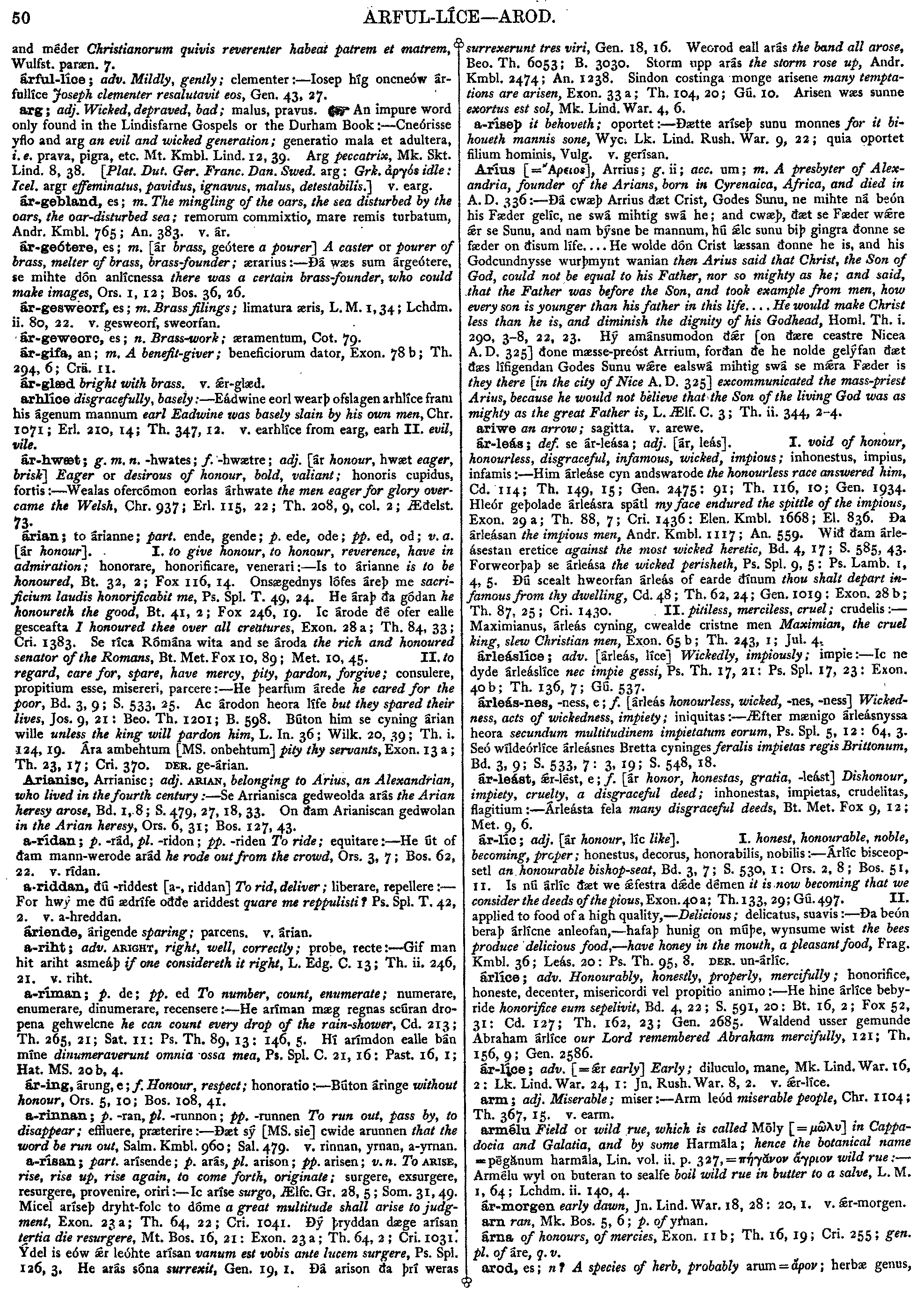
ar-líc;
adj.
[ár
honour,
líc
like].
I.
honest,
honourable,
noble,
becoming,
proper;
honestus,
decorus,
honorabilis,
nobilis
:--
Árlíc
bisceop setl
an
honourable
bishop-seat,
Bd.
3,
7;
S.
530,
1:
Ors.
2,
8;
Bos.
51,
11.
Is
nú
árlíc
ðæt
we
setl
an
honourable
bishop-seat,
Bd.
3,
7;
S.
530,
1:
Ors.
2,
8;
Bos.
51,
11.
Is
nú
árlíc
ðæt
we
 festra
dde
démen
it
is
now
becoming
that
we
consider
the
deeds
of
the
pious,
Exon.40
a;
Th.133,
29;
Gú.
497.
II.
applied
to
food
of
a
high
quality,
-
Delicious;
delicatus,
suavis
:--
Ða
beón
beraþ
árlícne
anleofan,
-
hafaþ
hunig
on
múþe,
wynsume
wist
the
bees
produce
delicious
food,
-
have
honey
in
the
mouth,
a
pleasant
food,
Frag.
Kmbl.
36;
Leás.
20
:
Ps.
Th.
95,
8.
DER
un-árlíc.
festra
dde
démen
it
is
now
becoming
that
we
consider
the
deeds
of
the
pious,
Exon.40
a;
Th.133,
29;
Gú.
497.
II.
applied
to
food
of
a
high
quality,
-
Delicious;
delicatus,
suavis
:--
Ða
beón
beraþ
árlícne
anleofan,
-
hafaþ
hunig
on
múþe,
wynsume
wist
the
bees
produce
delicious
food,
-
have
honey
in
the
mouth,
a
pleasant
food,
Frag.
Kmbl.
36;
Leás.
20
:
Ps.
Th.
95,
8.
DER
un-árlíc.
|
Source: Bosworth/Toller, page b0086, entry 24 View original page image as: [TIFF] [PNG] [View previous entry] [View next entry] |
[Comment on this entry] [View comments] |
The following entry has been hand-corrected once. |
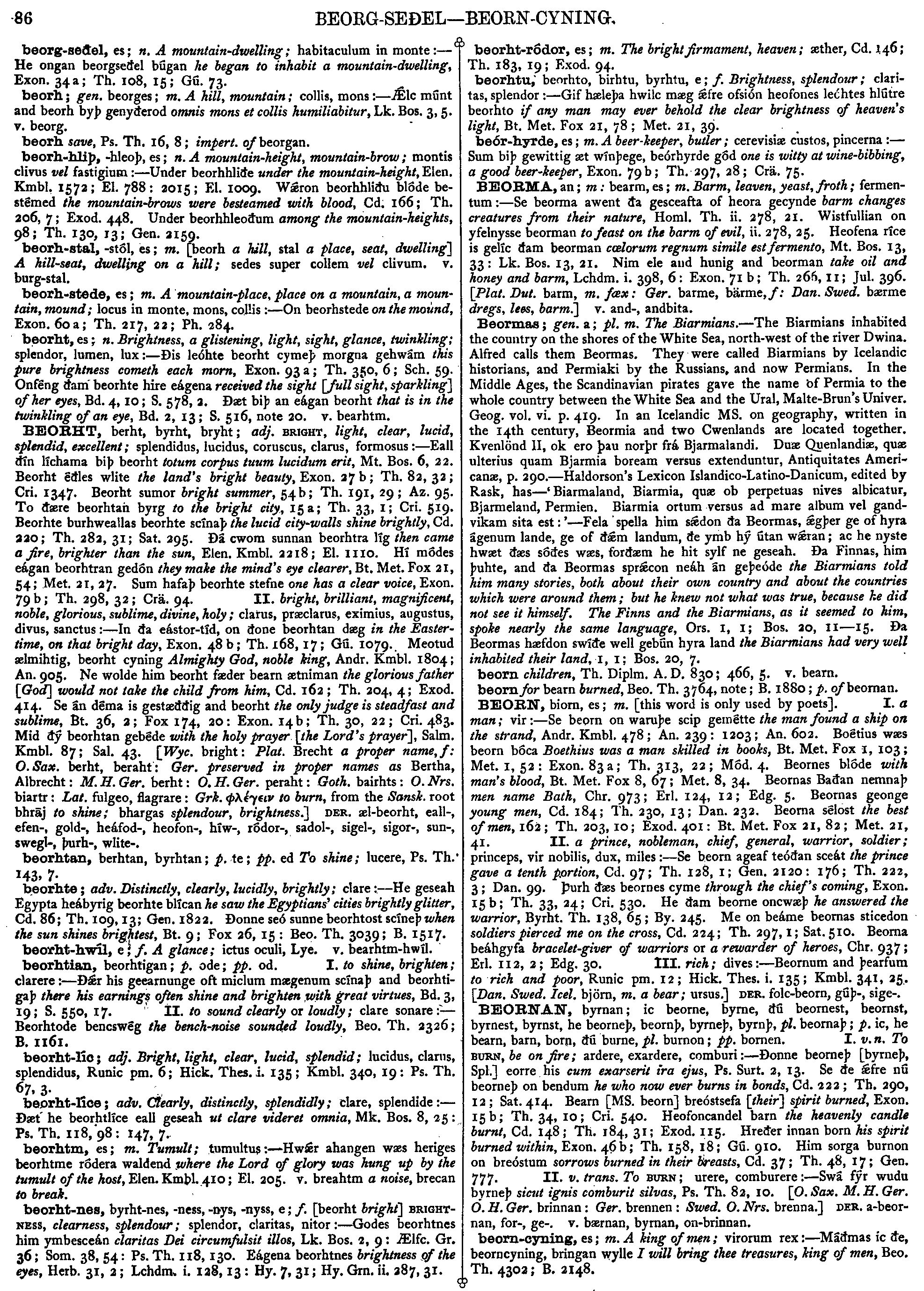
BEORN, birn, es; m. [this word is only used by poets]. I. a man; vir :-- Se beorn on waruþe scip gemétte the man found a ship on the strand, Andr. Kmbl. 478; An. 239 : 1203; An. 602. Boétius wæs beorn bóca Boethius was a man skilled in books, Bt. Met. Fox 1, 103; Met. 1, 52 : Exon. 83 a; Th. 313, 22; Mód. 4. Beornes blóde with man's blood, Bt. Met. Fox 8, 67; Met. 8, 34. Beornas Baðan nemnaþ men name Bath, Chr. 973; Erl. 124, 12; Edg. 5. Beornas geonge young men, Cd. 184; Th. 230, 13; Dan. 232. Beorna sélost the best of men, 162; Th. 203, 10; Exod. 401 : Bt. Met. Fox 21, 82; Met. 21, 41. II. a prince, nobleman, chief, general, warrior, soldier; princeps, vir nobilis, dux, miles :-- Se beorn ageaf teóðan sceát the prince gave a tenth portion, Cd. 97; Th. 128, 1; Gen. 2120 : 176; Th. 222, 3; Dan. 99. Þurh ðæs beornes cyme through the chief's coming, Exon. 15 b; Th. 33, 24; Cri. 530. He ðam beorne oncwæþ he answered the warrior, Byrht. Th. 138, 65; By. 245. Me on beáme beornas sticedon soldiers pierced me on the cross, Cd. 224; Th. 297,1; Sat. 510. Beorna beáhgyfa bracelet-giver of warriors or a rewarder of heroes, Chr. 937; Erl. 112, 2; Edg. 30. III. rich; dives :-- Beornum and þearfum to rich and poor, Runic pm. 12; Hick. Thes. i. 135; Kmbl. 341, 25, [Dan. Swed. Icel. björn, m. a bear; ursus.] DER. folc-beorn, gúþ-, sige-.
|
Source: Bosworth/Toller, page b0133, entry 21 View original page image as: [TIFF] [PNG] [View previous entry] [View next entry] |
[Comment on this entry] [View comments] |
The following entry has been hand-corrected once. |
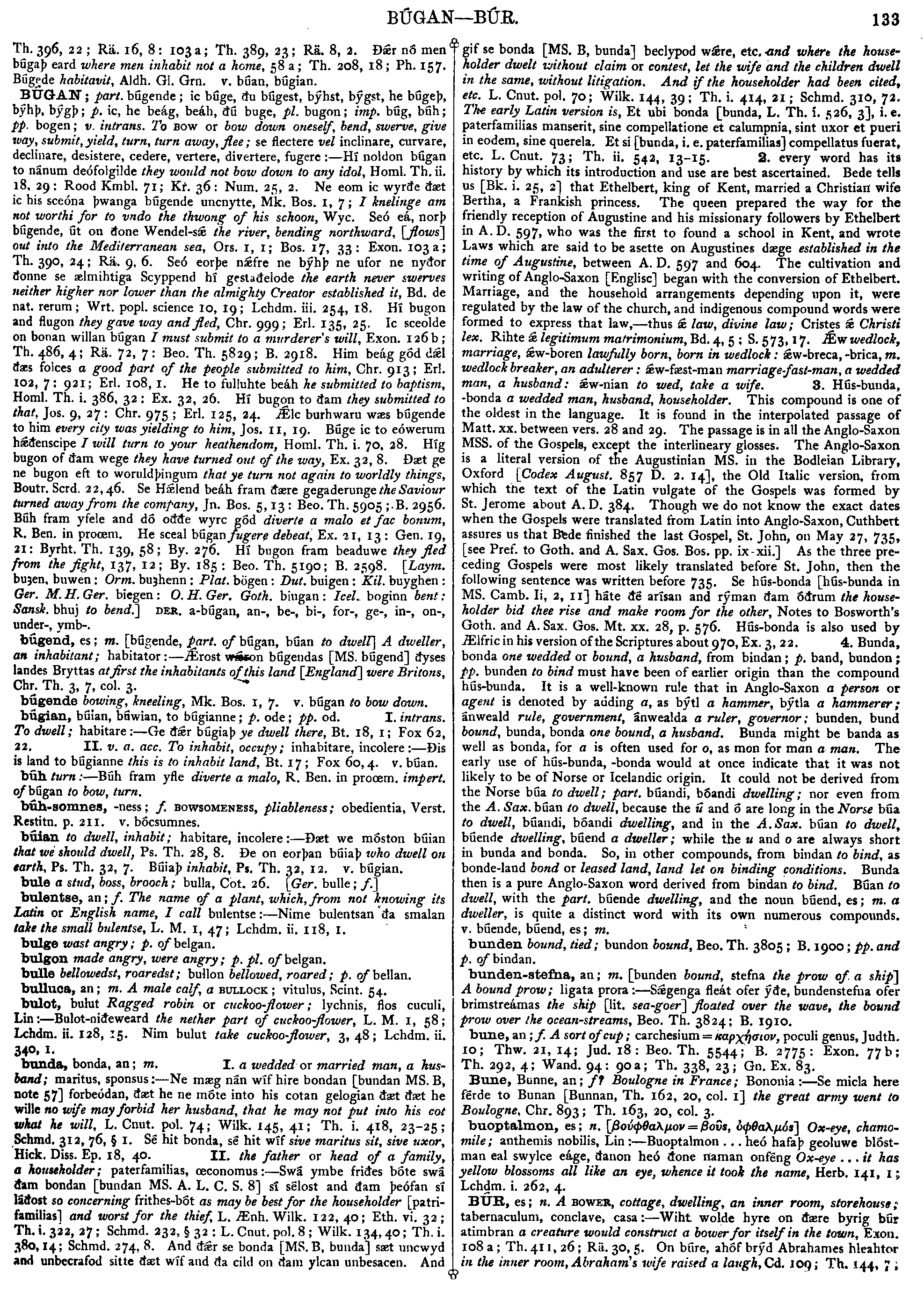
buoptalmon, es; n. [ GREEK ] Ox-eye, chamomile; anthemis nobilis, Lin :-- Buoptalrnon . . . heó hafaþ geoluwe blóst-man eal swylce eáge, ðanon heó ðone naman onféng Ox-eye . . . it has yellow blossoms all like an eye, whence it took the name, Herb. 141, l; Lchdm. i. 262, 4.
|
Source: Bosworth/Toller, page b0138, entry 22 View original page image as: [TIFF] [PNG] [View previous entry] [View next entry] |
[Comment on this entry] [View comments] |
The following entry has been hand-corrected once. |
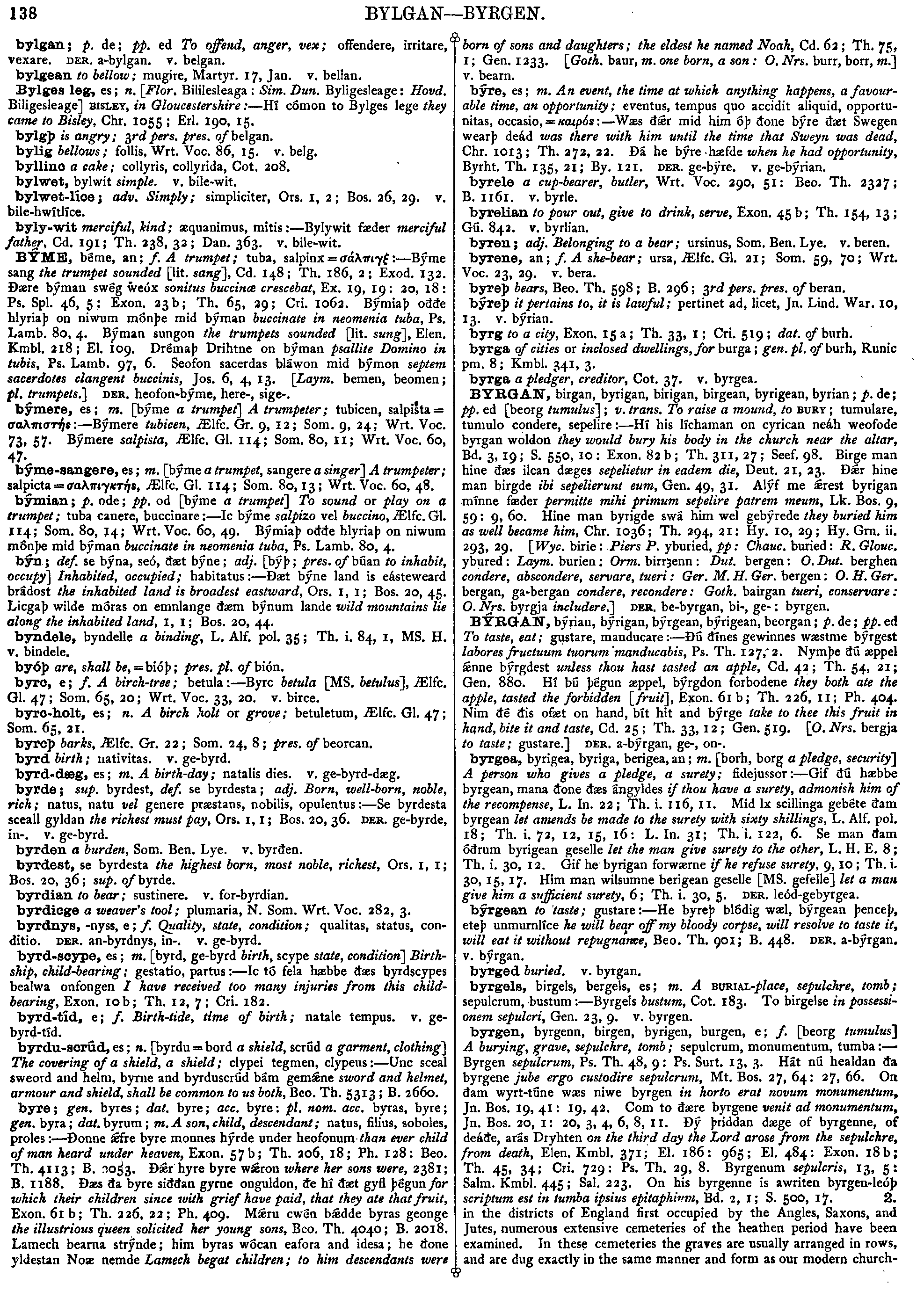
byrde; sup. byrdest, def. se byrdesta; adj. Born, well-born, noble, rich; natus, natu vel genere præstans, nobilis, opulentus :-- Se byrdesta sceall gyldan the richest must pay, Ors. 1, 1; Bos. 20, 36. DER. ge-byrde, in-, v. ge-byrd.
|
Source: Bosworth/Toller, page b0184, entry 9 View original page image as: [TIFF] [PNG] [View previous entry] [View next entry] |
[Comment on this entry] [View comments] |
The following entry has been hand-corrected once. |
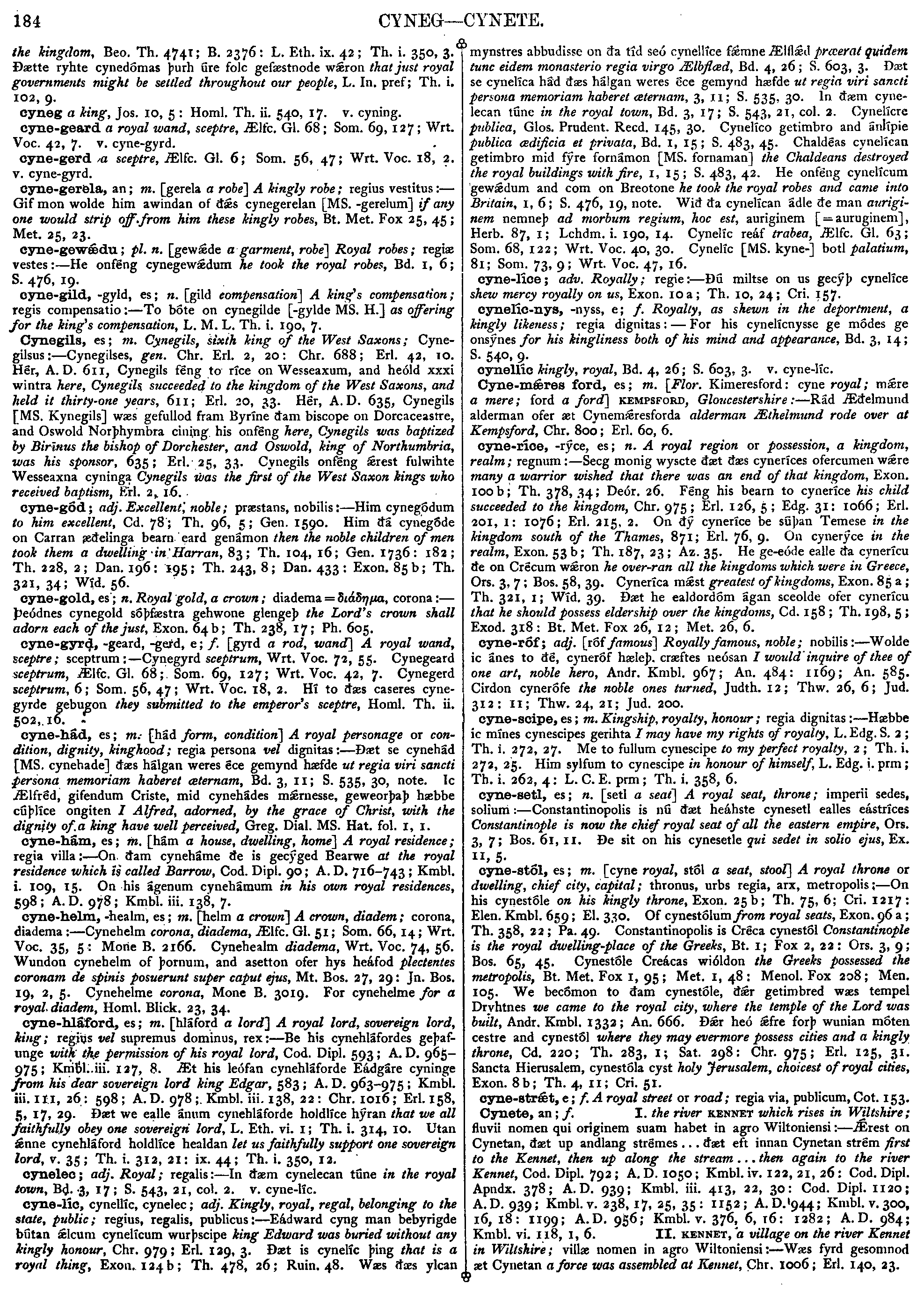
cyne-gód; adj. Excellent, noble; præstans, nobilis :-- Him cynegódum to him excellent, Cd. 78; Th. 96, 5; Gen. 1590. Him ðá cynegóde on Carran æðelinga bearn eard genámon then the noble children of men took them a dwelling in Harran, 83; Th. 104, 16; Gen. 1736: 182; Th. 228, 2; Dan. 196: 195; Th. 243, 8; Dan. 433: Exon. 85b; Th. 321, 34; Wíd. 56.
|
Source: Bosworth/Toller, page b0184, entry 23 View original page image as: [TIFF] [PNG] [View previous entry] [View next entry] |
[Comment on this entry] [View comments] |
The following entry has been hand-corrected once. |
cyne-róf; adj. [róf famous] Royally famous, noble; nobilis :-- Wolde ic ánes to ðé, cyneróf hæleþ cræftes neósan I would inquire of thee of one art, noble hero, Andr. Kmbl. 967; An. 484: 1169; An. 585. Cirdon cynerófe the noble ones turned, Judth. 12; Thw. 26, 6; Jud. 312: 11; Thw. 24, 21; Jud. 200.
|
Source: Bosworth/Toller, page b0378, entry 3 View original page image as: [TIFF] [PNG] [View previous entry] [View next entry] |
[Comment on this entry] [View comments] |
The following entry has been hand-corrected once. |
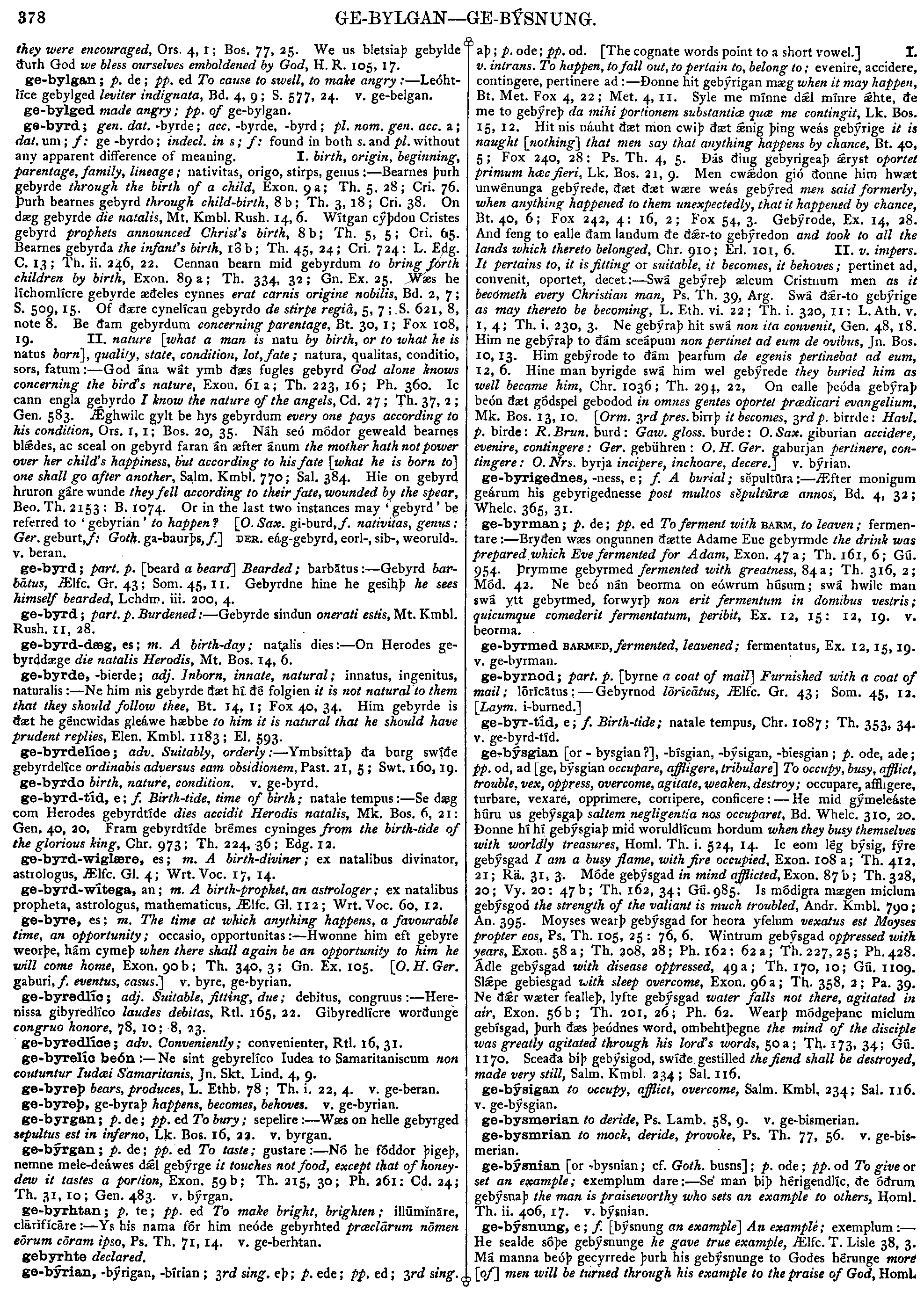
ge-byrd;
gen.
dat.
-byrde;
acc.
-byrde,
-byrd;
pl.
nom.
gen.
acc.
a;
dat.
um;
f
:
ge
-byrdo;
indecl.
in
s;
f
:
found
in
both
s.
and
pl.
without
any
apparent
difference
of
meaning.
I.
birth,
origin,
beginning,
parentage,
family,
lineage;
nativitas,
origo,
stirps,
genus
:--
Bearnes
þurh
gebyrde
through
the
birth
of
a
child,
Exon.
9
a;
Th.
5,
28;
Cri.
76.
Þurh
bearnes
gebyrd
through
child-birth,
8
b;
Th.
3,
18;
Cri.
38.
On
dæg
gebyrde
die
natalis,
Mt.
Kmbl.
Rush.
14,
6.
Wítgan
cýþdon
Cristes
gebyrd
prophets
announced
Christ's
birth,
8
b;
Th.
5,
5;
Cri.
65.
Bearnes
gebyrda
the
infant's
birth,
18
b;
Th.
45,
24;
Cri.
724
:
L.
Edg.
C.
13;
Th.
ii.
246,
22.
Cennan
bearn
mid
gebyrdum
to
bring
forth
children
by
birth,
Exon.
89
a;
Th.
334,
32;
Gn.
Ex.
25.
Wæs
he
líchomlícre
gebyrde
æðeles
cynnes
erat
carnis
origine
nobilis,
Bd.
2,
7;
S.
509,
15.
Of
ðære
cynelícan
gebyrdo
de
stirpe
regiâ,
5,
7;
S.
621,
8,
note
8.
Be
ðam
gebyrdum
concerning
parentage,
Bt.
30,
1;
Fox
108,
19.
II.
nature
[what
a
man
is
natu
by
birth,
or
to
what
he
is
natus
born],
quality,
state,
condition,
lot,
fate;
natura,
qualitas,
conditio,
sors,
fatum
:--
God
ána
wát
ymb
ðæs
fugles
gebyrd
God
alone
knows
concerning
the
bird's
nature,
Exon.
61
a;
Th.
223,
16;
Ph.
360.
Ic
cann
engla
gebyrdo
I
know
the
nature
of
the
angels,
Cd.
27;
Th.
37,
2;
Gen.
583.
Æ-acute;ghwilc
gylt
be
hys
gebyrdum
every
one
pays
according
to
his
condition,
Ors.
1,
1;
Bos.
20,
35.
Náh
seó
módor
geweald
bearnes
bldes,
ac
sceal
on
gebyrd
faran
án
æfter
ánum
the
mother
hath
not
power
over
her
child's
happiness,
but
according
to
his
fate
[what
he
is
born
to]
one
shall
go
after
another,
Salm.
Kmbl.
770;
Sal.
384.
Hie
on
gebyrd
hruron
gáre
wunde
they
fell
according
to
their
fate,
wounded
by
the
spear,
Beo.
Th.
2153
:
B.
1074.
Or
in
the
last
two
instances
may
'gebyrd'
be
referred
to
'gebyrian'
to
happen?
[O.
Sax.
gi-burd,
f.
nativitas,
genus
:
Ger.
geburt,
f
:
Goth.
ga-baurþs,
f.]
DER.
eág-gebyrd,
eorl-,
sib-,
weoruld-.
v.
beran.
|
Source: Bosworth/Toller, page b0637, entry 3 View original page image as: [TIFF] [PNG] [View previous entry] [View next entry] |
[Comment on this entry] [View comments] |
The following entry has been hand-corrected once. |
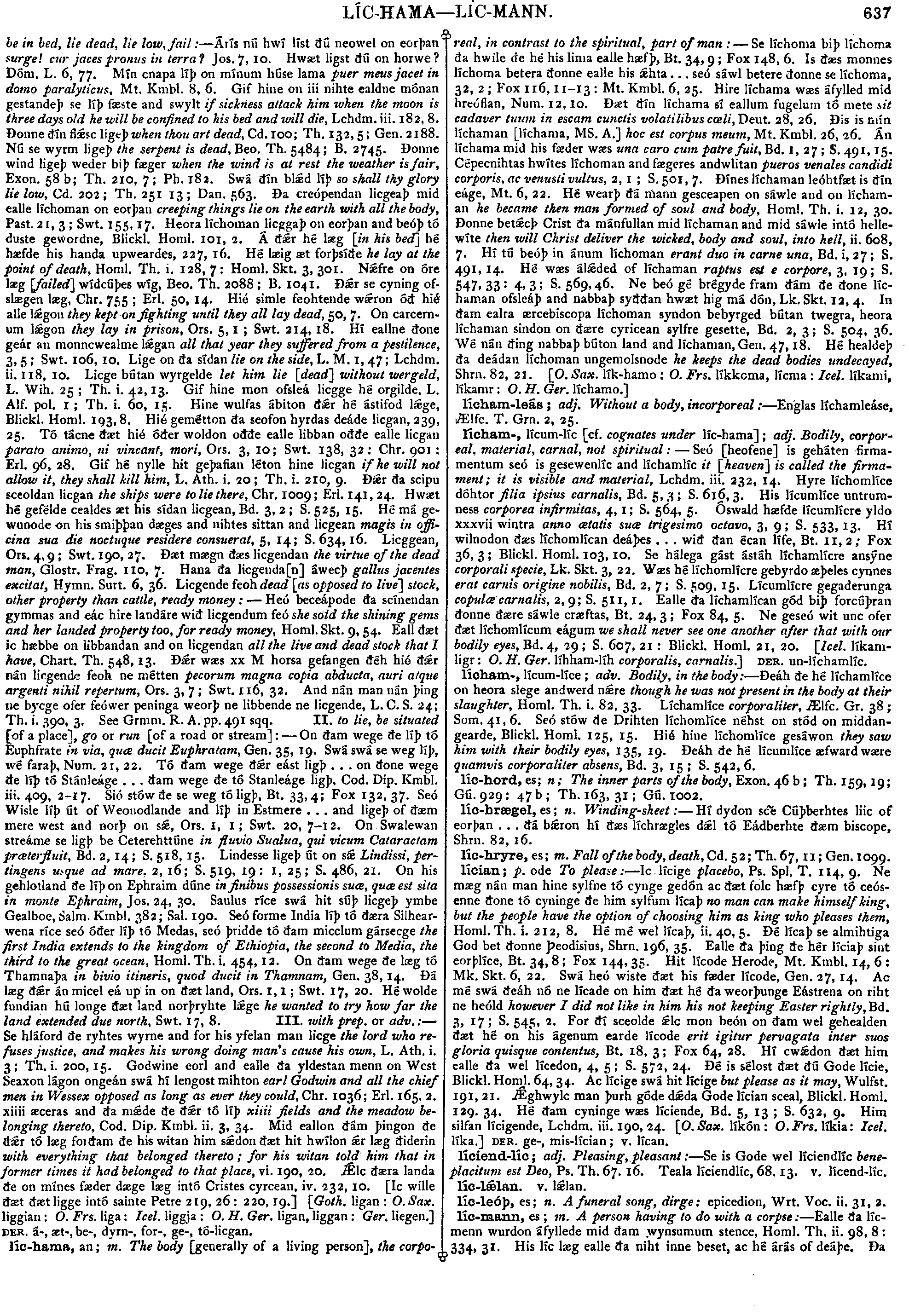
lícham-, lícum-líc [cf. cognates under líc-hama]; adj. Bodily, corporeal, material, carnal, not spiritual :-- Seó [heofene] is geháten firmamentum seó is gesewenlíc and líchamlíc it [heaven] is called the firmament; it is visible and material, Lchdm. iii. 232, 14. Hyre líchomlíce dóhtor filia ipsius carnalis, Bd. 5, 3; S. 616, 3. His lícumlíce untrumness corporea infirmitas, 4, 1; S. 564, 5. Oswald hæfde lícumlícre yldo xxxvii wintra anno ætatis suæ trigesimo octavo, 3, 9; S. 533, 53. Hí wilnodon ðæs líchomlícan deáþes ... wið ðan écan lífe, Bt. 11, 2; Fox 36, 3; Blickl. Homl. 103, 10. Se hálega gást ástáh líchamlícre ansýne corporali specie, Lk. Skt. 3, 22. Wæs hé líchomlícre gebyrdo æþeles cynnes erat carnis origine nobilis, Bd. 2, 7; S. 509, 15. Lícumlícre gegaderunga copulæ carnalis, 2, 9; S. 511, 1. Ealle ða líchamlícan gód biþ forcúþran ðonne ðære sáwle cræftas, Bt. 24, 3; Fox 84, 5. Ne geseó wit unc ofer ðæt líchomlicum eágum we shall never see one another after that with our bodily eyes, Bd. 4, 29; S. 607, 21: Blickl. Homl. 21, 20. [Icel. líkamligr: O. H. Ger. líhham-líh corporalis, carnalis.] DER. un-líchamlíc.
|
Source: Bosworth/Toller, page b0660, entry 7 View original page image as: [TIFF] [PNG] [View previous entry] [View next entry] |
[Comment on this entry] [View comments] |
The following entry has been hand-corrected once. |
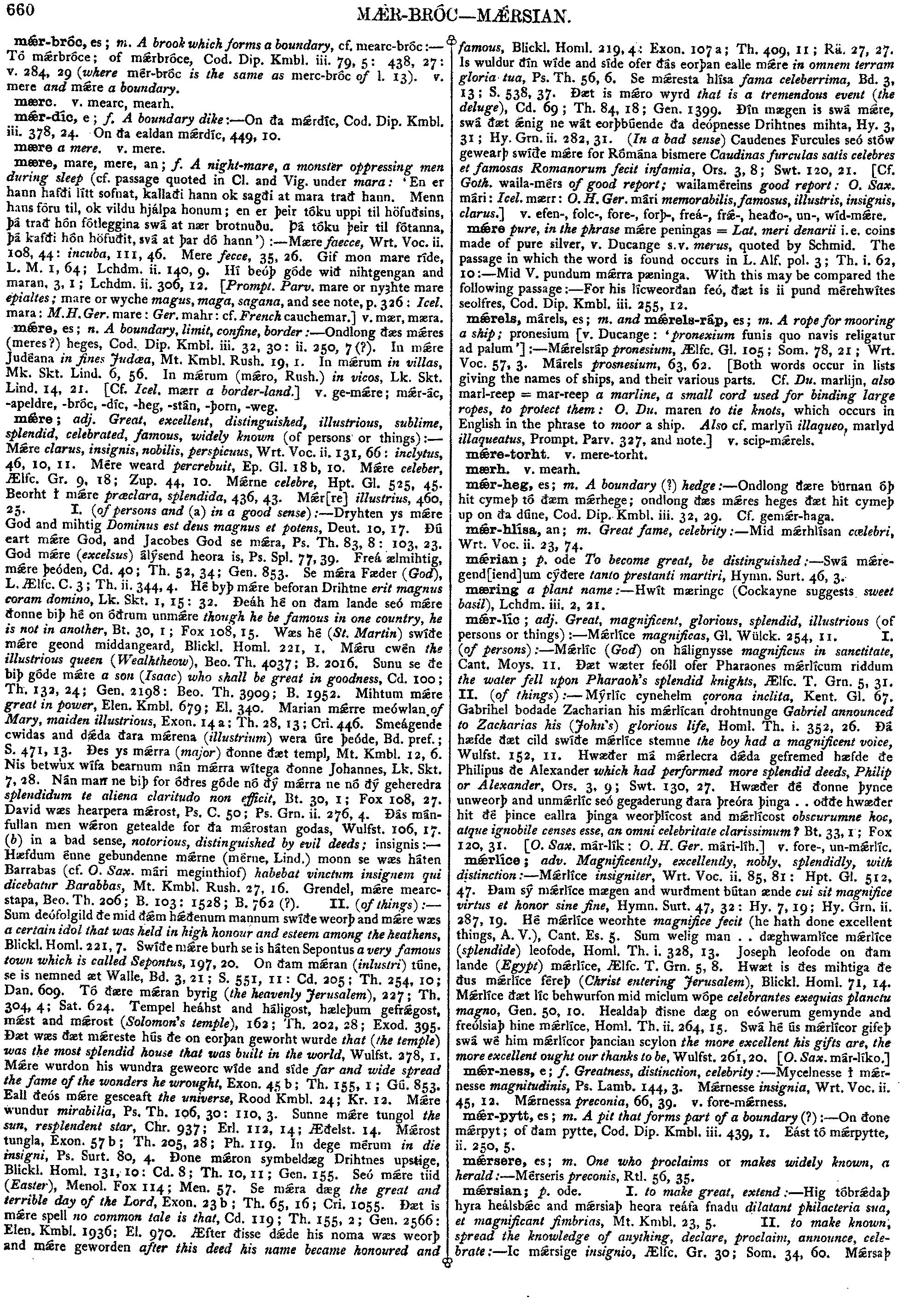
mre;
adj.
Great,
excellent,
distinguished,
illustrious,
sublime,
splendid,
celebrated,
famous,
widely
known
(of
persons
or
things)
:--
Mære
clarus,
insignis,
nobilis,
perspicuus,
Wrt.
Voc.
ii.
131,
66:
inclytus,
46,
10,
11.
Mere
weard
percrebuit,
Ep.
Gl.
18b,
10.
Mre
celeber,
Ælfc.
Gr.
9,
18;
Zup.
44,
10.
Mrne
celebre,
Hpt.
Gl.
525,
45.
Beorht
 mre
præclara,
splendida,
436,
43.
Mr[re]
illustrius,
460,
25.
I.
(of
persons
and
(a)
in
a
good
sense)
:--
Dryhten
ys
mre
God
and
mihtig
Dominus
est
deus
magnus
et
potens.
Deut.
10,
17.
Ðú
eart
mre
God,
and
Jacobes
God
se
mra,
Ps.
Th.
83,
8
:
103,
23.
God
mre
(excelsus)
álýsend
heora
is.
Ps.
Spl.
77,
39.
Freá
ælmihtig,
mre
þeóden,
Cd.
40;
Th.
52,
34;
Gen.
853.
Se
mra
Fæder
(God),
L.
Ælfc.
C.
3;
Th.
ii.
344,
4.
Hé
byþ
mre
beforan
Drihtne
erit
magnus
coram
domino.
Lk.
Skt.
1.
15:
32.
Ðeáh
he
on
ðam
lande
seó
mre
ðonne
biþ
hé
on
óðrum
unmre
though
he
be
famous
in
one
country,
he
is
not
in
another,
Bt.
30,
1;
Fox
108,
15.
Wæs
hé
(St.
Martin)
swíðe
mre
geond
middangeard,
Blickl.
Homl.
221,
1.
Mru
cwén
the
illustrious
queen
(Wealhtheow),
Beo.
Th.
4037;
B.
2016.
Sunu
se
ðe
biþ
góde
mre
a
son
(Isaac)
who
shall
be
great
in
goodness,
Cd.
100;
Th.
133,
24;
Gen.
2198:
Beo.
Th.
3909;
B.
1952.
Mihtum
mre
great
in
power,
Elen.
Kmbl.
679;
El.
340.
Marian
mrre
meówlan.
of
Mary,
maiden
illustrious,
Exon.
14
a;
Th.
28,
13;
Cri.
446.
Smeágende
cwidas
and
dda
ðara
mrena
(illustrium)
wera
úre
þeóde,
Bd.
pref.;
S.
471,
13.
Ðes
ys
mrra
(major)
ðonne
ðæt
templ,
Mt.
Kmbl.
12,
6.
Nis
betwux
wífa
bearnum
nán
mrra
wítega
ðonne
Johannes,
Lk.
Skt.
7,
28.
Nán
man
ne
biþ
for
óðres
góde
nó
ðý
mrra
ne
nó
ðý
geheredra
splendidum
te
aliena
claritudo
non
efficit.
Bt.
30,
1;
Fox
108,
27.
David
wæs
hearpera
mrost,
Ps.
C.
50;
Ps.
Grn.
ii.
276,
4.
Ðás
mánfullan
men
wron
getealde
for
ða
mrostan
godas,
Wulfst.
106,
17.
(b)
in
a
bad
sense,
notorious,
distinguished
by
evil
deeds;
insignis
:--
Hæfdum
énne
gebundenne
mrne
(mérne.
Lind.)
monn
se
wæs
háten
Barrabas
(cf.
O.
Sax.
mári
meginthiof)
habebat
vinctum
insignem
qui
dicebatur
Barabbas,
Mt.
Kmbl.
Rush.
27,
16.
Grendel,
mre
mearc-stapa,
Beo.
Th.
206;
B.
103:
1528;
B.
762
(?).
II.
(of
things)
:--
Sum
deófolgild
ðe
mid
ðm
hðenum
mannum
swíðe
weorþ
and
mre
wæs
a
certain
idol
that
was
held
in
high
honour
and
esteem
among
the
heathens,
Blickl.
Homl.
221,
7.
Swíðe
mre
burh
se
is
háten
Sepontus
a
very
famous
town
which
is
called
Sepontus,
197,
20.
On
ðam
mran
(inlustri)
túne,
se
is
nemned
æt
Walle,
Bd.
3,
21;
S.
551,
11:
Cd.
205;
Th.
254,
10;
Dan.
609.
Tó
ðære
mran
byrig
(the
heavenly
Jerusalem),
227;
Th.
304,
4;
Sat.
624.
Tempel
heáhst
and
háligost,
hæleþum
gefrgost,
mst
and
mrost
(Solomon's
temple),
162;
Th.
202,
28;
Exod.
395.
Ðæt
wæs
ðæt
mreste
hús
ðe
on
eorþan
geworht
wurde
that
(the
temple)
was
the
most
splendid
house
that
was
built
in
the
world.
Wulfst.
278,
1.
Mre
wurdon
his
wundra
geweorc
wíde
and
síde
far
and
wide
spread
the
fame
of
the
wonders
he
wrought.
Exon.
45
b;
Th.
155,
l;
Gú.
853.
Eall
ðeós
mre
gesceaft
the
universe.
Rood
Kmbl.
24;
Kr.
12.
Mre
wundur
mirabilia,
Ps.
Th.
106,
30:
110,
3.
Sunne
mre
tungol
the
sun,
resplendent
star.
Chr.
937;
Erl.
112,
14;
Æðelst.
14.
Mrost
tungla,
Exon.
57
b;
Th.
205,
28;
Ph.
119.
In
dege
mérum
in
die
insigni,
Ps.
Surt.
80,
4.
Ðone
mron
symbeldæg
Drihtnes
upstige,
Blickl.
Homl.
131,
10:
Cd.
8;
Th.
10,
II;
Gen.
155.
Seó
mre
tiid
(Easter),
Menol.
Fox
114;
Men.
57.
Se
mra
dæg
the
great
and
terrible
day
of
the
Lord,
Exon.
23
b;
Th.
65,
16;
Cri.
1055.
Ðæt
is
mre
spell
no
common
tale
is
that,
Cd.
119;
Th.
155,
2;
Gen.
2566:
Elen.
Kmbl.
1936;
El.
970.
Æfter
ðisse
dde
his
noma
wæs
weorþ
and
mre
geworden
after
this
deed
his
name
became
honoured
and
famous,
Blickl.
Homl.
219,
4-:
Exon.
1073;
Th.
409,
11;
Rä.
27,
27.
Is
wuldur
ðín
wíde
and
síde
ofer
ðás
eorþan
ealle
mre
in
omnem
terram
gloria
tua.
Ps.
Th.
56,
6.
Se
mresta
hlísa
fama
celeberrima,
Bd.
3,
13:
S.
538,
37.
Ðæt
is
mro
wyrd
that
is
a
tremendous
event
(the
deluge),
Cd.
69;
Th.
84,
18;
Gen.
1399.
Ðín
mægen
is
swá
mre,
swá
ðæt
nig
ne
wát
eorþbúende
ða
deópnesse
Drihtnes
mihta,
Hy.
3,
31;
Hy.
Grn.
ii.
282,
31.
(In
a
bad
sense)
Caudenes
Furcules
seó
stów
gewearþ
swíðe
mre
for
Rómána
bismere
Caudinas
furculas
satis
celebres
et
famosas
Romanorum
fecit
infamia,
Ors.
3,
8;
Swt.
120,
21.
[Cf.
Goth.
waila-mérs
of
good
report;
wailaméreins
good
report:
O.
Sax.
mári:
Icel.
mærr:
O.
H.
Ger.
mári
memorabilis,
famosus,
illustris,
insignis,
clarus.]
v.
efen-,
folc-,
fore-,
forþ-,
freá-,
fr-,
heaðo-,
un-,
wíd-mre.
mre
præclara,
splendida,
436,
43.
Mr[re]
illustrius,
460,
25.
I.
(of
persons
and
(a)
in
a
good
sense)
:--
Dryhten
ys
mre
God
and
mihtig
Dominus
est
deus
magnus
et
potens.
Deut.
10,
17.
Ðú
eart
mre
God,
and
Jacobes
God
se
mra,
Ps.
Th.
83,
8
:
103,
23.
God
mre
(excelsus)
álýsend
heora
is.
Ps.
Spl.
77,
39.
Freá
ælmihtig,
mre
þeóden,
Cd.
40;
Th.
52,
34;
Gen.
853.
Se
mra
Fæder
(God),
L.
Ælfc.
C.
3;
Th.
ii.
344,
4.
Hé
byþ
mre
beforan
Drihtne
erit
magnus
coram
domino.
Lk.
Skt.
1.
15:
32.
Ðeáh
he
on
ðam
lande
seó
mre
ðonne
biþ
hé
on
óðrum
unmre
though
he
be
famous
in
one
country,
he
is
not
in
another,
Bt.
30,
1;
Fox
108,
15.
Wæs
hé
(St.
Martin)
swíðe
mre
geond
middangeard,
Blickl.
Homl.
221,
1.
Mru
cwén
the
illustrious
queen
(Wealhtheow),
Beo.
Th.
4037;
B.
2016.
Sunu
se
ðe
biþ
góde
mre
a
son
(Isaac)
who
shall
be
great
in
goodness,
Cd.
100;
Th.
133,
24;
Gen.
2198:
Beo.
Th.
3909;
B.
1952.
Mihtum
mre
great
in
power,
Elen.
Kmbl.
679;
El.
340.
Marian
mrre
meówlan.
of
Mary,
maiden
illustrious,
Exon.
14
a;
Th.
28,
13;
Cri.
446.
Smeágende
cwidas
and
dda
ðara
mrena
(illustrium)
wera
úre
þeóde,
Bd.
pref.;
S.
471,
13.
Ðes
ys
mrra
(major)
ðonne
ðæt
templ,
Mt.
Kmbl.
12,
6.
Nis
betwux
wífa
bearnum
nán
mrra
wítega
ðonne
Johannes,
Lk.
Skt.
7,
28.
Nán
man
ne
biþ
for
óðres
góde
nó
ðý
mrra
ne
nó
ðý
geheredra
splendidum
te
aliena
claritudo
non
efficit.
Bt.
30,
1;
Fox
108,
27.
David
wæs
hearpera
mrost,
Ps.
C.
50;
Ps.
Grn.
ii.
276,
4.
Ðás
mánfullan
men
wron
getealde
for
ða
mrostan
godas,
Wulfst.
106,
17.
(b)
in
a
bad
sense,
notorious,
distinguished
by
evil
deeds;
insignis
:--
Hæfdum
énne
gebundenne
mrne
(mérne.
Lind.)
monn
se
wæs
háten
Barrabas
(cf.
O.
Sax.
mári
meginthiof)
habebat
vinctum
insignem
qui
dicebatur
Barabbas,
Mt.
Kmbl.
Rush.
27,
16.
Grendel,
mre
mearc-stapa,
Beo.
Th.
206;
B.
103:
1528;
B.
762
(?).
II.
(of
things)
:--
Sum
deófolgild
ðe
mid
ðm
hðenum
mannum
swíðe
weorþ
and
mre
wæs
a
certain
idol
that
was
held
in
high
honour
and
esteem
among
the
heathens,
Blickl.
Homl.
221,
7.
Swíðe
mre
burh
se
is
háten
Sepontus
a
very
famous
town
which
is
called
Sepontus,
197,
20.
On
ðam
mran
(inlustri)
túne,
se
is
nemned
æt
Walle,
Bd.
3,
21;
S.
551,
11:
Cd.
205;
Th.
254,
10;
Dan.
609.
Tó
ðære
mran
byrig
(the
heavenly
Jerusalem),
227;
Th.
304,
4;
Sat.
624.
Tempel
heáhst
and
háligost,
hæleþum
gefrgost,
mst
and
mrost
(Solomon's
temple),
162;
Th.
202,
28;
Exod.
395.
Ðæt
wæs
ðæt
mreste
hús
ðe
on
eorþan
geworht
wurde
that
(the
temple)
was
the
most
splendid
house
that
was
built
in
the
world.
Wulfst.
278,
1.
Mre
wurdon
his
wundra
geweorc
wíde
and
síde
far
and
wide
spread
the
fame
of
the
wonders
he
wrought.
Exon.
45
b;
Th.
155,
l;
Gú.
853.
Eall
ðeós
mre
gesceaft
the
universe.
Rood
Kmbl.
24;
Kr.
12.
Mre
wundur
mirabilia,
Ps.
Th.
106,
30:
110,
3.
Sunne
mre
tungol
the
sun,
resplendent
star.
Chr.
937;
Erl.
112,
14;
Æðelst.
14.
Mrost
tungla,
Exon.
57
b;
Th.
205,
28;
Ph.
119.
In
dege
mérum
in
die
insigni,
Ps.
Surt.
80,
4.
Ðone
mron
symbeldæg
Drihtnes
upstige,
Blickl.
Homl.
131,
10:
Cd.
8;
Th.
10,
II;
Gen.
155.
Seó
mre
tiid
(Easter),
Menol.
Fox
114;
Men.
57.
Se
mra
dæg
the
great
and
terrible
day
of
the
Lord,
Exon.
23
b;
Th.
65,
16;
Cri.
1055.
Ðæt
is
mre
spell
no
common
tale
is
that,
Cd.
119;
Th.
155,
2;
Gen.
2566:
Elen.
Kmbl.
1936;
El.
970.
Æfter
ðisse
dde
his
noma
wæs
weorþ
and
mre
geworden
after
this
deed
his
name
became
honoured
and
famous,
Blickl.
Homl.
219,
4-:
Exon.
1073;
Th.
409,
11;
Rä.
27,
27.
Is
wuldur
ðín
wíde
and
síde
ofer
ðás
eorþan
ealle
mre
in
omnem
terram
gloria
tua.
Ps.
Th.
56,
6.
Se
mresta
hlísa
fama
celeberrima,
Bd.
3,
13:
S.
538,
37.
Ðæt
is
mro
wyrd
that
is
a
tremendous
event
(the
deluge),
Cd.
69;
Th.
84,
18;
Gen.
1399.
Ðín
mægen
is
swá
mre,
swá
ðæt
nig
ne
wát
eorþbúende
ða
deópnesse
Drihtnes
mihta,
Hy.
3,
31;
Hy.
Grn.
ii.
282,
31.
(In
a
bad
sense)
Caudenes
Furcules
seó
stów
gewearþ
swíðe
mre
for
Rómána
bismere
Caudinas
furculas
satis
celebres
et
famosas
Romanorum
fecit
infamia,
Ors.
3,
8;
Swt.
120,
21.
[Cf.
Goth.
waila-mérs
of
good
report;
wailaméreins
good
report:
O.
Sax.
mári:
Icel.
mærr:
O.
H.
Ger.
mári
memorabilis,
famosus,
illustris,
insignis,
clarus.]
v.
efen-,
folc-,
fore-,
forþ-,
freá-,
fr-,
heaðo-,
un-,
wíd-mre.
|
Source: Bosworth/Toller, page b1023, entry 1 View original page image as: [TIFF] [PNG] [View previous entry] [View next entry] |
[Comment on this entry] [View comments] |
The following entry has been hand-corrected once. |
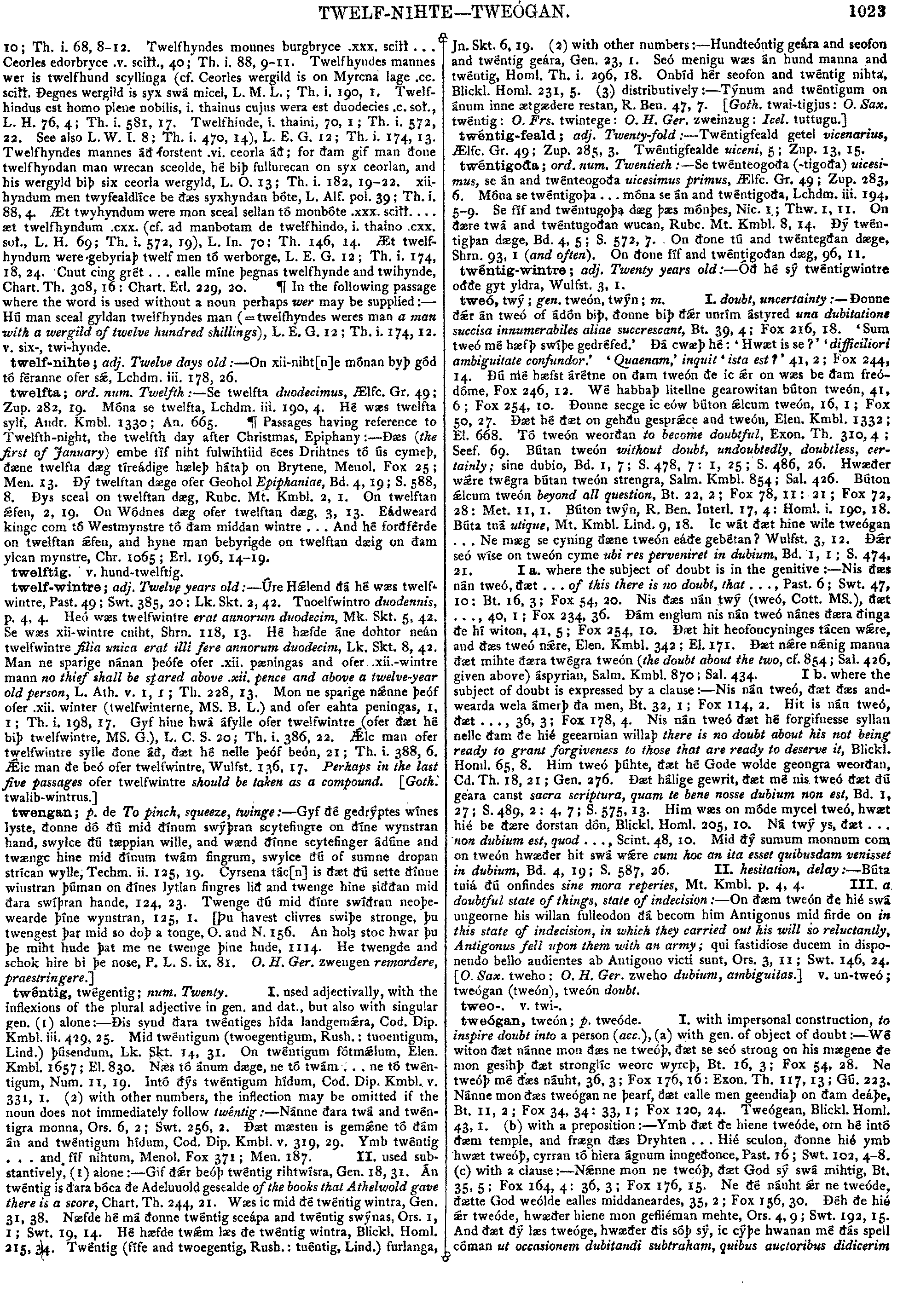
10;
Th.
i.
68,
8-12.
Twelfhyndes
monnes
burgbryce
.xxx.
sci
.
.
.
Ceorles
edorbryce
.v.
sci.,
40;
Th.
i.
88,
9-11.
Twelfhyndes
mannes
wer
is
twelfhund
scyllinga
(cf.
Ceorles
wergild
is
on
Myrcna
lage
.cc.
sci.
Ðegnes
wergild
is
syx
swá
micel,
L.
M.
L.;
Th.
i.
190,
1.
Twelfhindus
est
homo
plene
nobilis,
i.
thainus
cujus
wera
est
duodecies
.c.
so.,
L.
H.
76,
4;
Th.
i.
581,
17.
Twelfhinde,
i.
thaini,
70,
1;
Th.
i.
572,
22.
See
also
L.
W.
I.
8;
Th.
i.
470,
14),
L.
E.
G.
12;
Th.
i.
174,
13.
Twelfhyndes
mannes
áð
forstent
.vi.
ceorla
áð;
for
ðam
gif
man
ðone
twelfhyndan
man
wrecan
sceolde,
hé
biþ
fullurecan
on
syx
ceorlan,
and
his
wergyld
biþ
six
ceorla
wergyld,
L.
O.
13;
Th.
i.
182,
19-22.
xii-hyndum
men
twyfealdlíce
be
ðæs
syxhyndan
bóte,
L.
Alf.
pol.
39;
Th.
i.
88,
4.
Æt
twyhyndum
were
mon
sceal
sellan
tó
monbóte
.xxx.
sci.
.
.
.
æt
twelfhyndum
.cxx.
(cf.
ad
manbotam
de
twelfhindo,
i.
thaino
.cxx.
so.,
L.
H.
69;
Th.
i.
572,
19),
L.
In.
70;
Th.
146,
14.
Æt
twelfhyndum
were
gebyriaþ
twelf
men
tó
werborge,
L.
E.
G.
12;
Th.
i.
174,
18,
24.
Cnut
cing
grét
.
.
.
ealle
míne
þegnas
twelfhynde
and
twihynde,
Chart.
Th.
308,
16:
Chart.
Erl.
229,
20.

In
the
following
passage
where
the
word
is
used
without
a
noun
perhaps
wer
may
be
supplied:--Hú
man
sceal
gyldan
twelfhyndes
man
(=twelfhyndes
weres
man
a
man
with
a
wergild
of
twelve
hundred
shillings),
L.
E.
G.
12;
Th.
i.
174,
12.
v.
six-,
twi-hynde.
| Result Page: |  |
Previous | 1 2 3 4 | Next |  |
Germanic Lexicon Project (main page)
This search system was written by
Sean Crist
Please consider
volunteering
to correct the data in these online dictionaries.
No rights reserved. Feel free to use these data in any way you please.