|
|

Search for no again, using less strict matching (1777 results)
|
Source: Bosworth/Toller, page b0613, entry 2 View original page image as: [TIFF] [PNG] [View previous entry] [View next entry] |
[Comment on this entry] [View comments] |
The following entry has been hand-corrected once. |
LÆ-acute;TAN,
p.
lét,
leórt;
pp.
l ten.
The
ellipsis
of
a
verb
in
the
infinitive,
the
meaning
of
which
may
be
inferred
from
the
context,
not
unfrequently
takes
place
after
ltan;
and
the
connection
of
many
of
the
meanings
which
follow
with
the
simple
one
seems
explainable
in
this
way.
I.
to
LET,
allow,
permit,
suffer
:--
God
lt
him
fyrst
ðæt
hé
his
mándda
geswíce
God
allows
him
time
that
he
may
cease
from
his
crimes,
Homl.
Th.
i.
268,
32.
Ðonne
ne
lteþ
hé
ús
nó
costian
ofer
gemet
then
he
will
not
let
us
be
tempted
beyond
measure,
Blickl.
Homl.
13,
8.
Gif
Drihten
ðé
lteþ
ðone
teóþan
dl
ánne
habban
if
the
Lord
lets
thee
have
only
the
tenth
part,
51,
3.
God
lét
hí
habban
ágenne
cyre,
Homl.
Th.
i.
10,
19.
Ne
leórt
nigne
monno
tó
fylgenne
hine
non
admisit
quemquam
sequi
se,
Mk.
Skt.
Lind.
5,
37.
Ðá
onlýsde
hé
hine
and
lét
hine
féran
æfter
ðam
biscope
absolvit
eum,
et
post
Theodorum
ire
permisit,
Bd.
4,
1;
S.
565,
3.
Se
déma
lét
ða
módor
tó
ðam
suna
on
synderlícre
clýsingce
the
judge
allowed
the
mother
to
come
to
the
son
in
a
chamber
apart,
Homl.
Skt.
4,
342.
Se
éca
Drihten
hine
sylfne
lét
ldon
on
ða
heán
dúne
the
Lord
eternal
allowed
himself
to
be
led
on
to
the
high
mountain,
Blickl.
Homl.
33,
10.
Drihten
ealle
ða
gefylde
ða
ðe
hié
on
eorþan
léton
hingrian
and
þyrstan
for
his
naman
the
Lord
had
filled
all
those
who
let
themselves,
or
were
content
to,
hunger
and
thirst
for
his
name's
sake
[cf.
in
Icel.
láta
with
a
reflex.
infin.],
159,
17.
Lt
beón
ealne
dæg
let
it
be
all
day,
L.
M.
2,
22;
Lchdm.
ii.
206,
25.
Ltaþ
gðer
weaxan
sinite
utraque
crescere,
Mt.
Kmbl.
13,
30.
Léte
pateretur,
Wrt.
Voc.
ii.
67,
4.
Hé
lifde
búton
synnum
ðeáh
ðe
hé
hine
léte
costian,
Blickl.
Homl.
33,
17.
Ltan
nánne
lybban
to
let
none
live,
Ex.
14,
5.
Se
ðe
mýn
blód
nolde
ltan
ágeótan
he
that
would
not
suffer
my
blood
to
be
shed,
Nicod.
20;
Thw.
10,
17.
Léton,
Exon.
46
b;
Th.
152,
3;
Gú.
921.
Gif
ðú
ðé
wilt
dón
manegra
beteran
ðonne
scealt
ðú
ðé
ltan
ánes
wyrsan
if
thou
wilt
make
thyself
the
superior
of
many,
thou
must
allow
thyself
to
be
the
inferior
of
one,
Bt.
32,
1;
Fox
114,
14.
II.
to
let
[alone],
let
go,
give
up,
dismiss,
leave,
forsake,
let
[blood]
:--
Ne
recce
ic
hwæt
hí
déman.
Ic
lte
tó
ðínum
dóme
má
ðonne
tó
hiora
I
care
not
what
judgements
they
make.
I
give
myself
up,
or
trust,
to
your
judgement
more
than
to
theirs,
Bt.
38,
5;
Fox
206,
14.
Hwý
nelt
ðú
géman
ðæt
mín
sweostor
mé
lt
áne
þegnian
why
dost
thou
not
heed
that
my
sister
leaves
me
to
serve
alone?
Blickl.
Homl.
67,
31.
Hé
lt
his
hláfordes
gebod
tó
giémeliéste
he
leaves
to
neglect
[neglects]
his
lord's
command,
Past.
17,
8;
Swt.
121,
14.
Ltt
ðonne
án
ðæt
gefeoht
sume
hwíle
he
lets
the
battle
alone
then
for
some
time,
33,
7;
Swt.
227,
10.
Hé
cwæþ
tó
him
ltaþ
ðæt
nett
on
ða
swíðran
healfe
ðæs
réwettes
...
hig
léton
dixit
eis
mittite
in
dexteram
nauigii
rete
...
miserunt,
Jn.
Skt.
21,
6.
Ðæt
ic
sylf
ongeat
ne
lét
ic
ðæt
unwriten
what
I
myself
knew,
I
did
not
leave
unwritten,
Bd.
pref;
S.
472,
26.
God
hine
lét
frigne
God
left
him
free,
Homl.
Th.
i.
18,
29.
Ic
lét
míne
wylne
tó
ðé
ego
dedi
ancillam
meam
in
sinum
tuum,
Gen.
16,
5.
Se
arcebiscop
lét
hit
eall
tó
heora
gene
rde
the
archbishop
left
it
all
to
their
own
discretion,
Chart.
Th.
341,
11.
God
hí
hðenum
leódum
lét
tó
anwealde
God
left
them
to
the
power
of
heathen
nations,
Jud.
1,
8.
Hé
lét
hí
tó
handa
Madian
tradidit
illos
in
manu
Madian,
6,
1.
Ðá
gyrnde
se
cyng
ealra
ðæra
þegna
ðe
ða
eorlas
r
hæfdon,
and
hí
létan
hí
ealle
him
tó
handa,
Chr.
1048;
Erl.
180,
9.
Gé
forsáwon
eall
mín
geþeaht
and
léton
eów
tó
giémeléste
ðonne
ic
eów
cídde
despexistis
omne
consilium
meum
et
increpationes
meas
neglexistis,
Past,
36,
1;
Swt.
247,
22.
Swá
swá
hit
his
yldran
létan
and
lfdan
ðam
tó
gewealde
as
his
parents
left
and
bequeathed
it
to
be
at
his
disposal,
L.
O.
14;
Th.
i.
184,
3;
Lchdm.
iii.
286,
15.
Hine
eft
ðm
mannum
hálne
and
gesundne
ágeaf
ðám
ðe
hine
r
deádne
léton
gave
him
back
safe
and
sound
to
the
men
who
before
had
left
him
dead,
Blickl.
Homl.
219,
22.
Lt
ðíne
lác
beforan
ðam
altare
relinque
munus
tuum
ad
altare,
Mt.
Kmbl.
5,
24.
Lt
ðú
him
blód
on
dre
let
blood
for
him
from
a
vein,
L.
M.
1,
4;
Lchdm.
ii.
46,
22.
Beó
ðú
be
ðínum
and
lt
mé
be
mínum
be
thou
with
thine,
and
leave
me
with
mine,
Lchdm.
iii.
288,
8.
Gif
hé
tóþ
of
ásleá
lt
hig
frige
dentem
si
excusserit,
dimittet
eos
liberos,
Ex.
21,
27.
Lte
hig
frige,
26.
Wé
lraþ
ðæt
man
nig
ne
lte
unbiscpod
tó
lange,
Wulfst.
120,
15.
Lte
[ðæt
feoh]
án
and
fó
se
ágend
tó
let
him
give
up
[the
property],
and
let
the
owner
take
it,
L.
H.
E.
7;
Th.
i.
30,
9:
12;
Th.
i.
34,
12.
Hwilce
hwíle
hine
wille
Drihten
hér
on
worlde
ltan
how
long
the
Lord
will
leave
him
in
this
world,
Blickl.
Homl.
125,
9.
Hé
sceal
ltan
his
unnyttan
geþancas
of
his
móde
he
must
dismiss
his
idle
thoughts
from
his
mind,
Wulfst.
234,
26.
Ðonne
hé
hí
nyle
ltan
tó
hiera
ágnum
wilnungum
quos
in
sua
desideria
non
relaxat,
Past.
50,
4;
Swt.
391,
22.
Hé
nó
be
ðæm
ánum
ltan
wolde
ac
ofer
ðone
gársecg
ðone
ylecan
leóman
ðæs
fullan
geleáfan
áspringan
lét
he
would
not
leave
off
when
that
[the
spreading
of
the
gospel
over
part
of
the
world]
only
was
done,
but
caused
the
same
beam
of
the
perfect
faith
to
spring
forth
across
the
ocean
[to
England],
Lchdm.
iii.
432,
16.
Wið
poccum
swíðe
sceal
mon
blód
ltan,
L.
M.
1,
40;
Lchdm.
ii.
106,
3.
Nis
him
blód
tó
ltanne,
35;
Lchdm.
ii.
82,
16.
III.
to
let,
cause,
make,
get,
have,
cause
to
be,
place
:--
Ic
hine
symble
gehýre
and
míne
mildse
ofer
ðone
lte
I
will
ever
hear
him,
and
my
mercy
shall
be
upon
that
man,
Wulfst.
264,
11.
Swá
hí
hiora
lufe
neár
Gode
ltaþ
swá
hí
bióþ
orsorgru
the
nearer
to
God
they
place
their
love,
the
more
free
are
they
from
care,
Bt.
39,
7;
Fox
222,
24:
40,
7;
Fox
242,
26-28.
Hé
lét
betwux
him
and
mínum
feóndum
ðæt
hé
nfre
gesewen
[wæs]
fram
him
posuit
tenebras
latibulum
suum,
Ps.
Th.
17,
11.
Ðá
fór
hé
norþryhte
be
ðæm
lande
lét
him
ealne
weg
ðæt
wéste
land
on
ðæt
steórbord
then
he
sailed
due
north
along
the
coast:
he
had
the
waste
land
all
the
way
on
his
starboard,
Ors.
1,
1;
Swt.
17,
10.
Ða
hé
lét
standan
beforan
ymbeútan
ða
eardungstówe
quos
stare
fecit
circa
tabernaculm,
Num.
11,
24.
Hé
sette
scole
and
on
ðære
hé
lét
cnihtas
lran
he
set
up
a
school,
and
had
boys
taught
in
it;
instituit
scholam
in
qua
pueri
literis
erudirentur,
Bd.
3,
18;
S.
545,
45.
Se
cing
lét
gerídan
ealle
ða
land
ðe
his
módor
áhte
him
tó
handa,
Chr.
1042;
Erl.
169,
19:
1023;
Erl.
162,
35:
1035;
Erl.
164,
22.
Wit
ðæt
ðá
létan
and
unéþelíce
þurhtugan
ðæt
hé
ðæs
geþafa
wolde
beón
with
difficulty
we
got
him
to
assent
to
it,
Bd.
5,
4;
S.
617,
17.
Hí
léton
hig
hádian
tó
bisceopum
they
got
themselves
ordained
bishops,
1053;
Erl.
188,
14.
IV.
to
make
a
thing
appear
[so
and
so],
make
as
if,
make
out,
profess,
pretend,
estimate,
consider,
suppose,
think
:--
Ic
léto
existimabo,
Lk.
Skt.
Lind.
13,
18.
Hé
léttes
arbitretur,
Jn.
Skt.
Lind.
16,
2.
Ne
ltaþ
wé
non
dissimulamus,
Wrt.
Voc.
ii.
62,
22.
Ealle
wé
ltaþ
efendýrne
Engliscne
and
Deniscne
we
estimate
all
at
the
same
amount,
Englishman
and
Dane,
L.
A.
G.
2;
Th.
i.
152,
12.
[Cf.
Icel.
manngjöld
skyldi
jöfn
látin
ok
spora-höggit.]
Ðonne
wé
ðisses
middangeardes
welan
foresettaþ
and
ús
leófran
ltaþ
ðonne
ða
lufan
ðara
heofonlícra
eádignessa
cum
mundi
divitias
amori
cælestium
præponimus,
Bd.
3,
19;
S.
548,
16.
Fela
is
ðæra
ðe
embe
bletsunga
oððe
unbletsunga
leóhtlíce
ltaþ
many
are
there
that
esteem
lightly
of
blessings
or
cursings
[cf.
Piers
P.
iv.
160-161
moste
peple
...
leten
mekenesse
a
maistre
and
Mede
a
mansed
schrewe.
Loue
lete
of
hir
li
ten.
The
ellipsis
of
a
verb
in
the
infinitive,
the
meaning
of
which
may
be
inferred
from
the
context,
not
unfrequently
takes
place
after
ltan;
and
the
connection
of
many
of
the
meanings
which
follow
with
the
simple
one
seems
explainable
in
this
way.
I.
to
LET,
allow,
permit,
suffer
:--
God
lt
him
fyrst
ðæt
hé
his
mándda
geswíce
God
allows
him
time
that
he
may
cease
from
his
crimes,
Homl.
Th.
i.
268,
32.
Ðonne
ne
lteþ
hé
ús
nó
costian
ofer
gemet
then
he
will
not
let
us
be
tempted
beyond
measure,
Blickl.
Homl.
13,
8.
Gif
Drihten
ðé
lteþ
ðone
teóþan
dl
ánne
habban
if
the
Lord
lets
thee
have
only
the
tenth
part,
51,
3.
God
lét
hí
habban
ágenne
cyre,
Homl.
Th.
i.
10,
19.
Ne
leórt
nigne
monno
tó
fylgenne
hine
non
admisit
quemquam
sequi
se,
Mk.
Skt.
Lind.
5,
37.
Ðá
onlýsde
hé
hine
and
lét
hine
féran
æfter
ðam
biscope
absolvit
eum,
et
post
Theodorum
ire
permisit,
Bd.
4,
1;
S.
565,
3.
Se
déma
lét
ða
módor
tó
ðam
suna
on
synderlícre
clýsingce
the
judge
allowed
the
mother
to
come
to
the
son
in
a
chamber
apart,
Homl.
Skt.
4,
342.
Se
éca
Drihten
hine
sylfne
lét
ldon
on
ða
heán
dúne
the
Lord
eternal
allowed
himself
to
be
led
on
to
the
high
mountain,
Blickl.
Homl.
33,
10.
Drihten
ealle
ða
gefylde
ða
ðe
hié
on
eorþan
léton
hingrian
and
þyrstan
for
his
naman
the
Lord
had
filled
all
those
who
let
themselves,
or
were
content
to,
hunger
and
thirst
for
his
name's
sake
[cf.
in
Icel.
láta
with
a
reflex.
infin.],
159,
17.
Lt
beón
ealne
dæg
let
it
be
all
day,
L.
M.
2,
22;
Lchdm.
ii.
206,
25.
Ltaþ
gðer
weaxan
sinite
utraque
crescere,
Mt.
Kmbl.
13,
30.
Léte
pateretur,
Wrt.
Voc.
ii.
67,
4.
Hé
lifde
búton
synnum
ðeáh
ðe
hé
hine
léte
costian,
Blickl.
Homl.
33,
17.
Ltan
nánne
lybban
to
let
none
live,
Ex.
14,
5.
Se
ðe
mýn
blód
nolde
ltan
ágeótan
he
that
would
not
suffer
my
blood
to
be
shed,
Nicod.
20;
Thw.
10,
17.
Léton,
Exon.
46
b;
Th.
152,
3;
Gú.
921.
Gif
ðú
ðé
wilt
dón
manegra
beteran
ðonne
scealt
ðú
ðé
ltan
ánes
wyrsan
if
thou
wilt
make
thyself
the
superior
of
many,
thou
must
allow
thyself
to
be
the
inferior
of
one,
Bt.
32,
1;
Fox
114,
14.
II.
to
let
[alone],
let
go,
give
up,
dismiss,
leave,
forsake,
let
[blood]
:--
Ne
recce
ic
hwæt
hí
déman.
Ic
lte
tó
ðínum
dóme
má
ðonne
tó
hiora
I
care
not
what
judgements
they
make.
I
give
myself
up,
or
trust,
to
your
judgement
more
than
to
theirs,
Bt.
38,
5;
Fox
206,
14.
Hwý
nelt
ðú
géman
ðæt
mín
sweostor
mé
lt
áne
þegnian
why
dost
thou
not
heed
that
my
sister
leaves
me
to
serve
alone?
Blickl.
Homl.
67,
31.
Hé
lt
his
hláfordes
gebod
tó
giémeliéste
he
leaves
to
neglect
[neglects]
his
lord's
command,
Past.
17,
8;
Swt.
121,
14.
Ltt
ðonne
án
ðæt
gefeoht
sume
hwíle
he
lets
the
battle
alone
then
for
some
time,
33,
7;
Swt.
227,
10.
Hé
cwæþ
tó
him
ltaþ
ðæt
nett
on
ða
swíðran
healfe
ðæs
réwettes
...
hig
léton
dixit
eis
mittite
in
dexteram
nauigii
rete
...
miserunt,
Jn.
Skt.
21,
6.
Ðæt
ic
sylf
ongeat
ne
lét
ic
ðæt
unwriten
what
I
myself
knew,
I
did
not
leave
unwritten,
Bd.
pref;
S.
472,
26.
God
hine
lét
frigne
God
left
him
free,
Homl.
Th.
i.
18,
29.
Ic
lét
míne
wylne
tó
ðé
ego
dedi
ancillam
meam
in
sinum
tuum,
Gen.
16,
5.
Se
arcebiscop
lét
hit
eall
tó
heora
gene
rde
the
archbishop
left
it
all
to
their
own
discretion,
Chart.
Th.
341,
11.
God
hí
hðenum
leódum
lét
tó
anwealde
God
left
them
to
the
power
of
heathen
nations,
Jud.
1,
8.
Hé
lét
hí
tó
handa
Madian
tradidit
illos
in
manu
Madian,
6,
1.
Ðá
gyrnde
se
cyng
ealra
ðæra
þegna
ðe
ða
eorlas
r
hæfdon,
and
hí
létan
hí
ealle
him
tó
handa,
Chr.
1048;
Erl.
180,
9.
Gé
forsáwon
eall
mín
geþeaht
and
léton
eów
tó
giémeléste
ðonne
ic
eów
cídde
despexistis
omne
consilium
meum
et
increpationes
meas
neglexistis,
Past,
36,
1;
Swt.
247,
22.
Swá
swá
hit
his
yldran
létan
and
lfdan
ðam
tó
gewealde
as
his
parents
left
and
bequeathed
it
to
be
at
his
disposal,
L.
O.
14;
Th.
i.
184,
3;
Lchdm.
iii.
286,
15.
Hine
eft
ðm
mannum
hálne
and
gesundne
ágeaf
ðám
ðe
hine
r
deádne
léton
gave
him
back
safe
and
sound
to
the
men
who
before
had
left
him
dead,
Blickl.
Homl.
219,
22.
Lt
ðíne
lác
beforan
ðam
altare
relinque
munus
tuum
ad
altare,
Mt.
Kmbl.
5,
24.
Lt
ðú
him
blód
on
dre
let
blood
for
him
from
a
vein,
L.
M.
1,
4;
Lchdm.
ii.
46,
22.
Beó
ðú
be
ðínum
and
lt
mé
be
mínum
be
thou
with
thine,
and
leave
me
with
mine,
Lchdm.
iii.
288,
8.
Gif
hé
tóþ
of
ásleá
lt
hig
frige
dentem
si
excusserit,
dimittet
eos
liberos,
Ex.
21,
27.
Lte
hig
frige,
26.
Wé
lraþ
ðæt
man
nig
ne
lte
unbiscpod
tó
lange,
Wulfst.
120,
15.
Lte
[ðæt
feoh]
án
and
fó
se
ágend
tó
let
him
give
up
[the
property],
and
let
the
owner
take
it,
L.
H.
E.
7;
Th.
i.
30,
9:
12;
Th.
i.
34,
12.
Hwilce
hwíle
hine
wille
Drihten
hér
on
worlde
ltan
how
long
the
Lord
will
leave
him
in
this
world,
Blickl.
Homl.
125,
9.
Hé
sceal
ltan
his
unnyttan
geþancas
of
his
móde
he
must
dismiss
his
idle
thoughts
from
his
mind,
Wulfst.
234,
26.
Ðonne
hé
hí
nyle
ltan
tó
hiera
ágnum
wilnungum
quos
in
sua
desideria
non
relaxat,
Past.
50,
4;
Swt.
391,
22.
Hé
nó
be
ðæm
ánum
ltan
wolde
ac
ofer
ðone
gársecg
ðone
ylecan
leóman
ðæs
fullan
geleáfan
áspringan
lét
he
would
not
leave
off
when
that
[the
spreading
of
the
gospel
over
part
of
the
world]
only
was
done,
but
caused
the
same
beam
of
the
perfect
faith
to
spring
forth
across
the
ocean
[to
England],
Lchdm.
iii.
432,
16.
Wið
poccum
swíðe
sceal
mon
blód
ltan,
L.
M.
1,
40;
Lchdm.
ii.
106,
3.
Nis
him
blód
tó
ltanne,
35;
Lchdm.
ii.
82,
16.
III.
to
let,
cause,
make,
get,
have,
cause
to
be,
place
:--
Ic
hine
symble
gehýre
and
míne
mildse
ofer
ðone
lte
I
will
ever
hear
him,
and
my
mercy
shall
be
upon
that
man,
Wulfst.
264,
11.
Swá
hí
hiora
lufe
neár
Gode
ltaþ
swá
hí
bióþ
orsorgru
the
nearer
to
God
they
place
their
love,
the
more
free
are
they
from
care,
Bt.
39,
7;
Fox
222,
24:
40,
7;
Fox
242,
26-28.
Hé
lét
betwux
him
and
mínum
feóndum
ðæt
hé
nfre
gesewen
[wæs]
fram
him
posuit
tenebras
latibulum
suum,
Ps.
Th.
17,
11.
Ðá
fór
hé
norþryhte
be
ðæm
lande
lét
him
ealne
weg
ðæt
wéste
land
on
ðæt
steórbord
then
he
sailed
due
north
along
the
coast:
he
had
the
waste
land
all
the
way
on
his
starboard,
Ors.
1,
1;
Swt.
17,
10.
Ða
hé
lét
standan
beforan
ymbeútan
ða
eardungstówe
quos
stare
fecit
circa
tabernaculm,
Num.
11,
24.
Hé
sette
scole
and
on
ðære
hé
lét
cnihtas
lran
he
set
up
a
school,
and
had
boys
taught
in
it;
instituit
scholam
in
qua
pueri
literis
erudirentur,
Bd.
3,
18;
S.
545,
45.
Se
cing
lét
gerídan
ealle
ða
land
ðe
his
módor
áhte
him
tó
handa,
Chr.
1042;
Erl.
169,
19:
1023;
Erl.
162,
35:
1035;
Erl.
164,
22.
Wit
ðæt
ðá
létan
and
unéþelíce
þurhtugan
ðæt
hé
ðæs
geþafa
wolde
beón
with
difficulty
we
got
him
to
assent
to
it,
Bd.
5,
4;
S.
617,
17.
Hí
léton
hig
hádian
tó
bisceopum
they
got
themselves
ordained
bishops,
1053;
Erl.
188,
14.
IV.
to
make
a
thing
appear
[so
and
so],
make
as
if,
make
out,
profess,
pretend,
estimate,
consider,
suppose,
think
:--
Ic
léto
existimabo,
Lk.
Skt.
Lind.
13,
18.
Hé
léttes
arbitretur,
Jn.
Skt.
Lind.
16,
2.
Ne
ltaþ
wé
non
dissimulamus,
Wrt.
Voc.
ii.
62,
22.
Ealle
wé
ltaþ
efendýrne
Engliscne
and
Deniscne
we
estimate
all
at
the
same
amount,
Englishman
and
Dane,
L.
A.
G.
2;
Th.
i.
152,
12.
[Cf.
Icel.
manngjöld
skyldi
jöfn
látin
ok
spora-höggit.]
Ðonne
wé
ðisses
middangeardes
welan
foresettaþ
and
ús
leófran
ltaþ
ðonne
ða
lufan
ðara
heofonlícra
eádignessa
cum
mundi
divitias
amori
cælestium
præponimus,
Bd.
3,
19;
S.
548,
16.
Fela
is
ðæra
ðe
embe
bletsunga
oððe
unbletsunga
leóhtlíce
ltaþ
many
are
there
that
esteem
lightly
of
blessings
or
cursings
[cf.
Piers
P.
iv.
160-161
moste
peple
...
leten
mekenesse
a
maistre
and
Mede
a
mansed
schrewe.
Loue
lete
of
hir
li te
and
lewte
it
lasse:
Orm.
7523-
uss
birrþ
lætenn
unnorneli
and
litell
off
uss
sellfenn
and
lætenn
wel
off
oþre
menn],
L.
I.
P.
6;
Th.
ii.
310,
36.
Gé
beótlíce
lætaþ
ye
boast,
Wulfst.
46,
15.
Hý
þencaþ
and
ltaþ
ðæt
tó
warscype,
ðæt
hý
óðre
mágan
pcan,
55,
2.
Hé
lét
ðæt
hyt
Dryhtnes
sylfes
andwlyta
wre
he
supposed
that
it
was
the
face
of
the
Lord
himself,
St.
Andr.
42,
9.
Ðá
sendun
hig
mid
searwum
ða
ðe
rihtwíse
léton
observantes
miserunt
insidiatores
qui
se
justos
simularent,
Lk.
Skt.
20,
20.
Ðá
léton
hý
sume
ðæt
ðæt
mycel
unrd
wre
some
of
them
considered
it
a
very
bad
plan,
Chr.
1052;
Erl.
179,
32.
Manige
léton
ðæt
hit
cometa
wre
many
supposed
that
it
was
a
comet,
1097;
Er1.234,
13.
Ðæs
ðe
men
léton
as
men
supposed,
Erl.
234,
17.
Hí
hí
selfe
léton
gðer
ge
for
heáne
ge
for
unwrste
they
considered
themselves
as
abject
and
undone;
ultima
propemodum
desperatione
tabuerunt
[cf.
Piers
P.
xv.
5
somme
leten
me
for
a
lorel],
Ors.
3,
1;
Swt.
98,
22.
Léton
ðá
gedwealde
men,
swylce
Simon
Godes
sylfes
sunu
wre.
Wulfst.
99,
7.
Ðæt
man
þurh
ðæt
lte
ðæt
hé
sí
ðæs
legeres
wyrðe
so
that
for
that
reason
it
be
considered
that
he
is
worthy
of
such
burial,
L.
Edg.
C.
29;
Th.
ii.
250,
17.
Ðæt
hé
ða
ðe
him
underþiédde
síen
lte
him
gelíce
æqualem
se
subditis
deputet,
Past.
17,
1;
Swt.
107,
15.
Ðæt
cild
ðe
læg
on
cradele
ða
gýtseras
lton
efenscyldig
and
hit
gewittig
wre,
L.
C.
S.
77;
Th.
i.
420,
2.
Ic
wælle
léta
æstimabo,
Lk.
Skt.
Lind.
13,
20.
Se
ealdormonn
sceal
ltan
hine
selfne
gelícne
his
hiéremonnum,
Past.
17,
1;
Swt.
107,
8.
V.
to
behave
towards,
treat
:--
Ðam
elþeódigan
and
útancumenan
ne
lt
ðú
nó
uncúþlíce
wið
hine
as
regards
the
alien
and
foreigner
do
not
behave
unkindly
towards
him
[cf.
Icel.
björn
lætr
allblítt
við
hana],
L.
Alf.
47;
Th.
i.
54,
20.
VI.
to
let
[land,
&c.]
:--
Eádward
cyning
and
ða
híwan
in
Wintanceastre
ltaþ
tó
Dænewulfe
bisceope
twentig
hída
landes,
Chart.
Th.
158,
7.
Ðá
com
sum
óðer
and
beád
máre
ðonne
ðe
óðer
r
sealde
and
se
cyng
hit
létt
ðam
menn
ðe
him
máre
beád
then
some
other
man
came
and
offered
more
than
the
other
had
before
given,
and
the
king
let
it
to
the
man
that
offered
more,
Chr.
1086;
Erl.
220,
10.
Ðá
hý
létan
him
tó
ðæt
land
æt
Eádburge
byrig,
Cod.
Dip.
Kmbl.
iv.
76,
5:
Chart.
Th.
151,
6.
VII.
with
adverbs
:--
Ðás
óðre
ltaþ
ðone
n
áweg
on
sopinum
these
others
let
the
n
fall
away
in
the
supine,
Ælfc.
Gr.
28;
Som.
31,
60.
Ælmr
abbod
hí
ltan
áweg
they
let
abbot
Aylmer
go
away,
Chr.
1011;
Erl.
145,
13.
Ðá
cwdon
ða
witan
ðæt
betere
wre
ðæt
man
ðene
áþ
áweg
léte
ðonne
hine
man
sealde
...
Ðá
lét
hé
ðone
áþ
áweg
then
the
witan
said
that
it
would
be
better
that
the
oath
should
be
dispensed
with
than
that
it
should
be
taken
...
Then
he
omitted
the
oath,
Chart.
Th.
289,
24-30.
Æt
ealre
ðære
hergunge
and
æt
eallum
ðám
hearmum
ðe
r
ðam
gedón
wre
r
ðæt
friþ
geset
wre
man
eall
onweig
lte
and
nán
man
ðæt
ne
wræce
ne
bóte
ne
bidde
as
regards
all
the
harrying
and
all
the
injuries
that
were
done
before
the
peace
was
made,
let
it
all
be
dismissed,
and
let
no
man
avenge
it
or
ask
for
compensation,
L.
Eth.
ii.
6;
Th.
i.
288,
3.
Petrus
cnucode
óþ
ðæt
hí
hine
inn
léton
Peter
knocked
until
they
let
him
in,
Homl.
Th.
i.
382,
23.
Hé
lt
him
eáþelíce
ymbe
ðæt
he
takes
it
easily,
Wulfst.
298,
30:
Homl.
Skt.
4,
342.
[Goth.
létan:
O.
Sax.
látan:
O.
Fries.
léta:
Icel.
láta:
O.
H.
Ger.
lázan.]
DER.
á-,
for-,
ge-,
of-,
on-,
tó-
ltan.
te
and
lewte
it
lasse:
Orm.
7523-
uss
birrþ
lætenn
unnorneli
and
litell
off
uss
sellfenn
and
lætenn
wel
off
oþre
menn],
L.
I.
P.
6;
Th.
ii.
310,
36.
Gé
beótlíce
lætaþ
ye
boast,
Wulfst.
46,
15.
Hý
þencaþ
and
ltaþ
ðæt
tó
warscype,
ðæt
hý
óðre
mágan
pcan,
55,
2.
Hé
lét
ðæt
hyt
Dryhtnes
sylfes
andwlyta
wre
he
supposed
that
it
was
the
face
of
the
Lord
himself,
St.
Andr.
42,
9.
Ðá
sendun
hig
mid
searwum
ða
ðe
rihtwíse
léton
observantes
miserunt
insidiatores
qui
se
justos
simularent,
Lk.
Skt.
20,
20.
Ðá
léton
hý
sume
ðæt
ðæt
mycel
unrd
wre
some
of
them
considered
it
a
very
bad
plan,
Chr.
1052;
Erl.
179,
32.
Manige
léton
ðæt
hit
cometa
wre
many
supposed
that
it
was
a
comet,
1097;
Er1.234,
13.
Ðæs
ðe
men
léton
as
men
supposed,
Erl.
234,
17.
Hí
hí
selfe
léton
gðer
ge
for
heáne
ge
for
unwrste
they
considered
themselves
as
abject
and
undone;
ultima
propemodum
desperatione
tabuerunt
[cf.
Piers
P.
xv.
5
somme
leten
me
for
a
lorel],
Ors.
3,
1;
Swt.
98,
22.
Léton
ðá
gedwealde
men,
swylce
Simon
Godes
sylfes
sunu
wre.
Wulfst.
99,
7.
Ðæt
man
þurh
ðæt
lte
ðæt
hé
sí
ðæs
legeres
wyrðe
so
that
for
that
reason
it
be
considered
that
he
is
worthy
of
such
burial,
L.
Edg.
C.
29;
Th.
ii.
250,
17.
Ðæt
hé
ða
ðe
him
underþiédde
síen
lte
him
gelíce
æqualem
se
subditis
deputet,
Past.
17,
1;
Swt.
107,
15.
Ðæt
cild
ðe
læg
on
cradele
ða
gýtseras
lton
efenscyldig
and
hit
gewittig
wre,
L.
C.
S.
77;
Th.
i.
420,
2.
Ic
wælle
léta
æstimabo,
Lk.
Skt.
Lind.
13,
20.
Se
ealdormonn
sceal
ltan
hine
selfne
gelícne
his
hiéremonnum,
Past.
17,
1;
Swt.
107,
8.
V.
to
behave
towards,
treat
:--
Ðam
elþeódigan
and
útancumenan
ne
lt
ðú
nó
uncúþlíce
wið
hine
as
regards
the
alien
and
foreigner
do
not
behave
unkindly
towards
him
[cf.
Icel.
björn
lætr
allblítt
við
hana],
L.
Alf.
47;
Th.
i.
54,
20.
VI.
to
let
[land,
&c.]
:--
Eádward
cyning
and
ða
híwan
in
Wintanceastre
ltaþ
tó
Dænewulfe
bisceope
twentig
hída
landes,
Chart.
Th.
158,
7.
Ðá
com
sum
óðer
and
beád
máre
ðonne
ðe
óðer
r
sealde
and
se
cyng
hit
létt
ðam
menn
ðe
him
máre
beád
then
some
other
man
came
and
offered
more
than
the
other
had
before
given,
and
the
king
let
it
to
the
man
that
offered
more,
Chr.
1086;
Erl.
220,
10.
Ðá
hý
létan
him
tó
ðæt
land
æt
Eádburge
byrig,
Cod.
Dip.
Kmbl.
iv.
76,
5:
Chart.
Th.
151,
6.
VII.
with
adverbs
:--
Ðás
óðre
ltaþ
ðone
n
áweg
on
sopinum
these
others
let
the
n
fall
away
in
the
supine,
Ælfc.
Gr.
28;
Som.
31,
60.
Ælmr
abbod
hí
ltan
áweg
they
let
abbot
Aylmer
go
away,
Chr.
1011;
Erl.
145,
13.
Ðá
cwdon
ða
witan
ðæt
betere
wre
ðæt
man
ðene
áþ
áweg
léte
ðonne
hine
man
sealde
...
Ðá
lét
hé
ðone
áþ
áweg
then
the
witan
said
that
it
would
be
better
that
the
oath
should
be
dispensed
with
than
that
it
should
be
taken
...
Then
he
omitted
the
oath,
Chart.
Th.
289,
24-30.
Æt
ealre
ðære
hergunge
and
æt
eallum
ðám
hearmum
ðe
r
ðam
gedón
wre
r
ðæt
friþ
geset
wre
man
eall
onweig
lte
and
nán
man
ðæt
ne
wræce
ne
bóte
ne
bidde
as
regards
all
the
harrying
and
all
the
injuries
that
were
done
before
the
peace
was
made,
let
it
all
be
dismissed,
and
let
no
man
avenge
it
or
ask
for
compensation,
L.
Eth.
ii.
6;
Th.
i.
288,
3.
Petrus
cnucode
óþ
ðæt
hí
hine
inn
léton
Peter
knocked
until
they
let
him
in,
Homl.
Th.
i.
382,
23.
Hé
lt
him
eáþelíce
ymbe
ðæt
he
takes
it
easily,
Wulfst.
298,
30:
Homl.
Skt.
4,
342.
[Goth.
létan:
O.
Sax.
látan:
O.
Fries.
léta:
Icel.
láta:
O.
H.
Ger.
lázan.]
DER.
á-,
for-,
ge-,
of-,
on-,
tó-
ltan.
|
Source: Bosworth/Toller, page b0614, entry 11 View original page image as: [TIFF] [PNG] [View previous entry] [View next entry] |
[Comment on this entry] [View comments] |
The following entry has been hand-corrected once. |
læt-hýdig; adj. Slow-minded, slow of thought, dull :-- Nis mon on moldan ... ðæs læthýdig ðæt hine sé árgifa ealles biscyrge módes cræfta no man is there on earth so dull, that the bounteous giver hath quite cut him off from powers of mind, Exon. 78 b; Th. 294, 5; Crä. 10.
|
Source: Bosworth/Toller, page b0614, entry 20 View original page image as: [TIFF] [PNG] [View previous entry] [View next entry] |
[Comment on this entry] [View comments] |
The following entry has been hand-corrected once. |
lwed,
léud,
es;
m.
A
layman
:--
Gif
man
léud
ofsleá
an
þeófþe
licge
bútan
wyrgelde
if
a
layman
be
slain
while
thieving,
let
no
wergild
be
paid
for
the
slaying.
L.
Wih.
25;
Th.
i.
42,
13.
v.
next
word.
|
Source: Bosworth/Toller, page b0614, entry 25 View original page image as: [TIFF] [PNG] [View previous entry] [View next entry] |
[Comment on this entry] [View comments] |
The following entry has been hand-corrected once. |
láf,
e;
f.
I.
what
is
left,
remnant,
remains,
relic,
remainder,
rest,
lave
[in
northern
dialects]
:--
Láf
superstes,
Ælfc.
Gr.
9;
Som.
11,
7.
Healmes
láf
stipulæ,
Ælfc.
Gl.
59;
Som.
67,
131;
Wt.
Voc.
38,
51.
Ðr
wæs
ungemetlíc
wæl
geslægen
and
sió
láf
wið
ðone
here
friþ
nam
there
was
immense
slaughter,
and
those
who
were
left
made
peace
with
the
Danes,
Chr.
867;
Erl.
72,
17:
894;
Erl.
93,
1.
Seó
wpna
láf
the
weapons'
leavings,
the
survivors
of
a
battle,
Cd.
93;
Th.
121,
5;
Gen.
2005.
Secg
gára
láf
se
ða
gúþe
genæs,
94;
Th.
121,
32;
Gen.
2019.
Ða
Norþmen
dreórig
daraþa
láf,
Chr.
937;
Erl.
115,
3;
Æðelst.
54.
Seoððan
se
écea
dl
of
biþ
ðæt
is
seó
sáwl
hwæt
biþ
elles
seó
láf
búton
wyrma
mete
when
the
eternal
part,
that
is
the
soul,
is
gone,
what
else
is
the
rest
but
food
for
worms?
Blickl.
Homl.
iii.
32.
Ic
beó
tó
láfe
resto,
Ælfc.
Gr.
24;
Som.
25,
62.
Ne
wearþ
ðr
forþon
án
Bret
tó
láfe
there
[at
Anderida]
was
not
even
one
Briton
left,
Chr.
491;
Erl.
14,
7.
Ðæs
folces
ðe
ðær
tó
láfe
wæs,
Blickl.
Homl.
79,
20.
Betcan
eów
on
hðenra
hand
heries
láfe
to
deliver
you
into
the
hands
of
the
heathen,
all
that
is
left
of
or
by
a
host,
Wulfst.
295,
20.
Sumes
þinges
láfe
reliquiæ,
Ælfc.
Gr.
13;
Som.
16,
19.
Láfa
árleásra
forwurþaþ
reliquiæ
impiorum
interibunt,
Ps.
Spl.
36,
40.
Wætra
láfe
the
survivors
of
the
flood,
Cd.
75;
Th.
93,
21;
Gen.
1549.
Hí
námon
ða
láfa
tulerunt
reliquias,
Mt.
Kmbl.
14,
20.
II.
used
in
poetry
of
weapons
with
the
gen.
of
the
implement
employed
in
making
them
:--
Ic
eom
wráðra
láf
fýres
and
feóle
I
am
the
leaving
of
foes,
of
fire
and
of
file
[a
sword,
forged
in
the
fire
and
sharpened
by
the
file],
Exon.
126
a;
Th.
484,
6;
Rä.
70,
3.
Homera
láfa
swords,
Beo.
Th.
5651;
B.
2829:
Exon.
102
b;
Th.
388,
14;
Rä.
6,
7:
Chr.
937;
Erl.
112,
6;
Æðelst.
6.
III.
what
is
left
as
an
inheritance,
legacy,
heirloom
[of
armour
or
weapons:
'das
schwert
ist
des
mannes
grösztes
kleinod,
das
nur
auf
seinen
nächsten
männlichen
erben
übergeht'
Grmm.
Gesch.
D.
S.
p.
12]
:--
Beaduscrúda
betst
ðæt
míne
breóst
wereþ;
ðæt
is
Hrædlan
láf,
Welandes
geweorc,
Beo.
Th.
913;
Bö
454.
Gomel
swyrd
Eánmundes
láf
an
ancient
sword,
an
heirloom
from
Eanmund,
5216;
B.
2611:
5250;
B.
2628.
Ðr
brægd
eorl
Beówulfes
ealde
láfe,
1595;
B.
795:
2981;
B.
1488.
Hét
in
gefetian
Hréðles
láfe;
næs
sincmáððum
sélra
on
sweordes
hád,
4389;
B.
2191.
IV.
a
relict,
widow
:--
Láf
vel
forlten
wíf
derelicta,
Ælfc.
Gl.
88;
Som.
74,
65;
Wrt.
Voc.
50,
46.
Ne
nime
ðæs
forþfarenan
láf
nánne
óðerne
man
búton
his
bróður
uxor
defuncti
non
nubet
alteri,
sed
accipiet
eam
frater
ejus,
Deut.
25,
5.
And
fre
ne
geweorþe
ðæt
Cristen
man
gewífige
on
ðæs
láfe
ðe
swá
neáh
wre
on
woroldcundre
sibbe
and
never
let
it
happen
that
a
Christian
man
marry
the
relict
of
him
who
was
so
near
[within
the
prohibited
degrees]
in
worldly
relationship,
L.
Eth.
vi.
12;
Th.
i.
318,
15:
L.
C.
E.
7;
Th.
i.
364,
23.
Se
forlét
his
fulluht
and
lifode
on
héðenum
þeáwe
swá
ðæt
hé
heafde
his
feder
láfe
tó
wífe,
Chr.
616;
Erl.
21,
40.
Paplinus
genam
Æðelburge
Eádwines
láfe
and
gewát
on
scipe
tó
Cent,
633;
Erl.
25,
21.
Ðá
gewát
Eádríc
...
Ðá
hæfde
Eádríc
láfe
and
nán
bearn
then
Eadric
died
...
Eadric
left
a
widow
but
no
child,
Chart.
Th.
272,
22.
[Goth.
laiba
a
remnant:
O.
Frs.
láva:
O.
Sax.
lé a:
Icel.
leif:
O.
H.
Ger.
leiba.]
DER.
ege-,
ende-,
eormen-,
here-,
húsel-,
met-,
s-,
un-,
weá-,
ýð-,
yrfe-láf.
a:
Icel.
leif:
O.
H.
Ger.
leiba.]
DER.
ege-,
ende-,
eormen-,
here-,
húsel-,
met-,
s-,
un-,
weá-,
ýð-,
yrfe-láf.
|
Source: Bosworth/Toller, page b0616, entry 13 View original page image as: [TIFF] [PNG] [View previous entry] [View next entry] |
[Comment on this entry] [View comments] |
The following entry has been hand-corrected once. |
lah-mann,
es;
m.
A
man
acquainted
with,
and
whose
duty
it
was
to
declare,
the
law
:--
xii
lahmenn
scylon
riht
tcean
Wealan
and
Ænglan
vi
Engliscne
and
vi
Wylisce.
Þolien
ealles
ðæs
hý
ágon
gif
hí
wóh
tcen
oþþe
geládian
hí
ðæt
hí
bet
ne
cúþon
xii
lawmen
shall
declare
the
law
to
Welsh
and
English,
vi
English
and
vi
Welsh.
Let
them
forfeit
all
they
own
if
they
declare
wrong;
or
clear
themselves
[on
the
ground]
that
they
knew
no
better,
L.
O.
D.
3;
Th.
i.
354,
9.
In
L.
Ed.
C.
38;
Th.
i.
461,
21
the
latinized
form
of
the
word
occurs
:--
Postea
inquirat
justicia
per
lagemannos,
et
per
meliores
homines
de
burgo
vel
hundredo
vel
villa.
See
Cl.
&
Vig.
Dict.
sub
voce
lögmaðr.
|
Source: Bosworth/Toller, page b0617, entry 4 View original page image as: [TIFF] [PNG] [View previous entry] [View next entry] |
[Comment on this entry] [View comments] |
The following entry has been hand-corrected once. |
LAND,
es;
n.
I.
LAND
as
opposed
to
water
or
air,
earth
:--
Wé
ðec
in
lyft
gelddun
oftugon
ðé
landes
wynna
we
led
thee
aloft,
earth's
pleasures
withdrew
from
thee,
Exon.
39
b;
Th.
130,
15;
Gú.
438.
Ðá
siððan
tóférdon
ða
apostolas
wíde
landes
geond
ealle
ðás
world
then
afterwards
the
apostles
separated
and
went
far
and
wide
on
earth,
throughout
all
this
world,
L.
Ælfc.
P.
21;
Th.
ii.
372,
6:
Wulfst.
105,
6.
Monigra
folca
ceápstów
of
lande
and
of
s
cumendra
multorum
emporium
populorum
terra
marique
venientium,
Bd.
2,
3;
S.
504,
19.
Úsic
æt
lande
gebrohte,
5,
1;
S.
614,
10.
Hig
tugon
hyra
scypo
tó
lande
subductis
ad
terram
navibus,
Lk.
Skt.
5,
11.
Ðá
cómon
hié
tó
londe
on
Cornwalum,
Chr.
891;
Erl.
88,
11.
Wron
ða
menn
uppe
on
londe
of
ágáne,
897;
Erl.
95,
24.
Án
scip
flotigende
swá
néh
ðan
lande
swá
hit
nýxt
mge,
1031;
Erl.
162,
7.
Ðá
gesundrod
wæs
lago
wið
lande.
Cd,
8;
Th.
10,
27;
Gen.
163.
Cam
ðá
tó
lande
swíðmód
swymman,
Beo.
Th.
3250;
B.
1623.
Stile
þynceþ
lyft
ofer
londe.
Exon.
101
b;
Th.
383,
15;
Rä.
4,
11.
Lifigende
ða
ðe
land
tredaþ
living
creatures
that
walk
the
earth,
Cd.
10;
Th.
13,
16;
Gen.
203.
II.
a
land,
country,
region,
district,
province
:--
Ðæs
landes
gold
ys
golda
sélost
aurum
terræ
illius
optimum
est,
Gen.
2,
12.
Is
seó
cirice
on
Campania
ðæs
landes
gemro
the
church
is
on
the
borders
of
the
land
of
Campania,
Blickl.
Homl.
197,
19.
Úres
landes
mann
nostras:
eówres
landes
mann
vestras,
Ælfc.
Gr.
15;
Zup.
94,
8:
102,
21.
Ne
nim
ðú
náne
sibbe
wið
ðæs
landes
menn
ne
ineas
pactum
cum
hominibus
illarum
regionum,
Ex.
34,
15.
Twegen
landes
menn
and
án
ælþeódig,
Homl.
Th.
ii.
26,
20.
Twegen
sacerdas
ðe
r
on
lífe
wron
his
landes
menn
two
priests
who
before,
when
living,
had
been
his
countrymen,
342,
3.
Ðá
cómon
ða
landes
menn
[the
Northumbrians]
tógeánes
him
and
hine
ofslógon,
Chr.
1068;
Erl.
205,
2.
Hí
wron
of
Galiléam
ðæm
lande,
Blickl.
Homl.
123,
21.
Hé
leng
on
ðam
lande
gewunian
ne
mihte
he
could
not
live
longer
in
that
country,
113,
11.
On
Lindesse
lande
in
provincia
Lindissi,
Bd.
3,
27;
S.
558,
34.
Andreas
sette
his
hand
ofer
ðara
wera
eágan
ðe
ðr
on
lande
wron
Andrew
placed
his
hand
upon
the
eyes
of
the
men
who
were
there
in
that
country,
Blickl.
Homl.
239,
3.
Ceólwulf
and
Eádbald
of
ðæm
londe
áfóron
Ceolwulf
and
Eadbald
left
the
country,
Chr.
794;
Erl.
58,
6.
Ælþeódige
mæn
of
lande
mid
heora
htum
and
mid
synnum
gewíten
let
foreigners
depart
from
the
country
with
their
goods
and
with
their
sins,
L.
Wih.
4;
Th.
i.
38,
2.
Þerh
óðer
woeg
eft
gecerrdon
in
lond
hiera
per
aliam
viam
reversi
sunt
in
regionem
suam,
Mt.
Kmbl,
Lind.
2,
12.
Mid
ðý
hí
ðider
cóman
on
land
cum
illo
advenissent,
Bd.
5,
10;
S.
624,
1.
Ðæt
wron
ða
restan
scipu
Deniscra
monna
ðe
Angelcynnes
lond
gesóhton,
Chr.
787;
Erl.
56,
16.
Æ-acute;lc
ðæra
landa
ðe
nigne
friþige
ðæra
ðe
Ængla
land
hergie
every
land
that
affords
protection
to
any
of
those
that
harry
England,
L.
Eth.
ii.
1;
Th.
i.
284,
17.
Ðá
ldde
hé
mé
on
fyrran
lænd
cum
me
in
ulteriora
produceret,
Bd.
5,
12;
S.
628,
9.
In
ða
nésta
gemro
and
londo
[lond,
Rush.]
in
proximas
villas
et
vicos.
Mk.
Skt.
Lind.
6,
36.
III.
land,
landed
property,
estate,
cultivated
land,
country
[as
opposed
to
town]
:--
Gesáwen
æcer
vel
land
seges.
Ælfc.
Gl.
97;
Som.
76,
48;
Wrt.
Voc.
53,
55.
Land
solum
vel
tellus
vel
terra,
vel
arvum,
98;
Som.
76,
98;
Wrt.
Voc.
54,
42,
Ðis
land
hoc
rus,
Ælf.
Gr.
9;
Som.
12,
21.
Land
agellum,
Bd.
4,
12;
S.
581,
5.
Se
árfæsta
bigenga
ðæs
gástlícan
landes
pius
agri
spiritalis
cultor,
Bd.
2,
15;
S.
519,
8.
xii
hída
gesettes
landes
xii
hides
of
cultivated
land,
L.
In.
64:
65;
Th.
i.
144,
6:
9.
Be
gyrde
londes
of
a
yard
of
land,
67;
Th.
i.
146,
1.
Þolige
landes
and
lífes
let
him
lose
land
and
life,
L.
C.
E.
2;
Th.
i.
358,
21.
On
lande
ruri,
Ælfc.
Gr.
38;
Som.
41,
18.
Sý
hit
binnan
byrig
sý
hit
upp
on
lande,
L.
C.
S.
24;
Th.
i.
390,
5.
Ge
on
lande
ge
on
óðrum
þingum
ge
on
óðrum
gestreónum
consisting
of
land
and
of
other
things
and
of
other
acquisitions,
Blickl.
Homl.
51,
7.
Noe
began
tó
wircenne
ðæt
land
cæpit
Noe
exercere
terram,
Gen.
9,
20.
Búton
earmre
wudewan
ðe
næfde
nán
land
except
a
poor
widow
that
had
no
land,
L.
Ath.
v.
2;
Th.
i.
230,
20.
Færende
on
lond
euntes
in
villam,
Mk.
Skt.
Lind.
16,
12.
Heora
wlenca
wron
swíðe
monigfealde
on
landum
and
on
wíngeardum,
Blickl.
Homl.
99,
15.
Hér
geswutelaþ
on
ðissum
gewrite
ðæt
Leófríc
eorl
and
his
gebedda
habbap
geunnen
twá
land
hac
inscriptione
manifestatur
Leofricum
comitem
et
Godgivam
comitissam
duas
villas
concessisse,
Cod.
Dip.
Kmbl.
iv.
72,
20.
Æ-acute;lc
ðe
forlt
land
[londo,
Lind.]
omnis
qui
reliquit
agros,
Mt.
Kmbl.
19,
29:
Bd.
5,
19;
S.
636,
35.
Feówer
land
hé
forgeaf
ælþeódigum
tó
andfencge
and
tó
ælmesddum
he
gave
four
estates
for
the
reception
of
strangers
and
for
deeds
of
charity,
Homl.
Skt.
7,
386.
Byrig
and
land
þurhféran
oppida
et
rura
peragrare,
Bd.
3,
28;
S.
560,
32:
3,
30;
S.
562,
13.
[The
word
occurs
in
all
the
Teutonic
languages.]
DER.
burg-,
eá-,
eard-,
eást-,
ég-,
el-,
ele-,
éðel-,
feld-,
feor-,
folc-,
gehlot-,
heáfod-,
heáh-,
íg-,
in-,
irfe-,
irp-,
lín-,
mearc-,
mór-,
omer-,
sand-,
síd-,
sundor-,
sundor-geref-,
tún-,
þeód-,
un-,
út-,
wea[lh]-,
wíd-,
wyn-,
wyrðe-land.
|
Source: Bosworth/Toller, page b0622, entry 6 View original page image as: [TIFF] [PNG] [View previous entry] [View next entry] |
[Comment on this entry] [View comments] |
The following entry has been hand-corrected once. |
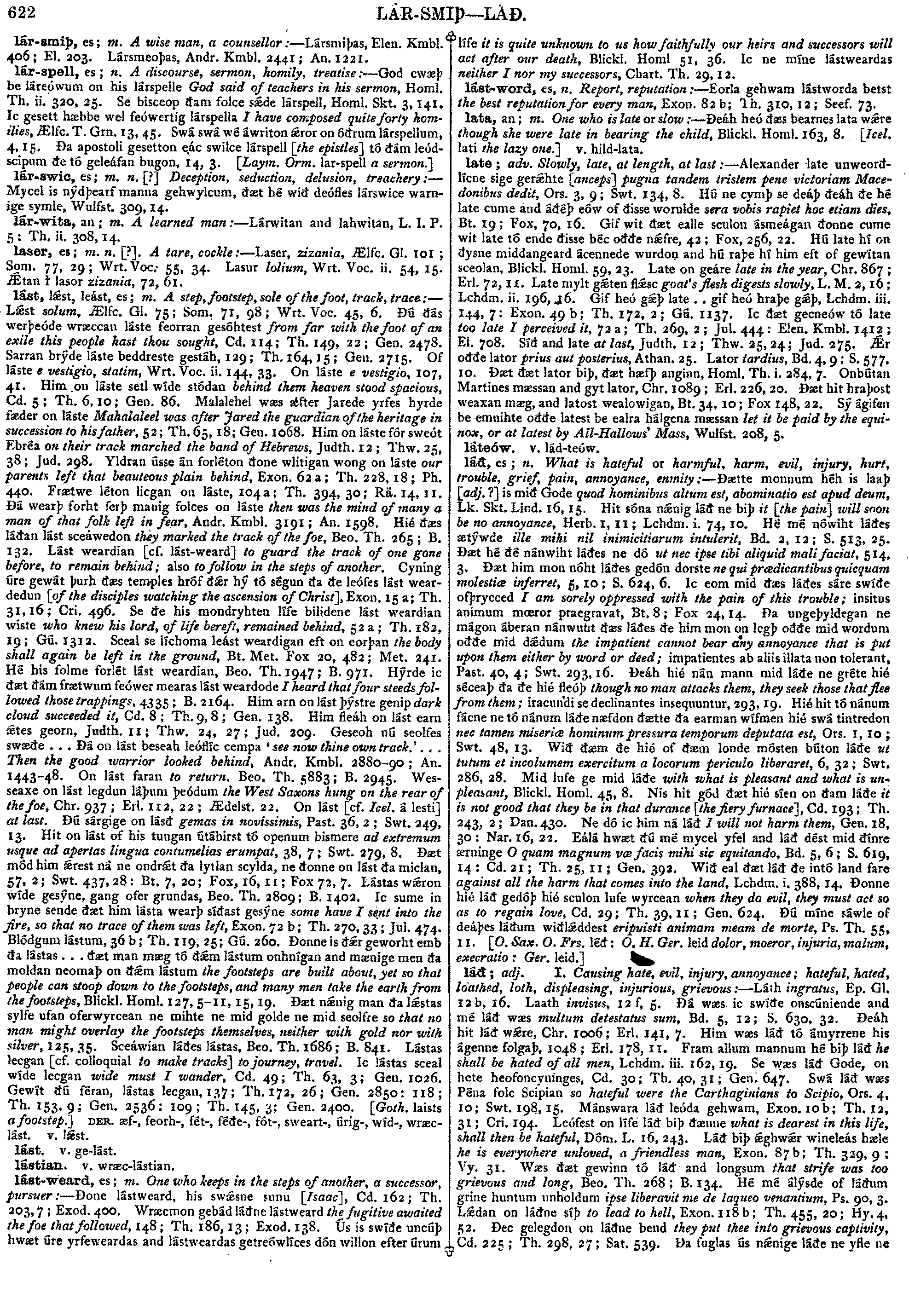
lást,
lst,
leást,
es;
m.
A
step,
footstep,
sole
of
the
foot,
track,
trace
:--
Lst
solum,
Ælfc.
Gl.
75;
Som.
71,
98;
Wrt.
Voc.
45,
6.
Ðú
ðás
werþeóde
wræccan
láste
feorran
gesóhtest
from
far
with
the
foot
of
an
exile
this
people
hast
thou
sought,
Cd.
114;
Th.
149,
22;
Gen.
2478.
Sarran
brýde
láste
beddreste
gestáh,
129;
Th.
164,
15;
Gen.
2715.
Of
láste
e
vestigio,
statim,
Wrt.
Voc.
ii.
144,
33.
On
láste
e
vestigio,
107,
41.
Him
on
láste
setl
wíde
stódan
behind
them
heaven
stood
spacious,
Cd.
5;
Th.
6,
10;
Gen.
86.
Malalehel
wæs
æfter
Jarede
yrfes
hyrde
fæder
on
láste
Mahalaleel
was
after
Jared
the
guardian
of
the
heritage
in
succession
to
his
father,
52;
Th.
65,
18;
Gen.
1068.
Him
on
láste
fór
sweót
Ebréa
on
their
track
marched
the
band
of
Hebrews,
Judth.
12;
Thw.
25,
38;
Jud.
298.
Yldran
ússe
in
forléton
ðone
wlitigan
wong
on
láste
our
parents
left
that
beauteous
plain
behind,
Exon.
62
a;
Th.
228,
18;
Ph.
440.
Frætwe
léton
licgan
on
láste,
104
a;
Th.
394,
30;
Rä.
14,
11.
Ðá
wearþ
forht
ferþ
manig
folces
on
láste
then
was
the
mind
of
many
a
man
of
that
folk
left
in
fear,
Andr.
Kmbl.
3191;
An.
1598.
Hié
ðæs
láðan
lást
sceáwedon
they
marked
the
track
of
the
foe,
Beo.
Th.
265;
B.
132.
Lást
weardian
[cf.
lást-weard]
to
guard
the
track
of
one
gone
before,
to
remain
behind;
also
to
follow
in
the
steps
of
another.
Cyning
úre
gewát
þurh
ðæs
temples
hróf
ðr
hý
tó
ségun
ða
ðe
leófes
lást
weardedun
[of
the
disciples
watching
the
ascension
of
Christ],
Exon.
15
a;
Th.
31,
16;
Cri.
496.
Se
ðe
his
mondryhten
lífe
bilidene
lást
weardian
wiste
who
knew
his
lord,
of
life
bereft,
remained
behind,
52
a;
Th.
182,
19;
Gú.
1312.
Sceal
se
líchoma
leást
weardigan
eft
on
eorþan
the
body
shall
again
be
left
in
the
ground,
Bt.
Met.
Fox
20,
482;
Met.
241.
Hé
his
folme
forlét
lást
weardian,
Beo.
Th.
1947;
B.
971.
Hýrde
ic
ðæt
ðám
frætwum
feówer
mearas
lást
weardode
I
heard
that
four
steeds
followed
those
trappings,
4335;
B.
2164.
Him
arn
on
lást
þýstre
genip
dark
cloud
succeeded
it,
Cd.
8;
Th.
9,
8;
Gen.
138.
Him
fleáh
on
lást
earn
tes
georn,
Judth.
11;
Thw.
24,
27;
Jud.
209.
Gescoh
nú
seolfes
swæðe
...
Ðá
on
lást
beseah
leóflíc
cempa
'see
now
thine
own
track.'
...
Then
the
good
warrior
looked
behind,
Andr.
Kmbl.
2880-90;
An.
1443-48.
On
lást
faran
to
return.
Beo.
Th.
5883;
B.
2945.
Wesseaxe
on
lást
legdun
láþam
þeódum
the
West
Saxons
hung
on
the
rear
of
the
foe,
Chr.
937;
Erl.
112,
22;
Ædelst.
22.
On
lást
[cf.
Icel.
á
lesti]
at
last.
Ðú
sárgige
on
lásð
gemas
in
novissimis,
Past.
36,
2;
Swt.
249,
13.
Hit
on
lást
of
his
tungan
útábirst
tó
openum
bismere
ad
extremum
usque
ad
apertas
lingua
coutumelias
erumpat,
38,
7;
Swt.
279,
8.
Ðæt
mód
him
rest
ná
ne
ondrt
ða
lytlan
scylda,
ne
ðonne
on
lást
ða
miclan,
57,
2;
Swt.
437,
28:
Bt.
7,
20;
Fox,
16,
11;
Fox
72,
7.
Lástas
wron
wíde
gesýne,
gang
ofer
grundas,
Beo.
Th.
2809;
B.
1402.
Ic
sume
in
bryne
sende
ðæt
him
lásta
wearþ
síðast
gesýne
some
have
I
sent
into
the
fire,
so
that
no
trace
of
them
was
left,
Exon.
72
b;
Th.
270,
33;
Jul.
474.
|
Source: Bosworth/Toller, page b0622, entry 7 View original page image as: [TIFF] [PNG] [View previous entry] [View next entry] |
[Comment on this entry] [View comments] |
The following entry has been hand-corrected once. |
Blódgum
lástum,
36
b;
Th.
119,
25;
Gú.
260.
Ðonne
is
ðr
geworht
emb
ða
lástas...
ðæt
man
mæg
tó
ðm
lástum
onhnígan
and
mænige
men
ða
moldan
neomaþ
on
ðm
lástum
the
footsteps
are
built
about,
yet
so
that
people
can
stoop
down
to
the
footsteps,
and
many
men
take
the
earth
from
the
footsteps,
Blickl.
Homl.
127,
5-11,
55,
59.
Ðæt
nnig
man
ða
lstas
sylfe
ufan
oferwyrcean
ne
mihte
ne
mid
golde
ne
mid
seolfre
so
that
no
man
might
overlay
the
footsteps
themselves,
neither
with
gold
nor
with
silver,
125,
35.
Sceáwian
láðes
lástas,
Beo.
Th.
1686;
B.
841.
Lástas
lecgan
[cf.
colloquial
to
make
tracks]
to
journey,
travel.
Ic
lástas
sceal
wíde
lecgan
wide
must
I
wander,
Cd.
49;
Th.
63,
3;
Gen.
1026.
Gewít
ðú
féran,
lástas
lecgan,
137;
Th.
172,
26;
Gen.
2850:
118;
Th.
153,
9;
Gen.
2536:
l09;
Th.
145,
3;
Gen.
2400.
[Goth.
laists
a
footstep.]
DER.
æf-,
feorh-,
fét-,
féðe-,
fót-,
sweart-,
úríg-,
wíd-,
wræclást.
v.
lst.
|
Source: Bosworth/Toller, page b0622, entry 15 View original page image as: [TIFF] [PNG] [View previous entry] [View next entry] |
[Comment on this entry] [View comments] |
The following entry has been hand-corrected once. |
láð,
es;
n.
What
is
hateful
or
harmful,
harm,
evil,
injury,
hurt,
trouble,
grief,
pain,
annoyance,
enmity
:--
Ðætte
monnum
héh
is
laaþ
[adj.?]
is
mið
Gode
quod
hominibus
altum
est,
abominatio
est
apud
deum,
Lk.
Skt.
Lind.
16,
15.
Hit
sóna
nnig
láð
ne
biþ
it
[the
pain]
will
soon
be
no
annoyance,
Herb.
1,
11;
Lchdm.
i.
74,
10.
Hé
mé
nówiht
láðes
ætýwde
ille
mihi
nil
inimicitiarum
intulerit,
Bd.
2,
12;
S.
513,
25.
Ðæt
hé
ðé
nánwiht
láðes
ne
dó
ut
nec
ipse
tibi
aliquid
mali
faciat,
514,
3.
Ðæt
him
mon
nóht
láðes
gedón
dorste
ne
qui
prædicantibus
quicquam
molestiæ
inferret,
5,
10;
S.
624,
6.
Ic
eom
mid
ðæs
láðes
sáre
swíðe
ofþrycced
I
am
sorely
oppressed
with
the
pain
of
this
trouble;
insitus
animum
moeror
praegravat,
Bt.
8;
Fox
24,
14.
Ða
ungeþyldegan
ne
mágon
áberan
nánwuht
ðæs
láðes
ðe
him
mon
on
legþ
oððe
mid
wordum
oððe
mid
ddum
the
impatient
cannot
bear
any
annoyance
that
is
put
upon
them
either
by
word
or
deed;
impatientes
ab
aliis
illata
non
tolerant,
Past.
40,
4;
Swt.
293,
16.
Ðeáh
hié
nán
mann
mid
láðe
ne
gréte
hié
séceaþ
ða
ðe
hié
fleóþ
though
no
man
attacks
them,
they
seek
those
that
flee
from
them;
iracundi
se
declinantes
insequuntur,
293,
19.
Hié
hit
tó
nánum
fácne
ne
tó
nánum
láðe
næfdon
ðætte
ða
earman
wífmen
hié
swá
tintredon
nec
tamen
miseriæ
hominum
pressura
temporum
deputata
est,
Ors.
1,
10;
Swt.
48,
13.
Wið
ðæm
ðe
hié
of
ðæm
londe
mósten
búton
láðe
ut
tutum
et
incolumem
exercitum
a
locorum
periculo
liberaret,
6,
32;
Swt.
286,
28.
Mid
lufe
ge
mid
láðe
with
what
is
pleasant
and
what
is
unpleasant,
Blickl.
Homl.
45,
8.
Nis
hit
gód
ðæt
hié
síen
on
ðam
láðe
it
is
not
good
that
they
be
in
that
durance
[the
fiery
furnace],
Cd.
193;
Th.
243,
2;
Dan.
430.
Ne
dó
ic
him
ná
láð
I
will
not
harm
them,
Gen.
18,
30:
Nar.
16,
22.
Eálá
hwæt
ðú
mé
mycel
yfel
and
láð
dést
mid
ðínre
ærninge
O
quam
magnum
væ
facis
mihi
sic
equitando,
Bd.
5,
6;
S.
619,
14:
Cd.
21;
Th.
25,
11;
Gen.
392.
Wið
eal
ðæt
láð
ðe
intó
land
fare
against
all
the
harm
that
comes
into
the
land,
Lchdm.
i.
388,
14.
Ðonne
hié
láð
gedóþ
hié
sculon
lufe
wyrcean
when
they
do
evil,
they
must
act
so
as
to
regain
love,
Cd.
29;
Th.
39,
11;
Gen.
624.
Ðú
míne
sáwle
of
deáþes
láðum
wiðlddest
eripuisti
animam
meam
de
morte,
Ps.
Th.
55,
11.
[O.
Sax.
O.
Frs.
léð:
O.
H.
Ger.
leid
dolor,
moeror,
injuria,
malum,
execratio:
Ger.
leid.]
|
Source: Bosworth/Toller, page b0625, entry 15 View original page image as: [TIFF] [PNG] [View previous entry] [View next entry] |
[Comment on this entry] [View comments] |
The following entry has been hand-corrected once. |
leán;
p.
lóg
[a
weak
form
also
occurs
(cf.
Icel.)
:--
Se
ðe
wolde
leógan
oftost
on
his
wordon,
ealle
hine
leádan,
ða
ðe
God
lufedan,
Wulfst.
168,
17.]
To
blame,
reproach,
find
fault
with,
disapprove,
scorn
:--
Ne
leá
ic
ðé
ná
ðæt
ðú
gðer
lufige
I
blame
thee
not
for
loving
either,
Shrn.
197,
2.
Hý
nfre
man
lyhþ
se
ðe
secgan
wile
sóð
æfter
rihte
a
man
that
will
rightly
tell
the
truth
will
never
blame
them,
Beo.
Th.
2101;
B.
1048.
Ða
ðe
ðæt
unliéfde
leáþ
and
swá
ðeáh
dóþ
qui
accusant
prava,
nec
tamen
devitant,
Past.
55,
1;
Swt,
427,
12.
Paulus
ðæt
yfel
ðære
forlegnesse
swá
manegum
áwiergdum
leahtrum
lóh
Paulus
fornicationis
vitium
tot
criminibus
execrandis
inseruit,
51,
8;
Swt.
401,
26.
Hé
him
lóh
ðæt
hé
hæfde
his
bróðor
wíf
him
tó
cifese
he
reproached
him
with
having
his
brother's
wife
as
his
concubine,
Shrn.
123,
1.
Nales
wordum
lóg
méces
ecge
he
brought
no
word
of
blame
against
the
blade's
edge,
Beo.
Th.
3627;
B.
1811.
Ðara
manna
ðe
mé
ðæt
lógon
ðæt
ic
ðm
wegum
férde
hominum
qui
dixerant
mihi
ne
festinarem,
Nar.
6,
27.
Ðone
siðfæt
him
snotere
ceorlas
lythwón
lógon
prudent
men
a
little
blamed
him
for
that
journey,
Beo.
Th.
408;
B.
203.
Ne
hié
winedrihten
wiht
ne
lógon,
1729;
B.
862.
Ne
ðé
silfne
ne
hera
ne
ðé
silfne
ne
leah
neither
praise
thyself,
nor
blame
thyself,
Prov.
Kmbl.
36.
Herigaþ
oft
suá
suíðe
suá
hié
hit
leán
scoldon
plerumque
laudant
etiam,
quod
reprobare
debuerant,
Past.
17,
3;
Swt.
111,
6.
Ða
déman
beóþ
swíðor
tó
herigenne
ðonne
tó
leánne,
Blickl.
63,
21.
Eal
swilc
is
tó
leánne
nfre
tó
lufianne,
L.
Eth,
vi,
29;
Th.
i.
322,
22.
Bócláre
leánde
and
unriht
lufiende
scorning
booklearning
and
loving
wrong,
Wulfst.
82,
2.
[Goth.
laian;
p.
lailó
to
revile;
O.
Sax.
lahan;
p.
lóg:
Icel.
lá;
p.
láðí
to
blame:
O.
H.
Ger.
lahan;
p.
luog
vituperare.]
v.
be-leán.
| Result Page: |  |
Previous | 27 28 29 30 31 32 33 34 35 36 37 38 39 40 41 42 43 44 45 | Next |  |
Germanic Lexicon Project (main page)
This search system was written by
Sean Crist
Please consider
volunteering
to correct the data in these online dictionaries.
No rights reserved. Feel free to use these data in any way you please.