|
|

|
Source: Bosworth/Toller, page b0074, entry 55 View original page image as: [TIFF] [PNG] [View previous entry] [View next entry] |
[Comment on this entry] [View comments] |
The following entry has been hand-corrected once. |
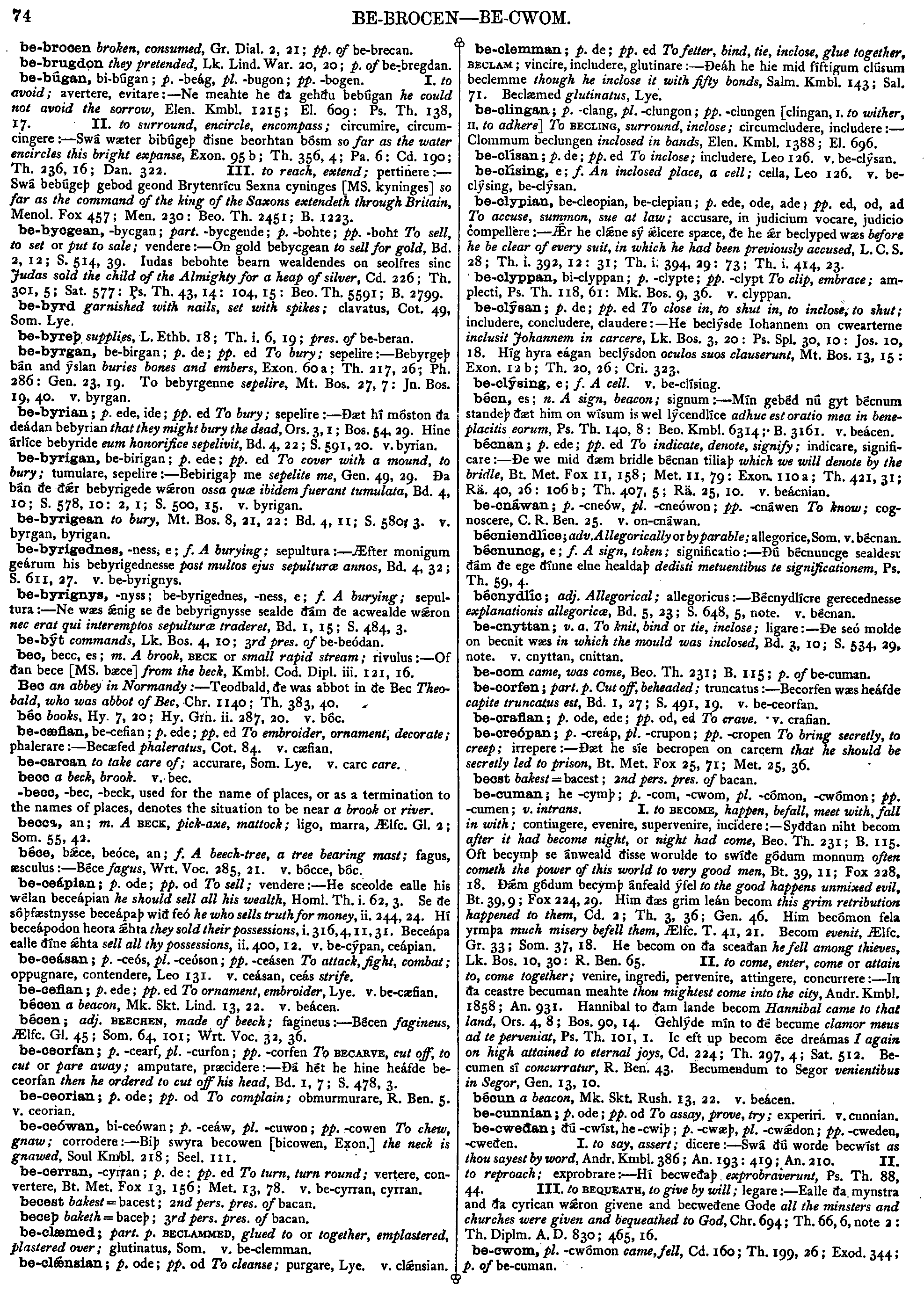
be-cuman;
he
-cymþ;
p.
-com,
-cwom,
pl.
-cómon,
-cwómon;
pp.
-cumen;
v.
intrans.
I.
to
BECOME,
happen,
befall,
meet
with,
fall
in
with;
contingere,
evenire,
supervenire,
incidere
:--
Syððan
niht
becom
after
it
had
become
night,
or
night
had
come,
Beo.
Th.
231;
B.
115.
Oft
becymþ
se
ánweald
ðisse
worulde
to
swíðe
gódum
monnum
often
cometh
the
power
of
this
world
to
very
good
men,
Bt.
39,
11;
Fox
228,
18.
Ð m
gódum
becymþ
ánfeald
ýfel
to
the
good
happens
unmixed
evil,
Bt.
39,
9
;
Fox
224,
29.
Him
ðæs
grim
leán
becom
this
grim
retribution
happened
to
them,
Cd.
2
;
Th.
3,
36;
Gen.
46.
Him
becómon
fela
yrmþa
much
misery
befell
them,
Ælfc.
T.
41,
21.
Becom
evenit,
Ælfc.
Gr.
33;
Som.
37,
18.
He
becom
on
ða
sceaðan
he
fell
among
thieves,
Lk.
Bos-
10,
30
:
R.
Ben.
65.
II.
to
come,
enter,
come
or
attain
to,
come
together;
venire,
ingredi,
pervenire,
attingere,
concurrere
:--
In
ða
ceastre
becuman
meahte
thou
mightest
come
into
the
city,
Andr.
Kmbl.
1858;
An.
931.
Hannibal
to
ðam
lande
becom
Hannibal
came
to
that
land,
Ors.
4,
8
;
Bos.
90,
14.
Gehlýde
mín
to
ðé
becume
clamor
meus
ad
te
perveniat,
Ps.
Th.
101,
1.
Ic
eft
up
becom
éce
dreámas
I
again
on
high
attained
to
eternal
joys,
Cd.
224;
Th.
297,
4;
Sat.
512.
Becumen
sí
concurratur,
R.
Ben.
43.
Becumendum
to
Segor
venientibus
in
Segor,
Gen.
13,
10.
m
gódum
becymþ
ánfeald
ýfel
to
the
good
happens
unmixed
evil,
Bt.
39,
9
;
Fox
224,
29.
Him
ðæs
grim
leán
becom
this
grim
retribution
happened
to
them,
Cd.
2
;
Th.
3,
36;
Gen.
46.
Him
becómon
fela
yrmþa
much
misery
befell
them,
Ælfc.
T.
41,
21.
Becom
evenit,
Ælfc.
Gr.
33;
Som.
37,
18.
He
becom
on
ða
sceaðan
he
fell
among
thieves,
Lk.
Bos-
10,
30
:
R.
Ben.
65.
II.
to
come,
enter,
come
or
attain
to,
come
together;
venire,
ingredi,
pervenire,
attingere,
concurrere
:--
In
ða
ceastre
becuman
meahte
thou
mightest
come
into
the
city,
Andr.
Kmbl.
1858;
An.
931.
Hannibal
to
ðam
lande
becom
Hannibal
came
to
that
land,
Ors.
4,
8
;
Bos.
90,
14.
Gehlýde
mín
to
ðé
becume
clamor
meus
ad
te
perveniat,
Ps.
Th.
101,
1.
Ic
eft
up
becom
éce
dreámas
I
again
on
high
attained
to
eternal
joys,
Cd.
224;
Th.
297,
4;
Sat.
512.
Becumen
sí
concurratur,
R.
Ben.
43.
Becumendum
to
Segor
venientibus
in
Segor,
Gen.
13,
10.
|
Source: Bosworth/Toller, page b0092, entry 31 View original page image as: [TIFF] [PNG] [View previous entry] [View next entry] |
[Comment on this entry] [View comments] |
The following entry has been hand-corrected once. |
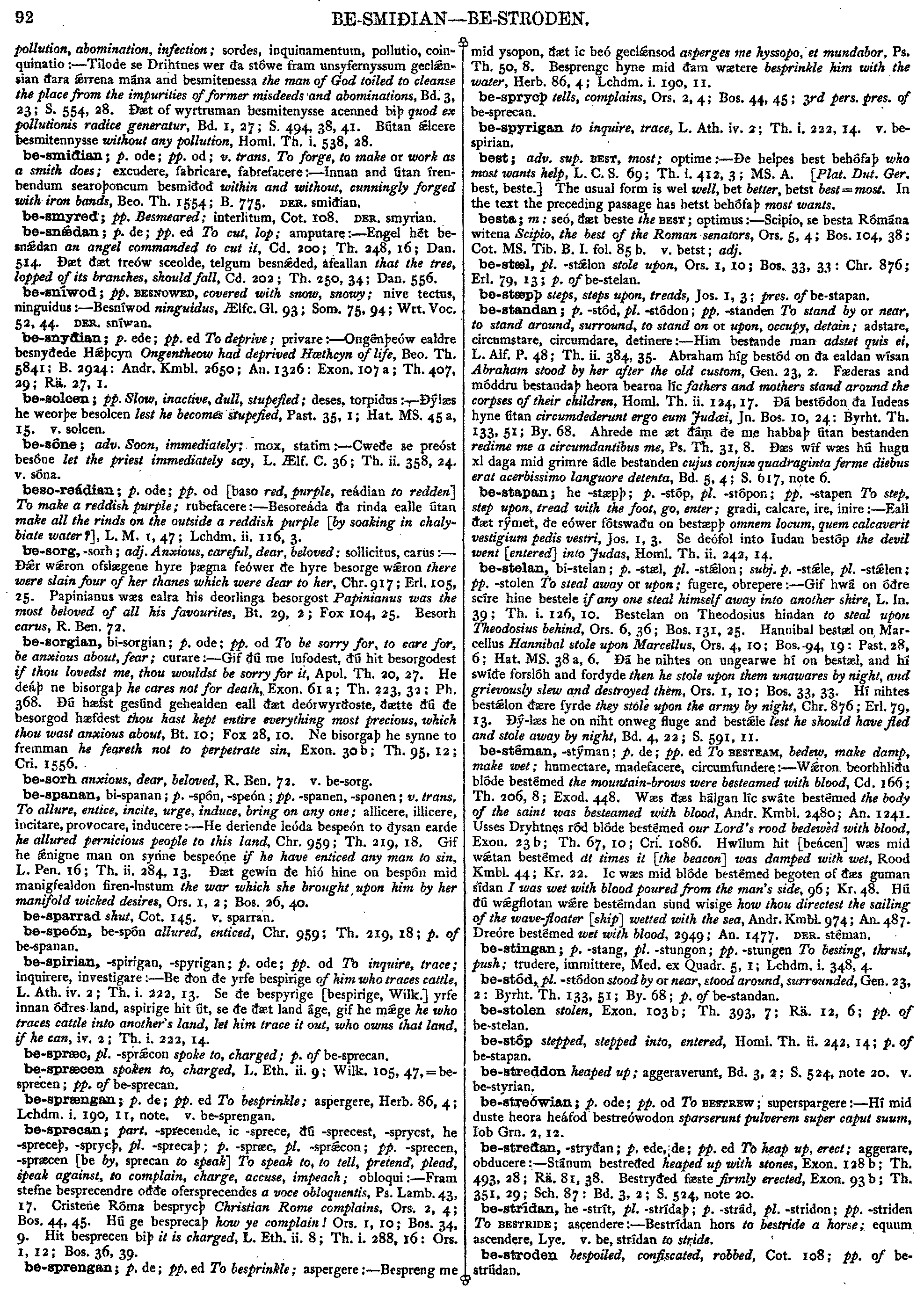
be-stelan,
bi-stelan
;
p.
-stæl,
pl.
-stlon;
subj.
p.
-stle,
pl.
-stlen;
pp.
-stolen
To
steal
away
or
upon;
fugere,
obrepere
:--
Gif
hwá
on
óðre
scíre
hine
bestele
if
any
one
steal
himself
away
into
another
shire,
L.
In.
39;
Th.
i.
126,
10.
Bestelan
on
Theodosius
hindan
to
steal
upon
Theodosius
behind,
Ors.
6,
36;
Bos.
131,
25.
Hannibal
bestæl
on
Marcellus
Hannibal
stole
upon
Marcellus,
Ors.
4,
10;
Bos.
94,
19
:
Past.
28,
6;
Hat.
MS.
38
a,
6.
Ðá
he
nihtes
on
ungearwe
hí
on
bestæl,
and
hí
swíðe
forslóh
and
fordyde
then
he
stole
upon
them
unawares
by
night,
and
grievously
slew
and
destroyed
them,
Ors.
1,
10;
Bos.
33,
33.
Hí
nihtes
bestlon
ðære
fyrde
they
stole
upon
the
army
by
night,
Chr.
876;
Erl.
79,
13.
Ðý-læs
he
on
niht
onweg
fluge
and
bestle
lest
he
should
have
fled
and
stole
away
by
night,
Bd.
4,
22;
S.
591,
11.
|
Source: Bosworth/Toller, page b0109, entry 16 View original page image as: [TIFF] [PNG] [View previous entry] [View next entry] |
[Comment on this entry] [View comments] |
The following entry has been hand-corrected once. |
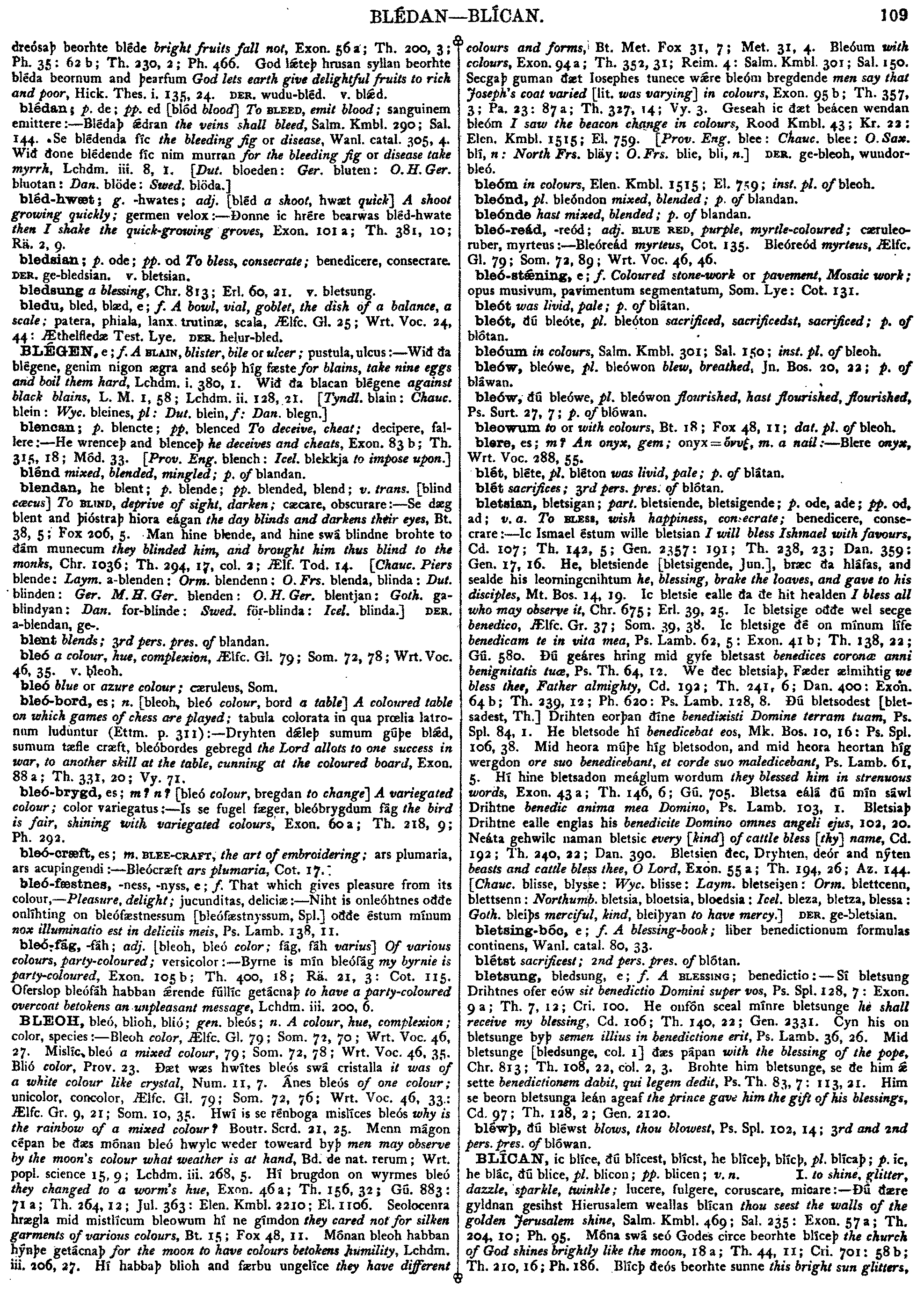
bleó-fæstnes, -ness, -nyss, e; f. That which gives pleasure from its colour,-Pleasure, delight; jucunditas, deliciæ :-- Niht is onleóhtnes oððe onlíhting on bleófæstnessum [bleófæstnyssum, Spl.] oððe éstum mínum nox illuminatio est in deliciis meis, Ps. Lamb. 138, 11.
|
Source: Bosworth/Toller, page b0129, entry 24 View original page image as: [TIFF] [PNG] [View previous entry] [View next entry] |
[Comment on this entry] [View comments] |
The following entry has been hand-corrected once. |
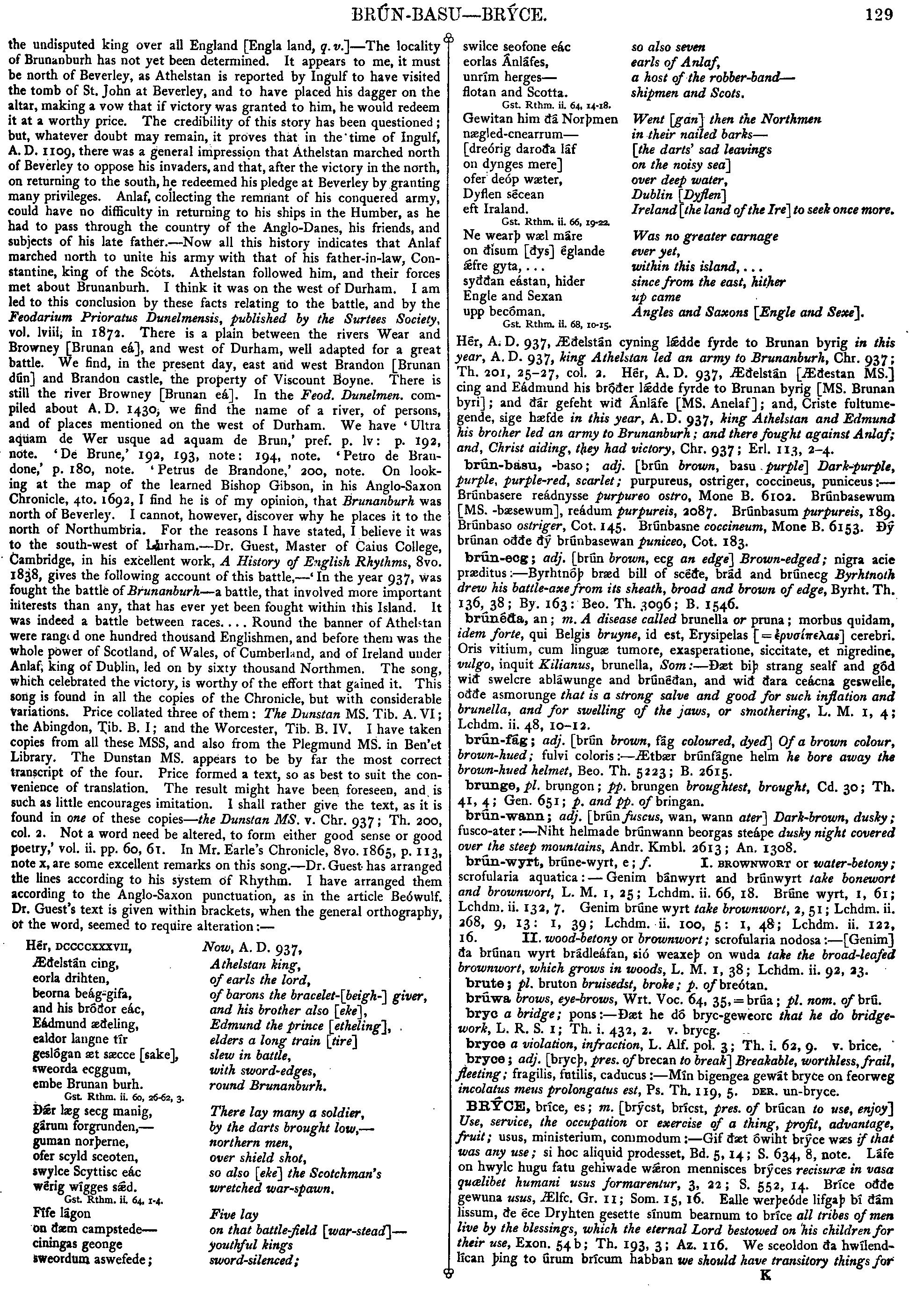
brún-wann; adj. [brún fuscus, wan, wann ater] Dark-brown, dusky; fusco-ater :-- Niht helmade brúnwann beorgas steápe dusky night covered over the steep mountains, Andr. Kmbl. 2613; An. 1308.
|
Source: Bosworth/Toller, page b0137, entry 13 View original page image as: [TIFF] [PNG] [View previous entry] [View next entry] |
[Comment on this entry] [View comments] |
The following entry has been hand-corrected once. |
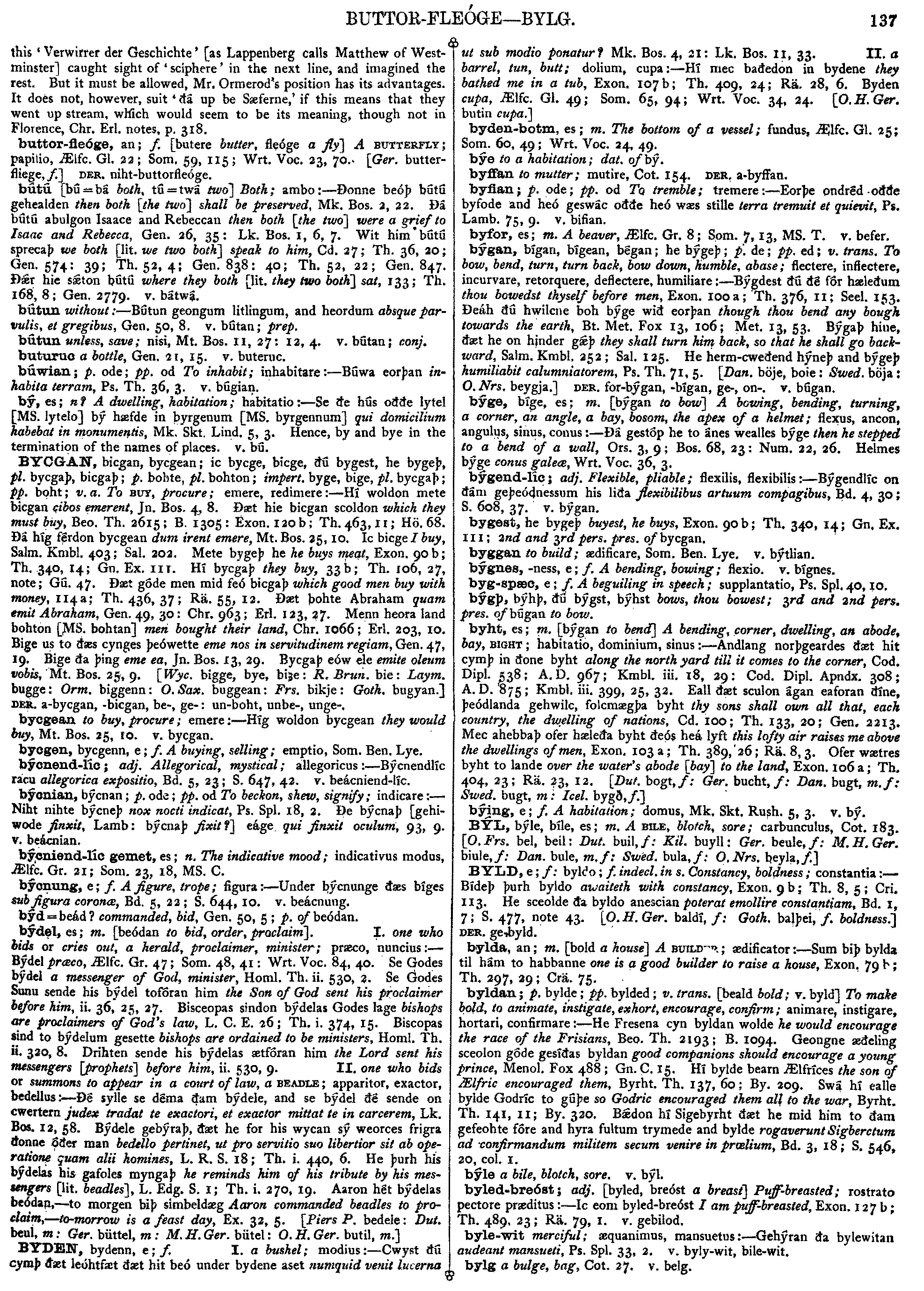
bycnian, býcnan; p. ode; pp. od To beckon, shew, signify; indicare :-- Niht nihte býcneþ nox nocti indicat, Ps. Spl. 18, 2. Ðe býcnaþ [gehiwode finxit, Lamb: býcnaþ fixit? eáge qui finxit oculum, 93, 9. v. beácnian.
|
Source: Bosworth/Toller, page b0141, entry 15 View original page image as: [TIFF] [PNG] [View previous entry] [View next entry] |
[Comment on this entry] [View comments] |
The following entry has been hand-corrected once. |
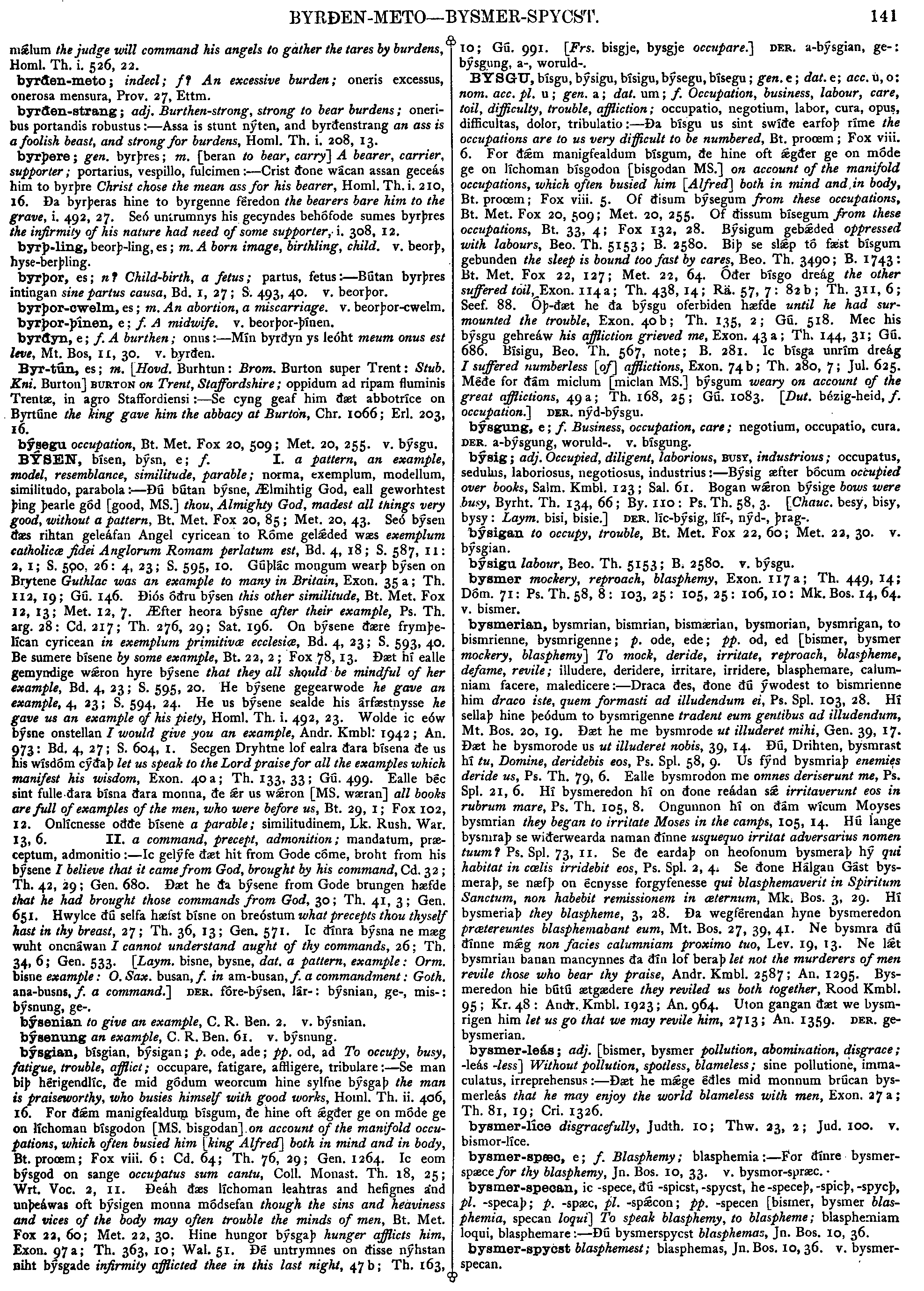
býsgian,
bísgian,
býsigan;
p.
ode,
ade;
pp.
od,
ad
To
occupy,
busy,
fatigue,
trouble,
afflict;
occupare,
fatigare,
affligere,
tribulare
:--
Se
man
biþ
hérigendlíc,
ðe
mid
gódum
weorcum
hine
sylfne
býsgaþ
the
man
is
praiseworthy,
who
busies
himself
with
good
works,
Homl.
Th.
ii.
406,
16.
For
ðm
manigfealdum
bísgum,
ðe
hine
oft
gðer
ge
on
móde
ge
on
líchoman
bísgodon
[MS.
bisgodan].
on
account
of
the
manifold
occupations,
which
often
busied
him
[king
Alfred]
both
in
mind
and
in
body,
Bt.
proœm;
Fox
viii.
6:
Cd.
64;
Th.
76,
29;
Gen.
1264.
Ic
eom
býsgod
on
sange
occupatus
sum
cantu,
Coll.
Monast.
Th.
18,
25;
Wrt.
Voc.
2,
11.
Ðeáh
ðæs
líchoman
leahtras
and
hefignes
and
unþeáwas
oft
býsigen
monna
módsefan
though
the
sins
and
heaviness
and
vices
of
the
body
may
often
trouble
the
minds
of
men,
Bt.
Met.
Fox
22,
60;
Met.
22,
30.
Hine
hunger
býsgaþ
hunger
afflicts
him,
Exon.
97a;
Th.
363,
10;
Wal.
51.
Ðé
untrymnes
on
ðisse
nýhstan
niht
býsgade
infirmity
afflicted
thee
in
this
last
night,
47
b;
Th.
163,
10;
Gú.
991.
[Frs.
bisgje,
bysgje
occupare.]
DER.
a-býsgian,
ge-:
býsgung,
a-,
woruld-.
|
Source: Bosworth/Toller, page b0147, entry 25 View original page image as: [TIFF] [PNG] [View previous entry] [View next entry] |
[Comment on this entry] [View comments (1)] |
The following entry has been hand-corrected once. |
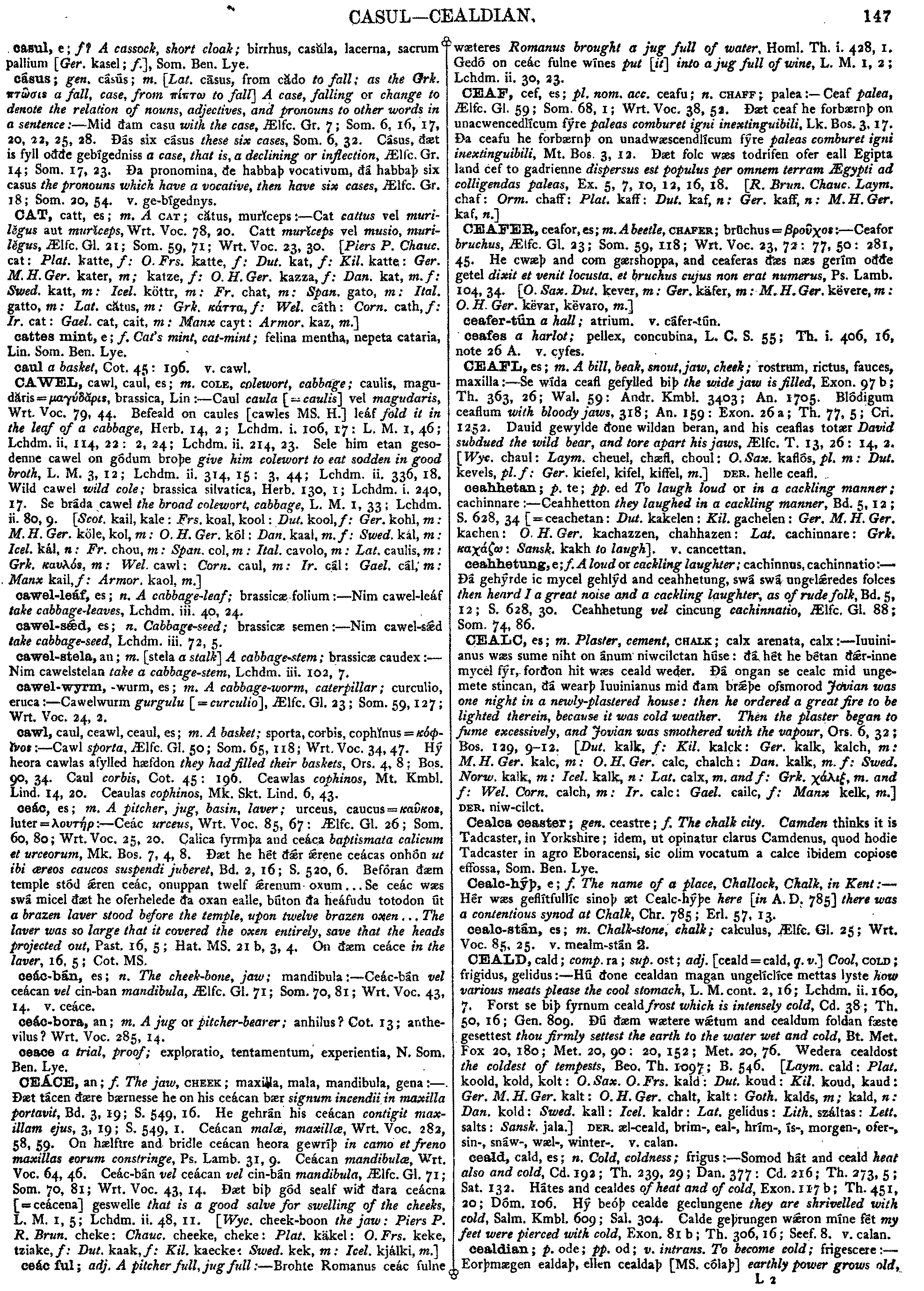
CEALC,
es;
m.
Plaster,
cement,
CHALK;
calx
arenata,
calx
:--
Iuuinianus
wæs
sume
niht
on
ánum
niwcilctan
húse:
ðá
hét
he
bétan
ðr-inne
mycel
fýr,
forðon
hit
wæs
ceald
weder.
Ðá
ongan
se
cealc
mid
unge-mete
UNCERTAIN
stincan,
ðá
wearþ
Iuuinianus
mid
ðam
brþe
ofsmorod
Jovian
was
one
night
in
a
newly-plastered
house:
then
he
ordered
a
great
fire
to
be
lighted
therein,
because
it
was
cold
weather.
Then
the
plaster
began
to
fume
excessively,
and
Jovian
was
smothered
with
the
vapour,
Ors.
6,
32;
Bos.
129,
9-12.
[Dut.
kalk,
f;
Kil.
kalck:
Ger.
kalk,
kalch,
m:
M.
H.
Ger.
kalc,
m:
O.
H.
Ger.
calc,
chalch:
Dan.
kalk,
m.
f:
Swed.
Norw.
kalk,
m:
Icel.
kalk,
n:
Lat.
calx,
m.
and
f:
Grk.
GREEK
m.
and
f:
Wel.
Corn.
calch,
m:
Ir.
calc:
Gael.
cailc,
f:
Manx
kelk,
m.]
DER.
niw-cilct.
|
Source: Bosworth/Toller, page b0155, entry 29 View original page image as: [TIFF] [PNG] [View previous entry] [View next entry] |
[Comment on this entry] [View comments] |
The following entry has been hand-corrected once. |
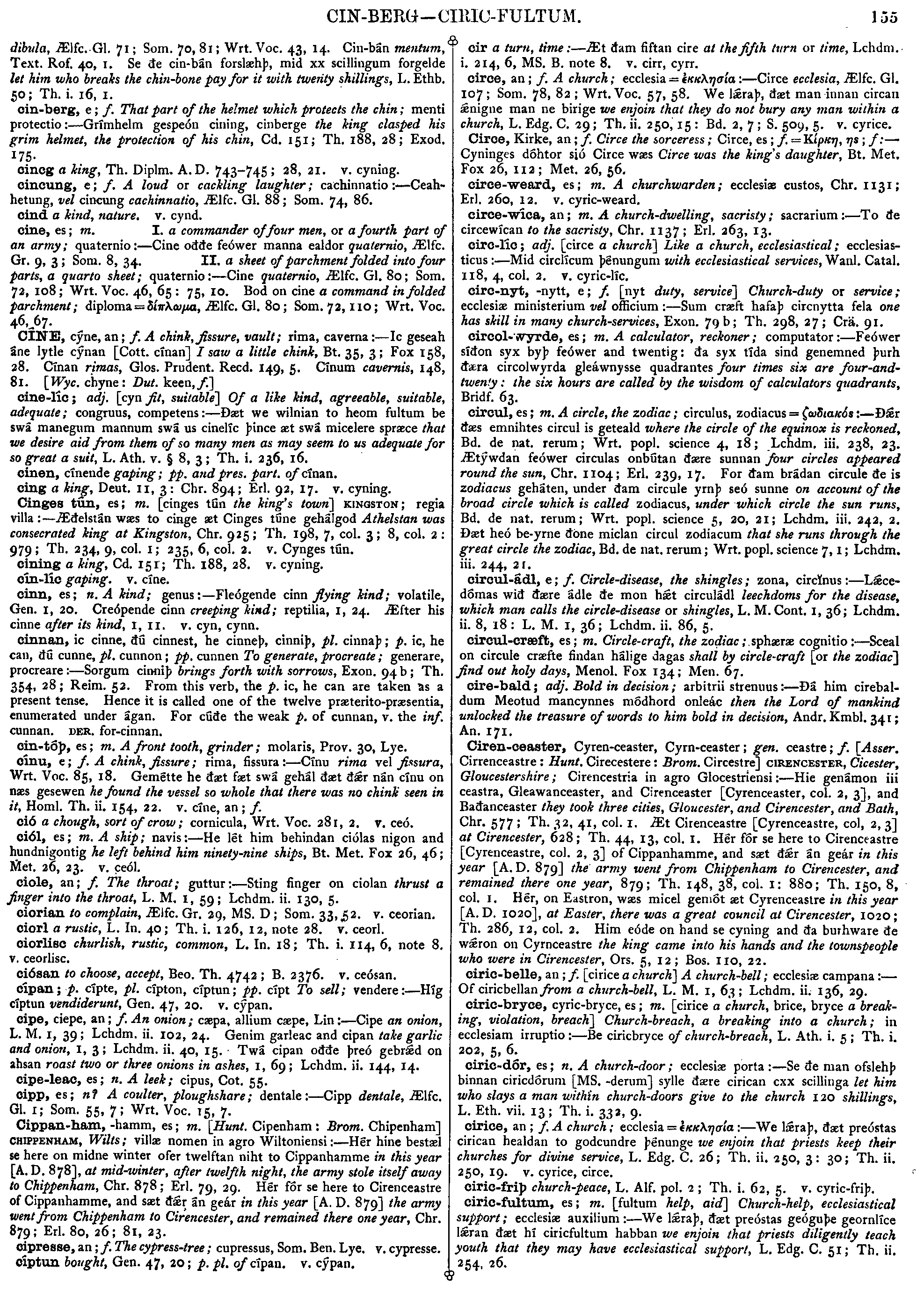
Cippan-ham,
-hamm,
es;
m.
[Hunt.
Cipenham:
Brom.
Chipenham]
CHIPPENHAM,
Wilts;
villæ
nomen
in
agro
Wiltoniensi
:--
Hér
hine
bestæl
se
here
on
midne
winter
ofer
twelftan
niht
to
Cippanhamme
in
this
year
[A.
D.
878],
at
mid-winter,
after
twelfth
night,
the
army
stole
itself
away
to
Chippenham,
Chr.
878;
Erl.
79,
29.
Hér
fór
se
here
to
Cirenceastre
of
Cippanhamme,
and
sæt
ðr
án
geár
in
this
year
[A.
D.
879]
the
army
went
from
Chippenham
to
Cirencester,
and
remained
there
one
year,
Chr.
879;
Erl.
80,
26;
81,
23.
|
Source: Bosworth/Toller, page b0173, entry 22 View original page image as: [TIFF] [PNG] [View previous entry] [View next entry] |
[Comment on this entry] [View comments] |
The following entry has been hand-corrected once. |
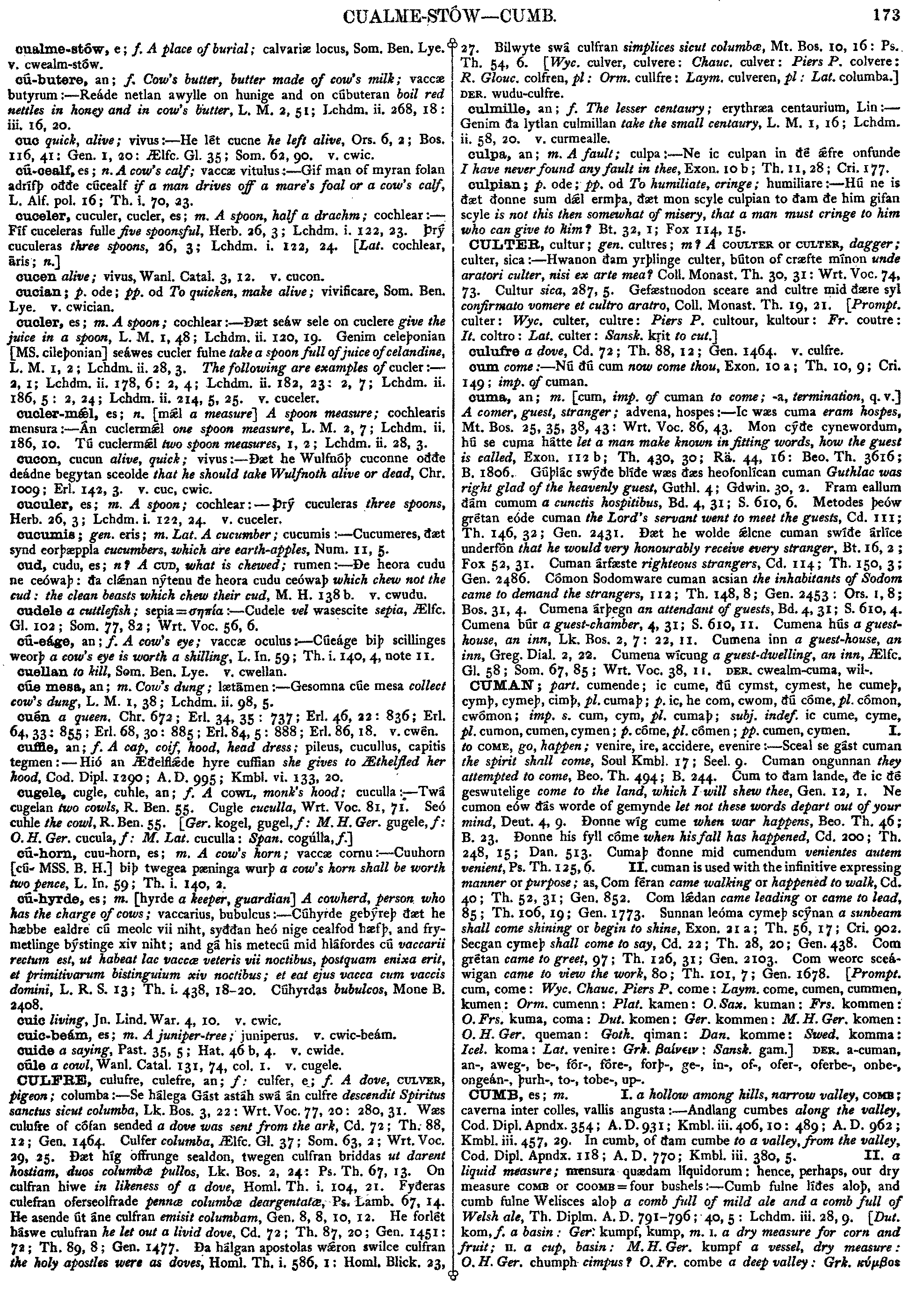
cú-hyrde, es; m. [hyrde a keeper, guardian] A cowherd, person who has the charge of cows; vaccarius, bubulcus :-- Cúhyrde gebýreþ ðæt he hæbbe ealdre cú meolc vii niht, syððan heó nige cealfod hæfþ, and frymetlinge býstinge xiv niht; and gá his metecú mid hláfordes cú vaccarii rectum est, ut habeat lac vaccæ veteris vii noctibus, postquam enixa erit, et primitivarum bistinguium xiv noctibus; el eat ejus vacca cum vaccis domini, L. R. S. 13; Th. i. 438, 18-20. Cúhyrdas bubulcos, Mone B. 2408.
|
Source: Bosworth/Toller, page b0179, entry 12 View original page image as: [TIFF] [PNG] [View previous entry] [View next entry] |
[Comment on this entry] [View comments] |
The following entry has been hand-corrected once. |
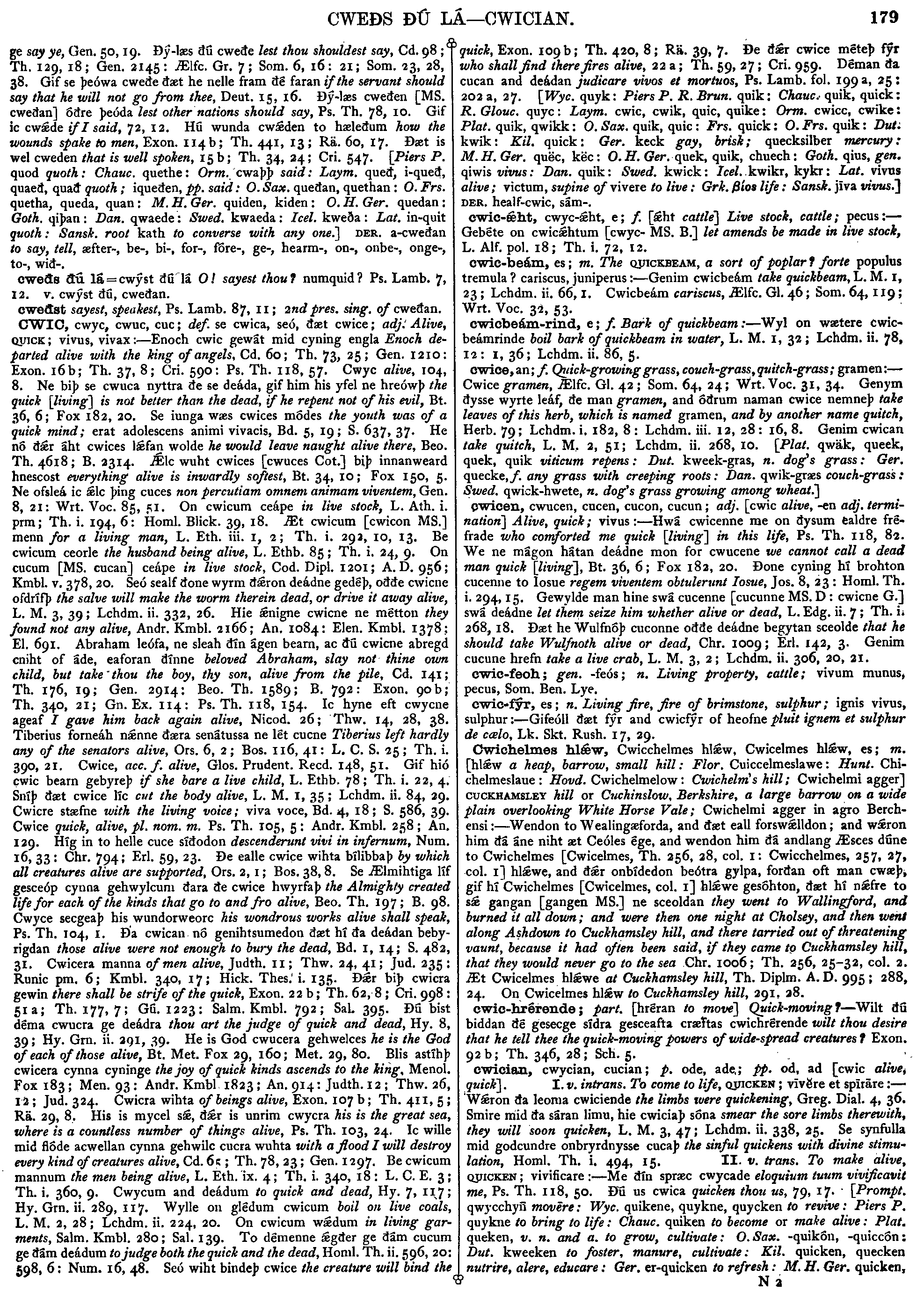
Cwichelmes
hlw,
Cwicchelmes
hlw,
Cwicelmes
hlw,
es;
m.
[hlw
a
heap,
barrow,
small
hill:
Flor.
Cuiccelmeslawe:
Hunt.
Chichelmeslaue:
Hovd.
Cwichelmelow:
Cwichelm's
hill;
Cwichelmi
agger]
CUCKHAMSLEY
hill
or
Cuchinslow,
Berkshire,
a
large
barrow
on
a
wide
plain
overlooking
White
Horse
Vale;
Cwichelmi
agger
in
agro
Berchensi
:--
Wendon
to
Wealingæforda,
and
ðæt
eall
forswlldon;
and
wron
him
ðá
áne
niht
æt
Ceóles
ége,
and
wendon
him
ðá
andlang
Æsces
dúne
to
Cwichelmes
[Cwicelmes,
Th.
256,
28,
col.
1:
Cwicchelmes,
257,
27,
col.
1]
hlwe,
and
ðr
onbídedon
beótra
gylpa,
forðan
oft
man
cwæþ,
gif
hí
Cwichelmes
[Cwicelmes,
col.
1]
hlwe
gesóhton,
ðæt
hí
nfre
to
s
gangan
[gangen
MS.]
ne
sceoldan
they
went
to
Wallingford,
and
burned
it
all
down;
and
were
then
one
night
at
Cholsey,
and
then
went
along
Ashdown
to
Cuckhamsley
hill,
and
there
tarried
out
of
threatening
vaunt,
because
it
had
often
been
said,
if
they
came
to
Cuckhamsley
hill,
that
they
would
never
go
to
the
sea
Chr.
1006;
Th.
256,
25-32,
col.
2.
Æt
Cwicelmes
hlwe
at
Cuckhamsley
hill,
Th.
Diplm.
A.
D.
995;
288,
24.
On
Cwicelmes
hlw
to
Cuckhamsley
hill,
291,
28.
| Result Page: |  |
Previous | 1 2 3 4 5 6 7 8 9 10 11 | Next |  |
Germanic Lexicon Project (main page)
This search system was written by
Sean Crist
Please consider
volunteering
to correct the data in these online dictionaries.
No rights reserved. Feel free to use these data in any way you please.