|
|

Search for next again, using less strict matching (1092 results)
|
Source: Bosworth/Toller, page b0139, entry 1 View original page image as: [TIFF] [PNG] [View previous entry] [View next entry] |
[Comment on this entry] [View comments (2)] |
The following entry has been hand-corrected once. |
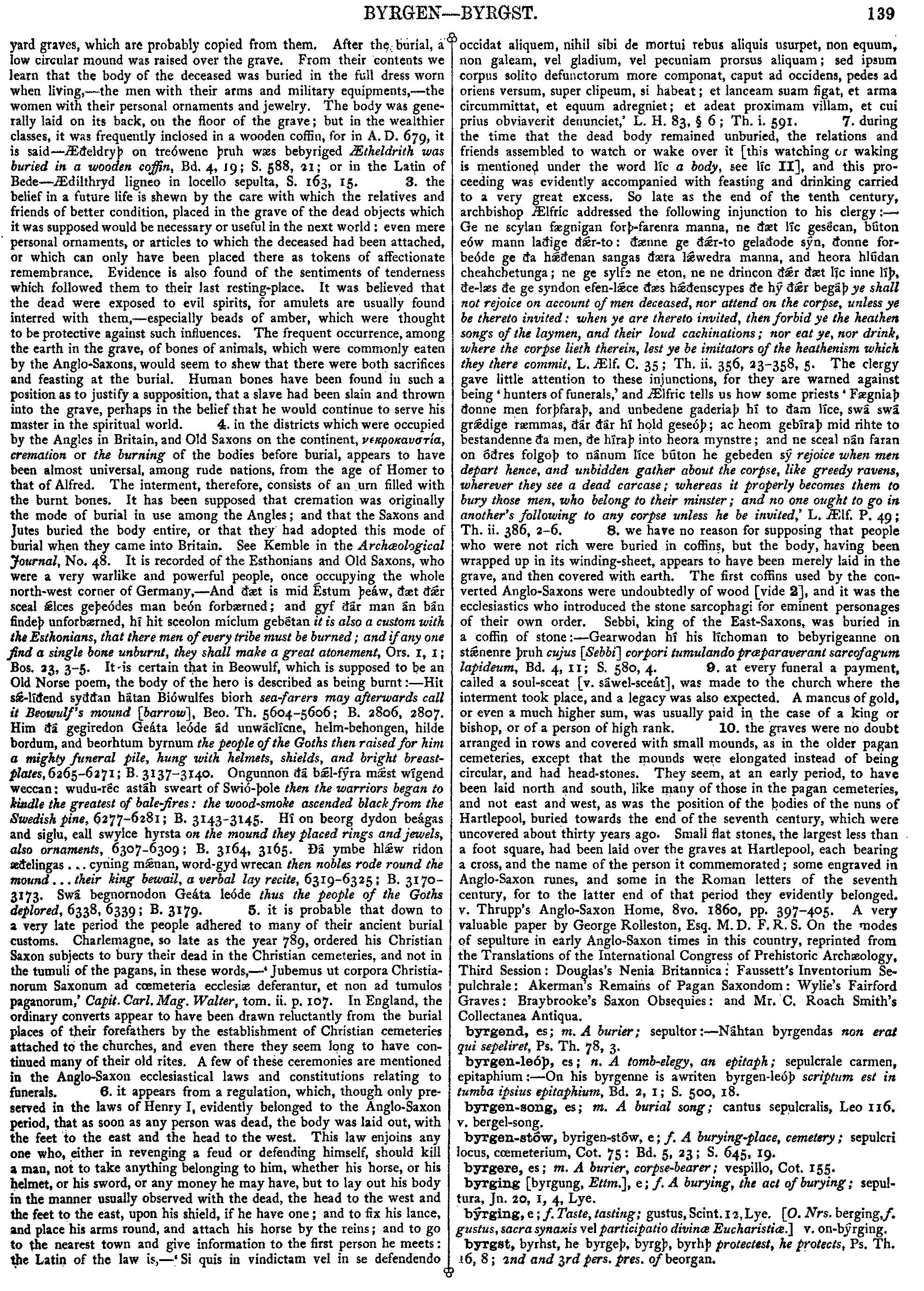
yard
graves,
which
arc
probably
copied
from
them.
After
the.
burial,
a
low
circular
mound
was
raised
over
the
grave.
From
their
contents
we
learn
that
the
body
of
the
deceased
was
buried
in
the
full
dress
worn
when
living,
--
the
men
with
their
arms
and
military
equipments,
--
the
women
with
their
personal
ornaments
and
jewelry.
The
body
was
generally
laid
on
its
back,
on
the
floor
of
the
grave;
but
in
the
wealthier
classes,
it
was
frequently
inclosed
in
a
wooden
coffin,
for
in
A.
D.
679,
it
is
said
--
Æðeldryþ
on
treówene
þruh
wæs
bebyriged
Ætheldrith
was
buried
in
a
wooden
coffin,
Bd.
4,
19;
S.
588,
2l;
or
in
the
Latin
of
Bede
--
Ædilthryd
ligneo
in
locello
sepulta,
S.
163,
15.
3.
the
belief
in
a
future
life
is
shewn
by
the
care
with
which
the
relatives
and
friends
of
better
condition,
placed
in
the
grave
of
the
dead
objects
which
it
was
supposed
would
be
necessary
or
useful
in
the
next
world:
even
mere
personal
ornaments,
or
articles
to
which
the
deceased
had
been
attached,
or
which
can
only
have
been
placed
there
as
tokens
of
affectionate
remembrance.
Evidence
is
also
found
of
the
sentiments
of
tenderness
which
followed
them
to
their
last
resting-place.
It
was
believed
that
the
dead
were
exposed
to
evil
spirits,
for
amulets
are
usually
found
interred
with
them,
--
especially
beads
of
amber,
which
were
thought
to
be
protective
against
such
influences.
The
frequent
occurrence,
among
the
earth
in
the
grave,
of
bones
of
animals,
which
were
commonly
eaten
by
the
Anglo-Saxons,
would
seem
to
shew
that
there
were
both
sacrifices
and
feasting
at
the
burial.
Human
bones
have
been
found
in
such
a
position
as
to
justify
a
supposition,
that
a
slave
had
been
slain
and
thrown
into
the
grave,
perhaps
in
the
belief
that
he
would
continue
to
serve
his
master
in
the
spiritual
world.
4.
in
the
districts
which
were
occupied
by
the
Angles
in
Britain,
and
Old
Saxons
on
the
continent,
GREEK,
cremation
or
the
burning
of
the
bodies
before
burial,
appears
to
have
been
almost
universal,
among
rude
nations,
from
the
age
of
Homer
to
that
of
Alfred.
The
interment,
therefore,
consists
of
an
urn
filled
with
the
burnt
bones.
It
has
been
supposed
that
cremation
was
originally
the
mode
of
burial
in
use
among
the
Angles;
and
that
the
Saxons
and
Jutes
buried
the
body
entire,
or
that
they
had
adopted
this
mode
of
burial
when
they
came
into
Britain.
See
Kemble
in
the
Archæolgical
Journal,
No.
48.
It
is
recorded
of
the
Esthonians
and
Old
Saxons,
who
were
a
very
warlike
and
powerful
people,
once
occupying
the
whole
north-west
corner
of
Germany,
--
And
ðæt
is
mid
Éstum
þeáw,
ðæt
ð r
sceal
lces
geþeódes
man
beón
forbærned;
and
gyf
ðár
man
án
bán
findeþ
unforbærned,
hí
hit
sceolon
miclum
gebétan
it
is
also
a
custom
with
the
Esthonians,
that
there
men
of
every
tribe
must
be
burned;
and
if
any
one
find
a
single
bone
unburnt,
they
shall
make
a
great
atonement,
Ors.
1.
1;
Bos.
23,
3-5.
It
is
certain
that
in
Beowulf,
which
is
supposed
to
be
an
Old
Norse
poem,
the
body
of
the
hero
is
described
as
being
burnt
:--
Hit
s-liðend
syððan
hátan
Biówulfes
biorh
sea-farers
may
afterwards
call
it
Beowulf's
mound
[barrow],
Beo.
Th.
5604-5606;
B.
2806,
2807.
Him
ðá
gegiredon
Geáta
leóde
ád
unwáclícne,
helm-behongen,
hilde
bordum,
and
beorhtum
byrnum
the
people
of
the
Goths
then
raised
for
him
a
mighty
funeral
pile,
hung
with
helmets,
shields,
and
bright
breast-plates,
6265-6271;
B.
3137-3140.
Ongunnon
ðá
bl-fýra
mst
wígend
weccan:
wudu-réc
astáh
sweart
of
Swió-þole
then
the
warriors
began
to
kindle
the
greatest
of
bale-fires:
the
wood-smoke
ascended
black
from
the
Swedish
pine,
6277-6281;
B.
3143-3145.
Hí
on
beorg
dydon
beágas
and
siglu,
eall
swylce
hyrsta
on
the
mound
they
placed
rings
and
jewels,
also
ornaments,
6307-6309;
B.
3164,
3165.
Ðá
ymbe
hlw
ridon
æðelingas
.
.
.
cyring
mnan,
word-gyd
wrecan
then
nobles
rode
round
the
mound.
.
.
their
king
bewail,
a
verbal
lay
recite,
6319-6325;
B.
3170-3173.
Swá
begnomodon
Geáta
leóde
thus
the
people
of
the
Goths
deplored,
6338,
6339;
B.
3179.
5.
it
is
probable
that
down
to
a
very
late
period
the
people
adhered
to
many
of
their
ancient
burial
customs.
Charlemagne,
so
late
as
the
year
789,
ordered
his
Christian
Saxon
subjects
to
bury
their
dead
in
the
Christian
cemeteries,
and
not
in
the
tumuli
of
the
pagans,
in
these
words,
--
Jubemus
ut
corpora
Christianorum
Saxonum
ad
cœmeteria
ecclesiæ
deferantur,
et
non
ad
tumulos
paganorum,
Capit.
Carl.
Mag.
Walter,
tom.
ii.
p.
107.
In
England,
the
ordinary
converts
appear
to
have
been
drawn
reluctantly
from
the
burial
places
of
their
forefathers
by
the
establishment
of
Christian
cemeteries
attached
to
the
churches,
and
even
there
they
seem
long
to
have
continued
many
of
their
old
rites.
A
few
of
these
ceremonies
are
mentioned
in
the
Anglo-Saxon
ecclesiastical
laws
and
constitutions
relating
to
funerals.
6.
it
appears
from
a
regulation,
which,
though
only
preserved
in
the
laws
of
Henry
I,
evidently
belonged
to
the
Anglo-Saxon
period,
that
as
soon
as
any
person
was
dead,
the
body
was
laid
out,
with
the
feet
to
the
east
and
the
head
to
the
west.
This
law
enjoins
any
one
who,
either
in
revenging
a
feud
or
defending
himself,
should
kill
a
man,
not
to
take
anything
belonging
to
him,
whether
his
horse,
or
his
helmet,
or
his
sword,
or
any
money
he
may
have,
but
to
lay
out
his
body
in
the
manner
usually
observed
with
the
dead,
the
head
to
the
west
and
the
feet
to
the
east,
upon
his
shield,
if
he
have
one;
and
to
fix
his
lance,
and
place
his
arms
round,
and
attach
his
horse
by
the
reins;
and
to
go
to
the
nearest
town
and
give
information
to
the
first
person
he
meets;
the
Latin
of
the
law
is,
--
'Si
quis
in
vindictam
vel
in
se
defendendo
occidat
aliquem,
nihil
sibi
de
mortui
rebus
aliquis
usurpet,
non
equum,
non
galeam,
vel
gladium,
vel
pecuniam
prorsus
aliquam;
sed
ipsum
corpus
solito
defunctorum
more
componat,
caput
ad
occidens,
pedes
ad
oriens
versum,
super
clipeum,
si
habeat;
et
lanceam
suatn
figat,
et
arma
circummittat,
et
equum
adregniet;
et
adeat
proxtmam
villam,
et
eni
prius
obviaverit
denunciet,'
L.
H.
83,
§
6;
Th.
i.
591.
7.
during
the
time
that
the
dead
body
remained
unburied,
the
relations
and
friends
assembled
to
watch
or
wake
over
it
[this
watching
or
waking
is
mentioned
under
the
word
líc
a
body,
see
líc
II],
and
this
proceeding
was
evidently
accompanied
with
feasting
and
drinking
carried
to
a
very
great
excess.
So
late
as
the
end
of
the
tenth
century,
archbishop
Ælfric
addressed
the
following
injunction
to
his
clergy
:--
Ge
ne
scylan
fægnigan
forþ-farenra
manna,
ne
ðæt
líc
gesécan,
búton
eów
mann
laðige
ðr-to:
ðænne
ge
ðr-to
gelaðode
sýn,
ðonne
forbeóde
ge
ða
hðenan
sangas
ðæra
lwedra
manna,
and
heora
hlúdan
cheahchetunga;
ne
ge
sylfe
ne
eton,
ne
ne
drincon
ðr
ðæt
líc
inne
líþ,
ðe-læs
ðe
ge
syndon
efen-lce
ðæs
hðenscypes
ðe
hý
ðr
begáþ
ye
shall
not
rejoice
on
account
of
men
deceased,
nor
attend
on
the
corpse,
unless
ye
be
thereto
invited:
when
ye
are
thereto
invited,
then
forbid
ye
the
heathen
songs
of
the
laymen,
and
their
loud
cachinations;
nor
eat
ye,
nor
drink,
where
the
corpse
lieth
therein,
lest
ye
be
imitators
of
the
heathenism
which
they
there
commit,
L.
Ælf.
C.
35;
Th.
ii.
356,
23-358,
5.
The
clergy
gave
little
attention
to
these
injunctions,
for
they
are
warned
against
being
'hunters
of
funerals,'
and
Ælfric
tells
us
how
some
priests
'Fægniaþ
ðonne
men
forþfaraþ,
and
unbedene
gaderiaþ
hí
to
ðam
líce,
swá
swá
grdige
ræmmas,
ðár
ðár
hí
hold
geseóþ;
ac
heom
gebíraþ
mid
rihte
to
bestandenne
ða
men,
ðe
híraþ
into
heora
mynstre;
and
ne
sceal
nán
faran
on
ððres
folgoþ
to
nánum
líce
búton
he
gebeden
sý
rejoice
when
men
depart
hence,
and
unbidden
gather
about
the
corpse,
Kite
greedy
ravens,
wherever
they
see
a
dead
carcase;
whereas
it
properly
becomes
them
to
bury
those
men,
who
belong
to
their
minster;
and
no
one
ought
to
go
in
another's
following
to
any
corpse
unless
he
be
invited,'
L.
Ælf.
P.
49;
Th.
ii.
386,
2-6.
8.
we
have
no
reason
for
supposing
that
people
who
were
not
rich
were
buried
in
coffins,
but
the
body,
having
been
wrapped
up
in
its
winding-sheet,
appears
to
have
been
merely
laid
in
the
grave,
and
then
covered
with
earth.
The
first
coffins
used
by
the
converted
Anglo-Saxons
were
undoubtedly
of
wood
[vide
2],
and
it
was
the
ecclesiastics
who
introduced
the
stone
sarcophagi
for
eminent
personages
of
their
own
order.
Sebbi,
king
of
the
East-Saxons,
was
buried
in
a
coffin
of
stone
:--
Gearwodan
hí
his
líchoman
to
bebyrigeanne
on
stnenre
þruh
cujus
[Sebbi]
corpori
tumulando
præparaverant
sarcofagum
lapideum,
Bd.
4,
11;
S.
580,
4.
9.
at
every
funeral
a
payment,
called
a
soul-sceat
[v.
sáwel-sceát],
was
made
to
the
church
where
the
interment
took
place,
and
a
legacy
was
also
expected.
A
mancus
of
gold,
or
even
a
much
higher
sum,
was
usually
paid
in
the
case
of
a
king
or
bishop,
or
of
a
person
of
high
rank.
10.
the
graves
were
no
doubt
arranged
in
rows
and
covered
with
small
mounds,
as
in
the
older
pagan
cemeteries,
except
that
the
mounds
were
elongated
instead
of
being
circular,
and
had
head-stones.
They
seem,
at
an
early
period,
to
have
been
laid
north
and
south,
like
many
of
those
in
the
pagan
cemeteries,
and
not
east
and
west,
as
was
the
position
of
the
bodies
of
the
nuns
of
Hartlepool,
buried
towards
the
end
of
the
seventh
century,
which
were
uncovered
about
thirty
years
ago.
Small
flat
stones,
the
largest
less
than
a
foot
square,
had
been
laid
over
the
graves
at
Hartlepool,
each
bearing
a
cross,
and
the
name
of
the
person
it
commemorated;
some
engraved
in
Anglo-Saxon
runes,
and
some
in
the
Roman
letters
of
the
seventh
century,
for
to
the
latter
end
of
that
period
they
evidently
belonged.
v.
Thrupp's
Anglo-Saxon
Home,
8vo.
1860,
pp.
397-405.
A
very
valuable
paper
by
George
Rolleston,
Esq.
M.D.
F.R.S.
On
the
modes
of
sepulture
in
early
Anglo-Saxon
times
in
this
country,
reprinted
from
the
Translations
of
the
International
Congress
of
Prehistoric
Archæeology,
Third
Session:
Douglas's
Nenia
Britannica:
Faussett's
Inventorium
Sepulchrale:
Akerman's
Remains
of
Pagan
Saxondom:
Wylie's
Fairford
Graves:
Braybrooke's
Saxon
Obsequies:
and
Mr.
C.
Roach
Smith's
Collectanea
Antíqua.
r
sceal
lces
geþeódes
man
beón
forbærned;
and
gyf
ðár
man
án
bán
findeþ
unforbærned,
hí
hit
sceolon
miclum
gebétan
it
is
also
a
custom
with
the
Esthonians,
that
there
men
of
every
tribe
must
be
burned;
and
if
any
one
find
a
single
bone
unburnt,
they
shall
make
a
great
atonement,
Ors.
1.
1;
Bos.
23,
3-5.
It
is
certain
that
in
Beowulf,
which
is
supposed
to
be
an
Old
Norse
poem,
the
body
of
the
hero
is
described
as
being
burnt
:--
Hit
s-liðend
syððan
hátan
Biówulfes
biorh
sea-farers
may
afterwards
call
it
Beowulf's
mound
[barrow],
Beo.
Th.
5604-5606;
B.
2806,
2807.
Him
ðá
gegiredon
Geáta
leóde
ád
unwáclícne,
helm-behongen,
hilde
bordum,
and
beorhtum
byrnum
the
people
of
the
Goths
then
raised
for
him
a
mighty
funeral
pile,
hung
with
helmets,
shields,
and
bright
breast-plates,
6265-6271;
B.
3137-3140.
Ongunnon
ðá
bl-fýra
mst
wígend
weccan:
wudu-réc
astáh
sweart
of
Swió-þole
then
the
warriors
began
to
kindle
the
greatest
of
bale-fires:
the
wood-smoke
ascended
black
from
the
Swedish
pine,
6277-6281;
B.
3143-3145.
Hí
on
beorg
dydon
beágas
and
siglu,
eall
swylce
hyrsta
on
the
mound
they
placed
rings
and
jewels,
also
ornaments,
6307-6309;
B.
3164,
3165.
Ðá
ymbe
hlw
ridon
æðelingas
.
.
.
cyring
mnan,
word-gyd
wrecan
then
nobles
rode
round
the
mound.
.
.
their
king
bewail,
a
verbal
lay
recite,
6319-6325;
B.
3170-3173.
Swá
begnomodon
Geáta
leóde
thus
the
people
of
the
Goths
deplored,
6338,
6339;
B.
3179.
5.
it
is
probable
that
down
to
a
very
late
period
the
people
adhered
to
many
of
their
ancient
burial
customs.
Charlemagne,
so
late
as
the
year
789,
ordered
his
Christian
Saxon
subjects
to
bury
their
dead
in
the
Christian
cemeteries,
and
not
in
the
tumuli
of
the
pagans,
in
these
words,
--
Jubemus
ut
corpora
Christianorum
Saxonum
ad
cœmeteria
ecclesiæ
deferantur,
et
non
ad
tumulos
paganorum,
Capit.
Carl.
Mag.
Walter,
tom.
ii.
p.
107.
In
England,
the
ordinary
converts
appear
to
have
been
drawn
reluctantly
from
the
burial
places
of
their
forefathers
by
the
establishment
of
Christian
cemeteries
attached
to
the
churches,
and
even
there
they
seem
long
to
have
continued
many
of
their
old
rites.
A
few
of
these
ceremonies
are
mentioned
in
the
Anglo-Saxon
ecclesiastical
laws
and
constitutions
relating
to
funerals.
6.
it
appears
from
a
regulation,
which,
though
only
preserved
in
the
laws
of
Henry
I,
evidently
belonged
to
the
Anglo-Saxon
period,
that
as
soon
as
any
person
was
dead,
the
body
was
laid
out,
with
the
feet
to
the
east
and
the
head
to
the
west.
This
law
enjoins
any
one
who,
either
in
revenging
a
feud
or
defending
himself,
should
kill
a
man,
not
to
take
anything
belonging
to
him,
whether
his
horse,
or
his
helmet,
or
his
sword,
or
any
money
he
may
have,
but
to
lay
out
his
body
in
the
manner
usually
observed
with
the
dead,
the
head
to
the
west
and
the
feet
to
the
east,
upon
his
shield,
if
he
have
one;
and
to
fix
his
lance,
and
place
his
arms
round,
and
attach
his
horse
by
the
reins;
and
to
go
to
the
nearest
town
and
give
information
to
the
first
person
he
meets;
the
Latin
of
the
law
is,
--
'Si
quis
in
vindictam
vel
in
se
defendendo
occidat
aliquem,
nihil
sibi
de
mortui
rebus
aliquis
usurpet,
non
equum,
non
galeam,
vel
gladium,
vel
pecuniam
prorsus
aliquam;
sed
ipsum
corpus
solito
defunctorum
more
componat,
caput
ad
occidens,
pedes
ad
oriens
versum,
super
clipeum,
si
habeat;
et
lanceam
suatn
figat,
et
arma
circummittat,
et
equum
adregniet;
et
adeat
proxtmam
villam,
et
eni
prius
obviaverit
denunciet,'
L.
H.
83,
§
6;
Th.
i.
591.
7.
during
the
time
that
the
dead
body
remained
unburied,
the
relations
and
friends
assembled
to
watch
or
wake
over
it
[this
watching
or
waking
is
mentioned
under
the
word
líc
a
body,
see
líc
II],
and
this
proceeding
was
evidently
accompanied
with
feasting
and
drinking
carried
to
a
very
great
excess.
So
late
as
the
end
of
the
tenth
century,
archbishop
Ælfric
addressed
the
following
injunction
to
his
clergy
:--
Ge
ne
scylan
fægnigan
forþ-farenra
manna,
ne
ðæt
líc
gesécan,
búton
eów
mann
laðige
ðr-to:
ðænne
ge
ðr-to
gelaðode
sýn,
ðonne
forbeóde
ge
ða
hðenan
sangas
ðæra
lwedra
manna,
and
heora
hlúdan
cheahchetunga;
ne
ge
sylfe
ne
eton,
ne
ne
drincon
ðr
ðæt
líc
inne
líþ,
ðe-læs
ðe
ge
syndon
efen-lce
ðæs
hðenscypes
ðe
hý
ðr
begáþ
ye
shall
not
rejoice
on
account
of
men
deceased,
nor
attend
on
the
corpse,
unless
ye
be
thereto
invited:
when
ye
are
thereto
invited,
then
forbid
ye
the
heathen
songs
of
the
laymen,
and
their
loud
cachinations;
nor
eat
ye,
nor
drink,
where
the
corpse
lieth
therein,
lest
ye
be
imitators
of
the
heathenism
which
they
there
commit,
L.
Ælf.
C.
35;
Th.
ii.
356,
23-358,
5.
The
clergy
gave
little
attention
to
these
injunctions,
for
they
are
warned
against
being
'hunters
of
funerals,'
and
Ælfric
tells
us
how
some
priests
'Fægniaþ
ðonne
men
forþfaraþ,
and
unbedene
gaderiaþ
hí
to
ðam
líce,
swá
swá
grdige
ræmmas,
ðár
ðár
hí
hold
geseóþ;
ac
heom
gebíraþ
mid
rihte
to
bestandenne
ða
men,
ðe
híraþ
into
heora
mynstre;
and
ne
sceal
nán
faran
on
ððres
folgoþ
to
nánum
líce
búton
he
gebeden
sý
rejoice
when
men
depart
hence,
and
unbidden
gather
about
the
corpse,
Kite
greedy
ravens,
wherever
they
see
a
dead
carcase;
whereas
it
properly
becomes
them
to
bury
those
men,
who
belong
to
their
minster;
and
no
one
ought
to
go
in
another's
following
to
any
corpse
unless
he
be
invited,'
L.
Ælf.
P.
49;
Th.
ii.
386,
2-6.
8.
we
have
no
reason
for
supposing
that
people
who
were
not
rich
were
buried
in
coffins,
but
the
body,
having
been
wrapped
up
in
its
winding-sheet,
appears
to
have
been
merely
laid
in
the
grave,
and
then
covered
with
earth.
The
first
coffins
used
by
the
converted
Anglo-Saxons
were
undoubtedly
of
wood
[vide
2],
and
it
was
the
ecclesiastics
who
introduced
the
stone
sarcophagi
for
eminent
personages
of
their
own
order.
Sebbi,
king
of
the
East-Saxons,
was
buried
in
a
coffin
of
stone
:--
Gearwodan
hí
his
líchoman
to
bebyrigeanne
on
stnenre
þruh
cujus
[Sebbi]
corpori
tumulando
præparaverant
sarcofagum
lapideum,
Bd.
4,
11;
S.
580,
4.
9.
at
every
funeral
a
payment,
called
a
soul-sceat
[v.
sáwel-sceát],
was
made
to
the
church
where
the
interment
took
place,
and
a
legacy
was
also
expected.
A
mancus
of
gold,
or
even
a
much
higher
sum,
was
usually
paid
in
the
case
of
a
king
or
bishop,
or
of
a
person
of
high
rank.
10.
the
graves
were
no
doubt
arranged
in
rows
and
covered
with
small
mounds,
as
in
the
older
pagan
cemeteries,
except
that
the
mounds
were
elongated
instead
of
being
circular,
and
had
head-stones.
They
seem,
at
an
early
period,
to
have
been
laid
north
and
south,
like
many
of
those
in
the
pagan
cemeteries,
and
not
east
and
west,
as
was
the
position
of
the
bodies
of
the
nuns
of
Hartlepool,
buried
towards
the
end
of
the
seventh
century,
which
were
uncovered
about
thirty
years
ago.
Small
flat
stones,
the
largest
less
than
a
foot
square,
had
been
laid
over
the
graves
at
Hartlepool,
each
bearing
a
cross,
and
the
name
of
the
person
it
commemorated;
some
engraved
in
Anglo-Saxon
runes,
and
some
in
the
Roman
letters
of
the
seventh
century,
for
to
the
latter
end
of
that
period
they
evidently
belonged.
v.
Thrupp's
Anglo-Saxon
Home,
8vo.
1860,
pp.
397-405.
A
very
valuable
paper
by
George
Rolleston,
Esq.
M.D.
F.R.S.
On
the
modes
of
sepulture
in
early
Anglo-Saxon
times
in
this
country,
reprinted
from
the
Translations
of
the
International
Congress
of
Prehistoric
Archæeology,
Third
Session:
Douglas's
Nenia
Britannica:
Faussett's
Inventorium
Sepulchrale:
Akerman's
Remains
of
Pagan
Saxondom:
Wylie's
Fairford
Graves:
Braybrooke's
Saxon
Obsequies:
and
Mr.
C.
Roach
Smith's
Collectanea
Antíqua.
|
Source: Bosworth/Toller, page b0259, entry 17 View original page image as: [TIFF] [PNG] [View previous entry] [View next entry] |
[Comment on this entry] [View comments] |
The following entry has been hand-corrected once. |
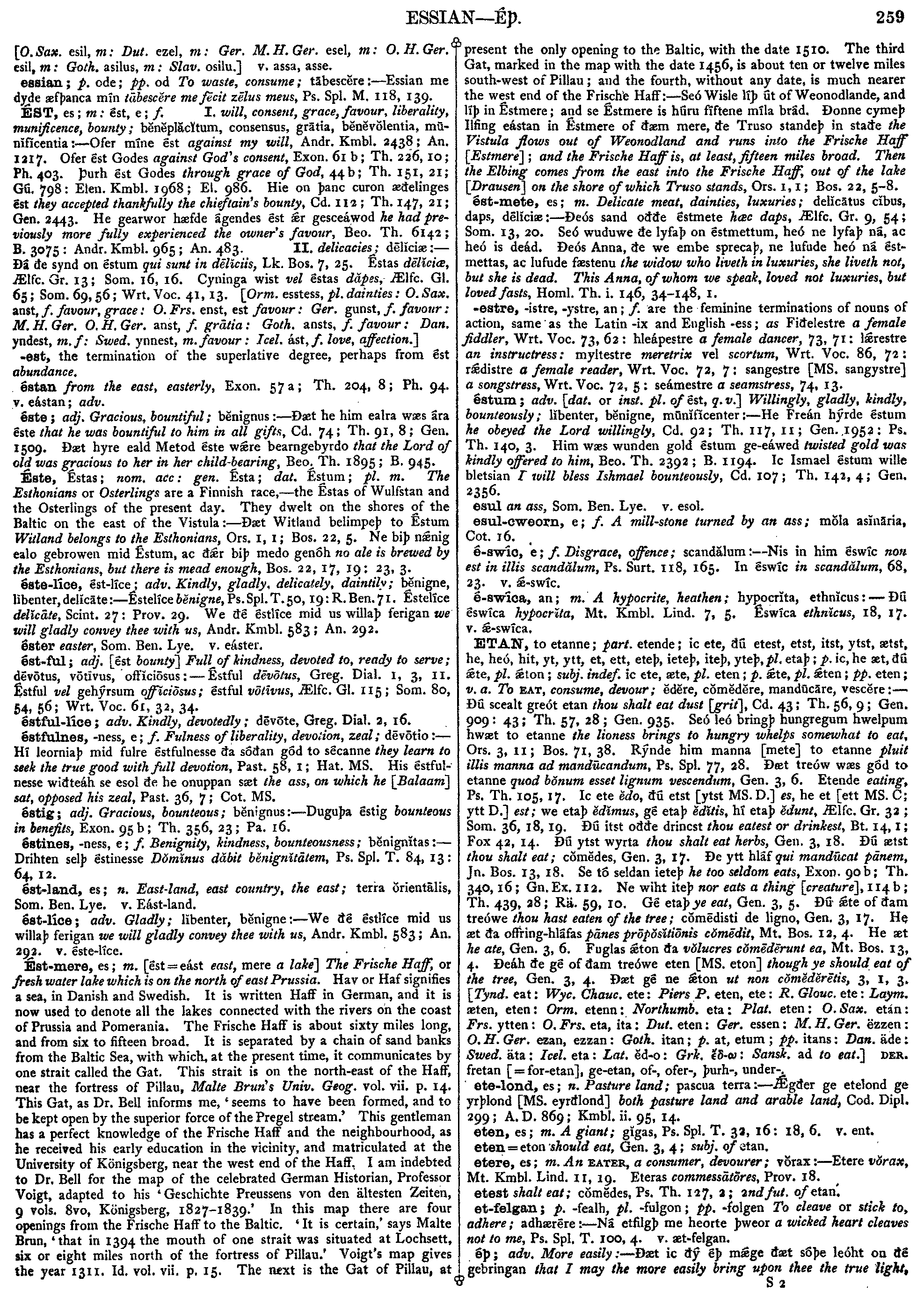
Ést-mere, es; m. [ést = eást east, mere a lake] The Frische Haff, or fresh water lake which is on the north of east Prussia. Hav or Haf signifies a sea, in Danish and Swedish. It is written Haff in German, and it is now used to denote all the lakes connected with the rivers on the coast of Prussia and Pomerania. The Frische Haff is about sixty miles long, and from six to fifteen broad. It is separated by a cham of sand banks from the Baltic Sea, with which, at the present time, it communicates by one strait called the Gat. This strait is on the north-east of the Haff, near the fortress of Pillau, Malte Brunts Univ. Geog. vol. vii. p. 14. This Gat, as Dr. Bell informs me, 'seems to have been formed, and to be kept open by the superior force of the Pregel stream.' This gentleman has a perfect knowledge of the Frische Haff and the neighbourhood, as he received his early education in the vicinity, and matriculated at the University of Königsberg, near the west end of the Haff. I am indebted to Dr. Bell for the map of the celebrated German Historian, Professor Voigt, adapted to his 'Geschichte Preussens von den ältesten Zeiten, 9 vols. 8vo, Königsberg, 1827-1839.' In this map there are four openings from the Frische Haff to the Baltic. 'It is certain,' says Malte Brun, 'that in 1394 the mouth of one strait was situated at Lochsett, six or eight miles north of the fortress of Pillau.' Voigt's map gives the year 1311. Id. vol. vii. p. 15. The next is the Gat of Pillau, at present the only opening to the Baltic, with the date 1510. The third Gat, marked in the map with the date 1456, is about ten or twelve miles south-west of Pillau; and the fourth, without any date, is much nearer the west end of the Frische Haff :-- Seó Wisle líþ út of Weonodlande, and líþ in Éstmere; and se Éstmere is húru fíftene míla brád. Ðonne cymeþ Ilfing eástan in Éstmere of ðæm mere, ðe Truso standeþ in staðe the Vistula flows out of Weonodland and runs into the Frische Haf [Estmere]; and the Frische Haff is, at least, fifteen miles broad. Then the Elbing comes from the east into the Frische Haff, out of the lake [Drausen] on the shore of which Truso stands, Ors. 1, 1; Bos. 22, 5-8.
|
Source: Bosworth/Toller, page b0261, entry 17 View original page image as: [TIFF] [PNG] [View previous entry] [View next entry] |
[Comment on this entry] [View comments] |
The following entry has been hand-corrected once. |
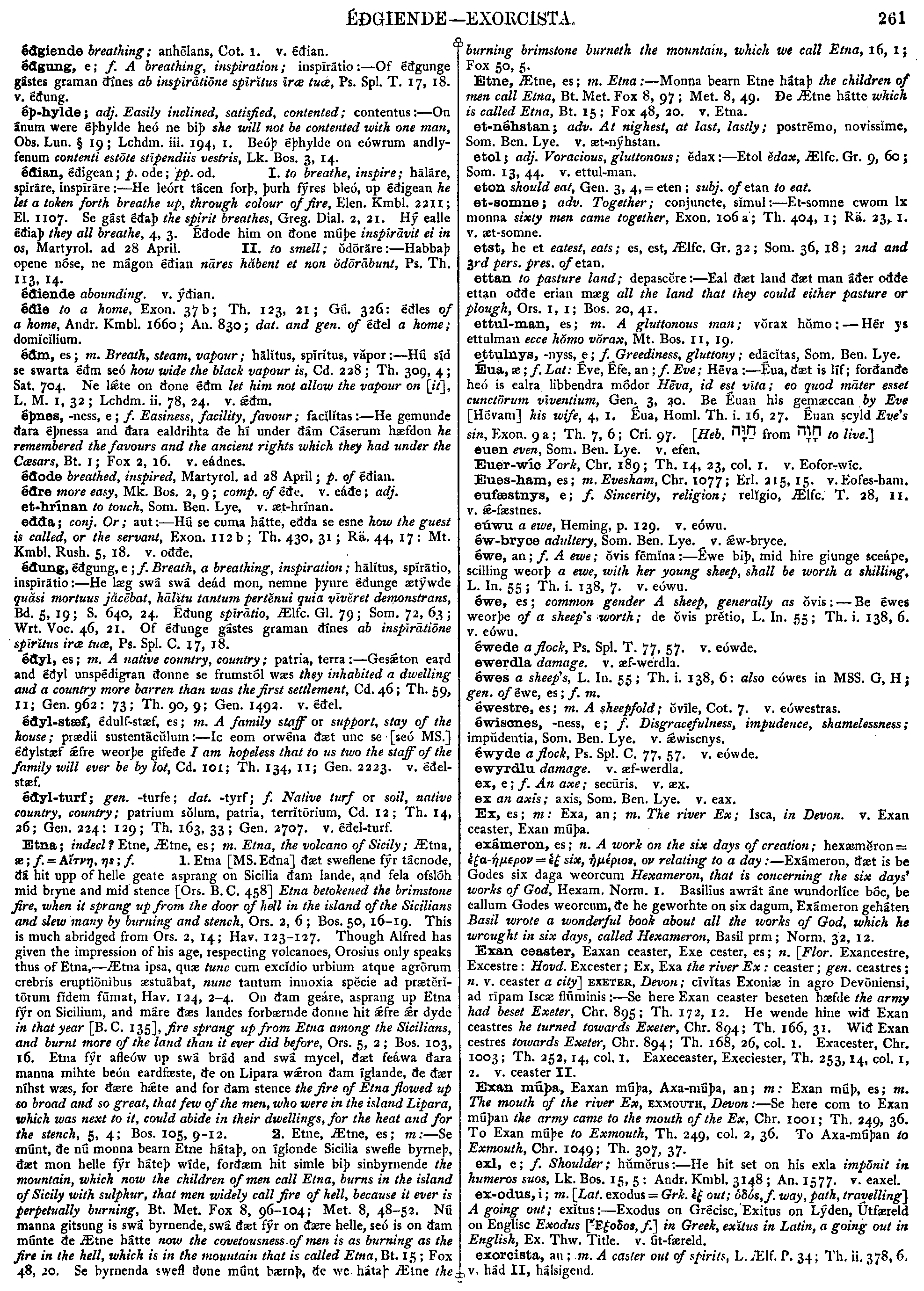
Etna;
indecl?
Etne,
Ætne,
es;
m.
Etna,
the
volcano
of
Sicily;
Ætna,
æ;
f.
=
GREEK;
f.
1.
Etna
[MS.
Eðna]
ðæt
sweflene
fýr
tácnode,
dá
hit
upp
of
helle
geate
asprang
on
Sicilia
ðam
lande,
and
fela
ofslóh
mid
bryne
and
mid
stence
[Ors.
B.
C.
458]
Etna
betokened
the
brimstone
fire,
when
it
sprang
up
from
the
door
of
hell
in
the
island
of
the
Sicilians
and
slew
many
by
burning
and
stench,
Ors.
2,
6;
Bos.
50,
16-19.
This
is
much
abridged
from
Ors.
2,
14;
Hav.
123-127.
Though
Alfred
has
given
the
impression
of
his
age,
respecting
volcanoes,
Orosius
only
speaks
thus
of
Etna,
--
Ætna
ipsa,
quæ
tunc
cum
exc dio
urbium
atque
agr
dio
urbium
atque
agr rum
crebris
eruptinibus
æstu
rum
crebris
eruptinibus
æstu bat,
nunc
tantum
innoxia
sp
bat,
nunc
tantum
innoxia
sp cie
ad
prætrtrum
fidem
f
cie
ad
prætrtrum
fidem
f mat,
Hav.
124,
2-4.
On
ðam
geáre,
asprang
up
Etna
fýr
on
Sicilium,
and
máre
ðæs
landes
forbærnde
ðonne
hit
fre
r
dyde
in
that
year
[B.
C.
135],
fire
sprang
up
from
Etna
among
the
Sicilians,
and
burnt
more
of
the
land
than
it
ever
did
before,
Ors.
5,
2;
Bos.
103,
16.
Etna
fýr
afleów
up
swá
brád
and
swá
mycel,
ðæt
feáwa
ðara
manna
mihte
beón
eardfæste,
ðe
on
Lipara
wron
ðam
íglande,
ðe
ðær
níhst
wæs,
for
dære
hte
and
for
ðam
stence
the
fire
of
Etna
flowed
up
so
broad
and
so
great,
that
few
of
the
men,
who
were
in
the
island
Lipara,
which
was
next
to
it,
could
abide
in
their
dwellings,
for
the
heat
and
for
the
stench,
5,
4;
Bos.
105,
9-12.
2.
Etne,
Ætne,
es;
m:--
Se
múnt,
ðe
nú
monna
bearn
Etne
hátaþ,
on
íglonde
Sicilia
swefle
byrneþ,
ðæt
mon
helle
fýr
háteþ
wide,
forðæm
hit
simle
biþ
sinbyrnende
the
mountain,
which
now
the
children
of
men
call
Etna,
burns
in
the
island
of
Sicily
with
sulphur,
that
men
widely
call
fire
of
hell,
because
it
ever
is
perpetually
burning,
Bt.
Met.
Fox
8,
96-104;
Met.
8,
48-52.
Nú
manna
gitsung
is
swá
byrnende,
swá
ðæt
fýr
on
ðaelig;re
helle,
seó
is
on
ðam
múnte
ðe
Ætne
hátte
now
the
covetousness
of
men
is
as
burning
as
the
fire
in
the
hell,
which
is
in
the
mountain
that
is
called
Etna,
Bt.
15;
Fox
48,
20.
Se
byrnenda
swefl
ðone
múnt
bærnþ,
ðe
we
hátaþ
Ætne
the
burning
brimstone
burneth
the
mountain,
which
we
call
Etna,
16,
1;
Fox
50,
5.
mat,
Hav.
124,
2-4.
On
ðam
geáre,
asprang
up
Etna
fýr
on
Sicilium,
and
máre
ðæs
landes
forbærnde
ðonne
hit
fre
r
dyde
in
that
year
[B.
C.
135],
fire
sprang
up
from
Etna
among
the
Sicilians,
and
burnt
more
of
the
land
than
it
ever
did
before,
Ors.
5,
2;
Bos.
103,
16.
Etna
fýr
afleów
up
swá
brád
and
swá
mycel,
ðæt
feáwa
ðara
manna
mihte
beón
eardfæste,
ðe
on
Lipara
wron
ðam
íglande,
ðe
ðær
níhst
wæs,
for
dære
hte
and
for
ðam
stence
the
fire
of
Etna
flowed
up
so
broad
and
so
great,
that
few
of
the
men,
who
were
in
the
island
Lipara,
which
was
next
to
it,
could
abide
in
their
dwellings,
for
the
heat
and
for
the
stench,
5,
4;
Bos.
105,
9-12.
2.
Etne,
Ætne,
es;
m:--
Se
múnt,
ðe
nú
monna
bearn
Etne
hátaþ,
on
íglonde
Sicilia
swefle
byrneþ,
ðæt
mon
helle
fýr
háteþ
wide,
forðæm
hit
simle
biþ
sinbyrnende
the
mountain,
which
now
the
children
of
men
call
Etna,
burns
in
the
island
of
Sicily
with
sulphur,
that
men
widely
call
fire
of
hell,
because
it
ever
is
perpetually
burning,
Bt.
Met.
Fox
8,
96-104;
Met.
8,
48-52.
Nú
manna
gitsung
is
swá
byrnende,
swá
ðæt
fýr
on
ðaelig;re
helle,
seó
is
on
ðam
múnte
ðe
Ætne
hátte
now
the
covetousness
of
men
is
as
burning
as
the
fire
in
the
hell,
which
is
in
the
mountain
that
is
called
Etna,
Bt.
15;
Fox
48,
20.
Se
byrnenda
swefl
ðone
múnt
bærnþ,
ðe
we
hátaþ
Ætne
the
burning
brimstone
burneth
the
mountain,
which
we
call
Etna,
16,
1;
Fox
50,
5.
|
Source: Bosworth/Toller, page b0368, entry 10 View original page image as: [TIFF] [PNG] [View previous entry] [View next entry] |
[Comment on this entry] [View comments] |
The following entry has been hand-corrected once. |
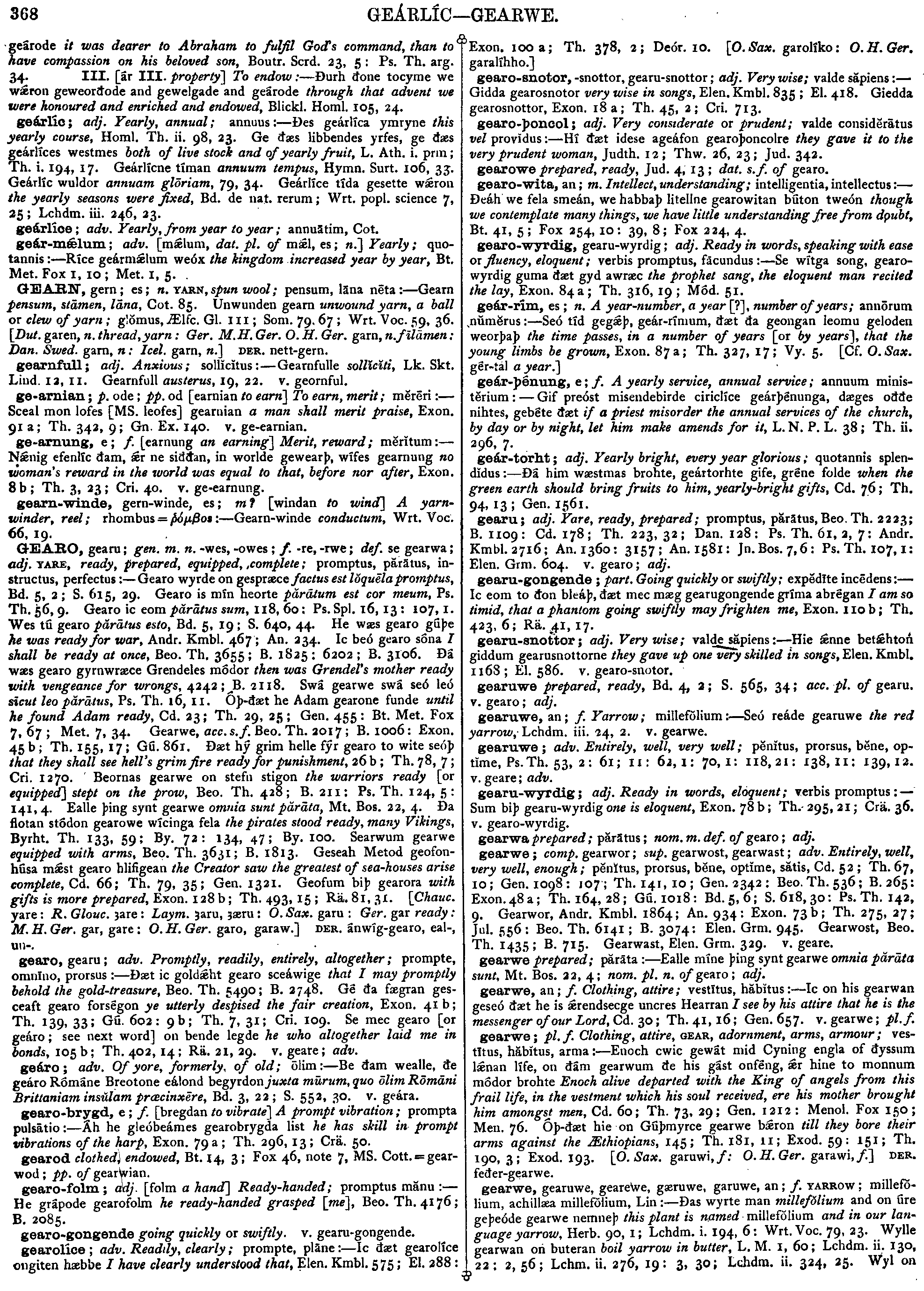
gearo,
gearu;
adv.
Promptly,
readily,
entirely,
altogether;
prompte,
omn no,
prorsus
:--
Ðæt
ic
goldht
gearo
sceáwige
that
I
may
promptly
behold
the
gold-treasure,
Beo.
Th.
5490;
B.
2748.
Gé
ða
fægran
gesceaft
gearo
forségon
ye
utterly
despised
the
fair
creation,
Exon.
41
b;
Th.
139,
33;
Gú.
602
:
9
b;
Th.
7,
31;
Cri.
109.
Se
mec
gearo
[or
geáro;
see
next
word]
on
bende
legde
he
who
altogether
laid
me
in
bonds,
105
b;
Th.
402,
14;
Rä.
21,
29.
v.
geare;
adv.
no,
prorsus
:--
Ðæt
ic
goldht
gearo
sceáwige
that
I
may
promptly
behold
the
gold-treasure,
Beo.
Th.
5490;
B.
2748.
Gé
ða
fægran
gesceaft
gearo
forségon
ye
utterly
despised
the
fair
creation,
Exon.
41
b;
Th.
139,
33;
Gú.
602
:
9
b;
Th.
7,
31;
Cri.
109.
Se
mec
gearo
[or
geáro;
see
next
word]
on
bende
legde
he
who
altogether
laid
me
in
bonds,
105
b;
Th.
402,
14;
Rä.
21,
29.
v.
geare;
adv.
|
Source: Bosworth/Toller, page b0388, entry 14 View original page image as: [TIFF] [PNG] [View previous entry] [View next entry] |
[Comment on this entry] [View comments] |
The following entry has been hand-corrected once. |
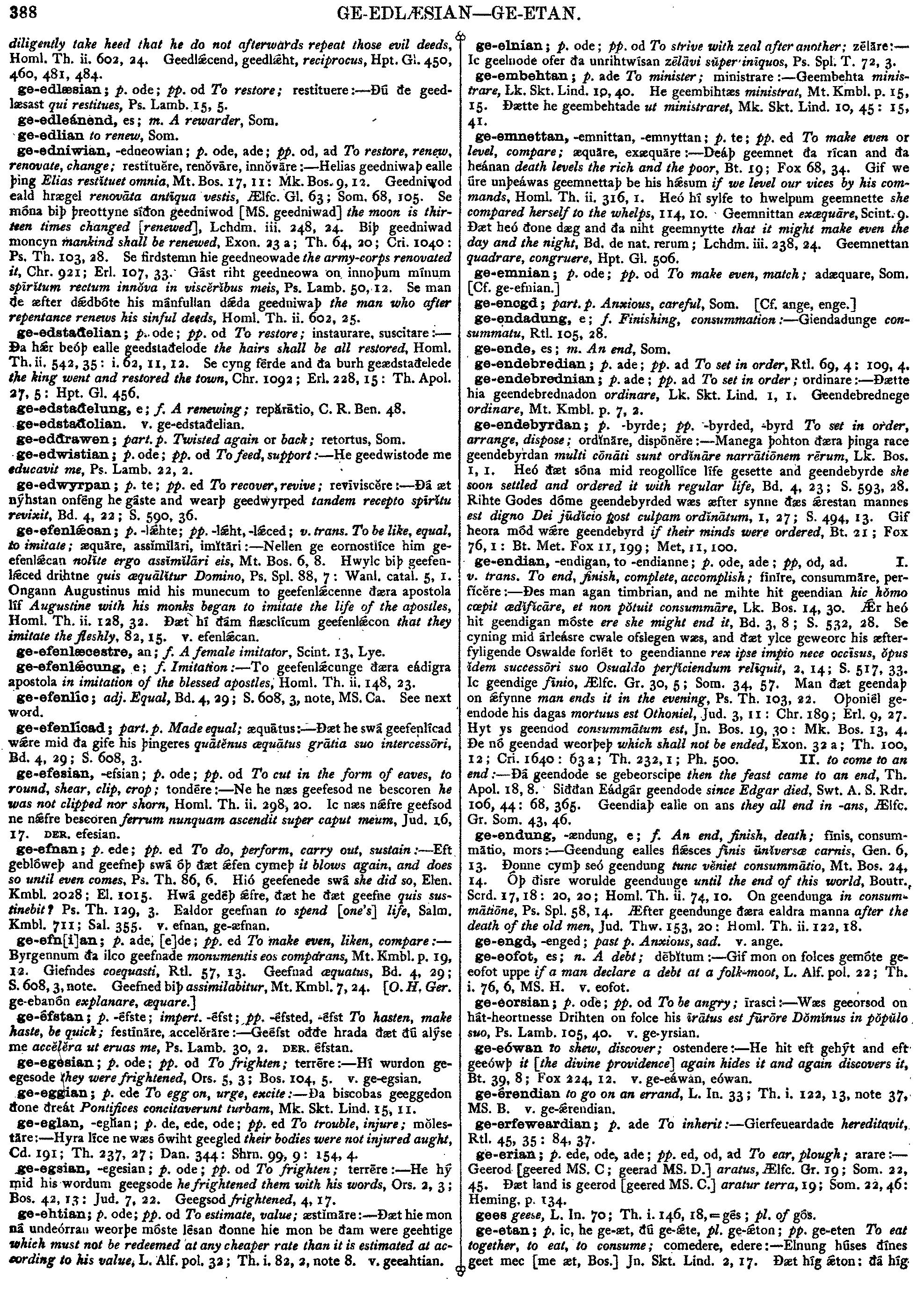
ge-efenlíc; adj. Equal, Bd. 4, 29; S. 6o8, 3, note, MS. Ca. See next word.
|
Source: Bosworth/Toller, page b0400, entry 8 View original page image as: [TIFF] [PNG] [View previous entry] [View next entry] |
[Comment on this entry] [View comments] |
The following entry has been hand-corrected once. |
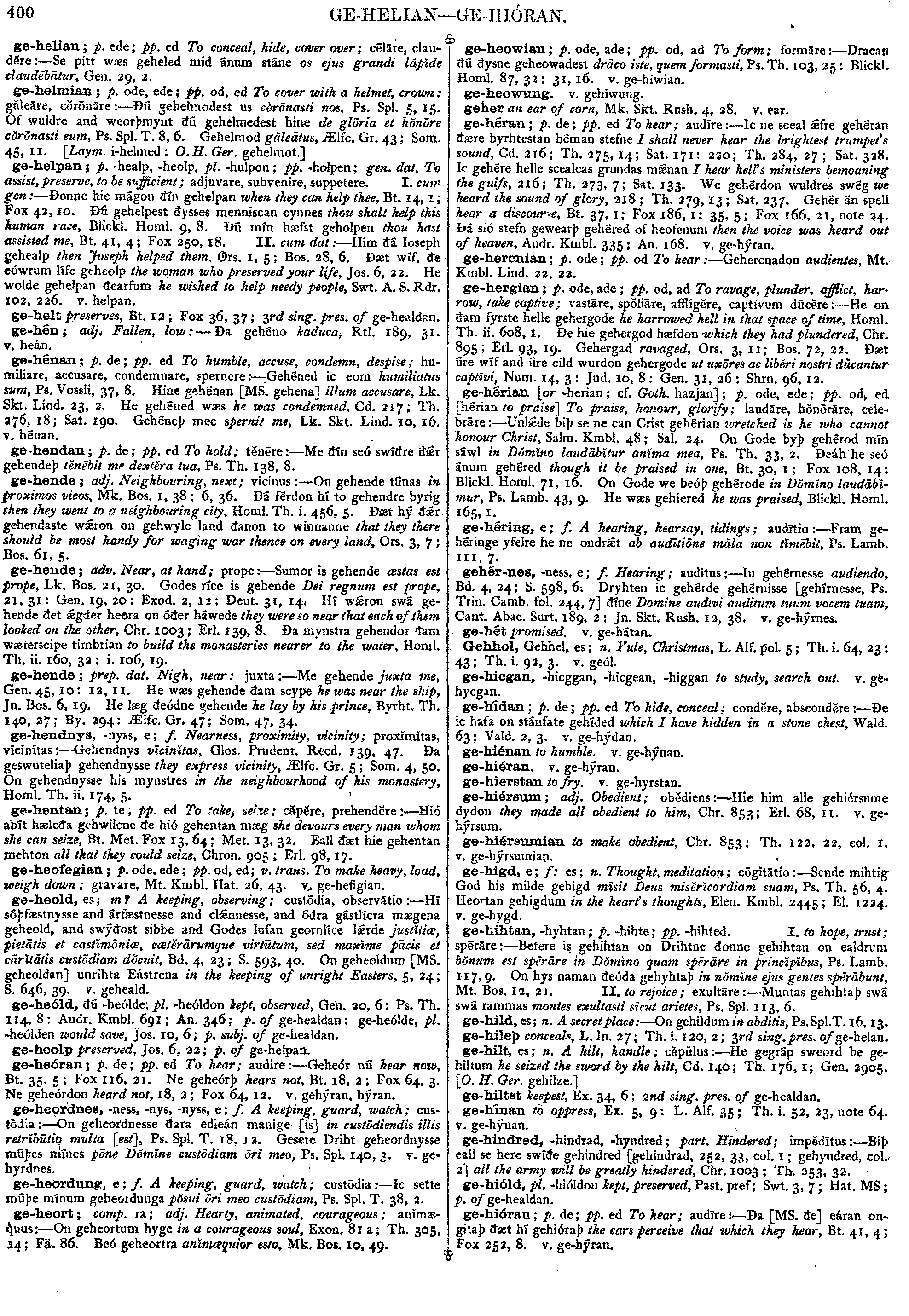
ge-hende;
adj.
Neighbouring,
next;
vicinus
:--
On
gehende
túnas
in
proximos
vicos,
Mk.
Bos.
1,
38
:
6,
36.
Ðá
férdon
hí
to
gehendre
byrig
then
they
went
to
a
neighbouring
city,
Homl.
Th.
i.
456,
5.
Ðæt
hý
ðr,
gehendaste
wron
on
gehwylc
land
ðanon
to
winnanne
that
they
there
should
be
most
handy
for
waging
war
thence
on
every
land,
Ors.
3,
7;
Bos.
61,
5.
|
Source: Bosworth/Toller, page b0421, entry 15 View original page image as: [TIFF] [PNG] [View previous entry] [View next entry] |
[Comment on this entry] [View comments] |
The following entry has been hand-corrected once. |
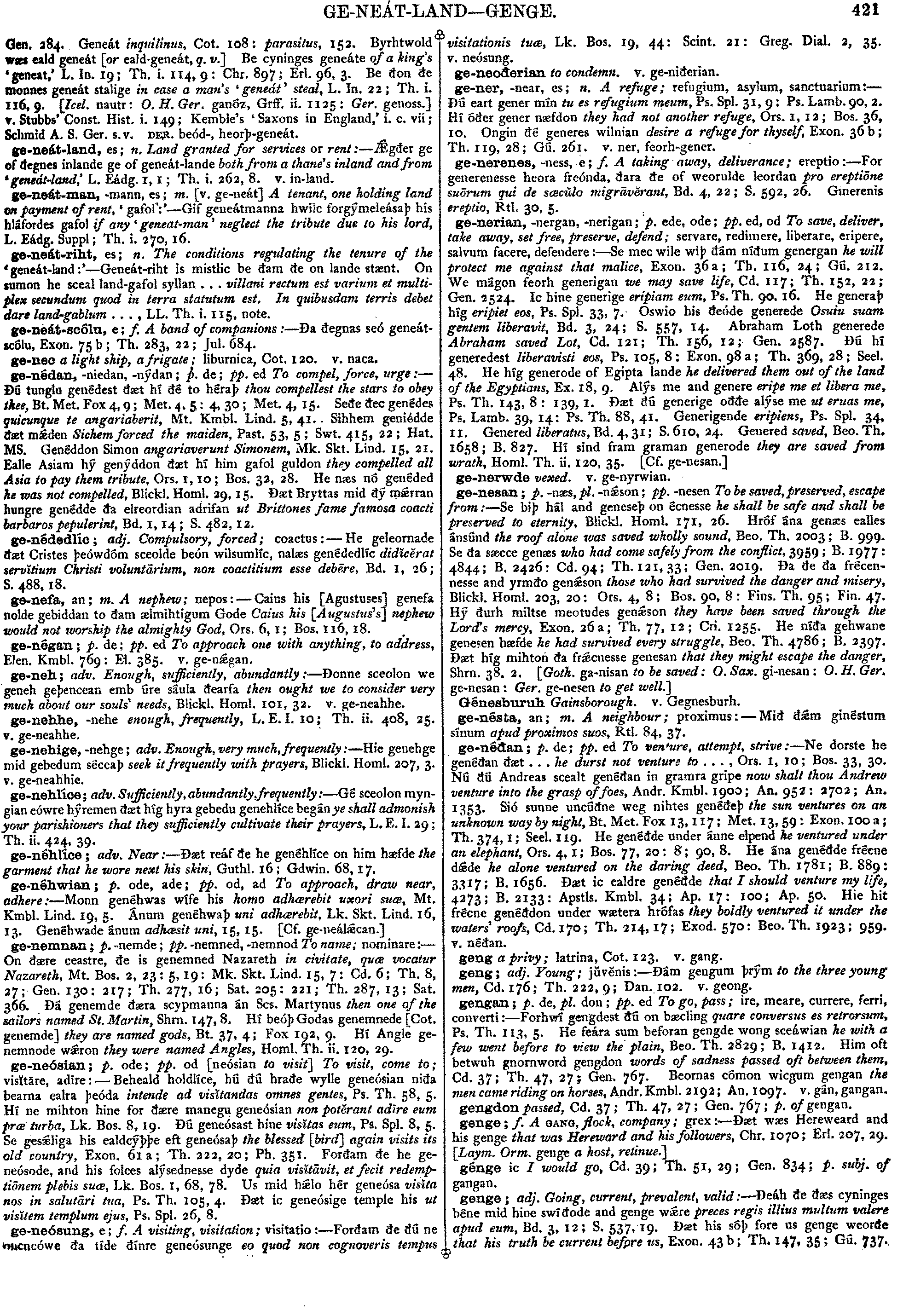
ge-néhlíce; adv. Near :-- Ðæt reáf ðe he genéhlíce on him hæfde the garment that he wore next his skin, Guthl. 16; Gdwin. 68, 17.
|
Source: Bosworth/Toller, page b0424, entry 29 View original page image as: [TIFF] [PNG] [View previous entry] [View next entry] |
[Comment on this entry] [View comments] |
The following entry has been hand-corrected once. |
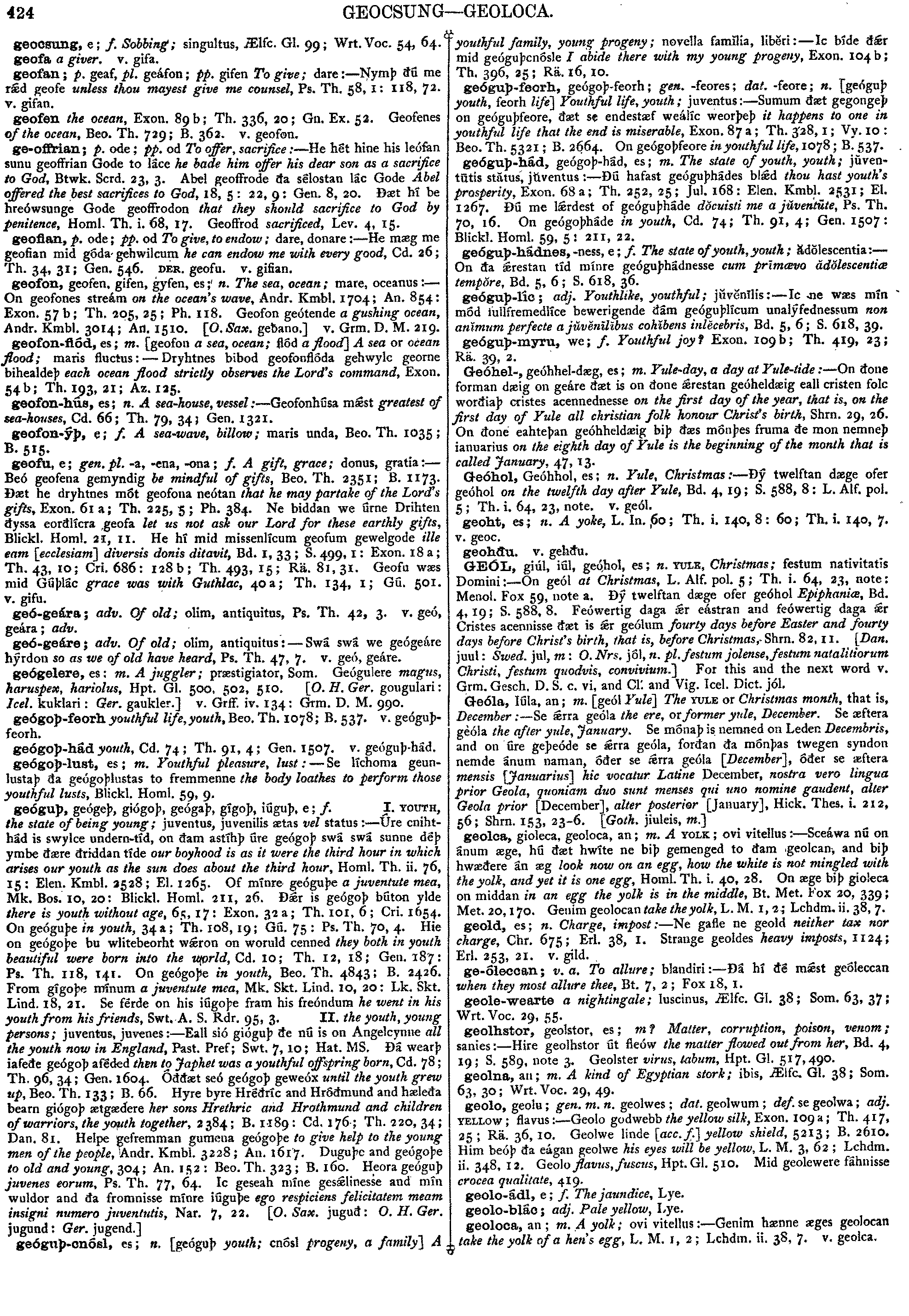
GEÓL,
giúl,
iúl,
geóhol,
es;
n.
YULE,
Christmas;
festum
nativitatis
Domini
:--
On
geól
at
Christmas,
L.
Alf.
pol.
5;
Th.
i.
64,
23,
note:
Menol.
Fox
59,
note
a.
Ðý
twelftan
dæge
ofer
geóhol
Epiphaniæ,
Bd.
4,
19;
S.
588,
8.
Feówertig
daga
r
eástran
and
feówertig
daga
r
Cristes
acennisse
ðæt
is
r
geólum
fourty
days
before
Easter
and
fourty
days
before
Christ's
birth,
that
is,
before
Christmas,
Shrn.
82,
11.
[Dan.
juul:
Swed.
jul,
m:
O.
Nrs.
jól,
n.
pl.
festum
jolense,
festum
natalitiorum
Christi,
festum
quodvis,
convivium.]
For
this
and
the
next
word
v.
Grm.
Gesch.
D.
S.
c.
vi,
and
Cl.
and
Vig.
Icel.
Dict.
jól.
|
Source: Bosworth/Toller, page b0475, entry 6 View original page image as: [TIFF] [PNG] [View previous entry] [View next entry] |
[Comment on this entry] [View comments] |
The following entry has been hand-corrected once. |
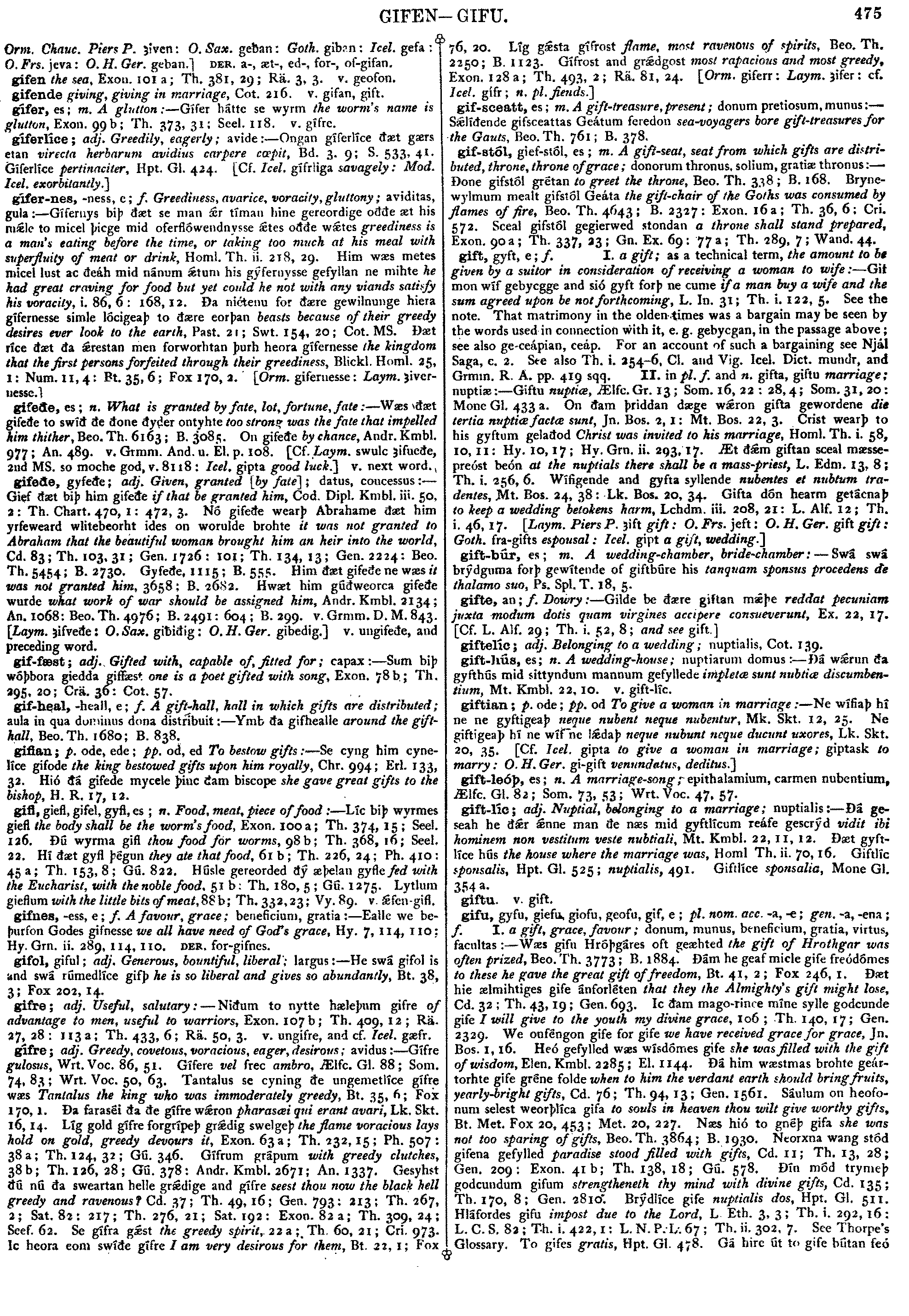
gifeðe,
es;
n.
What
is
granted
by
fate,
lot,
fortune,
fate
:--
Wæs
ðæt
gifeðe
to
swíð
ðe
ðone
ðyer
ontyhte
too
strong
was
the
fate
that
impelled
him
thither,
Beo.
Th.
6163;
B.
3085.
On
gifeðe
by
chance,
Andr.
Kmbl.
977;
An.
489.
v.
Grmm.
And.
u.
El.
p.
108.
[Cf.
Laym.
swulc
 ifueðe,
2nd
MS.
so
moche
god,
v.
8118:
Icel.
gipta
good
luck.]
v.
next
word.
ifueðe,
2nd
MS.
so
moche
god,
v.
8118:
Icel.
gipta
good
luck.]
v.
next
word.
|
Source: Bosworth/Toller, page b0481, entry 12 View original page image as: [TIFF] [PNG] [View previous entry] [View next entry] |
[Comment on this entry] [View comments] |
The following entry has been hand-corrected once. |
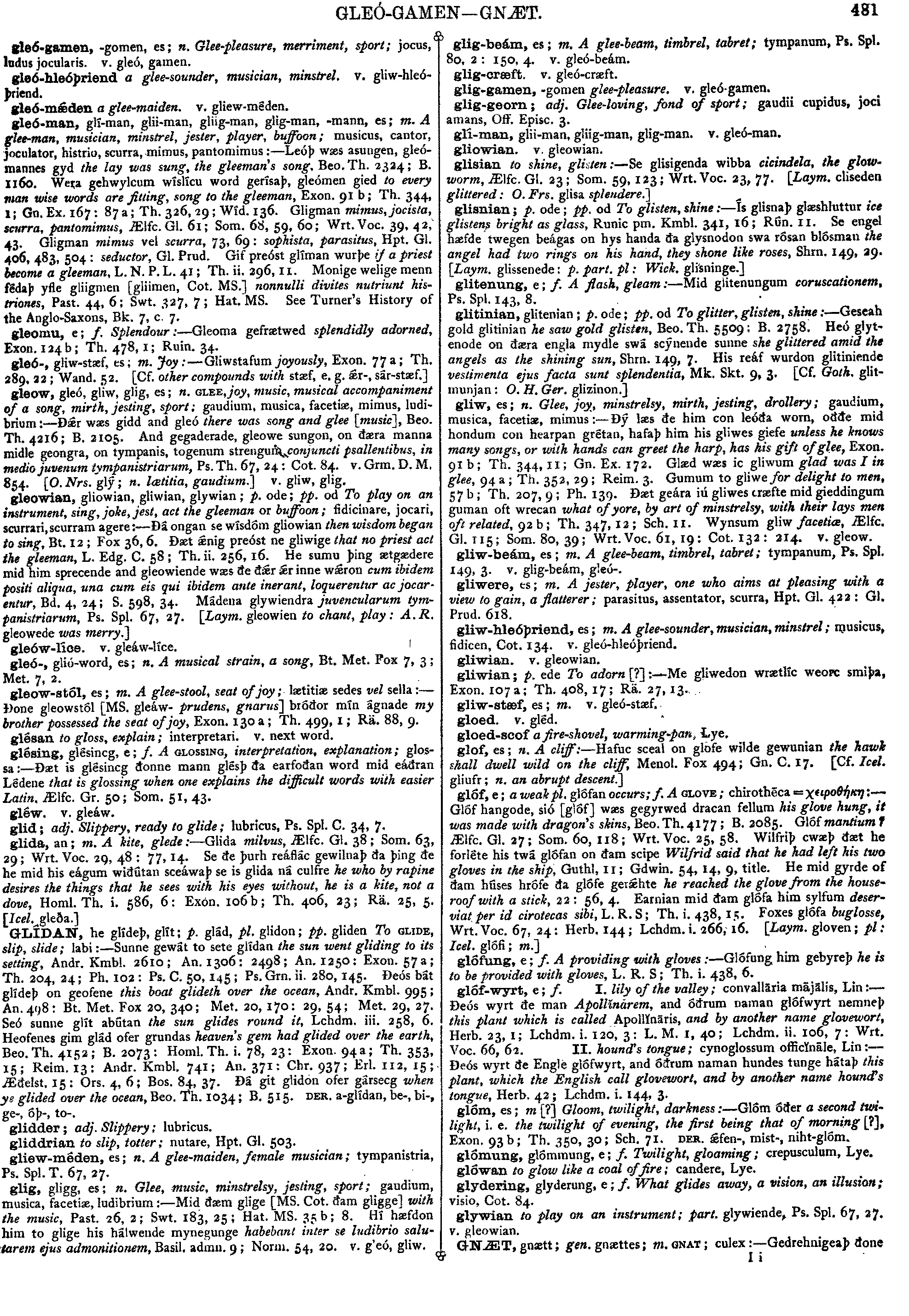
glésan to gloss, explain; interpretari. v. next word.
| Result Page: |  |
Previous | 1 2 3 4 5 6 7 8 9 10 11 | Next |  |
Germanic Lexicon Project (main page)
This search system was written by
Sean Crist
Please consider
volunteering
to correct the data in these online dictionaries.
No rights reserved. Feel free to use these data in any way you please.