|
|

Tip: In the search results, you can click on any word or abbreviation for more information.
|
Source: Cleasby/Vigfusson, page b0158, entry 7 View original page image as: [TIFF] [PNG] [View previous entry] [View next entry] |
[Comment on this entry] [View comments] |
The following entry has been hand-corrected once. |
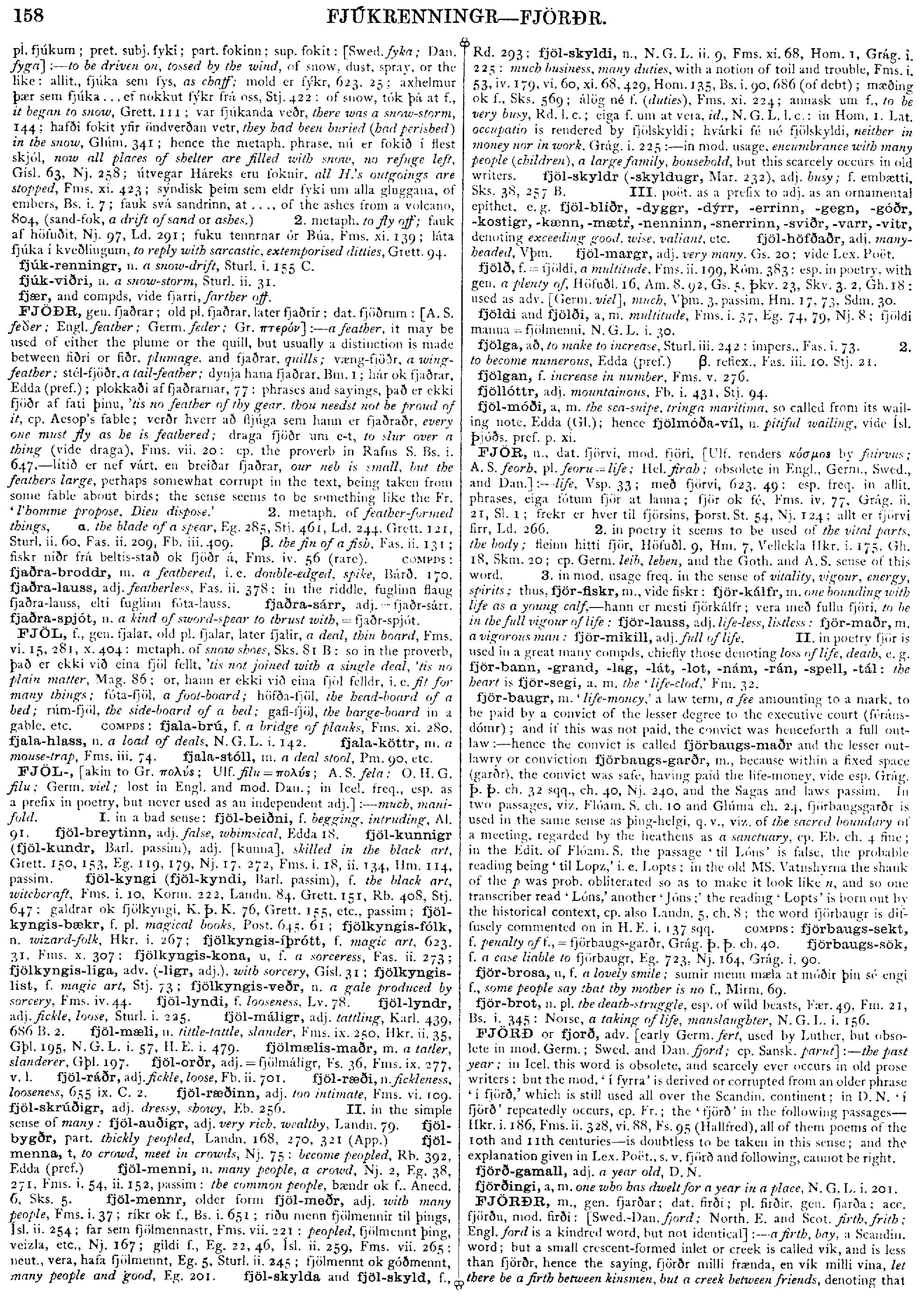
FJÖL-, [akin to Gr. GREEK; Ulf. filu = GREEK; A. S. fela; O. H. G. filu; Germ. viel; lost in Engl. and mod. Dan.; in Icel. freq., esp. as a prefix in poetry, but never used as an independent adj.] :-- much, manifold. I. in a bad sense: fjöl-beiðni, f. begging, intruding, Al. 91. fjöl-breytinn, adj. false, whimsical, Edda 18. fjöl-kunnigr (fjöl-kundr, Barl. passim), adj. [kunna], skilled in the black art, Grett. 150, 153, Eg. 119, 179, Nj. 17, 272, Fms. i. 18, ii. 134, Hm. 114, passim. fjöl-kyngi (fjöl-kyndi, Barl. passim), f. the black art, witchcraft, Fms. i. 10, Korm. 222, Landn. 84, Grett. 151, Rb. 408, Stj. 647; galdrar ok fjölkyngi, K. Þ. K. 76, Grett. 155, etc., passim; fjölkyngis-bækr, f. pl. magical books, Post. 645. 61; fjölkyngis-fólk, n. wizard-folk, Hkr. i. 267; fjölkyngis-íþrótt, f. magic art, 623. 31, Fms. x. 307; fjölkyngis-kona, u, f. a sorceress, Fas. ii. 273; fjölkyngis-liga, adv. (-ligr, adj.), with sorcery, Gísl. 31; fjölkyngis-list, f. magic art, Stj. 73; fjölkyngis-veðr, n. a gale produced by sorcery, Fms. iv. 44. fjöl-lyndi, f. looseness, Lv. 78. fjöl-lyndr, adj. fickle, loose, Sturl. i. 225. fjöl-máligr, adj. tattling, Karl. 439, 686 B. 2. fjöl-mæli, n. tittle-tattle, slander, Fms. ix. 250, Hkr. ii. 35, Gþl. 195, N. G. L. i. 57, H. E. i. 479. fjölmælis-maðr, m. a tatler, slanderer, Gþl. 197. fjöl-orðr, adj. = fjölmáligr, Fs. 36, Fms. ix. 277, v.l. fjöl-ráðr, adj. fickle, loose, Fb. ii. 701. fjöl-ræði, n. fickleness, looseness, 655 ix. C. 2. fjöl-ræðinn, adj. too intimate, Fms. vi. 109. fjöl-skrúðigr, adj. dressy, showy, Eb. 256. II. in the simple sense of many: fjöl-auðigr, adj. very rich, wealthy, Landn. 79. fjöl-bygðr, part. thickly peopled, Landn. 168, 270, 321 (App.) fjöl-menna, t, to crowd, meet in crowds, Nj. 75: become peopled, Rb. 392, Edda (pref.) fjöl-menni, n. many people, a crowd, Nj. 2, Eg. 38, 271, Fms. i. 54, ii. 152, passim: the common people, bændr ok f.. Anecd. 6, Sks. 5. fjöl-mennr, older form fjöl-meðr, adj. with many people, Fms. i. 37; rikr ok f., Bs. i. 651; riðu menn fjölmennir til þings, Ísl. ii. 254; far sem fjölmennastr, Fms. vii. 221: peopled, fjölmennt þing, veizla, etc., Nj. 167; gildi f., Eg. 22, 46, Ísl. ii. 259, Fms. vii. 265: neut., vera, hafa fjölmennt, Eg. 5, Sturl. ii. 245; fjölmennt ok góðmennt, many people and good, Eg. 201. fjöl-skylda and fjöl-skyld, f., Rd. 293; fjöl-skyldi, n., N. G. L. ii. 9, Fms. xi. 68, Hom. i, Grág. i. 225: much business, many duties, with a notion of toil and trouble, Fms. i. 53, iv. 179, vi. 60, xi. 68, 429, Hom. 135, Bs. i. 90, 686 (of debt); mæðing ok f., Sks. 569; álög né f. (duties), Fms. xi. 224; annask um f., to be very busy, Rd. l.c.; eiga f. um at vera, id., N. G. L. l.c.: in Hom. 1. Lat. occupatio is rendered by fjölskyldi; hvárki fé né fjölskyldi, neither in money nor in work, Grág. i. 225 :-- in mod. usage, encumbrance with many people (children), a large family, household, but this scarcely occurs in old writers. fjöl-skyldr (-skyldugr, Mar. 232), adj. busy; f. embætti, Sks. 38, 257 B. III. poët. as a prefix to adj. as an ornamental epithet, e.g. fjöl-blíðr, -dyggr, -dýrr, -errinn, -gegn, -góðr, -kostigr, -kænn, -mætf, -nenninn, -snerrinn, -sviðr, -varr, -vitr, denoting exceeding good, wise, valiant, etc. fjöl-höfðaðr, adj. many-headed, Vþm. fjöl-margr, adj. very many, Gs. 20; vide Lex. Poët.
|
Source: Cleasby/Vigfusson, page b0160, entry 34 View original page image as: [TIFF] [PNG] [View previous entry] [View next entry] |
[Comment on this entry] [View comments] |
The following entry has been hand-corrected once. |
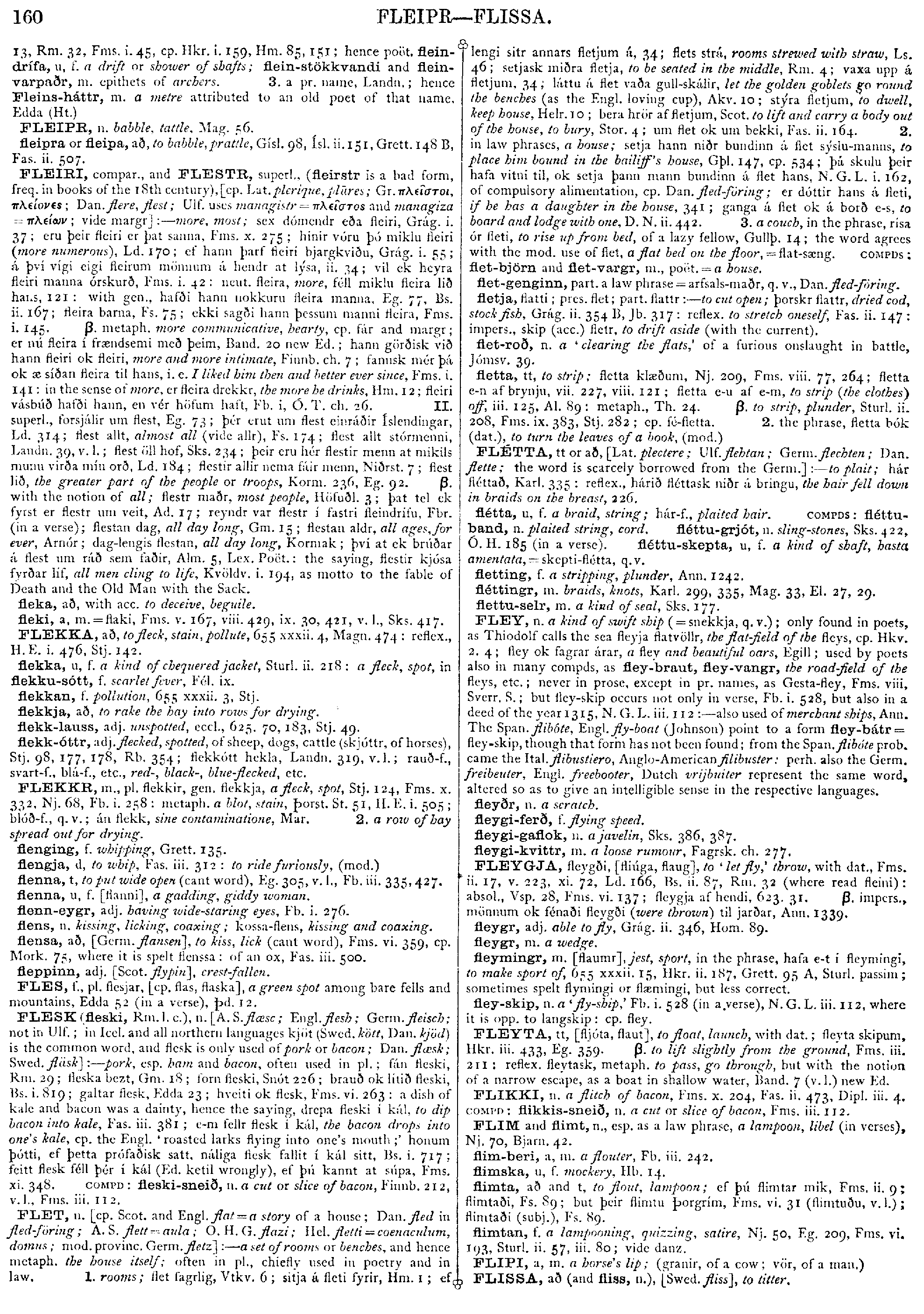
FLEY, n. a kind of swift ship (= snekkja, q.v.); only found in poets, as Thiodolf calls the sea fleyja flatvöllr, the flat-field of the fleys, cp. Hkv. 2. 4; fley ok fagrar árar, a fley and beautiful oars, Egill; used by poets also in many compds, as fley-braut, fley-vangr, the road-field of the fleys, etc.; never in prose, except in pr. names, as Gesta-fley, Fms. viii, Sverr. S.; but fley-skip occurs not only in verse, Fb. i. 528, but also in a deed of the year 1315, N. G. L. iii. 112 :-- also used of merchant ships, Ann. The Span. flibóte, Engl. fly-boat (Johnson) point to a form fley-bátr = fley-skip, though that form has not been found; from the Span. flibóte prob. came the Ital. flibustiero, Anglo-American filibuster: perh. also the Germ. freibeuter, Engl. freebooter, Dutch vrijbuiter represent the same word, altered so as to give an intelligible sense in the respective languages.
|
Source: Cleasby/Vigfusson, page b0161, entry 41 View original page image as: [TIFF] [PNG] [View previous entry] [View next entry] |
[Comment on this entry] [View comments] |
The following entry has been hand-corrected once. |
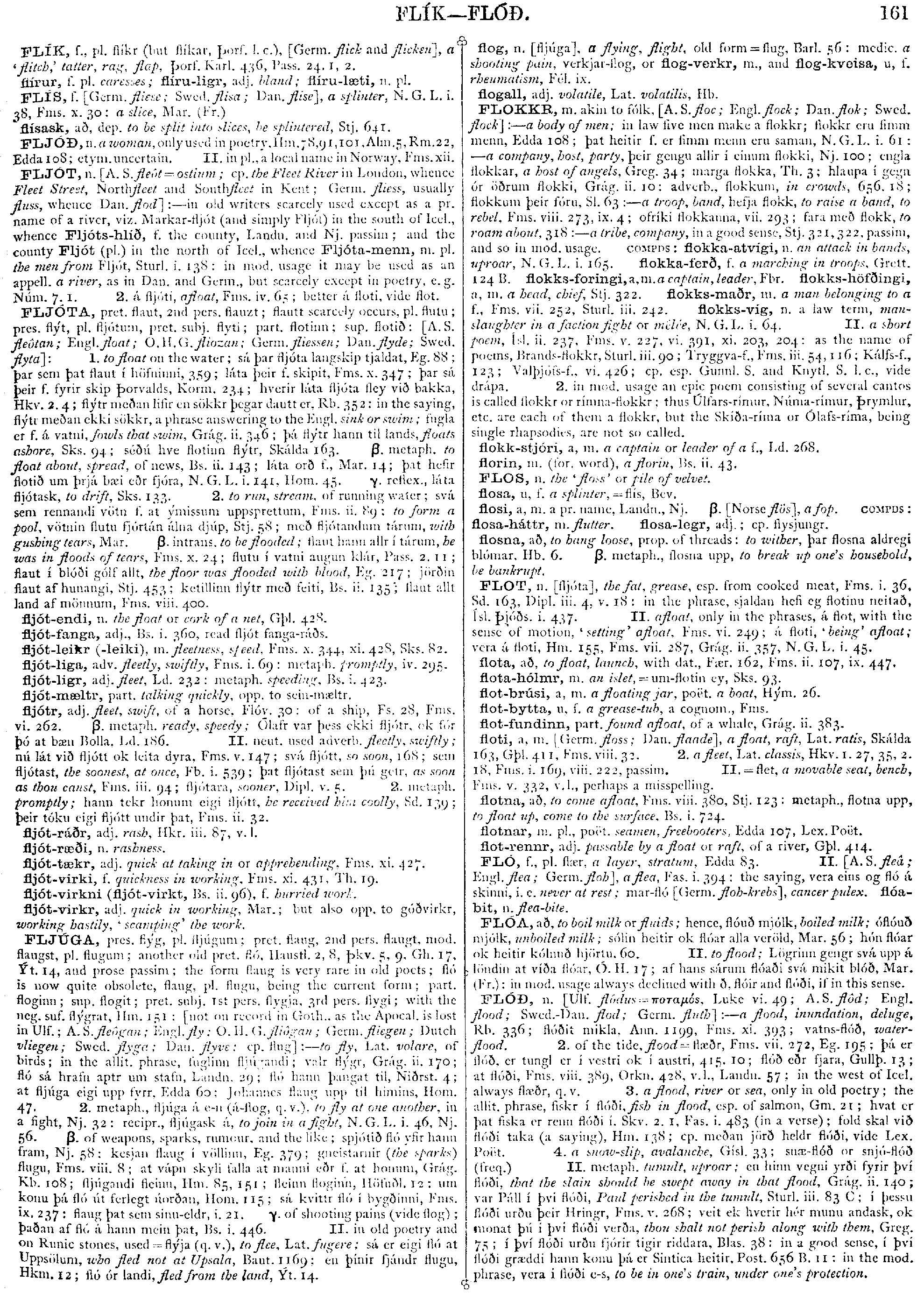
FLÓ, f., pl. flær, a layer, stratum, Edda 83. II. [A. S. fleâ; Engl. flea; Germ. floh], a flea, Fas. i. 394: the saying, vera eins og fló á skinni, i.e. never at rest; mar-fló [Germ. floh-krebs], cancer pulex. flóa-bit, n. flea-bite.
|
Source: Cleasby/Vigfusson, page b0162, entry 8 View original page image as: [TIFF] [PNG] [View previous entry] [View next entry] |
[Comment on this entry] [View comments] |
The following entry has been hand-corrected once. |
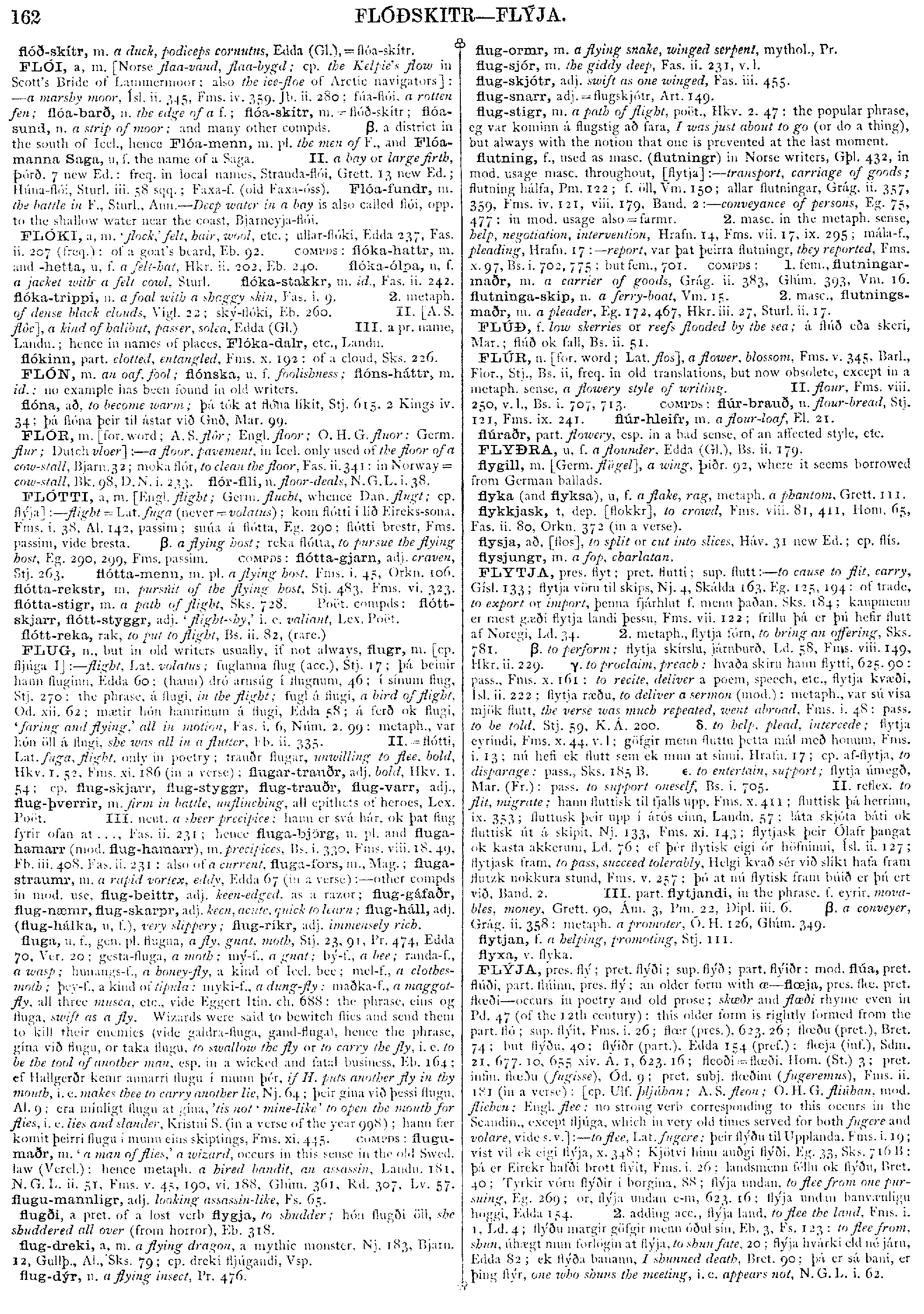
FLÓTTI,
a,
m.
[Engl.
flight;
Germ.
flucht,
whence
Dan.
flugt;
cp.
flýja]
:--
flight
=
Lat.
fuga
(never
=
volatus):
kom
flótti
í
lið
Eireks-sona,
Fms.
i.
38,
Al.
142,
passim;
snúa
á
flótta,
Eg.
290;
flótti
brestr,
Fms.
passim,
vide
bresta.
 .
a
flying
host;
reka
flótta,
to
pursue
the
flying
host,
Eg.
290,
299,
Fms.
passim.
COMPDS:
flótta-gjarn,
adj.
craven,
Stj.
263.
flótta-menn,
m.
pl.
a
flying
host,
Fms.
i.
45,
Orkn.
106.
flótta-rekstr,
m.
pursuit
of
the
flying
host,
Stj.
483,
Fms.
vi.
323.
flótta-stigr,
m.
a
path
of
flight,
Sks.
728.
Poët.
compds:
flótt-skjarr,
flótt-styggr,
adj.
'flight-shy,'
i.e.
valiant,
Lex.
Poët.
.
a
flying
host;
reka
flótta,
to
pursue
the
flying
host,
Eg.
290,
299,
Fms.
passim.
COMPDS:
flótta-gjarn,
adj.
craven,
Stj.
263.
flótta-menn,
m.
pl.
a
flying
host,
Fms.
i.
45,
Orkn.
106.
flótta-rekstr,
m.
pursuit
of
the
flying
host,
Stj.
483,
Fms.
vi.
323.
flótta-stigr,
m.
a
path
of
flight,
Sks.
728.
Poët.
compds:
flótt-skjarr,
flótt-styggr,
adj.
'flight-shy,'
i.e.
valiant,
Lex.
Poët.
|
Source: Cleasby/Vigfusson, page b0167, entry 37 View original page image as: [TIFF] [PNG] [View previous entry] [View next entry] |
[Comment on this entry] [View comments] |
The following entry has been hand-corrected once. |
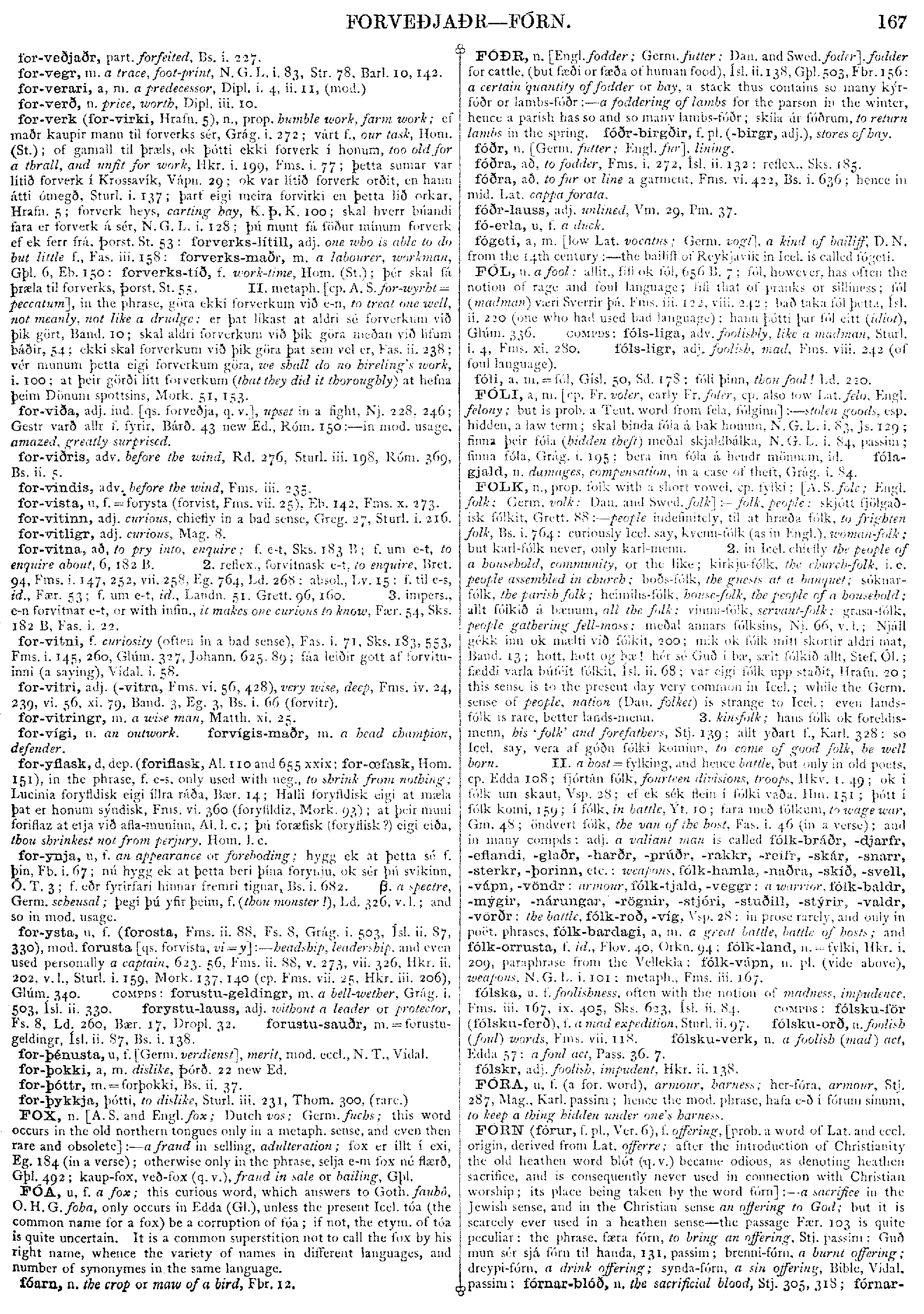
FÓLK, n., prop. folk with a short vowel, cp. fylki; [A. S. folc; Engl. folk; Germ. volk: Dan. and Swed. folk] :-- folk, people: skjótt fjölgaðisk fólkit, Grett. 88 :-- people indefinitely, til at hræða fólk, to frighten folk, Bs. i. 764: curiously Icel. say, kvenn-fólk (as in Engl.). woman-folk; but karl-fólk never, only karl-menn. 2. in Icel. chiefly the people of a household, community, or the like; kirkju-fólk, the church-folk, i.e. people assembled in church; boðs-fólk, the guests at a banquet; sóknar-fólk, the parish folk; heimilis-fólk, house-folk, the people of a household; allt fólkið á bænum, all the folk; vinnu-fólk, servant-folk; grasa-fólk, people gathering fell-moss; meðal annars fólksins, Nj. 66, v.l.; Njáll gékk inn ok mælti víð fólkit, 200; mik ok fólk mitt skortir aldri mat, Band. 13; hott, hott og hæt hér sé Guð í bæ, sælt fólkið allt, Stef. Ól.; fæddi varla búféit fólkit, Ísl. ii. 68; var eigi fólk upp staðit, Hrafn. 20; this sense is to the present day very common in Icel.; while the Germ. sense of people, nation (Dan. folket) is strange to Icel.; even lands-fólk is rare, better lands-menn. 3. kinsfolk; hans fólk ok foreldismenn, his 'folk' and forefathers, Stj. 139; allt yðart f., Karl. 328: so Icel. say, vera af góðu fólki kominn, to come of good folk, be well born. II. a host = fylking, and hence battle, but only in old poets, cp. Edda 108; fjórtán fólk, fourteen divisions, troops, Hkv. 1. 49; ok í fólk um skaut, Vsp. 28; ef ek sék flein í fólki vaða, Hm. 151; þótt í fólk komi, 159; í fólk, in battle, Ýt. 10; fara með fólkum, to wage war, Gm. 48; öndvert fólk, the van of the host, Fas. i. 46 (in a verse); and in many compds: adj. a valiant man ii called fólk-bráðr, -djarfr, -eflandi, -glaðr, -harðr, -prúðr, -rakkr, -reifr, -skár, -snarr, -sterkr, -þorinn, etc.: weapons, folk-hamla, -naðra, -skíð, -svell, -vápn, -vöndr: armour, fólk-tjald, -veggr: a warrior, fólk-baldr, -mýgir, -nárungar, -rögnir, -stjóri, -stuðill, -stýrir, -valdr, -vörðr: the battle, fólk-roð, -víg, Vsp. 28: in prose rarely, and only in poët. phrases, fólk-bardagi, a, m. a great battle, battle of hosts; and fólk-orrusta, f. id., Flov. 40, Orkn. 94; fólk-land, n. = fylki, Hkr. i. 209, paraphrase from the Vellekla; fólk-vápn, n. pl. (vide above), weapons, N. G. L. i. 101: metaph., Fms. iii. 167.
|
Source: Cleasby/Vigfusson, page b0167, entry 41 View original page image as: [TIFF] [PNG] [View previous entry] [View next entry] |
[Comment on this entry] [View comments] |
The following entry has been hand-corrected once. |
FÓRN (fórur, f. pl., Ver. 6), f. offering, [prob. a word of Lat. and eccl. origin, derived from Lat. offerre; after the introduction of Christianity the old heathen word blót (q.v.) became odious, as denoting heathen sacrifice, and is consequently never used in connection with Christian worship; its place being taken by the word fórn] :-- a sacrifice in the Jewish sense, and in the Christian sense an offering to God; but it is scarcely ever used in a heathen sense -- the passage Fær. 103 is quite peculiar: the phrase, færa fórn, to bring an offering, Stj. passim; Gúð mun sér sjá fórn til handa, 131, passim; brenni-fórn, a burnt offering; dreypi-fórn, a drink offering; synda-fórn, a sin offering, Bible, Vídal. passim: fórnar-blöð, n, the sacrificial blood, Stj. 305, 318; fórnar-
|
Source: Cleasby/Vigfusson, page b0169, entry 9 View original page image as: [TIFF] [PNG] [View previous entry] [View next entry] |
[Comment on this entry] [View comments] |
The following entry has been hand-corrected once. |
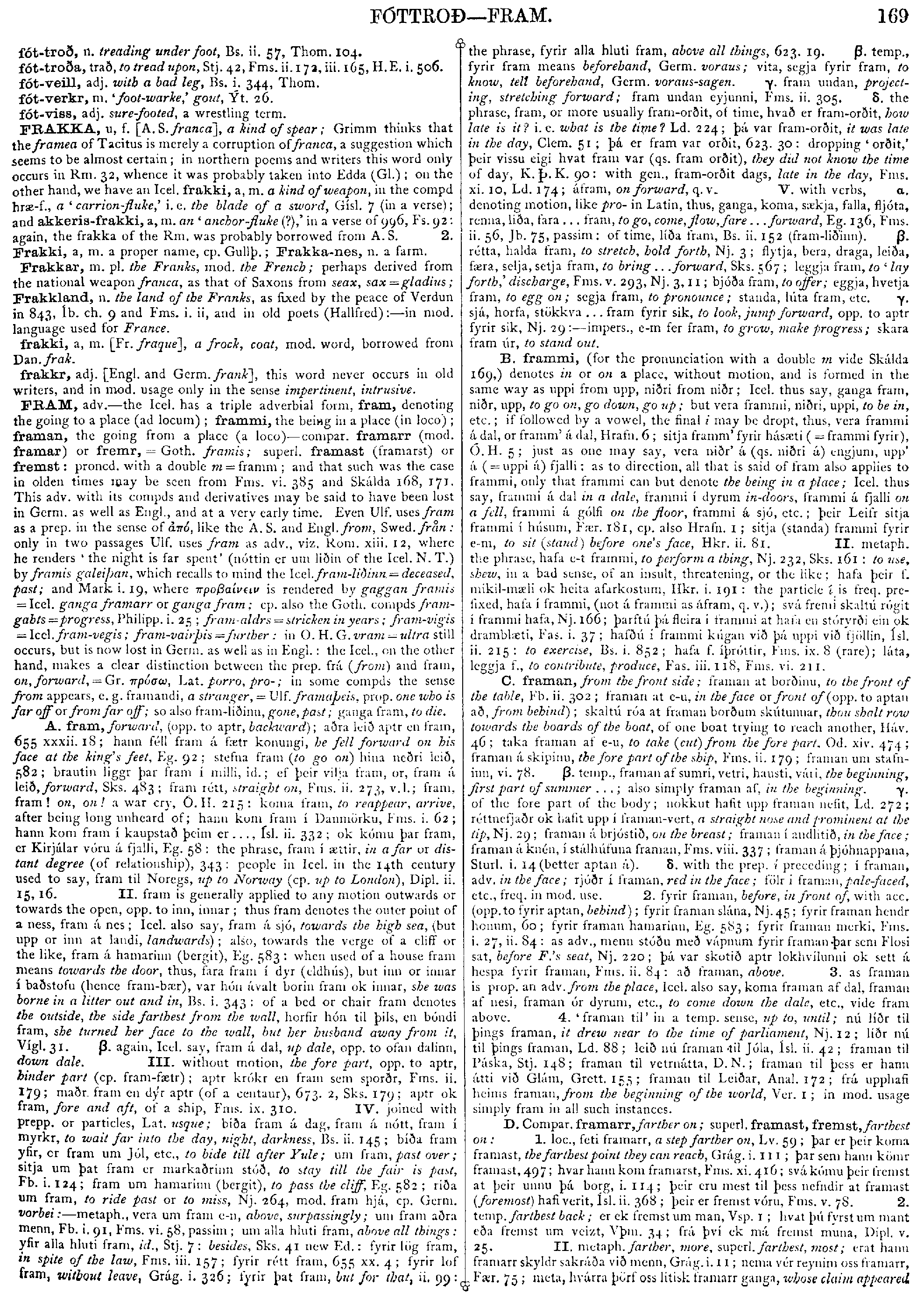
frakkr, adj. [Engl. and Germ. frank], this word never occurs in old writers, and in mod. usage only in the sense impertinent, intrusive.
|
Source: Cleasby/Vigfusson, page b0174, entry 23 View original page image as: [TIFF] [PNG] [View previous entry] [View next entry] |
[Comment on this entry] [View comments] |
The following entry has been hand-corrected once. |
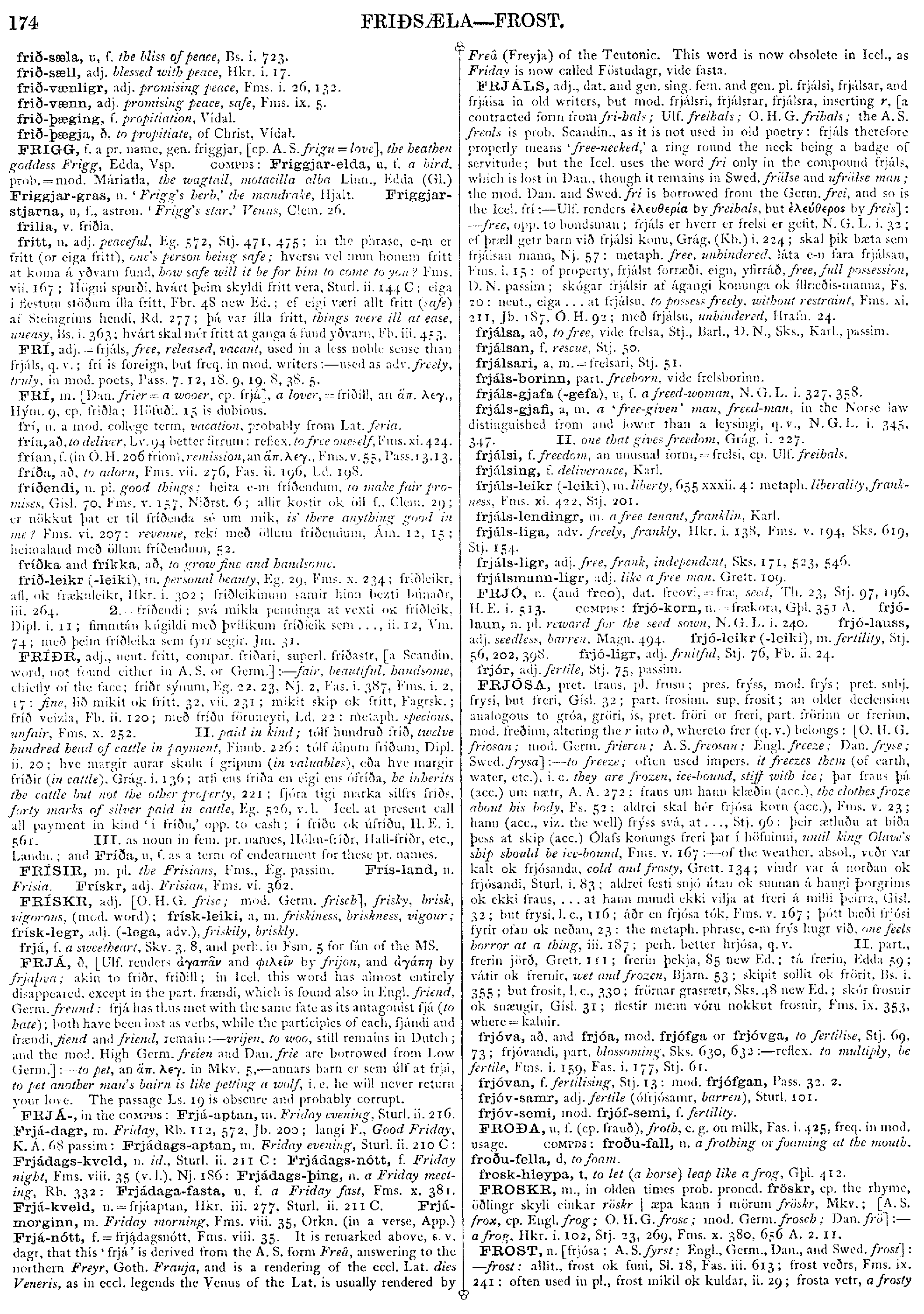
FRJÁ, ð, [Ulf. renders GREEK and GREEK by frijon, and GREEK by frjaþva; akin to friðr, friðill; in Icel. this word has almost entirely disappeared, except in the part. frændi, which is found also in Engl. friend, Germ. freund: frjá has thus met with the same fate as its antagonist fjá (to hate); both have been lost as verbs, while the participles of each, fjándi and frændi, fiend and friend, remain :-- vrijen, to woo, still remains in Dutch; and the mod. High Germ. freien and Dan. frie are borrowed from Low Germ.] :-- to pet, an GREEK in Mkv. 5, -- annars barn er sem úlf at frjá, to pet another man's bairn is like petting a wolf, i.e. he will never return your love. The passage Ls. 19 is obscure and probably corrupt.
|
Source: Cleasby/Vigfusson, page b0175, entry 18 View original page image as: [TIFF] [PNG] [View previous entry] [View next entry] |
[Comment on this entry] [View comments] |
The following entry has been hand-corrected once. |
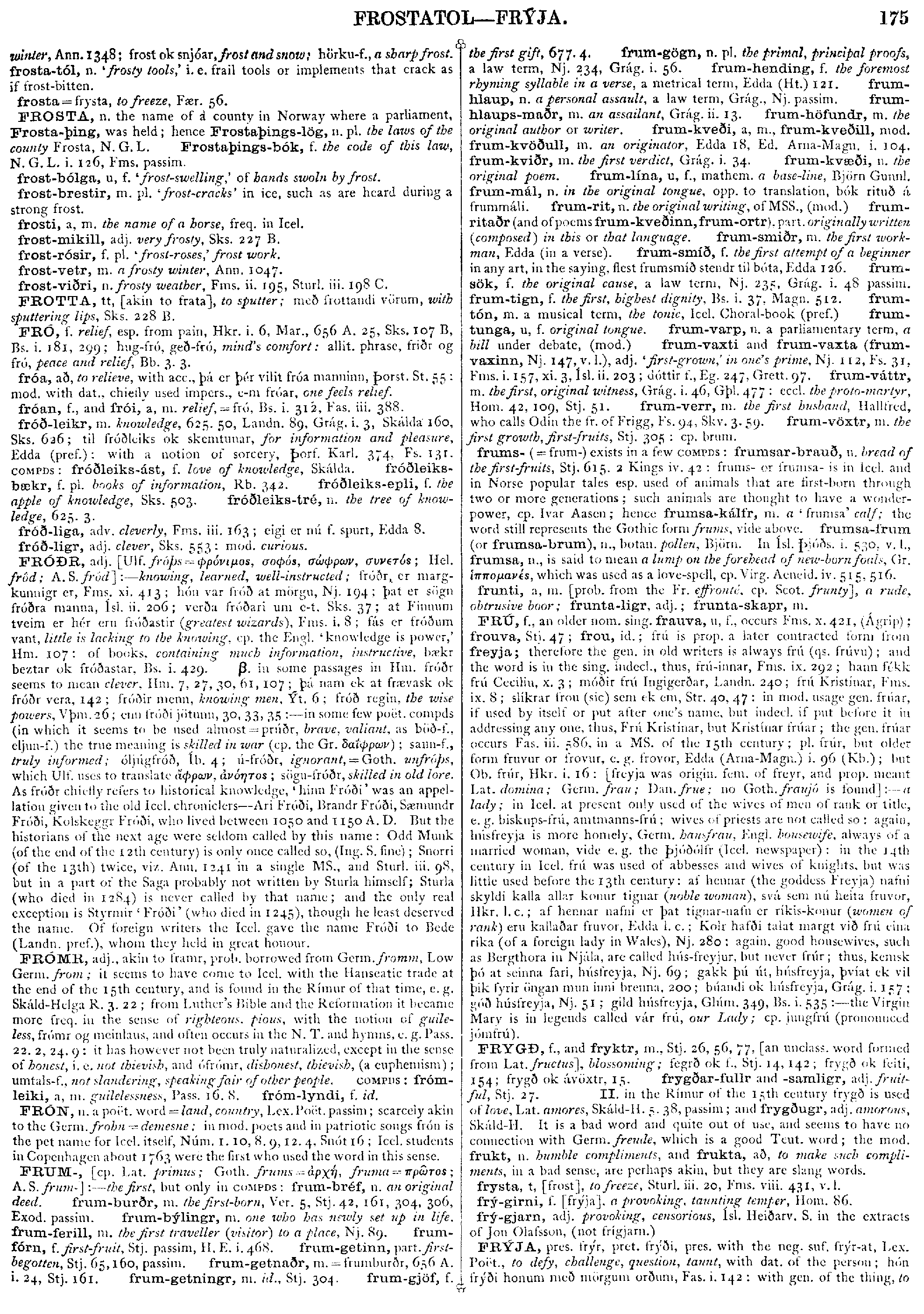
FRÓÐR,
adj.
[Ulf.
frôþs
=
GREEK,
GREEK,
GREEK,
GREEK;
Hel.
frôd;
A.
S.
frôd]
:--
knowing,
learned,
well-instructed;
fróðr,
er
margkunnigr
er,
Fms.
xi.
413;
hón
var
fróð
at
mörgu,
Nj.
194;
þat
er
sögn
fróðra
manna,
Ísl.
ii.
206;
verða
fróðari
um
e-t,
Sks.
37;
at
Finnum
tveim
er
hér
eru
fróðastir
(greatest
wizards),
Fms.
i.
8;
fás
er
fróðum
vant,
little
is
lacking
to
the
knowing,
cp.
the
Engl.
'knowledge
is
power,'
Hm.
107:
of
books,
containing
much
information,
instructive,
bækr
beztar
ok
fróðastar,
Bs.
i.
429.
.
in
some
passages
in
Hm.
fróðr
seems
to
mean
clever,
Hm.
7,
27,
30,
6l,
107;
þá
nam
ek
at
frævask
ok
fróðr
vera,
142;
fróðir
menn,
knowing
men,
Ýt.
6;
fróð
regin,
the
wise
powers,
Vþm.
26;
enn
fróði
jötunn,
30,
33,
35
:--
in
some
few
poët.
compds
(in
which
it
seems
to
be
used
almost
=
prúðr,
brave,
valiant,
as
böð-f.,
eljun-f.)
the
true
meaning
is
skilled
in
war
(cp.
the
Gr.
GREEK);
sann-f.,
truly
informed;
óljúgfróð,
Íb.
4;
ú-fróðr,
ignorant,
=
Goth.
unfróþs,
which
Ulf.
uses
to
translate
GREEK,
GREEK;
sögu-fróðr,
skilled
in
old
lore.
As
fróðr
chiefly
refers
to
historical
knowledge,
'hinn
Fróði'
was
an
appellation
given
to
the
old
Icel.
chroniclers
--
Ari
Fróði,
Brandr
Fróði,
Sæmundr
Fróði,
Kolskeggr
Fróði,
who
lived
between
1050
and
1150
A.D.
But
the
historians
of
the
next
age
were
seldom
called
by
this
name:
Odd
Munk
(of
the
end
of
the
12th
century)
is
only
once
called
so,
(Ing.
S.
fine);
Snorri
(of
the
13th)
twice,
viz.
Ann.
1241
in
a
single
MS.,
and
Sturl.
iii.
98,
but
in
a
part
of
the
Saga
probably
not
written
by
Sturla
himself;
Sturla
(who
died
in
1284)
is
never
called
by
that
name;
and
the
only
real
exception
is
Styrmir
'Fróði'
(who
died
in
1245),
though
he
least
deserved
the
name.
Of
foreign
writers
the
Icel.
gave
the
name
Fróði
to
Bede
(Landn.
pref.),
whom
they
held
in
great
honour.
|
Source: Cleasby/Vigfusson, page b0175, entry 24 View original page image as: [TIFF] [PNG] [View previous entry] [View next entry] |
[Comment on this entry] [View comments] |
The following entry has been hand-corrected once. |
FRÚ, f., an older nom. sing. frauva, u, f., occurs Fms. x. 421, (Ágrip); frouva, Stj. 47; frou, id.; frú is prop. a later contracted form from freyja; therefore the gen. in old writers is always frú (qs. frúvu); and the word is in the sing. indecl., thus, frú-innar, Fms. ix. 292; hann fékk frú Ceciliu, x. 3; móðir frú Ingigerðar, Landn. 240; frú Kristínar, Fms. ix. 8; slíkrar frou (sic) sem ek em, Str. 40, 47: in mod. usage gen. frúar, if used by itself or put after one's name, but indecl. if put before it in addressing any one, thus, Frú Kristínar, but Kristínar frúar; the gen. frúar occurs Fas. iii. 586, in a MS. of the 15th century; pl. frúr, but older form fruvur or frovur, e.g. frovor, Edda (Arna-Magn.) i. 96 (Kb.); but Ob. frúr, Hkr. i. 16: [freyja was origin. fem. of freyr, and prop. meant Lat. domina; Germ. frau; Dan. frue; no Goth. fraujô is found] :-- a lady; in Icel. at present only used of the wives of men of rank or title, e.g. biskups-frú, amtmanns-frú; wives of priests are not called so: again, húsfreyja is more homely, Germ. hausfrau, Engl. housewife, always of a married woman, vide e.g. the Þjóðólfr (Icel. newspaper): in the 14th century in Icel. frú was used of abbesses and wives of knights, but was little used before the 13th century: af hennar (the goddess Freyja) nafni skyldi kalla allar konur tignar (noble woman), svá sem nú heita fruvor, Hkr. l.c.; af hennar nafni er þat tignar-nafn er ríkis-konur (women of rank) eru kallaðar fruvor, Edda l.c.; Kolr hafði talat margt við frú eina ríka (of a foreign lady in Wales), Nj. 280: again, good housewives, such as Bergthora in Njála, are called hús-freyjur, but never frúr; thus, kemsk þó at seinna fari, húsfreyja, Nj. 69; gakk þú út, húsfreyja, þvíat ek vil þik fyrir öngan mun inni brenna, 200; búandi ok húsfreyja, Grág. i. 157; góð húsfreyja, Nj. 51; gild húsfreyja, Glúm. 349, Bs. i. 535 :-- the Virgin Mary is in legends called vár frú, our Lady; cp. jungfrú (pronounced jómfrú).
| Result Page: |  |
Previous | 21 22 23 24 25 26 27 28 29 30 31 32 33 34 35 36 37 38 39 | Next |  |
Germanic Lexicon Project (main page)
This search system was written by
Sean Crist
Please consider
volunteering
to correct the data in these online dictionaries.
No rights reserved. Feel free to use these data in any way you please.