|
|

Tip: In the search results, you can click on any word or abbreviation for more information.
|
Source: Cleasby/Vigfusson, page b0096, entry 2 View original page image as: [TIFF] [PNG] [View previous entry] [View next entry] |
[Comment on this entry] [View comments] |
The following entry has been hand-corrected once. |
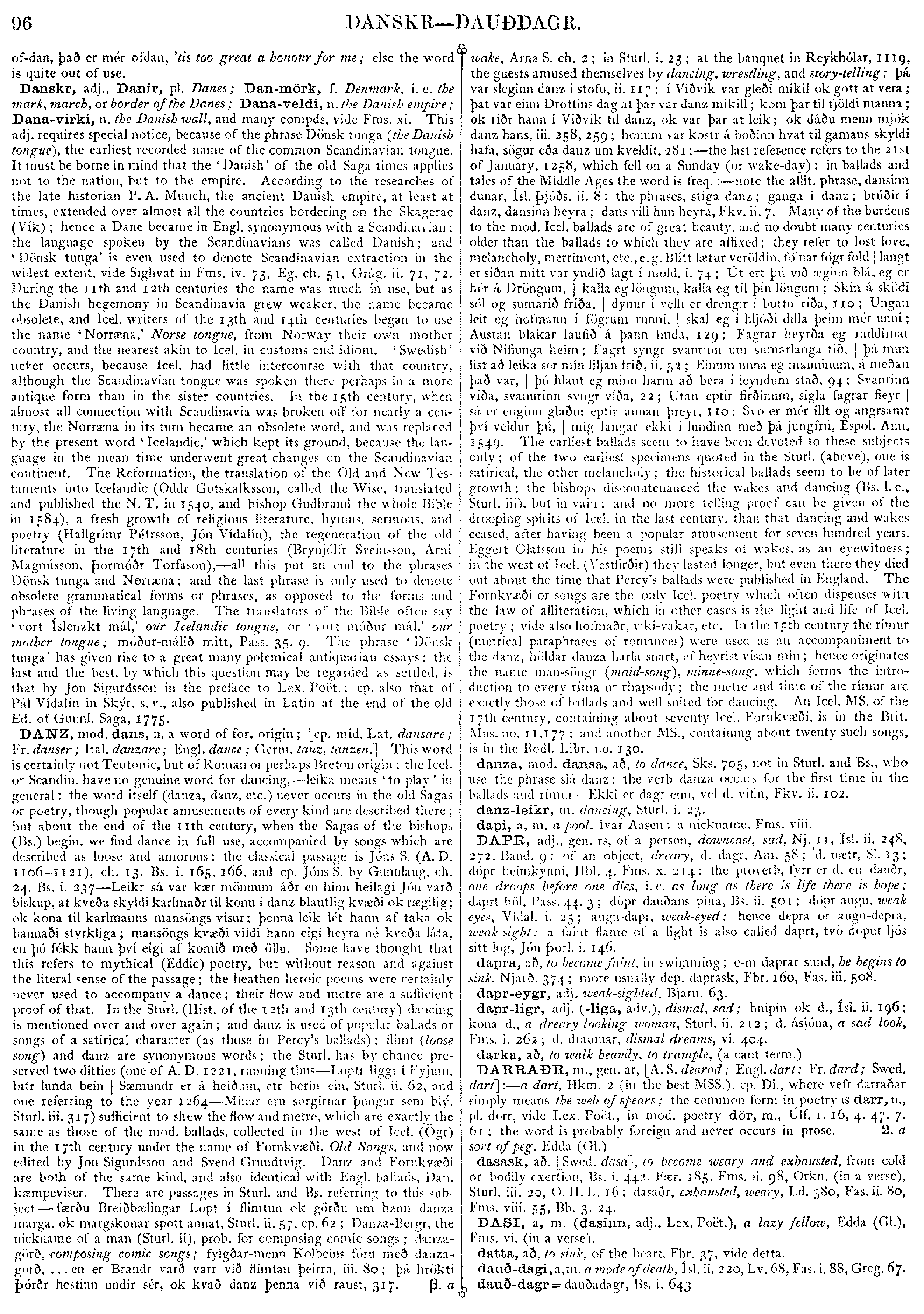
Danskr, adj., Danir, pl. Danes; Dan-mörk, f. Denmark, i.e. the mark, march, or border of the Danes; Dana-veldi, n. the Danish empire; Dana-virki, n. the Danish wall, and many compds, vide Fms. xi. This adj. requires special notice, because of the phrase Dönsk tunga (the Danish tongue), the earliest recorded name of the common Scandinavian tongue. It must be borne in mind that the 'Danish' of the old Saga times applies not to the nation, but to the empire. According to the researches of the late historian P.A. Munch, the ancient Danish empire, at least at times, extended over almost all the countries bordering on the Skagerac (Vík); hence a Dane became in Engl. synonymous with a Scandinavian; the language spoken by the Scandinavians was called Danish; and 'Dönsk tunga' is even used to denote Scandinavian extraction in the widest extent, vide Sighvat in Fms. iv. 73, Eg. ch. 51, Grág. ii. 71, 72. During the 11th and 12th centuries the name was much in use, but as the Danish hegemony in Scandinavia grew weaker, the name became obsolete, and Icel. writers of the 13th and 14th centuries began to use the name 'Norræna,' Norse tongue, from Norway their own mother country, and the nearest akin to Icel. in customs and idiom. 'Swedish' never occurs, because Icel. had little intercourse with that country, although the Scandinavian tongue was spoken there perhaps in a more antique form than in the sister countries. In the 15th century, when almost all connection with Scandinavia was broken off for nearly a century, the Norræna in its turn became an obsolete word, and was replaced by the present word 'Icelandic,' which kept its ground, because the language in the mean time underwent great changes on the Scandinavian continent. The Reformation, the translation of the Old and New Testaments into Icelandic (Oddr Gotskalksson, called the Wise, translated and published the N.T. in 1540, and bishop Gudbrand the whole Bible in 1584), a fresh growth of religious literature, hymns, sermons, and poetry (Hallgrímr Pétrsson, Jón Vídalín), the regeneration of the old literature in the 17th and 18th centuries (Brynjólfr Sveinsson, Arni Magnússon, Þormóðr Torfason), -- all this put an end to the phrases Dönsk tunga and Norræna; and the last phrase is only used to denote obsolete grammatical forms or phrases, as opposed to the forms and phrases of the living language. The translators of the Bible often say 'vort Íslenzkt mál,' our Icelandic tongue, or 'vort móður mál,' our mother tongue; móður-málið mitt, Pass. 35. 9. The phrase 'Dönsk tunga' has given rise to a great many polemical antiquarian essays: the last and the best, by which this question may be regarded as settled, is that by Jon Sigurdsson in the preface to Lex. Poët.; cp. also that of Pál Vídalín in Skýr. s.v., also published in Latin at the end of the old Ed. of Gunnl. Saga, 1775.
|
Source: Cleasby/Vigfusson, page b0096, entry 3 View original page image as: [TIFF] [PNG] [View previous entry] [View next entry] |
[Comment on this entry] [View comments] |
The following entry has been hand-corrected once. |
DANZ,
mod.
dans,
n.
a
word
of
for.
origin;
[cp.
mid.
Lat.
dansare;
Fr.
danser;
Ital.
danzare;
Engl.
dance;
Germ.
tanz,
tanzen.]
This
word
is
certainly
not
Teutonic,
but
of
Roman
or
perhaps
Breton
origin:
the
Icel.
or
Scandin.
have
no
genuine
word
for
dancing,
--
leika
means
'to
play'
in
general:
the
word
itself
(danza,
danz,
etc.)
never
occurs
in
the
old
Sagas
or
poetry,
though
popular
amusements
of
every
kind
are
described
there;
but
about
the
end
of
the
11th
century,
when
the
Sagas
of
the
bishops
(Bs.)
begin,
we
find
dance
in
full
use,
accompanied
by
songs
which
are
described
as
loose
and
amorous:
the
classical
passage
is
Jóns
S.
(A.D.
1106-1121),
ch.
13.
Bs.
i.
165,
166,
and
cp.
Júns
S.
by
Gunnlaug,
ch.
24.
Bs.
i.
237
--
Leikr
sá
var
kær
mönnum
áðr
en
hinn
heilagi
Jón
varð
biskup,
at
kveða
skyldi
karlmaðr
til
konu
í
danz
blautlig
kvæði
ok
rægilig;
ok
kona
til
karlmanns
mansöngs
vísur;
þenna
leik
lét
hann
af
taka
ok
bannaði
styrkliga;
mansöngs
kvæði
vildi
hann
eigi
heyra
né
kveða
láta,
en
þó
fékk
hann
því
eigi
af
komið
með
öllu.
Some
have
thought
that
this
refers
to
mythical
(Eddic)
poetry,
but
without
reason
and
against
the
literal
sense
of
the
passage;
the
heathen
heroic
poems
were
certainly
never
used
to
accompany
a
dance;
their
flow
and
metre
are
a
sufficient
proof
of
that.
In
the
Sturl.
(Hist.
of
the
12th
and
13th
century)
dancing
is
mentioned
over
and
over
again;
and
danz
is
used
of
popular
ballads
or
songs
of
a
satirical
character
(as
those
in
Percy's
ballads):
flimt
(loose
song)
and
danz
are
synonymous
words;
the
Sturl.
has
by
chance
preserved
two
ditties
(one
of
A.D.
1221,
running
thus
--
Loptr
liggr
í
Eyjum,
bítr
lunda
bein
|
Sæmundr
er
á
heiðum,
etr
berin
ein.
Stud.
ii.
62,
and
one
referring
to
the
year
1264
--
Mínar
eru
sorgirnar
þungar
sem
blý,
Sturl.
iii.
317)
sufficient
to
shew
the
flow
and
metre,
which
are
exactly
the
same
as
those
of
the
mod.
ballads,
collected
in
the
west
of
Icel.
(Ögr)
in
the
17th
century
under
the
name
of
Fornkvæði,
Old
Songs,
and
now
edited
by
Jon
Sigurdsson
and
Svend
Grundtvig.
Danz
and
Fornkvæði
are
both
of
the
same
kind,
and
also
identical
with
Engl.
ballads,
Dan.
kæmpeviser.
There
are
passages
in
Sturl.
and
B.S.
referring
to
this
subject
--
færðu
Breiðbælingar
Lopt
í
flimtun
ok
görðu
um
hann
danza
marga,
ok
margskonar
spott
annat,
Sturl.
ii.
57,
cp.
62;
Danza-Bergr,
the
nickname
of
a
man
(Stud,
ii),
prob.
for
composing
comic
songs;
danza-
görð,
composing
comic
songs;
fylgðar-menn
Kolbeins
fóru
með
danza-
görð,
...
en
er
Brandr
varð
varr
við
flimtan
þeirra,
iii.
80;
þá
hrökti
Þórðr
hestinn
undir
sér,
ok
kvað
danz
þenna
við
raust,
317.
 .
a
wake,
Arna
S.
ch.
2;
in
Sturl.
i.
23;
at
the
banquet
in
Reykhólar,
1119,
the
guests
amused
themselves
by
dancing,
wrestling,
and
story-telling;
þá
var
sleginn
danz
í
stofu,
ii.
117;
í
Viðvík
var
gleði
mikil
ok
gott
at
vera;
þat
var
einn
Drottins
dag
at
þar
var
danz
mikill;
kom
þar
til
fjöldi
manna;
ok
ríðr
hann
í
Viðvík
til
danz,
ok
var
þar
at
leik;
ok
dáðu
menn
mjök
danz
hans,
iii.
258,
259;
honum
var
kostr
á
boðinn
hvat
til
gamans
skyldi
hafa,
sögur
eða
danz
um
kveldit,
281;
--
the
last
reference
refers
to
the
21st
of
January,
1258,
which
fell
on
a
Sunday
(or
wake-day):
in
ballads
and
tales
of
the
Middle
Ages
the
word
is
freq.
:--
note
the
allit.
phrase,
dansinn
dunar,
Ísl.
Þóðs.
ii.
8:
the
phrases,
stiga
danz;
ganga
í
danz;
brúðir
í
danz,
dansinn
heyra;
dans
vill
hun
heyra,
Fkv.
ii.
7.
Many
of
the
burdens
to
the
mod.
Icel.
ballads
are
of
great
beauty,
and
no
doubt
many
centuries
older
than
the
ballads
to
which
they
are
affixed;
they
refer
to
lost
love,
melancholy,
merriment,
etc.,
e.g.
Blítt
lætur
veröldin,
fölnar
fögr
fold
|
langt
er
síðan
mitt
var
yndið
lagt
í
mold,
i.
74;
Út
ert
þú
við
æginn
blá,
eg
er
hér
á
Dröngum,
|
kalla
eg
löngum,
kalla
eg
til
þin
löngum;
Skín
á
skildi
Sól
og
sumarið
fríða,
|
dynur
í
velli
er
drengir
í
burtu
riða,
110;
Ungan
leit
eg
hofmann
í
fögrum
runni,
|
skal
eg
í
hljóði
dilla
þeim
mér
unm;
Austan
blakar
laufið
á
þann
linda,
129;
Fagrar
heyrða
eg
raddirnar
við
Niflunga
heim;
Fagrt
syngr
svanrinn
um
sumarlanga
tíð,
|
þá
mun
list
að
leika
sér
mín
liljan
fríð,
ii.
52:
Einum
unna
eg
manninum,
á
meðan
það
var,
|
þó
hlaut
eg
minn
harm
að
bera
í
leyndum
stað,
94;
Svanrinn
víða.
svanurinn
syngr
viða,
22;
Utan
eptir
firðinum,
sigla
fagrar
fleyr
|
sá
er
enginn
glaður
eptir
annan
þreyr,
110;
Svo
er
mér
illt
og
angrsamt
því
veldur
þú,
|
mig
langar
ekki
í
lundinn
með
þá
jungfrú,
Espol.
Ann.
1549.
The
earliest
ballads
seem
to
have
been
devoted
to
these
subjects
only;
of
the
two
earliest
specimens
quoted
in
the
Sturl.
(above),
one
is
satirical,
the
other
melancholy;
the
historical
ballads
seem
to
be
of
later
growth:
the
bishops
discountenanced
the
wakes
and
dancing
(Bs.
l.c.,
Sturl.
iii),
but
in
vain:
and
no
more
telling
proof
can
be
given
of
the
drooping
spirits
of
Icel.
in
the
last
century,
than
that
dancing
and
wakes
ceased,
after
having
been
a
popular
amusement
for
seven
hundred
years.
Eggert
Olafsson
in
his
poems
still
speaks
of
wakes,
as
an
eyewitness;
in
the
west
of
Icel.
(Vestfirðir)
they
lasted
longer,
but
even
there
they
died
out
about
the
time
that
Percy's
ballads
were
published
in
England.
The
Fornkvæði
or
songs
are
the
only
Icel.
poetry
which
often
dispenses
with
the
law
of
alliteration,
which
in
other
cases
is
the
light
and
life
of
Icel.
poetry;
vide
also
hofmaðr,
viki-vakar,
etc.
In
the
15th
century
the
rímur
(metrical
paraphrases
of
romances)
were
used
as
an
accompaniment
to
the
danz,
höldar
danza
harla
snart,
ef
heyrist
vísan
mín;
hence
originates
the
name
man-söngr
(maid-song),
minne-sang,
which
forms
the
introduction
to
every
ríma
or
rhapsody;
the
metre
and
time
of
the
rímur
are
exactly
those
of
ballads
and
well
suited
for
dancing.
An
Icel.
MS.
of
the
17th
century,
containing
about
seventy
Icel.
Fornkvæði,
is
in
the
Brit.
Mus.
no.
11,177;
and
another
MS.,
containing
about
twenty
such
songs,
is
in
the
Bodl.
Libr.
no.
130.
.
a
wake,
Arna
S.
ch.
2;
in
Sturl.
i.
23;
at
the
banquet
in
Reykhólar,
1119,
the
guests
amused
themselves
by
dancing,
wrestling,
and
story-telling;
þá
var
sleginn
danz
í
stofu,
ii.
117;
í
Viðvík
var
gleði
mikil
ok
gott
at
vera;
þat
var
einn
Drottins
dag
at
þar
var
danz
mikill;
kom
þar
til
fjöldi
manna;
ok
ríðr
hann
í
Viðvík
til
danz,
ok
var
þar
at
leik;
ok
dáðu
menn
mjök
danz
hans,
iii.
258,
259;
honum
var
kostr
á
boðinn
hvat
til
gamans
skyldi
hafa,
sögur
eða
danz
um
kveldit,
281;
--
the
last
reference
refers
to
the
21st
of
January,
1258,
which
fell
on
a
Sunday
(or
wake-day):
in
ballads
and
tales
of
the
Middle
Ages
the
word
is
freq.
:--
note
the
allit.
phrase,
dansinn
dunar,
Ísl.
Þóðs.
ii.
8:
the
phrases,
stiga
danz;
ganga
í
danz;
brúðir
í
danz,
dansinn
heyra;
dans
vill
hun
heyra,
Fkv.
ii.
7.
Many
of
the
burdens
to
the
mod.
Icel.
ballads
are
of
great
beauty,
and
no
doubt
many
centuries
older
than
the
ballads
to
which
they
are
affixed;
they
refer
to
lost
love,
melancholy,
merriment,
etc.,
e.g.
Blítt
lætur
veröldin,
fölnar
fögr
fold
|
langt
er
síðan
mitt
var
yndið
lagt
í
mold,
i.
74;
Út
ert
þú
við
æginn
blá,
eg
er
hér
á
Dröngum,
|
kalla
eg
löngum,
kalla
eg
til
þin
löngum;
Skín
á
skildi
Sól
og
sumarið
fríða,
|
dynur
í
velli
er
drengir
í
burtu
riða,
110;
Ungan
leit
eg
hofmann
í
fögrum
runni,
|
skal
eg
í
hljóði
dilla
þeim
mér
unm;
Austan
blakar
laufið
á
þann
linda,
129;
Fagrar
heyrða
eg
raddirnar
við
Niflunga
heim;
Fagrt
syngr
svanrinn
um
sumarlanga
tíð,
|
þá
mun
list
að
leika
sér
mín
liljan
fríð,
ii.
52:
Einum
unna
eg
manninum,
á
meðan
það
var,
|
þó
hlaut
eg
minn
harm
að
bera
í
leyndum
stað,
94;
Svanrinn
víða.
svanurinn
syngr
viða,
22;
Utan
eptir
firðinum,
sigla
fagrar
fleyr
|
sá
er
enginn
glaður
eptir
annan
þreyr,
110;
Svo
er
mér
illt
og
angrsamt
því
veldur
þú,
|
mig
langar
ekki
í
lundinn
með
þá
jungfrú,
Espol.
Ann.
1549.
The
earliest
ballads
seem
to
have
been
devoted
to
these
subjects
only;
of
the
two
earliest
specimens
quoted
in
the
Sturl.
(above),
one
is
satirical,
the
other
melancholy;
the
historical
ballads
seem
to
be
of
later
growth:
the
bishops
discountenanced
the
wakes
and
dancing
(Bs.
l.c.,
Sturl.
iii),
but
in
vain:
and
no
more
telling
proof
can
be
given
of
the
drooping
spirits
of
Icel.
in
the
last
century,
than
that
dancing
and
wakes
ceased,
after
having
been
a
popular
amusement
for
seven
hundred
years.
Eggert
Olafsson
in
his
poems
still
speaks
of
wakes,
as
an
eyewitness;
in
the
west
of
Icel.
(Vestfirðir)
they
lasted
longer,
but
even
there
they
died
out
about
the
time
that
Percy's
ballads
were
published
in
England.
The
Fornkvæði
or
songs
are
the
only
Icel.
poetry
which
often
dispenses
with
the
law
of
alliteration,
which
in
other
cases
is
the
light
and
life
of
Icel.
poetry;
vide
also
hofmaðr,
viki-vakar,
etc.
In
the
15th
century
the
rímur
(metrical
paraphrases
of
romances)
were
used
as
an
accompaniment
to
the
danz,
höldar
danza
harla
snart,
ef
heyrist
vísan
mín;
hence
originates
the
name
man-söngr
(maid-song),
minne-sang,
which
forms
the
introduction
to
every
ríma
or
rhapsody;
the
metre
and
time
of
the
rímur
are
exactly
those
of
ballads
and
well
suited
for
dancing.
An
Icel.
MS.
of
the
17th
century,
containing
about
seventy
Icel.
Fornkvæði,
is
in
the
Brit.
Mus.
no.
11,177;
and
another
MS.,
containing
about
twenty
such
songs,
is
in
the
Bodl.
Libr.
no.
130.
|
Source: Cleasby/Vigfusson, page b0096, entry 12 View original page image as: [TIFF] [PNG] [View previous entry] [View next entry] |
[Comment on this entry] [View comments] |
The following entry has been hand-corrected once. |
DARRAÐR, m., gen. ar, [A.S. dearod; Engl. dart; Fr. dard; Swed. dart] :-- a dart, Hkm. 2 (in the best MSS.), cp. DL, where vefr darraðar simply means the web of spears; the common form in poetry is darr, n., pl. dörr, vide Lex. Poët., in mod. poetry dör, m., Úlf. I. 16, 4. 47, 7. 61; the word is probably foreign and never occurs in prose. 2. a sort of peg, Edda (Gl.)
|
Source: Cleasby/Vigfusson, page b0098, entry 10 View original page image as: [TIFF] [PNG] [View previous entry] [View next entry] |
[Comment on this entry] [View comments] |
The following entry has not been hand-corrected. However, the page is reserved and someone is correcting it. |
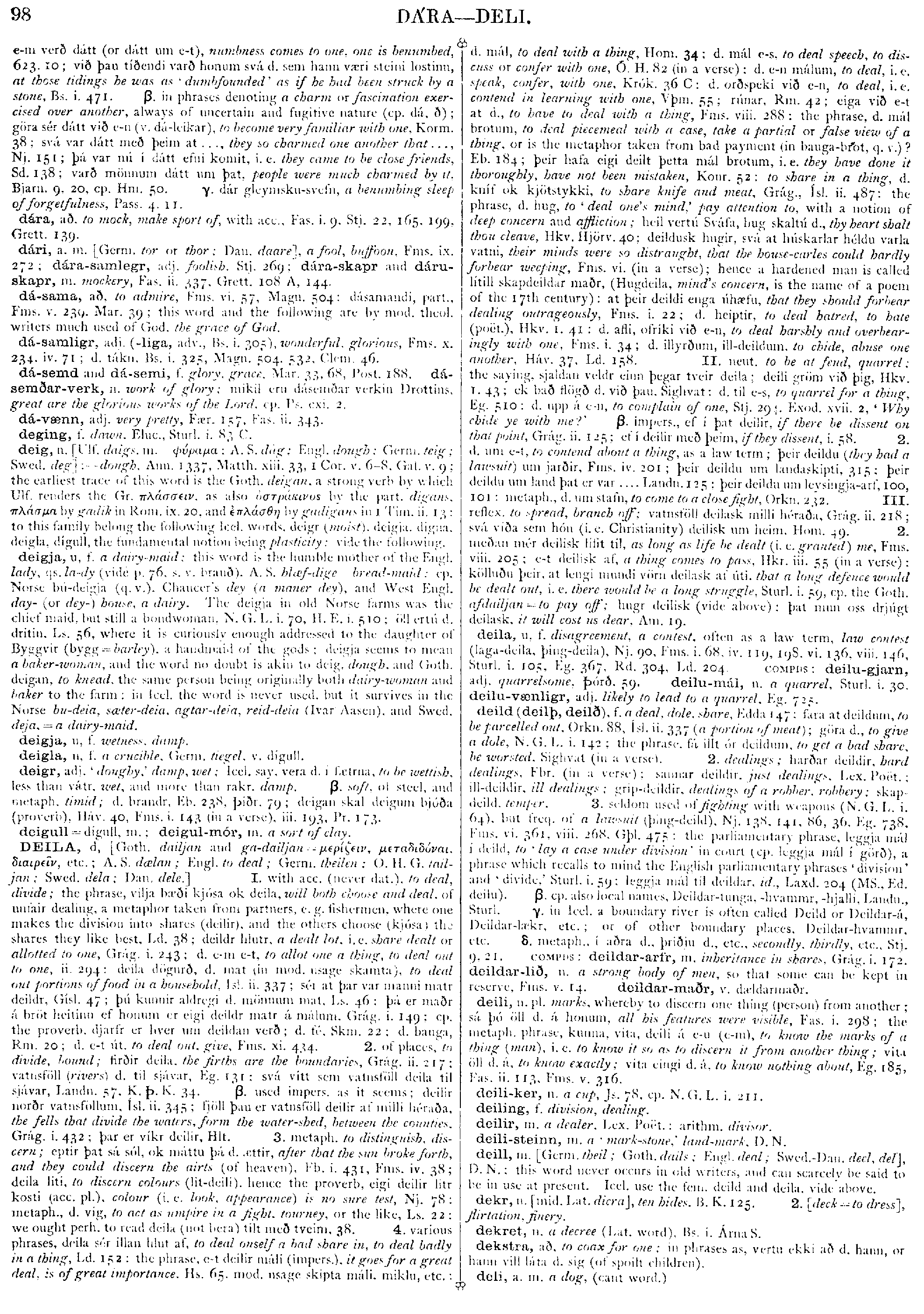
deigja, u, f. a dai ry-w ai t/; this word i. - the humble mother of the Engl. lad y, c)s. l n- dy (vide p. 76. s. v. brauð). A. S. hhef-dige bread-maid: cp. Norse bii-dei:;ja (q. v.). Chaucer's dey (a matter dey), and We^t Fngl. day- (or dey-) house, a dairy. The deigia in old Norse farms was the chief maid, but still a bondwoman, N. G. 1, . i. 70, 1!. E. i. 5 10: (ill erti'i d. dritin. Ls. 56, where it is curiously enough addressed to the daughter of Bytrgvir (bygg -- -barley'), a handmaid ot the gods; deigja seems to mean a baker-woman, and the word no doubt is akin to deig. dough, and Goth, deigan, to knead, the same person being originally both ilairy-womnn and baker to the farm: in Icel. the word is never used, but it survives in the Norse bu-deia, scuter-deia. agtar-deia, reid-deia (Ivar Aasen). and Swed. deja. -- a dairy-maid.
|
Source: Cleasby/Vigfusson, page b0098, entry 15 View original page image as: [TIFF] [PNG] [View previous entry] [View next entry] |
[Comment on this entry] [View comments] |
The following entry has not been hand-corrected. However, the page is reserved and someone is correcting it. |
DEILA, d, [Goth, dailjan and ga-dailjan • - fj. (pt^fiv, jj. tra?ii5uvai. Siaipftv, etc.; A. S. dcclan; Engl. to deal; Germ, the/ l ev/; (.). H. G. lail- ja?i; Swed. dela; Dan, dele.] I. with acc. (never dat.), to deal, divide; the phrase, vilja Ixrði kjósa ok deila, will both choose and deal, of unfair dealing, a metaphor taken from partners, e. g. fishermen, where one makes the division into shares (deilir), and the others choose (kjósa) the shares they like best, Ld. 38; deildr hlutr, a dealt lot. i. e. s hare dealt or allotted !o one, drag. i. 243; d. e-m e-t, to allot one a thing, to deal out to one, ii. 294: deila dögurð, d. mat (in mod. usage skamta), to deid out portions of food in a household. Is!, ii. 337; sér at þar var inanni matr deildr, Gísl. 47; þú kunuir aldregi d. monnum mat, Ls. 46: þ;i er maðr ;'i brot heilinn ef honum er eigi deildr matr á maltim. Gn'tg. i. 149; cp. the proverb, djarfr er hver inn deildan verð; d. fc. Skin. 22; d. bauga, Rm. 20; d. e-t lit. to deal out, give, Fms. xi. 434. 2. of places, to divide, bound; fírðir deila. the firths are the boundaries, Grág. ii.; j 7; vatnsfoll (r iver s) d. til sjuvar. Eg. 131: sva vitt sem vatnsfoll deila til sjávar, Landn. 57. K. p. K. 34. P. used irnpers. as it seems; deilir norðr vatnsfollum, í si. ii. 345; Ijiill þau er vatnsfoll deilir at" milli hi'raða, the fells that divide the waters, form the water-shed, between the counties. Grug. i. 432; þar er vikr deilir, Hit. 3. metaph. to distinguish, dis- cern; eptir þat s;'i sól, ok máttu þó. d. . f. ttir, after that the sun broke forth, and they could discern the airts (of heaven), Fb. i. 431, Fms. iv. 38; deila liti, to discern colours (lit-deili). hence the proverb, eigi deilir litr kosti (acc. pl.), colour (i. e. l oo k, appearance) is no sure test, Nj. 78: metaph., d. vig, to act as umpire in a fight, tourney, or the like, Ls. 22: we ought perh. to read deila (not beia) tilt með tveim, 38. 4. various phrases, drila ser illan hint af, to deal on self a had share in, to deal badly in a thing, Ld. 152: the phrase, e-t deilir múli (impers.), it goes for a great deal,:s of great importance. Us. 65. mod. usage skipta mali. miklu, etc.: d. mill, to dealwith a thing, Hom. 34; d. mal e-s, to deal speech, to dis- cuss or confer with one, 0. H. 82 (in a verse): d. e-n málum, to deal, i. e. speak, confer, with one, Krók. 36 C: d. orðspeki við e-n, to deal, i. e. contend in learning with one, Vþm. 55; n'mar, Rm. 42; eiga við e-t at d., to have to deal with a thing, Fms. viii. 288: the phrase, d. mál brotum, to deal piecemeal with a case, take a partial or false view of a thing, or is the metaphor taken from bad payment (in bauga-br*ot, q. v.) ? Eb. 184; þeir ha fa eigi deilt þetta mál brotum, i. e. they have done it thoroughly, have not been mistaken, Konr. 52: to share in a thing, o. knit ok kjütstykki, to share knife and meat, Grág., Ísl. ii. 487: the phrase, d. hug, /o ' deal one's mind. ' pay attention to, with a notion of deep concern and affliction; heil vertii Sváfa, hug skaltú d., thy heart shall tbou cleave, Hkv. lljorv. 40: deildusk hngir, svá at huskarlar héldu varla vatni, their minds ivere so distraught, that the house-carles could hardly forbear weeping, Fms. vi. (in a verse); hence a hardened man is called lítill skapdeildar maðr, (Hugdeila, mind's concern, is the name of a poem of the 171)1 century): at þeir deildi enga uhsefu, that they should forbear dealing outrageously, Fms. i. 22; d. heiptir. to deal hatred, to hate (poet.), Hkv. 41: d. afti, ofriki við e-n, to deal harshly and overbear- ingly u'itb one. Fms. i. 34; d. illyrðuni, ill-deil(!um. t o c hide, abuse one another, Húv. 37, Ld. 158. II. neut. to be at feud, quarrel; the saying, sjaldan veldr einn þegar tveir deila; deili grom við þig, Hkv. 43; ek bað flogð d. við þau. Sighvat: d. til e-s, to quarrel for a thing, Eg. 510: d. npp á e-n, to complain of one, Sij. 29.;. Exod. xvii. 2, ' Why chide ye with me?' P. impers., ef í þat deilir. if there be dissent on thai point, Grng. ii. 125; et í deilir með þeim, if they dissent, i. 58. 2. d. uni e-i, to contend about a thing, as a law term; þeir deildu (they hail a lawsuit) um jarðir, Fms. iv. 201; þeir deildu nm landaskipti, 315; þeir deildu um land þat er var ... . Landn. 125; þeir dei'du inn levsingia-arf, JOO, IOI: metaph., d. nm stafn, to come to a close fight, Orkn. 232. III. reflex, to spread, branch off; vatnsfoll deilask milli héraða, Grág. ii. 218; svá viða sem lion (i. e. Christianity) deilisk \m heim. Hom. 49. 2. ineðan mér deilisk lílit til, as long as life be dealt (i. e. granted) mt, Fins, viii. 205; e-t deilisk af, a thing comes to pass, Hkr. iii. 55 (in a verse); kölluðn þeir, at lengi muiuli viirn deilask al liti. that a long defence would be dealt out, i. e. there woidd b, - a long struggle, Sturl. i. =, 9, cp. the Goth. afditiljan -- fo pay off; hugr deilisk (vide above): bat mun oss drjiigt deilask, it will cost us dear. Am.
|
Source: Cleasby/Vigfusson, page b0098, entry 23 View original page image as: [TIFF] [PNG] [View previous entry] [View next entry] |
[Comment on this entry] [View comments] |
The following entry has not been hand-corrected. However, the page is reserved and someone is correcting it. |
deill, m. [Germ, th c il; Goth, dail s; Engl. deal; Swed. -D. -ui. d if l, del], I). N.; this word never occurs in old writers, and can scarcely be said to be in use at present. Icel. use the fern, deild and deila, vide above.
|
Source: Cleasby/Vigfusson, page b0104, entry 10 View original page image as: [TIFF] [PNG] [View previous entry] [View next entry] |
[Comment on this entry] [View comments] |
The following entry has not been hand-corrected. However, the page is reserved and someone is correcting it. |
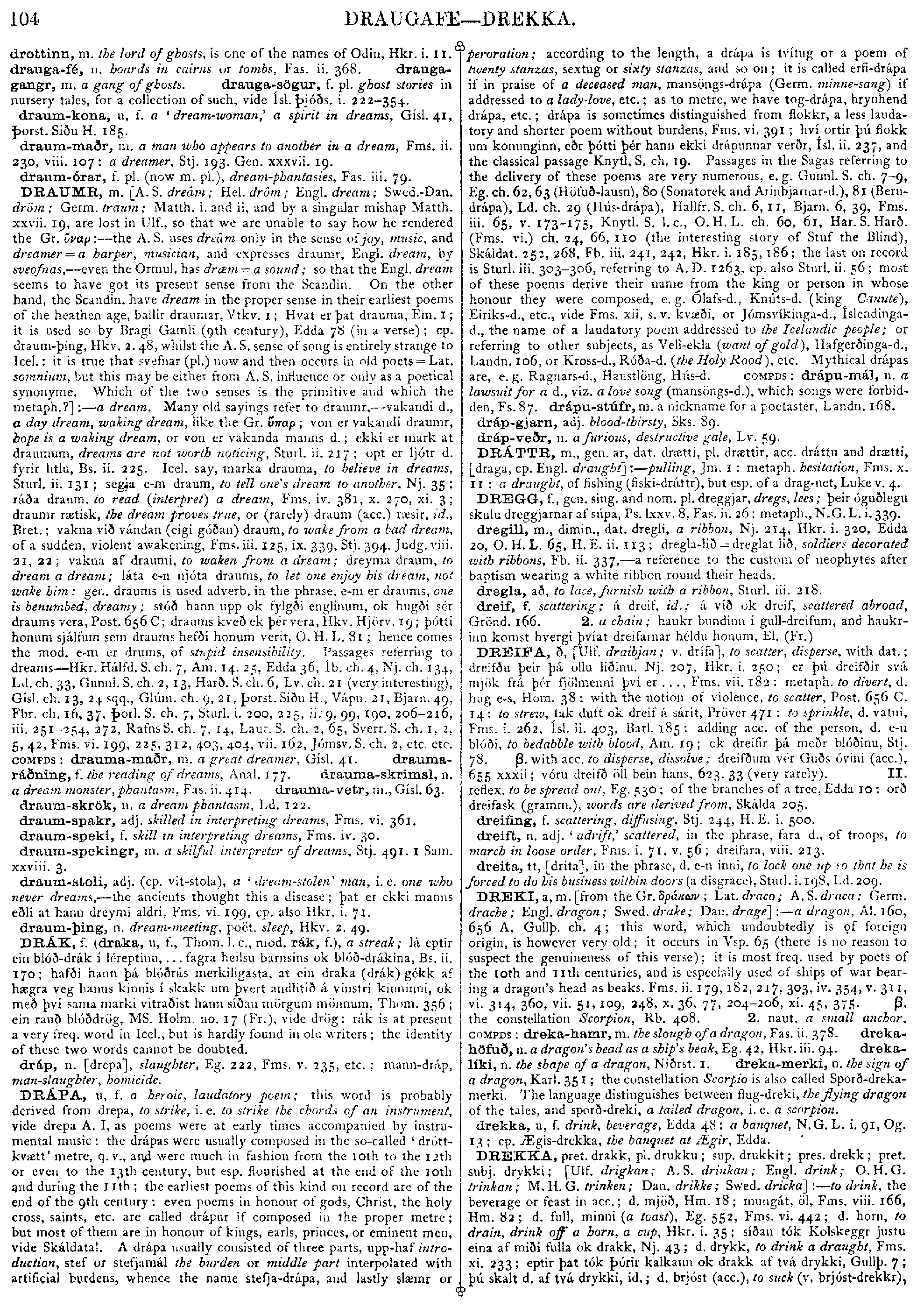
draum-stoli, adj. (cp. vit-stola), a -dream-stolen' man, i. e. one ivho never dreams, -- -- the ancients thought this a disease; þat er ekki inanns eðli at hann drcymi aldri, Fms. vi. 199, cp. also Hkr. i. 71.
|
Source: Cleasby/Vigfusson, page b0105, entry 16 View original page image as: [TIFF] [PNG] [View previous entry] [View next entry] |
[Comment on this entry] [View comments] |
The following entry has not been hand-corrected. However, the page is reserved and someone is correcting it. |
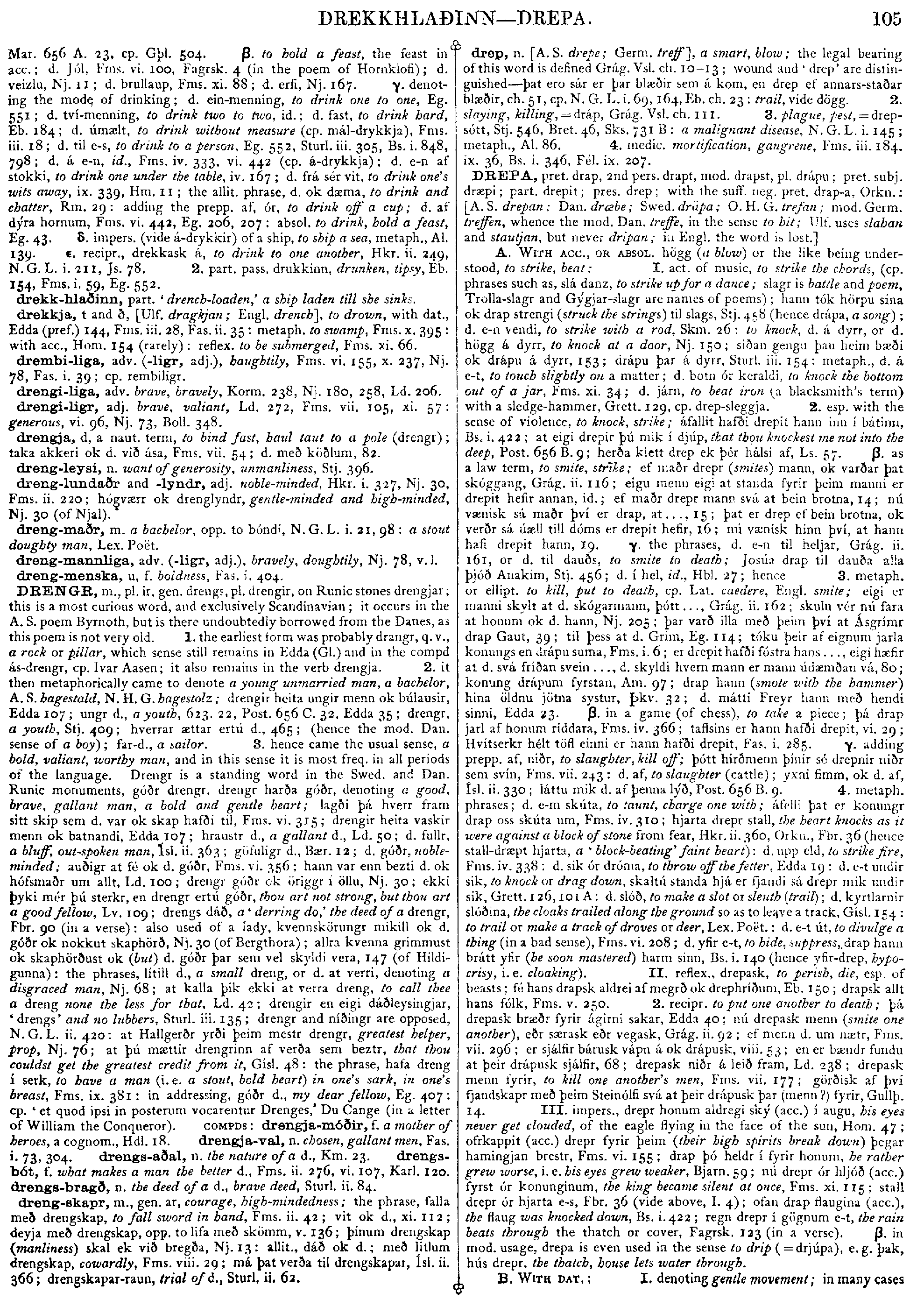
DREPA, pret. drap, 2nd pers. drapt, mod. drapst, pl. drápu; pret. subj. draepi; part, drepit; pres. drep; with the suft". neg. pret. drap-a. Orkn.: [A. S. drepan; Dan. drœbe; Swed. drapa; O. H. G. trefan; mod. Germ. treffen, whence the mod. Dan. treffe, in the sense to hit; Ulf. uses slahan and stautjan, but never dripan; in Engl. the word is lost.] A. WITH ACC., OR ABSOL. högg (a blow) or the like being under- stood, to strike, beat: I. act. of music, to strike the chords, (cp. phrases such as, slá danz, to strike up for a dance; slagr is battle and poem, Trolla-slagr and Gygjar-slagr are names of poems); hann tók hörpu sína ok drap strengi (struck the strings) til slags, Stj. 458 (hence drápa, a so?ig); d. e-n vendi, t o s trike with a rod, Skm. 26: to knock, å. á dyrr, or d. hogg á dyrr, to knock at a door, Nj. 150; síðan gengu þau heim bæði ok drápu á dyrr, 153; cirápu þar á dyrr, Sturl. iii. 154: metaph., d. á e-t, to tou c h slightly on a matter; d. botn or keraldi, to knock the bottom out of a jar, Fms. xi. 34; d. jam, to beat iron (a blacksmith's term) with a sledge-hammer, Grett. 129, cp. drep-sleggja. 2. esp. with the sense of violence, to knock, strike; áfallit hafði drepit hann inn í bátinn, Bs. i. 422; at eigi drepir þú mik í djúp, that thou knockest me not into the deep, Post. 6568. 9; herða klett drep ek þór hálsi af, Ls. 57. p. as a law term, to smite, strike; ef maðr drepr (smites) mann, ok varðar þat skóggang, Grág. ii. 116; eigu menu eigi at standa fyrir þeim inanni er drepit hefir annan, id.; ef maðr drepr mann svá at bein brotna, 14; nú vænisk sá maðr því er drap, at..., 15; þat er drep cf bein brotna, ok verðr sá úæll till dóms er drepit hefir, 16; mi vænisk hinn því, at hann hafi drepit hann, 19. y- tnc phrases, d. e-n til heljar, Grág. ii. 161, or d. til dauðs, to smite todeath; Josua drap til dauða alia þjóð Anakim, Stj. 456; d. í hel, id., Hbl. 27; hence 3. metaph. or ellipt. to kill, pwt todeath, cp. Lat. caedere, Engl. smite; eigi er manni skylt at d. skógarmann, þótt..., Grág. ii. 162; skulu vór mi fara at honum ok d. hann, Nj. 205; þar varð ilia með þeim því at Ásgrímr drap Gaut, 39; til þess at d. Grim, Eg. 114; tóku þeir af eignum jarla konungs en drápu suma, Fms. i. 6; er drepit hafði fóstra hans ..., eigi hæfir at d. svá fríðan svein ..., d. skyldi hvern mann er mann údæmðan vá, 80; konung drápum fyrstan, Am. 97; drap hann (smote with the hammer) hina öldnu jötna systur, ^kv. 32; d. mátti Freyr hann með hendi sinni, Edda 23. p. in a game (of chess), to take a piece; þá drap jarl af honum riddara, Fms. iv. 366; îaflsins er hann hafði drepit, vi. 29; Hvítserkr hélt töfl einni er hann hafði drepit, Fas. i. 285. y. adding prepp. af, niðr, to slaughter, kill off'; þótt hirðmenn þínir so drepnir niðr sem svín, Fms. vii. 243: d. af, to slaughter (cattle); yxni fimm, ok d. af, Ísl. ii. 330; láttu mik d. af þenna lyð, Post. 656 B. 9. 4. metaph. phrases; d. e-m skúta, to taunt, charge one with; áfelli þat er konungr drap oss skvita um, Fms. iv. 310; hjarta drepr stall, the heart knocks as it were against a block of stone from fear, Hkr. ii. 360, Orkn., Fbr. 36 (hence stall-dræpt hjarta, a ' block-beating'faint heart): d. upp eld, to strike fire, Fms. iv. 338: d. sik or droma, to throw off the fetter, Edda 19: d. e-t undir sik, to kn oc k or dra g- down, skahii standa hjá er fjandi sá drepr mik undir sik, Grett. 126, 101 A: d. slóð, to make a slot or sleuth (trail); d. kyrtlarnir slóðina, the cloaks trailed along the ground so as to lea. vea track, Gísl. 154: to trail or w ake a tr ac k of droves or deer, Lex. Poët.: d. e-t út, to divulge a thing (in a bad sense), Fms. vi. 208; d. yfir e-t, to hide, suppress,, dTzp hann brátt yfir (he soo n mastered) harm sinn, Bs. i. 140 (hence yfir-drep, hyp o- c ri s y, i. e. cloaking). II. reflex., drepask, to perish, die, esp. of beasts; fé hans drapsk aldrei af megrð ok drephríðum, Eb. 150; drapsk allt hans folk, Fms. v. 250. 2. recipr. to put one another to death; þá drepask bræðr fyrir ágirni sakar, Edda 40; mi drepask merm (smite one another), eðr særask eðr vegask, Grág. ii. 92; ef menu d. um nætr, Fms. vii. 296; er sjálfir bárusk vápn á ok drápusk, viii. 53; en er bændr fundu at þeir drápusk sjálfir, 68; drepask niðr á ieið fram, Ld. 238; drepask menn fyrir, to killone another's men, Fms. vii. 17?! görðisk af því fjandskapr með þeim Steinólfi svá at þeir drápusk þar (menn ?) fyrir, Gullþ. 14. III. impers., drepr honum aldregi ský (acc.) í augu, hi s eyes never get clouded, of the eagle flying in the face of the sun, Hom. 47; ofrkappit (acc.) drepr fyrir þeim (their high spirits break down) þegar hamingjan brestr, Fms. vi. 155; drap þó heldr í fyrir honum, he rather grew worse, i. e. his eyes . gr ew weaker, Bjarn. 59; nú drcpr ór hljóð (acc.) fyrst or konunginum, the kin g" became silent at once, Fms. xi. 115; stall drepr or hjarta e-s, Fbr. 36 (vide above, I. 4); ofan drap flaugina (acc.), the flaug wa s knocked down, Bs. 1. 422; regn drepr í gögnum e-t, the rain beats through the thatch or cover, Fagrsk. 123 (in a verse). p. in mod. usage, drepa is even used in the sense to drip (= drjupa), e. g. þak, hús drepr, the thatch, house lets water B. WITH DAT,; I. denoting gentle movement; in many cases
|
Source: Cleasby/Vigfusson, page b0106, entry 10 View original page image as: [TIFF] [PNG] [View previous entry] [View next entry] |
[Comment on this entry] [View comments] |
The following entry has not been hand-corrected. However, the page is reserved and someone is correcting it. |
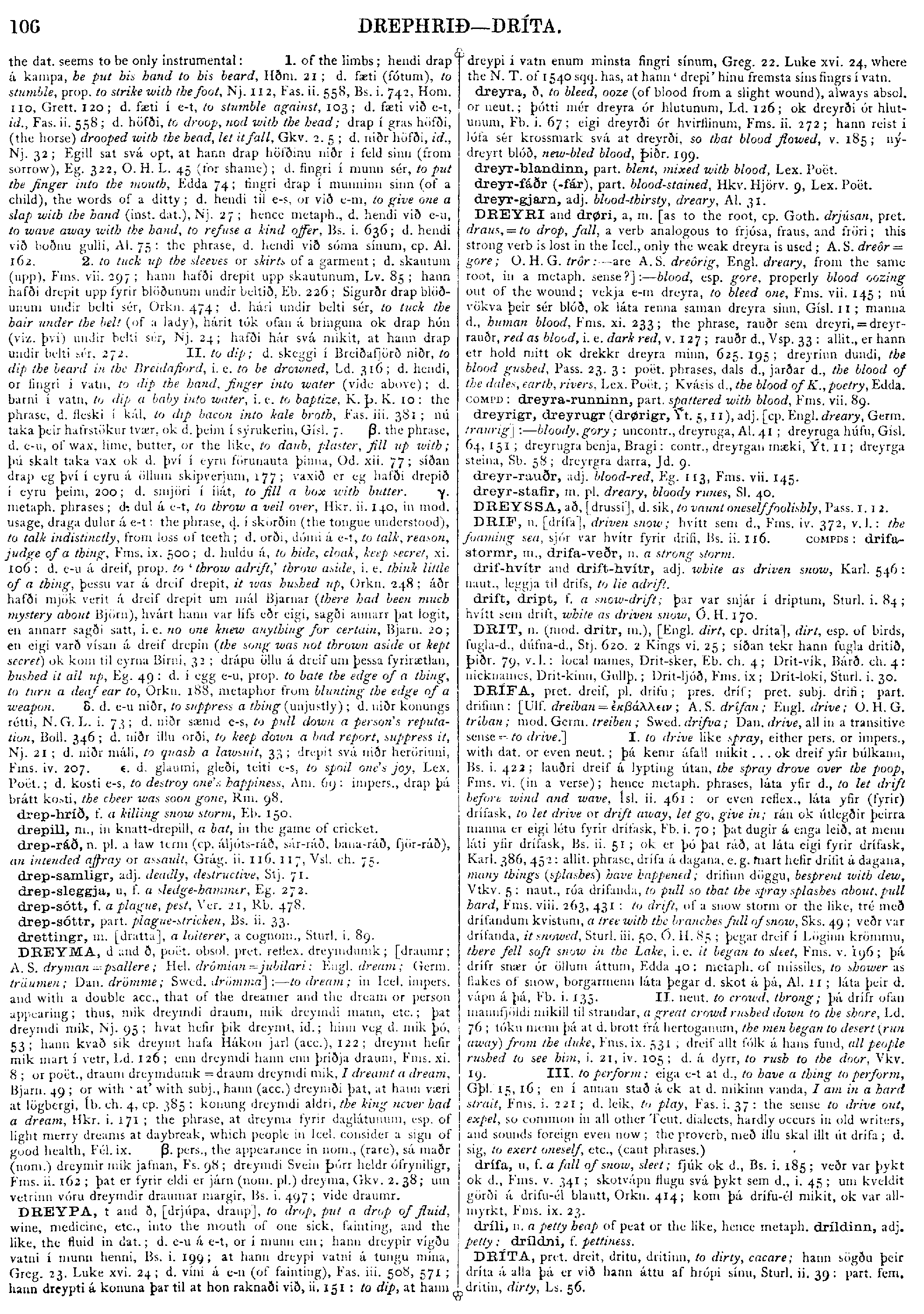
DREYMA, d and ð, pout, obsol. pret. retlex. dreyindumk; [draumr; A. S. dry man -- psallere; Hel. drornian -- jubilari; Engl. dream; Germ. triiumen; Dan. drömme; Swed. driitnina'] :-- to dream; in Icel. impers. and with a double acc., that of the dreamer and the dream or person appearing; thus, mik dreyindi draum, inik dreymdi mann, etc.; þat dreyindi mik, Nj. 95; hvat hefir þik dreymt, id.; hiiin veg d. mik þó, 53; hann kvað sik dreymt hafa Hákon jarl (acc.), 122; dreymt hefir mik mart í vetr, Ld. 126; enn dreyindi hann enu þriðja draum, Fms. xi. 8; or poet., draum dreymdumk = draum dreymdi mik, I dreamt a dream, Bjarn. 49; or with ' at' with subj., hann (acc.) dreymði þat, at hann væri at logbergi, tb. ch. 4, cp. 385: konung dreyindi aldri, the king never had a dream, Hkr. i. 171; the phrase, at dreyma fyrir daglatununi, esp. of light merry dreams at daybreak, which people in Icel. consider a sign of good health, Fél. ix. P. pers., the appearance in nom., (rare), sú maðr (nom.) dreymir n;ik jafnan, Fs. 98; dreymdi Svein p-órr heldr ófryniligr, Fms. ii. 162; þat er fyrir eldi er jam (nom. pl.) dreyma, Gkv. 2. 38; um vetrinn vóru dreymdir draumar margir, Bs. i. 497; vide draumr.
|
Source: Cleasby/Vigfusson, page b0109, entry 27 View original page image as: [TIFF] [PNG] [View previous entry] [View next entry] |
[Comment on this entry] [View comments] |
The following entry has not been hand-corrected. However, the page is reserved and someone is correcting it. |
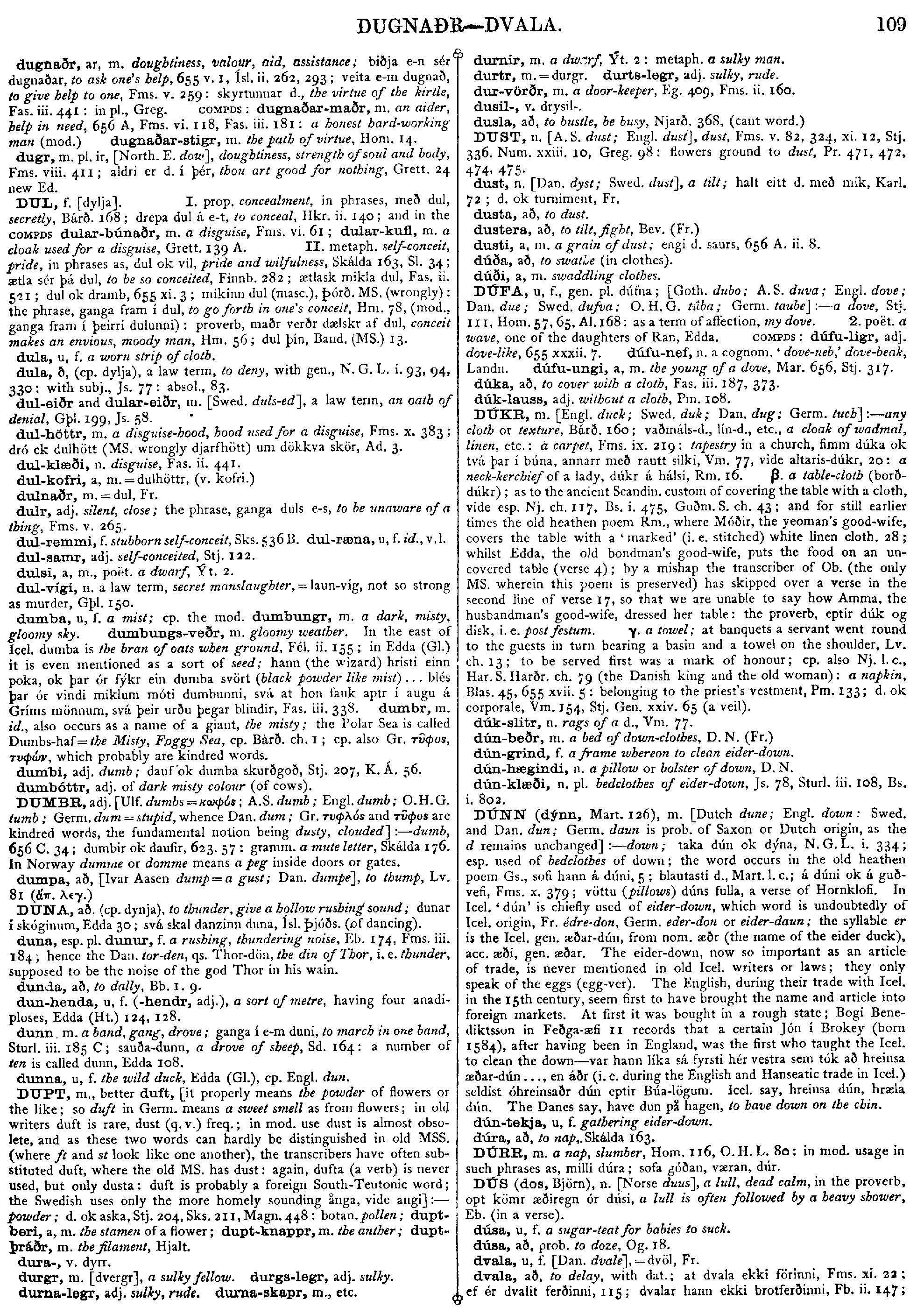
DUPT, m., better duft, [it properly means the powder of flowers or the like; so duft in Germ, means a sw eet sme ll as from flowers; in old writers duft is rare, dust (q. v.) freq.; in mod. use dust is almost obso- lete, and as these two words can hardly be distinguished in old MSS. (where ft and s t look like one another), the transcribers have often sub- stituted duft, where the old MS. has dust: again, dufta (a verb) is never used, but only dusta: duft is probably a foreign South-Teutonic word; the Swedish uses only the more homely sounding ånga, vide angi] :-- powder; d. ok aska. Stj. 204, Sks. 2ii, Magn. 448: botan. pollen; dupt- beri, a, m. thestamen of a flower; dupt-knappr, m. the anther; dupt- fcráðr, m. the filament, Hjalt.
| Result Page: |  |
Previous | 17 18 19 20 21 22 23 24 25 26 27 28 29 30 31 32 33 34 35 | Next |  |
Germanic Lexicon Project (main page)
This search system was written by
Sean Crist
Please consider
volunteering
to correct the data in these online dictionaries.
No rights reserved. Feel free to use these data in any way you please.