|
|

|
Source: Bosworth/Toller, page b0289, entry 38 View original page image as: [TIFF] [PNG] [View previous entry] [View next entry] |
[Comment on this entry] [View comments] |
The following entry has been hand-corrected once. |
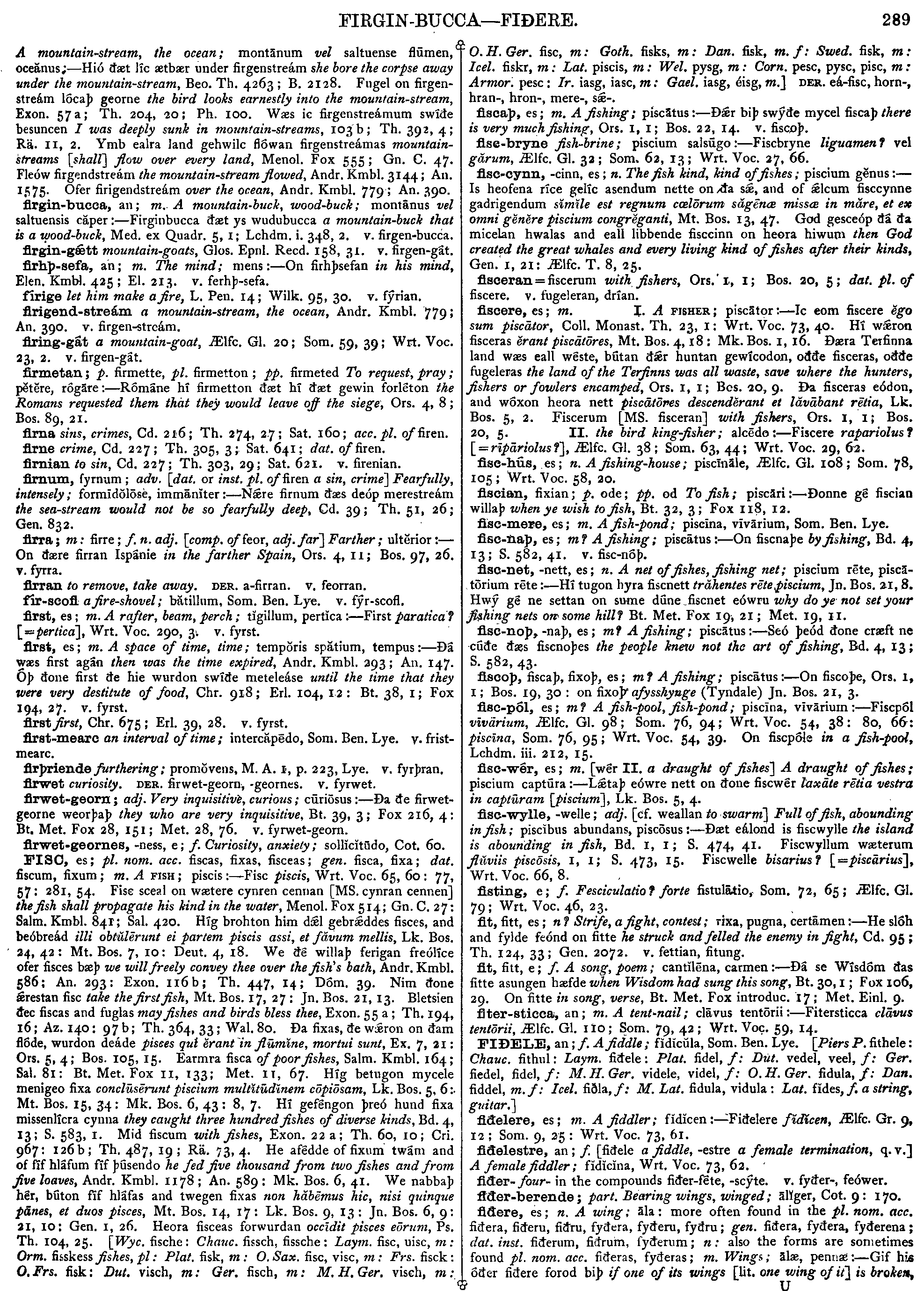
fisc-wér,
es;
m.
[wér
II.
a
draught
of
fishes]
A
draught
of
fishes;
piscium
captúra
:--
L taþ
eówre
nett
on
ðone
fiscwér
laxáte
rétia
vestra
in
captúram
[piscium],
Lk.
Bos.
5,
4.
taþ
eówre
nett
on
ðone
fiscwér
laxáte
rétia
vestra
in
captúram
[piscium],
Lk.
Bos.
5,
4.
|
Source: Bosworth/Toller, page b0361, entry 14 View original page image as: [TIFF] [PNG] [View previous entry] [View next entry] |
[Comment on this entry] [View comments] |
The following entry has been hand-corrected once. |
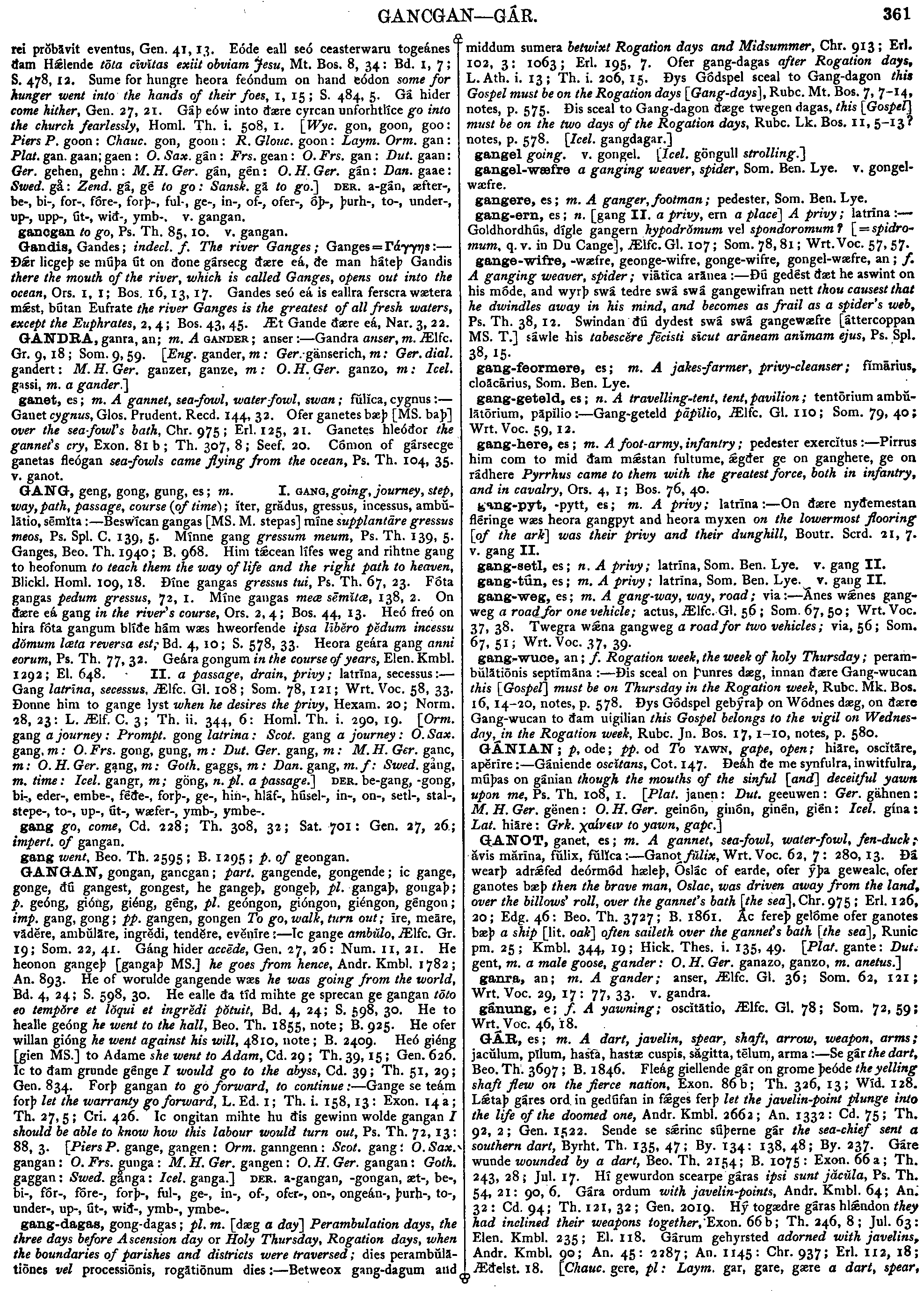
gange-wifre,
-wæfre,
geonge-wifre,
gonge-wifre,
gongel-wæfre,
an;
f.
A
ganging
weaver,
spider;
vi t
t ca
ar
ca
ar nea
:--
Ðú
gedést
ðæt
he
aswint
on
his
móde,
and
wyrþ
swá
tedre
swá
swá
gangewifran
nett
thou
causest
that
he
dwindles
away
in
his
mind,
and
becomes
as
frail
as
a
spider's
web,
Ps.
Th.
38,
12.
Swindan
ðú
dydest
swá
swá
gangewæfre
[áttercoppan
MS.
T.]
sáwle
his
tabesc
nea
:--
Ðú
gedést
ðæt
he
aswint
on
his
móde,
and
wyrþ
swá
tedre
swá
swá
gangewifran
nett
thou
causest
that
he
dwindles
away
in
his
mind,
and
becomes
as
frail
as
a
spider's
web,
Ps.
Th.
38,
12.
Swindan
ðú
dydest
swá
swá
gangewæfre
[áttercoppan
MS.
T.]
sáwle
his
tabesc re
f
re
f cisti
scut
arneam
anmam
ejus,
Ps.
Spl.
38,
15.
cisti
scut
arneam
anmam
ejus,
Ps.
Spl.
38,
15.
|
Source: Bosworth/Toller, page b0458, entry 5 View original page image as: [TIFF] [PNG] [View previous entry] [View next entry] |
[Comment on this entry] [View comments] |
The following entry has been hand-corrected once. |
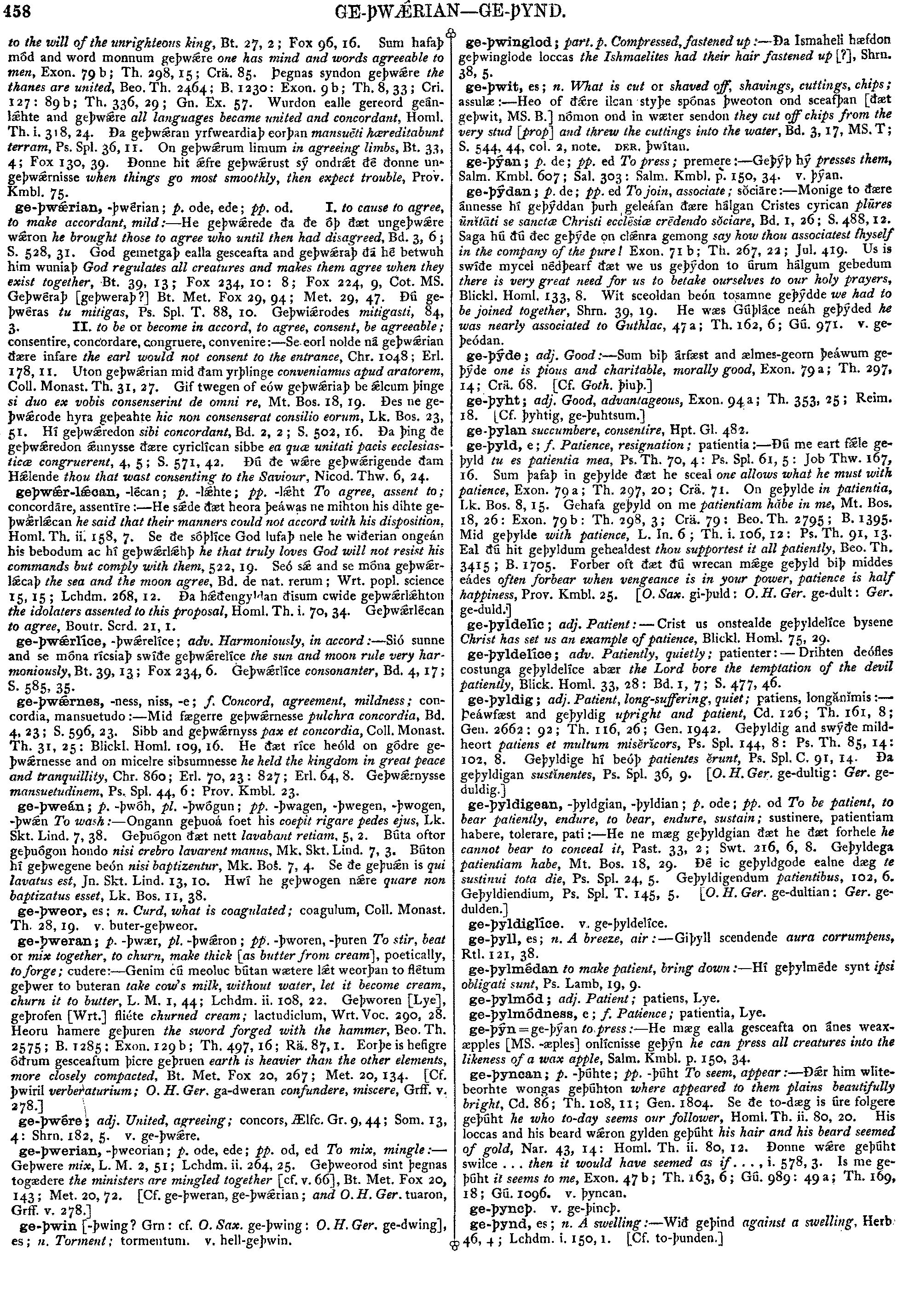
ge-þweán;
p.
-þwóh,
pl.
-þwógun;
pp.
-þwagen,
-þwegen,
-þwogen,
-þwn
To
wash
:--
Ongann
geþuoá
foet
his
coepit
rigare
pedes
ejus,
Lk.
Skt.
Lind.
7,
38.
Geþuógon
ðæt
nett
lavabant
retiam,
5,
2.
Búta
oftor
geþuógon
hondo
nisi
crebro
lavarent
manus,
Mk.
Skt.
Lind.
7,
3.
Búton
hí
geþwegene
beón
nisi
baptizentur,
Mk.
Bos.
7,
4.
Se
ðe
geþun
is
qui
lavatus
est,
Jn.
Skt.
Lind.
13,
10.
Hwí
he
geþwogen
nre
quare
non
baptizatus
esset,
Lk.
Bos.
11,
38.
|
Source: Bosworth/Toller, page b0496, entry 28 View original page image as: [TIFF] [PNG] [View previous entry] [View next entry] |
[Comment on this entry] [View comments] |
The following entry has been hand-corrected once. |
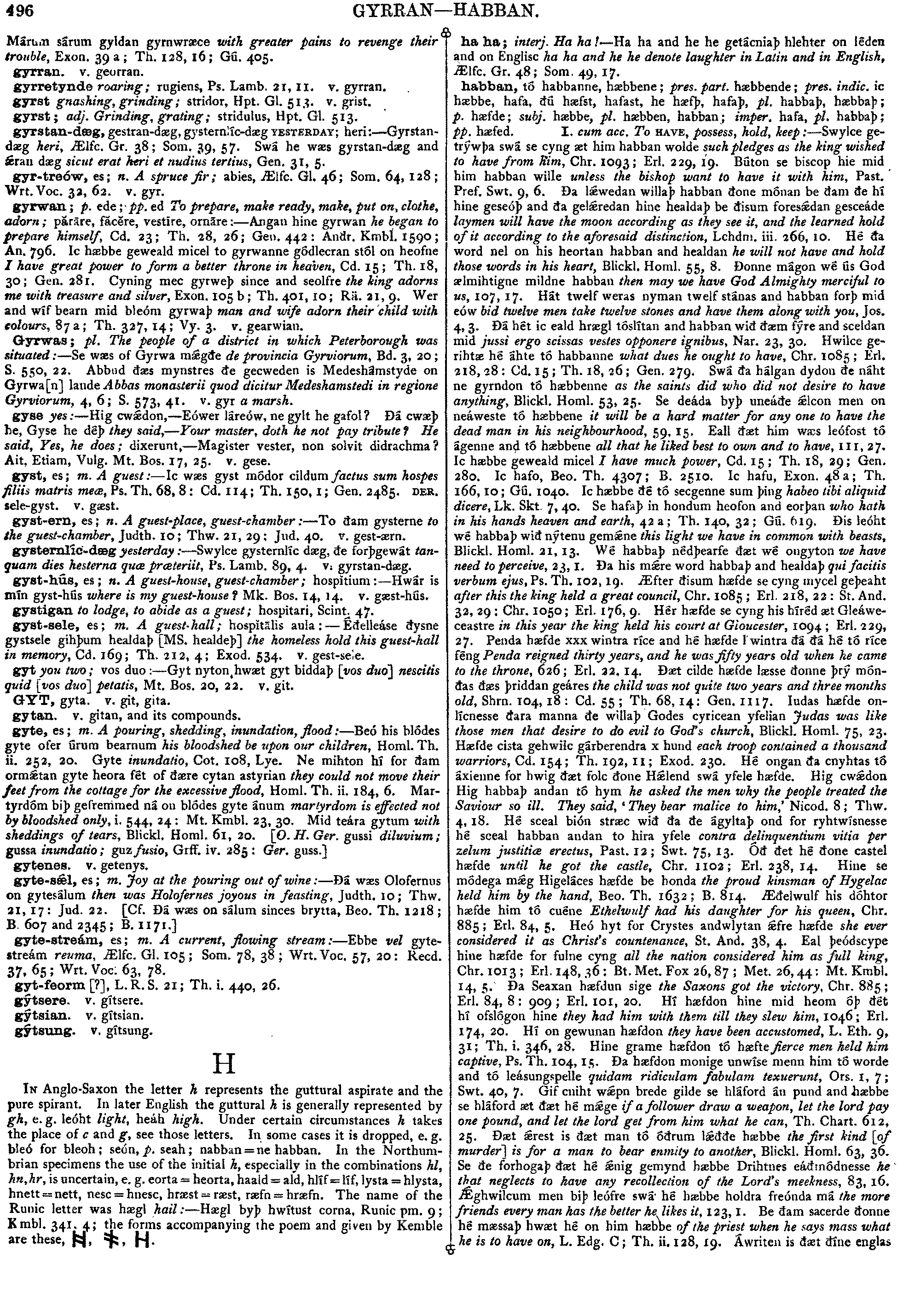
H IN Anglo-Saxon the letter h represents the guttural aspirate and the pure spirant. In later English the guttural h is generally represented by gh, e. g. leóht light, heáh high. Under certain circumstances h takes the place of c and g, see those letters. In. some cases it is dropped, e. g. bleó for bleoh; seón, p. seah; nabban = ne habban. In the Northumbrian specimens the use of the initial h, especially in the combinations hl, hn, hr, is uncertain, e. g. eorta = heorta, haald = ald, hlíf = líf, lysta = hlysta, hnett = nett, nesc = hnesc, hræst = ræst, ræfn = hræfn. The name of the Runic letter was hægl hail :-- Hægl byþ hwítust corna, Runic pm. 9; Kmbl. 341, 4; the forms accompanying the poem and given by Kemble are these, RUNE , RUNE , RUNE .
|
Source: Bosworth/Toller, page b0613, entry 2 View original page image as: [TIFF] [PNG] [View previous entry] [View next entry] |
[Comment on this entry] [View comments] |
The following entry has been hand-corrected once. |
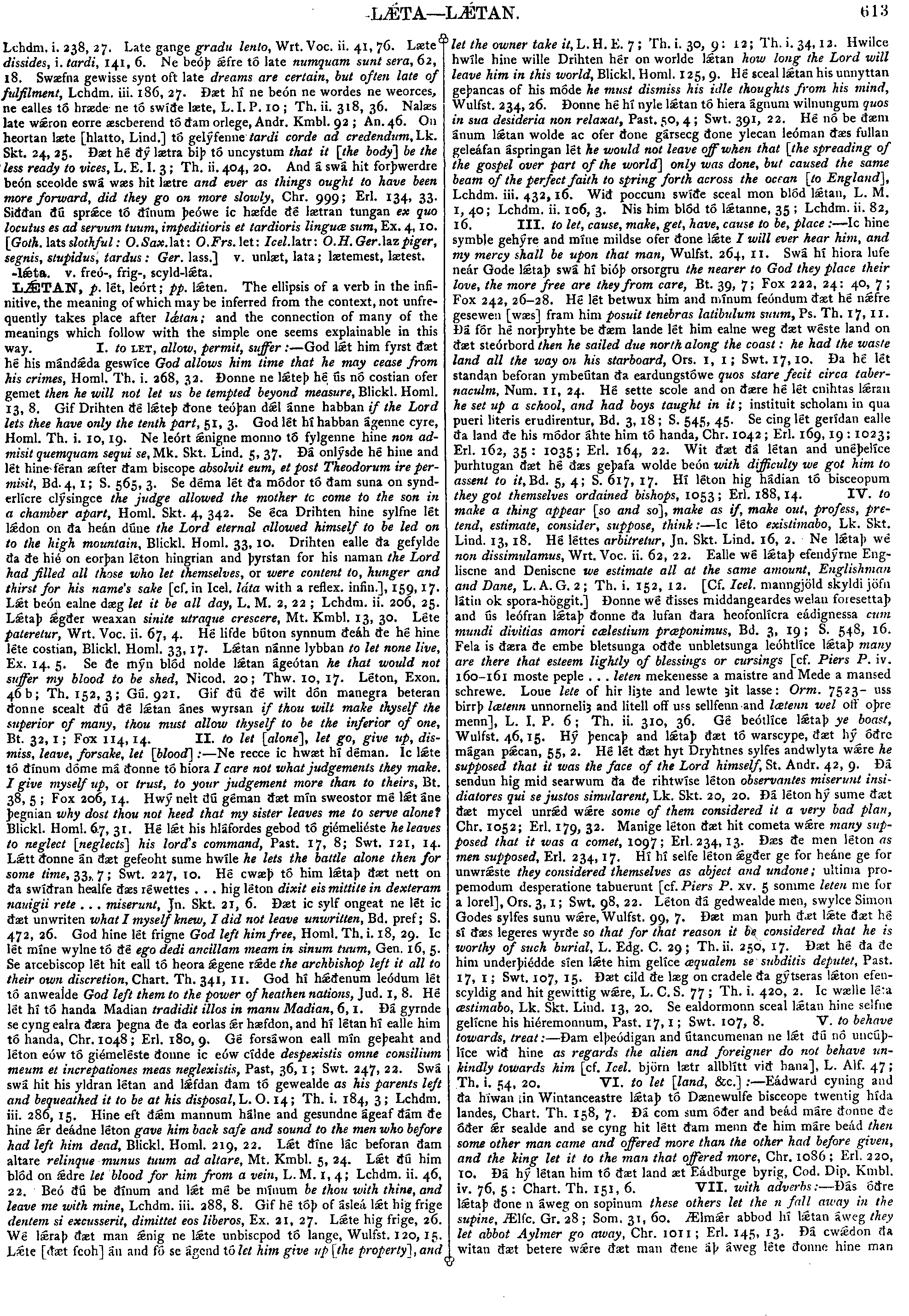
LÆ-acute;TAN,
p.
lét,
leórt;
pp.
lten.
The
ellipsis
of
a
verb
in
the
infinitive,
the
meaning
of
which
may
be
inferred
from
the
context,
not
unfrequently
takes
place
after
ltan;
and
the
connection
of
many
of
the
meanings
which
follow
with
the
simple
one
seems
explainable
in
this
way.
I.
to
LET,
allow,
permit,
suffer
:--
God
lt
him
fyrst
ðæt
hé
his
mándda
geswíce
God
allows
him
time
that
he
may
cease
from
his
crimes,
Homl.
Th.
i.
268,
32.
Ðonne
ne
lteþ
hé
ús
nó
costian
ofer
gemet
then
he
will
not
let
us
be
tempted
beyond
measure,
Blickl.
Homl.
13,
8.
Gif
Drihten
ðé
lteþ
ðone
teóþan
dl
ánne
habban
if
the
Lord
lets
thee
have
only
the
tenth
part,
51,
3.
God
lét
hí
habban
ágenne
cyre,
Homl.
Th.
i.
10,
19.
Ne
leórt
nigne
monno
tó
fylgenne
hine
non
admisit
quemquam
sequi
se,
Mk.
Skt.
Lind.
5,
37.
Ðá
onlýsde
hé
hine
and
lét
hine
féran
æfter
ðam
biscope
absolvit
eum,
et
post
Theodorum
ire
permisit,
Bd.
4,
1;
S.
565,
3.
Se
déma
lét
ða
módor
tó
ðam
suna
on
synderlícre
clýsingce
the
judge
allowed
the
mother
to
come
to
the
son
in
a
chamber
apart,
Homl.
Skt.
4,
342.
Se
éca
Drihten
hine
sylfne
lét
ldon
on
ða
heán
dúne
the
Lord
eternal
allowed
himself
to
be
led
on
to
the
high
mountain,
Blickl.
Homl.
33,
10.
Drihten
ealle
ða
gefylde
ða
ðe
hié
on
eorþan
léton
hingrian
and
þyrstan
for
his
naman
the
Lord
had
filled
all
those
who
let
themselves,
or
were
content
to,
hunger
and
thirst
for
his
name's
sake
[cf.
in
Icel.
láta
with
a
reflex.
infin.],
159,
17.
Lt
beón
ealne
dæg
let
it
be
all
day,
L.
M.
2,
22;
Lchdm.
ii.
206,
25.
Ltaþ
gðer
weaxan
sinite
utraque
crescere,
Mt.
Kmbl.
13,
30.
Léte
pateretur,
Wrt.
Voc.
ii.
67,
4.
Hé
lifde
búton
synnum
ðeáh
ðe
hé
hine
léte
costian,
Blickl.
Homl.
33,
17.
Ltan
nánne
lybban
to
let
none
live,
Ex.
14,
5.
Se
ðe
mýn
blód
nolde
ltan
ágeótan
he
that
would
not
suffer
my
blood
to
be
shed,
Nicod.
20;
Thw.
10,
17.
Léton,
Exon.
46
b;
Th.
152,
3;
Gú.
921.
Gif
ðú
ðé
wilt
dón
manegra
beteran
ðonne
scealt
ðú
ðé
ltan
ánes
wyrsan
if
thou
wilt
make
thyself
the
superior
of
many,
thou
must
allow
thyself
to
be
the
inferior
of
one,
Bt.
32,
1;
Fox
114,
14.
II.
to
let
[alone],
let
go,
give
up,
dismiss,
leave,
forsake,
let
[blood]
:--
Ne
recce
ic
hwæt
hí
déman.
Ic
lte
tó
ðínum
dóme
má
ðonne
tó
hiora
I
care
not
what
judgements
they
make.
I
give
myself
up,
or
trust,
to
your
judgement
more
than
to
theirs,
Bt.
38,
5;
Fox
206,
14.
Hwý
nelt
ðú
géman
ðæt
mín
sweostor
mé
lt
áne
þegnian
why
dost
thou
not
heed
that
my
sister
leaves
me
to
serve
alone?
Blickl.
Homl.
67,
31.
Hé
lt
his
hláfordes
gebod
tó
giémeliéste
he
leaves
to
neglect
[neglects]
his
lord's
command,
Past.
17,
8;
Swt.
121,
14.
Ltt
ðonne
án
ðæt
gefeoht
sume
hwíle
he
lets
the
battle
alone
then
for
some
time,
33,
7;
Swt.
227,
10.
Hé
cwæþ
tó
him
ltaþ
ðæt
nett
on
ða
swíðran
healfe
ðæs
réwettes
...
hig
léton
dixit
eis
mittite
in
dexteram
nauigii
rete
...
miserunt,
Jn.
Skt.
21,
6.
Ðæt
ic
sylf
ongeat
ne
lét
ic
ðæt
unwriten
what
I
myself
knew,
I
did
not
leave
unwritten,
Bd.
pref;
S.
472,
26.
God
hine
lét
frigne
God
left
him
free,
Homl.
Th.
i.
18,
29.
Ic
lét
míne
wylne
tó
ðé
ego
dedi
ancillam
meam
in
sinum
tuum,
Gen.
16,
5.
Se
arcebiscop
lét
hit
eall
tó
heora
gene
rde
the
archbishop
left
it
all
to
their
own
discretion,
Chart.
Th.
341,
11.
God
hí
hðenum
leódum
lét
tó
anwealde
God
left
them
to
the
power
of
heathen
nations,
Jud.
1,
8.
Hé
lét
hí
tó
handa
Madian
tradidit
illos
in
manu
Madian,
6,
1.
Ðá
gyrnde
se
cyng
ealra
ðæra
þegna
ðe
ða
eorlas
r
hæfdon,
and
hí
létan
hí
ealle
him
tó
handa,
Chr.
1048;
Erl.
180,
9.
Gé
forsáwon
eall
mín
geþeaht
and
léton
eów
tó
giémeléste
ðonne
ic
eów
cídde
despexistis
omne
consilium
meum
et
increpationes
meas
neglexistis,
Past,
36,
1;
Swt.
247,
22.
Swá
swá
hit
his
yldran
létan
and
lfdan
ðam
tó
gewealde
as
his
parents
left
and
bequeathed
it
to
be
at
his
disposal,
L.
O.
14;
Th.
i.
184,
3;
Lchdm.
iii.
286,
15.
Hine
eft
ðm
mannum
hálne
and
gesundne
ágeaf
ðám
ðe
hine
r
deádne
léton
gave
him
back
safe
and
sound
to
the
men
who
before
had
left
him
dead,
Blickl.
Homl.
219,
22.
Lt
ðíne
lác
beforan
ðam
altare
relinque
munus
tuum
ad
altare,
Mt.
Kmbl.
5,
24.
Lt
ðú
him
blód
on
dre
let
blood
for
him
from
a
vein,
L.
M.
1,
4;
Lchdm.
ii.
46,
22.
Beó
ðú
be
ðínum
and
lt
mé
be
mínum
be
thou
with
thine,
and
leave
me
with
mine,
Lchdm.
iii.
288,
8.
Gif
hé
tóþ
of
ásleá
lt
hig
frige
dentem
si
excusserit,
dimittet
eos
liberos,
Ex.
21,
27.
Lte
hig
frige,
26.
Wé
lraþ
ðæt
man
nig
ne
lte
unbiscpod
tó
lange,
Wulfst.
120,
15.
Lte
[ðæt
feoh]
án
and
fó
se
ágend
tó
let
him
give
up
[the
property],
and
let
the
owner
take
it,
L.
H.
E.
7;
Th.
i.
30,
9:
12;
Th.
i.
34,
12.
Hwilce
hwíle
hine
wille
Drihten
hér
on
worlde
ltan
how
long
the
Lord
will
leave
him
in
this
world,
Blickl.
Homl.
125,
9.
Hé
sceal
ltan
his
unnyttan
geþancas
of
his
móde
he
must
dismiss
his
idle
thoughts
from
his
mind,
Wulfst.
234,
26.
Ðonne
hé
hí
nyle
ltan
tó
hiera
ágnum
wilnungum
quos
in
sua
desideria
non
relaxat,
Past.
50,
4;
Swt.
391,
22.
Hé
nó
be
ðæm
ánum
ltan
wolde
ac
ofer
ðone
gársecg
ðone
ylecan
leóman
ðæs
fullan
geleáfan
áspringan
lét
he
would
not
leave
off
when
that
[the
spreading
of
the
gospel
over
part
of
the
world]
only
was
done,
but
caused
the
same
beam
of
the
perfect
faith
to
spring
forth
across
the
ocean
[to
England],
Lchdm.
iii.
432,
16.
Wið
poccum
swíðe
sceal
mon
blód
ltan,
L.
M.
1,
40;
Lchdm.
ii.
106,
3.
Nis
him
blód
tó
ltanne,
35;
Lchdm.
ii.
82,
16.
III.
to
let,
cause,
make,
get,
have,
cause
to
be,
place
:--
Ic
hine
symble
gehýre
and
míne
mildse
ofer
ðone
lte
I
will
ever
hear
him,
and
my
mercy
shall
be
upon
that
man,
Wulfst.
264,
11.
Swá
hí
hiora
lufe
neár
Gode
ltaþ
swá
hí
bióþ
orsorgru
the
nearer
to
God
they
place
their
love,
the
more
free
are
they
from
care,
Bt.
39,
7;
Fox
222,
24:
40,
7;
Fox
242,
26-28.
Hé
lét
betwux
him
and
mínum
feóndum
ðæt
hé
nfre
gesewen
[wæs]
fram
him
posuit
tenebras
latibulum
suum,
Ps.
Th.
17,
11.
Ðá
fór
hé
norþryhte
be
ðæm
lande
lét
him
ealne
weg
ðæt
wéste
land
on
ðæt
steórbord
then
he
sailed
due
north
along
the
coast:
he
had
the
waste
land
all
the
way
on
his
starboard,
Ors.
1,
1;
Swt.
17,
10.
Ða
hé
lét
standan
beforan
ymbeútan
ða
eardungstówe
quos
stare
fecit
circa
tabernaculm,
Num.
11,
24.
Hé
sette
scole
and
on
ðære
hé
lét
cnihtas
lran
he
set
up
a
school,
and
had
boys
taught
in
it;
instituit
scholam
in
qua
pueri
literis
erudirentur,
Bd.
3,
18;
S.
545,
45.
Se
cing
lét
gerídan
ealle
ða
land
ðe
his
módor
áhte
him
tó
handa,
Chr.
1042;
Erl.
169,
19:
1023;
Erl.
162,
35:
1035;
Erl.
164,
22.
Wit
ðæt
ðá
létan
and
unéþelíce
þurhtugan
ðæt
hé
ðæs
geþafa
wolde
beón
with
difficulty
we
got
him
to
assent
to
it,
Bd.
5,
4;
S.
617,
17.
Hí
léton
hig
hádian
tó
bisceopum
they
got
themselves
ordained
bishops,
1053;
Erl.
188,
14.
IV.
to
make
a
thing
appear
[so
and
so],
make
as
if,
make
out,
profess,
pretend,
estimate,
consider,
suppose,
think
:--
Ic
léto
existimabo,
Lk.
Skt.
Lind.
13,
18.
Hé
léttes
arbitretur,
Jn.
Skt.
Lind.
16,
2.
Ne
ltaþ
wé
non
dissimulamus,
Wrt.
Voc.
ii.
62,
22.
Ealle
wé
ltaþ
efendýrne
Engliscne
and
Deniscne
we
estimate
all
at
the
same
amount,
Englishman
and
Dane,
L.
A.
G.
2;
Th.
i.
152,
12.
[Cf.
Icel.
manngjöld
skyldi
jöfn
látin
ok
spora-höggit.]
Ðonne
wé
ðisses
middangeardes
welan
foresettaþ
and
ús
leófran
ltaþ
ðonne
ða
lufan
ðara
heofonlícra
eádignessa
cum
mundi
divitias
amori
cælestium
præponimus,
Bd.
3,
19;
S.
548,
16.
Fela
is
ðæra
ðe
embe
bletsunga
oððe
unbletsunga
leóhtlíce
ltaþ
many
are
there
that
esteem
lightly
of
blessings
or
cursings
[cf.
Piers
P.
iv.
160-161
moste
peple
...
leten
mekenesse
a
maistre
and
Mede
a
mansed
schrewe.
Loue
lete
of
hir
li te
and
lewte
it
lasse:
Orm.
7523-
uss
birrþ
lætenn
unnorneli
and
litell
off
uss
sellfenn
and
lætenn
wel
off
oþre
menn],
L.
I.
P.
6;
Th.
ii.
310,
36.
Gé
beótlíce
lætaþ
ye
boast,
Wulfst.
46,
15.
Hý
þencaþ
and
ltaþ
ðæt
tó
warscype,
ðæt
hý
óðre
mágan
pcan,
55,
2.
Hé
lét
ðæt
hyt
Dryhtnes
sylfes
andwlyta
wre
he
supposed
that
it
was
the
face
of
the
Lord
himself,
St.
Andr.
42,
9.
Ðá
sendun
hig
mid
searwum
ða
ðe
rihtwíse
léton
observantes
miserunt
insidiatores
qui
se
justos
simularent,
Lk.
Skt.
20,
20.
Ðá
léton
hý
sume
ðæt
ðæt
mycel
unrd
wre
some
of
them
considered
it
a
very
bad
plan,
Chr.
1052;
Erl.
179,
32.
Manige
léton
ðæt
hit
cometa
wre
many
supposed
that
it
was
a
comet,
1097;
Er1.234,
13.
Ðæs
ðe
men
léton
as
men
supposed,
Erl.
234,
17.
Hí
hí
selfe
léton
gðer
ge
for
heáne
ge
for
unwrste
they
considered
themselves
as
abject
and
undone;
ultima
propemodum
desperatione
tabuerunt
[cf.
Piers
P.
xv.
5
somme
leten
me
for
a
lorel],
Ors.
3,
1;
Swt.
98,
22.
Léton
ðá
gedwealde
men,
swylce
Simon
Godes
sylfes
sunu
wre.
Wulfst.
99,
7.
Ðæt
man
þurh
ðæt
lte
ðæt
hé
sí
ðæs
legeres
wyrðe
so
that
for
that
reason
it
be
considered
that
he
is
worthy
of
such
burial,
L.
Edg.
C.
29;
Th.
ii.
250,
17.
Ðæt
hé
ða
ðe
him
underþiédde
síen
lte
him
gelíce
æqualem
se
subditis
deputet,
Past.
17,
1;
Swt.
107,
15.
Ðæt
cild
ðe
læg
on
cradele
ða
gýtseras
lton
efenscyldig
and
hit
gewittig
wre,
L.
C.
S.
77;
Th.
i.
420,
2.
Ic
wælle
léta
æstimabo,
Lk.
Skt.
Lind.
13,
20.
Se
ealdormonn
sceal
ltan
hine
selfne
gelícne
his
hiéremonnum,
Past.
17,
1;
Swt.
107,
8.
V.
to
behave
towards,
treat
:--
Ðam
elþeódigan
and
útancumenan
ne
lt
ðú
nó
uncúþlíce
wið
hine
as
regards
the
alien
and
foreigner
do
not
behave
unkindly
towards
him
[cf.
Icel.
björn
lætr
allblítt
við
hana],
L.
Alf.
47;
Th.
i.
54,
20.
VI.
to
let
[land,
&c.]
:--
Eádward
cyning
and
ða
híwan
in
Wintanceastre
ltaþ
tó
Dænewulfe
bisceope
twentig
hída
landes,
Chart.
Th.
158,
7.
Ðá
com
sum
óðer
and
beád
máre
ðonne
ðe
óðer
r
sealde
and
se
cyng
hit
létt
ðam
menn
ðe
him
máre
beád
then
some
other
man
came
and
offered
more
than
the
other
had
before
given,
and
the
king
let
it
to
the
man
that
offered
more,
Chr.
1086;
Erl.
220,
10.
Ðá
hý
létan
him
tó
ðæt
land
æt
Eádburge
byrig,
Cod.
Dip.
Kmbl.
iv.
76,
5:
Chart.
Th.
151,
6.
VII.
with
adverbs
:--
Ðás
óðre
ltaþ
ðone
n
áweg
on
sopinum
these
others
let
the
n
fall
away
in
the
supine,
Ælfc.
Gr.
28;
Som.
31,
60.
Ælmr
abbod
hí
ltan
áweg
they
let
abbot
Aylmer
go
away,
Chr.
1011;
Erl.
145,
13.
Ðá
cwdon
ða
witan
ðæt
betere
wre
ðæt
man
ðene
áþ
áweg
léte
ðonne
hine
man
sealde
...
Ðá
lét
hé
ðone
áþ
áweg
then
the
witan
said
that
it
would
be
better
that
the
oath
should
be
dispensed
with
than
that
it
should
be
taken
...
Then
he
omitted
the
oath,
Chart.
Th.
289,
24-30.
Æt
ealre
ðære
hergunge
and
æt
eallum
ðám
hearmum
ðe
r
ðam
gedón
wre
r
ðæt
friþ
geset
wre
man
eall
onweig
lte
and
nán
man
ðæt
ne
wræce
ne
bóte
ne
bidde
as
regards
all
the
harrying
and
all
the
injuries
that
were
done
before
the
peace
was
made,
let
it
all
be
dismissed,
and
let
no
man
avenge
it
or
ask
for
compensation,
L.
Eth.
ii.
6;
Th.
i.
288,
3.
Petrus
cnucode
óþ
ðæt
hí
hine
inn
léton
Peter
knocked
until
they
let
him
in,
Homl.
Th.
i.
382,
23.
Hé
lt
him
eáþelíce
ymbe
ðæt
he
takes
it
easily,
Wulfst.
298,
30:
Homl.
Skt.
4,
342.
[Goth.
létan:
O.
Sax.
látan:
O.
Fries.
léta:
Icel.
láta:
O.
H.
Ger.
lázan.]
DER.
á-,
for-,
ge-,
of-,
on-,
tó-
ltan.
te
and
lewte
it
lasse:
Orm.
7523-
uss
birrþ
lætenn
unnorneli
and
litell
off
uss
sellfenn
and
lætenn
wel
off
oþre
menn],
L.
I.
P.
6;
Th.
ii.
310,
36.
Gé
beótlíce
lætaþ
ye
boast,
Wulfst.
46,
15.
Hý
þencaþ
and
ltaþ
ðæt
tó
warscype,
ðæt
hý
óðre
mágan
pcan,
55,
2.
Hé
lét
ðæt
hyt
Dryhtnes
sylfes
andwlyta
wre
he
supposed
that
it
was
the
face
of
the
Lord
himself,
St.
Andr.
42,
9.
Ðá
sendun
hig
mid
searwum
ða
ðe
rihtwíse
léton
observantes
miserunt
insidiatores
qui
se
justos
simularent,
Lk.
Skt.
20,
20.
Ðá
léton
hý
sume
ðæt
ðæt
mycel
unrd
wre
some
of
them
considered
it
a
very
bad
plan,
Chr.
1052;
Erl.
179,
32.
Manige
léton
ðæt
hit
cometa
wre
many
supposed
that
it
was
a
comet,
1097;
Er1.234,
13.
Ðæs
ðe
men
léton
as
men
supposed,
Erl.
234,
17.
Hí
hí
selfe
léton
gðer
ge
for
heáne
ge
for
unwrste
they
considered
themselves
as
abject
and
undone;
ultima
propemodum
desperatione
tabuerunt
[cf.
Piers
P.
xv.
5
somme
leten
me
for
a
lorel],
Ors.
3,
1;
Swt.
98,
22.
Léton
ðá
gedwealde
men,
swylce
Simon
Godes
sylfes
sunu
wre.
Wulfst.
99,
7.
Ðæt
man
þurh
ðæt
lte
ðæt
hé
sí
ðæs
legeres
wyrðe
so
that
for
that
reason
it
be
considered
that
he
is
worthy
of
such
burial,
L.
Edg.
C.
29;
Th.
ii.
250,
17.
Ðæt
hé
ða
ðe
him
underþiédde
síen
lte
him
gelíce
æqualem
se
subditis
deputet,
Past.
17,
1;
Swt.
107,
15.
Ðæt
cild
ðe
læg
on
cradele
ða
gýtseras
lton
efenscyldig
and
hit
gewittig
wre,
L.
C.
S.
77;
Th.
i.
420,
2.
Ic
wælle
léta
æstimabo,
Lk.
Skt.
Lind.
13,
20.
Se
ealdormonn
sceal
ltan
hine
selfne
gelícne
his
hiéremonnum,
Past.
17,
1;
Swt.
107,
8.
V.
to
behave
towards,
treat
:--
Ðam
elþeódigan
and
útancumenan
ne
lt
ðú
nó
uncúþlíce
wið
hine
as
regards
the
alien
and
foreigner
do
not
behave
unkindly
towards
him
[cf.
Icel.
björn
lætr
allblítt
við
hana],
L.
Alf.
47;
Th.
i.
54,
20.
VI.
to
let
[land,
&c.]
:--
Eádward
cyning
and
ða
híwan
in
Wintanceastre
ltaþ
tó
Dænewulfe
bisceope
twentig
hída
landes,
Chart.
Th.
158,
7.
Ðá
com
sum
óðer
and
beád
máre
ðonne
ðe
óðer
r
sealde
and
se
cyng
hit
létt
ðam
menn
ðe
him
máre
beád
then
some
other
man
came
and
offered
more
than
the
other
had
before
given,
and
the
king
let
it
to
the
man
that
offered
more,
Chr.
1086;
Erl.
220,
10.
Ðá
hý
létan
him
tó
ðæt
land
æt
Eádburge
byrig,
Cod.
Dip.
Kmbl.
iv.
76,
5:
Chart.
Th.
151,
6.
VII.
with
adverbs
:--
Ðás
óðre
ltaþ
ðone
n
áweg
on
sopinum
these
others
let
the
n
fall
away
in
the
supine,
Ælfc.
Gr.
28;
Som.
31,
60.
Ælmr
abbod
hí
ltan
áweg
they
let
abbot
Aylmer
go
away,
Chr.
1011;
Erl.
145,
13.
Ðá
cwdon
ða
witan
ðæt
betere
wre
ðæt
man
ðene
áþ
áweg
léte
ðonne
hine
man
sealde
...
Ðá
lét
hé
ðone
áþ
áweg
then
the
witan
said
that
it
would
be
better
that
the
oath
should
be
dispensed
with
than
that
it
should
be
taken
...
Then
he
omitted
the
oath,
Chart.
Th.
289,
24-30.
Æt
ealre
ðære
hergunge
and
æt
eallum
ðám
hearmum
ðe
r
ðam
gedón
wre
r
ðæt
friþ
geset
wre
man
eall
onweig
lte
and
nán
man
ðæt
ne
wræce
ne
bóte
ne
bidde
as
regards
all
the
harrying
and
all
the
injuries
that
were
done
before
the
peace
was
made,
let
it
all
be
dismissed,
and
let
no
man
avenge
it
or
ask
for
compensation,
L.
Eth.
ii.
6;
Th.
i.
288,
3.
Petrus
cnucode
óþ
ðæt
hí
hine
inn
léton
Peter
knocked
until
they
let
him
in,
Homl.
Th.
i.
382,
23.
Hé
lt
him
eáþelíce
ymbe
ðæt
he
takes
it
easily,
Wulfst.
298,
30:
Homl.
Skt.
4,
342.
[Goth.
létan:
O.
Sax.
látan:
O.
Fries.
léta:
Icel.
láta:
O.
H.
Ger.
lázan.]
DER.
á-,
for-,
ge-,
of-,
on-,
tó-
ltan.
|
Source: Bosworth/Toller, page b0639, entry 8 View original page image as: [TIFF] [PNG] [View previous entry] [View next entry] |
[Comment on this entry] [View comments] |
The following entry has been hand-corrected once. |
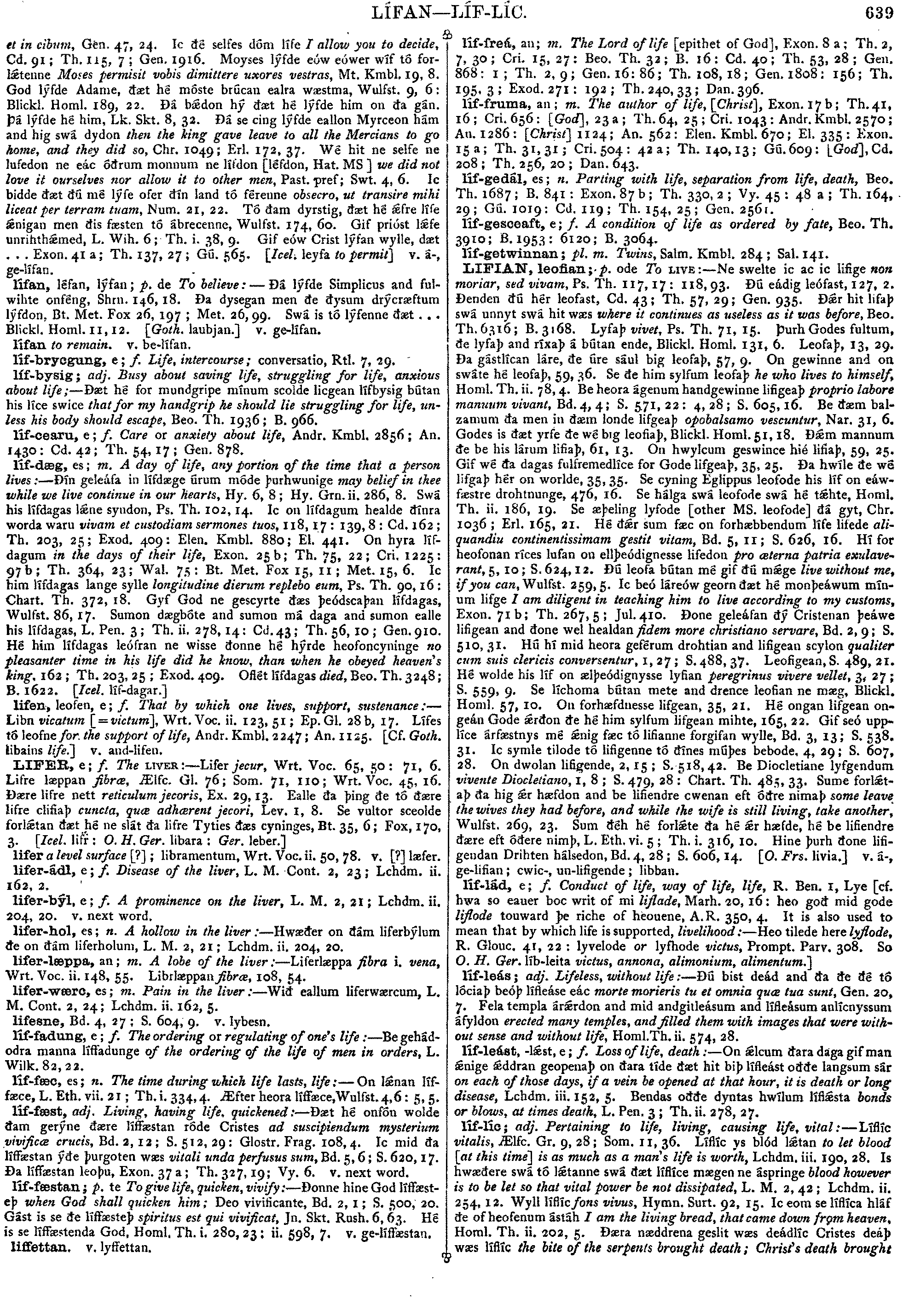
LIFER,
e;
f.
The
LIVER
:--
Lifer
jecur,
Wrt.
Voc.
65,
50:
71,
6.
Lifre
læppan
fibræ,
Ælfc.
Gl.
76;
Som.
71,
110;
Wrt.
Voc.
45,
16.
Ðære
lifre
nett
reticulum
jecoris,
Ex.
29,
13.
Ealle
ða
þing
ðe
tó
ðære
lifre
clifiaþ
cuncta,
quæ
adhærent
jecori,
Lev.
1,
8.
Se
vultor
sceolde
forltan
ðæt
hé
ne
slát
ða
lifre
Tyties
ðæs
cyninges,
Bt.
35,
6;
Fox,
170,
3.
[Icel.
lifr:
O.
H.
Ger.
libara:
Ger.
leber.]
|
Source: Bosworth/Toller, page b0646, entry 17 View original page image as: [TIFF] [PNG] [View previous entry] [View next entry] |
[Comment on this entry] [View comments] |
The following entry has been hand-corrected once. |
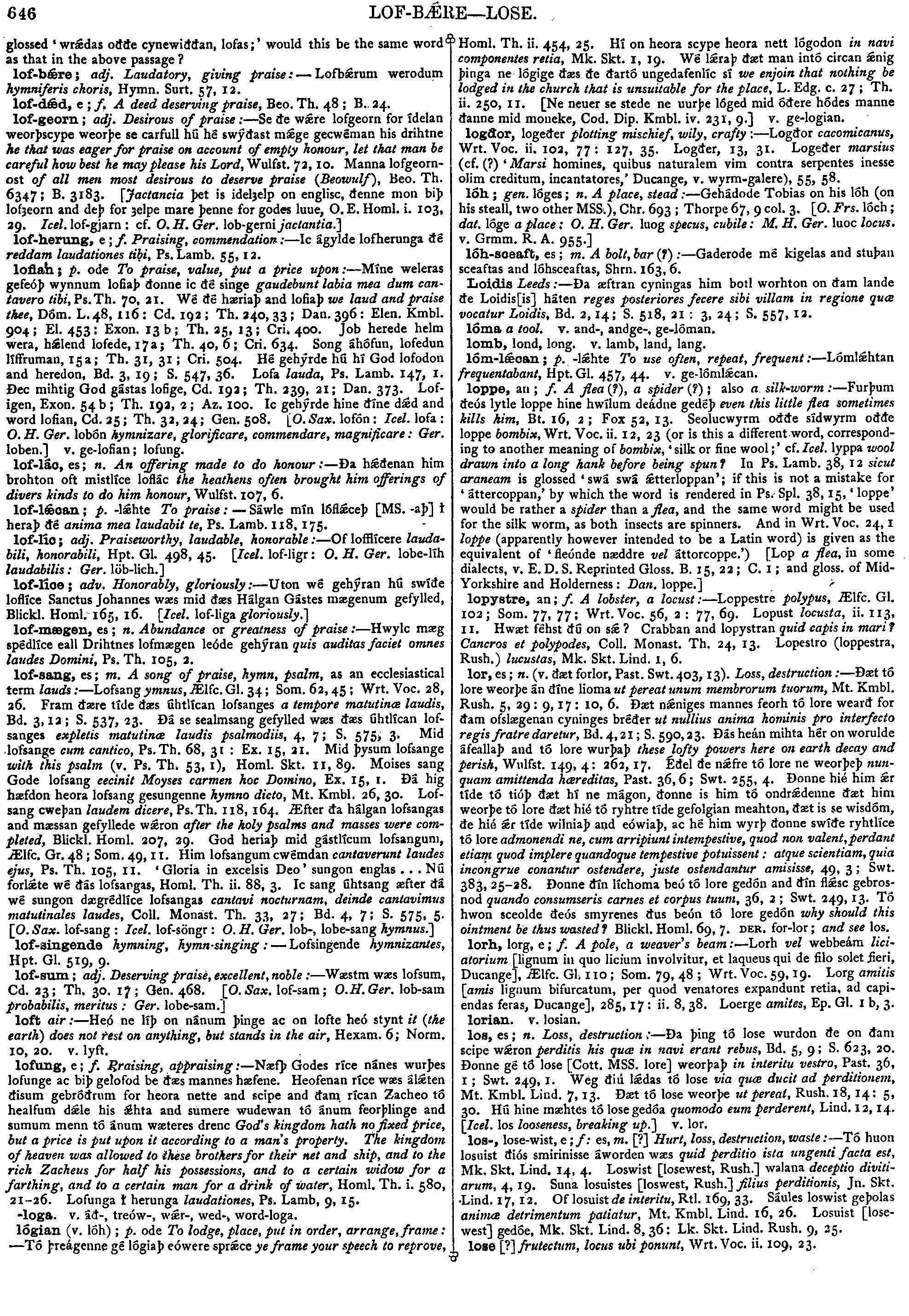
lógian
(v.
lóh);
p.
ode
To
lodge,
place,
put
in
order,
arrange,
frame
:--
Tó
þreágenne
gé
lógiaþ
eówere
sprce
ye
frame
your
speech
to
reprove,
Homl.
Th.
ii.
454,
25.
Hí
on
heora
scype
heora
nett
lógodon
in
navi
componentes
retia,
Mk.
Skt.
1,
19.
Wé
lraþ
ðæt
man
intó
circan
nig
þinga
ne
lógige
ðæs
ðe
ðartó
ungedafenlíc
sí
we
enjoin
that
nothing
be
lodged
in
the
church
that
is
unsuitable
for
the
place,
L.
Edg.
c.
27;
Th.
ii.
250,
11.
[Ne
neuer
se
stede
ne
uurþe
lóged
mid
óðere
hódes
mane
ðanne
mid
moneke,
Cod.
Dip.
Kmbl.
iv.
231,
9.]
v.
ge-logian.
|
Source: Bosworth/Toller, page b0727, entry 20 View original page image as: [TIFF] [PNG] [View previous entry] [View next entry] |
[Comment on this entry] [View comments] |
The following entry has been hand-corrected once. |
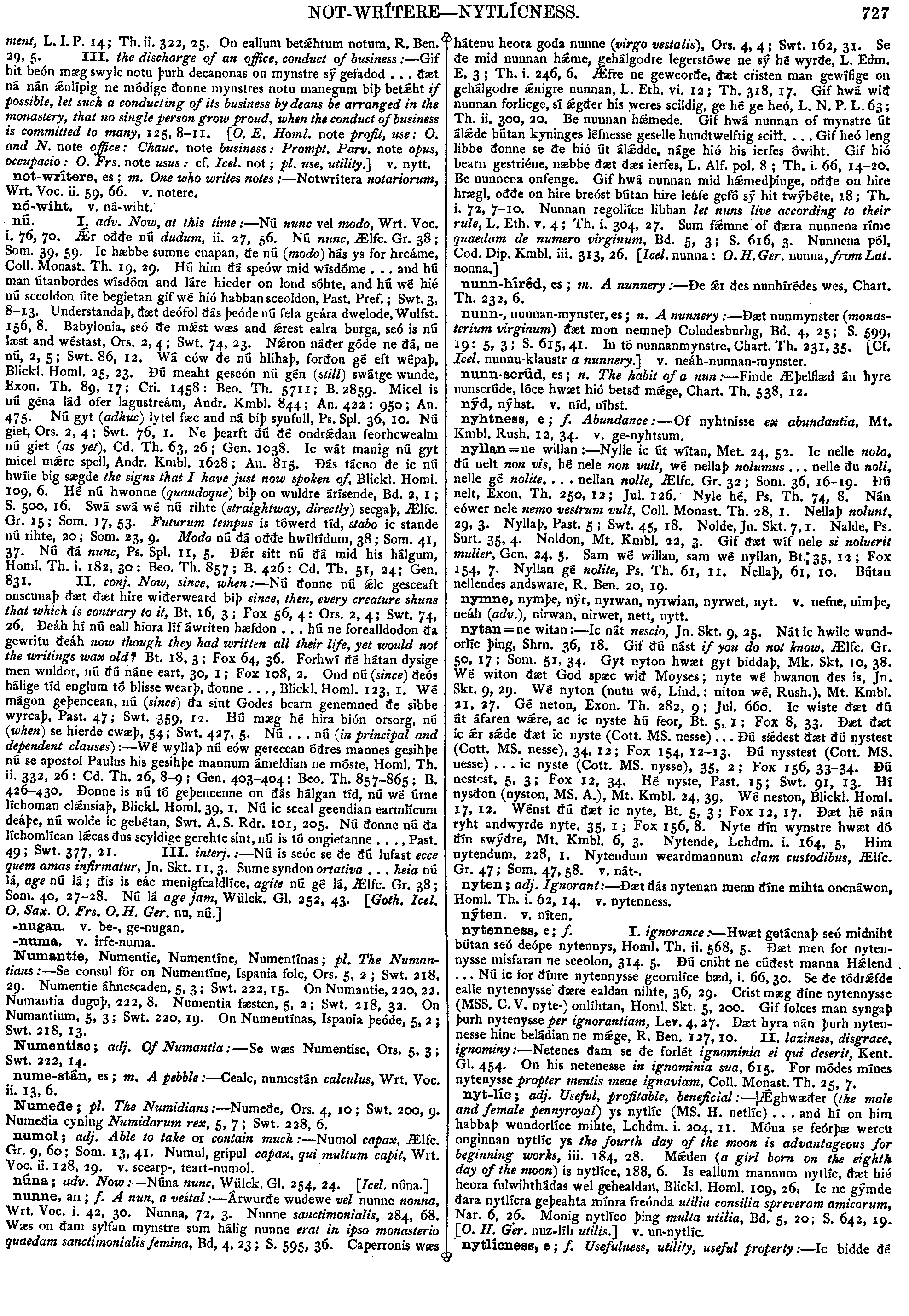
nymne, nymþe, nýr, nyrwan, nyrwian, nyrwet, nyt. v. nefne, nimþe, neáh (adv.), nirwan, nirwet, nett, nytt.
|
Source: Bosworth/Toller, page b0790, entry 5 View original page image as: [TIFF] [PNG] [View previous entry] [View next entry] |
[Comment on this entry] [View comments] |
The following entry has been hand-corrected once. |
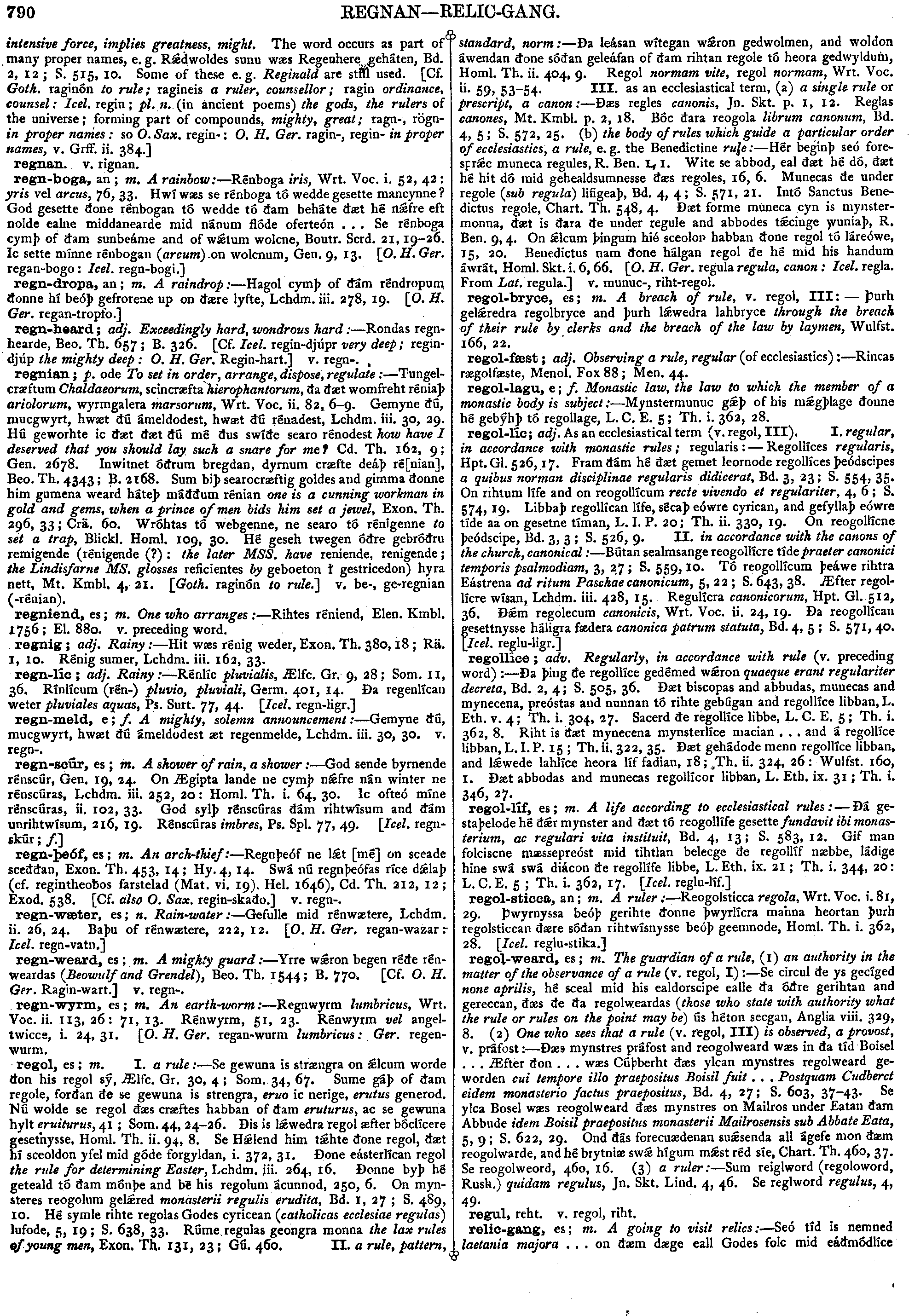
regnian;
p.
ode
To
set
in
order,
arrange,
dispose,
regulate
:--
Tungelcræftum
Chaldaeorum,
scincræfta
hierophantorum,
ða
ðæt
womfreht
réniaþ
ariolorum,
wyrmgalera
marsorum,
Wrt.
Voc.
ii.
82,
6-9.
Gemyne
ðú,
mucgwyrt,
hwæt
ðú
ámeldodest,
hwæt
ðú
rénadest,
Lchdm.
iii.
30,
29.
Hú
geworhte
ic
ðæt
ðæt
ðú
me
ðus
swíðe
searo
rénodest
how
have
I
deserved
that
you
should
lay
such
a
snare
for
me?
Cd.
Th.
162,
9;
Gen.
2678.
Inwitnet
óðrum
bregdan,
dyrnum
cræfte
deáþ
ré[nian],
Beo.
Th.
4343;
B.
2168.
Sum
biþ
searocræftig
goldes
and
gimma
ðonne
him
gumena
weard
háteþ
máððum
rénian
one
is
a
cunning
workman
in
gold
and
gems,
when
a
prince
of
men
bids
him
set
a
jewel,
Exon.
Th.
296,
33;
Crä.
60.
Wróhtas
tó
webgenne,
ne
searo
tó
rénigenne
to
set
a
trap,
Blickl.
Homl.
109,
30.
Hé
geseh
twegen
óðre
gebróðru
remigende
(rénigende
(?)
:
the
later
MSS.
have
reniende,
renigende;
the
Lindisfarne
MS.
glosses
reficientes
by
geboeton
 gestricedon)
hyra
nett,
Mt.
Kmbl,
4,
21.
[Goth.
raginón
to
rule.]
v.
be-,
ge-regnian
(-rénian).
gestricedon)
hyra
nett,
Mt.
Kmbl,
4,
21.
[Goth.
raginón
to
rule.]
v.
be-,
ge-regnian
(-rénian).
|
Source: Bosworth/Toller, page b0793, entry 22 View original page image as: [TIFF] [PNG] [View previous entry] [View next entry] |
[Comment on this entry] [View comments] |
The following entry has been hand-corrected once. |
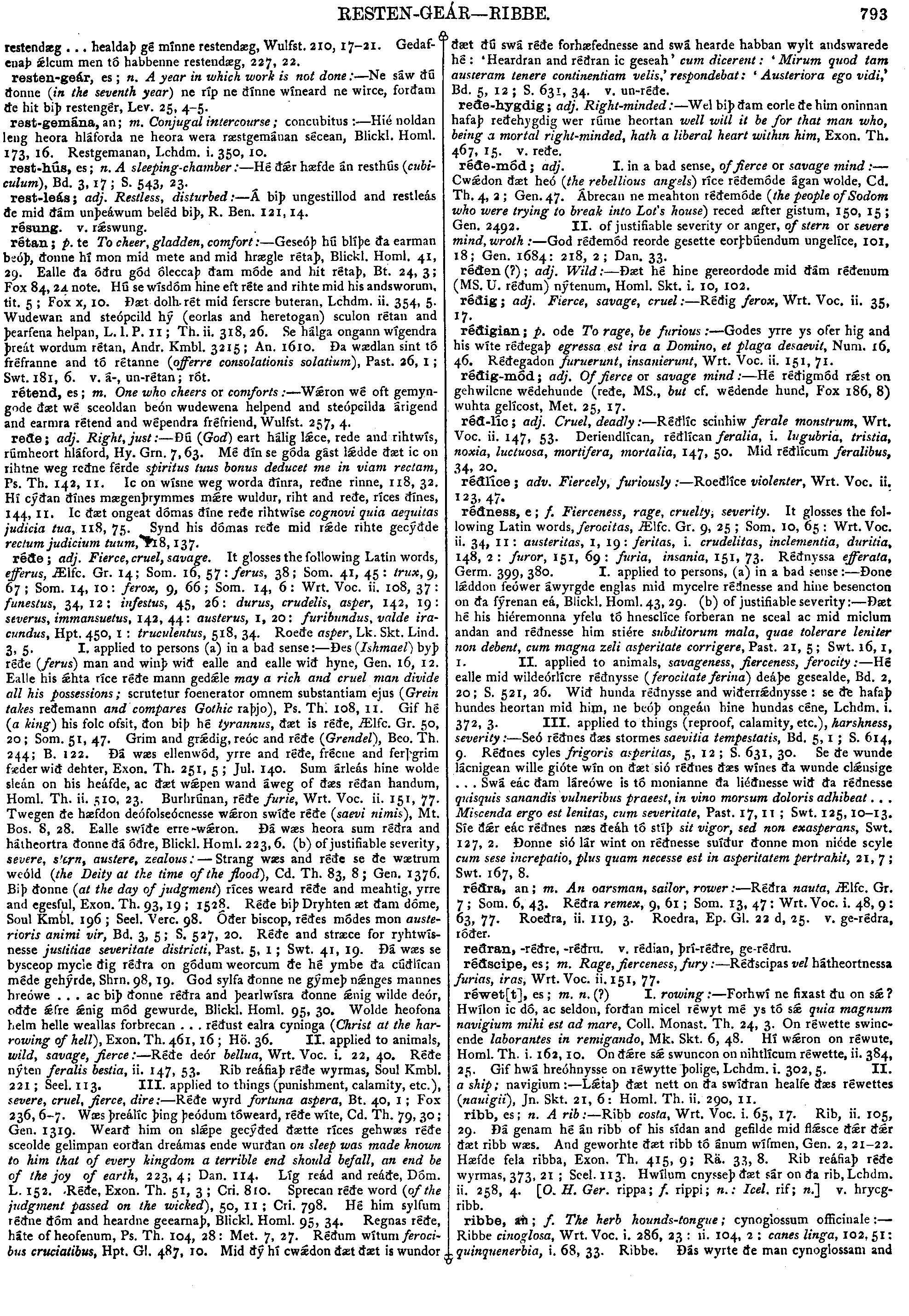
réwet[t],
es;
m.
n.
(?)
I.
rowing
:--
Forhwí
ne
fixast
ðu
on
s?
Hwílon
ic
dó,
ac
seldon,
forðan
micel
réwyt
mé
ys
tó
s
quia
magnum
navigium
mihi
est
ad
mare,
Coll.
Monast.
Th.
24,
3.
On
réwette
swincende
laborantes
in
remigando,
Mk.
Skt.
6,
48.
Hí
wron
on
réwute,
Homl.
Th.
i.
162,
10.
On
ðre
s
swuncon
on
nihtlícum
réwette,
ii.
384,
25.
Gif
hwá
hreóhnysse
on
réwytte
þolige,
Lchdm.
i.
302,
5.
II.
a
ship;
navigium
:--
Ltaþ
ðæt
nett
on
ða
swíðran
healfe
ðæs
réwettes
(nauigii),
Jn.
Skt.
21,
6
:
Homl.
Th.
ii.
290,
11.
| Result Page: |  |
Previous | 1 2 3 4 | Next |  |
Germanic Lexicon Project (main page)
This search system was written by
Sean Crist
Please consider
volunteering
to correct the data in these online dictionaries.
No rights reserved. Feel free to use these data in any way you please.