|
|

|
Source: Bosworth/Toller, page b0713, entry 27 View original page image as: [TIFF] [PNG] [View previous entry] [View next entry] |
[Comment on this entry] [View comments] |
The following entry has been hand-corrected once. |
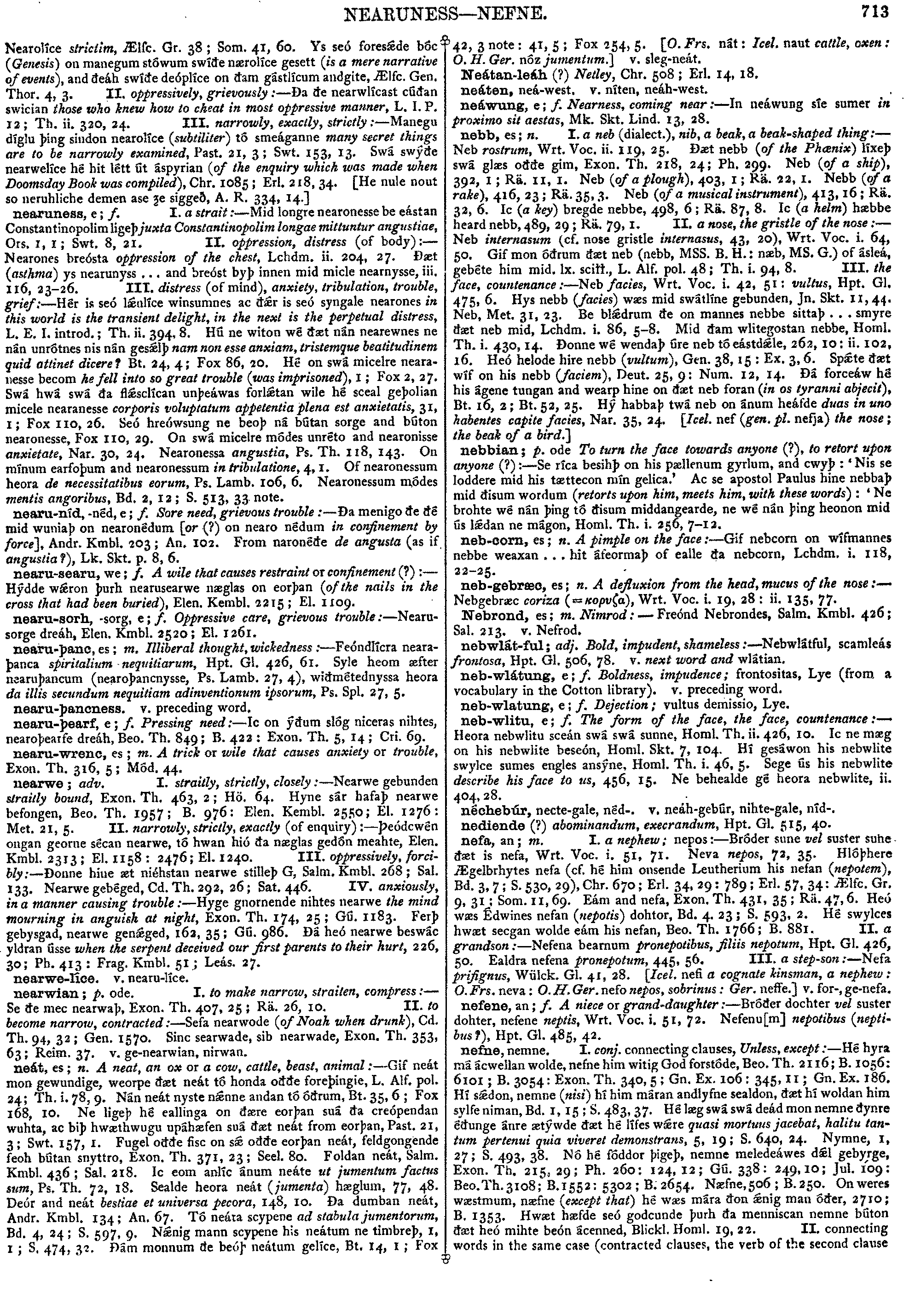
nefa, an; m. I. a nephew; nepos :-- Bróder sune vel suster sune ðæt is nefa, Wrt. Voc. i. 51, 71. Neva nepos, 72, 35. Hlóþhere Ægelbrhytes nefa (cf. hé him onsende Leutherium his nefan (nepotem), Bd. 3,7; S. 530. 29), Chr. 670; Erl. 34, 29: 789; Erl. 57, 34: Ælfc. Gr. 9, 31 : Som. 11, 69. Eám and nefa, Exon. Th. 431. 35; Rä. 47, 6. Heó wæs Édwines nefan (nepotis) dohtor, Bd. 4. 23 ; S. 593, 2. Hé swylces hwæt secgan wolde eám his nefan, Beo. Th. 1766; B. 881. II. a grandson :-- Nefena bearnum pronepotibus, filiis nepotum, Hpt. Gl. 426, 50. Ealdra nefena pronepotum, 445, 56. III. a step-son :-- Nefa prifignus, Wülck. Gl. 41, 28. [Icel. nefi a cognate kinsman, a nephew : O. Frs. neva : O. H. Ger. nefo nepos, sobrinus : Ger. neffe.] v. for-, ge-nefa.
|
Source: Bosworth/Toller, page d0649, entry 7 View original page image as: [TIFF] [PNG] [View previous entry] [View next entry] |
[Comment on this entry] [View comments] |
The following entry has been hand-corrected once. |
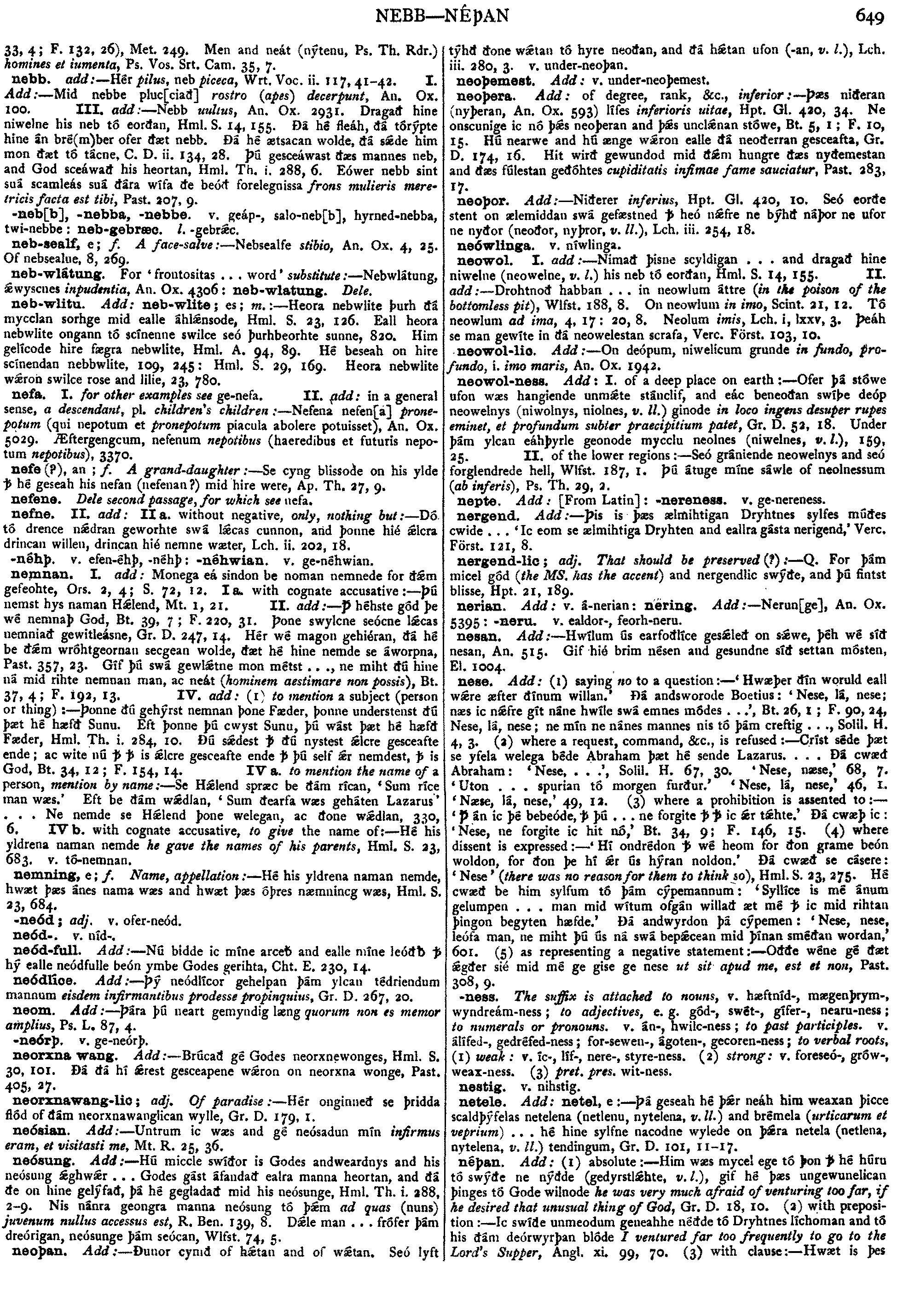
nefa. I. for other examples see ge-nefa. II. add: in a general sense, a descendant, pl. children's children :-- Nefena nefen[a] prone-potum (qui nepotum et pronepotum piacula abolere potuisset), An. Ox. 5029. Æftergengcum, nefenum nepotibus (haeredibus et futuris nepotum nepotibus), 3370.
|
Source: Torp, page b0292, entry 6 View original page image as: [TIFF] [PNG] [View previous entry] [View next entry] |
[Comment on this entry] [View comments] |
The following entry has been hand-corrected once. |
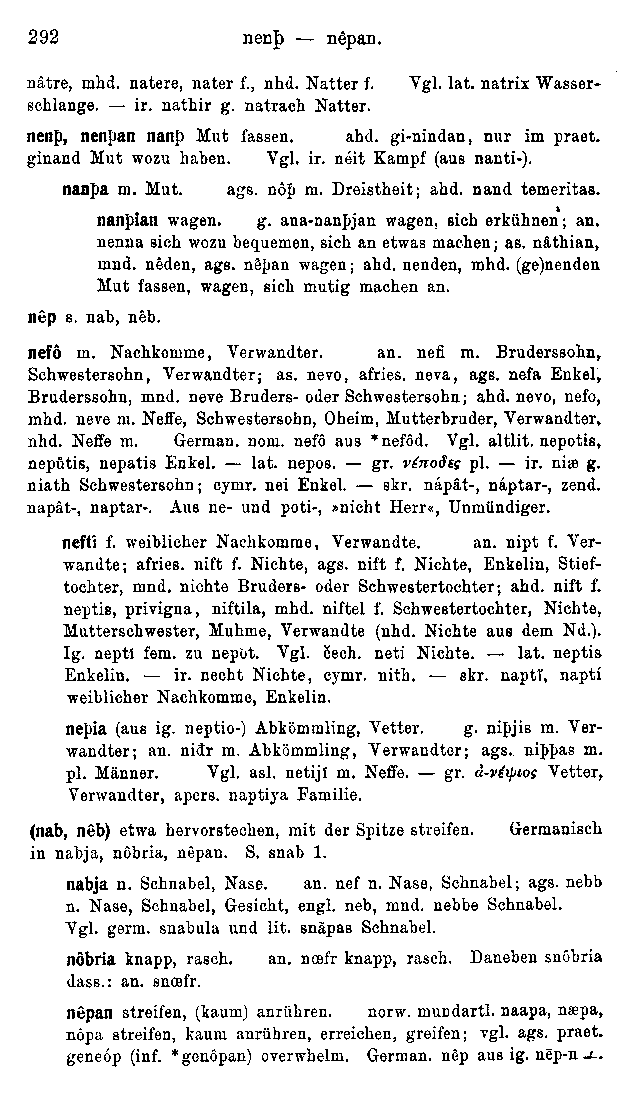
nefô
m.
Nachkomme,
Verwandter.
an.
nefi
m.
Bruderssohn,
Schwestersohn,
Verwandter;
as.
nevo,
afries.
neva,
ags.
nefa
Enkel,
Bruderssohn,
mnd.
neve
Bruders-
oder
Schwestersohn;
ahd.
nevo,
nefo,
mhd.
neve
m.
Neffe,
Schwestersohn,
Oheim,
Mutterbruder,
Verwandter,
nhd.
Neffe
m.
German.
nom.
nefô
aus
*nefôd.
Vgl.
altlit.
nepotis,
nep tis,
nepatis
Enkel.
-
lat.
nepos.
-
gr.
[ne'podes]
pl.
-
ir.
niæ
g.
niath
Schwestersohn;
cymr.
nei
Enkel.
-
skr.
nápât-,
náptar-,
zend.
napât-,
naptar-.
Aus
ne-
und
poti-,
»nicht
Herr«,
Unmündiger.
tis,
nepatis
Enkel.
-
lat.
nepos.
-
gr.
[ne'podes]
pl.
-
ir.
niæ
g.
niath
Schwestersohn;
cymr.
nei
Enkel.
-
skr.
nápât-,
náptar-,
zend.
napât-,
naptar-.
Aus
ne-
und
poti-,
»nicht
Herr«,
Unmündiger.
[Translate the German words]
|
Source: Bosworth/Toller, page b0719, entry 28 View original page image as: [TIFF] [PNG] [View previous entry] [View next entry] |
[Comment on this entry] [View comments] |
The following entry has been hand-corrected once. |
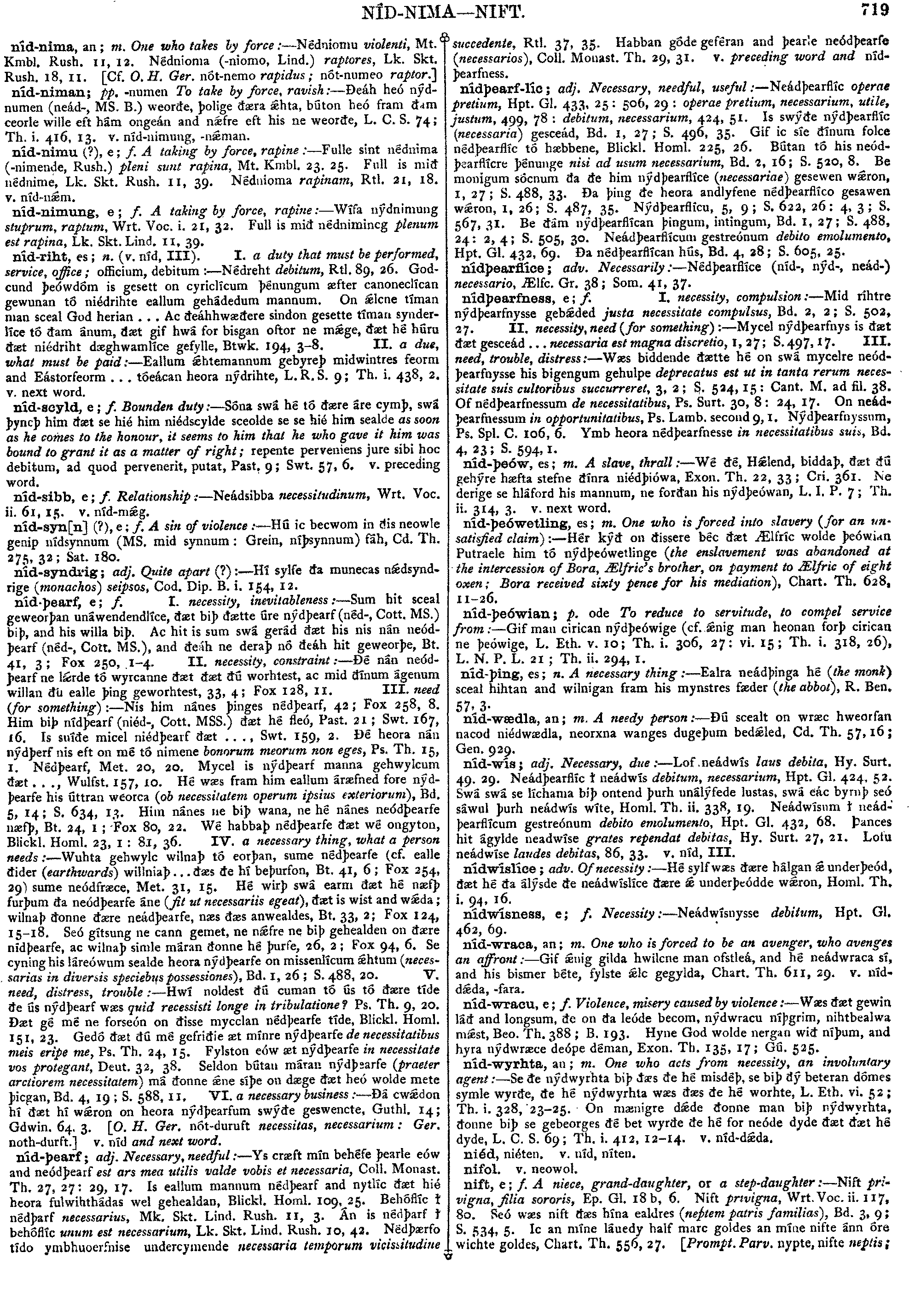
nift, e ; f. A niece, grand-daughter, or a step-daughter :-- Nift privigna, filia sororis, Ep. Gl. 18 b, 6. Nift privigna, Wrt. Voc. ii. 117, 80. Seó wæs nift ðæs hína ealdres (neptem patris families), Bd. 3, 9; S. 534, 5. Ic an míne láuedy half marc goldes an míne nifte ánn óre wichte goldes, Chart. Th. 556, 27. [Prompt. Parv. nypte, nifte neptis; nypt, broderys douter lectis : Rebecca was forð nefte (great niece) of Abraham, Gen. a. Ex. 1386 : O. Frs. nift niece : Icel. nipt a female relative, sister, daughter, niece : O. H. Ger. nift neptis, privigna.] Cf. nefa.
|
Source: Bosworth/Toller, page d0347, entry 7 View original page image as: [TIFF] [PNG] [View previous entry] [View next entry] |
[Comment on this entry] [View comments] |
The following entry has been hand-corrected once. |
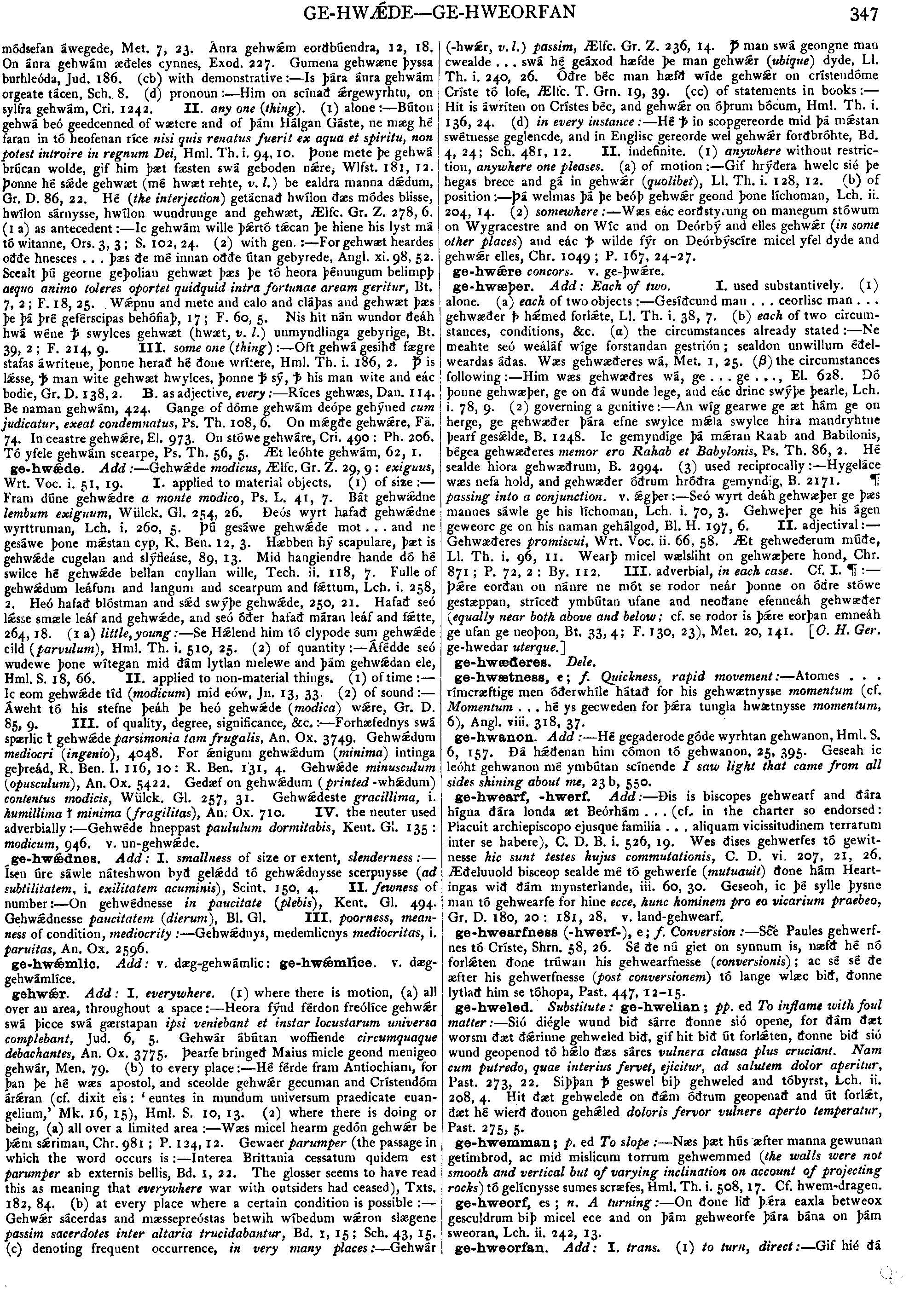
ge-hwæþer.
Add;
Each
of
two.
I.
used
substantively.
(1)
alone,
(a)
each
of
two
objects
:--
Ges
 cund
man
.
.
.
ceorlisc
man
.
.
.
gehwæer
cund
man
.
.
.
ceorlisc
man
.
.
.
gehwæer
 h
h med
forlte,
Ll.
Th.
i.
38,
7.
(b)
each
of
two
circumstances,
conditions,
&c.
(
med
forlte,
Ll.
Th.
i.
38,
7.
(b)
each
of
two
circumstances,
conditions,
&c.
( )
the
circumstances
already
stated
:--
Ne
meahte
seó
weál
)
the
circumstances
already
stated
:--
Ne
meahte
seó
weál f
wge
forstandan
gestrión;
sealdon
unwillum
f
wge
forstandan
gestrión;
sealdon
unwillum
 el-weardas
as.
Wæs
gehwæeres
w,
Met.
l,
25.
(
el-weardas
as.
Wæs
gehwæeres
w,
Met.
l,
25.
( )
the
circumstances
following
:--
Him
wæs
gehwseres
w,
ge
.
.
.
ge
.
.
.
,
El.
628.
D
)
the
circumstances
following
:--
Him
wæs
gehwseres
w,
ge
.
.
.
ge
.
.
.
,
El.
628.
D þonne
gehwæþer,
ge
on
wunde
lege,
and
eác
drinc
sw
þonne
gehwæþer,
ge
on
wunde
lege,
and
eác
drinc
sw þe
þearle,
Lch.
i.
78,
9.
(2)
governing
a
genitive
:--
An
wg
gearwe
ge
æt
hm
ge
on
herge,
ge
gehwæer
þra
efne
swylce
mla
swylce
hira
mandryhtne
þearf
geslde,
B.
1248.
Ic
gemyndige
þ
mran
Raab
and
Babilonis,
bgea
gehwæeres
memor
era
Rahab
et
Babylonis,
Ps.
Th.
86,
2.
H
sealde
hiora
gehwærum,
B.
2994.
(3)
used
reciprocally
:--
Hygelce
wæs
nefa
hold,
and
gehwæer
rum
hrra
gemyndig,
B.
2171.

passing
into
a
conjunction,
v.
gþer
:--
Seó
wyrt
deáh
gehwæþer
ge
þæs
mannes
swle
ge
his
lchonman.
Lch.
i.
70,
3.
Gehweþer
ge
his
gen
geweorc
ge
on
his
naman
gehlgod,
Bl.
H.
197,
6.
II.
adjectival
:--
Gehwæeres
promiscui,
Wrt.
Voc.
ii.
66,
58.
Æt
gehweerum
m
þe
þearle,
Lch.
i.
78,
9.
(2)
governing
a
genitive
:--
An
wg
gearwe
ge
æt
hm
ge
on
herge,
ge
gehwæer
þra
efne
swylce
mla
swylce
hira
mandryhtne
þearf
geslde,
B.
1248.
Ic
gemyndige
þ
mran
Raab
and
Babilonis,
bgea
gehwæeres
memor
era
Rahab
et
Babylonis,
Ps.
Th.
86,
2.
H
sealde
hiora
gehwærum,
B.
2994.
(3)
used
reciprocally
:--
Hygelce
wæs
nefa
hold,
and
gehwæer
rum
hrra
gemyndig,
B.
2171.

passing
into
a
conjunction,
v.
gþer
:--
Seó
wyrt
deáh
gehwæþer
ge
þæs
mannes
swle
ge
his
lchonman.
Lch.
i.
70,
3.
Gehweþer
ge
his
gen
geweorc
ge
on
his
naman
gehlgod,
Bl.
H.
197,
6.
II.
adjectival
:--
Gehwæeres
promiscui,
Wrt.
Voc.
ii.
66,
58.
Æt
gehweerum
m e,
Ll.
Th.
i.
96,
II.
Wearþ
micel
wælsliht
on
gehwæþere
bond,
Chr.
871;
P.
72,
2
:
By.
112.
III.
adverbial,
in
each
case.
Cf.
I.

:--
Þre
eoran
on
nnre
ne
mt
se
rodor
neár
þonne
on
re
stwe
gestæppan,
strce
ymbtan
ufane
and
neoane
efenneáh
gehwæer
(equally
near
both
above
and
below;
cf.
se
rodor
is
þre
eorþan
emneáh
ge
ufan
ge
neobon,
Bt.
33,
4;
F.
130,
23),
Met.
20,
141.
[O.
H.
Ger.
ge-hwedar
uterque.]
e,
Ll.
Th.
i.
96,
II.
Wearþ
micel
wælsliht
on
gehwæþere
bond,
Chr.
871;
P.
72,
2
:
By.
112.
III.
adverbial,
in
each
case.
Cf.
I.

:--
Þre
eoran
on
nnre
ne
mt
se
rodor
neár
þonne
on
re
stwe
gestæppan,
strce
ymbtan
ufane
and
neoane
efenneáh
gehwæer
(equally
near
both
above
and
below;
cf.
se
rodor
is
þre
eorþan
emneáh
ge
ufan
ge
neobon,
Bt.
33,
4;
F.
130,
23),
Met.
20,
141.
[O.
H.
Ger.
ge-hwedar
uterque.]
|
Source: Bosworth/Toller, page d0378, entry 12 View original page image as: [TIFF] [PNG] [View previous entry] [View next entry] |
[Comment on this entry] [View comments] |
The following entry has been hand-corrected once. |
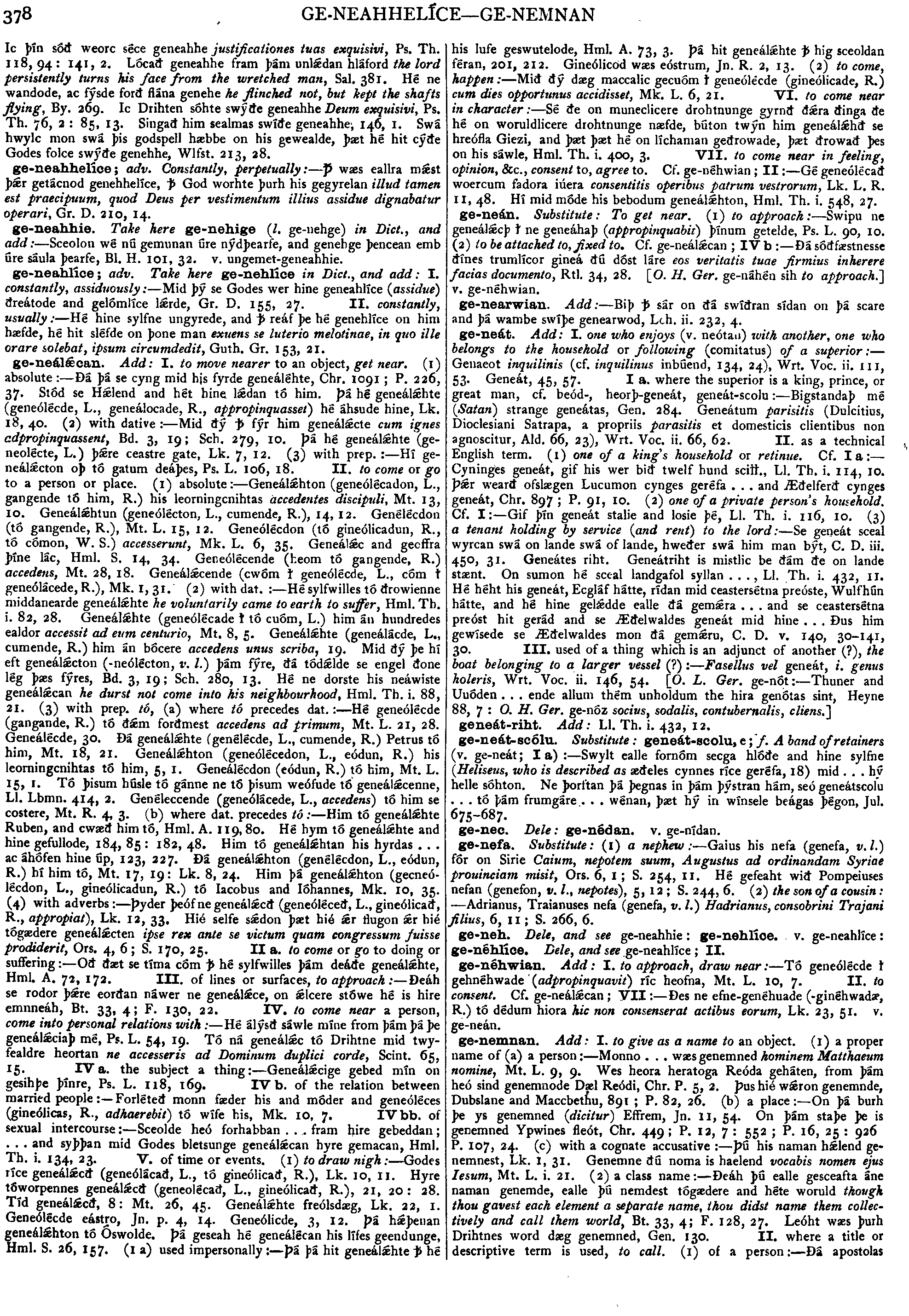
ge-nefa. Substitute: (1) a nephew :-- Gaius his nefa (genefa, v. l.) fór on Sirie Caium, nepotem suum, Augustus ad ordinandam Syriae prouinciam misit, Ors. 6, l; S. 254, n. Hé gefeaht wið Pompeiuses nefan (genefon, v. l. , nepotes), 5, 12; 8. 244, 6. (2) the son of a cousin :-- Adrianus, Traianuses nefa (genefa, v. l.) Hadrianus, consobrini Trajani filius, 6, 11; S. 266, 6.
|
Source: Bosworth/Toller, page d0491, entry 32 View original page image as: [TIFF] [PNG] [View previous entry] [View next entry] |
[Comment on this entry] [View comments] |
The following entry has been hand-corrected once. |

habban.
A.
For
I
and
IV
substitute:
I.
to
have,
hold
in
or
with
the
hand
(lit.
or
fig.
)
:--
Hé
hafað
in
hondum
heofon
and
eorðan,
Gú.
619.
Hine
se
m g
Higeláces
hæfde
be
houda,
B.
814.
Wit
hæfdon
swurd
nacod
on
handa,
539.
Þá
mdenu
hæfden
hí
sylfe
be
handa
heom
betweónum.
Gr.
D.
119,
13.
Þæt
þíne
englas
þé
on
hondum
habban,
Bl.
H.
27,
14.
I
a.
of
the
hand
:--
Gif
man
frigne
man
æt
hæbbendre
handa
(while
the
hand
still
holds
the
stolen
goods)
gefó,
Ll.
Th.
i.
42,
15:
198,.
26.
Habbendre,
220,
11.
II.
to
have,
possess.
(1)
absolute
:--
Æ-acute;lcon
þra
þe
hæfí
man
sylð
.
.
.
Þám
ðe
næfð
(nafeþ,
R.
,
ne
hæfis,
L.
)
omni
habenti
dabitur
.
.
.
qui
non
habet,
Mt.
25,
29.
Sién
ðá
hæbbendan
swelce
hié
nówiht
hæbben,
Past.
387,
35.
God
ne
hét
ús
gewelgian
þá
hæbbendan,
Wlfst.
287,
24.
(2)
with
object,
(a)
to
hold
as
property,
possess
material
or
non-material
objects
:--
Mín
lond
þe
ic
hæbbe
and
mé
God
láh,
C.
D.
i.
310,
5.
Wealh,
gif
hé
hafæð
(hæfð,
v.
l.
)
fíf
hýda,
Ll.
Th.
i.
118,
10.
Hé
hæfde
mycele
hta,
Mt.
19,
22.
Þá
cýððo
þæs
crístenan
geleáfan
þe
hí
hæfdon,
Bd.
5,
22
;
Sch.
682,
19.
Gif
hé
wite
hwá
þæs
deádan
ierfe
hæbbe,
Ll.
Th.
i.
136,
5.
Æ-acute;lc
man
þe
hors
habbe,
232,
20.
Þá
hálgan
þe
náht
ne
gyrndon
tó
hæbbenne.
Bl.
H.
53,
25.
(b)
to
hold
as
something
at
one's
disposal
or
service,
under
one's
control,
v.
heofon-hæbbend
:--
Þis
leóht
(this
world)
wé
habbaþ
wið
nýtenu
gemne,
Bl.
H.
21,
13.
Hámtúnscíre
hé
hæfde
oþ
hé
ofslóg
þone
aldormon,
Chr.
755;
P.
46,
21.
Hié
him
hæfdon
siþþan
ealle
þá
anwealdas
þe
hié
ealle
r
hæfdon,
Ors.
3,
11;
S.
152,
24.
Him
his
nefa
gesealde
Ircanian
on
onwald
tó
habbanne
eum
Hyrcanorum
genti
praeposuit,
l,
12
;
S.
54,
12.

habban
and
healdan
to
have
and
keep
:--
Þá
his
mre
word
habbað
and
healdad,
Ps.
Th.
102,
19.
Þá
þe
Godes
ríces
geleáfan
habbað
and
healdaþ,
Bl.
H.
55,
17.
Hafa
and
geheald
húsa
sélest,
.
.
.
waca
wið
wráðurn,
B.
658.
Þá
word
þæs
godspelles
on
his
heortan
habban
and
healdan,
Bl.
H.
557
7.
III.
denoting
various
kinds
of
connexion
between
subject
and
object,
e.
g.
kindred,
relative
position
:--
Ic
hæbbe
(hafo,
L.
,
R.
)
fíf
gebróþru,
Lk.
16,
28.
Ic
lýt
hafo
heáfodrnága,
B.
2150.
Sé
ðe
brýde
hæfð
(hæfes.
L.
,
hæfeð,
R.
),
sé
is
brýdgurna,
Jn.
3,
29.
Hæfde
hé
ágenne
bróþor,
Bd.
4,
22
;
Sch.
456,
19.
Surne
þá
apostolas
hæfdon
him
gemacan,
Hml.
A.
14,
34.
Búton
hé
yruenoman
hæbbe,
Ll.
Th.
i.
290,
10.
Búton
hé
hæbbe
manigne
man
þe
him
hére,
Bt.
29,
1;
F.
104,
9:
Solil.
H.
3,
12.
Swá
hé
hæbbe
freónda
má,
Bl.
H.
123,
i.
Heó
cwæð
heó
hine
ne
nánne
habban
(have
as
husband)
wolde,
Chr.
1067
;
P.
201,
16.
Nis
mé
þearf
hearran
tó
habbanne,
Gen.
279.
III
a.
with
complement
or
adverbial
extension
defining
the
connexion,
cf.
VI.
(1)
the
object
a
person
:--
Wé
habbað
(habbas,
L.
)
Abraham
ús
tó
fæder
patrem
habemus
Abraham,
Mt.
3,
9.
Wé
habbað
ðune
god
tó
fæder
unum
patrem
habemus
deum,
Jn.
8,
41.
Æþelwulf
his
dohtor
hæfde
him
tó
cuéne,
Chr.
885
;
P.
78,
27.
Þá
hæfdon
hí
him
tó
wífum,
Ors.
2,
2
;
S.
64,
30.
Hine
grame
hæfdon
tó
hæfte,
Ps.
Th.
104,
15.
Hæbbe
hé
him
twégen
ceorlas
tó
gewitnesse,
Ll.
Th.
i.
34,
4.
Hæbbe
hé
him
in
áde
wdan
gódne.
42,
8.
Þ-bar;
lc
man
hæbbe
æt
þre
syhl
.ii.
wel
gehorsede
men,
208,
12.
Þ-bar;
hí
hí
tó
wífe
habbon,
Hml.
S.
17,
158.
(2)
the
object
a
thing,
(a)
a
noun
or
pronoun
:--
Nim
ic
þé
tó
sillenne
habbe,
Ap.
Th.
12,
2.
Hé
hæfðe
þriddan
dl
his
firde
beæftan
him.
Ors.
I.
12
;
S.
52,
32.
Theodosius
hæfde
þone
wind
mid
him,
6,
36;
S.
294,
26.
Be
þám
sácerde
.
.
,
hwæt
hé
on
him
hæbbe,
Ll.
Th.
ii.
128,
19.
Hæbbe
hé
him
gemne
wið
God,
i.
332,
31.
Þám
þe
heora
dl
getýnedne
hæbben,
128,
9.
Búton
se
biscep
hié
mid
him
habban
wille,
Past.
9,
6.
g
Higeláces
hæfde
be
houda,
B.
814.
Wit
hæfdon
swurd
nacod
on
handa,
539.
Þá
mdenu
hæfden
hí
sylfe
be
handa
heom
betweónum.
Gr.
D.
119,
13.
Þæt
þíne
englas
þé
on
hondum
habban,
Bl.
H.
27,
14.
I
a.
of
the
hand
:--
Gif
man
frigne
man
æt
hæbbendre
handa
(while
the
hand
still
holds
the
stolen
goods)
gefó,
Ll.
Th.
i.
42,
15:
198,.
26.
Habbendre,
220,
11.
II.
to
have,
possess.
(1)
absolute
:--
Æ-acute;lcon
þra
þe
hæfí
man
sylð
.
.
.
Þám
ðe
næfð
(nafeþ,
R.
,
ne
hæfis,
L.
)
omni
habenti
dabitur
.
.
.
qui
non
habet,
Mt.
25,
29.
Sién
ðá
hæbbendan
swelce
hié
nówiht
hæbben,
Past.
387,
35.
God
ne
hét
ús
gewelgian
þá
hæbbendan,
Wlfst.
287,
24.
(2)
with
object,
(a)
to
hold
as
property,
possess
material
or
non-material
objects
:--
Mín
lond
þe
ic
hæbbe
and
mé
God
láh,
C.
D.
i.
310,
5.
Wealh,
gif
hé
hafæð
(hæfð,
v.
l.
)
fíf
hýda,
Ll.
Th.
i.
118,
10.
Hé
hæfde
mycele
hta,
Mt.
19,
22.
Þá
cýððo
þæs
crístenan
geleáfan
þe
hí
hæfdon,
Bd.
5,
22
;
Sch.
682,
19.
Gif
hé
wite
hwá
þæs
deádan
ierfe
hæbbe,
Ll.
Th.
i.
136,
5.
Æ-acute;lc
man
þe
hors
habbe,
232,
20.
Þá
hálgan
þe
náht
ne
gyrndon
tó
hæbbenne.
Bl.
H.
53,
25.
(b)
to
hold
as
something
at
one's
disposal
or
service,
under
one's
control,
v.
heofon-hæbbend
:--
Þis
leóht
(this
world)
wé
habbaþ
wið
nýtenu
gemne,
Bl.
H.
21,
13.
Hámtúnscíre
hé
hæfde
oþ
hé
ofslóg
þone
aldormon,
Chr.
755;
P.
46,
21.
Hié
him
hæfdon
siþþan
ealle
þá
anwealdas
þe
hié
ealle
r
hæfdon,
Ors.
3,
11;
S.
152,
24.
Him
his
nefa
gesealde
Ircanian
on
onwald
tó
habbanne
eum
Hyrcanorum
genti
praeposuit,
l,
12
;
S.
54,
12.

habban
and
healdan
to
have
and
keep
:--
Þá
his
mre
word
habbað
and
healdad,
Ps.
Th.
102,
19.
Þá
þe
Godes
ríces
geleáfan
habbað
and
healdaþ,
Bl.
H.
55,
17.
Hafa
and
geheald
húsa
sélest,
.
.
.
waca
wið
wráðurn,
B.
658.
Þá
word
þæs
godspelles
on
his
heortan
habban
and
healdan,
Bl.
H.
557
7.
III.
denoting
various
kinds
of
connexion
between
subject
and
object,
e.
g.
kindred,
relative
position
:--
Ic
hæbbe
(hafo,
L.
,
R.
)
fíf
gebróþru,
Lk.
16,
28.
Ic
lýt
hafo
heáfodrnága,
B.
2150.
Sé
ðe
brýde
hæfð
(hæfes.
L.
,
hæfeð,
R.
),
sé
is
brýdgurna,
Jn.
3,
29.
Hæfde
hé
ágenne
bróþor,
Bd.
4,
22
;
Sch.
456,
19.
Surne
þá
apostolas
hæfdon
him
gemacan,
Hml.
A.
14,
34.
Búton
hé
yruenoman
hæbbe,
Ll.
Th.
i.
290,
10.
Búton
hé
hæbbe
manigne
man
þe
him
hére,
Bt.
29,
1;
F.
104,
9:
Solil.
H.
3,
12.
Swá
hé
hæbbe
freónda
má,
Bl.
H.
123,
i.
Heó
cwæð
heó
hine
ne
nánne
habban
(have
as
husband)
wolde,
Chr.
1067
;
P.
201,
16.
Nis
mé
þearf
hearran
tó
habbanne,
Gen.
279.
III
a.
with
complement
or
adverbial
extension
defining
the
connexion,
cf.
VI.
(1)
the
object
a
person
:--
Wé
habbað
(habbas,
L.
)
Abraham
ús
tó
fæder
patrem
habemus
Abraham,
Mt.
3,
9.
Wé
habbað
ðune
god
tó
fæder
unum
patrem
habemus
deum,
Jn.
8,
41.
Æþelwulf
his
dohtor
hæfde
him
tó
cuéne,
Chr.
885
;
P.
78,
27.
Þá
hæfdon
hí
him
tó
wífum,
Ors.
2,
2
;
S.
64,
30.
Hine
grame
hæfdon
tó
hæfte,
Ps.
Th.
104,
15.
Hæbbe
hé
him
twégen
ceorlas
tó
gewitnesse,
Ll.
Th.
i.
34,
4.
Hæbbe
hé
him
in
áde
wdan
gódne.
42,
8.
Þ-bar;
lc
man
hæbbe
æt
þre
syhl
.ii.
wel
gehorsede
men,
208,
12.
Þ-bar;
hí
hí
tó
wífe
habbon,
Hml.
S.
17,
158.
(2)
the
object
a
thing,
(a)
a
noun
or
pronoun
:--
Nim
ic
þé
tó
sillenne
habbe,
Ap.
Th.
12,
2.
Hé
hæfðe
þriddan
dl
his
firde
beæftan
him.
Ors.
I.
12
;
S.
52,
32.
Theodosius
hæfde
þone
wind
mid
him,
6,
36;
S.
294,
26.
Be
þám
sácerde
.
.
,
hwæt
hé
on
him
hæbbe,
Ll.
Th.
ii.
128,
19.
Hæbbe
hé
him
gemne
wið
God,
i.
332,
31.
Þám
þe
heora
dl
getýnedne
hæbben,
128,
9.
Búton
se
biscep
hié
mid
him
habban
wille,
Past.
9,
6.
|
Source: Bosworth/Toller, page d0649, entry 9 View original page image as: [TIFF] [PNG] [View previous entry] [View next entry] |
[Comment on this entry] [View comments] |
The following entry has been hand-corrected once. |
nefene. Dele second passage, for which see nefa.
|
Source: Cleasby/Vigfusson, page b0448, entry 27 View original page image as: [TIFF] [PNG] [View previous entry] [View next entry] |
[Comment on this entry] [View comments] |
The following entry has been hand-corrected once. |
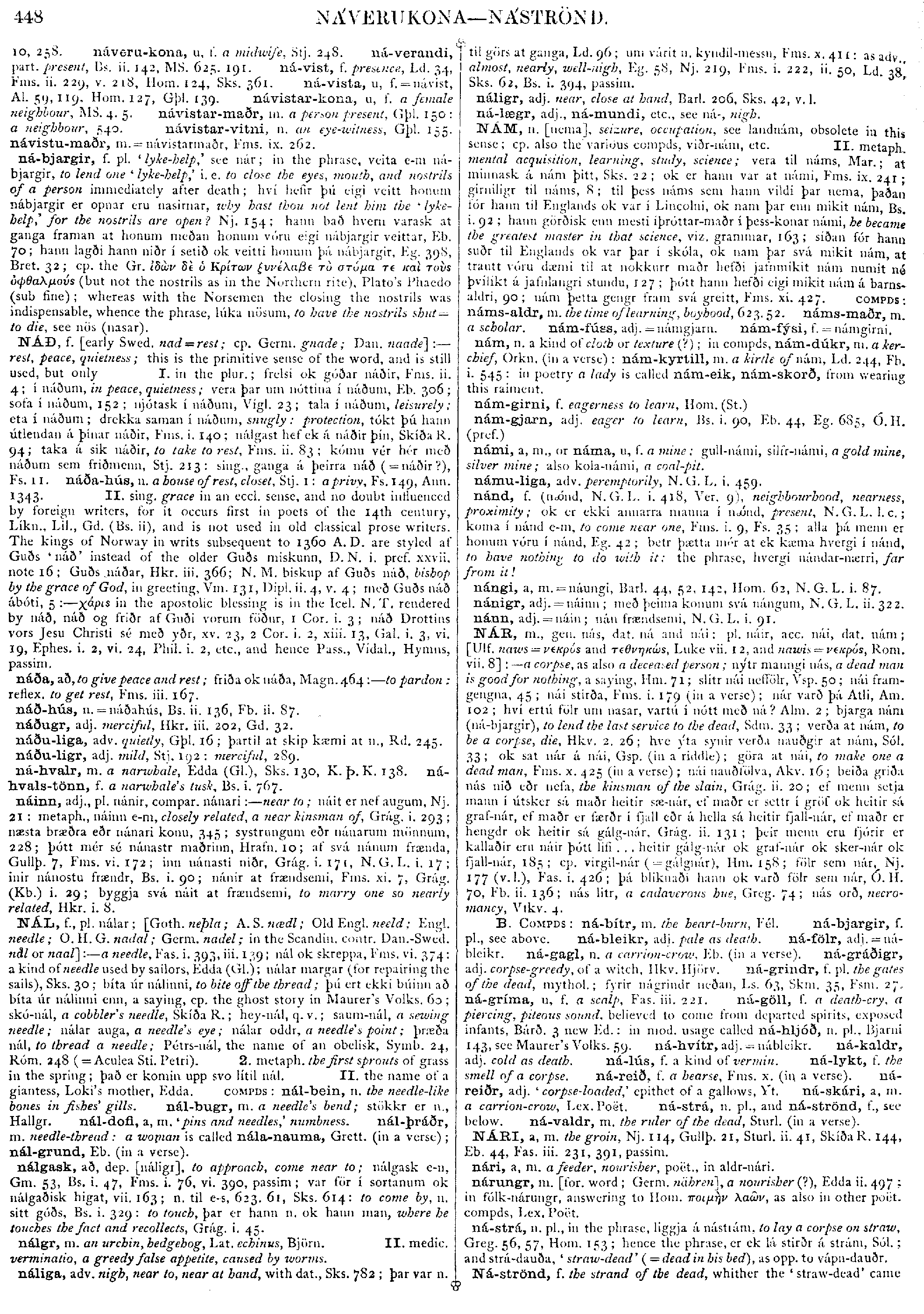
NÁR, m., gen. nás, dat. ná and nái: pl. náir, acc. nái, dat. nám; [Ulf. naws = GREEK and GREEK, Luke vii. 12, and nawis = GREEK, Rom. vii. 8] :-- a corpse, as also a deceased person; nýtr manngi nás, a dead man is good for nothing, a saying, Hm. 71; slítr nái neffölr, Vsp. 50; nái fram-gengna, 45; nái stirða, Fms. i. 179 (in a verse); nár varð þá Atli, Am. 102; hví ertú fölr um nasar, vartú í nótt með ná? Alm. 2; bjarga nám (ná-bjargir), to lend the last service to the dead, Sdm. 33: verða at nám, to be a corpse, die, Hkv. 2. 26; hve ýta synir verða nauðgir at nám, Sól. 33; ok sat nár á nái, Gsp. (in a riddle); göra at nái, to make one a dead man. Fms. x. 425 (in a verse); nái nauðfölva, Akv. 16; beiða griða nás nið eðr nefa, the kinsman of the slain, Grág. ii. 20; ef menn setja mann í útsker sá maðr heitir sæ-nár, ef maðr er settr í gröf ok heitir sá graf-nár, ef maðr er færðr í fjall eðr á hella sá heitir fjall-nár, ef maðr er hengdr ok heitir sá gálg-nár, Grág. ii. 131; þeir menn eru fjórir er kallaðir eru náir þótt lifi . . . heitir gálg-nár ok graf-nár ok sker-nár ok fjall-nár, 185; cp. virgil-nár ( = gálgnár), Hm. 158; fölr sem nár, Nj. 177 (v. l.), Fas. i. 426; þá bliknaði hann ok varð fölr sem nár, Ó. H. 70, Fb. ii. 136; nás litr, a cadaverous hue, Greg. 74; nás orð, necromancy, Vtkv. 4. B. COMPDS: ná-bítr, m. the heart-burn, Fél. ná-bjargir, f. pl., see above. ná-bleikr, adj. pale as death. ná-fölr, adj. = nábleikr. ná-gagl, n. a carrion-crow, Eb. (in a verse). ná-gráðigr, adj. corpse-greedy, of a witch, Hkv. Hjörv. ná-grindr, f. pl. the gates of the dead, mythol.; fyrir nágrindr neðan, Ls. 63, Skm. 35, Fsm. 27, ná-gríma, u, f. a scalp, Fas. iii. 221. ná-göll, f. a death-cry, a piercing, piteous sound, believed to come from departed spirits, exposed infants, Bárð. 3 new Ed.: in mod. usage called ná-hljóð, n. pl., Bjarni 143, see Maurer's Volks. 59. ná-hvítr, adj. = nábleikr. ná-kaldr, adj. cold as death. ná-lús, f. a kind of vermin. na-lykt, f. the smell of a corpse. ná-reið, f. a hearse, Fms. x. (in a verse). ná-reiðr, adj. 'corpse-loaded,' epithet of a gallows, Yt. ná-skári, a, m. a carrion-crow, Lex. Poët. ná-strá, n. pl., and ná-strönd, f., see below. ná-valdr, m. the ruler of the dead, Sturl. (in a verse).
|
Source: Cleasby/Vigfusson, page b0450, entry 12 View original page image as: [TIFF] [PNG] [View previous entry] [View next entry] |
[Comment on this entry] [View comments] |
The following entry has been hand-corrected once. |
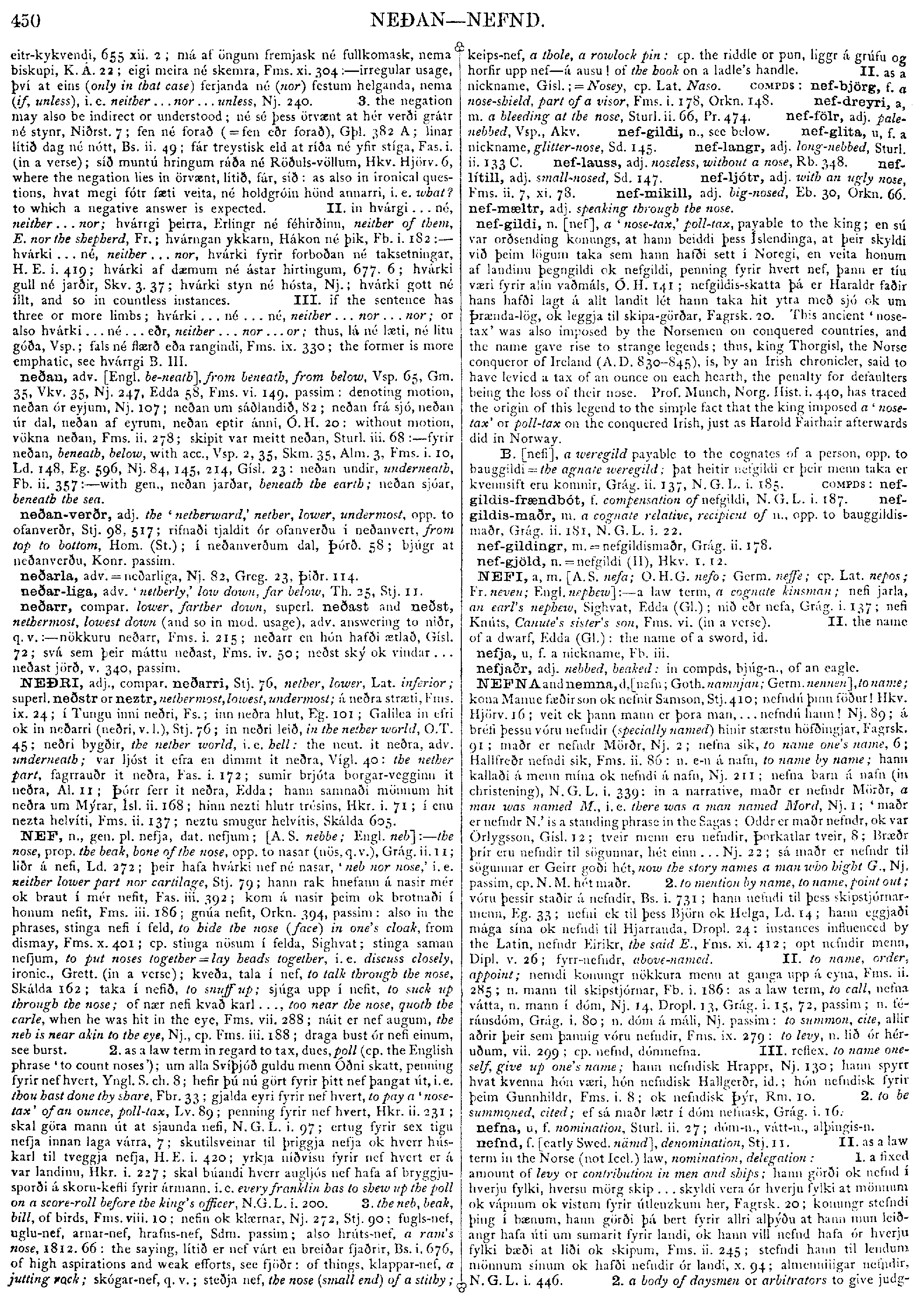
NEFI, a, m. [A. S. nefa; O. H. G. nefo; Germ, neffe; cp. Lat. nepos; Fr. neveu; Engl. nephew] :-- a law term, a cognate kinsman; nefi jarla, an earl's nephew, Sighvat, Edda (Gl.); nið eðr nefa, Grág. i. 137; nefi Knúts, Canute's sister's son, Fms. vi. (in a verse). II. the name of a dwarf, Edda (Gl.): the name of a sword, id.
| Result Page: | 1 2 | Next |  |
Germanic Lexicon Project (main page)
This search system was written by
Sean Crist
Please consider
volunteering
to correct the data in these online dictionaries.
No rights reserved. Feel free to use these data in any way you please.