|
|

Tip: In the search results, you can click on any word or abbreviation for more information.
|
Source: Bosworth/Toller, page b0707, entry 20 View original page image as: [TIFF] [PNG] [View previous entry] [View next entry] |
[Comment on this entry] [View comments] |
The following entry has been hand-corrected once. |
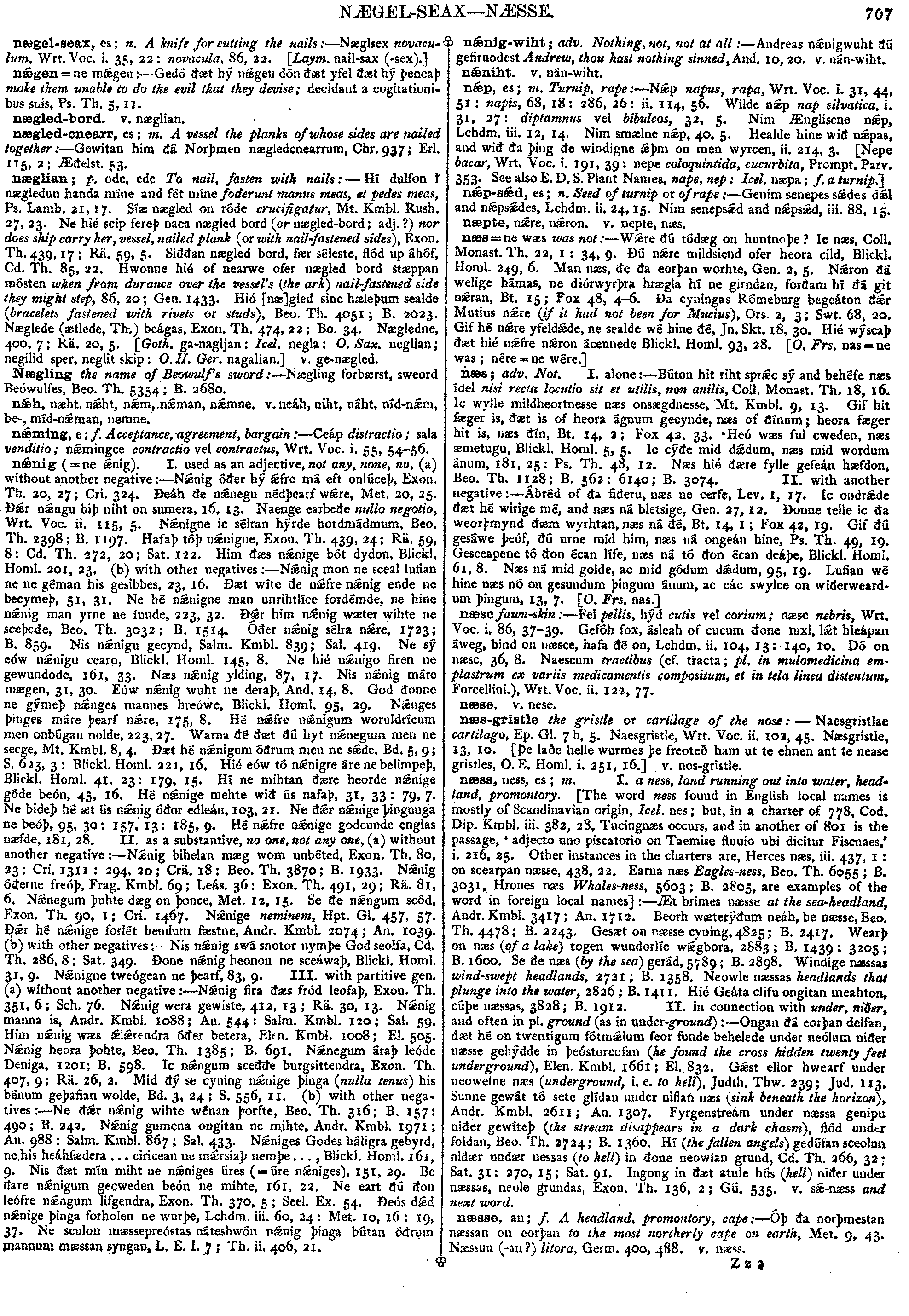
næss,
ness,
es
;
m.
I.
a
ness,
land
running
out
into
water,
headland,
promontory.
[The
word
ness
found
in
English
local
names
is
mostly
of
Scandinavian
origin,
Icel.
nes
;
but,
in
a
charter
of
778,
Cod.
Dip.
Kmbl.
iii.
382,
28,
Tucingnæs
occurs,
and
in
another
of
801
is
the
passage,
'adjecto
uno
piscatorio
on
Taemise
fluuio
ubi
dicitur
Fiscnaes,'
i.
216,
25.
Other
instances
in
the
charters
are,
Herces
næs,
iii.
437,
1
:
on
scearpan
næsse,
438,
22.
Earna
næs
Eagles-ness,
Beo.
Th.
6055
;
B.
3031,
Hrones
næs
Whales-ness,
5603;
B.
2805,
are
examples
of
the
word
in
foreign
local
names]
:--
Æt
brimes
næsse
at
the
sea-headland,
Andr.
Kmbl.
3417;
An.
1712.
Beorh
wæterýðum
neáh,
be
næsse,
Beo.
Th.
4478;
B.
2243.
Gesæt
on
næsse
cyning,
4825;
B.
2417.
Wearþ
on
næs
(of
a
lake)
togen
wundorlíc
w gbora,
2883
;
B.
1439
:
3205;
B.
1600.
Se
ðe
næs
(by
the
sea)
gerád,
5789;
B.
2898.
Windige
næssas
wind-swept
headlands,
2721
;
B.
1358.
Neowle
næssas
headlands
that
plunge
into
the
water,
2826;
B.
1411.
Hié
Geáta
clifu
ongitan
meahton,
cúþe
næssas,
3828;
B.
1912.
II.
in
connection
with
under,
niðer,
and
often
in
pl.
ground
(as
in
under-ground)
:--
Ongan
ðá
eorþan
delfan,
ðæt
hé
on
twentigum
fótmlum
feor
funde
behelede
under
neólum
niðer
næsse
gehýdde
in
þeóstorcofan
(he
found
the
cross
hidden
twenty
feet
underground),
Elen.
Kmbl.
1661
;
El.
832.
Gst
ellor
hwearf
under
neowelne
næs
(underground,
i.
e.
to
hell),
Judth.
Thw.
239;
Jud.
113.
Sunne
gewát
tó
sete
glídan
under
niflan
næs
(sink
beneath
the
horizon),
Andr.
Kmbl.
2611;
An.
1307.
Fyrgenstreám
under
næssa
genipu
niðer
gewíteþ
(the
stream
disappears
in
a
dark
chasm),
flód
under
foldan,
Beo.
Th.
2724;
B.
1360.
Hí
(the
fallen
angels)
gedúfan
sceolun
niðær
undær
nessas
(to
hell)
in
ðone
neowlan
grund,
Cd.
Th.
266,
32
:
Sat.
31
:
270,
15;
Sat.
91.
Ingong
in
ðæt
atule
hús
(hell)
niðer
under
næssas,
neole
grundas,
Exon.
Th.
136,
2
;
Gú.
535.
v.
s-næss
and
next
word.
gbora,
2883
;
B.
1439
:
3205;
B.
1600.
Se
ðe
næs
(by
the
sea)
gerád,
5789;
B.
2898.
Windige
næssas
wind-swept
headlands,
2721
;
B.
1358.
Neowle
næssas
headlands
that
plunge
into
the
water,
2826;
B.
1411.
Hié
Geáta
clifu
ongitan
meahton,
cúþe
næssas,
3828;
B.
1912.
II.
in
connection
with
under,
niðer,
and
often
in
pl.
ground
(as
in
under-ground)
:--
Ongan
ðá
eorþan
delfan,
ðæt
hé
on
twentigum
fótmlum
feor
funde
behelede
under
neólum
niðer
næsse
gehýdde
in
þeóstorcofan
(he
found
the
cross
hidden
twenty
feet
underground),
Elen.
Kmbl.
1661
;
El.
832.
Gst
ellor
hwearf
under
neowelne
næs
(underground,
i.
e.
to
hell),
Judth.
Thw.
239;
Jud.
113.
Sunne
gewát
tó
sete
glídan
under
niflan
næs
(sink
beneath
the
horizon),
Andr.
Kmbl.
2611;
An.
1307.
Fyrgenstreám
under
næssa
genipu
niðer
gewíteþ
(the
stream
disappears
in
a
dark
chasm),
flód
under
foldan,
Beo.
Th.
2724;
B.
1360.
Hí
(the
fallen
angels)
gedúfan
sceolun
niðær
undær
nessas
(to
hell)
in
ðone
neowlan
grund,
Cd.
Th.
266,
32
:
Sat.
31
:
270,
15;
Sat.
91.
Ingong
in
ðæt
atule
hús
(hell)
niðer
under
næssas,
neole
grundas,
Exon.
Th.
136,
2
;
Gú.
535.
v.
s-næss
and
next
word.
|
Source: Bosworth/Toller, page b0708, entry 26 View original page image as: [TIFF] [PNG] [View previous entry] [View next entry] |
[Comment on this entry] [View comments] |
The following entry has been hand-corrected once. |
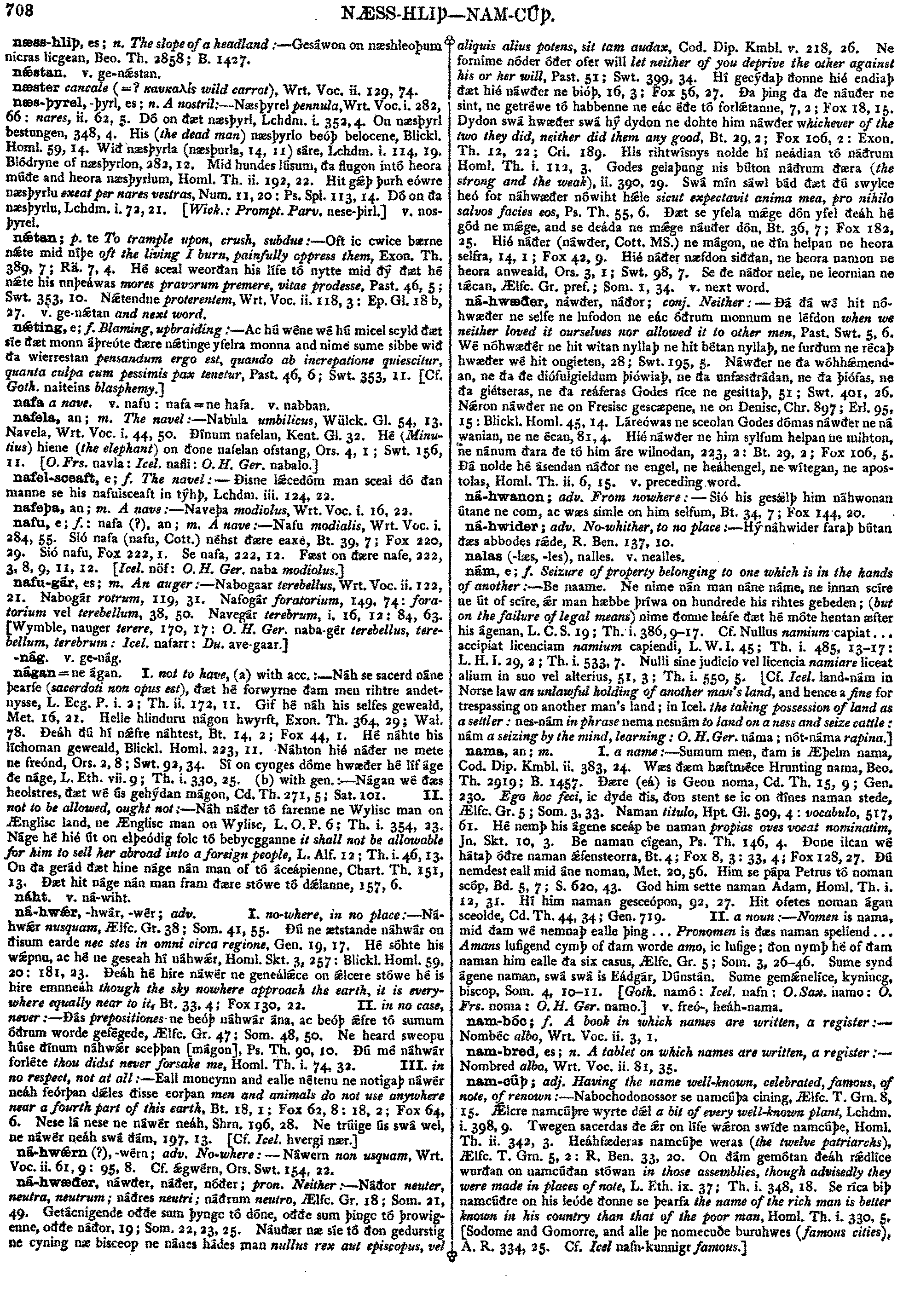
nam-bóc; f. A book in which names are written, a register :-- Nombéc albo, Wrt. Voc. ii. 3, 1.
|
Source: Bosworth/Toller, page b0708, entry 27 View original page image as: [TIFF] [PNG] [View previous entry] [View next entry] |
[Comment on this entry] [View comments] |
The following entry has been hand-corrected once. |
nam-bred, es; n. A tablet on which names are written, a register :-- Nombred albo, Wrt. Voc. ii. 81, 35.
|
Source: Bosworth/Toller, page b0709, entry 2 View original page image as: [TIFF] [PNG] [View previous entry] [View next entry] |
[Comment on this entry] [View comments] |
The following entry has been hand-corrected once. |
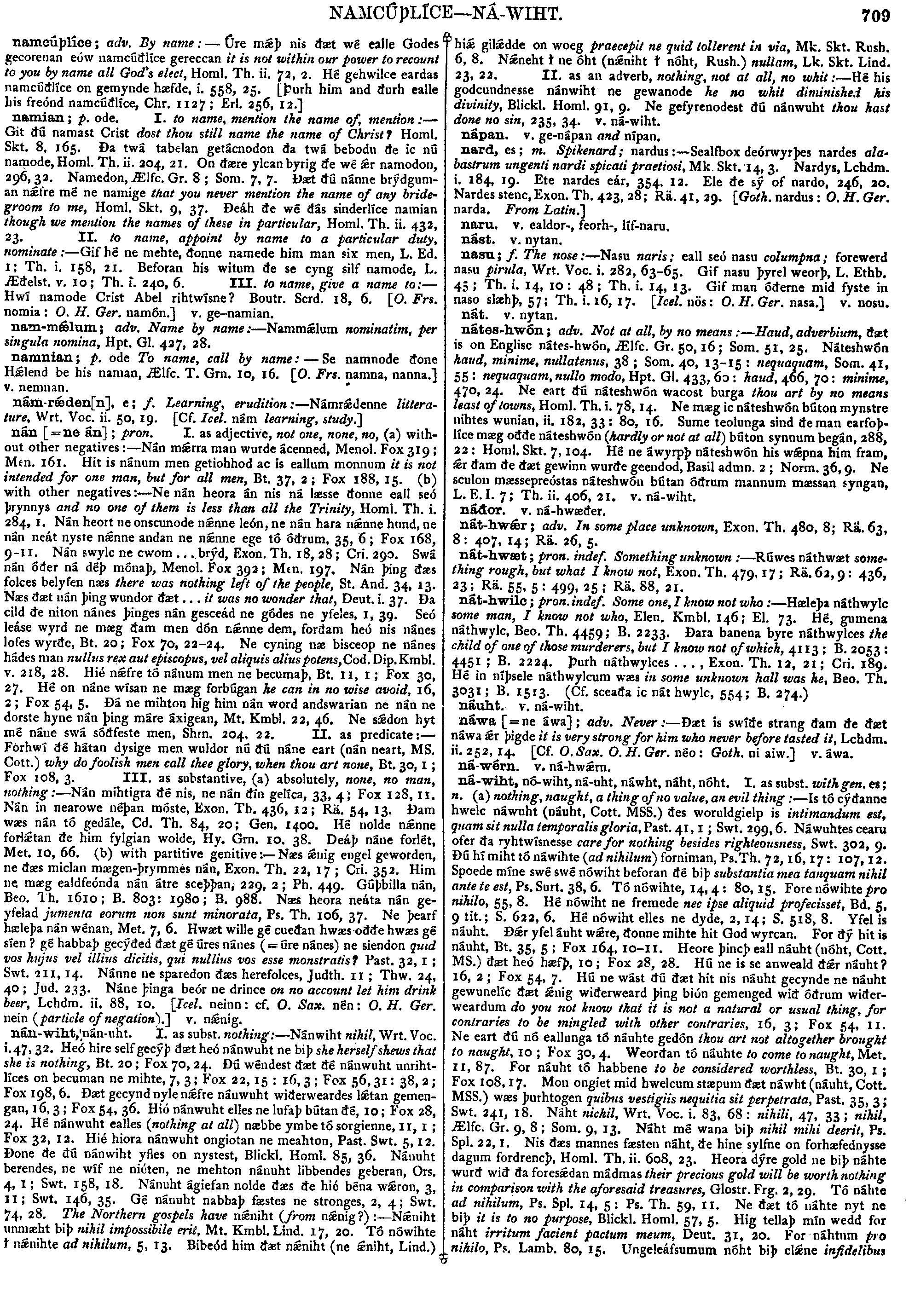
namian;
p.
ode.
I.
to
name,
mention
the
name
of,
mention
:--
Git
ðú
namast
Crist
dost
thou
still
name
the
name
of
Christ?
Homl.
Skt.
8,
165.
Ða
twá
tabelan
getácnodon
ða
twá
bebodu
ðe
ic
nú
namode,
Homl.
Th.
ii.
204,
21.
On
ðære
ylcan
byrig
ðe
wé
r
namodon,
296,
32.
Namedon,
Ælfc.
Gr.
8
;
Som.
7,
7.
Ðæt
ðú
nánne
brýdguman
nfre
mé
ne
namige
that
you
never
mention
the
name
of
any
bridegroom
to
me,
Homl.
Skt.
9,
37.
Ðeáh
ðe
wé
ðás
sinderlíce
namian
though
we
mention
the
names
of
these
in
particular,
Homl.
Th.
ii.
432,
23.
II.
to
name,
appoint
by
name
to
a
particular
duty,
nominate
:--
Gif
hé
ne
mehte,
ðonne
namede
him
man
six
men,
L.
Ed.
1
;
Th.
i.
158,
21.
Beforan
his
witum
ðe
se
cyng
silf
namode,
L.
Æðelst.
v.
10;
Th.
i.
240,
6.
III.
to
name,
give
a
name
to
:--
Hwí
namode
Crist
Abel
rihtwísne?
Boutr.
Scrd.
18,
6.
[O.
Frs.
nomia
:
O.
H.
Ger.
namón.]
v.
ge-namian.
|
Source: Bosworth/Toller, page b0714, entry 5 View original page image as: [TIFF] [PNG] [View previous entry] [View next entry] |
[Comment on this entry] [View comments] |
The following entry has been hand-corrected once. |
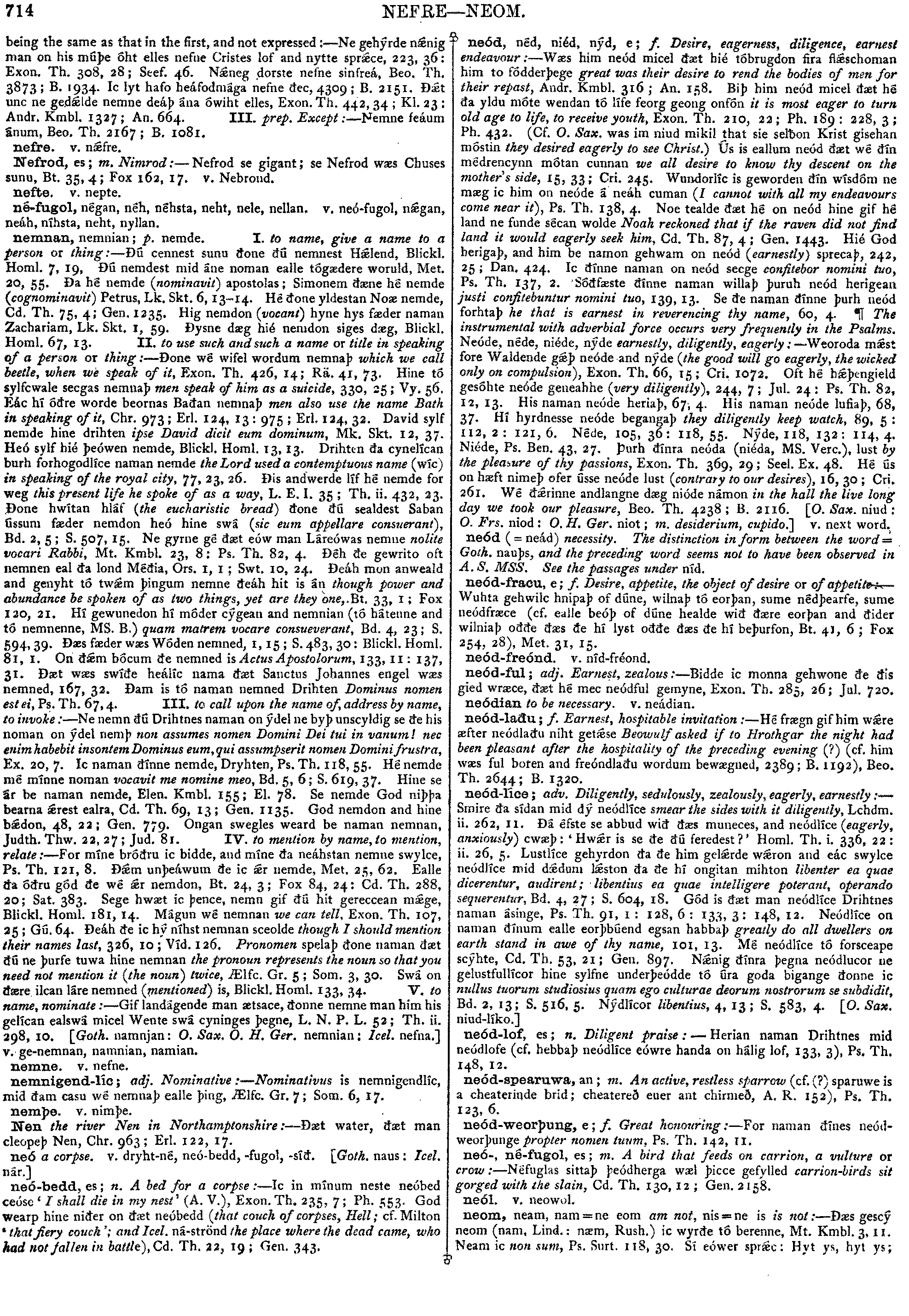
nemnan,
nemnian
;
p.
nemde.
I.
to
name,
give
a
name
to
a
person
or
thing
:--
Ða
cennest
sunu
ðone
ðú
nemnest
Hlend,
Blickl.
Homl.
7,
19,
Ðú
nemdest
mid
áne
noman
ealle
tógædere
woruld,
Met.
20,
55.
Ða
hé
nemde
(nominavit)
apostolas
;
Simonem
ðæne
hé
nemde
(cognominavit)
Petrus,
Lk.
Skt.
6,
13-14.
Hé
ðone
yldestan
Noæ
nemde,
Cd.
Th.
75,
4;
Gen.
1235.
Hig
nemdon
(vocant)
hyne
hys
fæder
naman
Zachariam,
Lk.
Skt.
1,
59.
Ðysne
dæg
hié
nemdon
siges
dæg,
Blickl.
Homl.
67,
13.
II.
to
use
such
and
such
a
name
or
title
in
speaking
of
a
person
or
thing
:--
Ðone
wé
wifel
wordum
nemnaþ
which
we
call
beetle,
when
we
speak
of
it,
Exon.
Th.
426,
14;
Rä.
41,
73.
Hine
tó
sylfcwale
secgas
nemnaþ
men
speak
of
him
as
a
suicide,
330,
25;
Vy.
56.
Eác
hí
óðre
worde
beornas
Baðan
nemnaþ
men
also
use
the
name
Bath
in
speaking
of
it,
Chr.
973;
Erl.
124,
13:
975
;
Erl.
124,
32.
David
sylf
nemde
hine
drihten
ipse
David
dicit
eum
dominum,
Mk.
Skt.
12,
37.
Heó
sylf
hié
þeówen
nemde,
Blickl.
Homl.
13,
13.
Drihten
ða
cynelícan
burh
forhogodlíce
naman
nemde
the
Lord
used
a
contemptuous
name
(wíc)
in
speaking
of
the
royal
city,
77,
23,
26.
Ðis
andwerde
líf
hé
nemde
for
weg
this
present
life
he
spoke
of
as
a
way,
L.
E.
I.
35
;
Th.
ii.
432,
23.
Ðone
hwítan
hláf
(the
eucharistic
bread)
ðone
ðú
sealdest
Saban
ússum
fæder
nemdon
heó
hine
swá
(sic
eum
appellare
consuerant),
Bd.
2,
5
;
S.
507,
15.
Ne
gyrne
gé
ðæt
eów
man
Láreówas
nemne
nolite
vocari
Rabbi,
Mt.
Kmbl.
23,
8:
Ps.
Th.
82,
4.
Ðéh
ðe
gewrito
oft
nemnen
eal
ða
lond
Méðia,
Ors.
1,
1;
Swt.
10,
24.
Ðeáh
mon
anweald
and
genyht
tó
twm
þingum
nemne
ðeáh
hit
is
án
though
power
and
abundance
be
spoken
of
as
two
things,
yet
are
they
one,
Bt.
33.
1;
Fox
120,
21.
Hí
gewunedon
hí
móder
cýgean
and
nemnian
(tó
hátenne
and
tó
nemnenne,
MS.
B.)
quam
matrem
vocare
consueverant,
Bd.
4,
23;
S.
594,
39.
Ðæs
fæder
wæs
Wóden
nemned,
1,
15;
S.
483,
30:
Blickl.
Homl.
81,
1.
On
ðm
bócum
ðe
nemned
is
Actus
Apostolorum,
133,
11
:
137,
31.
Ðæt
wæs
swíðe
heálíc
nama
ðæt
Sanctus
Johannes
engel
wæs
nemned,
167,
32.
Ðam
is
tó
naman
nemned
Drihten
Dominus
nomen
est
ei,
Ps.
Th.
67,
4.
III.
to
call
upon
the
name
of,
address
by
name,
to
invoke
:--
Ne
nemn
ðú
Drihtnes
naman
on
ýdel
ne
byþ
unscyldig
se
ðe
his
noman
on
ýdel
nemþ
non
assumes
nomen
Domini
Dei
tui
in
vanum!
nec
enim
habebit
insontem
Dominus
eum,qui
assumpserit
nomen
Domini
frustra,
Ex.
20,
7.
Ic
naman
ðínne
nemde,
Dryhten,
Ps.
Th.
118,
55.
Hé
nemde
mé
mínne
noman
vacavit
me
nomine
meo,
Bd.
5,
6;
S.
619,
37.
Hine
se
ár
be
naman
nemde,
Elen.
Kmbl.
155;
El.
78.
Se
nemde
God
niþþa
bearna
rest
ealra,
Cd.
Th.
69,
13;
Gen.
1135.
God
nemdon
and
hine
bdon,
48,
22;
Gen.
779.
Ongan
swegles
weard
be
naman
nemnan,
Judth.
Thw.
22,
27
;
Jud.
81.
IV.
to
mention
by
name,
to
mention,
relate
:--
For
míne
bróðru
ic
bidde,
and
míne
ða
neáhstan
nemne
swylce,
Ps.
Th.
121,
8.
Ðm
unþeáwum
ðe
ic
r
nemde,
Met.
25,
62.
Ealle
ða
óðru
gód
ðe
wé
r
nemdon,
Bt.
24,
3
;
Fox
84,
24
:
Cd.
Th.
288,
20;
Sat.
383.
Sege
hwæt
ic
þence,
nemn
gif
ðú
hit
gereccean
mge,
Blickl.
Honal.
181,
14.
Mágun
wé
nemnan
we
can
tell,
Exon.
Th.
107,
25
;
Gú.
64.
Ðeáh
ðe
ic
hý
níhst
nemnan
sceolde
though
I
should
mention
their
names
last,
326,
10
;
Víd.
126.
Pronomen
spelaþ
ðone
naman
ðæt
ðú
ne
þurfe
tuwa
hine
nemnan
the
pronoun
represents
the
noun
so
that
you
need
not
mention
it
(the
noun)
twice,
Ælfc.
Gr.
5
;
Som.
3,
30.
Swá
on
ðære,
ilcan
láre
nemned
(mentioned)
is,
Blickl.
Homl.
133,
34.
V.
to
name,
nominate
:--
Gif
landágende
man
ætsace,
ðonne
nemne
man
him
his
gelícan
ealswá
micel
Wente
swá
cyninges
þegne,
L.
N.
P.
L.
52;
Th.
ii.
298,
10.
[Goth.
namnjan:
O.
Sax.
O.
H.
Ger.
nemnian
:
Icel.
nefna.]
v.
ge-nemnan,
namnian,
namian.
|
Source: Bosworth/Toller, page b0726, entry 33 View original page image as: [TIFF] [PNG] [View previous entry] [View next entry] |
[Comment on this entry] [View comments] |
The following entry has been hand-corrected once. |
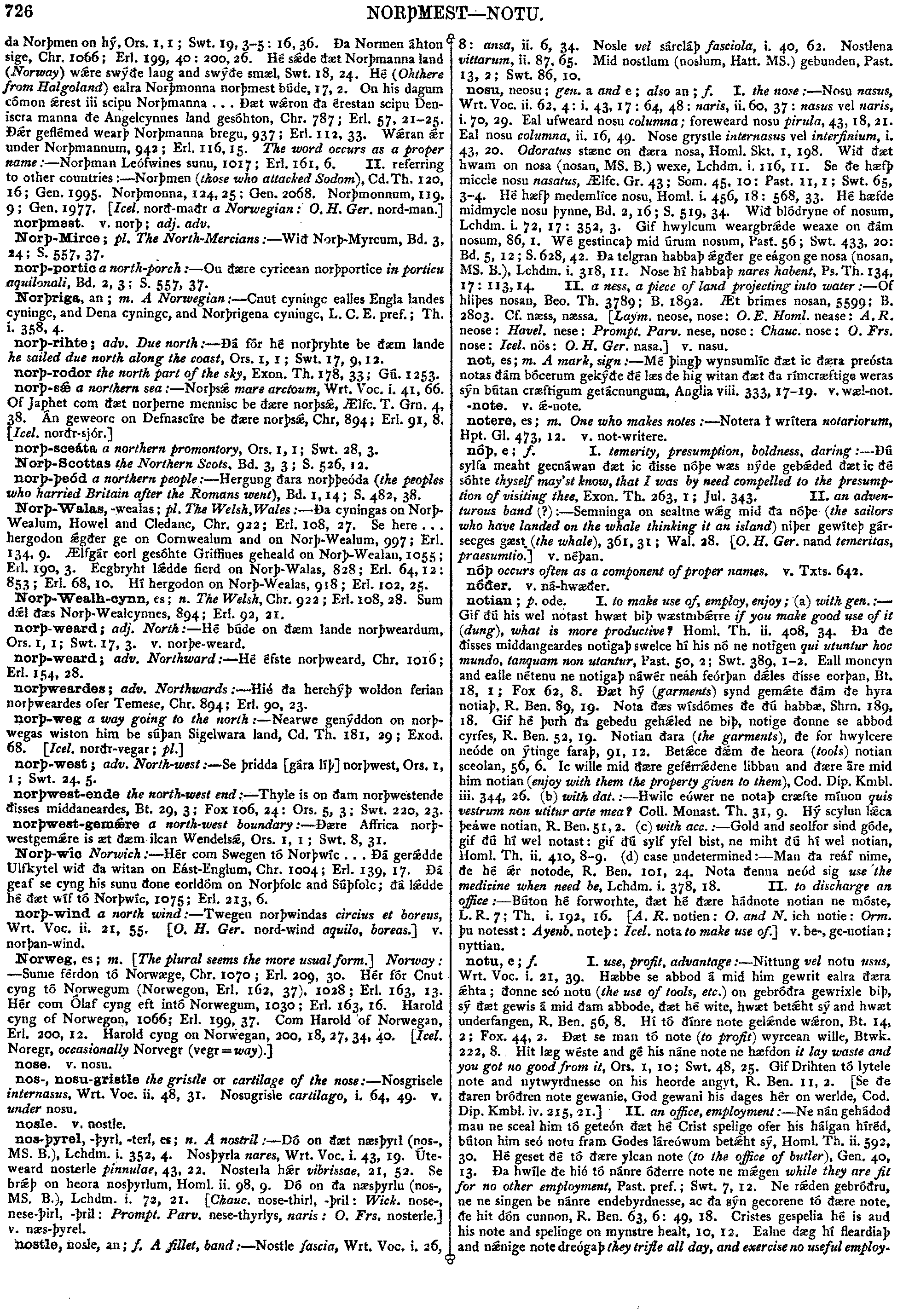
nóþ occurs often as a component of proper names. v. Txts. 642.
|
Source: Bosworth/Toller, page b0730, entry 1 View original page image as: [TIFF] [PNG] [View previous entry] [View next entry] |
[Comment on this entry] [View comments] |
The following entry has been hand-corrected once. |
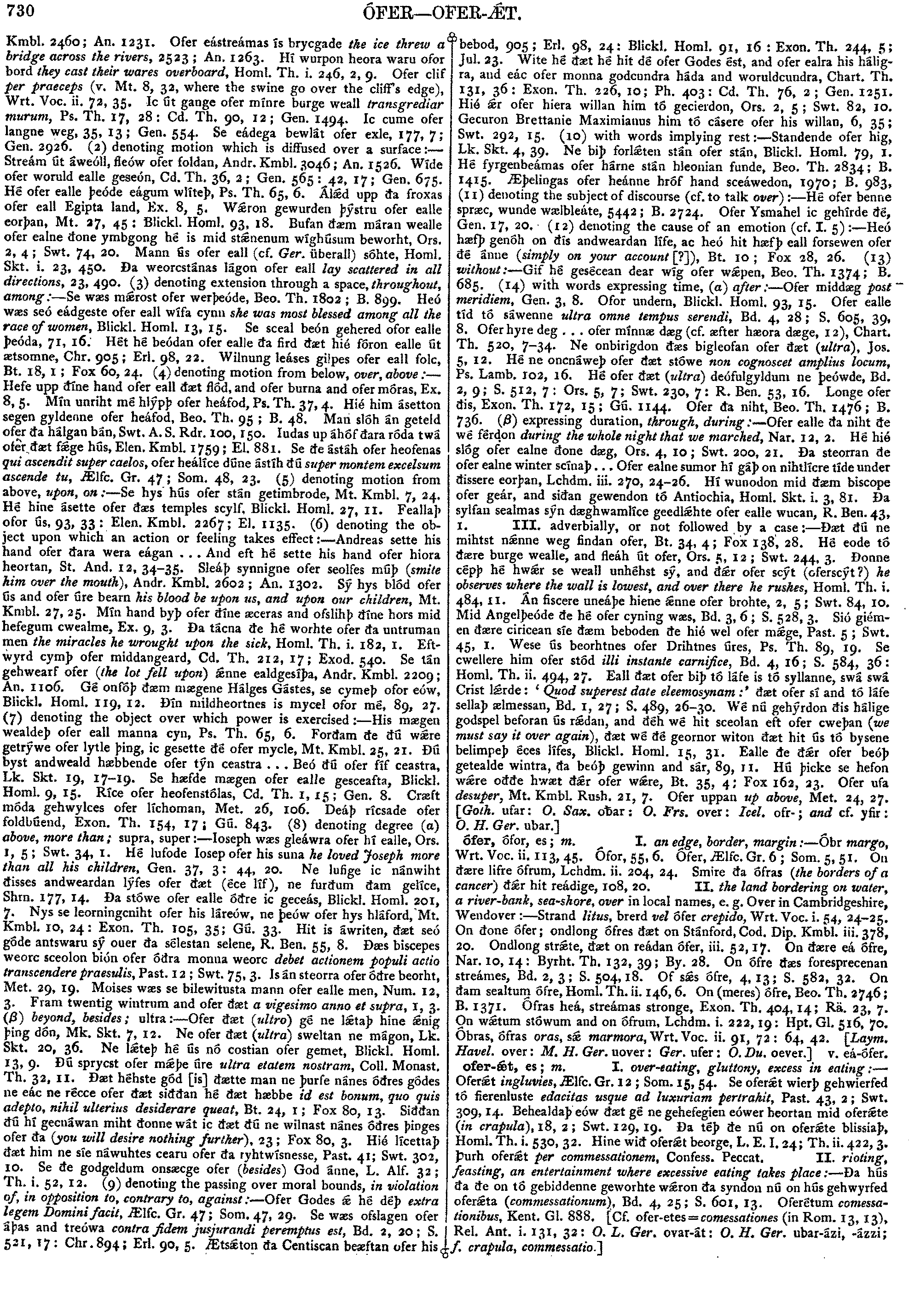
ófer,
ófor,
es;
m.
I.
an
edge,
border,
margin
:--
Óbr
mango,
Wrt.
Voc.
ii.
113,
45.
Ófor,
55,
6.
Ófer,
Ælfc.
Gr.
6;
Som.
5,
51.
On
ðære
lifre
ófrum,
Lchdm.
ii.
204,
24.
Smire
ða
ófras
(the
borders
of
a
cancer)
ðr
hit
reádige,
108,
20.
II.
the
land
bordering
on
water,
a
river-bank,
sea-shore,
over
in
local
names,
e.g.
Over
in
Cambridgeshire,
Wendover
:--
Strand
litus,
brerd
vel
ófer
crepido,
Wrt.
Voc.
i.
54.
24-25.
On
ðone
ófer;
ondlong
ófres
ðæt
on
Stánford,
Cod.
Dip.
Kmbl.
iii.
378,
20.
Ondlong
strte,
ðæt
on
reádan
ófer,
iii.
52,
17.
On
ðære
eá
ófre,
Nar.
10,
14:
Byrht.
Th.
132,
39;
By.
28.
On
ófre
ðæs
foresprecenan
|
Source: Bosworth/Toller, page b0745, entry 1 View original page image as: [TIFF] [PNG] [View previous entry] [View next entry] |
[Comment on this entry] [View comments] |
The following entry has been hand-corrected once. |
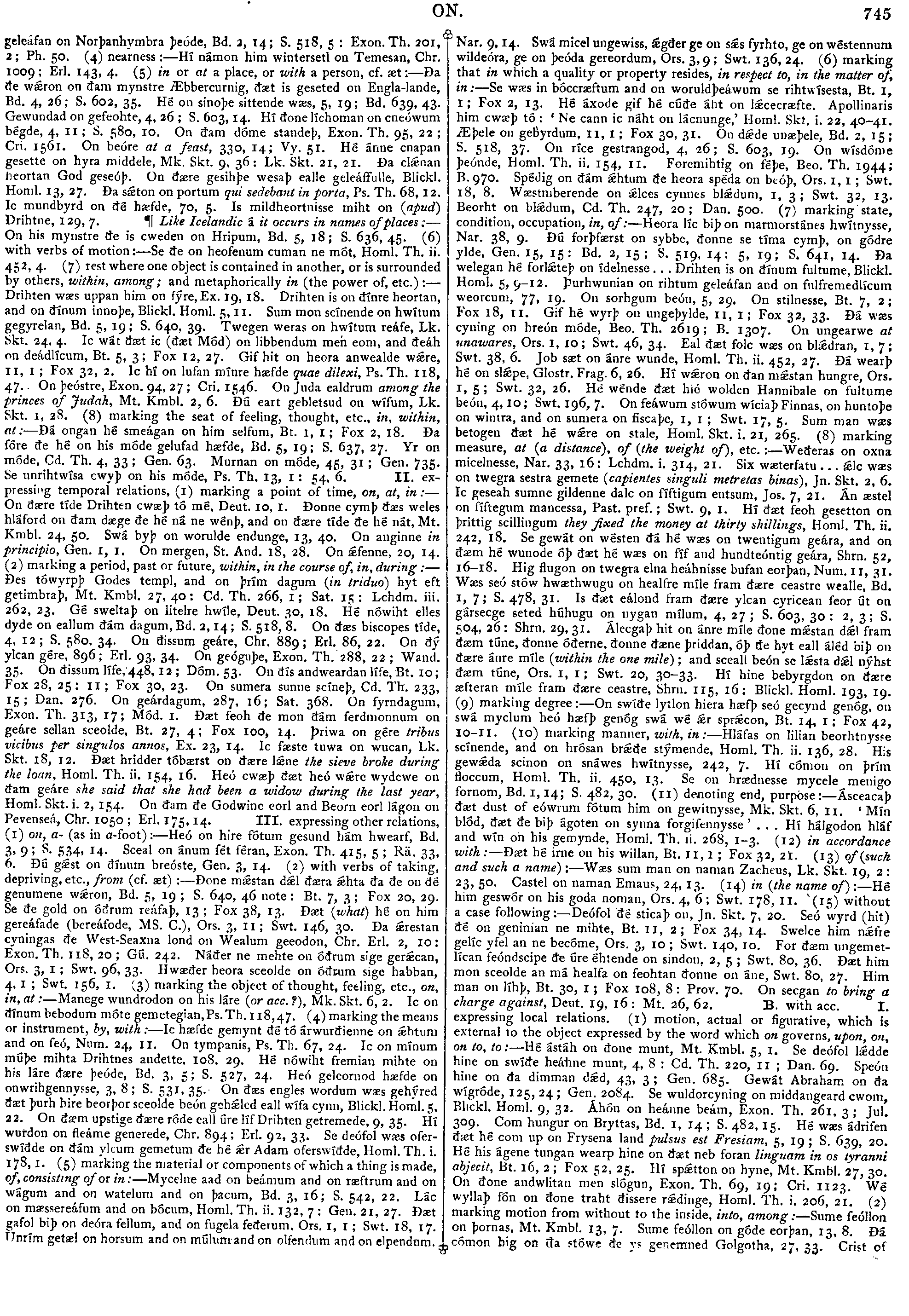
geleáfan
on
Norþanhymbra
þeóde,
Bd.
2,
14;
S.
518,
5:
Exon.
Th.
201,
2;
Ph.
50.
(4)
nearness:--Hí
námon
him
wintersetl
on
Temesan,
Chr.
1009;
Erl.
143,
4.
(5)
in
or
at
a
place,
or
with
a
person,
cf.
æt:--Ða
ðe
wron
on
ðam
mynstre
Æbbercurnig,
ðæt
is
geseted
on
Englalande,
Bd.
4,
26;
S.
602,
35.
Hé
on
sinoþe
sittende
wæs,
5,
19;
Bd.
639,
43.
Gewundad
on
gefeohte,
4,
26;
S.
603,
14.
Hí
ðone
líchoman
on
cneówum
bégde,
4,
11;
S.
580,
10.
On
ðam
dóme
standeþ,
Exon.
Th.
95,
22;
Cri.
1561.
On
beóre
at
a
feast,
330,
14;
Vy.
51.
Hé
ánne
cnapan
gesette
on
hyra
middele,
Mk.
Skt.
9,
36:
Lk.
Skt.
21,
21.
Ða
clnan
heortan
God
geseóþ.
On
ðære
gesihþe
wesaþ
ealle
geleáffulle,
Blickl.
Homl.
13,
27.
Ða
ston
on
portum
qui
sedebant
in
porta,
Ps.
Th.
68,
12.
Ic
mundbyrd
on
ðé
hæfde,
70,
5.
Is
mildheortnisse
miht
on
(apud)
Drihtne,
129,
7.

Like
Icelandic
á
it
occurs
in
names
of
places:--On
his
mynstre
ðe
is
cweden
on
Hripum,
Bd.
5,
18;
S.
636,
45.
(6)
with
verbs
of
motion:--Se
ðe
on
heofenum
cuman
ne
mót,
Homl.
Th.
ii.
452,
4.
(7)
rest
where
one
object
is
contained
in
another,
or
is
surrounded
by
others,
within,
among;
and
metaphorically
in
(the
power
of,
etc.):--Drihten
wæs
uppan
him
on
fýre,
Ex.
19,
18.
Drihten
is
on
ðínre
heortan,
and
on
ðínum
innoþe,
Blickl.
Homl.
5,
11.
Sum
mon
scínende
on
hwítum
gegyrelan,
Bd.
5,
19;
S.
640,
39.
Twegen
weras
on
hwítum
reáfe,
Lk.
Skt.
24,
4.
Ic
wát
ðæt
ic
(ðæt
Mód)
on
libbendum
men
eom,
and
ðeáh
on
deádlícum,
Bt.
5,
3;
Fox
12,
27.
Gif
hit
on
heora
anwealde
wre,
11,
1;
Fox
32,
2.
Ic
hí
on
lufan
mínre
hæfde
quae
dilexi,
Ps.
Th.
118,
47.
On
þeóstre,
Exon.
94,
27;
Cri.
1546.
On
Juda
ealdrum
among
the
princes
of
Judah,
Mt.
Kmbl.
2,
6.
Ðú
eart
gebletsud
on
wífum,
Lk.
Skt.
1,
28.
(8)
marking
the
seat
of
feeling,
thought,
etc.,
in,
within,
at:--Ðá
ongan
hé
smeágan
on
him
selfum,
Bt.
1,
1;
Fox
2,
18.
Ða
fóre
ðe
hé
on
his
móde
gelufad
hæfde,
Bd.
5,
19;
S.
637,
27.
Yr
on
móde,
Cd.
Th.
4,
33;
Gen.
63.
Murnan
on
móde,
45,
31;
Gen.
735.
Se
unrihtwísa
cwyþ
on
his
móde,
Ps.
Th.
13,
1:
54,
6.
II.
expressing
temporal
relations,
(1)
marking
a
point
of
time,
on,
at,
in:--On
ðære
tíde
Drihten
cwæþ
tó
mé,
Deut.
10,
1.
Ðonne
cymþ
ðæs
weles
hláford
on
ðam
dæge
ðe
hé
ná
ne
wénþ,
and
on
ðære
tíde
ðe
hé
nát,
Mt.
Kmbl.
24,
50.
Swá
byþ
on
worulde
endunge,
13,
40.
On
anginne
in
principio,
Gen.
1,
1.
On
mergen,
St.
And.
18,
28.
On
fenne,
20,
14.
(2)
marking
a
period,
past
or
future,
within,
in
the
course
of,
in,
during:--Ðes
tówyrpþ
Godes
templ,
and
on
þrím
dagum
(in
triduo)
hyt
eft
getimbraþ,
Mt.
Kmbl.
27,
40:
Cd.
Th.
266,
1;
Sat.
15:
Lchdm.
iii.
262,
23.
Gé
sweltaþ
on
litelre
hwíle,
Deut.
30,
18.
Hé
nówiht
elles
dyde
on
eallum
ðám
dagum,
Bd.
2,
14;
S.
518,
8.
On
ðæs
biscopes
tíde,
4,
12;
S.
580,
34.
On
ðissum
geáre,
Chr.
889;
Erl.
86,
22.
On
ðý
ylcan
gére,
896;
Erl.
93,
34.
On
geóguþe,
Exon.
Th.
288,
22;
Wand.
35.
On
ðissum
lífe,
448,
12;
Dóm.
53.
On
ðís
andweardan
lífe,
Bt.
10;
Fox
28,
25:
11;
Fox
30,
23.
On
sumera
sunne
scíneþ,
Cd.
Th.
233,
15;
Dan.
276.
On
geárdagum,
287,
16;
Sat.
368.
On
fyrndagum,
Exon.
Th.
313,
17;
Mód.
1.
Ðæt
feoh
ðe
mon
ðám
ferdmonnum
on
geáre
sellan
sceolde,
Bt.
27,
4;
Fox
100,
14.
Þriwa
on
gére
tribus
vicibus
per
singulos
annos,
Ex.
23,
14.
Ic
fæste
tuwa
on
wucan,
Lk.
Skt.
18,
12.
Ðæt
hridder
tóbærst
on
ðære
lne
the
sieve
broke
during
the
loan,
Homl.
Th.
ii.
154,
16.
Heó
cwæþ
ðæt
heó
wre
wydewe
on
ðam
geáre
she
said
that
she
had
been
a
widow
during
the
last
year,
Homl.
Skt.
i.
2,
154.
On
ðam
ðe
Godwine
eorl
and
Beorn
eorl
lágon
on
Pevenseá,
Chr.
1050;
Erl.
175,
14.
III.
expressing
other
relations,
(1)
on,
a-
(as
in
a-foot):--Heó
on
hire
fótum
gesund
hám
hwearf,
Bd.
3.
9;
S.
534,
14.
Sceal
on
ánum
fét
féran,
Exon.
Th.
415,
5;
Rä.
33,
6.
Ðú
gst
on
ðínum
breóste,
Gen.
3,
14.
(2)
with
verbs
of
taking,
depriving,
etc.,
from
(cf.
æt):--Ðone
mstan
dl
ðæra
hta
ða
ðe
on
ðé
genumene
wron,
Bd.
5,
19;
S.
640,
46
note:
Bt.
7,
3;
Fox
20,
29.
Se
ðe
gold
on
óðrum
reáfaþ,
13;
Fox
38,
13.
Ðæt
(what)
hé
on
him
gereáfade
(bereáfode,
MS.
C.),
Ors.
3,
11;
Swt.
146,
30.
Ða
restan
cyningas
ðe
West-Seaxna
lond
on
Wealum
geeodon,
Chr.
Erl.
2,
10:
Exon.
Th.
118,
20;
Gú.
242.
Náðer
ne
mehte
on
óðrum
sige
gercan,
Ors.
3,
1;
Swt.
96,
33.
Hwæðer
heora
sceolde
on
óðrum
sige
habban,
4,
1;
Swt.
156,
1.
(3)
marking
the
object
of
thought,
feeling,
etc.,
on,
in,
at:--Manege
wundrodon
on
his
láre
(or
acc.?),
Mk.
Skt.
6,
2.
Ic
on
ðínum
bebodum
móte
gemetegian,
Ps.
Th.
118,
47.
(4)
marking
the
means
or
instrument,
by,
with:--Ic
hæfde
gemynt
ðé
tó
árwurðienne
on
htum
and
on
feó,
Num.
24,
11.
On
tympanis,
Ps.
Th.
67,
24.
Ic
on
mínum
múþe
mihta
Drihtnes
andette,
108,
29.
Hé
nówiht
fremian
mihte
on
his
láre
ðære
þeóde,
Bd.
3,
5;
S.
527,
24.
Heó
geleornod
hæfde
on
onwrihgennysse,
3,
8;
S.
531,
35.
On
ðæs
engles
wordum
wæs
gehýred
ðæt
þurh
hire
beorþor
sceolde
beón
gehled
eall
wífa
cynn,
Blickl.
Homl.
5,
22.
On
ðæm
upstige
ðære
róde
eall
úre
líf
Drihten
getremede,
9,
35.
Hí
wurdon
on
fleáme
generede,
Chr.
894;
Erl.
92,
33.
Se
deófol
wæs
oferswíðde
on
ðám
ylcum
gemetum
ðe
hé
r
Adam
oferswíðde,
Homl.
Th.
i.
178,
1.
(5)
marking
the
material
or
components
of
which
a
thing
is
made,
of,
consisting
of
or
in:--Mycelne
aad
on
beámum
and
on
ræftrum
and
on
wágum
and
on
watelum
and
on
þacum,
Bd.
3,
16;
S.
542,
22.
Lác
on
mæssereáfum
and
on
bócum,
Homl.
Th.
ii.
132,
7:
Gen.
21,
27.
Ðæt
gafol
biþ
on
deóra
fellum,
and
on
fugela
feðerum,
Ors.
1,
1;
Swt.
18,
17.
Unrím
getæl
on
horsum
and
on
múlum
and
on
olfendum
and
on
elpendum.
Nar.
9,
14.
Swá
micel
ungewiss,
gðer
ge
on
ss
fyrhto,
ge
on
wéstennum
wildeóra,
ge
on
þeóda
gereordum,
Ors.
3,
9;
Swt.
136,
24.
(6)
marking
that
in
which
a
quality
or
property
resides,
in
respect
to,
in
the
matter
of,
in:--Se
wæs
in
bóccræftum
and
on
woruldþeáwum
se
rihtwísesta,
Bt.
1,
1;
Fox
2,
13.
Hé
áxode
gif
hé
cúðe
áht
on
lcecræfte.
Apollinaris
him
cwæþ
tó:
'Ne
cann
ic
náht
on
lácnunge,'
Homl.
Skt.
i.
22,
40-41.
Æþele
on
gebyrdum,
11,
1;
Fox
30,
31.
On
dde
unæþele,
Bd.
2,
15;
S.
518,
37.
On
ríce
gestrangod,
4,
26;
S.
603,
19.
On
wísdóme
þeónde,
Homl.
Th.
ii.
154,
11.
Foremihtig
on
féþe,
Beo.
Th.
1944;
B.
970.
Spédig
on
ðám
htum
ðe
heora
spéda
on
beóþ,
Ors.
1,
1;
Swt.
18,
8.
Wæstmberende
on
lces
cynnes
bldum,
1,
3;
Swt.
32,
13.
Beorht
on
bldum,
Cd.
Th.
247,
20;
Dan.
500.
(7)
marking
state,
condition,
occupation,
in,
of:--Heora
líc
biþ
on
marmorstánes
hwítnysse,
Nar.
38,
9.
Ðú
forþfærst
on
sybbe,
ðonne
se
tíma
cymþ,
on
gódre
ylde,
Gen.
15,
15:
Bd.
2,
15;
S.
519,
14:
5,
19;
S.
641,
14.
Ða
welegan
hé
forlteþ
on
ídelnesse
.
.
.
Drihten
is
on
ðínum
fultume,
Blickl.
Homl.
5,
9-12.
Þurhwunian
on
rihtum
geleáfan
and
on
fulfremedlícum
weorcum,
77,
19.
On
sorhgum
beón,
5,
29.
On
stilnesse,
Bt.
7,
2;
Fox
18,
11.
Gif
hé
wyrþ
on
ungeþylde,
11,
1;
Fox
32,
33.
Ðá
wæs
cyning
on
hreón
móde,
Beo.
Th.
2619;
B.
1307.
On
ungearwe
at
unawares,
Ors.
1,
10;
Swt.
46,
34.
Eal
ðæt
folc
wæs
on
bldran,
1,
7;
Swt.
38,
6.
Job
sæt
on
ánre
wunde,
Homl.
Th.
ii.
452,
27.
Ðá
wearþ
hé
on
slpe,
Glostr.
Frag.
6,
26.
Hí
wron
on
ðan
mstan
hungre,
Ors.
1,
5;
Swt.
32,
26.
Hé
wénde
ðæt
hié
wolden
Hannibale
on
fultume
beón,
4,
10;
Swt.
196,
7.
On
feáwum
stówum
wíciaþ
Finnas,
on
huntoþe
on
wintra,
and
on
sumera
on
físcaþe,
1,
1;
Swt.
17,
5.
Sum
man
wæs
betogen
ðæt
hé
wre
on
stale,
Homl.
Skt.
i.
21,
265.
(8)
marking
measure,
at
(a
distance),
of
(the
weight
of),
etc.:--Weðeras
on
oxna
micelnesse,
Nar.
33,
16:
Lchdm.
i.
314,
21.
Six
wæterfatu
.
.
.
lc
wæs
on
twegra
sestra
gemete
(capientes
singuli
metretas
binas),
Jn.
Skt.
2,
6.
Ic
geseah
sumne
gildenne
dalc
on
fíftigum
entsum,
Jos.
7,
21.
Án
æstel
on
fíftegum
mancessa,
Past.
pref.;
Swt.
9,
1.
Hí
ðæt
feoh
gesetton
on
þrittig
scillingum
they
fixed
the
money
at
thirty
shillings,
Homl.
Th.
ii.
242,
18.
Se
gewát
on
wésten
ðá
hé
wæs
on
twentigum
geára,
and
on
ðæm
hé
wunode
óþ
ðæt
hé
wæs
on
fíf
and
hundteóntig
geára,
Shrn.
52,
16-18.
Hig
flugon
on
twegra
elna
heáhnisse
bufan
eorþan,
Num.
11,
31.
Wæs
seó
stów
hwæthwugu
on
healfre
míle
fram
ðære
ceastre
wealle,
Bd.
1,
7;
S.
478,
31.
Is
ðæt
eálond
fram
ðære
ylcan
cyricean
feor
út
on
gársecge
seted
húhugu
on
nygan
mílum,
4,
27;
S.
603,
30:
2,
3;
S.
504,
26:
Shrn.
29,
31.
Álecgaþ
hit
on
ánre
míle
ðone
mstan
dl
fram
ðæm
túne,
ðonne
óðerne,
ðonne
ðæne
þriddan,
óþ
ðe
hyt
eall
áléd
biþ
on
ðære
ánre
míle
(within
the
one
mile);
and
sceall
beón
se
lsta
dl
nýhst
ðæm
túne,
Ors.
1,
1;
Swt.
20,
30-33.
Hí
hine
bebyrgdon
on
ðære
æfteran
míle
fram
ðære
ceastre,
Shrn.
115,
16:
Blickl.
Homl.
193,
19.
(9)
marking
degree:--On
swíðe
lytlon
hiera
hæfþ
seó
gecynd
genóg,
on
swá
myclum
heó
hæfþ
genóg
swá
wé
r
sprcon,
Bt.
14,
1;
Fox
42,
10-11.
(10)
marking
manner,
with,
in:--Hláfas
on
lilian
beorhtnysse
scínende,
and
on
hrósan
brðe
stýmende,
Homl.
Th.
ii.
136,
28.
His
gewda
scinon
on
snáwes
hwítnysse,
242,
7.
Hí
cómon
on
þrím
floccum,
Homl.
Th.
ii.
450,
13.
Se
on
hrædnesse
mycele
menigo
fornom,
Bd.
1,
14;
S.
482,
30.
(11)
denoting
end,
purpose:--Ásceacaþ
ðæt
dust
of
eówrum
fótum
him
on
gewitnysse,
Mk.
Skt.
6,
11.
'Mín
blód,
ðæt
ðe
biþ
ágoten
on
synna
forgifennysse'
.
.
.
Hí
hálgodon
hláf
and
wín
oh
his
gemynde,
Homl.
Th.
ii.
268,
1-3.
(12)
in
accordance
with:--Ðæt
hé
irne
on
his
willan,
Bt.
11,
1;
Fox
32,
21.
(13)
of
(such
and
such
a
name):--Wæs
sum
man
on
naman
Zacheus,
Lk.
Skt.
19,
2:
23,
50.
Castel
on
naman
Emaus,
24,
13.
(14)
in
(the
name
of):--Hé
him
geswór
on
his
goda
noman,
Ors.
4,
6;
Swt.
178,
11.
(15)
without
a
case
following:--Deófol
ðé
sticaþ
on,
Jn.
Skt.
7,
20.
Seó
wyrd
(hit)
ðé
on
geniman
ne
mihte,
Bt.
11,
2;
Fox
34,
14.
Swelce
him
nfre
gelíc
yfel
an
ne
becóme,
Ors.
3,
10;
Swt.
140,
10.
For
ðæm
ungemetlícan
feóndscipe
ðe
úre
éhtende
on
sindon,
2,
5;
Swt.
80,
36.
Ðæt
him
mon
sceolde
an
má
healfa
on
feohtan
ðonne
on
áne,
Swt.
80,
27.
Him
man
on
líhþ,
Bt.
30,
1;
Fox
108,
8:
Prov.
70.
On
secgan
to
bring
a
charge
against,
Deut.
19,
16:
Mt.
26,
62.
B.
with
acc.
I.
expressing
local
relations.
(1)
motion,
actual
or
figurative,
which
is
external
to
the
object
expressed
by
the
word
which
on
governs,
upon,
on,
on
to,
to:--Hé
ástáh
on
ðone
munt,
Mt.
Kmbl.
5,
1.
Se
deófol
ldde
hine
on
swíðe
heáhne
munt,
4,
8:
Cd.
Th.
220,
11;
Dan.
69.
Speón
hiue
on
ða
dimman
dd,
43,
3;
Gen.
685.
Gewát
Abraham
on
ða
wígróde,
125,
24;
Gen.
2084.
Se
wuldorcyning
on
middangeard
cwom,
Blickl.
Homl.
9,
32.
Áhón
on
heánne
beám,
Exon.
Th.
261,
3;
Jul.
309.
Com
hungur
on
Bryttas,
Bd.
1,
14;
S.
482,
15.
Hé
wæs
ádrifen
ðæt
hé
com
up
on
Frysena
land
pulsus
est
Fresiam,
5,
19;
S.
639,
20.
Hé
his
ágene
tungan
wearp
hine
on
ðæt
neb
foran
linguam
in
os
tyranni
abjecit,
Bt.
16,
2;
Fox
52,
25.
Hí
sptton
on
hyne,
Mt.
Kmbl.
27,
30.
On
ðone
andwlitan
men
slógun,
Exon.
Th.
69,
19;
Cri.
1123.
Wé
wyllaþ
fón
on
ðone
traht
ðissere
rdinge,
Homl.
Th.
i.
206,
21.
(2)
marking
motion
from
without
to
the
inside,
into,
among:--Sume
feóllon
on
þornas,
Mt.
Kmbl.
13,
7.
Sume
feóllon
on
góde
eorþan,
13,
8.
Ðá
cómon
big
on
ða
stówe
ðe
ys
genemned
Golgotha,
27,
33.
Crist
of
|
Source: Bosworth/Toller, page b0763, entry 16 View original page image as: [TIFF] [PNG] [View previous entry] [View next entry] |
[Comment on this entry] [View comments] |
The following entry has been hand-corrected once. |
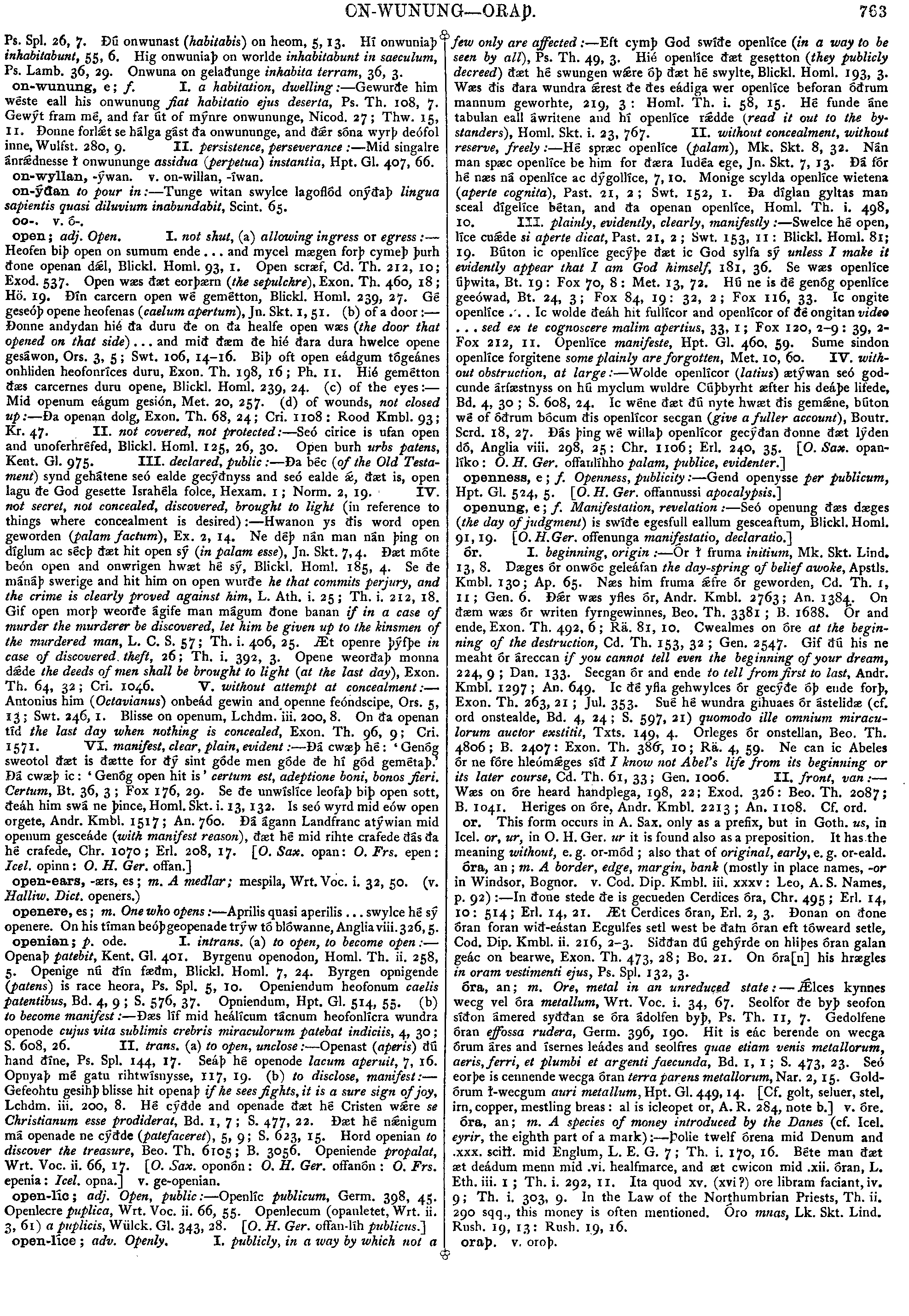
óra, an ; m. A border, edge, margin, bank (mostly in place names, -or in Windsor, Bognor. v. Cod. Dip. Kmbl. iii. xxxv: Leo, A. S. Names. p. 92) :-- In ðone stede ðe is gecueden Cerdices óra, Chr. 495 ; Erl. 14, 10: 514; Erl. 14, 21. Æt Cerdices óran, Erl. 2, 3. Ðonan on ðone óran foran wið-eástan Ecgulfes setl west be ðatn óran eft tóweard setle, Cod. Dip. Kmbl. ii. 216, 2-3. Siððan dú gehýrde on hliþes óran galan geác on bearwe. Exon. Th. 473, 28; Bo. 21. On óra[n] his hrægles in oram vestimenti ejus, Ps. Spl. 132, 3.
|
Source: Bosworth/Toller, page b0768, entry 10 View original page image as: [TIFF] [PNG] [View previous entry] [View next entry] |
[Comment on this entry] [View comments] |
The following entry has been hand-corrected once. |
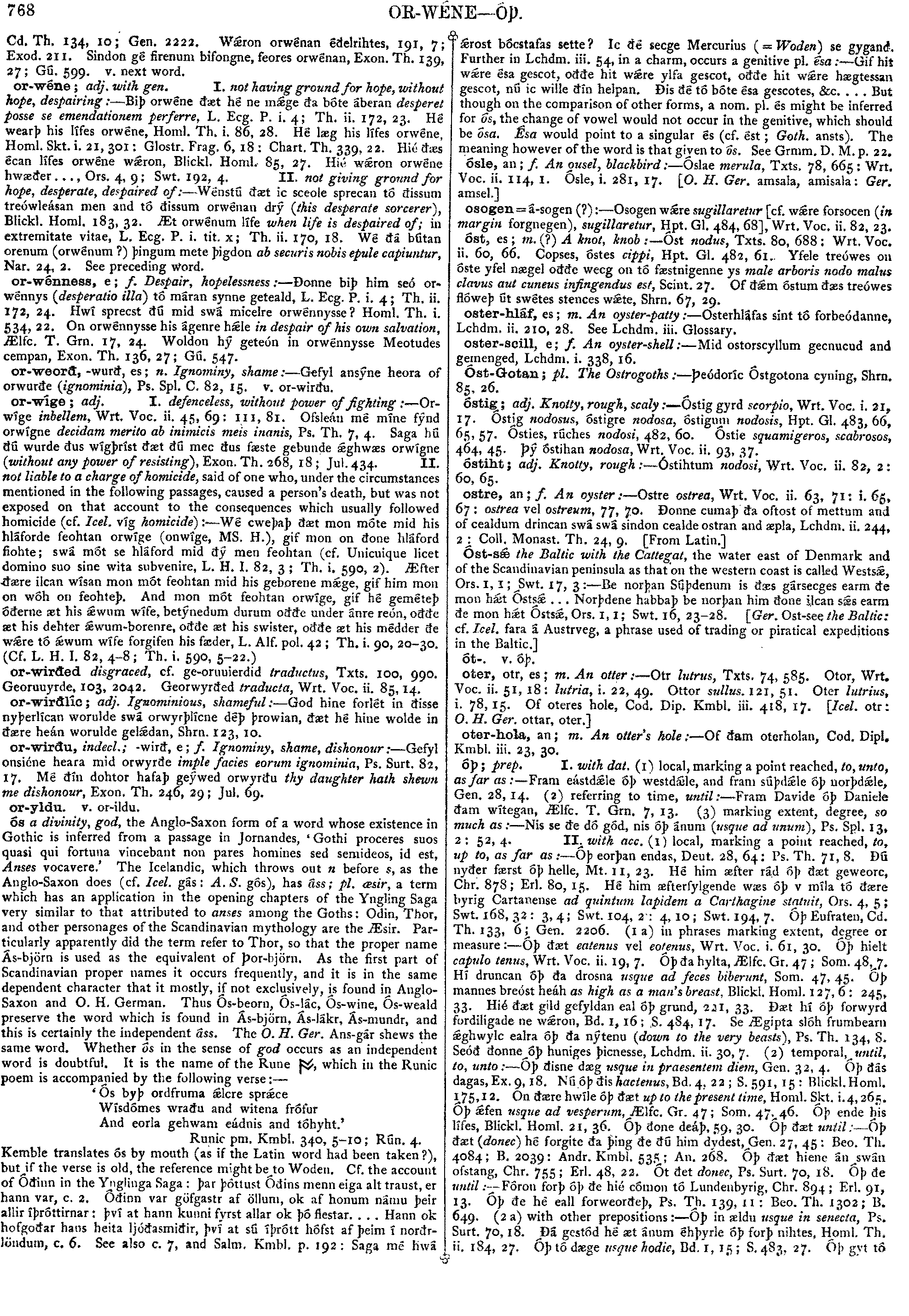
ós
a
divinity,
god,
the
Anglo-Saxon
form
of
a
word
whose
existence
in
Gothic
is
inferred
from
a
passage
in
Jornandes,
'Gothi
proceres
suos
quasi
qui
fortuna
vincebant
non
pares
homines
sed
semideos,
id
est,
Anses
vocavere.'
The
Icelandic,
which
throws
out
n
before
s,
as
the
Anglo-Saxon
does
(cf.
Icel.
gás:
A.
S.
gós),
has
áss;
pl.
æsir,
a
term
which
has
an
application
in
the
opening
chapters
of
the
Yngling
Saga
very
similar
to
that
attributed
to
anses
among
the
Goths:
Odin,
Thor,
and
other
personages
of
the
Scandinavian
mythology
are
the
Æsir.
Particularly
apparently
did
the
term
refer
to
Thor,
so
that
the
proper
name
Ás-björn
is
used
as
the
equivalent
of
Þor-björn.
As
the
first
part
of
Scandinavian
proper
names
it
occurs
frequently,
and
it
is
in
the
same
dependent
character
that
it
mostly,
if
not
exclusively,
is
found
in
Anglo-Saxon
and
O.
H.
German.
Thus
Ós-beorn,
Ós-lác,
Ós-wine,
Ós-weald
preserve
the
word
which
is
found
in
Ás-björn,
Ás-lákr,
Ás-mundr,
and
this
is
certainly
the
independent
áss.
The
O.
H.
Ger.
Ans-gár
shews
the
same
word.
Whether
ós
in
the
sense
of
god
occurs
as
an
independent
word
is
doubtful.
It
is
the
name
of
the
Rune
RUNE,
which
in
the
Runic
poem
is
accompanied
by
the
following
verse:--
'Ós
byþ
ordfruma
lcre
sprce
Wísdómes
wraðu
and
witena
frófur
And
eorla
gehwam
eádnís
and
tóhyht.'
Runic
pm.
Kmbl.
340,
5-10;
Rún.
4.
Kemble
translates
ós
by
mouth
(as
if
the
Latin
word
had
been
taken?),
but
if
the
verse
is
old,
the
reference
might
be
to
Woden.
Cf.
the
account
of
Óðinn
in
the
Yngfinga
Saga:
þar
þóttust
Ódins
menn
eiga
ale
traust,
er
hann
var,
c.
2.
Óðinn
var
göfgastr
af
öllum,
ok
af
honum
námu
þeir
allir
íþróttirnar:
því
at
hann
kunni
fyrst
allar
ok
þó
fiestar.
.
.
.
Hann
ok
hofgoðar
hans
heita
ljóðasmiðir,
því
at
sfi
íþrótt
hófst
af
þeim
í
norðrlöndum,
c.
6.
See
also
c.
7,
and
Salm.
Kmbl.
p.
192:
Saga
mé
hwá
rost
bócstafas
sette?
Ic
ðe
secge
Mercurius
(
=
Woden)
se
gygand.
Further
in
Lchdm.
iii.
54,
in
a
charm,
occurs
a
genitive
pl.
ésa:--Gif
hit
wre
ésa
gescot,
oððe
hit
wre
ylfa
gescot,
oððe
hit
wre
hægtessan
gescot,
nú
ic
wille
ðín
helpan.
Ðis
Ðis
ðé
tó
bóte
ésa
gescotes,
&c.
.
.
.
But
though
on
the
comparison
of
other
forms,
a
nom.
pl.
és
might
be
inferred
for
Ís,
the
change
of
vowel
would
not
occur
in
the
genitive,
which
should
be
ósa.
Ésa
would
point
to
a
singular
és
(cf.
ést;
Goth.
ansts).
The
meaning
however
of
the
word
is
that
given
to
ós.
See
Grmm.
D.
M.
p.
22.
| Result Page: |  |
Previous | 1 2 3 4 5 6 7 8 9 10 11 12 13 14 15 16 17 18 | Next |  |
Germanic Lexicon Project (main page)
This search system was written by
Sean Crist
Please consider
volunteering
to correct the data in these online dictionaries.
No rights reserved. Feel free to use these data in any way you please.