|
|

Tip: In the search results, you can click on any word or abbreviation for more information.
|
Source: Cleasby/Vigfusson, page b0489, entry 1 View original page image as: [TIFF] [PNG] [View previous entry] [View next entry] |
[Comment on this entry] [View comments] |
The following entry has been hand-corrected once. |
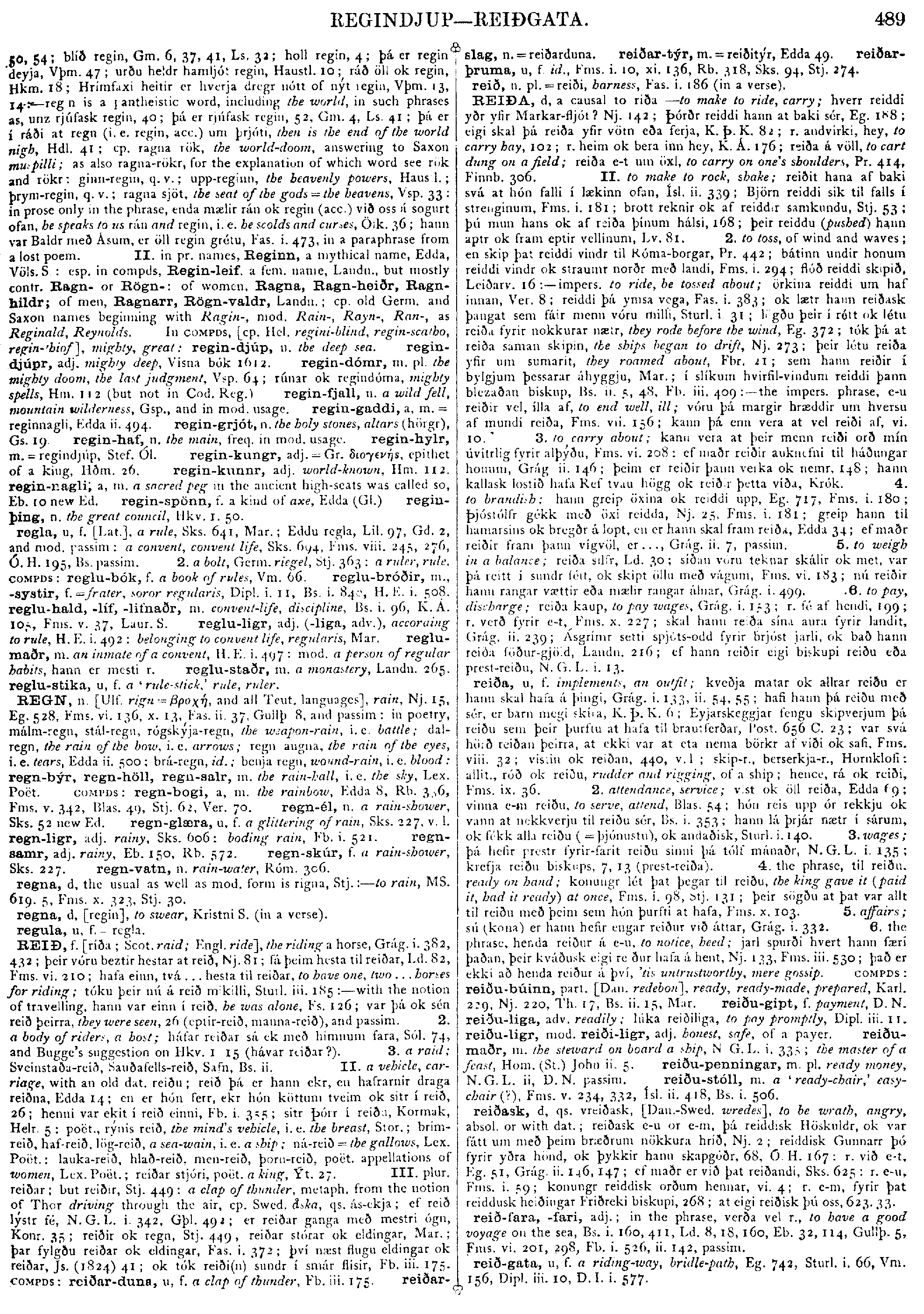
50, 54; blíð regin, Gm. 6, 37, 41, Ls, 32; holl regin, 4; þá er regin deyja, Vþm. 47; urðu heldr hamljó: regin, Haustl. 10; ráð öll ok regin, Hkm. 18; Hrímfaxi heitir er hverja dregr nótt of nýt regin, Vþm. 13, 14 :-- regin is a pantheistic word, including the world, in such phrases as, unz rjúfask regin, 40; þá er rjúfask regin, 52, Gm. 4, Ls. 41; þá er í ráði at regn (i.e. regin, acc.) um þrjóti, then is the end of the world nigh, Hdl. 41; cp. ragna rök, the world-doom, answering to Saxon muspilli; as also ragna-rökr, for the explanation of which word see rök and rökr: ginn-regin, q.v.; upp-reginn, the heavenly powers, Haustl.; þrym-regin, q.v.; ragna sjöt, the seat of the gods = the heavens, Vsp. 33: in prose only in the phrase, enda mælir rán ok regin (acc.) við oss á sogurt ofan, he speaks to us rán and regin, i.e. he scolds and curses, Ölk. 36; hann var Baldr með Ásum, er öll regin grétu, Fas. i. 473, in a paraphrase from a lost poem. II. in pr. names, Reginn, a mythical name, Edda, Völs. S: esp. in compds, Regin-leif, a fem. name, Landn., but mostly contr. Ragn- or Rögn-: of women, Ragna, Ragn-heiðr, Ragn-hildr; of men, Ragnarr, Rögn-valdr, Landn.; cp. old Germ. and Saxon names beginning with Ragin-, mod. Rain-, Rayn-, Ran-, as Reginald, Reynolds. In COMPDS, [cp. Hel. regini-blind, regin-scatho, regin-thiof], mighty, great: regin-djúp, n. the deep sea. regin-djúpr, adj. mighty deep, Vísna bók 1612. regin-dómr, m. pl. the mighty doom, the last judgment, Vsp. 64; rúnar ok regindóma, mighty spells, Hm. 112 (but not in Cod. Reg.) regin-fjall, n. a wild fell, mountain wilderness, Gsp., and in mod. usage. regin-gaddi, a, m. = reginnagli, Edda ii. 494. regin-grjót, n. the holy stones, altars (hörgr), Gs. 19 regin-haf, n. the main, freq. in mod. usage. regin-hylr, m. = regindjúp, Stef. Ól. regin-kungr, adj. = Gr. GREEK, epithet of a king, Hðm. 26. regin-kunnr, adj. world-known, Hm. 112. regin-nagli, a, m. a sacred peg in the ancient high-seats was called so, Eb. 10 new Ed. regin-spönn, f. a kind of axe, Edda (Gl.) regin-þing, n. the great council, Hkv. 1. 50.
|
Source: Cleasby/Vigfusson, page b0491, entry 32 View original page image as: [TIFF] [PNG] [View previous entry] [View next entry] |
[Comment on this entry] [View comments] |
The following entry has been hand-corrected once. |
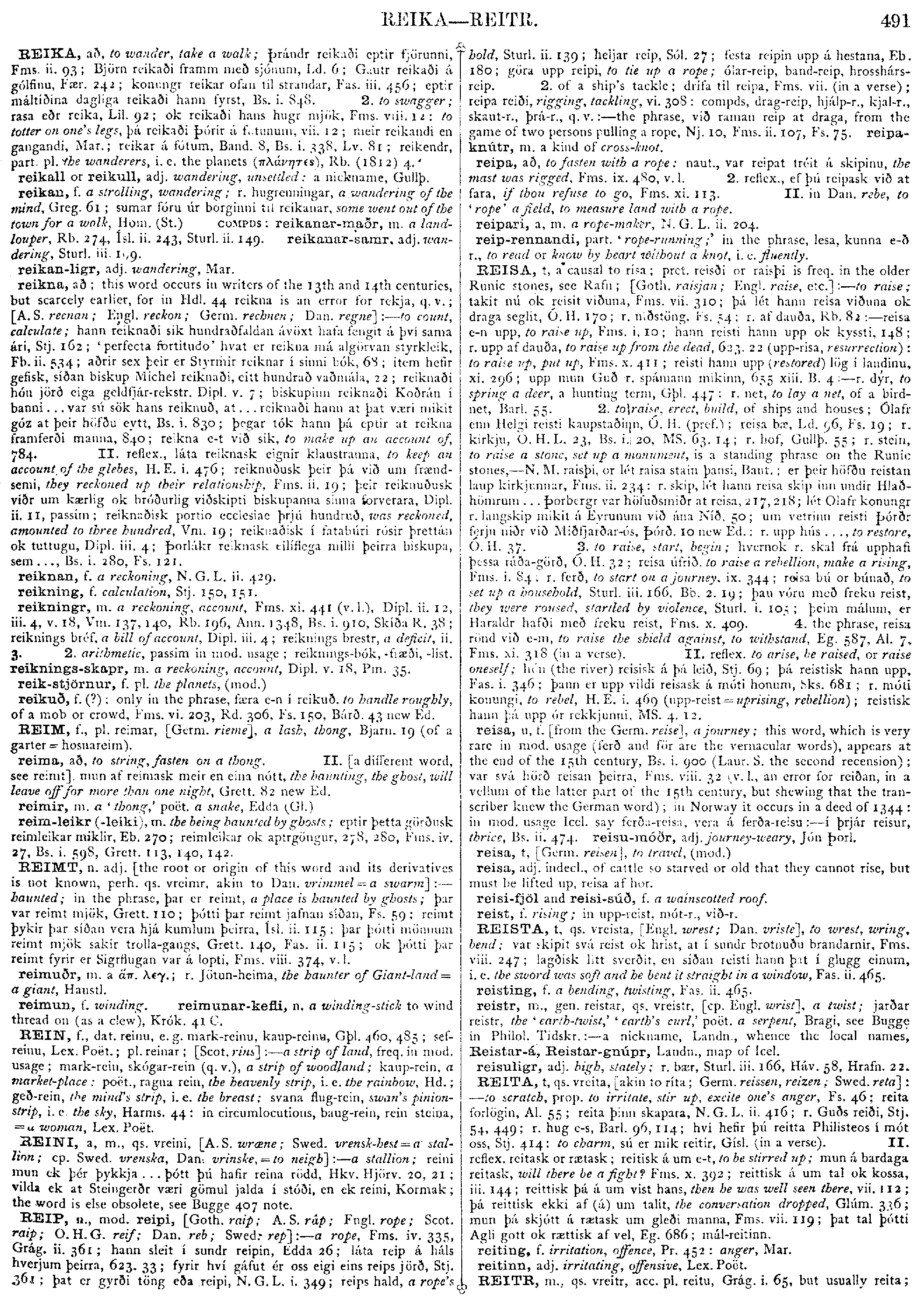
reistr, m., gen. reistar, qs. vreistr, [cp. Engl. wrist], a twist; jarðar reistr, the 'earth-twist,' 'earth's curl,' poët, a serpent, Bragi, see Bugge in Philol. Tidskr. :-- a nickname, Landn., whence the local names, Reistar-á, Reistar-gnúpr, Landn., map of Icel.
|
Source: Cleasby/Vigfusson, page b0495, entry 36 View original page image as: [TIFF] [PNG] [View previous entry] [View next entry] |
[Comment on this entry] [View comments] |
The following entry has been hand-corrected once. |
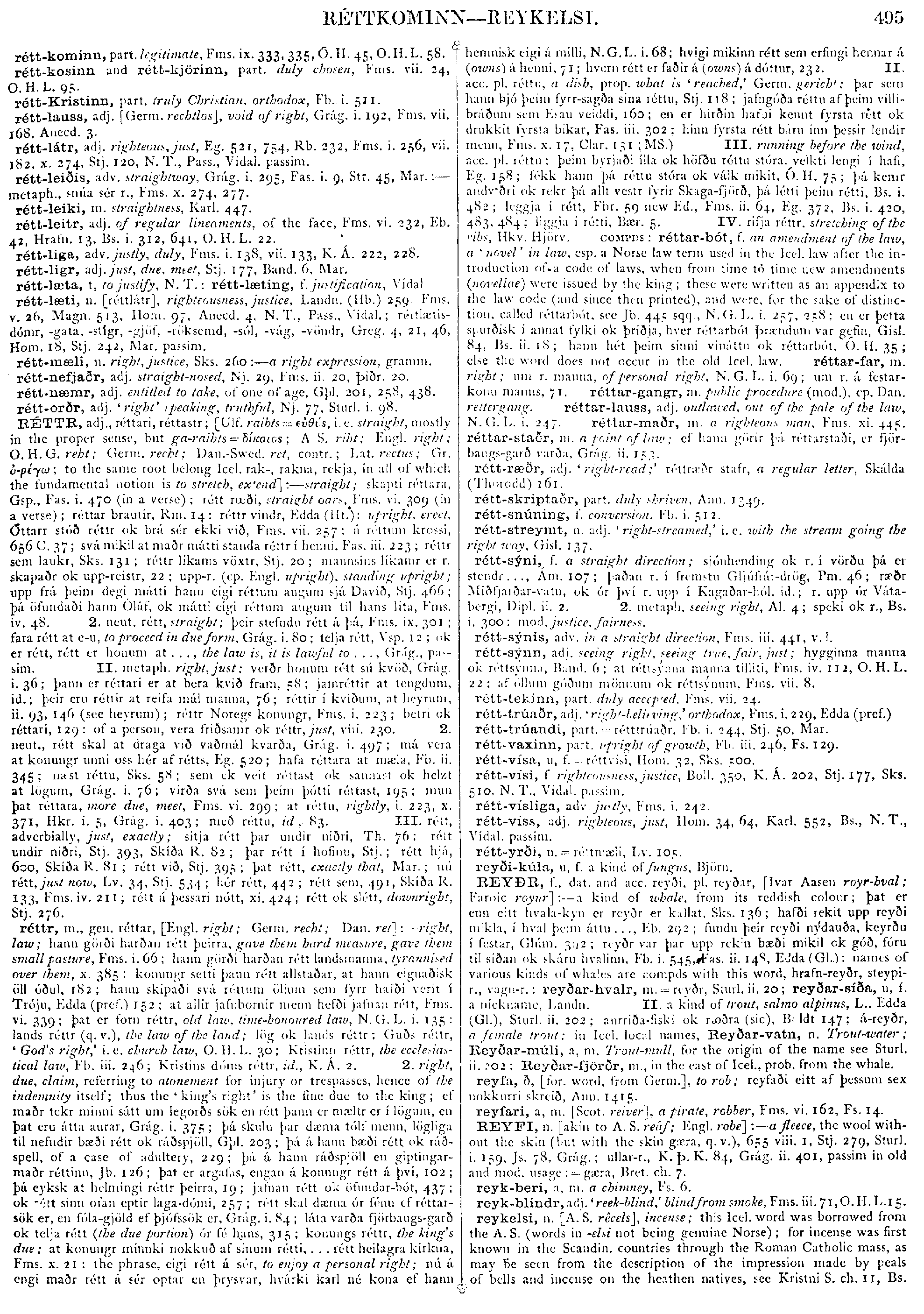
REYÐR,
f.,
dat.
and
acc.
reyði.
pl.
reyðar,
[Ivar
Aasen
royr-hval;
Faroic
royur]
:--
a
kind
of
whale,
from
its
reddish
colour;
þat
er
enn
eitt
hvala-kyn
er
reyðr
er
kallat,
Sks.
136;
hafði
rekit
upp
reyði
mikla,
í
hval
þeim
áttu
...,
Eb.
292;
fundu
þeir
reyði
nýdauða,
keyrðu
í
festar,
Glúm.
392;
reyðr
var
þar
upp
rokin
bæði
mikil
ok
góð,
fóru
til
siðan
ok
skáru
hvalinn,
Fb.
i.
545,
Fas.
ii.
148,
Edda(Gl.):
names
of
various
kinds
of
whales
are
compds
with
this
word,
hrafn-reyðr,
steypi-r.,
vagn-r.:
reyðar-hvalr,
m.
=
reyðr,
Sturl.
ii.
20;
reyðar-síða,
u,
f.
a
nickname,
Landn.
II.
a
kind
of
trout,
salmo
alpinus,
L.
Edda
(Gl.),
Sturl.
ii.
202;
aurriða-fiski
ok
r ðra
(sic),
Boldt
147;
á-reyðr,
a
female
trout:
in
Icel.
local
names,
Reyðar-vatn,
n.
Trout-water;
Reyðar-múli,
a,
m.
Trout-mull,
for
the
origin
of
the
name
see
Sturl.
ii.
202;
Reyðar-fjörðr,
m.,
in
the
east
of
Icel.,
prob.
from
the
whale.
ðra
(sic),
Boldt
147;
á-reyðr,
a
female
trout:
in
Icel.
local
names,
Reyðar-vatn,
n.
Trout-water;
Reyðar-múli,
a,
m.
Trout-mull,
for
the
origin
of
the
name
see
Sturl.
ii.
202;
Reyðar-fjörðr,
m.,
in
the
east
of
Icel.,
prob.
from
the
whale.
|
Source: Cleasby/Vigfusson, page b0496, entry 7 View original page image as: [TIFF] [PNG] [View previous entry] [View next entry] |
[Comment on this entry] [View comments] |
The following entry has been hand-corrected once. |
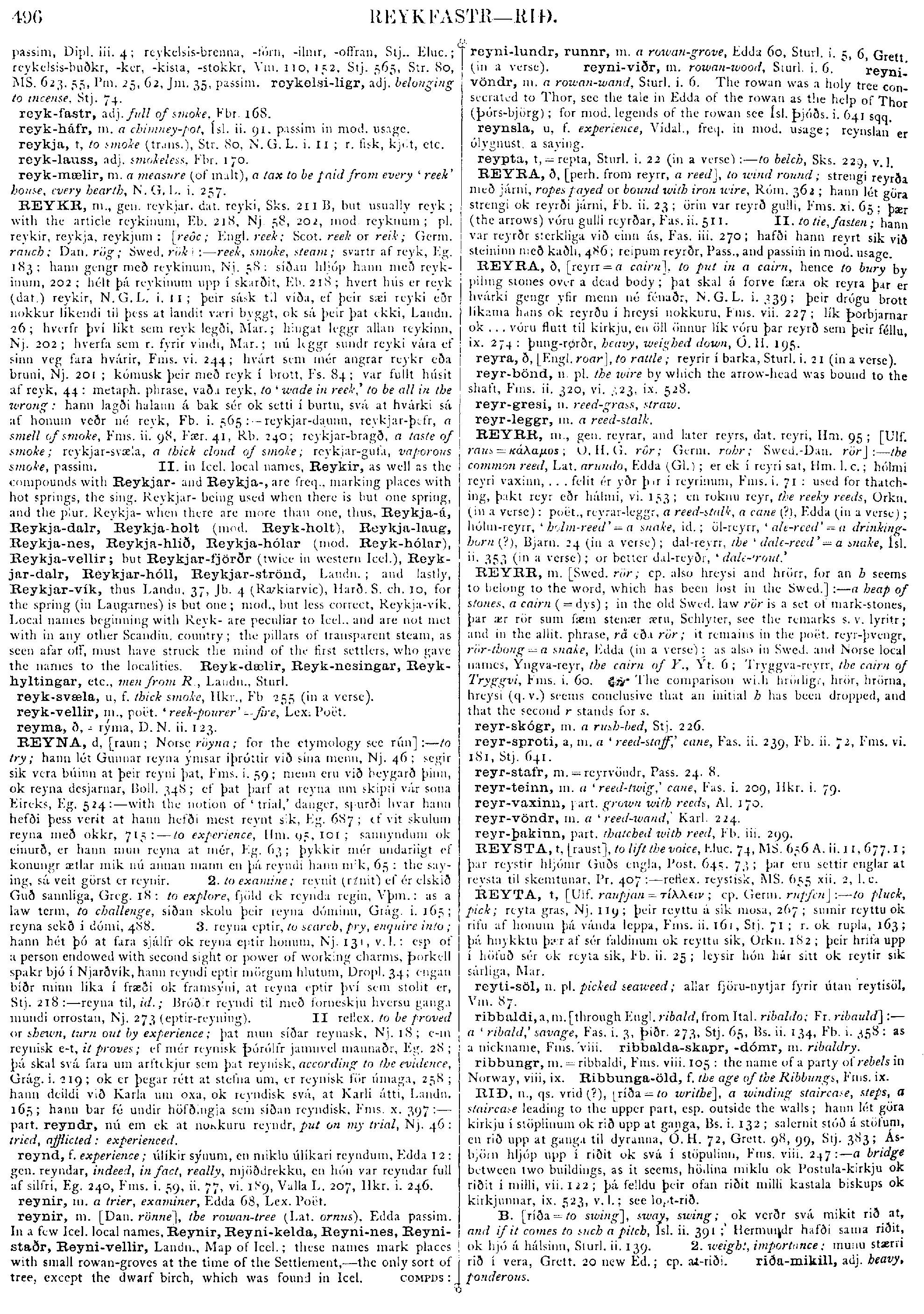
REYKR, m., gen. reykjar. dat. reyki, Sks. 211 B, but usually reyk; with the article reykinum, Eb. 218, Nj 58, 202, mod. reyknum; pl. reykir, reykja, reykjum: [A.S. reôc; Engl. reek; Scot. reek or reik; Germ. rauch; Dan. rög; Swed. rök] :-- reek, smoke, steam; svartr af reyk, Eg. 183; hann gengr með reykinum, Nj. 58: síðan hljóp hann með reykinum, 202; hélt þá reykinum upp í skarðit, Eb. 218; hvert hús er reyk (dat.) reykir, N.G.L. i. 11; þeir sásk til víða, ef þeir sæi reyki eðr nokkur líkendi til þess at landit væri byggt, ok sá þeir þat ekki, Landn. 26; hverfr því likt sem reyk legði, Mar.; hingat leggr allan reykinn, Nj. 202; hverfa sem r. fyrir vindi, Mar.; nú leggr sundr reyki vára ef sinn veg fara hvárir, Fms. vi. 244; hvárt sem mér angrar reykr eða bruni, Nj. 201; kómusk þeir með reyk í brott, Fs. 84; var fullt húsit af reyk, 44: metaph. phrase, vaða reyk, to 'wade in reek' to be all in the wrong; hann lagði halann á bak sér ok setti í burtu, svá at hvárki sá af honum veðr né reyk, Fb. i. 565 :-- reykjar-daunn, reykjar-þefr, a smell of smoke, Fms. ii. 98, Fær. 41, Rb. 240; reykjar-bragð, a taste of smoke; reykjar-svæla, a thick cloud of smoke; reykjar-gufa, vaporous smoke, passim. II. in Icel. local names, Reykir, as well as the compounds with Reykjar- and Reykja-, are freq., marking places with hot springs, the sing. Reykjar- being used when there is but one spring, and the plur. Reykja- when there are more than one, thus, Reykja-á, Reykja-dalr, Reykja-holt (mod. Reyk-holt), Reykja-laug, Reykja-nes, Reykja-hlíð, Reykja-hólar (mod. Reyk-hólar), Reykja-vellir; but Reykjar-fjörðr (twice in western Icel.), Reykjar-dalr, Reykjar-hóll, Reykjar-strönd, Landn.; and lastly, Reykjar-vík, thus Landn. 37, Jb. 4 (Ra/kiarvic), UNCERTAIN Harð. S. ch. 10, for the spring (in Laugarnes) is but one; mod., but less correct, Reykja-vík. Local names beginning with Reyk- are peculiar to Icel., and are not met with in any other Scandin. country; the pillars of transparent steam, as seen afar off, must have struck the mind of the first settlers, who gave the names to the localities. Reyk-dælir, Reyk-nesingar, Reyk-hyltingar, etc., men from R, Landn., Sturl.
|
Source: Cleasby/Vigfusson, page b0496, entry 14 View original page image as: [TIFF] [PNG] [View previous entry] [View next entry] |
[Comment on this entry] [View comments] |
The following entry has been hand-corrected once. |
reynir, m. [Dan. rönne], the rowan-tree (Lat. ornus), Edda passim. In a few Icel. local names, Reynir, Reyni-kelda, Reyni-nes, Reyni-staðr, Reyni-vellir, Landn., Map of Icel.; these names mark places with small rowan-groves at the time of the Settlement, -- the only sort of tree, except the dwarf birch, which was found in Icel. COMPDS: reyni-lundr, runnr, m. a rowan-grove, Edda 60, Sturl. i. 5, 6, Grett (in a verse). reyni-viðr, m. rowan-wood, Sturl. i. 6. reyni-vöndr, m. a rowan-wand, Sturl. i. 6. The rowan was a holy tree consecrated to Thor, see the tale in Edda of the rowan as the help of Thor (Þors-björg); for mod. legends of the rowan see Ísl. Þjóðs. i. 641 sqq.
|
Source: Cleasby/Vigfusson, page b0496, entry 24 View original page image as: [TIFF] [PNG] [View previous entry] [View next entry] |
[Comment on this entry] [View comments] |
The following entry has been hand-corrected once. |
REYRR, m. [Swed. rör; cp. also hreysi and hrörr, for an h seems to belong to the word, which has been lost in the Swed.] :-- a heap of stones, a cairn (= dys); in the old Swed. law rör is a set of mark-stones, þar ær rör sum fæm stenær æru, Schlyter, see the remarks s.v. lyritr; and in the allit. phrase, rå eða rör; it remains in the poët. reyr-þvengr, rör-thong = a snake, Edda (in a verse); as also in Swed. and Norse local names, Yngva-reyr, the cairn of Y., Ýt. 6; Tryggva-reyrr, the cairn of Tryggvi, Fms. i. 60. &FINGER; The comparison with hrörligr, hrör, hrörna, hreysi (q.v.) seems conclusive that an initial h has been dropped, and that the second r stands for s.
|
Source: Cleasby/Vigfusson, page b0500, entry 8 View original page image as: [TIFF] [PNG] [View previous entry] [View next entry] |
[Comment on this entry] [View comments] |
The following entry has been hand-corrected once. |
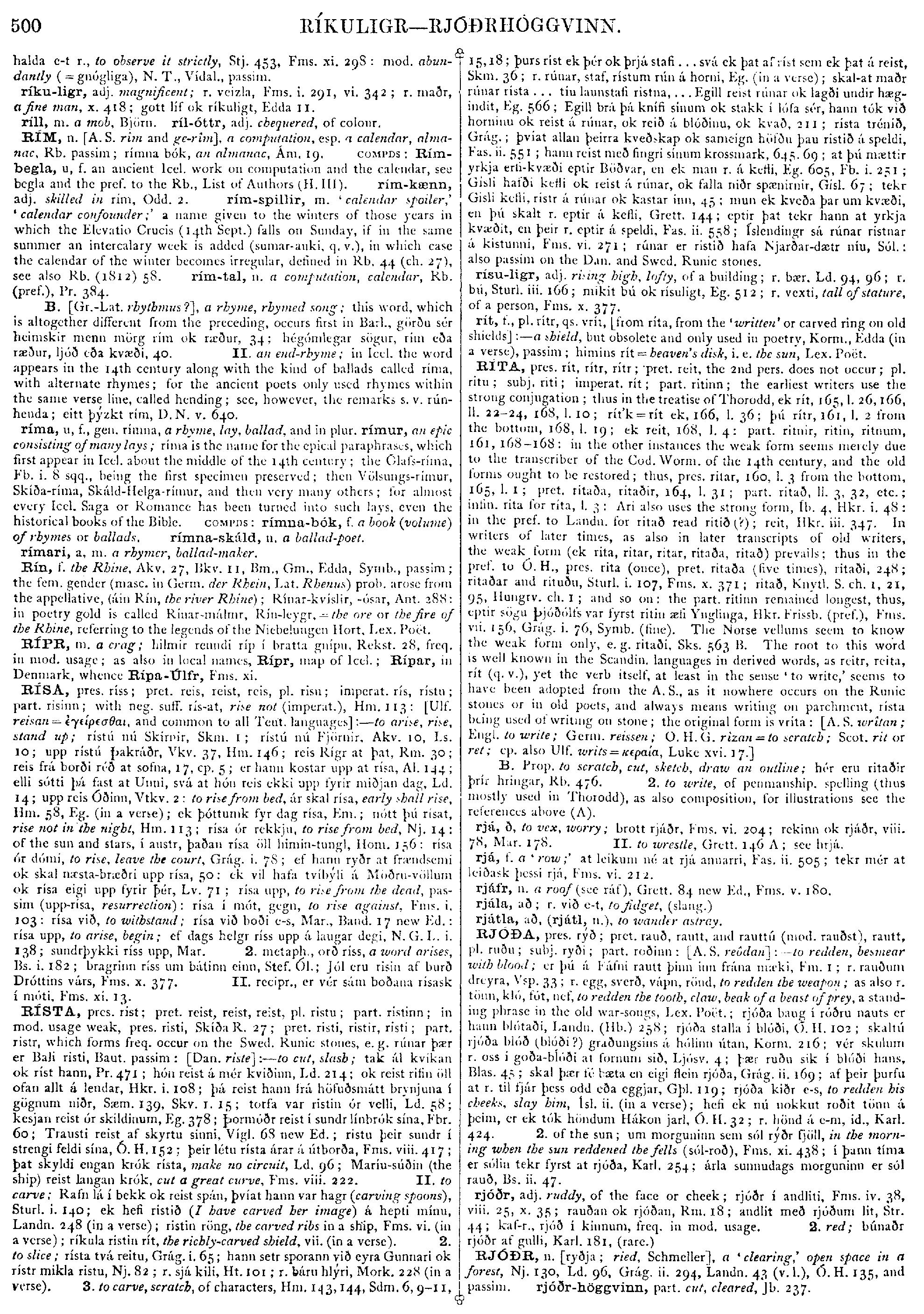
RÍPR, m. a crag; hilmir renndi ríp í bratta guípu, Rekst. 28, freq. in mod. usage; as also in local names, Rípr, map of led.; Rípar, in Denmark, whence Rípa-Úlfr, Fms. xi.
|
Source: Cleasby/Vigfusson, page b0501, entry 39 View original page image as: [TIFF] [PNG] [View previous entry] [View next entry] |
[Comment on this entry] [View comments] |
The following entry has been hand-corrected once. |
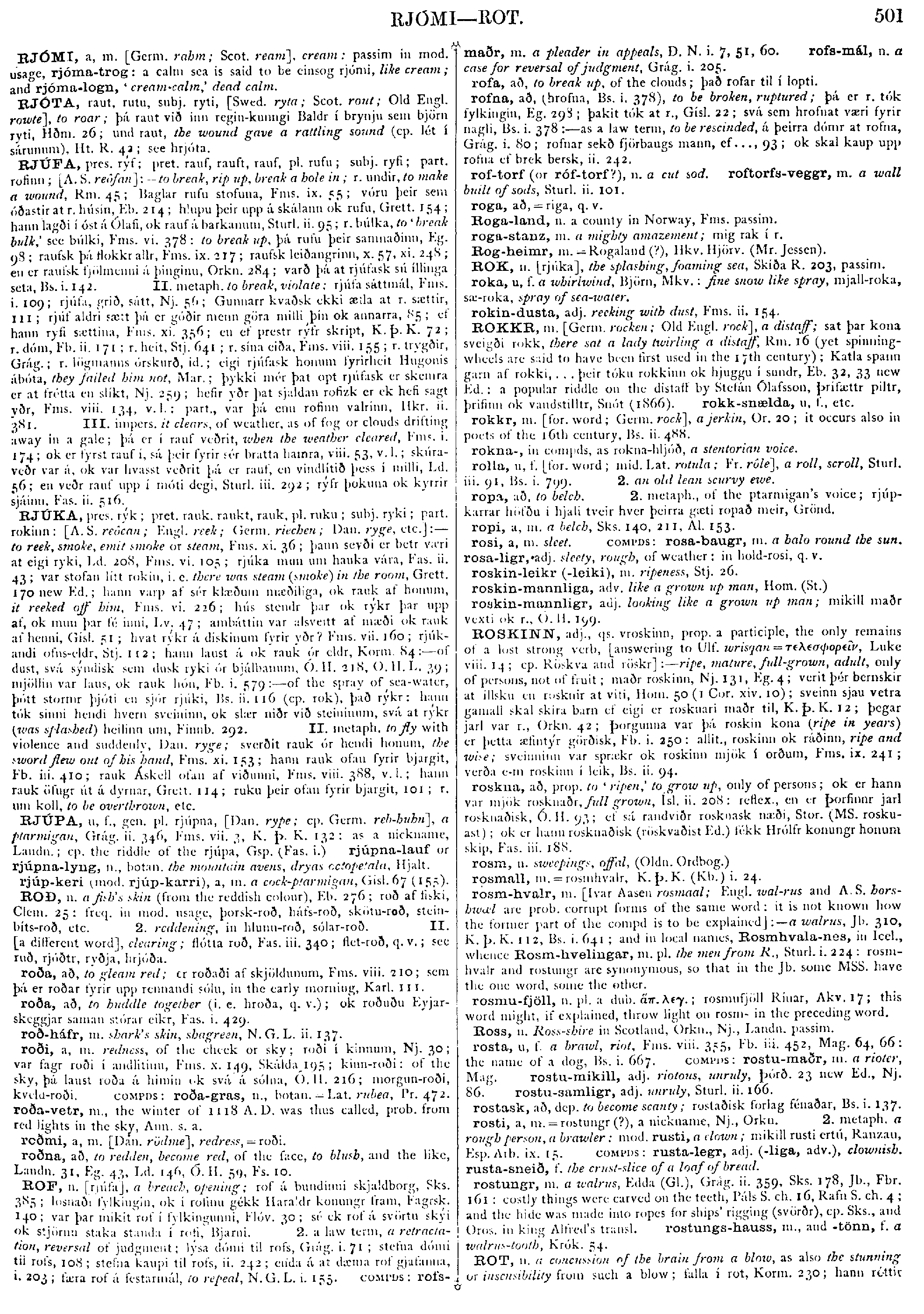
rosm-hvalr, m. [Ivar Aasen rosmaal; Engl. wal-rus and A.S. bors-hwæl are prob. corrupt forms of the same word: it is not known how the former part of the compd is to be explained] :-- a walrus, Jb. 310, K.Þ.K. 112, Bs. i. 641; and in local names, Rosmhvala-nes, in Icel., whence Rosm-hvelingar, m. pl. the men from R., Sturl. i. 224: rosm-hvalr and rostungr are synonymous, so that in the Jb. some MSS. have the one word, some the other.
|
Source: Cleasby/Vigfusson, page b0503, entry 22 View original page image as: [TIFF] [PNG] [View previous entry] [View next entry] |
[Comment on this entry] [View comments] |
The following entry has been hand-corrected once. |
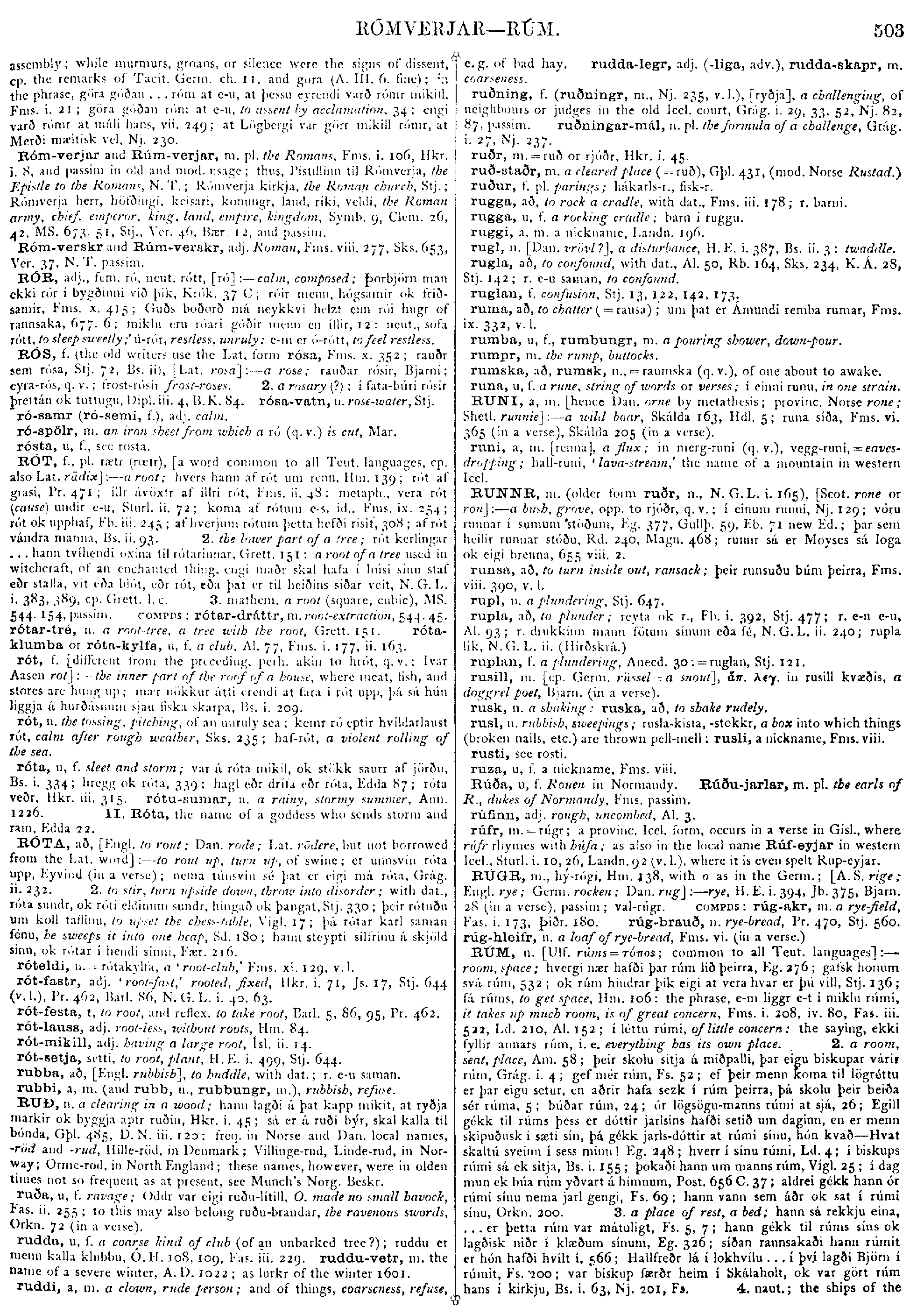
RUÐ, n. a clearing in a wood; hann lagði á þat kapp mikit, at ryðja markir ok byggja aptr ruðin, Hkr. i. 45; sá er á ruði býr, skal kalla til bónda, Gþl. 485, D.N. iii. 120: freq. in Norse and Dan. local names,-röd and -rud, Hille-röd, in Denmark; Villinge-rud, Linde-rud, in Norway; Orme-rod, in North England; these names, however, were in olden times not so frequent as at present, see Munch's Norg. Beskr.
|
Source: Cleasby/Vigfusson, page b0504, entry 1 View original page image as: [TIFF] [PNG] [View previous entry] [View next entry] |
[Comment on this entry] [View comments] |
The following entry has been hand-corrected once. |
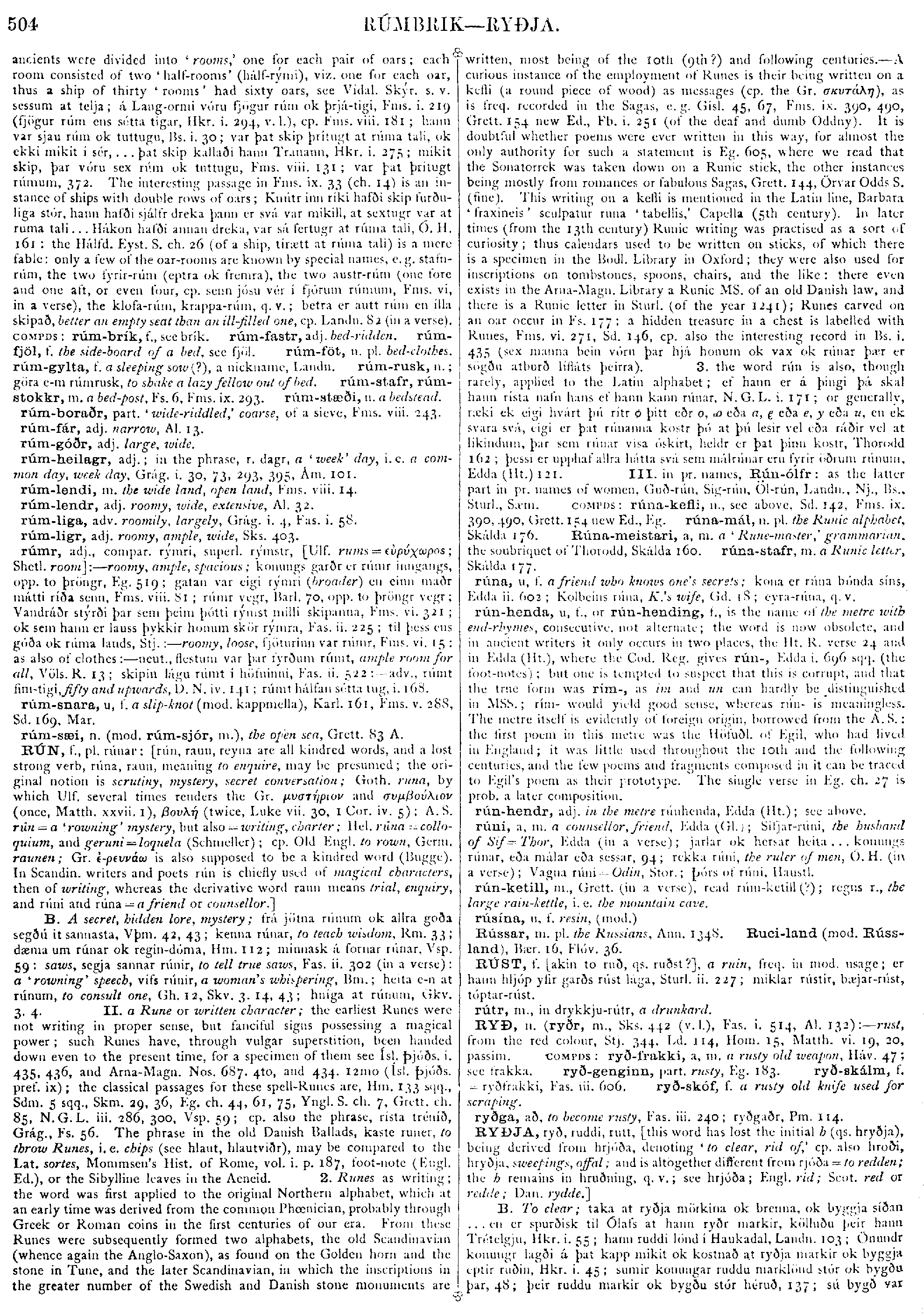
ancients were divided into 'rooms,' one for each pair of oars; each room consisted of two 'half-rooms' (hálf-rými), viz. one for each oar, thus a ship of thirty 'rooms' had sixty oars, see Vidal. Skýr. s.v. sessum at telja; á Lang-ormi vóru fjögur rúm ok þrjá-tigi, Fms. i. 219 (fjögur rúm ens sétta tigar, Hkr. i. 294, v.l.), cp. Fms. viii. 181; hann var sjau rúm ok tuttugu, Bs. i. 30; var þat skip þrítugt at rúma tali, ok ekki mikit í sér, ... þat skip kallaði hann Tranann, Hkr. i. 275; mikit skip, þar vóru sex rúm ok tuttugu, Fms. viii. 131; var þat þrítugt rúmum, 372. The interesting passage in Fms. ix. 33 (ch. 14) is an instance of ships with double rows of oars; Knútr inn ríki hafði skip furðu-liga stór, hann hafði sjálfr dreka þann er svá var mikill, at sextugr var at ruma tali ... Hákon hafði annan dreka, var sá fertugr at rúma tali, Ó.H. 161: the Hálfd. Eyst. S. ch. 26 (of a ship, tirætt at rúma tali) is a mere fable: only a few of the oar-rooms are known by special names, e.g. stafn-rúm, the two fyrir-rúm (eptra ok fremra), the two austr-rúm (one fore and one aft, or even four, cp. senn jósu vér í fjórum rúmum, Fms, vi, in a verse), the klofa-rúm, krappa-rúm, q.v.; betra er autt rúm en ílla skipað, better an empty seat than an ill-filled one, cp. Landn. 82 (in a verse). COMPDS: rúm-brík, f., see brík. rúm-fastr, adj. bed-ridden. rúm-fjöl, f. the side-board of a bed, see fjöl. rúm-föt, n. pl. bed-clothes. rúm-gylta, f. a sleeping sow(?), a nickname, Landn. rúm-rusk, n.; göra e-m rúmrusk, to shake a lazy fellow out of bed. rúm-stafr, rúm-stokkr, m. a bed-post, Fs. 6, Fms. ix. 293. rúm-stæði, n. a bedstead.
| Result Page: |  |
Previous | 49 50 51 52 53 54 55 56 57 58 59 60 61 62 63 64 65 66 67 | Next |  |
Germanic Lexicon Project (main page)
This search system was written by
Sean Crist
Please consider
volunteering
to correct the data in these online dictionaries.
No rights reserved. Feel free to use these data in any way you please.