|
|

|
Source: Cleasby/Vigfusson, page b0333, entry 6 View original page image as: [TIFF] [PNG] [View previous entry] [View next entry] |
[Comment on this entry] [View comments] |
The following entry has been hand-corrected once. |
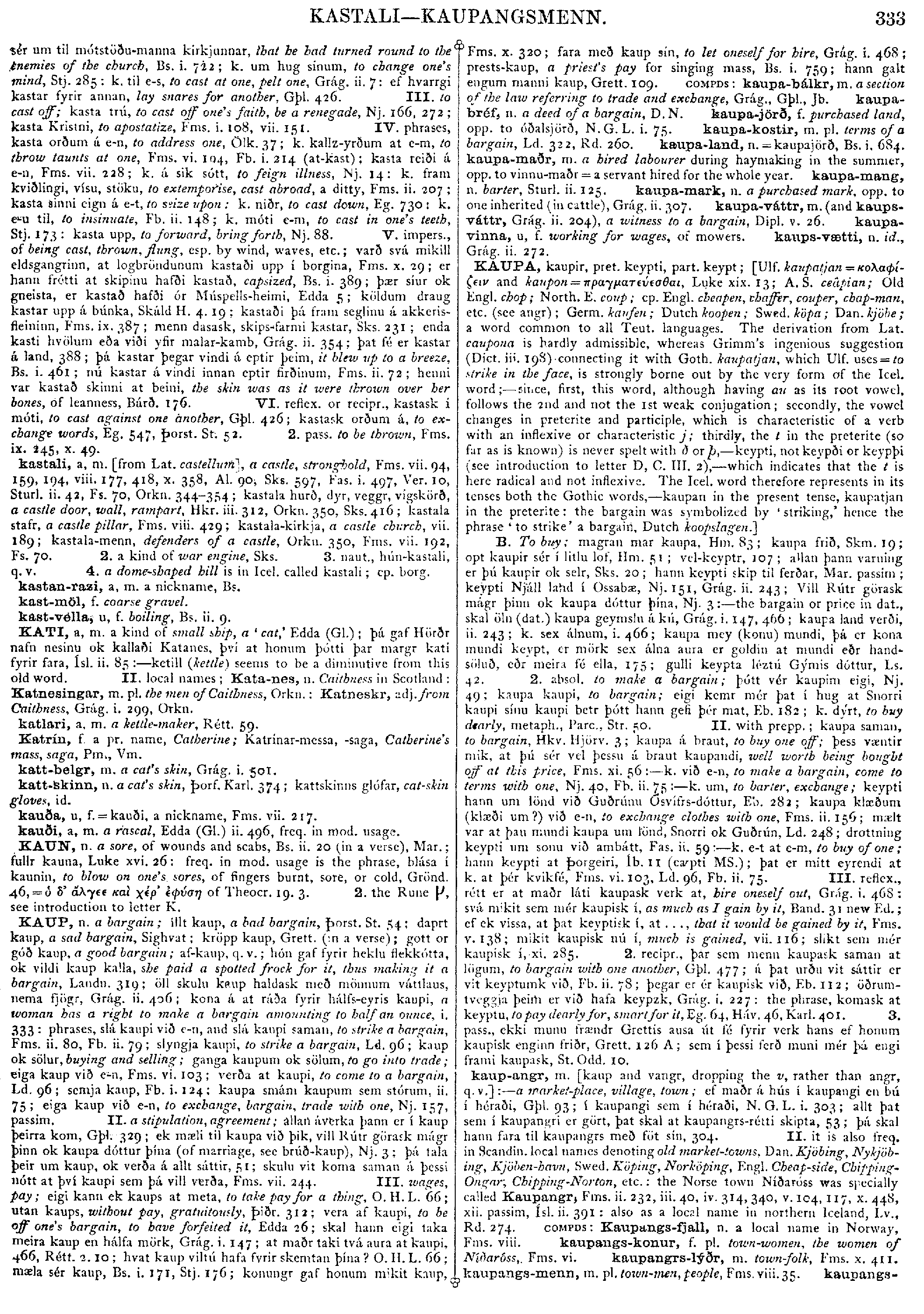
KATI, a, m. a kind of small ship, a 'cat,' Edda (Gl.); þá gaf Hörðr nafn nesinu ok kallaði Katanes, því at honum þótti þar margr kati fyrir fara, Ísl. ii. 85 :-- ketíll (kettle) seems to be a diminutive from this old word. II. local names; Kata-nes, n. Caithness in Scotland: Katnesingar, m. pl. the men of Caithness, Orkn.: Katneskr, adj. from Caithness, Grág. i. 299, Orkn.
|
Source: Cleasby/Vigfusson, page b0333, entry 17 View original page image as: [TIFF] [PNG] [View previous entry] [View next entry] |
[Comment on this entry] [View comments] |
The following entry has been hand-corrected once. |
kaup-angr, m. [kaup and vangr, dropping the v, rather than angr, q.v.] :-- a market-place, village, town; ef maðr á hús í kaupangi en bú í héraði, Gþl. 93; í kaupangi sem í héraði, N. G. L. i. 303; allt þat sem í kaupangri er gört, þat skal at kaupangrs-rétti skipta, 53; þá skal hann fara til kaupangrs með föt sín, 304. II. it is also freq. in Scandin. local names denoting old market-towns, Dan. Kjöbing, Nykjöbing, Kjöben-havn, Swed. Köping, Norköping, Engl. Cheap-side, Chipping-Ongar; Chipping-Norton, etc.: the Norse town Níðaróss was specially called Kaupangr, Fms. ii. 232, iii. 40, iv. 314, 340, v. 104, 117, x. 448, xii. passim, Ísl. ii. 391: also as a local name in northern Iceland, Lv., Rd. 274. COMPDS: Kaupangs-fjall, n. a local name in Norway, Fms. viii. kaupangs-konur, f. pl. town-women, the women of Níðaróss, Fms. vi. kaupangrs-lýðr, m. town-folk, Fms. x. 411. kaupangs-menn, m. pl. town-men, people, Fms. viii. 35. kaupangs-
|
Source: Cleasby/Vigfusson, page b0335, entry 35 View original page image as: [TIFF] [PNG] [View previous entry] [View next entry] |
[Comment on this entry] [View comments] |
The following entry has been hand-corrected once. |
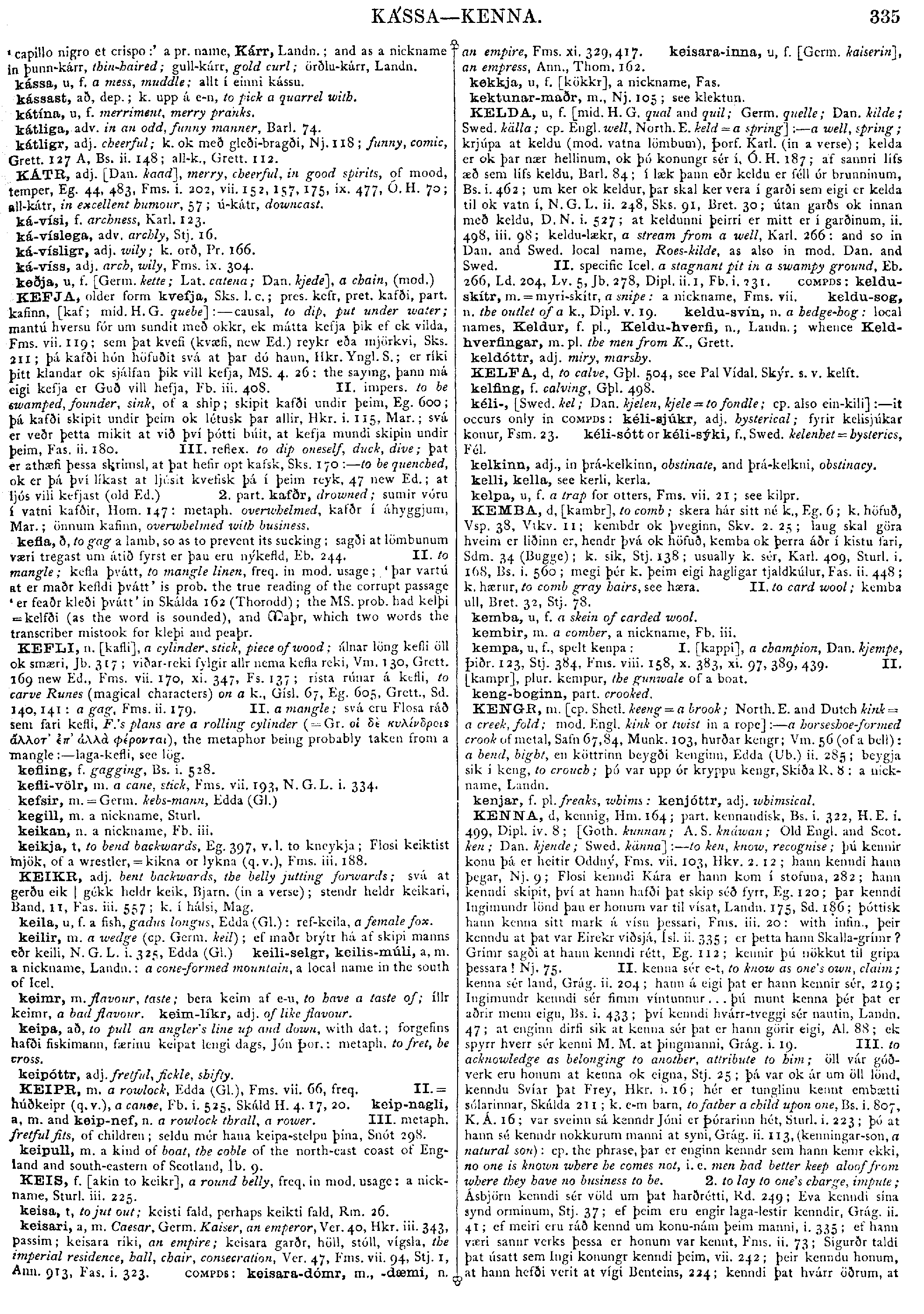
KELDA, u, f. [mid. H. G. qual and quil; Germ. quelle; Dan. kilde; Swed. källa; cp. Engl. well, North. E. keld = a spring] :-- a well, spring; krjúpa at keldu (mod. vatna lömbum), Þorf. Karl. (in a verse); kelda er ok þar nær hellinum, ok þó konungr sér í, Ó. H. 187; af sannri lífs æð sem lífs keldu, Barl. 84; í læk þann eðr keldu er féll ór brunninum, Bs. i. 462; um ker ok keldur, þar skal ker vera í garði sem eigi er kelda til ok vatn í, N. G. L. ii. 248, Sks. 91, Bret. 30; útan garðs ok innan með keldu, D. N. i. 527; at keldunni þeirri er mitt er í garðinum, ii. 498, iii. 98; keldu-lækr, a stream from a well, Karl. 266: and so in Dan. and Swed. local name, Roes-kilde, as also in mod. Dan. and Swed. II. specific Icel. a stagnant pit in a swampy ground, Eb. 266, Ld. 204, Lv. 5, Jb. 278, Dipl. ii. 1, Fb. i. 231. COMPDS: keldu-skítr, m. = myri-skítr, a snipe: a nickname, Fms. vii. keldu-sog, n. the outlet of a k., Dipl. v. 19. keldu-svín, n. a hedge-hog: local names, Keldur, f. pl., Keldu-hverfi, n., Landn.; whence Keld-hverfingar, m. pl. the men from K., Grett.
|
Source: Cleasby/Vigfusson, page b0336, entry 1 View original page image as: [TIFF] [PNG] [View previous entry] [View next entry] |
[Comment on this entry] [View comments] |
The following entry has been hand-corrected once. |
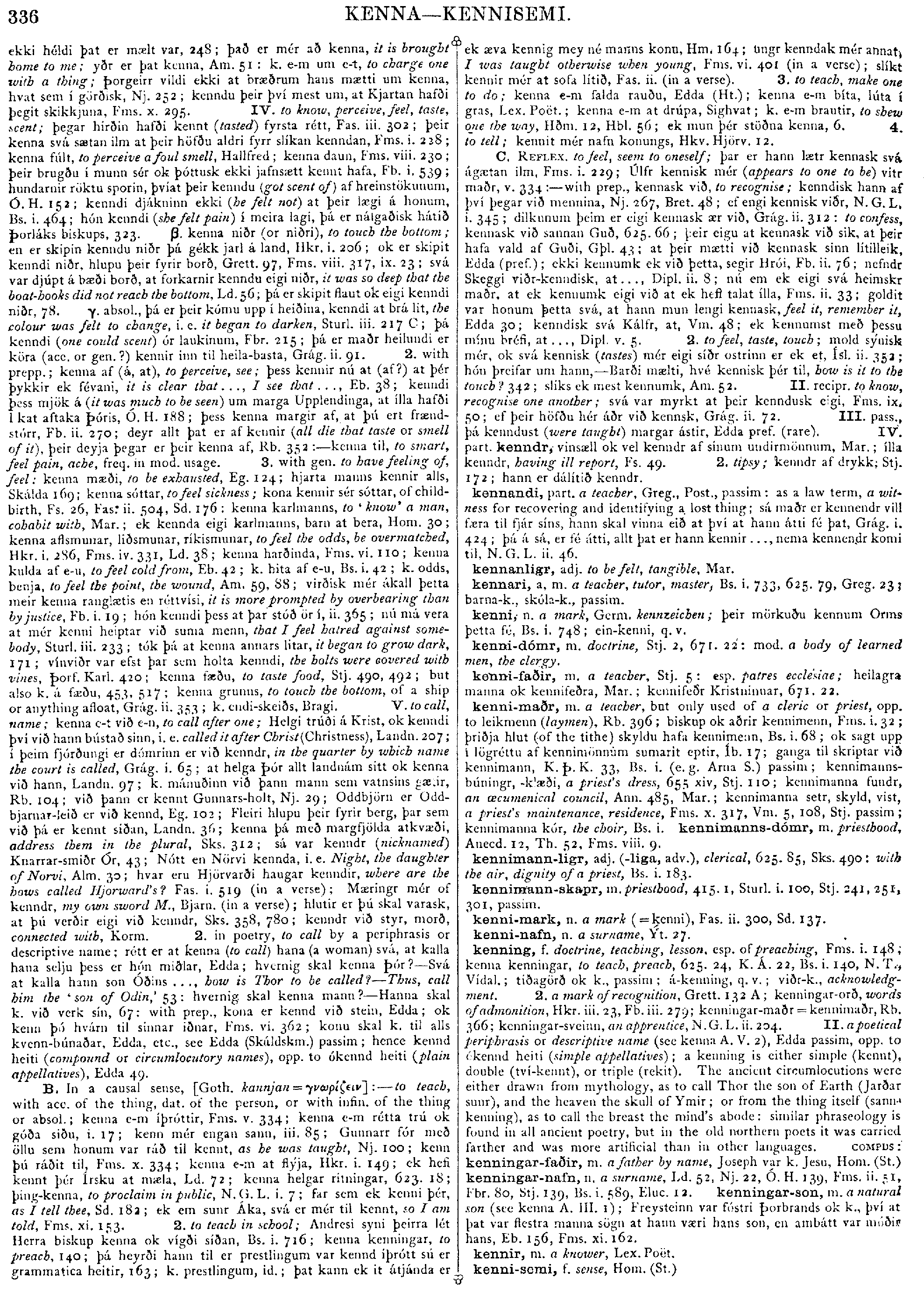
ekki
héldi
þat
er
mælt
var,
248;
það
er
mér
að
kenna,
it
is
brought
home
to
me;
yðr
er
þat
kenna,
Am.
51:
k.
e-m
um
e-t,
to
charge
one
with
a
thing;
Þorgeirr
vildi
ekki
at
bræðrum
hans
mætti
um
kenna,
hvat
sem
í
görðisk,
Nj.
252;
kenndu
þeir
því
mest
um,
at
Kjartan
hafði
þegit
skikkjuna,
Fms.
x.
295.
IV.
to
know,
perceive,
feel,
taste,
scent;
þegar
hirðin
hafði
kennt
(tasted)
fyrsta
rétt,
Fas.
iii.
302;
þeir
kenna
svá
sætan
ilm
at
þeir
höfðu
aldri
fyrr
slíkan
kenndan,
Fms.
i.
228;
kenna
fúlt,
to
perceive
a
foul
smell,
Hallfred;
kenna
daun,
Fms.
viii.
230;
þeir
brugðu
í
munn
sér
ok
þóttusk
ekki
jafnsætt
kennt
hafa,
Fb.
i.
539;
hundarnir
röktu
sporin,
þvíat
þeir
kenndu
(got
scent
of)
af
hreinstökunum,
Ó.
H.
152;
kenndi
djákninn
ekki
(he
felt
not)
at
þeir
lægi
á
honum,
Bs.
i.
464;
hón
kenndi
(she
felt
pain)
í
meira
lagi,
þá
er
nálgaðisk
hátíð
Þorláks
biskups,
323.
 .
kenna
niðr
(or
niðri),
to
touch
the
bottom;
en
er
skipin
kenndu
niðr
þá
gékk
jarl
á
land,
Hkr.
i.
206;
ok
er
skipit
kenndi
niðr,
hlupu
þeir
fyrir
borð,
Grett.
97,
Fms.
viii.
317,
ix.
23;
svá
var
djúpt
á
bæði
borð,
at
forkarnir
kenndu
eigi
niðr,
it
was
so
deep
that
the
boat-hooks
did
not
reach
the
bottom,
Ld.
56;
þá
er
skipit
flaut
ok
eigi
kenndi
niðr,
78.
.
kenna
niðr
(or
niðri),
to
touch
the
bottom;
en
er
skipin
kenndu
niðr
þá
gékk
jarl
á
land,
Hkr.
i.
206;
ok
er
skipit
kenndi
niðr,
hlupu
þeir
fyrir
borð,
Grett.
97,
Fms.
viii.
317,
ix.
23;
svá
var
djúpt
á
bæði
borð,
at
forkarnir
kenndu
eigi
niðr,
it
was
so
deep
that
the
boat-hooks
did
not
reach
the
bottom,
Ld.
56;
þá
er
skipit
flaut
ok
eigi
kenndi
niðr,
78.
 .
absol.,
þá
er
þeir
kómu
upp
í
heiðina,
kenndi
at
brá
lit,
the
colour
was
felt
to
change,
i.e.
it
began
to
darken,
Sturl.
iii.
217
C;
þá
kenndi
(one
could
scent)
ór
laukinum,
Fbr.
215;
þá
er
maðr
heilundi
er
köra
(acc.
or
gen.?)
kennir
inn
til
heila-basta,
Grág.
ii.
91.
2.
with
prepp.;
kenna
af
(á,
at),
to
perceive,
see;
þess
kennir
nú
at
(af?)
at
þér
þykkir
ek
févani,
it
is
clear
that
...,
I
see
that
...,
Eb.
38;
kenndi
þess
mjök
á
(it
was
much
to
be
seen)
um
marga
Upplendinga,
at
ílla
hafði
lekat
UNCERTAIN
aftaka
Þóris,
Ó.
H.
188;
þess
kenna
margir
af,
at
þú
ert
frændstórr,
Fb.
ii.
270;
deyr
allt
þat
er
af
kennir
(all
die
that
taste
or
smell
of
it),
þeir
deyja
þegar
er
þeir
kenna
af,
Rb.
352
:--
kenna
til,
to
smart,
feel
pain,
ache,
freq.
in
mod.
usage.
3.
with
gen.
to
have
feeling
of,
feel;
kenna
mæði,
lo
be
exhausted,
Eg.
124;
hjarta
manns
kennir
alls,
Skálda
169;
kenna
sóttar,
to
feel
sickness;
kona
kennir
sér
sóttar,
of
childbirth,
Fs.
26,
Fas.
ii.
504,
Sd.
176:
kenna
karlmanns,
to
'know'
a
man,
cohabit
with,
Mar.;
ek
kennda
eigi
karlmanns,
barn
at
bera,
Hom.
30;
kenna
aflsmunar,
liðsmunar,
ríkismunar,
to
feel
the
odds,
be
overmatched,
Hkr.
i.
286,
Fms.
iv.
331,
Ld.
38;
kenna
harðinda,
Fms.
vi.
110;
kenna
kulda
af
e-u,
to
feel
cold
from,
Eb.
42;
k.
hita
af
e-u,
Bs.
i.
42;
k.
odds,
benja,
to
feel
the
point,
the
wound,
Am.
59,
88;
virðisk
mér
ákall
þetta
meir
kenna
ranglætis
en
réttvísi,
it
is
more
prompted
by
overbearing
than
by
justice,
Fb.
i.
19;
hón
kenndi
þess
at
þar
stóð
ör
í,
ii.
365;
nú
má
vera
at
mér
kenni
heiptar
við
suma
menn,
that
I
feel
hatred
against
somebody,
Sturl.
iii.
233;
tók
þá
at
kenna
annars
litar,
it
began
to
grow
dark,
171;
vínviðr
var
efst
þar
sem
holta
kenndi,
the
holts
were
covered
with
vines,
Þorf.
Karl.
420;
kenna
fæðu,
to
taste
food,
Stj.
490,
492;
but
also
k.
á
fæðu,
453,
517;
kenna
grunns,
to
touch
the
bottom,
of
a
ship
or
anything
afloat,
Grág.
ii.
353;
k.
endi-skeiðs,
Bragi.
V.
to
call,
name;
kenna
e-t
við
e-n,
to
call
after
one;
Helgi
trúði
á
Krist,
ok
kenndi
því
við
hann
bústað
sinn,
i.e.
called
it
after
Christ
(Christness),
Landn.
207;
í
þeim
fjórðungi
er
dómrinn
er
við
kenndr,
in
the
quarter
by
which
name
the
court
is
called,
Grág.
i.
65;
at
helga
Þór
allt
landnám
sitt
ok
kenna
við
hann,
Landn.
97;
k.
mánuðinn
við
þann
mann
sem
vatnsins
gætir,
Rb.
104;
við
þann
er
kennt
Gunnars-holt,
Nj.
29;
Oddbjörn
er
Oddbjarnar-leið
er
við
kennd,
Eg.
102;
Fleiri
hlupu
þeir
fyrir
berg,
þar
sem
við
þá
er
kennt
síðan,
Landn.
36;
kenna
þá
með
margfjölda
atkvæði,
address
them
in
the
plural,
Sks.
312;
sá
var
kenndr
(nicknamed)
Knarrar-smiðr
Ór,
43;
Nótt
en
Nörvi
kennda,
i.e.
Night,
the
daughter
of
Norvi,
Alm.
30;
hvar
eru
Hjörvarði
haugar
kenndir,
where
are
the
hows
called
Hjorward's?
Fas.
i.
519
(in
a
verse);
Mæringr
mér
of
kenndr,
my
own
sword
M.,
Bjarn.
(in
a
verse);
hlutir
er
þú
skal
varask,
at
þú
verðir
eigi
við
kenndr,
Sks.
358,
780;
kenndr
við
styr,
morð,
connected
with,
Korm.
2.
in
poetry,
to
call
by
a
periphrasis
or
descriptive
name;
rétt
er
at
kenna
(to
call)
hana
(a
woman)
svá,
at
kalla
hana
selju
þess
er
hón
miðlar,
Edda;
hvernig
skal
kenna
Þór?
--
Svá
at
kalla
hann
son
Óðins
...,
how
is
Thor
to
be
called?
--
Thus,
call
him
the
'son
of
Odin,'
53:
hvernig
skal
kenna
mann?
--
Hanna
skal
k.
við
verk
sín,
67:
with
prep.,
kona
er
kennd
við
stein,
Edda;
ok
kenn
þó
hvárn
til
sinnar
iðnar,
Fms.
vi.
362;
konu
skal
k.
til
alls
kvenn-búnaðar,
Edda,
etc.,
see
Edda
(Skáldskm.)
passim;
hence
kennd
heiti
(compound
or
circumlocutory
names),
opp.
to
ókennd
heiti
(plain
appellatives),
Edda
49.
.
absol.,
þá
er
þeir
kómu
upp
í
heiðina,
kenndi
at
brá
lit,
the
colour
was
felt
to
change,
i.e.
it
began
to
darken,
Sturl.
iii.
217
C;
þá
kenndi
(one
could
scent)
ór
laukinum,
Fbr.
215;
þá
er
maðr
heilundi
er
köra
(acc.
or
gen.?)
kennir
inn
til
heila-basta,
Grág.
ii.
91.
2.
with
prepp.;
kenna
af
(á,
at),
to
perceive,
see;
þess
kennir
nú
at
(af?)
at
þér
þykkir
ek
févani,
it
is
clear
that
...,
I
see
that
...,
Eb.
38;
kenndi
þess
mjök
á
(it
was
much
to
be
seen)
um
marga
Upplendinga,
at
ílla
hafði
lekat
UNCERTAIN
aftaka
Þóris,
Ó.
H.
188;
þess
kenna
margir
af,
at
þú
ert
frændstórr,
Fb.
ii.
270;
deyr
allt
þat
er
af
kennir
(all
die
that
taste
or
smell
of
it),
þeir
deyja
þegar
er
þeir
kenna
af,
Rb.
352
:--
kenna
til,
to
smart,
feel
pain,
ache,
freq.
in
mod.
usage.
3.
with
gen.
to
have
feeling
of,
feel;
kenna
mæði,
lo
be
exhausted,
Eg.
124;
hjarta
manns
kennir
alls,
Skálda
169;
kenna
sóttar,
to
feel
sickness;
kona
kennir
sér
sóttar,
of
childbirth,
Fs.
26,
Fas.
ii.
504,
Sd.
176:
kenna
karlmanns,
to
'know'
a
man,
cohabit
with,
Mar.;
ek
kennda
eigi
karlmanns,
barn
at
bera,
Hom.
30;
kenna
aflsmunar,
liðsmunar,
ríkismunar,
to
feel
the
odds,
be
overmatched,
Hkr.
i.
286,
Fms.
iv.
331,
Ld.
38;
kenna
harðinda,
Fms.
vi.
110;
kenna
kulda
af
e-u,
to
feel
cold
from,
Eb.
42;
k.
hita
af
e-u,
Bs.
i.
42;
k.
odds,
benja,
to
feel
the
point,
the
wound,
Am.
59,
88;
virðisk
mér
ákall
þetta
meir
kenna
ranglætis
en
réttvísi,
it
is
more
prompted
by
overbearing
than
by
justice,
Fb.
i.
19;
hón
kenndi
þess
at
þar
stóð
ör
í,
ii.
365;
nú
má
vera
at
mér
kenni
heiptar
við
suma
menn,
that
I
feel
hatred
against
somebody,
Sturl.
iii.
233;
tók
þá
at
kenna
annars
litar,
it
began
to
grow
dark,
171;
vínviðr
var
efst
þar
sem
holta
kenndi,
the
holts
were
covered
with
vines,
Þorf.
Karl.
420;
kenna
fæðu,
to
taste
food,
Stj.
490,
492;
but
also
k.
á
fæðu,
453,
517;
kenna
grunns,
to
touch
the
bottom,
of
a
ship
or
anything
afloat,
Grág.
ii.
353;
k.
endi-skeiðs,
Bragi.
V.
to
call,
name;
kenna
e-t
við
e-n,
to
call
after
one;
Helgi
trúði
á
Krist,
ok
kenndi
því
við
hann
bústað
sinn,
i.e.
called
it
after
Christ
(Christness),
Landn.
207;
í
þeim
fjórðungi
er
dómrinn
er
við
kenndr,
in
the
quarter
by
which
name
the
court
is
called,
Grág.
i.
65;
at
helga
Þór
allt
landnám
sitt
ok
kenna
við
hann,
Landn.
97;
k.
mánuðinn
við
þann
mann
sem
vatnsins
gætir,
Rb.
104;
við
þann
er
kennt
Gunnars-holt,
Nj.
29;
Oddbjörn
er
Oddbjarnar-leið
er
við
kennd,
Eg.
102;
Fleiri
hlupu
þeir
fyrir
berg,
þar
sem
við
þá
er
kennt
síðan,
Landn.
36;
kenna
þá
með
margfjölda
atkvæði,
address
them
in
the
plural,
Sks.
312;
sá
var
kenndr
(nicknamed)
Knarrar-smiðr
Ór,
43;
Nótt
en
Nörvi
kennda,
i.e.
Night,
the
daughter
of
Norvi,
Alm.
30;
hvar
eru
Hjörvarði
haugar
kenndir,
where
are
the
hows
called
Hjorward's?
Fas.
i.
519
(in
a
verse);
Mæringr
mér
of
kenndr,
my
own
sword
M.,
Bjarn.
(in
a
verse);
hlutir
er
þú
skal
varask,
at
þú
verðir
eigi
við
kenndr,
Sks.
358,
780;
kenndr
við
styr,
morð,
connected
with,
Korm.
2.
in
poetry,
to
call
by
a
periphrasis
or
descriptive
name;
rétt
er
at
kenna
(to
call)
hana
(a
woman)
svá,
at
kalla
hana
selju
þess
er
hón
miðlar,
Edda;
hvernig
skal
kenna
Þór?
--
Svá
at
kalla
hann
son
Óðins
...,
how
is
Thor
to
be
called?
--
Thus,
call
him
the
'son
of
Odin,'
53:
hvernig
skal
kenna
mann?
--
Hanna
skal
k.
við
verk
sín,
67:
with
prep.,
kona
er
kennd
við
stein,
Edda;
ok
kenn
þó
hvárn
til
sinnar
iðnar,
Fms.
vi.
362;
konu
skal
k.
til
alls
kvenn-búnaðar,
Edda,
etc.,
see
Edda
(Skáldskm.)
passim;
hence
kennd
heiti
(compound
or
circumlocutory
names),
opp.
to
ókennd
heiti
(plain
appellatives),
Edda
49.
|
Source: Cleasby/Vigfusson, page b0337, entry 44 View original page image as: [TIFF] [PNG] [View previous entry] [View next entry] |
[Comment on this entry] [View comments] |
The following entry has been hand-corrected once. |
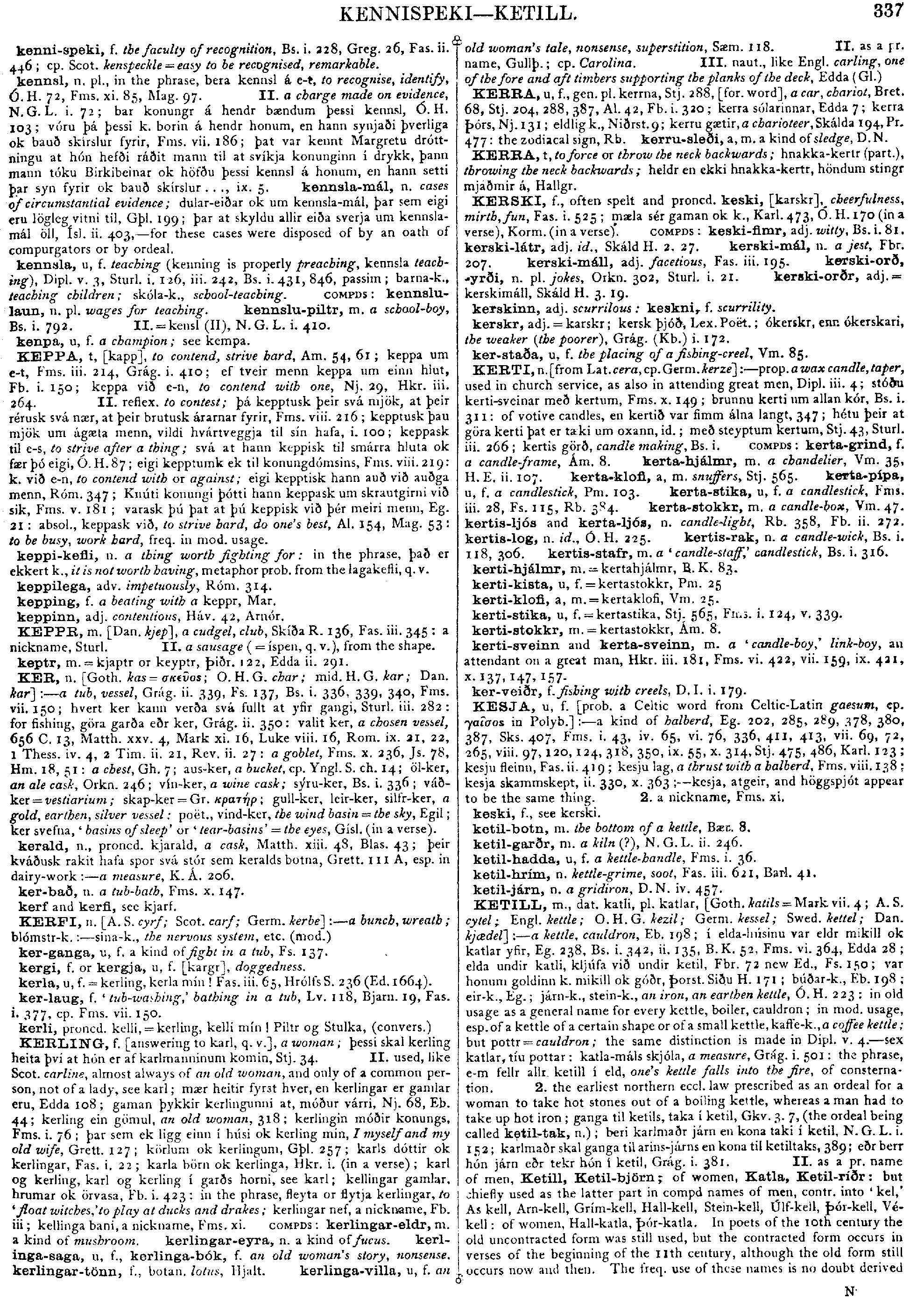
KETILL, m., dat. katli, pl. katlar, [Goth. katils = Mark vii. 4; A. S. cytel; Engl. kettle; O. H. G. kezil; Germ. kessel; Swed. kettel; Dan. kjædel] :-- a kettle, cauldron, Eb. 198; í elda-húsinu var eldr mikill ok katlar yfir, Eg. 238, Bs. i. 342, ii. 135, B. K. 52, Fms. vi. 364, Edda 28; elda undir katli, kljúfa við undir ketil, Fbr. 72 new Ed., Fs. 150; var honum goldinn k. mikill ok góðr, Þorst. Siðu H. 171; búðar-k., Eb. 198; eir-k., Eg.; járn-k., stein-k., an iron, an earthen kettle, Ó. H. 223: in old usage as a general name for every kettle, boiler, cauldron; in mod. usage, esp. of a kettle of a certain shape or of a small kettle, kaffe-k., a coffee kettle; but pottr = cauldron; the same distinction is made in Dipl. v. 4. -- sex katlar, tíu pottar: katla-máls skjóla, a measure, Grág. i. 501: the phrase, e-m fellr allr ketill í eld, one's kettle falls into the fire, of consternation. 2. the earliest northern eccl. law prescribed as an ordeal for a woman to take hot stones out of a boiling kettle, whereas a man had to take up hot iron; ganga til ketils, taka í ketil, Gkv. 3. 7, (the ordeal being called ketil-tak, n.); beri karlmaðr járn en kona taki í ketil, N. G. L. i. 152; karlmaðr skal ganga til arins-járns en kona til ketiltaks, 389; eðr berr hón járn eðr tekr hón í ketil, Grág. i. 381. II. as a pr. name of men, Ketill, Ketil-björn; of women, Katla, Ketil-ríðr: but chiefly used as the latter part in compd names of men, contr. into 'kel,' As-kell, Arn-kell, Grím-kell, Hall-kell, Stein-kell, Úlf-kell, Þór-kell, Vé-kell: of women, Hall-katla, Þór-katla. In poets of the 10th century the old uncontracted form was still used, but the contracted form occurs in verses of the beginning of the 11th century, although the old form still occurs now and then. The freq. use of these names is no doubt derived
|
Source: Cleasby/Vigfusson, page b0338, entry 1 View original page image as: [TIFF] [PNG] [View previous entry] [View next entry] |
[Comment on this entry] [View comments] |
The following entry has been hand-corrected once. |
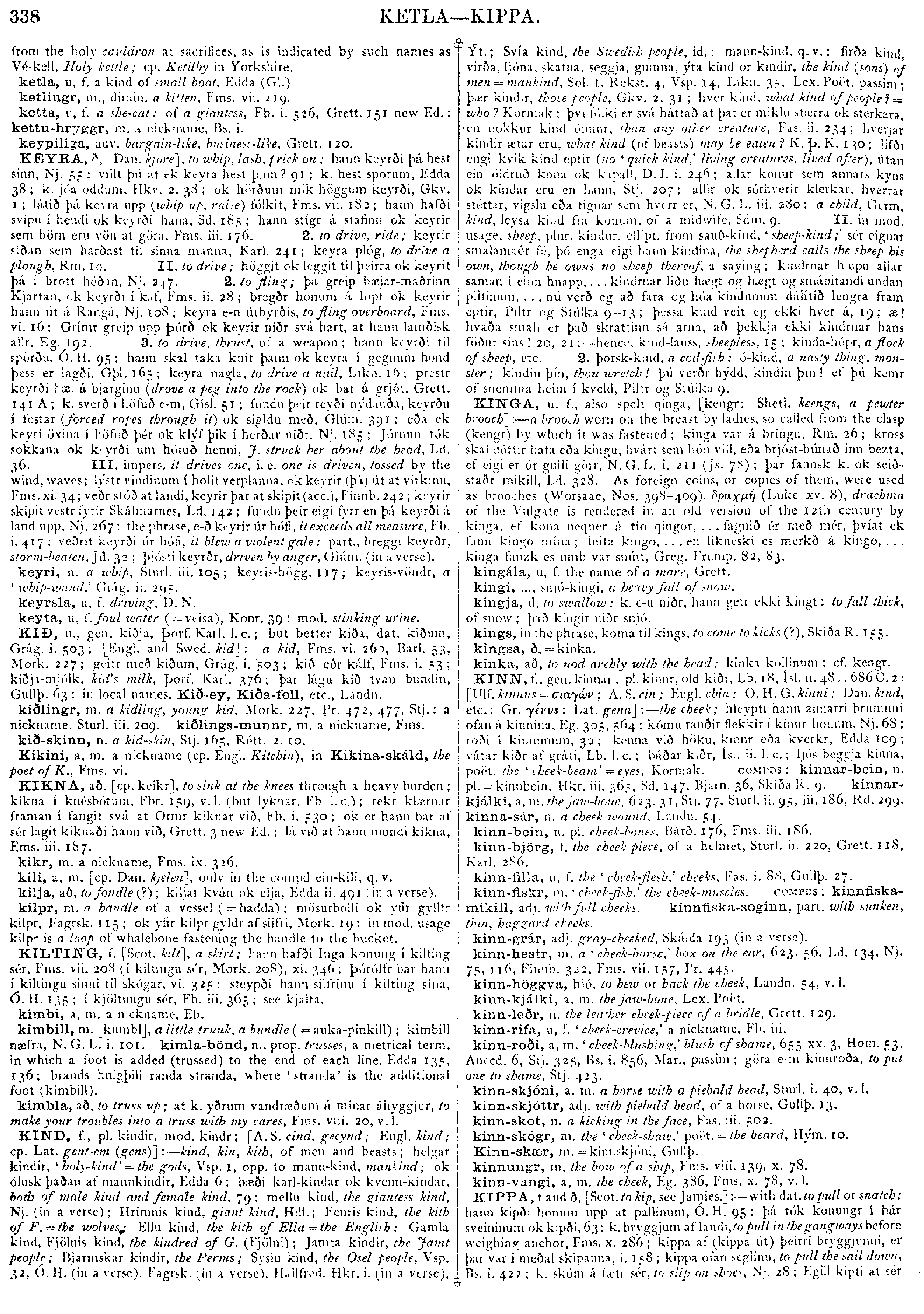
from the holy cauldron at sacrifices, as is indicated by such names as Vé-kell, Holy kettle; cp. Ketilby in Yorkshire.
|
Source: Cleasby/Vigfusson, page b0338, entry 10 View original page image as: [TIFF] [PNG] [View previous entry] [View next entry] |
[Comment on this entry] [View comments] |
The following entry has been hand-corrected once. |
KIÐ, n., gen. kiðja, Þorf. Karl. l.c.; but better kiði, dat. kiðum, Grág. i. 503; [Engl. and Swed. kid] :-- a kid, Fms. vi. 260, Barl. 53, Mork. 227; geitr með kiðum, Grág. i. 503; kið eðr kálf, Fms. i. 53; kiðja-mjólk, kid's milk, Þorf. Karl. 376; þar lágu kið tvau bundin, Gullþ. 63: in local names, Kið-ey, Kiða-fell, etc., Landn.
|
Source: Cleasby/Vigfusson, page b0339, entry 13 View original page image as: [TIFF] [PNG] [View previous entry] [View next entry] |
[Comment on this entry] [View comments] |
The following entry has been hand-corrected once. |
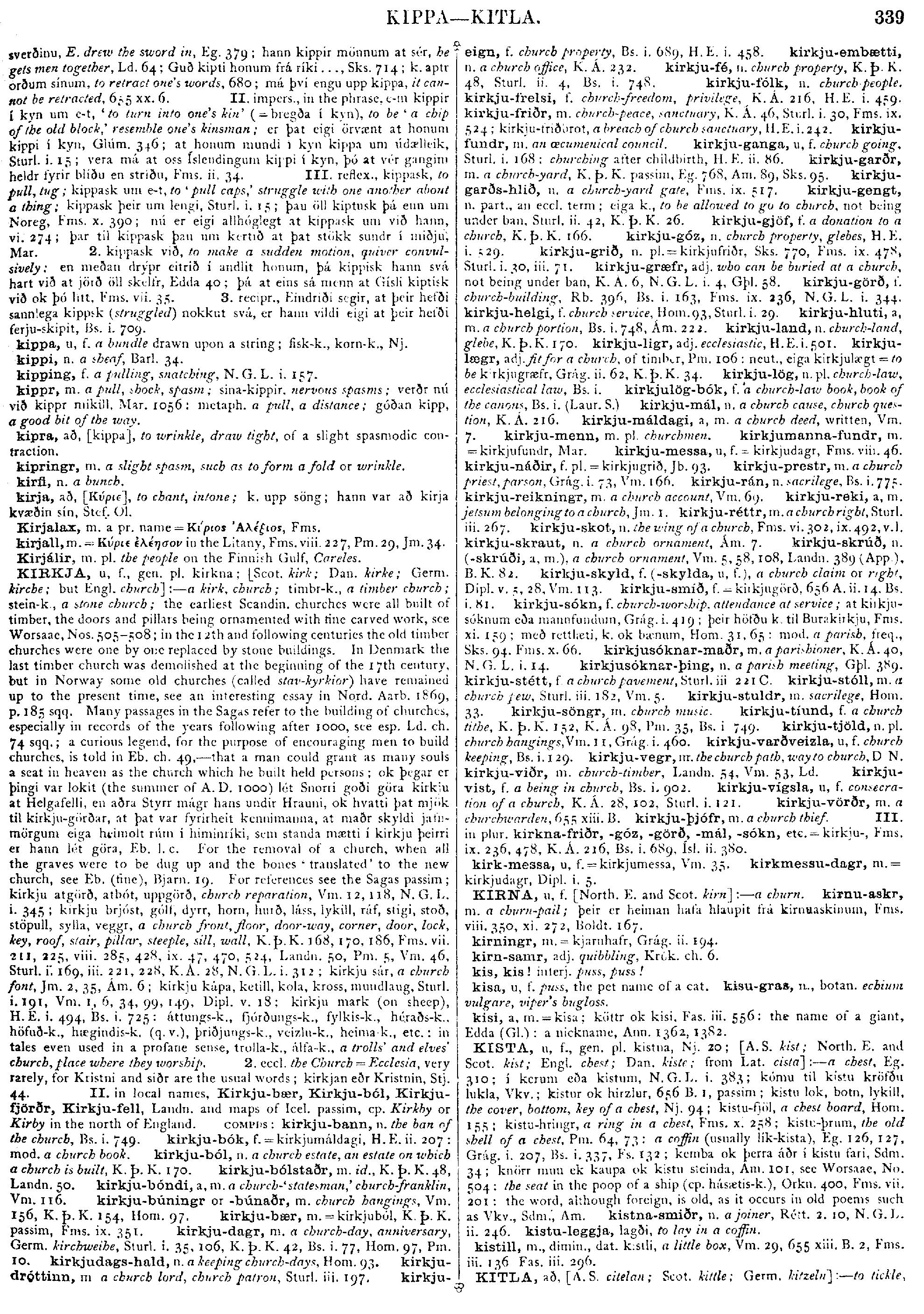
KIRKJA, u, f., gen. pl. kirkna; [Scot. kirk; Dan. kirke; Germ. kirche; but Engl. church] :-- a kirk, church; timbr-k., a timber church; stein-k., a stone church; the earliest Scandin. churches were all built of timber, the doors and pillars being ornamented with fine carved work, see Worsaae, Nos. 505-508; in the 12th and following centuries the old timber churches were one by one replaced by stone buildings. In Denmark the last timber church was demolished at the beginning of the 17th century, but in Norway some old churches (called stav-kyrkior) have remained up to the present time, see an interesting essay in Nord. Aarb. 1869, p. 185 sqq. Many passages in the Sagas refer to the building of churches, especially in records of the years following after 1000, see esp. Ld. ch. 74 sqq.; a curious legend, for the purpose of encouraging men to build churches, is told in Eb. ch. 49, -- that a man could grant as many souls a seat in heaven as the church which he built held persons; ok þegar er þingi var lokit (the summer of A.D. 1000) lét Snorri goði göra kirkju at Helgafelli, en aðra Styrr mágr hans undir Hrauni, ok hvatti pat mjök til kirkju-görðar, at þat var fyrirheit kennimanna, at maðr skyldi jafnmörgum eiga heimolt rúm í himinríki, sem standa mætti í kirkju þeirri er hann lét göra, Eb. l.c. For the removal of a church, when all the graves were to be dug up and the bones 'translated' to the new church, see Eb. (fine), Bjarn. 19. For references see the Sagas passim; kirkju atgörð, atbót, uppgörð, church reparation, Vm. 12, 118, N. G. L. i. 345; kirkju brjóst, gólf, dyrr, horn, hurð, láss, lykill, ráf, stigi, stoð, stöpull, sylla, veggr, a church front, floor, door-way, corner, door, lock, key, roof, stair, pillar, steeple, sill, wall, K. Þ. K. 168, 170, 186, Fms. vii. 211, 225, viii. 285, 428, ix. 47, 470, 524, Landn. 50, Pm. 5, Vm. 46, Sturl. i. 169, iii. 221, 228, K. Á. 28, N. G. L. i. 312; kirkju sár, a church font, Jm. 2, 35, Ám. 6; kirkju kápa, ketill, kola, kross, mundlaug, Sturl. i. 191, Vm. 1, 6, 34, 99, 149, Dipl. v. 18; kirkju mark (on sheep), H. E. i. 494, Bs. i. 725: áttungs-k., fjórðungs-k., fylkis-k., héraðs-k., höfuð-k., hægindis-k. (q.v.), þriðjungs-k., veizlu-k., heima-k., etc.: in tales even used in a profane sense, trolla-k., álfa-k., a trolls' and elves' church, place where they worship. 2. eccl. the Church = Ecclesia, very rarely, for Kristni and siðr are the usual words; kirkjan eðr Kristnin, Stj. 44. II. in local names, Kirkju-bær, Kirkju-ból, Kirkju-fjörðr, Kirkju-fell, Landn. and maps of Icel. passim, cp. Kirkby or Kirby in the north of England. COMPDS: kirkju-bann, n. the ban of the church, Bs. i. 749. kirkju-bók, f. = kirkjumáldagi, H. E. ii. 207: mod. a church book. kirkju-ból, n. a church estate, an estate on which a church is built, K. Þ. K. 170. kirkju-bólstaðr, m. id., K. Þ. K. 48, Landn. 50. kirkju-bóndi, a, m. a church-'statesman,' church-franklin, Vm. 116. kirkju-búningr or -búnaðr, m. church hangings, Vm. 156, K. Þ. K. 154, Hom. 97. kirkju-bær, m. = kirkjuból, K. Þ. K. passim, Fms. ix. 351. kirkju-dagr, m. a church-day, anniversary, Germ. kirchweihe, Sturl. i. 35, 106, K. Þ. K. 42, Bs. i. 77, Hom. 97, Pm. 10. kirkjudags-hald, n. a keeping church-days, Hom. 93. kirkju-dróttinn, m. a church lord, church patron, Sturl. iii. 197. kirkju-eign, f. church property, Bs. i. 689, H. E. i. 458. kirkju-embætti, n. a church office, K. Á. 232. kirkju-fé, n. church property, K. Þ. K. 48, Sturl. ii. 4, Bs. i. 748. kirkju-fólk, n. church people. kirkju-frelsi, f. church-freedom, privilege, K. Á. 216, H. E. i. 459. kirkju-friðr, m. church-peace, sanctuary, K. Á. 46, Sturl. i. 30, Fms. ix. 524; kirkju-friðbrot, a breach of church sanctuary, H. E. i. 242. kirkju-fundr, m. an œcumenical council. kirkju-ganga, u, f. church going, Sturl. i. 168: churching after childbirth, H. E. ii. 86. kirkju-garðr, m. a church-yard, K. Þ. K. passim, Eg. 768, Ám. 89, Sks. 95. kirkjugarðs-hlið, n. a church-yard gate, Fms. ix. 517. kirkju-gengt, n. part., an eccl. term; eiga k., to be allowed to go to church, not being under ban, Sturl. ii. 42, K. Þ. K. 26. kirkju-gjöf, f. a donation to a church, K. Þ. K. 166. kirkju-góz, n. church properly, glebes, H. E. i. 529. kirkju-grið, n. pl. = kirkjufriðr, Sks. 770, Fms. ix. 478, Sturl. i. 30, iii. 71. kirkju-græfr, adj. who can be buried at a church, not being under ban, K. Á. 6, N. G. L. i. 4, Gþl. 58. kirkju-görð, f. church-building, Rb. 396, Bs. i. 163, Fms. ix. 236, N. G. L. i. 344. kirkju-helgi, f. church service, Hom. 93, Sturl. i. 29. kirkju-hluti, a, m. a church portion, Bs. i. 748, Am. 222. kirkju-land, n. church-land, glebe, K. Þ. K. 170. kirkju-ligr, adj. ecclesiastic, H. E. i. 501. kirkju-lægr, adj. fit for a church, of timber, Pm. 106: neut., eiga kirkjulægt = to be kirkjugræfr, Grág. ii. 62, K. Þ. K. 34. kirkju-lög, n. pl. church-law, ecclesiastical law, Bs. i. kirkjulög-bók, f. a church-law book, book of the canons, Bs. i. (Laur. S.) kirkju-mál, n. a church cause, church question, K. Á. 216. kirkju-maldagi, a, m. a church deed, written, Vm. 7. kirkju-menn, m. pl. churchmen. kirkjumanna-fundr, m. = kirkjufundr, Mar. kirkju-messa, u, f. = kirkjudagr, Fms. viii. 46. kirkju-náðir, f. pl. = kirkjugrið, Jb. 93. kirkju-prestr, m. a church priest, parson, Grág. i. 73, Vm. 166. kirkju-rán, n. sacrilege, Bs. i. 775. kirkju-reikningr, m. a church account, Vm. 69. kirkju-reki, a, m. jetsum belonging to a church, Jm. 1. kirkju-réttr, m. a church right, Sturl. iii. 267. kirkju-skot, n. the wing of a church, Fms. vi. 302, ix. 492, v.l. kirkju-skraut, n. a church ornament, Am. 7. kirkju-skrúð, n. (-skrúði, a, m.). a church ornament, Vm. 5, 58, 108, Landn. 389 (App.), B. K. 82. kirkju-skyld, f. (-skylda, u, f.), a church claim or right, Dipl. v. 5, 28, Vm. 113. kirkju-smíð, f. = kirkjugörð, 656 A. ii. 14, Bs. i. 81. kirkju-sókn, f. church-worship, attendance at service; at kirkjusóknum eða mannfundum, Grág. i. 419; þeir höfðu k. til Burakirkju, Fms. xi. 159; með rettlæti, k. ok bænum, Hom. 31, 65: mod. a parish, freq., Sks. 94. Fms. x. 66. kirkjusóknar-maðr, m. a parishioner, K. Á. 40, N. G. L. i. 14. kirkjusóknar-þing, n. a parish meeting, Gþl. 389. kirkju-stétt, f. a church pavement, Sturl. iii 221 C. kirkju-stóll, m. a church pew, Sturl. iii. 182, Vm. 5. kirkju-stuldr, m. sacrilege, Hom. 33. kirkju-söngr, m. church music. kirkju-tíund, f. a church tithe, K. Þ. K. 152, K. Á. 98, Pm. 35, Bs. i. 749. kirkju-tjöld, n. pl. church hangings, Vm. 11, Grág. i. 460. kirkju-varðveizla, u, f. church keeping, Bs. i. 129. kirkju-vegr, m. the church path, way to church, D. N. kirkju-viðr, m. church-timber, Landn. 54, Vm. 53, Ld. kirkju-vist, f. a being in church, Bs. i. 902. kirkju-vígsla, u, f. consecration of a church, K. Á. 28, 102, Sturl. i. 121. kirkju-vörðr, m. a churchwarden, 655 xiii. B. kirkju-þjófr, m. a church thief. III. in plur. kirkna-friðr, -góz, -görð, -mál, -sókn, etc. = kirkju-, Fms. ix. 236, 478, K. Á. 216, Bs. i. 689, Ísl. ii. 380.
|
Source: Cleasby/Vigfusson, page b0340, entry 50 View original page image as: [TIFF] [PNG] [View previous entry] [View next entry] |
[Comment on this entry] [View comments] |
The following entry has not been hand-corrected. However, the page is reserved and someone is correcting it. |
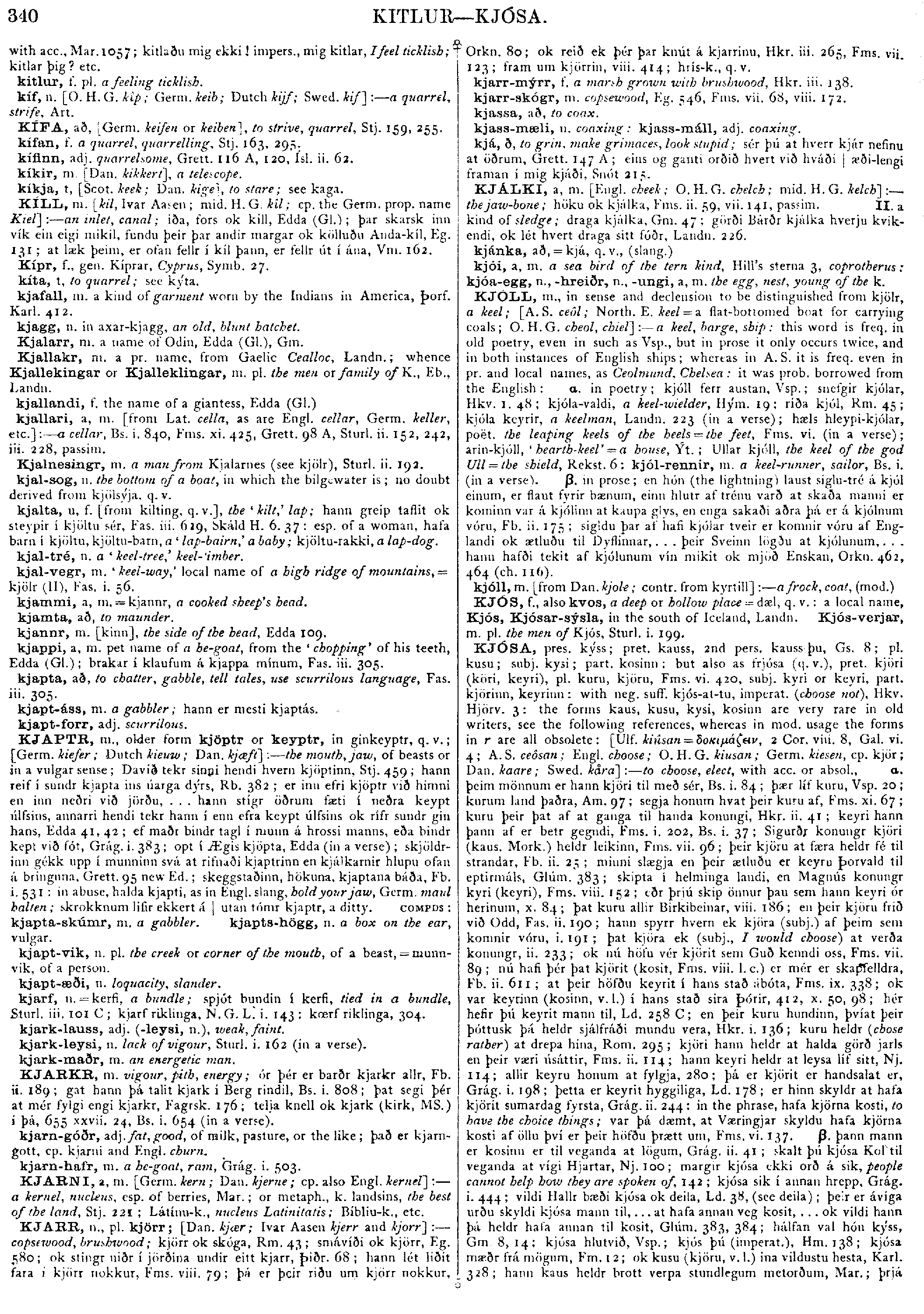
KJÓLL, m., in sense and declension to be distinguished from kjölr, a keel; [A. S. ceôl; North. E. keel = a flat-bottomed boat for carrying coals; O. H. G. cheol, chiel~ :-- -a keel, barge, ship: this word is freq. in old poetry, even in such as Vsp., but in prose it only occurs twice, and in both instances of English ships; whereas in A. S. it is freq. even in pr. and local names, as Ceolmnnd, Chelsea: it was prob. borrowed from the English: a. in poetry; kjóll ferr austan, Vsp.; snefgir kjólar, Hkv. I. 48; kjola-valdi, a keel-wielder, Hy'm. 19; ríða kjól, Rm. 45; kjóla kcyrir, a keelman, Landn. 223 (in a verse); hæls hleypi-kjólar, poët. the leaping keels of the heels = the feet, Fms. vi. (in a verse); arin-kjóll, ' hearth-keel' = a house, Ýt.; Ullar kjóll, the keel of the god Ull = the shield, Rekst. 6: kjól-rennir, m. a keel-runner, sailor, Bs. i. (in a verse1). p. in prose; en hón (the lightning") laust siglu-tré á kjól einum, er flaut fyrir bænurn, einn hlutr af trénu varð at skaða manni er kominn var á kjólinn at kaupa glys, en enga sakaði aðra þá er á kjólnum voru, Fb. ii. 175; sigldu bar at hafi kjúlar tveir er kornnir vóru af Eng- landi ok ætluðu til Dyflinnar, ... þeir Sveinn liigSu at kjolunuin, ... hann hafði tekit af kjólunum vin mikit ok mjoð F^nskan, Orkn. 462, 464 (ch. 116).
|
Source: Cleasby/Vigfusson, page b0341, entry 33 View original page image as: [TIFF] [PNG] [View previous entry] [View next entry] |
[Comment on this entry] [View comments] |
The following entry has not been hand-corrected. However, the page is reserved and someone is correcting it. |
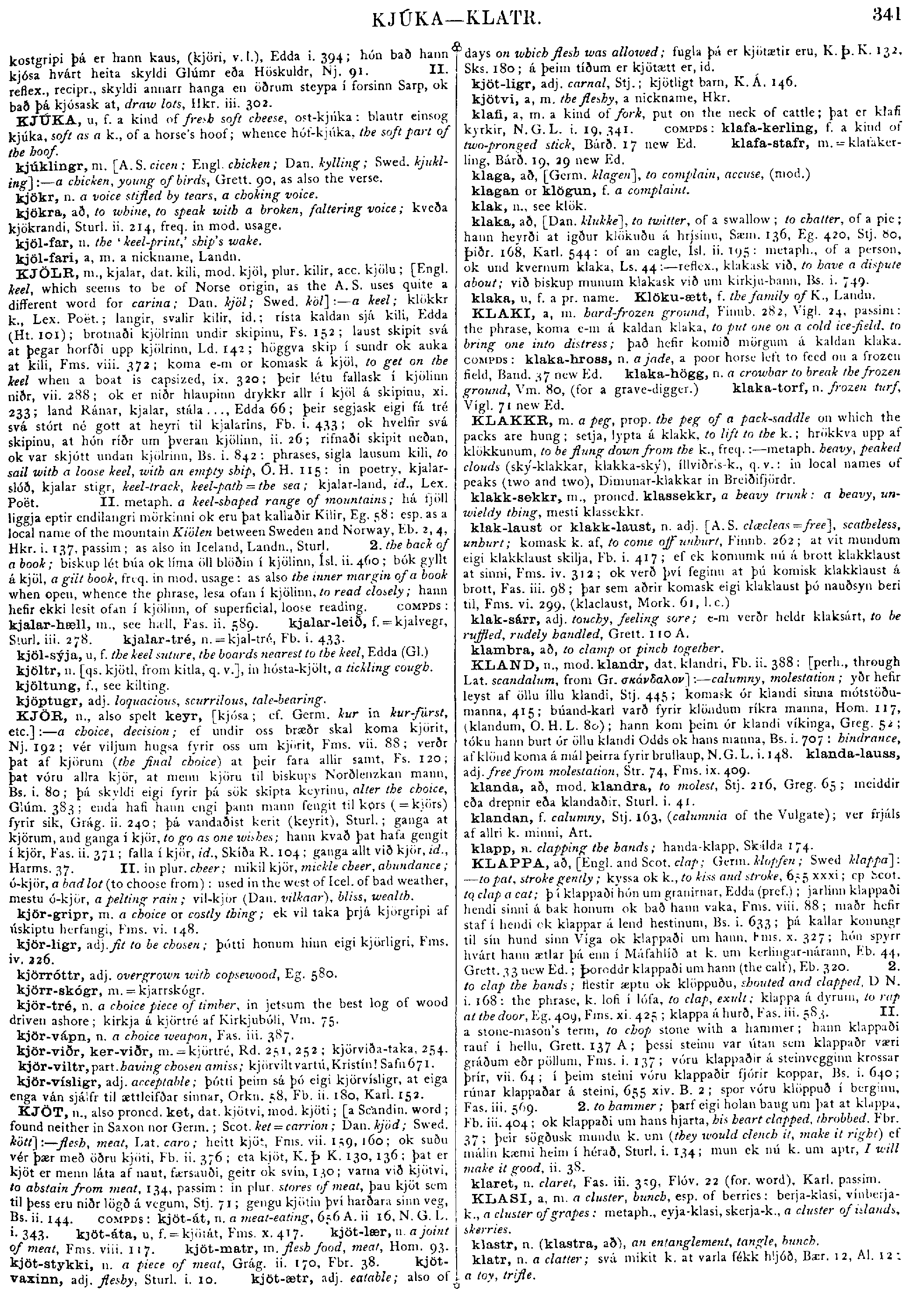
KLAKKR, in. a peg, prop, the peg of a pack-saddle on which the packs are hung; setja, lypta á klakk, to lift to the k.; hriikkva upp af klükkunum, to be flung down from the k., freq. :-- metaph. heavy, peaked clouds (sky'-klakkar, klakka-sky), íllviðris-k., q. v.: in local names of peaks (two and two), Dimunar-klakkar in Breiðifjördr.
| Result Page: |  |
Previous | 39 40 41 42 43 44 45 46 47 48 49 50 51 52 53 54 55 56 57 | Next |  |
Germanic Lexicon Project (main page)
This search system was written by
Sean Crist
Please consider
volunteering
to correct the data in these online dictionaries.
No rights reserved. Feel free to use these data in any way you please.