|
|

|
Source: Cleasby/Vigfusson, page b0288, entry 50 View original page image as: [TIFF] [PNG] [View previous entry] [View next entry] |
[Comment on this entry] [View comments] |
The following entry has been hand-corrected once. |
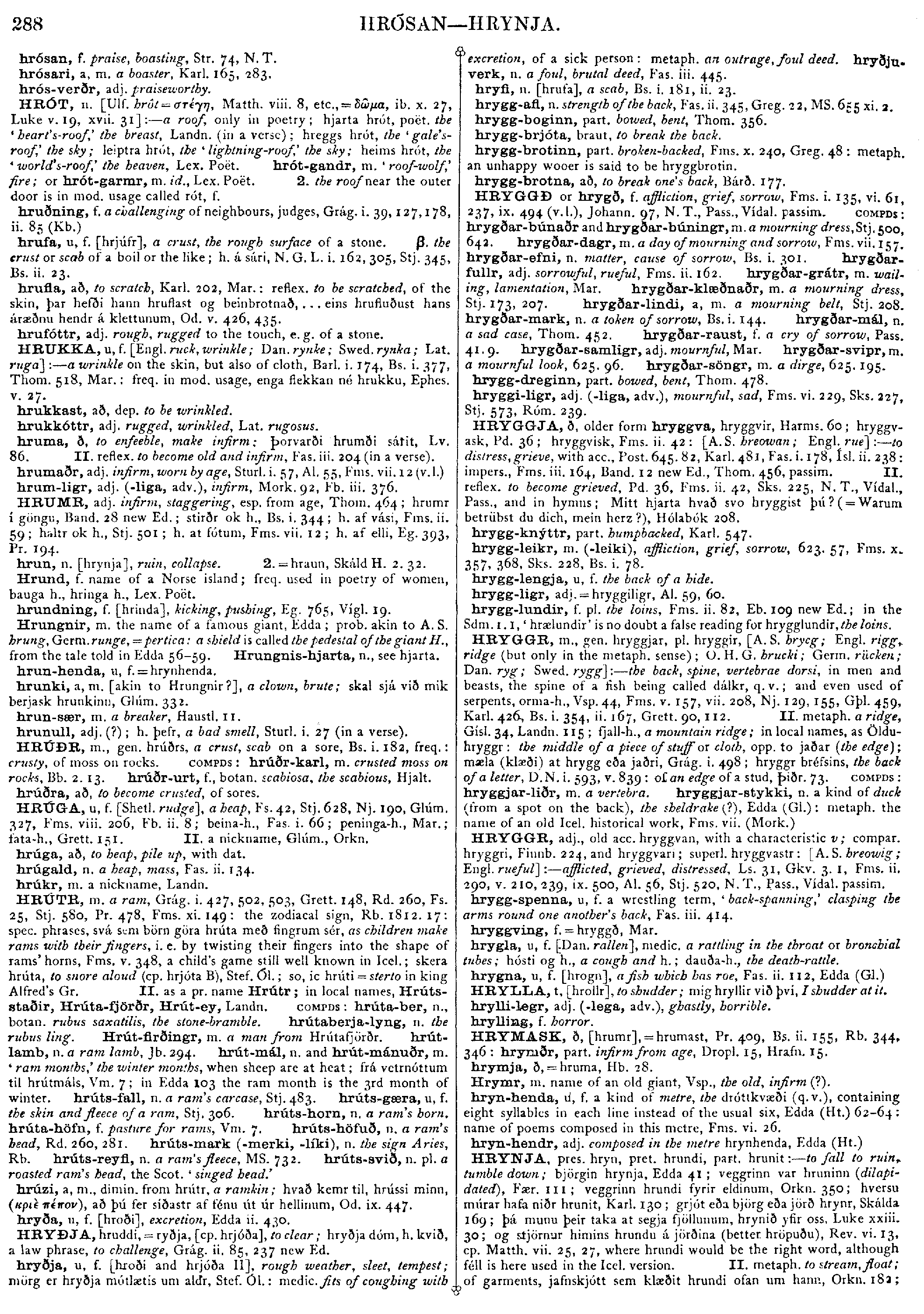
HRYGGR, m., gen. hryggjar, pl. hryggir, [A. S. hrycg; Engl. rigg, ridge (but only in the metaph. sense); O. H. G. hrucki; Germ. rücken; Dan. ryg; Swed. rygg] :-- the back, spine, vertebrae dorsi, in men and beasts, the spine of a fish being called dálkr, q.v.; and even used of serpents, orma-h., Vsp. 44, Fms. v. 157, vii. 208, Nj. 129, 155, Gþl. 459, Karl. 426, Bs. i. 354, ii. 167, Grett. 90, 112. II. metaph. a ridge, Gísl. 34, Landn. 115; fjall-h., a mountain ridge; in local names, as Öldu-hryggr: the middle of a piece of stuff or cloth, opp. to jaðar (the edge); mæla (klæði) at hrygg eða jaðri, Grág. i. 498; hryggr bréfsins, the back of a letter, D. N. i. 593, v. 839: of an edge of a stud, Þiðr. 73. COMPDS: hryggjar-liðr, m. a vertebra. hryggjar-stykki, n. a kind of duck (from a spot on the back), the sheldrake (?), Edda (Gl.): metaph. the name of an old Icel. historical work, Fms. vii. (Mork.)
|
Source: Cleasby/Vigfusson, page b0290, entry 6 View original page image as: [TIFF] [PNG] [View previous entry] [View next entry] |
[Comment on this entry] [View comments] |
The following entry has been hand-corrected once. |
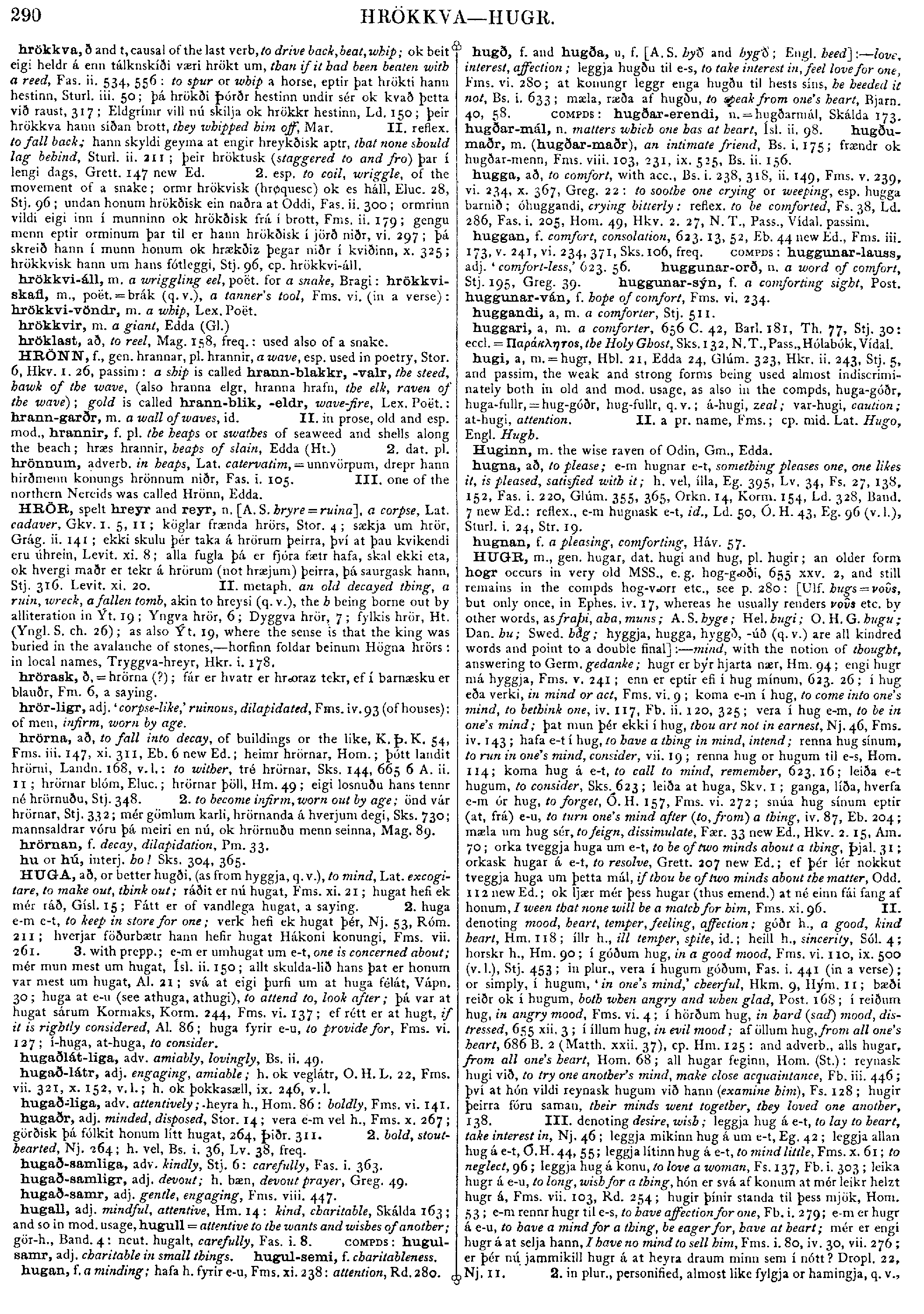
HRÖR, spelt hreyr and reyr, n. [A. S. hryre = ruina], a corpse, Lat. cadaver, Gkv. 1. 5, 11; köglar frænda hrörs, Stor. 4; sækja um hrör, Grág. ii. 141; ekki skulu þér taka á hrörum þeirra, því at þau kvikendi eru úhrein, Levit. xi. 8; alla fugla þá er fjóra fætr hafa, skal ekki eta, ok hvergi maðr er tekr á hrörum (not hræjum) þeirra, þá saurgask hann, Stj. 316. Levit. xi. 20. II. metaph. an old decayed thing, a ruin, wreck, a fallen tomb, akin to hreysi (q.v.), the h being borne out by alliteration in Ýt. 19; Yngva hrör, 6; Dyggva hrör, 7; fylkis hrör, Ht. (Yngl. S. ch. 26); as also Ýt. 19, where the sense is that the king was buried in the avalanche of stones, -- horfinn foldar beinum Högna hrörs: in local names, Tryggva-hreyr, Hkr. i. 178.
|
Source: Cleasby/Vigfusson, page b0292, entry 22 View original page image as: [TIFF] [PNG] [View previous entry] [View next entry] |
[Comment on this entry] [View comments] |
The following entry has been hand-corrected once. |
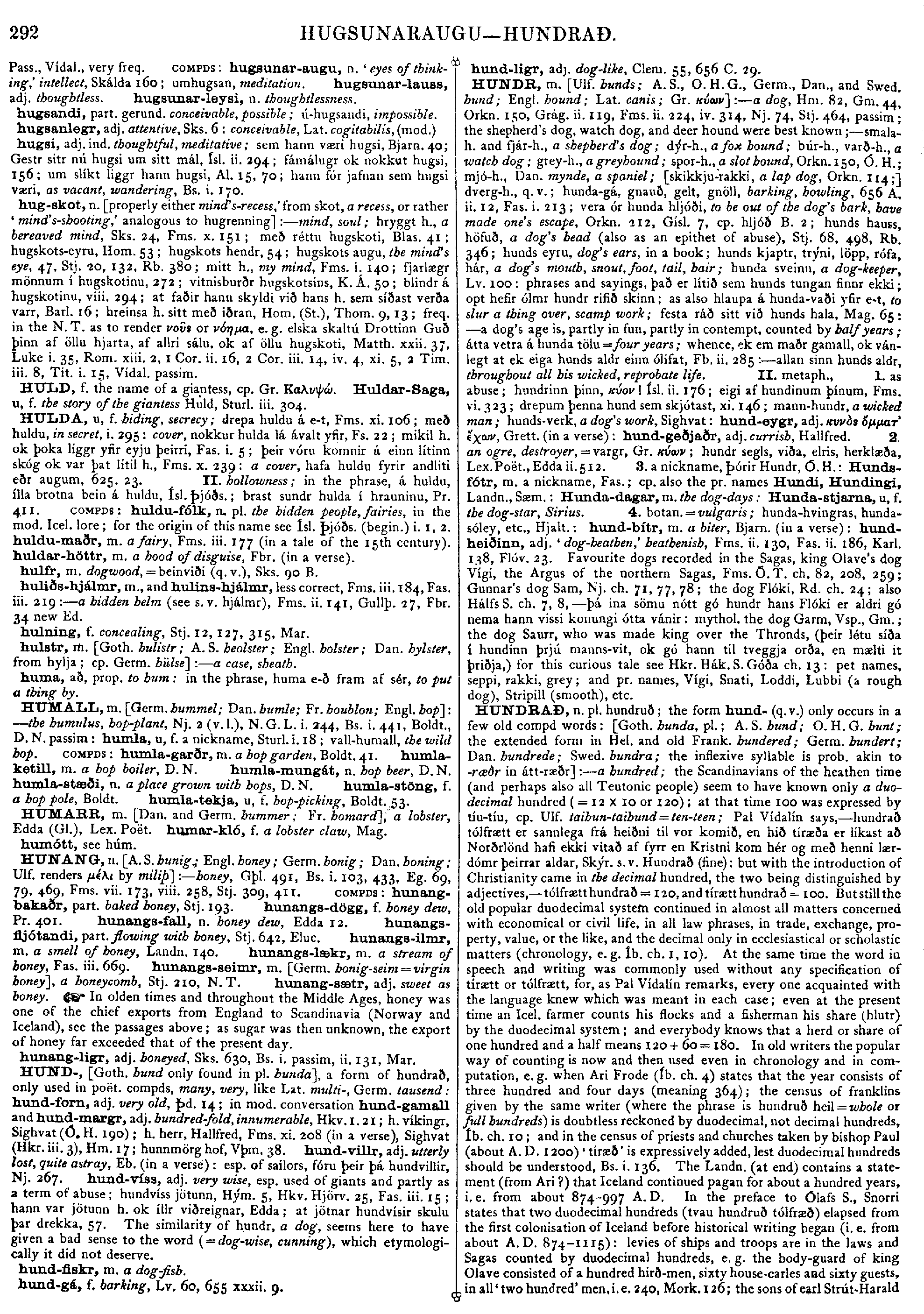
HUNDR, m. [Ulf. hunds; A. S., O. H. G., Germ., Dan., and Swed. hund; Engl. hound; Lat. canis; Gr. GREEK] :-- a dog, Hm. 82, Gm. 44, Orkn. 150, Grág. ii. 119, Fms. ii. 224, iv. 314, Nj. 74, Stj. 464, passim; the shepherd's dog, watch dog, and deer hound were best known; -- smala-h. and fjár-h., a shepherd's dog; dýr-h., a fox hound; búr-h., varð-h., a watch dog; grey-h., a greyhound; spor-h., a slot hound, Orkn. 150, Ó. H.; mjó-h., Dan. mynde, a spaniel; [skikkju-rakki, a lap dog, Orkn. 114;] dverg-h., q.v.; hunda-gá, gnauð, gelt, gnöll, barking, howling, 656 A. ii. 12, Fas. i. 213; vera ór hunda hljóði, to be out of the dog's bark, have made one's escape, Orkn. 212, Gísl. 7, cp. hljóð B. 2; hunds hauss, höfuð, a dog's head (also as an epithet of abuse), Stj. 68, 498, Rb. 346; hunds eyru, dog's ears, in a book; hunds kjaptr, trýni, löpp, rófa, hár, a dog's mouth, snout, foot, tail, hair; hunda sveinn, a dog-keeper, Lv. 100: phrases and sayings, það er lítið sem hunds tungan finnr ekki; opt hefir ólmr hundr rifið skinn; as also hlaupa á hunda-vaði yfir e-t, to slur a thing over, scamp work; festa ráð sitt við hunds hala, Mag. 65 :-- a dog's age is, partly in fun, partly in contempt, counted by half years; átta vetra á hunda tölu = four years; whence, ek em maðr gamall, ok vánlegt at ek eiga hunds aldr einn ólifat, Fb. ii. 285 :-- allan sinn hunds aldr, throughout all his wicked, reprobate life. II. metaph., 1. as abuse; hundrinn þinn, GREEK! Ísl. ii. 176; eigi af hundinum þínum, Fms. vi. 323; drepum þenna hund sem skjótast, xi. 146; mann-hundr, a wicked man; hunds-verk, a dog's work, Sighvat: hund-eygr, adj. GREEK, Grett. (in a verse): hund-geðjaðr, adj. currish, Hallfred. 2. an ogre, destroyer, = vargr, Gr. GREEK; hundr segls, viða, elris, herklæða, Lex. Poët., Edda ii. 512. 3. a nickname, Þórir Hundr, Ó. H.: Hunds-fótr, m. a nickname, Fas.; cp. also the pr. names Hundi, Hundingi, Landn., Sæm.: Hunda-dagar, m. the dog-days: Hunda-stjarna, u, f. the dog-star, Sirius. 4. botan. = vulgaris; hunda-hvingras, hunda-sóley, etc., Hjalt.: hund-bítr, m. a biter, Bjarn. (in a verse): hund-heiðinn, adj. 'dog-heathen,' heathenish, Fms. ii. 130, Fas. ii. 186, Karl. 138, Flóv. 23. Favourite dogs recorded in the Sagas, king Olave's dog Vígi, the Argus of the northern Sagas, Fms. Ó. T. ch. 82, 208, 259; Gunnar's dog Sam, Nj. ch. 71, 77, 78; the dog Flóki, Rd. ch. 24; also Hálfs S. ch. 7, 8, -- þá ina sömu nótt gó hundr hans Flóki er aldri gó nema hann vissi konungi ótta vánir: mythol. the dog Garm, Vsp., Gm.; the dog Saurr, who was made king over the Thronds, (þeir létu síða í hundinn þrjú manns-vit, ok gó hann til tveggja orða, en mælti it þriðja,) for this curious tale see Hkr. Hák. S. Góða ch. 13: pet names, seppi, rakki, grey; and pr. names, Vígi, Snati, Loddi, Lubbi (a rough dog), Stripill (smooth), etc.
|
Source: Cleasby/Vigfusson, page b0293, entry 3 View original page image as: [TIFF] [PNG] [View previous entry] [View next entry] |
[Comment on this entry] [View comments] |
The following entry has been hand-corrected once. |
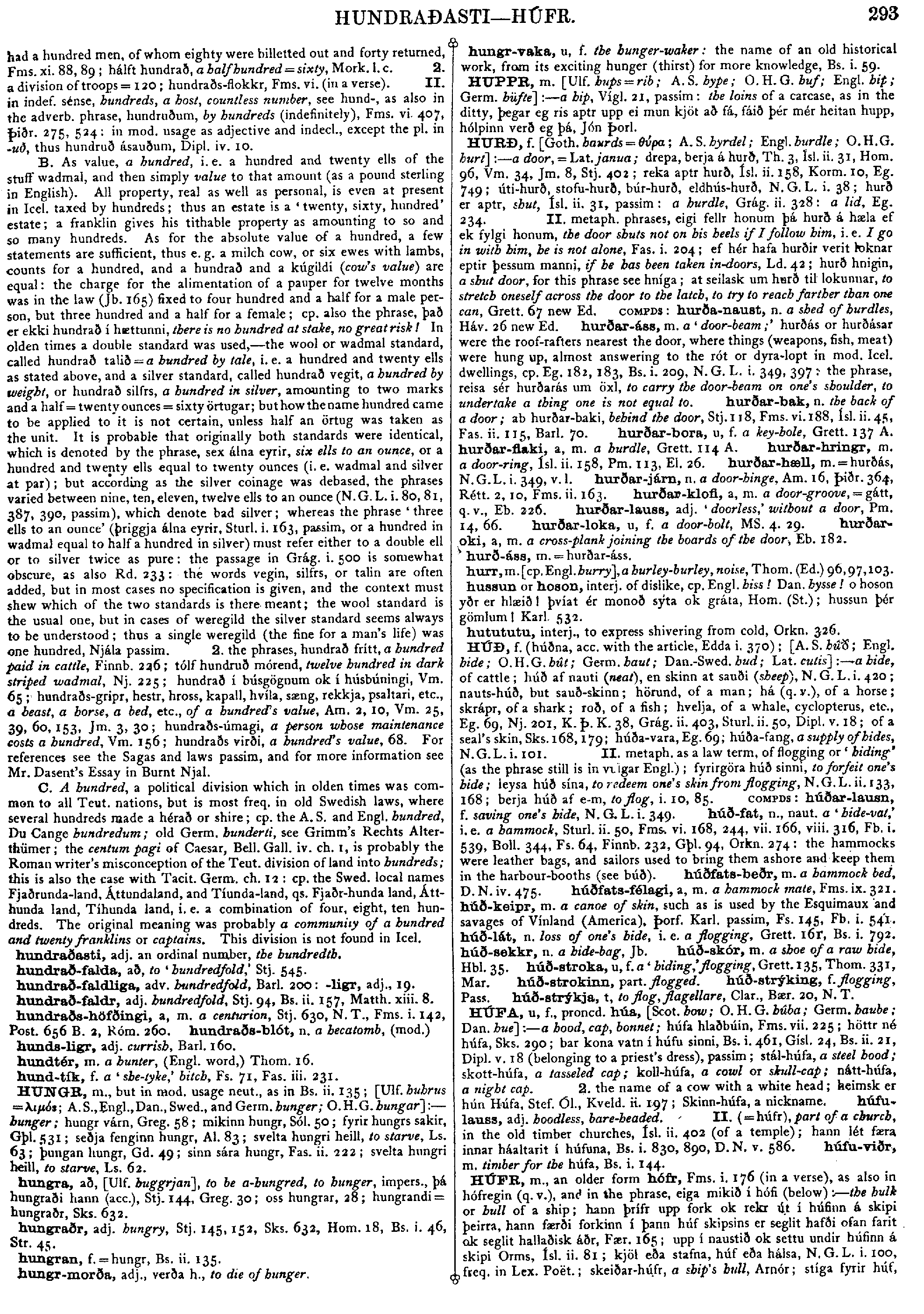
C. A hundred, a political division which in olden times was common to all Teut. nations, but is most freq. in old Swedish laws, where several hundreds made a hérað or shire; cp. the A. S. and Engl. hundred, Du Cange hundredum; old Germ. hunderti, see Grimm's Rechts Alterthümer; the centum pagi of Caesar, Bell. Gall. iv. ch. 1, is probably the Roman writer's misconception of the Teut. division of land into hundreds; this is also the case with Tacit. Germ. ch. 12: cp. the Swed. local names Fjaðrunda-land, Áttundaland, and Tíunda-land, qs. Fjaðr-hunda land, Átthunda land, Tíhunda land, i.e. a combination of four, eight, ten hundreds. The original meaning was probably a community of a hundred and twenty franklins or captains. This division is not found in Icel.
|
Source: Cleasby/Vigfusson, page b0294, entry 9 View original page image as: [TIFF] [PNG] [View previous entry] [View next entry] |
[Comment on this entry] [View comments] |
The following entry has been hand-corrected once. |
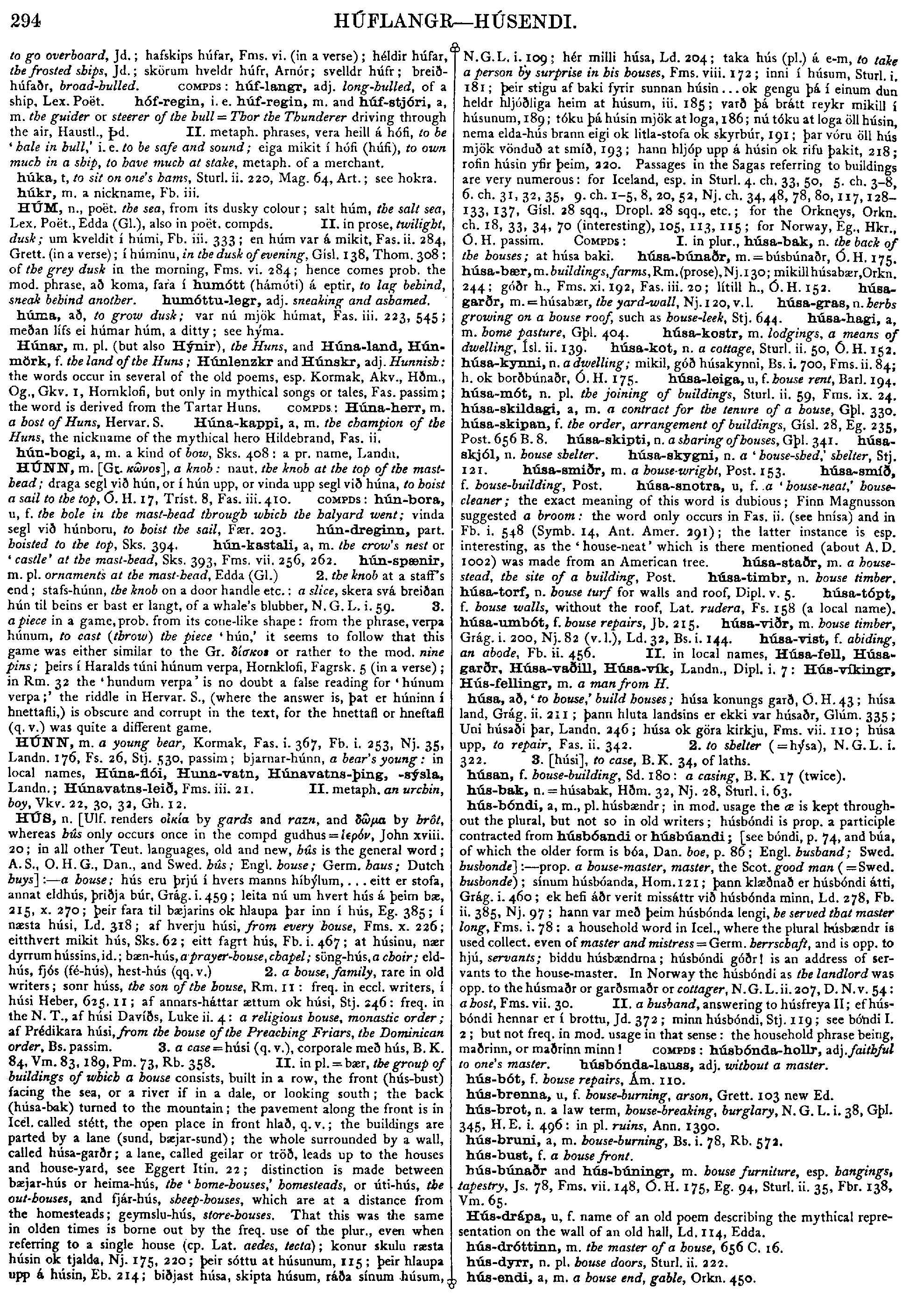
HÚNN, m. a young bear, Kormak, Fas. i. 367, Fb. i. 253, Nj. 35, Landn. 176, Fs. 26, Stj. 530, passim; bjarnar-húnn, a bear's young: in local names, Húna-flói, Húna-vatn, Húnavatns-þing, -sýsla, Landn.; Húnavatns-leið, Fms. iii. 21. II. metaph. an urchin, boy, Vkv. 22, 30, 32, Gh. 12.
|
Source: Cleasby/Vigfusson, page b0294, entry 10 View original page image as: [TIFF] [PNG] [View previous entry] [View next entry] |
[Comment on this entry] [View comments] |
The following entry has been hand-corrected once. |
HÚS, n. [Ulf. renders GREEK by gards and razn, and GREEK by hrôt, whereas hûs only occurs once in the compd gudhus = GREEK, John xviii. 20; in all other Teut. languages, old and new, hûs is the general word; A. S., O. H. G., Dan., and Swed. hûs; Engl. house; Germ. haus; Dutch huys] :-- a house; hús eru þrjú í hvers manns híbýlum, ... eitt er stofa, annat eldhús, þriðja búr, Grág. i. 459; leita nú um hvert hús á þeim bæ, 215, x. 270; þeir fara til bæjarins ok hlaupa þar inn í hús, Eg. 385; í næsta húsi, Ld. 318; af hverju húsi, from every house, Fms. x. 226; eitthvert mikit hús, Sks. 62; eitt fagrt hús, Fb. i. 467; at húsinu, nær dyrrum hússins, id.; bæn-hús, a prayer-house, chapel; söng-hús, a choir; eld-hús, fjós (fé-hús), hest-hús (qq.v.) 2. a house, family, rare in old writers; sonr húss, the son of the house, Rm. 11: freq. in eccl. writers, í húsi Heber, 625. 11; af annars-háttar ættum ok húsi, Stj. 246: freq. in the N. T., af húsi Davíðs, Luke ii. 4: a religious house, monastic order; af Prédikara húsi, from the house of the Preaching Friars, the Dominican order, Bs. passim. 3. a case = húsi (q.v.), corporale með hús, B. K. 84, Vm. 83, 189, Pm. 73, Rb. 358. II. in pl. = bær, the group of buildings of which a house consists, built in a row, the front (hús-bust) facing the sea, or a river if in a dale, or looking south; the back (húsa-bak) turned to the mountain; the pavement along the front is in Icel. called stétt, the open place in front hlað, q.v.; the buildings are parted by a lane (sund, bæjar-sund); the whole surrounded by a wall, called húsa-garðr; a lane, called geilar or tröð, leads up to the houses and house-yard, see Eggert Itin. 22; distinction is made between bæjar-hús or heima-hús, the 'home-houses,' homesteads, or úti-hús, the out-houses, and fjár-hús, sheep-houses, which are at a distance from the homesteads; geymslu-hús, store-houses. That this was the same in olden times is borne out by the freq. use of the plur., even when referring to a single house (cp. Lat. aedes, tecta); konur skulu ræsta húsin ok tjalda, Nj. 175, 220; þeir sóttu at húsunum, 115; þeir hlaupa upp á húsin, Eb. 214; biðjast húsa, skipta húsum, ráða sínum húsum, N. G. L. i. 109; hér milli húsa, Ld. 204; taka hús (pl.) á e-m, to take a person by surprise in his houses, Fms. viii. 172; inni í húsum, Sturl. i. 181; þeir stigu af baki fyrir sunnan húsin ... ok gengu þá í einum dun heldr hljóðliga heim at húsum, iii. 185; varð þá brátt reykr mikill í húsunum, 189; tóku þá húsin mjök at loga, 186; nú tóku at loga öll húsin, nema elda-hús brann eigi ok litla-stofa ok skyrbúr, 191; þar vóru öll hús mjök vönduð at smíð, 193; hann hljóp upp á húsin ok rifu þakit, 218; rofin húsin yfir þeim, 220. Passages in the Sagas referring to buildings are very numerous: for Iceland, esp. in Sturl. 4. ch. 33, 50, 5. ch. 3-8, 6. ch. 31, 32, 35, 9. ch. 1-5, 8, 20, 52, Nj. ch. 34, 48, 78, 80, 117, 128-133, 137, Gísl. 28 sqq., Dropl. 28 sqq., etc.; for the Orkneys, Orkn. ch. 18, 33, 34, 70 (interesting), 105, 113, 115; for Norway, Eg., Hkr., Ó. H. passim. COMPDS: I. in plur., húsa-bak, n. the back of the houses; at húsa baki. húsa-búnaðr, m. = húsbúnaðr UNCERTAIN, Ó. H. 175. húsa-bær, m. buildings, farms, Rm. (prose), Nj. 130; mikill húsabær, Orkn. 244; góðr h., Fms. xi. 192, Fas. iii. 20; lítill h., Ó. H. 152. húsa-garðr, m. = húsabær, the yard-wall, Nj. 120, v.l. húsa-gras, n. herbs growing on a house roof, such as house-leek, Stj. 644. húsa-hagi, a, m. home pasture, Gþl. 404. húsa-kostr, m. lodgings, a means of dwelling, Ísl. ii. 139. húsa-kot, n. a cottage, Sturl. ii. 50, Ó. H. 152. húsa-kynni, n. a dwelling; mikil, góð húsakynni, Bs. i. 700, Fms. ii. 84; h. ok borðbúnaðr, Ó. H. 175. húsa-leiga, u, f. house rent, Barl. 194. húsa-mót, n. pl. the joining of buildings, Sturl. ii. 59, Fms. ix. 24. húsa-skildagi, a, m. a contract for the tenure of a house, Gþl. 330. húsa-skipan, f. the order, arrangement of buildings, Gísl. 28, Eg. 235, Post. 656 B. 8. húsa-skipti, n. a sharing of houses, Gþl. 341. húsa-skjól, n. house shelter. húsa-skygni, n. a 'house-shed,' shelter, Stj. 121. húsa-smiðr, m. a house-wright, Post. 153. húsa-smíð, f. house-building, Post. húsa-snotra, u, f. a 'house-neat,' house-cleaner; the exact meaning of this word is dubious; Finn Magnusson suggested a broom: the word only occurs in Fas. ii. (see hnísa) and in Fb. i. 548 (Symb. 14, Ant. Amer. 291); the latter instance is esp. interesting, as the 'house-neat' which is there mentioned (about A.D. 1002) was made from an American tree. húsa-staðr, m. a house-stead, the site of a building, Post. húsa-timbr, n. house timber. húsa-torf, n. house turf for walls and roof, Dipl. v. 5. húsa-tópt, f. house walls, without the roof, Lat. rudera, Fs. 158 (a local name). húsa-umbót, f. house repairs, Jb. 215. húsa-viðr, m. house timber, Grág. i. 200, Nj. 82 (v.l.), Ld. 32, Bs. i. 144. húsa-vist, f. abiding, an abode, Fb. ii. 456. II. in local names, Húsa-fell, Húsa-garðr, Húsa-vaðill, Húsa-vík, Landn., Dipl. i. 7: Hús-víkingr, Hús-fellingr, m. a man from H.
|
Source: Cleasby/Vigfusson, page b0295, entry 45 View original page image as: [TIFF] [PNG] [View previous entry] [View next entry] |
[Comment on this entry] [View comments] |
The following entry has been hand-corrected once. |
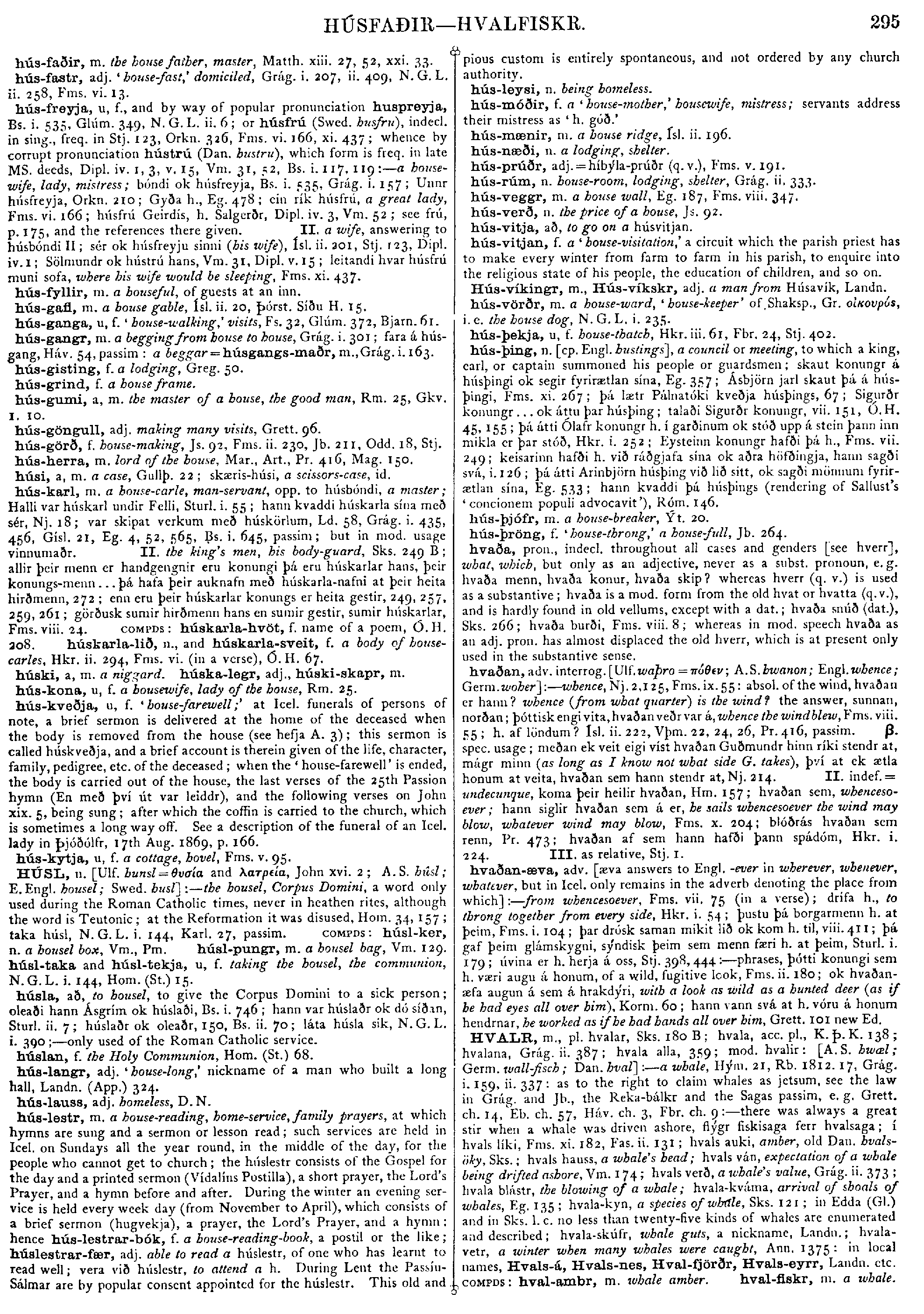
HVALR, m., pl. hvalar, Sks. 180 B; hvala, acc. pl., K. þ. K. 138; hvalana, Grág. ii. 387; hvala alla, 359; mod. hvalir: [A. S. hwœl; Germ, wall-fiscb; Dan. hval] :-- a whale, Hým. 21, Rb. 1812. 17, Grág. 1. 159, ii.337: as to the right to claim whales as jetsum, see the law in Grág. and Jb., the Reka-bálkr and the Sagas passim, e. g. Grett. ch. 14,Eb. ch. 57, Háv. ch. 3, Fbr. ch. 9 :-- there was always a great stir when a whale was driven ashore, flýgr fiskisaga ferr hvalsaga; í hvals líki, Fms. xi. 182, Fas. ii. 131; hvals auki, amber, old Dan. hvals- öky, Sks.; hvals hauss, a whale's head; hvals ván, expectation of a whale being drifted ashore, Vm. 174; hvals verð, a whale's value, Grág. ii. 373; hvala blástr, the blowing of a whale; hvala-kváma, arrival of shoals of whales, Eg. 135; hvala-kyn, a species of whale, Sks. 121; in Edda (Gl.) and in Sks. 1. c. no less than twenty-five kinds of whales are enumerated and described; hvala-skúfr, whale guts, a nickname, Landn.; hvala- vetr, a winter when many whales were caught, Ann. 1375: in local names, Hvals-á, Hvals-nes, Hval-fjörðr, Hvals-eyrr, Landn. etc. COMPDS: hval-ambr, m. whale amber. hval-fiskr, m. a whale.
|
Source: Cleasby/Vigfusson, page b0298, entry 7 View original page image as: [TIFF] [PNG] [View previous entry] [View next entry] |
[Comment on this entry] [View comments (1)] |
The following entry has been hand-corrected once. |
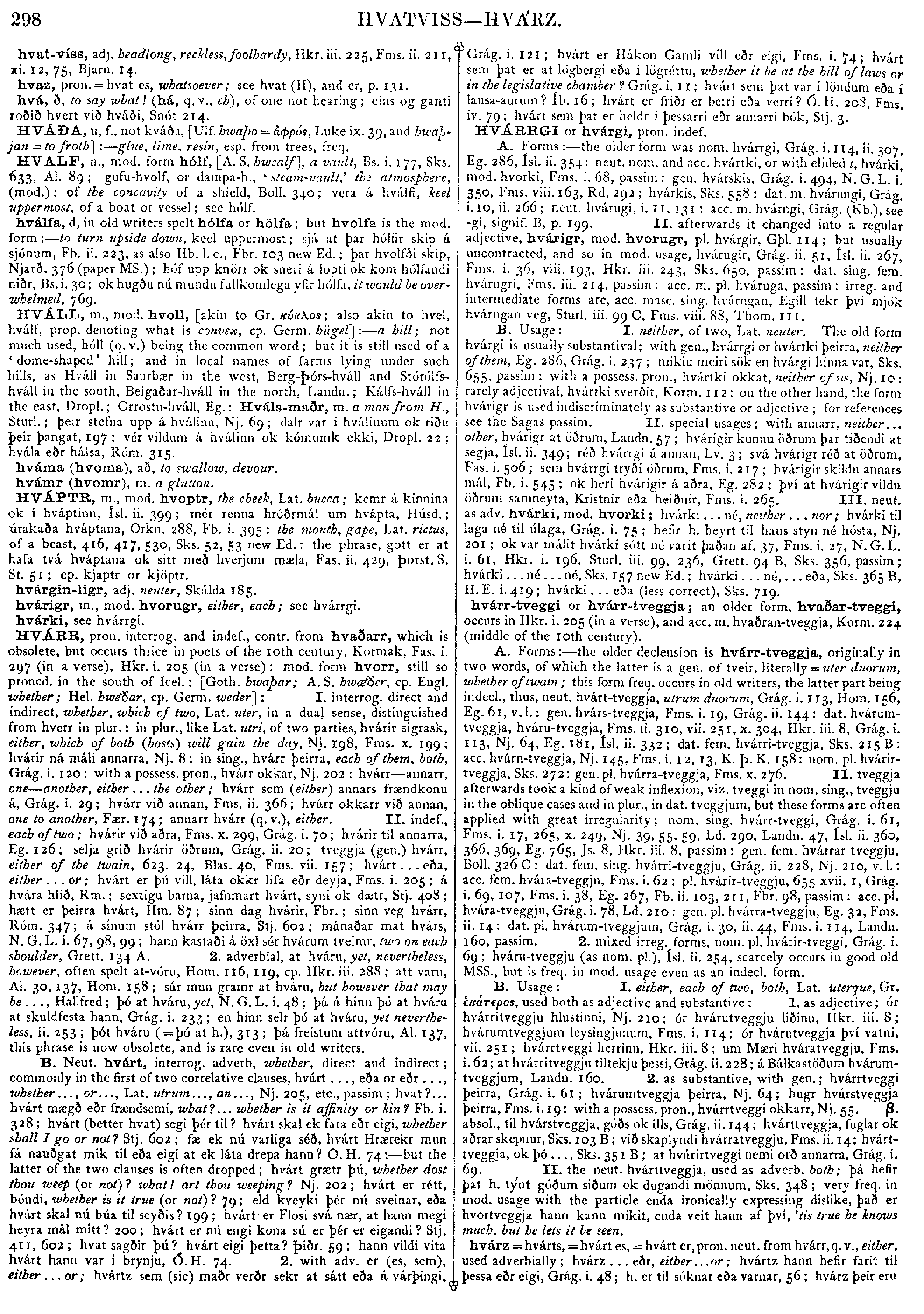
HVÁLL, m., mod. hvoll, [akin to Gr. GREEK also akin to hvel, hválf, prop, denoting what is convex, cp. Germ, hügel] :-- a bill; not much used, holl (q. v.) being the common word; but it is still used of a 'dome-shaped' hill; and in local names of farms lying under such hills, as Hváll in Saurbær in the west, Berg-þórs-hváll and Stórólfs- hváll in the south, Beigaðar-hváll in the north, Landn.; Kálfs-hváll in the east, Dropl.; Orrostu-hváll, Eg.: Hváls-maðr, m. a man from H., Sturl.; þeir stefna upp á hválinn, Nj. 69; dalr var í hválinum ok riðu þeir þangat, 197; vér vildum á hválinn ok kómumk ekki, Dropl. 22; hvála eðr hálsa, Róm. 315.
|
Source: Cleasby/Vigfusson, page b0300, entry 2 View original page image as: [TIFF] [PNG] [View previous entry] [View next entry] |
[Comment on this entry] [View comments] |
The following entry has been hand-corrected once. |
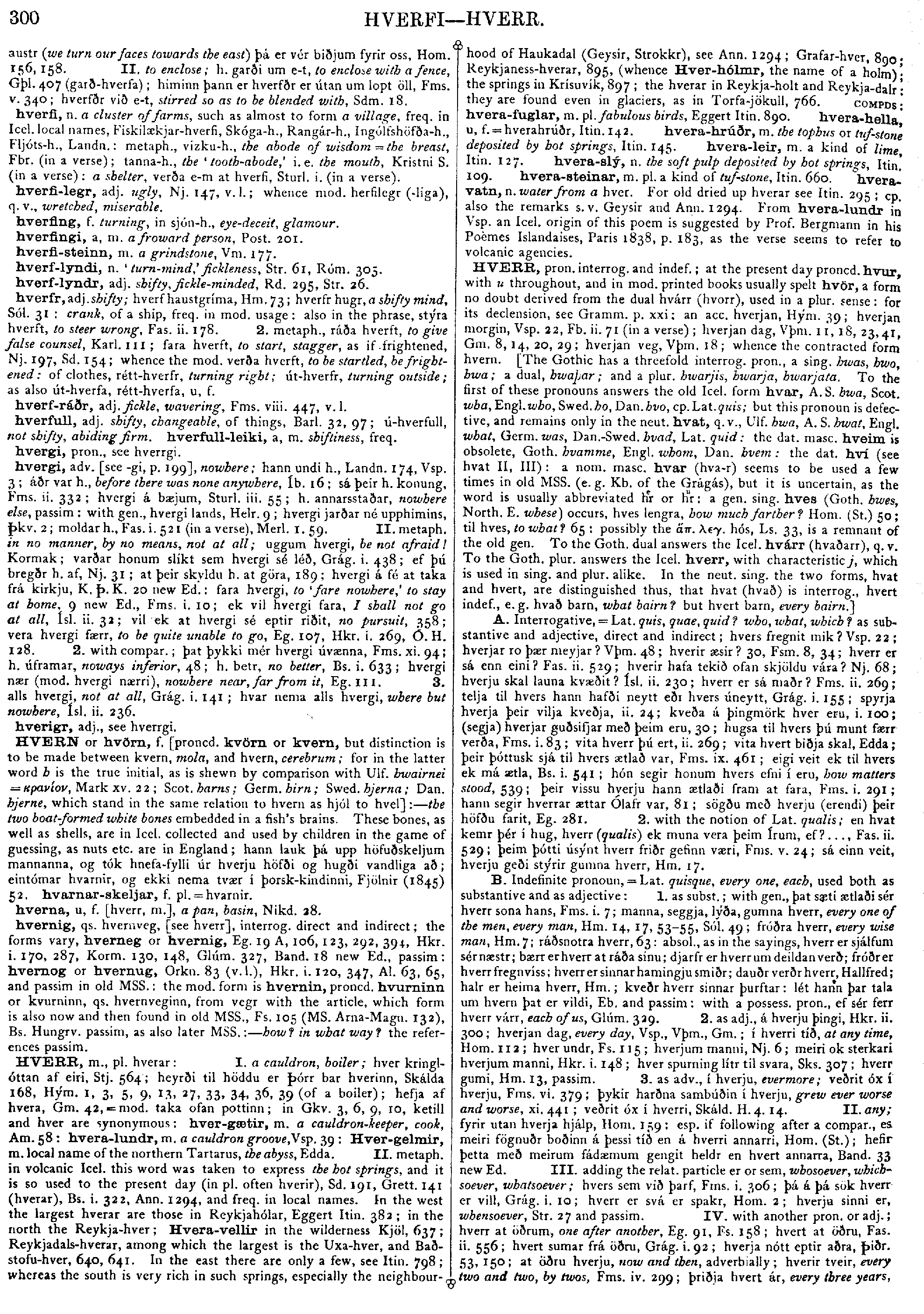
hverfi, n. a cluster of farms, such as almost to form a village, freq. in Icel. local names, Fiskilækjar-hverfi, Skóga-h., Rangár-h., Ingólfshöfða-h., Fljóts-h., Landn.: metaph., vizku-h., the abode of wisdom = the breast, Fbr. (in a verse); tanna-h., the 'tooth-abode,' i. e. the mouth, Kristni S. (in a verse): a shelter, verða e-m at hverfi, Sturl. i. (in a verse).
|
Source: Cleasby/Vigfusson, page b0300, entry 18 View original page image as: [TIFF] [PNG] [View previous entry] [View next entry] |
[Comment on this entry] [View comments] |
The following entry has been hand-corrected once. |
HVERR, m., pl. hverar: I. a cauldron, boiler; hver kringl- óttan af eiri, Stj. 564; heyrði til höddu er Þorr bar hverinn, Skálda 168, Hym. 1, 3, 5, 9, 13, 27, 33, 34, 36, 39 (of a boiler); hefja af hvera, Gm. 42,= mod. taka ofan pottinn; in Gkv. 3, 6, 9, 10, ketill and hver are synonymous: hver-gætir, m. a cauldron-keeper, cook, Am. 58: hvera-lundr, m. a cauldron groove, Vsp. 39: Hver-gelmir, m. local name of the northern Tartarus, the abyss, Edda. II. metaph. in volcanic Icel. this word was taken to express the hot springs, and it is so used to the present day (in pl. often hverir), Sd. 191, Grett. 141 (hverar), Bs. i. 322, Ann. 1294, and freq. in local names. In the west the largest hverar are those in Reykjahólar, Eggert Itin. 382; in the north the Reykja-hver; Hvera-vellir in the wilderness Kjöl, 637; Reykjadals-hverar, among which the largest is the Uxa-hver, and Bað- stofu-hver, 640, 641. In the east there are only a few, see Itin. 798; whereas the south is very rich in such springs, especially the neighbour- hood of Haukadal (Geysir, Strokkr), see Ann. 1294; Grafar-hver, 890- Reykjaness-hverar, 895, (whence Hver-holmr, the name of a holm); the springs in Krísuvík, 897; the hverar in Reykja-holt and Reykja-dalr: they are found even in glaciers, as in Torfa-jökull, 766. COMPDS; hvera-fuglar, m. pl. fabulous birds, Eggert Itin. 890. hvera-hella, u, f. = hverahrúðr, Itin. 142. hvera-hrúðr, m. the tophus or tuf-stone deposited by hot springs, Itin. 145. hvera-leir, m. a kind of lime Itin. 127. hvera-slý, n. the soft pulp deposited by hot springs, Itin. 109. hvera-steinar, m. pl. a kind of tuf-stone, Itin. 660. hvera- vatn, n. water from a hver. For old dried up hverar see Itin. 295; cp. also the remarks s. v. Geysir and Ann. 1294. From hvera-lundr in Vsp. an Icel. origin of this poem is suggested by Prof. Bergmann in his Poëmes Islandaises, Paris 1838, p. 183, as the verse seems to refer to volcanic agencies.
| Result Page: |  |
Previous | 36 37 38 39 40 41 42 43 44 45 46 47 48 49 50 51 52 53 54 | Next |  |
Germanic Lexicon Project (main page)
This search system was written by
Sean Crist
Please consider
volunteering
to correct the data in these online dictionaries.
No rights reserved. Feel free to use these data in any way you please.