|
|

|
Source: Cleasby/Vigfusson, page b0220, entry 5 View original page image as: [TIFF] [PNG] [View previous entry] [View next entry] |
[Comment on this entry] [View comments] |
The following entry has been hand-corrected once. |
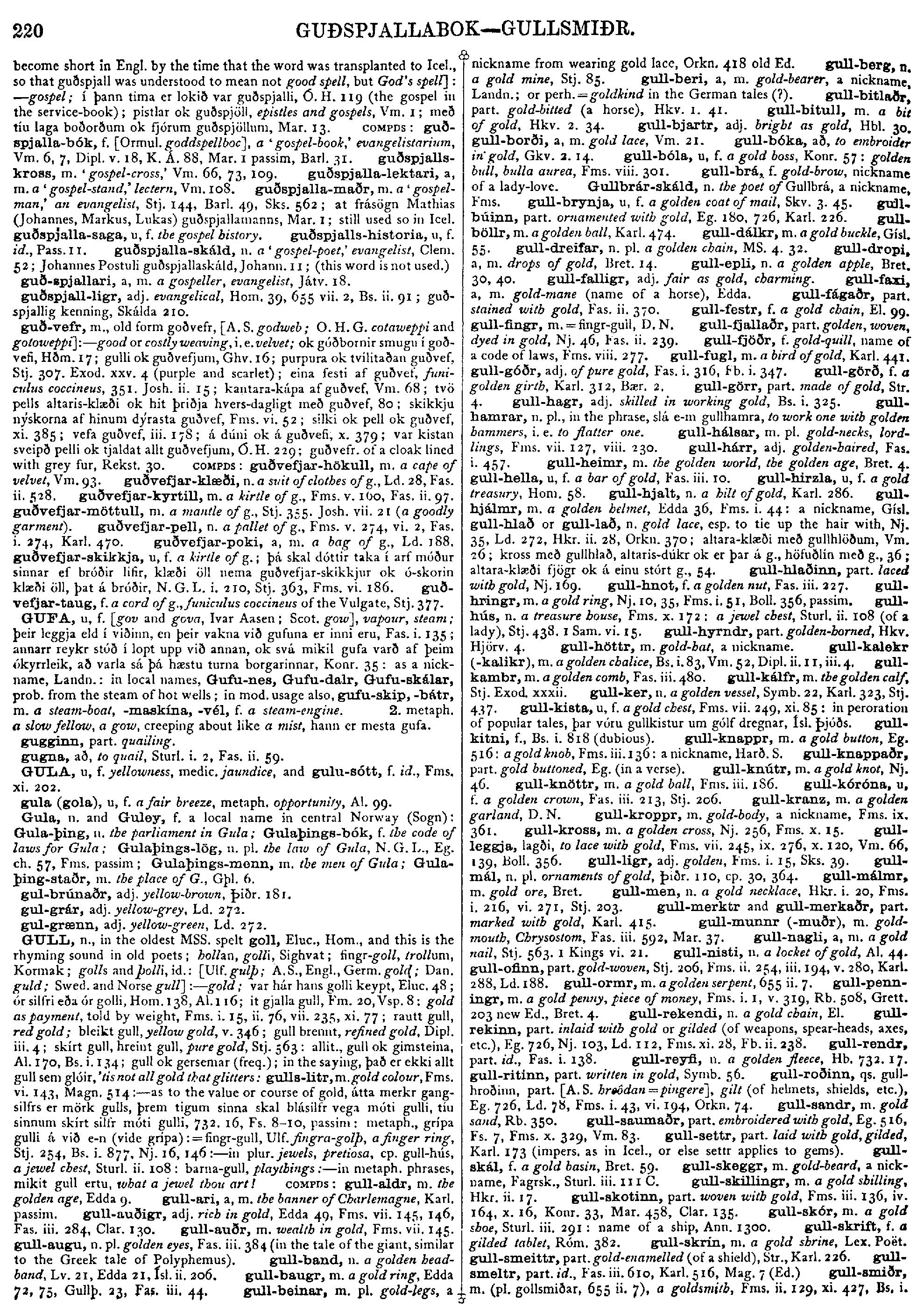
GUFA, u, f. [gov and gova, Ivar Aasen; Scot. gow], vapour, steam; þeir leggja eld í viðinn, en þeir vakna við gufuna er inni eru, Fas. i. 135; annarr reykr stóð í lopt upp við annan, ok svá mikil gufa varð af þeim ókyrrleik, að varla sá þá hæstu turna borgarinnar, Konr. 35: as a nickname, Landn.: in local names, Gufu-nes, Gufu-dalr, Gufu-skálar, prob. from the steam of hot wells; in mod. usage also, gufu-skip, -bátr, m. a steam-boat, -maskína, -vél, f. a steam-engine. 2. metaph. a slow fellow, a gow, creeping about like a mist, hann er mesta gufa.
|
Source: Cleasby/Vigfusson, page b0221, entry 14 View original page image as: [TIFF] [PNG] [View previous entry] [View next entry] |
[Comment on this entry] [View comments] |
The following entry has been hand-corrected once. |
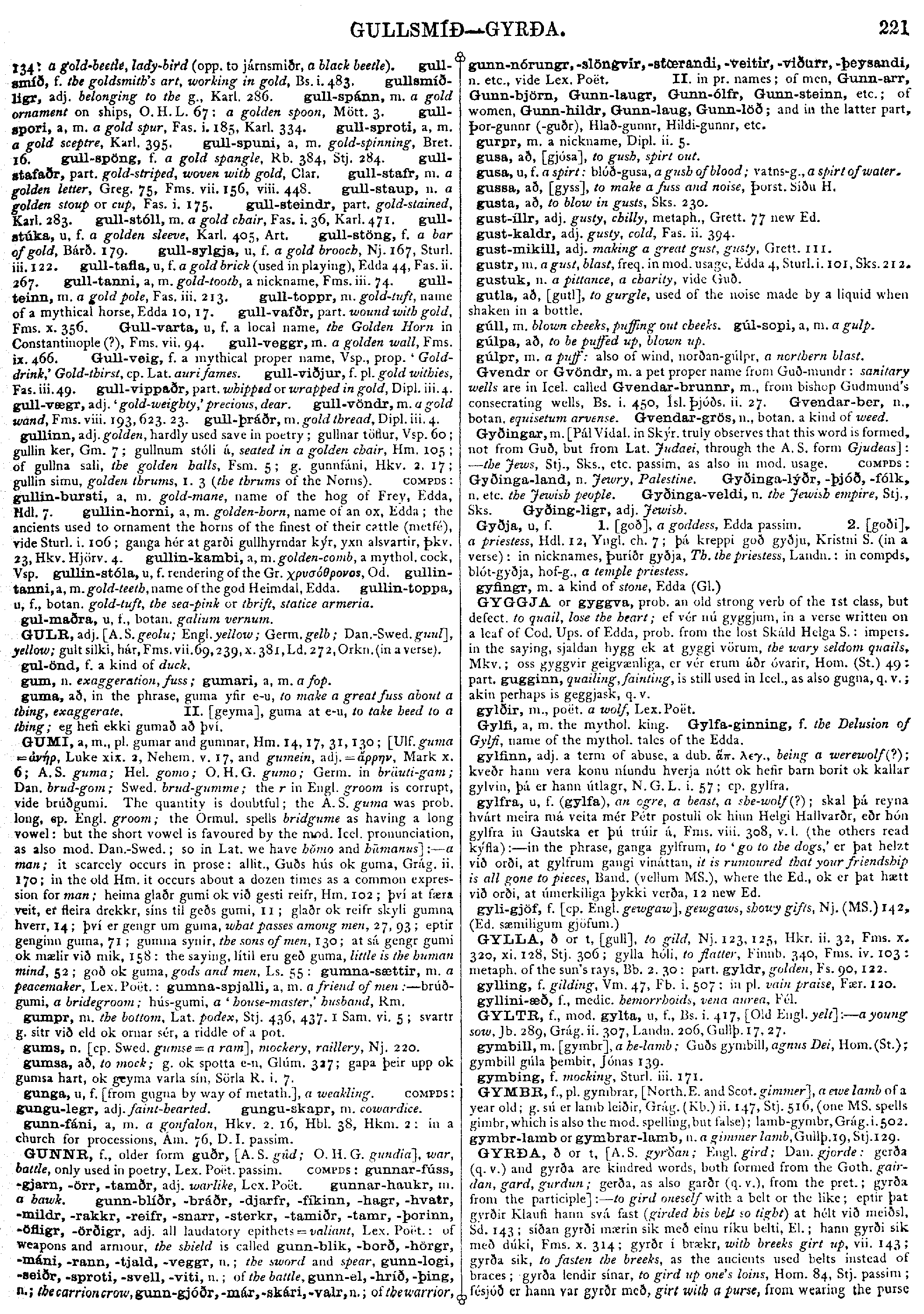
GUNNR, f., older form guðr, [A. S. gûd; O. H. G. gundia], war, battle, only used in poetry, Lex. Poët, passim. COMPDS: gunnar-fúss, -gjarn, -örr, -tamðr, adj. warlike, Lex. Poët. gunnar-haukr, m. a hawk. gunn-blíðr, -bráðr, -djarfr, -fíkinn, -hagr, -hvatr, -mildr, -rakkr, -reifr, -snarr, -sterkr, -tamiðr, -tamr, -þorinn, -öfligr, -örðigr, adj. all laudatory epithets = valiant, Lex. Poët.: of weapons and armour, the shield is called gunn-blik, -borð, -hörgr, -máni, -rann, -tjald, -veggr, n.; the sword and spear, gunn-logi, -seiðr, -sproti, -svell, -viti, n.; of the battle, gunn-el, -hríð, -þing, n.; the carrion crow, gunn-gjóðr, -már, -skári, -valr, n.; of the warrior, gunn-nórungr, -slöngvir, -stœrandi, -veitir, -viðurr, -þeysandi, n. etc., vide Lex. Poët. II. in pr. names; of men, Gunn-arr, Gunn-björn, Gunn-laugr, Gunn-ólfr, Gunn-steinn, etc.; of women, Gunn-hildr, Gunn-laug, Gunn-löð; and in the latter part. Þor-gunnr (-guðr), Hlað-gunnr, Hildi-gunnr, etc.
|
Source: Cleasby/Vigfusson, page b0222, entry 6 View original page image as: [TIFF] [PNG] [View previous entry] [View next entry] |
[Comment on this entry] [View comments] |
The following entry has been hand-corrected once. |
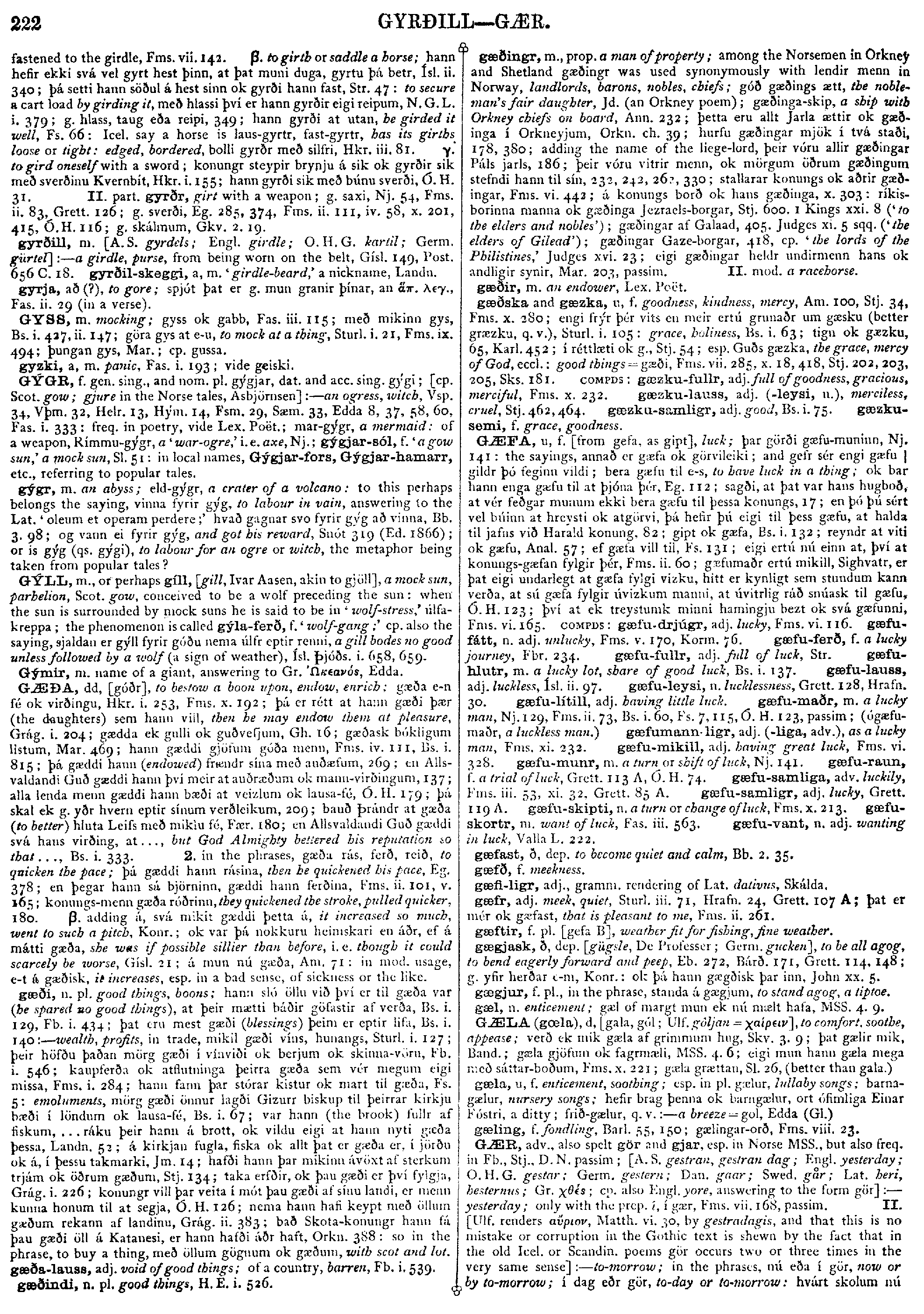
GÝGR, f. gen. sing., and nom. pl. gýgjar, dat. and acc. sing. gýgi; [cp. Scot. gow; gjure in the Norse tales, Asbjörnsen] :-- an ogress, witch, Vsp. 34, Vþm. 32, Helr. 13, Hým. 14, Fsm. 29, Sæm. 33, Edda 8, 37, 58, 60, Fas. i. 333: freq. in poetry, vide Lex. Poët.; mar-gýgr, a mermaid: of a weapon, Rímmu-gýgr, a 'war-ogre' i.e. axe, Nj.; gýgjar-sól, f. 'a gow sun,' a mock sun, Sl. 51: in local names, Gýgjar-fors, Gýgjar-hamarr, etc., referring to popular tales.
|
Source: Cleasby/Vigfusson, page b0223, entry 30 View original page image as: [TIFF] [PNG] [View previous entry] [View next entry] |
[Comment on this entry] [View comments] |
The following entry has been hand-corrected once. |
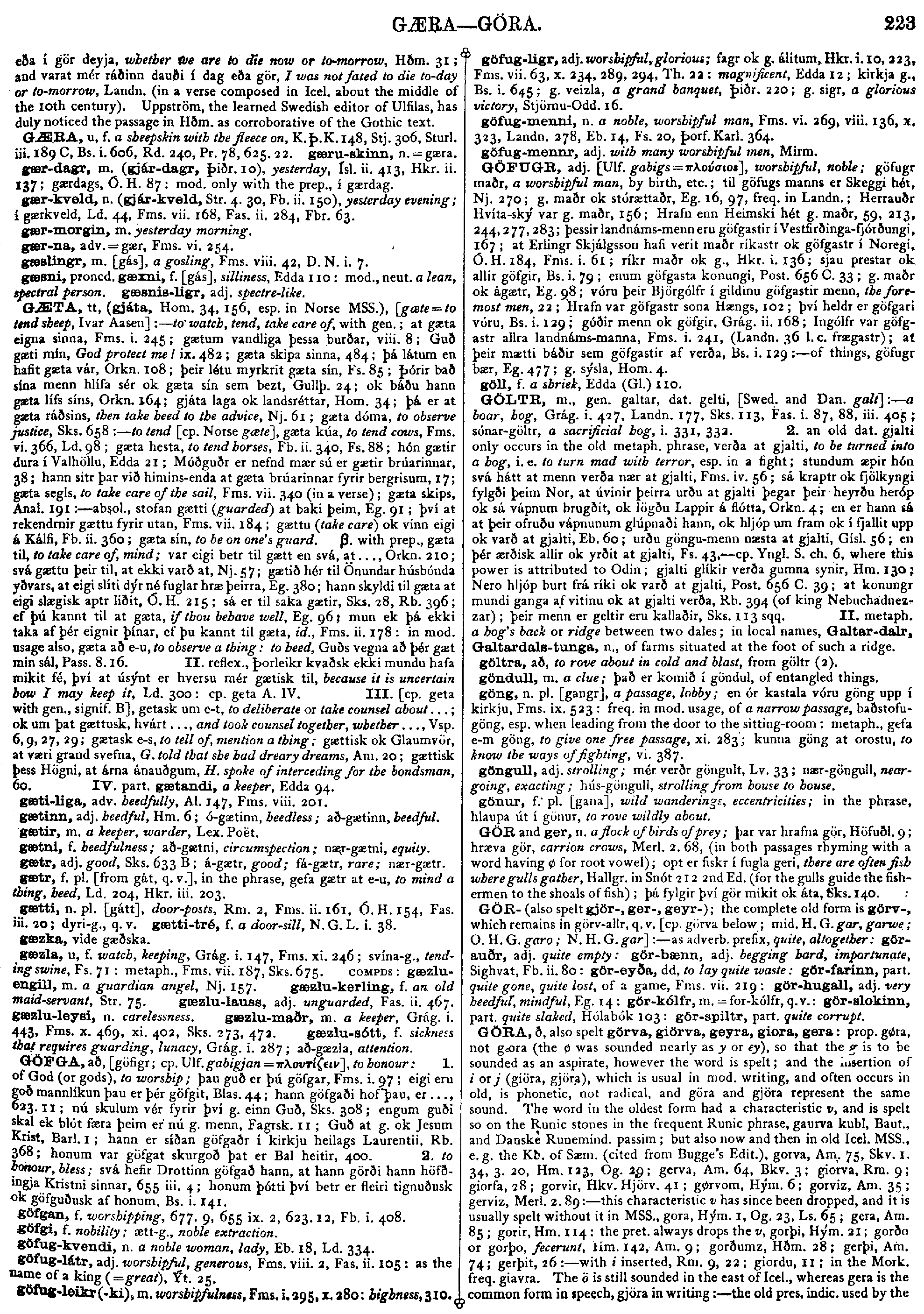
GÖLTR, m., gen. galtar, dat. gelti, [Swed. and Dan. galt] :-- a boar, hog, Grág. i. 427, Landn. 177, Sks. 113, Fas. i. 87, 88, iii. 405; sónar-göltr, a sacrificial hog, i. 331, 332. 2. an old dat. gjalti only occurs in the old metaph. phrase, verða at gjalti, to be turned into a hog, i.e. to turn mad with terror, esp. in a fight; stundum æpir hón svá hátt at menn verða nær at gjalti, Fms. iv. 56; sá kraptr ok fjölkyngi fylgði þeim Nor, at úvinir þeirra urðu at gjalti þegar þeir heyrðu heróp ok sá vápnum brugðit, ok lögðu Lappir á flótta, Orkn. 4; en er hann sá at þeir ofruðu vápnunum glúpnaði hann, ok hljóp um fram ok í fjallit upp ok varð at gjalti, Eb. 60; urðu göngu-menn næsta at gjalti, Gísl. 56; en þér ærðisk allir ok yrðit at gjalti, Fs. 43,--cp. Yngl. S. ch. 6, where this power is attributed to Odin; gjalti glíkir verða gumna synir, Hm. 130; Nero hljóp burt frá ríki ok varð at gjalti, Post. 656 C. 39; at konungr mundi ganga af vitinu ok at gjalti verða, Rb. 394 (of king Nebuchadnezzar); þeir menn er geltir eru kallaðir, Sks. 113 sqq. II. metaph. a hog's back or ridge between two dales; in local names, Galtar-dalr, Galtardals-tunga, n., of farms situated at the foot of such a ridge.
|
Source: Cleasby/Vigfusson, page b0227, entry 1 View original page image as: [TIFF] [PNG] [View previous entry] [View next entry] |
[Comment on this entry] [View comments] |
The following entry has been hand-corrected once. |
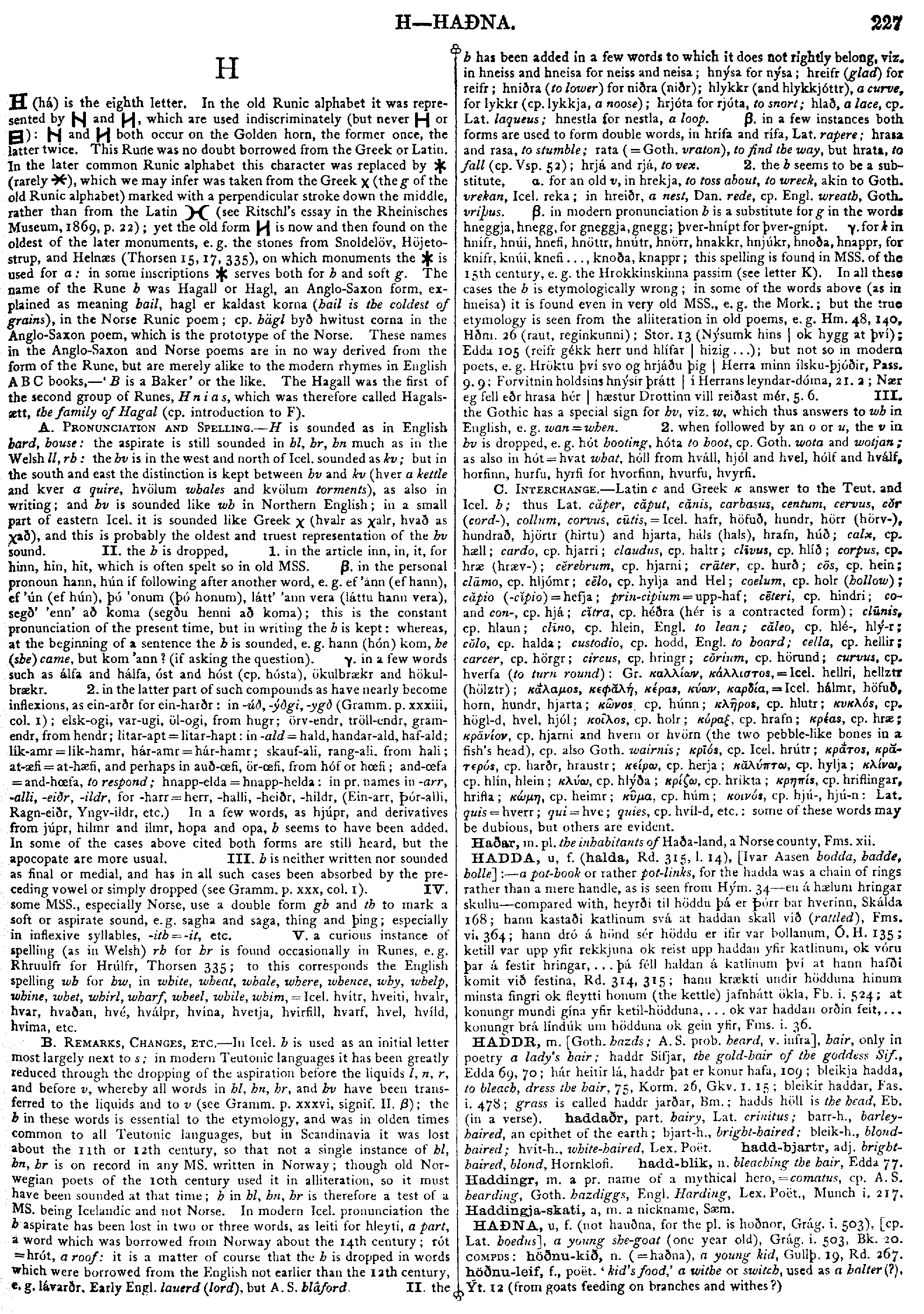
H (há) is the eighth letter. In the old Runic alphabet it was represented by RUNE and RUNE, which are used indiscriminately (but never RUNE or RUNE): RUNE and RUNE both occur on the Golden horn, the former once, the latter twice. This Rune was no doubt borrowed from the Greek or Latin. In the later common Runic alphabet this character was replaced by RUNE (rarely RUNE), which we may infer was taken from the Greek RUNE (the g of the old Runic alphabet) marked with a perpendicular stroke down the middle, rather than from the Latin RUNE (see Ritschl's essay in the Rheinisches Museum, 1869, p. 22); yet the old form RUNE is now and then found on the oldest of the later monuments, e.g. the stones from Snoldelöv, Höjetostrup, and Helnæs (Thorsen 15, 17, 335), on which monuments the RUNE is used for a: in some inscriptions RUNE serves both for h and soft g. The name of the Rune h was Hagall or Hagl, an Anglo-Saxon form, explained as meaning hail, hagl er kaldast korna (hail is the coldest of grains), in the Norse Runic poem; cp. hägl byð hwitust corna in the Anglo-Saxon poem, which is the prototype of the Norse. These names in the Anglo-Saxon and Norse poems are in no way derived from the form of the Rune, but are merely alike to the modern rhymes in English ABC books, -- 'B is a Baker' or the like. The Hagall was the first of the second group of Runes, H n i a s, which was therefore called Hagals-ætt, the family of Hagal (cp. introduction to F).
|
Source: Cleasby/Vigfusson, page b0227, entry 2 View original page image as: [TIFF] [PNG] [View previous entry] [View next entry] |
[Comment on this entry] [View comments] |
The following entry has been hand-corrected once. |
A.
PRONUNCIATION
AND
SPELLING.
--
H
is
sounded
as
in
English
hard,
house:
the
aspirate
is
still
sounded
in
hl,
hr,
hn
much
as
in
the
Welsh
ll,
rh:
the
hv
is
in
the
west
and
north
of
Icel.
sounded
as
kv;
but
in
the
south
and
east
the
distinction
is
kept
between
hv
and
kv
(hver
a
kettle
and
kver
a
quire,
hvölum
whales
and
kvölum
torments),
as
also
in
writing;
and
hv
is
sounded
like
wh
in
Northern
English;
in
a
small
part
of
eastern
Icel.
it
is
sounded
like
Greek
 (hvalr
as
alr,
hvað
as
að),
and
this
is
probably
the
oldest
and
truest
representation
of
the
hv
sound.
II.
the
h
is
dropped,
1.
in
the
article
inn,
in,
it,
for
hinn,
hin,
hit,
which
is
often
spelt
so
in
old
MSS.
(hvalr
as
alr,
hvað
as
að),
and
this
is
probably
the
oldest
and
truest
representation
of
the
hv
sound.
II.
the
h
is
dropped,
1.
in
the
article
inn,
in,
it,
for
hinn,
hin,
hit,
which
is
often
spelt
so
in
old
MSS.
 .
in
the
personal
pronoun
hann,
hún
if
following
after
another
word,
e.g.
ef
'ann
(ef
hann),
ef
'ún
(ef
hún),
þó
'onum
(þó
honum),
látt'
'ann
vera
(láttu
hann
vera),
segð'
'enn'
að
koma
(segðu
henni
að
koma);
this
is
the
constant
pronunciation
of
the
present
time,
but
in
writing
the
h
is
kept:
whereas,
at
the
beginning
of
a
sentence
the
h
is
sounded,
e.g.
hann
(hón)
kom,
he
(she)
came,
but
kom
'ann
?
(if
asking
the
question).
.
in
the
personal
pronoun
hann,
hún
if
following
after
another
word,
e.g.
ef
'ann
(ef
hann),
ef
'ún
(ef
hún),
þó
'onum
(þó
honum),
látt'
'ann
vera
(láttu
hann
vera),
segð'
'enn'
að
koma
(segðu
henni
að
koma);
this
is
the
constant
pronunciation
of
the
present
time,
but
in
writing
the
h
is
kept:
whereas,
at
the
beginning
of
a
sentence
the
h
is
sounded,
e.g.
hann
(hón)
kom,
he
(she)
came,
but
kom
'ann
?
(if
asking
the
question).
 .
in
a
few
words
such
as
álfa
and
hálfa,
óst
and
host
(cp.
hósta),
ökulbrækr
and
hökulbraekr.
2.
in
the
latter
part
of
such
compounds
as
have
nearly
become
inflexions,
as
ein-arðr
for
ein-harðr:
in
-úð,
-ýðgi,
-ygð
(Gramm.
p.
xxxiii,
col.
1);
elsk-ogi,
var-ugi,
öl-ogi,
from
hugr;
örv-endr,
tröll-endr,
gram-endr,
from
hendr;
litar-apt
=
litar-hapt:
in
-ald
=
hald,
handar-ald,
haf-ald;
lík-amr
=
lík-hamr,
hár-amr
=
hár-hamr;
skauf-ali,
rang-ali,
from
hali;
at-æfi
=
at-hæfi,
and
perhaps
in
auð-œfi,
ör-œfi,
from
hóf
or
hœfi;
and-œfa
=
and-hœfa,
to
respond;
hnapp-elda
=
hnapp-helda:
in
pr.
names
in
-arr,
-alli,
-eiðr,
-ildr,
for
-harr
=
herr,
-halli,
-heiðr,
-hildr,
(Ein-arr,
Þór-alli,
Ragn-eiðr,
Yngv-ildr,
etc.)
In
a
few
words,
as
hjúpr,
and
derivatives
from
júpr,
hilmr
and
ilmr,
hopa
and
opa,
h
seems
to
have
been
added.
In
some
of
the
cases
above
cited
both
forms
are
still
heard,
but
the
apocopate
are
more
usual.
III.
h
is
neither
written
nor
sounded
as
final
or
medial,
and
has
in
all
such
cases
been
absorbed
by
the
preceding
vowel
or
simply
dropped
(see
Gramm.
p.
xxx,
col.
1).
IV.
some
MSS.,
especially
Norse,
use
a
double
form
gh
and
th
to
mark
a
soft
or
aspirate
sound,
e.g.
sagha
and
saga,
thing
and
þing;
especially
in
inflexive
syllables,
-ith
=
-it,
etc.
V.
a
curious
instance
of
spelling
(as
in
Welsh)
rh
for
hr
is
found
occasionally
in
Runes,
e.g.
Rhruulfr
for
Hrúlfr,
Thorsen
335;
to
this
corresponds
the
English
spelling
wh
for
hw,
in
white,
wheat,
whale,
where,
whence,
why,
whelp,
whine,
whet,
whirl,
wharf,
wheel,
while,
whim,
=
Icel.
hvítr,
hveiti,
hvalr,
hvar,
hvaðan,
hvé,
hválpr,
hvína,
hvetja,
hvirfill,
hvarf,
hvel,
hvíld,
hvima,
etc.
.
in
a
few
words
such
as
álfa
and
hálfa,
óst
and
host
(cp.
hósta),
ökulbrækr
and
hökulbraekr.
2.
in
the
latter
part
of
such
compounds
as
have
nearly
become
inflexions,
as
ein-arðr
for
ein-harðr:
in
-úð,
-ýðgi,
-ygð
(Gramm.
p.
xxxiii,
col.
1);
elsk-ogi,
var-ugi,
öl-ogi,
from
hugr;
örv-endr,
tröll-endr,
gram-endr,
from
hendr;
litar-apt
=
litar-hapt:
in
-ald
=
hald,
handar-ald,
haf-ald;
lík-amr
=
lík-hamr,
hár-amr
=
hár-hamr;
skauf-ali,
rang-ali,
from
hali;
at-æfi
=
at-hæfi,
and
perhaps
in
auð-œfi,
ör-œfi,
from
hóf
or
hœfi;
and-œfa
=
and-hœfa,
to
respond;
hnapp-elda
=
hnapp-helda:
in
pr.
names
in
-arr,
-alli,
-eiðr,
-ildr,
for
-harr
=
herr,
-halli,
-heiðr,
-hildr,
(Ein-arr,
Þór-alli,
Ragn-eiðr,
Yngv-ildr,
etc.)
In
a
few
words,
as
hjúpr,
and
derivatives
from
júpr,
hilmr
and
ilmr,
hopa
and
opa,
h
seems
to
have
been
added.
In
some
of
the
cases
above
cited
both
forms
are
still
heard,
but
the
apocopate
are
more
usual.
III.
h
is
neither
written
nor
sounded
as
final
or
medial,
and
has
in
all
such
cases
been
absorbed
by
the
preceding
vowel
or
simply
dropped
(see
Gramm.
p.
xxx,
col.
1).
IV.
some
MSS.,
especially
Norse,
use
a
double
form
gh
and
th
to
mark
a
soft
or
aspirate
sound,
e.g.
sagha
and
saga,
thing
and
þing;
especially
in
inflexive
syllables,
-ith
=
-it,
etc.
V.
a
curious
instance
of
spelling
(as
in
Welsh)
rh
for
hr
is
found
occasionally
in
Runes,
e.g.
Rhruulfr
for
Hrúlfr,
Thorsen
335;
to
this
corresponds
the
English
spelling
wh
for
hw,
in
white,
wheat,
whale,
where,
whence,
why,
whelp,
whine,
whet,
whirl,
wharf,
wheel,
while,
whim,
=
Icel.
hvítr,
hveiti,
hvalr,
hvar,
hvaðan,
hvé,
hválpr,
hvína,
hvetja,
hvirfill,
hvarf,
hvel,
hvíld,
hvima,
etc.
|
Source: Cleasby/Vigfusson, page b0231, entry 14 View original page image as: [TIFF] [PNG] [View previous entry] [View next entry] |
[Comment on this entry] [View comments] |
The following entry has been hand-corrected once. |
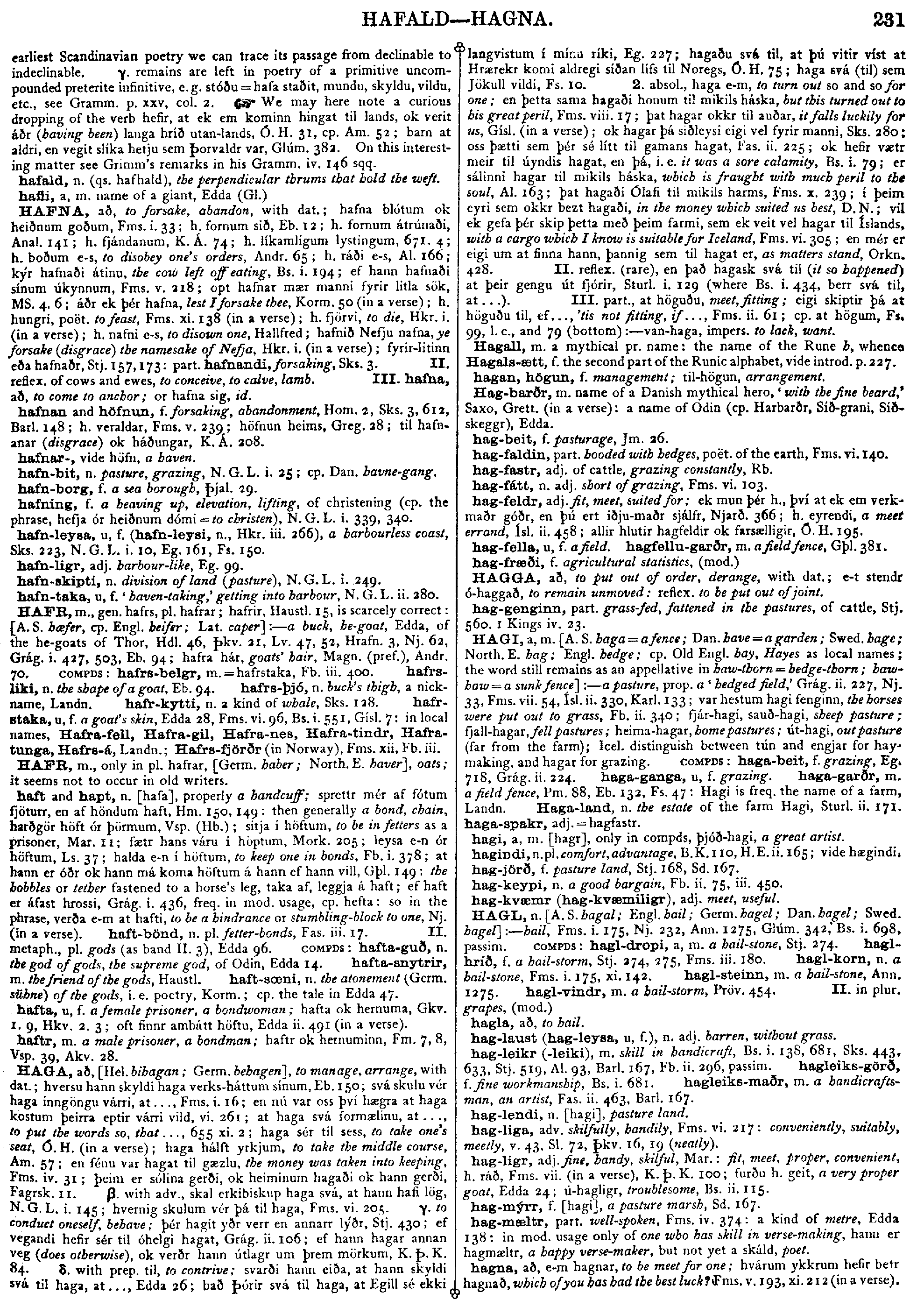
HAFR, m., gen. hafrs, pl. hafrar; hafrir, Haustl. 15, is scarcely correct: [A. S. hæfer, cp. Engl. heifer; Lat. caper] :-- a buck, he-goat, Edda, of the he-goats of Thor, Hdl. 46, Þkv. 21, Lv. 47, 52, Hrafn. 3, Nj. 62, Grág. i. 427, 503, Eb. 94; hafra hár, goats' hair, Magn. (pref.), Andr. 70. COMPDS: hafrs-belgr, m. = hafrstaka, Fb. iii. 400. hafrs-liki, n. the shape of a goat, Eb. 94. hafrs-þjó, n. buck's thigh, a nickname, Landn. hafr-kytti, n. a kind of whale, Sks. 128. hafr-staka, u, f. a goat's skin, Edda 28, Fms. vi. 96, Bs. 4. 551, Gísl. 7: in local names, Hafra-fell, Hafra-gil, Hafra-nes, Hafra-tindr, Hafra-tunga, Hafrs-á, Landn.; Hafrs-fjörðr (in Norway), Fms. xii, Fb. iii.
|
Source: Cleasby/Vigfusson, page b0231, entry 32 View original page image as: [TIFF] [PNG] [View previous entry] [View next entry] |
[Comment on this entry] [View comments] |
The following entry has been hand-corrected once. |
HAGI, a, m. [A. S. haga = a fence; Dan. have = a garden; Swed. hage; North. E. hag; Engl. hedge; cp. Old Engl. hay, Hayes as local names; the word still remains as an appellative in haw-thorn = hedge-thorn; haw-haw = a sunk fence] :-- a pasture, prop. a 'hedged field,' Grág. ii. 227, Nj. 33, Fms. vii. 54, Ísl. ii. 330, Karl. 133; var hestum hagi fenginn, the horses were put out to grass, Fb. ii. 340; fjár-hagi, sauð-hagi, sheep pasture; fjall-hagar, fell pastures; heima-hagar, home pastures; út-hagi, out pasture (far from the farm); Icel. distinguish between tún and engjar for haymaking, and hagar for grazing. COMPDS: haga-beit, f. grazing, Eg. 718, Grág. ii. 224. haga-ganga, u, f. grazing. haga-garðr, m. a field fence, Pm. 88, Eb. 132, Fs. 47: Hagi is freq. the name of a farm, Landn. Haga-land, n. the estate of the farm Hagi, Sturl. ii. 171. haga-spakr, adj. = hagfastr.
|
Source: Cleasby/Vigfusson, page b0235, entry 13 View original page image as: [TIFF] [PNG] [View previous entry] [View next entry] |
[Comment on this entry] [View comments] |
The following entry has been hand-corrected once. |
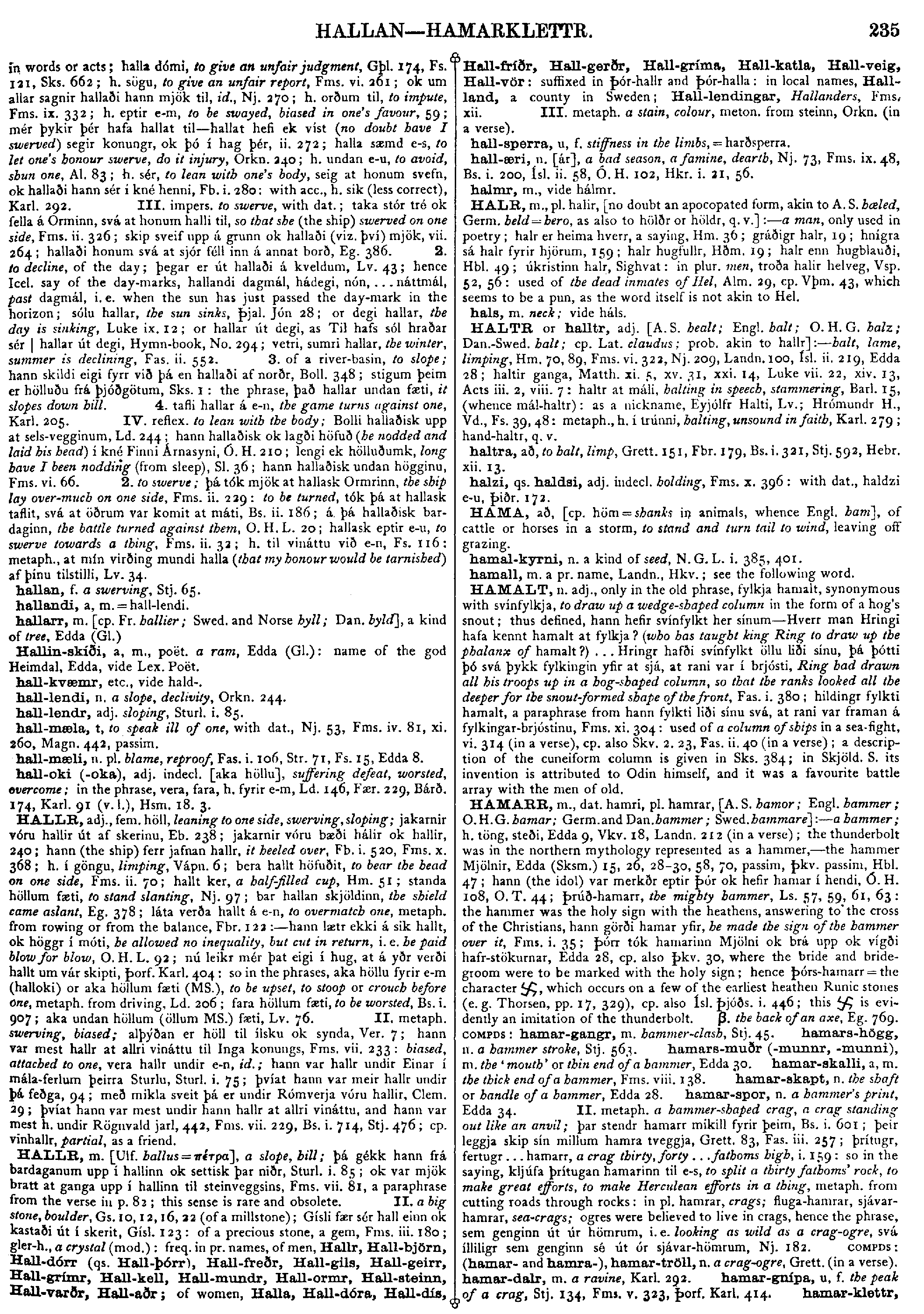
HALLR, m. [Ulf. hallus = GREEK], a slope, hill; þá gékk hann frá bardaganum upp í hallinn ok settisk þar niðr, Sturl. i. 85; ok var mjök bratt at ganga upp í hallinn til steinveggsins, Fms. vii. 8i, a paraphrase from the verse in p. 82; this sense is rare and obsolete. II. a big stone, boulder, Gs. 10, 12, 16, 22 (of a millstone); Gísli fær sér hall einn ok kastaði út í skerit, Gísl. 123: of a precious stone, a gem, Fms. iii. 180; gler-h., a crystal (mod.): freq. in pr. names, of men, Hallr, Hall-björn, Hall-dórr (qs. Hall-þórr), Hall-freðr, Hall-gils, Hall-geirr, Hall-grímr, Hall-kell, Hall-mundr, Hall-ormr, Hall-steinn, Hall-varðr, Hall-aðr; of women, Halla, Hall-dóra, Hall-dís, Hall-fríðr, Hall-gerðr, Hall-gríma, Hall-katla, Hall-veig, Hall-vör: suffixed in Þór-hallr and Þór-halla: in local names, Hall-land, a county in Sweden; Hall-lendingar, Hallanders, Fms. xii. III. metaph. a stain, colour, meton. from steinn, Orkn. (in a verse).
|
Source: Cleasby/Vigfusson, page b0236, entry 1 View original page image as: [TIFF] [PNG] [View previous entry] [View next entry] |
[Comment on this entry] [View comments] |
The following entry has been hand-corrected once. |
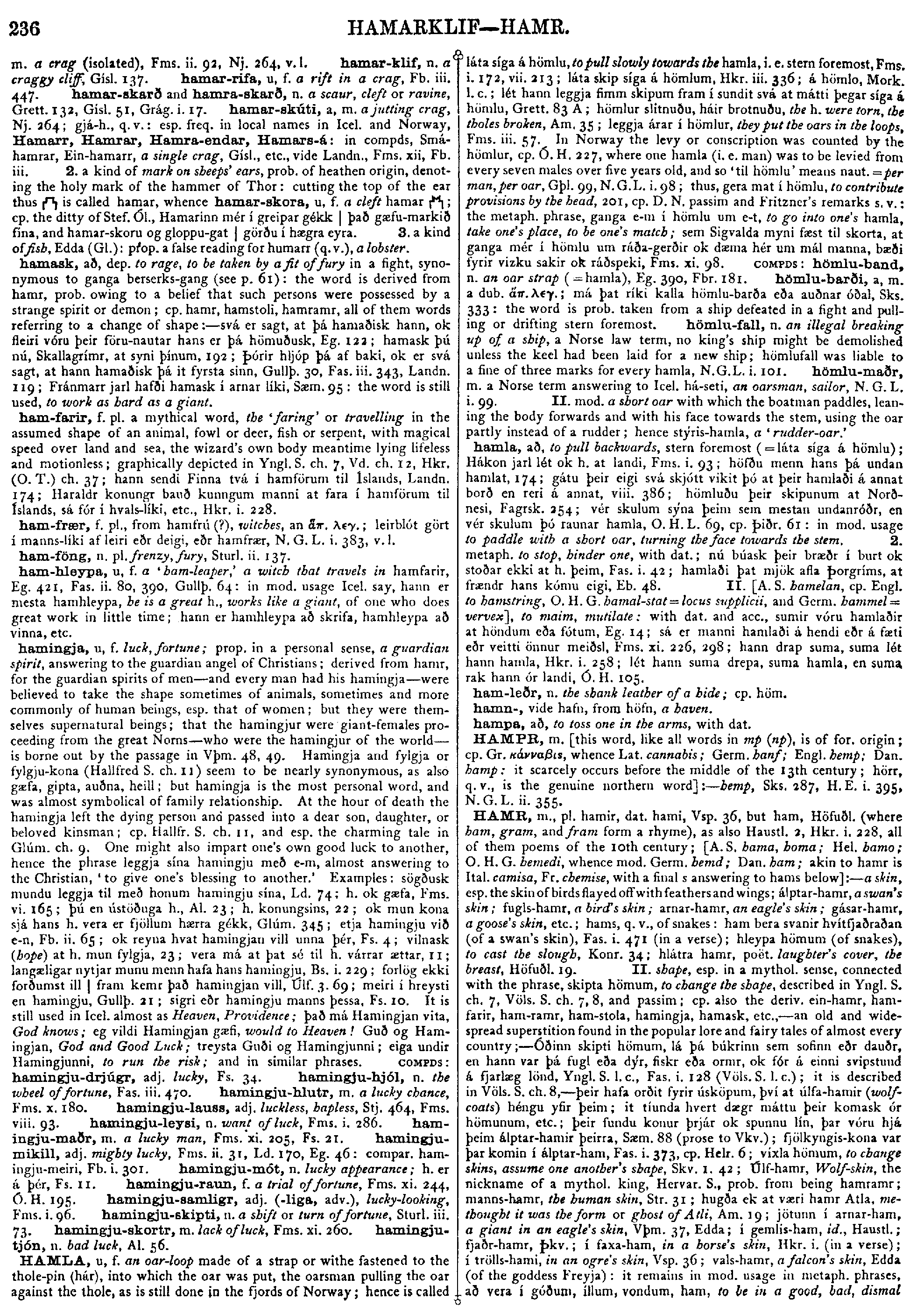
m. a crag (isolated), Fms. ii. 92, Nj. 264, v.l. hamar-klif, n. a craggy cliff, Gísl. 137. hamar-rifa, u, f. a rift in a crag, Fb. iii. 447. hamar-skarð and hamra-skarð, n. a scaur, cleft or ravine, Grett. 132, Gísl. 51, Grág. i. 17. hamar-skúti, a, m. a jutting crag, Nj. 264; gjá-h., q.v.: esp. freq. in local names in Icel. and Norway, Hamarr, Hamrar, Hamra-endar, Hamars-á: in compds, Smá-hamrar, Ein-hamarr, a single crag, Gísl., etc., vide Landn., Fms. xii, Fb. iii. 2. a kind of mark on sheeps' ears, prob. of heathen origin, denoting the holy mark of the hammer of Thor: cutting the top of the ear thus UNCERTAIN is called hamar, whence hamar-skora, u, f. a cleft hamar UNCERTAIN; cp. the ditty of Stef. Ól., Hamarinn mér í greipar gékk | það gæfu-markið fína, and hamar-skoru og gloppu-gat | görðu í hægra eyra. 3. a kind of fish, Edda (Gl.): prop. a false reading for humarr (q.v.), a lobster.
| Result Page: |  |
Previous | 30 31 32 33 34 35 36 37 38 39 40 41 42 43 44 45 46 47 48 | Next |  |
Germanic Lexicon Project (main page)
This search system was written by
Sean Crist
Please consider
volunteering
to correct the data in these online dictionaries.
No rights reserved. Feel free to use these data in any way you please.