|
|

|
Source: Bosworth/Toller, page d0567, entry 35 View original page image as: [TIFF] [PNG] [View previous entry] [View next entry] |
[Comment on this entry] [View comments] |
The following entry has been hand-corrected once. |
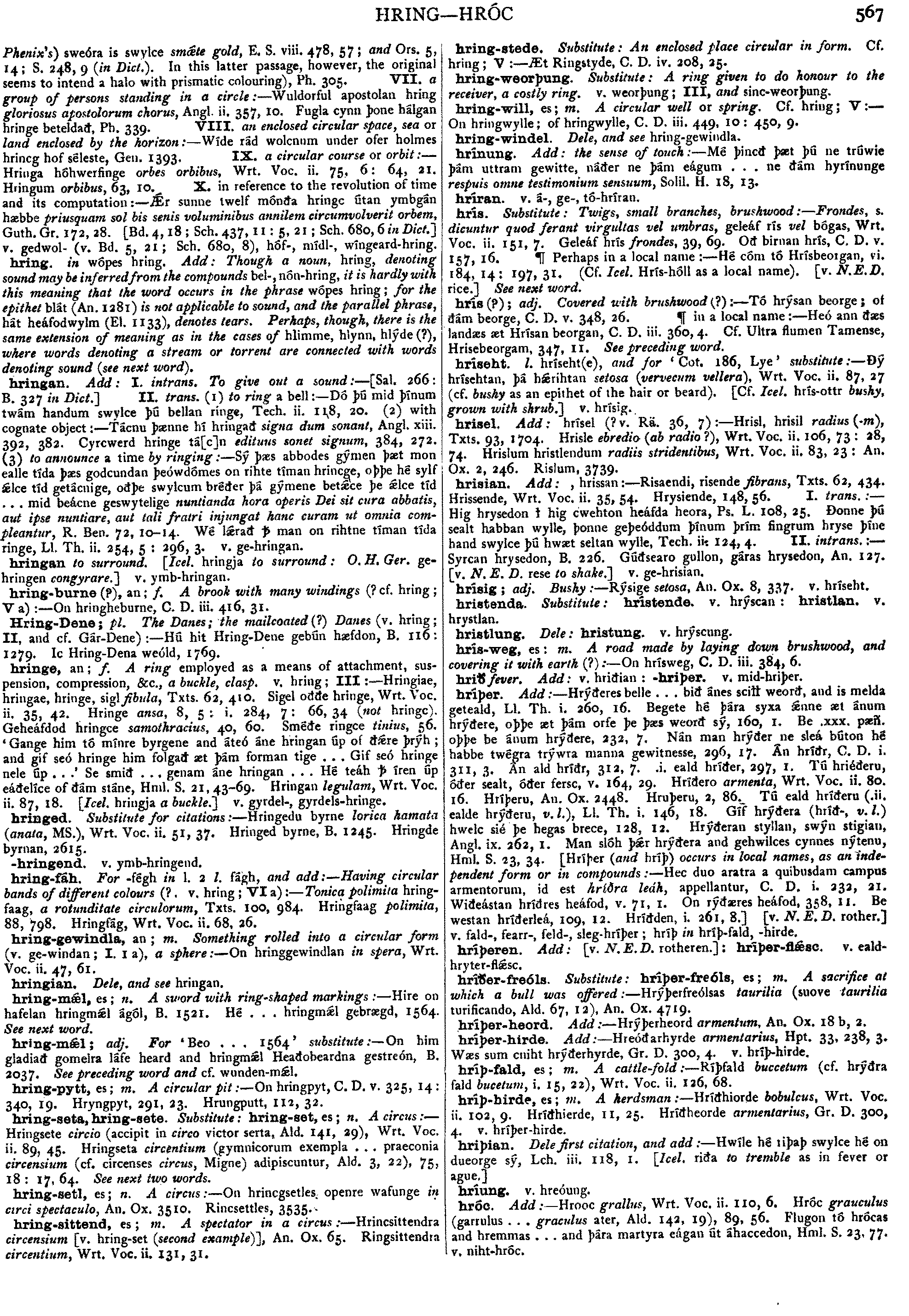
hríþer.
Add:--Hrýðeres
belle
.
.
.
bið
ánes
sci weorð,
and
is
melda
geteald,
Ll.
Th.
i.
260,
16.
Begete
hé
þára
syxa
weorð,
and
is
melda
geteald,
Ll.
Th.
i.
260,
16.
Begete
hé
þára
syxa
 nne
æt
ánum
hrýðere,
oþþe
æt
þám
orfe
þe
þæs
weorð
sý,
160,
1.
Be
.xxx.
pæñ.
oþþe
be
ánum
hrýðere,
232,
7.
Nán
man
hrýðer
ne
sleá
búton
hé
habbe
twégra
trýwra
manna
gewitnesse,
296,
17.
Án
hríðr,
C.
D.
i.
311,
3.
Án
ald
hríðr,
312,
7.
.i.
eald
hríðer,
297,
1.
Tú
hriéðeru,
óðer
sealt,
óðer
fersc,
v.
164,
29.
Hríðero
armenta,
Wrt.
Voc.
ii.
80,
16.
Hríþeru,
An.
Ox.
2448.
Hruþeru,
2,
86.
Tú
eald
hríðeru
(.ii.
ealde
hrýðeru,
v.
l.),
Ll.
Th.
i.
146,
18.
Gif
hrýðera
(hríð-,
v.
l.)
hwelc
sié
þe
hegas
brece,
128,
12.
Hrýðeran
styllan,
swýn
stigian,
Angl.
ix.
262,
1.
Man
slóh
þr
hrýðera
and
gehwilces
cynnes
nýtenu,
Hml.
S.
23,
34.
[Hríþer
(and
hríþ)
occurs
in
local
names,
as
an
independent
form
or
in
compounds:--Hec
duo
aratra
a
quibusdam
campus
armentorum,
id
est
hríðra
leáh,
appellantur,
C.
D.
i.
232,
21.
Wiðeástan
hríðres
heáfod,
v.
71,
1.
On
rýðæres
heáfod,
358,
11.
Be
westan
hríðerleá,
109,
12.
Hríðden,
i.
261,
8.]
[v.
N.
E.
D.
rother.]
v.
fald-,
fearr-,
feld-,
sleg-hríþer;
hríþ
in
hríþ-fald,
-hirde.
nne
æt
ánum
hrýðere,
oþþe
æt
þám
orfe
þe
þæs
weorð
sý,
160,
1.
Be
.xxx.
pæñ.
oþþe
be
ánum
hrýðere,
232,
7.
Nán
man
hrýðer
ne
sleá
búton
hé
habbe
twégra
trýwra
manna
gewitnesse,
296,
17.
Án
hríðr,
C.
D.
i.
311,
3.
Án
ald
hríðr,
312,
7.
.i.
eald
hríðer,
297,
1.
Tú
hriéðeru,
óðer
sealt,
óðer
fersc,
v.
164,
29.
Hríðero
armenta,
Wrt.
Voc.
ii.
80,
16.
Hríþeru,
An.
Ox.
2448.
Hruþeru,
2,
86.
Tú
eald
hríðeru
(.ii.
ealde
hrýðeru,
v.
l.),
Ll.
Th.
i.
146,
18.
Gif
hrýðera
(hríð-,
v.
l.)
hwelc
sié
þe
hegas
brece,
128,
12.
Hrýðeran
styllan,
swýn
stigian,
Angl.
ix.
262,
1.
Man
slóh
þr
hrýðera
and
gehwilces
cynnes
nýtenu,
Hml.
S.
23,
34.
[Hríþer
(and
hríþ)
occurs
in
local
names,
as
an
independent
form
or
in
compounds:--Hec
duo
aratra
a
quibusdam
campus
armentorum,
id
est
hríðra
leáh,
appellantur,
C.
D.
i.
232,
21.
Wiðeástan
hríðres
heáfod,
v.
71,
1.
On
rýðæres
heáfod,
358,
11.
Be
westan
hríðerleá,
109,
12.
Hríðden,
i.
261,
8.]
[v.
N.
E.
D.
rother.]
v.
fald-,
fearr-,
feld-,
sleg-hríþer;
hríþ
in
hríþ-fald,
-hirde.
|
Source: Bosworth/Toller, page d0570, entry 13 View original page image as: [TIFF] [PNG] [View previous entry] [View next entry] |
[Comment on this entry] [View comments] |
The following entry has been hand-corrected once. |
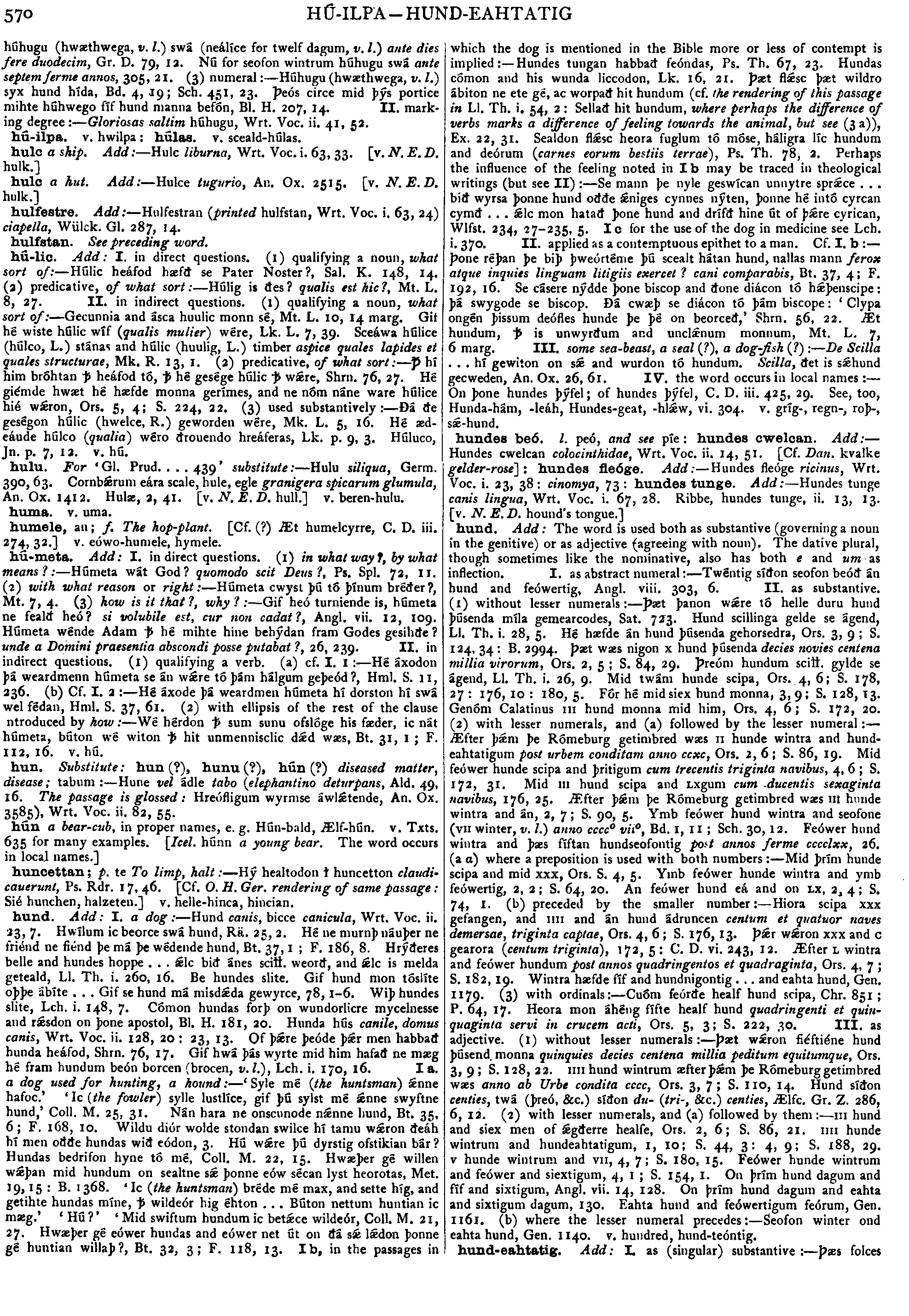
hún a bear-cub, in proper names, e.g. Hún-bald, Ælf-hún. v. Txts. 635 for many examples. [Icel. húnn a young bear. The word occurs in local names.]
|
Source: Bosworth/Toller, page d0570, entry 15 View original page image as: [TIFF] [PNG] [View previous entry] [View next entry] |
[Comment on this entry] [View comments] |
The following entry has been hand-corrected once. |
hund.
Add:
I.
a
dog
:--
Hund
canis,
bicce
canicula,
Wrt.
Voc.
ii.
23,
7.
Hwílum
ic
beorce
swá
hund,
Rä.
25,
2.
Hé
ne
murnþ
náuþer
ne
friénd
ne
fiénd
þe
má
þe
wédende
hund,
Bt.
37,
1;
F.
186,
8.
Hrýðeres
belle
and
hundes
hoppe
...
lc
bið
ánes
sci.
weorð,
and
lc
is
melda
geteald,
Ll.
Th.
i.
260,
16.
Be
hundes
slite.
Gif
hund
mon
tóslíte
oþþe
ábíte
...
Gif
se
hund
má
misdda
gewyrce,
78,
1-6.
Wiþ
hundes
slite,
Lch.
i.
148,
7.
Cómon
hundas
forþ
on
wundorlicre
mycelnesse
and
rsdon
on
þone
apostol,
Bl.
H.
181,
20.
Hunda
hús
canile,
domus
canis,
Wrt.
Voc.
ii.
128,
20:
23,
13.
Of
þre
þeóde
þr
men
habbað
hunda
heáfod,
Shrn.
76,
17.
Gif
hwá
þás
wyrte
mid
him
hafað
ne
mæg
hé
fram
hundum
beón
borcen
(brocen,
v.
l.),
Lch.
i.
170,
16.
I
a.
a
dog
used
for
hunting,
a
hound
:--
'Syle
mé
(the
huntsman)
nne
hafoc.'
'Ic
(the
fowler)
sylle
lustlíce,
gif
þú
sylst
mé
nne
swyftne
hund,'
Coll.
M.
25,
31.
Nán
hara
ne
onscunode
nnne
hund,
Bt.
35,
6;
F.
168,
10.
Wildu
diór
wolde
stondan
swilce
hí
tamu
wron
ðeáh
hí
men
oððe
hundas
wið
eódon,
3.
Hú
wre
þú
dyrstig
ofstikian
bár?
Hundas
bedrifon
hyne
tó
mé,
Coll.
M.
22,
15.
Hwæþer
gé
willen
wþan
mid
hundum
on
sealtne
s
þonne
eów
sécan
lyst
heorotas,
Met.
19,
15:
B.
1368.
'Ic
(the
huntsman)
bréde
mé
max,
and
sette
híg,
and
getihte
hundas
míne,
 wildeór
hig
éhton
...
Búton
nettum
huntian
ic
mæg.'
'Hú?'
'Mid
swiftum
hundum
ic
betce
wildeór,
Coll.
M.
21,
27.
Hwæþer
gé
eówer
hundas
and
eówer
net
út
on
ðá
s
ldon
þonne
gé
huntian
willaþ?,
Bt.
32,
3;
F.
118,
13.
I
b,
in
the
passages
in
which
the
dog
is
mentioned
in
the
Bible
more
or
less
of
contempt
is
implied
:--
Hundes
tungan
habbað
feóndas,
Ps.
Th.
67,
23.
Hundas
cómon
and
his
wunda
liccodon,
Lk.
16,
21.
Þæt
flsc
þæt
wildro
ábiton
ne
ete
gé,
ac
worpað
hit
hundum
(cf.
the
rendering
of
this
passage
in
Ll.
Th.
i.
54,
2:
Sellað
hit
hundum,
where
perhaps
the
difference
of
verbs
marks
a
difference
of
feeling
towards
the
animal,
but
see
(3
a)),
Ex.
22,
31.
Sealdon
flsc
heora
fuglum
tó
móse,
háligra
líc
hundum
and
deórum
(carnes
eorum
bestiis
terrae),
Ps.
Th.
78,
2.
Perhaps
the
influence
of
the
feeling
noted
in
I
b
may
be
traced
in
theological
writings
(but
see
II)
:--
Se
mann
þe
nyle
geswícan
unnytre
sprce
...
bið
wyrsa
þonne
hund
oððe
niges
cynnes
nýten,
þonne
hé
intó
cyrcan
cymð
...
lc
mon
hatað
þone
hund
and
drífð
hine
út
of
þre
cyrican,
Wlfst.
234,
27-235,
5.
I
c
for
the
use
of
the
dog
in
medicine
see
Lch.
i.
370.
II.
applied
as
a
contemptuous
epithet
to
a
man.
Cf.
I.
b
:--
Þone
réþan
þe
biþ
þweórtéme
þú
scealt
hátan
hund,
nallas
mann
ferox
atque
inquies
linguam
litigiis
exercet?
cani
comparabis,
Bt.
37,
4;
F.
192,
16.
Se
cásere
nýdde
þone
biscop
and
ðone
diácon
tó
hþenscipe:
þá
swygode
se
biscop.
Ðá
cwæþ
se
diácon
tó
þám
biscope:
'Clypa
ongén
þissum
deófles
hunde
þe
þé
on
beorceð,'
Shrn.
56,
22.
Æt
hundum,
is
unwyrðum
and
unclnum
monnum,
Mt.
L.
7,
6
marg.
III.
some
sea-beast,
a
seal
(?),
a
dog-fish
(?)
:--
De
Scilla
...
hí
gewiton
on
s
and
wurdon
tó
hundum.
Scilla,
ðet
is
shund
gecweden,
An.
Ox.
26,
61.
IV.
the
word
occurs
in
local
names
:--
On
þone
hundes
þýfel;
of
hundes
þýfel,
C.
D.
iii.
425,
29.
See,
too,
Hunda-hám,
-leáh,
Hundes-geat,
-hlw,
vi.
304.
v.
gríg-,
regn-,
roþ-,
s-hund.
wildeór
hig
éhton
...
Búton
nettum
huntian
ic
mæg.'
'Hú?'
'Mid
swiftum
hundum
ic
betce
wildeór,
Coll.
M.
21,
27.
Hwæþer
gé
eówer
hundas
and
eówer
net
út
on
ðá
s
ldon
þonne
gé
huntian
willaþ?,
Bt.
32,
3;
F.
118,
13.
I
b,
in
the
passages
in
which
the
dog
is
mentioned
in
the
Bible
more
or
less
of
contempt
is
implied
:--
Hundes
tungan
habbað
feóndas,
Ps.
Th.
67,
23.
Hundas
cómon
and
his
wunda
liccodon,
Lk.
16,
21.
Þæt
flsc
þæt
wildro
ábiton
ne
ete
gé,
ac
worpað
hit
hundum
(cf.
the
rendering
of
this
passage
in
Ll.
Th.
i.
54,
2:
Sellað
hit
hundum,
where
perhaps
the
difference
of
verbs
marks
a
difference
of
feeling
towards
the
animal,
but
see
(3
a)),
Ex.
22,
31.
Sealdon
flsc
heora
fuglum
tó
móse,
háligra
líc
hundum
and
deórum
(carnes
eorum
bestiis
terrae),
Ps.
Th.
78,
2.
Perhaps
the
influence
of
the
feeling
noted
in
I
b
may
be
traced
in
theological
writings
(but
see
II)
:--
Se
mann
þe
nyle
geswícan
unnytre
sprce
...
bið
wyrsa
þonne
hund
oððe
niges
cynnes
nýten,
þonne
hé
intó
cyrcan
cymð
...
lc
mon
hatað
þone
hund
and
drífð
hine
út
of
þre
cyrican,
Wlfst.
234,
27-235,
5.
I
c
for
the
use
of
the
dog
in
medicine
see
Lch.
i.
370.
II.
applied
as
a
contemptuous
epithet
to
a
man.
Cf.
I.
b
:--
Þone
réþan
þe
biþ
þweórtéme
þú
scealt
hátan
hund,
nallas
mann
ferox
atque
inquies
linguam
litigiis
exercet?
cani
comparabis,
Bt.
37,
4;
F.
192,
16.
Se
cásere
nýdde
þone
biscop
and
ðone
diácon
tó
hþenscipe:
þá
swygode
se
biscop.
Ðá
cwæþ
se
diácon
tó
þám
biscope:
'Clypa
ongén
þissum
deófles
hunde
þe
þé
on
beorceð,'
Shrn.
56,
22.
Æt
hundum,
is
unwyrðum
and
unclnum
monnum,
Mt.
L.
7,
6
marg.
III.
some
sea-beast,
a
seal
(?),
a
dog-fish
(?)
:--
De
Scilla
...
hí
gewiton
on
s
and
wurdon
tó
hundum.
Scilla,
ðet
is
shund
gecweden,
An.
Ox.
26,
61.
IV.
the
word
occurs
in
local
names
:--
On
þone
hundes
þýfel;
of
hundes
þýfel,
C.
D.
iii.
425,
29.
See,
too,
Hunda-hám,
-leáh,
Hundes-geat,
-hlw,
vi.
304.
v.
gríg-,
regn-,
roþ-,
s-hund.
|
Source: Bosworth/Toller, page d0572, entry 34 View original page image as: [TIFF] [PNG] [View previous entry] [View next entry] |
[Comment on this entry] [View comments] |
The following entry has been hand-corrected once. |
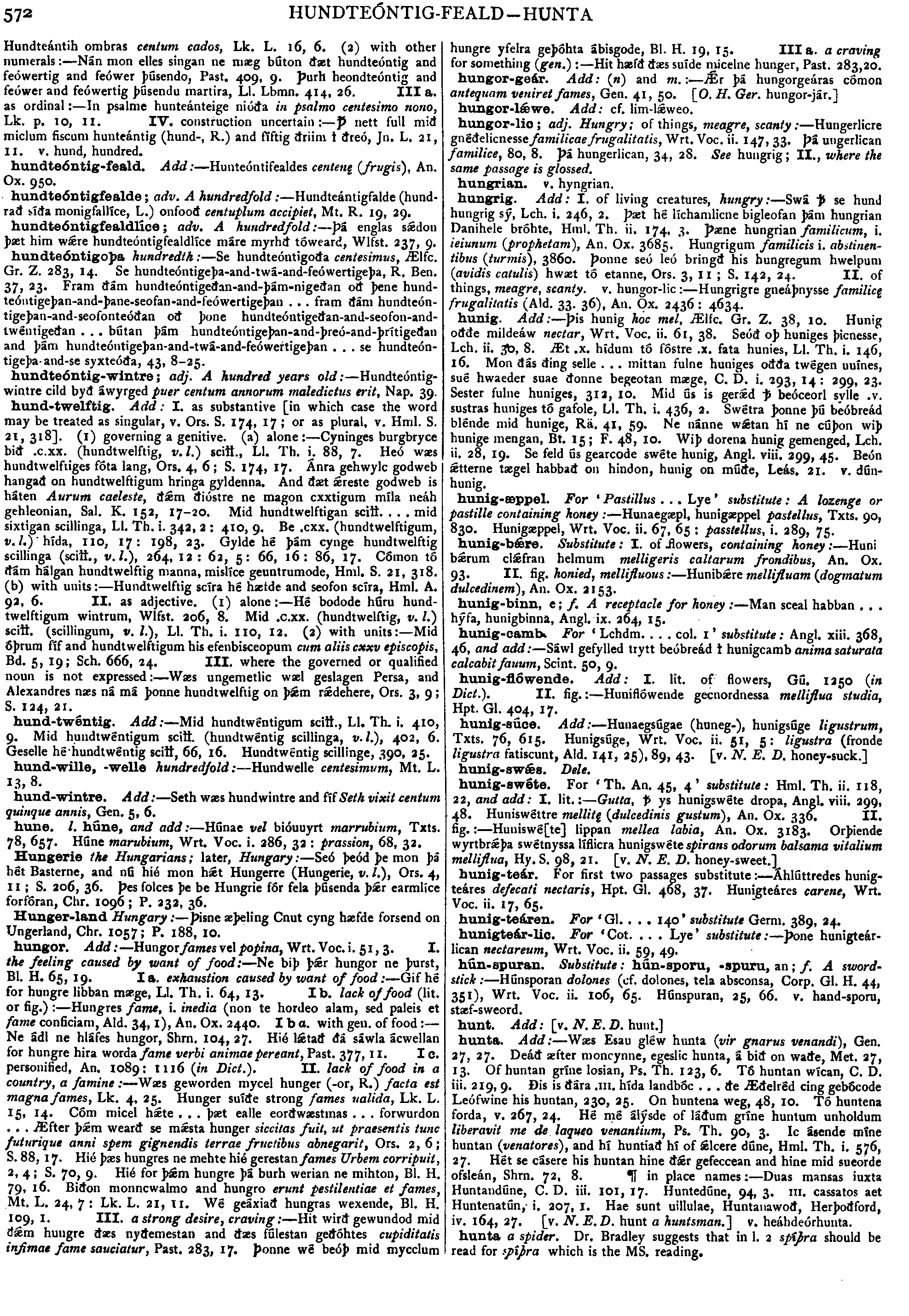
hunta.
Add:
--
Wæs
Esau
gléw
hunta
(vir
gnarus
venandi),
Gen.
27,
27.
Deáð
æfter
moncynne,
egeslic
hunta,
á
bið
on
waðe,
Met.
27,
13.
Of
huntan
gríne
losian,
Ps.
Th.
123,
6.
Tó
huntan
wícan,
C.
D.
iii.
219,
9.
Ðis
is
ðára
.iii.
hída
landbóc
.
.
.
ðe
Æðelréd
cing
gebócode
Leófwine
his
huntan,
230,
25.
On
huntena
weg,
48,
10.
Tó
huntena
forda,
v.
267,
24.
Hé
me
álýsde
of
láðum
gríne
huntum
unholdum
liberavit
me
de
laqueo
venantium,
Ps.
Th.
90,
3.
Ic
ásende
míne
huntan
(venatores),
and
hi
huntiað
hí
of
lcere
dúne,
Hml.
Th.
i.
576,
27.
Hét
se
cásere
his
huntan
hine
ðr
gefeccean
and
hine
mid
sueorde
ofsleán,
Shrn.
72,
8.
in
place
names
:--
Duas
mansas
iuxta
Huntandúne,
C.
D.
iii.
101,
17.
Huntedúne,
94,
3.
iii.
cassatos
aet
Huntenatún,
-
i.
207,
I.
Hae
sunt
uillulae,
Huntanawoð,
Herþoðford,
iv.
164,
27.
[v.
N.
E.
D.
hunt
a
huntsman.]
v.
heáhdeórhunta.
hunta
a
spider.
Dr.
Bradley
suggests
that
in
1.
2
spí
þra
should
be
read
for
sþíþra
which
is
the
MS.
reading.
|
Source: Bosworth/Toller, page d0577, entry 3 View original page image as: [TIFF] [PNG] [View previous entry] [View next entry] |
[Comment on this entry] [View comments] |
The following entry has been hand-corrected once. |
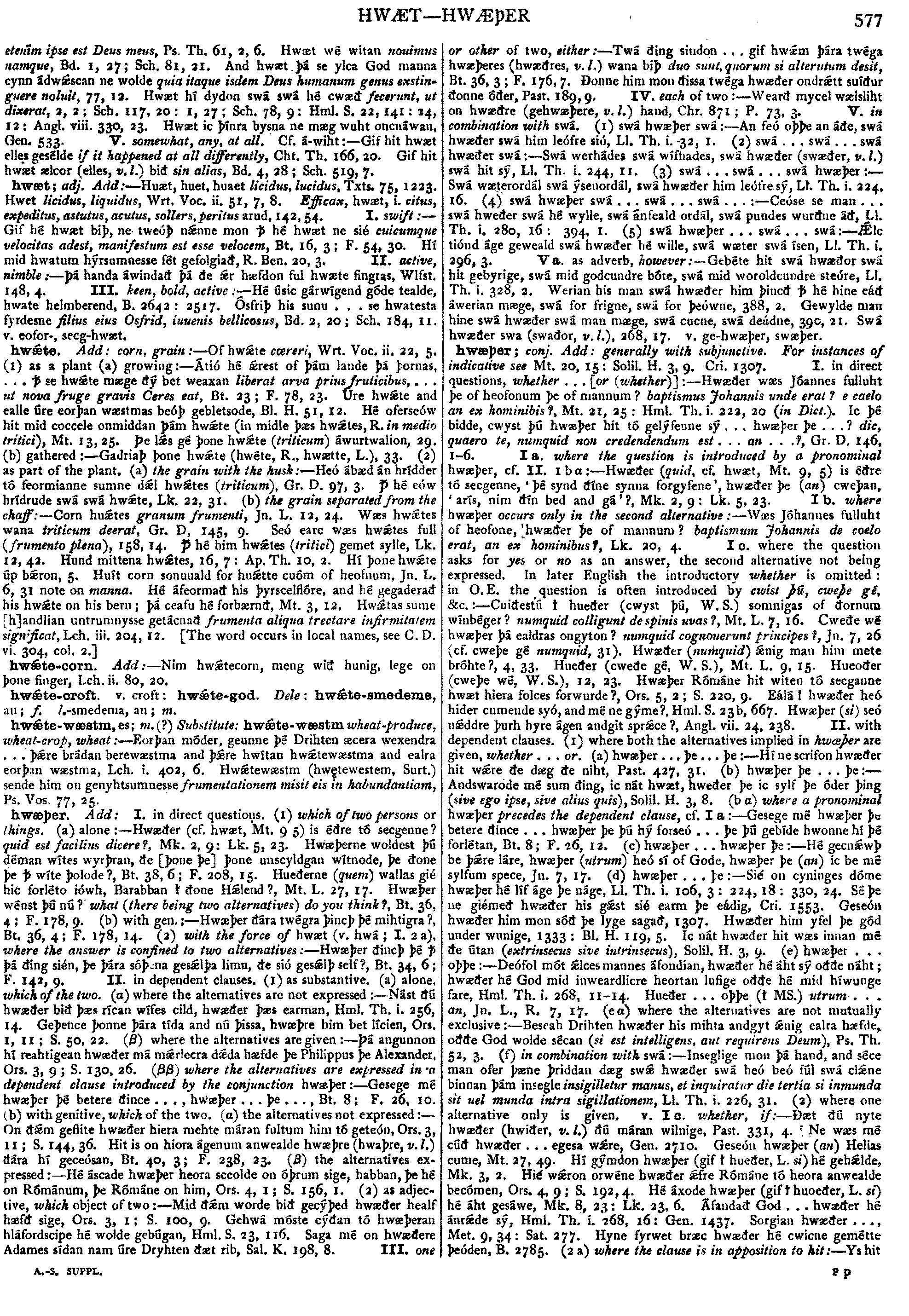
hwte.
Add:
corn,
grain
:--
Of
hwæte
cœreri,
Wrt.
Voc.
ii.
22,
5.
(1)
as
a
plant
(a)
growing
:--
Átió
hé
rest
of
þám
lande
þá
þornas,
...
se
hwte
mæge
ðý
bet
weaxan
liberat
arva
prius
fruticibus,
...
ut
nova
fruge
gravis
Ceres
eat,
Bt.
23;
F.
78,
23.
Úre
hwte
and
ealle
úre
eorþan
wæstmas
beóþ
gebletsode,
Bl.
H.
51,
12.
Hé
oferseów
hit
mid
coccele
onmiddan
þám
hwte
(in
midle
þæs
hwtes,
R.
in
medio
tritici),
Mt.
13,
25.
Þe
ls
gé
þone
hwte
(triticum)
áwurtwalion,
29.
(b)
gathered
:--
Gadriaþ
þone
hwte
(hwéte,
R.,
hwætte,
L.),
33.
(2)
as
part
of
the
plant,
(a)
the
grain
with
the
husk
:--
Heó
ábæd
án
hrídder
tó
feormianne
sumne
dl
hwtes
(triticum).
Gr.
D.
97,
3.
Þ-bar;
hé
eów
hrídrude
swá
swá
hwte,
Lk.
22,
31.
(b)
the
grain
separated
from
the
chaff
:--
Corn
hutes
granum
frumenti,
Jn.
L.
12,
24.
Wæs
hwtes
wana
tríticum
deerat,
Gr.
D.
145,
9.
Seó
earc
wæs
hwtes
full
(frumento
plena),
158,
14.
Þ-bar;
hé
him
hwtes
(tritici)
gemet
sylle,
Lk.
12,
42.
Hund
mittena
hwtes,
16,
7:
Ap.
Th.
10,
2.
Hí
þone
hwte
úp
bron,
5.
Huít
corn
sonuuald
for
hutte
cuóm
of
heofnum,
Jn.
L.
6,
31
note
on
manna.
Hé
áfeormað
his
þyrscelflóre,
and
hé
gegaderað
his
hwte
on
his
bern;
þá
ceafu
hé
forbærnð,
Mt.
3,
12.
Hwtas
sume
[h]andlian
untrumnysse
getácnað
frumenta
aliqua
trectare
infirmitatem
significat,
Lch.
iii.
204,
12.
[The
word
occurs
in
local
names,
see
C.
D.
vi.
304,
col.
2.]
|
Source: Bosworth/Toller, page d0581, entry 10 View original page image as: [TIFF] [PNG] [View previous entry] [View next entry] |
[Comment on this entry] [View comments] |
The following entry has been hand-corrected once. |
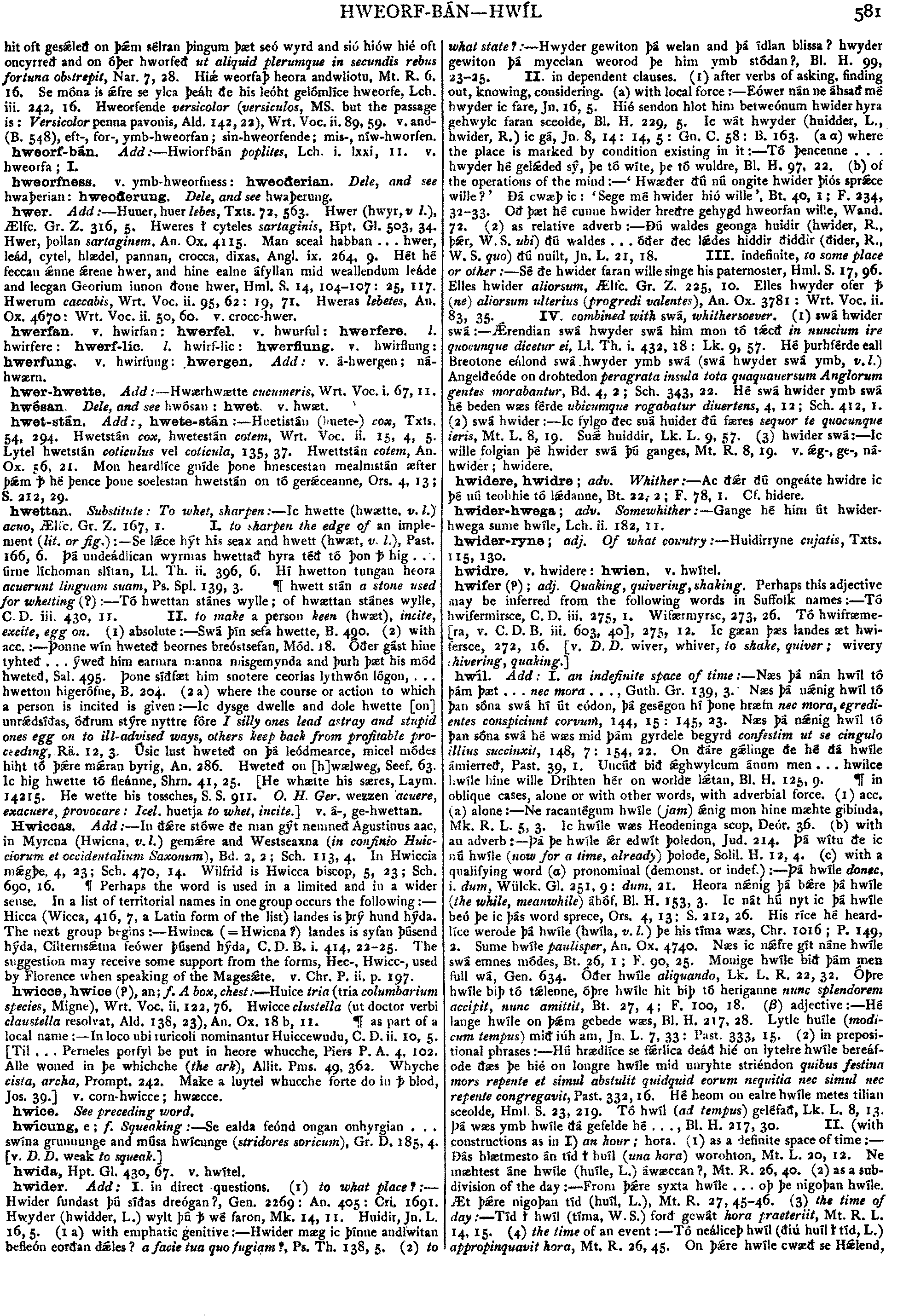
Hwiccas.
Add
:--
In

 re
st
re
st we
e
man
g
we
e
man
g t
nemne
Agustinus
aac,
in
Myrcna
(Hwicna,
v.
l.)
gemre
and
Westseaxna
(in
confinio
Huic-ciorum
et
occidentalium
Saxonum),
Bd.
2,
2
;
Sch.
113,
4.
In
Hwiccia
mgþe,
4,
23;
Sch.
470,
14.
Wilfrid
is
Hwicca
biscop,
5,
23;
Sch.
690,
16.

Perhaps
the
word
is
used
in
a
limited
and
in
a
wider
sense.
In
a
list
of
territorial
names
in
one
group
occurs
the
following
:--
Hicca
(Wicca,
416,
7,
a
Latin
form
of
the
list)
landes
is
þr
hund
hda.
The
next
group
begins
:--
Hwinca
(
=
Hwicna?)
landes
is
syfan
þ
t
nemne
Agustinus
aac,
in
Myrcna
(Hwicna,
v.
l.)
gemre
and
Westseaxna
(in
confinio
Huic-ciorum
et
occidentalium
Saxonum),
Bd.
2,
2
;
Sch.
113,
4.
In
Hwiccia
mgþe,
4,
23;
Sch.
470,
14.
Wilfrid
is
Hwicca
biscop,
5,
23;
Sch.
690,
16.

Perhaps
the
word
is
used
in
a
limited
and
in
a
wider
sense.
In
a
list
of
territorial
names
in
one
group
occurs
the
following
:--
Hicca
(Wicca,
416,
7,
a
Latin
form
of
the
list)
landes
is
þr
hund
hda.
The
next
group
begins
:--
Hwinca
(
=
Hwicna?)
landes
is
syfan
þ send
hda,
Cilternstna
feówer
þsend
hda,
C.
D.
B.
i.
414,
22-25.
The
suggestion
may
receive
some
support
from
the
forms,
Hec-,
Hwicc-,
used
by
Florence
when
speaking
of
the
Mageste.
v.
Chr.
P.
ii.
p.
197.
send
hda,
Cilternstna
feówer
þsend
hda,
C.
D.
B.
i.
414,
22-25.
The
suggestion
may
receive
some
support
from
the
forms,
Hec-,
Hwicc-,
used
by
Florence
when
speaking
of
the
Mageste.
v.
Chr.
P.
ii.
p.
197.
|
Source: Bosworth/Toller, page d0581, entry 20 View original page image as: [TIFF] [PNG] [View previous entry] [View next entry] |
[Comment on this entry] [View comments] |
The following entry has been hand-corrected once. |
hwifer
(?)
;
adj.
Quaking,
quivering,
shaking.
Perhaps
this
adjective
may
be
inferred
from
the
following
words
in
Suffolk
names
:--
T
hwifermirsce,
C.
D.
iii.
275,
l.
Wifærmyrsc,
273,
26.
T
hwifræme-[ra,
v.
C.
D.
B.
iii.
603,
40],
275,
12.
Ic
gæan
þæs
landes
æt
hwi-fersce,
272,
16.
[v.
D.
D.
wiver,
whiver,
to
shake,
quiver;
wivery
hivering,
quaking.]
|
Source: Bosworth/Toller, page d0583, entry 8 View original page image as: [TIFF] [PNG] [View previous entry] [View next entry] |
[Comment on this entry] [View comments] |
The following entry has been hand-corrected once. |
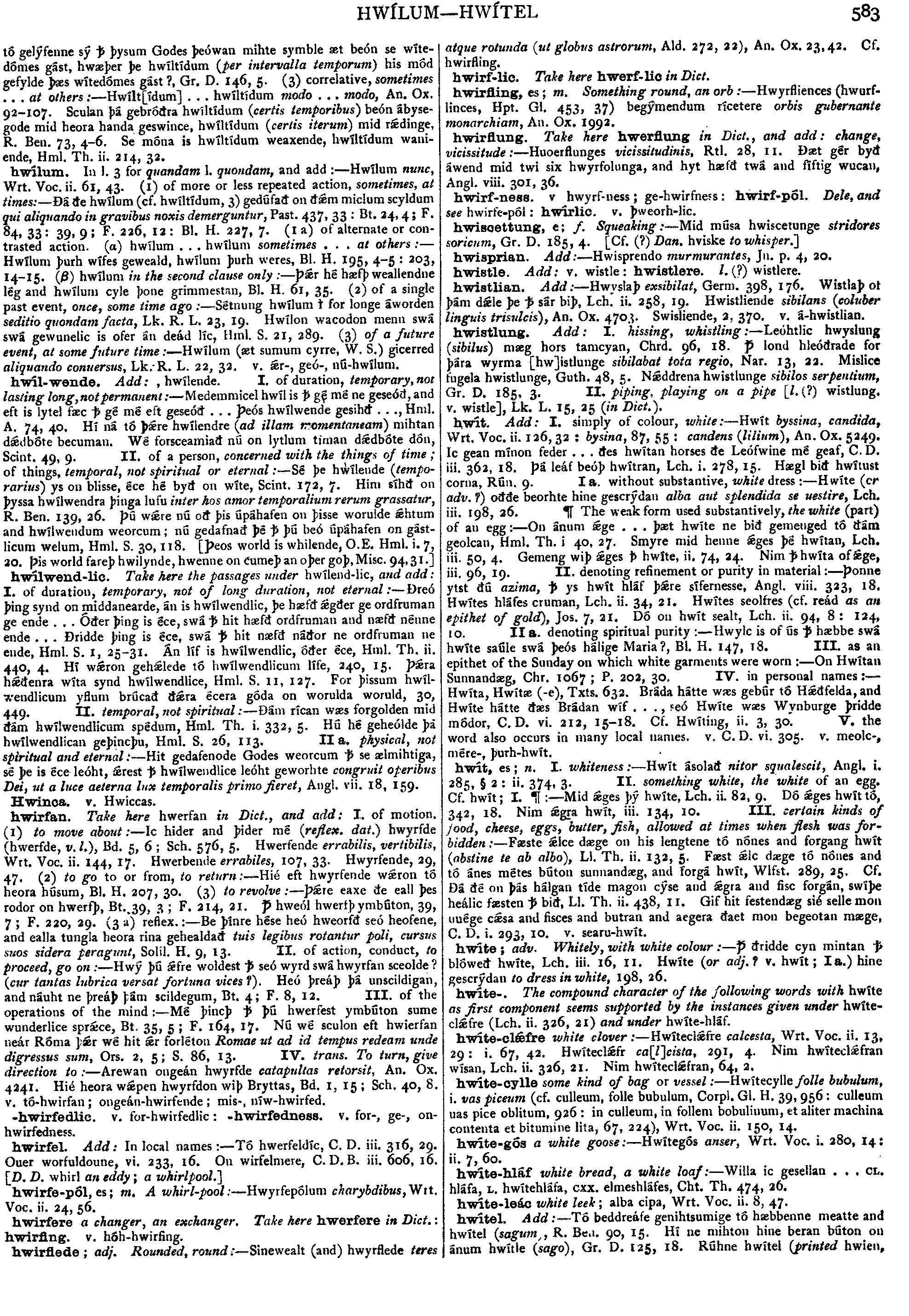
hwirfel.
Add:
In
local
names
:--
T
hwerfeld c,
C.
D.
iii.
316,
29.
Ouer
worfuldoune,
vi.
233,
16.
On
wirfelmere,
C.
D.
B.
iii.
606,
16.
[D.
D.
whirl
an
eddy;
a
whirlpool.]
c,
C.
D.
iii.
316,
29.
Ouer
worfuldoune,
vi.
233,
16.
On
wirfelmere,
C.
D.
B.
iii.
606,
16.
[D.
D.
whirl
an
eddy;
a
whirlpool.]
|
Source: Bosworth/Toller, page d0583, entry 21 View original page image as: [TIFF] [PNG] [View previous entry] [View next entry] |
[Comment on this entry] [View comments] |
The following entry has been hand-corrected once. |
hwt.
Add:
I.
simply
of
colour,
white
:--
Hwt
byssina,
Candida,
Wrt.
Voc.
ii.
126,
32
;
bysina,
87,
55
:
candens
(lilium)
An.
Ox.
5249.
Ic
gean
mnon
feder
.
.
.
es
hwtan
horses
e
Leófwine
m geaf,
C.
D.
iii.
362,
18.
Þ
geaf,
C.
D.
iii.
362,
18.
Þ leáf
beóþ
hwtran,
Lch.
i.
278,
15.
Hægl
bi
hwtust
corna,
Rn.
9.
Ia.
without
substantive,
white
dress
:--
Hwte
(cr
adv.?)
oe
beorhte
bine
gescrdan
alba
aut
splendida
se
uestire,
Lch.
iii.
198,
26.

The
weak
form
used
substantively,
the
white
(part)
of
an
egg
:--
On
num
ge
.
.
.
þæt
hwte
ne
bi
gemenged
t
m
geolcan,
Hml.
Th.
i
40,
27.
Smyre
mid
henne
ges
þ
hwtan,
Lch.
iii.
50,
4.
Gemeng
wiþ
ges
hwte,
ii.
74,
24.
Nim
hwta
of
ge,
iii.
96,
19.
II.
denoting
refinement
or
purity
in
material
:--
Þonne
ytst
azima,
ys
hwt
hlf
þre
sfernesse,
Angl.
viii.
323,
18.
Hwtes
hlfes
cruman,
Lch.
ii.
34,
21.
Hwtes
seolfres
(cf.
reád
as
an
epithet
of
gold),
Jos.
7,
21.
D
on
hwt
sealt,
Lch.
ii.
94,
8
:
124,
10.
II
a.
denoting
spiritual
purity
:--
Hwylc
is
of
s
hæbbe
sw
hwte
sale
sw
þeós
hlige
Maria?,
Bl.
H.
147,
18.
III.
as
an
epithet
of
the
Sunday
on
which
white
garments
were
worn
:--
On
Hwtan
Sunnandæg,
Chr.
1067;
P.
202;
30.
IV.
in
personal
names
:--
Hwta,
Hwtæ
(-e),
Txts.
632.
Brda
htte
wæs
gebr
t
Hfelda,
and
Hwte
htte
æs
Brdan
wf
.
.
.
,
seó
Hwte
wæs
Wynburge
þridde
mdor,
C.
D.
vi.
212,
15-18.
Cf.
Hwting,
ii.
3,
30.
V.
the
word
also
occurs
in
many
local
names,
v.
C.
D.
vi.
305.
v.
meolc-,
mre-,
þurh-hwt.
leáf
beóþ
hwtran,
Lch.
i.
278,
15.
Hægl
bi
hwtust
corna,
Rn.
9.
Ia.
without
substantive,
white
dress
:--
Hwte
(cr
adv.?)
oe
beorhte
bine
gescrdan
alba
aut
splendida
se
uestire,
Lch.
iii.
198,
26.

The
weak
form
used
substantively,
the
white
(part)
of
an
egg
:--
On
num
ge
.
.
.
þæt
hwte
ne
bi
gemenged
t
m
geolcan,
Hml.
Th.
i
40,
27.
Smyre
mid
henne
ges
þ
hwtan,
Lch.
iii.
50,
4.
Gemeng
wiþ
ges
hwte,
ii.
74,
24.
Nim
hwta
of
ge,
iii.
96,
19.
II.
denoting
refinement
or
purity
in
material
:--
Þonne
ytst
azima,
ys
hwt
hlf
þre
sfernesse,
Angl.
viii.
323,
18.
Hwtes
hlfes
cruman,
Lch.
ii.
34,
21.
Hwtes
seolfres
(cf.
reád
as
an
epithet
of
gold),
Jos.
7,
21.
D
on
hwt
sealt,
Lch.
ii.
94,
8
:
124,
10.
II
a.
denoting
spiritual
purity
:--
Hwylc
is
of
s
hæbbe
sw
hwte
sale
sw
þeós
hlige
Maria?,
Bl.
H.
147,
18.
III.
as
an
epithet
of
the
Sunday
on
which
white
garments
were
worn
:--
On
Hwtan
Sunnandæg,
Chr.
1067;
P.
202;
30.
IV.
in
personal
names
:--
Hwta,
Hwtæ
(-e),
Txts.
632.
Brda
htte
wæs
gebr
t
Hfelda,
and
Hwte
htte
æs
Brdan
wf
.
.
.
,
seó
Hwte
wæs
Wynburge
þridde
mdor,
C.
D.
vi.
212,
15-18.
Cf.
Hwting,
ii.
3,
30.
V.
the
word
also
occurs
in
many
local
names,
v.
C.
D.
vi.
305.
v.
meolc-,
mre-,
þurh-hwt.
|
Source: Bosworth/Toller, page d0586, entry 3 View original page image as: [TIFF] [PNG] [View previous entry] [View next entry] |
[Comment on this entry] [View comments] |
The following entry has been hand-corrected once. |
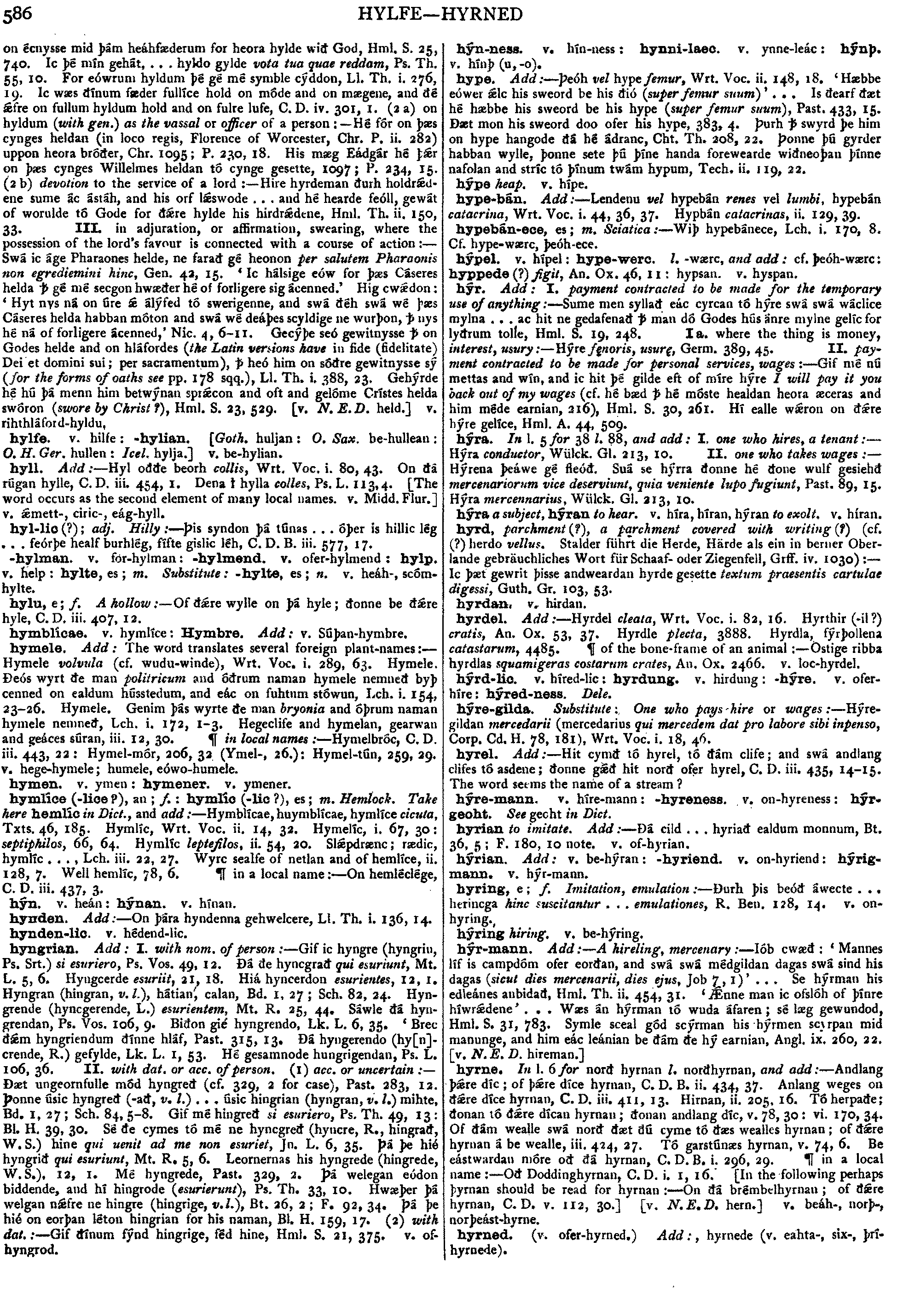
hyll.
Add
:--
Hyl
oe
beorh
collis,
Wrt.
Voc.
i.
80,
43.
On
rgan
hylle,
C.
D.
iii.
454,
1.
Dena
hylla
colles.
Ps.
L.
113,
4.
[The
word
occurs
as
the
second
element
of
many
local
names,
v.
Midd.
Flur.]
v.
mett-,
ciric-,
eág-hyll.
| Result Page: |  |
Previous | 17 18 19 20 21 22 23 24 25 26 27 28 29 30 31 32 33 34 35 | Next |  |
Germanic Lexicon Project (main page)
This search system was written by
Sean Crist
Please consider
volunteering
to correct the data in these online dictionaries.
No rights reserved. Feel free to use these data in any way you please.