|
|

|
Source: Bosworth/Toller, page d0133, entry 2 View original page image as: [TIFF] [PNG] [View previous entry] [View next entry] |
[Comment on this entry] [View comments] |
The following entry has been hand-corrected once. |
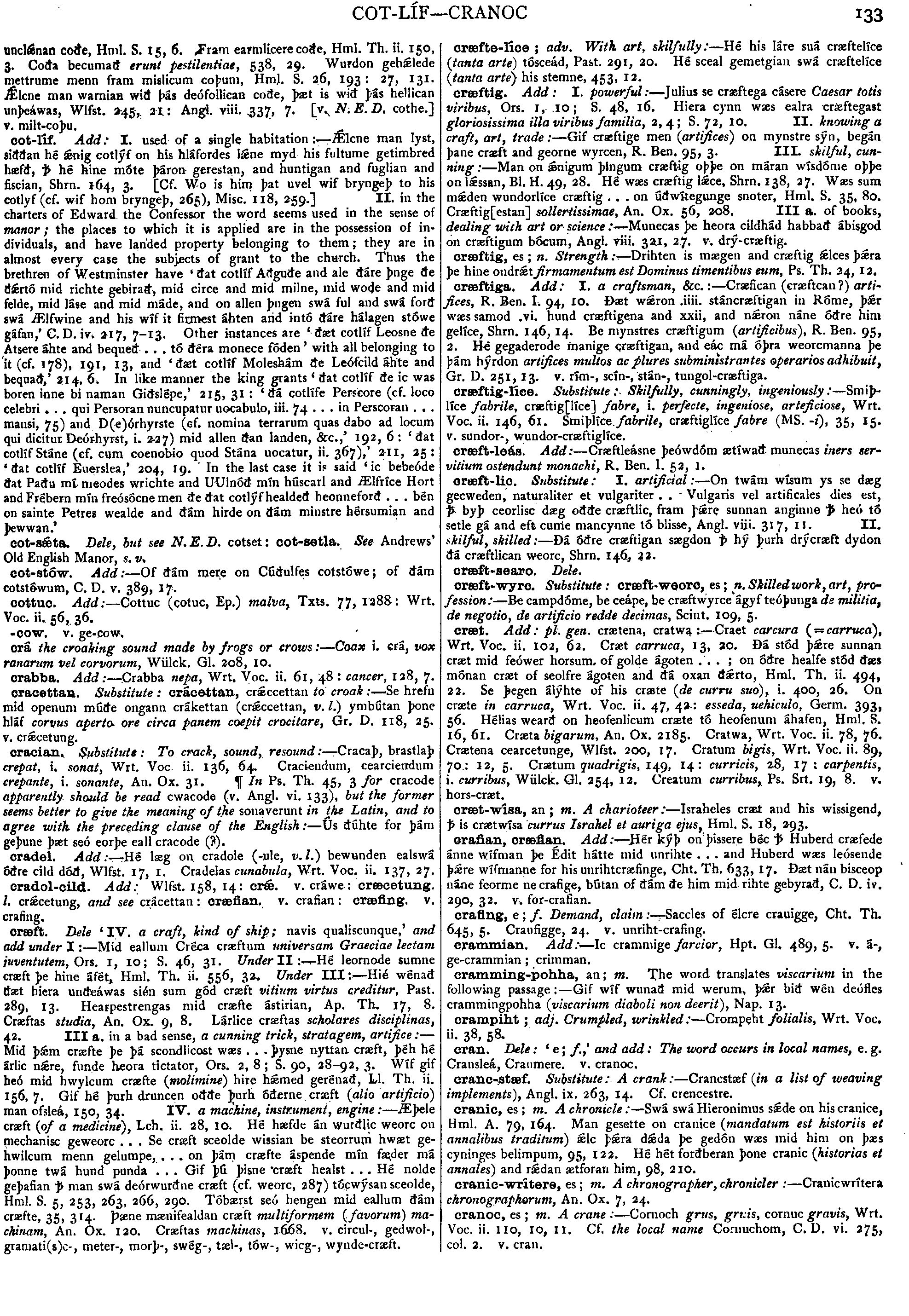
cot-líf.
Add:--
I.
used
of
a
single
habitation:--Æ-acute;lcne
man
lyst,
siððan
hé
 nig
cotlýf
on
his
hláfordes
lne
myd
his
fultume
getimbred
hæfð,
nig
cotlýf
on
his
hláfordes
lne
myd
his
fultume
getimbred
hæfð,
 hé
hine
móte
þáron
gerestan,
and
huntigan
and
fuglian
and
fiscian,
Shrn.
164,
3.
[Cf.
Wo
is
him
þat
uvel
wif
bryngeþ
to
his
cotlyf
(cf.
wif
hom
bryngeþ,
265),
Misc.
118,
259.]
II.
in
the
charters
of
Edward
the
Confessor
the
word
seems
used
in
the
sense
of
manor;
the
places
to
which
it
is
applied
are
in
the
possession
of
individuals,
and
have
landed
property
belonging
to
them;
they
are
in
almost
every
case
the
subjects
of
grant
to
the
church.
Thus
the
brethren
of
Westminster
have
'ðat
cotlíf
Aðguðe
and
ale
ðáre
þnge
ðe
ðrtó
mid
richte
gebirað,
mid
circe
and
mid
milne,
mid
wode
and
mid
felde,
mid
láse
and
mid
máde,
and
on
allen
þngen
swá
ful
and
swá
forð
swá
Ælfwine
and
his
wíf
it
firmest
áhten
and
intó
ðáre
hálagen
stówe
gáfan,'
C.
D.
iv.
217,
7-13.
Other
instances
are
'ðæt
cotlíf
Leosne
ðe
Atsere
áhte
and
bequeð
.
.
.
tó
ðéra
monece
fóden'
with
all
belonging
to
it
(cf.
178),
191,
13,
and
'ðæt
cotlíf
Moleshám
ðe
Leófcild
áhte
and
bequað,'
214,
6.
In
like
manner
the
king
grants
'ðat
cotlíf
ðe
ic
was
boren
inne
bi
naman
Giðslépe,'
215,
31:
'ðá
cotlífe
Perscore
(cf.
loco
celebri
.
.
.
qui
Persoran
nuncupatur
uocabulo,
iii.
74
.
.
.
in
Perscoran
.
.
.
mansi,
75)
and
D(e)órhyrste
(of.
nomina
terrarum
quas
dabo
ad
locum
qui
dicitur
Deórhyrst,
i.
227)
mid
allen
ðan
landen,
&c.,'
192,
6:
'ðat
cotlíf
Stáne
(cf.
cum
coenobio
quod
Stána
uocatur,
ii.
367),'
211,
25:
'ðat
cotlíf
Euerslea,'
204,
19.
In
the
last
case
it
is
said
'ic
bebeóde
ðat
Paðu
mí
meodes
wrichte
and
UUlnóð
mín
húscarl
and
Ælfríce
Hort
and
Frébern
mín
freósócne
men
ðe
ðat
cotlýf
healdeð
heonneforð
.
.
.
bén
on
sainte
Petres
wealde
and
ðám
hirde
on
ðám
minstre
hérsumian
and
þewwan.
hé
hine
móte
þáron
gerestan,
and
huntigan
and
fuglian
and
fiscian,
Shrn.
164,
3.
[Cf.
Wo
is
him
þat
uvel
wif
bryngeþ
to
his
cotlyf
(cf.
wif
hom
bryngeþ,
265),
Misc.
118,
259.]
II.
in
the
charters
of
Edward
the
Confessor
the
word
seems
used
in
the
sense
of
manor;
the
places
to
which
it
is
applied
are
in
the
possession
of
individuals,
and
have
landed
property
belonging
to
them;
they
are
in
almost
every
case
the
subjects
of
grant
to
the
church.
Thus
the
brethren
of
Westminster
have
'ðat
cotlíf
Aðguðe
and
ale
ðáre
þnge
ðe
ðrtó
mid
richte
gebirað,
mid
circe
and
mid
milne,
mid
wode
and
mid
felde,
mid
láse
and
mid
máde,
and
on
allen
þngen
swá
ful
and
swá
forð
swá
Ælfwine
and
his
wíf
it
firmest
áhten
and
intó
ðáre
hálagen
stówe
gáfan,'
C.
D.
iv.
217,
7-13.
Other
instances
are
'ðæt
cotlíf
Leosne
ðe
Atsere
áhte
and
bequeð
.
.
.
tó
ðéra
monece
fóden'
with
all
belonging
to
it
(cf.
178),
191,
13,
and
'ðæt
cotlíf
Moleshám
ðe
Leófcild
áhte
and
bequað,'
214,
6.
In
like
manner
the
king
grants
'ðat
cotlíf
ðe
ic
was
boren
inne
bi
naman
Giðslépe,'
215,
31:
'ðá
cotlífe
Perscore
(cf.
loco
celebri
.
.
.
qui
Persoran
nuncupatur
uocabulo,
iii.
74
.
.
.
in
Perscoran
.
.
.
mansi,
75)
and
D(e)órhyrste
(of.
nomina
terrarum
quas
dabo
ad
locum
qui
dicitur
Deórhyrst,
i.
227)
mid
allen
ðan
landen,
&c.,'
192,
6:
'ðat
cotlíf
Stáne
(cf.
cum
coenobio
quod
Stána
uocatur,
ii.
367),'
211,
25:
'ðat
cotlíf
Euerslea,'
204,
19.
In
the
last
case
it
is
said
'ic
bebeóde
ðat
Paðu
mí
meodes
wrichte
and
UUlnóð
mín
húscarl
and
Ælfríce
Hort
and
Frébern
mín
freósócne
men
ðe
ðat
cotlýf
healdeð
heonneforð
.
.
.
bén
on
sainte
Petres
wealde
and
ðám
hirde
on
ðám
minstre
hérsumian
and
þewwan.
|
Source: Bosworth/Toller, page d0145, entry 7 View original page image as: [TIFF] [PNG] [View previous entry] [View next entry] |
[Comment on this entry] [View comments] |
The following entry has been hand-corrected once. |
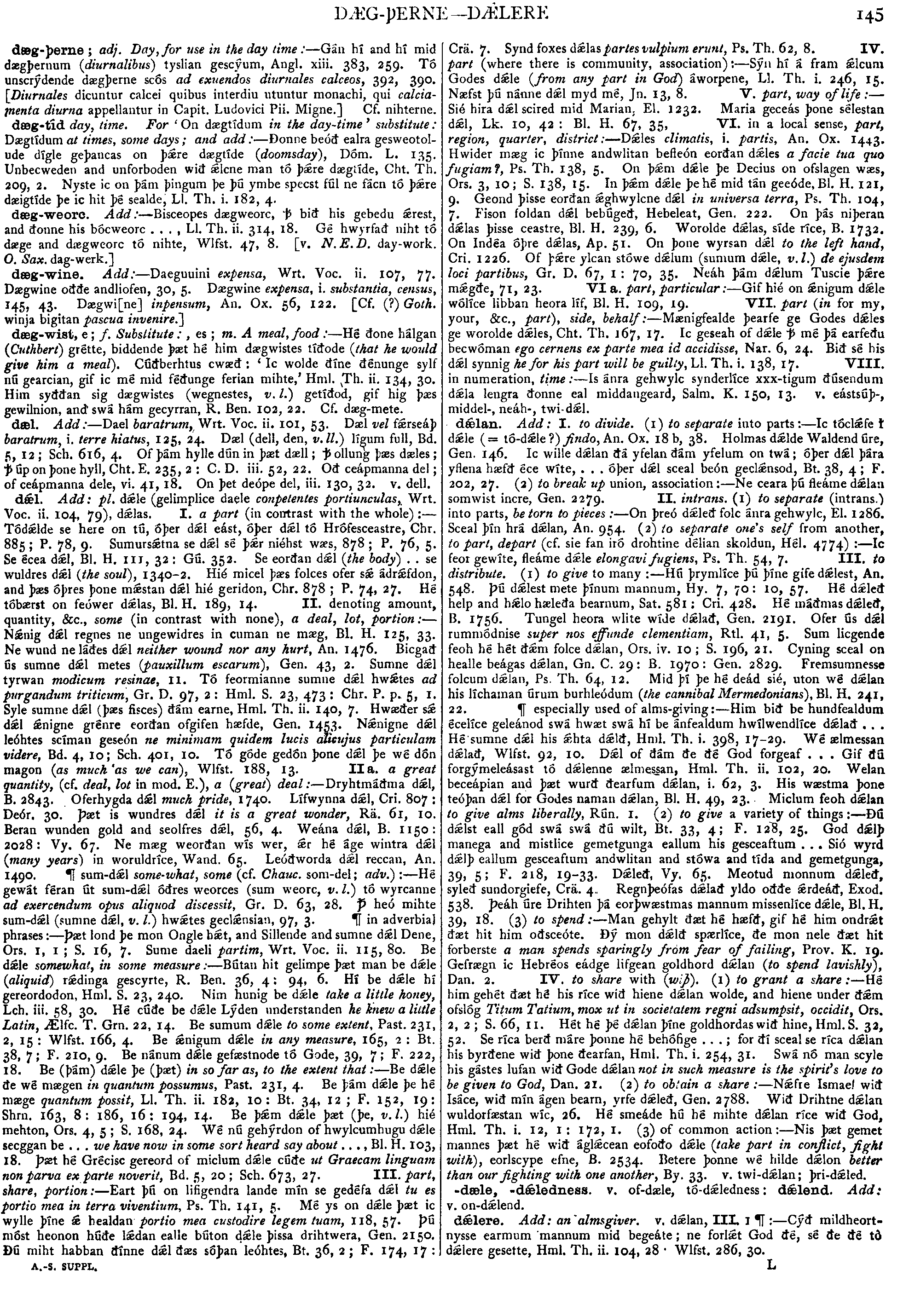
dl.
Add:
pl.
dle
(gelimplice
daele
conpetentes
portiunculas,
Wrt.
Voc.
ii.
104,
79),
dlas.
I.
a
part
(in
contrast
with
the
whole):--Tódlde
se
here
on
tú,
óþer
dl
eást,
óþer
dl
tó
Hrófesceastre,
Chr.
885;
P.
78,
9.
Sumurstna
se
dl
sé
þr
niéhst
wæs,
878;
P.
76,
5.
Se
écea
dl,
Bl.
H.
111,
32:
Gú.
352.
Se
eorðan
dl
(the
body).
.
se
wuldres
dl
(the
soul),
1340-2.
Hié
micel
þæs
folces
ofer
s
ádrfdon,
and
þæs
óþres
þone
mstan
dl
hié
geridon,
Chr.
878;
P.
74,
27.
Hé
tóbærst
on
feówer
dlas,
Bl.
H.
189,
14.
II.
denoting
amount,
quantity,
&c.,
some
(in
contrast
with
none),
a
deal,
lot,
portion:--Nnig
dl
regnes
ne
ungewidres
in
cuman
ne
mæg,
Bl.
H.
125,
33.
Ne
wund
ne
láðes
dl
neither
wound
nor
any
hurt,
An.
1476.
Bicgað
ús
sumne
dl
metes
(pauxillum
escarum),
Gen.
43,
2.
Sumne
dl
tyrwan
modicum
resinae,
11.
Tó
feormianne
sumne
dl
hwtes
ad
purgandum
triticum,
Gr.
D.
97,
2:
Hml.
S.
23,
473:
Chr.
P.
p.
5,
1.
Syle
sumne
dl
(þæs
fisces)
ðám
earne,
Hml.
Th.
ii.
140,
7.
Hwæðer
s
dl
nigne
grénre
eorðan
ofgifen
hæfde,
Gen.
1453.
Nnigne
dl
leóhtes
scíman
geseón
ne
minimam
quidem
lucis
alicujus
particulam
videre,
Bd.
4,
10;
Sch.
401,
10.
Tó
góde
gedón
þone
dl
þe
wé
dón
magon
(as
much
as
we
can),
Wlfst.
188,
13.
II
a.
a
great
quantity,
(cf.
deal,
lot
in
mod.
E.),
a
(great)
deal:--Dryhtmáðma
dl,
B.
2843.
Oferhygda
dl
much
pride,
1740.
Lífwynna
dl,
Cri.
807:
Deór.
30.
Þæt
is
wundres
dl
it
is
a
great
wonder,
Rä.
61,
10.
Beran
wunden
gold
and
seolfres
dl,
56,
4.
Weána
dl,
B.
1150:
2028:
Vy.
67.
Ne
mæg
weorðan
wís
wer,
r
hé
áge
wintra
dl
(many
years)
in
woruldríce,
Wand.
65.
Leóðworda
dl
reccan,
An.
1490.

sum-dl
some-what,
some
(cf.
Chauc.
som-del;
adv.):--Hé
gewát
féran
út
sum-dl
óðres
weorces
(sum
weorc,
v.
l.)
tó
wyrcanne
ad
exercendum
opus
aliquod
discessit,
Gr.
D.
63,
28.
Þ-bar;
heó
mihte
sum-dl
(sumne
dl,
v.
l.)
hwtes
geclnsian,
97,
3.

in
adverbial
phrases:--Þæt
lond
þe
mon
Ongle
ht,
and
Sillende
and
sumne
dl
Dene,
Ors.
1,
1;
S.
16,
7.
Sume
daeli
partim,
Wrt.
Voc.
ii.
115,
80.
Be
dle
somewhat,
in
some
measure:--Bútan
hit
gelimpe
þæt
man
be
dle
(aliquid)
rdinga
gescyrte,
R.
Ben.
36,
4:
94,
6.
Hí
be
dle
hí
gereordodon,
Hml.
S.
23,
240.
Nim
hunig
be
dle
take
a
little
honey,
Lch.
iii.
58,
30.
Hé
cúðe
be
dle
Lýden
understanden
he
knew
a
little
Latin,
Ælfc.
T.
Grn.
22,
14.
Be
sumum
dle
to
some
extent,
Past.
231,
2,
15:
Wlfst.
166,
4.
Be
nigum
dle
in
any
measure,
165,
2:
Bt.
38,
7;
F.
210,
9.
Be
nánum
dle
gefæstnode
tó
Gode,
39,
7;
F.
222,
18.
Be
(þám)
dle
þe
(þæt)
in
so
far
as,
to
the
extent
that:--Be
dle
ðe
wé
mægen
in
quantum
possumus,
Past.
231,
4.
Be
þám
dle
þe
hé
mæge
quantum
possit,
Ll.
Th.
ii.
182,
10:
Bt.
34,
12;
F.
152,
19:
Shrn.
163,
8:
186,
16:
194,
14.
Be
þm
dle
þæt
(þe,
v.
l.)
hié
mehton,
Ors.
4,
5;
S.
168,
24.
Wé
nú
gehýrdon
of
hwylcumhugu
dle
secggan
be
.
.
.
we
have
now
in
some
sort
heard
say
about
.
.
.,
Bl.
H.
103,
18.
Þæt
hé
Grécisc
gereord
of
miclum
dle
cúðe
ut
Graecam
linguam
non
parva
ex
parte
noverit,
Bd.
5,
20;
Sch.
673,
27.
III.
part,
share,
portion:--Eart
þú
on
lifigendra
lande
mín
se
gedéfa
dl
tu
es
portio
mea
in
terra
viventium,
Ps.
Th.
141,
5.
Mé
ys
on
dle
þæt
ic
wylle
þíne
healdan
portio
mea
custodire
legem
tuam,
118,
57.
Þú
móst
heonon
húðe
ldan
ealle
búton
dle
þissa
drihtwera,
Gen.
2150.
Ðú
miht
habban
ðínne
dl
ðæs
sóþan
leóhtes,
Bt.
36,
2;
F.
174,
17:
A.
Crä.
7.
Synd
foxes
dlas
partes
vulpium
erunt,
Ps.
Th.
62,
8.
IV.
part
(where
there
is
community,
association):--Sýn
hí
á
fram
lcum
Godes
dle
(from
any
part
in
God)
áworpene,
Ll.
Th.
i.
246,
15.
Næfst
þú
nánne
dl
myd
mé,
Jn.
13,
8.
V.
part,
way
of
life:--Sié
hira
dl
scired
mid
Marian,
El.
1232.
Maria
geceás
þone
sélestan
dl,
Lk.
10,
42:
Bl.
H.
67,
35.
VI.
in
a
local
sense,
part,
region,
quarter,
district:--Dles
climatis,
i.
partis,
An.
Ox.
1443.
Hwider
mæg
ic
þínne
andwlitan
befleón
eorðan
dles
a
facie
tua
quo
fugiam?,
Ps.
Th.
138,
5.
On
þm
dle
þe
Decius
on
ofslagen
wæs,
Ors.
3,
10;
S.
138,
15.
In
þm
dle
þe
hé
mid
tán
geeóde,
Bl.
H.
121,
9.
Geond
þisse
eorðan
ghwylcne
dl
in
universa
terra,
Ps.
Th.
104,
7.
Fison
foldan
dl
bebúgeð,
Hebeleat,
Gen.
222.
On
þás
niþeran
dlas
þisse
ceastre,
Bl.
H.
239,
6.
Worolde
dlas,
síde
ríce,
B.
1732.
On
Indéa
óþre
dlas,
Ap.
51.
On
þone
wyrsan
dl
to
the
left
hand,
Cri.
1226.
Of
þre
ylcan
stówe
dlum
(sumum
dle,
v.
l.)
de
ejusdem
loci
partibus,
Gr.
D.
67,
1:
70,
35.
Neáh
þám
dlum
Tuscie
þre
mgðe,
71,
23.
VI
a.
part,
particular:--Gif
hié
on
nigum
dle
wólíce
libban
heora
líf,
Bl.
H.
109,
19.
VII.
part
(in
for
my,
your,
&c.,
part),
side,
behalf:--Mænigfealde
þearfe
ge
Godes
dles
ge
worolde
dles,
Cht.
Th.
167,
17.
Ic
geseah
of
dle
mé
þá
earfeðu
becwóman
ego
cernens
ex
parte
mea
id
accidisse,
Nar.
6,
24.
Bið
sé
his
dl
synnig
he
for
his
part
will
be
guilty,
Ll.
Th.
i.
138,
17.
VIII.
in
numeration,
time:--Is
ánra
gehwylc
synderlíce
xxx-tigum
ðúsendum
dla
lengra
ðonne
eal
middangeard,
Salm.
K.
150,
13.
v.
eástsúþ-,
middel-,
neáh-,
twi-dl.
|
Source: Bosworth/Toller, page d0154, entry 6 View original page image as: [TIFF] [PNG] [View previous entry] [View next entry] |
[Comment on this entry] [View comments] |
The following entry has been hand-corrected once. |
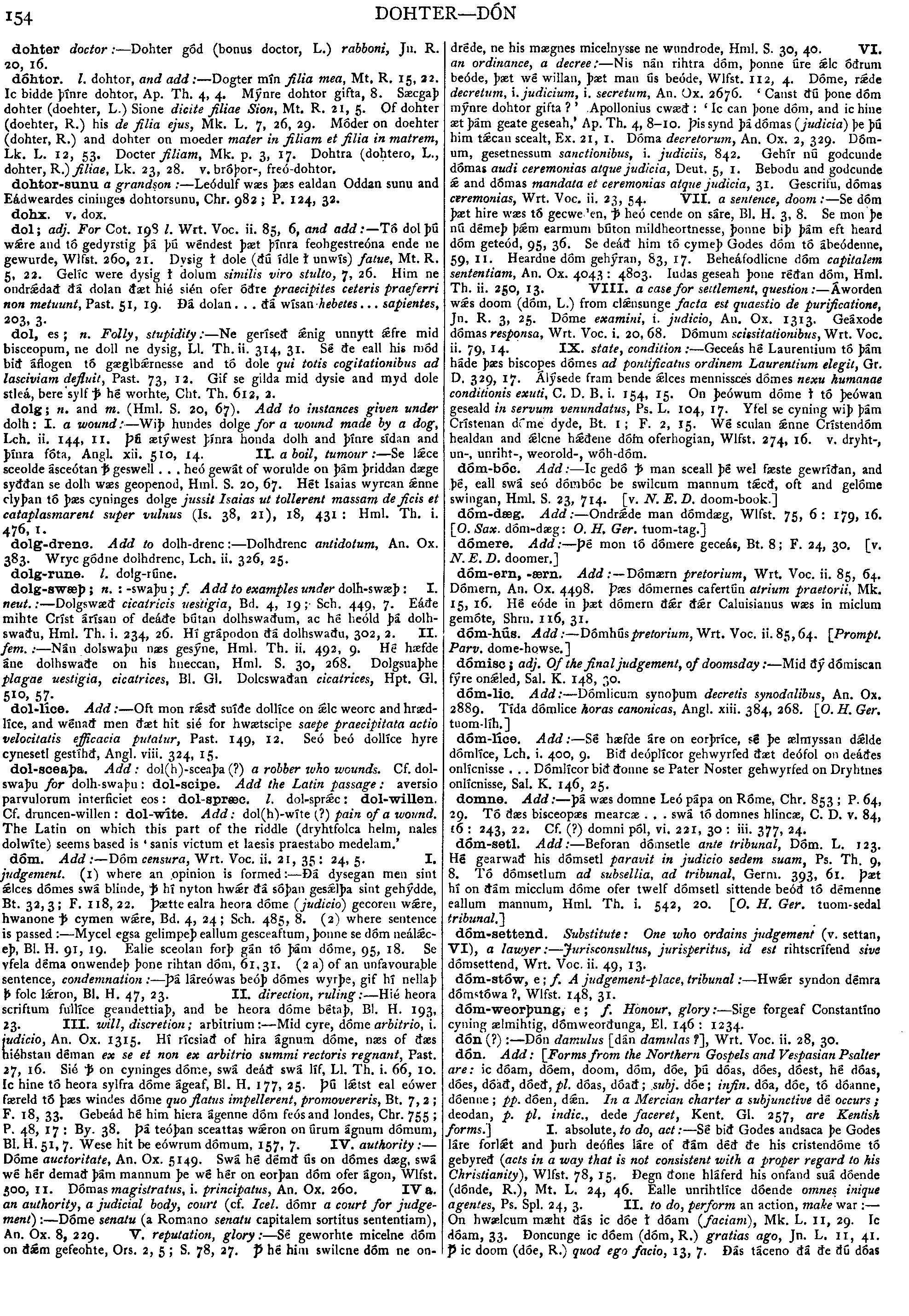
dol,
es;
n.
Folly,
stupidity:--Ne
geríseð
nig
unnytt
fre
mid
bisceopum,
ne
doll
ne
dysig,
Ll.
Th.
ii.
314,
31.
Sé
ðe
eall
his
mód
bið
áflogen
tó
gæglbrnesse
and
tó
dole
qui
totis
cogitationibus
ad
lasciviam
defluit,
Past.
73,
12.
Gif
se
gilda
mid
dysie
and
myd
dole
stleá,
bere
sylf
hé
worhte,
Cht.
Th.
612,
2.
|
Source: Bosworth/Toller, page d0168, entry 13 View original page image as: [TIFF] [PNG] [View previous entry] [View next entry] |
[Comment on this entry] [View comments] |
The following entry has been hand-corrected once. |
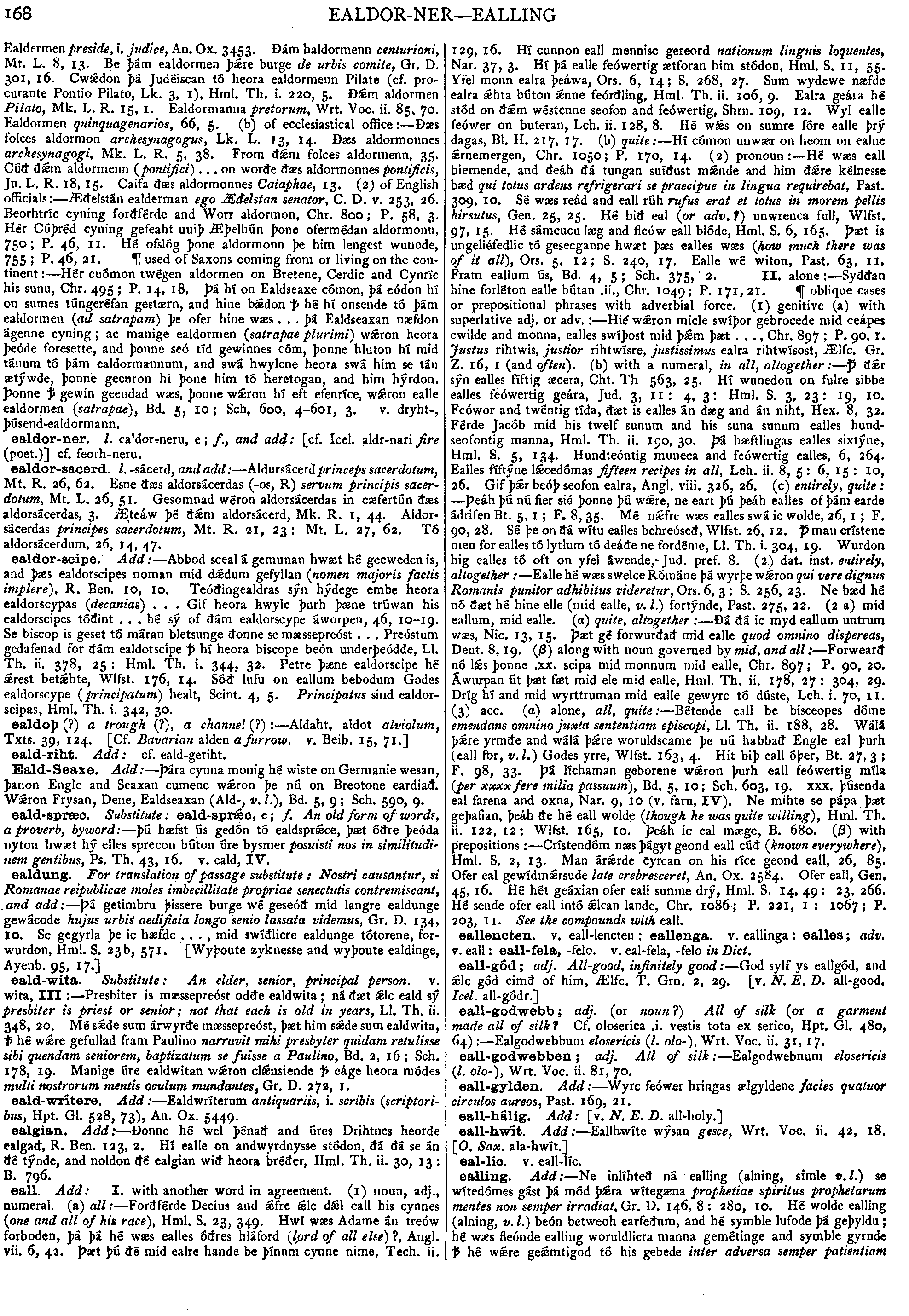
eall.
Add:
I.
with
another
word
in
agreement.
(1)
noun,
adj.,
numeral.
(a)
all:--Forðférde
Decius
and
fre
lc
dl
eall
his
cynnes
(one
and
all
of
his
race),
Hml.
S.
23,
349.
Hwí
wæs
Adame
án
treów
forboden,
þá
þá
hé
wæs
ealles
óðres
hláford
(lord
of
all
else)
?,
Angl.
vii.
6,
42.
Þæt
þú
ðé
mid
ealre
hande
be
þínum
cynne
nime,
Tech.
ii.
129,
16.
Hí
cunnon
eall
mennisc
gereord
nationum
linguis
loquentes,
Nar.
37,
3.
Hí
þá
ealle
feówertig
ætforan
him
stódon,
Hml.
S.
11,
55.
Yfel
monn
ealra
þeáwa,
Ors.
6,
14;
S.
268,
27.
Sum
wydewe
næfde
ealra
hta
búton
nne
feórðling,
Hml.
Th.
ii.
106,
9.
Ealra
geára
hé
stód
on
ðm
wéstenne
seofon
and
feówertig,
Shrn.
109,
12.
Wyl
ealle
feówer
on
buteran,
Lch.
ii.
128,
8.
Hé
ws
on
sumre
fóre
ealle
þrý
dagas,
Bl.
H.
217,
17.
(b)
quite:--Hí
cómon
unwær
on
heom
on
ealne
rnemergen,
Chr.
1050;
P.
170,
14.
(2)
pronoun:--Hé
wæs
eall
biernende,
and
ðeáh
ðá
tungan
suíðust
mnde
and
him
ðre
kélnesse
bæd
qui
tolus
ardens
refrigerari
se
praecipue
in
lingua
requirebat,
Past.
309,
10.
Sé
wæs
reád
and
eall
rúh
rufus
erat
et
totus
in
morem
pellis
hirsutus,
Gen.
25,
25.
Hé
bið
eal
(or
adv.?)
unwrenca
full,
Wlfst.
97,
15.
Hé
sámcucu
læg
and
fleów
eall
blóde,
Hml.
S.
6,
165.
Þæt
is
ungeliéfedlic
tó
gesecganne
hwæt
þæs
ealles
wæs
(how
much
there
was
of
it
all),
Ors.
5,
12;
S.
240,
17.
Ealle
wé
witon,
Past.
63,
11.
Fram
eallum
ús,
Bd.
4,
5;
Sch.
375,
2.
II.
alone:--Syððan
hine
forléton
ealle
bútan
.ii.,
Chr.
1049;
P.
171,
21.

oblique
cases
or
prepositional
phrases
with
adverbial
force.
(1)
genitive
(a)
with
superlative
adj.
or
adv.:--Hié
wron
micle
swíþor
gebrocede
mid
ceápes
cwilde
and
monna,
ealles
swíþost
mid
þm
þæt
.
.
.,
Chr.
897;
P.
90,
1.
Justus
rihtwis,
justior
rihtwísre,
justissimus
ealra
rihtwísost,
Ælfc.
Gr.
Z.
16,
1
(and
often).
(b)
with
a
numeral,
in
all,
altogether:--Þ-bar;
ðr
sýn
ealles
fíftig
æcera,
Cht.
Th
563,
25.
Hí
wunedon
on
fulre
sibbe
ealles
feówertig
geára,
Jud.
3,
11:
4,
3:
Hml.
S.
3,
23:
19,
10.
Feówor
and
twéntig
tída,
ðæt
is
ealles
án
dæg
and
án
niht,
Hex.
8,
32.
Férde
Jacób
mid
his
twelf
sunum
and
his
suna
sunum
ealles
hund seofontig
manna,
Hml.
Th.
ii.
190,
30.
Þá
hæftlingas
ealles
sixtýne,
Hml.
S.
5,
134.
Hundteóntig
muneca
and
feówertig
ealles,
6,
264.
Ealles
fíftýne
lcedómas
fifteen
recipes
in
all,
Lch.
ii.
8,
5:
6,
15:
10,
26.
Gif
þr
beóþ
seofon
ealra,
Angl.
viii.
326,
26.
(c)
entirely,
quite:--Þeáh
þú
nú
fier
sié
þonne
þú
wre,
ne
eart
þú
þeáh
ealles
of
þám
earde
ádrifen
Bt.
5,
1;
F.
8,
35.
Mé
nfre
wæs
ealles
swá
ic
wolde,
26,
1;
F.
90,
28.
Sé
þe
on
ðá
wítu
ealles
behreóseð,
Wlfst.
26,
12.
Þ-bar;
man
crístene
men
for
ealles
tó
lytlum
tó
deáðe
ne
fordéme,
Ll.
Th.
i.
304,
19.
Wurdon
hig
ealles
tó
oft
on
yfel
áwende,
Jud.
pref.
8.
(2)
dat.
inst.
entirely,
altogether:--Ealle
hé
wæs
swelce
Rómáne
þá
wyrþe
wron
qui
vere
dignus
Romanis
punitor
adhibitus
videretur,
Ors.
6,
3;
S.
256,
23.
Ne
bæd
hé
nó
ðæt
hé
hine
elle
(mid
ealle,
v.
l.)
fortýnde,
Past.
275,
22.
(2
a)
mid
eallum,
mid
ealle.
(
seofontig
manna,
Hml.
Th.
ii.
190,
30.
Þá
hæftlingas
ealles
sixtýne,
Hml.
S.
5,
134.
Hundteóntig
muneca
and
feówertig
ealles,
6,
264.
Ealles
fíftýne
lcedómas
fifteen
recipes
in
all,
Lch.
ii.
8,
5:
6,
15:
10,
26.
Gif
þr
beóþ
seofon
ealra,
Angl.
viii.
326,
26.
(c)
entirely,
quite:--Þeáh
þú
nú
fier
sié
þonne
þú
wre,
ne
eart
þú
þeáh
ealles
of
þám
earde
ádrifen
Bt.
5,
1;
F.
8,
35.
Mé
nfre
wæs
ealles
swá
ic
wolde,
26,
1;
F.
90,
28.
Sé
þe
on
ðá
wítu
ealles
behreóseð,
Wlfst.
26,
12.
Þ-bar;
man
crístene
men
for
ealles
tó
lytlum
tó
deáðe
ne
fordéme,
Ll.
Th.
i.
304,
19.
Wurdon
hig
ealles
tó
oft
on
yfel
áwende,
Jud.
pref.
8.
(2)
dat.
inst.
entirely,
altogether:--Ealle
hé
wæs
swelce
Rómáne
þá
wyrþe
wron
qui
vere
dignus
Romanis
punitor
adhibitus
videretur,
Ors.
6,
3;
S.
256,
23.
Ne
bæd
hé
nó
ðæt
hé
hine
elle
(mid
ealle,
v.
l.)
fortýnde,
Past.
275,
22.
(2
a)
mid
eallum,
mid
ealle.
( )
quite,
altogether:--Ðá
ðá
ic
myd
eallum
untrum
wæs,
Nic.
13,
15.
Þæt
gé
forwurðað
mid
ealle
quod
omnino
dispereas,
Deut.
8,
19.
(
)
quite,
altogether:--Ðá
ðá
ic
myd
eallum
untrum
wæs,
Nic.
13,
15.
Þæt
gé
forwurðað
mid
ealle
quod
omnino
dispereas,
Deut.
8,
19.
( )
along
with
noun
governed
by
mid,
and
all:--Forwearð
nó
ls
þonne
.xx.
scipa
mid
monnum
mid
ealle,
Chr.
897;
P.
90,
20.
Áwurpan
út
þæt
fæt
mid
ele
mid
ealle,
Hml.
Th.
ii.
178,
27:
304,
29.
Dríg
hí
and
mid
wyrttruman
mid
ealle
gewyrc
tó
dúste,
Lch.
i.
70,
11.
(3)
acc.
()
alone,
all,
quite:--Bétende
eall
be
bisceopes
dóme
emendans
omnino
juxta
sententiam
episcopi,
Ll.
Th.
ii.
188,
28.
Wálá
þre
yrmðe
and
wálá
þre
woruldscame
þe
nú
habbað
Engle
eal
þurh
(eall
for,
v.
l.)
Godes
yrre,
Wlfst.
163,
4.
Hit
biþ
eall
óþer,
Bt.
27,
3;
F.
98,
33.
Þá
líchaman
geborene
wron
þurh
eall
feówertig
míla
(per
xxxx
fere
milia
passuum),
Bd.
5,
10;
Sch.
603,
19.
xxx.
þúsenda
eal
farena
and
oxna,
Nar.
9,
10
(v.
faru,
IV).
Ne
mihte
se
pápa
þæt
geþafian,
þeáh
ðe
hé
eall
wolde
(though
he
was
quite
willing),
Hml.
Th.
ii.
122,
12:
Wlfst.
165,
10.
Þeáh
ic
eal
mæge,
B.
680.
()
with
prepositions:--Crístendóm
næs
þágyt
geond
eall
cúð
(known
everywhere),
Hml.
S.
2,
13.
Man
árrde
cyrcan
on
his
ríce
geond
eall,
26,
85.
Ofer
eal
gewídmrsude
late
crebresceret,
An.
Ox.
2584.
Ofer
eall,
Gen.
45,
16.
Hé
hét
geáxian
ofer
eall
sumne
drý,
Hml.
S.
14,
49:
23,
266.
Hé
sende
ofer
eall
intó
lcan
lande,
Chr.
1086;
P.
221,
1:
1067;
P.
203,
11.
See
the
compounds
with
eall.
)
along
with
noun
governed
by
mid,
and
all:--Forwearð
nó
ls
þonne
.xx.
scipa
mid
monnum
mid
ealle,
Chr.
897;
P.
90,
20.
Áwurpan
út
þæt
fæt
mid
ele
mid
ealle,
Hml.
Th.
ii.
178,
27:
304,
29.
Dríg
hí
and
mid
wyrttruman
mid
ealle
gewyrc
tó
dúste,
Lch.
i.
70,
11.
(3)
acc.
()
alone,
all,
quite:--Bétende
eall
be
bisceopes
dóme
emendans
omnino
juxta
sententiam
episcopi,
Ll.
Th.
ii.
188,
28.
Wálá
þre
yrmðe
and
wálá
þre
woruldscame
þe
nú
habbað
Engle
eal
þurh
(eall
for,
v.
l.)
Godes
yrre,
Wlfst.
163,
4.
Hit
biþ
eall
óþer,
Bt.
27,
3;
F.
98,
33.
Þá
líchaman
geborene
wron
þurh
eall
feówertig
míla
(per
xxxx
fere
milia
passuum),
Bd.
5,
10;
Sch.
603,
19.
xxx.
þúsenda
eal
farena
and
oxna,
Nar.
9,
10
(v.
faru,
IV).
Ne
mihte
se
pápa
þæt
geþafian,
þeáh
ðe
hé
eall
wolde
(though
he
was
quite
willing),
Hml.
Th.
ii.
122,
12:
Wlfst.
165,
10.
Þeáh
ic
eal
mæge,
B.
680.
()
with
prepositions:--Crístendóm
næs
þágyt
geond
eall
cúð
(known
everywhere),
Hml.
S.
2,
13.
Man
árrde
cyrcan
on
his
ríce
geond
eall,
26,
85.
Ofer
eal
gewídmrsude
late
crebresceret,
An.
Ox.
2584.
Ofer
eall,
Gen.
45,
16.
Hé
hét
geáxian
ofer
eall
sumne
drý,
Hml.
S.
14,
49:
23,
266.
Hé
sende
ofer
eall
intó
lcan
lande,
Chr.
1086;
P.
221,
1:
1067;
P.
203,
11.
See
the
compounds
with
eall.
|
Source: Bosworth/Toller, page d0172, entry 26 View original page image as: [TIFF] [PNG] [View previous entry] [View next entry] |
[Comment on this entry] [View comments] |
The following entry has been hand-corrected once. |
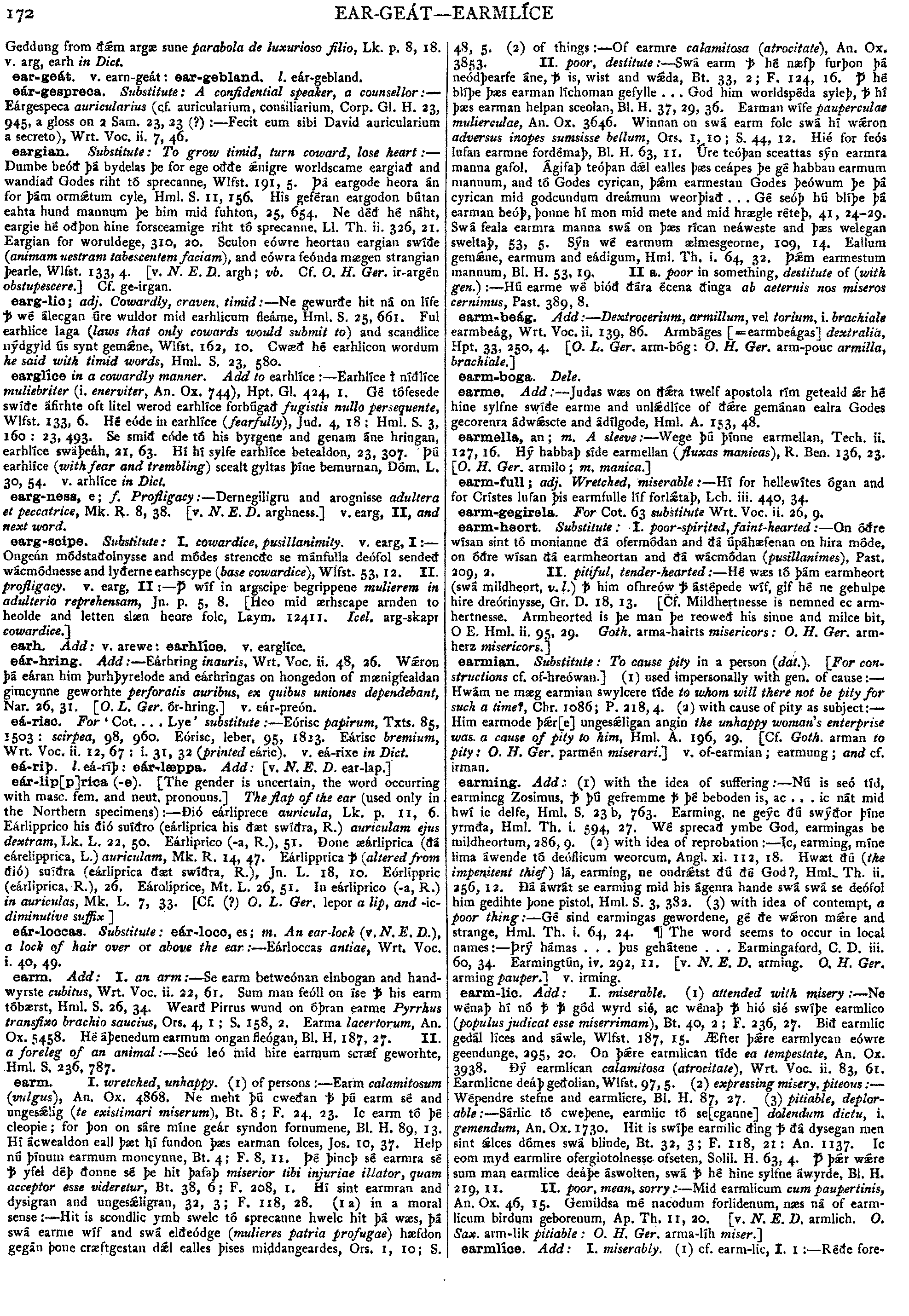
earm-lic.
Add:
I.
miserable.
(1)
attended
with
misery:--Ne
wénaþ
hí
nó
gód
wyrd
sié,
ac
wénaþ
hió
sié
swíþe
earmlico
(populus
judicat
esse
miserrimam),
Bt.
40,
2;
F.
236,
27.
Bið
earmlic
gedál
líces
and
sáwle,
Wlfst.
187,
15.
Æfter
þre
earmlycan
eówre
geendunge,
295,
20.
On
þre
earmlican
tíde
ea
tempestate,
An.
Ox.
3938.
Ðý
earmlican
calamitosa
(atrocitate),
Wrt.
Voc.
ii.
83,
61.
Earmlicne
deáþ
geðolian,
Wlfst.
97,
5.
(2)
expressing
misery,
piteous:--Wépendre
stefne
and
earmlicre,
Bl.
H.
87,
27.
(3)
pitiable,
deplorable:--Sárlic
tó
cweþene,
earmlic
tó
se[cganne]
dolendum
dictu,
i.
gemendum,
An.
Ox.
1730.
Hit
is
swíþe
earmlic
ðing
ðá
dysegan
men
sint
lces
dómes
swá
blinde,
Bt.
32,
3;
F.
118,
21:
An.
1137.
Ic
eom
myd
earmlire
ofergiotolnesse
ofseten,
Solil.
H.
63,
4.
Þ-bar;
þr
wre
sum
man
earmlice
deáþe
áswolten,
swá
hé
hine
sylfne
áwyrde,
Bl.
H.
219,
11.
II.
poor,
mean,
sorry:--Mid
earmlicum
cum
paupertinis,
An.
Ox.
46,
15.
Gemildsa
mé
nacodum
forlidenum,
næs
ná
of
earmlicum
birdum
geborenum,
Ap.
Th.
11,
20.
[v.
N.
E.
D.
armlich.
O.
Sax.
arm-lik
pitiable:
O.
H.
Ger.
arma-líh
miser.]
|
Source: Bosworth/Toller, page d0199, entry 11 View original page image as: [TIFF] [PNG] [View previous entry] [View next entry] |
[Comment on this entry] [View comments] |
The following entry has been hand-corrected once. |
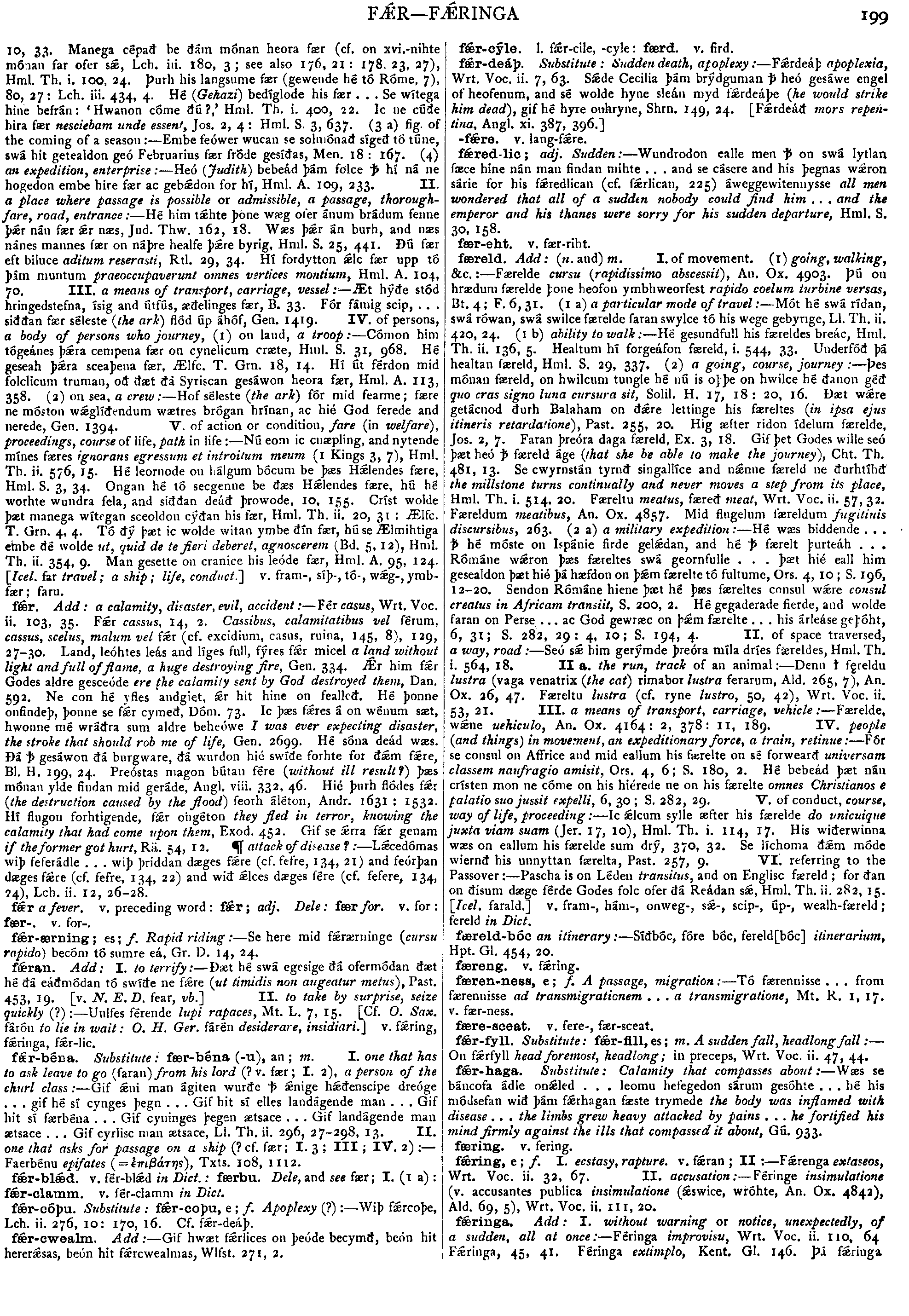
fr-deáþ.
Substitute:
Sudden
death,
apoplexy:--Frdeáþ
apoplexia,
Wrt.
Voc.
ii.
7,
63.
Sde
Cecilia
þám
brýdguman
þ
heó
gesáwe
engel
of
heofenum,
and
sé
wolde
hyne
sleán
myd
frdeáþe
(he
would
strike
him
dead),
gif
hé
hyre
onhryne,
Shrn.
149,
24.
[Frdeáð
mors
repentina,
Angl.
xi.
387,
396.]
|
Source: Bosworth/Toller, page d0253, entry 3 View original page image as: [TIFF] [PNG] [View previous entry] [View next entry] |
[Comment on this entry] [View comments] |
The following entry has been hand-corrected once. |
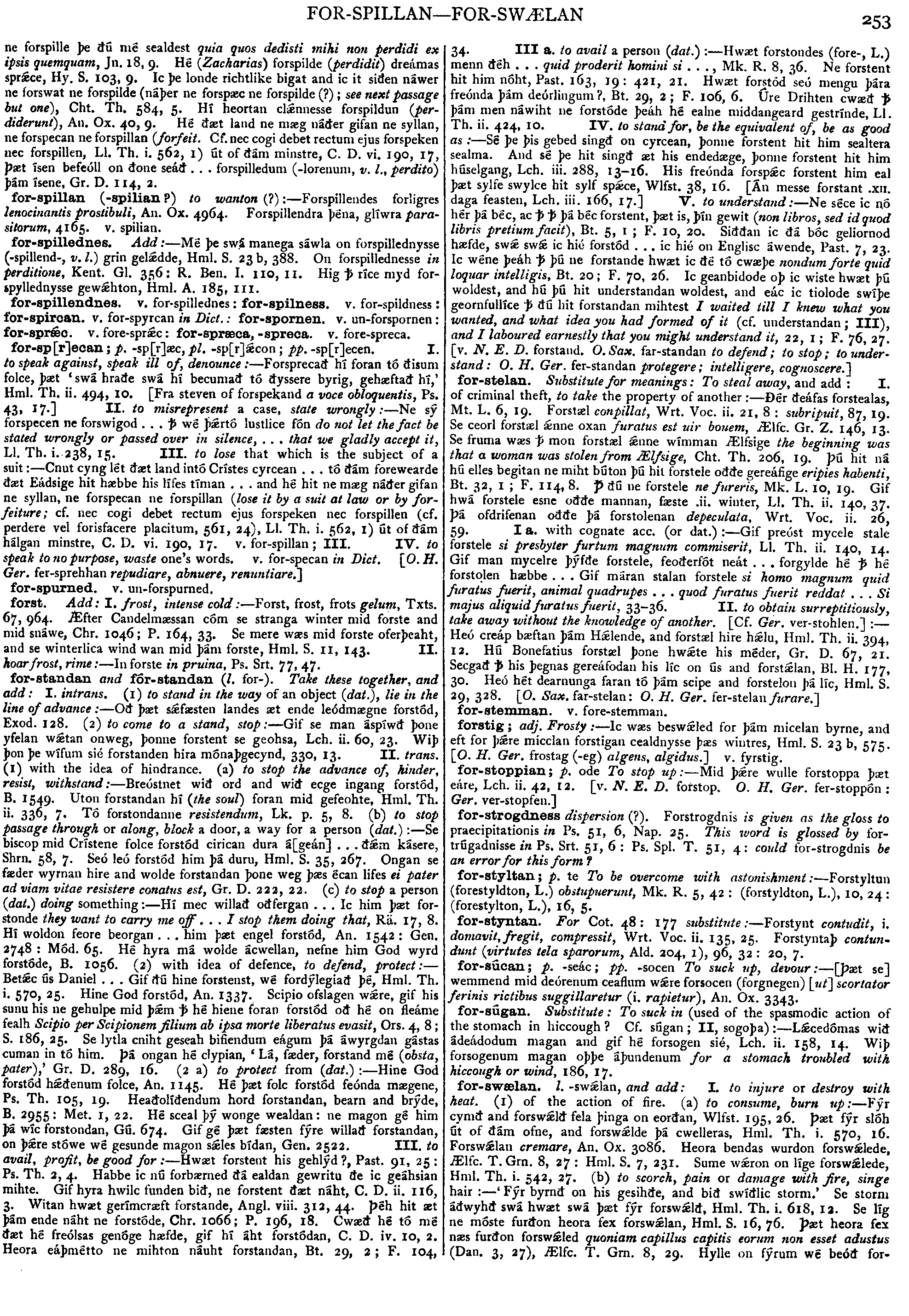
for-spillednes.
Add
:--
Mé
þe
swá
manega
sáwla
on
forspillednysse
(-spillend-,
v.
l.)
grin
geldde,
Hml.
S.
23
b,
388.
On
forspillednesse
in
perditione,
Kent.
Gl.
356:
R.
Ben.
I.
110,
11.
Hig
ríce
myd
forspyllednysse
gewhton,
Hml.
A.
185,
111.
|
Source: Bosworth/Toller, page d0256, entry 20 View original page image as: [TIFF] [PNG] [View previous entry] [View next entry] |
[Comment on this entry] [View comments] |
The following entry has been hand-corrected once. |
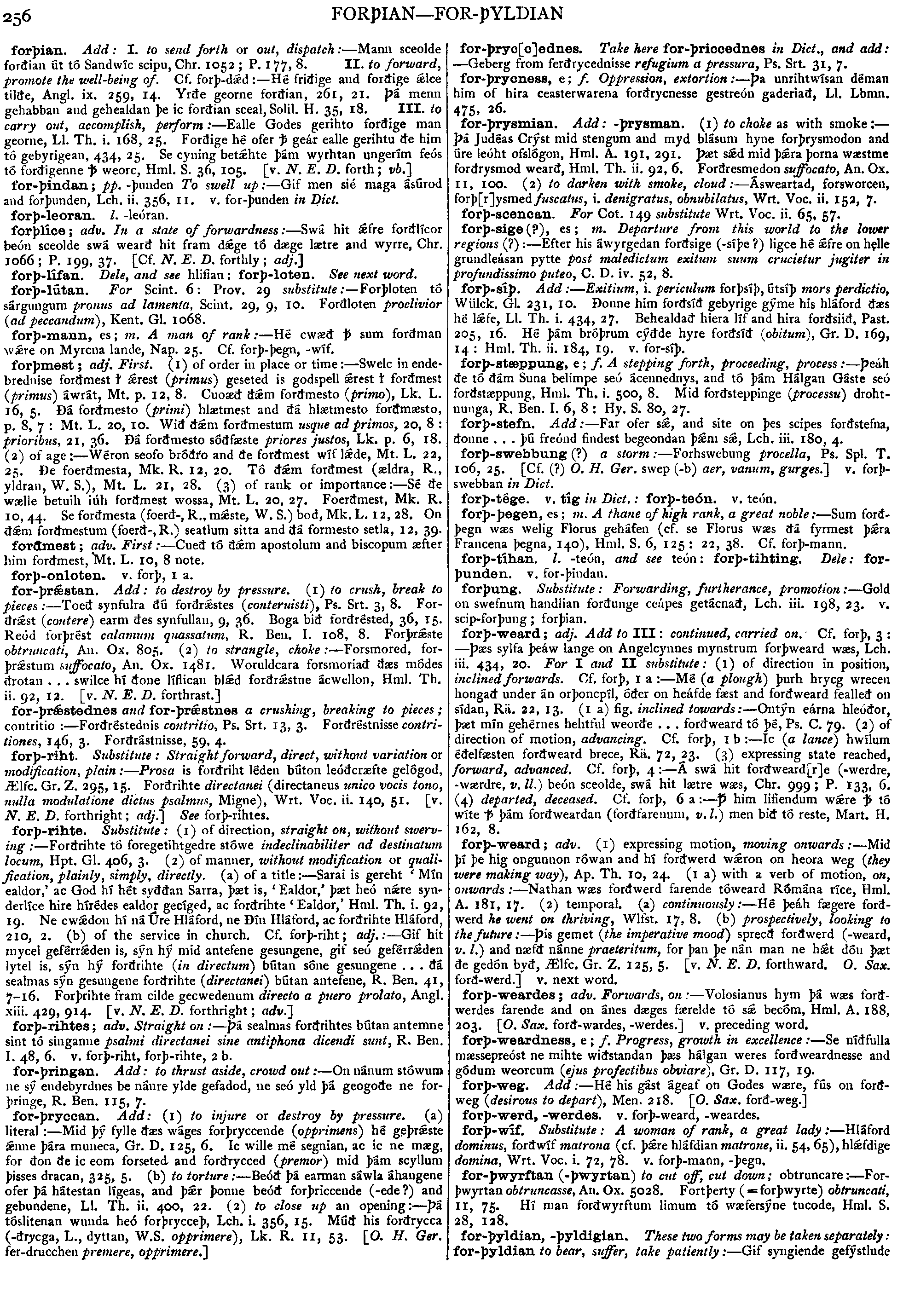
for-þrysmian.
Add:
-þrysman.
(1)
to
choke
as
with
smoke
:--
Þá
Judéas
Crýst
mid
stengum
and
myd
blásum
hyne
forþrysmodon
and
úre
leóht
ofslógon,
Hml.
A.
191,
291.
Þæt
sd
mid
þra
þorna
wæstme
forðrysmod
wearð,
Hml.
Th.
ii.
92,
6.
Forðresmedon
suffocato,
An.
Ox.
11,
100.
(2)
to
darken
with
smoke,
cloud
:--
Ásweartad,
forsworcen,
forþ[r]ysmed
fuscatus,
i.
denigratus,
obnubilatus,
Wrt.
Voc.
ii.
152,
7.
|
Source: Bosworth/Toller, page d0294, entry 1 View original page image as: [TIFF] [PNG] [View previous entry] [View next entry] |
[Comment on this entry] [View comments] |
The following entry has been hand-corrected once. |
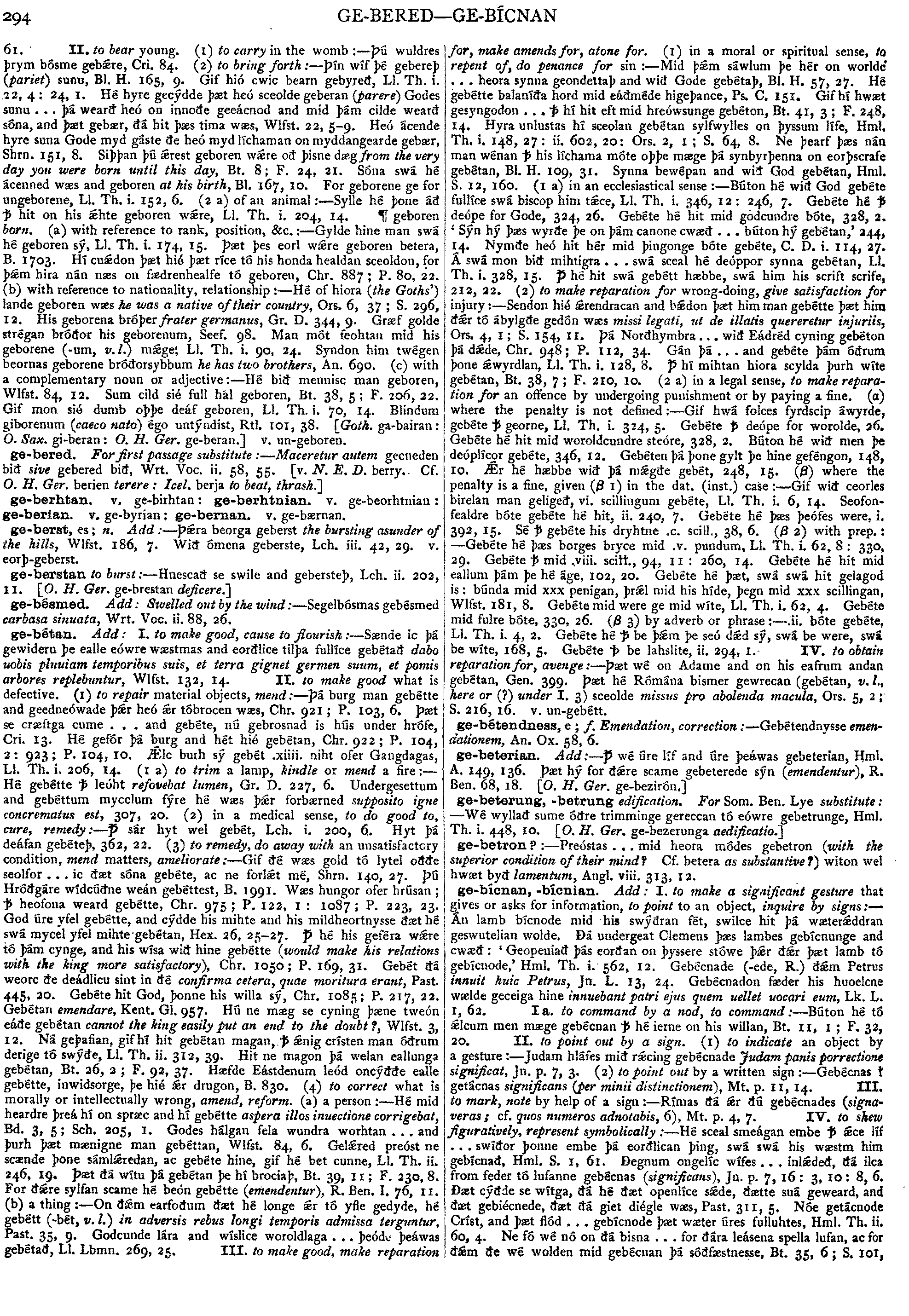
61.
II.
to
bear
young.
(1)
to
carry
in
the
womb
:--
þú
wuldres
þrym
bósme
gebre,
Cri.
84.
(2)
to
bring
forth:
--
þ
ín
wíf
þé
gebereþ
(pariet)
sunu.
Bl.
H.
165,
9.
Gif
hió
cwic
bearn
gebyreð,
Ll.
Th.
i.
22,
4
:
24,
1.
Hé
hyre
gecýdde
þæt
heó
sceolde
geberan
(parere)
Godes
sunu
.
.
.
þá
wearð
heó
on
innoðe
geeácnod
and
mid
þám
cilde
wearð
sóna,
and
þæt
gebær,
ðá
hit
þæs
tima
wæs.
Wlfst.
22,
5-9.
Heó
ácende
hyre
suna
Gode
myd
gáste
ðe
heó
myd
líchaman
on
myddangearde
gebær.
Shrn.
151,
8.
Siþþan
þú
rest
geboren
wre
oð
þisne
dæg
from
the
very
day
you
were
born
until
this
day,
Bt.
8;
F.
24,
21.
Sóna
swá
hé
ácenned
wæs
and
geboren
at
his
birth,
Bl.
167,
10.
For
geborene
ge
for
ungeborene,
Ll.
Th.
i.
152,
6.
(2
a)
of
an
animal
:--
Sylle
hé
þone
áð
hit
on
his
hte
geboren
wre,
Ll.
Th.
i.
204,
14.
geboren
born,
(a)
with
reference
to
rank,
position,
&c.
:--
Gylde
hine
man
swá
hé
geboren
sý
Ll.
Th.
i.
174,
15.
þæt
þes
eorl
wre
geboren
betera,
B.
1703.
Hí
cudon
þæt
hié
þæt
ríce
tó
his
honda
healdan
sceoldon,
for
þm
hira
nán
næs
on
fædrenhealfe
tó
geboren,
Chr.
887
;
P.
80,
22.
(b)
with
reference
to
nationality,
relationship
:--
Hé
of
hiora
(the
Goths')
lande
geboren
wæs
he
was
a
native
of
their
country,
Ors.
6,
37
;
S.
296,
12.
His
geborena
bróþer
frater
germanus,
Gr.
D.
344,
9.
Græf
golde
strégan
bróðor
his
geborenum,
Seef.
98.
Man
mót
feohtan
mid
his
geborene
(-um,
v.
l.)
mge;
Ll.
Th.
i.
90,
24.
Syndon
him
twégen
beornas
geborene
bróðorsybbum
he
has
two
brothers,
An.
690.
(c)
with
a
complementary
noun
or
adjective
:--
Hé
bið
mennisc
man
geboren,
Wlfst.
84,
12.
Sum
cild
sié
full
hál
geboren,
Bt.
38,
5
;
F.
206,
22.
Gif
mon
sié
dumb
oþþe
deáf
geboren,
Ll.
Th.
i.
70,
14.
Blindum
giborenum
(caeca
nato)
égo
untýndist.
Rtl.
101,
38.
[Goth.
ga-bairan:
O.
Sax.
gi-beran:
O.
H.
Ger.
ge-beran.]
v.
un-geboren.
|
Source: Bosworth/Toller, page d0302, entry 15 View original page image as: [TIFF] [PNG] [View previous entry] [View next entry] |
[Comment on this entry] [View comments] |
The following entry has been hand-corrected once. |
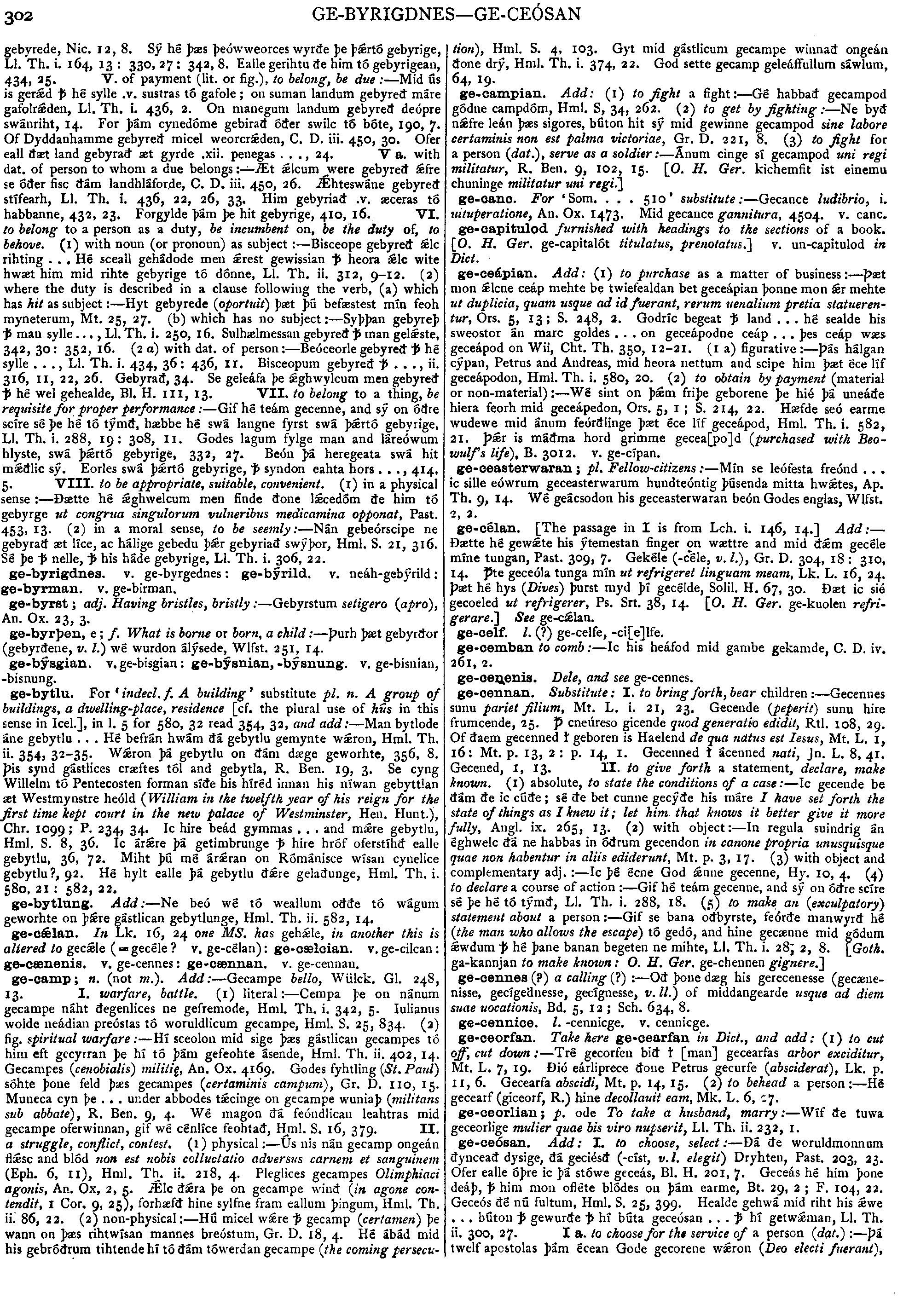
ge-célan.
[The
passage
in
I
is
from
Lch.
i.
146,
14.]
Add
:--
Ðætte
hé
gewte
his
ýtemestan
finger
on
wættre
and
mid
ðm
gecéle
míne
tungan,
Past.
309,
7.
Gekéle
(-céle,
v.l.)
Gr.
D.
304,
18:
310,
14.
te
geceóla
tunga
mín
ut
refrigeret
linguam
meam,
Lk.
L.
16,
24.
Þæt
hé
hys
(Dives)
þurst
myd
þí
gecélde,
Solil.
H.
67,
30.
Ðæt
ic
sié
gecoeled
ut
refrigerer,
Ps.
Srt.
38,
14.
[O.H.
Ger.
ge-kuolen
refrigerare.]
See
ge-clan.
| Result Page: |  |
Previous | 1 2 3 4 5 6 7 8 9 | Next |  |
Germanic Lexicon Project (main page)
This search system was written by
Sean Crist
Please consider
volunteering
to correct the data in these online dictionaries.
No rights reserved. Feel free to use these data in any way you please.