|
|

Search for mun again, using less strict matching (684 results)
|
Source: Cleasby/Vigfusson, page b0761, entry 44 View original page image as: [TIFF] [PNG] [View previous entry] [View next entry] |
[Comment on this entry] [View comments] |
The following entry has been hand-corrected once. |
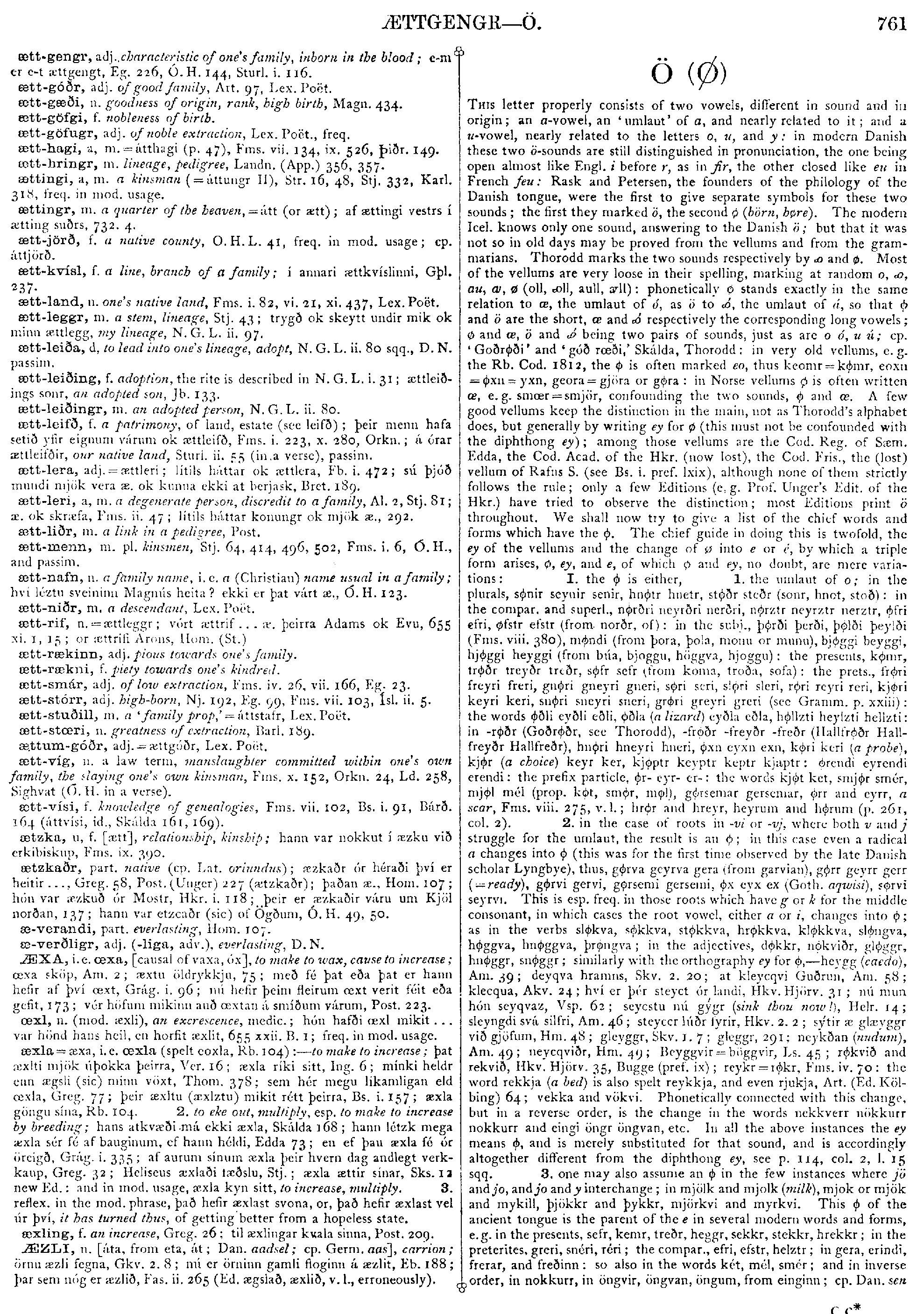
THIS
letter
properly
consists
of
two
vowels,
different
in
sound
and
in
origin;
an
a-vowel,
an
'umlaut'
of
a,
and
nearly
related
to
it;
and
a
u-vowel,
nearly
related
to
the
letters
o,
u,
and
y:
in
modern
Danish
these
two
ö-sounds
are
still
distinguished
in
pronunciation,
the
one
being
open
almost
like
Engl.
i
before
r,
as
in
fir,
the
other
closed
like
eu
in
French
feu:
Rask
and
Petersen,
the
founders
of
the
philology
of
the
Danish
tongue,
were
the
first
to
give
separate
symbols
for
these
two
sounds;
the
first
they
marked
ö,
the
second
ø
(börn,
høre).
The
modern
Icel.
knows
only
one
sound,
answering
to
the
Danish
ö;
but
that
it
was
not
so
in
old
days
may
be
proved
from
the
vellums
and
from
the
grammarians.
Thorodd
marks
the
two
sounds
respectively
by
 and
ø.
Most
of
the
vellums
are
very
loose
in
their
spelling,
marking
at
random
o,
,
au,
(?),
UNCERTAIN
ø
(oll,
ll,
aull,
arll
UNCERTAIN):
phonetically
ø
stands
exactly
in
the
same
relation
to
œ,
the
umlaut
of
ó,
as
ö
to
and
ø.
Most
of
the
vellums
are
very
loose
in
their
spelling,
marking
at
random
o,
,
au,
(?),
UNCERTAIN
ø
(oll,
ll,
aull,
arll
UNCERTAIN):
phonetically
ø
stands
exactly
in
the
same
relation
to
œ,
the
umlaut
of
ó,
as
ö
to
 ,
the
umlaut
of
á,
so
that
ø
and
ö
are
the
short,
œ
and
respectively
the
corresponding
long
vowels;
ø
and
œ,
ö
and
being
two
pairs
of
sounds,
just
as
are
o
ó,
u
ú;
cp.
'Goðrøði'
and
'góð
rœði,'
Skálda,
Thorodd:
in
very
old
vellums,
e.g.
the
Rb.
Cod.
1812,
the
ø
is
often
marked
eo,
thus
keomr
=
kømr,
eoxn
=
øxn
=
yxn,
geora
=
gjöra
or
gøra:
in
Norse
vellums
ø
is
often
written
œ,
e.g.
smœr
=
smjör,
confounding
the
two
sounds,
ø
and
œ.
A
few
good
vellums
keep
the
distinction
in
the
main,
not
as
Thorodd's
alphabet
does,
but
generally
by
writing
ey
for
ø
(this
must
not
be
confounded
with
the
diphthong
ey);
among
those
vellums
are
the
Cod.
Reg.
of
Sæm.
Edda,
the
Cod.
Acad.
of
the
Hkr.
(now
lost),
the
Cod.
Fris.,
the
(lost)
vellum
of
Rafns
S.
(see
Bs.
i.
pref.
lxix),
although
none
of
them
strictly
follows
the
rule;
only
a
few
Editions
(e.g.
Prof.
Unger's
Edit,
of
the
Hkr.)
have
tried
to
observe
the
distinction;
most
Editions
print
ö
throughout.
We
shall
now
try
to
give
a
list
of
the
chief
words
and
forms
which
have
the
ø.
The
chief
guide
in
doing
this
is
twofold,
the
ey
of
the
vellums
and
the
change
of
ø
into
e
or
é,
by
which
a
triple
form
arises,
ø,
ey,
and
e,
of
which
ø
and
ey,
no
doubt,
are
mere
variations:
I.
the
ø
is
either,
1.
the
umlaut
of
o;
in
the
plurals,
sønir
seynir
senir,
hnøtr
hnetr,
støðr
steðr
(sonr,
hnot,
stoð):
in
the
compar.
and
superl.,
nørðri
neyrðri
nerðri,
nørztr
neyrztr
nerztr,
øfri
efri,
øfstr
efstr
(from
norðr,
of):
in
the
subj.,
þørði
þerði,
þølði
þeylði
(Fms.
viii.
380),
møndi
(from
þora,
þola,
monu
or
munu),
bjøggi
beyggi,
hjøggi
heyggi
(from
búa,
bjoggu,
höggva,
hjoggu):
the
presents,
kømr,
trøðr
treyðr
treðr,
søfr
sefr
(from
koma,
troða,
sofa):
the
prets.,
frøri
freyri
freri,
gnøri
gneyri
gneri,
søri
seri,
sløri
sleri,
róri
reyri
reri,
kjøri
keyri
keri,
snøri
sneyri
sneri,
grøri
greyri
greri
(see
Gramm.
p.
xxiii):
the
words
øðli
eyðli
eðli,
øðla
(a
lizard)
eyðla
eðla,
høllzti
heylzti
hellzti:
in
-røðr
(Goðrøðr,
see
Thorodd),
-frøðr
-freyðr
-freðr
(Hallfrøðr
Hallfreyðr
Hallfreðr),
hnøri
hneyri
hneri,
øxn
eyxn
exn,
køri
keri
(a
probe),
kjør
(a
choice)
keyr
ker,
kjøptr
keyptr
keptr
kjaptr:
ørendi
eyrendi
erendi:
the
prefix
particle,
ør-
eyr-
er-:
the
words
kjøt
ket,
smjør
smér,
mjøl
mél
(prop.
køt,
smør,
møl),
gørsemar
gersemar,
ørr
and
eyrr,
a
scar,
Fms.
viii.
275,
v.l.;
hrør
and
hreyr,
heyrum
and
hørum
(p.
261,
col.
2).
2.
in
the
case
of
roots
in
-vi
or
-vj,
where
both
v
and
j
struggle
for
the
umlaut,
the
result
is
an
ø;
in
this
case
even
a
radical
a
changes
into
ø
(this
was
for
the
first
time
observed
by
the
late
Danish
scholar
Lyngbye),
thus,
gørva
geyrva
gera
(from
garvian),
gørr
geyrr
gerr
(=
ready),
gørvi
gervi,
gørsemi
gersemi,
øx
eyx
ex
(Goth.
aqwisi),
sørvi
seyrvi.
This
is
esp.
freq.
in
those
roots
which
have
g
or
k
for
the
middle
consonant,
in
which
cases
the
root
vowel,
either
a
or
i,
changes
into
ø;
as
in
the
verbs
sløkva,
søkkva,
støkkva,
hrøkkva,
kløkkva,
sløngva,
høggva,
hnøggva,
þrøngva;
in
the
adjectives,
døkkr,
nøkviðr,
gløggr,
hnøggr,
snøggr;
similarly
with
the
orthography
ey
for
ø,
--
heygg
(caedo),
Am.
39;
deyqva
hramns,
Skv.
2.
20;
at
kleycqvi
Guðrun,
Am.
58;
klecqua,
Akv.
24;
hví
er
þér
steyct
ór
landi,
Hkv.
Hjörv.
31;
nú
mun
hón
seyqvaz,
Vsp.
62;
seycstu
nú
gýgr
(sink
thou
now!),
Helr.
14;
sleyngdi
svá
silfri,
Am.
46;
steyccr
lúðr
fyrir,
Hkv.
2.
2;
sýtir
æ
glæyggr
við
gjöfum,
Hm.
48;
gleyggr,
Skv.
1.
7;
gleggr,
291;
neykðan
(nudum),
Am.
49;
neycqviðr,
Hm.
49;
Beyggvir
=
böggvir,
Ls.
45;
røkvið
and
rekvið,
Hkv.
Hjörv.
35,
Bugge
(pref.
ix);
reykr
=
røkr,
Fms.
iv.
70:
the
word
rekkja
(a
bed)
is
also
spelt
reykkja,
and
even
rjukja,
Art.
(Ed.
Kölbing)
64;
vekka
and
vökvi.
Phonetically
connected
with
this
change,
but
in
a
reverse
order,
is
the
change
in
the
words
nekkverr
nökkurr
nokkurr
and
eingi
öngr
öngvan,
etc.
In
all
the
above
instances
the
ey
means
ø,
and
is
merely
substituted
for
that
sound,
and
is
accordingly
altogether
different
from
the
diphthong
ey,
see
p.
114,
col.
2,
l.
15
sqq.
3.
one
may
also
assume
an
ø
in
the
few
instances
where
jö
and
jo,
and
jo
and
y
interchange;
in
mjölk
and
mjolk
(milk),
mjok
or
mjök
and
mykill,
þjökkr
and
þykkr,
mjörkvi
and
myrkvi.
This
ø
of
the
ancient
tongue
is
the
parent
of
the
e
in
several
modern
words
and
forms,
e.g.
in
the
presents,
sefr,
kemr,
treðr,
heggr,
sekkr,
stekkr,
hrekkr;
in
the
preterites,
greri,
snéri,
réri;
the
compar.,
efri,
efstr,
helztr;
in
gera,
erindi,
frerar,
and
freðinn:
so
also
in
the
words
két,
mél,
smér;
and
in
inverse
order,
in
nokkurr,
in
öngvir,
öngvan,
öngum,
from
einginn;
cp.
Dan.
sen
,
the
umlaut
of
á,
so
that
ø
and
ö
are
the
short,
œ
and
respectively
the
corresponding
long
vowels;
ø
and
œ,
ö
and
being
two
pairs
of
sounds,
just
as
are
o
ó,
u
ú;
cp.
'Goðrøði'
and
'góð
rœði,'
Skálda,
Thorodd:
in
very
old
vellums,
e.g.
the
Rb.
Cod.
1812,
the
ø
is
often
marked
eo,
thus
keomr
=
kømr,
eoxn
=
øxn
=
yxn,
geora
=
gjöra
or
gøra:
in
Norse
vellums
ø
is
often
written
œ,
e.g.
smœr
=
smjör,
confounding
the
two
sounds,
ø
and
œ.
A
few
good
vellums
keep
the
distinction
in
the
main,
not
as
Thorodd's
alphabet
does,
but
generally
by
writing
ey
for
ø
(this
must
not
be
confounded
with
the
diphthong
ey);
among
those
vellums
are
the
Cod.
Reg.
of
Sæm.
Edda,
the
Cod.
Acad.
of
the
Hkr.
(now
lost),
the
Cod.
Fris.,
the
(lost)
vellum
of
Rafns
S.
(see
Bs.
i.
pref.
lxix),
although
none
of
them
strictly
follows
the
rule;
only
a
few
Editions
(e.g.
Prof.
Unger's
Edit,
of
the
Hkr.)
have
tried
to
observe
the
distinction;
most
Editions
print
ö
throughout.
We
shall
now
try
to
give
a
list
of
the
chief
words
and
forms
which
have
the
ø.
The
chief
guide
in
doing
this
is
twofold,
the
ey
of
the
vellums
and
the
change
of
ø
into
e
or
é,
by
which
a
triple
form
arises,
ø,
ey,
and
e,
of
which
ø
and
ey,
no
doubt,
are
mere
variations:
I.
the
ø
is
either,
1.
the
umlaut
of
o;
in
the
plurals,
sønir
seynir
senir,
hnøtr
hnetr,
støðr
steðr
(sonr,
hnot,
stoð):
in
the
compar.
and
superl.,
nørðri
neyrðri
nerðri,
nørztr
neyrztr
nerztr,
øfri
efri,
øfstr
efstr
(from
norðr,
of):
in
the
subj.,
þørði
þerði,
þølði
þeylði
(Fms.
viii.
380),
møndi
(from
þora,
þola,
monu
or
munu),
bjøggi
beyggi,
hjøggi
heyggi
(from
búa,
bjoggu,
höggva,
hjoggu):
the
presents,
kømr,
trøðr
treyðr
treðr,
søfr
sefr
(from
koma,
troða,
sofa):
the
prets.,
frøri
freyri
freri,
gnøri
gneyri
gneri,
søri
seri,
sløri
sleri,
róri
reyri
reri,
kjøri
keyri
keri,
snøri
sneyri
sneri,
grøri
greyri
greri
(see
Gramm.
p.
xxiii):
the
words
øðli
eyðli
eðli,
øðla
(a
lizard)
eyðla
eðla,
høllzti
heylzti
hellzti:
in
-røðr
(Goðrøðr,
see
Thorodd),
-frøðr
-freyðr
-freðr
(Hallfrøðr
Hallfreyðr
Hallfreðr),
hnøri
hneyri
hneri,
øxn
eyxn
exn,
køri
keri
(a
probe),
kjør
(a
choice)
keyr
ker,
kjøptr
keyptr
keptr
kjaptr:
ørendi
eyrendi
erendi:
the
prefix
particle,
ør-
eyr-
er-:
the
words
kjøt
ket,
smjør
smér,
mjøl
mél
(prop.
køt,
smør,
møl),
gørsemar
gersemar,
ørr
and
eyrr,
a
scar,
Fms.
viii.
275,
v.l.;
hrør
and
hreyr,
heyrum
and
hørum
(p.
261,
col.
2).
2.
in
the
case
of
roots
in
-vi
or
-vj,
where
both
v
and
j
struggle
for
the
umlaut,
the
result
is
an
ø;
in
this
case
even
a
radical
a
changes
into
ø
(this
was
for
the
first
time
observed
by
the
late
Danish
scholar
Lyngbye),
thus,
gørva
geyrva
gera
(from
garvian),
gørr
geyrr
gerr
(=
ready),
gørvi
gervi,
gørsemi
gersemi,
øx
eyx
ex
(Goth.
aqwisi),
sørvi
seyrvi.
This
is
esp.
freq.
in
those
roots
which
have
g
or
k
for
the
middle
consonant,
in
which
cases
the
root
vowel,
either
a
or
i,
changes
into
ø;
as
in
the
verbs
sløkva,
søkkva,
støkkva,
hrøkkva,
kløkkva,
sløngva,
høggva,
hnøggva,
þrøngva;
in
the
adjectives,
døkkr,
nøkviðr,
gløggr,
hnøggr,
snøggr;
similarly
with
the
orthography
ey
for
ø,
--
heygg
(caedo),
Am.
39;
deyqva
hramns,
Skv.
2.
20;
at
kleycqvi
Guðrun,
Am.
58;
klecqua,
Akv.
24;
hví
er
þér
steyct
ór
landi,
Hkv.
Hjörv.
31;
nú
mun
hón
seyqvaz,
Vsp.
62;
seycstu
nú
gýgr
(sink
thou
now!),
Helr.
14;
sleyngdi
svá
silfri,
Am.
46;
steyccr
lúðr
fyrir,
Hkv.
2.
2;
sýtir
æ
glæyggr
við
gjöfum,
Hm.
48;
gleyggr,
Skv.
1.
7;
gleggr,
291;
neykðan
(nudum),
Am.
49;
neycqviðr,
Hm.
49;
Beyggvir
=
böggvir,
Ls.
45;
røkvið
and
rekvið,
Hkv.
Hjörv.
35,
Bugge
(pref.
ix);
reykr
=
røkr,
Fms.
iv.
70:
the
word
rekkja
(a
bed)
is
also
spelt
reykkja,
and
even
rjukja,
Art.
(Ed.
Kölbing)
64;
vekka
and
vökvi.
Phonetically
connected
with
this
change,
but
in
a
reverse
order,
is
the
change
in
the
words
nekkverr
nökkurr
nokkurr
and
eingi
öngr
öngvan,
etc.
In
all
the
above
instances
the
ey
means
ø,
and
is
merely
substituted
for
that
sound,
and
is
accordingly
altogether
different
from
the
diphthong
ey,
see
p.
114,
col.
2,
l.
15
sqq.
3.
one
may
also
assume
an
ø
in
the
few
instances
where
jö
and
jo,
and
jo
and
y
interchange;
in
mjölk
and
mjolk
(milk),
mjok
or
mjök
and
mykill,
þjökkr
and
þykkr,
mjörkvi
and
myrkvi.
This
ø
of
the
ancient
tongue
is
the
parent
of
the
e
in
several
modern
words
and
forms,
e.g.
in
the
presents,
sefr,
kemr,
treðr,
heggr,
sekkr,
stekkr,
hrekkr;
in
the
preterites,
greri,
snéri,
réri;
the
compar.,
efri,
efstr,
helztr;
in
gera,
erindi,
frerar,
and
freðinn:
so
also
in
the
words
két,
mél,
smér;
and
in
inverse
order,
in
nokkurr,
in
öngvir,
öngvan,
öngum,
from
einginn;
cp.
Dan.
sen
|
Source: Cleasby/Vigfusson, page b0762, entry 3 View original page image as: [TIFF] [PNG] [View previous entry] [View next entry] |
[Comment on this entry] [View comments] |
The following entry has been hand-corrected once. |
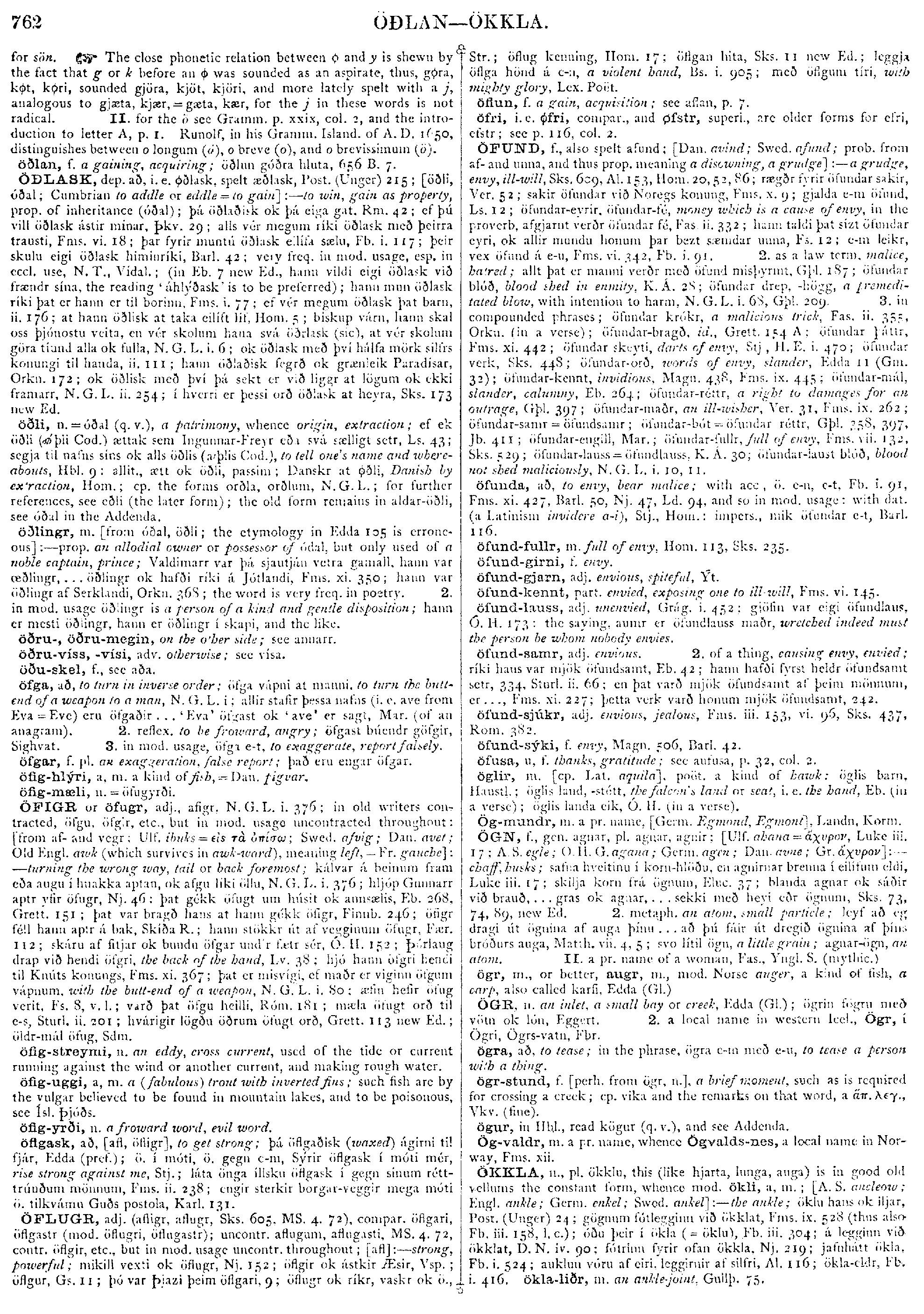
ÖÐLASK, dep. að, i.e. øðlask, spelt æðlask, Post. (Unger) 215; [öðli, óðal; Cumbrian to addle or eddle = to gain]:-- to win, gain as property, prop. of inheritance (óðal); þá öðlaðisk ok þá eiga gat, Rm. 42; ef þú vill öðlask ástir mínar, Þkv. 29; alls vér megum ríki öðlask með þeirra trausti, Fms. vi. 18; þar fyrir muntu öðlask eilífa sælu, Fb. i. 117; þeir skulu eigi öðlask himinríki, Barl. 42; very freq. in mod. usage, esp. in eccl. use, N.T., Vídal.; (in Eb. 7 new Ed., hann vildi eigi öðlask við frændr sína, the reading 'áhlýðask' is to be preferred); hann mun öðlask ríki þat er hann er til borinn, Fms. i. 77; ef vér megum öðlask þat barn, ii. 176; at hann öðlisk at taka eilíft líf, Hom. 5; biskup várn, hann skal oss þjónostu veita, en vér skolum hana svá öðrlask (sic), at vér skolum göra tíund alla ok fulla, N.G.L. i. 6; ok öðlask með því hálfa mörk silfrs konungi til handa, ii. 111: hann öðlaðisk fegrð ok grænleik Paradisar, Orkn. 172; ok öðlisk með því þá sekt er við liggr at lögum ok ekki framarr, N.G.L. ii. 254; í hverri er þessi orð öðlask at heyra, Sks. 173 new Ed.
|
Source: Cleasby/Vigfusson, page b0763, entry 7 View original page image as: [TIFF] [PNG] [View previous entry] [View next entry] |
[Comment on this entry] [View comments] |
The following entry has been hand-corrected once. |
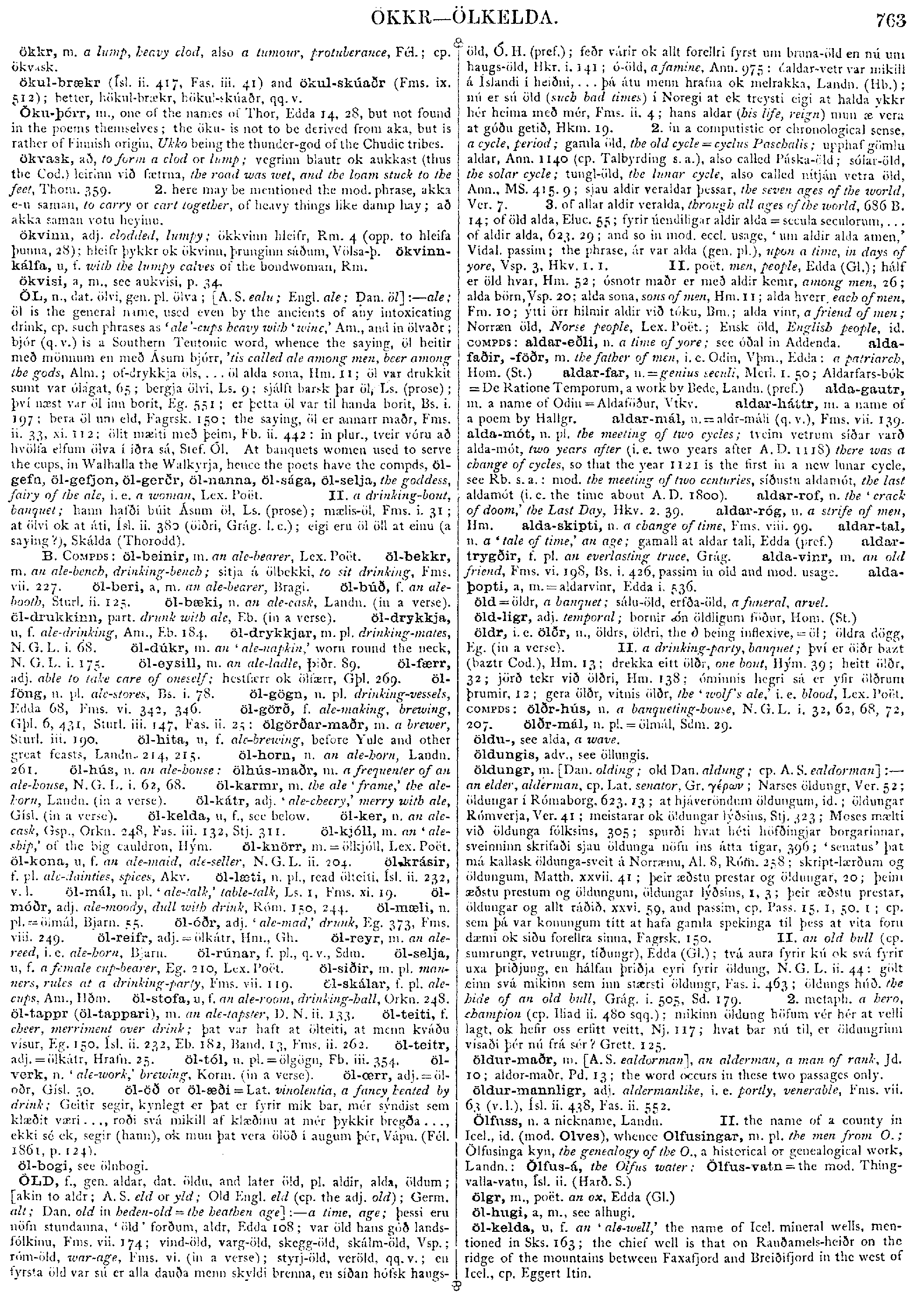
ÖL, n., dat. ölvi, gen. pl. ölva; [A.S. ealu; Engl. ale; Dan. öl] :-- ale; öl is the general name, used even by the ancients of any intoxicating drink, cp. such phrases as 'ale'-cups heavy with 'wine,' Am., and in ölvaðr; bjór (q.v.) is a Southern Teutonic word, whence the saying, öl heitir með mönnum en með Ásum bjórr, 'tis called ale among men, beer among the gods, Alm.; of-drykkja öls, ... öl alda sona, Hm. 11; öl var drukkit sumt var ólagat, 65; bergja ölvi, Ls. 9: sjálft barsk þar öl, Ls. (prose); því næst var öl inn borit, Eg. 551; er þetta öl var til handa borit, Bs. i. 197; bera öl um eld, Fagrsk. 150; the saying, öl er annarr maðr, Fms. ii. 33, xi. 112; ölit mælti með þeim, Fb. ii. 442: in plur., tveir vóru að hvölfa elfum ölva í iðra sá, Stef. Ól. At banquets women used to serve the cups, in Walhalla the Walkyrja, hence the poets have the compds, öl-gefn, öl-gefjon, öl-gerðr, öl-nanna, öl-saga, öl-selja, the goddess, fairy of the ale, i.e. a woman, Lex. Poët. II. a drinking-bout, banquet; hann hafði búit Ásum öl, Ls. (prose); mælis-öl, Fms. i. 31; at ölvi ok at áti, Ísl. ii. 380 (ölðri, Grág. l.c.); eigi eru öl öll at einu (a saying?), Skálda (Thorodd). B. COMPDS: öl-beinir, m. an ale-bearer, Lex. Poët. öl-bekkr, m. an ale-bench, drinking-bench; sitja á ölbekki, to sit drinking, Fms. vii. 227. öl-beri, a, m. an ale-bearer, Bragi. öl-búð, f. an ale-booth, Sturl. ii. 125. öl-bæki, n. an ale-cask, Landn. (in a verse). öl-drukkinn, part. drunk with ale, Eb. (in a verse). öl-drykkja, u, f. ale-drinking, Am., Eb. 184. öl-drykkjar, m. pl. drinking-mates, N.G.L. i. 68. öl-dúkr, m. an 'ale-napkin,' worn round the neck, N.G.L. i. 175. öl-eysill, m. an ale-ladle, Þiðr. 89. öl-færr, adj. able to take care of oneself; hestfærr ok ölfærr, Gþl. 269. öl-föng, n. pl. ale-stores, Bs. i. 78. öl-gögn, n. pl. drinking-vessels, Edda 68, Fms. vi. 342, 346. öl-görð, f. ale-making, brewing, Gþl. 6, 431, Sturl. iii. 147, Fas. ii. 25: ölgörðar-maðr, m. a brewer, Sturl. iii. 190. öl-hita, u, f. ale-brewing, before Yule and other great feasts, Landn. 214, 215. öl-horn, n. an ale-horn, Landn. 261. öl-hús, n. an ale-house: ölhús-maðr, m. a frequenter of an ale-house, N.G.L. i. 62, 68. öl-karmr, m. the ale 'frame,' the ale-horn, Landn. (in a verse). öl-kátr, adj. 'ale-cheery,' merry with ale, Gísl. (in a verse). öl-kelda, u, f., see below. öl-ker, n. an ale-cask, Gsp., Orkn. 248, Fas. iii. 132, Stj. 311. öl-kjóll, m. an 'ale-ship,' of the big cauldron, Hým. öl-knörr, m. = ölkjóll. Lex. Poët, öl-kona, u, f. an ale-maid, ale-seller, N.G.L. ii. 204. öl-krásir, f. pl. ale-dainties, spices, Akv. öl-læti, n. pl., read ölteiti, Ísl. ii. 232, v.l. öl-mál, n. pl. 'ale-talk,' table-talk, Ls. 1, Fms. xi. 19. öl-móðr, adj. ale-moody, dull with drink, Róm, 150, 244. öl-mæli, n. pl. = ölmál, Bjarn. 55. öl-óðr, adj. 'ale-mad,' drunk, Eg. 373, Fms. viii. 249. öl-reifr, adj. = ölkátr, Hm., Gh. öl-reyr, m. an ale-reed, i.e. ale-horn, Bjarn. öl-rúnar, f. pl., q.v., Sdm. öl-selja, u, f. a female cup-bearer, Eg. 210, Lex. Poët. öl-siðir, m. pl. manners, rules at a drinking-party, Fms. vii. 119. öl-skálar, f. pl. ale-cups, Am., Hðm. öl-stofa, u, f. an ale-room, drinking-hall, Orkn. 248. öl-tappr (öl-tappari), m. an ale-tapster, D.N. ii. 133. öl-teiti, f. cheer, merriment over drink; þat var haft at ölteiti, at menn kváðu vísur, Eg. 150, Ísl. ii. 232, Eb. 182, Band. 13, Fms. ii. 262. öl-teitr, adj. = ölkátr, Hratn. 25. öl-tól, n. pl. = ölgögn. Fb. iii. 354. öl-verk, n. 'ale-work,' brewing, Korm. (in a verse). öl-œrr, adj. = öloðr, Gísl. 30. öl-öð or öl-æði = Lat. vinolentia, a fancy heated by drink; Geitir segir, kynlegt er þat er fyrir mik bar. mér sýndist sem klæðit væri ..., roði svá mikill af klæðinu at mér þykkir bregða ..., ekki sé ek, segir (hann), ok mun þat vera ölöð í augum þér, Vápn. (Fél. 1861, p. 124).
|
Source: Cleasby/Vigfusson, page b0763, entry 9 View original page image as: [TIFF] [PNG] [View previous entry] [View next entry] |
[Comment on this entry] [View comments] |
The following entry has been hand-corrected once. |
ÖLD, f., gen. aldar, dat. öldu, and later öld, pl. aldir, alda, öldum; [akin to aldr; A.S. eld or yld; Old Engl. eld (cp. the adj. old); Germ. alt; Dan. old in heden-old = the heathen age] :-- a time, age; þessi eru nofn stundanna, 'öld' forðum, aldr, Edda 108; var öld hans góð landsfólkinu, Fms. vii. 174; vind-öld, varg-öld, skegg-öld, skálm-öld, Vsp.; róm-öld, war-age, Fms. vi. (in a verse); styrj-öld, veröld, qq.v.; en fyrsta öld var sú er alla dauða menn skyldi brenna, en síðan hófsk haugs-öld, Ó.H. (pref.); feðr várir ok allt forellri fyrst um brana-öld en nú um haugs-öld, Hkr. i. 141; ó-öld, a famine, Ann. 975: óaldar-vetr var mikill á Íslandi í heiðni, ... þá átu menn hrafna ok melrakka, Landn. (Hb.); nú er sú öld (such bad times) í Noregi at ek treysti eigi at halda ykkr hér heima með mér, Fms. ii. 4; hans aldar (his life, reign) mun æ vera at góðu getið, Hkm. 19. 2. in a computistic or chronological sense, a cycle, period; gamla öld. the old cycle = cyclus Paschalis; upphaf gömlu aldar, Ann. 1140 (cp. Talbyrding s.a.), also called Páska-öld; sólar-öld, the solar cycle; tungl-öld, the lunar cycle, also called nítján vetra öld. Ann., MS. 415. 9; sjau aldir veraldar þessar, the seven ages of the world, Ver. 7. 3. of allar aldir veralda, through all ages of the world, 686 B. 14; of öld alda, Eluc. 55; fyrir úendiligar aldir alda = secula seculorum, ... of aldir alda, 623. 29; and so in mod. eccl. usage, 'um aldir alda amen,' Vídal. passim; the phrase, ár var alda (gen. pl.), upon a time, in days of yore, Vsp. 3, Hkv. 1. 1. II. poët, men, people, Edda (Gl.); hálf er öld hvar, Hm. 52; ósnotr maðr er með aldir kemr, among men, 26; alda börn, Vsp. 20; alda sona, sons of men, Hm. 11; alda hverr. each of men, Fm. 10; ýtti örr hilmir aldir við tóku, Bm.; alda vinr, a friend of men; Norræn öld, Norse people. Lex. Poët.; Ensk öld, English people, id. COMPDS: aldar-eðli, n. a time of yore; see óðal in Addenda. alda-faðir, -föðr, m. the father of men, i.e. Odin, Vþm., Edda: a patriarch, Hom. (St.) aldar-far, n. = genius seculi, Merl. 1. 50; Aldarfars-bók = De Ratione Temporum, a work by Bede, Landn. (pref.) alda-gautr, m. a name of Odin = Aldafoður, Vtkv. aldar-háttr, m. a name of a poem by Hallgr. aldar-mál, n. = aldr-máli (q.v.), Fms. vii. 139. alda-mót, n. pl. the meeting of two cycles; tveim vetrum síðar varð alda-mót, two years after (i.e. two years after A.D. 1118) there was a change of cycles, so that the year 1121 is the first in a new lunar cycle, see Rb. s.a.: mod. the meeting of two centuries, síðustu aldamót, the last aldamót (i.e. the time about A.D. 1800). aldar-rof, n. the 'crack of doom,' the Last Day, Hkv. 2. 39. aldar-róg, n. a strife of men, Hm. alda-skipti, n. a change of time, Fms. viii. 99. aldar-tal, n. a 'tale of time,' an age; gamall at aldar tali, Edda (pref.) aldar-trygðir, f. pl. an everlasting truce, Grág. alda-vinr, m. an old friend, Fms. vi. 198, Bs. i. 426, passim in old and mod. usage. alda-þopti, a, m. = aldarvinr, Edda i. 536.
|
Source: Cleasby/Vigfusson, page b0764, entry 4 View original page image as: [TIFF] [PNG] [View previous entry] [View next entry] |
[Comment on this entry] [View comments] |
The following entry has been hand-corrected once. |
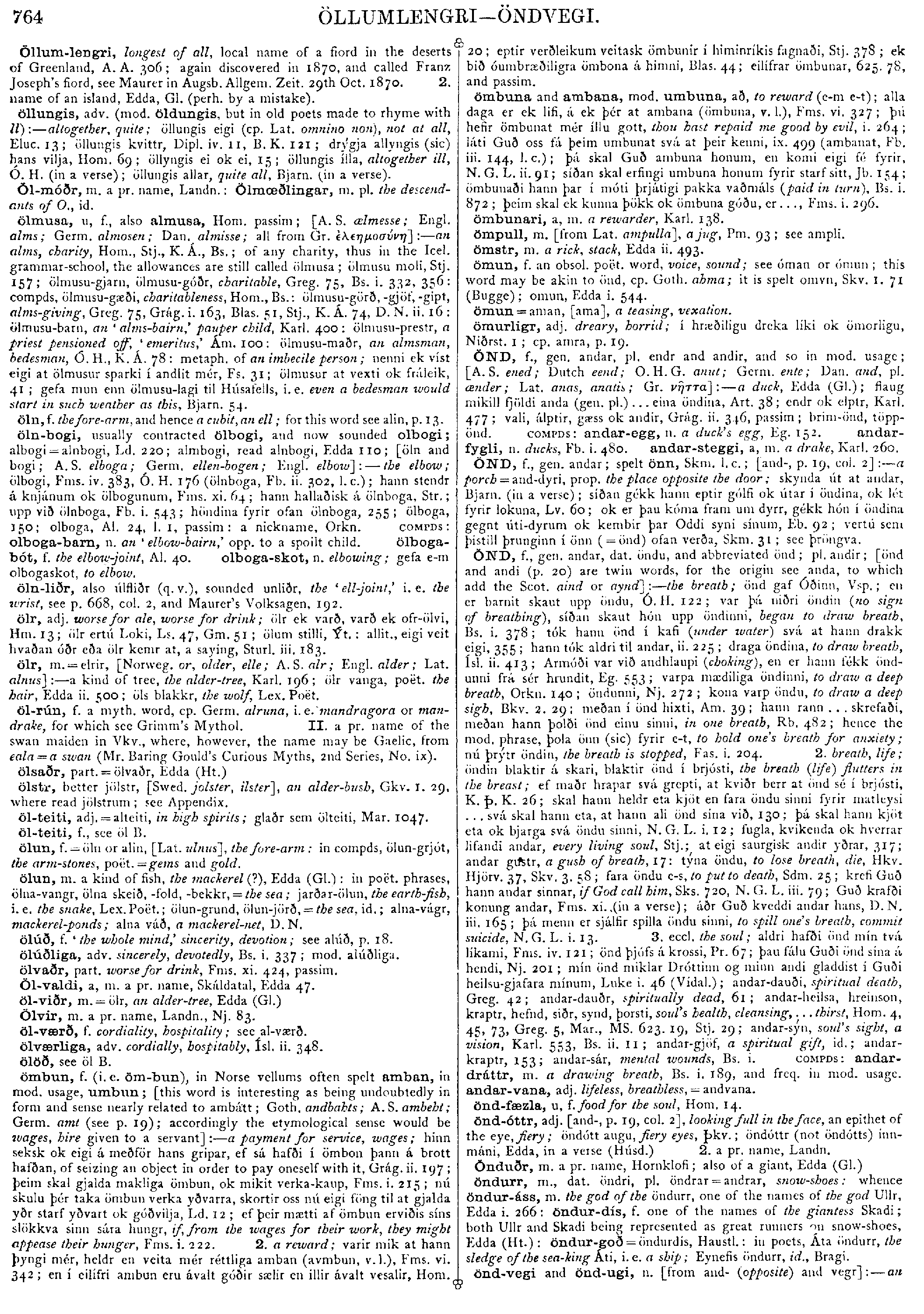
ölmusa, u, f., also almusa, Hom. passim; [A.S. ælmesse; Engl. alms; Germ. almosen; Dan. almisse; all from Gr. GREEK] :-- an alms, charity, Hom., Stj., K.Á., Bs.; of any charity, thus in the Icel. grammar-school, the allowances are still called ölmusa; ölmusu moli, Stj. 157; ölmusu-gjarn, ölmusu-góðr, charitable, Greg. 75, Bs. i. 332, 356: compds, ölmusu-gæði, charitableness, Hom., Bs.: ölmusu-görð, -gjöf, -gipt, alms-giving, Greg. 75, Grág. i. 163, Blas. 51, Stj., K.Á. 74, D.N. ii. 16: ölmusu-barn, an 'alms-bairn,' pauper child, Karl. 400: ölmusu-prestr, a priest pensioned off, 'emeritus,' Ám. 100: ölmusu-maðr, an almsman, bedesman, Ó.H., K.Á. 78: metaph. of an imbecile person; nenni ek víst eigi at ölmusur sparki í andlit mér, Fs. 31; ölmusur at vexti ok fráleik, 41; gefa mun enn ölmusu-lagi til Húsafells, i.e. even a bedesman would start in such weather as this, Bjarn. 54.
|
Source: Cleasby/Vigfusson, page b0765, entry 1 View original page image as: [TIFF] [PNG] [View previous entry] [View next entry] |
[Comment on this entry] [View comments] |
The following entry has been hand-corrected once. |
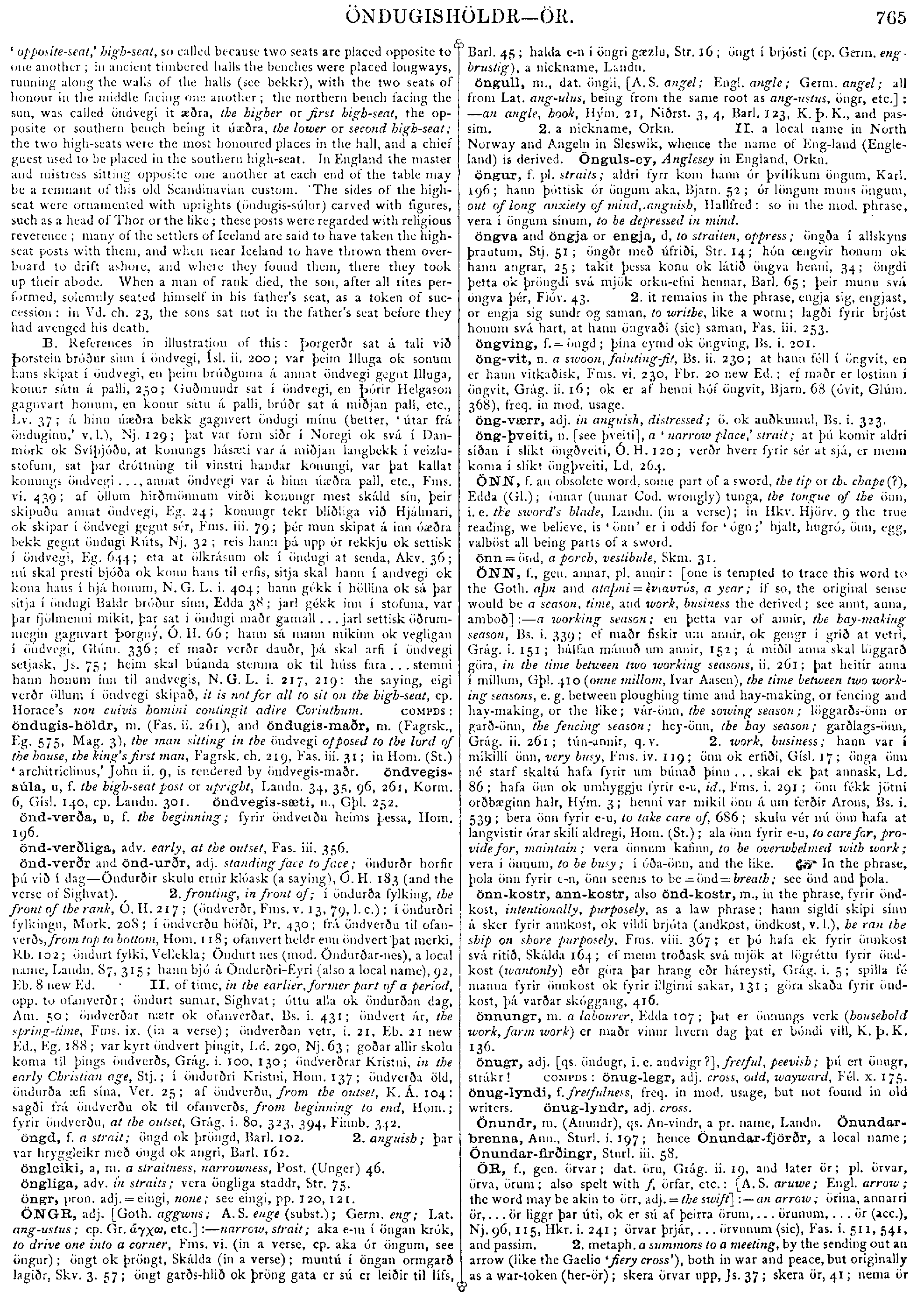
'opposite-seat,' high-seat, so called because two seats are placed opposite to one another; in ancient timbered halls the benches were placed longways, running along the walls of the halls (sec bekkr), with the two seats of honour in the middle facing one another; the northern bench facing the sun, was called öndvegi it æðra, the higher or first high-seat, the opposite or southern bench being it úæðra, the lower or second high-seat; the two high-seats were the most honoured places in the hall, and a chief guest used to be placed in the southern high-seat. In England the master and mistress sitting opposite one another at each end of the table may be a remnant of this old Scandinavian custom. The sides of the high-seat were ornamented with uprights (öndugis-súlur) carved with figures, such as a head of Thor or the like; these posts were regarded with religious reverence; many of the settlers of Iceland are said to have taken the high-seat posts with them, and when near Iceland to have thrown them over-board to drift ashore, and where they found them, there they took up their abode. When a man of rank died, the son, after all rites performed, solemnly seated himself in his father's seat, as a token of succession: in Vd. ch. 23, the sons sat not in the father's seat before they had avenged his death. B. References in illustration of this: Þorgerðr sat á tali við Þorstein bróður sinn í öndvegi, Ísl. ii. 200; var þeim Illuga ok sonum hans skipat í öndvegi, en þeim brúðguma á annat öndvegi gegnt Illuga, konur sátu a palli, 250; Guðmundr sat í öndvegi, en Þórir Helgason gagnvart honum, en konur sátu á palli, brúðr sat á miðjan pall, etc., Lv. 37; á hinn úæðra bekk gagnvert öndugi mínu (better, 'útar frá öndnginu,' v.l.), Nj. 129; þat var forn siðr í Noregi ok svá í Danmörk ok Svíþjóðu, at konungs hásæti var á miðjan langbekk í veizlustofum, sat þar dróttning til vinstri handar konungi, var þat kallat konungs öndvegi ..., annat öndvegi var á hinn úæðra pall, etc., Fms. vi. 439; af öllum hirðmönnum virði konungr mest skáld sín, þeir skipuðu annat öndvegi, Eg. 24; konungr tekr blíðliga við Hjálmari, ok skipar í öndvegi gegnt sér, Fms. iii. 79; þér mun skipat á inn óæðra bekk gegnt öndugi Rúts, Nj. 32; reis hann þá upp or rekkju ok settisk í öndvegi, Eg. 644; eta at ölkrásim ok í öndugi at senda, Akv. 36; nú skal presti bjóða ok konu hans til erfis, sitja skal hann í andvegi ok kona hans í hjá honum, N.G.L. i. 404; hann gékk í höllina ok sá þar sitja í öndugi Baldr bróður sinn, Edda 38; jarl gékk inn í stofuna, var þar fjölmenni mikit, þar sat í öndugi maðr gamall ... jarl settisk öðrum-megin gagnvart Þorgný, Ó.H. 66; hann sá mann mikinn ok vegligan í öndvegi, Glúm. 336; ef maðr verðr dauðr, þá skal arfi í öndvegi setjask, Js. 75; heim skal búanda stemna ok til húss fara ... stemni hann honum inn til andvegis, N.G.L. i. 217, 219: the saying, eigi verðr öllum í öndvegi skipað, it is not for all to sit on the high-seat, cp. Horace's non cuivis homini contingit adire Corinthum. COMPDS: öndugis-höldr, m. (Fas. ii. 261), and öndugis-maðr, m. (Fagrsk., Eg. 575, Mag. 3), the man sitting in the öndvegi opposed to the lord of the house, the king's first man, Fagrsk. ch. 219, Fas. iii. 31; in Hom. (St.) 'architriclinus', John ii. 9, is rendered by öndvegis-maðr. öndvegis-súla, u, f. the high-seat post or upright, Landn. 34, 35, 96, 261, Korm. 6, Gísl. 140, cp. Landn. 301. öndvegis-sæti, n., Gþl. 252.
|
Source: Cleasby/Vigfusson, page b0766, entry 9 View original page image as: [TIFF] [PNG] [View previous entry] [View next entry] |
[Comment on this entry] [View comments] |
The following entry has been hand-corrected once. |
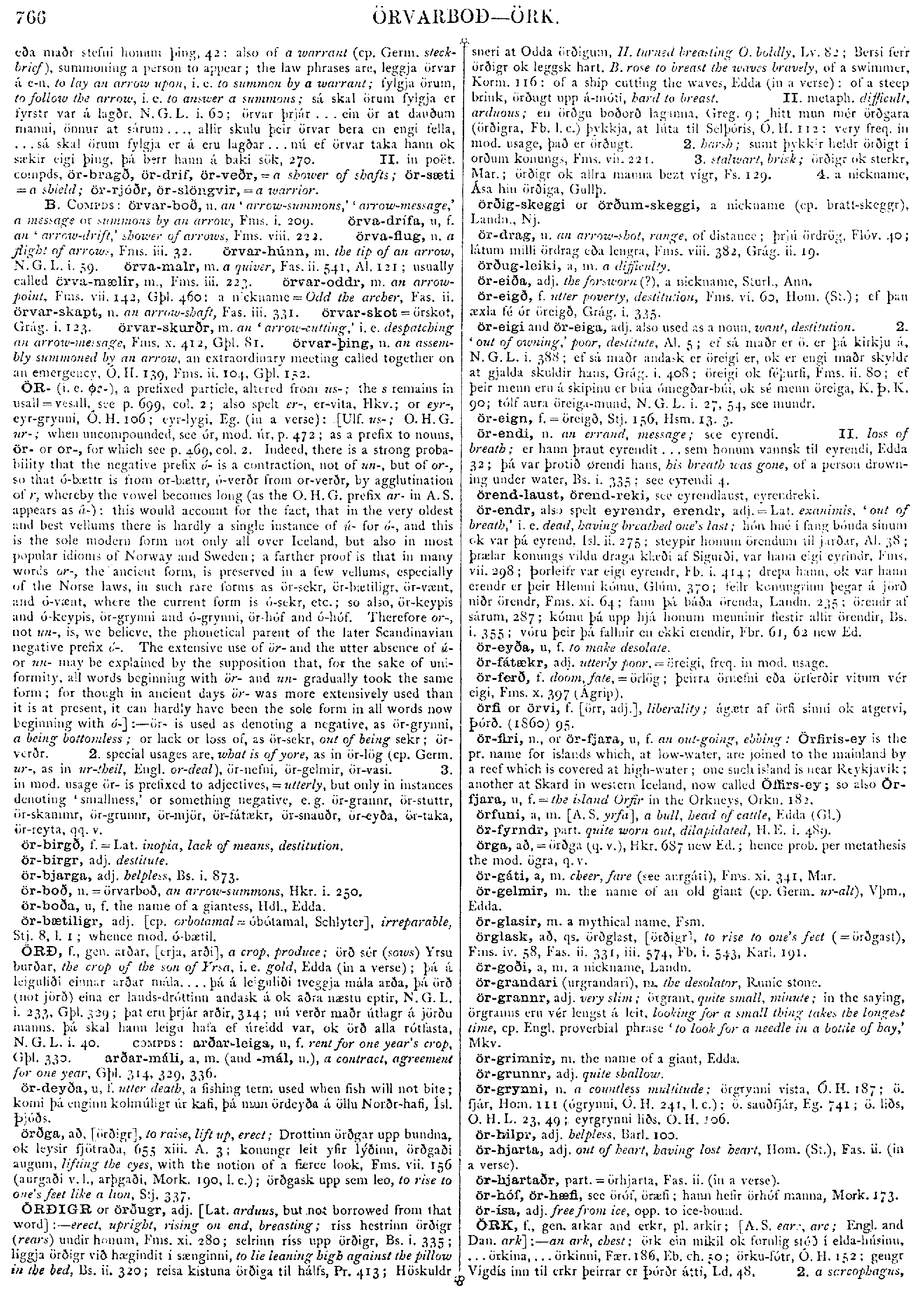
ör-deyða, u, f. utter death, a fishing term used when fish will not bite; komi þá enginn kolmúligr úr kafi, þá mun ördeyða á öllu Norðr-hafi, Ísl. Þjóðs.
|
Source: Cleasby/Vigfusson, page b0766, entry 11 View original page image as: [TIFF] [PNG] [View previous entry] [View next entry] |
[Comment on this entry] [View comments] |
The following entry has been hand-corrected once. |
ÖRÐIGR or örðugr, adj. [Lat. arduus, but not borrowed from that word] :-- erect, upright, rising on end, breasting; ríss hestrinn örðigr (rears) undir honum. Fms. xi. 280; selrinn ríss upp örðigr, Bs. i. 335; liggja örðigr við hægindit í sænginni, to lie leaning high against the pillow in the bed, Bs. ii. 320; reisa kistuna örðiga til hálfs, Pr. 413; Höskuldr sneri at Odda örðigum, H. turned breasting O. boldly, Lv. 82; Bersi ferr örðigr ok leggsk hart, B. rose to breast the waves bravely, of a swimmer, Korm. 116: of a ship cutting the waves, Edda (in a verse): of a steep brink, örðugt upp á-móti, hard to breast. II. metaph. difficult, arduous; en örðgu boðorð laginna, Greg. 9; hitt mun mér örðgara (örðigra, Fb. l.c.) þykkja, at lúta til Selþóris, Ó.H. 112: very freq. in mod. usage, það er örðugt. 2. harsh; sumt þykkir heldr örðigt í orðum konungs, Fms. vii. 221. 3. stalwart, brisk; örðigr ok sterkr, Mar.; orðigr ok allra manna bezt vígr, Fs. 129. 4. a nickname, Ása hin örðiga, Gullþ.
|
Source: Cleasby/Vigfusson, page b0767, entry 41 View original page image as: [TIFF] [PNG] [View previous entry] [View next entry] |
[Comment on this entry] [View comments] |
The following entry has been hand-corrected once. |
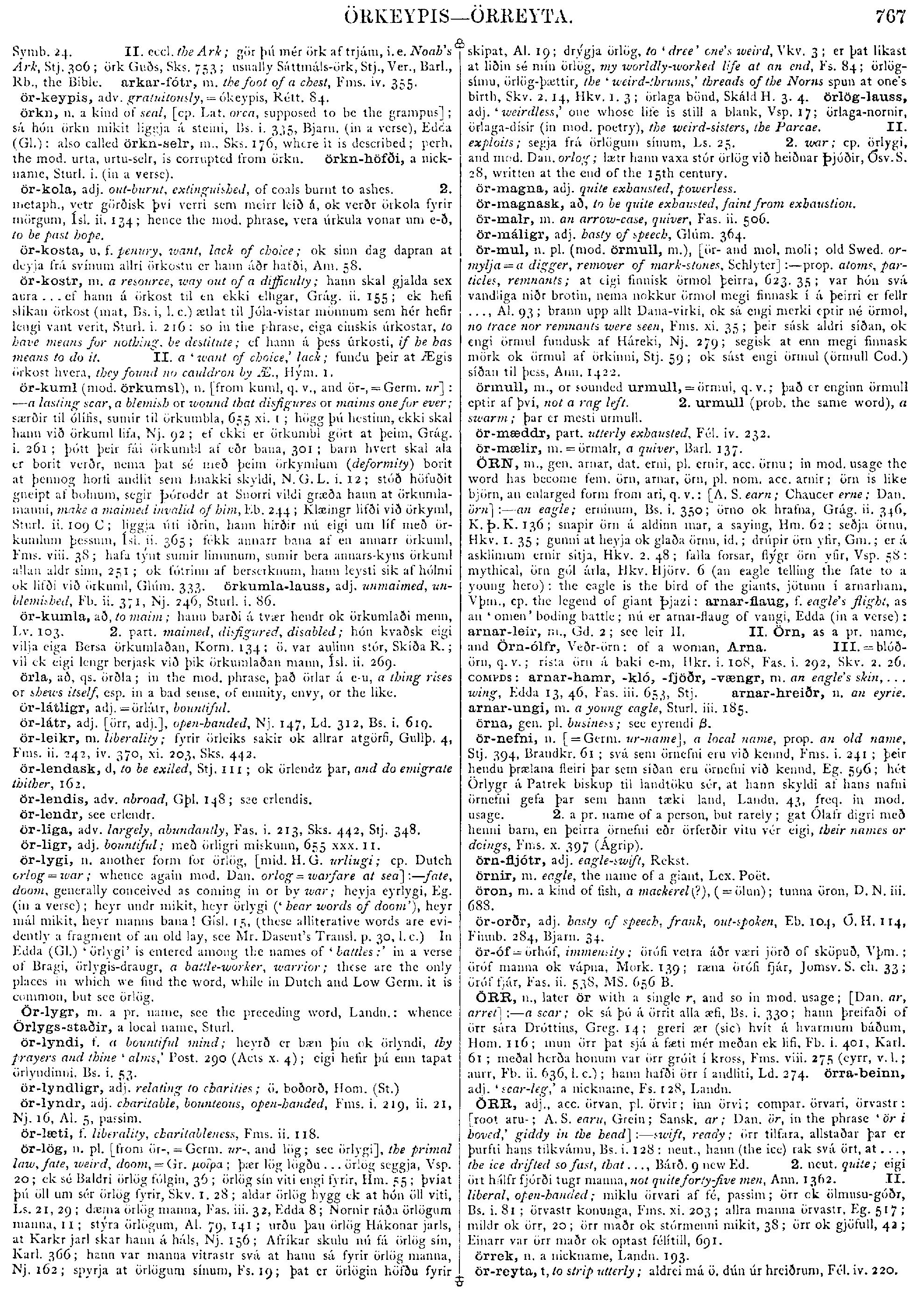
ÖRR, n., later or with a single r, and so in mod. usage; [Dan. ar, arret] :-- a scar; ok sá þó á örrit alla æfi, Bs. i. 330; hann þreifaði of örr sára Dróttins, Greg. 14; greri ær (sic) hvít á hvarmum báðum, Hom. 116; mun örr þat sjá á fæti mér meðan ek lifi, Fb. i. 401, Karl. 61; meðal herða honum var örr gróit í kross, Fms. viii. 275 (eyrr, v.l.; aurr, Fb. ii. 636, l.c.); hann hafði örr í andliti, Ld. 274. örra-beinn, adj. 'scar-leg,' a nickname, Fs. 128, Landn.
|
Source: Gordon/Taylor, page b0006, entry 1 View original page image as: [TIFF][PNG] [View previous entry] [View next entry] |
[Comment on this entry] [View comments] |
The following entry has been hand-corrected once. |
kaupinu,
ok
veittu
Loka
atg ngu.
En
er
hann
varð
hræddr,
ngu.
En
er
hann
varð
hræddr,
þá
svarði
hann
eiða
at
hann
skyldi
svá
til
haga
at
smiðrinn
væri
af
kaupinu,
hvat
sem
hann
kostaði
til.
35
Ok
hit
sama
kveld,
er
smiðrinn
ók
út
eptir
grjótinu
með
hestinn
Svaðilfara,
þá
hljóp
ór
skógi
nkkurum
merr
ok
at
hestinum
ok
hrein
við.
En
er
hestrinn
kendi
hvat
hrossi
þetta
var,
þá
œddisk
hann
ok
sleit
sundr
reipin
ok
hljóp
til
merarinnar,
en
hon
undan
til
skógar
ok
smiðrínn
eptir
ok
40
vill
taka
hestinn,
en
þessi
hross
hlaupa
alla
nótt,
ok
dvelsk
smíðin
þá
nótt.
Ok
eptir
um
daginn
varð
ekki
svá
smíðat
sem
fyrr
hafði
orðit.
Ok
þá
er
smiðrinn
sér
at
eigi
mun
lokit
verða
verkinu,
þá
fœrisk
smiðrinn
í
jtunmóð.
En
er
Æsirnir
sá
þat
til
víss,
at
þar
var
bergrisi
kominn,
þá
varð
eigi
þyrmt
45
eiðunum,
ok
klluðu
þeir
á
Þór,
ok
jafnskjótt
kom
hann,
ok
því
næst
fór
á
lopt
hamarrinn
Mjllnir.
Galt
hann
þá
smíðarkaupit,
ok
eigi
sól
eða
tungl;
heldr
synjaði
hann
honum
at
byggva
í
Jtunheimum
ok
laust
þat
it
fyrsta
hgg,
er
haussinn
brotnaði
í
smán
mola,
ok
sendi
hann
niðr
undir
50
Niflheim.
En
Loki
hafði
þá
ferð
haft
til
Svaðilfara
at
nkkuru
síðar
bar
hann
fyl.
Þat
var
grátt
ok
hafði
átta
fœtr,
ok
er
sá
hestr
beztr
með
goðum
ok
mnnum.
| Result Page: |  |
Previous | 53 54 55 56 57 58 59 60 61 62 63 64 65 66 67 68 69 | Next |  |
Germanic Lexicon Project (main page)
This search system was written by
Sean Crist
Please consider
volunteering
to correct the data in these online dictionaries.
No rights reserved. Feel free to use these data in any way you please.