|
|

|
Source: Cleasby/Vigfusson, page b0237, entry 19 View original page image as: [TIFF] [PNG] [View previous entry] [View next entry] |
[Comment on this entry] [View comments] |
The following entry has been hand-corrected once. |
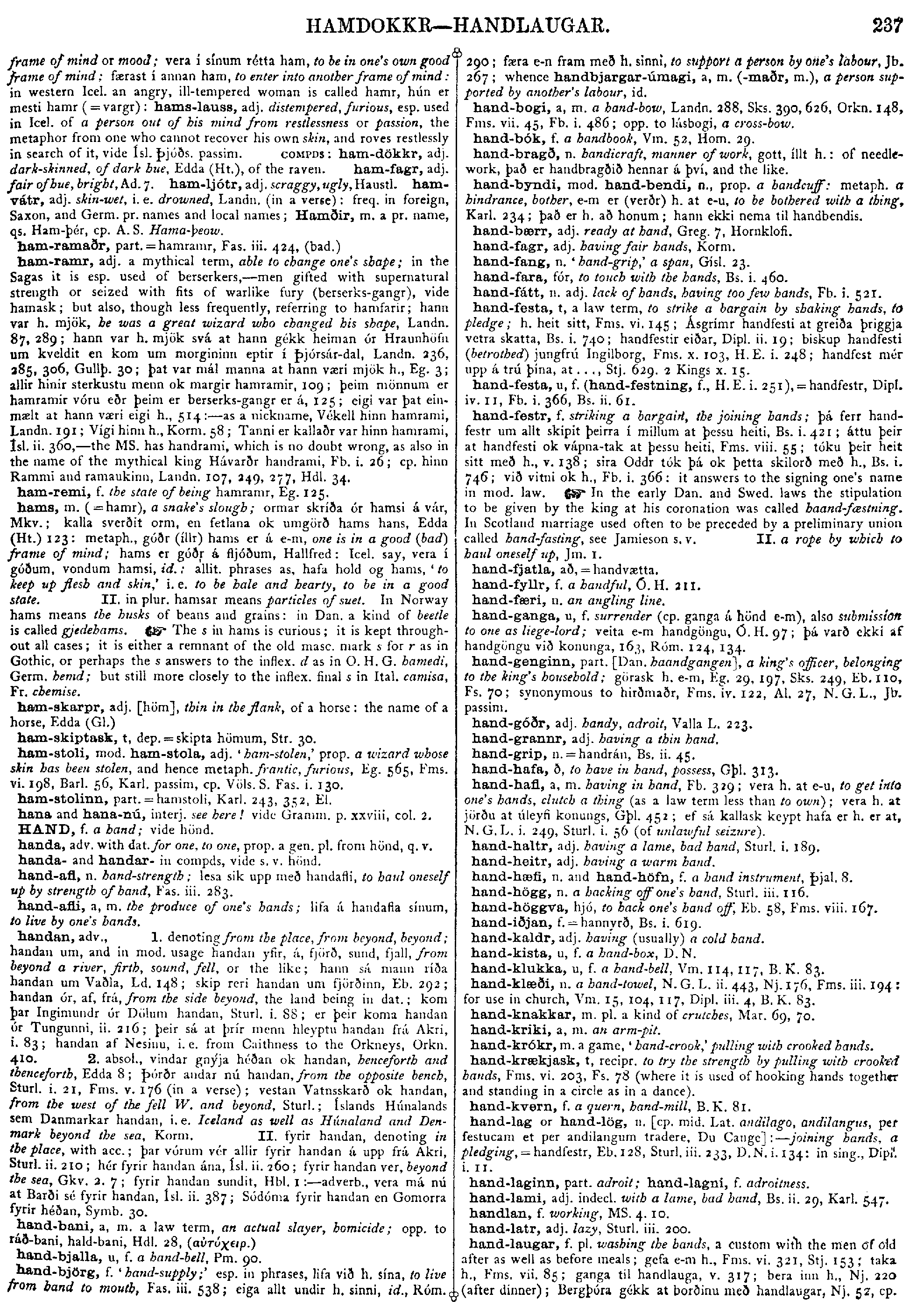
hand-björg, f. 'hand-supply;' esp. in phrases, lifa við h. sína, to live from hand to mouth, Fas. iii. 538; eiga allt undir h. sinni, id., Róm. 290; færa e-n fram með h. sinni, to support a person by one's labour, Jb. 267; whence handbjargar-úmagi, a, m. (-maðr, m.), a person supported by another's labour, id.
|
Source: Cleasby/Vigfusson, page b0242, entry 20 View original page image as: [TIFF] [PNG] [View previous entry] [View next entry] |
[Comment on this entry] [View comments] |
The following entry has been hand-corrected once. |
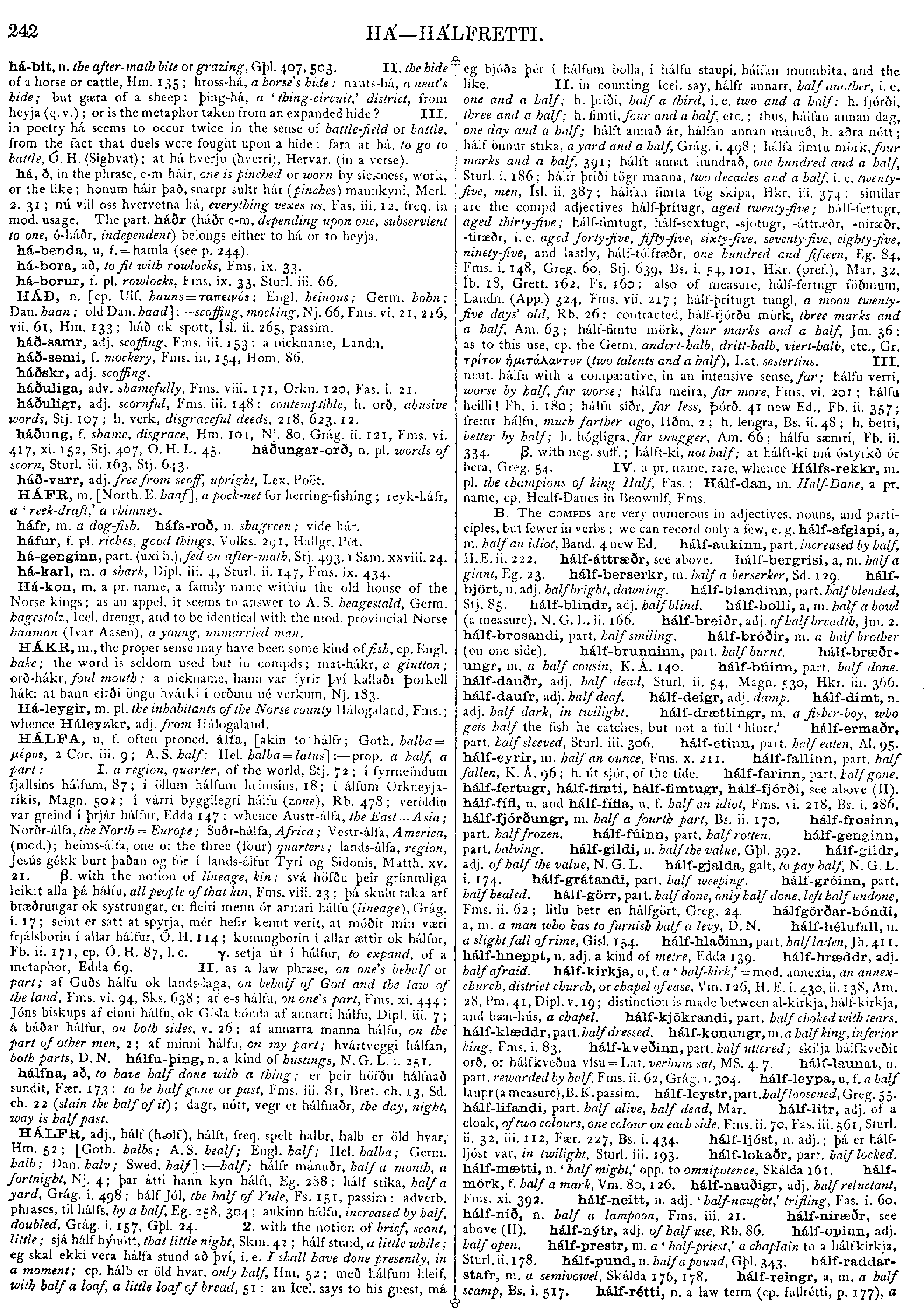
HÁKR, m., the proper sense may have been some kind of fish, cp. Engl. hake; the word is seldom used but in compds; mat-hákr, a glutton; orð-hákr, foul mouth: a nickname, hann var fyrir því kallaðr Þorkell hákr at hann eirði öngu hvárki í orðum né verkum, Nj. 183.
|
Source: Cleasby/Vigfusson, page b0244, entry 137 View original page image as: [TIFF] [PNG] [View previous entry] [View next entry] |
[Comment on this entry] [View comments] |
The following entry has been hand-corrected once. |
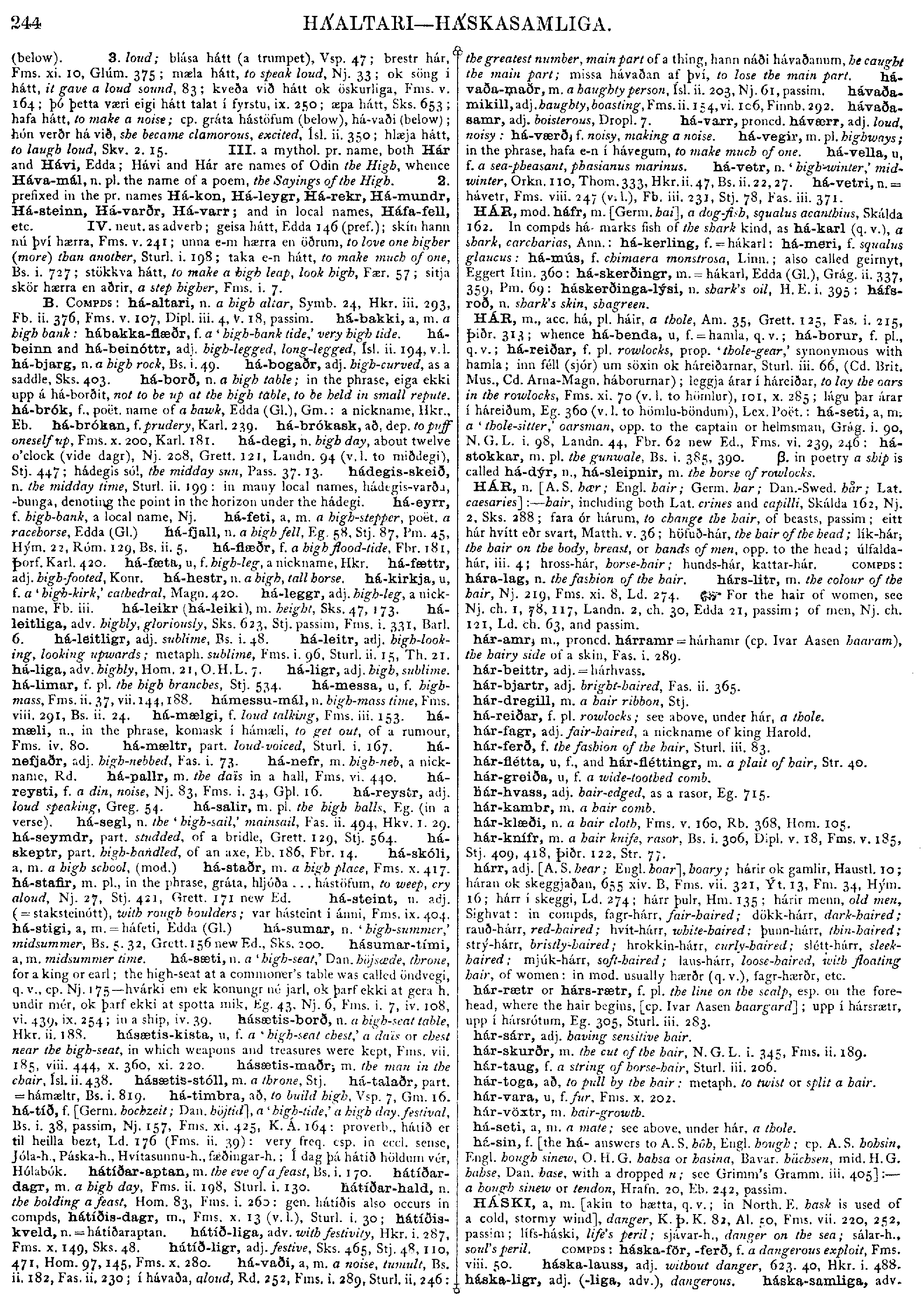
A.
To
heave,
lift,
raise;
hefja
stein,
to
lift
a
stone,
Eg.
142;
ok
munu
nú
ekki
meira
hefja
fjórir
menn,
140;
(hón)
hóf
hann
at
lopti,
hove
him
aloft,
Ýt.
9;
hefja
e-n
til
himins,
Edda
61
(in
a
verse);
hóf
hann
sér
af
herðum
hver,
Hym.
36;
þá
er
hefja
af
hvera
(mod.
taka
ofan
pott,
to
take
the
pot
off),
Gm.
42;
hóf
sér
á
höfuð
upp
hver
Sifjar
verr,
Hým.
34;
hón
hófat
augu
af
mér,
she
took
not
her
eyes
off
me,
Korm.
16;
hann
hóf
upp
augu
sín,
he
lifted
up
his
eyes,
623.
20;
hefja
sik
á
lopt,
to
make
a
leap,
Nj.
144.
2.
phrases,
hefja
handa,
to
lift
the
hands
(for
defence),
Nj.
65,
Ld.
262;
h.
höfuðs,
to
lift
the
head,
stand
upright,
be
undaunted;
sá
er
nú
hefir
eigi
höfuðs,
Nj.
213:
h.
sinn
munn
í
sundr,
to
open
one's
mouth,
Sturl.
iii.
189:
hefja
graut,
skyr,
etc.,
to
lift
the
porridge,
curds,
etc.,
eat
food
with
a
spoon,
Fms.
vi.
364;
Rindill
hóf
(Ed.
hafði
wrongly)
skyr
ok
mataðisk
skjótt,
Lv.
63.
3.
hefja
út,
to
lift
out
a
body,
carry
it
from
the
house
(út-hafning),
Eg.
24;
er
mik
út
hefja,
Am.
100;
var
konungr
hafiðr
dauðr
ór
hvílunni,
Hkr.
iii.
146.
The
ceremony
of
carrying
the
corpse
out
of
the
house
is
in
Icel.
still
performed
with
solemnity,
and
followed
by
hymns,
usually
verses
9
sqq.
of
the
25th
hymn
of
the
Passíu-Sálmar;
it
is
regarded
as
a
farewell
to
the
home
in
which
a
person
has
lived
and
worked;
and
is
a
custom
lost
in
the
remotest
heathen
age;
cp.
the
Scot.
to
lift.
 .
hefja
(barn)
ór
heiðnum
dómi,
to
lift
(a
bairn)
out
of
heathendom,
is
an
old
eccl.
term
for
to
be
sponsor
(mod.
halda
undir
skírn),
Sighvat
(in
a
verse);
N.
G.
L.
i.
350
records
three
kinds
of
sponsorship
--
halda
barni
undir
primsignan,
önnur
at
hefja
barn
ór
heiðnum
dómi,
þriðja
at
halda
á
barni
er
biskup
fermir:
to
baptize,
skal
þat
barn
til
kirkju
færa
ok
hefja
ór
heiðnum
dómi,
12;
barn
hvert
er
borit
verðr
eptir
nótt
ina
helgu,
þá
skal
haft
vera
(baptized)
at
Páskum,
id.
4.
to
exalt,
Ad.
20,
cp.
with
Yngl.
S.
ch.
10;
hóf
hann
Jóseph
til
sæmðar,
Sks.
454;
hafðr
til
ríkis,
458;
upp
hafðr,
451;
önd
hennar
var
upp
höfð
yfir
öll
engla
fylki,
Hom.
129;
hann
mektaðisk
mjök
ok
hóf
sik
of
hátt
af
þeim
auðæfum,
Stj.
154;
at
hann
hæfi
upp
(exaltaret)
Guðs
orð
með
tungunni,
Skálda
208;
konungr
hóf
hann
til
mestu
metorða,
625.
31:
er
hans
ríki
hóf,
28.
II.
impers.,
1.
to
be
heaved,
hurled,
drifted,
by
storm,
tide,
or
the
like;
þá
hóf
upp
knörr
(acc.)
undir
Eyjafjöllum,
a
ship
was
upheaved
by
the
gale,
Bs.
i.
30;
hóf
öll
skipin
(acc.
the
ship
drifted)
saman
inn
at
landinu,
Hkr.
i.
206;
þetta
hóf
(drifted)
fyrir
straumi,
iii.
94;
þeir
létu
hefja
ofan
skipin
forstreymis,
let
the
ship
drift
before
the
stream,
Fms.
vii.
253;
Birkibeina
hefr
undan,
the
B.
went
back,
ix.
528.
2.
medic.,
en
er
af
henni
hóf
öngvit
(acc.
when
she
awoke,
of
one
in
a
swoon),
Bjarn.
68;
þá
hóf
af
mér
vámur
allar
(acc.
all
ailments
left
me),
svá
at
ek
kenni
mér
nú
hvergi
íllt,
Sturl.
ii.
54;
ek
sé
at
þú
ert
fölr
mjök,
ok
má
vera,
at
af
þér
hafi,
I
see
thou
art
very
pale,
but
may
be
it
will
pass
off,
Finnb.
236;
hóf
honum
heldr
upp
brún
(acc.
his
face
brightened),
Eg.
55.
III.
.
hefja
(barn)
ór
heiðnum
dómi,
to
lift
(a
bairn)
out
of
heathendom,
is
an
old
eccl.
term
for
to
be
sponsor
(mod.
halda
undir
skírn),
Sighvat
(in
a
verse);
N.
G.
L.
i.
350
records
three
kinds
of
sponsorship
--
halda
barni
undir
primsignan,
önnur
at
hefja
barn
ór
heiðnum
dómi,
þriðja
at
halda
á
barni
er
biskup
fermir:
to
baptize,
skal
þat
barn
til
kirkju
færa
ok
hefja
ór
heiðnum
dómi,
12;
barn
hvert
er
borit
verðr
eptir
nótt
ina
helgu,
þá
skal
haft
vera
(baptized)
at
Páskum,
id.
4.
to
exalt,
Ad.
20,
cp.
with
Yngl.
S.
ch.
10;
hóf
hann
Jóseph
til
sæmðar,
Sks.
454;
hafðr
til
ríkis,
458;
upp
hafðr,
451;
önd
hennar
var
upp
höfð
yfir
öll
engla
fylki,
Hom.
129;
hann
mektaðisk
mjök
ok
hóf
sik
of
hátt
af
þeim
auðæfum,
Stj.
154;
at
hann
hæfi
upp
(exaltaret)
Guðs
orð
með
tungunni,
Skálda
208;
konungr
hóf
hann
til
mestu
metorða,
625.
31:
er
hans
ríki
hóf,
28.
II.
impers.,
1.
to
be
heaved,
hurled,
drifted,
by
storm,
tide,
or
the
like;
þá
hóf
upp
knörr
(acc.)
undir
Eyjafjöllum,
a
ship
was
upheaved
by
the
gale,
Bs.
i.
30;
hóf
öll
skipin
(acc.
the
ship
drifted)
saman
inn
at
landinu,
Hkr.
i.
206;
þetta
hóf
(drifted)
fyrir
straumi,
iii.
94;
þeir
létu
hefja
ofan
skipin
forstreymis,
let
the
ship
drift
before
the
stream,
Fms.
vii.
253;
Birkibeina
hefr
undan,
the
B.
went
back,
ix.
528.
2.
medic.,
en
er
af
henni
hóf
öngvit
(acc.
when
she
awoke,
of
one
in
a
swoon),
Bjarn.
68;
þá
hóf
af
mér
vámur
allar
(acc.
all
ailments
left
me),
svá
at
ek
kenni
mér
nú
hvergi
íllt,
Sturl.
ii.
54;
ek
sé
at
þú
ert
fölr
mjök,
ok
má
vera,
at
af
þér
hafi,
I
see
thou
art
very
pale,
but
may
be
it
will
pass
off,
Finnb.
236;
hóf
honum
heldr
upp
brún
(acc.
his
face
brightened),
Eg.
55.
III.
|
Source: Cleasby/Vigfusson, page b0247, entry 21 View original page image as: [TIFF] [PNG] [View previous entry] [View next entry] |
[Comment on this entry] [View comments] |
The following entry has been hand-corrected once. |
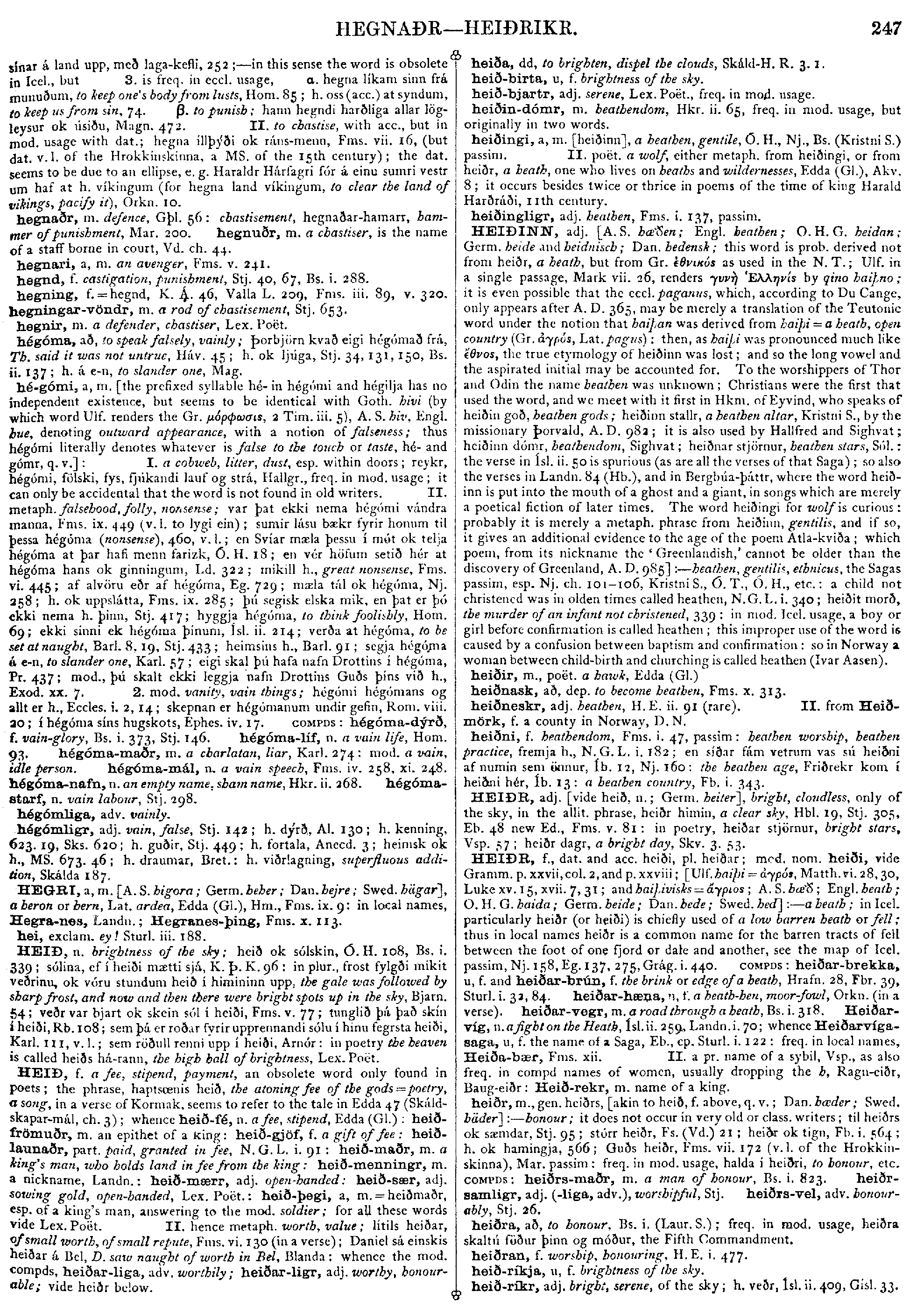
HEIÐINN, adj. [A. S. hæðen; Engl. heathen; O. H. G. heidan; Germ. heide and heidnisch; Dan. hedensk; this word is prob. derived not from heiðr, a heath, but from Gr. GREEK as used in the N. T.; Ulf. in a single passage, Mark vii. 26, renders GREEK by qino haiþno; it is even possible that the eccl. paganus, which, according to Du Cange, only appears after A.D. 365, may be merely a translation of the Teutonic word under the notion that haiþan was derived from haiþi = a heath, open country (Gr. GREEK, Lat. pagus): then, as haiþi was pronounced much like GREEK, the true etymology of heiðinn was lost; and so the long vowel and the aspirated initial may be accounted for. To the worshippers of Thor and Odin the name heathen was unknown; Christians were the first that used the word, and we meet with it first in Hkm. of Eyvind, who speaks of heiðin goð, heathen gods; heiðinn stallr, a heathen altar, Kristni S., by the missionary Þorvald, A.D. 982; it is also used by Hallfred and Sighvat; heiðinn dómr, heathendom, Sighvat; heiðnar stjörnur, heathen stars, Sól.: the verse in Ísl. ii. 50 is spurious (as are all the verses of that Saga); so also the verses in Landn. 84 (Hb.), and in Bergbúa-þáttr, where the word heiðinn is put into the mouth of a ghost and a giant, in songs which are merely a poetical fiction of later times. The word heiðingi for wolf is curious: probably it is merely a metaph. phrase from heiðinn, gentilis, and if so, it gives an additional evidence to the age of the poem Atla-kviða; which poem, from its nickname the 'Greenlandish,' cannot be older than the discovery of Greenland, A.D. 985] :-- heathen, gentilis, ethnicus, the Sagas passim, esp. Nj. ch. 101-106, Kristni S., Ó. T., Ó. H., etc.: a child not christened was in olden times called heathen, N. G. L. i. 340; heiðit morð, the murder of an infant not christened, 339: in mod. Icel. usage, a boy or girl before confirmation is called heathen; this improper use of the word is caused by a confusion between baptism and confirmation: so in Norway a woman between child-birth and churching is called heathen (Ivar Aasen).
|
Source: Cleasby/Vigfusson, page b0255, entry 11 View original page image as: [TIFF] [PNG] [View previous entry] [View next entry] |
[Comment on this entry] [View comments] |
The following entry has been hand-corrected once. |
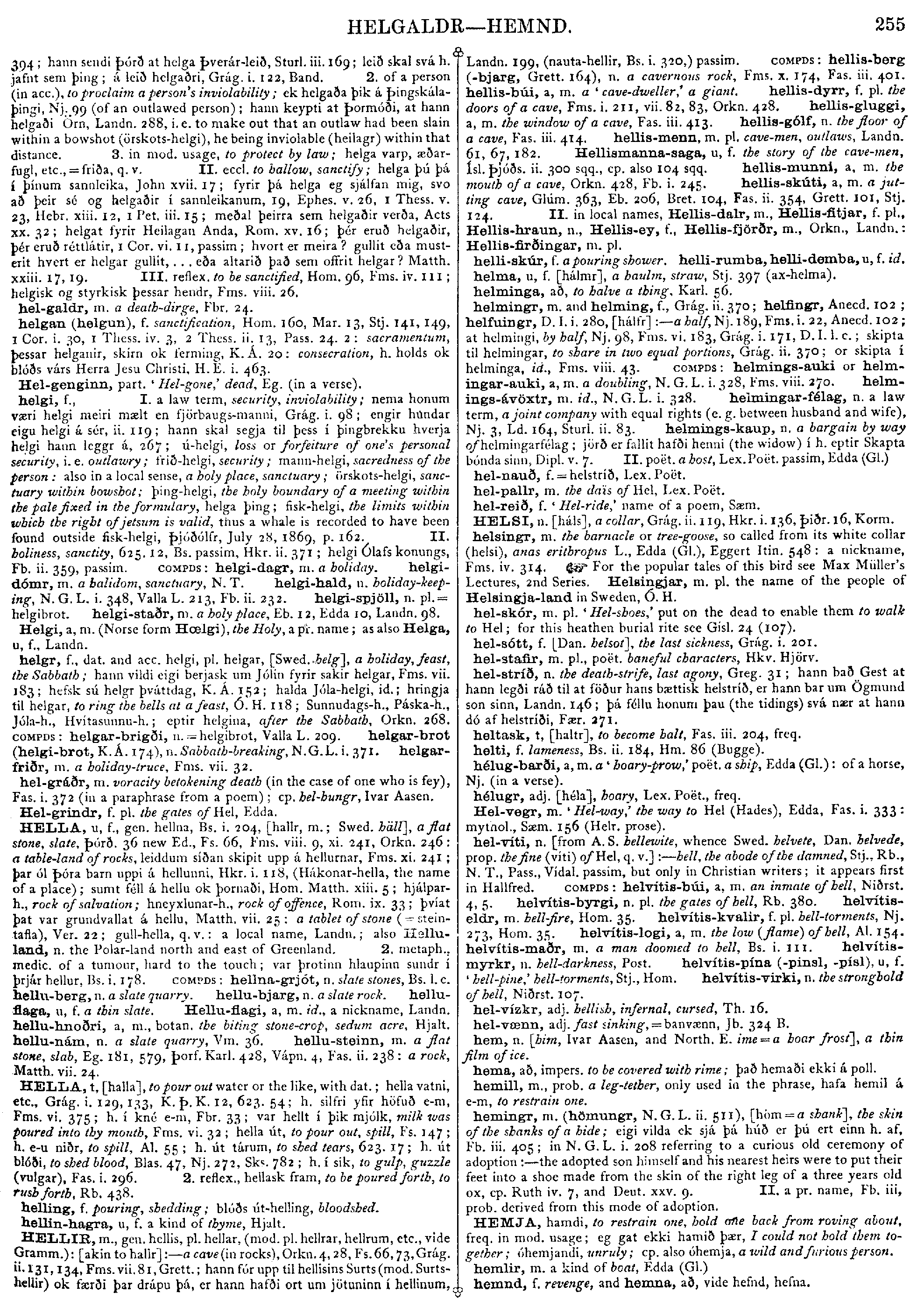
HELLA, t, [halla], to pour out water or the like, with dat.; hella vatni, etc., Grág. i. 129, 133, K. Þ. K. 12, 623. 54; h. silfri yfir höfuð e-m, Fms. vi. 375; h. í kné e-m, Fbr. 33; var hellt í þik mjólk, milk was poured into thy mouth, Fms. vi. 32; hella út, to pour out, spill, Fs. 147; h. e-u niðr, to spill, Al. 55; h. út tárum, to shed tears, 623. 17; h. út blóði, to shed blood, Blas. 47, Nj. 272, Sks. 782; h. í sik, to gulp, guzzle (vulgar), Fas. i. 296. 2. reflex., hellask fram, to be poured forth, to rush forth, Rb. 438.
|
Source: Cleasby/Vigfusson, page b0255, entry 14 View original page image as: [TIFF] [PNG] [View previous entry] [View next entry] |
[Comment on this entry] [View comments] |
The following entry has been hand-corrected once. |
HELLIR, m., gen. hellis, pl. hellar, (mod. pl. hellrar, hellrum, etc., vide Gramm.): [akin to hallr] :-- a cave (in rocks), Orkn. 4, 28, Fs. 66, 73, Grág. ii. 131, 134, Fms. vii. 81, Grett.; hann fór upp til hellisins Surts (mod. Surts-hellir) ok færði þar drápu þá, er hann hafði ort um jötuninn í hellinum, Landn. 199, (nauta-hellir, Bs. i. 320,) passim. COMPDS: hellis-berg (-bjarg, Grett. 164), n. a cavernous rock, Fms. x. 174, Fas. iii. 401. hellis-búi, a, m. a 'cave-dweller,' a giant. hellis-dyrr, f. pl. the doors of a cave, Fms. i. 211, vii. 82, 83, Orkn. 428. hellis-gluggi, a, m. the window of a cave, Fas. iii. 413. hellis-gólf, n. the floor of a cave, Fas. iii. 414. hellis-menn, m. pl. cave-men, outlaws, Landn. 61, 67, 182. Hellismanna-saga, u, f. the story of the cave-men, Ísl. Þjóðs. ii. 300 sqq., cp. also 104 sqq. hellis-munni, a, m. the mouth of a cave, Orkn. 428, Fb. i. 245. hellis-skúti, a, m. a jutting cave, Glúm. 363, Eb. 206, Bret. 104, Fas. ii. 354, Grett. 101, Stj. 124. II. in local names, Hellis-dalr, m., Hellis-fitjar, f. pl., Hellis-hraun, n., Hellis-ey, f., Hellis-fjörðr, m., Orkn., Landn.: Hellis-firðingar, m. pl.
|
Source: Cleasby/Vigfusson, page b0260, entry 30 View original page image as: [TIFF] [PNG] [View previous entry] [View next entry] |
[Comment on this entry] [View comments] |
The following entry has been hand-corrected once. |
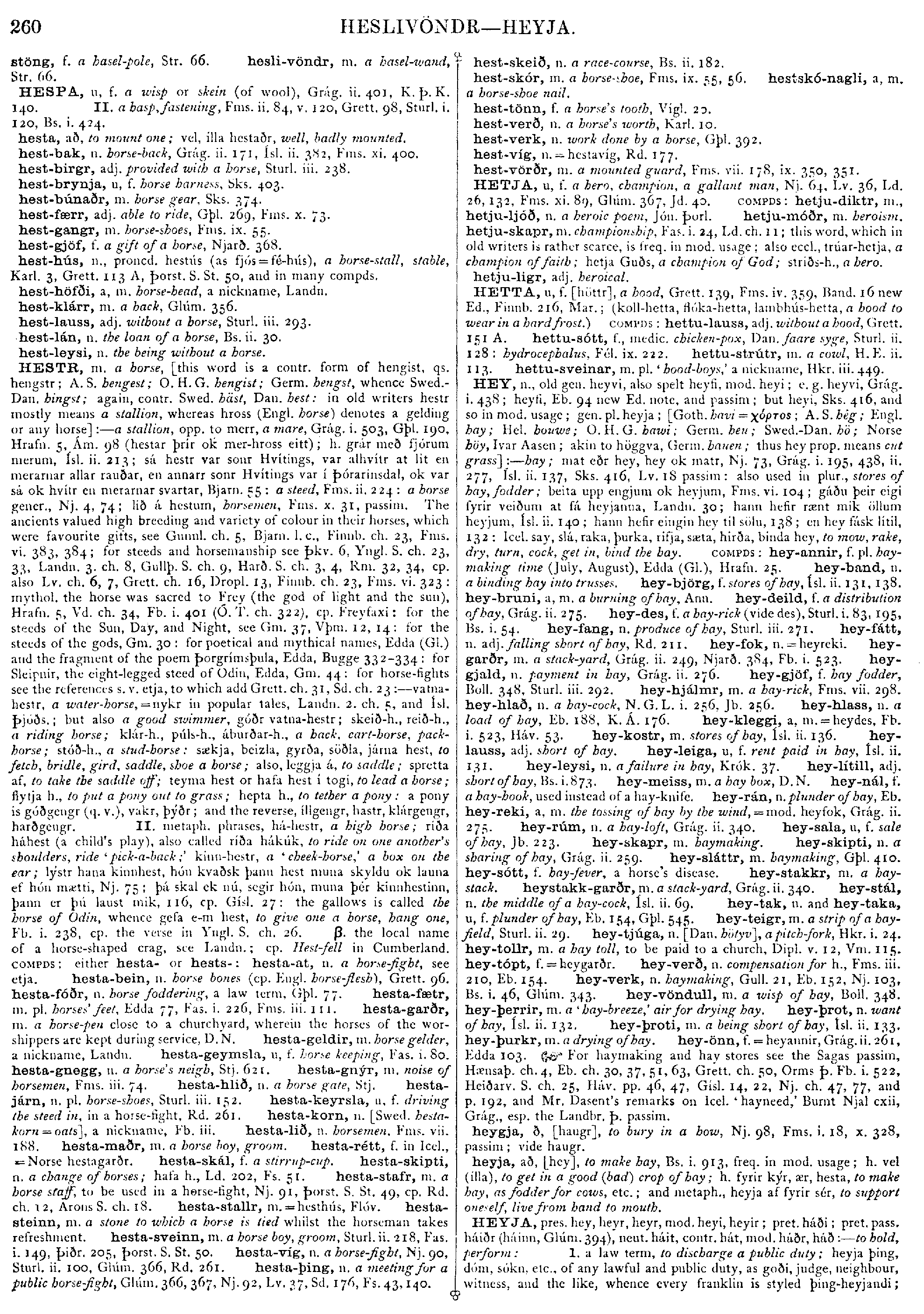
heyja, að, [hey], to make hay, Bs. i. 913, freq. in mod. usage; h. vel (ílla), to get in a good (bad) crop of hay; h. fyrir kýr, ær, hesta, to make hay, as fodder for cows, etc.; and metaph., heyja af fyrir sér, to support oneself, live from hand to mouth.
|
Source: Cleasby/Vigfusson, page b0272, entry 12 View original page image as: [TIFF] [PNG] [View previous entry] [View next entry] |
[Comment on this entry] [View comments] |
The following entry has been hand-corrected once. |
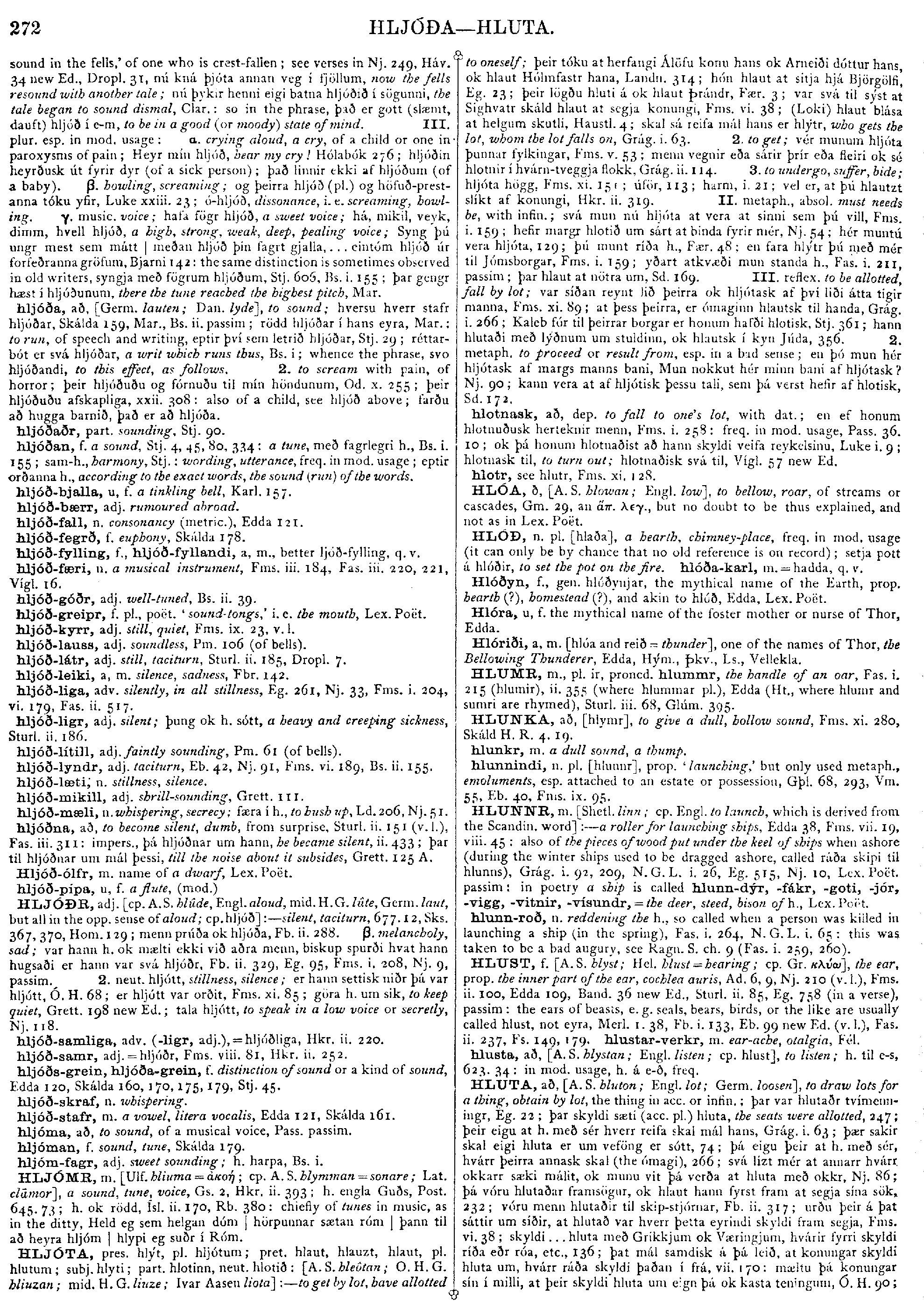
hljóð-greipr, f. pl., poët. 'sound-tongs,' i.e. the mouth, Lex. Poët.
|
Source: Cleasby/Vigfusson, page b0278, entry 1 View original page image as: [TIFF] [PNG] [View previous entry] [View next entry] |
[Comment on this entry] [View comments] |
The following entry has been hand-corrected once. |
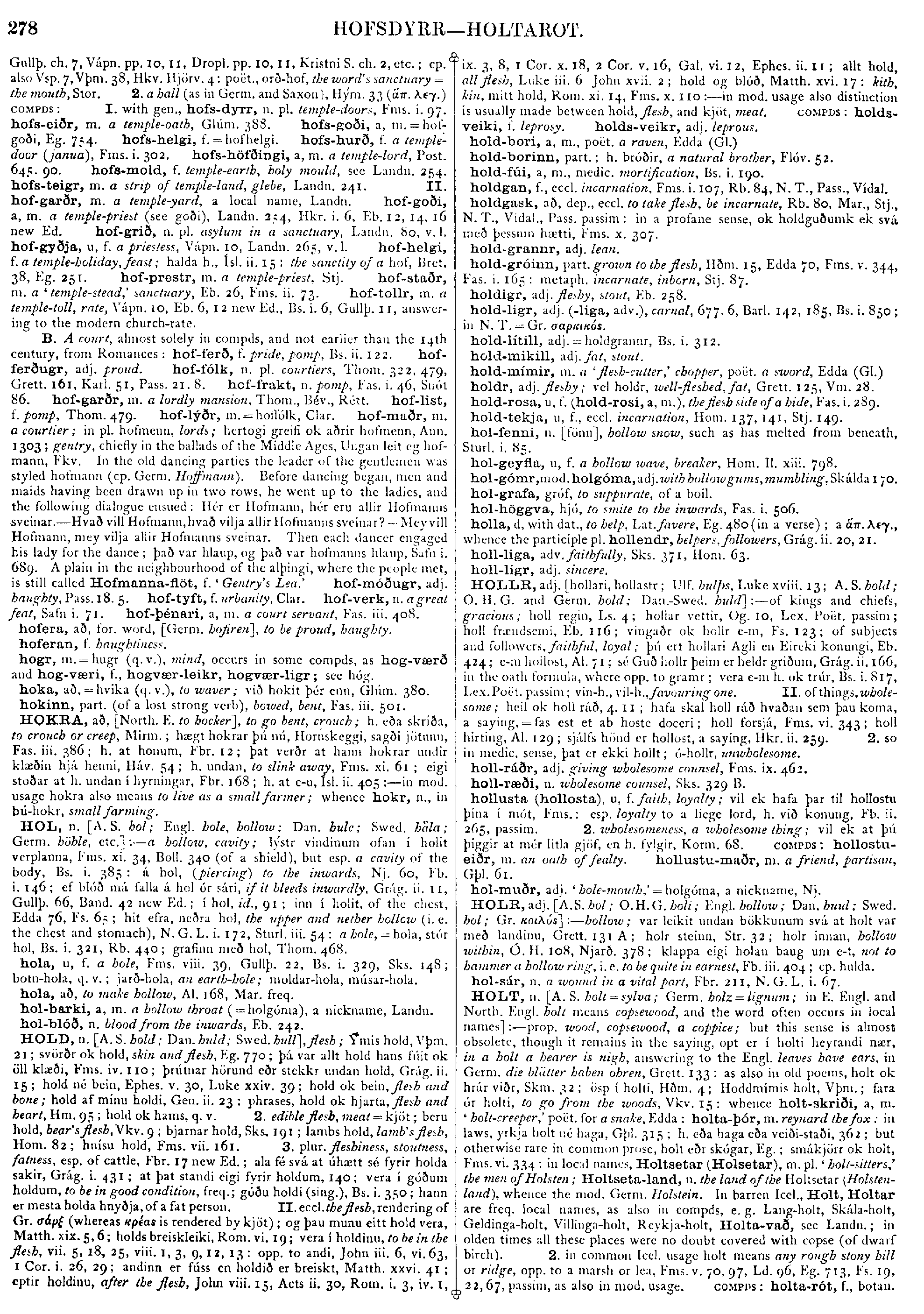
Gullþ. ch. 7, Vápn. pp. 10, 11, Dropl. pp. 10, 11, Kristni S. ch. 2, etc.; cp. also Vsp. 7, Vþm. 38, Hkv. Hjörv. 4: poët., orð-hof, the word's sanctuary = the mouth, Stor. 2. a hall (as in Germ. and Saxon), Hým. 33 (GREEK.) COMPDS: I. with gen., hofs-dyrr, n. pl. temple-doors, Fms. i. 97. hofs-eiðr, m. a temple-oath, Glúm. 388. hofs-goði, a, m. = hofgoði, Eg. 754. hofs-helgi, f. = hofhelgi. hofs-hurð, f. a temple-door (janua), Fms. i. 302. hofs-höfðingi, a, m. a temple-lord, Post. 645. 90. hofs-mold, f. temple-earth, holy mould, see Landn. 254. hofs-teigr, m. a strip of temple-land, glebe, Landn. 241. II. hof-garðr, m. a temple-yard, a local name, Landn. hof-goði, a, m. a temple-priest (see goði), Landn. 254, Hkr. i. 6, Eb. 12, 14, 16 new Ed. hof-grið, n. pl. asylum in a sanctuary, Landn. 80, v.l. hof-gyðja, u, f. a priestess, Vápn. 10, Landn. 265, v.l. hof-helgi, f. a temple-holiday, feast; halda h., Ísl. ii. 15: the sanctity of a hof, Bret. 38, Eg. 251. hof-prestr, m. a temple-priest, Stj. hof-staðr, m. a 'temple-stead,' sanctuary, Eb. 26, Fms. ii. 73. hof-tollr, m. a temple-toll, rate, Vápn. 10, Eb. 6, 12 new Ed., Bs. i. 6, Gullþ. 11, answering to the modern church-rate.
|
Source: Cleasby/Vigfusson, page b0284, entry 25 View original page image as: [TIFF] [PNG] [View previous entry] [View next entry] |
[Comment on this entry] [View comments] |
The following entry has been hand-corrected once. |
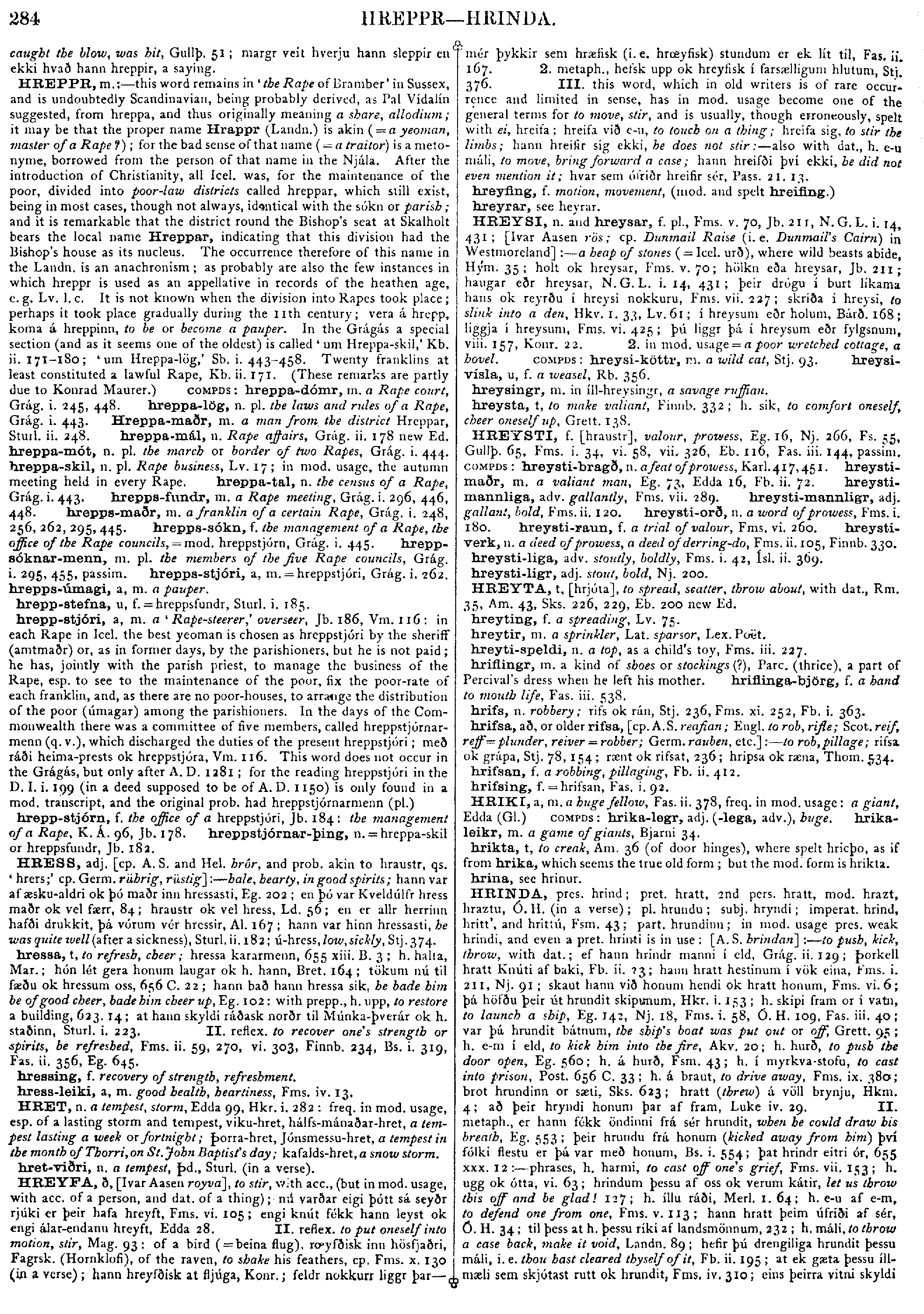
hriflingr, m. a kind of shoes or stockings (?), Parc. (thrice), a part of Percival's dress when he left his mother. hriflinga-björg, f. a hand to mouth life, Fas. iii. 538.
| Result Page: |  |
Previous | 6 7 8 9 10 11 12 13 14 15 16 17 18 19 20 21 | Next |  |
Germanic Lexicon Project (main page)
This search system was written by
Sean Crist
Please consider
volunteering
to correct the data in these online dictionaries.
No rights reserved. Feel free to use these data in any way you please.