|
|

|
Source: Bosworth/Toller, page b1152, entry 34 View original page image as: [TIFF] [PNG] [View previous entry] [View next entry] |
[Comment on this entry] [View comments (1)] |
The following entry has been hand-corrected once. |
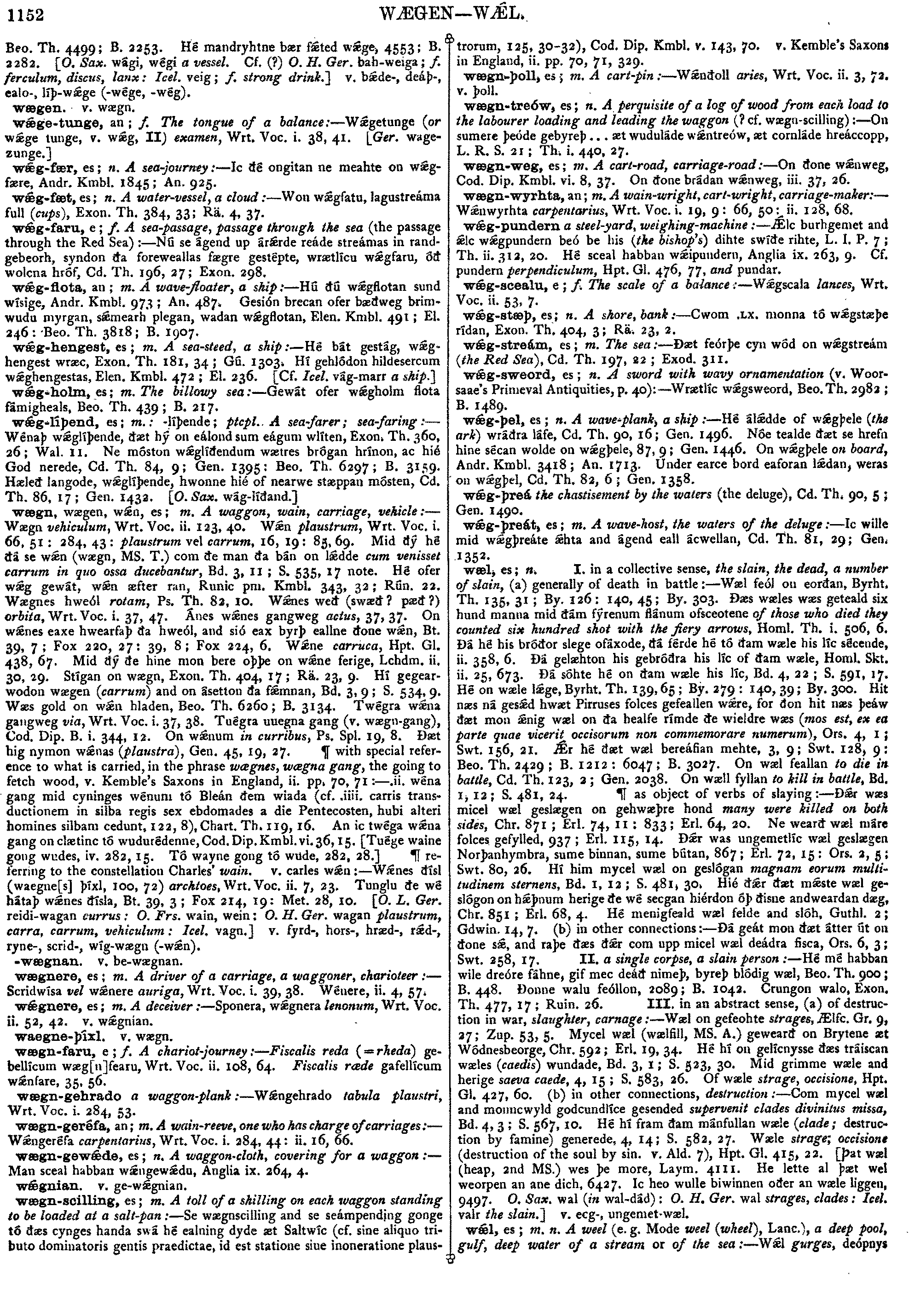
wæl,
es;
a.
I.
in
a
collective
sense,
the
slain,
the
dead,
a
number
of
slain,
(a)
generally
of
death
in
battle
:--
Wæl
feól
on
eorðan,
Byrht.
Th.
135,
31;
By.
126:
140,
45;
By.
303.
Ðæs
wæles
wæs
geteald
six
hund
manna
mid
ðám
fýrenum
flánum
ofsceotene
of
those
who
died
they
counted
six
hundred
shot
with
the
fiery
arrows,
Homl.
Th.
i.
506,
6.
Ðá
hé
his
bróðor
siege
ofáxode,
ðá
férde
hé
tó
ðam
wæle
his
líc
sécende,
ii.
358,
6.
Ðá
gelæhton
his
gebróðra
his
líc
of
ðam
wæle,
Homl.
Skt.
ii.
25,
673.
Ðá
sóhte
hé
on
ðam
wæle
his
líc,
Bd.
4,
22;
S.
591,
17.
Hé
on
wæle
l ge,
Byrht.
Th.
139,
65;
By.
279:
140,
39;
By.
300.
Hit
næs
ná
gesd
hwæt
Pirruses
folces
gefeallen
wre,
for
ðon
hit
næs
þeáw
ðæt
mon
nig
wæl
on
ða
healfe
rímde
ðe
wieldre
wæs
(mos
est,
ex
ea
parte
quae
vicerit
occisorum
non
commemorare
numerum),
Ors.
4,
1;
Swt.
156,
21.
Æ-acute;r
hé
ðæt
wæl
bereáfian
mehte,
3,
9;
Swt.
128,
9:
Beo.
Th.
2429;
B.
1212:
6047;
B.
3027.
On
wæl
feallan
to
die
in
battle,
Cd.
Th.
123,
2;
Gen.
2038.
On
wæll
fyllan
to
kill
in
battle,
Bd.
1,
12;
S.
481,
24.

as
object
of
verbs
of
slaying
:--
Ðr
wæs
micel
wæl
geslægen
on
gehwæþre
hond
many
were
killed
on
both
sides,
Chr.
871;
Erl.
74,
11:
833;
Erl.
64,
20.
Ne
wearð
wæl
máre
folces
gefylled,
937;
Erl.
115,
14.
Ðr
was
ungemetlíc
wæl
geslægen
Norþanhymbra,
sume
binnan,
sume
bútan,
867;
Erl.
72,
15:
Ors.
2,
5;
Swt.
80,
26.
Hí
him
mycel
wæl
on
geslógan
magnam
eorum
multitudinem
sternens,
Bd.
1,
12;
S.
481,
30,
Hié
ðr
ðæt
mste
wæl
geslógon
on
hþnum
herige
ðe
wé
secgan
hiérdon
óþ
ðisne
andweardan
dæg,
Chr.
851;
Erl.
68,
4.
Hé
menigfeald
wæl
felde
and
slóh,
Guthl.
2;
Gdwin.
14,
7.
(b)
in
other
connections
:--
Ðá
geát
mon
ðæt
átter
út
on
ðone
s,
and
raþe
ðæs
ðr
com
upp
micel
wæl
deádra
fisca,
Ors.
6,
3;
Swt.
258,
17.
II.
a
single
corpse,
a
slain
person
:--
Hé
mé
habban
wile
dreóre
fáhne,
gif
mec
deáð
nimeþ,
byreþ
blódig
wæl,
Beo.
Th.
900;
B.
448.
Ðonne
walu
feóllon,
2089;
B.
1042.
Crungon
walo,
Exon.
Th.
477,
17;
Ruin.
26.
III.
in
an
abstract
sense,
(a)
of
destruction
in
war,
slaughter,
carnage
:--
Wæl
on
gefeohte
strages,
Ælfc.
Gr.
9,
27;
Zup.
53,
5.
Mycel
wæl
(wælfill,
MS.
A.)
gewearð
on
Brytene
æt
Wódnesbeorge,
Chr.
592;
Erl.
19,
34.
Hé
hí
on
gelícnysse
ðæs
tráiscan
wæles
(caedis)
wundade,
Bd.
3,
1;
S.
523,
30.
Mid
grimme
wæle
and
herige
saeva
caede,
4,
15;
S.
583,
26.
Of
wæle
strage,
occisione,
Hpt.
Gl.
427,
60.
(b)
in
other
connections,
destruction
:--
Com
mycel
wæl
and
monncwyld
godcundlíce
gesended
supervenit
clades
divinitus
missa,
Bd.
4,
3;
S.
567,
10.
Hé
hí
fram
ðam
mánfullan
wæle
(clade;
destruction
by
famine)
generede,
4,
14;
S.
582,
27.
Wæle
strage;
occisione
(destruction
of
the
soul
by
sin.
v.
Ald.
7),
Hpt.
Gl.
415,
22.
[Þat
wæl
(heap,
2nd
MS.)
wes
þe
more,
Laym.
4111.
He
lette
al
þæt
wel
weorpen
an
ane
dich,
6427.
Ic
heo
wulle
biwinnen
oðer
an
wæle
liggen,
9497.
O.
Sax.
wal
(in
wal-dád):
O.
H.
Ger.
wal
strages,
clades:
Icel.
valr
the
slain.]
v.
ecg-,
ungemet-wæl.
ge,
Byrht.
Th.
139,
65;
By.
279:
140,
39;
By.
300.
Hit
næs
ná
gesd
hwæt
Pirruses
folces
gefeallen
wre,
for
ðon
hit
næs
þeáw
ðæt
mon
nig
wæl
on
ða
healfe
rímde
ðe
wieldre
wæs
(mos
est,
ex
ea
parte
quae
vicerit
occisorum
non
commemorare
numerum),
Ors.
4,
1;
Swt.
156,
21.
Æ-acute;r
hé
ðæt
wæl
bereáfian
mehte,
3,
9;
Swt.
128,
9:
Beo.
Th.
2429;
B.
1212:
6047;
B.
3027.
On
wæl
feallan
to
die
in
battle,
Cd.
Th.
123,
2;
Gen.
2038.
On
wæll
fyllan
to
kill
in
battle,
Bd.
1,
12;
S.
481,
24.

as
object
of
verbs
of
slaying
:--
Ðr
wæs
micel
wæl
geslægen
on
gehwæþre
hond
many
were
killed
on
both
sides,
Chr.
871;
Erl.
74,
11:
833;
Erl.
64,
20.
Ne
wearð
wæl
máre
folces
gefylled,
937;
Erl.
115,
14.
Ðr
was
ungemetlíc
wæl
geslægen
Norþanhymbra,
sume
binnan,
sume
bútan,
867;
Erl.
72,
15:
Ors.
2,
5;
Swt.
80,
26.
Hí
him
mycel
wæl
on
geslógan
magnam
eorum
multitudinem
sternens,
Bd.
1,
12;
S.
481,
30,
Hié
ðr
ðæt
mste
wæl
geslógon
on
hþnum
herige
ðe
wé
secgan
hiérdon
óþ
ðisne
andweardan
dæg,
Chr.
851;
Erl.
68,
4.
Hé
menigfeald
wæl
felde
and
slóh,
Guthl.
2;
Gdwin.
14,
7.
(b)
in
other
connections
:--
Ðá
geát
mon
ðæt
átter
út
on
ðone
s,
and
raþe
ðæs
ðr
com
upp
micel
wæl
deádra
fisca,
Ors.
6,
3;
Swt.
258,
17.
II.
a
single
corpse,
a
slain
person
:--
Hé
mé
habban
wile
dreóre
fáhne,
gif
mec
deáð
nimeþ,
byreþ
blódig
wæl,
Beo.
Th.
900;
B.
448.
Ðonne
walu
feóllon,
2089;
B.
1042.
Crungon
walo,
Exon.
Th.
477,
17;
Ruin.
26.
III.
in
an
abstract
sense,
(a)
of
destruction
in
war,
slaughter,
carnage
:--
Wæl
on
gefeohte
strages,
Ælfc.
Gr.
9,
27;
Zup.
53,
5.
Mycel
wæl
(wælfill,
MS.
A.)
gewearð
on
Brytene
æt
Wódnesbeorge,
Chr.
592;
Erl.
19,
34.
Hé
hí
on
gelícnysse
ðæs
tráiscan
wæles
(caedis)
wundade,
Bd.
3,
1;
S.
523,
30.
Mid
grimme
wæle
and
herige
saeva
caede,
4,
15;
S.
583,
26.
Of
wæle
strage,
occisione,
Hpt.
Gl.
427,
60.
(b)
in
other
connections,
destruction
:--
Com
mycel
wæl
and
monncwyld
godcundlíce
gesended
supervenit
clades
divinitus
missa,
Bd.
4,
3;
S.
567,
10.
Hé
hí
fram
ðam
mánfullan
wæle
(clade;
destruction
by
famine)
generede,
4,
14;
S.
582,
27.
Wæle
strage;
occisione
(destruction
of
the
soul
by
sin.
v.
Ald.
7),
Hpt.
Gl.
415,
22.
[Þat
wæl
(heap,
2nd
MS.)
wes
þe
more,
Laym.
4111.
He
lette
al
þæt
wel
weorpen
an
ane
dich,
6427.
Ic
heo
wulle
biwinnen
oðer
an
wæle
liggen,
9497.
O.
Sax.
wal
(in
wal-dád):
O.
H.
Ger.
wal
strages,
clades:
Icel.
valr
the
slain.]
v.
ecg-,
ungemet-wæl.
|
Source: Bosworth/Toller, page d0366, entry 5 View original page image as: [TIFF] [PNG] [View previous entry] [View next entry] |
[Comment on this entry] [View comments (1)] |
The following entry has been hand-corrected once. |
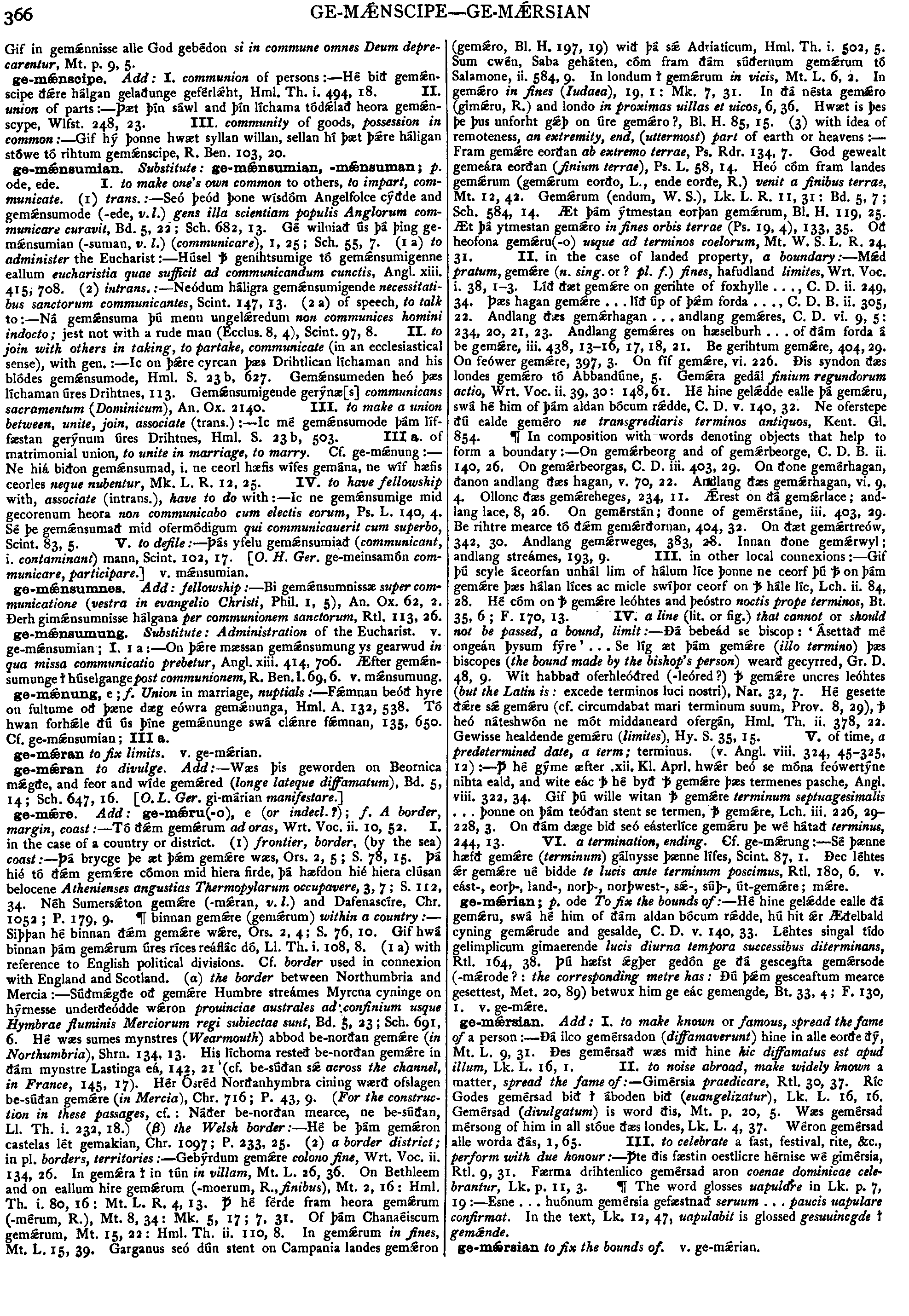
ge-mnsumung.
Substitute:
Administration
of
the
Eucharist,
v.
ge-mnsumian;
I.
l
a
:--
On
bre
mæssan
gemnsumung
ys
gearwud
in
qua
missa
communicatio
prebetur,
Angl.
xiii.
414,
706.
Æfter
gemn-sumunge
 húselgange
post
communionem,
R.
Ben.
1.
69,
6.
v.
mnsumung.
húselgange
post
communionem,
R.
Ben.
1.
69,
6.
v.
mnsumung.
|
Source: Bosworth/Toller, page d0640, entry 21 View original page image as: [TIFF] [PNG] [View previous entry] [View next entry] |
[Comment on this entry] [View comments] |
The following entry has been hand-corrected once. |
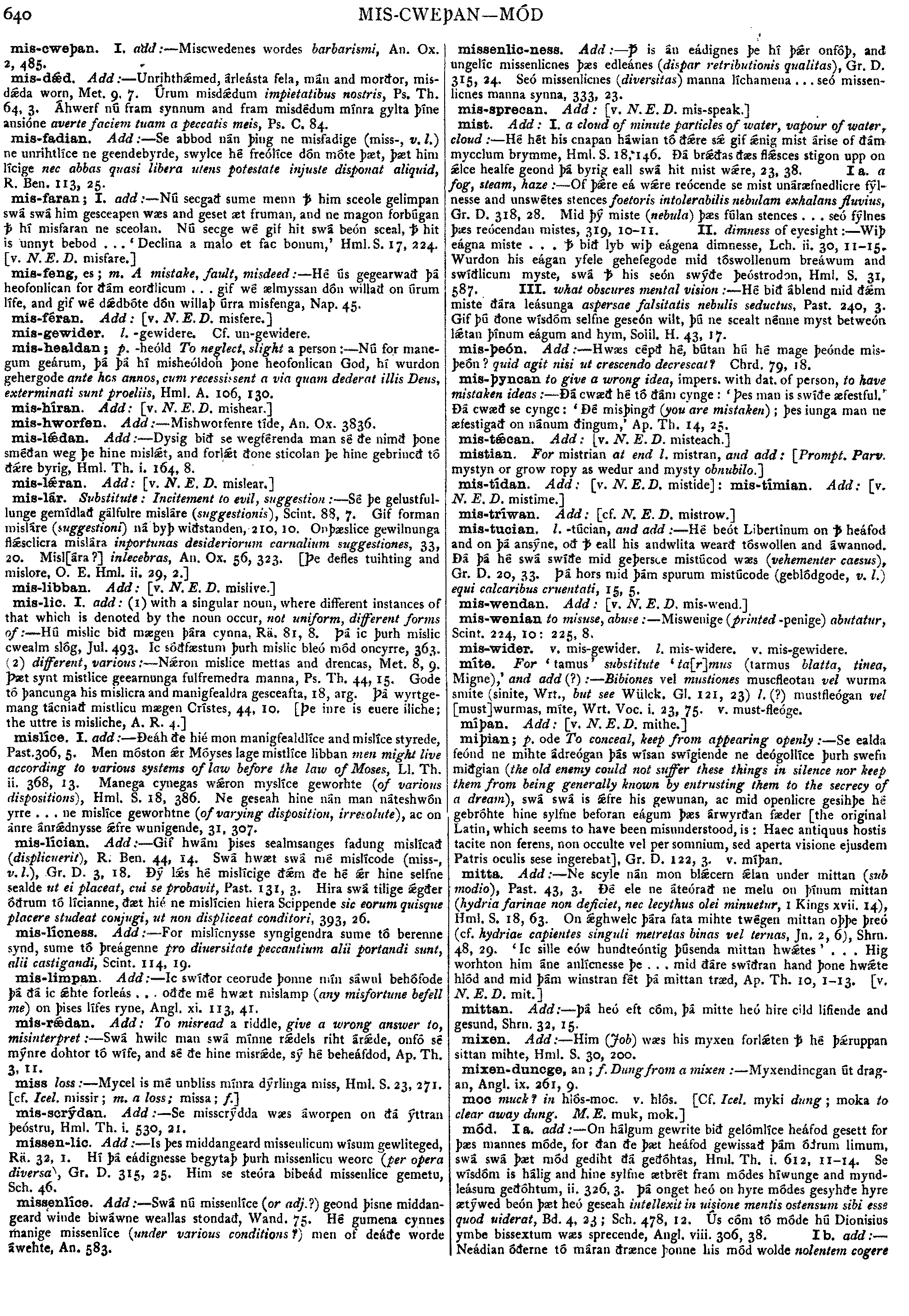
miss loss :-- Mycel is mé unbliss mínra dýrlinga miss, Hml. S. 23, 271. [cf. Icel. missir; m. a loss; missa; f.]
|
Source: Bosworth/Toller, page d0685, entry 11 View original page image as: [TIFF] [PNG] [View previous entry] [View next entry] |
[Comment on this entry] [View comments] |
The following entry has been hand-corrected once. |
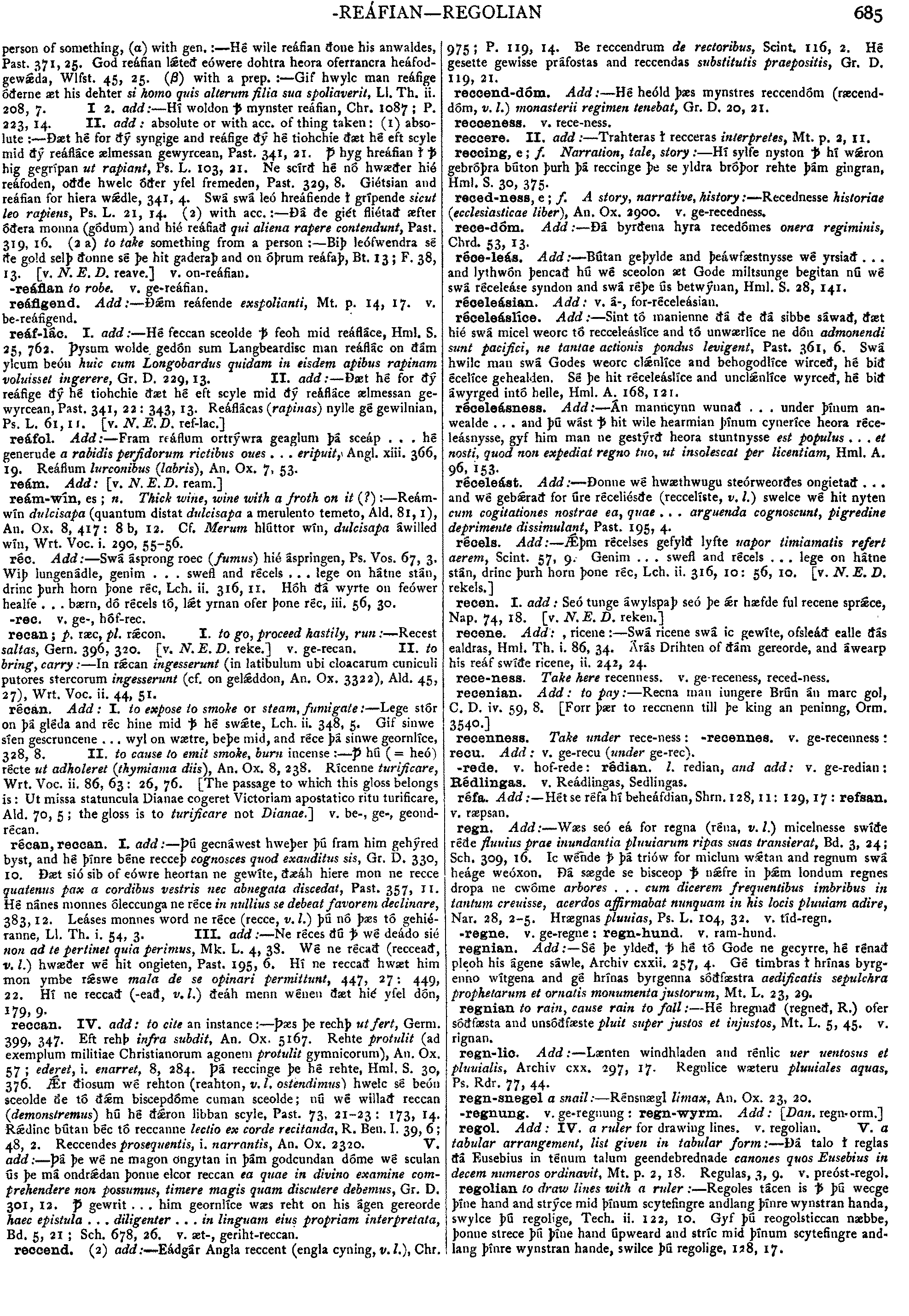
récan.
Add:
I.
to
expose
to
smoke
or
steam,
fumigate:
--
Lege
stór
on
þá
gléda
and
réc
hine
mid
 hé
swte,
Lch.
ii.
348,
5.
Gif
sinwe
síen
gescruncene
.
.
.
wyl
on
wætre,
beþe
mid,
and
réce
þá
sinwe
geornlíce,
328,
8.
II.
to
cause
to
emit
smoke,
burn
incense
:--
Þ-bar;
hú
(=
heó)
récte
ut
adholeret
(thymiama
diis),
An.
Ox.
8,
238.
Rícenne
turificare,
Wrt.
Voc.
ii.
86,
63:
26,
76.
[The
passage
to
which
this
gloss
belongs
is:
Ut
missa
statuncula
Dianae
cogeret
Victoriam
apostatico
ritu
turificare,
Ald.
70,
5;
the
gloss
is
to
turificare
not
Dianae.]
v.
be-,
ge-,
geond-récan.
hé
swte,
Lch.
ii.
348,
5.
Gif
sinwe
síen
gescruncene
.
.
.
wyl
on
wætre,
beþe
mid,
and
réce
þá
sinwe
geornlíce,
328,
8.
II.
to
cause
to
emit
smoke,
burn
incense
:--
Þ-bar;
hú
(=
heó)
récte
ut
adholeret
(thymiama
diis),
An.
Ox.
8,
238.
Rícenne
turificare,
Wrt.
Voc.
ii.
86,
63:
26,
76.
[The
passage
to
which
this
gloss
belongs
is:
Ut
missa
statuncula
Dianae
cogeret
Victoriam
apostatico
ritu
turificare,
Ald.
70,
5;
the
gloss
is
to
turificare
not
Dianae.]
v.
be-,
ge-,
geond-récan.
|
Source: Bright's OE Grammar, page b0328, entry 15 View original page image as: [TIFF] [PNG] [View previous entry] [View next entry] |
[Comment on this entry] [View comments] |
The following entry has been hand-corrected once. |
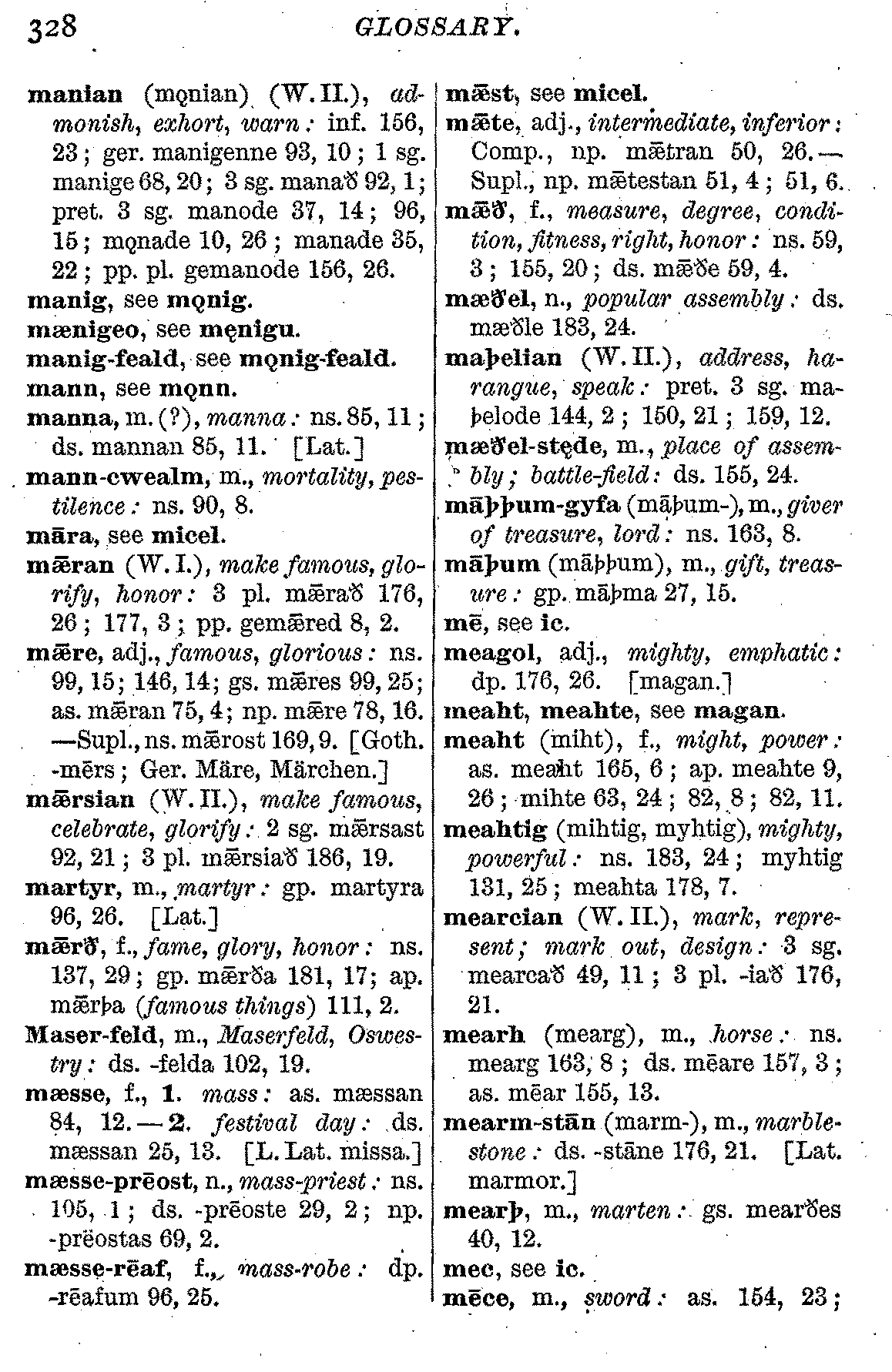
|
Source: Cleasby/Vigfusson, page b0009, entry 44 View original page image as: [TIFF] [PNG] [View previous entry] [View next entry] |
[Comment on this entry] [View comments] |
The following entry has been hand-corrected once. |
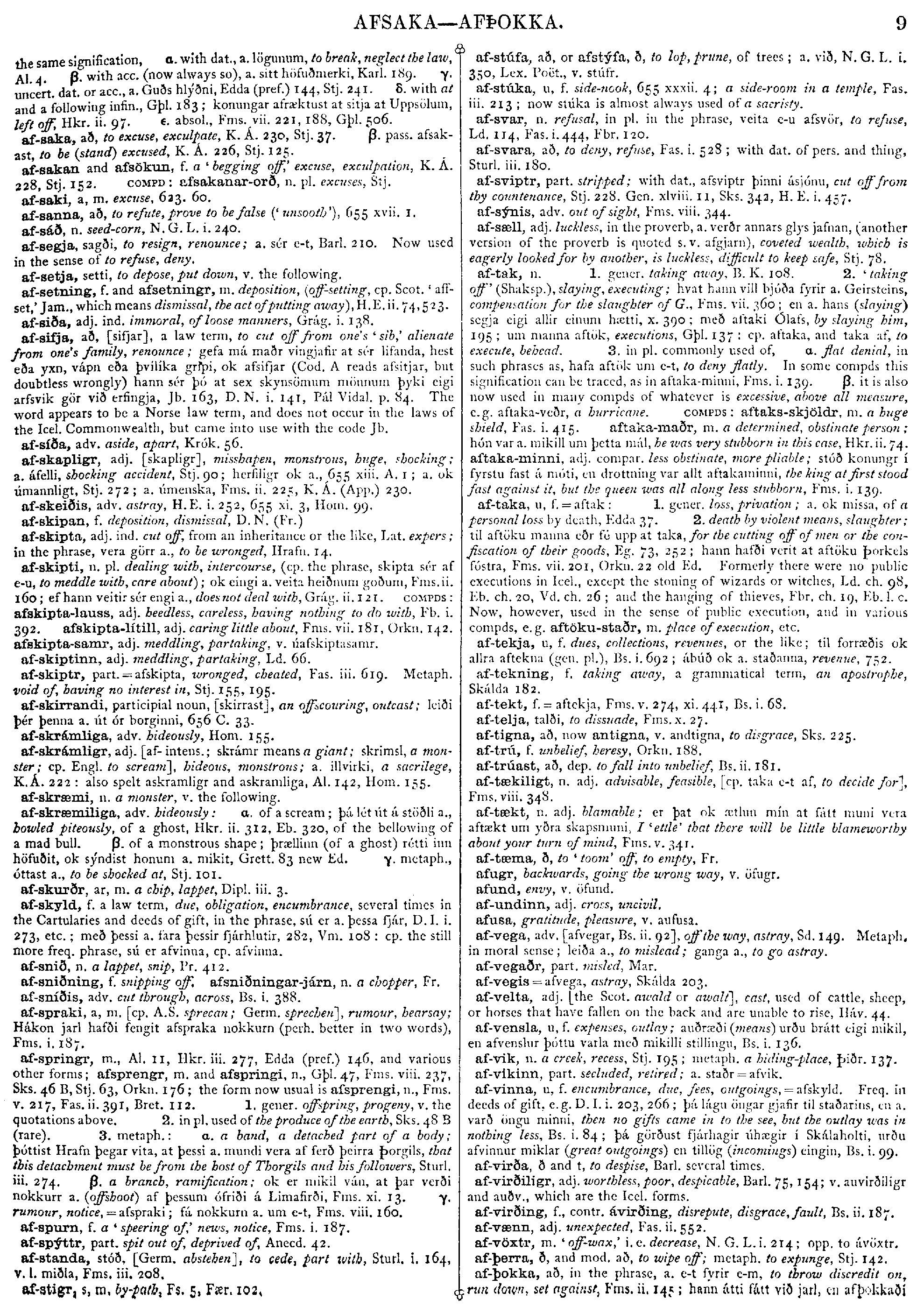
af-taka, n, f. = aftak: 1. gener. loss, privation; a. ok missa, of a personal loss by death, Edda 37. 2. death by violent means, slaughter; til aftöku manna eðr fú upp at taka, for the cutting off of men or the con- fiscation of their goods, Eg. 73, 252; hann hafði verit at aftöku þorkels fústra, Fms. vii. 201, Orkn. 22 old Ed. Formerly there were no public executions in Icel., except the stoning of wizards or witches, Ld. ch. 98, Eb. ch. 20, Vd. ch. 26; and the hanging of thieves, Fbr. ch. 19, Kb. l. c. Now, however, used in the sense of public execution, and in various compds, e. g. aftöku-staðr, m. place of execution, etc.
|
Source: Cleasby/Vigfusson, page b0114, entry 1 View original page image as: [TIFF] [PNG] [View previous entry] [View next entry] |
[Comment on this entry] [View comments] |
The following entry has not been hand-corrected. However, the page is reserved and someone is correcting it. |
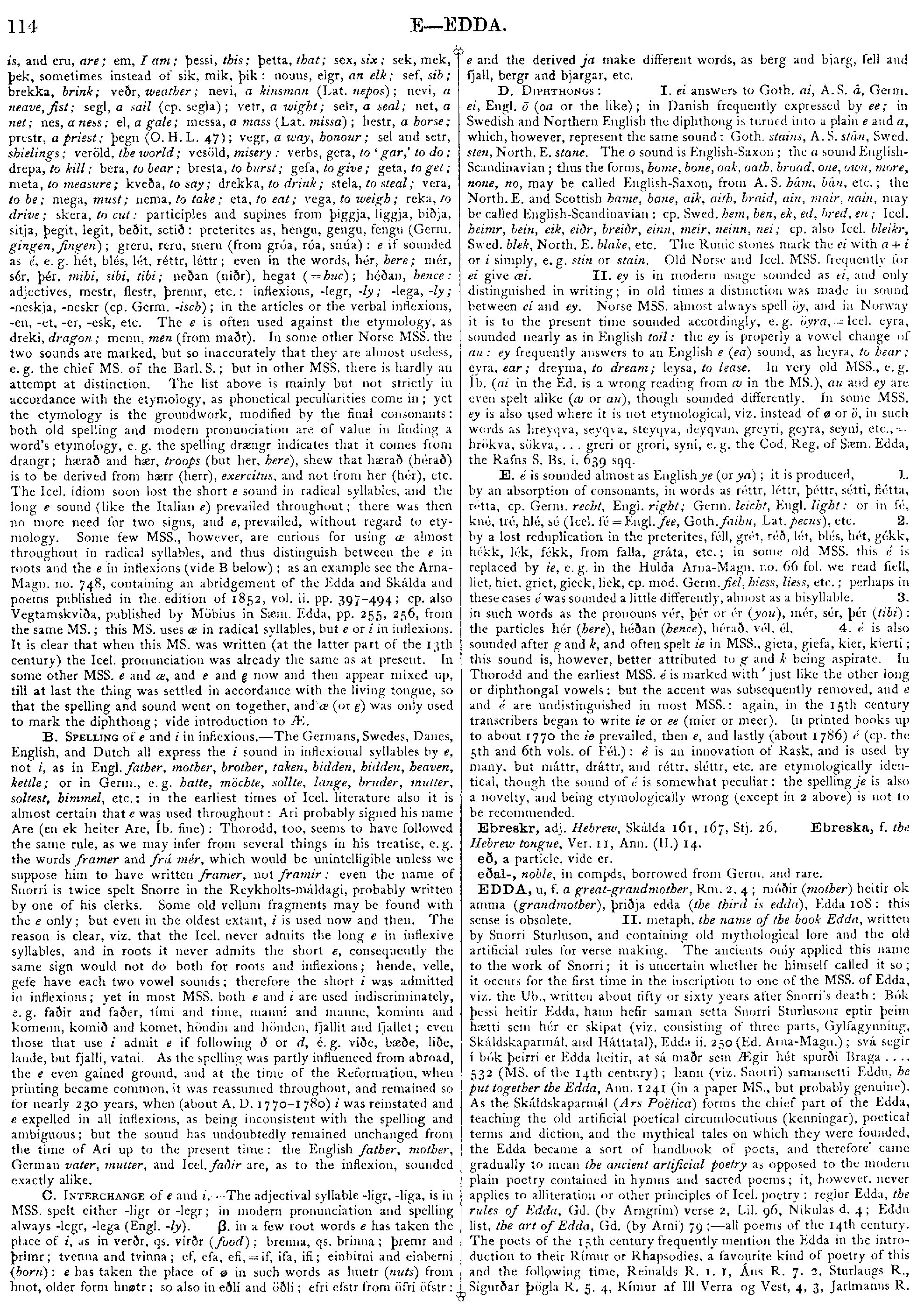
i s, and em, are; em, lam; þessi, thi s; þetta, that; sex, s i x: sek, mek, þek, sometimes instead of sik, mik, þik: nouns, elgr, an elk; sef, s ib; brekka, brink; veðr, weather; nevi, a kinsman (Lat. nepos); nevi, a neave, fist; segl, a sail (cp. segla); vetr, a wight; selr, a se a l; net, a net; nes, a ne ss; el, a gale; messa, a mass (Lat. missa); hestr, a horse; prtstr, a priest; þegn (O. H. L. 47); vegr, a way, honour; sel and setr, shielings; verold, the world; vesold, misery: verbs, gera, to ' gar, ' to do; drepa, to kill; bera, to bear; bresta, to burst; gefa, to give; geta, to get; meta, to measure; kveða, to say; drekka, to drink; stela, to steal; vera, to be; mega, must; nema, to take; eta, to e a t; vega, to weigh; reka, t o drive; skera, to cut: participles and supines from þiggja, liggja, biðja, sitja, þegit, legit, beðit, setið: preterites as, hengu, gengu, fengu (Germ. gingen, fingen); greru, reru, srxeru (from gróa, róa, snúa): e if sounded as é, e. g. hot, blés, let, réttr, léttr; even in the words, her, here; mér, scr, þér, mihi, sibi, tibi; neðan (niðr), hegat ( -- hue); héðan, hence: adjectives, mestr, flestr, þrennr, etc.: inflexions, -legr, - ly; -lega, - ly; -neskja, -neskr (cp. Germ, - i sc h); in the articles or the verbal inflexions, -en, -et, -er, -esk, etc. The e is often used against the etymology, as dreki, dragon; menu, men (from maðr). In some other Norse MSS. the two sounds are marked, but so inaccurately that they are almost useless, e. g. the chief MS. of the Bad. S.; but in other MSS. there is hardly an attempt at distinction. The list above is mainly but not strictly in accordance with the etymology, as phonetical peculiarities come in; yet the etymology is the groundwork, modified by the final consonants: both old spelling and modern pronunciation are of value in finding a word's etymology, e. g. the spelling drsengr indicates that it comes from drangr; hærað and haer, troops (but her, here), shew that hærað (hérað) is to be derived from hærr (herr), exercitus, and not from her (her), etc. The Icel. idiom soon lost the short e sound in radical syllables, and the long e sound (like the Italian e) prevailed throughout; there was then no more need for two signs, and e, prevailed, without regard to ety- mology. Some few MSS., however, are curious for using æ almost throughout in radical syllables, and thus distinguish between the e in roots and the e in inflexions (vide B below); as an example see the Arna- Magn. no. 748, containing an abridgement of the Edda and Skálda and poems published in the edition of 1852, vol. ii. pp. 397-494; cp. also Vegtamskviða, published by Mubius in Sæm. Edda, pp. 255, 256, from the same MS.; this MS. uses æ in radical syllables, but e or i in inflexions. It is clear that when this MS. was written (at the latter part of the i^th century) the Icel. pronunciation was already the same as at present. In some other MSS. e and ce, and e and g now and then appear mixed up, till at last the thing was settled in accordance with the living tongue, so that the spelling and sound went on together, and CE (or g) was only used to mark the diphthong; vide introduction to Æ. B. SPELLING of e and i in inflexions. -- The Germans, Swedes, Danes, English, and Dutch all express the i sound in inflexional syllables by e, not i, as in Engl. y a í her, mother, brother, taken, bidden, hidden, heaven, kettle; or in Germ., e. g. hatte, möchte, sollte, lange, bruder, mutter, soltesf, himmel, etc.: in the earliest times of Icel. literature also it is almost certain that e was used throughout: Ari probably signed his name Are (en ek heitcr Are, tb. fine): Thorodd, too, seems to have followed the same rule, as we may infer from several things in his treatise, e. g. the words framer and frá mér, which would be unintelligible unless we suppose him to have written framer, not framir: even the name of Snorri is twice spelt Snorre in the Reykholts-máldagi, probably written by one of his clerks. Some old vellum fragments may be found with the e only; but even in the oldest extant, i is used now and then. The reason is clear, viz. that the Icel. never admits the long e in inflexive syllables, and in roots it never admits the short e, consequently the same sign would not do both for roots and inflexions; hende, velle, gefe have each two vowel sounds; therefore the short i was admitted in inflexions; yet in most MSS. both e and i are used indiscriminately, a. g. faðir and faðer, tími and time, manni and manne, kominn and komenn, komið and komet, hihidin and hundcn, fjallit and fjallet; even those that use i admit e if following ð or d, é. g. viðe, bæðe, liðe, lande, but fjalli, vatni. As the spelling was partly influenced from abroad, the e even gained ground, and at the time of the Reformation, when printing became common, it was rcassmned throughout, and remained so for nearly 230 years, when (about A. D. 1770-1/80) i was reinstated and e expelled in all inflexions, as being inconsistent with the spelling and ambiguous; but the sound has undoubtedly remained unchanged from the time of Ari up to the present time: the English father, mother, German vater, mutter, and lcd. fadir are, as to the inflexion, sounded exactly alike. C. INTERCHANGE of e and i. -- The adjectival syllable -ligr, -liga, is in MSS. spelt either -ligr or -legr; in modern pronunciation and spelling always -legr, -lega (Engl. -ly). |3. in a few root words e has taken the place of i, as in verðr, qs. virðr (food); brenna, qs. brinna; þremr and þrimr; tvenna and tvinna; ef, efa, efi, = if, ifa, ifi; einbirni and einberni (horn): e has taken the place of a in such words as hnetr (nuts) from hnot, older form hnøtr: so also in eðli and öðli; efri efstr from öfri öfstr: e and the derived ja make different words, as berg and bjarg, fell and fjall, bergr and bjargar, etc. D. DIPHTHONGS: I. ei answers to Goth, ai, A. S. â, Germ. ei, Engl. a (oa or the like); in Danish frequently expressed by ee; in Swedish and Northern English the diphthong is turned into a plain e and a, which, however, represent the same sound: Goth, stains, A. S. stan, Swed. sten, North. E. s to ne. The o sound is English-Saxon; the a sound English- Scandinavian; thus the forms, home, bone, oak, oath, broad, one, own, more, none, no, may be called English-Saxon, from A. S. ham, ban, etc.; the North. E. and Scottish harne, bane, aik, ai/h, braid, ain, mair, /tain, may be called English-Scandinavian: cp. Swed. hem, ben, ek, ed. bred, en; Icel. heimr, bein, eik, eidr, breidr, einn, meir, neinn, nei; cp. also Icel. bleikr, Swed. blek, North. E. blake, etc. The Runic stones mark the ei with a + i or i simply, e. g. sti w or s tain. Old Norse and Icel. MSS. frequently for ei give Æ i. II. ey is in modern usage sounded as ei, and only distinguished in writing; in old times a distinction was made in sound between ei and ey. Norse MSS. almost always spell 'ôy, and in Norway it is to the present time sounded accordingly, e. g. iiyra, -- Icel. eyra, sounded nearly as in English toil: the ey is properly a vowel change of au: ey frequently answers to an English e (ea) sound, as heyra, to hear; eyra, e ar; dreyma, to dream; leysa, to lease. In very old MSS., e. g. Ib. (ai in the Ed. is a wrong reading from aj in the MS.), au and ey are even spelt alike (aj or a;^), though sounded differently. In some MSS. ey is also used where it is not etymological, viz. instead of ø or o, in such words as hreyqva, seyqva, stcyqva, deyqvan, greyri, geyra, seyni, etc., = hrökva, sökva, ... greri or grori, syni, e. g. the Cod. Reg. of S;em. Edda, the Rafns S. Bs. i. 639 E. é is sounded almost as English y e (or y a); it is produced, 1. by an absorption of consonants, in words as réttr, léttr, þéttr, sétti, flétta, n'-tta, cp. Germ, recht, Engl. right; Germ. Icicht, Engl. light: or in fo, kno, tré, hit:, sc (Icel. fe = Engl. / ee, Goth. / aih w, Lat. pe cws), etc. 2. by a lost reduplication in the preterites, fell, grot, réð, h-t, blús, hot, gékk, hékk, Ick, fékk, from falla, grata, etc.; in some old MSS. this é is replaced by ie, e. g. in the Hulda Arna-Magn. no. 66 fol. we read fiell, liet, hiet, griet, gieck, liek, cp. mod. Geim. fíel. hiess, Hess, etc.; perhaps in these cases e was sounded a little differently, almost as a bisyllable. 3. in such words as the pronouns vt'-r, þér or ér (you), niér, sér, þér (tibi): the particles her (here), héðan (hence), hérað, vi'-l, el. 4. t' is also sounded after g and k, and often spelt ie in MSS., gieta, giefa, kier, kierti; this sound is, however, better attributed to g and k being aspirate. In Thorodd and the earliest MSS. é is marked with ' just like the other long or diphthongal vowels; but the accent was subsequently removed, and e and é are undistinguished in most MSS.: again, in the 15th century transcribers began to write ie or ee (mier or meer). In printed books up to about 1770 the ie- prevailed, then e, and lastly (about 1786) (; (cp. the 5th and 6th vols. of Eél.): ë is an innovation of Rask, and is used by many, but máttr, dráttr, and rettr, sléttr, etc. are etymologically iden- tical, though the sound of K is somewhat peculiar: the spelling~/e is also a novelty, and being etymologically wrong (except in 2 above) is not to be recommended.
|
Source: Cleasby/Vigfusson, page b0222, entry 11 View original page image as: [TIFF] [PNG] [View previous entry] [View next entry] |
[Comment on this entry] [View comments] |
The following entry has been hand-corrected once. |
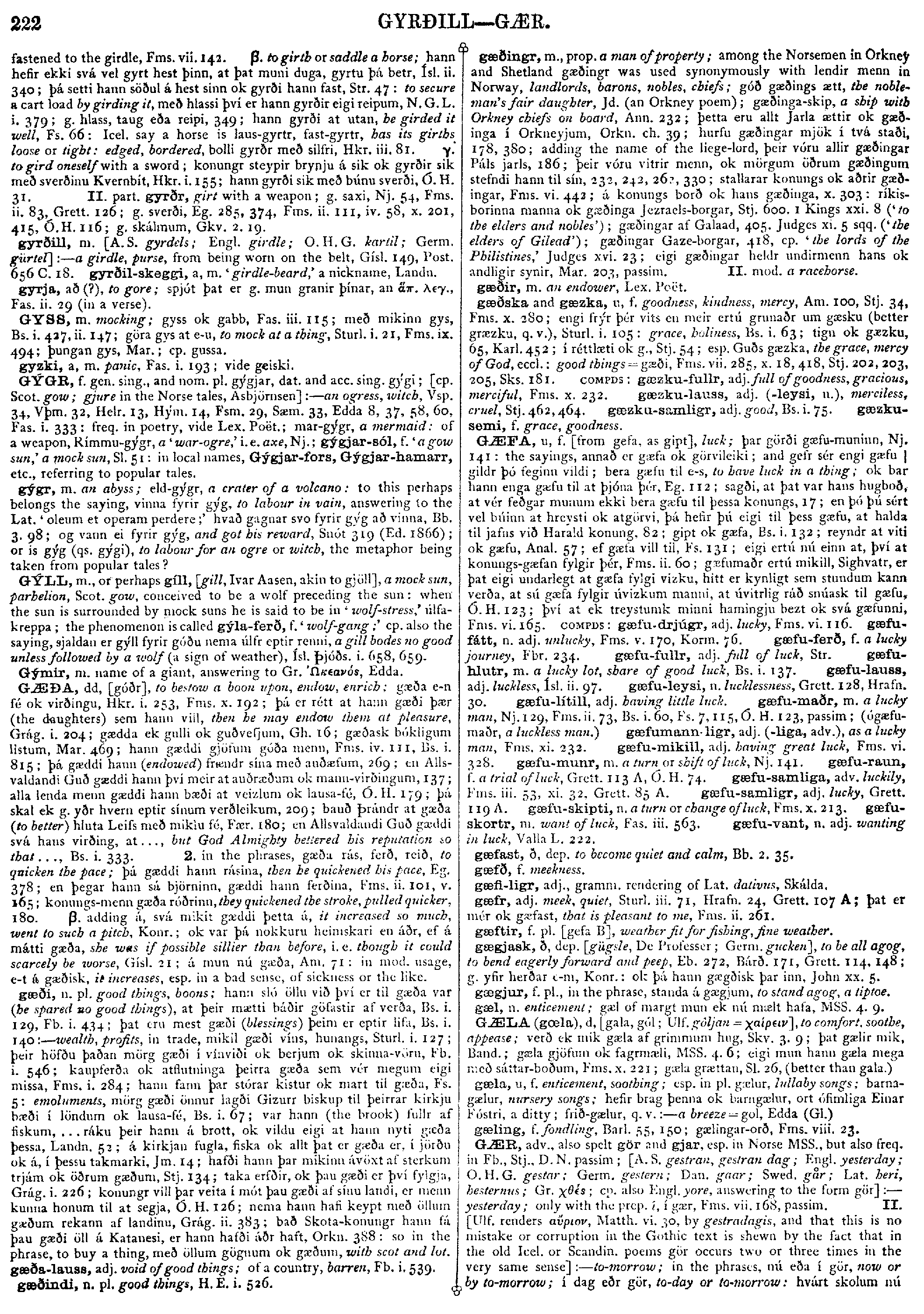
gæði, n. pl. good things, boons; hann sló öllu við því er til gæða var (he spared no good things), at þeir mætti báðir göfastir af verða, Bs. i. 129, Fb. i. 434; þat eru mest gæði (blessings) þeim er eptir lifa, Bs. i. 140 :-- wealth, profits, in trade, mikil gæði víns, hunangs, Sturl. i. 127; þeir höfðu þaðan mörg gæði í vínviði ok berjum ok skinna-vöru, Fb. i. 546; kaupferða ok atflutninga þeirra gæða sem vér megum eigi missa, Fms. i. 284; hann fann þar stórar kistur ok mart til gæða, Fs. 5: emoluments, mörg gæði önnur lagði Gizurr biskup til þeirrar kirkju bæði í löndum ok lausa-fé, Bs. i. 67; var hann (the brook) fullr af fiskum, ... ráku þeir hann á brott, ok vildu eigi at hann nyti gæða þessa, Landn. 52; á kirkjan fugla, fiska ok allt þat er gæða er, í jörðu ok á, í þessu takmarki, Jm. 14; hafði hann þar mikinn ávöxt af sterkum trjám ok öðrum gæðum, Stj. 134; taka erfðir, ok þau gæði er því fylgja, Grág. i. 226; konungr vill þar veita í mót þau gæði af sínu landi, er menn kunna honum til at segja, Ó. H. 126; nema hann hafi keypt með öllum gæðum rekann af landinu, Grág. ii. 383; bað Skota-konungr hann fá þau gæði öll á Katanesi, er hann hafði áðr haft, Orkn. 388: so in the phrase, to buy a thing, með öllum gögnum ok gæðum, with scot and lot. gæða-lauss, adj. void of good things; of a country, barren, Fb. i. 539.
|
Source: Cleasby/Vigfusson, page b0244, entry 56 View original page image as: [TIFF] [PNG] [View previous entry] [View next entry] |
[Comment on this entry] [View comments] |
The following entry has been hand-corrected once. |
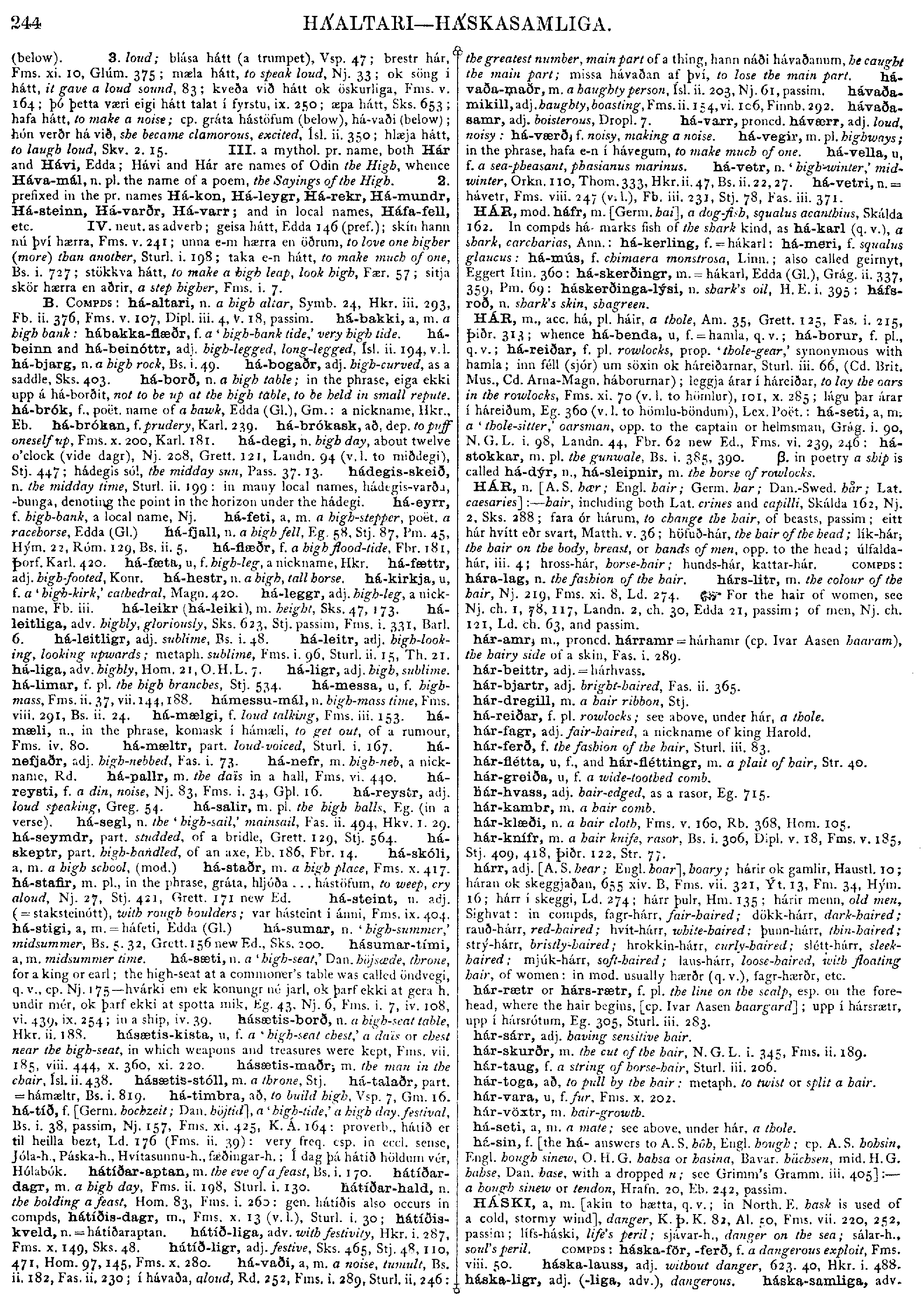
ii. 182, Fas. ii, 230; í hávaða, aloud, Rd. 252, Fms. i. 289, Sturl. ii. 246: the greatest number, main part of a thing, hann náði hávaðanum, he caught the main part; missa hávaðan af því, to lose the main part. há- vaða-maðr, m. a haughty person, Ísl. ii. 203, Nj. 61, passim. hávaða- mikill, adj. haughty, boasting, Fms. ii. 154, vi. 106, Finnb. 292. hávaða- samr, adj. boisterous, Dropl. 7. há-varr, proncd. háværr, adj. loud, noisy: há-værðj f. noisy, making a noise. há-vegir, m. pl. highways; in the phrase, hafa e-n í hávegum, to make much of one. há-vella, u,
|
Source: Cleasby/Vigfusson, page b0250, entry 33 View original page image as: [TIFF] [PNG] [View previous entry] [View next entry] |
[Comment on this entry] [View comments] |
The following entry has been hand-corrected once. |
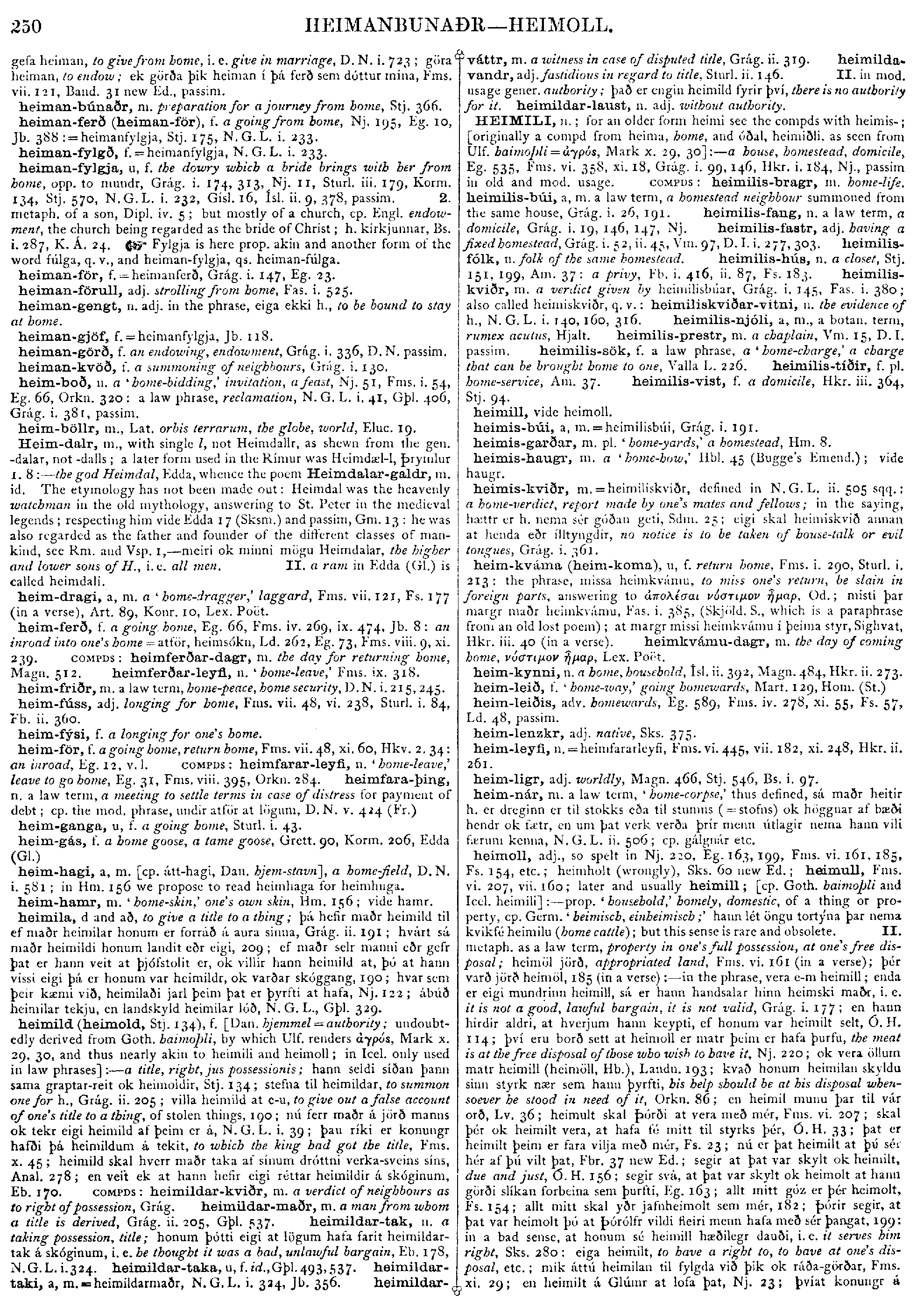
heim-kváma (heim-koma), u, f. return home, Fms. i. 290, Sturl. i. 213: the phrase, missa heimkvámu, to miss one's return, be slain in foreign parts, answering to GREEK, Od.; misti þar margr maðr heimkvámu, Fas. i. 385, (Skjöld. S., which is a paraphrase from an old lost poem); at margr missi heimkvámu í þeima styr, Sighvat, Hkr. iii. 40 (in a verse). heimkvámu-dagr, m. the day of coming home, GREEK, Lex. Poët.
| Result Page: |  |
Previous | 1 2 3 4 | Next |  |
Germanic Lexicon Project (main page)
This search system was written by
Sean Crist
Please consider
volunteering
to correct the data in these online dictionaries.
No rights reserved. Feel free to use these data in any way you please.