|
|

|
Source: Bosworth/Toller, page d0635, entry 36 View original page image as: [TIFF] [PNG] [View previous entry] [View next entry] |
[Comment on this entry] [View comments] |
The following entry has been hand-corrected once. |
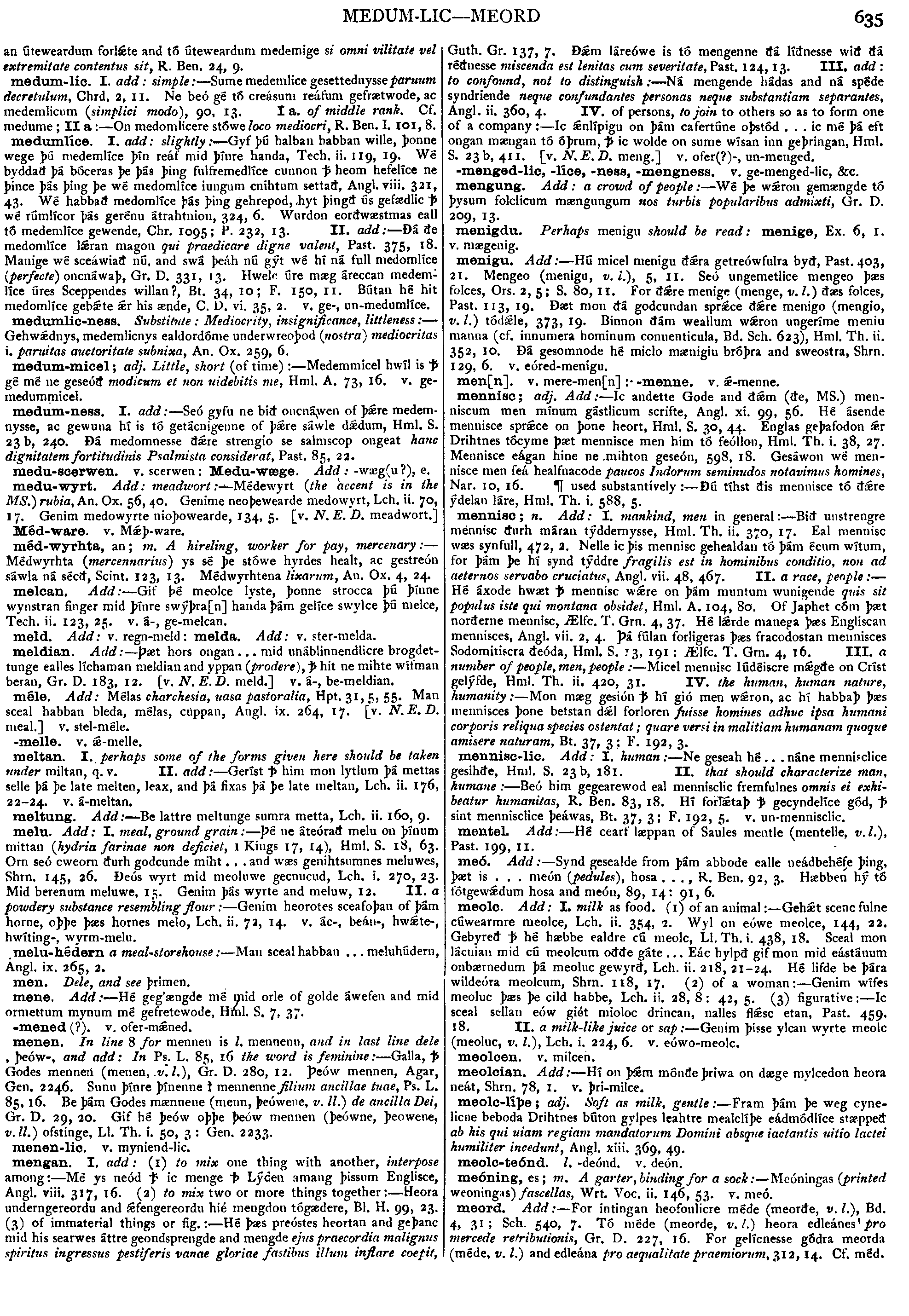
meolc.
Add:
I.
milk
as
food,
(1)
of
an
animal
:--
Geh t
scene
fulne
cúwearmre
meolce,
Lch.
ii.
354,
2.
Wyl
on
eówe
meolce,
144,
22,
Gebyreð
t
scene
fulne
cúwearmre
meolce,
Lch.
ii.
354,
2.
Wyl
on
eówe
meolce,
144,
22,
Gebyreð
 hé
hæbbe
ealdre
cú
meolc,
Ll.
Th.
i.
438,
18.
Sceal
mon
lácnian
mid
cú
meolcum
oððe
gáte
.
.
.
Eác
hylpð
gif
mon
mid
eástánum
onbærnedum
þá
meoluc
gewyrð,
Lch.
ii.
218,
21-24.
Hé
lifde
be
þára
wildeóra
meolcum,
Shrn.
118,
17.
(2)
of
a
woman
:--
Genim
wífes
meoluc
þæs
þe
cild
habbe,
Lch.
ii.
28,
8:
42,
5.
(3)
figurative
:--
Ic
sceal
sellan
eów
giét
mioloc
drincan,
nalles
flsc
etan.
Past.
459,
18.
II.
a
milk-like
juice
or
sap
:--
Genim
þisse
ylcan
wyrte
meolc
(meoluc,
v.
l.),
Lch.
i.
224,
6.
v.
eówo-meolc.
hé
hæbbe
ealdre
cú
meolc,
Ll.
Th.
i.
438,
18.
Sceal
mon
lácnian
mid
cú
meolcum
oððe
gáte
.
.
.
Eác
hylpð
gif
mon
mid
eástánum
onbærnedum
þá
meoluc
gewyrð,
Lch.
ii.
218,
21-24.
Hé
lifde
be
þára
wildeóra
meolcum,
Shrn.
118,
17.
(2)
of
a
woman
:--
Genim
wífes
meoluc
þæs
þe
cild
habbe,
Lch.
ii.
28,
8:
42,
5.
(3)
figurative
:--
Ic
sceal
sellan
eów
giét
mioloc
drincan,
nalles
flsc
etan.
Past.
459,
18.
II.
a
milk-like
juice
or
sap
:--
Genim
þisse
ylcan
wyrte
meolc
(meoluc,
v.
l.),
Lch.
i.
224,
6.
v.
eówo-meolc.
|
Source: Bosworth/Toller, page d0635, entry 39 View original page image as: [TIFF] [PNG] [View previous entry] [View next entry] |
[Comment on this entry] [View comments] |
The following entry has been hand-corrected once. |
meolc-líþe; adj. Soft as milk, gentle :-- Fram þám þe weg cynelicne beboda Drihtnes búton gylpes leahtre mealclíþe eádmódlíce stæppeð ab his qui uiam regiam mandatorum Domini absque iactantis uitio lactei humiliter incedunt, Angl. xiii. 369, 49.
|
Source: Bright's OE Grammar, page b0329, entry 16 View original page image as: [TIFF] [PNG] [View previous entry] [View next entry] |
[Comment on this entry] [View comments] |
The following entry has been hand-corrected once. |
|
Source: Cleasby/Vigfusson, page b0012, entry 56 View original page image as: [TIFF] [PNG] [View previous entry] [View next entry] |
[Comment on this entry] [View comments] |
The following entry has been hand-corrected once. |
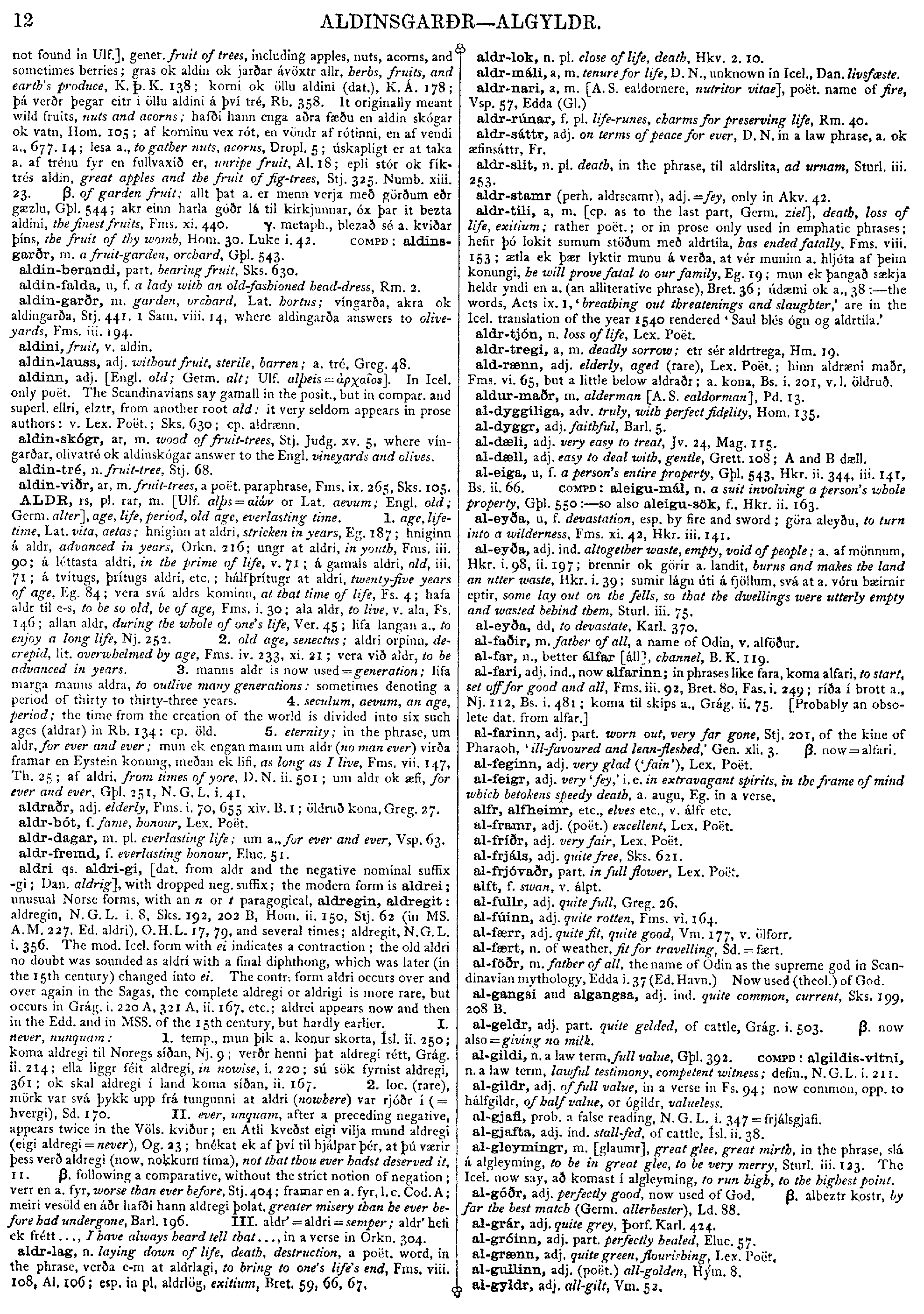
al-geldr,
adj.
part,
ow
ite
gelded,
of
cattle,
Grág.
i.
503.
 .
now
also=
giving
no
milk.
.
now
also=
giving
no
milk.
|
Source: Cleasby/Vigfusson, page b0040, entry 13 View original page image as: [TIFF] [PNG] [View previous entry] [View next entry] |
[Comment on this entry] [View comments] |
The following entry has not been hand-corrected. However, the page is reserved and someone is correcting it. |
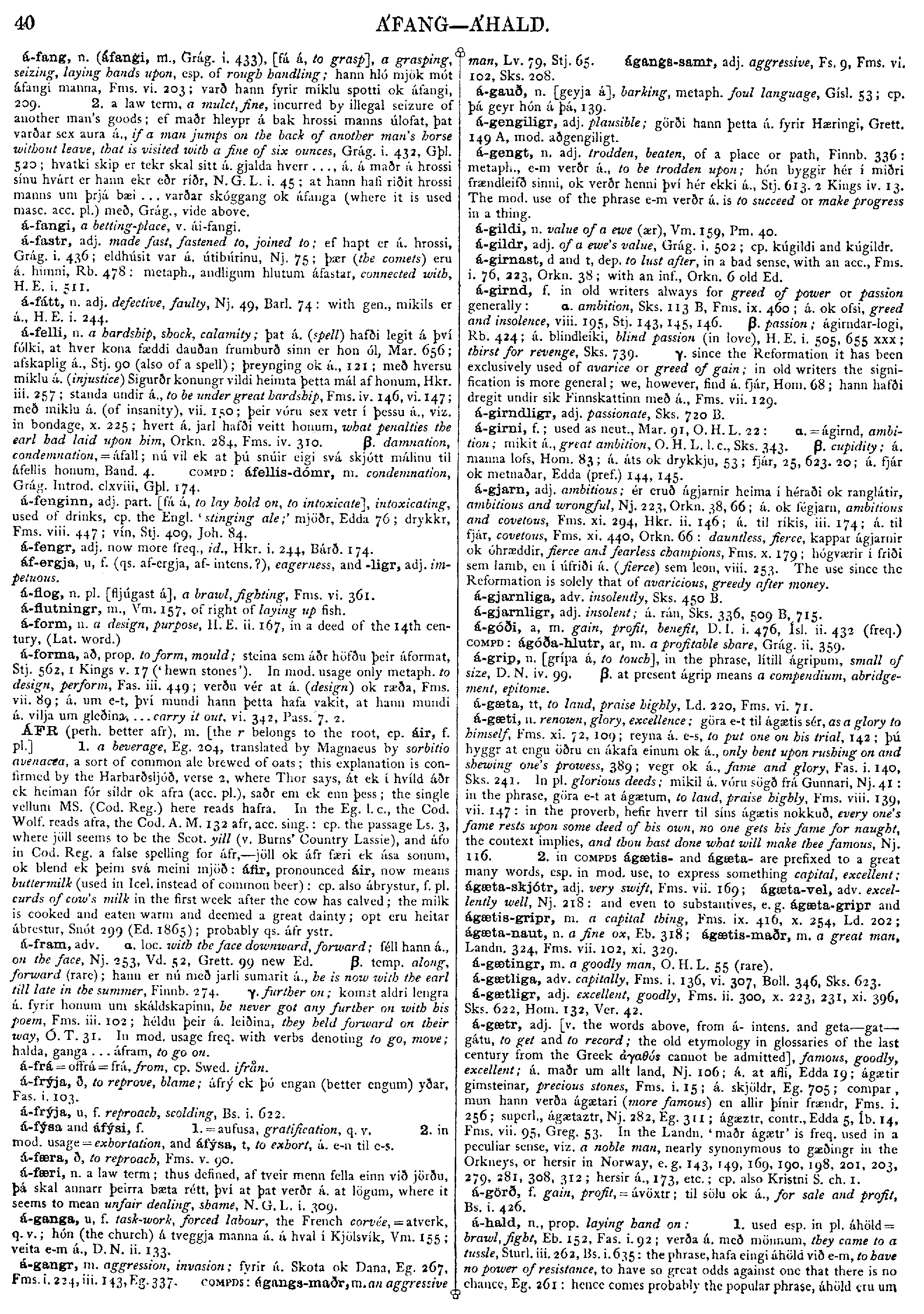
ÁFR (peril, better afr), m. [the r belongs to the root, cp. air, f. pl.] 1. a beverage, Eg. 204, translated by Magnaeus by sorbitio avenacea, a sort of common ale brewed of oats; this explanation is con- firmed by the Harbarðsljóð, verse 2, where Thor says, át ek í hvíld áðr ek heiman for sildr ok afra (acc. pl.), saðr em ek enn þess; the single vellum MS. (Cod. Reg.) here reads hafra. In the Eg. 1. c., the Cod. Wolf, reads afra, the Cod. A. M. 132 afr, acc. sing.: cp. the passage Ls. 3, where jöll seems to be the Scot, yill (v. Burns' Country Lassie), and úfo in Cod. Reg. a false spelling for áfr, -- jöll ok áfr færi tk ása sonum, ok blend ek þeini svá meini mjöð: áftr, pronounced áir, now means buttermilk (used in Icel. instead of common beer): cp. also ábrystur, f. pl. curds of cow's milk in the first week after the cow has calved; the milk is cooked and eaten warm and deemed a great dainty; opt eru heitar úbrcstur, Snot 299 (Ed. 1865); probably qs. áfr ystr.
|
Source: Cleasby/Vigfusson, page b0041, entry 127 View original page image as: [TIFF] [PNG] [View previous entry] [View next entry] |
[Comment on this entry] [View comments] |
The following entry has been hand-corrected once. |
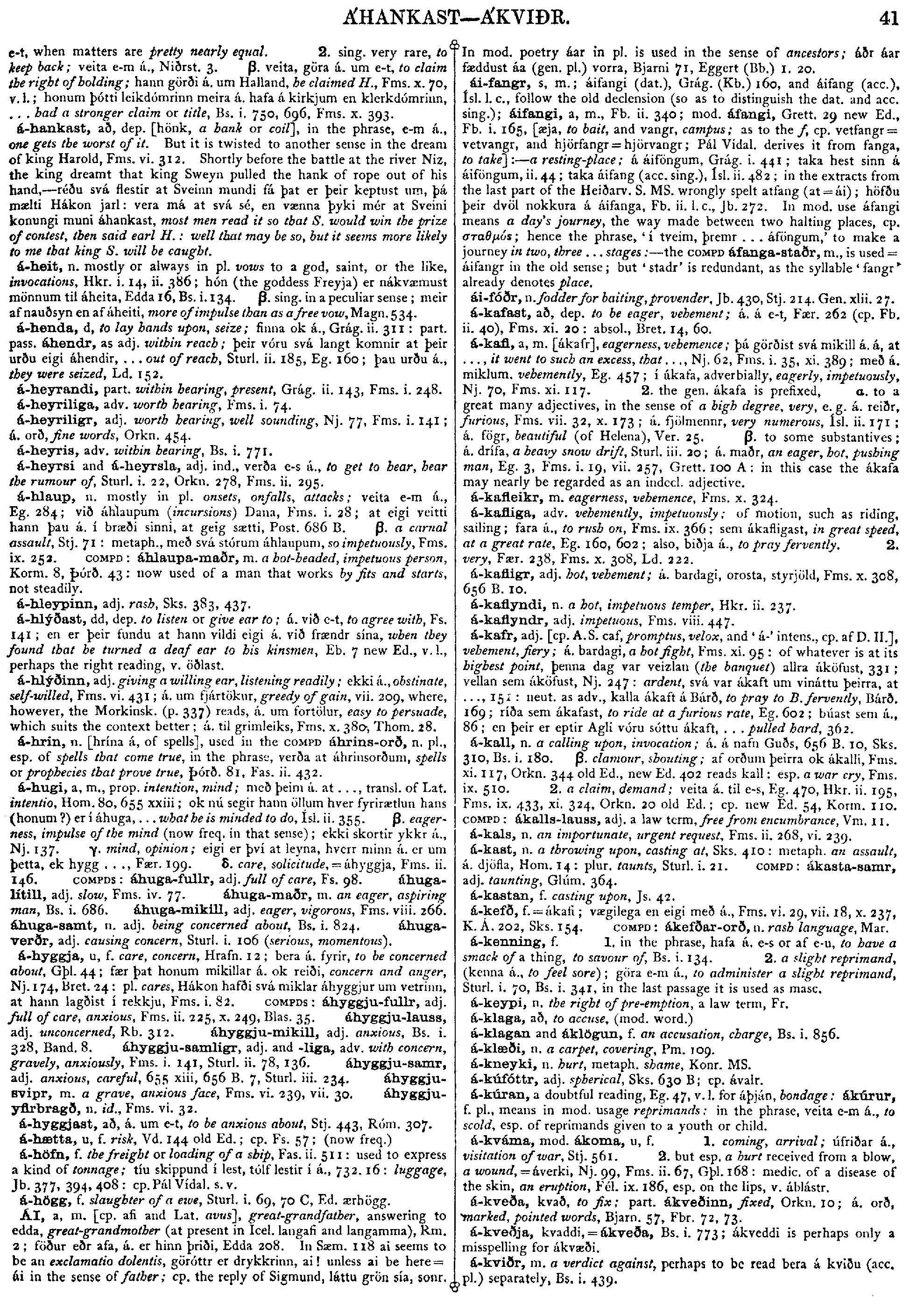
á-nyt, f. ewe's milk, = ærnyt, Landn. 197.
|
Source: Cleasby/Vigfusson, page b0064, entry 25 View original page image as: [TIFF] [PNG] [View previous entry] [View next entry] |
[Comment on this entry] [View comments] |
The following entry has been hand-corrected once. |
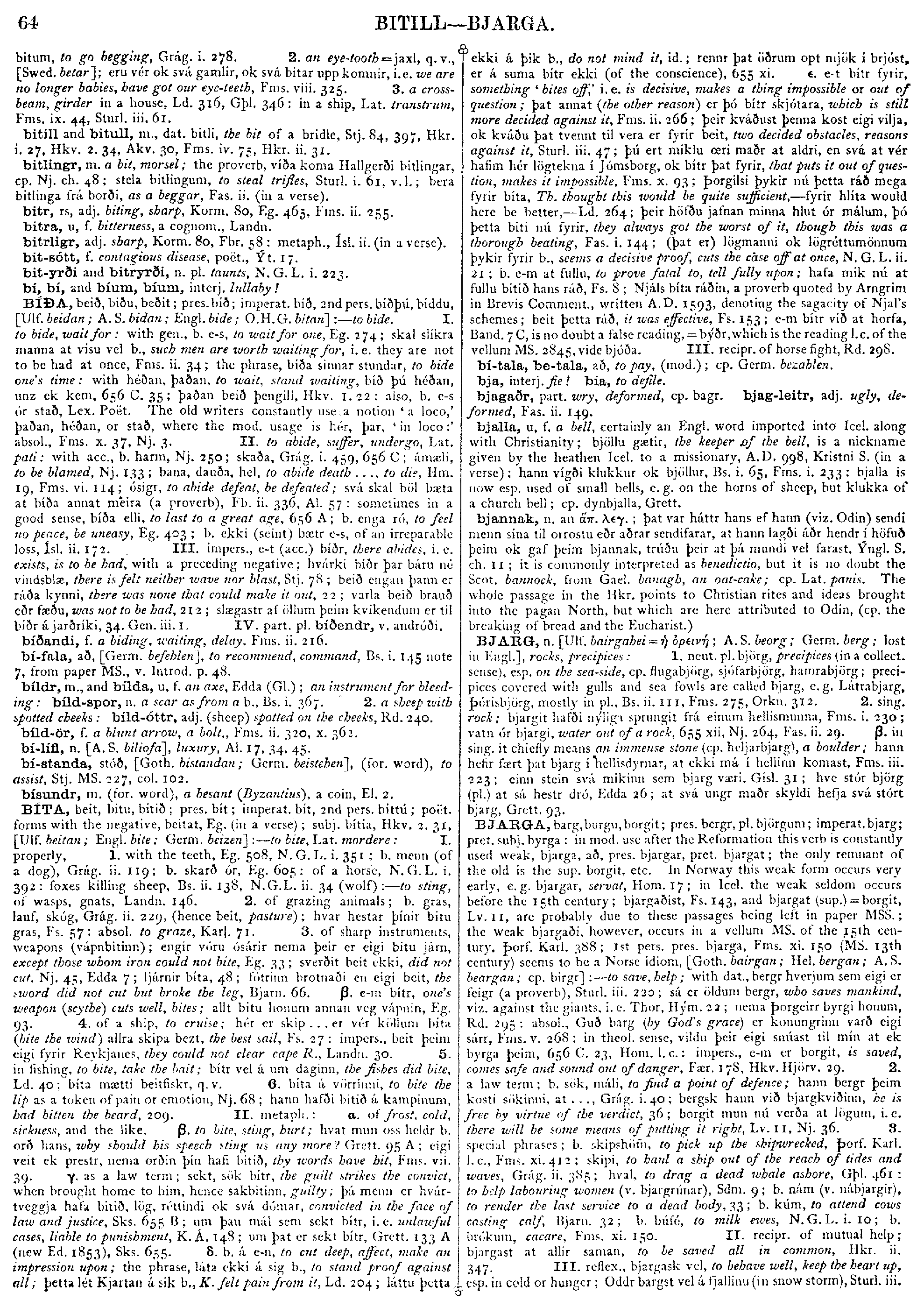
BJARGA, barg, burgu, borgit; pres. bergr, pl. björgum; imperat. bjarg; pret. subj. byrga: in mod. use after the Reformation this verb is constantly used weak, bjarga, að, pres. bjargar, pret. bjargat; the only remnant of the old is the sup. borgit, etc. In Norway this weak form occurs very early, e.g. bjargar, servat, Hom. 17; in Icel. the weak seldom occurs before the 15th century; bjargaðist, Fs. 143, and bjargat (sup.) = borgit, Lv. 11, are probably due to these passages being left in paper MSS.; the weak bjargaði, however, occurs in a vellum MS. of the 15th century, Þorf. Karl. 388; 1st pers. pres. bjarga, Fms. xi. 150 (MS. 13th century) seems to be a Norse idiom, [Goth. bairgan; Hel. bergan; A. S. beargan; cp. birgr] :-- to save, help; with dat., bergr hverjum sem eigi er feigr (a proverb), Sturl. iii. 220; sá er öldum bergr, who saves mankind, viz. against the giants, i.e. Thor, Hým. 22; nema Þorgeirr byrgi honum, Rd. 295: absol., Guð barg (by God's grace) er konungrinn varð eigi sárr, Fms. v. 268: in theol. sense, vildu þeir eigi snúast til mín at ek byrga þeim, 656 C. 23, Hom. l.c.: impers., e-m er borgit, is saved, comes safe and sound out of danger, Fær. 178, Hkv. Hjörv. 29. 2. a law term; b. sök, máli, to find a point of defence; hann bergr þeim kosti sökinni, at ..., Grág. i. 40; bergsk hann við bjargkviðinn, he is free by virtue of the verdict, 36; borgit mun nú verða at lögum, i.e. there will be some means of putting it right, Lv. 11, Nj. 36. 3. special phrases; b. skipshöfn, to pick up the shipwrecked, Þorf. Karl. l.c., Fms. xi. 412; skipi, to haul a ship out of the reach of tides and waves, Grág. ii. 385; hval, to drag a dead whale ashore, Gþl. 461: to help labouring women (v. bjargrúnar), Sdm. 9; b. nám (v. nábjargir), to render the last service to a dead body, 33; b. kúm, to attend cows casting calf, Bjarn. 32; b. búfé, to milk ewes, N. G. L. i. 10; b. brókum, cacare, Fms. xi. 150. II. recipr. of mutual help; bjargast at allir saman, to be saved all in common, Hkr. ii. 347. III. reflex., bjargask vel, to behave well, keep the heart up, esp. in cold or hunger; Oddr bargst vel á fjallinu (in snow storm), Sturl. iii.
|
Source: Cleasby/Vigfusson, page b0078, entry 3 View original page image as: [TIFF] [PNG] [View previous entry] [View next entry] |
[Comment on this entry] [View comments] |
The following entry has been hand-corrected once. |
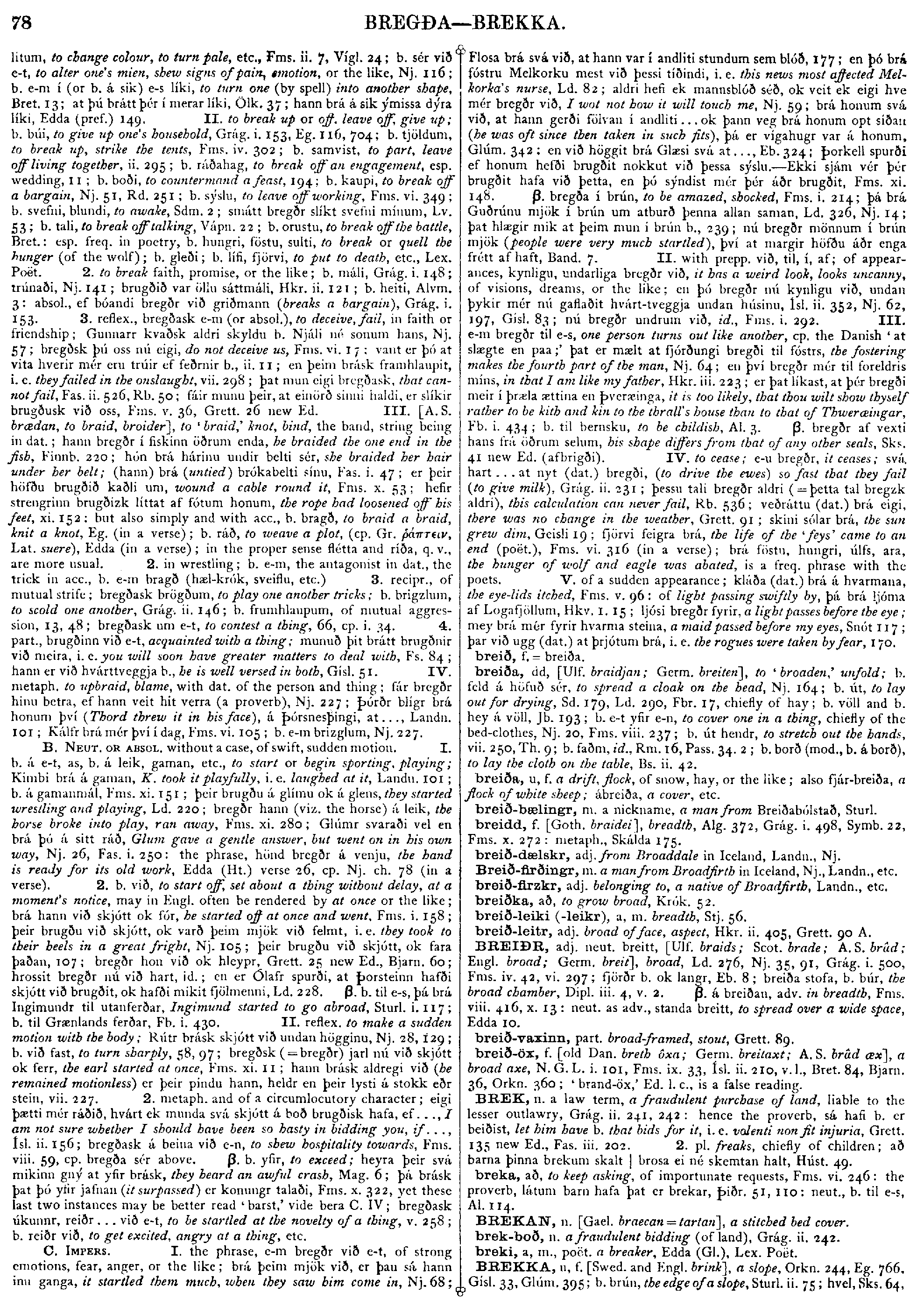
C.
IMPERS.
I.
the
phrase,
e-m
bregðr
við
e-t,
of
strong
emotions,
fear,
anger,
or
the
like;
brá
þeim
mjök
við,
er
þau
sá
hann
inn
ganga,
it
startled
them
much,
when
they
saw
him
come
in,
Nj.
68;
Flosa
brá
svá
við,
at
hann
var
í
andliti
stundum
sem
blóð,
177;
en
þó
brá
fóstru
Melkorku
mest
við
þessi
tíðindi,
i.e.
this
news
most
affected
Melkorka's
nurse,
Ld.
82;
aldri
hefi
ek
mannsblóð
séð,
ok
veit
ek
eigi
hve
mér
bregðr
við,
I
wot
not
how
it
will
touch
me,
Nj.
59;
brá
honum
svá
við,
at
hann
gerði
fölvan
í
andliti
...
ok
þann
veg
brá
honum
opt
síðan
(he
was
oft
since
then
taken
in
such
fits),
þá
er
vígahugr
var
á
honum,
Glúm.
342;
en
við
höggit
brá
Glæsi
svá
at
...,
Eb.
324;
Þorkell
spurði
ef
honum
hefði
brugðit
nokkut
við
þessa
sýslu.--Ekki
sjám
vér
þér
brugðit
hafa
við
þetta,
en
þó
sýndist
mér
þér
áðr
brugðit,
Fms.
xi.
148.
.
bregða
í
brún,
to
be
amazed,
shocked,
Fms.
i.
214;
þá
brá
Guðrúnu
mjök
í
brún
um
atburð
þenna
allan
saman,
Ld.
326,
Nj.
14;
þat
hlægir
mik
at
þeim
mun
í
brún
b.,
239;
nú
bregðr
mönnum
í
brún
mjök
(people
were
very
much
startled),
því
at
margir
höfðu
áðr
enga
frétt
af
haft,
Band.
7.
II.
with
prepp.
við,
til,
í,
af;
of
appearances,
kynligu,
undarliga
bregðr
við,
it
has
a
weird
look,
looks
uncanny,
of
visions,
dreams,
or
the
like;
en
þó
bregðr
nú
kynligu
við,
undan
þykir
mér
nú
gaflaðit
hvárt-tveggja
undan
húsinu,
Ísl.
ii.
352,
Nj.
62,
197,
Gísl.
83;
nú
bregðr
undrum
við,
id.,
Fms.
i.
292.
III.
e-m
bregðr
til
e-s,
one
person
turns
out
like
another,
cp.
the
Danish
'at
slægte
en
paa;'
þat
er
mælt
at
fjórðungi
bregði
til
fóstrs,
the
fostering
makes
the
fourth
part
of
the
man,
Nj.
64;
en
því
bregðr
mér
til
foreldris
míns,
in
that
I
am
like
my
father,
Hkr.
iii.
223;
er
þat
líkast,
at
þér
bregði
meir
í
þræla
ættina
en
Þveræinga,
it
is
too
likely,
that
thou
wilt
show
thyself
rather
to
be
kith
and
kin
to
the
thrall's
house
than
to
that
of
Thweræingar,
Fb.
i.
434;
b.
til
bernsku,
to
be
childish,
Al.
3.
.
bregðr
af
vexti
hans
frá
öðrum
selum,
his
shape
differs
from
that
of
any
other
seals,
Sks.
41
new
Ed.
(afbrigði).
IV.
to
cease;
e-u
bregðr,
it
ceases;
svá
hart
...
at
nyt
(dat.)
bregði,
(to
drive
the
ewes)
so
fast
that
they
fail
(to
give
milk),
Grág.
ii.
231;
þessu
tali
bregðr
aldri
(=
þetta
tal
bregzk
aldri),
this
calculation
can
never
fail,
Rb.
536;
veðráttu
(dat.)
brá
eigi,
there
was
no
change
in
the
weather,
Grett.
91;
skini
sólar
brá,
the
sun
grew
dim,
Geisü
19;
fjörvi
feigra
brá,
the
life
of
the
'feys'
came
to
an
end
(poët.),
Fms.
vi.
316
(in
a
verse);
brá
föstu,
hungri,
úlfs,
ara,
the
hunger
of
wolf
and
eagle
was
abated,
is
a
freq.
phrase
with
the
poets.
V.
of
a
sudden
appearance;
kláða
(dat.)
brá
á
hvarmana,
the
eye-lids
itched,
Fms.
v.
96:
of
light
passing
swiftly
by,
þá
brá
ljóma
af
Logafjöllum,
Hkv.
1.
15;
ljósi
bregðr
fyrir,
a
light
passes
before
the
eye;
mey
brá
mér
fyrir
hvarma
steina,
a
maid
passed
before
my
eyes,
Snót
117;
þar
við
ugg
(dat.)
at
þrjótum
brá,
i.e.
the
rogues
were
taken
by
fear,
170.
|
Source: Cleasby/Vigfusson, page b0080, entry 36 View original page image as: [TIFF] [PNG] [View previous entry] [View next entry] |
[Comment on this entry] [View comments] |
The following entry has been hand-corrected once. |
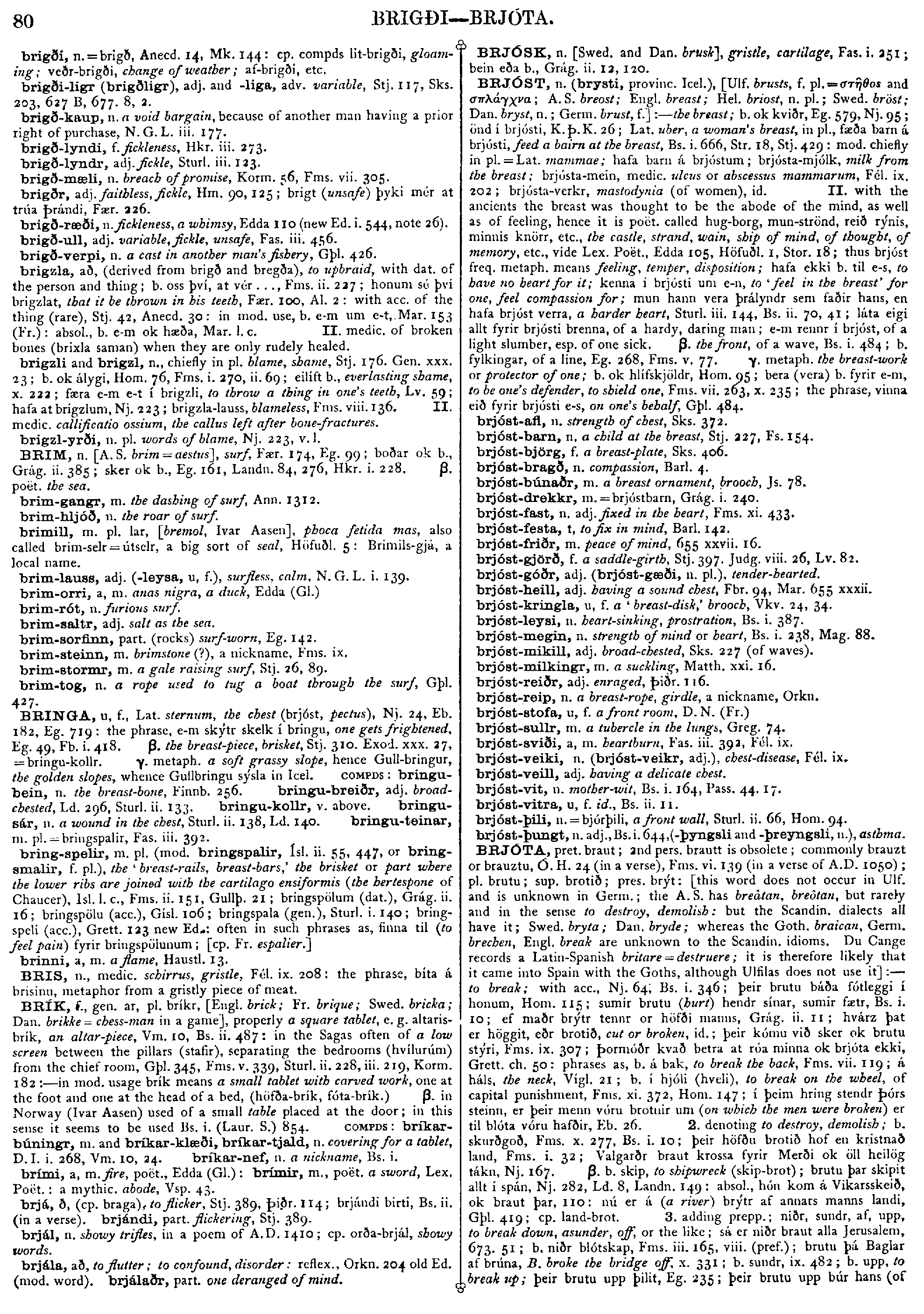
BRJÓST,
n.
(brysti,
provinc.
Icel.),
[Ulf.
brusts,
f.
pl.
=
GREEK
and
GREEK;
A.
S.
breost;
Engl.
breast;
Hel.
briost,
n.
pl.;
Swed.
bröst;
Dan.
bryst,
n.;
Germ,
brust,
f.]
:--
the
breast;
b.
ok
kviðr,
Eg.
579,
Nj.
95;
önd
í
brjósti,
K.
Þ.
K.
26;
Lat.
uber,
a
woman's
breast,
in
pl.,
fæða
barn
á
brjósti,
feed
a
bairn
at
the
breast,
Bs.
i.
666,
Str.
18,
Stj.
429:
mod.
chiefly
in
pl.
=
Lat.
mammae;
hafa
barn
á
brjóstum;
brjósta-mjólk,
milk
from
the
breast;
brjósta-mein,
medic.
ulcus
or
abscessus
mammarum,
Fél.
ix.
202;
brjósta-verkr,
mastodynia
(of
women),
id.
II.
with
the
ancients
the
breast
was
thought
to
be
the
abode
of
the
mind,
as
well
as
of
feeling,
hence
it
is
poët,
called
hug-borg,
mun-strönd,
reið
rýnis,
minnis
knörr,
etc.,
the
castle,
strand,
wain,
ship
of
mind,
of
thought,
of
memory,
etc.,
vide
Lex.
Poët.,
Edda
105,
Höfuðl.
1,
Stor.
18;
thus
brjóst
freq.
metaph.
means
feeling,
temper,
disposition;
hafa
ekki
b.
til
e-s,
to
have
no
heart
for
it;
kenna
í
brjósti
um
e-n,
to
'feel
in
the
breast'
for
one,
feel
compassion
for;
mun
hann
vera
þrályndr
sem
faðir
hans,
en
hafa
brjóst
verra,
a
harder
heart,
Sturl.
iii.
144,
Bs.
ii.
70,
41;
láta
eigi
allt
fyrir
brjósti
brenna,
of
a
hardy,
daring
man;
e-m
rennr
í
brjóst,
of
a
light
slumber,
esp.
of
one
sick.
.
the
front,
of
a
wave,
Bs.
i.
484;
b.
fylkingar,
of
a
line,
Eg.
268,
Fms.
v.
77.
 .
metaph.
the
breast-work
or
protector
of
one;
b.
ok
hlífskjöldr,
Hom.
95;
bera
(vera)
b.
fyrir
e-m,
to
be
one's
defender,
to
shield
one,
Fms.
vii.
263,
x.
235;
the
phrase,
vinna
eið
fyrir
brjósti
e-s,
on
one's
behalf,
Gþl.
484.
.
metaph.
the
breast-work
or
protector
of
one;
b.
ok
hlífskjöldr,
Hom.
95;
bera
(vera)
b.
fyrir
e-m,
to
be
one's
defender,
to
shield
one,
Fms.
vii.
263,
x.
235;
the
phrase,
vinna
eið
fyrir
brjósti
e-s,
on
one's
behalf,
Gþl.
484.
|
Source: Cleasby/Vigfusson, page b0081, entry 6 View original page image as: [TIFF] [PNG] [View previous entry] [View next entry] |
[Comment on this entry] [View comments] |
The following entry has been hand-corrected once. |
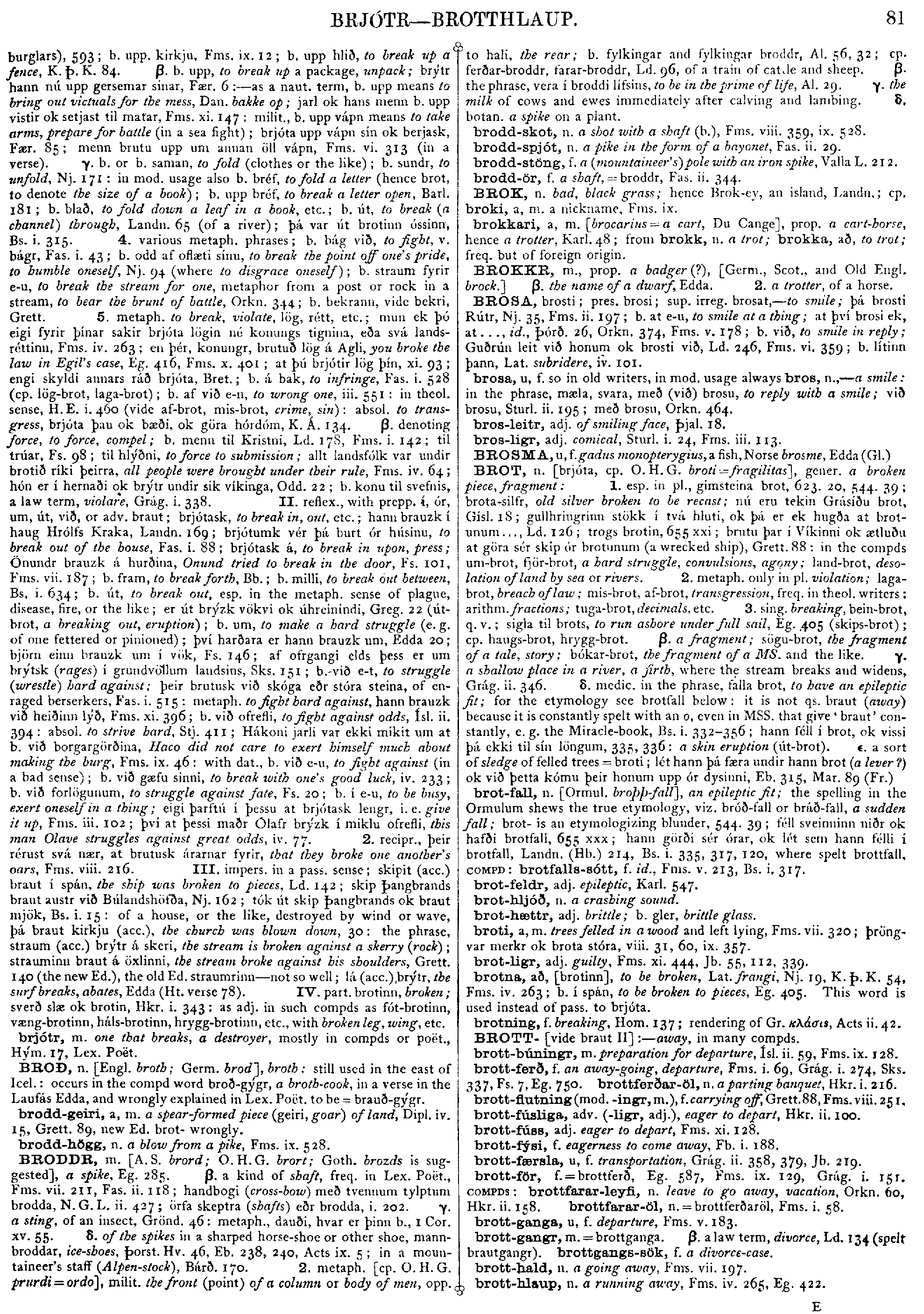
BRODDR,
m.
[A.
S.
brord;
O.
H.
G.
brort;
Goth.
brozds
is
suggested],
a
spike,
Eg.
285.
.
a
kind
of
shaft,
freq.
in
Lex.
Poët.,
Fms.
vii.
211,
Fas.
ii.
118;
handbogi
(cross-bow)
með
tvennum
tylptum
brodda,
N.
G.
L.
ii.
427;
örfa
skeptra
(shafts)
eðr
brodda,
i.
202.
.
a
sting,
of
an
insect,
Grönd.
46:
metaph.,
dauði,
hvar
er
þinn
b.,
1
Cor.
xv.
55.
 .
of
the
spikes
in
a
sharped
horse-shoe
or
other
shoe,
mannbroddar,
ice-shoes,
Þorst.
Hv.
46,
Eb.
238,
240,
Acts
ix.
5;
in
a
mountaineer's
staff
(Alpen-stock),
Bárð.
170.
2.
metaph.
[cp.
O.
H.
G.
prurdi
=
ordo],
milit.
the
front
(point)
of
a
column
or
body
of
men,
opp.
to
hali,
the
rear;
b.
fylkingar
and
fylkingar
broddr,
Al.
56,
32;
cp.
ferðar-broddr,
farar-broddr,
Ld.
96,
of
a
train
of
cattle
and
sheep.
.
the
phrase,
vera
í
broddi
lífsins,
to
be
in
the
prime
of
life,
Al.
29.
.
the
milk
of
cows
and
ewes
immediately
after
calving
and
lambing.
.
botan.
a
spike
on
a
plant.
.
of
the
spikes
in
a
sharped
horse-shoe
or
other
shoe,
mannbroddar,
ice-shoes,
Þorst.
Hv.
46,
Eb.
238,
240,
Acts
ix.
5;
in
a
mountaineer's
staff
(Alpen-stock),
Bárð.
170.
2.
metaph.
[cp.
O.
H.
G.
prurdi
=
ordo],
milit.
the
front
(point)
of
a
column
or
body
of
men,
opp.
to
hali,
the
rear;
b.
fylkingar
and
fylkingar
broddr,
Al.
56,
32;
cp.
ferðar-broddr,
farar-broddr,
Ld.
96,
of
a
train
of
cattle
and
sheep.
.
the
phrase,
vera
í
broddi
lífsins,
to
be
in
the
prime
of
life,
Al.
29.
.
the
milk
of
cows
and
ewes
immediately
after
calving
and
lambing.
.
botan.
a
spike
on
a
plant.
| Result Page: |  |
Previous | 1 2 3 4 5 6 7 8 9 10 11 12 13 14 | Next |  |
Germanic Lexicon Project (main page)
This search system was written by
Sean Crist
Please consider
volunteering
to correct the data in these online dictionaries.
No rights reserved. Feel free to use these data in any way you please.