|
|

|
Source: Bosworth/Toller, page b0629, entry 10 View original page image as: [TIFF] [PNG] [View previous entry] [View next entry] |
[Comment on this entry] [View comments] |
The following entry has been hand-corrected once. |
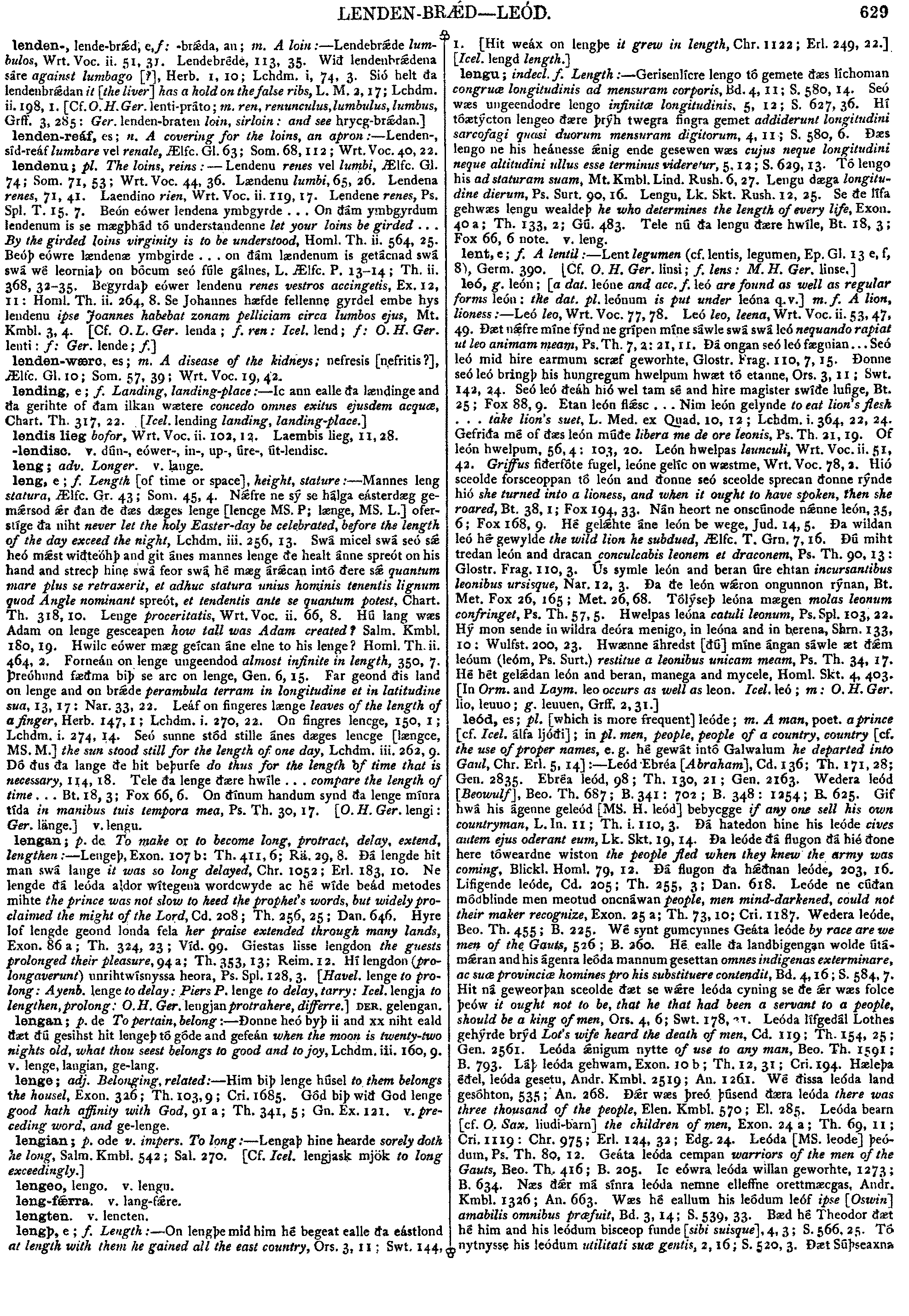
lengan; p. de To make or to become long, protract, delay, extend, lengthen :-- Lengeþ, Exon. 107 b: Th. 411, 6; Rä. 29, 8. Ðá lengde hit man swá lange it was so long delayed, Chr. 1052; Erl. 183, 10. Ne lengde ðá leóda aldor wítegena wordcwyde ac hé wíde beád metodes mihte the prince was not slow to heed the prophet's words, but widely proclaimed the might of the Lord, Cd. 208; Th. 256, 25; Dan. 646. Hyre lof lengde geond londa fela her praise extended through many lands, Exon. 86 a; Th. 324, 23; Víd. 99. Giestas lisse lengdon the guests prolonged their pleasure, 94 a; Th. 353, 13; Reim.12. Hí lengdon (prolongaverunt) unrihtwísnyssa heora, Ps. Spl. 128, 3. [Havel. lenge to prolong: Ayenb. lenge to delay: Piers P. lenge to delay, tarry: Icel. lengja to lengthen, prolong: O. H. Ger. lengjan protrahere, differre.] DER. gelengan.
|
Source: Bosworth/Toller, page b0630, entry 22 View original page image as: [TIFF] [PNG] [View previous entry] [View next entry] |
[Comment on this entry] [View comments] |
The following entry has been hand-corrected once. |
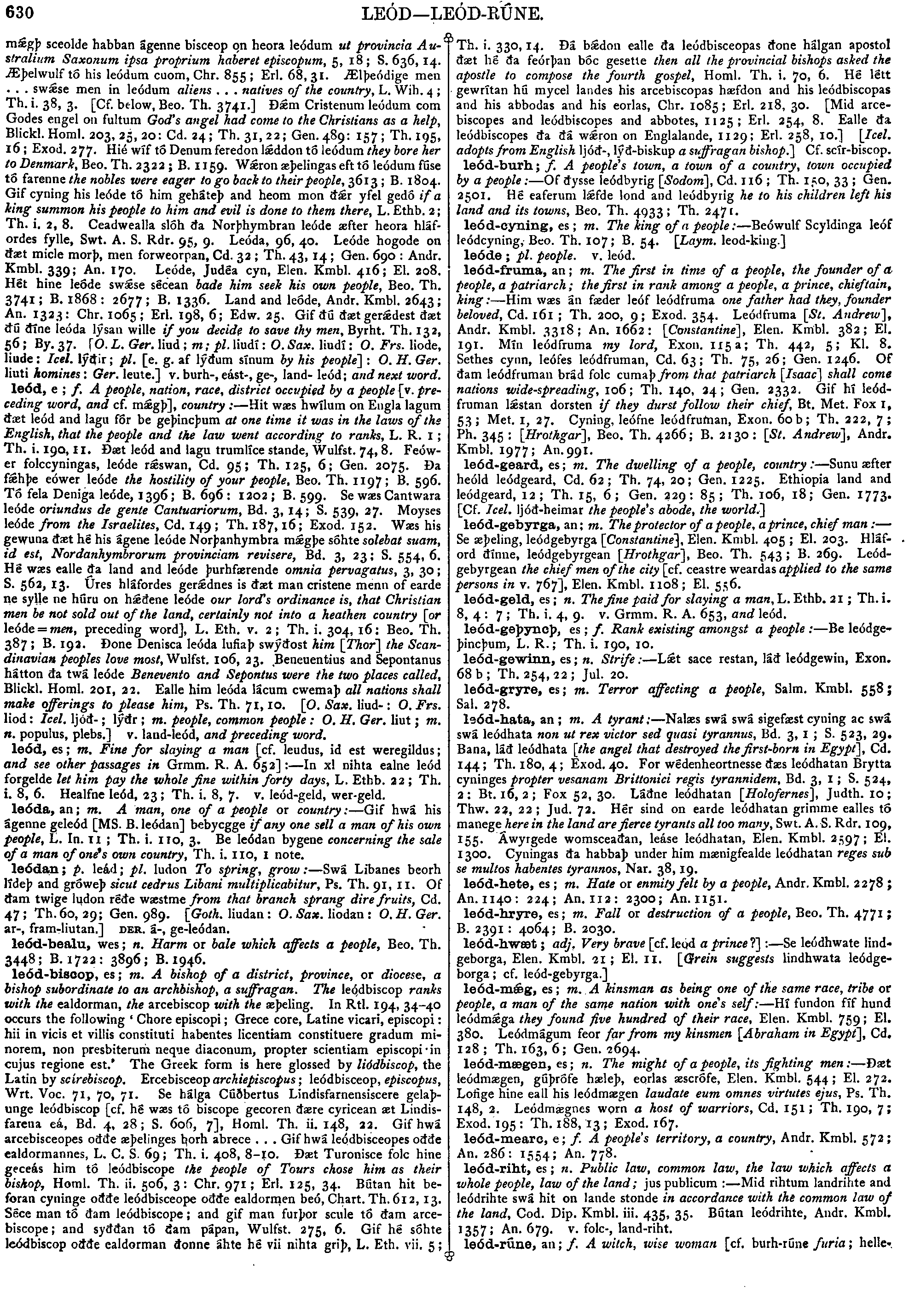
leód-mægen, es; n. The might of a people, its fighting men :-- Ðæt leódmægen, gúþrófe hæleþ, eorlas æscrófe, Elen. Kmbl. 544; El. 272. Lofige hine eall his leódmægen laudate eum omnes virtutes ejus, Ps. Th. 148, 2. Leódmægnes worn a host of warriors, Cd. 151; Th. 190, 7; Exod. 195: Th. 188, 13; Exod. 167.
|
Source: Bosworth/Toller, page b0635, entry 33 View original page image as: [TIFF] [PNG] [View previous entry] [View next entry] |
[Comment on this entry] [View comments] |
The following entry has been hand-corrected once. |
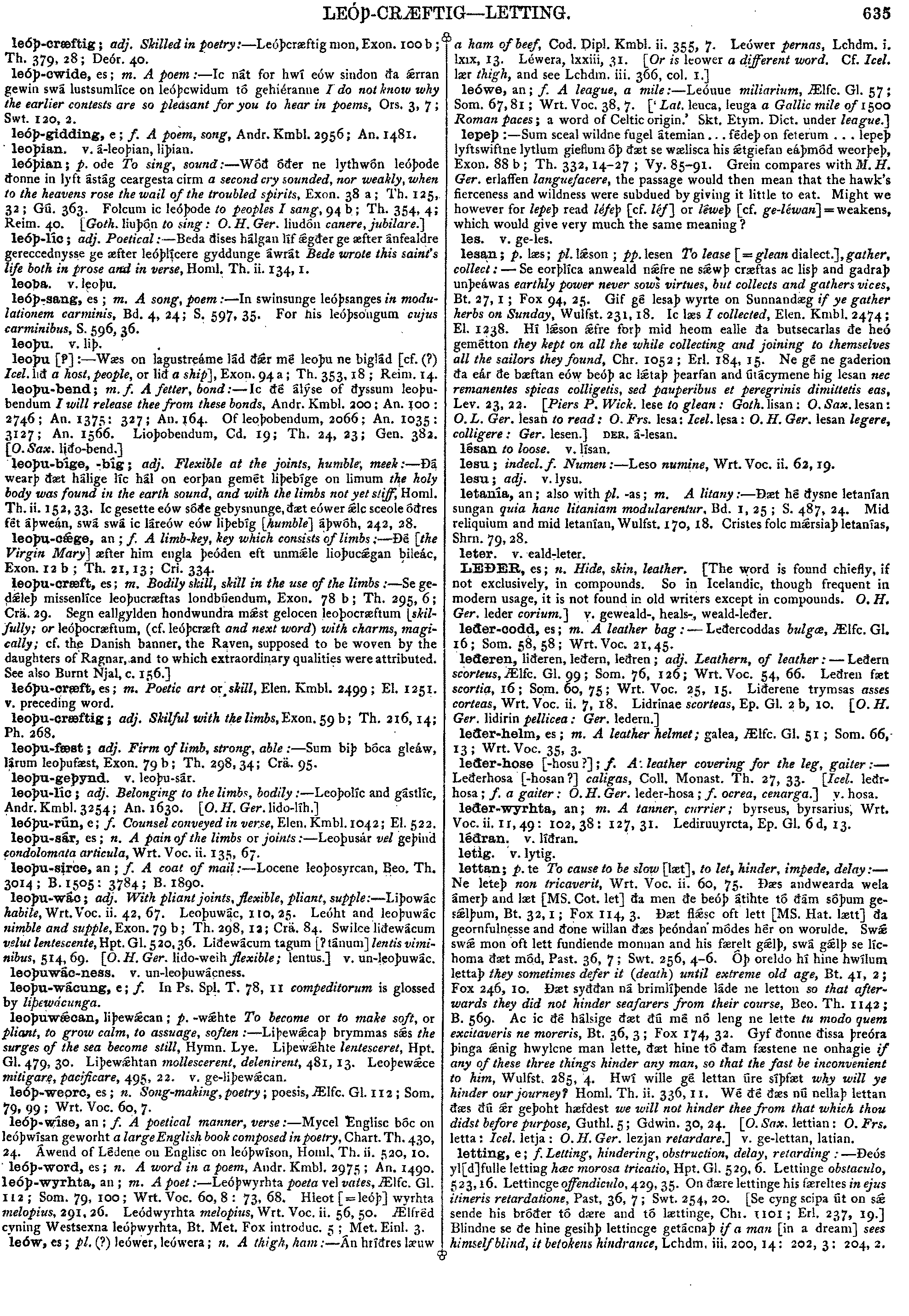
lepeþ
:--
Sum
sceal
wildne
fugel
átemian
...
fédep
on
feterum
...
lepeþ
lyftswiftne
lytlum
gieflum
óþ
ðæt
se
wælisca
his
 tgiefan
eáþmód
weorþeþ,
Exon.
88
b;
Th.
332,
14-27;
Vy.
85-91.
Grein
compares
with
M.
H.
Ger.
erlaffen
languefacere,
the
passage
would
then
mean
that
the
hawk's
fierceness
and
wildness
were
subdued
by
giving
it
little
to
eat.
Might
we
however
for
lepeþ
read
léfeþ
[cf.
léf]
or
léweþ
[cf.
ge-léwan]
=
weakens,
which
would
give
very
much
the
same
meaning?
tgiefan
eáþmód
weorþeþ,
Exon.
88
b;
Th.
332,
14-27;
Vy.
85-91.
Grein
compares
with
M.
H.
Ger.
erlaffen
languefacere,
the
passage
would
then
mean
that
the
hawk's
fierceness
and
wildness
were
subdued
by
giving
it
little
to
eat.
Might
we
however
for
lepeþ
read
léfeþ
[cf.
léf]
or
léweþ
[cf.
ge-léwan]
=
weakens,
which
would
give
very
much
the
same
meaning?
|
Source: Bosworth/Toller, page b0643, entry 8 View original page image as: [TIFF] [PNG] [View previous entry] [View next entry] |
[Comment on this entry] [View comments] |
The following entry has been hand-corrected once. |
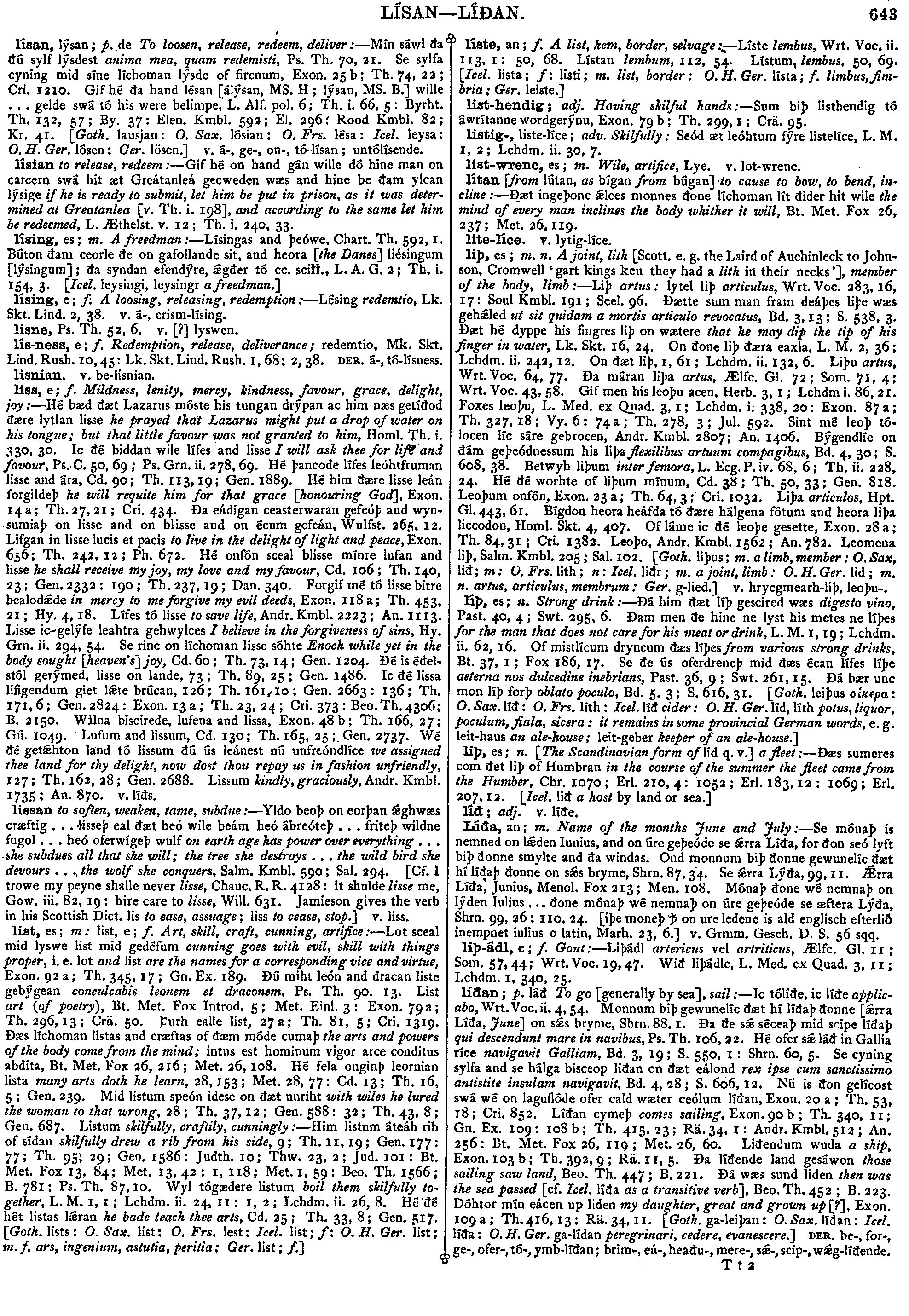
liss,
e;
f.
Mildness,
lenity,
mercy,
kindness,
favour,
grace,
delight,
joy
:--
Hé
bæd
ðæt
Lazarus
móste
his
tungan
drýpan
ac
him
næs
getíðod
ðære
lytlan
lisse
he
prayed
that
Lazarus
might
put
a
drop
of
water
on
his
tongue;
but
that
little
favour
was
not
granted
to
him,
Homl.
Th.
i.
330,
30.
Ic
ðé
biddan
wile
lífes
and
lisse
I
will
ask
thee
for
life
and
favour,
Ps.
C.
50,
69;
Ps.
Grn.
ii.
278,
69.
Hé
þancode
lífes
leóhtfruman
lisse
and
ára,
Cd.
90;
Th.
113,19;
Gen.
1889.
Hé
him
ðære
lisse
leán
forgildeþ
he
will
requite
him
for
that
grace
[honouring
God],
Exon.
14
a;
Th.
27,
21;
Cri.
434.
Ða
eádigan
ceasterwaran
gefeóþ
and
wynsumiaþ
on
lisse
and
on
blisse
and
on
écum
gefeán,
Wulfst.
265,
12.
Lifgan
in
lisse
lucis
et
pacis
to
live
in
the
delight
of
light
and
peace,
Exon.
656;
Th.
242,
12;
Ph.
672.
Hé
onfón
sceal
blisse
mínre
lufan
and
lisse
he
shall
receive
my
joy,
my
love
and
my
favour,
Cd.
106;
Th.
140,
23;
Gen.
2332:
190;
Th.
237,
19;
Dan.
340.
Forgif
mé
tó
lisse
bitre
bealodde
in
mercy
to
me
forgive
my
evil
deeds,
Exon.
118
a;
Th.
453,
21;
Hy.
4,
18.
Lífes
tó
lisse
to
save
life,
Andr.
Kmbl.
2223;
An.
1113.
Lisse
ic-gelýfe
leahtra
gehwylces
I
believe
in
the
forgiveness
of
sins,
Hy.
Grn.
ii.
294,
54.
Se
rinc
on
líchoman
lisse
sóhte
Enoch
while
yet
in
the
body
sought
[heaven's]
joy,
Cd.
60;
Th.
73,
14;
Gen.
1204.
Ðé
is
éðelstól
gerýmed,
lisse
on
lande,
73;
Th.
89,
25;
Gen.
1486.
Ic
ðé
lissa
lifigendum
giet
lte
brúcan,
126;
Th.
161,
10;
Gen.
2663:
136;
Th.
171,
6;
Gen.
2824:
Exon.
13
a;
Th.
23,
24;
Cri.
373:
Beo.
Th.
4306;
B.
2150.
Wilna
biscirede,
lufena
and
lissa,
Exon.
48
b;
Th.
166,
27;
Gú.
1049.
Lufum
and
lissum,
Cd.
130;
Th.
165,
25;
Gen.
2737.
Wé
ðé
gethton
land
tó
lissum
ðú
ús
leánest
nú
unfreóndlíce
we
assigned
thee
land
for
thy
delight,
now
dost
thou
repay
us
in
fashion
unfriendly,
127;
Th.
162,
28;
Gen.
2688.
Lissum
kindly,
graciously,
Andr.
Kmbl.
1735;
An.
870.
v.
líðs.
|
Source: Bosworth/Toller, page b0646, entry 25 View original page image as: [TIFF] [PNG] [View previous entry] [View next entry] |
[Comment on this entry] [View comments] |
The following entry has been hand-corrected once. |
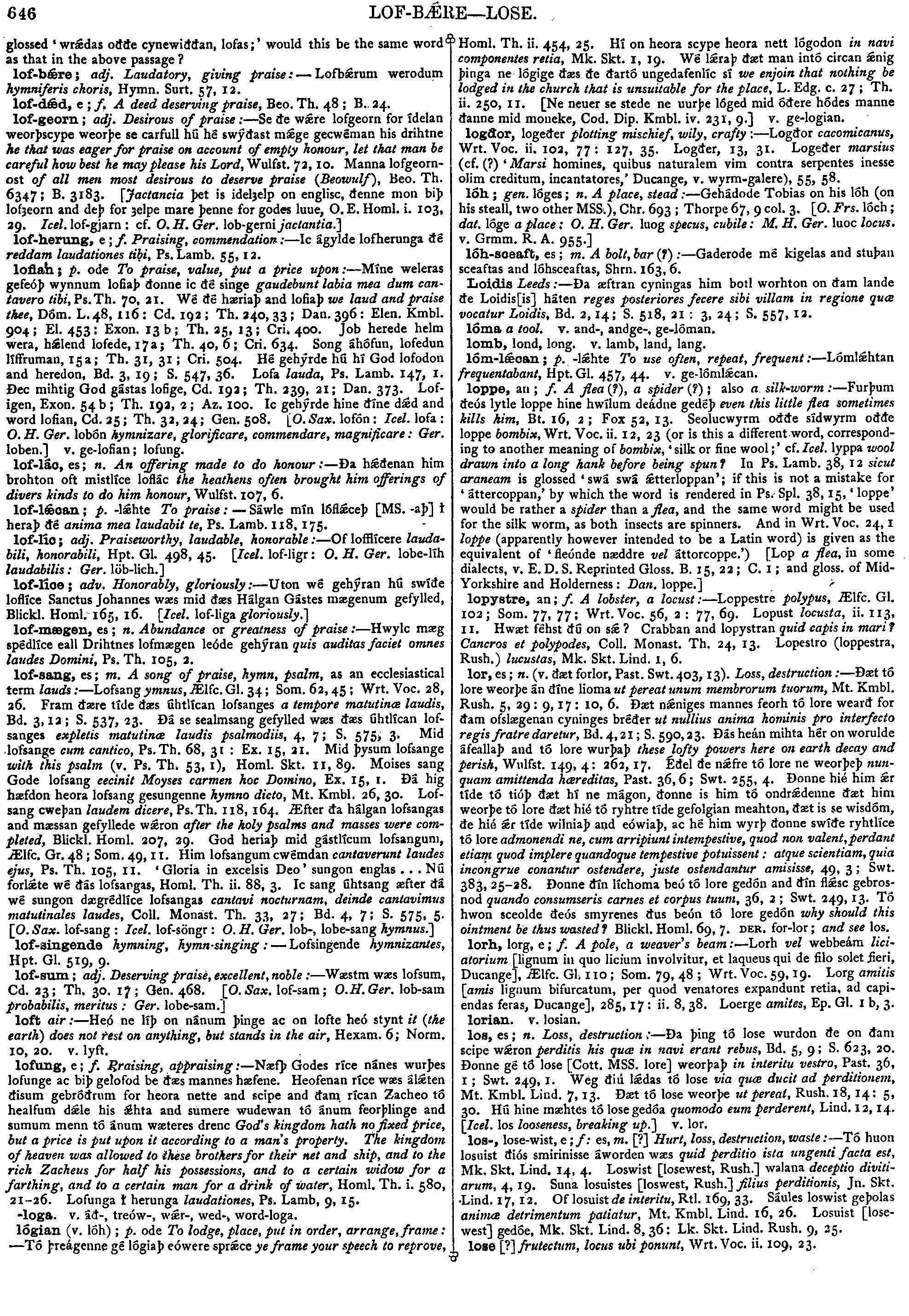
loppe,
an;
f.
A
flea(?),
a
spider(?);
also
a
silk-worm
:--
Furþum
ðeós
lytle
loppe
hine
hwílum
deádne
gedéþ
even
this
little
flea
sometimes
kills
him,
Bt.
16,
2;
Fox
52,
13.
Seolucwyrm
oððe
sídwyrm
oððe
loppe
bombix,
Wrt.
Voc.
ii.
12,
23
(or
is
this
a
different
word,
corresponding
to
another
meaning
of
bombix,
'silk
or
fine
wool;'
cf.
Icel.
lyppa
wool
drawn
into
a
long
hank
before
being
spun?
In
Ps.
Lamb.
38,
12
sicut
araneam
is
glossed
'swá
swá
tterloppan';
if
this
is
not
a
mistake
for
'áttercoppan,'
by
which
the
word
is
rendered
in
Ps.
Spl.
38,
15,
'loppe'
would
be
rather
a
spider
than
a
flea,
and
the
same
word
might
be
used
for
the
silk
worm,
as
both
insects
are
spinners.
And
in
Wrt.
Voc.
24,
1
loppe
(apparently
however
intended
to
be
a
Latin
word)
is
given
as
the
equivalent
of
'fleónde
næddre
vel
áttorcoppe.')
[Lop
a
flea,
in
some
dialects,
v.
E.
D.
S.
Reprinted
Gloss.
B.
15,
22
;
C.
1;
and
gloss.
of
Mid-Yorkshire
and
Holderness:
Dan.
loppe.]
|
Source: Bosworth/Toller, page b0647, entry 11 View original page image as: [TIFF] [PNG] [View previous entry] [View next entry] |
[Comment on this entry] [View comments] |
The following entry has been hand-corrected once. |
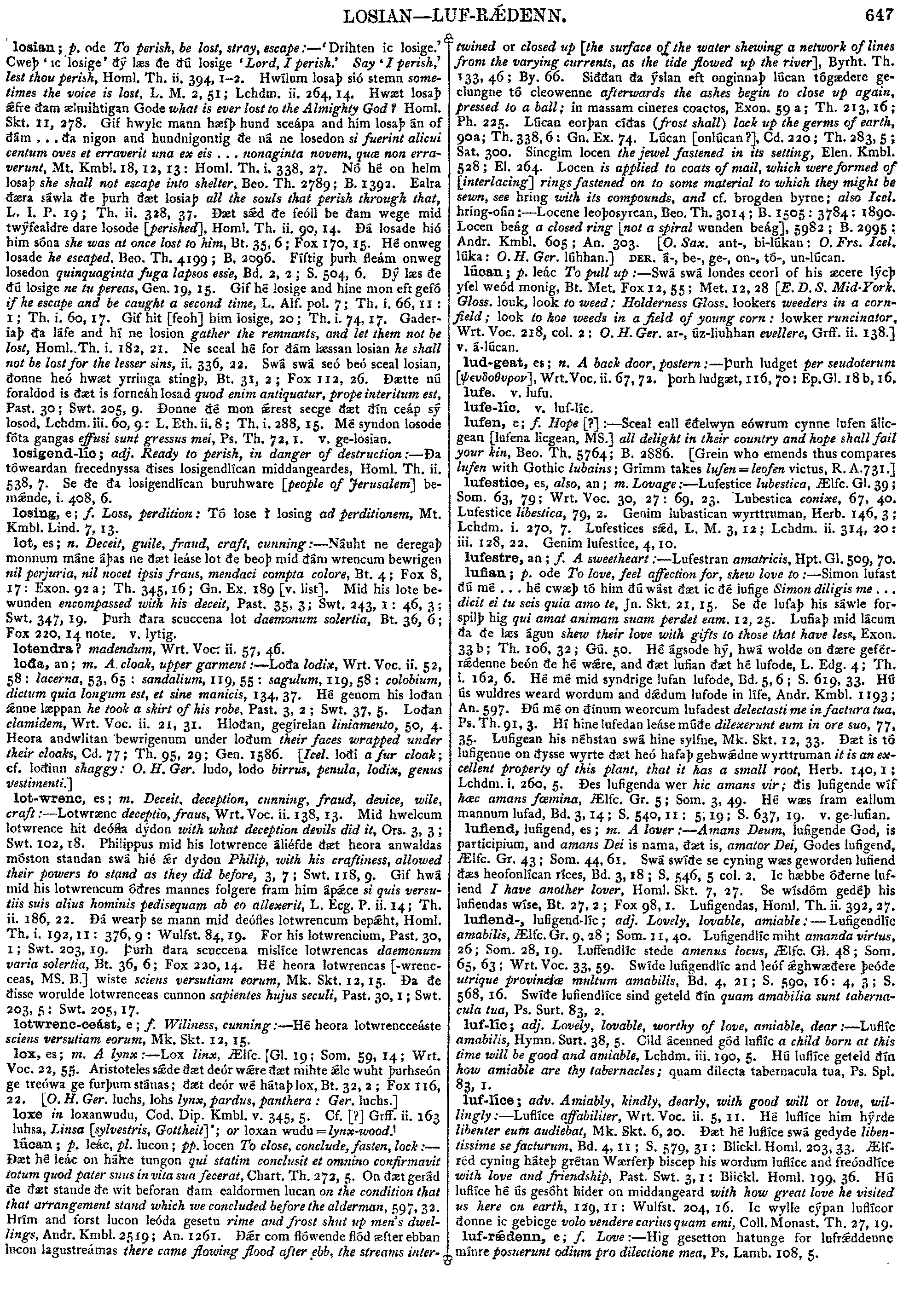
lúcan;
p.
leác,
pl.
lucon;
pp.
locen
To
close,
conclude,
fasten,
lock:-Ðæt
hé
leác
on
hálre
tungon
qui
statim
conclusit
et
omnino
confirmavit
totum
quod
pater
suus
in
vita
sua
fecerat,
Chart.
Th.
272,
5.
On
ðæt
gerád
ðe
ðæt
stande
ðe
wit
beforan
ðam
ealdormen
lucan
on
the
condition
that
that
arrangement
stand
which
we
concluded
before
the
alderman,
597,
32.
Hrím
and
forst
lucon
leóda
gesetu
rime
and
frost
shut
up
men's
dwellings,
Andr.
Kmbl.
2519;
An.
1261.
Ðr
com
flówende
flód
æfter
ebban
lucon
lagustreámas
there
came
flowing
flood
after
ebb,
the
streams
intertwined
or
closed
up
[the
surface
of
the
water
shewing
a
network
of
lines
from
the
varying
currents,
as
the
tide
flowed
up
the
river],
Byrht.
Th.
133,
46;
By.
66.
Siððan
ða
ýslan
eft
onginnaþ
lúcan
tógædere
geclungne
tó
cleowenne
afterwards
the
ashes
begin
to
close
up
again,
pressed
to
a
ball;
in
massam
cineres
coactos,
Exon.
59
a;
Th.
213,
16;
Ph.
225.
Lúcan
eorþan
cíðas
(frost
shall)
lock
up
the
germs
of
earth,
90
a;
Th.
338,
6:
Gn.
Ex.
74.
Lúcan
[onlúcan?],
Cd.
220;
Th.
283,
5;
Sat.
300.
Sincgim
locen
the
jewel
fastened
in
its
setting,
Elen.
Kmbl.
528;
El.
264.
Locen
is
applied
to
coats
of
mail,
which
were
formed
of
[interlacing]
rings
fastened
on
to
some
material
to
which
they
might
be
sewn,
see
hring
with
its
compounds,
and
cf.
brogden
byrne;
also
Icel.
hring-ofin
:--
Locene
leoþosyrcan,
Beo.
Th.
3014;
B.
1505:
3784:
1890.
Locen
beág
a
closed
ring
[not
a
spiral
wunden
beág],
5982;
B.
2995:
Andr.
Kmbl.
605;
An.
303.
[O.
Sax.
ant-,
bi-lúkan:
O.
Frs.
Icel.
lúka:
O.
H.
Ger.
lúhhan.]
DER.
á-,
be-,
ge-,
on-,
tó-,
un-lúcan.
|
Source: Bosworth/Toller, page b0653, entry 2 View original page image as: [TIFF] [PNG] [View previous entry] [View next entry] |
[Comment on this entry] [View comments] |
The following entry has been hand-corrected once. |
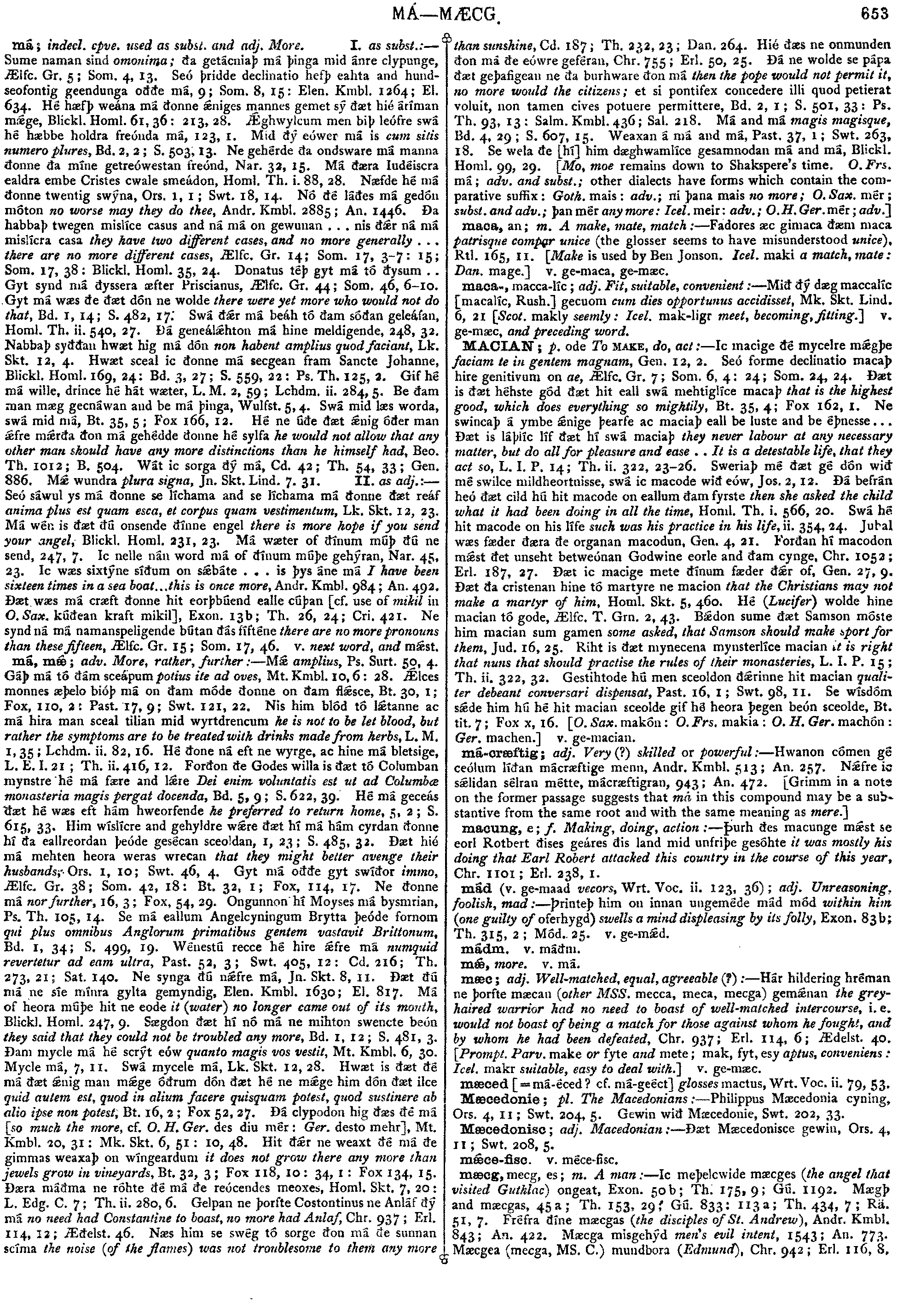
má,
m;
adv.
More,
rather,
further
:--
M
amplius,
Ps.
Surt.
50,
4.
Gáþ
má
tó
ðám
sceápum
potius
ite
ad
oves,
Mt.
Kmbl.
10,
6
:
28.
Æ-acute;lces
monnes
æþelo
bióþ
má
on
ðam
móde
ðonne
on
ðam
flsce,
Bt.
30,
1;
Fox,
110,
2:
Past.
17,
9;
Swt.
121,
22.
Nis
him
blód
tó
ltanne
ac
má
hira
man
sceal
tilian
mid
wyrtdrencum
he
is
not
to
be
let
blood,
but
rather
the
symptoms
are
to
be
treated
with
drinks
made
from
herbs,
L.
M.
1,
35
;
Lchdm.
ii.
82,
16.
Hé
ðone
ná
eft
ne
wyrge,
ac
hine
má
bletsige,
L.
E.
1.
21
;
Th.
ii.
416,
12.
Forðon
ðe
Godes
willa
is
ðæt
tó
Columban
mynstre
hé
má
fære
and
lre
Dei
enim
voluntatis
est
ut
ad
Columbæ
monasteria
magis
pergat
docenda,
Bd.
5,
9;
S.
622,
39.
Hé
má
geceás
ðæt
hé
wæs
eft
hám
hweorfende
he
preferred
to
return
home,
5,
2
;
S.
615,
33.
Him
wíslícre
and
gehyldre
wre
ðæt
hí
má
hám
cyrdan
ðonne
hí
ða
eallreordan
þeóde
gesécan
sceoldan,
1,
23
;
S.
485,
32.
Ðæt
hié
má
mehten
heora
weras
wrecan
that
they
might
better
avenge
their
husbands,
Ors.
1,
10;
Swt.
46,
4.
Gyt
má
oððe
gyt
swíðor
immo,
Ælfc.
Gr.
38;
Som.
42,
18
:
Bt.
32,
1;
Fox,
114,
17.
Ne
ðonne
má
nor
further,
16,
3;
Fox,
54,
29.
Ongunnon
hí
Moyses
má
bysmrian,
Ps.
Th.
105,
14.
Se
má
eallum
Angelcyningum
Brytta
þeóde
fornom
qui
plus
omnibus
Anglorum
primatibus
gentem
vastavit
Brittonum,
Bd.
1,
34;
S.
499,
19.
Wénestú
recce
hé
hire
fre
má
numquid
revertetur
ad
eam
ultra,
Past.
52,
3
;
Swt.
405,
12
:
Cd.
216;
Th.
273,
21;
Sat.
140.
Ne
synga
ðú
nfre,
má,
Jn.
Skt.
8,
11.
Ðæt
ðú
má
ne
síe
mínra
gylta
gemyndig,
Elen.
Kmbl.
1630;
El.
817.
Má
of
heora
múþe
hit
ne
eode
it
(water)
no
longer
came
out
of
its
mouth,
Blickl.
Homl.
247,
9.
Sægdon
ðæt
hí
nó
má
ne
mihton
swencte
beón
they
said
that
they
could
not
be
troubled
any
more,
Bd.
1,
12
;
S.
481,
3.
Ðam
mycle
má
hé
scrýt
eów
quanto
magis
vos
vestit,
Mt.
Kmbl.
6,
30.
Mycle
má,
7,
11.
Swá
mycele
má,
Lk.
Skt.
12,
28.
Hwæt
is
ðæt
ðé
má
ðæt
nig
man
mge
óðrum
dón
ðæt
hé
ne
mge
him
dón
ðæt
ilce
quid
autem
est,
quod
in
alium
facere
quisquam
potest,
quod
sustinere
ab
alio
ipse
non
potest;
Bt.
16,
2;
Fox
52,
27.
Ðá
clypodon
hig
ðæs
ðé
má
[so
much
the
more,
cf.
O.
H.
Ger.
des
diu
mér
:
Ger.
desto
mehr],
Mt.
Kmbl.
20,
31
:
Mk.
Skt.
6,
51
:
10,
48.
Hit
ðr
ne
weaxt
ðé
má
ðe
gimmas
weaxaþ
on
wíngeardum
it
does
not
grow
there
any
more
than
jewels
grow
in
vineyards,
Bt.
32,
3;
Fox
118,
10
:
34,
1
:
Fox
134,
15.
Ðæra
máðma
ne
róhte
ðé
má
ðe
reócendes
meoxes,
Homl.
Skt.
7,
20
:
L.
Edg.
C.
7;
Th.
ii.
280,
6.
Gelpan
ne
þorfte
Costontinus
ne
Anláf
ðý
má
no
need
had
Constantine
to
boast,
no
more
had
Anlaf,
Chr.
937
;
Erl.
114,
12;
Æðelst.
46.
Næs
him
se
swég
tó
sorge
ðon
má
ðe
sunnan
scíma
the
noise
(of
the
flames)
was
not
troublesome
to
them
any
more
than
sunshine,
Cd.
187;
Th.
232,
23;
Dan.
264.
Hié
ðæs
ne
onmunden
ðon
má
ðe
eówre
geféran,
Chr.
755;
Erl.
50,
25.
Ðá
ne
wolde
se
pápa
ðæt
geþafigean
ne
ða
burhware
ðon
má
then
the
pope
would
not
permit
it,
no
more
would
the
citizens;
et
si
pontifex
concedere
illi
quod
petierat
voluit,
non
tamen
cives
potuere
permittere,
Bd.
2,
1
;
S.
501,
33
:
Ps.
Th.
93,
13
:
Salm.
Kmbl.
436;
Sal.
218.
Má
and
má
magis
magisque,
Bd.
4,
29;
S.
607,
15.
Weaxan
á
má
and
má,
Past.
37,
1
;
Swt.
263,
18.
Se
wela
ðe
[hí]
him
dæghwamlíce
gesamnodan
má
and
má,
Blickl.
Homl.
99,
29.
[Mo,
moe
remains
down
to
Shakspere's
time.
O.
Frs.
má;
adv.
and
subst.;
other
dialects
have
forms
which
contain
the
comparative
suffix
:
Goth.
mais
:
adv.;
ni
þana
mais
no
more;
O.
Sax.
mér;
subst.
and
adv.;
þan
mér
any
more
:
Icel.
meir
:
adv.;
O.
H.
Ger;
mér;
adv.]
|
Source: Bosworth/Toller, page b0654, entry 21 View original page image as: [TIFF] [PNG] [View previous entry] [View next entry] |
[Comment on this entry] [View comments] |
The following entry has been hand-corrected once. |
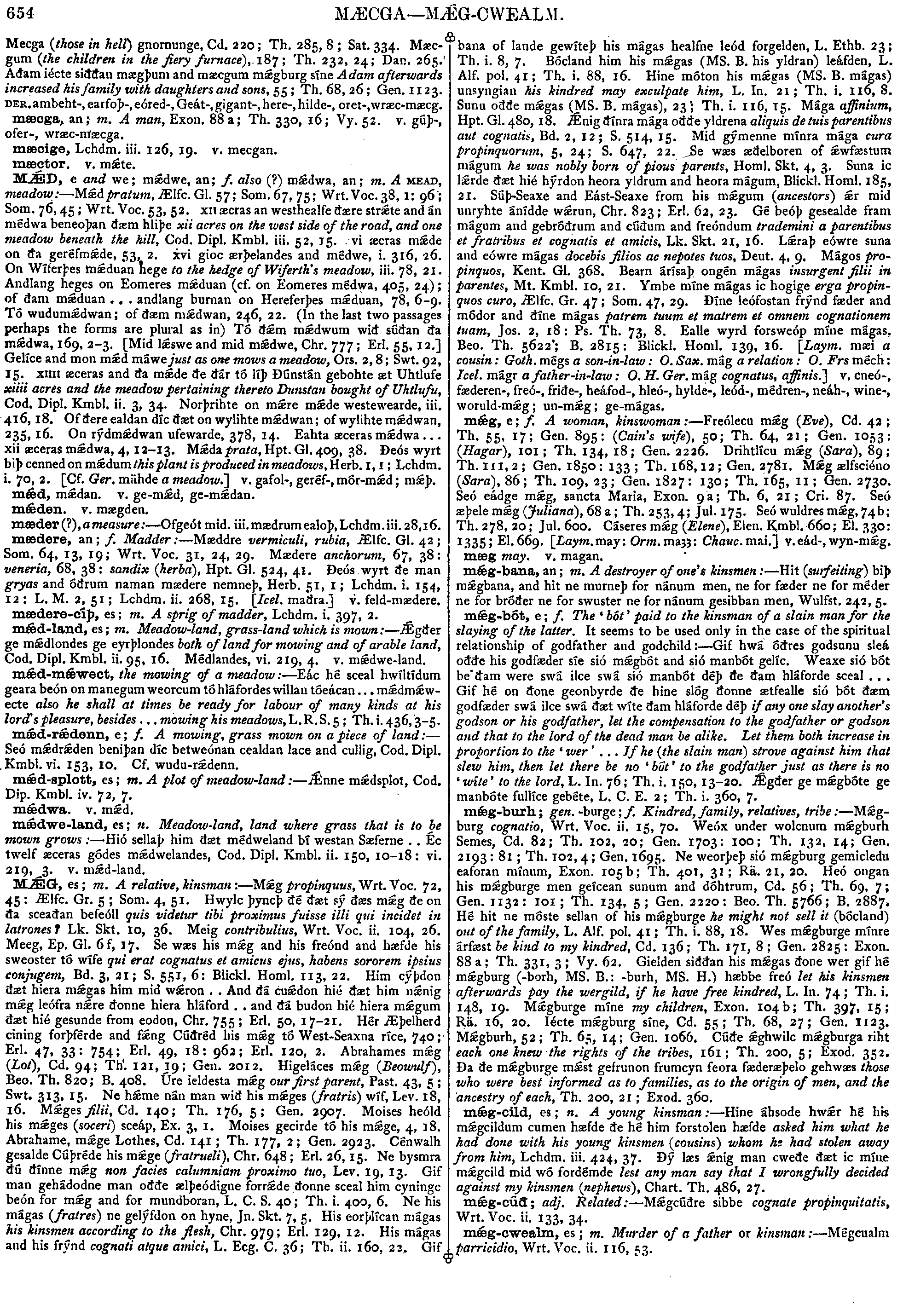
mg-burh;
gen.
-barge;
f.
Kindred,
family,
relatives,
tribe
:--
Mg-burg
cognatio,
Wrt.
Voc.
ii.
15,
70.
Weóx
under
wolcnum
mgburh
Semes,
Cd.
82;
Th.
102,
20;
Gen.
1703
:
100;
Th.
132,
14;
Gen.
2193
:
81;
Th.
102,
4;
Gen.
1695.
Ne
weorþeþ
sió
mgburg
gemicledu
eaforan
mínum,
Exon.
105
b;
Th.
401,
31;
Rä.
21,
20.
Heó
ongan
his
mgburge
men
geícean
sunum
and
dóhtrum,
Cd.
56;
Th.
69,
7;
Gen.
1132
:
101;
Th.
134,
5;
Gen.
2220
:
Beo.
Th.
5766;
B.
2887.
Hé
hit
ne
móste
sellan
of
his
mgburge
he
might
not
sell
it
(bócland)
out
of
the
family,
L.
Alf.
pol.
41;
Th.
i.
88,
18.
Wes
mgburge
mínre
árfæst
be
kind
to
my
kindred,
Cd.
136;
Th.
171,
8;
Gen.
2825
:
Exon.
88
a;
Th.
331,
3;
Vy.
62.
Gielden
siððan
his
mgas
ðone
wer
gif
hé
mgburg
(-borh,
MS.
B.:
-burh,
MS.
H.)
hæbbe
freó
let
his
kinsmen
afterwards
pay
the
wergild,
if
he
have
free
kindred,
L.
In.
74;
Th.
i.
148,
19.
Mgburge
míne
my
children,
Exon.
104
b;
Th.
397,
15;
Rä.
16,
20.
Iécte
mgburg
síne,
Cd.
55;
Th.
68,
27;
Gen.
1123.
Mgburh,
52;
Th.
65,
14;
Gen.
1066.
Cúðe
ghwilc
mgburga
riht
each
one
knew
the
rights
of
the
tribes,
161;
Th.
200,
5;
Exod.
352.
Ða
ðe
mgburge
mst
gefrunon
frumcyn
feora
fæderæþelo
gehwæs
those
who
were
best
informed
as
to
families,
as
to
the
origin
of
men,
and
the
ancestry
of
each,
Th.
200,
21;
Exod.
360.
|
Source: Bosworth/Toller, page b0655, entry 11 View original page image as: [TIFF] [PNG] [View previous entry] [View next entry] |
[Comment on this entry] [View comments] |
The following entry has been hand-corrected once. |
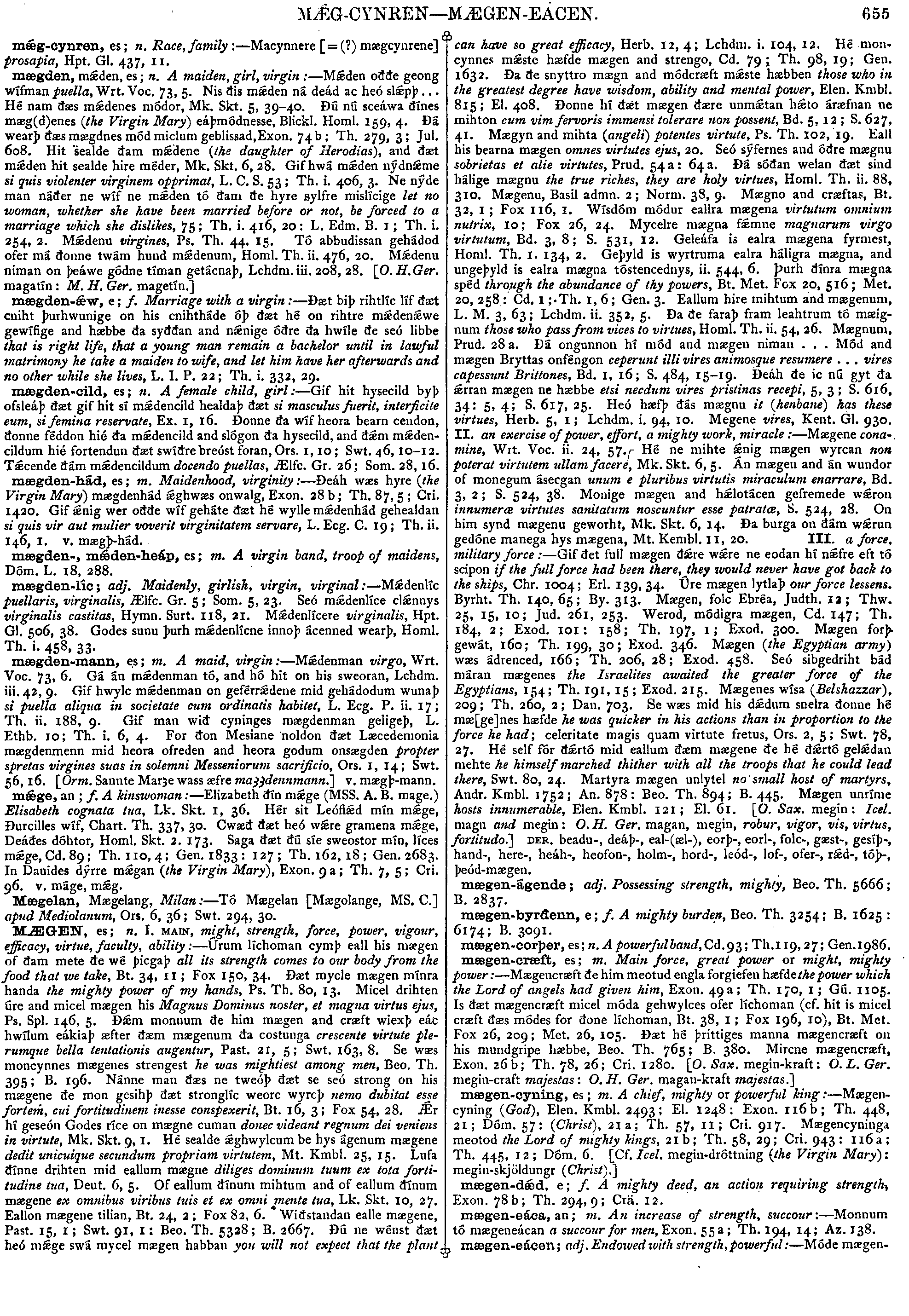
MÆGEN,
T.
es;
n.
I.
MAIN,
might,
strength,
force,
power,
vigour,
efficacy,
virtue,
faculty,
ability:--
Úrum
líchoman
cymþ
eall
his
mægen
of
ðam
mete
ðe
wé
þicgaþ
all
its
strength
comes
to
our
body
from
the
food
that
we
take,
Bt.
34,
11;
Fox
150,
34.
Ðæt
mycle
mægen
mínra
handa
the
mighty
power
of
my
hands.
Ps.
Th.
80,
13.
Micel
drihten
úre
and
micel
mægen
his
Magnus
Dominus
noster,
et
magna
virtus
ejus,
Ps.
Spl.
146,
5.
Ðm
monnum
ðe
him
mægen
and
cræft
wiexþ
eác
hwílum
eákiaþ
æfter
ðæm
mægenum
ða
costunga
crescente
virtute
plerumque
bella
tentationis
augentur,
Past.
21,
5;
Swt.
163,
8.
Se
wæs
moncynnes
mægenes
strengest
he
was
mightiest
among
men,
Beo.
Th.
395;
B.
196.
Nánne
man
ðæs
ne
tweóþ
ðæt
se
seó
strong
on
his
mægene
ðe
mon
gesihþ
ðæt
stronglíc
weorc
wyrcþ
nemo
dubitat
esse
fortem,
cui
fortitudinem
inesse
conspexerit,
Bt.
16,
3;
Fox
54,
28.
Æ-acute;r
hí
geseón
Godes
ríce
on
mægne
cuman
donec
videant
regnum
dei
veniens
in
virtute,
Mk.
Skt.
9,
1.
Hé
sealde
ghwylcum
be
hys
ágenum
mægene
dedit
unicuique
secundum
propriam
virlutem,
Mt.
Kmbl.
25,
15.
Lufa
ðínne
drihten
mid
eallum
mægne
diliges
dominum
tuum
ex
tota
forlitudine
tua,
Deut.
6,
5.
Of
eallum
ðínum
mihtum
and
of
eallum
ðínum
mægene
ex
omnibus
viribus
tuis
et
ex
omni
mente
tua,
Lk.
Skt.
10,
27.
Eallon
mægene
tilian,
Bt.
24,
2
;
Fox
82,
6.
Wiðstandan
ealle
mægene,
Past.
15,
1;
Swt.
91,
1:
Beo.
Th.
5328;
B.
2667.
Ðú
ne
wénst
ðæt
heó
mge
swá
mycel
mægen
habban
you
will
not
expect
that
the
plant.
can
have
so
great
efficacy.
Herb.
12,
4;
Lchdm.
i.
104,
12.
Hé
moncynnes
mste
hæfde
mægen
and
strengo,
Cd.
79;
Th.
98,
19;
Gen.
1632.
Ða
ðe
snyttro
mægn
and
módcræft
mste
hæbben
those
who
in
the
greatest
degree
have
wisdom,
ability
and
menial
power,
Elen.
Kmbl.
815;
El.
408.
Ðonne
hí
ðæt
mægen
ðære
unmtan
hto
áræfnan
ne
mihton
cum
vim
fervoris
immensi
tolerare
non
possent,
Bd.
5,
12;
S.
627,
41.
Mægyn
and
mihta
(angeli)
poteníes
virtute.
Ps.
Th.
102,
19.
Eall
his
bearna
mægen
omnes
virtutes
ejus,
20.
Seó
sýfernes
and
óðre
mægnu
sobrietas
et
alie
virtutes,
Prud.
54a:
64a.
Ðá
sóðan
welan
ðæt
sind
hálige
mægnu
the
true
riches,
they
are
holy
virtues,
Homl.
Th.
ii.
88,
310.
Mægenu,
Basil
admn.
2;
Norm.
38,
9.
Mægno
and
cræftas,
Bt.
32,
1;
Fox
116,
1.
Wísdóm
módur
eallra
mægena
virtutum
omnium
nutrix,
10;
Fox
26,
24.
Mycelre
mægna
fmne
magnarum
virgo
virtutum,
Bd.
3,
8;
S.
531,
12.
Geleáfa
is
ealra
mægena
fyrmest,
Homl.
Th.
1.
134,
2.
Geþyld
is
wyrtruma
ealra
háligra
mægna,
and
ungeþyld
is
ealra
mægna
tóstencednys,
ii.
544,
6.
Þurh
dínra
mægna
spéd
through
the
abundance
of
thy
powers,
Bt.
Met.
Fox
20,
516;
Met.
20,
258:
Cd.
1;
Th.
1.
6;
Gen.
3.
Eallum
hire
mihtum
and
mægenum,
L.
M.
3,
63;
Lchdm.
ii.
352,
5.
Ða
ðe
faraþ
fram
leahtrum
tó
mæignum
those
who
pass
from
vices
to
virtues,
Homl.
Th.
ii.
54,
26.
Mægnum,
Prud.
28a.
Ða
ongunnon
hí
mód
and
mægen
niman
.
.
.
Mód
and
mægen
Bryttas
onféngon
ceperunt
illi
vires
animosque
resumere
.
.
.
vires
capessunt
Brittones,
Bd.
1,
16;
S.
484,
15-19.
Ðeáh
ðe
ic
nú
gyt
ða
rran
mægen
ne
hæbbe
etsi
necdum
vires
pristinas
recepi,
5,
3;
S.
616,
34:
5,
4;
S.
617,
25.
Heó
hæfþ
ðás
mægnu
it
(henbane)
has
these
virtues,
Herb.
5,
1;
Lchdm.
i.
94,
10.
Megene
vires,
Kent.
Gl.
930.
II.
an
exercise
of
power,
effort,
a
mighty
work,
miracle:--
Mægene
conamine.
Wit.
Voc.
ii.
24,
57.
Hé
ne
mihte
nig
mægen
wyrcan
non
poterat
virtutem
ullam
facere,
Mk.
Skt.
6,
5.
Án
mægen
and
án
wundor
of
monegum
ásecgan
unum
e
pluribus
virtutis
miraculum
enarrare,
Bd.
3,
2;
S.
524,
38.
Monige
mægen
and
hlotácen
gefremede
wron
innumeræ
virtutes
sanitatum
noscuntur
esse
patratæ,
S.
524,
28.
On
him
synd
mægenu
geworht,
Mk.
Skt.
6,
14.
Ða
burga
on
ðám
wrun
gedóne
manega
hys
mægena,
Mt.
Kembl.
11,
20.
III.
a
force,
military
force:--
Gif
ðet
full
mægen
ðre
wre
ne
eodan
hí
nfre
eft
tó
scipon
if
the
full
force
had
been
there,
they
would
never
have
got
back
to
the
ships,
Chr.
1004;
Erl.
139,
34.
Úre
mægen
lytlaþ
our
force
lessens.
Byrht.
Th.
140,
65;
By.
313.
Mægen,
folc
Ebréa,
Judth.
12;
Thw.
25,
15,
10;
Jud.
261,
253.
Werod,
módigra
mægen,
Cd.
147;
Th.
184,
2;
Exod.
101:
158;
Th.
197,
1;
Exod.
300.
Mægen
forþgewát,
160;
Th.
199,
30;
Exod.
346.
Mægen
(the
Egyptian
army)
wæs
ádrenced,
166;
Th.
206,
28;
Exod.
458.
Seó
sibgedriht
bád
máran
mægenes
the
Israelites
awaited
the
greater
force
of
the
Egyptians,
154;
Th.
191,
15;
Exod.
215.
Mægenes
wísa
(Belshazzar),
209;
Th.
260,
2;
Dan.
703.
Se
wæs
mid
his
ddum
snelra
ðonne
hé
mæ[ge]nes
hæfde
he
was
quicker
in
his
actions
than
in
proportion
to
the
force
he
had;
celeritate
magis
quam
virtute
fretus,
Ors.
2,
5;
Swt.
78,
27.
Hé
self
fór
ðrtó
mid
eallum
ðæm
mægene
ðe
hé
ðrtó
geldan
mehte
he
himself
marched
thither
with
all
the
troops
that
he
could
lead
there,
Swt.
80,
24.
Martyra
mægen
unlytel
no
small
host
of
martyrs,
Andr.
Kmbl.
1752;
An.
878:
Beo.
Th.
894;
B.
445.
Mægen
unríme
hosts
innumerable,
Elen.
Kmbl.
121;
El.
61.
[O.
Sax.
megin:
Icel.
magn
and
megin:
O.
H.
Ger.
magan,
megin,
robur,
vigor,
vis,
virtus,
fortitudo.]
DER.
beadu-,
deáþ-,
eal-(æl-),
eorþ-,
eorl-,
folc-,
gæst-,
gesíþ-,
hand-,
here-,
heáh-,
heofon-,
holm-,
hord-,
leód-,
lof-,
ofer-,
rd-,
tóþ-,
þeód-mægen.
|
Source: Bosworth/Toller, page b0655, entry 15 View original page image as: [TIFF] [PNG] [View previous entry] [View next entry] |
[Comment on this entry] [View comments] |
The following entry has been hand-corrected once. |
mægen-cræft, es; m. Main force, great power or might, mighty power: -- Mægencræft ðe him meotud engla forgiefen hæfde the power which the Lord of angels had given him, Exon. 49 a; Th. 170, I; Gú. 1105. Is ðæt mægencræft micel móda gehwylces ofer líchoman (cf. hit is micel cræft ðæs módes for ðone líchoman, Bt. 38, 1; Fox 196, 10), Bt. Met. Fox 26, 209; Met. 26, 105. Ðæt he þrittiges manna mægencræft on his mundgripe hæbbe, Beo. Th. 765; B. 380. Mircne mægencræft, Exon. 26b; Th. 78, 26; Cri. 1280. [O. Sax. megin-kraft: O. L. Ger. megin-craft majestas: O. H. Ger. magan-kraft majestas.]
| Result Page: |  |
Previous | 20 21 22 23 24 25 26 27 28 29 30 31 32 33 34 35 36 37 38 | Next |  |
Germanic Lexicon Project (main page)
This search system was written by
Sean Crist
Please consider
volunteering
to correct the data in these online dictionaries.
No rights reserved. Feel free to use these data in any way you please.