|
|

Tip: In the search results, you can click on any word or abbreviation for more information.
|
Source: Bosworth/Toller, page b0890, entry 20 View original page image as: [TIFF] [PNG] [View previous entry] [View next entry] |
[Comment on this entry] [View comments] |
The following entry has been hand-corrected once. |
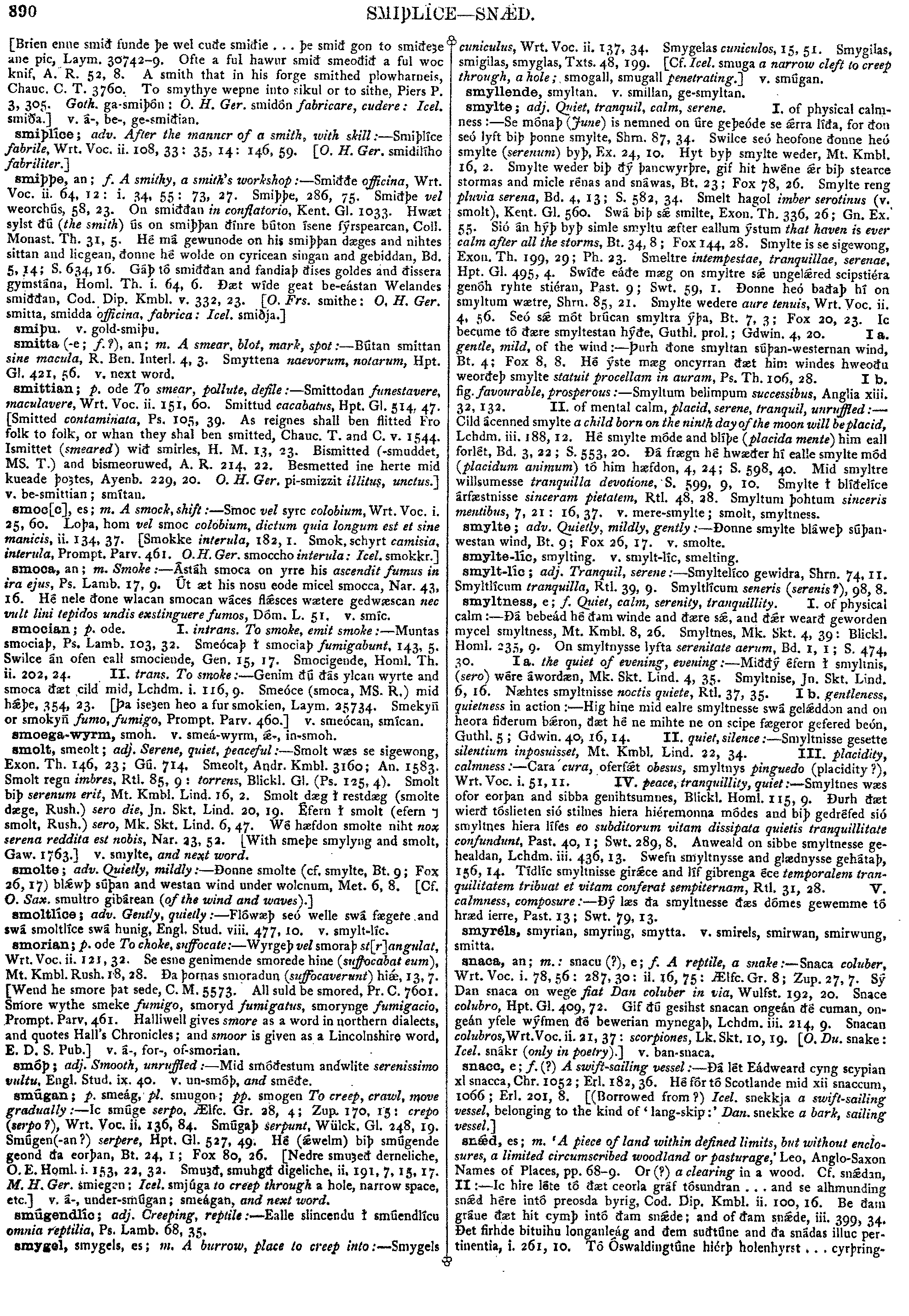
smylte;
adj.
Quiet,
tranquil,
calm,
serene.
I.
of
physical
calmness:--Se
mónaþ
(June)
is
nemned
on
úre
geþeóde
se
 rra
líða,
for
ðon
seó
lyft
biþ
þonne
smylte,
Shrn.
87,
34.
Swilce
seó
heofone
ðonne
heó
smylte
(serenum)
byþ,
Ex.
24,
10.
Hyt
byþ
smylte
weder,
Mt.
Kmbl.
16,
2.
Smylte
weder
biþ
ðý
þancwyrþre,
gif
hit
hwéne
r
biþ
stearce
stormas
and
micle
rénas
and
snáwas,
Bt.
23;
Fox
78,
26.
Smylte
reng
pluvia
serena,
Bd.
4,
13;
S.
582,
34.
Smelt
hagol
imber
serotinus
(v.
smolt),
Kent.
Gl.
560.
Swá
biþ
s
smilte,
Exon.
Th.
336,
26;
Gn.
Ex.
55.
Sió
án
hýþ
byþ
simle
smyltu
æfter
eallum
ýstum
that
haven
is
ever
calm
after
all
the
storms,
Bt.
34,
8;
Fox
144,
28.
Smylte
is
se
sigewong,
Exon.
Th.
199,
29;
Ph.
23.
Smeltre
intempestae,
tranquillae,
serenae,
Hpt.
Gl.
495,
4.
Swíðe
eáðe
mæg
on
smyltre
s
ungelred
scipstiéra
genóh
ryhte
stiéran,
Past.
9;
Swt.
59,
1.
Ðonne
heó
baðaþ
hí
on
smyltum
wætre,
Shrn.
85,
21.
Smylte
wedere
aure
tenuis,
Wrt.
Voc.
ii.
4,
56.
Seó
s
mót
brúcan
smyltra
ýþa,
Bt.
7,
3;
Fox
20,
23.
Ic
becume
tó
ðære
smyltestan
hýðe,
Guthl.
prol.;
Gdwin.
4,
20.
I
a.
gentle,
mild,
of
the
wind:--Þurh
ðone
smyltan
súþan-westernan
wind,
Bt.
4;
Fox
8,
8.
Hé
ýste
mæg
oncyrran
ðæt
him
windes
hweoðu
weorðeþ
smylte
statuit
procellam
in
auram,
Ps.
Th.
106,
28.
I
b.
fig.
favourable,
prosperous:--Smyltum
belimpum
successibus,
Anglia
xiii.
32,
132.
II.
of
mental
calm,
placid,
serene,
tranquil,
unruffled:--Cild
ácenned
smylte
a
child
born
on
the
ninth
day
of
the
moon
will
be
placid,
Lchdm.
iii.
188,
12.
Hé
smylte
móde
and
blíþe
(placida
mente)
him
eall
forlét,
Bd.
3,
22;
S.
553,
20.
Ðá
frægn
hé
hwæðer
hí
ealle
smylte
mód
(placidum
animum)
tó
him
hæfdon,
4,
24;
S.
598,
40.
Mid
smyltre
willsumesse
tranquilla
devotione,
S.
599,
9,
10.
Smylte
rra
líða,
for
ðon
seó
lyft
biþ
þonne
smylte,
Shrn.
87,
34.
Swilce
seó
heofone
ðonne
heó
smylte
(serenum)
byþ,
Ex.
24,
10.
Hyt
byþ
smylte
weder,
Mt.
Kmbl.
16,
2.
Smylte
weder
biþ
ðý
þancwyrþre,
gif
hit
hwéne
r
biþ
stearce
stormas
and
micle
rénas
and
snáwas,
Bt.
23;
Fox
78,
26.
Smylte
reng
pluvia
serena,
Bd.
4,
13;
S.
582,
34.
Smelt
hagol
imber
serotinus
(v.
smolt),
Kent.
Gl.
560.
Swá
biþ
s
smilte,
Exon.
Th.
336,
26;
Gn.
Ex.
55.
Sió
án
hýþ
byþ
simle
smyltu
æfter
eallum
ýstum
that
haven
is
ever
calm
after
all
the
storms,
Bt.
34,
8;
Fox
144,
28.
Smylte
is
se
sigewong,
Exon.
Th.
199,
29;
Ph.
23.
Smeltre
intempestae,
tranquillae,
serenae,
Hpt.
Gl.
495,
4.
Swíðe
eáðe
mæg
on
smyltre
s
ungelred
scipstiéra
genóh
ryhte
stiéran,
Past.
9;
Swt.
59,
1.
Ðonne
heó
baðaþ
hí
on
smyltum
wætre,
Shrn.
85,
21.
Smylte
wedere
aure
tenuis,
Wrt.
Voc.
ii.
4,
56.
Seó
s
mót
brúcan
smyltra
ýþa,
Bt.
7,
3;
Fox
20,
23.
Ic
becume
tó
ðære
smyltestan
hýðe,
Guthl.
prol.;
Gdwin.
4,
20.
I
a.
gentle,
mild,
of
the
wind:--Þurh
ðone
smyltan
súþan-westernan
wind,
Bt.
4;
Fox
8,
8.
Hé
ýste
mæg
oncyrran
ðæt
him
windes
hweoðu
weorðeþ
smylte
statuit
procellam
in
auram,
Ps.
Th.
106,
28.
I
b.
fig.
favourable,
prosperous:--Smyltum
belimpum
successibus,
Anglia
xiii.
32,
132.
II.
of
mental
calm,
placid,
serene,
tranquil,
unruffled:--Cild
ácenned
smylte
a
child
born
on
the
ninth
day
of
the
moon
will
be
placid,
Lchdm.
iii.
188,
12.
Hé
smylte
móde
and
blíþe
(placida
mente)
him
eall
forlét,
Bd.
3,
22;
S.
553,
20.
Ðá
frægn
hé
hwæðer
hí
ealle
smylte
mód
(placidum
animum)
tó
him
hæfdon,
4,
24;
S.
598,
40.
Mid
smyltre
willsumesse
tranquilla
devotione,
S.
599,
9,
10.
Smylte
 blíðelíce
árfæstnisse
sinceram
pietatem,
Rtl.
48,
28.
Smyltum
þohtum
sinceris
mentibus,
7,
21:
16,
37.
v.
mere-smylte;
smolt,
smyltness.
blíðelíce
árfæstnisse
sinceram
pietatem,
Rtl.
48,
28.
Smyltum
þohtum
sinceris
mentibus,
7,
21:
16,
37.
v.
mere-smylte;
smolt,
smyltness.
|
Source: Bosworth/Toller, page b1100, entry 15 View original page image as: [TIFF] [PNG] [View previous entry] [View next entry] |
[Comment on this entry] [View comments] |
The following entry has been hand-corrected once. |
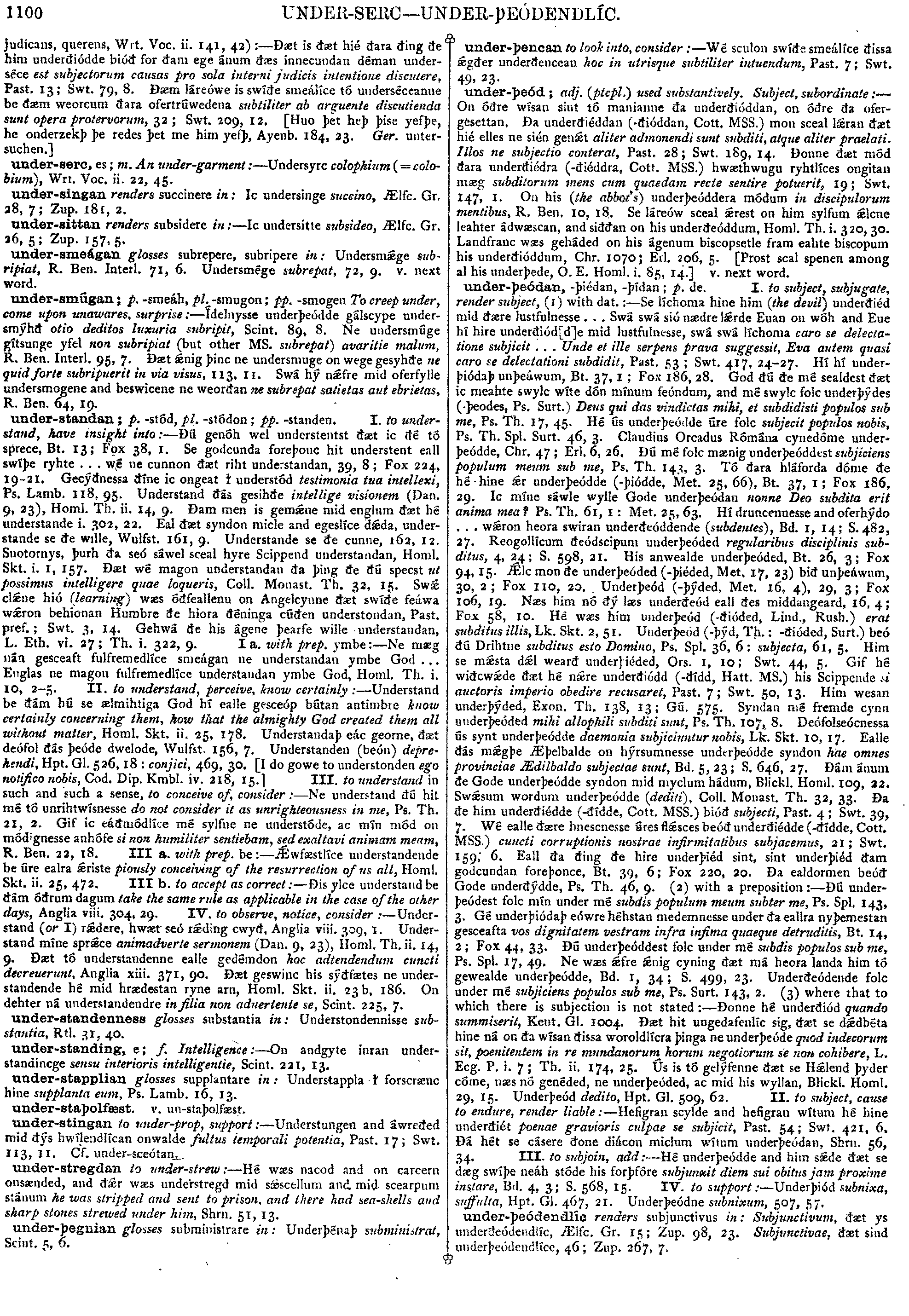
under-þeód;
adj.
(ptcpl.)
used
substantively.
Subject,
subordinate
:--
On
óðre
wísan
sint
tó
manianne
ða
underðióddan,
on
óðre
ða
ofergesettan.
Ða
underðiéddan
(-ðióddan,
Cott.
MSS.)
mon
sceal
lran
ðæt
hié
elles
ne
sién
gent
aliter
admonendi
sunt
subditi,
atque
aliter
praelati.
Illos
ne
subjectio
conterat,
Past.
28;
Swt.
189,
14.
Ðonne
ðæt
mód
ðara
underðiédra
(-ðiéddra,
Cott.
MSS.)
hwæthwugu
ryhtlíces
ongitan
mæg
subditorum
mens
cum
quaedam
recte
sentire
potuerit,
19;
Swt.
147,
1.
On
his
(the
abbot's)
underþeóddera
módum
in
discipulorum
mentibus,
R.
Ben.
10,
18.
Se
láreów
sceal
rest
on
him
sylfum
lcne
leahter
ádwæscan,
and
siððan
on
his
underðeóddum,
Homl.
Th,
i.
320,
30.
Landfranc
wæs
geháded
on
his
ágenum
biscopsetle
fram
eahte
biscopum
his
underðióddum,
Chr.
1070;
Erl.
206,
5.
[Prost
seal
spenen
among
al
his
underþede,
O.
E.
Homl.
i.
85,
14.]
v.
next
word.
|
Source: Bosworth/Toller, page b1229, entry 5 View original page image as: [TIFF] [PNG] [View previous entry] [View next entry] |
[Comment on this entry] [View comments] |
The following entry has been hand-corrected once. |
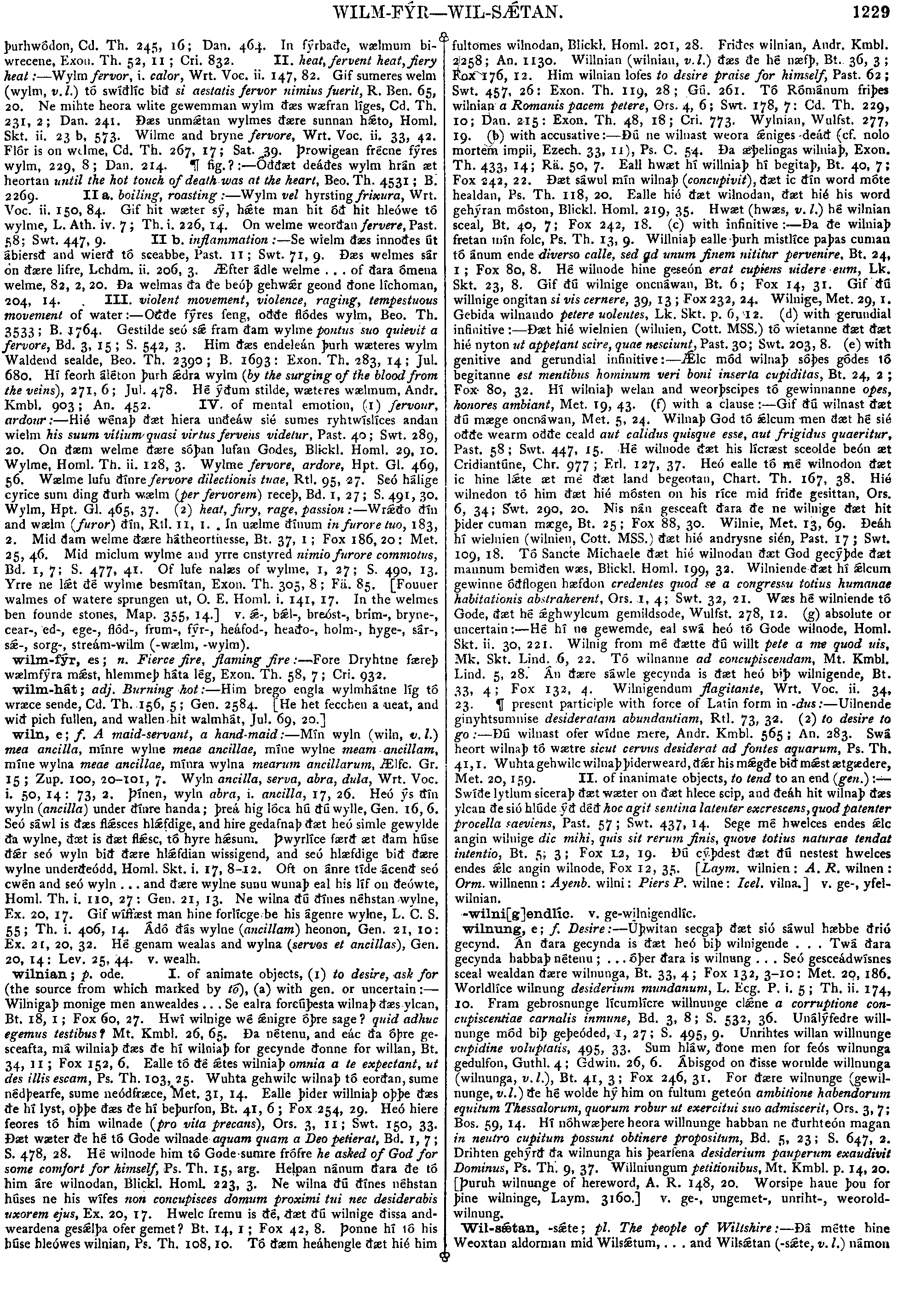
wilnian;
p.
ode.
I.
of
animate
objects,
(I)
to
desire,
ask
for
(the
source
from
which
marked
by
t ),
(a)
with
gen.
or
uncertain
:--
Wilnigaþ
monige
men
anwealdes
.
.
.
Se
ealra
forc
),
(a)
with
gen.
or
uncertain
:--
Wilnigaþ
monige
men
anwealdes
.
.
.
Se
ealra
forc iþesta
wilnaþ
iþesta
wilnaþ
 æs
ylcan,
Bt.
18,
I;
Fox
60,
27.
Hw
æs
ylcan,
Bt.
18,
I;
Fox
60,
27.
Hw wilnige
w
wilnige
w
 nigre
þre
sage?
quid
adhuc
egemus
testibus?
Mt.
Kmbl.
26,
65.
Ða
ntenu,
and
eác
a
þre
ge-sceafta,
m
nigre
þre
sage?
quid
adhuc
egemus
testibus?
Mt.
Kmbl.
26,
65.
Ða
ntenu,
and
eác
a
þre
ge-sceafta,
m wilniaþ
æs
e
h
wilniaþ
for
gecynde
onne
for
willan,
Bt.
34,
II;
Fox
152,
6.
Ealle
t
tes
wilniaþ
omnia
a
te
expectant,
ut
des
illis
escam,
Ps.
Th.
103,
25.
Wuhta
gehwilc
wilnaþ
t
eoran,
sume
ndþearfe,
sume
neódfræce,
Met.
31,
14.
Ealle
þider
willniaþ
oþþe
æs
e
h
lyst,
oþþe
æs
e
h
beþurfon.
Bt.
41,
6
;
Fox
254,
29.
Heó
hiere
feores
t
him
wilnade
(pro
vita
precans),
Ors.
3,
II;
Swt.
150,
33.
Ðæt
wæter
e
h
t
Gode
wilnade
aquam
quam
a
Deo
petierat,
Bd.
I.
7;
S.
478,
28.
H
wilnode
him
t
Gode
sumre
frfre
he
asked
of
God
for
some
comfort
for
himself,
Ps.
Th.
15,
arg.
Helpan
nnum
ara
e
t
him
re
wilnodan.
Blickl.
Homl
223,
3.
Ne
wilna
nes
nhstan
hses
ne
his
wfes
non
concupisces
domum
proximi
tui
nec
desiderabis
uxorem
ejus,
Ex.
20,
17.
Hwelc
fremu
is
e
æt
wilnige
issa
and-weardena
geslþa
ofer
gemet?
Bt.
14,
I;
Fox
42,
8.
Þonne
h
t
his
hso
hleówes
wilnian,
Ps.
Th.
108,
10.
T
æm
heáhengle
æt
hié
him
fultomes
wilnodan.
Blickl.
Homl.
201,
28.
Fries
wilnian,
Andr.
Kmbl.
2258;
An.
1130.
Willnian
(wilnian,
v.
l.)
æs
e
h
næfþ,
Bt.
36,
3
;
Fox
176,
12.
Him
wilnian
lofes
to
desire
praise
for
himself,
Past.
62
;
Swt.
457,
26:
Exon.
Th.
119,
28;
G.
261.
T
Rmnum
friþes
wilnian
a
Romanis
pacem
petere,
Ors.
4,
6;
Swt.
178,
7:
Cd.
Th.
229,
10;
Dan.
215:
Exon.
Th.
48,
18
;
Cri.
773.
Wylnian,
Wulfst.
277,
19.
(b)
with
accusative
:--
Ð
ne
wilnast
weora
niges
-deá
(cf.
nolo
mortem
impii,
Ezech.
33,
II),
Ps.
C.
54.
Ða
æþelingas
wilniaþ,
Exon.
Th.
433,
14;
Rä.
50,
7.
Eall
hwæt
h
willniaþ
h
begitaþ,
Bt.
40,
7;
Fox
242,
22.
Ðæt
swul
mn
wilnaþ
(concupivit),
æt
ic
n
word
mte
healdan,
Ps.
Th.
118,
20.
Ealle
hié
æt
wilnodan,
æt
hié
his
word
geh
wilniaþ
æs
e
h
wilniaþ
for
gecynde
onne
for
willan,
Bt.
34,
II;
Fox
152,
6.
Ealle
t
tes
wilniaþ
omnia
a
te
expectant,
ut
des
illis
escam,
Ps.
Th.
103,
25.
Wuhta
gehwilc
wilnaþ
t
eoran,
sume
ndþearfe,
sume
neódfræce,
Met.
31,
14.
Ealle
þider
willniaþ
oþþe
æs
e
h
lyst,
oþþe
æs
e
h
beþurfon.
Bt.
41,
6
;
Fox
254,
29.
Heó
hiere
feores
t
him
wilnade
(pro
vita
precans),
Ors.
3,
II;
Swt.
150,
33.
Ðæt
wæter
e
h
t
Gode
wilnade
aquam
quam
a
Deo
petierat,
Bd.
I.
7;
S.
478,
28.
H
wilnode
him
t
Gode
sumre
frfre
he
asked
of
God
for
some
comfort
for
himself,
Ps.
Th.
15,
arg.
Helpan
nnum
ara
e
t
him
re
wilnodan.
Blickl.
Homl
223,
3.
Ne
wilna
nes
nhstan
hses
ne
his
wfes
non
concupisces
domum
proximi
tui
nec
desiderabis
uxorem
ejus,
Ex.
20,
17.
Hwelc
fremu
is
e
æt
wilnige
issa
and-weardena
geslþa
ofer
gemet?
Bt.
14,
I;
Fox
42,
8.
Þonne
h
t
his
hso
hleówes
wilnian,
Ps.
Th.
108,
10.
T
æm
heáhengle
æt
hié
him
fultomes
wilnodan.
Blickl.
Homl.
201,
28.
Fries
wilnian,
Andr.
Kmbl.
2258;
An.
1130.
Willnian
(wilnian,
v.
l.)
æs
e
h
næfþ,
Bt.
36,
3
;
Fox
176,
12.
Him
wilnian
lofes
to
desire
praise
for
himself,
Past.
62
;
Swt.
457,
26:
Exon.
Th.
119,
28;
G.
261.
T
Rmnum
friþes
wilnian
a
Romanis
pacem
petere,
Ors.
4,
6;
Swt.
178,
7:
Cd.
Th.
229,
10;
Dan.
215:
Exon.
Th.
48,
18
;
Cri.
773.
Wylnian,
Wulfst.
277,
19.
(b)
with
accusative
:--
Ð
ne
wilnast
weora
niges
-deá
(cf.
nolo
mortem
impii,
Ezech.
33,
II),
Ps.
C.
54.
Ða
æþelingas
wilniaþ,
Exon.
Th.
433,
14;
Rä.
50,
7.
Eall
hwæt
h
willniaþ
h
begitaþ,
Bt.
40,
7;
Fox
242,
22.
Ðæt
swul
mn
wilnaþ
(concupivit),
æt
ic
n
word
mte
healdan,
Ps.
Th.
118,
20.
Ealle
hié
æt
wilnodan,
æt
hié
his
word
geh ran
mston,
Blickl.
Homl.
219,
35.
Hwæt
(hwæs,
v.
l.)
h
wilnian
sceal,
Bt.
40,
7;
Fox
242,
18.
(c)
with
infinitive
:--
Ða
e
wilniaþ
fretan
mn
folc,
Ps.
Th.
13,
9.
Willniaþ
raple
þurh
mistlce
paþas
cuman
t
num
ende
diverso
calle,
sed
UNCERTAINd
unum
finem
nititur
pervenire.
Bt.
24,
I
;
Fox
80,
8.
H
wilnode
hine
geseón
erat
cupiens
uidere
eum,
Lk.
Skt.
23,
8.
Gif
wilnige
oncnwan,
Bt.
6;
Fox
14,
31.
Gif
willnige
ongitan
si
vis
cernere,
39,
13
;
Fox
232,
24.
Wilnige,
Met.
29,
I.
Gebida
wilnando
petere
uolentes.
Lk.
Skt.
p.
6.
12.
(d)
with
geniudial
infinitive
:--
Ðæt
hié
wielnien
(wilnien,
Cott.
MSS.)
t
wietanne
æt
æt
hié
nyton
ut
appetant
scire,
quae
nesciunt,
Past.
30;
Swt.
203,
8.
(e)
with
genitive
and
gerundial
infinitive
:--
Æ-long;lc
md
wilnaþ
sþes
gdes
t
begitanne
est
mentibus
hominum
veri
boni
inserta
cupiditas,
Bt.
24,
2
;
Fox
80,
32.
H
wilniaþ
welan
and
weorþscipes
t
gewinnanne
opes,
honores
ambiant,
Met.
19,
43.
(f)
with
a
clause
:--
Gif
wilnast
æt
mæge
oncnáwan,
Met.
5,
24.
Wilnaþ
God
t
lcum
men
æt
h
sié
oe
wearm
oe
ceald
aut
calidus
quisque
esse,
aut
frigidus
quaeritur,
Past.
58;
Swt.
447,
15.
H
wilnode
æt
his
lcræst
sceolde
beón
æt
Cridiantne,
Chr.
977
;
Erl.
127,
37.
Heó
ealle
t
m
wilnodon
æt
ic
hine
lte
æt
m
æt
land
begeotan.
Chart.
Th.
167,
38.
Hié
wilnedon
t
him
æt
hié
msten
on
his
rce
mid
frie
gesittan,
Ors.
6,
34;
Swt.
290,
20.
Nis
nn
gesceaft
ara
e
ne
wilnige
æt
hit
þider
cuman
maUNCERTAINge,
Bt.
25
;
Fox
88,
30.
Wilnie,
Met.
13,
69.
Ðeáh
h
wielnien
(wilnien,
Cott.
MSS.)
æt
hié
andrysne
sién,
Past.
17;
Swt.
109,
18.
T
Sancte
Michaele
æt
hi
wilnodan
æt
God
gecþde
æt
mannum
bemien
wæs,
Blickl.
Homl.
199,
32.
Wilniende
æt
h
lcum
gewinne
flogen
hæfdon
credentes
quod
se
a
congressu
totius
humanae
habitationis
abstraherent,
Ors.
1,
4;
Swt.
32,
21.
Wæs
h
wilniende
t
Gode,
æt
h
ghwylcum
gemildsode,
Wulfst.
278,
12.
(g)
absolute
or
uncertain
:--
H
h
ne
gewemde,
eal
sw
heó
t
Gode
wilnode,
Homl.
Skt.
ii.
30,
221.
Wilnig
from
m
ætte
willt
pete
a
me
quod
uis,
Mk.
Skt.
Lind.
6,
22.
T
wilnanne
ad
concupiscendam,
Mt.
Kmbl.
Lind.
5,
28.
&A-long;n
ære
swle
gecynda
is
æt
heó
biþ
wilnigende,
Bt.
33,
4;
Fox
132,
4.
Wilnigendum
flagitante,
Wrt.
Voc.
ii.
34,
23.

present
participle
with
force
of
Latin
form
in
-dus
:--
Uilnende
ginyhtsumnise
desideratum
abundantiam,
Rtl.
73,
3.
2.
(2)
to
desire
to
go
:--
Ð
wilnast
ofer
wdne
mere,
Andr.
Kmbl.
565
;
An.
283.
Sw
heort
wilnaþ
t
wætre
sicut
cervus
desiderat
ad
fontes
aquarum,
Ps.
Th.
41,
1.
Wuhta
gehwilc
wilnaþþiderweard,
r
his
mge
bi
mst
ætgædere,
Met.
20,
159.
II.
of
inanimate
objects,
to
tend
to
an
end
(gen.)
:--
Swe
lytlum
siceraþ
æt
wæter
on
æt
hlece
scip,
and
eáh
hit
wilnaþ
æs
ylcan
e
sió
hlde
d
hoc
agit
sentina
latenter
excrescens,
quod
patenter
procella
saeviens,
Past.
57;
Swt.
437,
14.
Sege
m
hwelces
endes
lc
angin
wilnige
die
mihi,
quis
sit
rerum
finis,
quove
totius
naturae
tendat
intentio,
Bt.
5;
3
;
Fox
12,
19.
Ð
c.
þdest
æt
nestest
hwelces
endes
lc
angin
wilnode,
Fox
12,
35.
[Laym,
wilnien
:
A.
R.
wilnen
:
Orm.
willnenn:
Ayenb.
wilni:
Piers
P.
wilne:
Icel.
vilna.]
v.
ge-,
yfel-wilnian.
ran
mston,
Blickl.
Homl.
219,
35.
Hwæt
(hwæs,
v.
l.)
h
wilnian
sceal,
Bt.
40,
7;
Fox
242,
18.
(c)
with
infinitive
:--
Ða
e
wilniaþ
fretan
mn
folc,
Ps.
Th.
13,
9.
Willniaþ
raple
þurh
mistlce
paþas
cuman
t
num
ende
diverso
calle,
sed
UNCERTAINd
unum
finem
nititur
pervenire.
Bt.
24,
I
;
Fox
80,
8.
H
wilnode
hine
geseón
erat
cupiens
uidere
eum,
Lk.
Skt.
23,
8.
Gif
wilnige
oncnwan,
Bt.
6;
Fox
14,
31.
Gif
willnige
ongitan
si
vis
cernere,
39,
13
;
Fox
232,
24.
Wilnige,
Met.
29,
I.
Gebida
wilnando
petere
uolentes.
Lk.
Skt.
p.
6.
12.
(d)
with
geniudial
infinitive
:--
Ðæt
hié
wielnien
(wilnien,
Cott.
MSS.)
t
wietanne
æt
æt
hié
nyton
ut
appetant
scire,
quae
nesciunt,
Past.
30;
Swt.
203,
8.
(e)
with
genitive
and
gerundial
infinitive
:--
Æ-long;lc
md
wilnaþ
sþes
gdes
t
begitanne
est
mentibus
hominum
veri
boni
inserta
cupiditas,
Bt.
24,
2
;
Fox
80,
32.
H
wilniaþ
welan
and
weorþscipes
t
gewinnanne
opes,
honores
ambiant,
Met.
19,
43.
(f)
with
a
clause
:--
Gif
wilnast
æt
mæge
oncnáwan,
Met.
5,
24.
Wilnaþ
God
t
lcum
men
æt
h
sié
oe
wearm
oe
ceald
aut
calidus
quisque
esse,
aut
frigidus
quaeritur,
Past.
58;
Swt.
447,
15.
H
wilnode
æt
his
lcræst
sceolde
beón
æt
Cridiantne,
Chr.
977
;
Erl.
127,
37.
Heó
ealle
t
m
wilnodon
æt
ic
hine
lte
æt
m
æt
land
begeotan.
Chart.
Th.
167,
38.
Hié
wilnedon
t
him
æt
hié
msten
on
his
rce
mid
frie
gesittan,
Ors.
6,
34;
Swt.
290,
20.
Nis
nn
gesceaft
ara
e
ne
wilnige
æt
hit
þider
cuman
maUNCERTAINge,
Bt.
25
;
Fox
88,
30.
Wilnie,
Met.
13,
69.
Ðeáh
h
wielnien
(wilnien,
Cott.
MSS.)
æt
hié
andrysne
sién,
Past.
17;
Swt.
109,
18.
T
Sancte
Michaele
æt
hi
wilnodan
æt
God
gecþde
æt
mannum
bemien
wæs,
Blickl.
Homl.
199,
32.
Wilniende
æt
h
lcum
gewinne
flogen
hæfdon
credentes
quod
se
a
congressu
totius
humanae
habitationis
abstraherent,
Ors.
1,
4;
Swt.
32,
21.
Wæs
h
wilniende
t
Gode,
æt
h
ghwylcum
gemildsode,
Wulfst.
278,
12.
(g)
absolute
or
uncertain
:--
H
h
ne
gewemde,
eal
sw
heó
t
Gode
wilnode,
Homl.
Skt.
ii.
30,
221.
Wilnig
from
m
ætte
willt
pete
a
me
quod
uis,
Mk.
Skt.
Lind.
6,
22.
T
wilnanne
ad
concupiscendam,
Mt.
Kmbl.
Lind.
5,
28.
&A-long;n
ære
swle
gecynda
is
æt
heó
biþ
wilnigende,
Bt.
33,
4;
Fox
132,
4.
Wilnigendum
flagitante,
Wrt.
Voc.
ii.
34,
23.

present
participle
with
force
of
Latin
form
in
-dus
:--
Uilnende
ginyhtsumnise
desideratum
abundantiam,
Rtl.
73,
3.
2.
(2)
to
desire
to
go
:--
Ð
wilnast
ofer
wdne
mere,
Andr.
Kmbl.
565
;
An.
283.
Sw
heort
wilnaþ
t
wætre
sicut
cervus
desiderat
ad
fontes
aquarum,
Ps.
Th.
41,
1.
Wuhta
gehwilc
wilnaþþiderweard,
r
his
mge
bi
mst
ætgædere,
Met.
20,
159.
II.
of
inanimate
objects,
to
tend
to
an
end
(gen.)
:--
Swe
lytlum
siceraþ
æt
wæter
on
æt
hlece
scip,
and
eáh
hit
wilnaþ
æs
ylcan
e
sió
hlde
d
hoc
agit
sentina
latenter
excrescens,
quod
patenter
procella
saeviens,
Past.
57;
Swt.
437,
14.
Sege
m
hwelces
endes
lc
angin
wilnige
die
mihi,
quis
sit
rerum
finis,
quove
totius
naturae
tendat
intentio,
Bt.
5;
3
;
Fox
12,
19.
Ð
c.
þdest
æt
nestest
hwelces
endes
lc
angin
wilnode,
Fox
12,
35.
[Laym,
wilnien
:
A.
R.
wilnen
:
Orm.
willnenn:
Ayenb.
wilni:
Piers
P.
wilne:
Icel.
vilna.]
v.
ge-,
yfel-wilnian.
|
Source: Bosworth/Toller, page d0003, entry 10 View original page image as: [TIFF] [PNG] [View previous entry] [View next entry] |
[Comment on this entry] [View comments] |
The following entry has been hand-corrected once. |
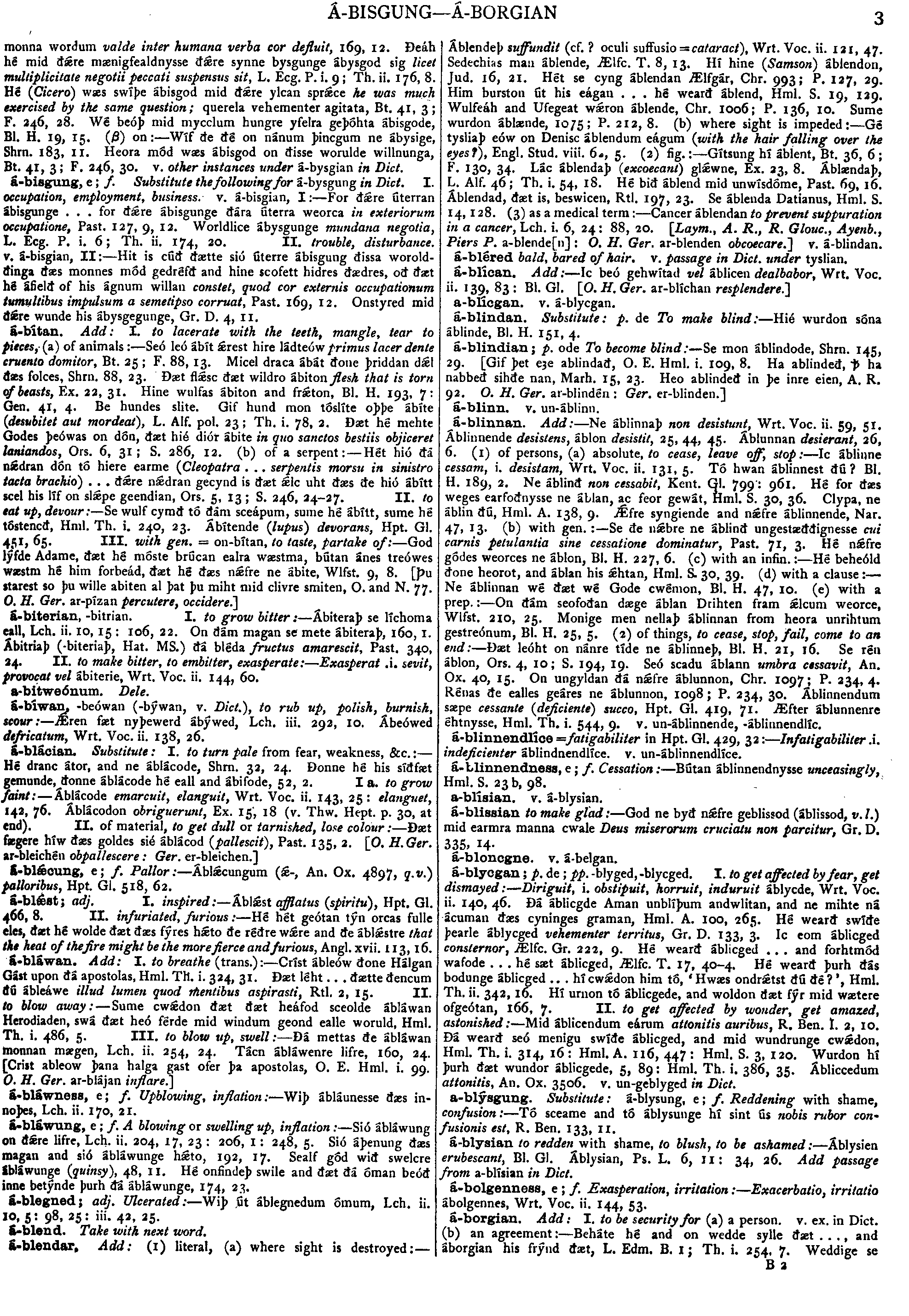
á-bláwan.
Add:
I.
to
breathe
(trans.)
:--
Críst
ábleów
ðone
Hálgan
Gást
upon
ðá
apostolas,
Hml.
Th.
i.
324,
31.
Ðæt
léht.
.
.
ðætte
ðencum
ðú
ábleáwe
illud
lumen
quod
mentibus
aspirasti,
Rtl.
2,
15.
II.
to
blow
away
:--
Sume
cwdon
ðæt
ðæt
heáfod
sceolde
ábláwan
Herodiaden,
swá
ðæt
heó
férde
mid
windum
geond
ealle
woruld,
Hml.
Th.
i.
486,
5.
III.
to
blow
up,
swell
:--
Ðá
mettas
ðe
ábláwan
monnan
mægen,
Lch.
ii.
254,
24.
Tácn
ábláwenre
lifre,
160,
24.
[Crist
ableow
þana
halga
gast
ofer
þa
apostolas,
O.
E.
Hml.
i.
99.
O.
H.
Ger.
ar-blájan
inflare.]
|
Source: Bosworth/Toller, page d0005, entry 30 View original page image as: [TIFF] [PNG] [View previous entry] [View next entry] |
[Comment on this entry] [View comments] |
The following entry has been hand-corrected once. |
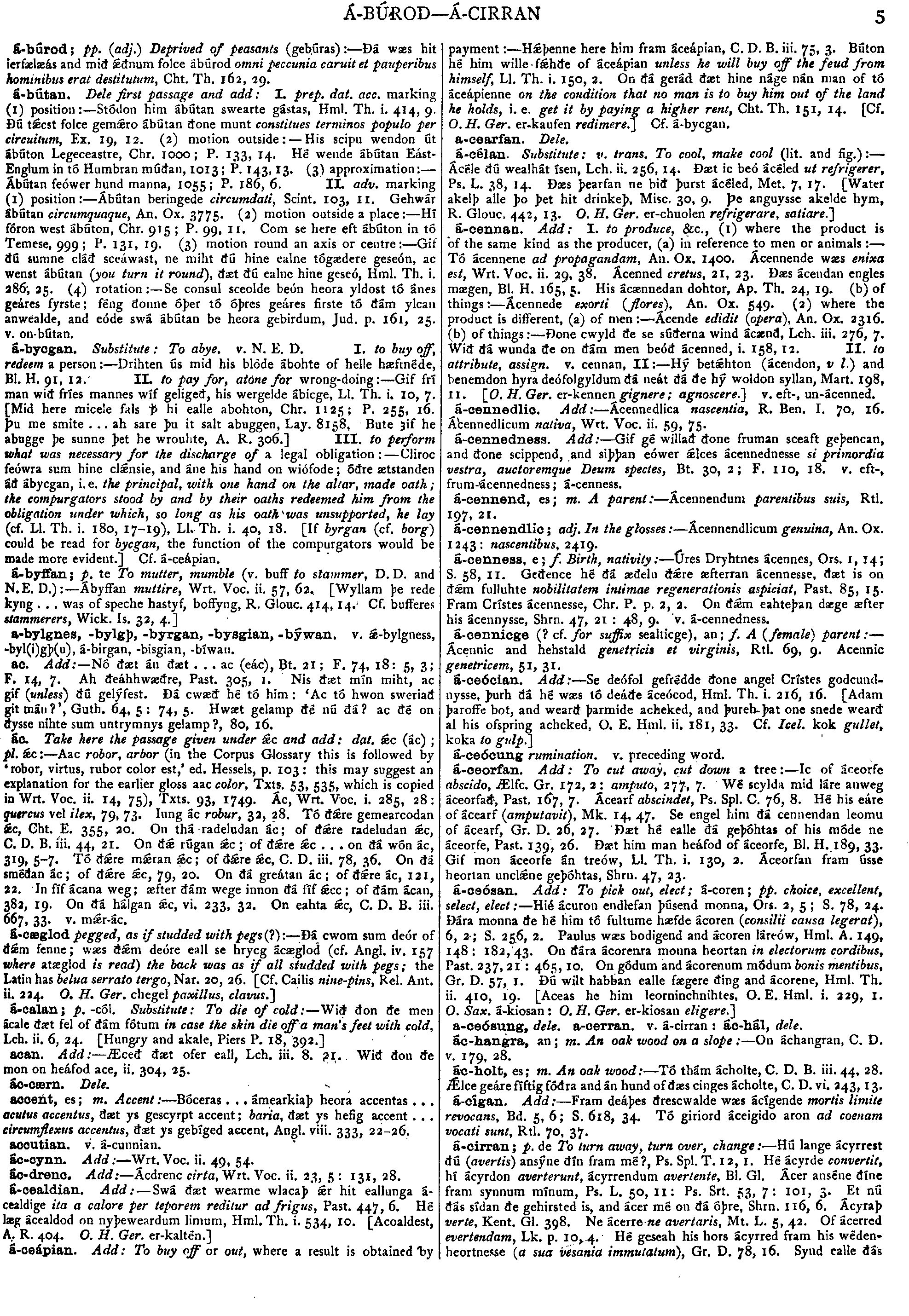
á-ceósan.
Add:
To
pick
out,
elect;
á-coren;
pp.
choice,
excellent,
select,
elect
:--
Hié
ácuron
endlefan
þúsend
monna,
Ors.
2,
5;
S.
78,
24.
Ðára
monna
ðe
hé
him
tó
fultume
hæfde
ácoren
(consilii
causa
legerat),
6.
2;
S.
256,
2.
Paulus
wæs
bodigend
and
coren
láreów,
Hml.
A.
149,
148
:
182,
43.
On
ðára
ácorenra
monna
heortan
in
electorum
cordibus,
Past.
237,
21
:
465,
10.
On
gódum
and
ácorenum
módum
bonis
mentibus,
Gr.
D.
57,
1.
Ðú
wilt
habban
ealle
fægere
ðing
and
ácorene,
Hml.
Th.
ii.
410,
19.
[Aceas
he
him
leorninchnihtes,
O.
E.
Hml.
i.
229,
1.
O.
Sax.
á-kiosan
:
O.
H.
Ger.
er-kiosan
eligere.]
|
Source: Bosworth/Toller, page d0087, entry 2 View original page image as: [TIFF] [PNG] [View previous entry] [View next entry] |
[Comment on this entry] [View comments] |
The following entry has been hand-corrected once. |
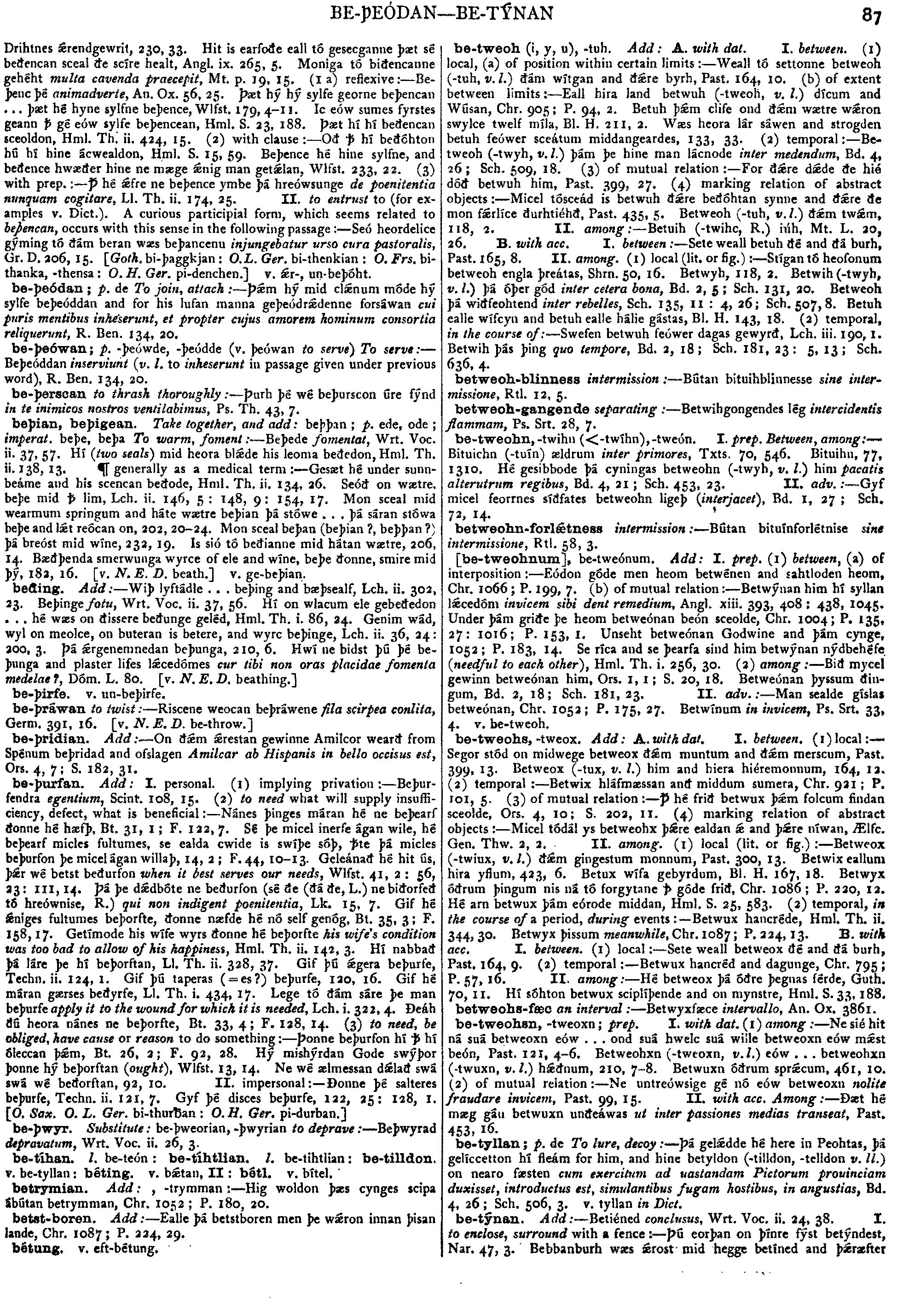
be-þeódan
;
p.
de
To
join,
attach
:--
]þm
hý
mid
clnum
móde
hý
sylfe
beþeóddan
and
for
his
lufan
manna
geþeódrdenne
forsáwan
cui
puris
mentibus
inherserunt,
et
propter
cujus
amorem
hominum
consortia
reliquerunt,
R.
Ben.
134,
20.
|
Source: Bosworth/Toller, page d0147, entry 18 View original page image as: [TIFF] [PNG] [View previous entry] [View next entry] |
[Comment on this entry] [View comments] |
The following entry has been hand-corrected once. |
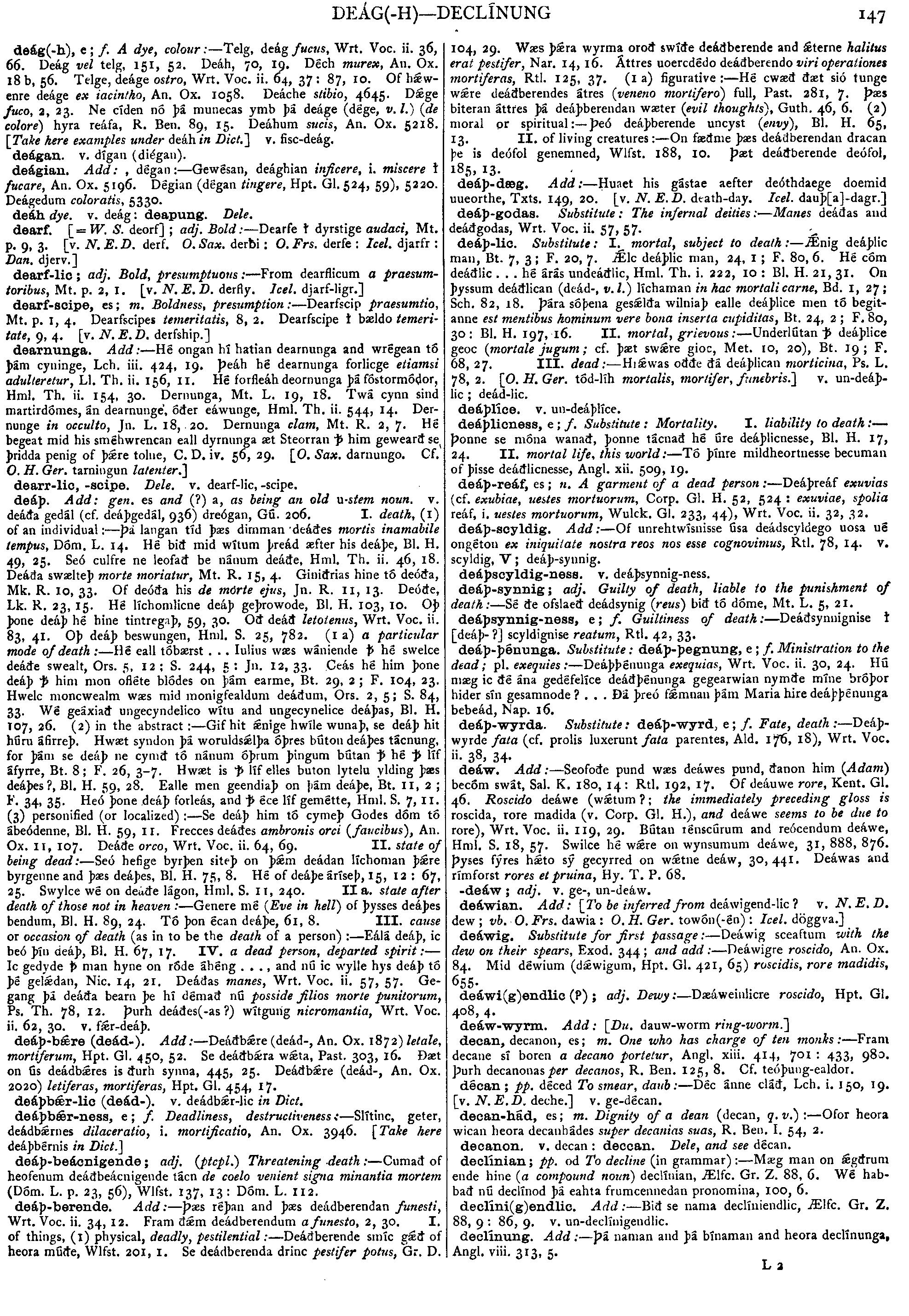
deáþ-lic.
Substitute:
I.
mortal,
subject
to
death:--Æ-acute;nig
deáþlic
man,
Bt.
7,
3;
F.
20,
7.
Æ-acute;lc
deáþlic
man,
24,
1;
F.
80,
6.
Hé
cóm
deáðlic
.
.
.
hé
árás
undeáðlic,
Hml.
Th.
i.
222,
10:
Bl.
H.
21,
31.
On
þyssum
deáðlican
(deád-,
v.
l.)
líchaman
in
hac
mortali
carne,
Bd.
1,
27;
Sch.
82,
18.
Þára
sóþena
geslða
wilniaþ
ealle
deáþlice
men
tó
begitanne
est
mentibus
hominum
vere
bona
inserta
cupiditas,
Bt.
24,
2;
F.
80,
30:
Bl.
H.
197,
16.
II.
mortal,
grievous:--Underlútan
 deáþlice
geoc
(mortale
jugunt;
cf.
þæt
swre
gioc,
Met.
10,
20),
Bt.
19;
F.
68,
27.
III.
dead:--Hrwas
oððe
ðá
deáþlican
morticina,
Ps.
L.
78,
2.
[O.
H.
Ger.
tód-líh
mortalis,
mortifer,
funebris.]
v.
un-deáþ-lic;
deád-lic.
deáþlice
geoc
(mortale
jugunt;
cf.
þæt
swre
gioc,
Met.
10,
20),
Bt.
19;
F.
68,
27.
III.
dead:--Hrwas
oððe
ðá
deáþlican
morticina,
Ps.
L.
78,
2.
[O.
H.
Ger.
tód-líh
mortalis,
mortifer,
funebris.]
v.
un-deáþ-lic;
deád-lic.
|
Source: Bosworth/Toller, page d0169, entry 15 View original page image as: [TIFF] [PNG] [View previous entry] [View next entry] |
[Comment on this entry] [View comments] |
The following entry has been hand-corrected once. |
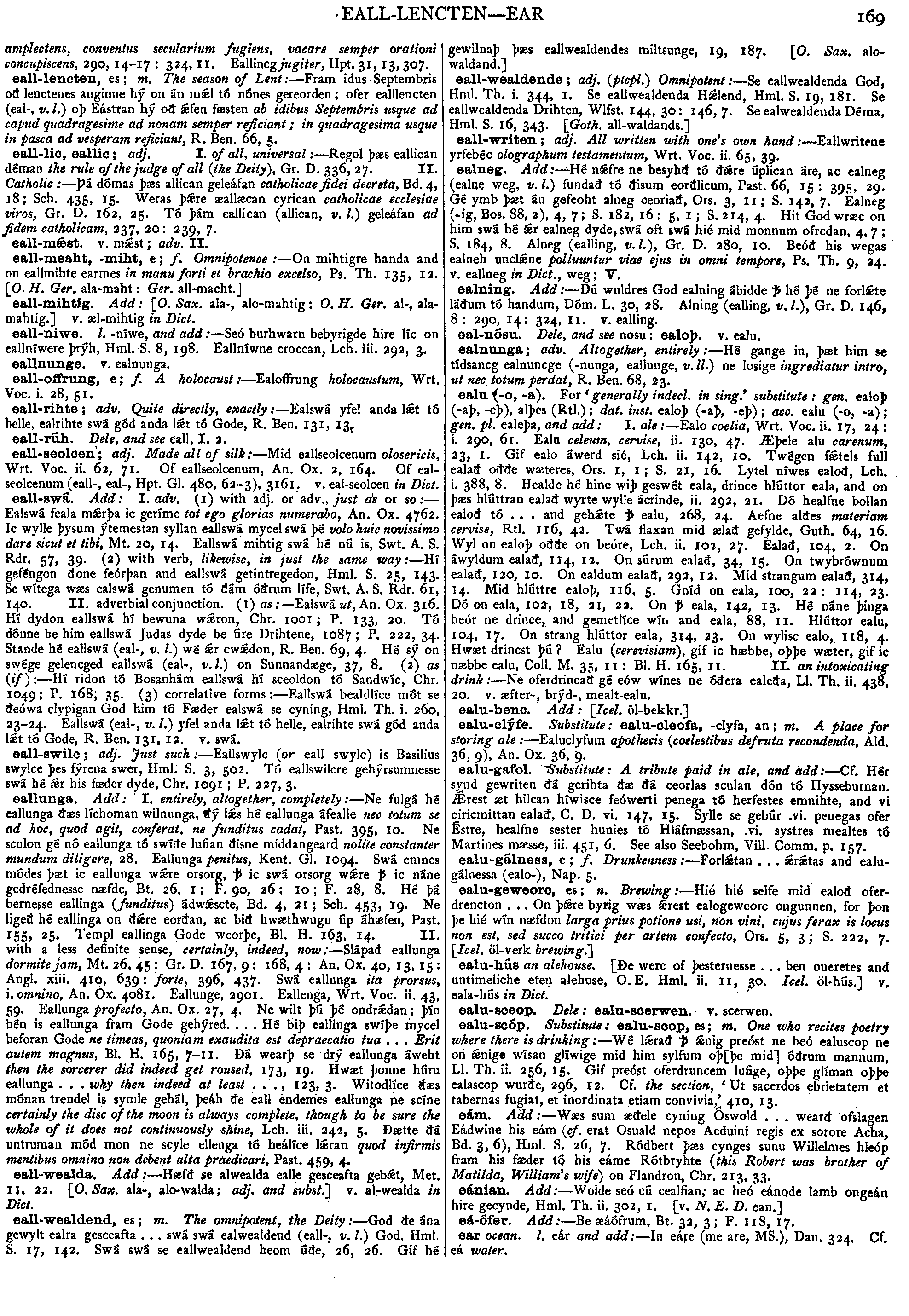
eallunga.
Add:
I.
entirely,
altogether,
completely:--Ne
fulgá
hé
eallunga
ðæs
líchoman
wilnunga,
ðý
ls
hé
eallunga
áfealle
nec
totum
se
ad
hoc,
quod
agit,
conferat,
ne
funditus
cadat,
Past.
395,
10.
Ne
sculon
gé
nó
eallunga
tó
swíðe
lufian
ðisne
middangeard
nolite
constanter
mundum
diligere,
28.
Eallunga
penitus,
Kent.
Gl.
1094.
Swá
emnes
módes
þæt
ic
eallunga
wre
orsorg,
ic
swá
orsorg
wre
ic
náne
gedréfednesse
næfde,
Bt.
26,
1;
F.
90,
26:
10;
F.
28,
8.
Hé
þá
bernesse
eallinga
(funditus)
ádwscte,
Bd.
4,
21;
Sch.
453,
19.
Ne
ligeð
hé
eallinga
on
ðre
eorðan,
ac
bið
hwæthwugu
úp
áhæfen,
Past.
155,
2S.
Templ
eallinga
Gode
weorþe,
Bl.
H.
163,
14.
II.
with
a
less
definite
sense,
certainly,
indeed,
now:--Slápað
eallunga
dormite
jam,
Mt.
26,
45:
Gr.
D.
167,
9:
168,
4:
An.
Ox.
40,
13,
15:
Angl.
xiii.
410,
639:
forte,
396,
437.
Swá
eallunga
ita
prorsus,
i.
omnino,
An.
Ox.
4081.
Eallunge,
2901.
Eallenga,
Wrt.
Voc.
ii.
43,
59.
Eallunga
profecto,
An.
Ox.
27,
4.
Ne
wilt
þú
þé
ondrdan;
þín
bén
is
eallunga
fram
Gode
gehýred.
.
.
.
Hé
biþ
eallinga
swíþe
mycel
beforan
Gode
ne
timeas,
quoniam
exaudita
est
depraecatio
tua
.
.
.
Erit
autem
magnus,
Bl.
H.
165,
7-11.
Ðá
wearþ
se
drý
eallunga
áweht
then
the
sorcerer
did
indeed
get
roused,
173,
19.
Hwæt
þonne
húru
eallunga
.
.
.
why
then
indeed
at
least
.
.
.,
123,
3.
Witodlíce
ðæs
mónan
trendel
is
symle
gehál,
þeáh
ðe
eall
endemes
eallunga
ne
scíne
certainly
the
disc
of
the
moon
is
always
complete,
though
to
be
sure
the
whole
of
it
does
not
continuously
shine,
Lch.
iii.
242,
5.
Ðætte
ðá
untruman
mód
mon
ne
scyle
ellenga
tó
heálíce
lran
quod
infirmis
mentibus
omnino
nan
debent
alta
praedicari,
Past.
459,
4.
|
Source: Bosworth/Toller, page d0195, entry 1 View original page image as: [TIFF] [PNG] [View previous entry] [View next entry] |
[Comment on this entry] [View comments] |
The following entry has been hand-corrected once. |
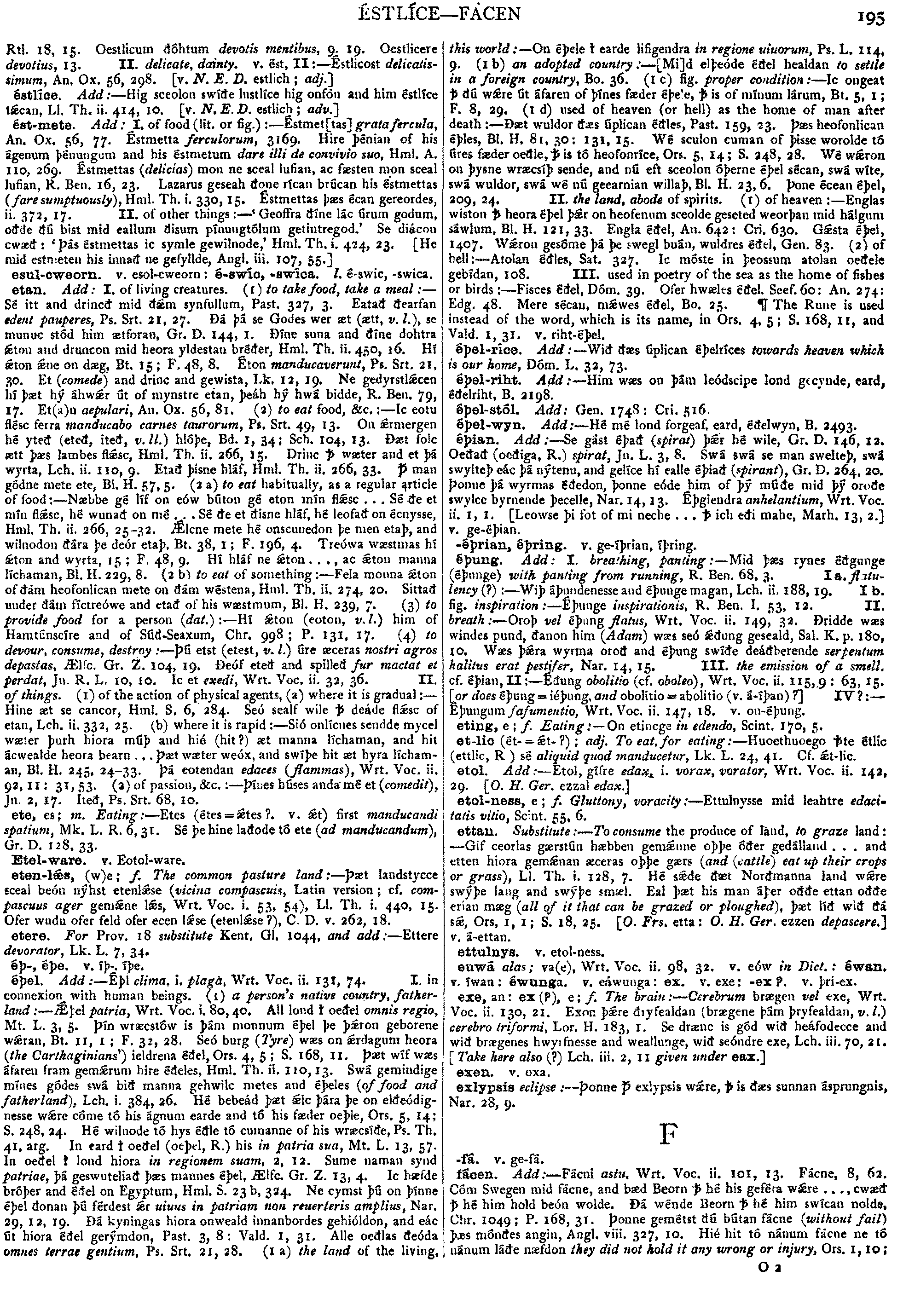
Rtl. 18, 15. Oestlicum ðóhtum devotis mentibus, 9. 19. Oestlicere devotius, 13. II. delicate, dainty. v. ést, II :-- Éstlicost delicatissimum, An. Ox. 56, 298. [v. N. E. D. estlich ; adj.]
|
Source: Bosworth/Toller, page d0386, entry 25 View original page image as: [TIFF] [PNG] [View previous entry] [View next entry] |
[Comment on this entry] [View comments] |
The following entry has been hand-corrected once. |
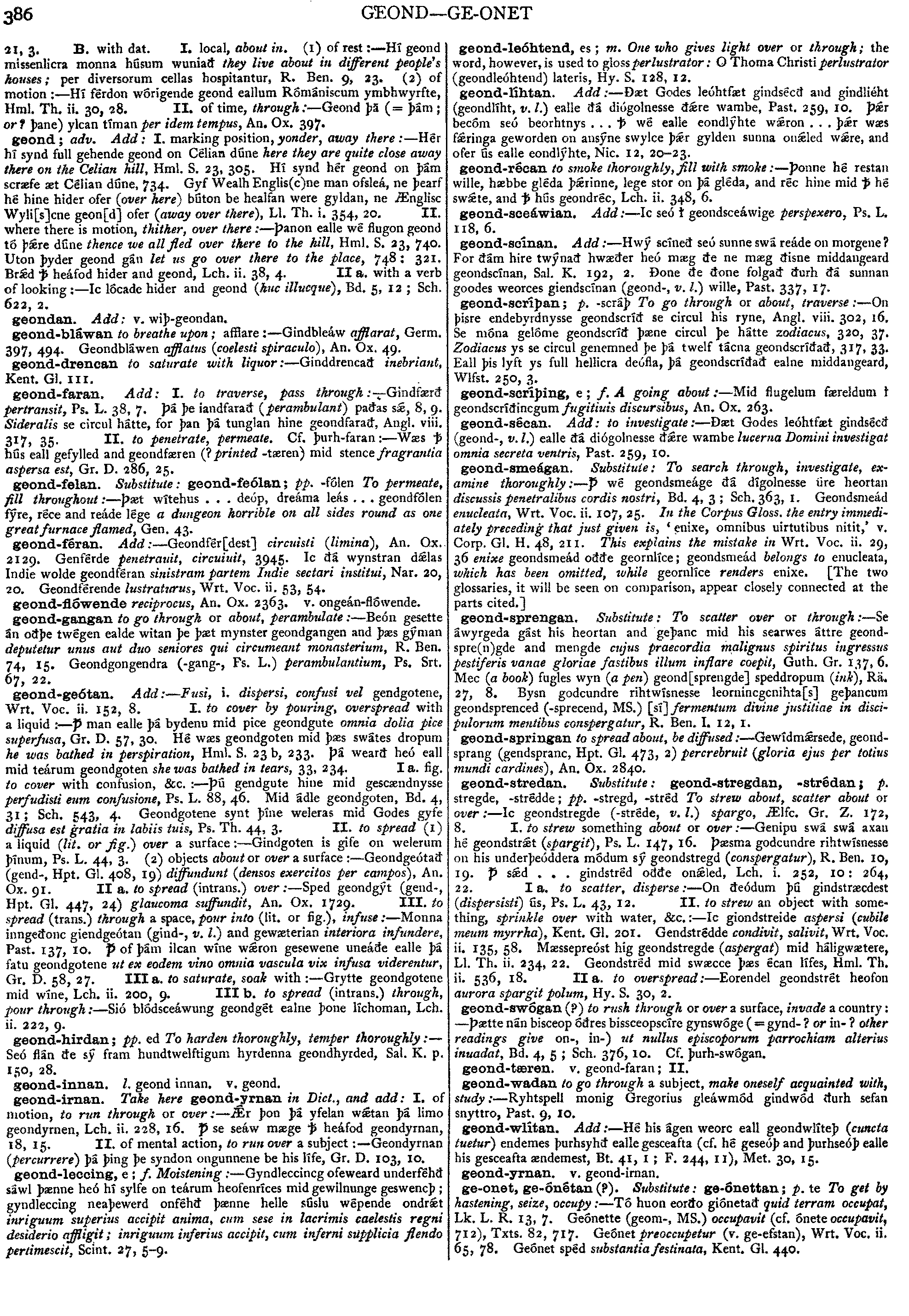
geond-sprengan. Substitute: To scatter over or through:--Se áwyrgeda gást his heortan and geþanc mid his searwes áttre geondspre(n)gde and mengde cujus praecordia malignus spiritus ingressus pestiferis vanae gloriae fastibus illum inflare coepit, Guth. Gr. 137, 6. Mec (a book) fugles wyn (a pen) geond[sprengde] speddropum (ink), Rä. 27, 8. Bysn godcundre rihtwísnesse leornincgcnihta[s] geþancum geondsprenced (-sprecend, MS.) [sí] fermentum divine justitiae in discipulorum mentibus conspergatur, R. Ben. I. 12, 1.
| Result Page: | 1 2 | Next |  |
Germanic Lexicon Project (main page)
This search system was written by
Sean Crist
Please consider
volunteering
to correct the data in these online dictionaries.
No rights reserved. Feel free to use these data in any way you please.