|
|

|
Source: Bosworth/Toller, page b0976, entry 25 View original page image as: [TIFF] [PNG] [View previous entry] [View next entry] |
[Comment on this entry] [View comments (1)] |
The following entry has been hand-corrected once. |
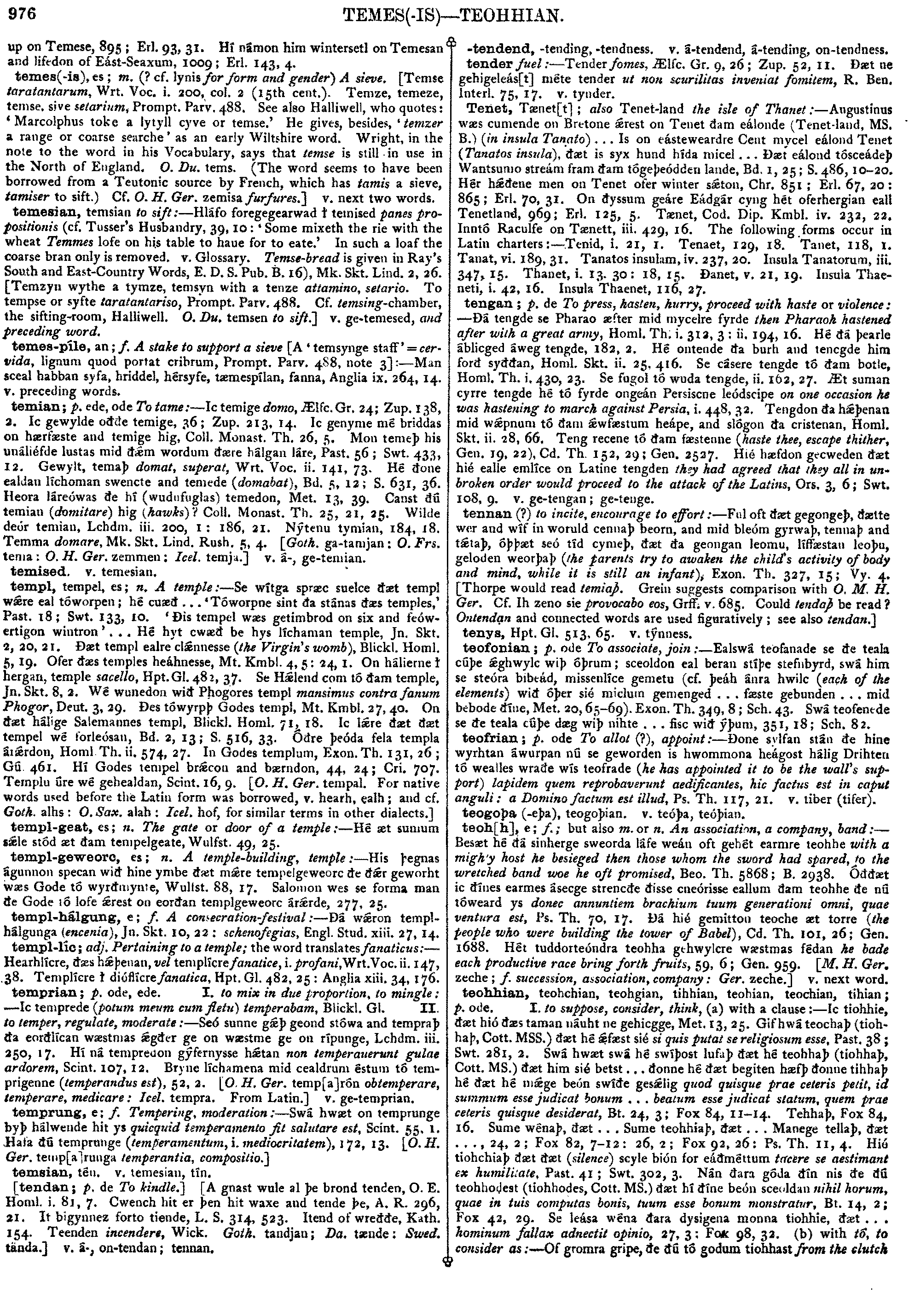
teohhian,
teohchian,
teohgian,
tihhian,
teohian,
teochian,
tihian;
p.
ode.
I.
to
suppose,
consider,
think,
(a)
with
a
clause
:--
Ic
tiohhie,
ðæt
hió
ðæs
taman
náuht
ne
gehicgge,
Met.
13,
25.
Gif
hwá
teochaþ
(tiohhaþ,
Cott.
MSS.)
ðæt
hé
 fæst
sié
si
quis
putat
se
religiosum
esse,
Past.
38;
Swt.
281,
2.
Swá
hwæt
swá
hé
swíþost
lufaþ
ðæt
hé
teohhaþ
(tiohhaþ,
Cott.
MS.)
ðæt
him
sié
betst
...
ðonne
hé
ðæt
begiten
hæfþ
ðonne
tihhaþ
hé
ðæt
hé
mge
beón
swíðe
geslig
quod
quisque
prae
ceteris
petit,
id
summum
esse
judicat
bonum
...
beatum
esse
judicat
statum,
quem
prae
ceteris
quisque
desiderat,
Bt.
24,
3;
Fox
84,
11-14.
Tehhaþ,
Fox
84,
16.
Sunte
wénaþ,
ðæt
...
Sume
teohhiaþ,
ðæt
...
Manege
tellaþ,
ðæt...,
24,
2;
Fox
82,
7-12:
26,
2;
Fox
92,
26:
Ps.
Th.
11,
4.
Hié
tiohchiaþ
ðæt
ðæt
(silence)
scyle
bión
for
eáðméttum
tacere
se
aestimant
ex
humilitate,
Past.
41;
Swt.
302,
3.
Nán
ðara
góda
ðín
nis
ðe
ðú
teohhodest
(tiohhodes,
Cott.
MS.)
ðæt
hí
ðíne
beón
sceoldan
nihil
horum,
quae
in
tuis
computas
bonis,
tuum
esse
bonum
monstratur,
Bt.
14,
2;
Fox
42,
29.
Se
leása
wéna
ðara
dysigena
manna
tiohhie,
ðæt
...
hominum
fallax
adnectit
opinio,
27,
3;
Fox.
98,
32.
(b)
with
tó,
to
consider
as
:--
Of
gromra
gripe,
ðe
ðú
tó
godum
tiohhast
from
the
clutch
of
cruel
ones,
whom
thou
countest
as
gods,
Exon.
Th.
255,
17;
Jul.
215.
Æ-acute;lc
mon
tiohhaþ
him
ðæt
tó
sélestum
goode
ðæt
ðæt
hé
swíþost
lufaþ
every
man
considers
that
as
his
best
good,
which
he
most
loves,
Bt.
33,
2;
Fox
122,
23.
Hí
teohhiaþ
út
him
tó
sndincgsceápum
aestimati
sumus
ut
oves
occisionis,
Ps.
Th.
43,
23.
Ðam
wísan
men
com
tó
lofe
and
tó
wyrðscipe
ðæt
se
unrihtwísa
cyning
him
teohhode
tó
wíte
cruciatus,
quos
putabat
tyrannus
materiam
crudelitatis,
vir
sapiens
fecit
esse
virtutis,
Bt.
16,
2;
Fox
52,
27.
Gif
hé
hit
ne
tiohchode
eall
tó
anum
si
utraque
unum
esse
non
decerneret,
Past,
49;
Swt.
385,
34.
(c)
in
other
ways
:--
Teohgaþ
decreverit,
cogitaverit,
Hpt.
Gl.
412,
48.
Ne
biþ
hé
swá
brád
swá
hé
teohhaþ
(tihhaþ,
Cott.
MS.),
Bt.
30,
1;
Fox
108,
12.
II.
to
purpose,
determine,
intend,
appoint,
(a)
with
an
accusative
:--
Man
ús
tyhhaþ
twegen
eardas
two
dwellings
are
intended
for
us,
Hy.
7,
97.
Oft
ic
leán
teohhode
hnáhran
rince,
Beo.
Th.
1907;
B.
951.
(b)
with
an
accusative
and
(implied)
infinitive
:--
Swilce
hé
ná
ða
sprce
ne
mnde
and
tiohhode
hit
þeáh
þiderweardes
(and
yet
he
intended
it
to
go
in
that
direction),
Bt.
39,
5;
Fox
218,
12.
(c)
with
a
clause
:--
Tó
ðm
sóþum
geslþum
ic
tiohhie
(tiohige,
Cott.
MS.)
ðæt
ic
ðé
lde,
Bt.
22,
2;
Fox
78,
7.
Swá
swá
hé
tiohhaþ,
ðæt
hit
sié,
39,
6;
Fox
220,
7.
Nis
nán
gesceaft
ðe
hé
tiohhige
(tiohhie,
Cott.
MS.)
ðæt
hió
scyle
winnan
wiþ
hire
Scippendes
willan
...
Hwæt
wénst
ðú
gif
negu
gesceaft
tiohhode
ðæt
hió
wiþ
his
willan
sceolde
winnan
hwæt
hió
mihte
wiþ
swá
mihtine
swá
wé
hine
gerehtne
habbaþ
nihil
est
quod
Deo
contraire
conetur
...
quid
si
conetur,
sum
tandem
proficiet
quidquam
adversus
eum,
quem
potentissimum
esse
concessimus,
35,
4;
Fox
160,
21-27.
Ðæt
hé
forðý
reáfige
ðý
hé
tiohchie
(teohhige,
Cott.
MSS.)
ðæt
hé
eft
scyle
mid
ðý
reáfláce
ælmessan
gewyrcean
pro
misericordia
facienda
peccare,
Past.
45;
Swt.
341,
22.
(d)
with
tó
:--
Swá
hwæt
swá
ðú
mé
tó
gyfe
tihhie
bring
ðæt
Gode
tó
onsægednysse
whatever
you
may
intend
as
a
gift
to
me,
bring
that
as
a
sacrifice
to
God,
Homl.
Ass.
123,
209.
(e)
with
gerundial
infinitive
:--
Ðr
ðú
ongeáte
hwidre
ic
ðé
teohhie
(tiohige,
Cott.
MS.)
tó
ldenne
si,
quonam
te
ducere
aggredimur,
agnosceres,
Bt.
22,
2;
Fox
78,
1.
Cildum
ðe
wé
tiochiaþ
úrne
eard
tó
te
forltanne,
and
hié
tiochiaþ
ús
tó
ierfeweardum
tó
habbanne,
Past.
50;
Swt.
391,
28.
Hý
teohhiaþ
mé
tó
áfyrranne,
Ps.
Th.
39,
16.
Hé
tiohchode
him
má
tó
fultemanne
...
hé
teohchode
hine
tó
ldanne
on
lífes
weg,
Past.
41;
Swt.
305,
4,
5.
His
(Ulysses')
þegnas
for
hiora
eardes
lufan
tihodon
hine
tó
forltanne,
Bt.
38,
1;
Fox
194,
29.
(f)
undetermined
:--
Teohhaþ
distinat,
i.
disponit,
contendit,
Wrt.
Voc.
ii.
141,
35.
[Cf.
O.
H.
Ger.
gi-zehón
instaurare,
resarcire.]
v.
ge-teohhian;
teón
(wk.).
fæst
sié
si
quis
putat
se
religiosum
esse,
Past.
38;
Swt.
281,
2.
Swá
hwæt
swá
hé
swíþost
lufaþ
ðæt
hé
teohhaþ
(tiohhaþ,
Cott.
MS.)
ðæt
him
sié
betst
...
ðonne
hé
ðæt
begiten
hæfþ
ðonne
tihhaþ
hé
ðæt
hé
mge
beón
swíðe
geslig
quod
quisque
prae
ceteris
petit,
id
summum
esse
judicat
bonum
...
beatum
esse
judicat
statum,
quem
prae
ceteris
quisque
desiderat,
Bt.
24,
3;
Fox
84,
11-14.
Tehhaþ,
Fox
84,
16.
Sunte
wénaþ,
ðæt
...
Sume
teohhiaþ,
ðæt
...
Manege
tellaþ,
ðæt...,
24,
2;
Fox
82,
7-12:
26,
2;
Fox
92,
26:
Ps.
Th.
11,
4.
Hié
tiohchiaþ
ðæt
ðæt
(silence)
scyle
bión
for
eáðméttum
tacere
se
aestimant
ex
humilitate,
Past.
41;
Swt.
302,
3.
Nán
ðara
góda
ðín
nis
ðe
ðú
teohhodest
(tiohhodes,
Cott.
MS.)
ðæt
hí
ðíne
beón
sceoldan
nihil
horum,
quae
in
tuis
computas
bonis,
tuum
esse
bonum
monstratur,
Bt.
14,
2;
Fox
42,
29.
Se
leása
wéna
ðara
dysigena
manna
tiohhie,
ðæt
...
hominum
fallax
adnectit
opinio,
27,
3;
Fox.
98,
32.
(b)
with
tó,
to
consider
as
:--
Of
gromra
gripe,
ðe
ðú
tó
godum
tiohhast
from
the
clutch
of
cruel
ones,
whom
thou
countest
as
gods,
Exon.
Th.
255,
17;
Jul.
215.
Æ-acute;lc
mon
tiohhaþ
him
ðæt
tó
sélestum
goode
ðæt
ðæt
hé
swíþost
lufaþ
every
man
considers
that
as
his
best
good,
which
he
most
loves,
Bt.
33,
2;
Fox
122,
23.
Hí
teohhiaþ
út
him
tó
sndincgsceápum
aestimati
sumus
ut
oves
occisionis,
Ps.
Th.
43,
23.
Ðam
wísan
men
com
tó
lofe
and
tó
wyrðscipe
ðæt
se
unrihtwísa
cyning
him
teohhode
tó
wíte
cruciatus,
quos
putabat
tyrannus
materiam
crudelitatis,
vir
sapiens
fecit
esse
virtutis,
Bt.
16,
2;
Fox
52,
27.
Gif
hé
hit
ne
tiohchode
eall
tó
anum
si
utraque
unum
esse
non
decerneret,
Past,
49;
Swt.
385,
34.
(c)
in
other
ways
:--
Teohgaþ
decreverit,
cogitaverit,
Hpt.
Gl.
412,
48.
Ne
biþ
hé
swá
brád
swá
hé
teohhaþ
(tihhaþ,
Cott.
MS.),
Bt.
30,
1;
Fox
108,
12.
II.
to
purpose,
determine,
intend,
appoint,
(a)
with
an
accusative
:--
Man
ús
tyhhaþ
twegen
eardas
two
dwellings
are
intended
for
us,
Hy.
7,
97.
Oft
ic
leán
teohhode
hnáhran
rince,
Beo.
Th.
1907;
B.
951.
(b)
with
an
accusative
and
(implied)
infinitive
:--
Swilce
hé
ná
ða
sprce
ne
mnde
and
tiohhode
hit
þeáh
þiderweardes
(and
yet
he
intended
it
to
go
in
that
direction),
Bt.
39,
5;
Fox
218,
12.
(c)
with
a
clause
:--
Tó
ðm
sóþum
geslþum
ic
tiohhie
(tiohige,
Cott.
MS.)
ðæt
ic
ðé
lde,
Bt.
22,
2;
Fox
78,
7.
Swá
swá
hé
tiohhaþ,
ðæt
hit
sié,
39,
6;
Fox
220,
7.
Nis
nán
gesceaft
ðe
hé
tiohhige
(tiohhie,
Cott.
MS.)
ðæt
hió
scyle
winnan
wiþ
hire
Scippendes
willan
...
Hwæt
wénst
ðú
gif
negu
gesceaft
tiohhode
ðæt
hió
wiþ
his
willan
sceolde
winnan
hwæt
hió
mihte
wiþ
swá
mihtine
swá
wé
hine
gerehtne
habbaþ
nihil
est
quod
Deo
contraire
conetur
...
quid
si
conetur,
sum
tandem
proficiet
quidquam
adversus
eum,
quem
potentissimum
esse
concessimus,
35,
4;
Fox
160,
21-27.
Ðæt
hé
forðý
reáfige
ðý
hé
tiohchie
(teohhige,
Cott.
MSS.)
ðæt
hé
eft
scyle
mid
ðý
reáfláce
ælmessan
gewyrcean
pro
misericordia
facienda
peccare,
Past.
45;
Swt.
341,
22.
(d)
with
tó
:--
Swá
hwæt
swá
ðú
mé
tó
gyfe
tihhie
bring
ðæt
Gode
tó
onsægednysse
whatever
you
may
intend
as
a
gift
to
me,
bring
that
as
a
sacrifice
to
God,
Homl.
Ass.
123,
209.
(e)
with
gerundial
infinitive
:--
Ðr
ðú
ongeáte
hwidre
ic
ðé
teohhie
(tiohige,
Cott.
MS.)
tó
ldenne
si,
quonam
te
ducere
aggredimur,
agnosceres,
Bt.
22,
2;
Fox
78,
1.
Cildum
ðe
wé
tiochiaþ
úrne
eard
tó
te
forltanne,
and
hié
tiochiaþ
ús
tó
ierfeweardum
tó
habbanne,
Past.
50;
Swt.
391,
28.
Hý
teohhiaþ
mé
tó
áfyrranne,
Ps.
Th.
39,
16.
Hé
tiohchode
him
má
tó
fultemanne
...
hé
teohchode
hine
tó
ldanne
on
lífes
weg,
Past.
41;
Swt.
305,
4,
5.
His
(Ulysses')
þegnas
for
hiora
eardes
lufan
tihodon
hine
tó
forltanne,
Bt.
38,
1;
Fox
194,
29.
(f)
undetermined
:--
Teohhaþ
distinat,
i.
disponit,
contendit,
Wrt.
Voc.
ii.
141,
35.
[Cf.
O.
H.
Ger.
gi-zehón
instaurare,
resarcire.]
v.
ge-teohhian;
teón
(wk.).
|
Source: Bosworth/Toller, page b0986, entry 5 View original page image as: [TIFF] [PNG] [View previous entry] [View next entry] |
[Comment on this entry] [View comments] |
The following entry has been hand-corrected once. |
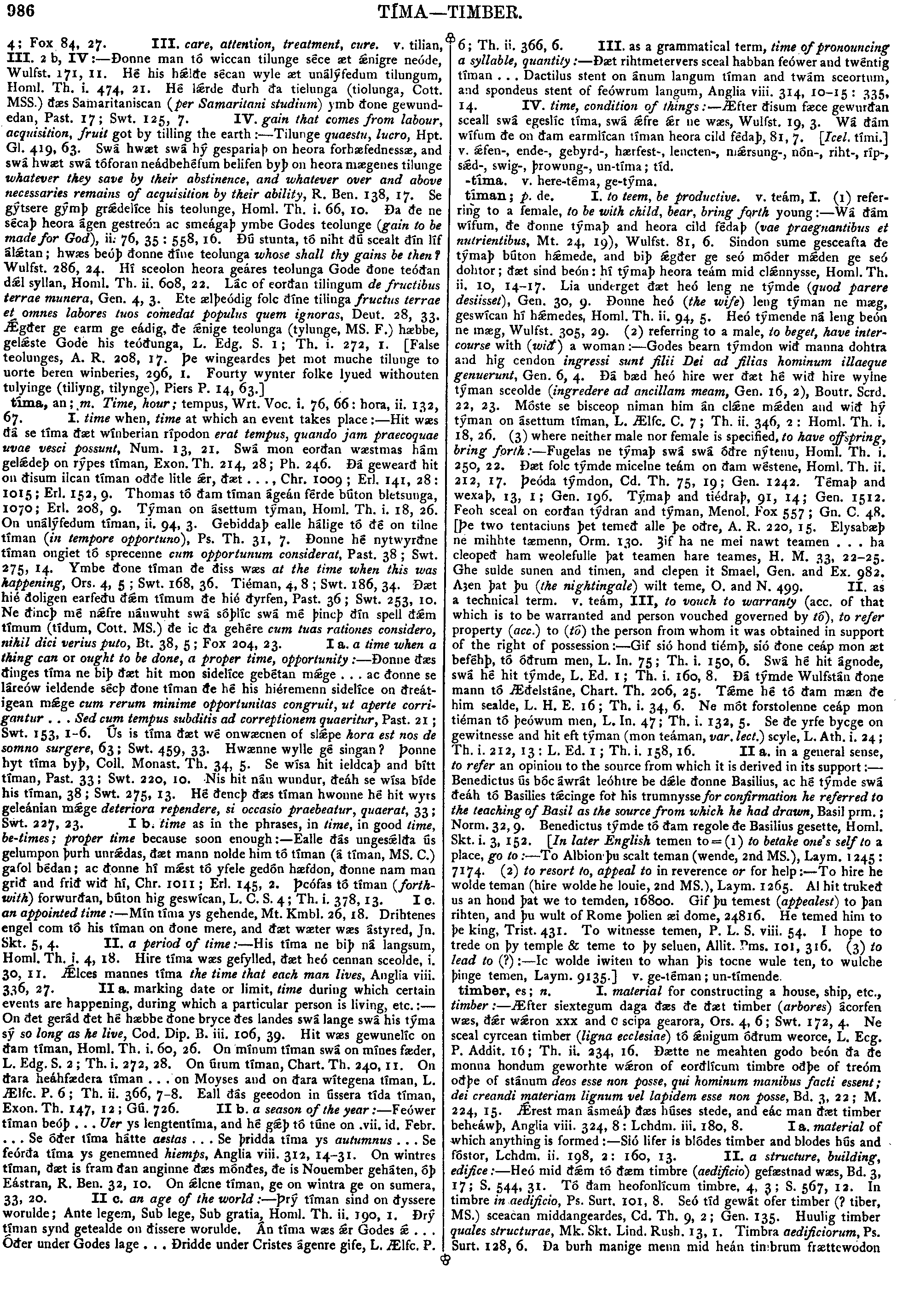
timber,
es;
n.
I.
material
for
constructing
a
house,
ship,
etc.,
timber:--Æfter
siextegum
daga
ðæs
ðe
ðæt
timber
(arbores)
ácorfen
wæs,
ðr
wron
xxx
and
c
scipa
gearora,
Ors.
4,
6;
Swt.
172,
4.
Ne
sceal
cyrcean
timber
(ligna
ecclesiae)
tó
nigum
óðrum
weorce,
L.
Ecg.
P.
Addit.
16;
Th.
ii.
234,
16,
Ðætte
ne
meahten
godo
beón
ða
ðe
monna
hondum
geworhte
wron
of
eorðlícum
timbre
oðþe
of
treóm
oðþe
of
stánum
deos
esse
non
posse,
qui
hominum
manibus
facti
essent;
dei
creandi
materiam
lignum
vel
lapidem
esse
non
posse,
Bd.
3,
22;
M.
224,
15.
Æ-acute;rest
man
ásmeáþ
ðæs
húses
stede,
and
eác
man
ðæt
timber
beheáwþ,
Anglia
viii.
324,
8:
Lchdm.
iii.
180,
8.
I
a.
material
of
which
anything
is
formed:--Sió
lifer
is
blódes
timber
and
blodes
hús
and
fóstor,
Lchdm.
ii.
198,
2:
160,
13.
II.
a
structure,
building,
edifice:--Heó
mid
ðm
tó
ðæm
timbre
(aedificio)
gefæstnad
wæs,
Bd.
3,
17;
S.
544,
31.
Tó
ðam
heofonlícum
timbre,
4,
3;
S.
567,
12.
In
timbre
in
aedificio,
Ps.
Surt.
101,
8.
Seó
tíd
gewát
ofer
timber
(?
tiber,
MS.)
sceacan
middangeardes,
Cd.
Th.
9,
2;
Gen.
135.
Huulig
timber
quales
structurae,
Mk.
Skt.
Lind.
Rush.
13,
1.
Timbra
aedificiorum,
Ps.
Surt.
128,
6.
Ða
burh
manige
menn
mid
heán
timbrum
frættewodon
|
Source: Bosworth/Toller, page b1104, entry 33 View original page image as: [TIFF] [PNG] [View previous entry] [View next entry] |
[Comment on this entry] [View comments] |
The following entry has been hand-corrected once. |
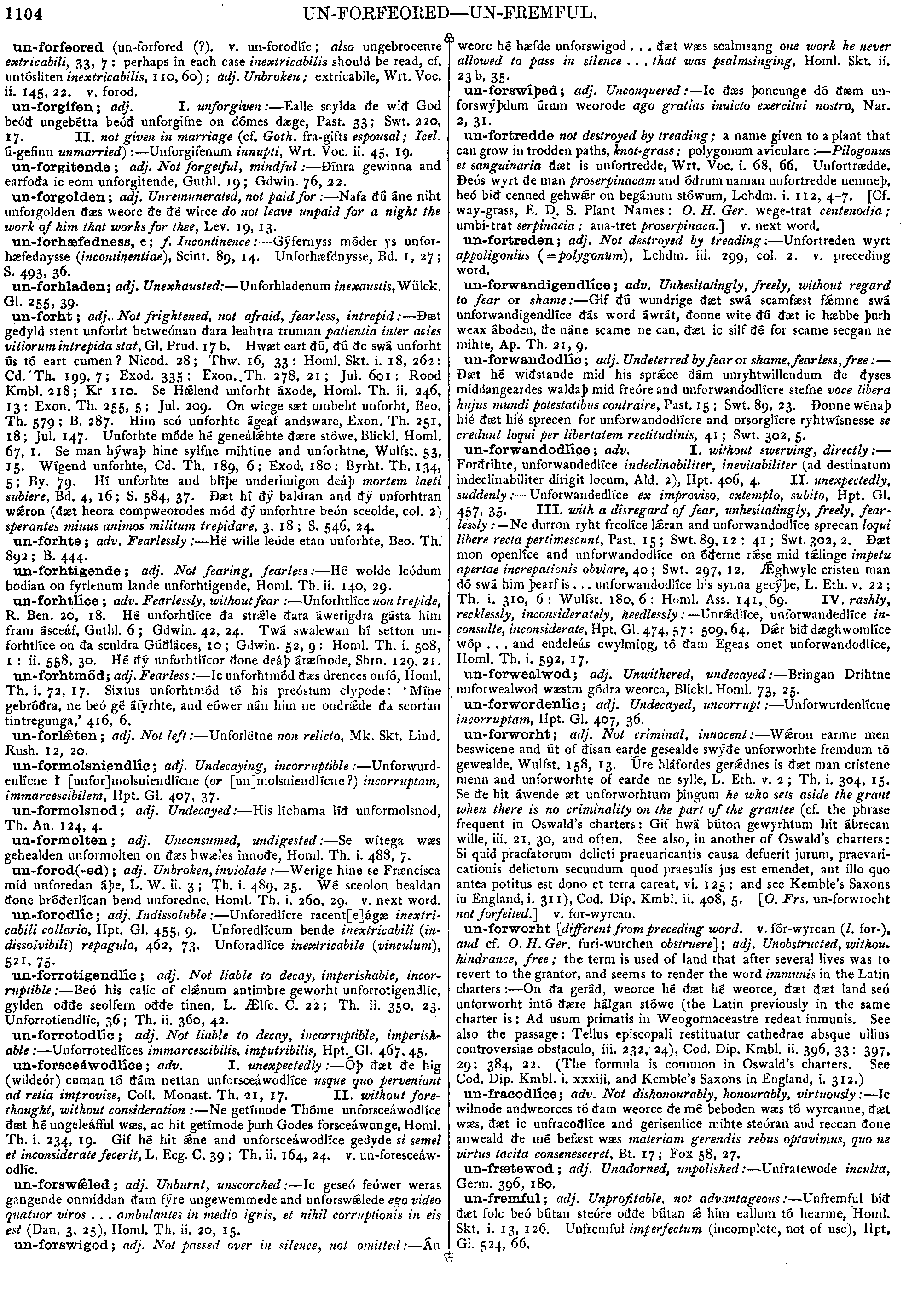
un-fracodlíce; adv. Not dishonourably, honourably, virtuously :-- Ic wilnode andweorces tó ðam weorce ðe mé beboden wæs tó wyrcanne, ðæt wæs, ðæt is unfracoðlíce and gerisenlíce mihte steóran and reccan ðone anweald ðe mé befæst wæs materiam gerendis rebus optavimus, quo ne virtus tacita consenesceret, Bt. 17; Fox 58, 27.
|
Source: Bosworth/Toller, page b1108, entry 21 View original page image as: [TIFF] [PNG] [View previous entry] [View next entry] |
[Comment on this entry] [View comments] |
The following entry has been hand-corrected once. |
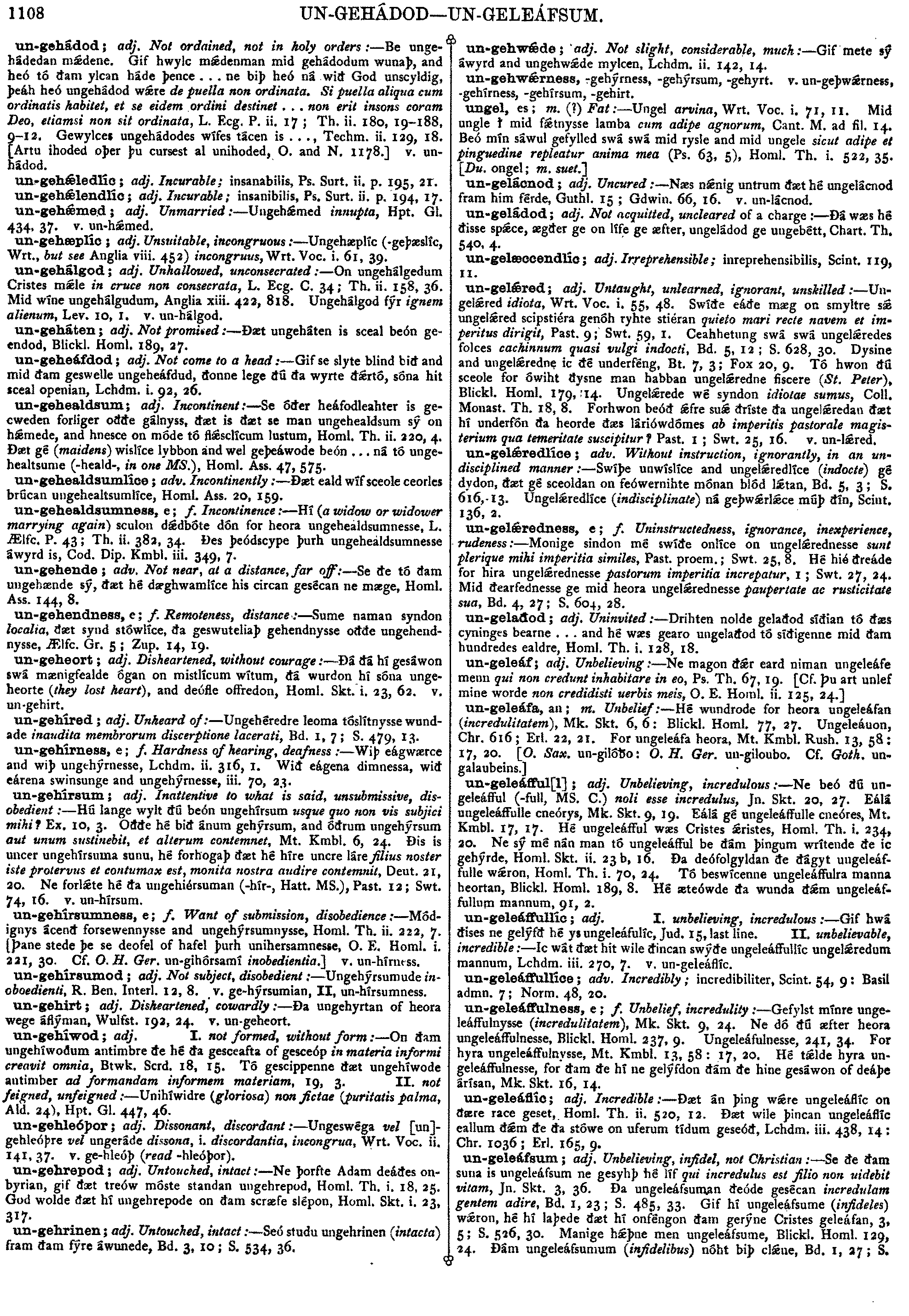
un-gehíwod; adj. I. not formed, without form :-- On ðam ungehíwodum antimbre ðe hé ða gesceafta of gesceóp in materia informi creavit omnia, Btwk. Scrd. 18, 15. Tó gescippenne ðæt ungehíwode antimber ad formandam informem materiam, 19, 3. II. not feigned, unfeigned :-- Unihíwidre (gloriosa) non fictae (puritatis palma, Ald. 24), Hpt. Gl. 447, 46.
|
Source: Bosworth/Toller, page b1204, entry 2 View original page image as: [TIFF] [PNG] [View previous entry] [View next entry] |
[Comment on this entry] [View comments] |
The following entry has been hand-corrected once. |
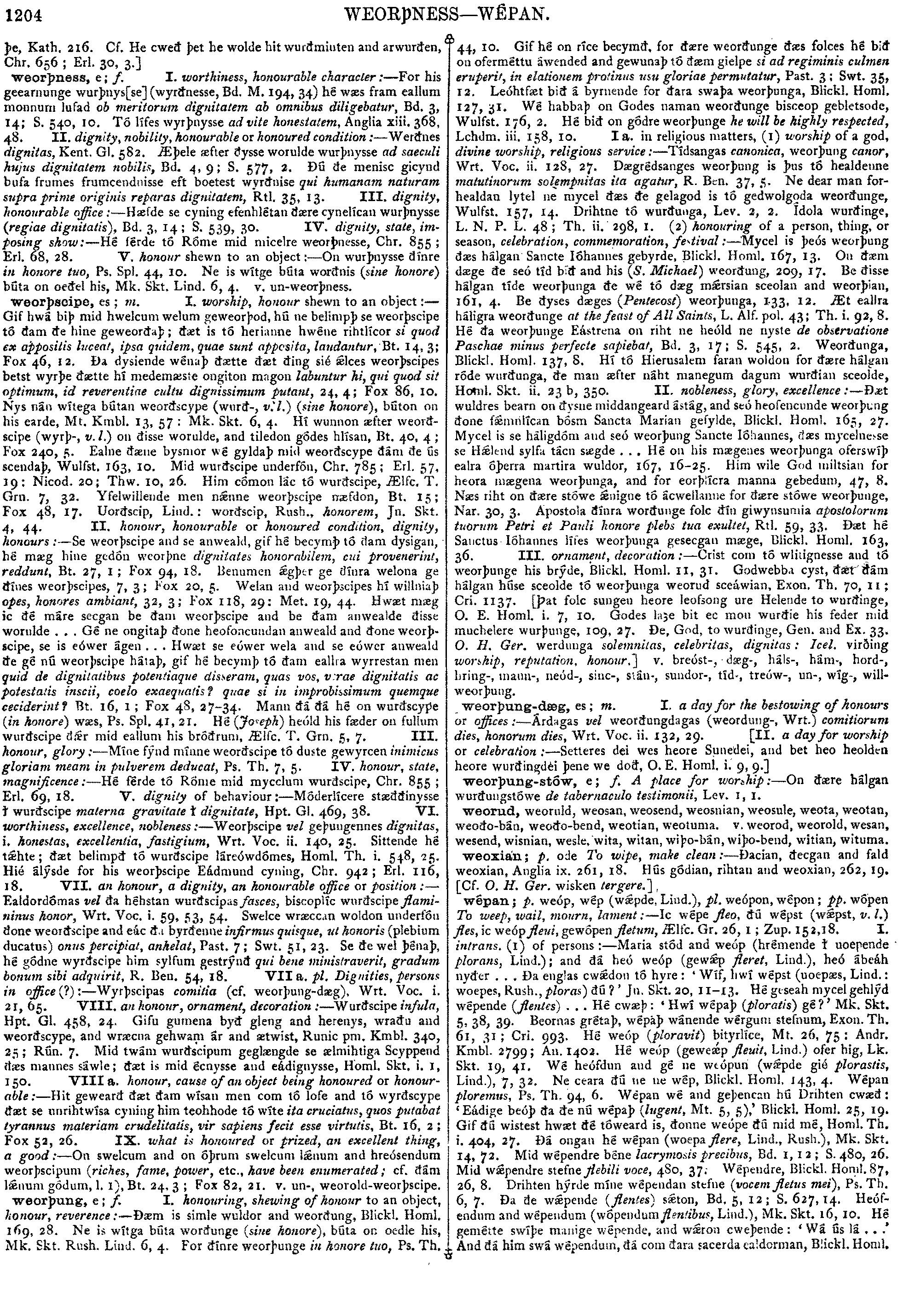
weorþness,
e;
f.
I.
worthiness,
honourable
character
:--
For
his
geearnunge
wurþnys[se]
(wyrðnesse,
Bd.
M.
194,
34)
hé
wæs
fram
eallum
monnum
lufad
ob
meritorum
dignitatem
ab
omnibus
diligebatur,
Bd.
3,
14;
S.
540,
10.
Tó
lífes
wyrþnysse
ad
vite
honestatem,
Anglia
xiii.
368,
48.
II.
dignity,
nobility,
honourable
or
honoured
condition:
--
Werðnes
dignitas,
Kent.
Gl.
582.
Æþele
æfter
ðysse
worulde
wurþnysse
ad
saeculi
hujus
dignitatem
nobilis,
Bd.
4,
9;
S.
577,
2.
Ðú
ðe
menisc
gicynd
bufa
frumes
frumcendnisse
eft
boetest
wyrðnise
qui
humanam
naturam
supra
prime
originis
reparas
dignitatem,
Rtl.
35,
13.
III.
dignity,
honourable
office
:
--
Hæfde
se
cyning
efenhlétan
ðære
cynelícan
wurþnysse
(regiae
dignitatis),
Bd.
3,
14
;
S.
539,
30.
IV.
dignity,
state,
imposing
show
:--
Hé
férde
tó
Róme
mid
micelre
weorþnesse,
Chr.
855
;
Erl.
68,
28.
V.
honour
shewn
to
an
object
:--
On
wurþnysse
ðínre
in
honore
tuo,
Ps.
Spl.
44,
10.
Ne
is
wítge
búta
worðnis
(sine
honore)
búta
on
oeðel
his,
Mk.
Skt.
Lind.
6,
4.
v.
un-weorþness.
weorþscipe,
es;
m.
I.
worship,
honour
shewn
to
an
object
:--
Gif
hwá
biþ
mid
hwelcum
welum
geweorþod,
hú
ne
belimpþ
se
weorþscipe
tó
ðam
ðe
hine
geweorðaþ;
ðæt
is
tó
herianne
hwéne
rihtlícor
si
quod
ex
appositis
luceat,
ipsa
quidem,
quae
sunt
apposita,
laudantur,
Bt.
14,
3;
Fox
46,
12.
Ða
dysiende
wénaþ
ðætte
ðæt
ðing
sié
lces
weorþscipes
betst
wyrþe
ðætte
hí
medemæste
ongiton
magon
labuntur
hi,
qui
quod
sit
optimum,
id
reverentiae
cultu
dignissimum
putant,
24,
4;
Fox
86,
10.
Nys
nán
wítega
bútan
weorðscype
(wurð-,
v.
l.)
(sine
honore),
búton
on
his
earde,
Mt.
Kmbl.
13,
57
:
Mk.
Skt.
6,
4.
Hí
wunnon
æfter
weorðscipe
(wyrþ
-,
v.
l.)
on
ðisse
worulde,
and
tiledon
gódes
hlísan,
Bt.
40,
4
;
Fox
240,
5.
Ealne
ðæne
bysmor
wé
gyldaþ
mid
weorðscype
ðám
ðe
ús
scendaþ,
Wulfst.
163,
10.
Mid
wurðscipe
underfón,
Chr.
785;
Erl.
57,
19:
Nicod.
20;
Thw.
10,
26.
Him
cómon
lác
tó
wurðscipe,
Ælfc.
T.
Grn.
7,
32.
Yfelwillende
men
nnne
weorþscipe
næfdon,
Bt.
15;
Fox
48,
17.
Uorðscip,
Lind.
:
worðscip,
Rush.,
honorem,
Jn.
Skt.
4,
44.
II.
honour,
honourable
or
honoured
condition,
dignity,
honours
:--
Se
weorþscipe
and
se
anweald,
gif
hé
becymþ
tó
ðam
dysigan,
hé
mæg
hine
gedón
weorþne
dignitates
honorabilem,
cui
provenerint,
reddunt,
Bt.
27,
1
;
Fox
94,
18.
Benumen
gþer
ge
ðínra
welona
ge
ðínes
weorþscipes,
7,
3;
Fox
20,
5.
Welan
and
weorþscipes
hí
willniaþ
opes,
honores
ambiant,
32,
3;
Fox
118,
29:
Met.
19,
44.
Hwæt
mæg
ic
ðé
máre
secgan
be
ðam
weorþscipe
and
be
ðam
anwealde
ðisse
worulde
.
.
.
Gé
ne
ongitaþ
ðone
heofoncundan
anweald
and
ðone
weorþscipe,
se
is
eówer
ágen
.
.
.
Hwæt
se
eówer
wela
and
se
eówer
anweald
ðe
gé
nú
weorþscipe
hátaþ,
gif
hé
becymþ
tó
ðam
eallra
wyrrestan
men
quid
de
dignitatibus
potentiaque
disseram,
quas
vos,
verae
dignitatis
ac
potestatis
inscii,
coelo
exaequatis
?
quae
si
in
improbissimum
quemque
ceciderint
?
Bt.
16,
1
;
Fox
48,
27-34.
Mann
ðá
ðá
hé
on
wurðscype
(in
honore)
wæs,
Ps.
Spl.
41,
21.
Hé
(Joseph)
heóld
his
fæder
on
fullum
wurðscipe
ðr
mid
eallum
his
bróðrum,
Ælfc.
T.
Grn.
5,
7.
III.
honour,
glory:
--
Míne
fýnd
mínne
weorðscipe
tó
duste
gewyrcen
inimicus
gloriam
meam
in
pulverem
deducat,
Ps.
Th.
7,
5.
IV.
honour,
state,
magnificence
:--
Hé
férde
tó
Róme
mid
mycclum
wurðscipe,
Chr.
855
;
Erl.
69,
18.
V.
dignity
of
behaviour
:--
Móderlícere
stæððinysse
 wurðscipe
materna
gravitate
dignitate,
Hpt.
Gl.
469,
38.
VI.
worthiness,
excellence,
nobleness
:--
Weorþscipe
vel
geþungennes
dignitas,
i.
honestas,
excellentia,
fastigium,
Wrt.
Voc.
ii.
140,
25.
Sittende
hé
thte
;
ðæt
belimpð
tó
wurðscipe
láreówdómes,
Homl.
Th.
i.
548,
25.
Hié
álýsde
for
his
weorþscipe
Eádmund
cyning,
Chr.
942;
Erl.
116,
18.
VII.
an
honour,
a
dignity,
an
honourable
office
or
position
:--
Ealdordómas
vel
ða
héhstan
wurðscipas
fasces,
biscoplíc
wurðscipe
flamininus
honor,
Wrt.
Voc.
i.
59,
53,
54.
Swelce
wræccan
woldon
underfón
ðone
weorðscipe
and
eác
ða
byrðenne
infirmus
quisque,
ut
honoris
(plebium
ducatus)
onus
percipiat,
anhelat,
Past.
7
;
Swt.
51,
23.
Se
ðe
wel
þénaþ,
hé
gódne
wyrðscipe
him
sylfum
gestrýnð
qui
bene
ministraverit,
gradum
bonum
sibi
adquirit,
R.
Ben.
54,
18.
VIIa.
pl.
Dignities,
persons
in
office
(?)
:--
Wyrþscipas
comitia
(cf.
weorþung-dæg).
Wrt.
Voc.
i.
21,
65.
VIII.
an
honour,
ornament,
decoration
:--
Wurðscipe
infula,
Hpt.
Gl.
458,
24.
Gifu
gumena
byð
gleng
and
herenys,
wraðu
and
weorðscype,
and
wræcna
gehwam
ár
and
ætwist,
Runic
pm.
Kmbl.
340,
25
;
Rún.
7.
Mid
twám
wurðscipum
geglængde
se
ælmihtiga
Scyppend
ðæs
mannes
sáwle;
ðæt
is
mid
écnysse
and
eádignysse,
Homl.
Skt.
i.
1,
150.
VIII
a.
honour,
cause
of
an
object
being
honoured
or
honourable
:--
Hit
gewearð
ðæt
ðam
wísan
men
com
tó
lofe
and
tó
wyrðscype
ðæt
se
unrihtwísa
cyning
him
teohhode
tó
wíte
ita
cruciatus,
quos
putabat
tyrannus
materiam
crudelitatis,
vir
sapiens
fecit
esse
virtutis,
Bt.
16,
2
;
Fox
52,
26.
IX.
what
is
honoured
or
prized,
an
excellent
thing,
a
good
:--
On
swelcum
and
on
óþrum
swelcum
lnum
and
hreósendum
weorþscipum
(riches,
fame,
power,
etc.
,
have
been
enumerated;
cf.
ðám
lnum
gódum,
I.
1
UNCERTAIN),
Bt.
24,
3
;
Fox
82,
21.
v.
un-,
weorold-weorþscipe.
wurðscipe
materna
gravitate
dignitate,
Hpt.
Gl.
469,
38.
VI.
worthiness,
excellence,
nobleness
:--
Weorþscipe
vel
geþungennes
dignitas,
i.
honestas,
excellentia,
fastigium,
Wrt.
Voc.
ii.
140,
25.
Sittende
hé
thte
;
ðæt
belimpð
tó
wurðscipe
láreówdómes,
Homl.
Th.
i.
548,
25.
Hié
álýsde
for
his
weorþscipe
Eádmund
cyning,
Chr.
942;
Erl.
116,
18.
VII.
an
honour,
a
dignity,
an
honourable
office
or
position
:--
Ealdordómas
vel
ða
héhstan
wurðscipas
fasces,
biscoplíc
wurðscipe
flamininus
honor,
Wrt.
Voc.
i.
59,
53,
54.
Swelce
wræccan
woldon
underfón
ðone
weorðscipe
and
eác
ða
byrðenne
infirmus
quisque,
ut
honoris
(plebium
ducatus)
onus
percipiat,
anhelat,
Past.
7
;
Swt.
51,
23.
Se
ðe
wel
þénaþ,
hé
gódne
wyrðscipe
him
sylfum
gestrýnð
qui
bene
ministraverit,
gradum
bonum
sibi
adquirit,
R.
Ben.
54,
18.
VIIa.
pl.
Dignities,
persons
in
office
(?)
:--
Wyrþscipas
comitia
(cf.
weorþung-dæg).
Wrt.
Voc.
i.
21,
65.
VIII.
an
honour,
ornament,
decoration
:--
Wurðscipe
infula,
Hpt.
Gl.
458,
24.
Gifu
gumena
byð
gleng
and
herenys,
wraðu
and
weorðscype,
and
wræcna
gehwam
ár
and
ætwist,
Runic
pm.
Kmbl.
340,
25
;
Rún.
7.
Mid
twám
wurðscipum
geglængde
se
ælmihtiga
Scyppend
ðæs
mannes
sáwle;
ðæt
is
mid
écnysse
and
eádignysse,
Homl.
Skt.
i.
1,
150.
VIII
a.
honour,
cause
of
an
object
being
honoured
or
honourable
:--
Hit
gewearð
ðæt
ðam
wísan
men
com
tó
lofe
and
tó
wyrðscype
ðæt
se
unrihtwísa
cyning
him
teohhode
tó
wíte
ita
cruciatus,
quos
putabat
tyrannus
materiam
crudelitatis,
vir
sapiens
fecit
esse
virtutis,
Bt.
16,
2
;
Fox
52,
26.
IX.
what
is
honoured
or
prized,
an
excellent
thing,
a
good
:--
On
swelcum
and
on
óþrum
swelcum
lnum
and
hreósendum
weorþscipum
(riches,
fame,
power,
etc.
,
have
been
enumerated;
cf.
ðám
lnum
gódum,
I.
1
UNCERTAIN),
Bt.
24,
3
;
Fox
82,
21.
v.
un-,
weorold-weorþscipe.
|
Source: Bosworth/Toller, page d0169, entry 24 View original page image as: [TIFF] [PNG] [View previous entry] [View next entry] |
[Comment on this entry] [View comments] |
The following entry has been hand-corrected once. |
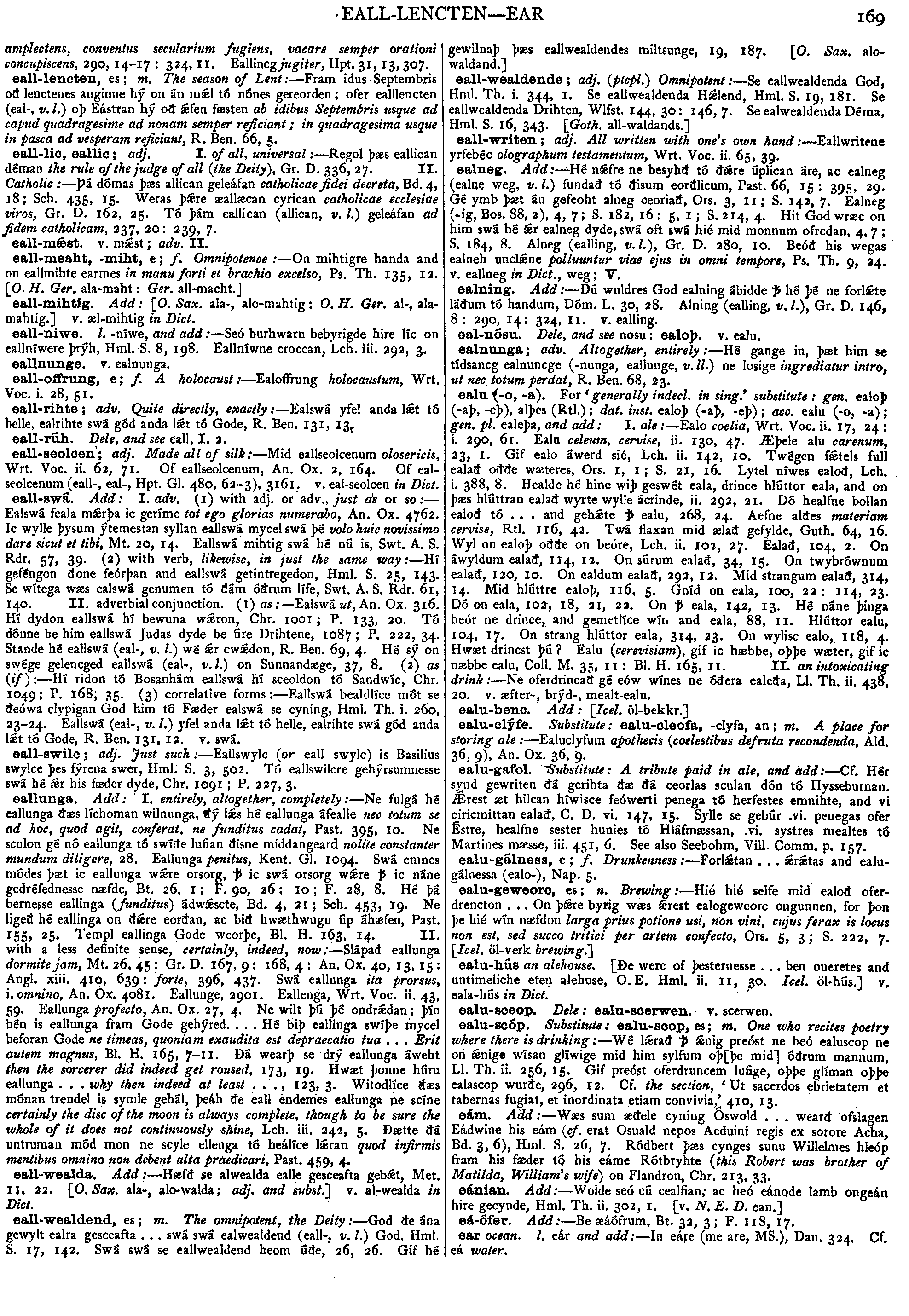
ealu
(-o,-a).
For
'generally
indecl.
in
sing.'
substitute:
gen.
ealoþ
(-aþ,
-eþ),
alþes
(Rtl.);
dat.
inst.
ealoþ
(-aþ,
-eþ);
acc.
ealu
(-o,
-a);
gen.
pl.
ealeþa,
and
add:
I.
ale:--Ealo
coelia,
Wrt.
Voc.
ii.
17,
24:
i.
290,
61.
Ealu
celeum,
cervise,
ii.
130,
47.
Æþele
alu
carenum,
23,
1.
Gif
ealo
áwerd
sié,
Lch.
ii.
142,
10.
Twégen
ftels
full
ealað
oððe
wæteres,
Ors.
1,
1;
S.
21,
16.
Lytel
níwes
ealoð,
Lch.
i.
388,
8.
Healde
hé
hine
wiþ
geswét
eala,
drince
hlúttor
eala,
and
on
þæs
hlúttran
ealað
wyrte
wylle
ácrinde,
ii.
292,
21.
Dó
healfae
bollan
ealoð
tó
.
.
.
and
gehte
 ealu,
268,
24.
Aefne
alðes
materiam
cervise,
Rtl.
116,
42.
Twá
flaxan
mid
ælað
gefylde,
Guth.
64,
16.
Wyl
on
ealoþ
oððe
on
beóre,
Lch.
ii.
102,
27.
Ealað,
104,
2.
On
áwyldum
ealað,
114,
12.
On
súrum
ealað,
34,
15.
On
twybrównum
ealað,
120,
10.
On
ealdum
ealað,
292,
12.
Mid
strangum
ealað,
314,
14.
Mid
hlúttre
ealoþ,
116,
5.
Gníd
on
eala,
100,
22:
114,
23.
Dó
on
eala,
102,
18,
21,
22.
On
eala,
142,
13.
Hé
náne
þinga
beór
ne
drince,
and
gemetlíce
wín
and
eala,
88,
11.
Hlúttor
ealu,
104,
17.
On
strang
hlúttor
eala,
314,
23.
On
wylisc
ealo,
118,
4.
Hwæt
drincst
þú?
Ealu
(cerevisiam),
gif
ic
hæbbe,
oþþe
wæter,
gif
ic
næbbe
ealu,
Coll.
M.
35,
11:
Bl.
H.
165,
11.
II.
an
intoxicating
drink:--Ne
oferdrincað
gé
eów
wínes
ne
óðera
ealeða,
Ll.
Th.
ii.
438,
20.
v.
æfter-,
brýd-,
mealt-ealu.
ealu,
268,
24.
Aefne
alðes
materiam
cervise,
Rtl.
116,
42.
Twá
flaxan
mid
ælað
gefylde,
Guth.
64,
16.
Wyl
on
ealoþ
oððe
on
beóre,
Lch.
ii.
102,
27.
Ealað,
104,
2.
On
áwyldum
ealað,
114,
12.
On
súrum
ealað,
34,
15.
On
twybrównum
ealað,
120,
10.
On
ealdum
ealað,
292,
12.
Mid
strangum
ealað,
314,
14.
Mid
hlúttre
ealoþ,
116,
5.
Gníd
on
eala,
100,
22:
114,
23.
Dó
on
eala,
102,
18,
21,
22.
On
eala,
142,
13.
Hé
náne
þinga
beór
ne
drince,
and
gemetlíce
wín
and
eala,
88,
11.
Hlúttor
ealu,
104,
17.
On
strang
hlúttor
eala,
314,
23.
On
wylisc
ealo,
118,
4.
Hwæt
drincst
þú?
Ealu
(cerevisiam),
gif
ic
hæbbe,
oþþe
wæter,
gif
ic
næbbe
ealu,
Coll.
M.
35,
11:
Bl.
H.
165,
11.
II.
an
intoxicating
drink:--Ne
oferdrincað
gé
eów
wínes
ne
óðera
ealeða,
Ll.
Th.
ii.
438,
20.
v.
æfter-,
brýd-,
mealt-ealu.
|
Source: Bosworth/Toller, page d0182, entry 23 View original page image as: [TIFF] [PNG] [View previous entry] [View next entry] |
[Comment on this entry] [View comments] |
The following entry has been hand-corrected once. |
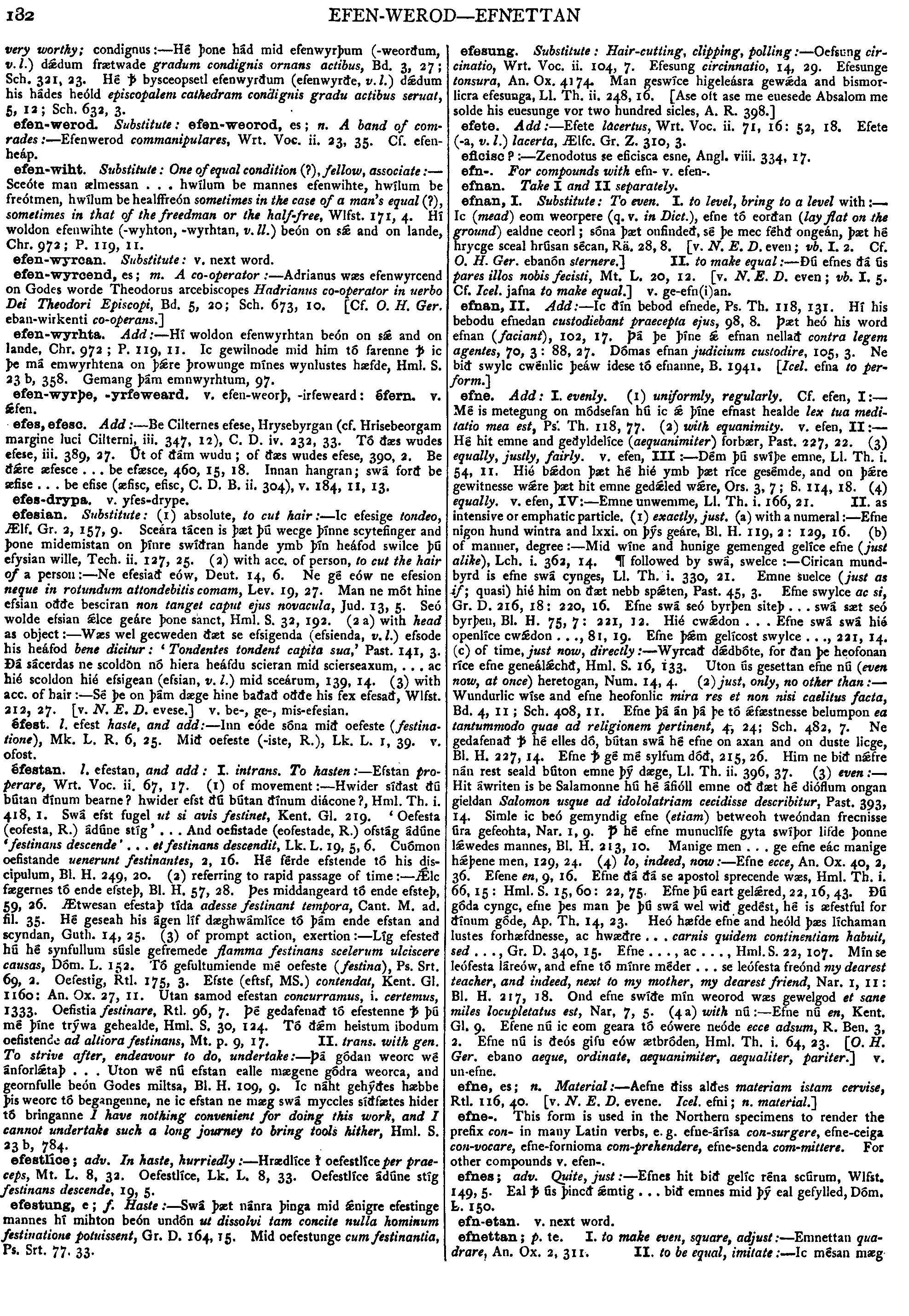
efne, es; n. Material:--Aefne ðiss alðes materiam istam cervise, Rtl. 116, 40. [v. N. E. D. evene. Icel. efni; n. material.]
|
Source: Bosworth/Toller, page d0404, entry 5 View original page image as: [TIFF] [PNG] [View previous entry] [View next entry] |
[Comment on this entry] [View comments] |
The following entry has been hand-corrected once. |
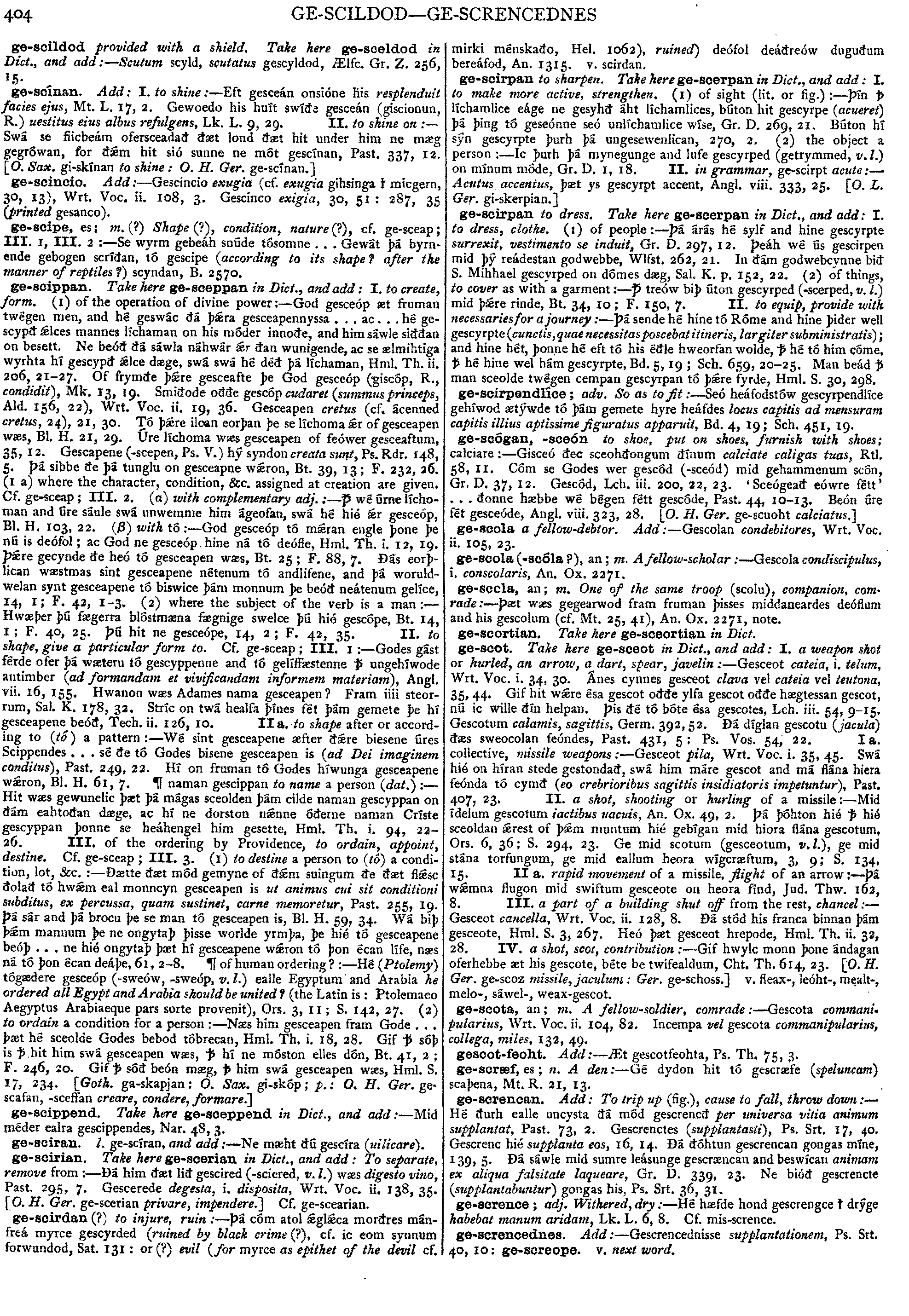
ge-scippan.
Take
here
ge-sceppan
in
Dict.,
and
add:
I.
to
create,
form.
(l)
of
the
operation
of
divine
power
:--
God
gesceóp
æt
fruman
twégen
men,
and
hé
geswác
ðá
þra
gesceapennyssa
.
.
.
ac
.
.
.
hé
gescypð
lces
mannes
líchaman
on
his
móder
innoðe,
and
him
sáwle
siððan
on
besett.
Ne
beóð
ðá
sáwla
náhwár
r
ðan
wunigende,
ac
se
ælmihtiga
wyrhta
hí
gescypð
lce
dæge,
swá
swá
hé
déð
þá
líchaman,
Hml.
Th.
ii.
206,
21-27.
Of
frymðe
þre
gesceafte
þe
God
gesceóp
(giscóp,
R.,
condidit),
Mk.
13,
19.
Smiðode
oððe
gescóp
cudaret
(summus
princeps,
Ald.
156,
22),
Wrt.
Voc.
ii.
19,
36.
Gesceapen
cretus
(cf.
ácenned
cretus,
24),
21,
30.
Tó
þre
ilcan
eorþan
þe
se
líchoma
r
of
gesceapen
wæs,
Bl.
H.
21,
29.
Úre
líchoma
wæs
gesceapen
of
feówer
gesceaftum,
35,
12.
Gescapene
(-scepen,
Ps.V.)
hý
syndon
creata
sunt,
Ps.
Rdr.
148,
5.
Þá
sibbe
ðe
þá
tunglu
on
gesceapne
wron,
Bt.
39,
13;
F.
232,
26.
(l
a)
where
the
character,
condition,
&c.
assigned
at
creation
are
given.
Cf.
ge-sceap
;
III.
2.
(a)
with
complementary
adj.
:--
Þ
UNCERTAIN
weé
úrne
líchoman
and
úre
sáule
swá
unwemme
him
ágeofan,
swá
hé
hié
r
gesceóp,
Bl.
H.
103,
22.
( )
with
tó
:--
God
gesceóp
tó
mran
engle
þone
þe
nú
is
deófol;
ac
God
ne
gesceóp
hine
ná
tó
deófle,
Hml.
Th.
i.
12,
19.
Þre
gecynde
ðe
heó
tó
gesceapen
wæs,
Bt.
25
;
F.
88,
7.
Ðás
eorþlican
wæstmas
sint
gesceapene
nétenum
tó
andlifene,
and
þá
woruldwelan
synt
gesceapene
tó
biswice
þám
monnum
þe
beóð
neátenum
gelíce,
14,
i;
F.
42,
1-3.
(2)
where
the
subject
of
the
verb
is
a
man
:--
Hwæþer
þú
fægerra
blóstmæna
fægnige
swelce
þú
hié
gescópe.
Bt.
14,
I
;
F.
40,
25.
Þú
hit
ne
gesceópe,
14,
2
;
F.
42,
35.
II.
to
shape,
give
a
particular
form
to.
Cf.
ge-sceap
;
III.
I
:--
Godes
gást
férde
ofer
þá
wæteru
tó
gescyppenne
and
tó
gelíffæstenne
ungehíwode
antimber
(ad
formandam
et
vivificandam
informem
materiam),
Angl.
vii.
16,
155.
Hwanon
wæs
Adames
nama
gesceapen?
Fram
iiii
steorrum,
Sal.
K.
178,
32.
Stríc
on
twá
healfa
þínes
fét
þám
gemete
þe
hí
gesceapene
beóð,
Tech.
ii.
126,
10.
II
a.
to
shape
after
or
according
to
(to)
a
pattern
:--
Wé
sint
gesceapene
æfter
ðre
biesene
úres
Scippendes.
.
.
sé
ðe
tó
Godes
bisene
gesceapen
is
(ad
Dei
imaginem
conditus),
Past.
249,
22.
Hí
on
fruman
tó
Godes
híwunga
gesceapene
wron,
Bl.
H.
61,
7.

naman
gescippan
to
name
a
person
(dat.)
:--
Hit
wæs
gewunelic
þæt
þá
mágas
sceolden
þám
cilde
naman
gescyppan
on
ðám
eahtoðan
dæge,
ac
hí
ne
dorston
nnne
óðerne
naman
Críste
gescyppan
þonne
se
heáhengel
him
gesette.
Hml.
Th.
i.
94,
22-26.
III.
of
the
ordering
by
Providence,
to
ordain,
appoint,
destine.
Cf.
ge-sceap
;
III.
3.
(l)
to
destine
a
person
to
(tó)
a
condition,
lot,
&c.
:--
Ðætte
ðæt
mód
gemyne
of
ðm
suingum
ðe
ðæt
flsc
ðolað
tó
hwm
eal
monncyn
gesceapen
is
ut
animus
cui
sit
conditioni
snbditus,
ex
percussa,
quam
sustinet,
carne
memoretur,
Past.
255,
19.
Þá
sár
and
þá
brocu
þe
se
man
tó
gesceapen
is,
Bl.
H.
59,
34.
Wá
biþ
þm
mannum
þe
ne
ongytaþ
þisse
worlde
yrmþa,
þe
hié
tó
gesceapene
beóþ
.
.
.
ne
hié
ongytaþ
þæt
hí
gesceapene
wron
tó
þon
écan
lífe,
næs
ná
tó
þon
écan
deáþe,
6i,
2-8.

of
human
ordering
?
:--
Hé
(Ptolemy)
tógædere
gesceóp
(-sweów,
-sweóp,
v.l.)
ealle
Egyptum
and
Arabia
he
ordered
all
Egypt
and
Arabia
should
be
united
?
(the
Latin
is:
Ptolemaeo
Aegyptus
Arabiaeque
pars
sorte
provenit),
Ors.
3,
II;
S.
142,
27.
(2)
to
ordain
a
condition
for
a
person
:--
Næs
him
gesceapen
fram
Gode
.
,
.
þæt
hé
sceolde
Godes
bebod
tóbrecan,
Hml.
Th.
i.
18,
28.
Gif
sóþ
is
hit
him
swá
gesceapen
wæs,
hí
ne
móston
elles
dón,
Bt.
41,
2
;
F.
246,
20.
Gif
sóð
beón
mæg,
him
swá
gesceapen
wæs,
Hml.
S.
17,
234.
(Goth.
ga-skapjan:
O.Sax.
gi-skóp;
p.
;
O.H.Ger.
ge-scafan,
-sceffan
creare,
condere,
formare.)
)
with
tó
:--
God
gesceóp
tó
mran
engle
þone
þe
nú
is
deófol;
ac
God
ne
gesceóp
hine
ná
tó
deófle,
Hml.
Th.
i.
12,
19.
Þre
gecynde
ðe
heó
tó
gesceapen
wæs,
Bt.
25
;
F.
88,
7.
Ðás
eorþlican
wæstmas
sint
gesceapene
nétenum
tó
andlifene,
and
þá
woruldwelan
synt
gesceapene
tó
biswice
þám
monnum
þe
beóð
neátenum
gelíce,
14,
i;
F.
42,
1-3.
(2)
where
the
subject
of
the
verb
is
a
man
:--
Hwæþer
þú
fægerra
blóstmæna
fægnige
swelce
þú
hié
gescópe.
Bt.
14,
I
;
F.
40,
25.
Þú
hit
ne
gesceópe,
14,
2
;
F.
42,
35.
II.
to
shape,
give
a
particular
form
to.
Cf.
ge-sceap
;
III.
I
:--
Godes
gást
férde
ofer
þá
wæteru
tó
gescyppenne
and
tó
gelíffæstenne
ungehíwode
antimber
(ad
formandam
et
vivificandam
informem
materiam),
Angl.
vii.
16,
155.
Hwanon
wæs
Adames
nama
gesceapen?
Fram
iiii
steorrum,
Sal.
K.
178,
32.
Stríc
on
twá
healfa
þínes
fét
þám
gemete
þe
hí
gesceapene
beóð,
Tech.
ii.
126,
10.
II
a.
to
shape
after
or
according
to
(to)
a
pattern
:--
Wé
sint
gesceapene
æfter
ðre
biesene
úres
Scippendes.
.
.
sé
ðe
tó
Godes
bisene
gesceapen
is
(ad
Dei
imaginem
conditus),
Past.
249,
22.
Hí
on
fruman
tó
Godes
híwunga
gesceapene
wron,
Bl.
H.
61,
7.

naman
gescippan
to
name
a
person
(dat.)
:--
Hit
wæs
gewunelic
þæt
þá
mágas
sceolden
þám
cilde
naman
gescyppan
on
ðám
eahtoðan
dæge,
ac
hí
ne
dorston
nnne
óðerne
naman
Críste
gescyppan
þonne
se
heáhengel
him
gesette.
Hml.
Th.
i.
94,
22-26.
III.
of
the
ordering
by
Providence,
to
ordain,
appoint,
destine.
Cf.
ge-sceap
;
III.
3.
(l)
to
destine
a
person
to
(tó)
a
condition,
lot,
&c.
:--
Ðætte
ðæt
mód
gemyne
of
ðm
suingum
ðe
ðæt
flsc
ðolað
tó
hwm
eal
monncyn
gesceapen
is
ut
animus
cui
sit
conditioni
snbditus,
ex
percussa,
quam
sustinet,
carne
memoretur,
Past.
255,
19.
Þá
sár
and
þá
brocu
þe
se
man
tó
gesceapen
is,
Bl.
H.
59,
34.
Wá
biþ
þm
mannum
þe
ne
ongytaþ
þisse
worlde
yrmþa,
þe
hié
tó
gesceapene
beóþ
.
.
.
ne
hié
ongytaþ
þæt
hí
gesceapene
wron
tó
þon
écan
lífe,
næs
ná
tó
þon
écan
deáþe,
6i,
2-8.

of
human
ordering
?
:--
Hé
(Ptolemy)
tógædere
gesceóp
(-sweów,
-sweóp,
v.l.)
ealle
Egyptum
and
Arabia
he
ordered
all
Egypt
and
Arabia
should
be
united
?
(the
Latin
is:
Ptolemaeo
Aegyptus
Arabiaeque
pars
sorte
provenit),
Ors.
3,
II;
S.
142,
27.
(2)
to
ordain
a
condition
for
a
person
:--
Næs
him
gesceapen
fram
Gode
.
,
.
þæt
hé
sceolde
Godes
bebod
tóbrecan,
Hml.
Th.
i.
18,
28.
Gif
sóþ
is
hit
him
swá
gesceapen
wæs,
hí
ne
móston
elles
dón,
Bt.
41,
2
;
F.
246,
20.
Gif
sóð
beón
mæg,
him
swá
gesceapen
wæs,
Hml.
S.
17,
234.
(Goth.
ga-skapjan:
O.Sax.
gi-skóp;
p.
;
O.H.Ger.
ge-scafan,
-sceffan
creare,
condere,
formare.)
|
Source: Bosworth/Toller, page d0471, entry 1 View original page image as: [TIFF] [PNG] [View previous entry] [View next entry] |
[Comment on this entry] [View comments] |
The following entry has been hand-corrected once. |
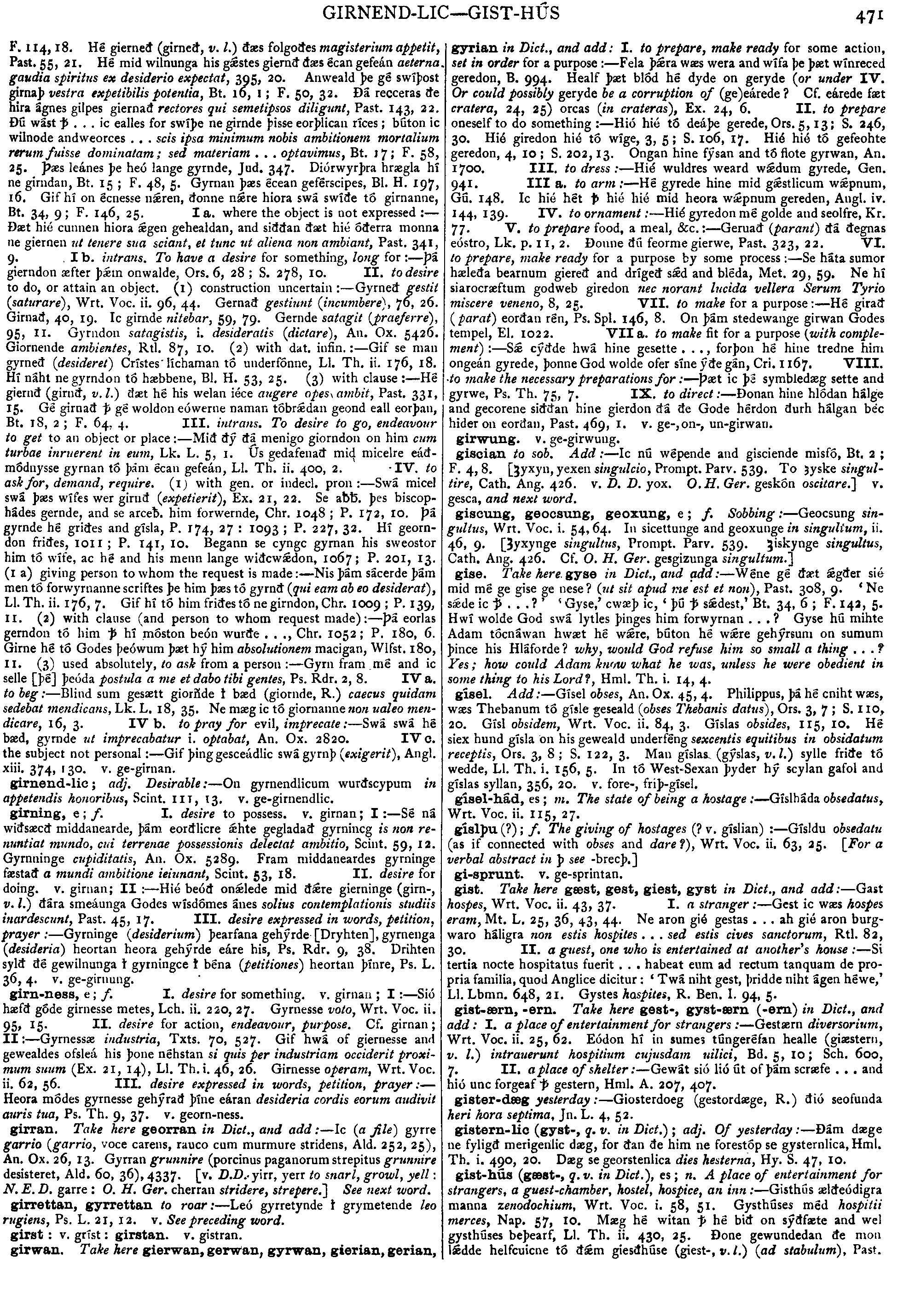
F.
114,
18.
Hé
gierneð
(girneð,
v.
l.)
ðæs
folgoðes
magisterium
appetit,
Past.
55,
21.
Hé
mid
wilnunga
his
gstes
giernð
ðæs
écan
gefeán
aeterna
gaudia
spiritus
ex
desiderio
expectat,
395,
20.
Anweald
þe
gé
swíþost
girnaþ
vestra
expetibilis
potentia,
Bt.
16,
1;
F.
50,
32.
Ðá
recceras
ðe
hira
ágnes
gilpes
giernað
rectores
qui
semetipsos
diligunt,
Past.
143,
22.
Ðú
wást
.
.
.
ic
ealles
for
swíþe
ne
girnde
þisse
eorþlican
ríces;
búton
ic
wilnode
andweorces
.
.
.
scis
ipsa
minimum
nobis
ambitionem
mortalium
rerum
fuisse
dominatam;
sed
materiam
.
.
.
optavimus,
Bt.
17;
F.
58,
25.
Þæs
leánes
þe
heó
lange
gyrnde,
Jud.
347.
Diórwyrþra
hrægla
hí
ne
girndan,
Bt.
15;
F.
48,
5.
Gyrnan
þæs
écean
geférscipes,
Bl.
H.
197,
16.
Gif
hí
on
écnesse
nren,
ðonne
nre
hiora
swá
swíðe
tó
girnanne,
Bt.
34,
9;
F.
146,
25.
I
a.
where
the
object
is
not
expressed:--Ðæt
hié
cunnen
hiora
gen
gehealdan,
and
siððan
ðæt
hié
óðerra
monna
ne
giernen
ut
tenere
sua
sciant,
et
tunc
ut
aliena
non
ambiant,
Past.
341,
9.
I
b.
intrans.
To
have
a
desire
for
something,
long
for:--Þá
gierndon
æfter
þm
onwalde,
Ors.
6,
28;
S.
278,
10.
II.
to
desire
to
do,
or
attain
an
object.
(1)
construction
uncertain:--Gyrneð
gestit
(saturare),
Wrt.
Voc.
ii.
96,
44.
Gernað
gestiunt
(incumbere),
76,
26.
Girnað,
40,
19.
Ic
girnde
nitebar,
59,
79.
Gernde
satagit
(praeferre),
95,
11.
Gyrndon
satagistis,
i.
desideratis
(dictare),
An.
Ox.
5426.
Giornende
ambientes,
Rtl.
87,
10.
(2)
with
dat.
infin.:--Gif
se
man
gyrneð
(desideret)
Crístes
líchaman
tó
underfónne,
Ll.
Th.
ii.
176,
18.
Hí
náht
ne
gyrndon
tó
hæbbene,
Bl.
H.
53,
25.
(3)
with
clause:--Hé
giernð
(girnð,
v.
l.)
ðæt
hé
his
welan
iéce
augers
opes
ambit,
Past.
331,
15.
Gé
girnað
gé
woldon
eówerne
naman
tóbrdan
geond
eall
eorþan,
Bt.
18,
2;
F.
64.
4.
III.
intrans.
To
desire
to
go,
endeavour
to
get
to
an
object
or
place:--Mið
ðý
ðá
menigo
giorndon
on
him
cum
turbae
inruerent
in
eum,
Lk.
L.
5,
1.
Ús
gedafenað
mid
micelre
eáðmódnysse
gyrnan
tó
þám
écan
gefeán,
Ll.
Th.
ii.
400,
2.
IV.
to
ask
for,
demand,
require.
(1)
with
gen.
or
indecl.
pron:--Swá
micel
swá
þæs
wífes
wer
girnð
(expetierit),
Ex.
21,
22.
Se
a .
þes
biscophádes
gernde,
and
se
arce.
him
forwernde,
Chr.
1048;
P.
172,
10.
Þá
gyrnde
hé
griðes
and
gísla,
P.
174,
27:
1093;
P.
227,
32.
Hí
georndon
friðes,
1011;
P.
141,
10.
Begann
se
cyngc
gyman
his
sweostor
him
tó
wífe,
ac
hé
and
his
menn
lange
wiðcwdon,
1067;
P.
201,
13.
(1
a)
giving
person
to
whom
the
request
is
made:--Nis
þám
sácerde
þám
men
tó
forwyrnanne
scriftes
þe
him
þæs
tó
gyrnð
(qui
eam
ab
eo
desiderat),
Ll.
Th.
ii.
176,
7.
Gif
hí
tó
him
friðes
tó
ne
girndon,
Chr.
1009;
P.
139,
11.
(2)
with
clause
(and
person
to
whom
request
made):--Þá
eorlas
gerndon
tó
him
hí
móston
beón
wurðe
.
.
.,
Chr.
1052;
P.
180,
6.
Girne
hé
tó
Godes
þeówum
þæt
hý
him
absolutionem
macigan,
Wlfst.
180,
11.
(3)
used
absolutely,
to
ask
from
a
person:--Gyrn
fram
mé
and
ic
selle
[þé]
þeóda
postula
a
me
et
dabo
tibi
gentes,
Ps.
Rdr.
2,
8.
IV
a.
to
beg:--Blind
sum
gesætt
gior&n-tilde;de
bæd
(giornde,
R.)
caecus
quidam
sedebat
mendicans,
Lk.
L.
18,
35.
Ne
mæg
ic
tó
giornanne
non
ualeo
mendicare,
16,
3.
IV
b.
to
pray
for
evil,
imprecate:--Swá
swá
hé
bæd,
gyrnde
ut
imprecabatur
i.
optabat,
An.
Ox.
2820.
IV
c.
the
subject
not
personal:--Gif
þing
gesceádlic
swá
gyrnþ
(exigerit),
Angl.
xiii.
374,
130.
v.
ge-girnan.
.
þes
biscophádes
gernde,
and
se
arce.
him
forwernde,
Chr.
1048;
P.
172,
10.
Þá
gyrnde
hé
griðes
and
gísla,
P.
174,
27:
1093;
P.
227,
32.
Hí
georndon
friðes,
1011;
P.
141,
10.
Begann
se
cyngc
gyman
his
sweostor
him
tó
wífe,
ac
hé
and
his
menn
lange
wiðcwdon,
1067;
P.
201,
13.
(1
a)
giving
person
to
whom
the
request
is
made:--Nis
þám
sácerde
þám
men
tó
forwyrnanne
scriftes
þe
him
þæs
tó
gyrnð
(qui
eam
ab
eo
desiderat),
Ll.
Th.
ii.
176,
7.
Gif
hí
tó
him
friðes
tó
ne
girndon,
Chr.
1009;
P.
139,
11.
(2)
with
clause
(and
person
to
whom
request
made):--Þá
eorlas
gerndon
tó
him
hí
móston
beón
wurðe
.
.
.,
Chr.
1052;
P.
180,
6.
Girne
hé
tó
Godes
þeówum
þæt
hý
him
absolutionem
macigan,
Wlfst.
180,
11.
(3)
used
absolutely,
to
ask
from
a
person:--Gyrn
fram
mé
and
ic
selle
[þé]
þeóda
postula
a
me
et
dabo
tibi
gentes,
Ps.
Rdr.
2,
8.
IV
a.
to
beg:--Blind
sum
gesætt
gior&n-tilde;de
bæd
(giornde,
R.)
caecus
quidam
sedebat
mendicans,
Lk.
L.
18,
35.
Ne
mæg
ic
tó
giornanne
non
ualeo
mendicare,
16,
3.
IV
b.
to
pray
for
evil,
imprecate:--Swá
swá
hé
bæd,
gyrnde
ut
imprecabatur
i.
optabat,
An.
Ox.
2820.
IV
c.
the
subject
not
personal:--Gif
þing
gesceádlic
swá
gyrnþ
(exigerit),
Angl.
xiii.
374,
130.
v.
ge-girnan.
Germanic Lexicon Project (main page)
This search system was written by
Sean Crist
Please consider
volunteering
to correct the data in these online dictionaries.
No rights reserved. Feel free to use these data in any way you please.