|
|

Tip: In the search results, you can click on any word or abbreviation for more information.
|
Source: Bosworth/Toller, page b0877, entry 11 View original page image as: [TIFF] [PNG] [View previous entry] [View next entry] |
[Comment on this entry] [View comments] |
The following entry has been hand-corrected once. |
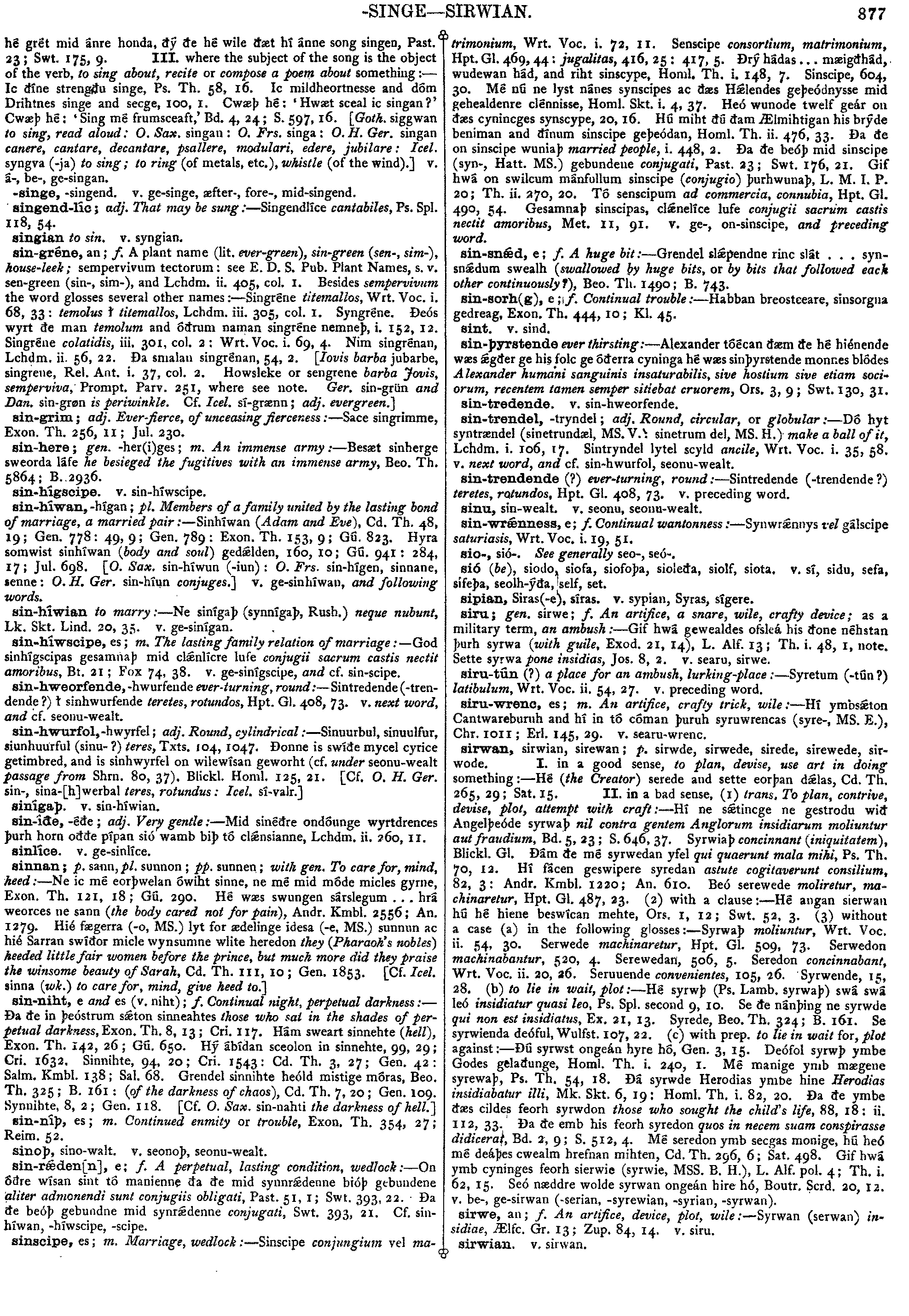
sin-híwscipe,
es
;
m.
The
lasting
family
relation
of
marriage
:--God
sinhígscipas
gesamnaþ
mid
cl nlícre
lufe
conjugii
sacrum
castis
nectit
amoribus.
Bt.
21
;
Fox
74,
38.
v.
ge-sinígscipe,
and
cf.
sin-scipe.
nlícre
lufe
conjugii
sacrum
castis
nectit
amoribus.
Bt.
21
;
Fox
74,
38.
v.
ge-sinígscipe,
and
cf.
sin-scipe.
|
Source: Bosworth/Toller, page b0877, entry 22 View original page image as: [TIFF] [PNG] [View previous entry] [View next entry] |
[Comment on this entry] [View comments] |
The following entry has been hand-corrected once. |
sinscipe,
es
;
m.
Marriage,
wedlock
:--Sinscipe
conjungium
vel
matrimonium,
Wrt.
Voc.
i.
72,
11.
Senscipe
consortium,
matrimonium,
Hpt.
Gl.
469,
44
:
jugalitas,
416,
25
:
417,
5.
Ðrý
hádas
.
.
.
mæigðhád,
wudewan
hád,
and
riht
sinscype,
Homl.
Th.
i.
148,
7.
Sinscipe,
604,
30.
Mé
nú
ne
lyst
nánes
synscipes
ac
ðæs
Hlendes
geþeódnysse
mid
gehealdenre
clénnisse,
Homl.
Skt.
i.
4,
37.
Heó
wunode
twelf
geár
on
ðæs
cynincges
synscype,
20,
16.
Hú
miht
ðú
ðam
Ælmihtigan
his
brýde
beniman
and
ðínum
sinscipe
geþeódan,
Homl.
Th.
ii.
476,
33.
Ða
ðe
on
sinscipe
wuniaþ
married
people,
i.
448,
2.
Ða
ðe
beóþ
mid
sinscipe
(syn-,
Hatt.
MS.)
gebundene
conjugati,
Past.
23
;
Swt.
176,
21.
Gif
hwá
on
swilcum
mánfullum
sinscipe
(conjugio)
þurhwunaþ,
L.
M.
I.
P.
20
;
Th.
ii.
270,
20.
Tó
senscipum
ad
commercia,
connubia,
Hpt.
Gl.
490,
54.
Gesamnaþ
sinscipas,
clnelíce
lufe
conjugii
sacrum
castis
nectit
amoribus,
Met.
11,
91.
v.
ge-,
on-sinscipe,
and
preceding
word.
|
Source: Bosworth/Toller, page b0904, entry 1 View original page image as: [TIFF] [PNG] [View previous entry] [View next entry] |
[Comment on this entry] [View comments] |
The following entry has been hand-corrected once. |
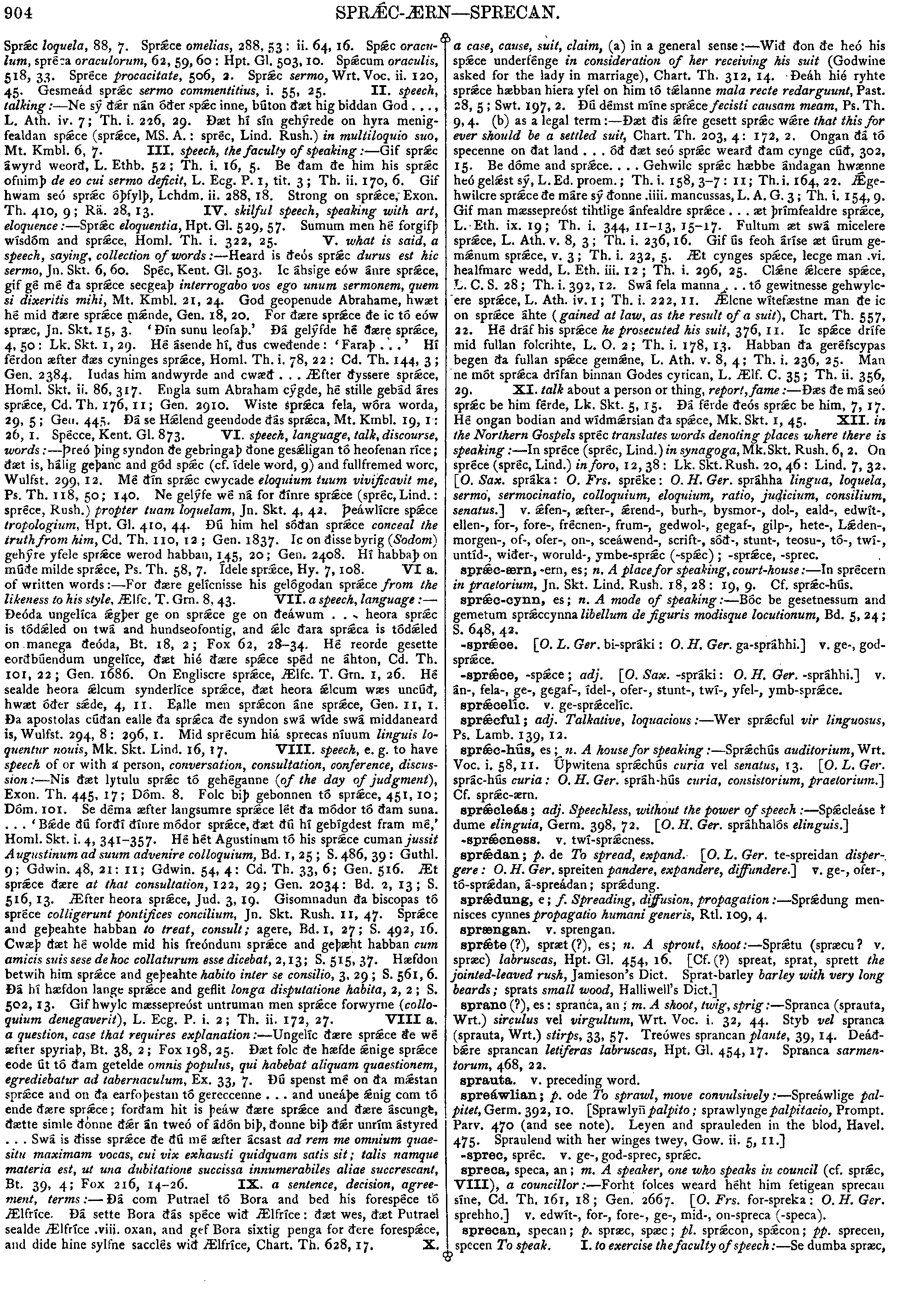
Sprc
loquela,
88,
7.
Sprce
omelias,
288,
53:
ii.
64,
16.
Spc
oraculum,
spréca
oraculorum,
62,
59,
60:
Hpt.
Gl.
503,
10.
Spcum
oraculis,
518,
33.
Spréce
procacitate,
506,
2.
Sprc
sermo,
Wrt.
Voc.
ii.
120,
45.
Gesmeád
sprc
sermo
commentitius,
i.
55,
25.
II.
speech,
talking
:--
Ne
sý
ðr
nán
óðer
spc
inne,
buton
ðæt
hig
biddan
God
...,
L.
Ath.
iv.
7;
Th.
i.
226,
29.
Ðæt
hí
sín
gehýrede
on
hyra
menigfealdan
spce
(sprce,
MS.
A.:
spréc,
Lind.
Rush.)
in
multiloquio
suo,
Mt.
Kmbl.
6,
7.
III.
speech,
the
faculty
of
speaking
:--
Gif
sprc
áwyrd
weorð,
L.
Ethb.
52;
Th.
i.
16,
5.
Be
ðam
ðe
him
his
sprc
ofnimþ
de
eo
cui
sermo
deficit,
L.
Ecg.
P.
1,
tit.
3;
Th.
ii.
170,
6.
Gif
hwam
seó
sprc
óþfylþ,
Lchdm.
ii.
288,
18.
Strong
on
sprce,
Exon.
Th.
410,
9;
Rä.
28,
13.
IV.
skilful
speech,
speaking
with
art,
eloquence
:--
Sprc
eloquentia,
Hpt.
Gl.
529,
57.
Sumum
men
hé
forgifþ
wísdóm
and
sprce,
Homl.
Th.
i.
322,
25.
V.
what
is
said,
a
speech,
saying,
collection
of
words
:--
Heard
is
ðeós
sprc
durus
est
hic
sermo,
Jn.
Skt.
6,
60.
Spéc,
Kent.
Gl.
503.
Ic
áhsige
eów
ánre
sprce,
gif
gé
mé
ða
sprce
secgeaþ
interrogabo
vos
ego
unum
sermonem,
quem
si
dixeritis
mihi,
Mt.
Kmbl.
21,
24.
God
geopenude
Abrahame,
hwæt
hé
mid
ðære
sprce
mnde,
Gen.
18,
20.
For
ðære
sprce
ðe
ic
tó
eów
spræc,
Jn.
Skt.
15,
3.
'Ðín
sunu
leofaþ.'
Ðá
gelýfde
hé
ðære
sprce,
4,
50:
Lk.
Skt.
1,
29.
Hé
ásende
hí,
ðus
cweðende:
'Faraþ
...'
Hí
férdon
æfter
ðæs
cyninges
sprce,
Homl.
Th.
i.
78,
22:
Cd.
Th.
144,
3;
Gen.
2384.
Iudas
him
andwyrde
and
cwæð
...
Æfter
ðyssere
sprce,
Homl.
Skt.
ii.
86,
317.
Engla
sum
Abraham
cýgde,
hé
stille
gebád
áres
sprce,
Cd.
Th.
176,
11;
Gen.
2910.
Wiste
sprca
fela,
wóra
worda,
29,
5;
Gen.
445.
Ðá
se
Hlend
geendode
ðás
sprca,
Mt.
Kmbl.
19,
1;
26,
1.
Spécce,
Kent.
Gl.
873.
VI.
speech,
language,
talk,
discourse,
words
:--
Þreó
þing
syndon
ðe
gebringaþ
ðone
gesligan
tó
heofenan
ríce;
ðæt
is,
hálig
geþanc
and
gód
spc
(cf.
ídele
word,
9)
and
fullfremed
worc,
Wulfst.
299,
12.
Mé
ðin
sprc
cwycade
eloquium
tuum
vivificavit
me,
Ps.
Th.
118,
50;
140.
Ne
gelýfe
wé
ná
for
ðínre
sprce
(spréc,
Lind.:
spréce,
Rush.)
propter
tuam
loquelam,
Jn.
Skt.
4,
42.
Þeáwlícre
spce
tropologium,
Hpt.
Gl.
410,
44.
Ðu
him
hel
sóðan
sprce
conceal
the
truth
from
him,
Cd.
Th.
110,
12;
Gen.
1837.
Ic
on
ðisse
byrig
(Sodom)
gehýre
yfele
sprce
werod
habban,
145,
20;
Gen.
2408.
Hí
habbaþ
on
múðe
milde
sprce,
Ps.
Th.
58,
7.
Ídele
sprce,
Hy.
7,
108.
VI
a.
of
written
words
:--
For
ðære
gelícnisse
his
gelógodan
sprce
from
the
likeness
to
his
style,
Ælfc.
T.
Grn.
8,
43.
VII.
a
speech,
language
:--
Ðeóda
ungelíca
gþer
ge
on
sprce
ge
on
ðeáwum
...
heora
sprc
is
tódled
on
twá
and
hundseofontig,
and
lc
ðara
sprca
is
tódled
on
manega
ðeóda,
Bt.
18,
2;
Fox
62,
28-34.
Hé
reorde
gesette
eorðbúendum
ungelíce,
ðæt
hié
ðære
spce
spéd
ne
áhton,
Cd.
Th.
101,
22;
Gen.
1686.
On
Engliscre
sprce,
Ælfc.
T.
Grn.
1,
26.
Hé
sealde
heora
lcum
synderlíce
sprce,
ðæt
heora
lcum
wæs
uncúð,
hwæt
óðer
sde,
4,
11.
Ealle
men
sprcon
áne
sprce.
Gen.
11,
1.
Ða
apostolas
cúðan
ealle
ða
sprca
ðe
syndon
swá
wíde
swá
middaneard
is,
Wulfst.
294,
8:
296,
1.
Mid
sprécum
hiá
sprecas
níuum
linguis
loquentur
nouis,
Mk.
Skt.
Lind.
16,
17.
VIII.
speech,
e.g.
to
have
speech
of
or
with
a
person,
conversation,
consultation,
conference,
discussion
:--
Nis
ðæt
lytulu
sprc
to
gehéganne
(of
the
day
of
judgment),
Exon.
Th.
445,
17;
Dóm.
8.
Folc
biþ
gebonnen
tó
sprce,
451,
10;
Dóm.
101.
Se
déma
æfter
langsumre
sprce
lét
ða
módor
tó
ðam
suna.
...
'Bde
ðú
forðí
ðínre
módor
sprce,
ðæt
ðú
hí
gebígdest
fram
mé,'
Homl.
Skt.
i.
4,
341-357.
Hé
hét
Agustinum
to
his
sprce
cuman
jussit
Augustinum
ad
suum
advenire
colloquium,
Bd.
1,
25;
S.
486,
39:
Guthl.
9;
Gdwin.
48,
21:
11;
Gdwin.
54,
4:
Cd.
Th.
33,
6;
Gen.
516.
Æt
sprce
ðære
at
that
consultation,
122,
29;
Gen.
2034:
Bd.
2,
13;
S.
516,
13.
Æfter
heora
sprce,
Jud.
3,
19.
Gisomnadun
ða
biscopas
tó
spréce
colligerunt
pontifices
concilium,
Jn.
Skt.
Rush.
11,
47.
Sprce
and
geþeahte
habban
to
treat,
consult;
agere,
Bd.
1,
27;
S.
492,
16.
Cwæþ
ðæt
hé
wolde
mid
his
freóndum
sprce
and
geþæht
habban
cum
amicis
suis
sese
de
hoc
collaturum
esse
dicebat,
2,
13;
S.
515,
37.
Hæfdon
betwih
him
sprce
and
geþeahte
habito
inter
se
consilio,
3,
29;
S.
561,
6.
Ða
hi
hæfdon
lange
sprce
and
geflit
longa
disputatione
habita,
2,
2;
S.
502,
13.
Gif
hwylc
mæssepreóst
untruman
men
sprce
forwyrne
(colloquium
denegaverit),
L.
Ecg.
P.
i.
2;
Th.
ii.
172,
27.
VIII
a.
a
question,
case
that
requires
explanation
:--
Ungelíc
ðære
sprce
ðe
wé
æfter
spyriaþ,
Bt.
38,
2;
Fox
198,
25.
Ðæt
folc
ðe
hæfde
nige
sprce
eode
út
tó
ðam
getelde
omnis
populus,
qui
habebat
aliquam
quaestionem,
egrediebatur
ad
tabernaculum,
Ex.
33,
7.
Ðú
spenst
mé
on
ða
mstan
sprce
and
on
ða
earfoþestan
tó
gereccenne
...
and
uneáþe
nig
com
tó
ende
ðære
sprce;
forðam
hit
is
þeáw
ðære
sprce
and
ðære
áscunge,
ðætte
simle
ðónne
ðr
án
tweó
of
ádón
biþ,
ðonne
biþ
ðr
unrím
ástyred
...
Swá
is
ðisse
sprce
ðe
ðu
mé
æfter
ácsast
ad
rem
me
omnium
quaesitu
maximam
vocas,
cui
vix
exhausti
quidquam
satis
sit;
talis
namque
materia
est,
ut
una
dubitatione
succissa
innumerabiles
aliae
succrescant,
Bt.
39,
4;
Fox
216,
14-26.
IX.
a
sentence,
decision,
agreement,
terms
:--
Ðá
com
Putrael
tó
Bora
and
bed
his
forespéce
tó
Ælfríce.
Ðá
sette
Bora
ðás
spéce
wið
Ælfríce:
ðæt
wes,
ðæt
Putrael
sealde
Ælfríce
.viii.
oxan,
and
gef
Bora
sixtig
penga
for
ðere
forespce,
and
dide
hine
sylfne
sacclés
wið
Ælfríce,
Chart.
Th.
628,
17.
X.
a
case,
cause,
suit,
claim,
(a)
in
a
general
sense
:--
Wið
ðon
ðe
heó
his
spce
underfénge
in
consideration
of
her
receiving
his
suit
(Godwine
asked
for
the
lady
in
marriage),
Chart.
Th.
312,
14.
Ðeáh
hié
ryhte
sprce
hæbban
hiera
yfel
on
him
tó
tlanne
mala
recte
redarguunt,
Past.
28,
5;
Swt.
197,
2.
Ðú
démst
míne
sprce
fecisti
causam
meam,
Ps.
Th.
9,
4.
(b)
as
a
legal
term
:--
Ðæt
ðis
fre
gesett
sprc
wre
that
this
for
ever
should
be
a
settled
suit,
Chart.
Th.
203,
4:
172,
2.
Ongan
ðá
tó
specenne
on
ðat
land
...
óð
ðæt
seó
sprc
wearð
ðam
cynge
cúð,
302,
15.
Be
dóme
and
sprce.
...
Gehwilc
sprc
hæbbe
ándagan
hwænne
heó
gelst
sý,
L.
Ed.
proem.;
Th.
i.
158,
3-7:
11;
Th.
i.
164,
22.
Æ-acute;gehwilcre
sprce
ðe
máre
sý
ðonne
.iiii.
mancussas,
L.
A.
G.
3;
Th.
i.
154,
9.
Gif
man
mæssepreóst
tihtlige
ánfealdre
sprce
...
æt
þrímfealdre
sprce,
L.
Eth.
ix.
19;
Th.
i.
344,
11-13,
15-17.
Fultum
æt
swá
micelere
sprce,
L.
Ath.
v.
8,
3;
Th.
i.
236,
16.
Gif
ús
feoh
áríse
æt
úrum
gemnum
sprce,
v.
3;
Th.
i.
232,
5.
Æt
cynges
spce,
lecge
man
.vi.
healfmarc
wedd,
L.
Eth.
iii.
12;
Th.
i.
296,
25.
Clne
lcere
spce,
L.
C.
S.
28;
Th.
i.
392,
12.
Swá
fela
manna
...
tó
gewitnesse
gehwylcere
sprce,
L.
Ath.
iv.
i;
Th.
i.
222,
11.
Æ-acute;lcne
wítefæstne
man
ðe
ic
on
sprce
áhte
(gained
at
law,
as
the
result
of
a
suit),
Chart.
Th.
557,
22.
Hé
dráf
his
sprce
he
prosecuted
his
suit,
376,
11.
Ic
spce
drífe
mid
fullan
folcrihte,
L.
O.
2;
Th.
i.
178,
13.
Habban
ða
geréfscypas
begen
ða
fullan
spce
gemne,
L.
Ath.
v.
8,
4;
Th.
i.
236,
25.
Man
ne
mót
sprca
drífan
binnan
Godes
cyrican,
L.
Ælf.
C.
35;
Th.
ii.
356,
29.
XI.
talk
about
a
person
or
thing,
report,
fame
:--
Ðæs
ðe
má
seó
sprc
be
him
férde,
Lk.
Skt.
5,
15.
Ðá
férde
ðeós
sprc
be
him,
7,
17.
Hé
ongan
bodian
and
wídmrsian
ða
spce,
Mk.
Skt.
1,
45.
XII.
in
the
Northern
Gospels
spréc
translates
words
denoting
places
where
there
is
speaking
:--
In
spréce
(spréc,
Lind.)
in
synagoga,
Mk.
Skt.
Rush.
6,
2.
On
spréce
(spréc,
Lind.)
in
foro,
12,
38:
Lk.
Skt.
Rush.
20,
46:
Lind.
7,
32.
[O.
Sax.
spráka:
O.
Frs.
spréke:
O.
H.
Ger.
spráhha
lingua,
loquela,
sermo,
sermocinatio,
colloquium,
eloquium,
ratio,
judicium,
consilium,
senatus.]
v.
fen-,
æfter-,
rend-,
burh-,
bysmor-,
dol-,
eald-,
edwít-,
ellen-,
for-,
fore-,
frécnen-,
frum-,
gedwol-,
gegaf-,
gilp-,
hete-,
Lden-,
morgen-,
of-,
ofer-,
on-,
sceáwend-,
scrift-,
sóð,
stunt-,
teosu-,
tó-,
twí-,
untíd-,
wiðer-,
woruld-,
ymbe-sprc
(-spc);
-sprce,
-sprec.
|
Source: Bosworth/Toller, page b0942, entry 8 View original page image as: [TIFF] [PNG] [View previous entry] [View next entry] |
[Comment on this entry] [View comments] |
The following entry has been hand-corrected once. |
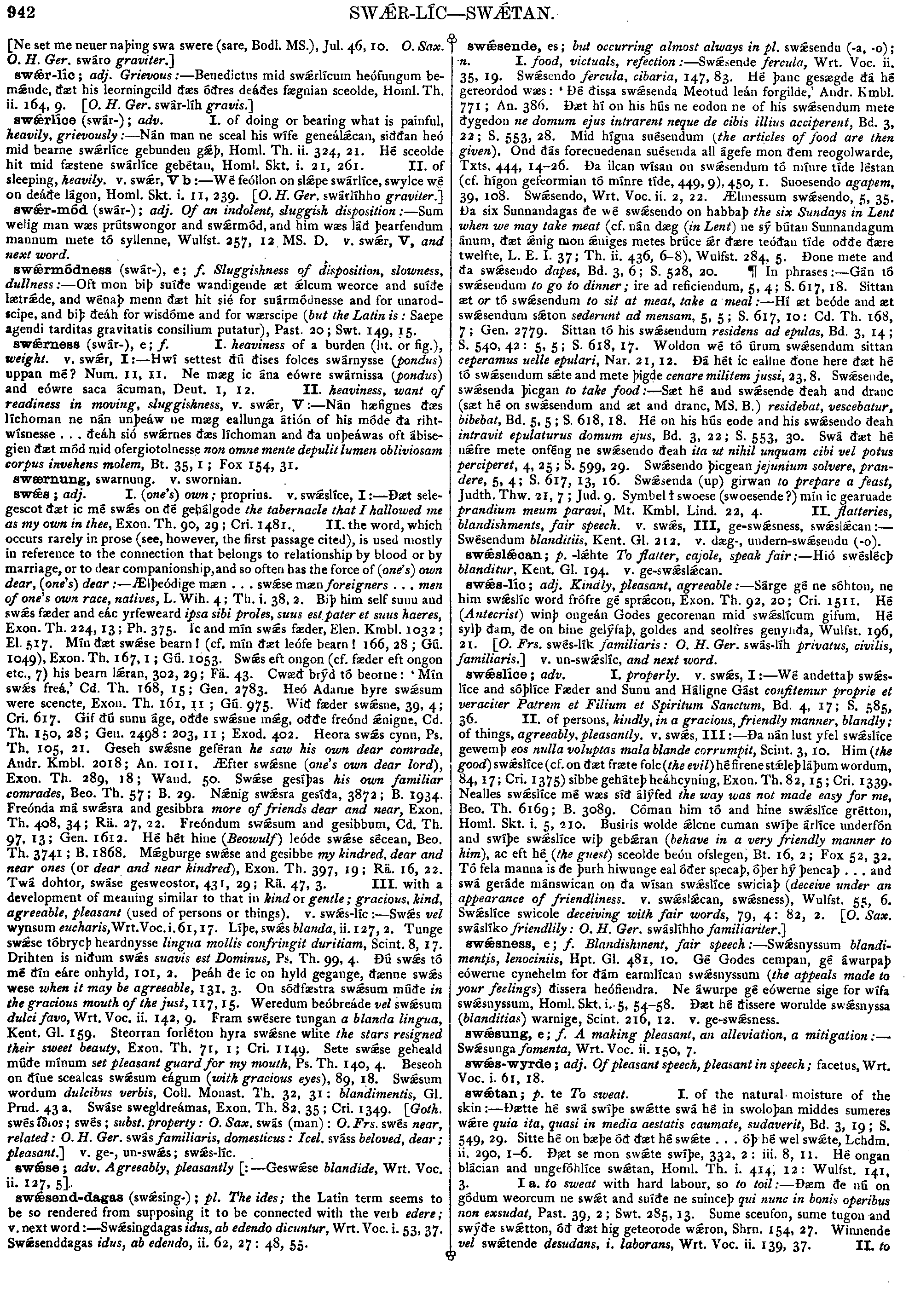
sws;
adj.
I.
(one's)
own;
proprius.
v.
swslice,
I
:--
Ðæt
selegescot
ðæt
ic
mé
sws
on
ðé
gehálgode
the
tabernacle
that
I
hallowed
me
as
my
own
in
thee,
Exon.
Th.
90,
29
;
Cri.
1481.
,
II.
the
word,
which
occurs
rarely
in
prose
(see,
however,
the
first
passage
cited),
is
used
mostly
in
reference
to
the
connection
that
belongs
to
relationship
by
blood
or
by
marriage,
or
to
dear
companionship,
and
so
often
has
the
force
of
(one's)
own
dear,
(one's)
dear
:--
Ælþeódige
mæn
.
.
.
swse
mæn
foreigners
.
.
.
men
of
one's
own
race,
natives,
L.
Wih.
4;
Th.
i.
38,
2.
Biþ
him
self
sunu
and
sws
fæder
and
eác
yrfeweard
ipsa
sibi
proles,
suus
est
pater
et
suus
haeres,
Exon.
Th.
224,
13;
Ph.
375.
Ic
and
mín
sws
fæder,
Elen.
Kmbl.
1032;
El.
517.
Mín
ðæt
swse
bearn!
(cf.
mín
ðæt
leófe
bearn!
166,
28;
Gú.
1049),
Exon.
Th.
167,
1;
Gú.
1053.
Sws
eft
ongon
(cf.
fæder
eft
ongon
etc.,
7)
his
bearn
lran,
302,
29;
Fä.
43.
Cwæð
brýd
tó
beorne
:
'Mín
sws
freá,'
Cd.
Th.
168,
15;
Gen.
2783.
Heó
Adame
hyre
swsum
were
scencte,
Exon.
Th.
161,
11;
Gú.
975.
Wið
fæder
swsne,
39,
4;
Cri.
617.
Gif
ðú
sunu
áge,
oððe
swsne
mg,
oððe
freónd
nigne,
Cd.
Th.
150,
28;
Gen.
2498
:
203,
11;
Exod.
402.
Heora
sws
cynn,
Ps.
Th.
105,
21.
Geseh
swsne
geféran
he
saw
his
own
dear
comrade,
Andr.
Kmbl.
2018;
An.
1011.
Æfter
swsne
(one's
own
dear
lord),
Exon.
Th.
289,
18;
Wand.
50.
Swse
gesíþas
his
own
familiar
comrades,
Beo.
Th.
57;
B.
29.
Nnig
swsra
gesíða,
3872;
B.
1934.
Freónda
má
swsra
and
gesibbra
more
of
friends
dear
and
near,
Exon.
Th.
408,
34;
Rä.
27,
22.
Freóndum
swsum
and
gesibbum,
Cd.
Th.
97,
13;
Gen.
1612.
Hé
hét
hine
(Beowulf)
leóde
swse
sécean.
Beo.
Th.
3741;
B.
1868.
Mgburge
swse
and
gesibbe
my
kindred,
dear
and
near
ones
(or
dear
and
near
kindred),
Exon.
Th.
397,
19;
Rä.
16,
22.
Twá
dohtor,
swáse
gesweostor,
431,
29;
Rä.
47,
3.
III.
with
a
development
of
meaning
similar
to
that
in
kind
or
gentle;
gracious,
kind,
agreeable,
pleasant
(used
of
persons
or
things).
v.
sws-líc
:--
Sws
vel
wynsum
eucharis,
Wrt.
Voc.
i.
61,
17.
Líþe,
sws
blanda,
ii.
127,
2.
Tunge
swse
tóbrycþ
heardnysse
lingua
mollis
confringit
duritiam,
Scint.
8,
17.
Drihten
is
niðum
sws
suavis
est
Dominus,
Ps.
Th.
99,
4.
Ðú
sws
tó
mé
ðín
eáre
onhyld,
101,
2.
Þeáh
ðe
ic
on
hyld
gegange,
ðænne
sws
wese
when
it
may
be
agreeable,
131,
3.
On
sóðfæstra
swsum
múðe
in
the
gracious
mouth
of
the
just,
117,
15.
Weredum
beóbreáde
vel
swsum
dulci
favo,
Wrt.
Voc.
ii.
142,
9.
Fram
swésere
tungan
a
blanda
lingua,
Kent.
Gl.
159.
Steorran
forléton
hyra
swsne
wlite
the
stars
resigned
their
sweet
beauty,
Exon.
Th.
71,
1;
Cri.
1149.
Sete
swse
geheald
múðe
mínum
set
pleasant
guard
for
my
mouth,
Ps.
Th.
140,
4.
Beseoh
on
ðíne
scealcas
swsum
eágum
(with
gracious
eyes),
89,
18.
Swsum
wordum
dulcibus
verbis,
Coll.
Monast.
Th.
32,
31:
blandimentis,
Gl.
Prud.
43
a.
Swáse
swegldreámas,
Exon.
Th.
82,
35;
Cri.
1349.
[Goth.
swés
GREEK;
swés;
subst.
property:
O.
Sax.
swás
(man)
:
O.
Frs.
swés
near,
related
:
O.
H.
Ger.
swás
familiaris,
domesticus
:
Icel.
sváss
beloved,
dear;
pleasant.]
v.
ge-,
un-sws;
sws-líc.
|
Source: Bosworth/Toller, page b1034, entry 3 View original page image as: [TIFF] [PNG] [View previous entry] [View next entry] |
[Comment on this entry] [View comments] |
The following entry has been hand-corrected once. |
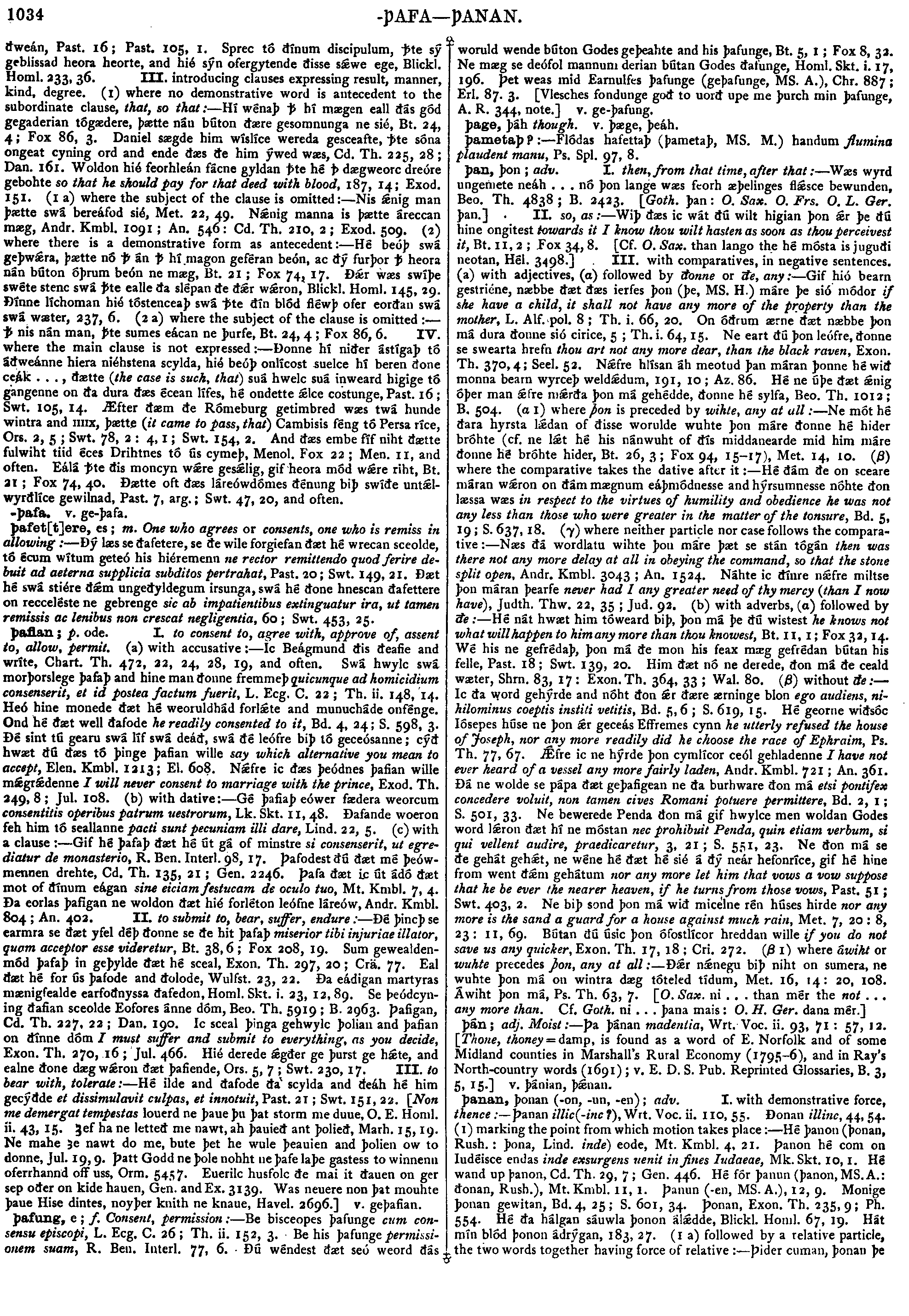
þafian;
p.
ode.
I.
to
consent
to,
agree
with,
approve
of,
assent
to,
allow,
permit.
(a)
with
accusative
:--
Ic
Beágmund
ðis
ðeafie
and
wríte,
Chart.
Th.
472,
22,
24,
28,
19,
and
often.
Swá
hwylc
swá
morþorslege
þafaþ
and
hine
man
ðonne
fremmeþ
quicunque
ad
homicidium
consenserit,
et
id
postea
factum
fuerit,
L.
Ecg.
C.
22;
Th.
ii.
148,
14.
Heó
hine
monede
ðæt
hé
weoruldhád
forlte
and
munucháde
onnfénge.
Ond
hé
ðæt
well
ðafode
he
readily
consented
to
it,
Bd.
4.
24;
S.
598,
3.
Ðé
sint
tú
gearu
swá
líf
swá
deáð,
swá
ðé
leófre
biþ
tó
geceósanne;
cýð
hwæt
ðú
ðæs
tó
þinge
þafian
wille
say
which
alternative
you
mean
to
accept,
Elen.
Kmbl.
1213;
El.
608.
Nfre
ic
ðæs
þeódnes
þafian
wille
mgrdenne
I
will
never
consent
to
marriage
with
the
prince,
Exod.
Th.
249,
8;
Jul.
108.
(b)
with
dative
:--
Gé
þafiaþ
eówer
fædera
weorcum
consentitis
operibus
patrum
uestrorum,
Lk.
Skt.
11,
48.
Ðafande
woeron
feh
him
tó
seallanne
pacti
sunt
pecuniam
illi
dare,
Lind.
22,
5.
(c)
with
a
clause
:--
Gif
hé
þafaþ
ðæt
hé
út
gá
of
minstre
si
consenserit,
ut
egrediatur
de
monasterio,
R.
Ben.
Interl.
98,
17.
Þafodest
ðú
ðæt
mé
þeówmennen
drehte,
Cd.
Th.
135,
21;
Gen.
2246.
Þafa
ðæt
ic
út
ádó
ðæt
mot
of
ðínum
eágan
sine
eiciam
festucam
de
oculo
tuo,
Mt.
Kmbl.
7,
4.
Ða
eorlas
þafigan
ne
woldon
ðæt
hié
forléton
leófne
láreów,
Andr.
Kmbl.
804;
An.
402.
II.
to
submit
to,
bear,
suffer,
endure
:--
Ðé
þincþ
se
earmra
se
ðæt
yfel
déþ
ðonne
se
ðe
hit
þafaþ
miserior
tibi
injuriae
illator,
quam
acceptor
esse
videretur,
Bt.
38,
6;
Fox
208,
19.
Sum
gewealden-mód
þafaþ
in
geþylde
ðæt
hé
sceal,
Exon.
Th.
297,
20;
Crä.
77.
Eal
ðæt
hé
for
ús
þafode
and
ðolode,
Wulfst.
23,
22.
Ða
eádigan
martyras
mænigfealde
earfoðnyssa
ðafedon,
Homl.
Skt.
i.
23,
12,
89.
Se
þeódcyning
ðafian
sceolde
Eofores
ánne
dóm,
Beo.
Th.
5919;
B.
2963.
Þafigan,
Cd.
Th.
227,
22;
Dan,
190.
Ic
sceal
þinga
gehwylc
þolian
and
þafian
on
ðínne
dóm
I
must
suffer
and
submit
to
everything,
as
you
decide,
Exon.
Th.
270,
6;
Jul.
466.
Hié
derede
gðer
ge
þurst
ge
hte,
and
ealne
ðone
dæg
wron
ðæt
þafiende,
Ors.
5,
7;
Swt.
230,
I7.
III.
to
bear
with,
tolerate
:--
Hé
ilde
and
ðafode
ða
scylda
and
ðeáh
hé
him
gecýðde
et
dissimulavit
culpas,
et
innotuit,
Past.
21;
Swt.
151,
22.
[Non
me
demergat
tempestas
louerd
ne
þaue
þu
þat
storm
me
duue,
O.
E.
Homl.
ii.
43,
15.
 ef
ha
ne
letteð
me
nawt,
ah
þauieð
ant
þolieð,
Marh.
15,
19.
Ne
mahe
e
nawt
do
me,
bute
þet
he
wule
þeauien
and
þolien
ow
to
donne,
Jul.
19,
9.
Þatt
Godd
ne
þole
nohht
ne
þafe
laþe
gastess
to
winnenn
oferrhannd
off
uss,
Orm.
5457.
Euerilc
husfolc
ðe
mai
it
ðauen
on
ger
sep
oðer
on
kide
hauen,
Gen.
and
Ex.
3139.
Was
neuere
non
þat
mouhte
þaue
Hise
dintes,
noyþer
knith
ne
knaue,
Havel.
2696.]
v.
geþafian.
ef
ha
ne
letteð
me
nawt,
ah
þauieð
ant
þolieð,
Marh.
15,
19.
Ne
mahe
e
nawt
do
me,
bute
þet
he
wule
þeauien
and
þolien
ow
to
donne,
Jul.
19,
9.
Þatt
Godd
ne
þole
nohht
ne
þafe
laþe
gastess
to
winnenn
oferrhannd
off
uss,
Orm.
5457.
Euerilc
husfolc
ðe
mai
it
ðauen
on
ger
sep
oðer
on
kide
hauen,
Gen.
and
Ex.
3139.
Was
neuere
non
þat
mouhte
þaue
Hise
dintes,
noyþer
knith
ne
knaue,
Havel.
2696.]
v.
geþafian.
|
Source: Bosworth/Toller, page b1104, entry 2 View original page image as: [TIFF] [PNG] [View previous entry] [View next entry] |
[Comment on this entry] [View comments] |
The following entry has been hand-corrected once. |
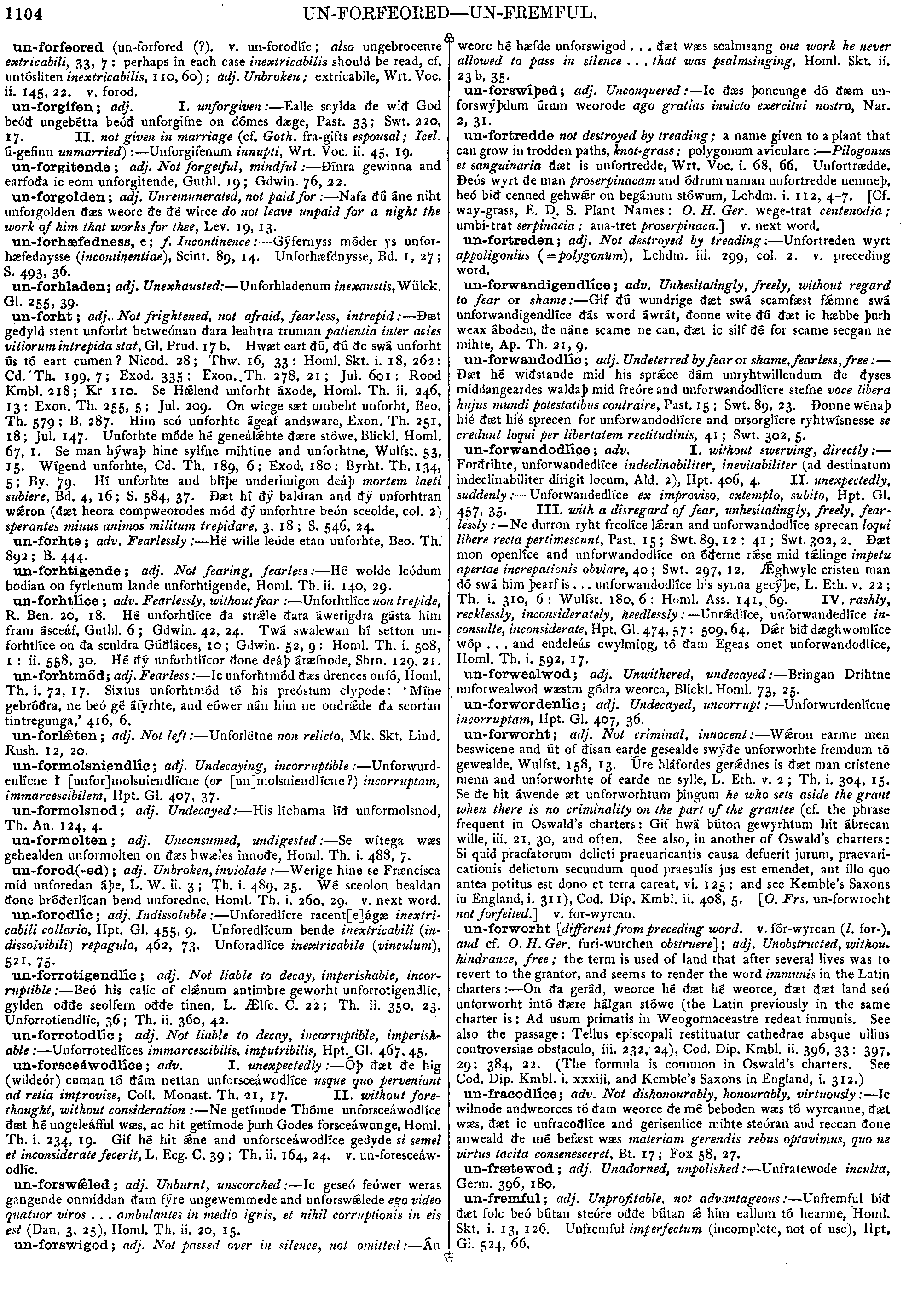
un-forgifen; adj. I. unforgiven :-- Ealle scylda ðe wið God beóð ungebétta beóð unforgifne on dómes dæge, Past. 33; Swt. 220, 17. II. not given in marriage (cf. Goth. fra-gifts espousal; Icel. ú-gefinn unmarried) :-- Unforgifenum innupti, Wrt. Voc. ii. 45, 19.
|
Source: Bosworth/Toller, page b1124, entry 19 View original page image as: [TIFF] [PNG] [View previous entry] [View next entry] |
[Comment on this entry] [View comments] |
The following entry has been hand-corrected once. |
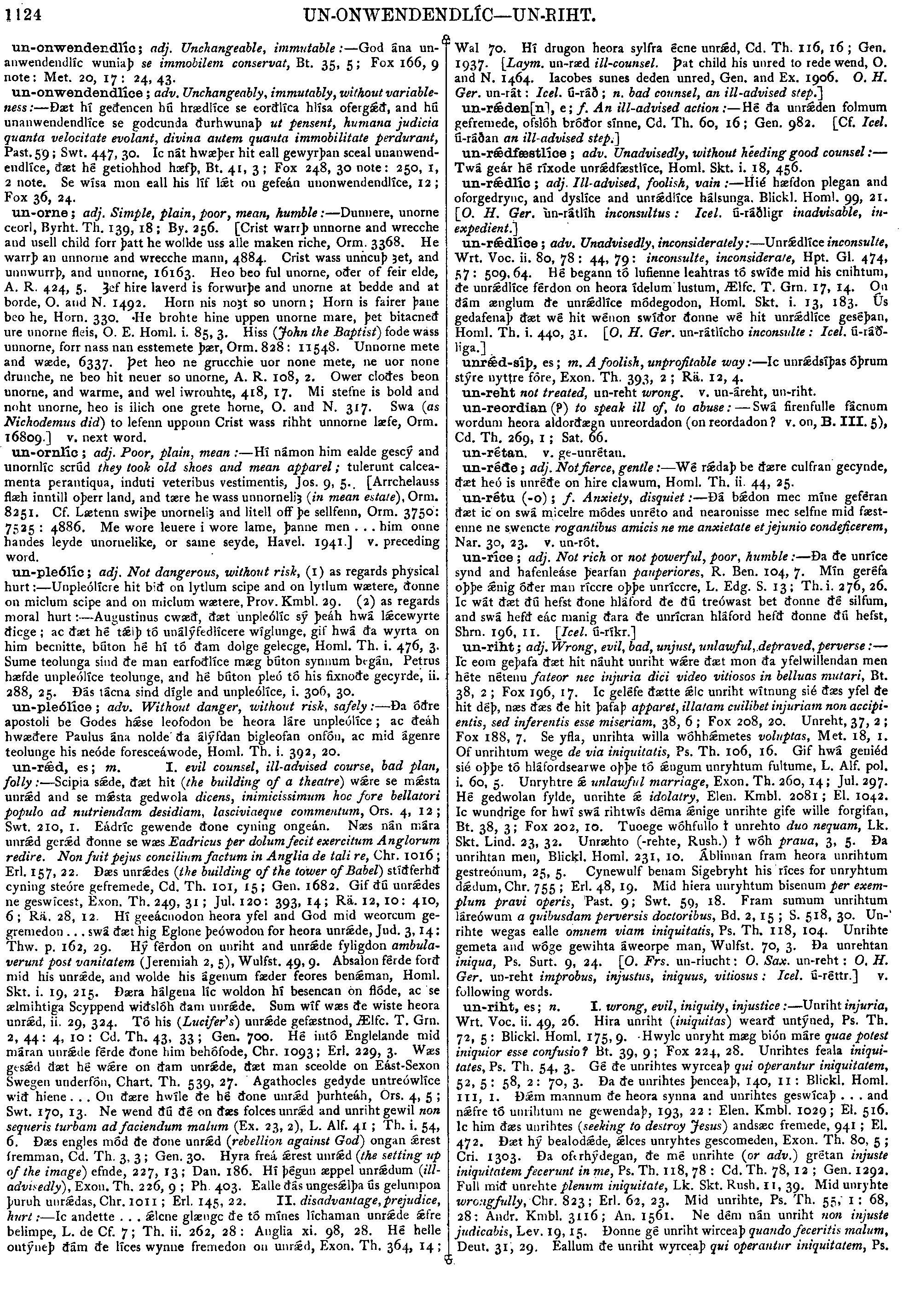
un-riht;
adj.
Wrong,
evil,
bad,
unjust,
unlawful,
depraved,
perverse
:--
Ic
eom
geþafa
ðæt
hit
náuht
unriht
wre
ðæt
mon
ða
yfelwillendan
men
héte
nétenu
fateor
nec
injuries
dici
video
vitiosos
in
belluas
mutari,
Bt.
38,
2;
Fox
196,
17.
Ic
geléfe
ðætte
lc
unriht
wítnung
sié
ðæs
yfel
ðe
hit
déþ,
næs
ðæs
ðe
hit
þafaþ
apparet,
illatam
cuilibet
injuriam
non
accipientis,
sed
inferentis
esse
miseriam,
38,
6;
Fox
208,
20.
Unreht,
37,
2;
Fox
188,
7.
Se
yfla,
unrihta
willa
wóhhmetes
voluptas,
Met.
18,
1.
Of
unrihtum
wege
de
via
iniquitatis,
Ps.
Th.
106,
16.
Gif
hwá
geniéd
sié
oþþe
tó
hláfordsearwe
oþþe
tó
ngum
unryhtum
fultume,
L.
Alf.
pol.
i.
60,
5.
Unryhtre
unlawful
marriage,
Exon.
Th.
260,
14;
Jul.
297.
Hé
gedwolan
fylde,
unrihte
idolatry,
Elen.
Kmbl.
2081;
El.
1042.
Ic
wundrige
for
hwí
swá
rihtwís
déma
nige
unrihte
gife
wille
forgifan,
Bt.
38,
3;
Fox
202,
10.
Tuoege
wóhfullo
 unrehto
duo
nequam,
Lk.
Skt.
Lind.
23,
32.
Unræhto
(-rehte,
Rush.)
wóh
praua,
3,
5.
Ða
unrihtan
men,
Blickl.
Homl.
231,
10.
Áblinnan
fram
heora
unrihtum
gestreónum,
25,
5.
Cynewulf
benam
Sigebryht
his
ríces
for
unryhtum
ddum,
Chr.
755;
Erl.
48,
19.
Mid
hiera
unryhtum
bisenum
per
exemplum
pravi
operis,
Past.
9;
Swt.
59,
18.
Fram
sumum
unrihtum
láreówum
a
quibusdam
perversis
doctoribus,
Bd.
2,
15;
S.
518,
30.
Unrihte
wegas
ealle
omnem
viam
iniquitatis,
Ps.
Th.
118,
104.
Unrihte
gemeta
and
wóge
gewihta
áweorpe
man,
Wulfst.
70,
3.
Ða
unrehtan
iniqua,
Ps.
Surt.
9,
24.
[O.
Frs.
un-riucht:
O.
Sax.
un-reht:
O.
H.
Ger.
un-reht
improbus,
injustus,
iniquus,
vitiosus:
Icel.
ú-réttr.]
v.
following
words.
unrehto
duo
nequam,
Lk.
Skt.
Lind.
23,
32.
Unræhto
(-rehte,
Rush.)
wóh
praua,
3,
5.
Ða
unrihtan
men,
Blickl.
Homl.
231,
10.
Áblinnan
fram
heora
unrihtum
gestreónum,
25,
5.
Cynewulf
benam
Sigebryht
his
ríces
for
unryhtum
ddum,
Chr.
755;
Erl.
48,
19.
Mid
hiera
unryhtum
bisenum
per
exemplum
pravi
operis,
Past.
9;
Swt.
59,
18.
Fram
sumum
unrihtum
láreówum
a
quibusdam
perversis
doctoribus,
Bd.
2,
15;
S.
518,
30.
Unrihte
wegas
ealle
omnem
viam
iniquitatis,
Ps.
Th.
118,
104.
Unrihte
gemeta
and
wóge
gewihta
áweorpe
man,
Wulfst.
70,
3.
Ða
unrehtan
iniqua,
Ps.
Surt.
9,
24.
[O.
Frs.
un-riucht:
O.
Sax.
un-reht:
O.
H.
Ger.
un-reht
improbus,
injustus,
iniquus,
vitiosus:
Icel.
ú-réttr.]
v.
following
words.
|
Source: Bosworth/Toller, page b1181, entry 6 View original page image as: [TIFF] [PNG] [View previous entry] [View next entry] |
[Comment on this entry] [View comments] |
The following entry has been hand-corrected once. |
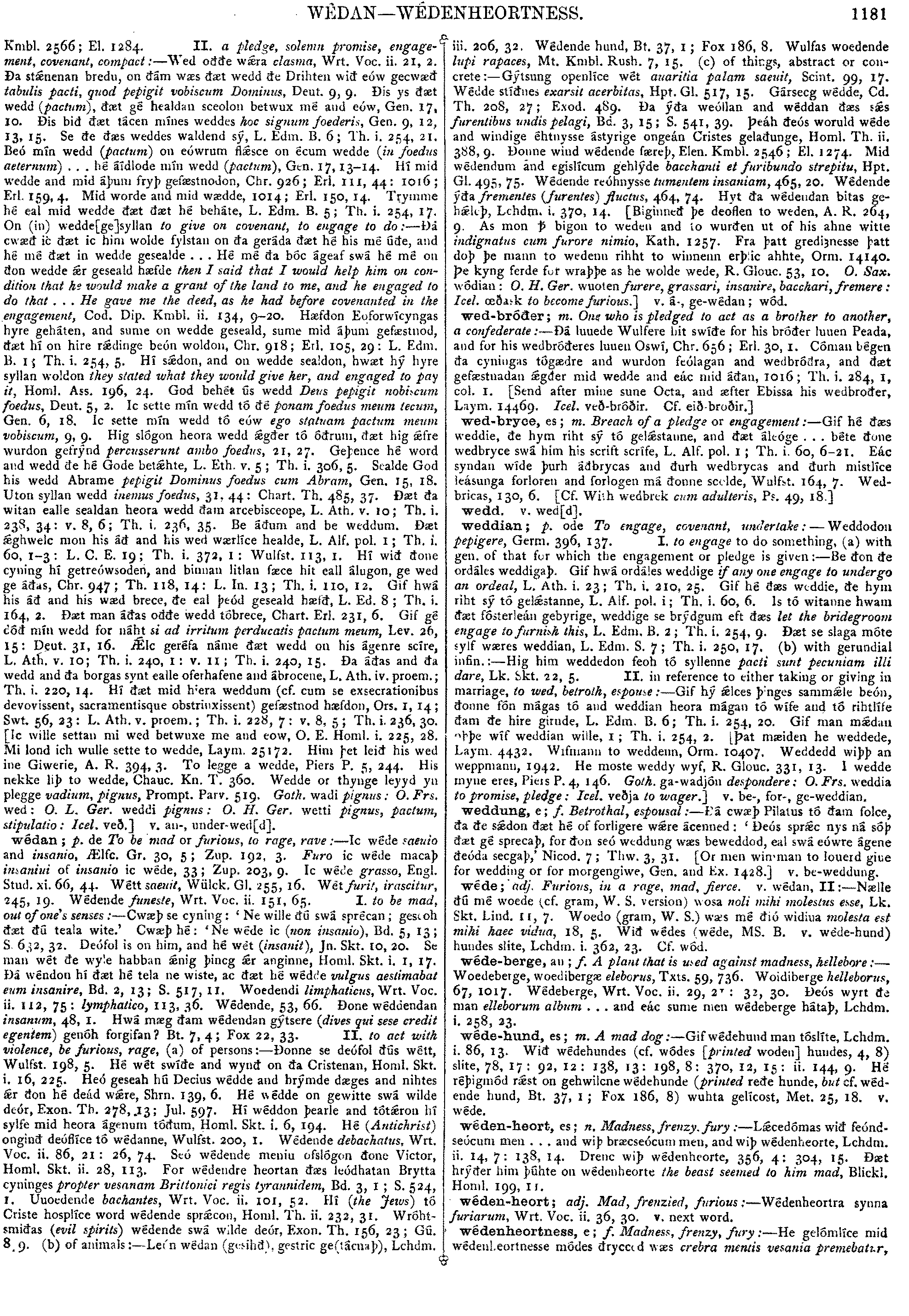
weddian;
p.
ode
To
engage,
covenant,
undertake
:--
Weddodon
pepigere,
Germ.
396,
137.
I.
to
engage
to
do
something,
(a)
with
gen.
of
that
for
which
the
engagement
or
pledge
is
given
:--
Be
ðon
ðe
ordáles
weddigaþ.
Gif
hwá
ordáles
weddige
if
any
one
engage
to
undergo
an
ordeal,
L.
Ath.
i.
23;
Th.
i.
210,
25.
Gif
hé
ðæs
weddie,
ðe
hym
riht
sý
tó
gelstanne,
L.
Alf.
pol.
i;
Th.
i.
60,
6.
Is
tó
witanne
hwam
ðæt
fósterleán
gebyrige,
weddige
se
brýdgum
eft
ðæs
let
the
bridegroom
engage
to
furnish
this,
L.
Edm.
B.
2
;
Th.
i.
254,
9.
Ðæt
se
slaga
móte
sylf
wæres
weddian,
L.
Edm.
S.
7
;
Th.
i.
250,
17.
(b)
with
gerundial
infin.
:--
Hig
him
weddedon
feoh
tó
syllenne
pacti
sunt
pecuniam
illi
dare,
Lk.
Skt.
22,
5.
II.
in
reference
to
either
taking
or
giving
in
marriage,
to
wed,
betroth,
espouse
:--
Gif
hý
lces
þinges
sammle
beón,
ðonne
fón
mágas
tó
and
weddian
heora
mágan
tó
wífe
and
tó
rihtlífe
ðam
ðe
hire
girude,
L.
Edm.
B.
6;
Th.
i.
254,
20.
Gif
man
mdan
oððe
wíf
weddian
wille,
1;
Th.
i.
254,
2.
[Þat
mæiden
he
weddede,
Laym.
4432.
Wifmann
to
weddenn,
Orm.
10407.
Weddedd
wiþþ
an
weppmann,
1942.
He
moste
weddy
wyf,
R.
Glouc.
331,
13.
I
wedde
myne
eres,
ILLEGIBLE
P.
4,
146.
Goth.
ga-wadjón
despondere:
O.
Frs.
weddia
to
promise,
pledge:
Icel.
veðja
to
wnger.]
v.
be-,
for-,
ge-weddian.
|
Source: Bosworth/Toller, page b1182, entry 18 View original page image as: [TIFF] [PNG] [View previous entry] [View next entry] |
[Comment on this entry] [View comments] |
The following entry has been hand-corrected once. |
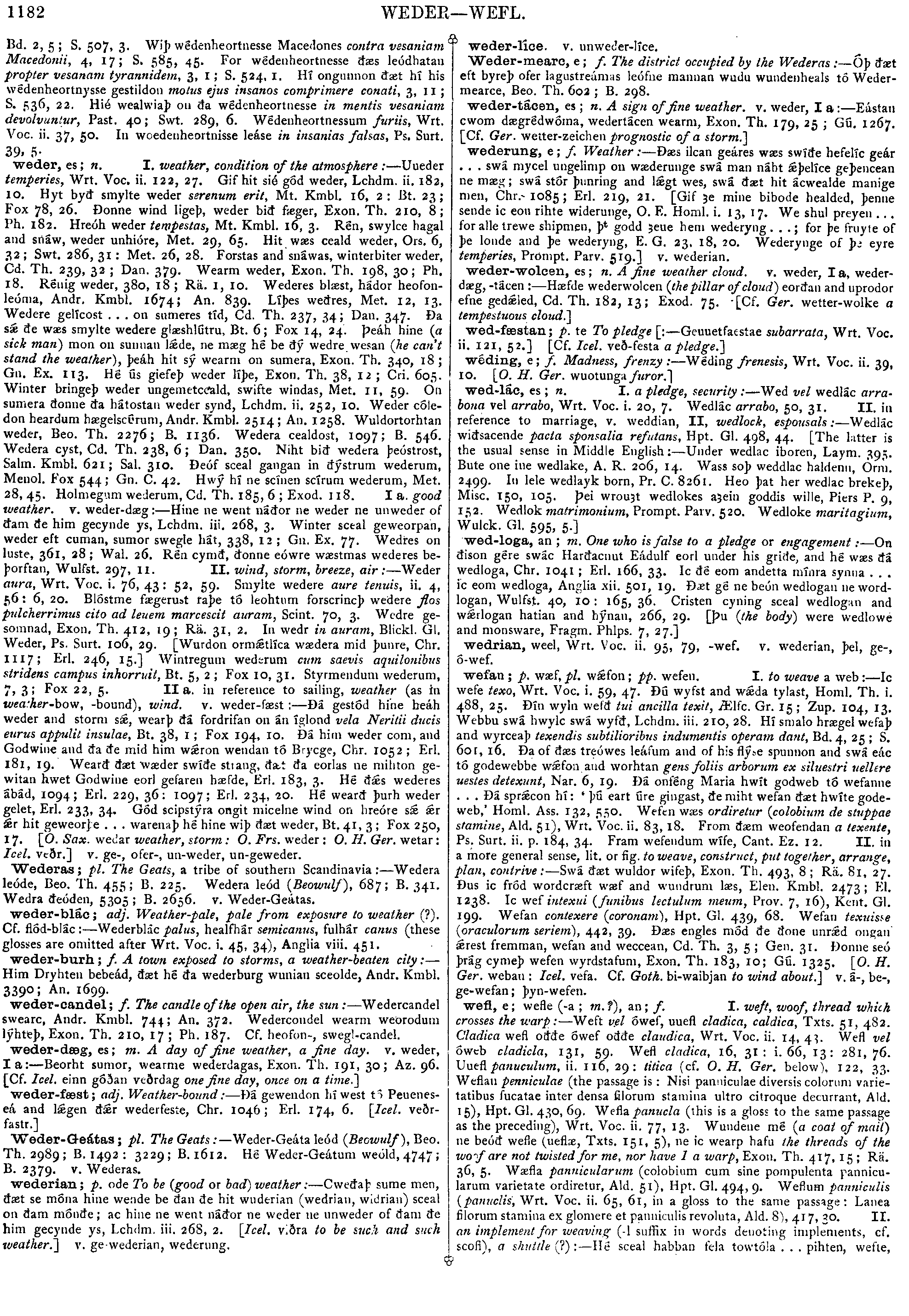
wed-lác,
es;
n.
I.
a
pledge,
security
:--
Wed
vel
wedlác
arra bona
vel
arrabo,
Wrt.
Voc.
i.
20,
7.
Wedlác
arrabo,
50,
31.
II.
in
reference
to
marriage,
v.
weddian,
II,
wedlock,
espousals
:--
Wedlác
wiðsacende
pacta
sponsalia
refutans,
Hpt.
Gl.
498,
44.
[The
latter
is
the
usual
sense
in
Middle
English
:--
Under
wedlac
iboren,
Laym.
395.
Bute
one
ine
wedlake,
A.
R.
206,
14.
Wass
soþ
weddlac
haldenu,
Orm.
2499.
I
lele
wedlayk
born,
Pr.
C.
8261.
Heo
þat
her
wedlac
brekeþ,
Misc.
150,
105.
Þei
wrout
wedlokes
aein
goddis
wille,
Piers
P.
9,
152.
Wedlok
matrimonium.
Prompt.
Parv.
520.
Wedloke
maritagium,
Wulck.
Gl.
595,
5.]
bona
vel
arrabo,
Wrt.
Voc.
i.
20,
7.
Wedlác
arrabo,
50,
31.
II.
in
reference
to
marriage,
v.
weddian,
II,
wedlock,
espousals
:--
Wedlác
wiðsacende
pacta
sponsalia
refutans,
Hpt.
Gl.
498,
44.
[The
latter
is
the
usual
sense
in
Middle
English
:--
Under
wedlac
iboren,
Laym.
395.
Bute
one
ine
wedlake,
A.
R.
206,
14.
Wass
soþ
weddlac
haldenu,
Orm.
2499.
I
lele
wedlayk
born,
Pr.
C.
8261.
Heo
þat
her
wedlac
brekeþ,
Misc.
150,
105.
Þei
wrout
wedlokes
aein
goddis
wille,
Piers
P.
9,
152.
Wedlok
matrimonium.
Prompt.
Parv.
520.
Wedloke
maritagium,
Wulck.
Gl.
595,
5.]
|
Source: Bosworth/Toller, page b1218, entry 1 View original page image as: [TIFF] [PNG] [View previous entry] [View next entry] |
[Comment on this entry] [View comments (1)] |
The following entry has been hand-corrected once. |
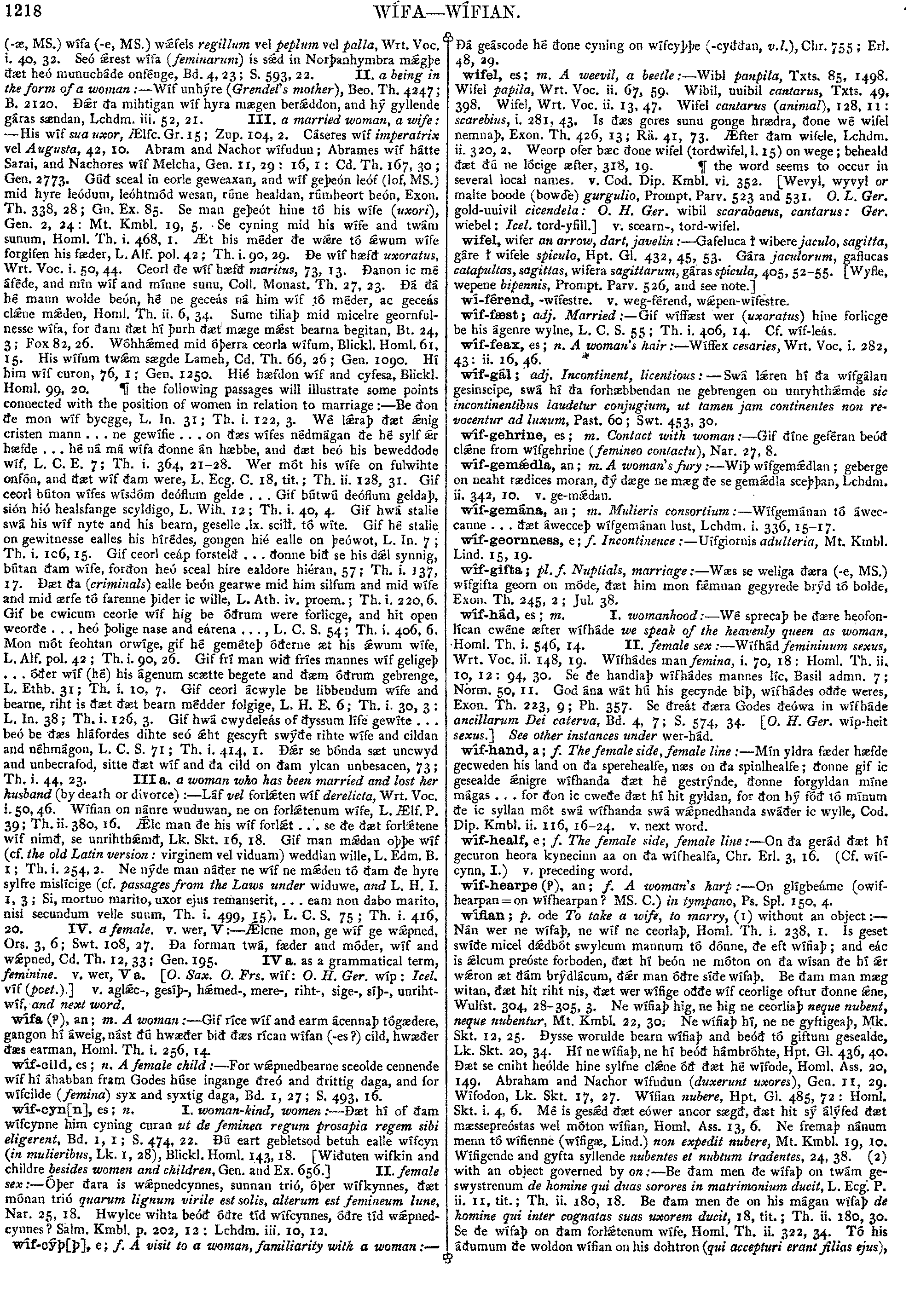
(-æ,
MS.)
wífa
(-e,
MS.)
wfels
regillum
vel
peplum
vel
palla,
Wrt.
Voc.
i.
40,
32.
Seó
rest
wífa
(feminarum)
ís
sd
in
Norþanhymbra
mgþe
ðæt
heó
munucháde
onfénge,
Bd.
4,
23
;
S.
593,
22.
II.
a
being
in
the
form
of
a
woman
:--
Wíf
unhýre
(Grendel's
mother),
Beo.
Th.
4247;
B.
2120.
Ðr
ða
mihtigan
wíf
hyra
mægen
berddon,
and
hý
gyllende
gáras
sndan.
Lchdm.
iii.
52,
21.
III.
a
married
woman,
a
wife:
--
His
wíf
sua
uxor,
Ælfc.
Gr.
15;
Zup.
104,
2.
Cáseres
wíf
imperatrix
vel
Augusta,
42,
10.
Abram
and
Nachor
wífudun;
Abrames
wíf
hátte
Sarai,
and
Nachores
wíf
Melcha,
Gen.
11,
29:
16,
1:
Cd.
Th.
167,
30;
Gen.
2773.
Gúð
sceal
in
eorle
geweaxan,
and
wíf
geþeón
leóf
(lof,
MS.)
mid
hyre
leódum,
leóhtmód
wesan,
rúne
healdan,
rúmheort
beón,
Exon.
Th.
338,
28;
Gn.
Ex.
85.
Se
man
geþeót
hine
tó
his
wífe
(uxori),
Gen.
2,
24:
Mt.
Kmbl.
19,
5.
Se
cyning
mid
his
wífe
and
twám
sunum.
Homl.
Th.
i.
468,
1.
Æt
his
méder
ðe
wre
tó
wum
wífe
forgifen
his
fæder,
L.
Alf.
pol.
42
;
Th.
i.
90,
29.
Ðe
wíf
hæfð
uxoratus,
Wrt.
Voc.
i.
50,
44.
Ceorl
ðe
wíf
hæfð
maritus,
73,
13.
Ðanon
ic
mé
áféde,
and
mín
wíf
and
mínne
sunu,
Coll.
Monast.
Th.
27,
23.
Ðá
ðá
hé
mann
wolde
beón,
hé
ne
geceás
ná
him
wíf
tó
méder,
ac
geceás
clne
mden,
Homl.
Th.
ii.
6,
34.
Sume
tiliaþ
mid
micelre
geornfulnesse
wífa,
for
ðam
ðæt
hí
þurh
ðæt
mæge
mst
bearna
begitan,
Bt.
24,
3
;
Fox
82,
26.
Wóhhmed
mid
óþerra
ceorla
wífum,
Blickl.
Homl.
61,
15.
His
wífum
twm
sægde
Lameh,
Cd.
Th.
66,
26
;
Gen.
1090.
Hí
him
wíf
curon,
76,
1;
Gen.
1250.
Hié
hæfdon
wíf
and
cyfesa,
Blickl.
Homl.
99,
20.

the
following
passages
will
illustrate
some
points
connected
with
the
position
of
women
in
relation
to
marriage
:--
Be
ðon
ðe
mon
wíf
bycgge,
L.
In.
31;
Th.
i.
122,
3.
Wé
lraþ
ðæt
nig
cristen
mann
.
.
.
ne
gewífie
.
.
.
on
ðæs
wífes
nédmágan
ðe
hé
sylf
r
hæfde
.
.
.
hé
ná
má
wífa
ðonne
án
hæbbe,
and
dæt
beó
his
beweddode
wíf,
L.
C.
E.
7;
Th.
i.
364,
21-28.
Wer
mót
his
wífe
on
fulwihte
onfón,
and
ðæt
wíf
ðam
were,
L.
Ecg.
C.
18,
tit.;
Th.
ii.
128,
31.
Gif
ceorl
búton
wífes
wísdóm
deóflum
gelde
.
.
.
Gif
bútwú
deóflum
geldaþ,
sión
hió
healsfange
scyldigo,
L.
Win.
12
;
Th.
i.
40,
4.
Gif
hwá
stalie
swá
his
wíf
nyte
and
his
bearn,
geselle
.
lx.
Sci.
tó
wíte.
Gif
hé
stalie
on
gewitnesse
ealles
his
hírédes,
gongen
hié
ealle
on
þeówot,
L.
In.
7
;
Th.
i.
106,
15.
Gif
ceorl
ceáp
forstelð
.
.
.
ðonne
bið
se
his
dl
synnig,
bútan
ðam
wífe,
forðon
heó
sceal
hire
ealdore
hiéran,
57;
Th.
i.
137,
17.
Ðæt
ða
(criminals)
ealle
beón
gearwe
mid
him
silfum
and
mid
wífe
and
mid
ærfe
tó
farenne
þider
ic
wille,
L.
Ath.
iv.
proem,
;
Th.
i.
220,
6.
Gif
be
cwicum
ceorle
wíf
hig
be
óðrum
were
forlicge,
and
hit
open
weorðe
.
.
.
heó
þolige
nase
and
eárena
.
.
.
,
L.
C.
S.
54;
Th.
i.
406,
6.
Mon
mót
feohtan
orwíge,
gif
hé
geméteþ
óðerne
æt
his
wum
wífe,
L.
Alf.
pol.
42
;
Th.
i.
90,
26.
Gif
frí
man
wið
fríes
mannes
wíf
geligeþ
.
.
.
ððer
wíf
(hé)
his
ágenum
scætte
begete
and
ðæm
óðrum
gebrenge,
L.
Ethb.
31;
Th.
i.
10,
7.
Gif
ceorl
ácwyle
be
libbendum
wífe
and
bearne,
riht
is
ðæt
ðæt
bearn
médder
folgige,
L.
H.
E.
6;
Th.
i.
30,
3
:
L.
In.
38;
Th.
i.
126,
3.
Gif
hwá
cwydeleás
of
ðyssum
lífe
gewíte
.
.
.
beó
be
ðæs
hláfordes
dihte
seó
ht
gescyft
swýðe
rihte
wífe
and
cildan
and
néhmágon,
L.
C.
S.
71;
Th.
i.
414,
1.
Ðr
se
bónda
sæt
uncwyd
and
unbecrafod,
sitte
ðæt
wíf
and
ða
cild
on
ðam
ylcan
unbesacen,
73
;
Th.
i.
44,
23.
IIIa.
a.
a
woman
who
has
been
married
and
lost
her
husband
(by
death
or
divorce)
:--
Láf
vel
forlten
wíf
derelicta,
Wrt.
Voc.
i.
50,
46.
Wífian
on
nánre
wuduwan,
ne
on
forltenum
wífe,
L.
Ælf.
P.
39;
Th.
ii.
380,
16.
Æ-acute;lc
man
ðe
his
wíf
forlt.
.
.
se
ðe
ðæt
forltene
wíf
nimð,
se
unrihthmð,
Lk.
Skt.
16,
18.
Gif
man
mdan
oþþe
wíf
(cf.
the
old
Latin
version:
virginem
vel
viduam)
weddian
wille,
L.
Edm.
B.
1;
Th.
i.
254,
2.
Ne
nýde
man
náðer
ne
wíf
ne
mden
tó
ðam
ðe
hyre
sylfre
mislícige
(cf.
passages
from
the
Laws
under
widuwe,
and
L.
H.
I.
1.
3;
Si,
mortuo
marito,
uxor
ejus
remanserit,
.
.
.
eam
non
dabo
marito,
nisi
secundum
velle
sunm,
Th.
i.
499,
15),
L.
C.
S.
75
;
Th.
i.
416,
20.
IV.
a
female,
v.
wer,
V
:--
Æ-acute;lcne
mon,
ge
wíf
ge
wpned,
Ors.
3,
6;
Swt.
108,
27.
Ða
forman
twá,
fæder
and
móder,
wíf
and
wpned,
Cd.
Th.
12,
33;
Gen.
195.
IV
a.
as
a
grammatical
term,
feminine,
v.
wer,
V
a.
[O.
Sax.
O.
Frs.
wíf:
O.
H.
Ger.
wíp
:
Icel.
víf
(poet.).]
v.
aglc-,
gesíþ-,
hmed-,
mere-,
riht-,
sige-,
síþ-,
unrihtwíf,
and
next
word.
| Result Page: |  |
Previous | 1 2 3 4 5 6 7 8 9 10 11 12 13 14 15 | Next |  |
Germanic Lexicon Project (main page)
This search system was written by
Sean Crist
Please consider
volunteering
to correct the data in these online dictionaries.
No rights reserved. Feel free to use these data in any way you please.