|
|

Tip: In the search results, you can click on any word or abbreviation for more information.
|
Source: Cleasby/Vigfusson, page b0441, entry 31 View original page image as: [TIFF] [PNG] [View previous entry] [View next entry] |
[Comment on this entry] [View comments] |
The following entry has not been hand-corrected. However, the page is reserved and someone is correcting it. |
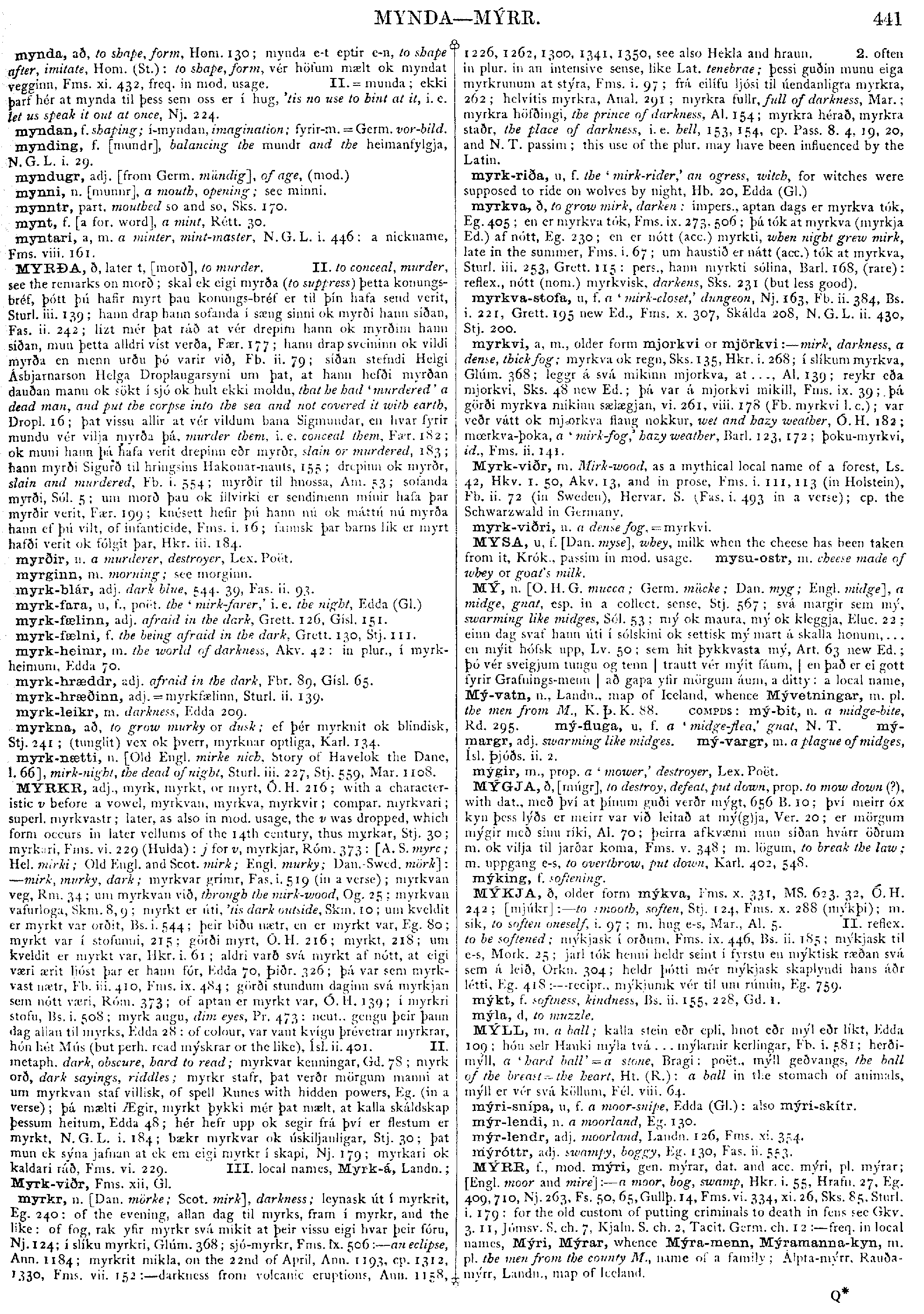
MÝ, n. [O. H. G. mucca; Germ, m'ucke; Dan. myg; Engl. midget, a midge, gnat, esp. in a collect, sense, Stj. 567; sva niargir sem my, swarming like midges. Sol. 53; mý ok maura, my ok kleggja, Eluc. 22: einn dag svaf hann uti í sólskini ok settisk my mart á skalla honum, ... en myit hófsk upp, Lv. 50; sem hit þykkvasta mý, Art. 63 new Ed.; þó vér sveigjum tungu og tenn | trautt vér myit fáum, | en það er ei gott iyrir Grafnings-memi | að gapa ylir nuirgum aurn, a ditty: a local name, My-vatn, n., Landn., map of Iceland, whence Mývetningar, m. pl. the men from M., K. Jj. K. 88. COMPDS: my-bit, n. a midge-bite, Rd. 295. my-fluga, u, f. a ' midge-flea, ' gnat, N. T. mý- margr, adj. sivarming like midges. my-vargr, m. a plague of midges, ísl. þjóðs. ii. 2.
|
Source: Cleasby/Vigfusson, page b0441, entry 43 View original page image as: [TIFF] [PNG] [View previous entry] [View next entry] |
[Comment on this entry] [View comments] |
The following entry has not been hand-corrected. However, the page is reserved and someone is correcting it. |
MÝRR, f., mod. myri, gen. myrar, dat. and acc. myri, pl. myrar; [Engl. m oor and mire] :-- a moor, bog, swamp, Hkr. i. 55, Hrafn. 27, Eg. 409, 710, Nj. 203, Fs. 50, 65, Gullþ. 14, Fms. vi. 334, xi. 26, Sks. 85, Sturl. i. 179: for the old custom of putting criminals to death in fens see Gkv. 3. II, Jonisv. S. ch. 7, Kjaln. S. ch. 2, Tacit. Germ. ch. 12 :-- freq. in local names, Myri, Myrar, whence Mýra-menn, Mýramanna-kyn, in. pl. the men from the county M., n. une of a family; Alpta-nivrr, Ranða- im'rr, Landn., map of Iceland.
|
Source: Cleasby/Vigfusson, page b0453, entry 10 View original page image as: [TIFF] [PNG] [View previous entry] [View next entry] |
[Comment on this entry] [View comments] |
The following entry has been hand-corrected once. |
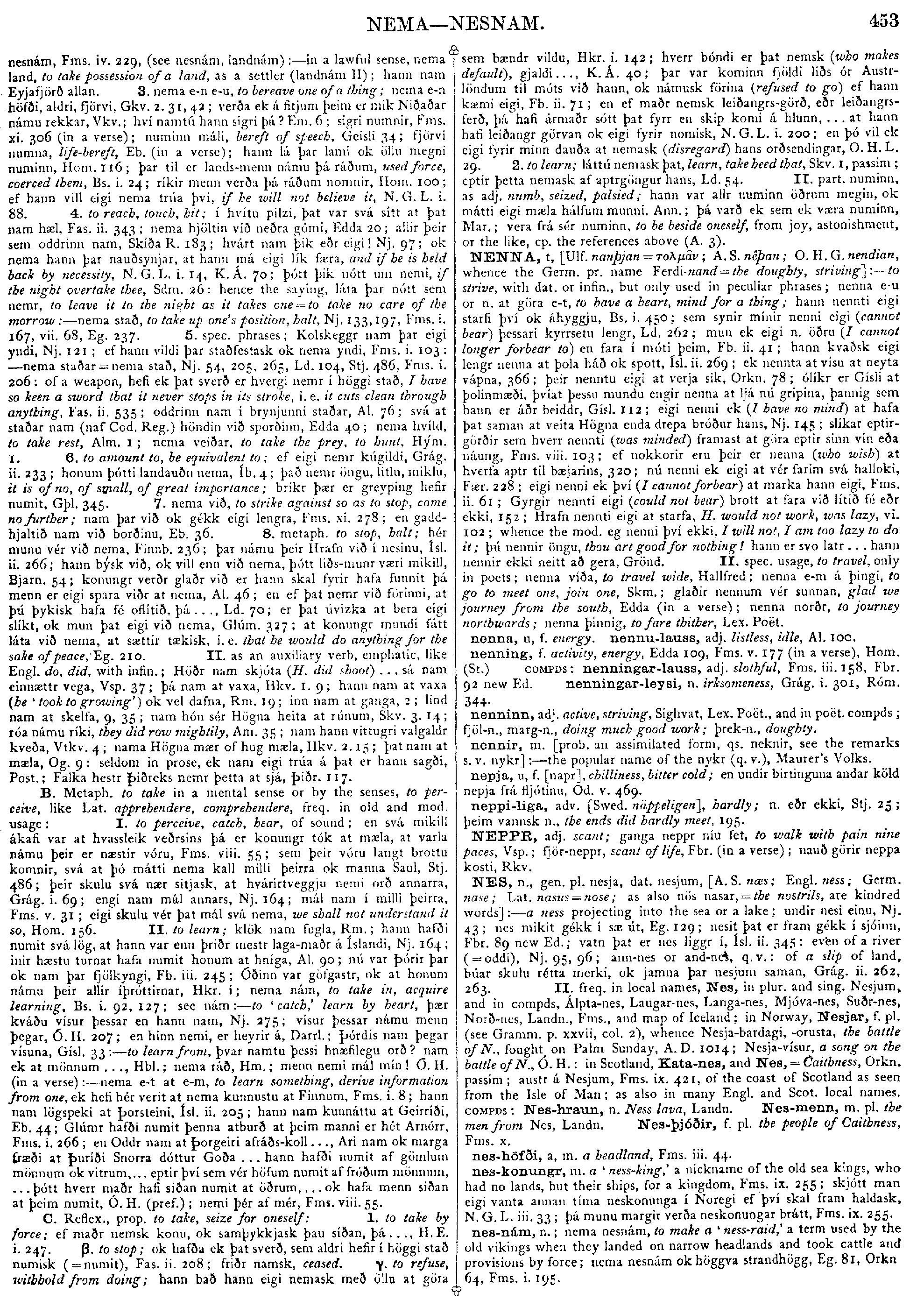
NES, n., gen. pl. nesja, dat. nesjum, [A. S. næs; Engl. ness; Germ. nase; Lat. nasus = nose; as also nös nasar, = the nostrils, are kindred words] :-- a ness projecting into the sea or a lake; undir nesi einu, Nj. 43; nes mikit gékk í sæ út, Eg. 129; nesit þat er fram gékk í sjóinn, Fbr. 89 new Ed.; vatn þat er nes liggr í, Ísl. ii. 345: even of a river (= oddi), Nj. 95, 96; ann-nes or and-nes, q. v.: of a slip of land, búar skulu rétta merki, ok jamna þar nesjum saman, Grág. ii. 262, 263. II. freq. in local names, Nes, in plur. and sing. Nesjum, and in compds, Álpta-nes, Laugar-nes, Langa-nes, Mjóva-nes, Suðr-nes, Norð-nes, Landn., Fms., and map of Iceland; in Norway, Nesjar, f. pl. (see Gramm. p. xxvii, col. 2), whence Nesja-bardagi, -orusta, the battle of N., fought on Palm Sunday, A. D. 1014; Nesja-vísur, a song on the battle of N., Ó. H.: in Scotland, Kata-nes, and Nes, = Caithness, Orkn. passim; austr á Nesjum, Fms. ix. 421, of the coast of Scotland as seen from the Isle of Man; as also in many Engl. and Scot, local names. COMPDS: Nes-hraun, Ness lava, Landn. Nes-menn, m. pl. the men from Nes, Landn. Nes-þjóðir, f. pl. the people of Caithness, Fms. x.
|
Source: Cleasby/Vigfusson, page b0455, entry 42 View original page image as: [TIFF] [PNG] [View previous entry] [View next entry] |
[Comment on this entry] [View comments] |
The following entry has been hand-corrected once. |
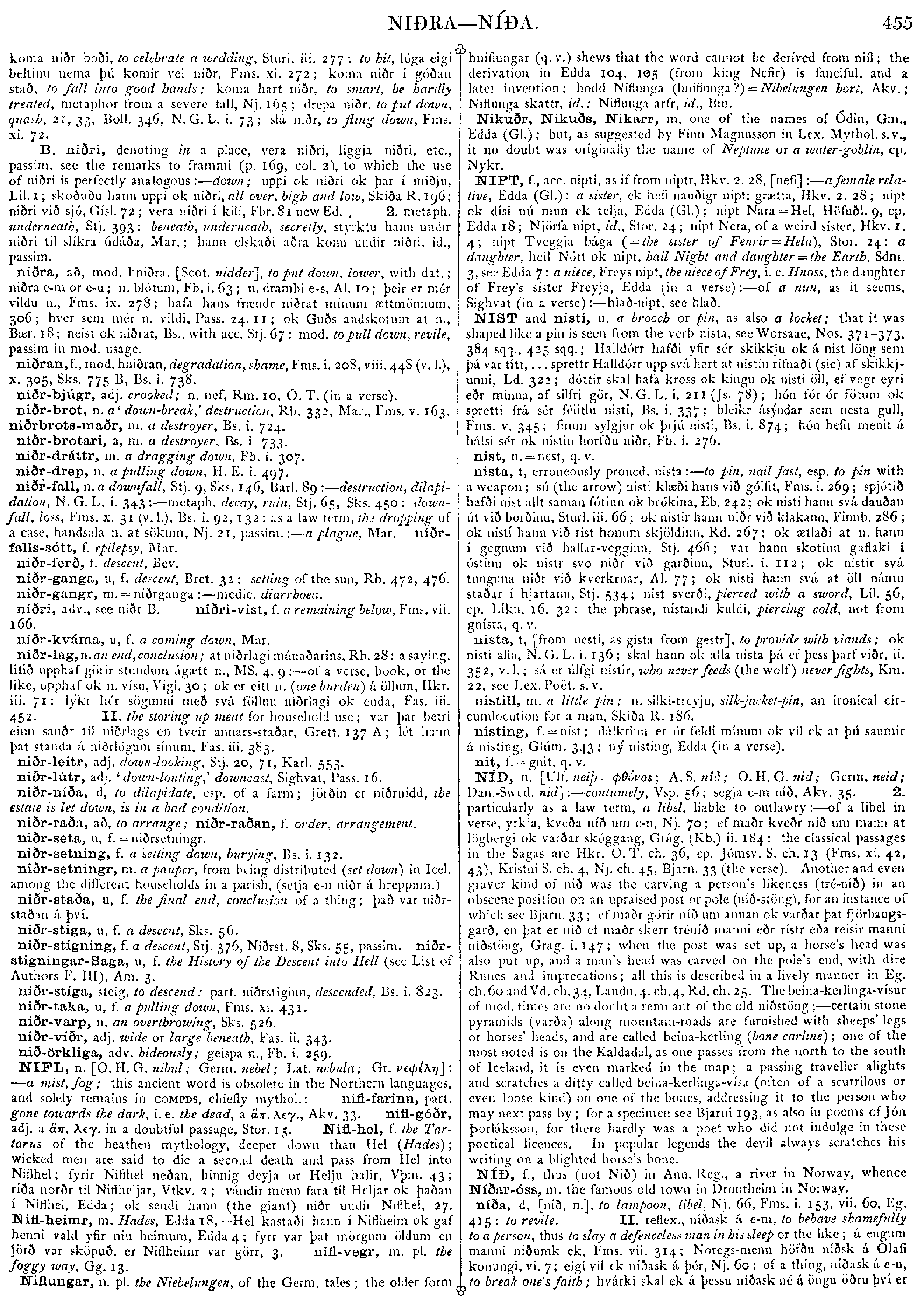
NÍÐ, n. [Ulf. neiþ = GREEK; A. S. nîð; O. H. G. nid; Germ, neid; Dan.-Swed. nid :-- contumely, Vsp. 56; segja e-m níð, Akv. 35. 2. particularly as a law term, a libel, liable to outlawry :-- of a libel in verse, yrkja, kveða níð um e-n, Nj. 70; ef maðr kveðr níð um mann at lögbergi ok varðar skóggang, Grág. (Kb.) ii. 184: the classical passages in the Sagas are Hkr. O. T. ch. 36, cp. Jómsv. S. ch. 13 (Fms. xi. 42, 43), Kristni S. ch. 4, Nj. ch. 45, Bjarn. 33 (the verse). Another and even graver kind of níð was the carving a person's likeness (tré-níð) in an obscene position on an upraised post or pole (níð-stöng), for an instance of which see Bjarn. 33; ef maðr görir níð um annan ok varðar þat fjörbaugs-garð, en þat er níð ef maðr skerr tréníð manni eðr rístr eða reisir manni níðstöng, Grág. i. 147; when the post was set up, a horse's head was also put up, and a man's head was carved on the pole's end, with dire Runes and imprecations; all this is described in a lively manner in Eg. ch. 60 and Vd. ch. 34, Landn. 4. ch. 4, Rd. ch. 25. The beina-kerlinga-vísur of mod. times are no doubt a remnant of the old níðstöng; -- certain stone pyramids (varða) along mountain-roads are furnished with sheeps' legs or horses' heads, and are called beina-kerling (bone carline); one of the most noted is on the Kaldadal, as one passes from the north to the south of Iceland, it is even marked in the map; a passing traveller alights and scratches a ditty called beina-kerlinga-vísa (often of a scurrilous or even loose kind) on one of the bones, addressing it to the person who may next pass by; for a specimen see Bjarni 193, as also in poems of Jón Þorláksson, for there hardly was a poet who did not indulge in these poetical licences. In popular legends the devil always scratches his writing on a blighted horse's bone.
|
Source: Cleasby/Vigfusson, page b0474, entry 26 View original page image as: [TIFF] [PNG] [View previous entry] [View next entry] |
[Comment on this entry] [View comments] |
The following entry has been hand-corrected once. |
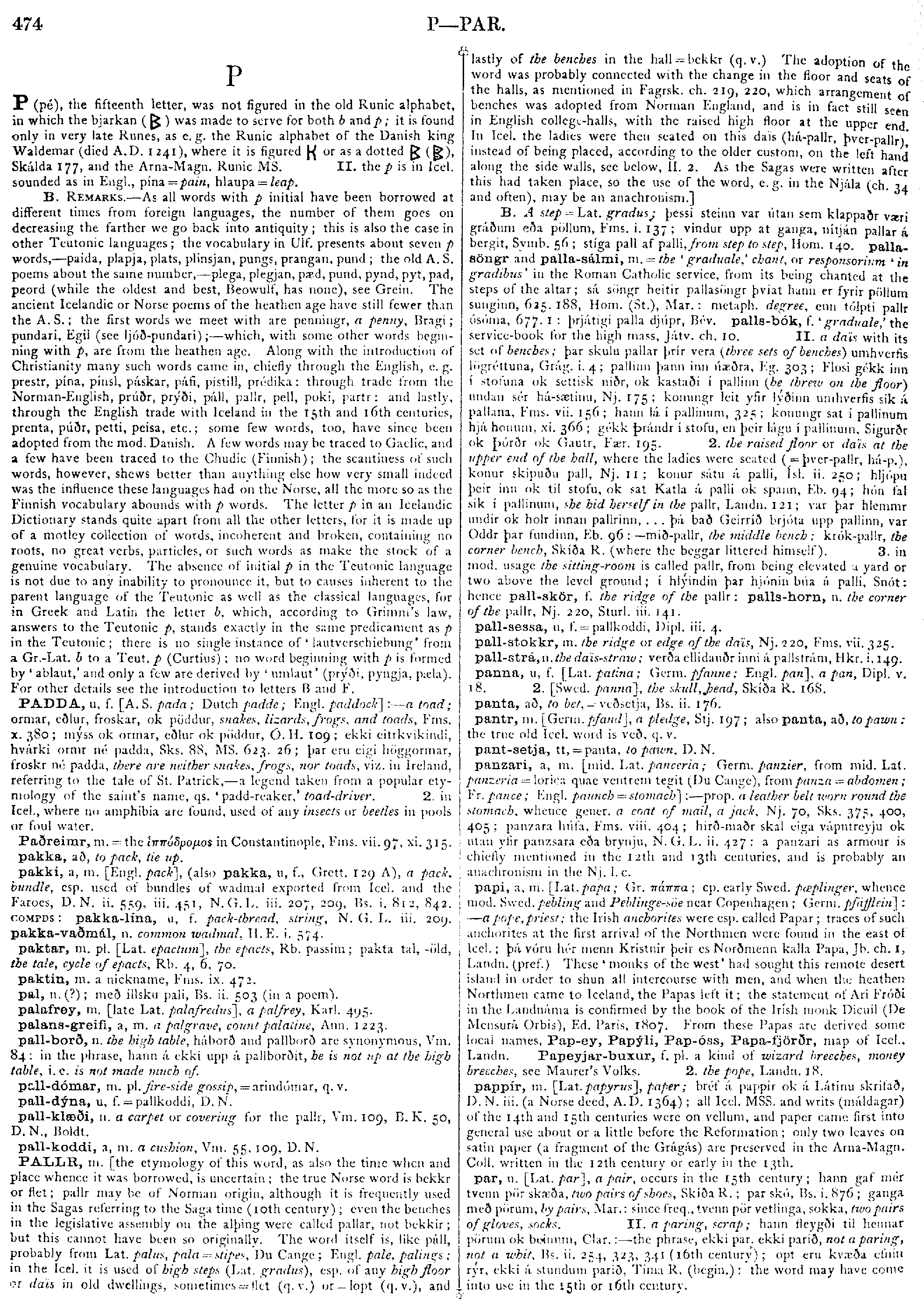
papi, a, m. [Lat. papa; Gr. GREEK; cp. early Swed. pæplinger, whence mod. Swed. pebling and Peblinge-söe near Copenhagen; Germ. pfäfflein] :-- a pope, priest; the Irish anchorites were esp. called Papar; traces of such anchorites at the first arrival of the Northmen were found in the east of Icel.; þá vóru hér menn Kristnir þeir es Norðmenn kalla Papa, Jb. ch. 1, Landn. (pref.) These 'monks of the west' had sought this remote desert island in order to shun all intercourse with men, and when the heathen Northmen came to Iceland, the Papas left it; the statement of Ari Fróði in the Landnáma is confirmed by the book of the Irish monk Dicuil (De Mensurâ Orbis), Ed. Paris, 1807. From these Papas are derived some local names, Pap-ey, Papýli, Pap-óss, Papa-fjörðr, map of Icel., Landn. Papeyjar-buxur, f. pl. a kind of wizard breeches, money breeches, see Maurer's Volks. 2. the pope, Landn. 18.
|
Source: Cleasby/Vigfusson, page b0491, entry 32 View original page image as: [TIFF] [PNG] [View previous entry] [View next entry] |
[Comment on this entry] [View comments] |
The following entry has been hand-corrected once. |
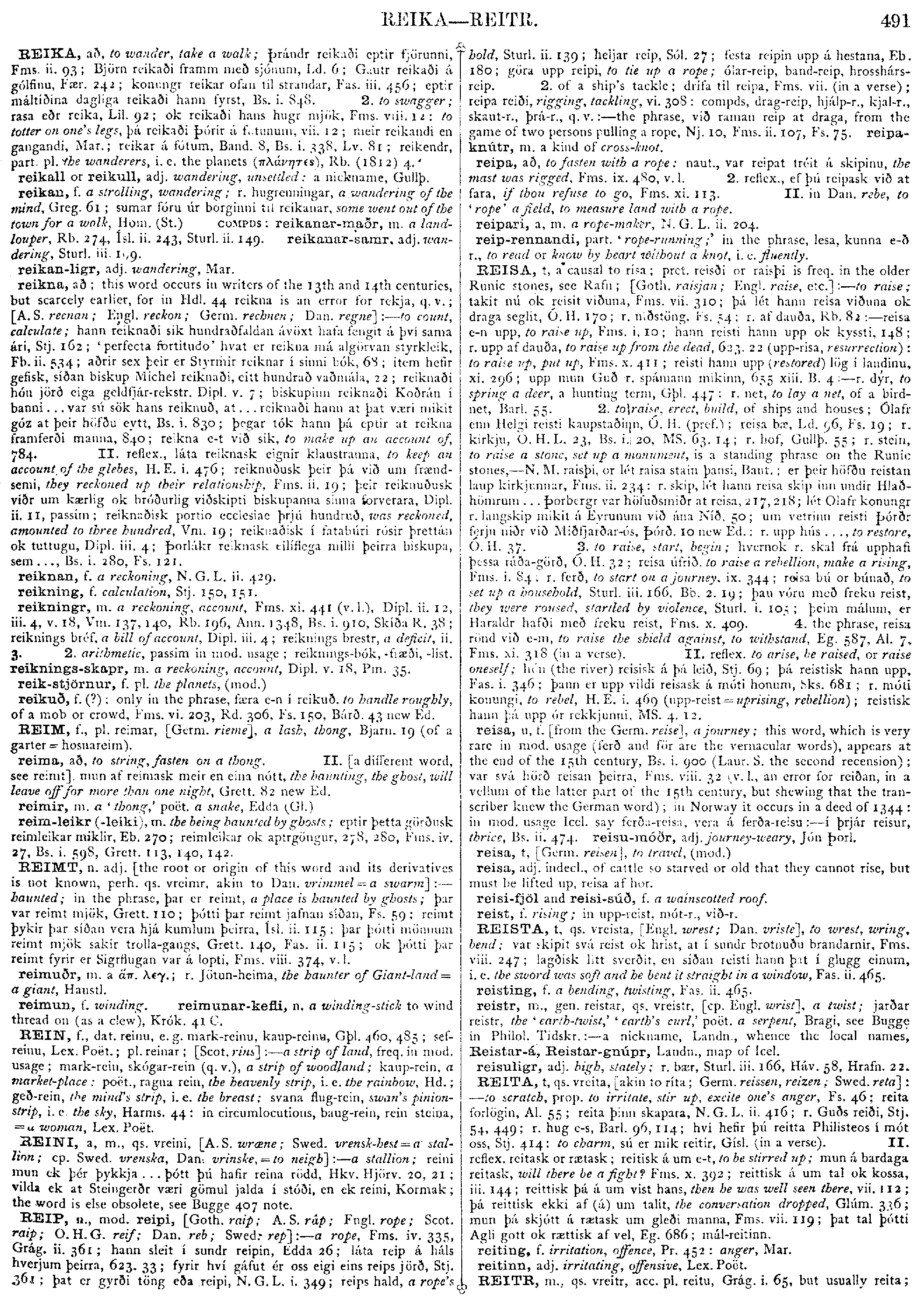
reistr, m., gen. reistar, qs. vreistr, [cp. Engl. wrist], a twist; jarðar reistr, the 'earth-twist,' 'earth's curl,' poët, a serpent, Bragi, see Bugge in Philol. Tidskr. :-- a nickname, Landn., whence the local names, Reistar-á, Reistar-gnúpr, Landn., map of Icel.
|
Source: Cleasby/Vigfusson, page b0496, entry 14 View original page image as: [TIFF] [PNG] [View previous entry] [View next entry] |
[Comment on this entry] [View comments] |
The following entry has been hand-corrected once. |
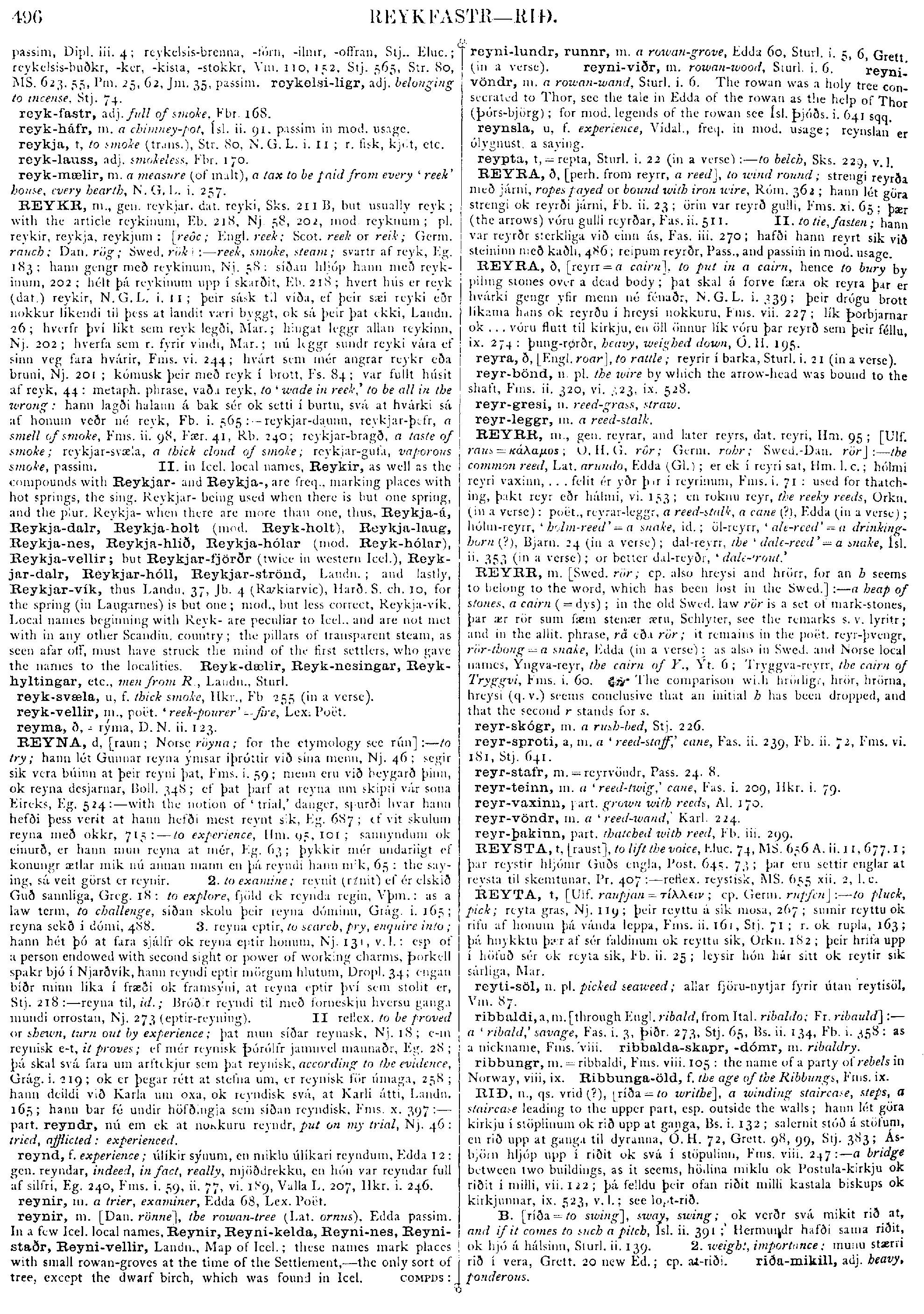
reynir, m. [Dan. rönne], the rowan-tree (Lat. ornus), Edda passim. In a few Icel. local names, Reynir, Reyni-kelda, Reyni-nes, Reyni-staðr, Reyni-vellir, Landn., Map of Icel.; these names mark places with small rowan-groves at the time of the Settlement, -- the only sort of tree, except the dwarf birch, which was found in Icel. COMPDS: reyni-lundr, runnr, m. a rowan-grove, Edda 60, Sturl. i. 5, 6, Grett (in a verse). reyni-viðr, m. rowan-wood, Sturl. i. 6. reyni-vöndr, m. a rowan-wand, Sturl. i. 6. The rowan was a holy tree consecrated to Thor, see the tale in Edda of the rowan as the help of Thor (Þors-björg); for mod. legends of the rowan see Ísl. Þjóðs. i. 641 sqq.
|
Source: Cleasby/Vigfusson, page b0500, entry 8 View original page image as: [TIFF] [PNG] [View previous entry] [View next entry] |
[Comment on this entry] [View comments] |
The following entry has been hand-corrected once. |
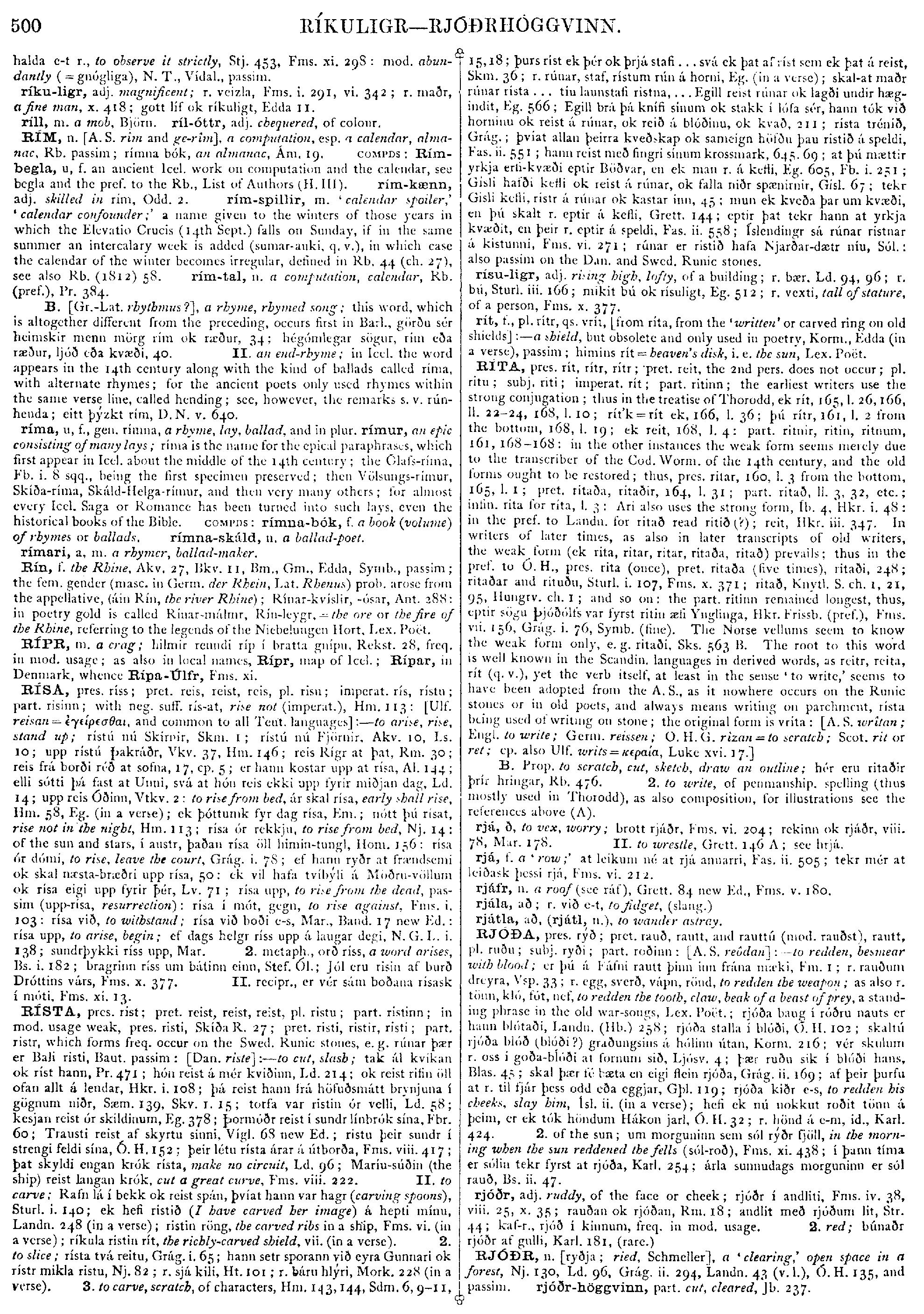
RÍPR, m. a crag; hilmir renndi ríp í bratta guípu, Rekst. 28, freq. in mod. usage; as also in local names, Rípr, map of led.; Rípar, in Denmark, whence Rípa-Úlfr, Fms. xi.
|
Source: Cleasby/Vigfusson, page b0521, entry 5 View original page image as: [TIFF] [PNG] [View previous entry] [View next entry] |
[Comment on this entry] [View comments] |
The following entry has been hand-corrected once. |
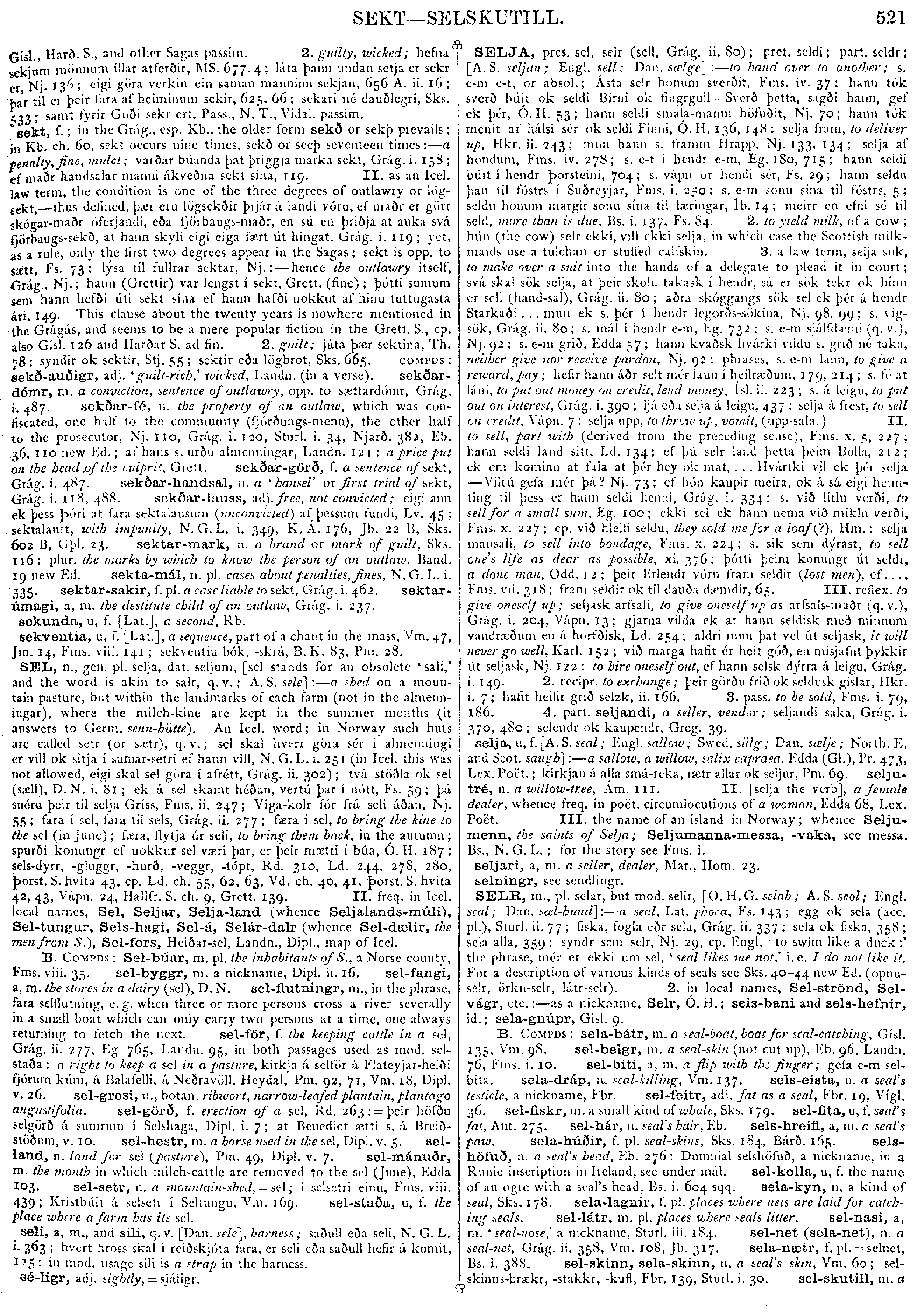
SEL, n., gen. pl. selja, dat. seljum, [sel stands for an obsolete 'sali,' and the word is akin to salr, q.v.; A.S. sele] :-- a shed on a mountain pasture, but within the landmarks of each farm (not in the almenningar), where the milch-kine are kept in the summer months (it answers to Germ. senn-hütte). An Icel. word; in Norway such huts are called setr (or sætr), q.v.; sel skal hverr göra sér í almenningi er vill ok sitja í sumar-setri ef hann vill, N.G.L. i. 251 (in Icel. this was not allowed, eigi skal sel göra í afrétt, Grág. ii. 302); tvá stöðla ok sel (sæll), D.N. i. 81; ek á sel skamt héðan, vertú þar í nótt, Fs. 59; þá snéru þeir til selja Gríss, Fms. ii. 247; Víga-kolr fór frá seli áðan, Nj. 55; fara í sel, fara til sels, Grág. ii. 277; færa í sel, to bring the kine to the sel (in June); fara, flytja úr seli, to bring them back, in the autumn; spurði konungr ef nokkur sel væri þar, er þeir mætti í búa, Ó.H. 187; sels-dyrr, -gluggr, -hurð, -veggr, -tópt, Rd. 310, Ld. 244, 278, 280, Þorst. S. hvíta 43, cp. Ld. ch. 55, 62, 63, Vd. ch. 40, 41, Þorst. S. hvíta 42, 43, Vápn. 24, Hallfr. S. ch. 9, Grett. 139. II. freq. in Icel. local names, Sel, Seljar, Selja-land (whence Seljalands-múli), Sel-tungur, Sels-hagi, Sel-á, Selár-dalr (whence Sel-dælir, the men from S.), Sel-fors, Heiðar-sel, Landn., Dipl., map of Icel. B. COMPDS: Sel-búar, m. pl. the inhabitants of S., a Norse county, Fms. viii. 35. sel-byggr, m. a nickname, Dipl. ii. 16. sel-fangi, a, m. the stores in a dairy (sel), D.N. sel-flutningr, m., in the phrase, fara selflutning, e.g. when three or more persons cross a river severally in a small boat which can only carry two persons at a time, one always returning to fetch the next. sel-för, f. the keeping cattle in a sel, Grág. ii. 277, Eg. 765, Landn. 95, in both passages used as mod. sel-staða: a right to keep a sel in a pasture, kirkja á selför á Flateyjar-heiði fjórum kúm, ú Balafelli, á Neðravöll, Heydal, Pm. 92, 71, Vm. 18, Dipl, v. 26. sel-gresi, n., botan. ribwort, narrow-leafed plantain, plantago angustifolia. sel-görð, f. erection of a sel, Rd. 263: = þeir höfðu selgörð á sumrum í Sclshaga, Dipl. i. 7; at Benedict ætti s. á Breiðstöðum, v. 10. sel-hestr, m. a horse used in the sel, Dipl. v. 5. sel-land, n. land for sel (pasture), Pm. 49, Dipl. v. 7. sel-mánuðr, m. the month in which milch-cattle are removed to the sel (June), Edda 103. sel-setr, n. a mountain-shed, = sel; í selsetri einu, Fms. viii. 439; Kristbúit á selsetr í Seltungu, Vm. 169. sel-staða, u, f. the place where a farm has its sel.
|
Source: Cleasby/Vigfusson, page b0531, entry 6 View original page image as: [TIFF] [PNG] [View previous entry] [View next entry] |
[Comment on this entry] [View comments] |
The following entry has been hand-corrected once. |
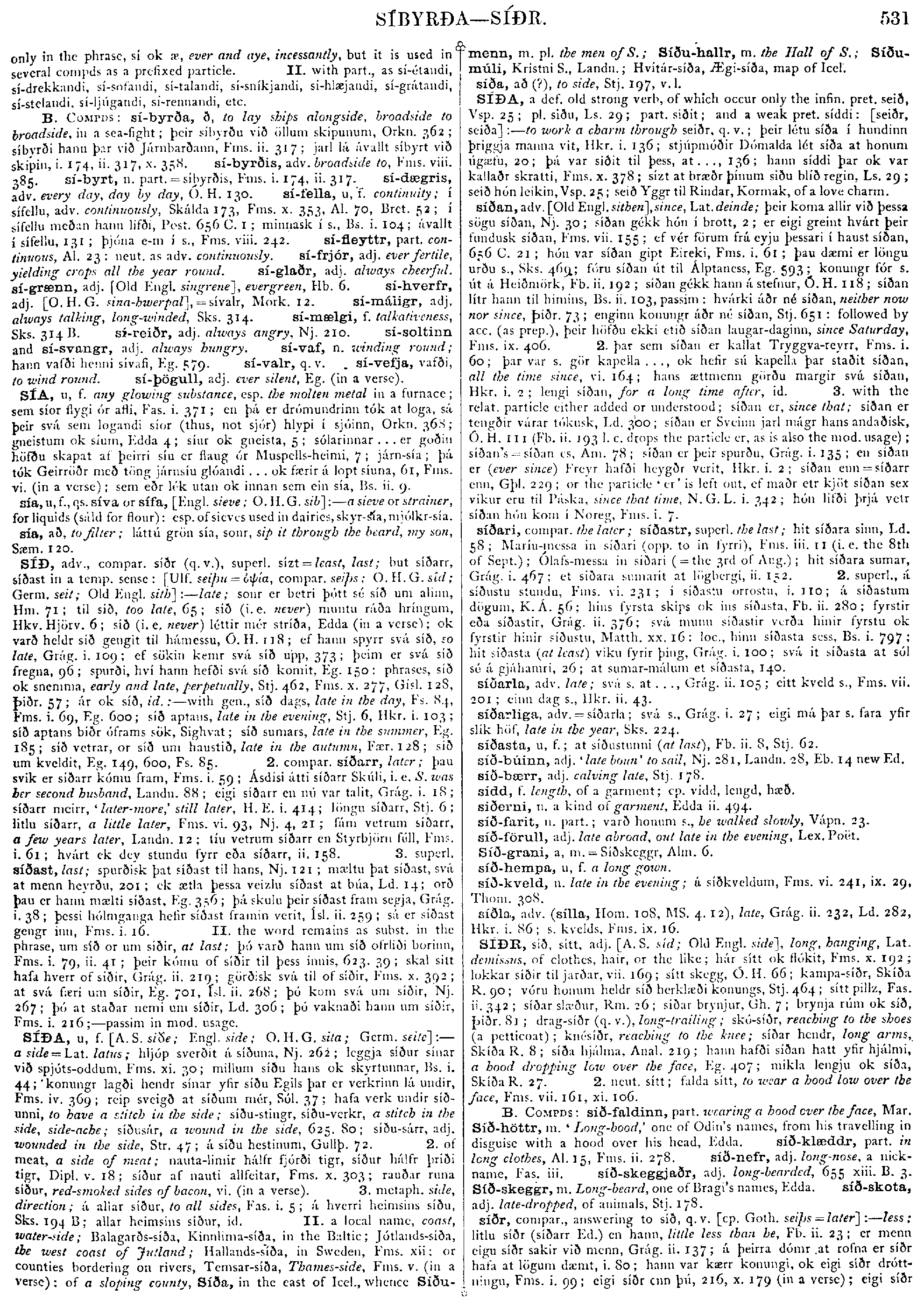
SÍÐA, u, f. [A.S. siðe; Engl. side; O.H.G. sita; Germ. seite] :-- a side = Lat. latus; hljóp sverðit á síðuna, Nj. 262; leggja síður sínar við spjóts-oddum, Fms. xi. 30; millum síðu hans ok skyrtunnar, Bs. i. 44; konungr lagði hendr sínar yfir síðu Egils þar er verkrinn lá undir, Fms. iv. 369; reip sveigð at síðum mér, Sól. 37; hafa verk undir síðunni, to have a stitch in the side; síðu-stingr, siðu-verkr, a stitch in the side, side-ache; síðusár, a wound in the side, 625. 80; síðu-sárr, adj. wounded in the side, Str. 47; á síðu hestinum, Gullþ. 72. 2. of meat, a side of meat; nauta-limir hálfr fjórði tigr, síður hálfr þriði tigr, Dipl. v. 18; síður af nauti allfeitar, Fms. x. 303; rauðar runa siður, red-smoked sides of bacon, vi. (in a verse). 3. metaph. side, direction; á allar síður, to all sides, Fas. i. 5; á hverri heimsins síðu, Sks. 194 B; allar heimsins síður, id. II. a local name, coast, water-side; Balagarðs-síða, Kinnlima-síða, in the Baltic; Jótlands-síða, the west coast of Jutland; Hallands-síða, in Sweden, Fms. xii: or counties bordering on rivers, Temsar-síða, Thames-side, Fms. v. (in a verse); of a sloping county, Síða, in the east of Icel., whence Síðu-menn, m. pl. the men of S.; Síðu-hallr, m. the Hall of S.; Síðu-múli, Kristni S., Landn.; Hvítár-síða, Ægi-síða, map of Icel.
| Result Page: |  |
Previous | 1 2 3 4 5 | Next |  |
Germanic Lexicon Project (main page)
This search system was written by
Sean Crist
Please consider
volunteering
to correct the data in these online dictionaries.
No rights reserved. Feel free to use these data in any way you please.