|
|

Search for mann again, using less strict matching (636 results)
|
Source: Bosworth/Toller, page b0767, entry 14 View original page image as: [TIFF] [PNG] [View previous entry] [View next entry] |
[Comment on this entry] [View comments (1)] |
The following entry has been hand-corrected once. |
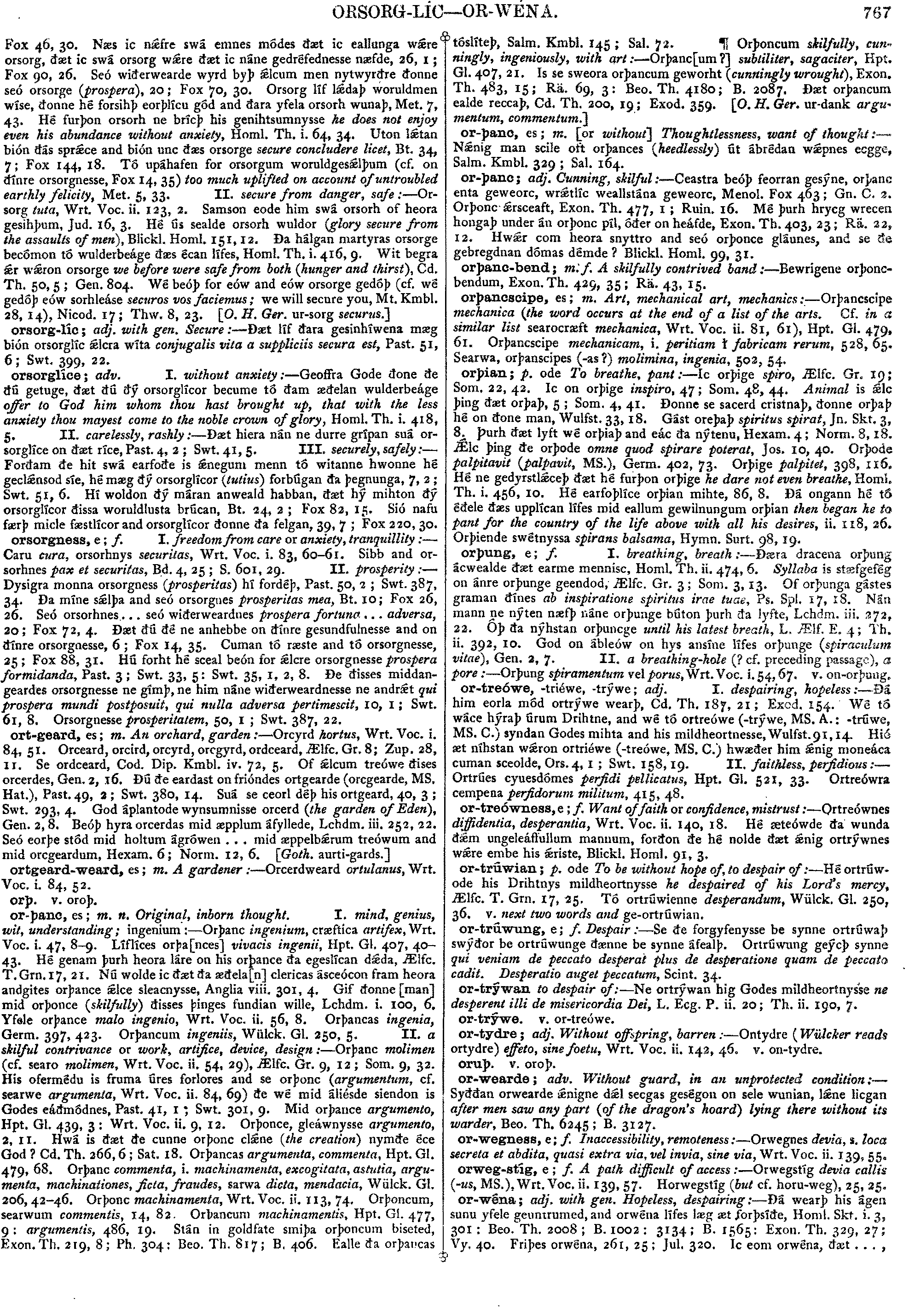
orpung, e; f. I. breathing, breath :-- Ðæra dracena orþung ácwealde ðæt earme mennisc, Homl. Th. ii. 474, 6. Syllaba is stæfgefég on ánre orþunge geendod, Ælfc. Gr. 3; Som. 3, 13. Of orþunga gástes graman ðínes ab inspiratione spiritus irae tuae, Ps. Spl. 17, 18. Nán mann ne nýten næfþ náne orþuage búton þurh ða lyfte, Lchdm. iii. 272, 22. Óþ ða nýhstan orþuncge until his latest breath, L. /Elf. E. 4; Th. ii. 392, 10. God on ábleów on hys ansíne lífes orþunge (spiraculum vitae), Gen. 2, 7. II a breathing-hole (? cf. preceding passage), a pore :-- Orþung spiramentum vel porus, Wrt. Voc. i. 54, 67. v. on-orþung.
|
Source: Bosworth/Toller, page b0769, entry 16 View original page image as: [TIFF] [PNG] [View previous entry] [View next entry] |
[Comment on this entry] [View comments] |
The following entry has been hand-corrected once. |
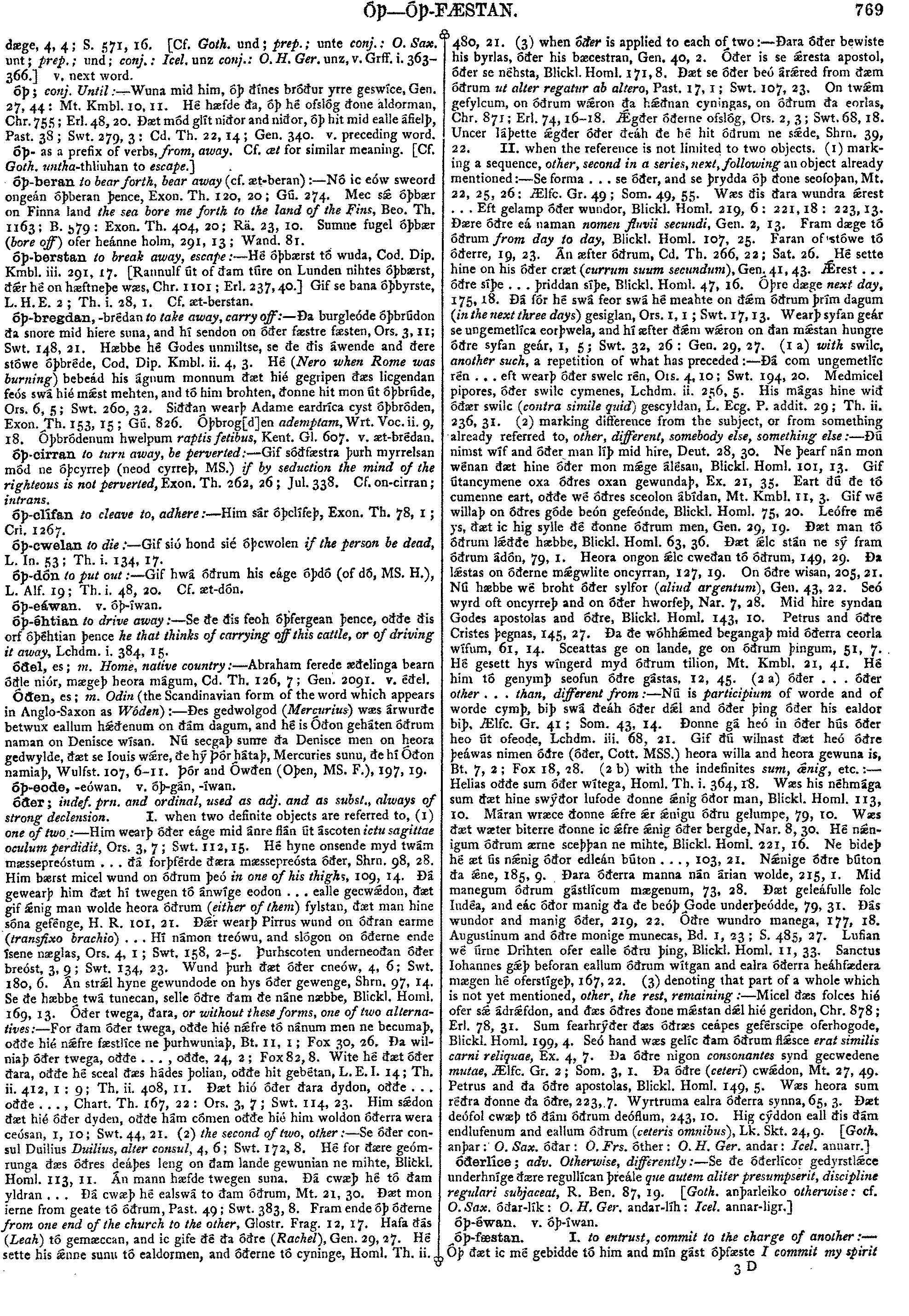
óðer;
indef.
prn.
and
ordinal,
used
as
adj.
and
as
subst.
,
always
of
strong
declension.
I.
when
two
definite
objects
are
referred
to,
(I)
one
of
two:--
Him
wearþ
óðer
eáge
mid
ánre
flán
út
áscoten
ictu
sagittae
oculum
perdidit,
Ors.
3,
7;
Swt.
112,
15.
Hé
hyne
onsende
myd
twám
mæssepreóstum
.
.
.
ðá
forþférde
ðæra
mæssepreósta
óðer.
Shrn.
98,
28.
Him
bærst
micel
wund
on
óðrum
þeó
in
one
of
his
thighs,
109,
14.
Ðá
gewearþ
him
ðæt
hí
twegen
tó
ánwíge
eodon
.
.
.
ealle
gecw don,
ðæt
gif
nig
man
wolde
heora
óðrum
(either
of
them)
fylstan,
ðæt
man
hine
sóna
gefénge,
H.
R.
101,
21.
Ðr
wearþ
Pirrus
wund
on
óðran
earme
(transfixo
brachio)
.
.
.
Hí
námon
tréowu,
and
slógon
on
óðerne
ende
ísene
næglas,
Ors.
4,
l;
Swt.
158,
2-5.
Þurhscoten
underneoðan
óðer
breóst,
3,
9;
Swt.
134,
23.
Wund
þurh
ðæt
óðer
cneów,
4,
6;
Swt.
180,
6.
Án
strl
hyne
gewundode
on
hys
óðer
gewenge,
Shrn.
97,
14.
Se
ðe
hæbbe
twá
tunecan,
selle
óðre
ðam
ðe
náne
næbbe,
Blickl.
Homl.
169,
13.
Óðer
twega,
ðara,
or
without
these
forms,
one
of
two
alternatives:--
For
ðam
óðer
twega,
oððe
hié
nfre
tó
nánum
men
ne
becumaþ,
oððe
hié
nfre
fæstlíce
ne
þurhwuniaþ,
Bt.
II,
l;
Fox
30,
26.
Ða
wil
don,
ðæt
gif
nig
man
wolde
heora
óðrum
(either
of
them)
fylstan,
ðæt
man
hine
sóna
gefénge,
H.
R.
101,
21.
Ðr
wearþ
Pirrus
wund
on
óðran
earme
(transfixo
brachio)
.
.
.
Hí
námon
tréowu,
and
slógon
on
óðerne
ende
ísene
næglas,
Ors.
4,
l;
Swt.
158,
2-5.
Þurhscoten
underneoðan
óðer
breóst,
3,
9;
Swt.
134,
23.
Wund
þurh
ðæt
óðer
cneów,
4,
6;
Swt.
180,
6.
Án
strl
hyne
gewundode
on
hys
óðer
gewenge,
Shrn.
97,
14.
Se
ðe
hæbbe
twá
tunecan,
selle
óðre
ðam
ðe
náne
næbbe,
Blickl.
Homl.
169,
13.
Óðer
twega,
ðara,
or
without
these
forms,
one
of
two
alternatives:--
For
ðam
óðer
twega,
oððe
hié
nfre
tó
nánum
men
ne
becumaþ,
oððe
hié
nfre
fæstlíce
ne
þurhwuniaþ,
Bt.
II,
l;
Fox
30,
26.
Ða
wil niaþ
óðer
twega,
oððe
.
.
.
,
oððe,
24,
2
;
Fox
82,
8.
Wite
hé
ðæt
óðer
ðara,
oððe
hé
sceal
ðæs
hádes
þolian,
oððe
hit
gebétan,
L.
E.
I.
14;
Th.
ii.
412,
l
:
9;
Th.
ii.
408,
II.
Ðæt
hió
óðer
ðara
dydon,
oððe
.
.
.
oððe
.
.
.
,
Chart.
Th.
167,
22
:
Ors.
3,
7;
Swt.
114,
23.
Him
sdon
ðæt
hié
óðer
dyden,
oððe
hám
cómen
oððe
hié
him
woldon
óðerra
wera
ceósan,
I,
10;
Swt.
44,
21.
(2)
the
second
of
two,
other:--
Se
óðer
consul
Duilius
Duilius,
alter
consul,
4,
6;
Swt.
172,
8.
Hé
for
ðære
geómrunga
ðæs
óðres
deáþes
leng
on
ðam
lande
gewunian
ne
mihte,
Blickl.
Homl.
113,
II.
Án
mann
hæfde
twegen
suna.
Ðá
cwæþ
hé
tó
ðám
yldran
.
.
.
Ðá
cwæþ
hé
ealswá
to
ðam
óðrum,
Mt.
21,
30.
Ðæt
mon
ierne
from
geate
tó
óðrum,
Past.
49
;
Swt.
383,
8.
Fram
ende
óþ
óðerne
from
one
end
of
the
church
to
the
other,
Glostr.
Frag.
12,
17.
Hafa
ðás
(Leah)
tó
gemæccan,
and
ic
gife
ðé
ða
óðre
(Rachel),
Gen.
29,
27.
Hé
sette
his
nne
sunu
tó
ealdormen,
and
óðerne
tó
cyninge,
Homl.
Th.
ii.
niaþ
óðer
twega,
oððe
.
.
.
,
oððe,
24,
2
;
Fox
82,
8.
Wite
hé
ðæt
óðer
ðara,
oððe
hé
sceal
ðæs
hádes
þolian,
oððe
hit
gebétan,
L.
E.
I.
14;
Th.
ii.
412,
l
:
9;
Th.
ii.
408,
II.
Ðæt
hió
óðer
ðara
dydon,
oððe
.
.
.
oððe
.
.
.
,
Chart.
Th.
167,
22
:
Ors.
3,
7;
Swt.
114,
23.
Him
sdon
ðæt
hié
óðer
dyden,
oððe
hám
cómen
oððe
hié
him
woldon
óðerra
wera
ceósan,
I,
10;
Swt.
44,
21.
(2)
the
second
of
two,
other:--
Se
óðer
consul
Duilius
Duilius,
alter
consul,
4,
6;
Swt.
172,
8.
Hé
for
ðære
geómrunga
ðæs
óðres
deáþes
leng
on
ðam
lande
gewunian
ne
mihte,
Blickl.
Homl.
113,
II.
Án
mann
hæfde
twegen
suna.
Ðá
cwæþ
hé
tó
ðám
yldran
.
.
.
Ðá
cwæþ
hé
ealswá
to
ðam
óðrum,
Mt.
21,
30.
Ðæt
mon
ierne
from
geate
tó
óðrum,
Past.
49
;
Swt.
383,
8.
Fram
ende
óþ
óðerne
from
one
end
of
the
church
to
the
other,
Glostr.
Frag.
12,
17.
Hafa
ðás
(Leah)
tó
gemæccan,
and
ic
gife
ðé
ða
óðre
(Rachel),
Gen.
29,
27.
Hé
sette
his
nne
sunu
tó
ealdormen,
and
óðerne
tó
cyninge,
Homl.
Th.
ii.
|
Source: Bosworth/Toller, page b0775, entry 13 View original page image as: [TIFF] [PNG] [View previous entry] [View next entry] |
[Comment on this entry] [View comments] |
The following entry has been hand-corrected once. |
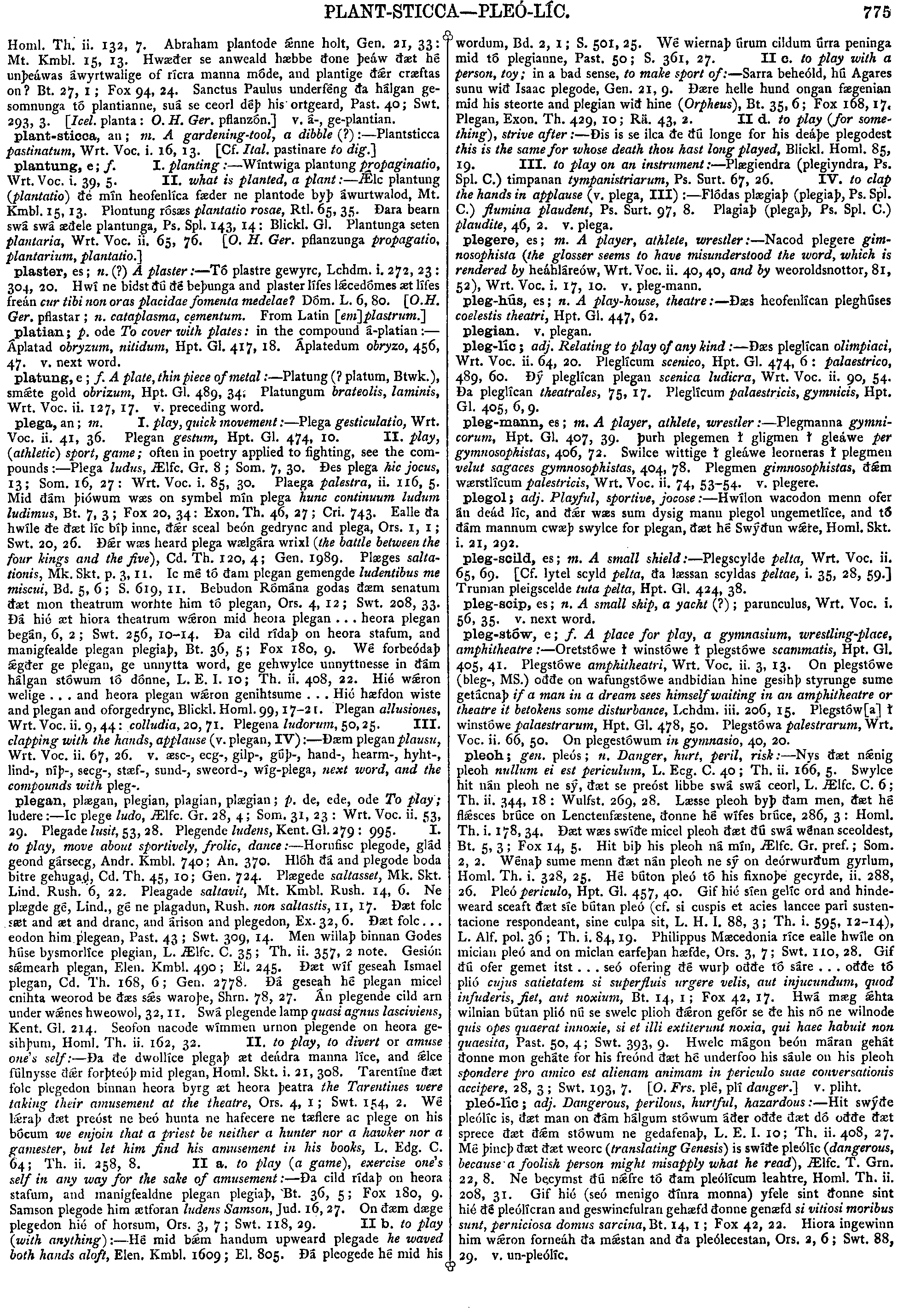
plegol;
adj.
Playful,
sportive,
jocose
:--
Hwílon
wacodon
menu
ofer
án
deád
líc,
and
ðr
wæs
sum
dysig
mann
plegol
ungemetíce,
and
tó
ðám
mannum
cwæþ
swylce
for
plegan,
ðæt
hé
Swýðun
wte,
Homl.
Skt.
i.
21,
292.
|
Source: Bosworth/Toller, page b0791, entry 1 View original page image as: [TIFF] [PNG] [View previous entry] [View next entry] |
[Comment on this entry] [View comments] |
The following entry has been hand-corrected once. |
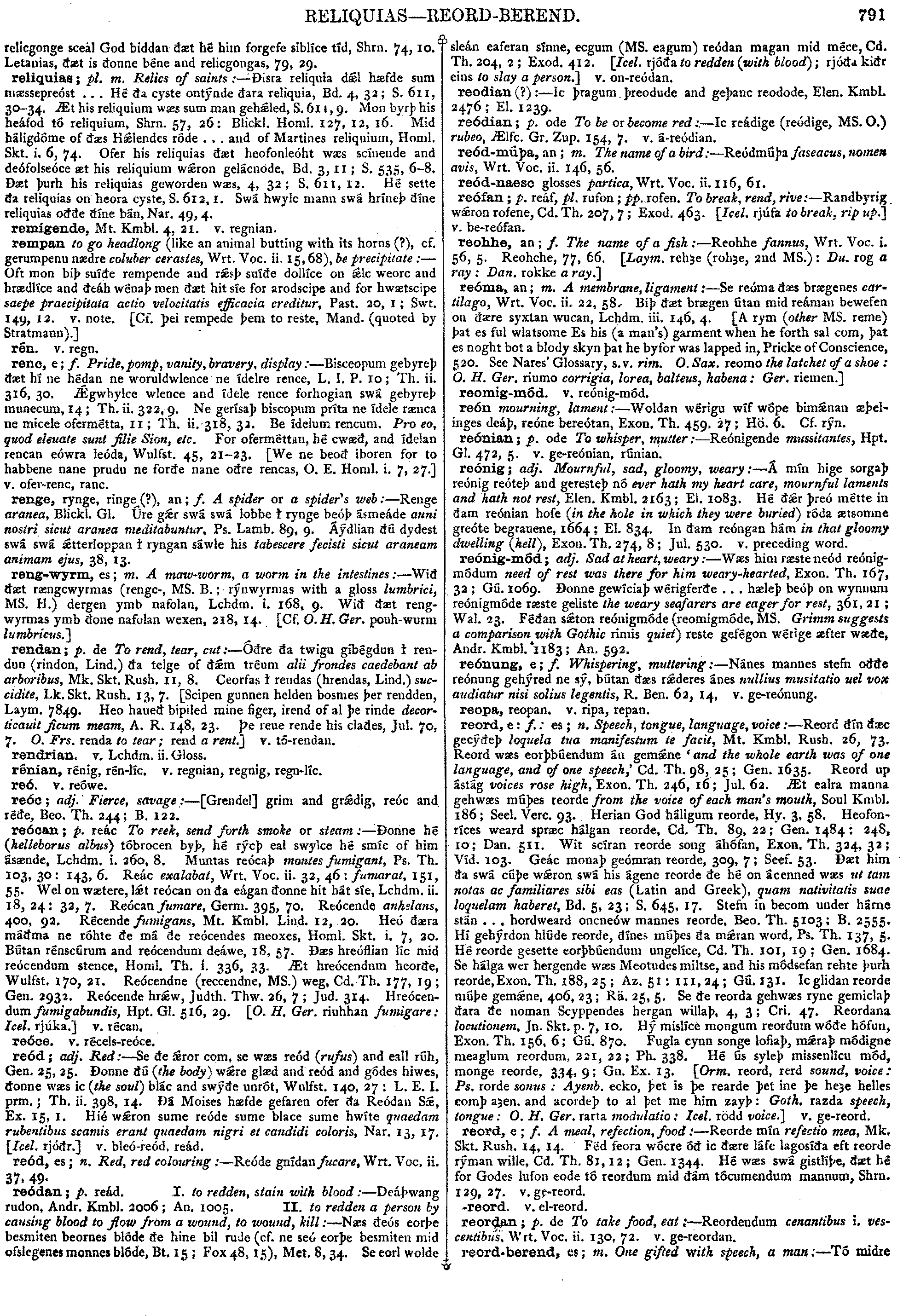
reliquias;
pl.
m.
Relics
of
saints
:--
Ðisra
reliquia
dl
hæfde
sum
mæssepreóst
.
.
.
Hé
ða
cyste
ontýnde
ðara
reliquia,
Bd.
4,
32;
S.
611,
30-34.
Æt
his
reliquium
wæs
sum
man
gehled,
S.
611,
9.
Mon
byrþ
his
heáfod
tó
reliquium,
Shrn.
57,
26
:
Blickl.
Homl.
127,
12,
16.
Mid
háligdóme
of
ðæs
Hlendes
róde
...
and
of
Martines
reliquium,
Homl.
Skt.
i.
6,
74.
Ofer
his
reliquias
ðæt
heofonleóht
wæs
scínende
and
deófolseóce
æt
his
reliquium
wron
gelácnóde,
Bd.
3,
11;
S.
535,
6-8.
Ðæt
þurh
his
reliquias
geworden
wæs,
4,
32;
S.
611,
12.
Hé
sette
ða
reliquias
on
heora
cyste,
S.
612,
1.
Swá
hwylc
mann
swá
hríneþ
ðíne
reliquias
oððe
ðíne
bán,
Nar.
49,
4.
|
Source: Bosworth/Toller, page b0793, entry 9 View original page image as: [TIFF] [PNG] [View previous entry] [View next entry] |
[Comment on this entry] [View comments (1)] |
The following entry has been hand-corrected once. |
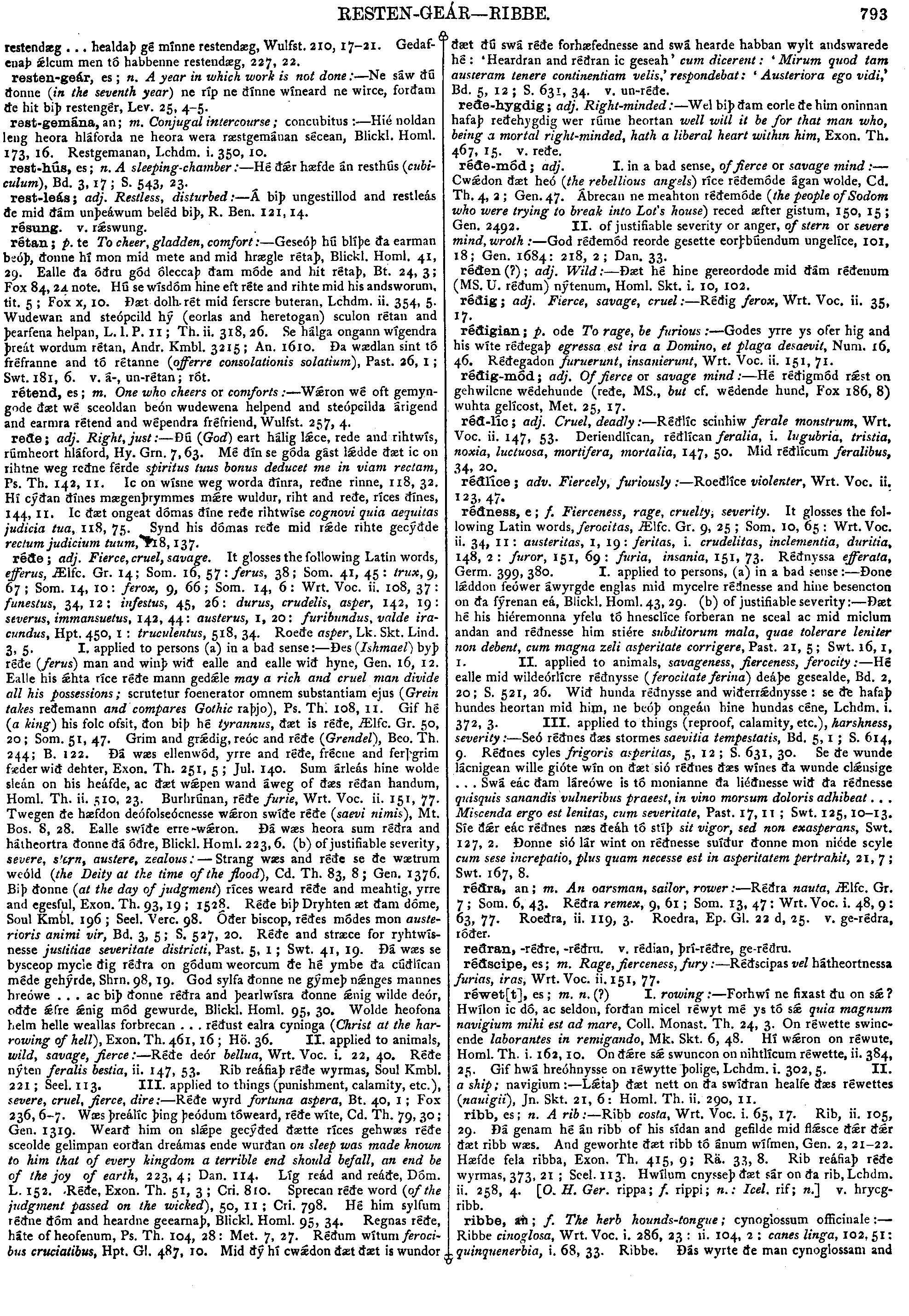
réðe;
adj.
Fierce,
cruel,
savage.
It
glosses
the
following
Latin
words,
efferus,
Ælfc.
Gr.
14;
Som.
16,
57
:
ferus,
38;
Som.
41,
45
:
trux,
9,
67;
Som.
14,
10
:
ferox,
9,
66;
Som.
14,
6
:
Wet.
Voc.
ii.
108,
37
:
funestus,
34,
12
:
infestus,
45,
26
:
durus,
crudelis,
asper,
142,
19
:
severus,
immansuetus,
142,
44
:
austerus,
1,
20
:
furibundus,
valde
iracundus,
Hpt.
450,
1
:
truculentus,
518,
34.
Roeðe
asper,
Lk.
Skt.
Lind.
3,
5.
I.
applied
to
persons
(a)
in
a
bad
sense
:--
Ðes
(Ishmael)
byþ
réðe
(ferus)
man
and
winþ
wið
ealle
and
ealle
wið
hyne,
Gen.
16,
12.
Ealle
his
hta
ríce
réðe
mann
gedle
may
a
rich
and
cruel
man
divide
all
his
possessions;
scrutetur
foenerator
omnem
substantiam
ejus
(Grein
takes
reðemann
and
compares
Gothic
raþjo),
Ps.
Th.
108,
11.
Gif
hé
(a
king)
his
folc
ofsit,
ðon
biþ
hé
tyrannus,
ðæt
is
réðe,
Ælfc.
Gr.
50,
20;
Som.
51,
47.
Grim
and
grdig,
reóc
and
réðe
(Grendel),
Beo.
Th.
244;
B.
122.
Ðá
wæs
ellenwód,
yrre
and
réðe,
frécne
and
ferþgrim
fæder
wið
dehter,
Exon.
Th.
251,
5;
Jul.
140.
Sum
árleás
hine
wolde
sleán
on
his
heáfde,
ac
ðæt
wpen
wand
áweg
of
ðæs
réðan
handum,
Homl.
Th.
ii.
510,
23.
Burhrúnan,
réðe
furie,
Wrt.
Voc.
ii.
151,
77.
Twegen
ðe
hæfdon
deófolseócnesse
wron
swíðe
réðe
(saevi
nimis),
Mt.
Bos.
8,
28.
Ealle
swíðe
erre-wron.
Ðá
wæs
heora
sum
réðra
and
hátheortra
ðonne
ðá
óðre,
Blickl.
Homl.
223,
6.
(b)
of
justifiable
severity,
severe,
stern,
austere,
zealous
:--
Strang
wæs
and
réðe
se
ðe
wætrum
weóld
(the
Deity
at
the
time
of
the
flood),
Cd.
Th.
83,
8;
Gen.
1376.
Biþ
ðonne
(at
the
day
of
judgment)
ríces
weard
réðe
and
meahtig,
yrre
and
egesful,
Exon.
Th.
93,
19;
1528.
Réðe
biþ
Dryhten
æt
ðam
dóme,
Soul
Kmbl.
196;
Seel.
Verc.
98.
Óðer
biscop,
réðes
módes
mon
austerioris
animi
vir,
Bd.
3,
5;
S.
527,
20.
Réðe
and
stræce
for
ryhtwísnesse
justitiae
severitate
districti,
Past.
5,
1;
Swt.
41,
19.
Ðá
wæs
se
bysceop
mycle
ðig
réðra
on
gódum
weorcum
ðe
hé
ymbe
ða
cúðlícan
méde
gehýrde,
Shrn.
98,
19.
God
sylfa
ðonne
ne
gýmeþ
nnges
mannes
hreowe
.
.
.
ac
biþ
ðonne
réðra
and
þearlwísra
ðonne
nig
wilde
deór,
oððe
fre
nig
mód
gewurde,
Blickl.
Homl.
95,
30.
Wolde
heofona
helm
helle
weallas
forbrecan
...
réðust
ealra
cyninga
(Christ
at
the
harrowing
of
hell),
Exon.
Th.
461,
16;
Hö.
36.
II.
applied
to
animals,
wild,
savage,
fierce
:--
Réðe
deór
bellua,
Wrt.
Voc.
i.
22,
40.
Réðe
nýten
feralis
bestia,
ii.
147,
53.
Rib
reáfiaþ
réðe
wyrmas,
Soul
Kmbl.
221;
Seel.
113.
III.
applied
to
things
(punishment,
calamity,
etc.),
severe,
cruel,
fierce,
dire
:--
Réðe
wyrd
fortuna
aspera,
Bt.
40,
1;
Fox
236,
6-7.
Wæs
þreálíc
þing
þeódum
tóweard,
réðe
wíte,
Cd.
Th.
79,
30;
Gen.
1319.
Wearð
him
on
slpe
gecýðed
ðætte
ríces
gehwæs
réðe
sceolde
gelimpan
eorðan
dreámas
ende
wurðan
on
sleep
was
made
known
to
him
that
of
every
kingdom
a
terrible
end
should
befall,
an
end
be
of
the
joy
of
earth,
223,
4;
Dan.
114.
Líg
reád
and
reáðe,
Dóm.
L.
152.
Réðe,
Exon.
Th.
51,
3;
Cri.
810.
Sprecan
réðe
word
(of
the
judgment
passed
on
the
wicked),
50,
11;
Cri.
798.
Hé
him
sylfum
réðne
ðóm
and
heardne
geearnaþ,
Blickl.
Homl.
95,
34.
Regnas
réðe,
háte
of
heofenum,
Ps.
Th.
104,
28
:
Met.
7,
27.
Réðum
wítum
ferocibus
cruciatibus,
Hpt.
Gl.
487,
10.
Mid
ðý
hí
cwdon
ðæt
ðæt
is
wundor
ðæt
ðú
swá
réðe
forhæfednesse
and
swá
hearde
habban
wylt
andswarede
hé
:
'Heardran
and
réðran
ic
geseah'
cum
dicerent
:
'Mirum
quod
tam
austeram
tenere
continentiam
velis,'
respondebat
:
'Austeriora
ego
vidi,'
Bd.
5,
12;
S.
631,
34.
v.
un-réðe.
|
Source: Bosworth/Toller, page b0795, entry 11 View original page image as: [TIFF] [PNG] [View previous entry] [View next entry] |
[Comment on this entry] [View comments] |
The following entry has been hand-corrected once. |
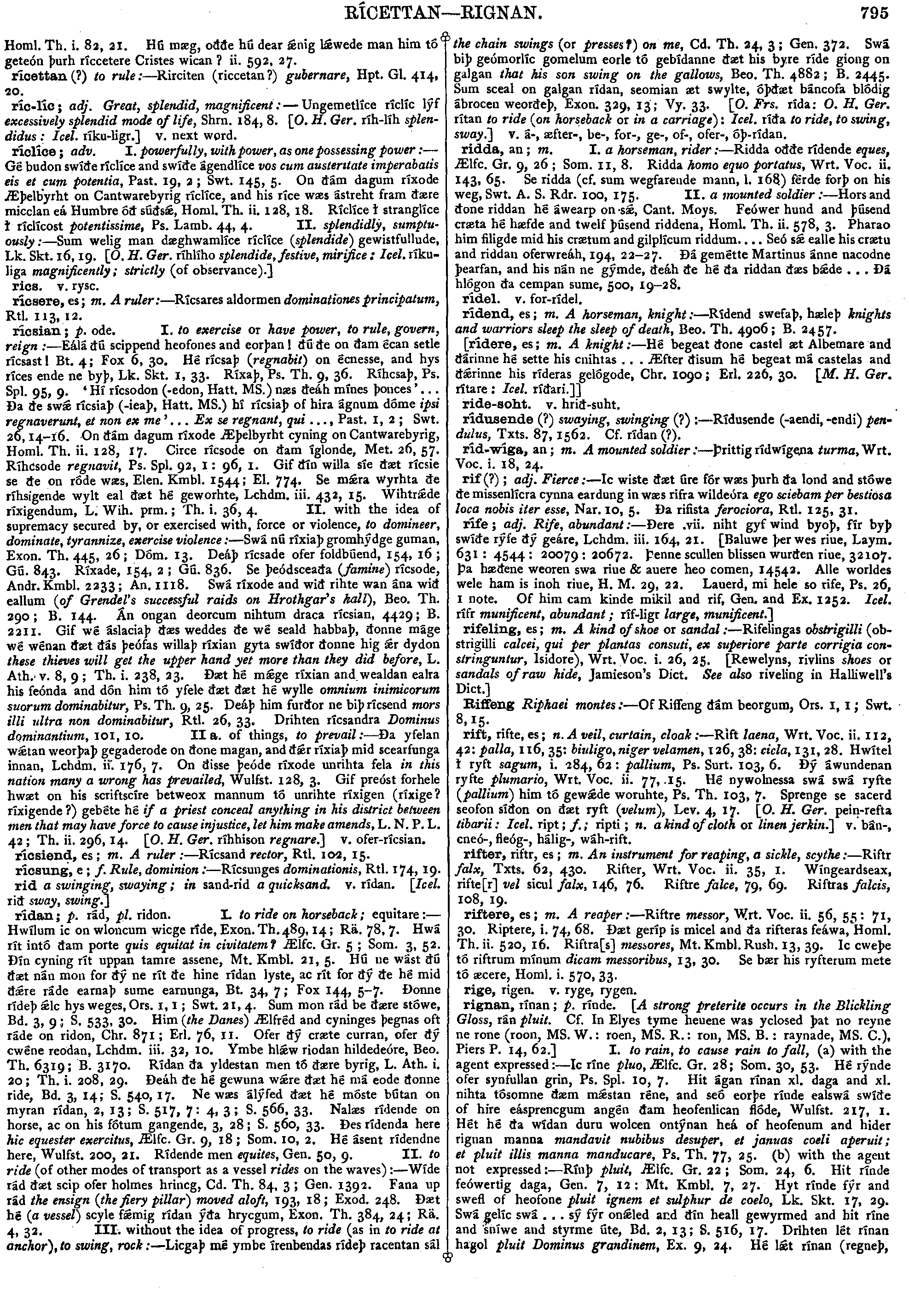
ridda,
an;
m.
I.
a
horseman,
rider
:--
Ridda
oððe
rídende
eques,
Ælfc.
Gr.
9,
26;
Som.
11,
8.
Ridda
homo
equo
portatus,
Wrt.
Voc.
ii.
143,
65.
Se
ridda
(cf.
sum
wegfarende
mann,
1.
168)
férde
forþ
on
his
weg,
Swt.
A.
S.
Rdr.
100,
175.
II.
a
mounted
soldier
:--
Hors
and
ðone
riddan
hé
áwearp
on
s,
Cant.
Moys.
Feówer
hund
and
þúsend
cræta
hé
hæfde
and
twelf
þúsend
riddena,
Homl.
Th.
ii.
578,
3.
Pharao
him
filigde
mid
his
crætum
and
gilplícum
riddum....
Seó
s
ealle
his
crætu
and
riddan
oferwreáh,
194,
22-27.
Ðá
gemétte
Martinus
ánne
nacodne
þearfan,
and
his
nán
ne
gýmde,
ðeáh
ðe
hé
ða
riddan
ðæs
bde
...
Ðá
hlógon
ða
cempan
sume,
500,
19-28.
|
Source: Bosworth/Toller, page b0797, entry 1 View original page image as: [TIFF] [PNG] [View previous entry] [View next entry] |
[Comment on this entry] [View comments] |
The following entry has been hand-corrected once. |
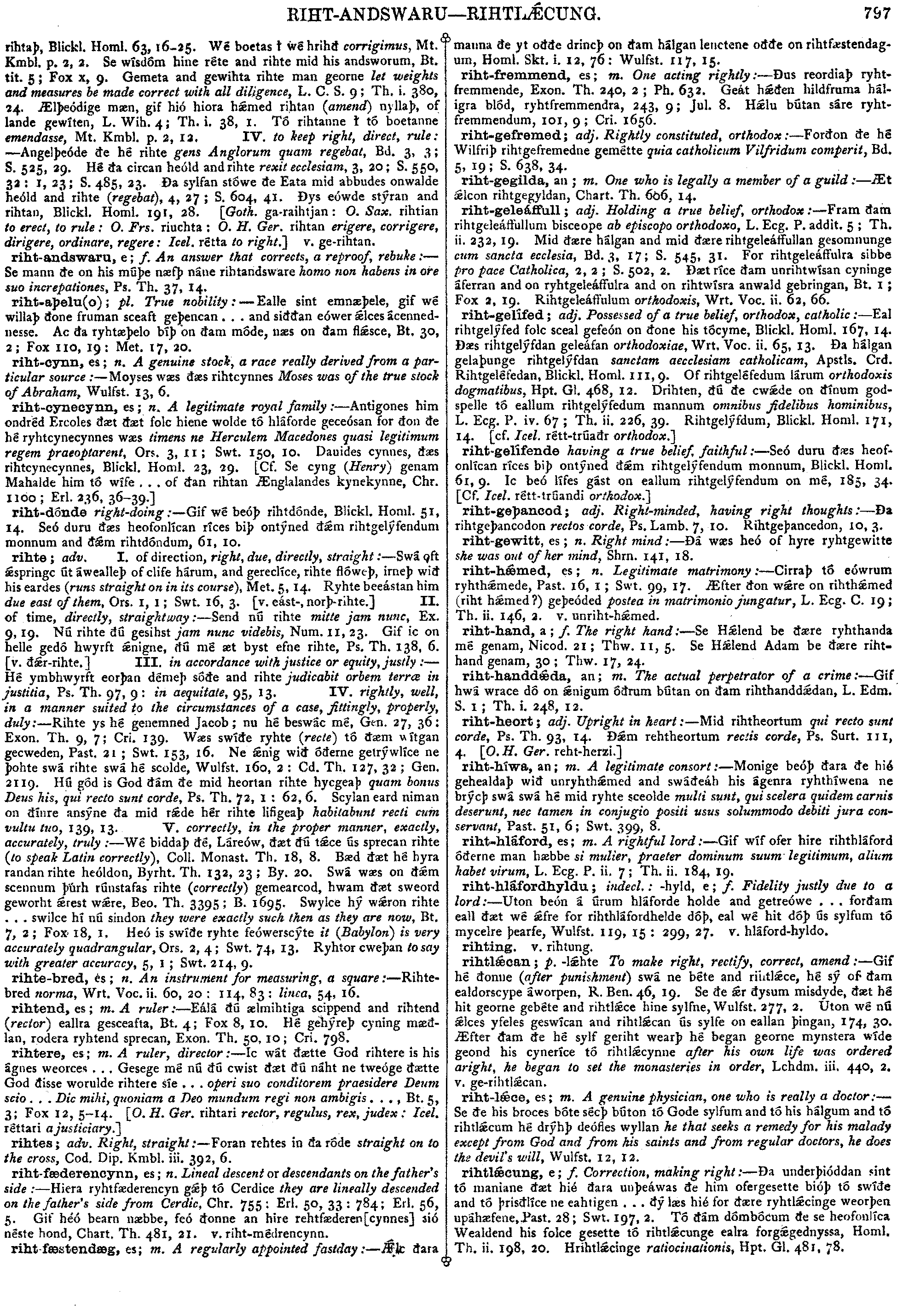
riht-andswaru, e; f. An answer that corrects, a reproof, rebuke :-- Se mann ðe on his múþe næfþ náne rihtandsware homo non habens in ore suo increpationes, Ps. Th. 37, 14.
|
Source: Bosworth/Toller, page b0798, entry 22 View original page image as: [TIFF] [PNG] [View previous entry] [View next entry] |
[Comment on this entry] [View comments] |
The following entry has been hand-corrected once. |
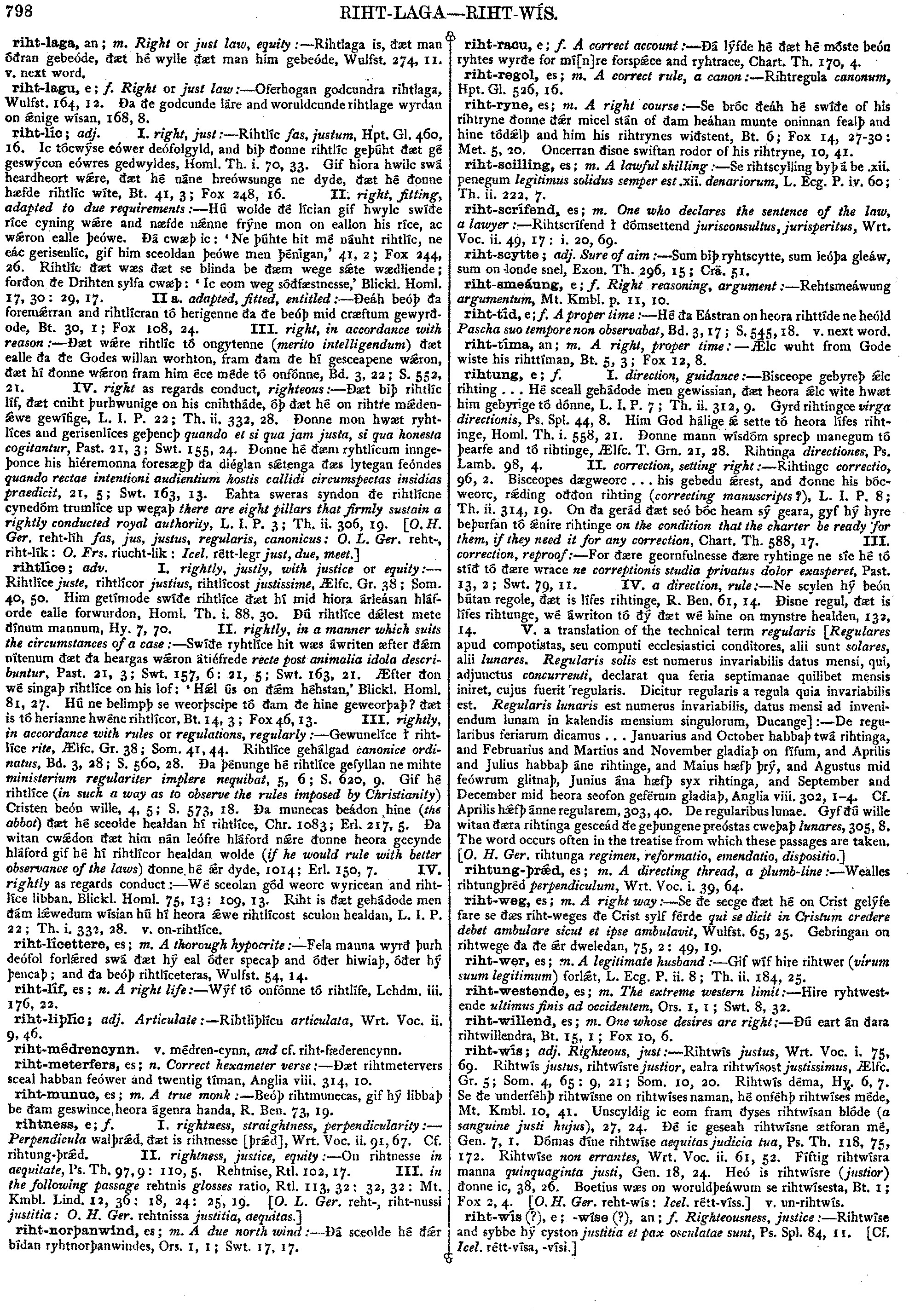
rihtung,
e;
f.
I.
direction,
guidance
:--
Bisceope
gebyreþ
lc
rihting
...
Hé
sceall
gehádode
men
gewissian,
ðæt
heora
lc
wite
hwæt
him
gebyrige
tó
dónne,
L.
I.
P.
7;
Th.
ii.
312,
9.
Gyrd
rihtingce
virga
directionis,
Ps.
Spl.
44,
8.
Him
God
hálige
sette
tó
heora
lífes
rihtinge,
Homl.
Th.
i.
558,
21.
Ðonne
mann
wísdóm
sprecþ
manegum
tó
þearfe
and
tó
rihtinge,
Ælfc.
T.
Grn.
21,
28.
Rihtinga
directiones,
Ps.
Lamb.
98,
4.
II.
correction,
setting
right
:--
Rihtingc
correctio,
96,
2.
Bisceopes
dægweorc
.
.
.
his
gebedu
rest,
and
ðonne
his
bócweorc,
rding
oððon
rihting
(correcting
manuscripts?),
L.
I.
P.
8;
Th.
ii.
314,
19.
On
ða
gerád
ðæt
seó
bóc
heam
sý
geara,
gyf
hý
hyre
beþurfan
tó
nire
rihtinge
on
the
condition
that
the
charter
be
ready
for
them,
if
they
need
it
for
any
correction,
Chart.
Th.
588,
17.
III.
correction,
reproof
:--
For
ðære
geornfulnesse
ðære
ryhtinge
ne
síe
hé
tó
stíð
tó
ðære
wrace
ne
correptionis
studia
privatus
dolor
exasperet,
Past.
13,
2;
Swt.
79,
11.
IV.
a
direction,
rule
:--
Ne
scylen
hý
beón
bútan
regole,
ðæt
is
lífes
rihtinge,
R.
Ben.
61,
14.
Ðisne
regul,
ðæt
is
lífes
rihtunge,
wé
áwriton
tó
dý
ðæt
wé
hine
on
mynstre
healden,
132,
14.
V.
a
translation
of
the
technical
term
regularis
[Regulares
apud
compotistas,
seu
computi
ecclesiastici
conditores,
alii
sunt
solares,
alii
lunares.
Regularis
solis
est
numerus
invariabilis
datus
mensi,
qui,
adjunctus
concurrenti,
declarat
qua
feria
septimanae
quilibet
mensis
iniret,
cujus
fuerit
regularis.
Dicitur
regularis
a
regula
quia
invariabilis
est.
Regularis
lunaris
est
numerus
invariabilis,
datus
mensi
ad
inveniendum
lunam
in
kalendis
mensium
singulorum,
Ducange]
:--
De
regularibus
feriarum
dicamus
.
.
.
Januarius
and
October
habbaþ
twá
rihtinga,
and
Februarius
and
Martius
and
November
gladiaþ
on
fífum,
and
Aprilis
and
Julius
habbaþ
áne
rihtinge,
and
Maius
hæfþ
þrý,
and
Agustus
mid
feówrum
glitnaþ,
Junius
ána
hæfþ
syx
rihtinga,
and
September
and
December
mid
heora
seofon
geférum
gladiaþ,
Anglia
viii.
302,
1-4.
Cf.
Aprilis
hfþ
ánne
regularem,
303,
40.
De
regularibus
lunae.
Gyf
ðú
wille
witan
ðæra
rihtinga
gesceád
ðe
geþungene
preóstas
cweþaþ
lunares,
305,
8.
The
word
occurs
often
in
the
treatise
from
which
these
passages
are
taken.
[O.
H.
Ger.
rihtunga
regimen,
reformatio,
emendatio,
dispositio.]
|
Source: Bosworth/Toller, page b0810, entry 24 View original page image as: [TIFF] [PNG] [View previous entry] [View next entry] |
[Comment on this entry] [View comments] |
The following entry has been hand-corrected once. |
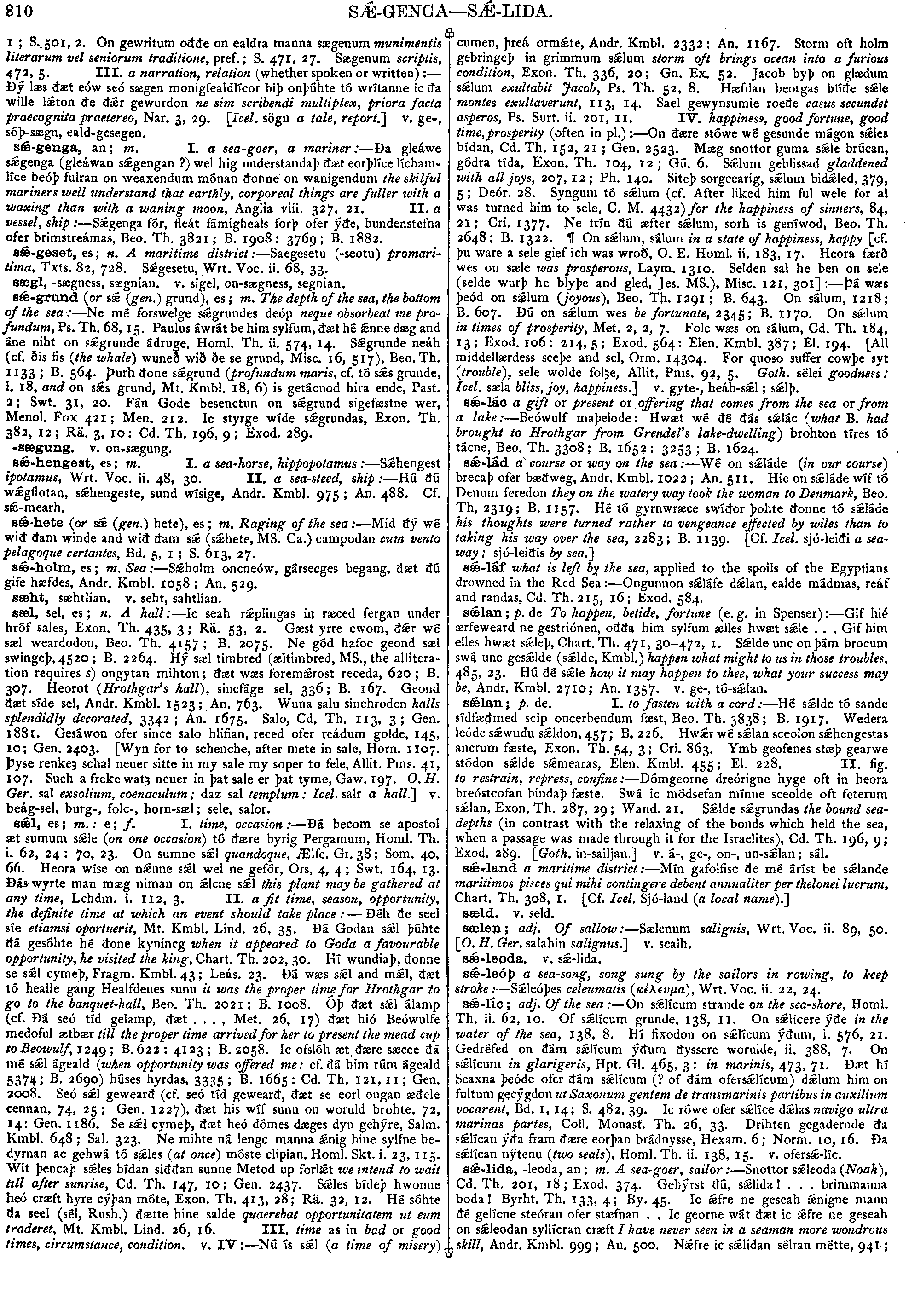
s-lida,
-leoda,
an;
m.
A
sea-goer,
sailor:--Snottor
sleoda
(Noah),
Cd.
Th.
201,
18;
Exod.
374.
Gehýrst
ðú,
slida!
.
.
.
brimmanna
boda!
Byrht.
Th.
133,
4;
By.
45.
Ic
fre
ne
geseah
nigne
mann
ðé
gelícne
steóran
ofer
stæfnan
.
.
Ic
georne
wát
ðæt
ic
fre
ne
geseah
on
sleodan
syllicran
cræft
I
have
never
seen
in
a
seaman
more
wondrous
skill,
Andr.
Kmbl.
999;
An.
500.
Nfre
ic
slidan
sélran
métte,
941;
|
Source: Bosworth/Toller, page b0819, entry 9 View original page image as: [TIFF] [PNG] [View previous entry] [View next entry] |
[Comment on this entry] [View comments] |
The following entry has been hand-corrected once. |
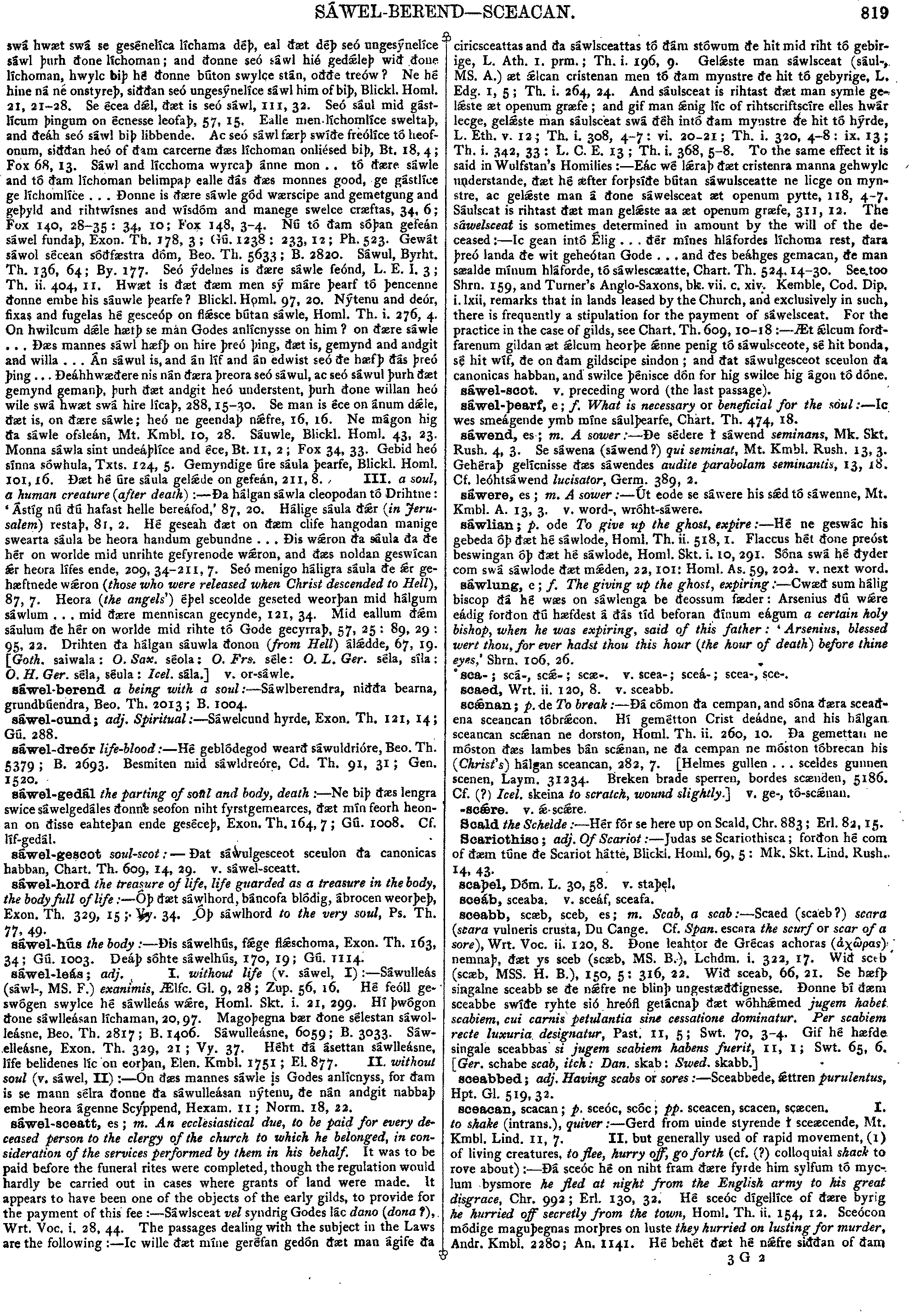
sáwel-leás;
adj.
I.
without
life
(v.
sáwel,
I):--Sáwulleás
(sáwl-,
MS.
F.)
exanimis,
Ælfc.
Gl.
9,
28;
Zup.
56,
16.
Hé
feóll
geswógen
swylce
hé
sáwlleás
wre,
Homl.
Skt.
i.
21,
299.
Hí
þwógon
ðone
sáwlleásan
líchaman,
20,
97.
Magoþegna
bær
ðone
sélestan
sáwolleásne,
Beo.
Th.
2817;
B.
1406.
Sáwulleásne,
6059;
B.
3033.
Sáwelleásne,
Exon.
Th.
329,
21
;
Vy.
37.
Héht
ðá
ásettan
sáwlleásne,
lífe
belidenes
líc
on
eorþan,
Elen.
Kmbl.
1751;
El.
877.
II.
without
soul
(v.
sáwel,
II):--On
ðæs
mannes
sáwle
is
Godes
anlícnyss,
for
ðam
is
se
mann
sélra
ðonne
ða
sáwulleásan
nýtenu,
ðe
nán
andgit
nabbaþ
embe
heora
ágenne
Scyppend,
Hexam.
11;
Norm.
18,
22.
| Result Page: |  |
Previous | 4 5 6 7 8 9 10 11 12 13 14 15 16 17 18 19 20 21 22 | Next |  |
Germanic Lexicon Project (main page)
This search system was written by
Sean Crist
Please consider
volunteering
to correct the data in these online dictionaries.
No rights reserved. Feel free to use these data in any way you please.