|
|

|
Source: Bosworth/Toller, page b0974, entry 8 View original page image as: [TIFF] [PNG] [View previous entry] [View next entry] |
[Comment on this entry] [View comments] |
The following entry has been hand-corrected once. |
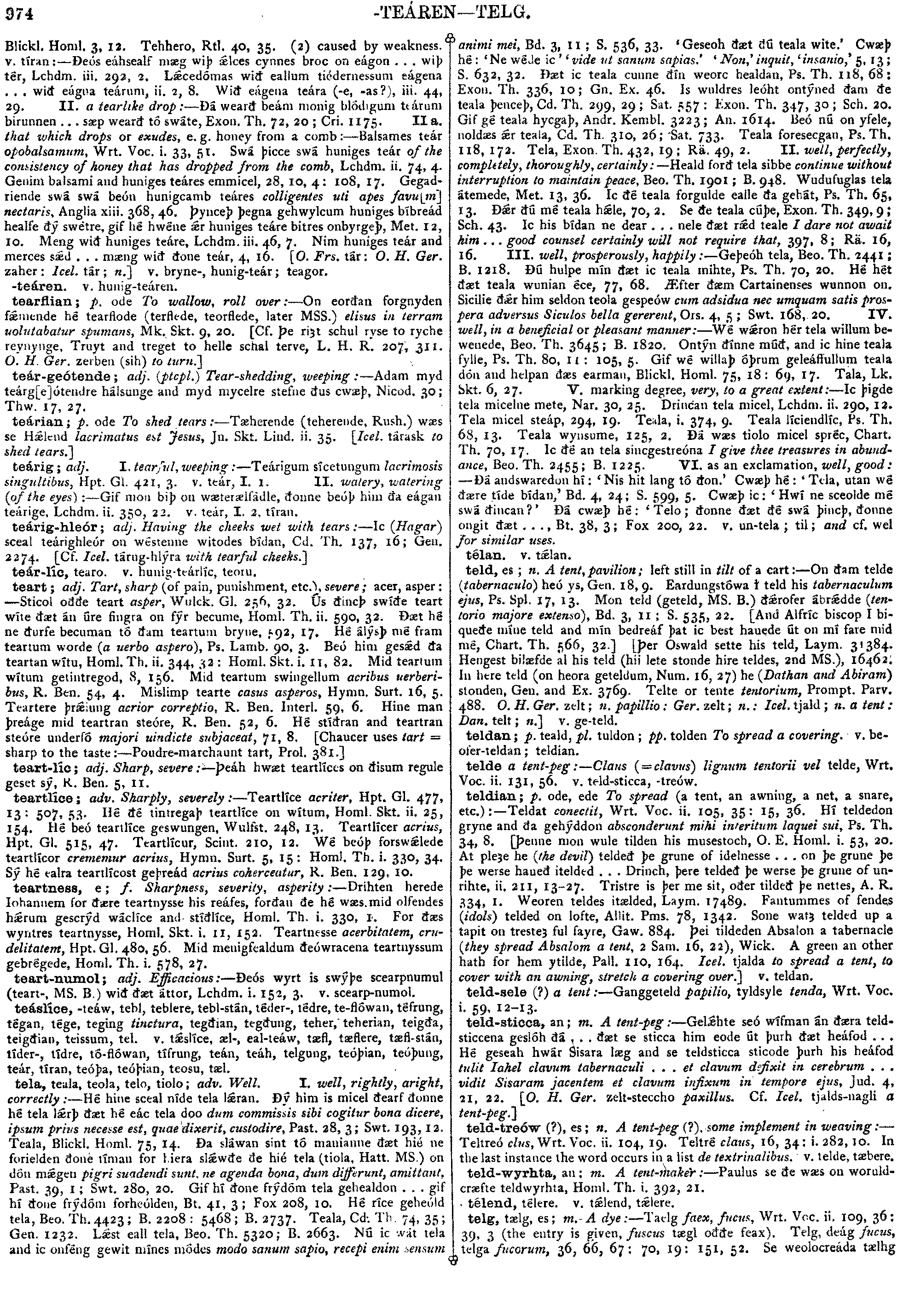
teart;
adj.
Tart,
sharp
(of
pain,
punishment,
etc.),
severe;
acer,
asper
:--
Sticol
oððe
teart
asper,
Wulck.
Gl.
256,
32.
Ús
ðincþ
swíðe
teart
wíte
ðæt
án
úre
fingra
on
fýr
becume,
Homl.
Th.
ii.
590,
32.
Ðæt
hé
ne
ðurfe
becuman
tó
ðam
teartum
bryne,
592,
17.
Hé
álýsþ
mé
fram
teartum
worde
(a
uerbo
aspero),
Ps.
Lamb.
90,
3.
Beó
him
ges d
ða
teartan
wítu,
Homl.
Th.
ii.
344,
32:
Homl.
Skt.
i.
11,
82.
Mid
teartum
wítum
getintregod,
8,
156.
Mid
teartum
swingellum
acribus
uerberibus,
R.
Ben.
54,
4.
Mislimp
tearte
casus
asperos,
Hymn.
Surt.
16,
5.
Teartere
þrlung
acrior
correptio,
R.
Ben.
Interl.
59,
6.
Hine
man
þreáge
mid
teartran
steóre,
R.
Ben.
52,
6.
Hé
stíðran
and
teartran
steóre
underló
majori
uindicte
subjaceat,
71,
8.
[Chaucer
uses
tart
=
sharp
to
the
taste
:--
Poudre-marchaunt
tart,
Prol.
381.]
d
ða
teartan
wítu,
Homl.
Th.
ii.
344,
32:
Homl.
Skt.
i.
11,
82.
Mid
teartum
wítum
getintregod,
8,
156.
Mid
teartum
swingellum
acribus
uerberibus,
R.
Ben.
54,
4.
Mislimp
tearte
casus
asperos,
Hymn.
Surt.
16,
5.
Teartere
þrlung
acrior
correptio,
R.
Ben.
Interl.
59,
6.
Hine
man
þreáge
mid
teartran
steóre,
R.
Ben.
52,
6.
Hé
stíðran
and
teartran
steóre
underló
majori
uindicte
subjaceat,
71,
8.
[Chaucer
uses
tart
=
sharp
to
the
taste
:--
Poudre-marchaunt
tart,
Prol.
381.]
|
Source: Bosworth/Toller, page b1107, entry 32 View original page image as: [TIFF] [PNG] [View previous entry] [View next entry] |
[Comment on this entry] [View comments] |
The following entry has been hand-corrected once. |
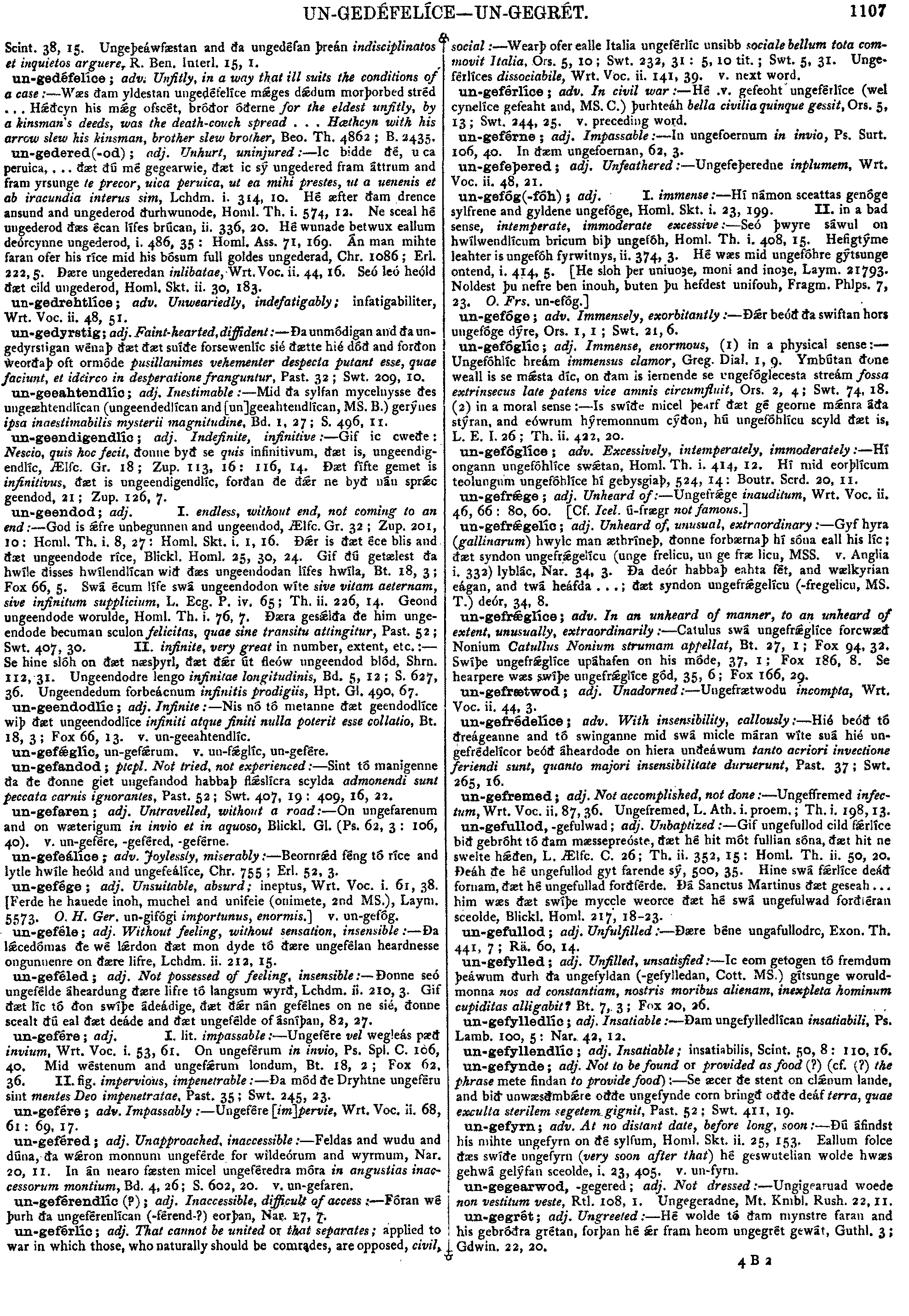
un-gefrédelíce; adv. With insensibility, callously :-- Hié beóð tó ðreágeanne and tó swinganne mid swá micle máran wíte suá hié ungefrédelícor beóð áheardode on hiera unðeáwum tanto acriori invectione feriendi sunt, quanto majori insensibilitate duruerunt, Past. 37; Swt. 265, 16.
|
Source: Bosworth/Toller, page d0369, entry 9 View original page image as: [TIFF] [PNG] [View previous entry] [View next entry] |
[Comment on this entry] [View comments] |
The following entry has been hand-corrected once. |
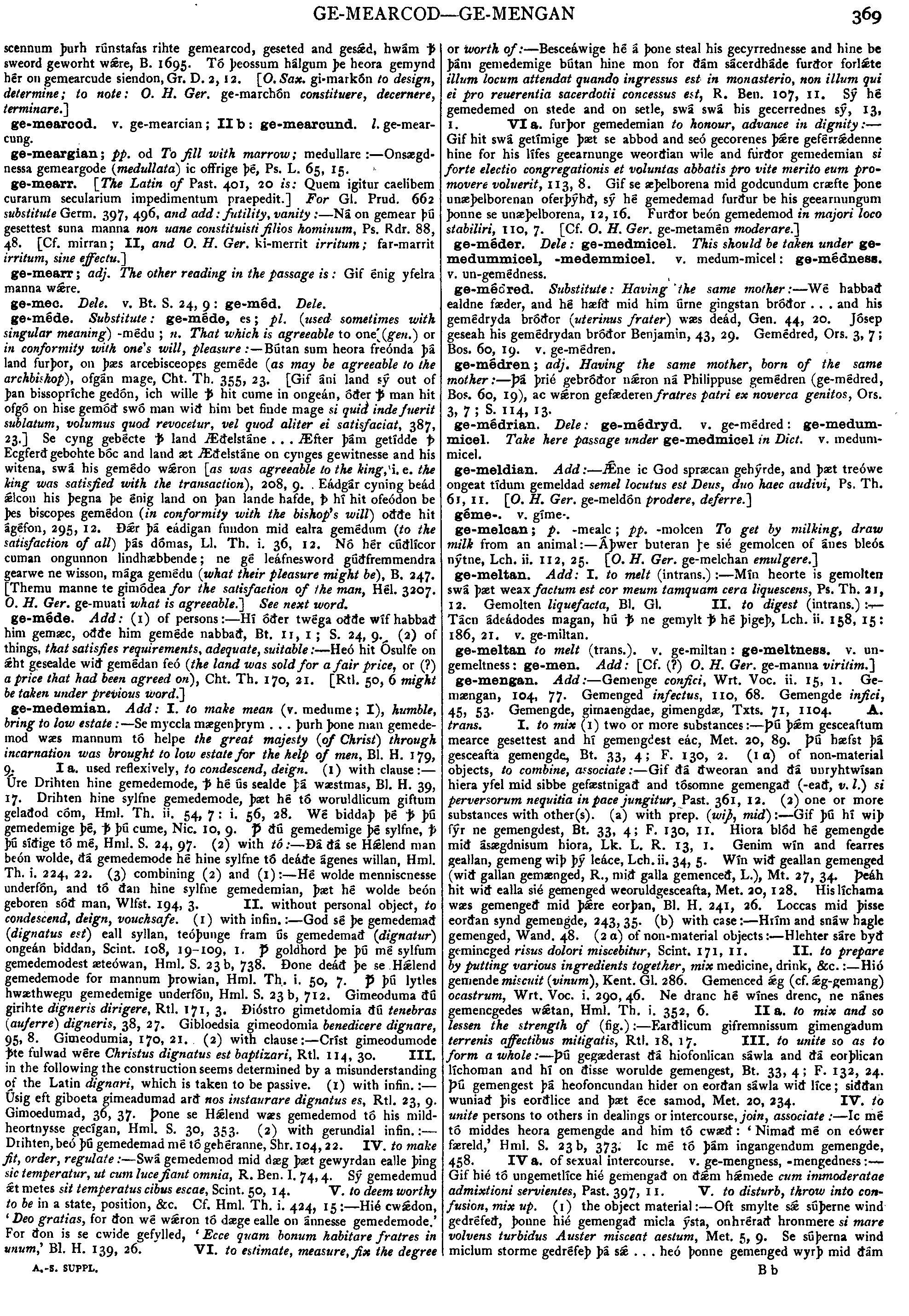
ge-medemian.
Add:
I.
to
make
mean
(v.
medume;
I),
humble,
bring
to
low
estate
:--
Se
myccla
mægenþrym
.
.
.
þurh
þone
man
gemede-mod
wæs
mannum
tó
helpe
the
great
majesty
(of
Christ)
through
incarnation
was
brought
to
low
estate
for
the
help
of
men,
Bl.
H.
179,
9.
I
a.
used
reflexively,
to
condescend,
deign.
(1)
with
clause
:--
Úre
Drihten
hine
gemedemode,
 hé
ús
sealde
þá
wæstmas,
Bl.
H.
39,
17.
Drihten
hine
sylfne
gemedemode,
þæt
hé
tó
woruldlicum
giftum
gelaðod
cóm,
Hml.
Th.
ii.
54,
7
:
i.
56,
28.
We
biddaþ
þé
þú
gemedemige
þé,
þú
cume,
Nic.
10,
9.
ðú
gemedemige
þé
sylfne,
þú
síðige
tó
mé,
Hml.
S.
24,
97.
(2)
with
tó
:--
Ðá
dá
se
Hlend
man
beón
wolde,
ðá
gemedemode
hé
hine
sylfne
tó
deáðe
ágenes
willan.
Hml.
Th.
i.
224,
22.
(3)
combining
(2)
and
(1)
:--
Hé
wolde
menniscnesse
underfón,
and
tó
ðan
hine
sylfne
gemedemian
þæt
hé
wolde
beón
geboren
sóð
man,
Wlfst.
194,
3.
II.
without
personal
object,
to
condescend,
deign,
vouchsafe.
(1)
with
infin.
:--
God
sé
þe
gemedemað
(dignatus
est)
eall
syllan,
teóþunge
fram
ús
gemedemað
(dignatur)
ongeán
biddan,
Scint.
108,
19-109,
l.
goldhord
þe
þú
mé
sylfum
gemedemodest
æteówan,
Hml.
S.
23
b,
738.
Ðone
deáð
þe
se
Hlend
gemedemode
for
mannum
þrowian,
Hml.
Th.
i.
50,
7.
þú
lytles
hwæthwegu
gemedemige
underfón,
Hml.
S.
23
b,
712.
Gimeoduma
ðú
girihte
digneris
dirigere.
Rtl.
171,
3.
Ðióstro
gimetdomia
ðú
tenebras
(auferre)
digneris,
38,
27.
Gibloedsia
gimeodomia
benedicere
dignare,
95,
8.
Gimeodumia,
170,
21.
(2)
with
clause
:--
Críst
gimeodumode
.
te
fulwad
wére
Christus
dignatus
est
baptizari,
Rtl.
ll.
),
30.
III.
in
the
following
the
construction
seems
determined
by
a
misunderstanding
of
the
Latin
dignari,
which
is
taken
to
be
passive,
(1)
with
infin.
:--
Úsig
eft
giboeta
gimeadumad
arð
nos
instaurare
dignatus
es.
Rtl.
23,
9.
Gimoedumad,
36,
37.
Þone
se
Hlend
wæs
gemedemod
tó
his
mild-heortnysse
gecígan,
Hml.
S.
30,
353.
(2)
with
gerundial
infin.
:--
Drihten,
beó
þú
gemedemad
mé
tó
gehéranne,
Shr.
104,
22.
IV.
to
make
fit,
order,
regulate
:--
Swá
gemedemod
mid
dæg
þæt
gewyrdan
ealle
þing
sic
temperatur,
ut
cum
luce
fiant
omnia,
R.
Ben.
I.
74,
4.
Sý
gemedemud
t
metes
sit
temperatus
cibus
escae,
Scint.
50,
14.
V.
to
deem
worthy
to
be
in
a
state,
position,
&
c.
Cf.
Hml.
Th.
i.
424,
15
:--
Hié
cwdon,
'
Deo
gratias,
for
ðon
wé
wron
tó
dæge
ealle
on
ánnesse
gemedemode.'
For
ðon
is
se
cwide
gefylled,
'Ecce
quam
bonum
habitare
fratres
in
unum,
'
Bl.
H.
139,
26.
VI.
to
estimate,
measure,
fix
the
degree
or
worth
of
:--
Besceáwige
hé
á
þone
steal
his
gecyrrednesse
and
hine
be
þám
gemedemige
bútan
hine
mon
for
dám
sácerdháde
furðor
forlte
ilium
locum
attendat
quando
ingressus
est
in
monasterio,
non
illum
qui
ei
pro
reuerentia
sacerdotii
concessus
est,
R.
Ben.
107,
II.
Sý
hé
gemedemed
on
stede
and
on
setle,
swá
swá
his
gecerrednes
sý,
13,
I.
VI
a.
furþor
gemedemian
to
honour,
advance
in
dignity
:--
-Gif
hit
swá
getímige
þæt
se
abbod
and
seó
gecorenes
þre
geférrdenne
hine
for
his
lífes
geearnunge
weorðian
wile
and
furðor
gemedemian
si
forte
electio
congregationis
et
voluntas
abbatis
pro
vite
merito
eum
promovere
voluerit,
113,
8.
Gif
se
æþelborena
mid
godcundum
cræfte
þone
unæþelborenan
oferþýhií,
sý
hé
gemedemad
furður
be
his
geearnungum
þonne
se
unæþelborena,
12,
16.
Furðor
beón
gemedemod
in
majori
loco
stabiliri,
lio,
7.
[Cf.
O.
H.
Ger.
ge-metamén
moderare.]
hé
ús
sealde
þá
wæstmas,
Bl.
H.
39,
17.
Drihten
hine
sylfne
gemedemode,
þæt
hé
tó
woruldlicum
giftum
gelaðod
cóm,
Hml.
Th.
ii.
54,
7
:
i.
56,
28.
We
biddaþ
þé
þú
gemedemige
þé,
þú
cume,
Nic.
10,
9.
ðú
gemedemige
þé
sylfne,
þú
síðige
tó
mé,
Hml.
S.
24,
97.
(2)
with
tó
:--
Ðá
dá
se
Hlend
man
beón
wolde,
ðá
gemedemode
hé
hine
sylfne
tó
deáðe
ágenes
willan.
Hml.
Th.
i.
224,
22.
(3)
combining
(2)
and
(1)
:--
Hé
wolde
menniscnesse
underfón,
and
tó
ðan
hine
sylfne
gemedemian
þæt
hé
wolde
beón
geboren
sóð
man,
Wlfst.
194,
3.
II.
without
personal
object,
to
condescend,
deign,
vouchsafe.
(1)
with
infin.
:--
God
sé
þe
gemedemað
(dignatus
est)
eall
syllan,
teóþunge
fram
ús
gemedemað
(dignatur)
ongeán
biddan,
Scint.
108,
19-109,
l.
goldhord
þe
þú
mé
sylfum
gemedemodest
æteówan,
Hml.
S.
23
b,
738.
Ðone
deáð
þe
se
Hlend
gemedemode
for
mannum
þrowian,
Hml.
Th.
i.
50,
7.
þú
lytles
hwæthwegu
gemedemige
underfón,
Hml.
S.
23
b,
712.
Gimeoduma
ðú
girihte
digneris
dirigere.
Rtl.
171,
3.
Ðióstro
gimetdomia
ðú
tenebras
(auferre)
digneris,
38,
27.
Gibloedsia
gimeodomia
benedicere
dignare,
95,
8.
Gimeodumia,
170,
21.
(2)
with
clause
:--
Críst
gimeodumode
.
te
fulwad
wére
Christus
dignatus
est
baptizari,
Rtl.
ll.
),
30.
III.
in
the
following
the
construction
seems
determined
by
a
misunderstanding
of
the
Latin
dignari,
which
is
taken
to
be
passive,
(1)
with
infin.
:--
Úsig
eft
giboeta
gimeadumad
arð
nos
instaurare
dignatus
es.
Rtl.
23,
9.
Gimoedumad,
36,
37.
Þone
se
Hlend
wæs
gemedemod
tó
his
mild-heortnysse
gecígan,
Hml.
S.
30,
353.
(2)
with
gerundial
infin.
:--
Drihten,
beó
þú
gemedemad
mé
tó
gehéranne,
Shr.
104,
22.
IV.
to
make
fit,
order,
regulate
:--
Swá
gemedemod
mid
dæg
þæt
gewyrdan
ealle
þing
sic
temperatur,
ut
cum
luce
fiant
omnia,
R.
Ben.
I.
74,
4.
Sý
gemedemud
t
metes
sit
temperatus
cibus
escae,
Scint.
50,
14.
V.
to
deem
worthy
to
be
in
a
state,
position,
&
c.
Cf.
Hml.
Th.
i.
424,
15
:--
Hié
cwdon,
'
Deo
gratias,
for
ðon
wé
wron
tó
dæge
ealle
on
ánnesse
gemedemode.'
For
ðon
is
se
cwide
gefylled,
'Ecce
quam
bonum
habitare
fratres
in
unum,
'
Bl.
H.
139,
26.
VI.
to
estimate,
measure,
fix
the
degree
or
worth
of
:--
Besceáwige
hé
á
þone
steal
his
gecyrrednesse
and
hine
be
þám
gemedemige
bútan
hine
mon
for
dám
sácerdháde
furðor
forlte
ilium
locum
attendat
quando
ingressus
est
in
monasterio,
non
illum
qui
ei
pro
reuerentia
sacerdotii
concessus
est,
R.
Ben.
107,
II.
Sý
hé
gemedemed
on
stede
and
on
setle,
swá
swá
his
gecerrednes
sý,
13,
I.
VI
a.
furþor
gemedemian
to
honour,
advance
in
dignity
:--
-Gif
hit
swá
getímige
þæt
se
abbod
and
seó
gecorenes
þre
geférrdenne
hine
for
his
lífes
geearnunge
weorðian
wile
and
furðor
gemedemian
si
forte
electio
congregationis
et
voluntas
abbatis
pro
vite
merito
eum
promovere
voluerit,
113,
8.
Gif
se
æþelborena
mid
godcundum
cræfte
þone
unæþelborenan
oferþýhií,
sý
hé
gemedemad
furður
be
his
geearnungum
þonne
se
unæþelborena,
12,
16.
Furðor
beón
gemedemod
in
majori
loco
stabiliri,
lio,
7.
[Cf.
O.
H.
Ger.
ge-metamén
moderare.]
|
Source: Bosworth/Toller, page d0398, entry 1 View original page image as: [TIFF] [PNG] [View previous entry] [View next entry] |
[Comment on this entry] [View comments] |
The following entry has been hand-corrected once. |
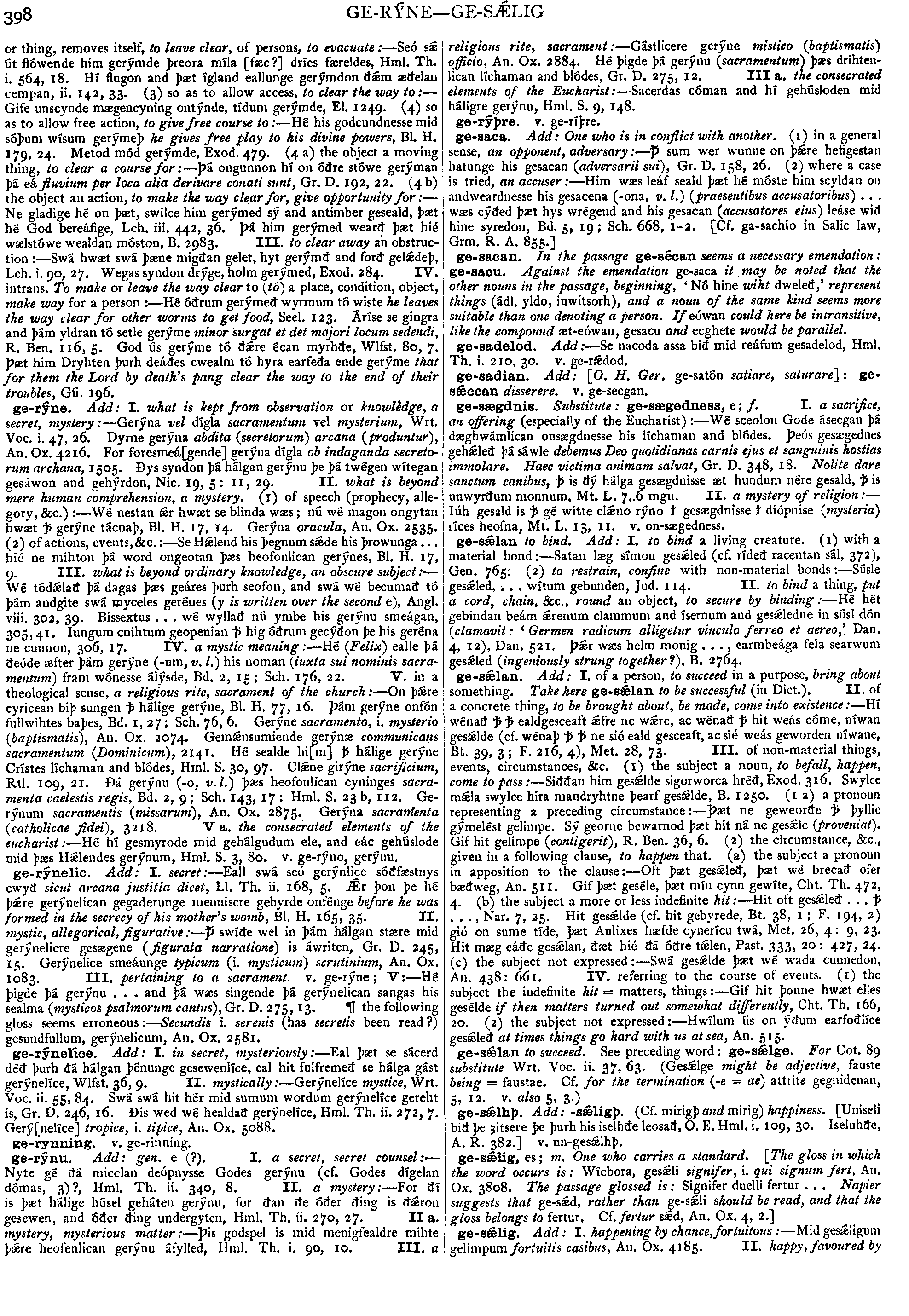
or
thing,
removes
itself,
to
leave
clear,
of
persons,
to
evacuate
:--
Seó
sfit
flówende
him
gerymde
þreora
mlla
[fæt]
dries
færeldes,
Hml.
Th.
i.
564,
1
8.
Hí
flugon
and
þæt
igland
eallunge
gerýmdon
ðm
æðelan
cempan,
ii.
142,
33.
(3)
so
as
to
allow
access,
to
clear
the
way
to;
--
Gife
unscynde
mægencyning
ontýnde,
tídum
gerymde,
El.
1249.
(4)
so
as
to
allow
free
action
,
to
give
free
course
to
:--
He
his
godcundnesse
mid
sóþum
wísum
gerýmeþ
he
gives
free
play
to
his
divine
powers,
Bl.
H.
179,
24.
Metod
mód
gerymde,
Exod.
479.
(4
a)
the
object
a
moving
thing,
to
clear
a
course
for
:--
Þá
ongunnon
hi
on
óðre
stówe
gerýman
þá
estfiuvium
per
loco
alia
derivare
conati
sunt,
Gr.
D.
192,
22.
(4
b)
the
object
an
action,
to
make
the
way
clear
for,
give
opportunity
for
:--
Ne
gladige
hé
on
þæt,
swilce
him
gerýmed
sý
and
antimber
geseald,
þæt
hé
God
bereáfige,
Lch.
iii.
442,
36.
Þá
him
gerýmed
wearð
þæt
hié
wælstówe
wealdan
móston,
B.
2983.
III.
to
clear
away
an
obstruction
:--
Swá
hwæt
swá
þæne
migðan
gelet,
hyt
gerýmð
and
forð
geldeþ,Lch.
i.
90,
27.
Wegas
syndon
drýge,
holm
gerýmed,
Exod.
284.
IV.
intrans.
To
make
or
leave
the
way
clear
to
(tó)
a
place,
condition,
object,
make
way
for
a
person
:--
Hé
óðtrum
gerýmeð
wyrmum
tó
wiste
he
leaves
the
way
clear
for
other
worms
to
get
food,
Seel.
123.
Áríse
se
gingra
and
þám
yldran
tó
setle
geryme
minor
surgat
et
det
majori
locum
sedendi,
R.
Ben.
116,
5.
God
ús
gerýme
tó
ðre
écan
myrhðe,
Wlfst.
80,
7.
Þæt
him
Dryhten
þurh
deáðes
cwealm
tó
hyra
earfeða
ende
gerýme
that
for
them
the
Lord
by
death's
pang
clear
the
way
to
the
end
of
their
troubles,
Gú.
196.
Germanic Lexicon Project (main page)
This search system was written by
Sean Crist
Please consider
volunteering
to correct the data in these online dictionaries.
No rights reserved. Feel free to use these data in any way you please.