|
|

Search for lyt again, using less strict matching (71 results)
|
Source: Bosworth/Toller, page d0556, entry 38 View original page image as: [TIFF] [PNG] [View previous entry] [View next entry] |
[Comment on this entry] [View comments] |
The following entry has been hand-corrected once. |
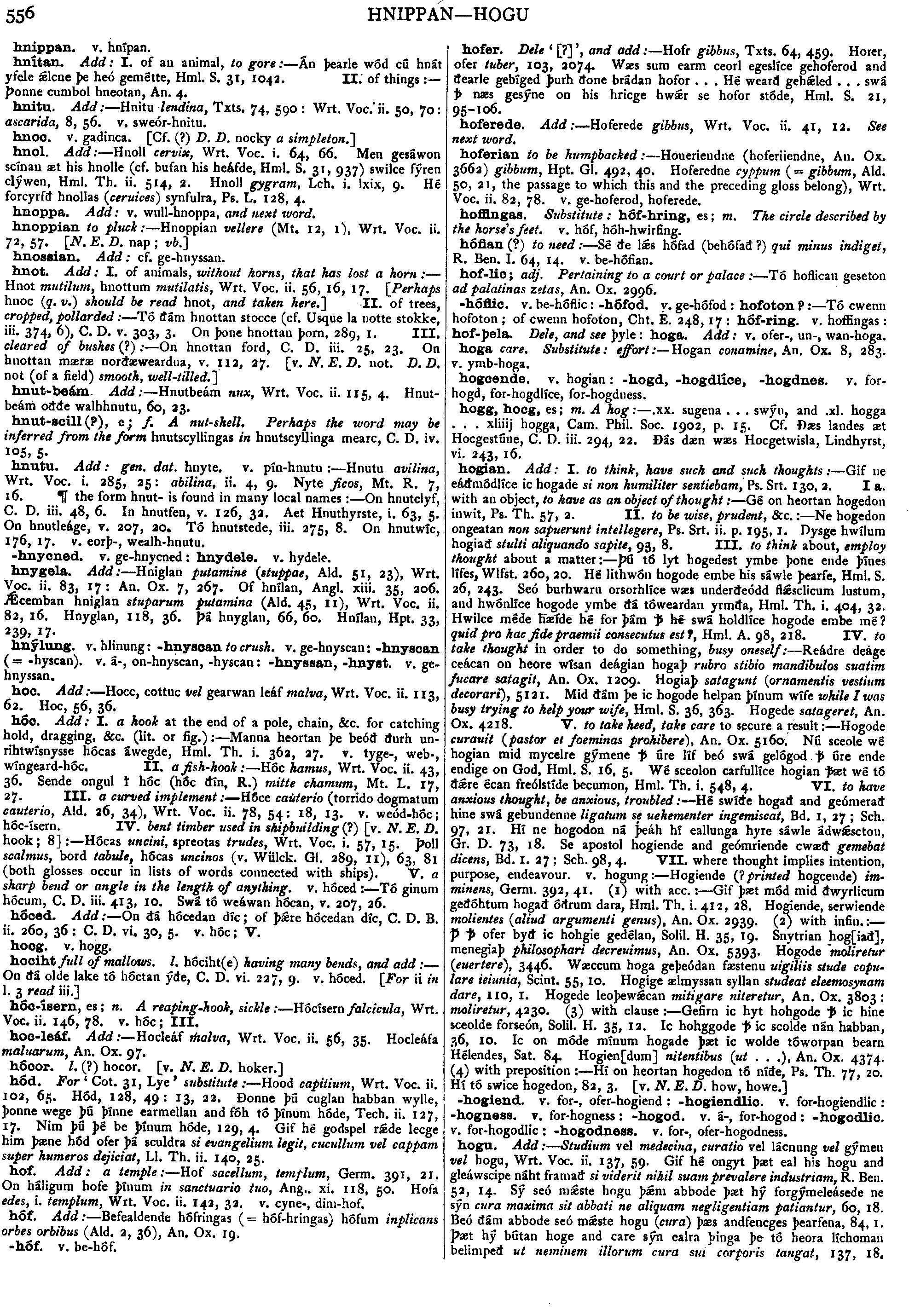
hogian.
Add:
I.
to
think,
have
such
and
such
thoughts
:--
Gif
ne
eá m
m dl
dl ce
ic
hogade
si
non
humiliter
sentiebam,
Ps.
Srt.
130,
2.
I
a.
with
an
object,
to
hove
as
an
object
of
thought
:--
G
ce
ic
hogade
si
non
humiliter
sentiebam,
Ps.
Srt.
130,
2.
I
a.
with
an
object,
to
hove
as
an
object
of
thought
:--
G on
heortan
hogedon
inwit,
Ps.
Th.
57,
2.
II.
to
be
wise,
prudent,
&c.
:--
Ne
hogedon
ongeatan
noa
sapuerunt
intellegere,
Ps.
Srt.
ii.
p.
195,
1.
Dysge
hwlum
hogia
stulti
aliquando
sapite,
93,
8.
III.
to
think
about,
employ
thought
about
a
matter
:--
Þ
on
heortan
hogedon
inwit,
Ps.
Th.
57,
2.
II.
to
be
wise,
prudent,
&c.
:--
Ne
hogedon
ongeatan
noa
sapuerunt
intellegere,
Ps.
Srt.
ii.
p.
195,
1.
Dysge
hwlum
hogia
stulti
aliquando
sapite,
93,
8.
III.
to
think
about,
employ
thought
about
a
matter
:--
Þ t
lyt
hogedest
ymbe
þone
ende
þnes
lfes,
Wlfst.
260,
20.
H
lihthwn
hogode
embe
his
s
t
lyt
hogedest
ymbe
þone
ende
þnes
lfes,
Wlfst.
260,
20.
H
lihthwn
hogode
embe
his
s wle
þearfe,
Hml.
S.
26,
243.
Seó
burhwaru
orsorhlce
wæs
undereódd
fl
wle
þearfe,
Hml.
S.
26,
243.
Seó
burhwaru
orsorhlce
wæs
undereódd
fl sclicum
lustum,
and
hwnlce
hogode
ymbe
tweardan
yrma,
Hml.
Th.
i.
404,
32.
Hwilce
mde
hæfde
h
for
þm
sclicum
lustum,
and
hwnlce
hogode
ymbe
tweardan
yrma,
Hml.
Th.
i.
404,
32.
Hwilce
mde
hæfde
h
for
þm
 h
sw
holdlce
hogode
embe
m
?
quid
pro
hac
fide
praemii
consecutus
est?
Hml.
A.
98,
218.
IV.
to
take
thought
in
order
to
do
something,
busy
oneself
:--
Reádre
deáge
ceácan
on
heore
wsan
deágian
hogaþ
rubro
stibio
mandibulos
suatim
fucare
satagit,
An.
Ox.
1209.
Hogiaþ
satagunt
(ornamentis
vestium
decor
art),
5121.
Mid
m
þe
ic
hogode
helpan
þnum
wfe
while
I
was
busy
trying
to
help
your
wife,
Hml.
S.
36,
363.
Hogede
satageret,
An.
Ox.
4218.
V.
to
take
heed,
take
care
to
secure
a
result
:--
Hogode
curauit
(pastor
et
foeminas
prohibere),
An.
Ox.
5160.
N
sceole
w
hogian
mid
mycelre
g
h
sw
holdlce
hogode
embe
m
?
quid
pro
hac
fide
praemii
consecutus
est?
Hml.
A.
98,
218.
IV.
to
take
thought
in
order
to
do
something,
busy
oneself
:--
Reádre
deáge
ceácan
on
heore
wsan
deágian
hogaþ
rubro
stibio
mandibulos
suatim
fucare
satagit,
An.
Ox.
1209.
Hogiaþ
satagunt
(ornamentis
vestium
decor
art),
5121.
Mid
m
þe
ic
hogode
helpan
þnum
wfe
while
I
was
busy
trying
to
help
your
wife,
Hml.
S.
36,
363.
Hogede
satageret,
An.
Ox.
4218.
V.
to
take
heed,
take
care
to
secure
a
result
:--
Hogode
curauit
(pastor
et
foeminas
prohibere),
An.
Ox.
5160.
N
sceole
w
hogian
mid
mycelre
g mene
re
lf
beó
sw
gelgod
re
ende
endige
on
God,
Hml.
S.
16,
5.
W
sceolon
carfullce
hogian
þæt
w
t
re
can
freólstde
becumon,
Hml.
Th.
i.
548,
4.
VI.
to
have
anxious
thought,
be
anxious,
troubled
:--
H
swe
hoga
and
geómera
hine
sw
gebundenne
ligatum
se
uehementer
ingemiscat,
Bd.
I.
27
;
Sch.
97,
21.
H
ne
hogodon
n
þeáh
h
eallunga
hyre
swle
dwscton,
Gr.
D.
73,
18.
Se
apostol
hogiende
and
geómriende
cwæ
gemebat
dicens,
Bd.
l,
27
;
Sch.
98,
4.
VII.
where
thought
implies
intention,
purpose,
endeavour,
v.
hogung
:--
Hogiende
(?
printed
hogcende)
im-minens,
Germ.
392,
41.
(l)
with
acc.
:--
Gif
þæt
md
mid
wyrlicum
gehtum
hoga
rum
dara,
Hml.
Th.
i.
412,
28.
Hogiende,
serwiende
molientes
(aliud
argumenti
genus).
An.
Ox.
2939.
(2)
with
infin.
:--
ofer
by
ic
hohgie
gedlan,
Solil.
H.
35,
19.
Snytrian
hog[ia],
menegiaþ
philosophari
decreuimus,
An.
Ox.
5393.
Hogode
molirelur
(euertere),
3446.
Wæccum
hoga
geþeódan
fæstenu
uigiliis
stude
copu-lare
ieiunia,
Scint.
55,
10.
Hogige
ælmyssan
syllan
studeat
eleemosynam
dare,
110,
I.
Hogede
leoþewcan
mitigare
nileretur,
An.
Ox.
3803
:
moliretur,
4230.
(3)
with
clause
:--
Gefirn
ic
hyt
hohgode
ic
hine
sceolde
forseón,
Solil.
H.
35,
12.
Ic
hohggode
ic
scolde
nn
habban,
36,
10.
Ic
on
mde
mnum
hogade
þæt
ic
wolde
tworpan
bearn
Hlendes,
Sat.
84.
Hogien[dum]
nitentibus
(ut
.
.
.
),
An.
Ox.
4374.
(4)
with
preposition
:--
H
on
heortan
hogedon
t
ne,
Ps.
Th.
77,
20.
H
t
swice
hogedon,
82,
3.
[v.
N.
E.
D.
how,
howe.]
mene
re
lf
beó
sw
gelgod
re
ende
endige
on
God,
Hml.
S.
16,
5.
W
sceolon
carfullce
hogian
þæt
w
t
re
can
freólstde
becumon,
Hml.
Th.
i.
548,
4.
VI.
to
have
anxious
thought,
be
anxious,
troubled
:--
H
swe
hoga
and
geómera
hine
sw
gebundenne
ligatum
se
uehementer
ingemiscat,
Bd.
I.
27
;
Sch.
97,
21.
H
ne
hogodon
n
þeáh
h
eallunga
hyre
swle
dwscton,
Gr.
D.
73,
18.
Se
apostol
hogiende
and
geómriende
cwæ
gemebat
dicens,
Bd.
l,
27
;
Sch.
98,
4.
VII.
where
thought
implies
intention,
purpose,
endeavour,
v.
hogung
:--
Hogiende
(?
printed
hogcende)
im-minens,
Germ.
392,
41.
(l)
with
acc.
:--
Gif
þæt
md
mid
wyrlicum
gehtum
hoga
rum
dara,
Hml.
Th.
i.
412,
28.
Hogiende,
serwiende
molientes
(aliud
argumenti
genus).
An.
Ox.
2939.
(2)
with
infin.
:--
ofer
by
ic
hohgie
gedlan,
Solil.
H.
35,
19.
Snytrian
hog[ia],
menegiaþ
philosophari
decreuimus,
An.
Ox.
5393.
Hogode
molirelur
(euertere),
3446.
Wæccum
hoga
geþeódan
fæstenu
uigiliis
stude
copu-lare
ieiunia,
Scint.
55,
10.
Hogige
ælmyssan
syllan
studeat
eleemosynam
dare,
110,
I.
Hogede
leoþewcan
mitigare
nileretur,
An.
Ox.
3803
:
moliretur,
4230.
(3)
with
clause
:--
Gefirn
ic
hyt
hohgode
ic
hine
sceolde
forseón,
Solil.
H.
35,
12.
Ic
hohggode
ic
scolde
nn
habban,
36,
10.
Ic
on
mde
mnum
hogade
þæt
ic
wolde
tworpan
bearn
Hlendes,
Sat.
84.
Hogien[dum]
nitentibus
(ut
.
.
.
),
An.
Ox.
4374.
(4)
with
preposition
:--
H
on
heortan
hogedon
t
ne,
Ps.
Th.
77,
20.
H
t
swice
hogedon,
82,
3.
[v.
N.
E.
D.
how,
howe.]
|
Source: Bosworth/Toller, page d0573, entry 8 View original page image as: [TIFF] [PNG] [View previous entry] [View next entry] |
[Comment on this entry] [View comments (1)] |
The following entry has been hand-corrected once. |
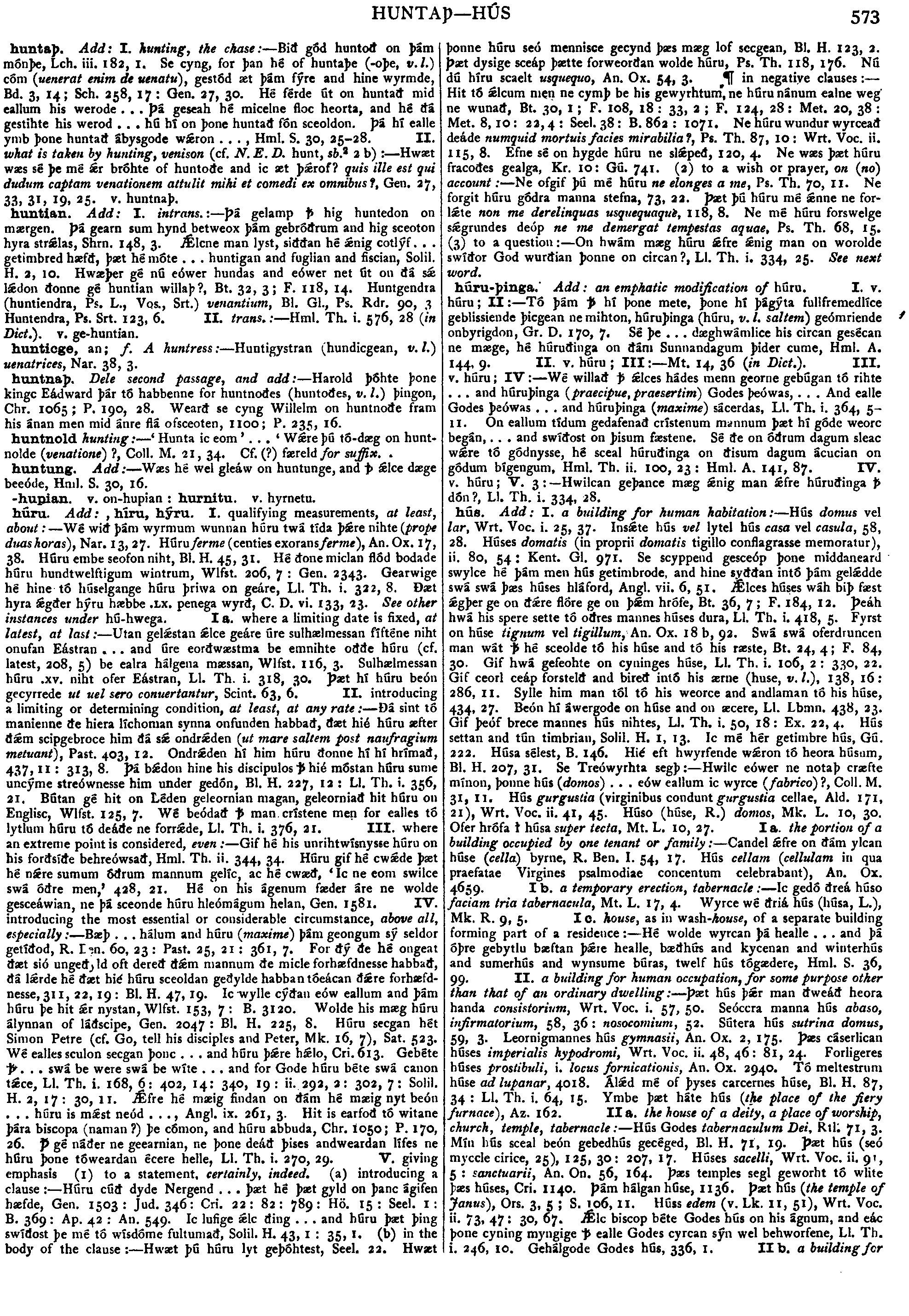
húru.
Add:
,
híru,
hýru.
I.
qualifying
measurements,
at
least,
about
:--
Wé
wið
þám
wyrmum
wunnan
húru
twá
tída
þ re
nihte
(prope
duas
horas),
Nar.
13,
27.
Húru
ferme
(centies
exorans
ferme),
An.
Ox.
17,
38.
Húru
embe
seofon
niht,
Bl.
H.
45,
31.
Hé
ðone
miclan
flód
bodade
húru
hundtwelftigum
wintrum,
Wlfst.
206,
7
:
Gen.
2343.
Gearwige
hé
hine
tó
húselgange
húru
þriwa
on
geáre,
Ll.
Th.
i.
322,
8.
Ðæt
hyra
gðer
hýru
hæbbe
.
LX.
penega
wyrð,
C.
D.
vi.
133,
23.
See
other
instances
under
hú-hwega.
I
a.
where
a
limiting
date
is
fixed,
at
latest,
at
last
:--
Utan
gelstan
lce
geáre
úre
sulhælmessan
fífténe
niht
onufan
Eástran
.
.
.
and
úre
eorðwæstma
be
emnihte
oððe
húru
(cf.
latest,
208,
5)
be
ealra
hálgena
mæssan,
Wlfst.
116,
3.
Sulhælmessan
húru
.
xv.
niht
ofer
Eástran,
Ll.
Th.
i.
318,
30.
Þæt
hí
húru
beón
gecyrrede
ut
uel
sero
conuertantur,
Scint.
63,
6.
II.
introducing
a
limiting
or
determining
condition,
at
least,
at
any
rate
:--
Ðá
sint
tó
manienne
ðe
hiera
líchoman
synna
onfunden
habbað,
ðæt
hié
húru
æfter
ðm
scipgebroce
him
ðá
sondrden
(ut
mare
saltern
post
naufragium
metuant),
Past.
403,
12.
Ondrden
ut
him
húru
ðonne
hí
hí
hrímað,
437,
11:
313,
8.
þá
bdon
hine
his
discipulos
hié
móstan
húru
sume
uncýme
streównesse
him
under
gedón,
Bl.
H.
227,
12
:
Ll.
Th.
i.
356,
21.
Bútan
gé
hit
on
Léden
geleornian
magan,
geleorniað
hit
húru
on
Englisc,
Wlfst.
125,
7.
Wé
beódað
man
crístene
men
for
ealles
tó
lytlum
húru
tó
deáðe
ne
forrde,
Ll.
Th.
i.
376,
21.
III.
where
an
extreme
point
is
considered,
even:
--
Gif
hé
his
unrihtwísnysse
húrn
on
his
forðsíðe
behreówsað,
Hml.
Th.
ii.
344,
34.
Húru
gif
hé
cwde
þæt
hé
nre
sumum
óðrum
mannum
gelíc,
ac
hé
cwæð,
'Ic
ne
com
swilce
swá
óðre
men,'
428,
21.
Hé
on
his
ágenum
fæder
áre
ne
wolde
gesceáwian,
ne
þá
sceonde
húru
hleómágum
helan,
Gen.
1581.
IV.
introducing
the
most
essential
or
considerable
circumstance,
above
all,
especially
:--
Bæþ
.
.
.
hálum
and
húru
(maxime)
þám
geongum
sý
seldor
getíðod,
R.
I
en.
60,
23:
Past.
25,
21:
361,
7.
For
ðý
ðe
hé
ongeat
ðæt
sió
ungeðyld
oft
dereð
ðm
mannum
ðe
micle
forhæfdnesse
habbað,
ðá
lrde
hé
ð
æt
hié
húru
sceoldan
geðylde
habban
tóeácan
ðre
forhæfdnesse,
311,
22,
19
:
Bl.
H.
47,
19.
Ic
wylle
cýðan
eów
eallum
and
þám
húru
þe
hit
r
nystan,
Wlfst.
153,
7
:
B.
3120.
Wolde
his
mæg
húru
álynnan
of
láðscipe,
Gen.
2047
:
Bl.
H.
225,
8.
Húru
secgan
hét
Simon
Petre
(cf.
Go,
tell
his
disciples
and
Peter,
Mk.
16,
7),
Sat.
523.
Wé
ealles
sculon
secgan
þone
.
.
.
and
húru
þre
hlo,
Cri.
613.
Gebéte
.
.
.swá
be
were
swá
be
wíte
.
.
.
and
for
Gode
húru
béte
swá
canon
tce,
Ll.
Th.
i.
168,
6:
402,
14:
340,
19
:
ii.
292,
2:
302,
7:
Solil.
H.
2,
17
:
30,
11.
Æ-acute;fre
hé
mæig
findan
on
ðám
hé
mæig
nyt
beón
.
.
.
húru
is
mst
neód
.
.
.
,
Angl.
ix.
261,
3.
Hit
is
earfoð
tó
witane
þára
biscopa
(naman
?)
þe
cómon,
and
húru
abbuda,
Chr.
1050;
P.
170,
26.
gé
náðer
ne
geearnian,
ne
þone
deáð
þises
andweardan
lífes
ne
húru
þone
tóweardan
écere
helle,
Ll.
Th.
i.
270,
29.
V.
giving
emphasis
(1)
to
a
statement,
certainly,
indeed,
(a)
introducing
a
clause
:--
Húru
cúð
dyde
Nergend
.
.
.
þæt
hé
þæt
gyld
on
þanc
ágifen
hæfde,
Gen.
1503:
Jud.
346:
Cri.
22:
82:
789:
Hö.
15:
Seel.
1:
B.
369:
Ap.
42
:
An.
549.
Ic
lufige
lc
ðing
.
.
.
and
húru
þæt
þing
swíðost
þe
mé
tó
wísdóme
fultumað,
Solil.
H.
43,
1
:
35,
1.
(b)
in
the
body
of
the
clause
:--
Hwæt
þú
húru
lyt
geþóhtest,
Seel.
22.
Hwæt
þonne
húru
seó
mennisce
gecynd
þæs
mæg
lof
secgean,
Bl.
H.
123,
2.
þæt
dysige
sceáp
þætte
forweorðan
wolde
húru,
Ps.
Th.
118,
176.
Nú
dú
híru
scaelt
usquequo,
An.
Ox.
54,
3.
in
negative
clauses
:--
Hit
tó
lcum
men
ne
cymþ
be
his
gewyrhtum,
ne
húru
nánum
ealne
weg
ne
wunað,
Bt.
30,
1;
F.
108,
18
:
33,
2
;
F.
124,
28:
Met.
20,
38
:
Met.
8,
10:
22,
4:
Seel.
38:
6.
862:
1071.
Ne
húru
wundur
wyrceað
deáde
numquid
mortuis
facies
mirabilia
?,
Ps.
Th.
87,
10:
Wrt.
Voc.
ii.
115,
8.
Efne
sé
on
hygde
húru
ne
slpeð,
120,
4.
Ne
wæs
þæt
húru
fracoðes
gealga,
Kr.
10:
Gú.
741.
(2)
to
a
wish
or
prayer,
on
(no)
account
:--
Ne
ofgif
þú
mé
húru
ne
elonges
a
me,
Ps.
Th.
70,
11.
Ne
forgit
húru
gódra
manna
stefna,
73,
22.
þæt
þú
húru
mé
nne
ne
for
re
nihte
(prope
duas
horas),
Nar.
13,
27.
Húru
ferme
(centies
exorans
ferme),
An.
Ox.
17,
38.
Húru
embe
seofon
niht,
Bl.
H.
45,
31.
Hé
ðone
miclan
flód
bodade
húru
hundtwelftigum
wintrum,
Wlfst.
206,
7
:
Gen.
2343.
Gearwige
hé
hine
tó
húselgange
húru
þriwa
on
geáre,
Ll.
Th.
i.
322,
8.
Ðæt
hyra
gðer
hýru
hæbbe
.
LX.
penega
wyrð,
C.
D.
vi.
133,
23.
See
other
instances
under
hú-hwega.
I
a.
where
a
limiting
date
is
fixed,
at
latest,
at
last
:--
Utan
gelstan
lce
geáre
úre
sulhælmessan
fífténe
niht
onufan
Eástran
.
.
.
and
úre
eorðwæstma
be
emnihte
oððe
húru
(cf.
latest,
208,
5)
be
ealra
hálgena
mæssan,
Wlfst.
116,
3.
Sulhælmessan
húru
.
xv.
niht
ofer
Eástran,
Ll.
Th.
i.
318,
30.
Þæt
hí
húru
beón
gecyrrede
ut
uel
sero
conuertantur,
Scint.
63,
6.
II.
introducing
a
limiting
or
determining
condition,
at
least,
at
any
rate
:--
Ðá
sint
tó
manienne
ðe
hiera
líchoman
synna
onfunden
habbað,
ðæt
hié
húru
æfter
ðm
scipgebroce
him
ðá
sondrden
(ut
mare
saltern
post
naufragium
metuant),
Past.
403,
12.
Ondrden
ut
him
húru
ðonne
hí
hí
hrímað,
437,
11:
313,
8.
þá
bdon
hine
his
discipulos
hié
móstan
húru
sume
uncýme
streównesse
him
under
gedón,
Bl.
H.
227,
12
:
Ll.
Th.
i.
356,
21.
Bútan
gé
hit
on
Léden
geleornian
magan,
geleorniað
hit
húru
on
Englisc,
Wlfst.
125,
7.
Wé
beódað
man
crístene
men
for
ealles
tó
lytlum
húru
tó
deáðe
ne
forrde,
Ll.
Th.
i.
376,
21.
III.
where
an
extreme
point
is
considered,
even:
--
Gif
hé
his
unrihtwísnysse
húrn
on
his
forðsíðe
behreówsað,
Hml.
Th.
ii.
344,
34.
Húru
gif
hé
cwde
þæt
hé
nre
sumum
óðrum
mannum
gelíc,
ac
hé
cwæð,
'Ic
ne
com
swilce
swá
óðre
men,'
428,
21.
Hé
on
his
ágenum
fæder
áre
ne
wolde
gesceáwian,
ne
þá
sceonde
húru
hleómágum
helan,
Gen.
1581.
IV.
introducing
the
most
essential
or
considerable
circumstance,
above
all,
especially
:--
Bæþ
.
.
.
hálum
and
húru
(maxime)
þám
geongum
sý
seldor
getíðod,
R.
I
en.
60,
23:
Past.
25,
21:
361,
7.
For
ðý
ðe
hé
ongeat
ðæt
sió
ungeðyld
oft
dereð
ðm
mannum
ðe
micle
forhæfdnesse
habbað,
ðá
lrde
hé
ð
æt
hié
húru
sceoldan
geðylde
habban
tóeácan
ðre
forhæfdnesse,
311,
22,
19
:
Bl.
H.
47,
19.
Ic
wylle
cýðan
eów
eallum
and
þám
húru
þe
hit
r
nystan,
Wlfst.
153,
7
:
B.
3120.
Wolde
his
mæg
húru
álynnan
of
láðscipe,
Gen.
2047
:
Bl.
H.
225,
8.
Húru
secgan
hét
Simon
Petre
(cf.
Go,
tell
his
disciples
and
Peter,
Mk.
16,
7),
Sat.
523.
Wé
ealles
sculon
secgan
þone
.
.
.
and
húru
þre
hlo,
Cri.
613.
Gebéte
.
.
.swá
be
were
swá
be
wíte
.
.
.
and
for
Gode
húru
béte
swá
canon
tce,
Ll.
Th.
i.
168,
6:
402,
14:
340,
19
:
ii.
292,
2:
302,
7:
Solil.
H.
2,
17
:
30,
11.
Æ-acute;fre
hé
mæig
findan
on
ðám
hé
mæig
nyt
beón
.
.
.
húru
is
mst
neód
.
.
.
,
Angl.
ix.
261,
3.
Hit
is
earfoð
tó
witane
þára
biscopa
(naman
?)
þe
cómon,
and
húru
abbuda,
Chr.
1050;
P.
170,
26.
gé
náðer
ne
geearnian,
ne
þone
deáð
þises
andweardan
lífes
ne
húru
þone
tóweardan
écere
helle,
Ll.
Th.
i.
270,
29.
V.
giving
emphasis
(1)
to
a
statement,
certainly,
indeed,
(a)
introducing
a
clause
:--
Húru
cúð
dyde
Nergend
.
.
.
þæt
hé
þæt
gyld
on
þanc
ágifen
hæfde,
Gen.
1503:
Jud.
346:
Cri.
22:
82:
789:
Hö.
15:
Seel.
1:
B.
369:
Ap.
42
:
An.
549.
Ic
lufige
lc
ðing
.
.
.
and
húru
þæt
þing
swíðost
þe
mé
tó
wísdóme
fultumað,
Solil.
H.
43,
1
:
35,
1.
(b)
in
the
body
of
the
clause
:--
Hwæt
þú
húru
lyt
geþóhtest,
Seel.
22.
Hwæt
þonne
húru
seó
mennisce
gecynd
þæs
mæg
lof
secgean,
Bl.
H.
123,
2.
þæt
dysige
sceáp
þætte
forweorðan
wolde
húru,
Ps.
Th.
118,
176.
Nú
dú
híru
scaelt
usquequo,
An.
Ox.
54,
3.
in
negative
clauses
:--
Hit
tó
lcum
men
ne
cymþ
be
his
gewyrhtum,
ne
húru
nánum
ealne
weg
ne
wunað,
Bt.
30,
1;
F.
108,
18
:
33,
2
;
F.
124,
28:
Met.
20,
38
:
Met.
8,
10:
22,
4:
Seel.
38:
6.
862:
1071.
Ne
húru
wundur
wyrceað
deáde
numquid
mortuis
facies
mirabilia
?,
Ps.
Th.
87,
10:
Wrt.
Voc.
ii.
115,
8.
Efne
sé
on
hygde
húru
ne
slpeð,
120,
4.
Ne
wæs
þæt
húru
fracoðes
gealga,
Kr.
10:
Gú.
741.
(2)
to
a
wish
or
prayer,
on
(no)
account
:--
Ne
ofgif
þú
mé
húru
ne
elonges
a
me,
Ps.
Th.
70,
11.
Ne
forgit
húru
gódra
manna
stefna,
73,
22.
þæt
þú
húru
mé
nne
ne
for lte
non
me
derelinguas
usquequaque,
118,
8.
Ne
mé
húru
forswelge
sgrundes
deóp
ne
me
demergat
tempestas
aquae.
Ps.
Th.
68,
15.
(3)
to
a
question
:--
On
hwám
mæg
húru
.
fre
nig
man
on
worolde
swíðor
God
wurðian
þonne
on
circan
?,
Ll.
Th.
i.
334,
25.
See
next
word.
lte
non
me
derelinguas
usquequaque,
118,
8.
Ne
mé
húru
forswelge
sgrundes
deóp
ne
me
demergat
tempestas
aquae.
Ps.
Th.
68,
15.
(3)
to
a
question
:--
On
hwám
mæg
húru
.
fre
nig
man
on
worolde
swíðor
God
wurðian
þonne
on
circan
?,
Ll.
Th.
i.
334,
25.
See
next
word.
|
Source: Bosworth/Toller, page d0699, entry 40 View original page image as: [TIFF] [PNG] [View previous entry] [View next entry] |
[Comment on this entry] [View comments] |
The following entry has been hand-corrected once. |
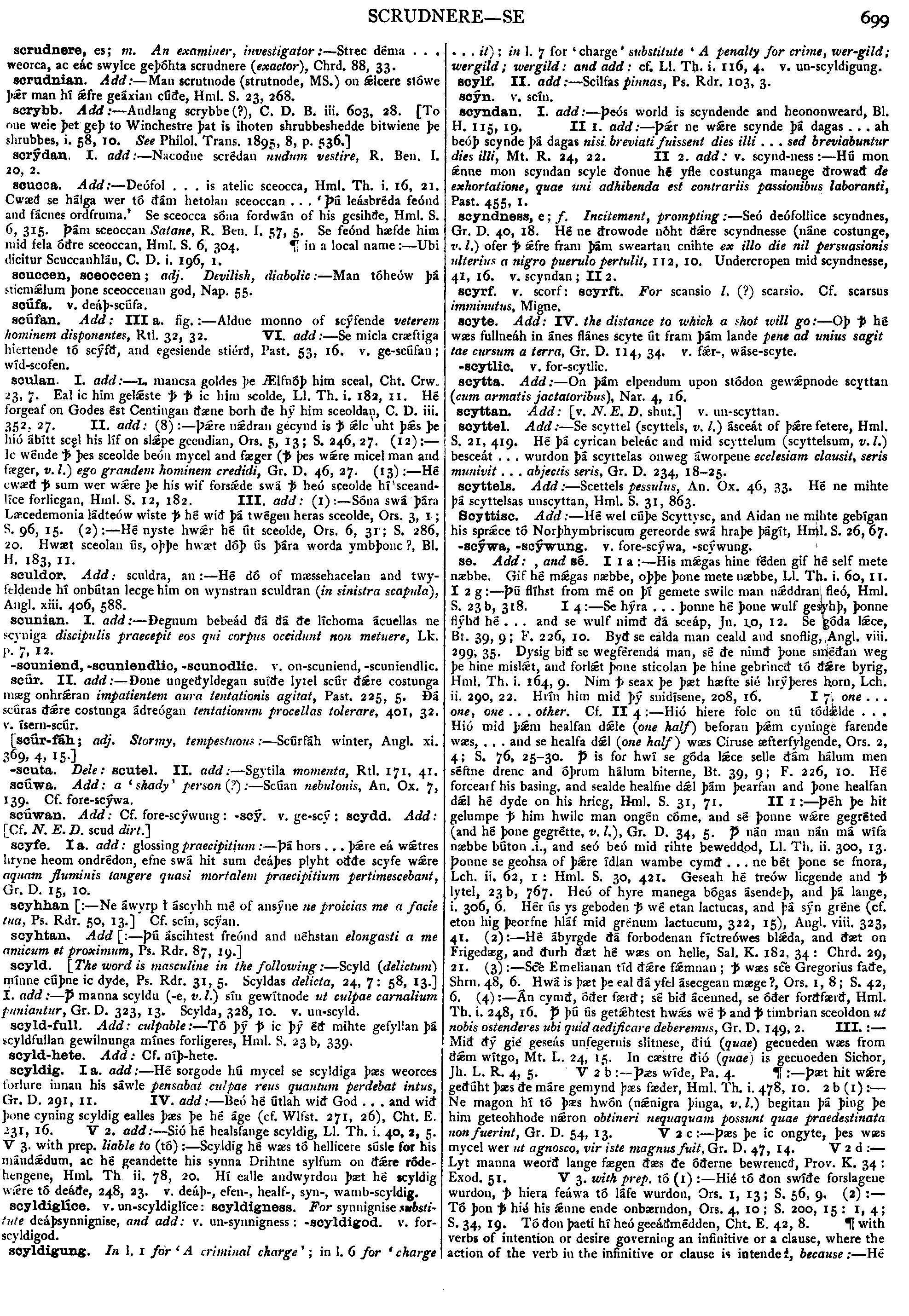
se.
Add:
,
and
sé.
I
1
a
:--
His
mgas
hine
féden
gif
hé
self
mete
næbbe.
Gif
hé
mgas
næbbe,
oþþe
þone
mete
næbbe,
Ll.
Th.
i.
60,
11.
I
2
g
:--
Þú
flíhst
from
mé
on
þí
gemete
swilc
man
nddran
fleó,
Hml.
S.
23
b,
318.
I
4
:--
Se
hýra
.
.
.
þonne
hé
þone
wulf
geyhþ,
þonne
flýhð
hé
.
.
.
and
se
wulf
nimð
ðá
sceáp,
Jn.
10,
12.
Se
góda
lce,
Bt.
39,9;
F.
226,
10.
Byð
se
ealda
man
ceald
and
snoflig,
Angl.
viii.
299,
35.
Dysig
bið
se
wegférenda
man,
sé
ðe
nimð
þone
sméðan
weg
þe
hine
mislt,
and
forlt
þone
sticolan
þe
hine
gebrincð
tó
ðre
byrig,
Hml.
Th.
i.
164,
9.
Nim
seax
þe
þæt
hæfte
sié
hrýþeres
horn,
Lch.
ii.
290,
22.
Hrín
him
mid
þý
snidísene,
208,
16.
I
7.
one
.
.
.
one,
one
.
.
.
other.
Cf.
II
4
:--
Hió
hiere
folc
on
tú
tódle
.
.
.
Hió
mid
þm
healfan
dle
(one
half)
beforan
þm
cyninge
farende
wæs,
,
.
.
and
se
healfa
dl
(one
half)
wæs
Ciruse
æfterfylgende,
Ors.
2,
4;
S.
76,
25-30.
Þ-bar;
is
for
hwí
se
góda
lce
selle
ðám
hálum
men
séftne
drenc
and
óþrum
hálum
biterne,
Bt.
39,
9;
F.
226,
10.
Hé
forcearf
his
basing,
and
sealde
healfne
dl
þám
þearfan
and
þone
healfan
dl
hé
dyde
on
his
hricg,
Hml.
S.
31,
71.
II
1
:--
Þéh
þe
hit
gelumpe
him
hwilc
man
ongén
cóme,
and
sé
þonne
wre
gegréted
(and
hé
þone
gegrétte,
v.
l.),
Gr.
D.
34,
5.
Þ-bar;
nán
man
nán
má
wífa
næbbe
búton
.i.
,
and
seó
beó
mid
rihte
beweddod,
Ll.
Th.
ii.
300,
13.
Þonne
se
geohsa
of
þre
ídlan
wambe
cymð
.
.
.
ne
bét
þone
se
fnora,
Lch.
ii.
62,
1:
Hml.
S.
30,
421.
Geseah
hé
treów
licgende
and
lytel,
23
b,
767.
Heó
of
hyre
manega
bógas
ásendeþ,
and
þá
lange,
i.
306,
6.
Hér
ús
ys
geboden
wé
etan
lactucas,
and
þá
sýn
gréne
(cf.
eton
hig
þeorfne
hláf
mid
grénum
lactucum,
322,
15),
Angl.
viii.
323,
41.
(2)
:--
Hé
ábyrgde
ðá
forbodenan
fíctreówes
blda,
and
ðæt
on
Frigedæg,
and
ðurh
ðæt
hé
wæs
on
helle,
Sal.
K.
182,
34:
Chrd.
29,
21.
(3):--
S e
Emelianan
tíd
ðre
fmnan;
wæs
se
Gregorius
faðe,
Shrn.
48,
6.
Hwá
is
þæt
þe
eal
ðá
yfel
ásecgean
mæge?,
Ors.
1,
8;
S.
42,
6.
(4)
:--
Án
cymð,
óðer
færð;
sé
bið
ácenned,
se
óðer
forðfærð,
Hml.
Th.
i.
248,
16.
Þ-bar;
þú
ús
gethtest
hws
wé
and
timbrian
sceoldon
ut
nobis
ostenderes
ubi
quid
aedificare
deberemus,
Gr.
D.
149,
2.
III.
:--
Mið
ðý
gié
geseás
unfegernis
slitnese,
ðiú
(quae)
gecueden
wæs
from
ðm
wítgo,
Mt.
L.
24,
15.
In
cæstre
ðió
(quae)
is
gecuoeden
Sichor,
Jn.
L.
R.
4,
5.
V
2
b
:--
Þæs
wíde,
Pa.
4.

:--
Þæt
hit
wre
geðúht
þæs
ðe
máre
gemynd
þæs
fæder,
Hml.
Th.
i.
478,
10.
2
b
(1)
:--
Ne
magon
hí
tó
þæs
hwón
(nnigra
þinga,
v.
l.)
begitan
þá
þing
þe
him
geteohhode
nron
obtineri
nequaquam
possunt
quae
praedestinata
non
fuerint,
Gr.
D.
54,
13.
V
2
c
:--
Þæs
þe
ic
ongyte,
þes
wæs
mycel
wer
ut
agnosco,
vir
iste
magnus
fuit,
Gr.
D.
47,
14.
V
2
d
:--
Lyt
manna
weorð
lange
fægen
ðæs
ðe
óðerne
bewrencð,
Prov.
K.
34:
Exod.
51.
V
3.
with
prep.
tó
(1)
:--
Hié
tó
don
swíðe
forslagene
wurdon,
hiera
feáwa
tó
láfe
wurdon,
Ors.
1.
13;
S.
56,
9.
(2)
:--
Tó
þon
hié
his
nne
ende
onbærndon,
Ors.
4,
10;
S.
200,
15:
1,
4;
S.
34,
19.
Tó
ðon
þaeti
hí
heó
geeáðmédden,
Cht.
E.
42,
8.

with
verbs
of
intention
or
desire
governing
an
infinitive
or
a
clause,
where
the
action
of
the
verb
in
the
infinitive
or
clause
is
intended,
because
:--
Hé
e
Emelianan
tíd
ðre
fmnan;
wæs
se
Gregorius
faðe,
Shrn.
48,
6.
Hwá
is
þæt
þe
eal
ðá
yfel
ásecgean
mæge?,
Ors.
1,
8;
S.
42,
6.
(4)
:--
Án
cymð,
óðer
færð;
sé
bið
ácenned,
se
óðer
forðfærð,
Hml.
Th.
i.
248,
16.
Þ-bar;
þú
ús
gethtest
hws
wé
and
timbrian
sceoldon
ut
nobis
ostenderes
ubi
quid
aedificare
deberemus,
Gr.
D.
149,
2.
III.
:--
Mið
ðý
gié
geseás
unfegernis
slitnese,
ðiú
(quae)
gecueden
wæs
from
ðm
wítgo,
Mt.
L.
24,
15.
In
cæstre
ðió
(quae)
is
gecuoeden
Sichor,
Jn.
L.
R.
4,
5.
V
2
b
:--
Þæs
wíde,
Pa.
4.

:--
Þæt
hit
wre
geðúht
þæs
ðe
máre
gemynd
þæs
fæder,
Hml.
Th.
i.
478,
10.
2
b
(1)
:--
Ne
magon
hí
tó
þæs
hwón
(nnigra
þinga,
v.
l.)
begitan
þá
þing
þe
him
geteohhode
nron
obtineri
nequaquam
possunt
quae
praedestinata
non
fuerint,
Gr.
D.
54,
13.
V
2
c
:--
Þæs
þe
ic
ongyte,
þes
wæs
mycel
wer
ut
agnosco,
vir
iste
magnus
fuit,
Gr.
D.
47,
14.
V
2
d
:--
Lyt
manna
weorð
lange
fægen
ðæs
ðe
óðerne
bewrencð,
Prov.
K.
34:
Exod.
51.
V
3.
with
prep.
tó
(1)
:--
Hié
tó
don
swíðe
forslagene
wurdon,
hiera
feáwa
tó
láfe
wurdon,
Ors.
1.
13;
S.
56,
9.
(2)
:--
Tó
þon
hié
his
nne
ende
onbærndon,
Ors.
4,
10;
S.
200,
15:
1,
4;
S.
34,
19.
Tó
ðon
þaeti
hí
heó
geeáðmédden,
Cht.
E.
42,
8.

with
verbs
of
intention
or
desire
governing
an
infinitive
or
a
clause,
where
the
action
of
the
verb
in
the
infinitive
or
clause
is
intended,
because
:--
Hé
|
Source: Bosworth/Toller, page d0727, entry 27 View original page image as: [TIFF] [PNG] [View previous entry] [View next entry] |
[Comment on this entry] [View comments] |
The following entry has been hand-corrected once. |
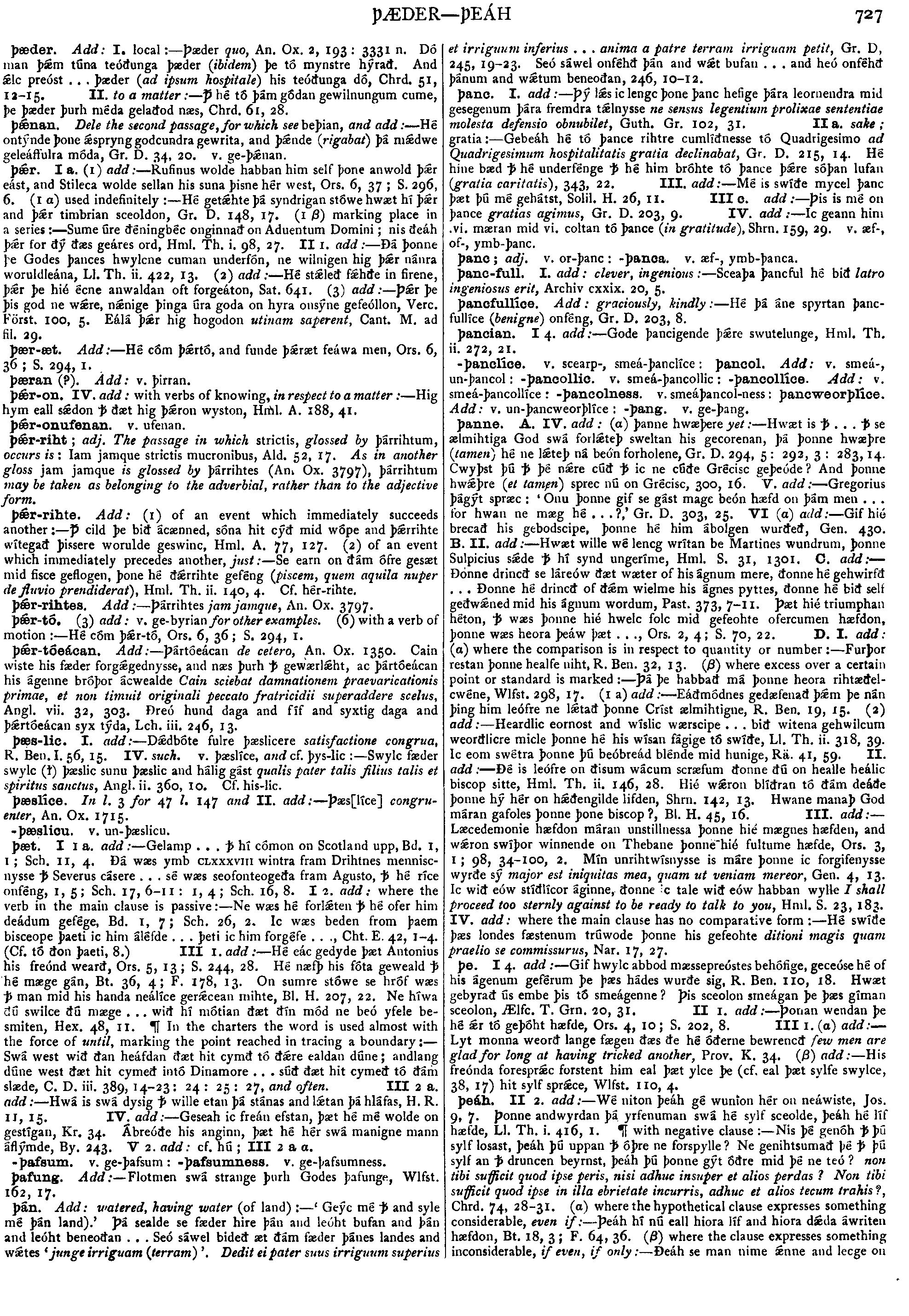
þe.
I
4.
add
:--
Gif
hwylc
abbod
mæssepreóstes
behófige,
geceóse
hé
of
his
ágenum
geférum
þe
þæs
hádes
wurðe
sig,
R.
Ben.
110,
18.
Hwæt
gebyrað
ús
embe
þis
tó
smeágenne?
Þis
sceolon
smeágan
þe
þæs
gíman
sceolon,
Ælfc.
T.
Grn.
20,
31.
II
1.
add
:--
Þonan
wendan
þe
hé
r
tó
geþóht
hæfde,
Ors.
4,
10;
S.
202,
8.
III
1.
(a)
add
:--
Lyt
monna
weorð
lange
fægen
ðæs
ðe
hé
óðerne
bewrencð
few
men
are
glad
for
long
at
having
tricked
another,
Prov.
K.
34.
( )
add
:--
His
freónda
foresprc
forstent
him
eal
þæt
ylce
þe
(cf.
eal
þæt
sylfe
swylce,
38,
17)
hit
sylf
sprce,
Wlfst,
110,
4.
)
add
:--
His
freónda
foresprc
forstent
him
eal
þæt
ylce
þe
(cf.
eal
þæt
sylfe
swylce,
38,
17)
hit
sylf
sprce,
Wlfst,
110,
4.
|
Source: Bosworth/Toller, page d0728, entry 29 View original page image as: [TIFF] [PNG] [View previous entry] [View next entry] |
[Comment on this entry] [View comments] |
The following entry has been hand-corrected once. |
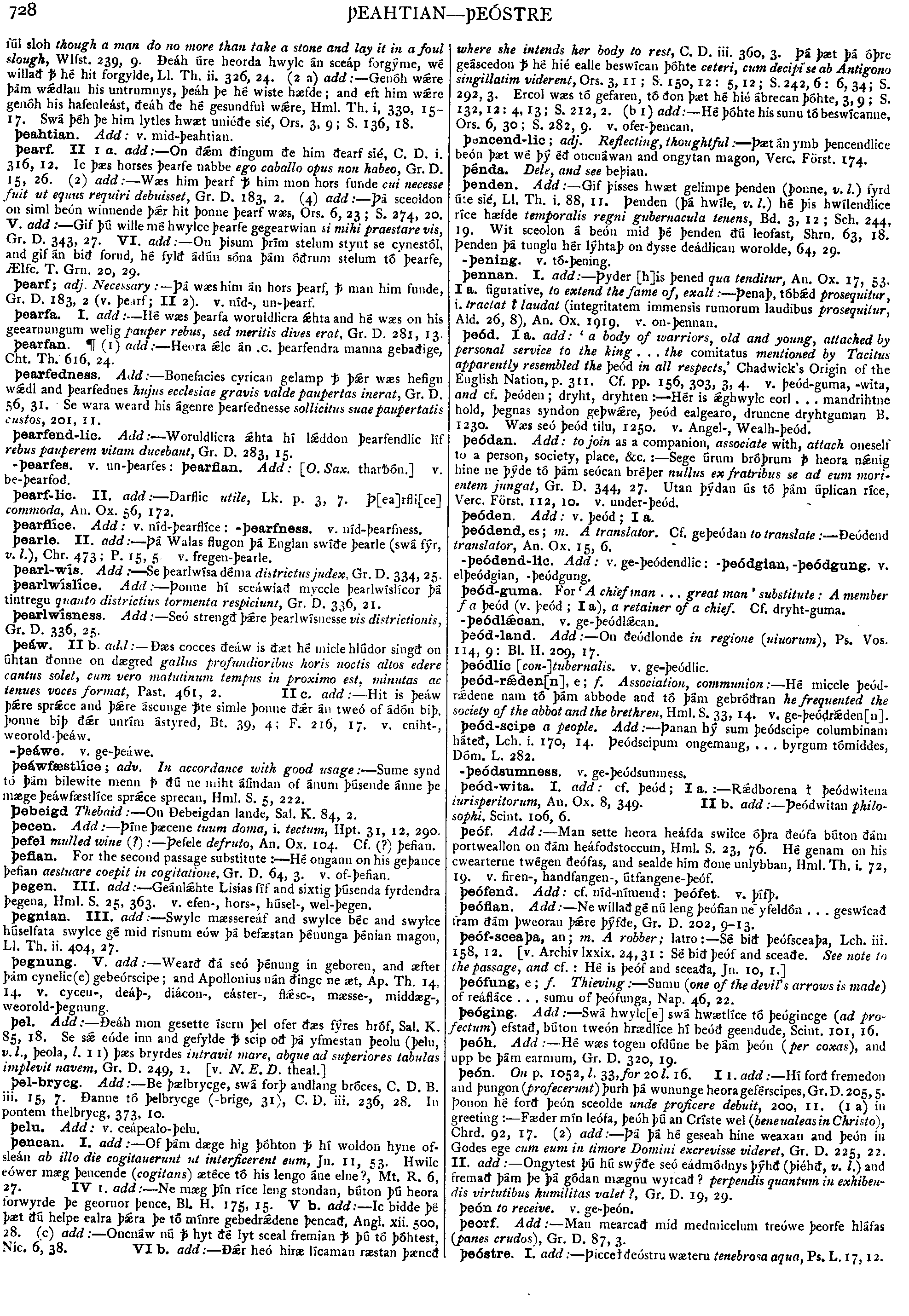
þencan.
I.
add
:--
Of
þám
dæge
hig
þóhton
hí
woldon
hyne
ofsleán
ab
illo
die
cogitauerunt
ut
interficersnt
eum,
Jn.
ii.
53.
Hwilc
eówer
mæg
þencende
(cogitans)
ætéce
tó
his
lengo
áne
elne?,
Mt.
R.
6,
27.
IV
1.
add
:--
Ne
mæg
þín
ríce
leng
stondan,
búton
þú
heora
forwyrde
þe
geornor
þence.
Bl.
H.
175,
15.
V
b.
add
:--
Ic
bidde
þé
þæt
ðú
helpe
ealra
þra
þe
tó
mínre
gebedrdene
þencað,
Angl.
xii.
500,
28.
(c)
add
:--
Oncnáw
nú
hyt
ðé
lyt
sceal
fremian
þú
tó
þóhtest,
Nic.
6,
38.
VI
b.
add
:--
Ðr
heó
hiræ
lícaman
ræstan
þæncð
where
she
intends
her
body
to
rest,
C.D.
iii.
360,
3.
Þá
þæt
þá
óþre
geáscedon
hé
hié
ealle
beswícan
þóhte
ceteri,
cum
deciptise
ab
Antigonu
singillatim
viderent,
Ors.
3,
11;
S.
150,
12:
5,
12;
S.
242,
6:
6,
34;
S.
292,
3.
Ercol
wæs
tó
gefaren,
tó
ðon
þæt
hé
hié
ábrecan
þóhte,
3,
9;
S.
132,
12:
4,
13;
S.
212,
2.
(b
i)
add
:--
Hé
þóhte
his
sunu
tó
beswícanne,
Ors.
6,
30;
S.
282,
9.
v.
ofer-þencan.
|
Source: Cleasby/Vigfusson, page b0274, entry 1 View original page image as: [TIFF] [PNG] [View previous entry] [View next entry] |
[Comment on this entry] [View comments] |
The following entry has been hand-corrected once. |
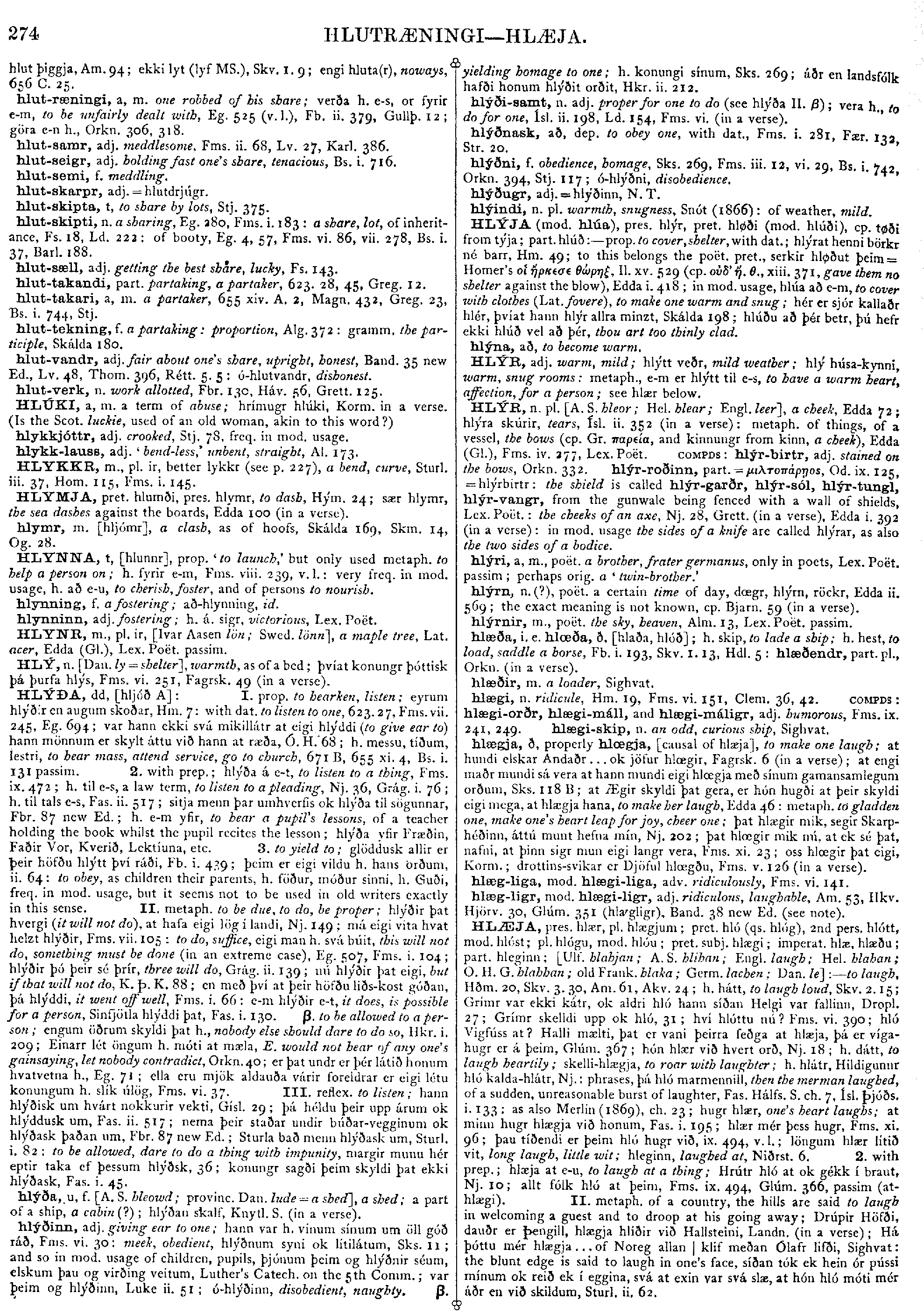
hlut þiggja, Am. 94; ekki lyt (lyf MS.), Skv. 1. 9; engi hluta(r), noways, 656 C. 25.
|
Source: Cleasby/Vigfusson, page b0645, entry 19 View original page image as: [TIFF] [PNG] [View previous entry] [View next entry] |
[Comment on this entry] [View comments] |
The following entry has been hand-corrected once. |
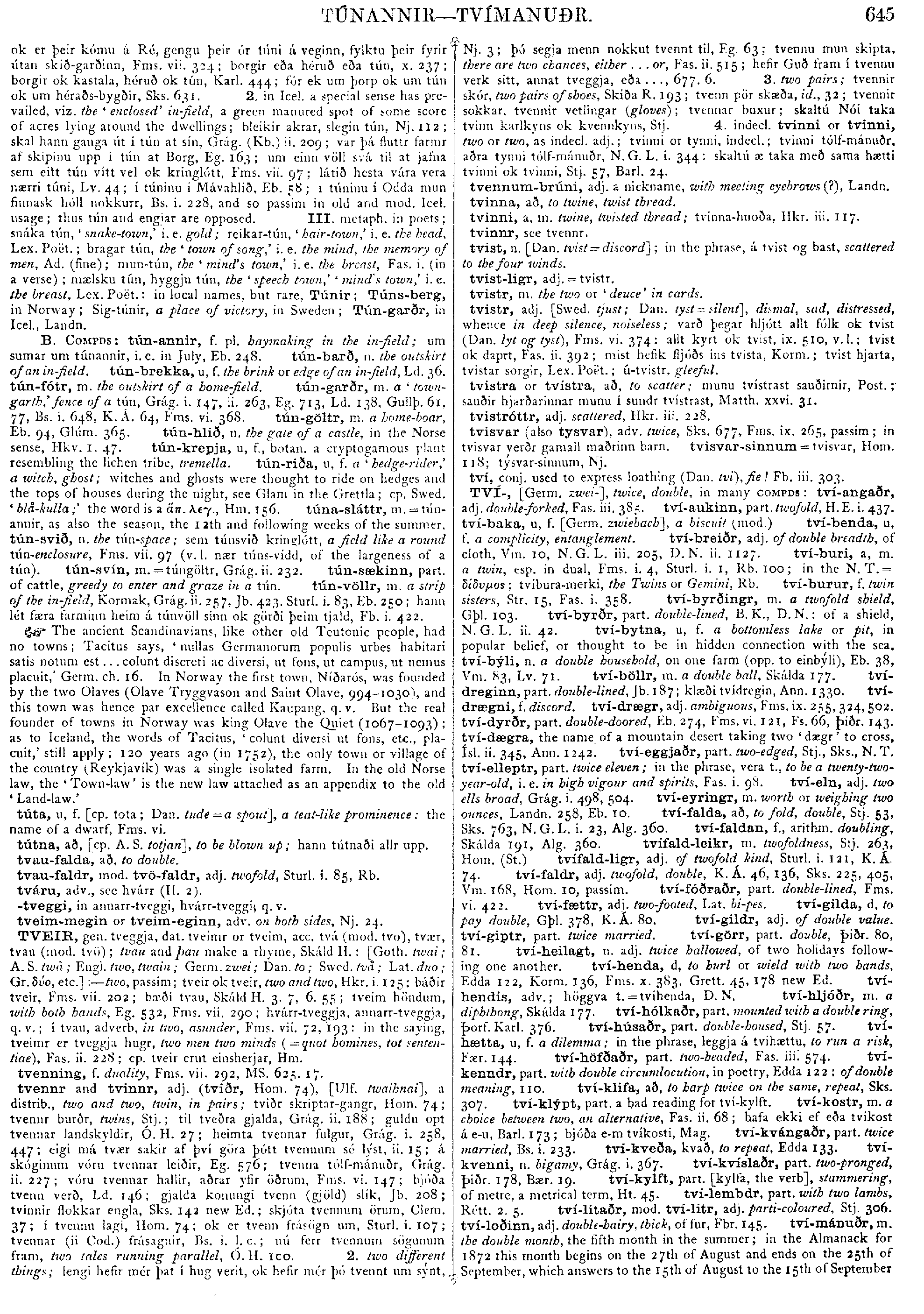
tvistr, adj. [Swed. tjust; Dan. tyst = silent], dismal, sad, distressed, whence in deep silence, noiseless; varð þegar hljótt allt fólk ok tvist (Dan. lyt og tyst), Fms. vi. 374: allt kyrt ok tvist, ix. 510, v.l.; tvist ok daprt, Fas. ii. 392; mist hefik fljóðs ins tvista, Korm.; tvist hjarta, tvistar sorgir, Lex. Poët.; ú-tvistr, gleeful.
| Result Page: |  |
Previous | 1 2 3 4 5 6 7 |
Germanic Lexicon Project (main page)
This search system was written by
Sean Crist
Please consider
volunteering
to correct the data in these online dictionaries.
No rights reserved. Feel free to use these data in any way you please.