|
|

Tip: In the search results, you can click on any word or abbreviation for more information.
|
Source: Bosworth/Toller, page b1196, entry 11 View original page image as: [TIFF] [PNG] [View previous entry] [View next entry] |
[Comment on this entry] [View comments] |
The following entry has been hand-corrected once. |
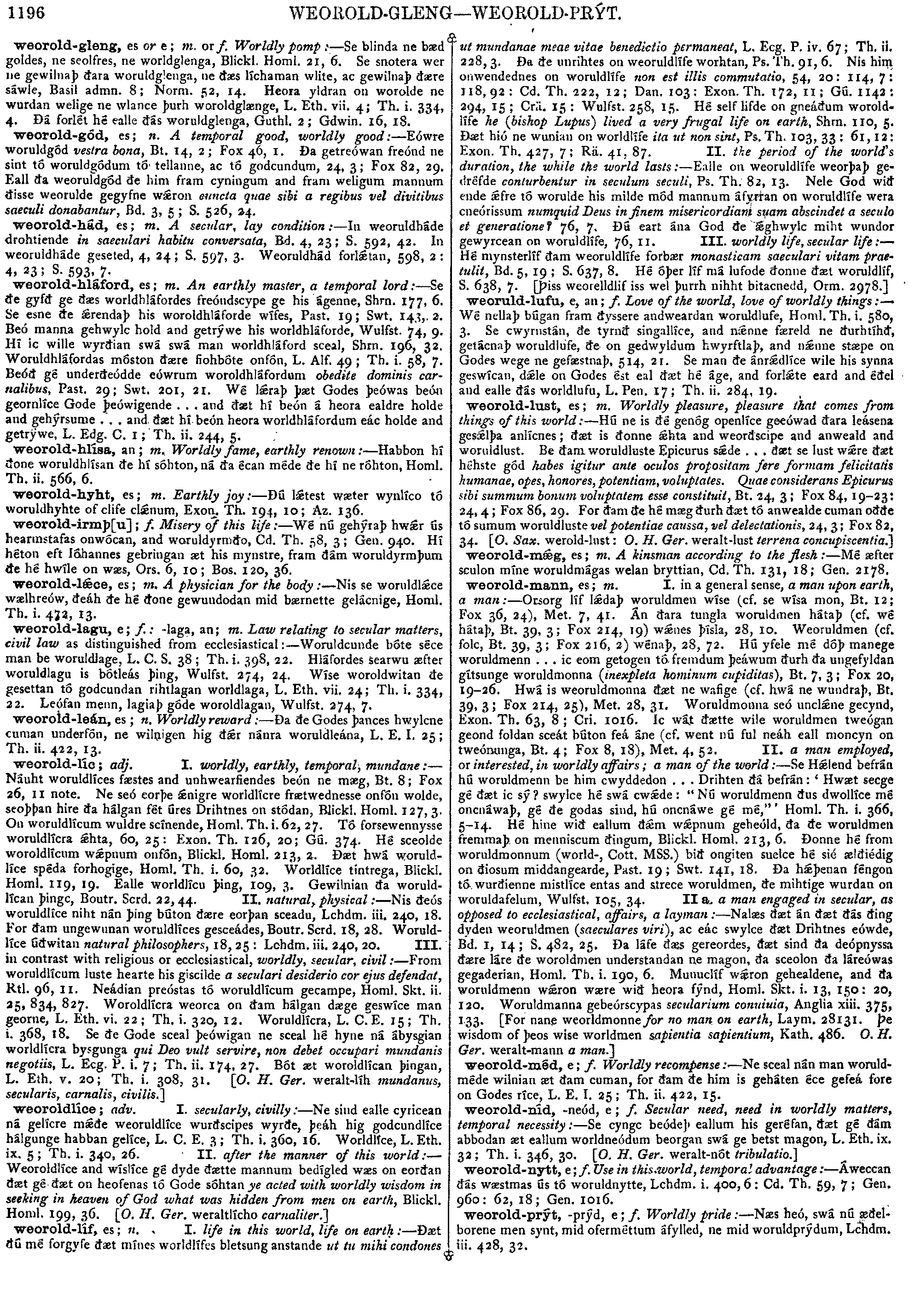
weorold-líc;
adj.
I.
worldly,
earthly,
temporal,
mundane:--
Náuht
woruldlíces
fæstes
and
unhwearfiendes
beón
ne
mæg,
Bt.
8;
Fox
26,
11
note.
Ne
seó
eorþe
 nigre
worldlícre
frætwednesse
onfón
wolde,
seoþþan
hire
ða
hálgan
fét
úres
Drihtnes
on
stódan,
Blickl.
Homl.
127,
3.
On
woruldlícum
wuldre
scínende,
Homl.
Th.
i.
62,
27.
Tó
forsewennysse
woruldlícra
hta,
60,
25:
Exon.
Th.
126,
20;
Gú.
374.
Hé
sceolde
woroldlícum
wpnum
onfón,
Blickl.
Homl.
213,
l.
Ðæt
hwá
woruld-líce
spéda
forhogige,
Homl.
Th.
i.
60,
32.
Worldlíce
tintrega,
Blickl.
Homl.
119,
19.
Ealle
worldlícu
þing,
109,
3.
Gewilnian
ða
woruldlícan
þingc,
Boutr.
Scrd.
22,
44.
II.natural,
physical:--
Nis
ðeós
woruldlíce
niht
nán
þing
búton
ðære
eorþan
sceadu,
Lchdm.
iii.
240,
18.
For
ðam
ungewunan
woruldlíces
gesceádes,
Boutr.
Scrd.
18,
28.
Woruldlíce
úðwitan
natural
philosophers,
18,
25
:
Lchdm.
iii.
240,
20.
III.
in
contrast
with
religious
or
ecclesiastical,
worldly,
secular,
civil:--
From
woruldlícum
luste
hearte
his
giscilde
a
seculari
desiderio
cor
ejus
defendat,
Rtl.
96,
11.
Neádian
preóstas
tó
woruldlícum
gecampe,
Homl.
Skt.
ii.
25,
834,
827.
Woroldlícra
weorca
on
ðam
hálgan
dæge
geswíce
man
georne,
L.
Eth.
vi.
22
;
Th.
i.
320,
12.
Woruldlícra,
L.
C.
E.
15
;
Th.
i.
368,
18.
Se
ðe
Gode
sceal
þeówigan
ne
sceal
hé
hyne
ná
ábysgian
worldlícra
bysgunga
qui
Deo
vult
servire,
non
debet
occupari
mundanis
negotiis,
L.
Ecg.
P.
i.
7;
Th.
ii.
174,
27.
Bót
æt
woroldlícan
þingan,
L.
Eth.
v.
20;
Th.
i.
308,
31.
[O.
H.
Ger.
weralt-líh
mundanus,
secularis,
carnalis,
civilis.]
nigre
worldlícre
frætwednesse
onfón
wolde,
seoþþan
hire
ða
hálgan
fét
úres
Drihtnes
on
stódan,
Blickl.
Homl.
127,
3.
On
woruldlícum
wuldre
scínende,
Homl.
Th.
i.
62,
27.
Tó
forsewennysse
woruldlícra
hta,
60,
25:
Exon.
Th.
126,
20;
Gú.
374.
Hé
sceolde
woroldlícum
wpnum
onfón,
Blickl.
Homl.
213,
l.
Ðæt
hwá
woruld-líce
spéda
forhogige,
Homl.
Th.
i.
60,
32.
Worldlíce
tintrega,
Blickl.
Homl.
119,
19.
Ealle
worldlícu
þing,
109,
3.
Gewilnian
ða
woruldlícan
þingc,
Boutr.
Scrd.
22,
44.
II.natural,
physical:--
Nis
ðeós
woruldlíce
niht
nán
þing
búton
ðære
eorþan
sceadu,
Lchdm.
iii.
240,
18.
For
ðam
ungewunan
woruldlíces
gesceádes,
Boutr.
Scrd.
18,
28.
Woruldlíce
úðwitan
natural
philosophers,
18,
25
:
Lchdm.
iii.
240,
20.
III.
in
contrast
with
religious
or
ecclesiastical,
worldly,
secular,
civil:--
From
woruldlícum
luste
hearte
his
giscilde
a
seculari
desiderio
cor
ejus
defendat,
Rtl.
96,
11.
Neádian
preóstas
tó
woruldlícum
gecampe,
Homl.
Skt.
ii.
25,
834,
827.
Woroldlícra
weorca
on
ðam
hálgan
dæge
geswíce
man
georne,
L.
Eth.
vi.
22
;
Th.
i.
320,
12.
Woruldlícra,
L.
C.
E.
15
;
Th.
i.
368,
18.
Se
ðe
Gode
sceal
þeówigan
ne
sceal
hé
hyne
ná
ábysgian
worldlícra
bysgunga
qui
Deo
vult
servire,
non
debet
occupari
mundanis
negotiis,
L.
Ecg.
P.
i.
7;
Th.
ii.
174,
27.
Bót
æt
woroldlícan
þingan,
L.
Eth.
v.
20;
Th.
i.
308,
31.
[O.
H.
Ger.
weralt-líh
mundanus,
secularis,
carnalis,
civilis.]
|
Source: Bosworth/Toller, page b1299, entry 9 View original page image as: [TIFF] [PNG] [View previous entry] [View next entry] |
[Comment on this entry] [View comments] |
The following entry has been hand-corrected once. |
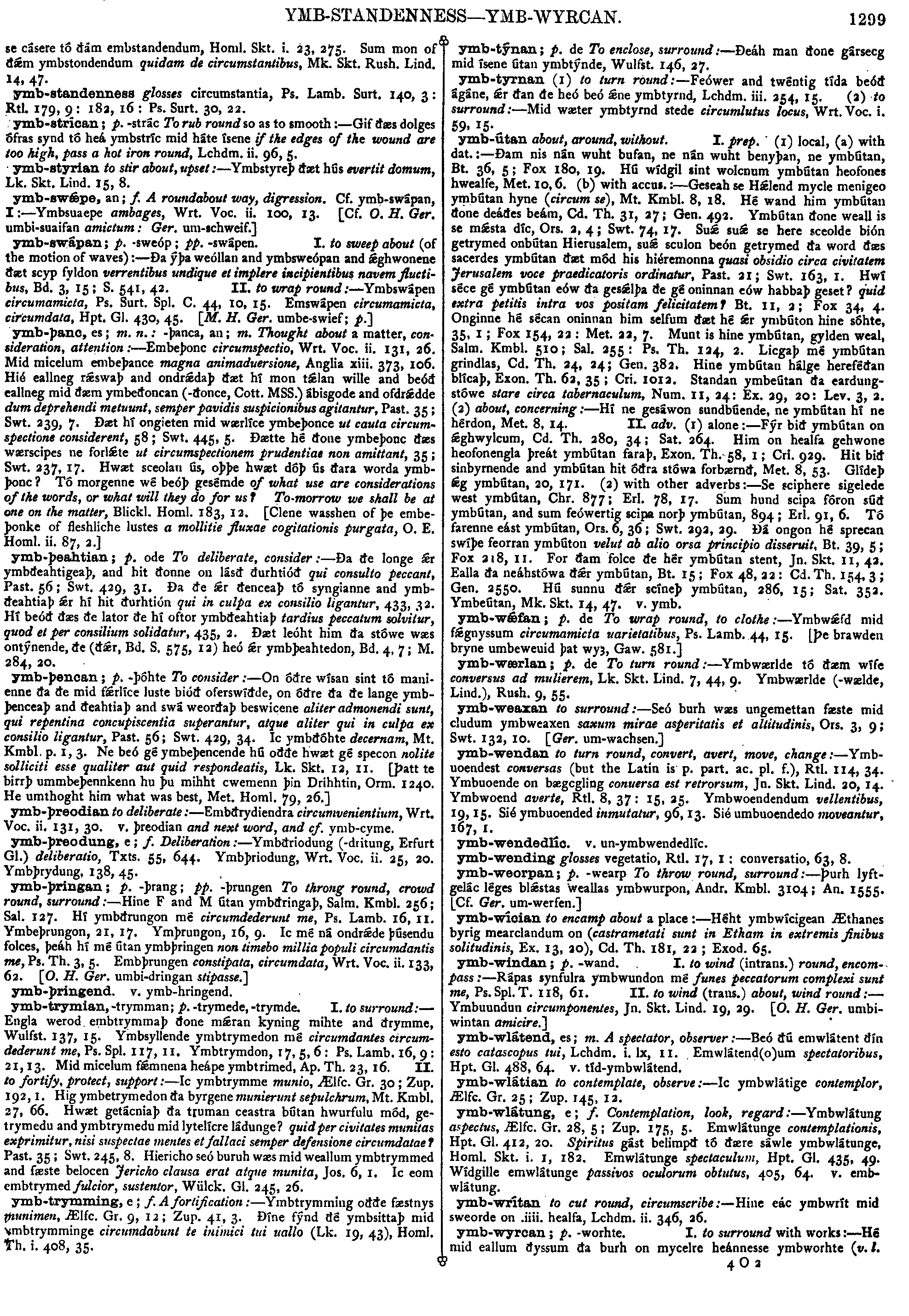
ymb-þencan;
p.
-þóhte
To
consider
:--
On
óðre
wísan
sint
tó
manienne
ða
ðe
mid
frlíce
luste
bióð
oferswíðde,
on
óðre
ða
ðe
lange
ymbþenceaþ
and
ðeahtiaþ
and
swá
weorðaþ
beswicene
aliter
admonendi
sunt,
qui
repentina
concupiscentia
superantur,
atque
aliter
qui
in
culpa
ex
consilio
ligantur,
Past.
56;
Swt.
429,
34.
Ic
ymbðóhte
decernam,
Mt.
Kmbl.
p.
1,
3.
Ne
beó
gé
ymbeþencende
hú
oððe
hwæt
gé
specon
nolite
solliciti
esse
qualiter
aut
quid
respondeatis,
Lk.
Skt.
12,
11.
[Þatt
te
birrþ
ummbeþennkenn
hu
þu
mihht
cwemenn
þin
Drihhtin,
Orm.
1240.
He
umthoght
him
what
was
best,
Met.
Homl.
79,
26.]
|
Source: Bosworth/Toller, page d0019, entry 35 View original page image as: [TIFF] [PNG] [View previous entry] [View next entry] |
[Comment on this entry] [View comments] |
The following entry has been hand-corrected once. |
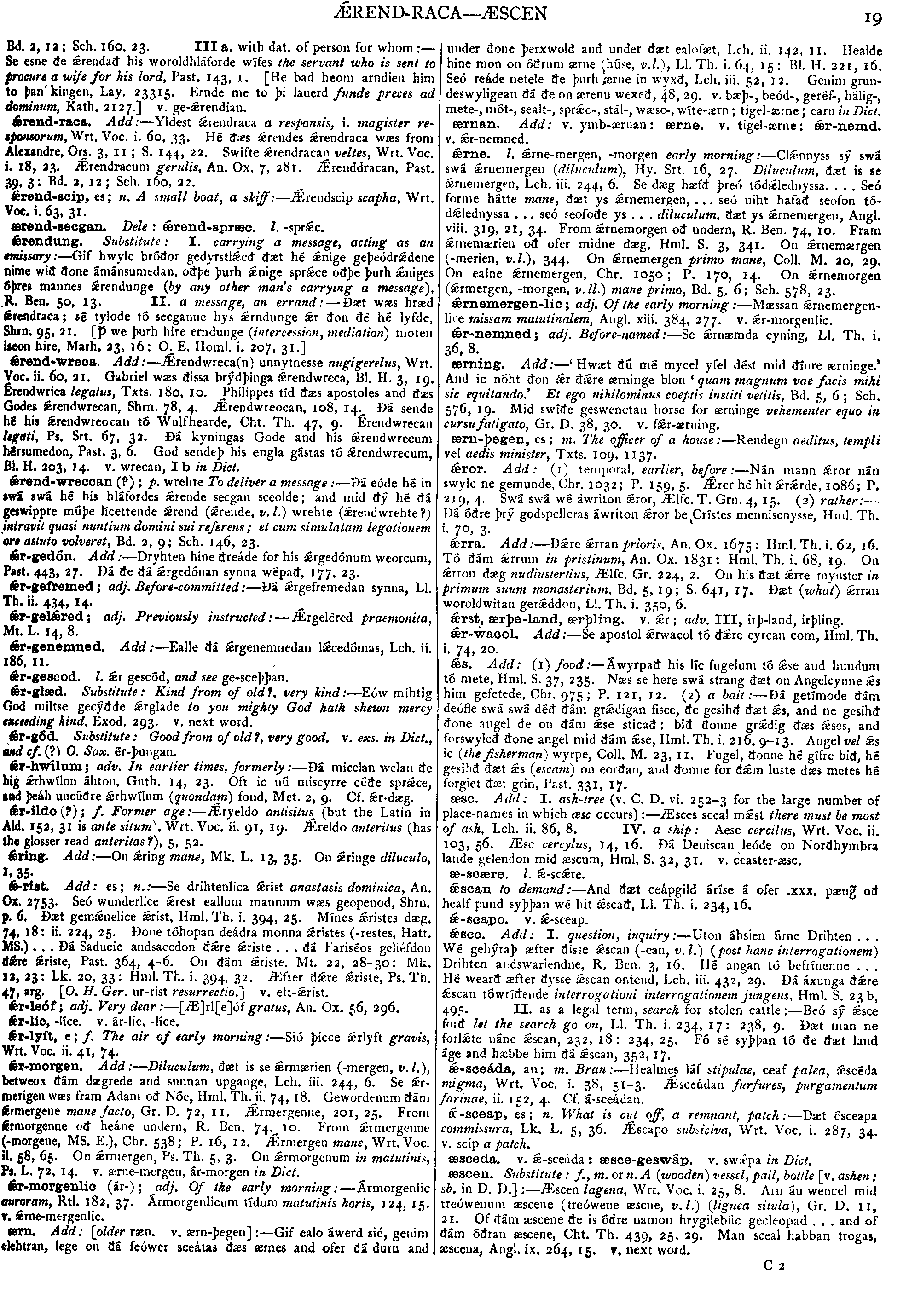
s.
Add:
(1)
food:--Áwyrpað
his
líc
fugelum
tó
se
and
hundum
tó
mete,
Hml.
S.
37,
235.
Næs
se
here
swá
strang
ðæt
on
Angelcynne
s
him
gefetede,
Chr.
975;
P.
121,
12.
(2)
a
bait:--Ðá
getímode
ðám
deófle
swá
swá
déð
ðám
grdigan
fisce,
ðe
gesihð
ðæt
s,
and
ne
gesihð
ðone
angel
ðe
on
ðám
se
sticað:
bið
ðonne
grdig
ðæs
ses,
and
forswylcð
ðone
angel
mid
ðám
se,
Hml.
Th.
i.
216,
9-13.
Angel
vel
s
ic
(the
fisherman)
wyrpe,
Coll.
M.
23,
11.
Fugel,
ðonne
hé
gífre
bið,
hé
gesihð
ðæt
s
(escam)
on
eorðan,
and
ðonne
for
ðm
luste
ðæs
metes
hé
forgiet
ðæt
grin,
Past.
331,
17.
|
Source: Bosworth/Toller, page d0062, entry 11 View original page image as: [TIFF] [PNG] [View previous entry] [View next entry] |
[Comment on this entry] [View comments] |
The following entry has been hand-corrected once. |
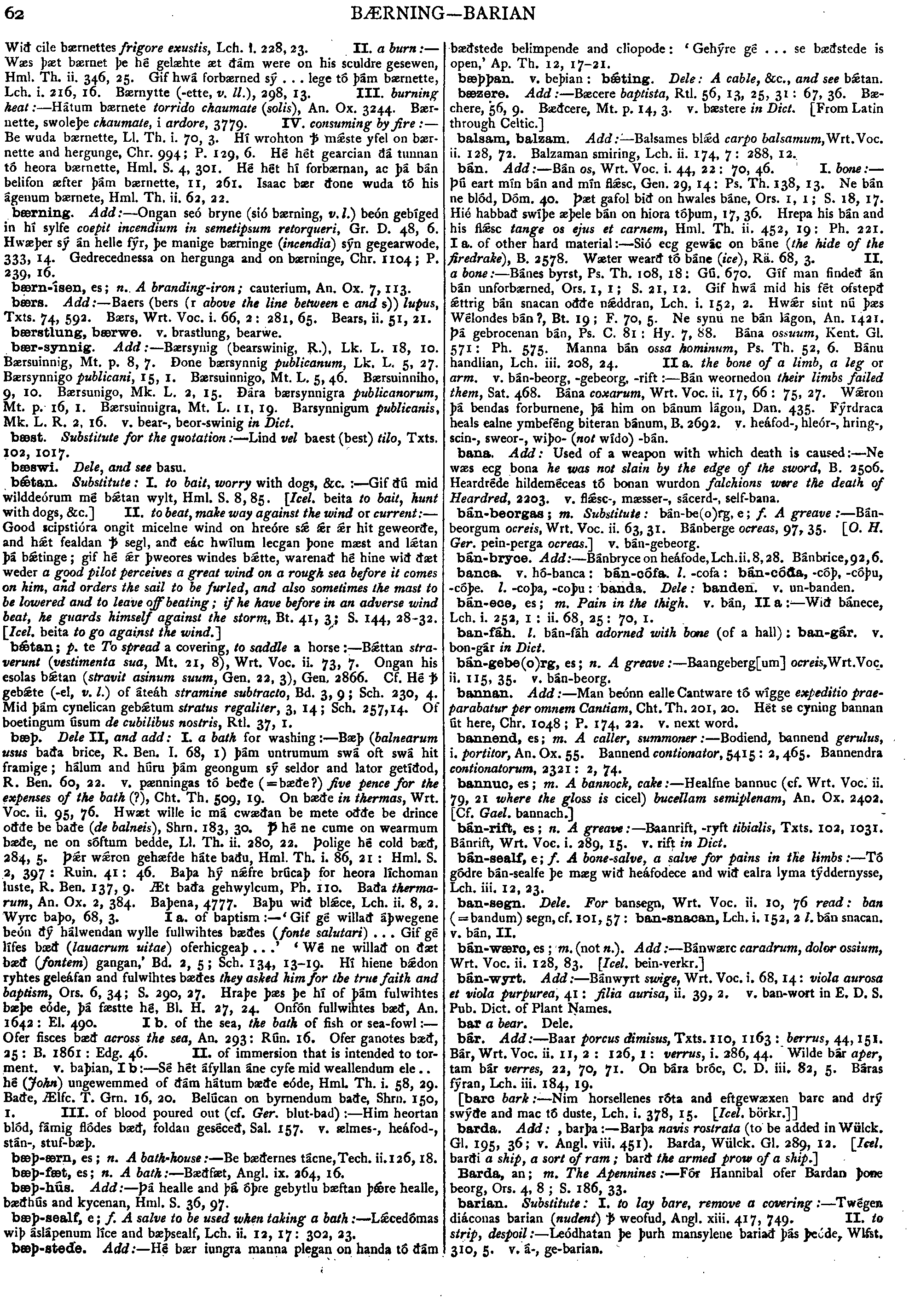
bæþ.
Dele
II,
and
add:
I.
a
bath
for
washing:--Bæþ
(balnearum
usus
baða
brice,
R.
Ben.
I.
68,
1)
þám
untrumum
swá
oft
swá
hit
framige;
hálum
and
húru
þám
geongum
sý
seldor
and
lator
getíðod,
R.
Ben.
60,
22.
v.
pænningas
tó
beðe
(
=
bæðe?)
five
pence
for
the
expenses
of
the
bath
(?),
Cht.
Th.
509,
19.
On
bæðe
in
thermas,
Wrt.
Voc.
ii.
95,
76.
Hwæt
wille
ic
má
cwæðan
be
mete
oððe
be
drince
oððe
be
baðe
(de
balneis),
Shrn.
183,
30.
Þ-bar;
hé
ne
cume
on
wearmum
bæðe,
ne
on
sóftum
bedde,
Ll.
Th.
ii.
280,
22.
Þolige
hé
cold
bæð,
284,
5.
Þr
wron
gehæfde
háte
baðu,
Hml.
Th.
i.
86,
21:
Hml.
S.
2,
397:
Ruin.
41:
46.
Baþa
hý
nfre
brúcaþ
for
heora
líchoman
luste,
R.
Ben.
137,
9.
Æt
baða
gehwylcum,
Ph.
110.
Baða
thermarum,
An.
Ox.
2,
384.
Baþena,
4777.
Baþu
wið
blce,
Lch.
ii.
8,
2.
Wyrc
baþo,
68,
3.
I
a.
of
baptism:--'Gif
gé
willað
áþwegene
beón
ðý
hálwendan
wylle
fullwihtes
bæðes
(fonte
salutari)
.
.
.
Gif
gé
lífes
bæð
(lauacrum
uitae)
oferhicgeaþ
.
.
.'
'Wé
ne
willað
on
ðæt
bæð
(fontem)
gangan,'
Bd.
2,
5;
Sch.
134,
13-19.
Hí
hiene
bdon
ryhtes
geleáfan
and
fulwihtes
bæðes
they
asked
him
for
the
true
faith
and
baptism,
Ors.
6,
34;
S.
290,
27.
Hraþe
þæs
þe
hí
of
þám
fulwihtes
bæþe
eóde,
þá
fæstte
hé,
Bl.
H.
27,
24.
Onfón
fullwihtes
bæð,
An.
1642:
El.
490.
I
b.
of
the
sea,
the
bath
of
fish
or
sea-fowl:--Ofer
fisces
bæð
across
the
sea,
An.
293:
Rún.
16.
Ofer
ganotes
bæð,
25:
B.
1861:
Edg.
46.
II.
of
immersion
that
is
intended
to
torment.
v.
baþian,
I
b:--Sé
hét
áfyllan
áne
cyfe
mid
weallendum
ele
.
.
hé
(John)
ungewemmed
of
ðám
hátum
bæðe
eóde,
Hml.
Th.
i.
58,
29.
Baðe,
Ælfc.
T.
Grn.
16,
20.
Belúcan
on
byrnendum
baðe,
Shrn.
150,
1.
III.
of
blood
poured
out
(cf.
Ger.
blut-bad):--Him
heortan
blód,
famig
flódes
bæð,
foldan
geséceð,
Sal.
157.
v.
ælmes-,
heáfod-,
stán-,
stuf-bæþ.
|
Source: Bosworth/Toller, page d0200, entry 2 View original page image as: [TIFF] [PNG] [View previous entry] [View next entry] |
[Comment on this entry] [View comments (1)] |
The following entry has been hand-corrected once. |
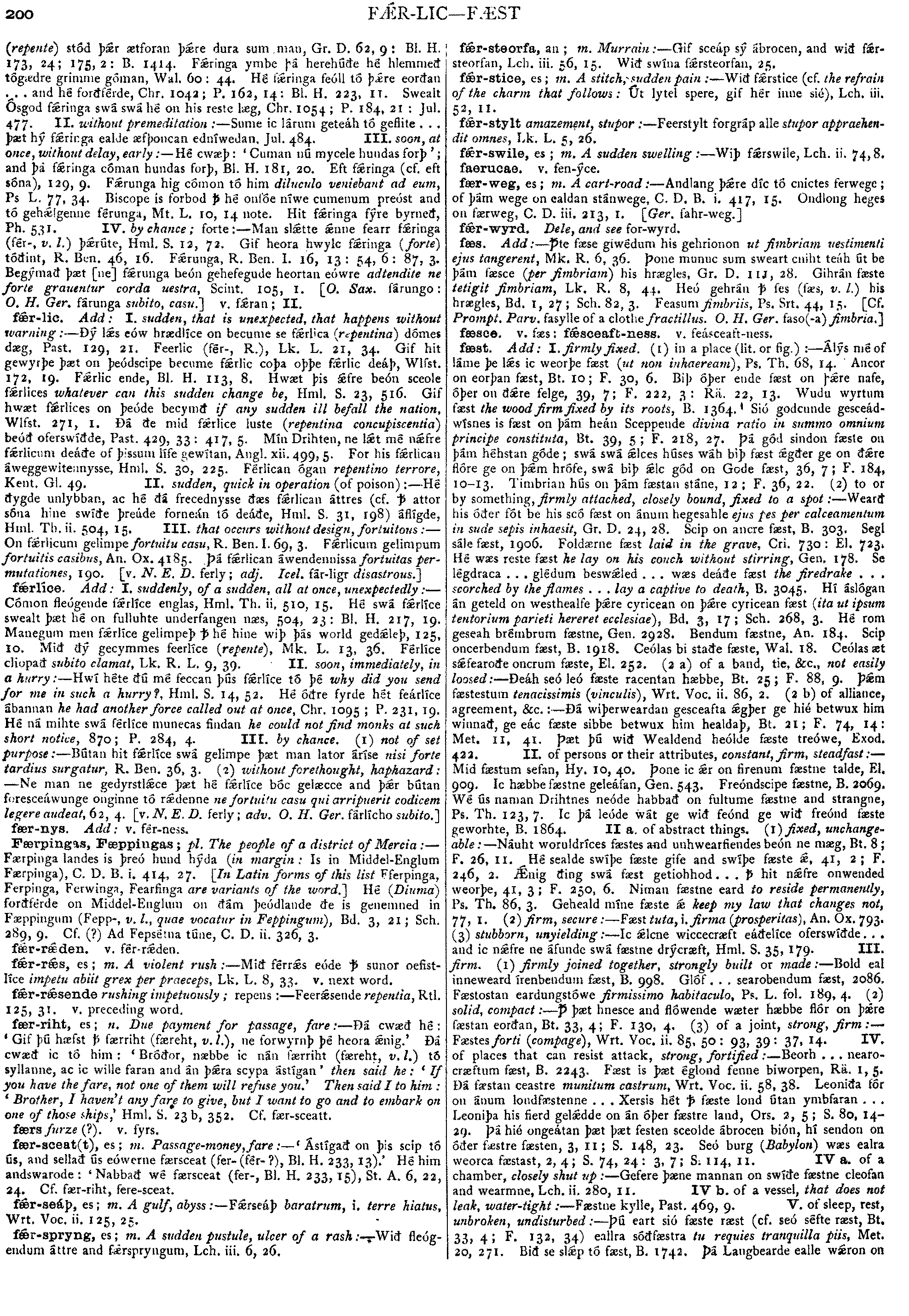
fr-lic.
Add:
I.
sudden,
that
is
unexpected,
that
happens
without
warning
:--
Ðý
ls
eów
hrædlíce
on
becume
se
frlíca
(repentina)
dómes
dæg,
Past.
129,
21.
Feerlic
(fér-,
R.),
Lk.
L.
21,
34.
Gif
hit
gewyrþe
þæt
on
þeódscipe
becume
frlic
coþa
oþþe
frlic
deáþ,
Wlfst.
172,
19.
Frlic
ende,
Bl.
H.
113,
8.
Hwæt
þis
fre
beón
sceole
frlices
whatever
can
this
sudden
change
be,
Hml.
S.
23,
516.
Gif
hwæt
frlices
on
þeóde
becymð
if
any
sudden
ill
befall
the
nation,
Wlfst.
271,
1.
Ðá
ðe
mid
frlice
luste
(repentina
concupiscentia)
beóð
oferswíðde,
Past.
429,
33
:
417,
5.
Mín
Drihten,
ne
lt
mé
nfre
frlicum
deáðe
of
þissum
lífe
gewítan,
Angl.
xii.
499,
5.
For
his
frlican
áweggewitennysse,
Hml.
S.
30,
225.
Férlican
ógan
repentino
terrore,
Kent.
Gl.
49.
II.
sudden,
quick
in
operation
(of
poison)
:--
Hé
ðygde
unlybban,
ac
hé
ðá
frecednysse
ðæs
fæ-acute;rlican
áttres
(cf.
 attor
sóna
hine
swíðe
þreáde
forneán
tó
deáðe,
Hml.
S.
31,
198)
áflígde,
Hml.
Th.
ii.
504,
15.
III.
that
occurs
without
design,
fortuitous
:--
On
frlicum
gelimpe
fortuitu
casu,
R.
Ben.
I.
69,
3.
Frlicum
gelimpum
fortuitis
casibus,
An.
Ox.
4185.
Þá
frlican
áwendennissa
fortuitas
permutationes,
190.
[v.
N.
E.
D.
ferly;
adj.
Icel.
fár-ligr
disastrous.]
attor
sóna
hine
swíðe
þreáde
forneán
tó
deáðe,
Hml.
S.
31,
198)
áflígde,
Hml.
Th.
ii.
504,
15.
III.
that
occurs
without
design,
fortuitous
:--
On
frlicum
gelimpe
fortuitu
casu,
R.
Ben.
I.
69,
3.
Frlicum
gelimpum
fortuitis
casibus,
An.
Ox.
4185.
Þá
frlican
áwendennissa
fortuitas
permutationes,
190.
[v.
N.
E.
D.
ferly;
adj.
Icel.
fár-ligr
disastrous.]
|
Source: Bosworth/Toller, page d0224, entry 8 View original page image as: [TIFF] [PNG] [View previous entry] [View next entry] |
[Comment on this entry] [View comments] |
The following entry has been hand-corrected once. |
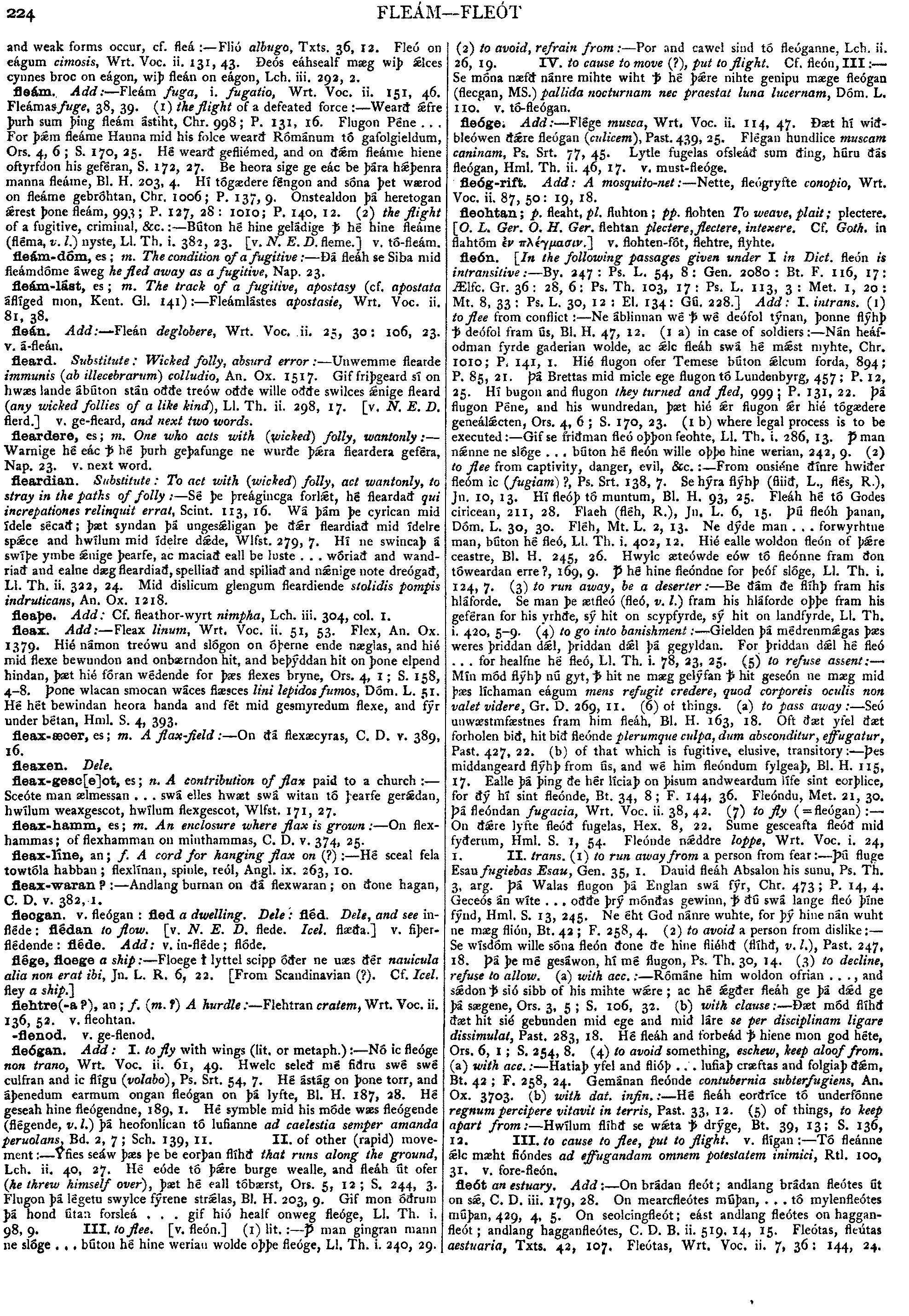
fleardian.
Substitute:
To
act
with
(wicked)
folly,
act
wantonly,
to
stray
in
the
paths
of
folly
:--
Sé
þe
þreágincga
forlt,
hé
fleardað
qui
increpationes
relinquit
errat,
Scint.
113,
16.
Wá
þám
þe
cyrican
mid
ídele
sécað;
þæt
syndan
þá
ungesligan
þe
ðr
fleardiað
mid
ídelre
spiéce
and
hwílum
mid
ídelre
dde.
Wlfst.
279,
7.
Hí
ne
swincaþ
á
swíþe
ymbe
nige
þearfe,
ac
maciað
eall
be
luste
.
.
.
wóriað
and
wandriaið
and
ealne
dæg
fleardiað,
spelliað
and
spiliað
and
nnige
note
dreógað,
Ll.
Th.
ii.
322,
24.
Mid
dislicum
glengum
fleardiende
stolidis
pompis
indruticans,
An.
Ox.
1218.
|
Source: Bosworth/Toller, page d0280, entry 3 View original page image as: [TIFF] [PNG] [View previous entry] [View next entry] |
[Comment on this entry] [View comments] |
The following entry has been hand-corrected once. |
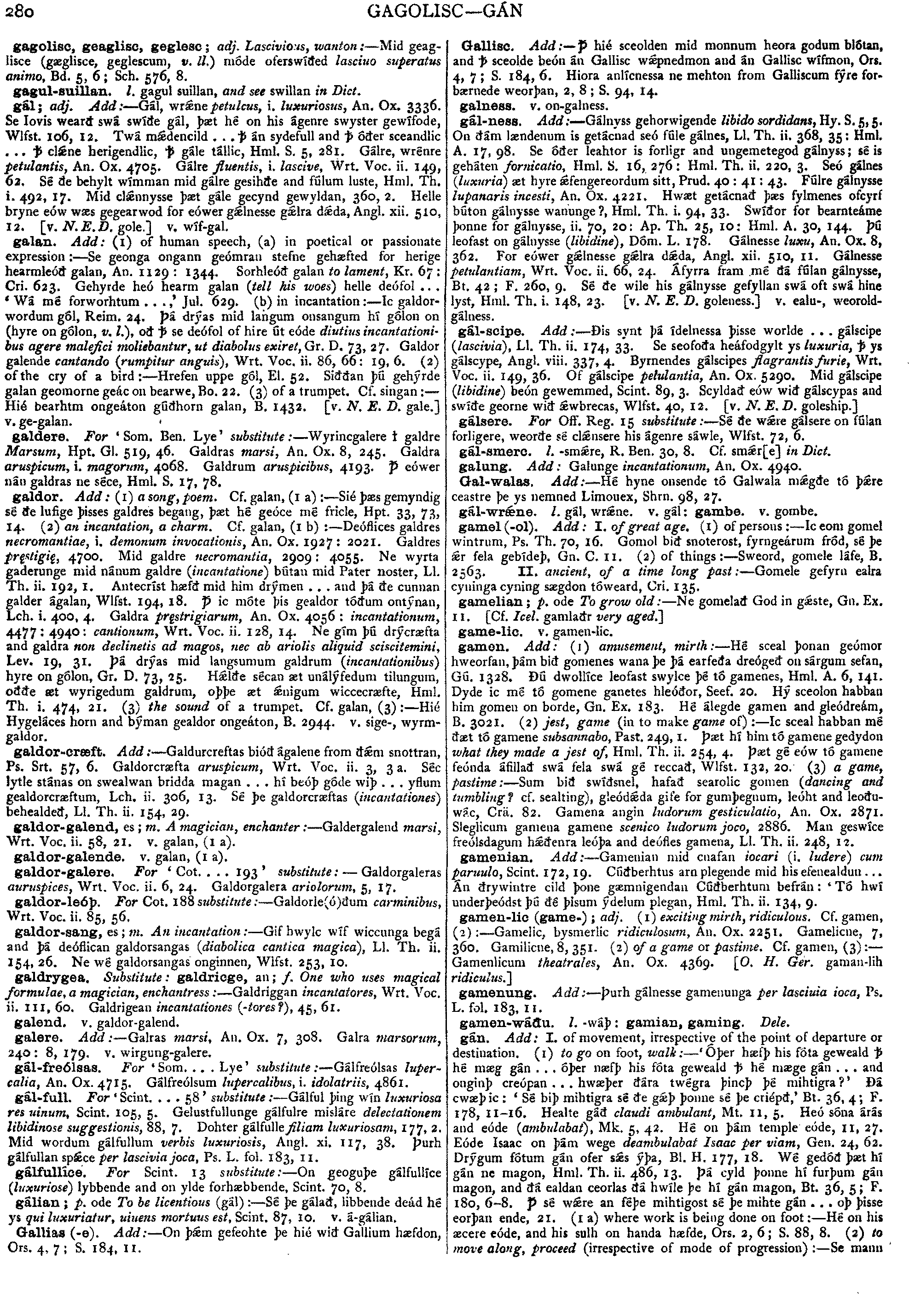
g l;
adj.
Add
:--
Gl,
wr
l;
adj.
Add
:--
Gl,
wr ne
petulcus,
i.
luxuriosus,
An.
Ox.
3336.
Se
Iovis
wear
ne
petulcus,
i.
luxuriosus,
An.
Ox.
3336.
Se
Iovis
wear sw
sw
sw
sw e
gl,
þæt
h
e
gl,
þæt
h on
his
genre
swyster
gewfode,
Wlfst.
106,
12.
Tw
mdencild
.
.
.
n
sydefull
and
on
his
genre
swyster
gewfode,
Wlfst.
106,
12.
Tw
mdencild
.
.
.
n
sydefull
and
 er
sceandlic
.
.
.
clne
herigendlic,
gle
tllic,
Hml.
S.
5,
281.
Glre,
wrnre
petulantis,
An.
Ox.
4705.
Glre
fluentis,
i.
lascive,
Wrt.
Voc.
ii.
149,
62.
S
e
behylt
wmman
mid
glre
gesihe
and
f
er
sceandlic
.
.
.
clne
herigendlic,
gle
tllic,
Hml.
S.
5,
281.
Glre,
wrnre
petulantis,
An.
Ox.
4705.
Glre
fluentis,
i.
lascive,
Wrt.
Voc.
ii.
149,
62.
S
e
behylt
wmman
mid
glre
gesihe
and
f lum
luste,
Hml.
Th.
i.
492,
17.
Mid
clnnysse
þæt
gle
gecynd
gewyldan,
360,
2.
Helle
bryne
eów
wæs
gegearwod
for
eówer
glnesse
glra
dda,
Angl.
xii.
510,
12.
[v.
N.
E.
D.
gole.]
v.
wf-gal.
lum
luste,
Hml.
Th.
i.
492,
17.
Mid
clnnysse
þæt
gle
gecynd
gewyldan,
360,
2.
Helle
bryne
eów
wæs
gegearwod
for
eówer
glnesse
glra
dda,
Angl.
xii.
510,
12.
[v.
N.
E.
D.
gole.]
v.
wf-gal.
|
Source: Bosworth/Toller, page d0291, entry 4 View original page image as: [TIFF] [PNG] [View previous entry] [View next entry] |
[Comment on this entry] [View comments] |
The following entry has been hand-corrected once. |
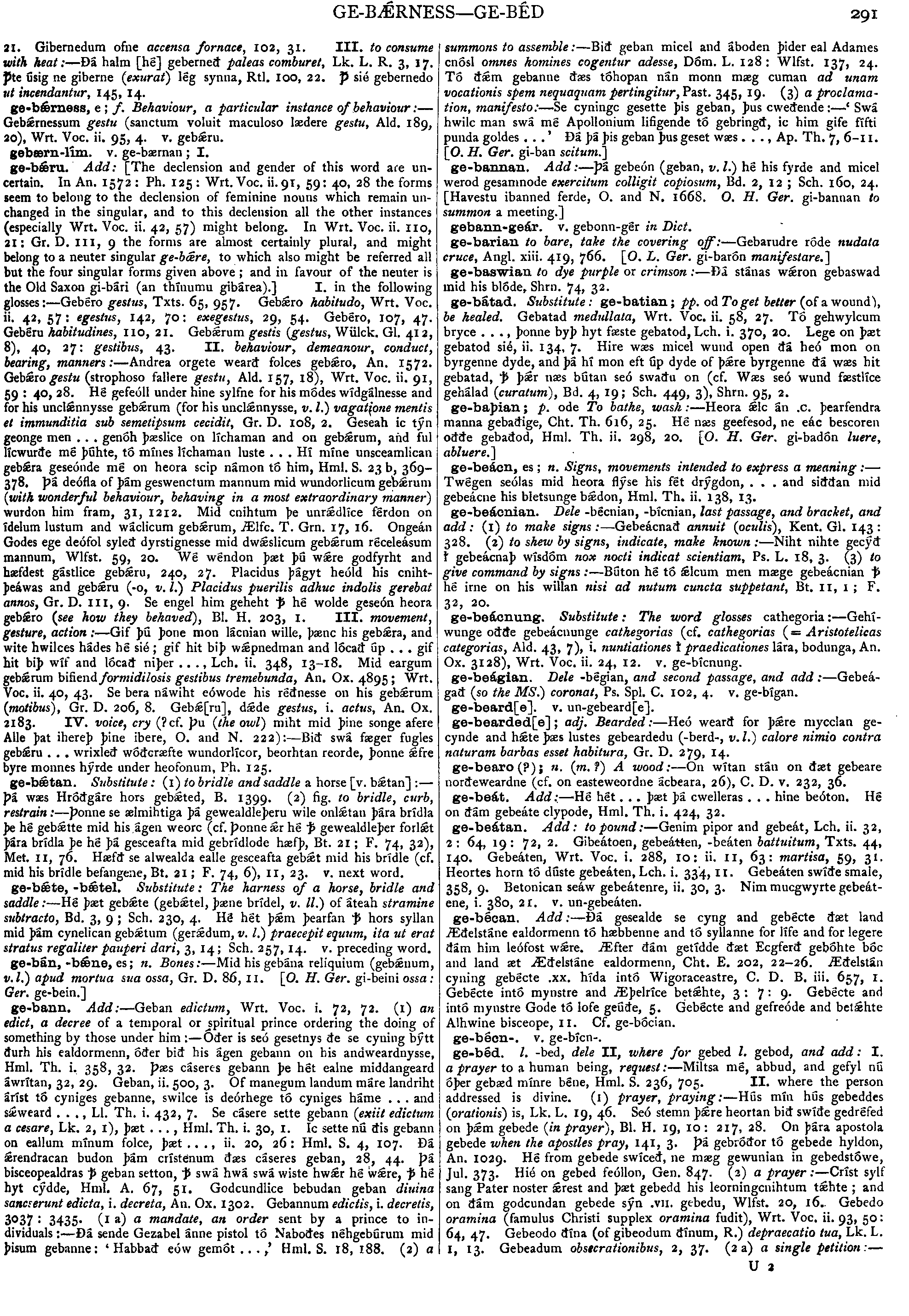
ge-bru.
Add:
[The
declension
and
gender
of
this
word
are
uncertain.
In
An.
1572:
Ph.
125:
Wrt.
Voc.
ii.
91,
59:
40,
28
the
forms
seem
to
belong
to
the
declension
of
feminine
nouns
which
remain
unchanged
in
the
singular,
and
to
this
declension
all
the
other
instances
(especially
Wrt.
Voc.
ii.
42,
57)
might
belong.
In
Wrt.
Voc.
ii.
110,
21:
Gr.
D.
111,
9
the
forms
are
almost
certainly
plural,
and
might
belong
to
a
neuter
singular
ge-bre,
to
which
also
might
be
referred
all
but
the
four
singular
forms
given
above;
and
in
favour
of
the
neuter
is
the
Old
Saxon
gi- ari
(an
thínumu
gibárea).]
I.
in
the
following
glosses
:--
Gebéro
gestus,
Txts.
65,
957.
Gebro
habitudo,
Wrt.
Voc.
ii.
42,
57:
egestus,
142,
70:
exegestus,
29,
54.
Gebéro,
107,
47.
Gebéru
habitudines,
110,
21.
Gebrum
gestis
(gestus,
Wülck.
Gl.
412,
8),
40,
27:
gestibus,
43.
II.
behaviour,
demeanour,
conduct,
bearing,
manners
:--
Andrea
orgete
wearð
folces
gebro,
An.
1572.
Gebro
gestu
(strophoso
fallere
gestu,
Ald.
157,
18),
Wrt.
Voc.
ii.
91,
59:
40,
28.
Hé
gefeóll
under
hine
sylfne
for
his
módes
wídgálnesse
and
for
his
unclnnysse
gebrum
(for
his
unclnnysse,
v.l.)
vagatione
mentis
et
immunditia
sub
semetipsum
cecidit,
Gr.
D.
108,
2.
Geseah
ic
týn
geonge
men
...
genóh
þæslice
on
líchaman
and
on
gebrum,
and
ful
lícwurðe
mé
þúhte,
tó
mínes
líchaman
luste
...
Hí
míne
unsceamlican
gebra
geseónde
mé
on
heora
scip
námon
tó
him,
Hml.
S.
23
b,
369-378.
Þá
deófla
of
þám
geswenctum
mannum
mid
wundorlicum
gebrum
(with
wonderful
behaviour,
behaving
in
a
most
extraordinary
manner)
wurdon
him
fram,
31,
1212.
Mid
cnihtum
þe
unrdlíce
férdon
on
ídelum
lustum
and
wáclicum
gebrum,
Ælfc.
T.
Grn.
17,
16.
Ongeán
Godes
ege
deófol
syleð
dyrstignesse
mid
dwslicum
gebrum
réceleásum
mannum,
Wlfst.
59,
20.
Wé
wéndon
þæt
þú
wre
godfyrht
and
hæfdest
gástlice
gebru,
240,
27.
Placidus
þágyt
heóld
his
cnihtþeáwas
and
gebru
(-o,
v.l.)
Placidus
puerilis
adhuc
indolis
gerebat
annos,
Gr.
D.
111,
9.
Se
engel
him
geheht
hé
wolde
geseón
heora
gebro
(see
how
they
behaved),
Bl.
H.
203,
1.
III.
movement,
gesture,
action
:--
Gif
þú
þone
mon
lácnian
wille,
þænc
his
gebra,
and
wite
hwilces
hádes
hé
sié;
gif
hit
biþ
wpnedman
and
lócað
úp
...
gif
hit
biþ
wíf
and
lócað
niþer
...,
Lch.
ii.
348,
13-18.
Mid
eargum
gebrum
bifiend
formidilosis
gestibus
tremebunda,
An.
Ox.
4895;
Wrt.
Voc.
ii.
40,
43.
Se
bera
náwiht
eówode
his
réðnesse
on
his
gebrum
(motibus),
Gr.
D.
206,
8.
Geb[ru],
dde
gestus,
i.
actus,
An.
Ox.
2183.
IV.
voice,
cry
(?cf.
Þu
(the
owl)
miht
mid
þine
songe
afere
Alle
þat
ihereþ
þine
ibere,
O.
and
N.
222)
:--
Bið
swá
fæger
fugles
gebru
...
wrixleð
wóðcræfte
wundorlícor,
beorhtan
reorde,
þonne
fre
byre
monnes
hýrde
under
heofonum,
Ph.
125.
ari
(an
thínumu
gibárea).]
I.
in
the
following
glosses
:--
Gebéro
gestus,
Txts.
65,
957.
Gebro
habitudo,
Wrt.
Voc.
ii.
42,
57:
egestus,
142,
70:
exegestus,
29,
54.
Gebéro,
107,
47.
Gebéru
habitudines,
110,
21.
Gebrum
gestis
(gestus,
Wülck.
Gl.
412,
8),
40,
27:
gestibus,
43.
II.
behaviour,
demeanour,
conduct,
bearing,
manners
:--
Andrea
orgete
wearð
folces
gebro,
An.
1572.
Gebro
gestu
(strophoso
fallere
gestu,
Ald.
157,
18),
Wrt.
Voc.
ii.
91,
59:
40,
28.
Hé
gefeóll
under
hine
sylfne
for
his
módes
wídgálnesse
and
for
his
unclnnysse
gebrum
(for
his
unclnnysse,
v.l.)
vagatione
mentis
et
immunditia
sub
semetipsum
cecidit,
Gr.
D.
108,
2.
Geseah
ic
týn
geonge
men
...
genóh
þæslice
on
líchaman
and
on
gebrum,
and
ful
lícwurðe
mé
þúhte,
tó
mínes
líchaman
luste
...
Hí
míne
unsceamlican
gebra
geseónde
mé
on
heora
scip
námon
tó
him,
Hml.
S.
23
b,
369-378.
Þá
deófla
of
þám
geswenctum
mannum
mid
wundorlicum
gebrum
(with
wonderful
behaviour,
behaving
in
a
most
extraordinary
manner)
wurdon
him
fram,
31,
1212.
Mid
cnihtum
þe
unrdlíce
férdon
on
ídelum
lustum
and
wáclicum
gebrum,
Ælfc.
T.
Grn.
17,
16.
Ongeán
Godes
ege
deófol
syleð
dyrstignesse
mid
dwslicum
gebrum
réceleásum
mannum,
Wlfst.
59,
20.
Wé
wéndon
þæt
þú
wre
godfyrht
and
hæfdest
gástlice
gebru,
240,
27.
Placidus
þágyt
heóld
his
cnihtþeáwas
and
gebru
(-o,
v.l.)
Placidus
puerilis
adhuc
indolis
gerebat
annos,
Gr.
D.
111,
9.
Se
engel
him
geheht
hé
wolde
geseón
heora
gebro
(see
how
they
behaved),
Bl.
H.
203,
1.
III.
movement,
gesture,
action
:--
Gif
þú
þone
mon
lácnian
wille,
þænc
his
gebra,
and
wite
hwilces
hádes
hé
sié;
gif
hit
biþ
wpnedman
and
lócað
úp
...
gif
hit
biþ
wíf
and
lócað
niþer
...,
Lch.
ii.
348,
13-18.
Mid
eargum
gebrum
bifiend
formidilosis
gestibus
tremebunda,
An.
Ox.
4895;
Wrt.
Voc.
ii.
40,
43.
Se
bera
náwiht
eówode
his
réðnesse
on
his
gebrum
(motibus),
Gr.
D.
206,
8.
Geb[ru],
dde
gestus,
i.
actus,
An.
Ox.
2183.
IV.
voice,
cry
(?cf.
Þu
(the
owl)
miht
mid
þine
songe
afere
Alle
þat
ihereþ
þine
ibere,
O.
and
N.
222)
:--
Bið
swá
fæger
fugles
gebru
...
wrixleð
wóðcræfte
wundorlícor,
beorhtan
reorde,
þonne
fre
byre
monnes
hýrde
under
heofonum,
Ph.
125.
|
Source: Bosworth/Toller, page d0448, entry 1 View original page image as: [TIFF] [PNG] [View previous entry] [View next entry] |
[Comment on this entry] [View comments (3)] |
The following entry has been hand-corrected once. |
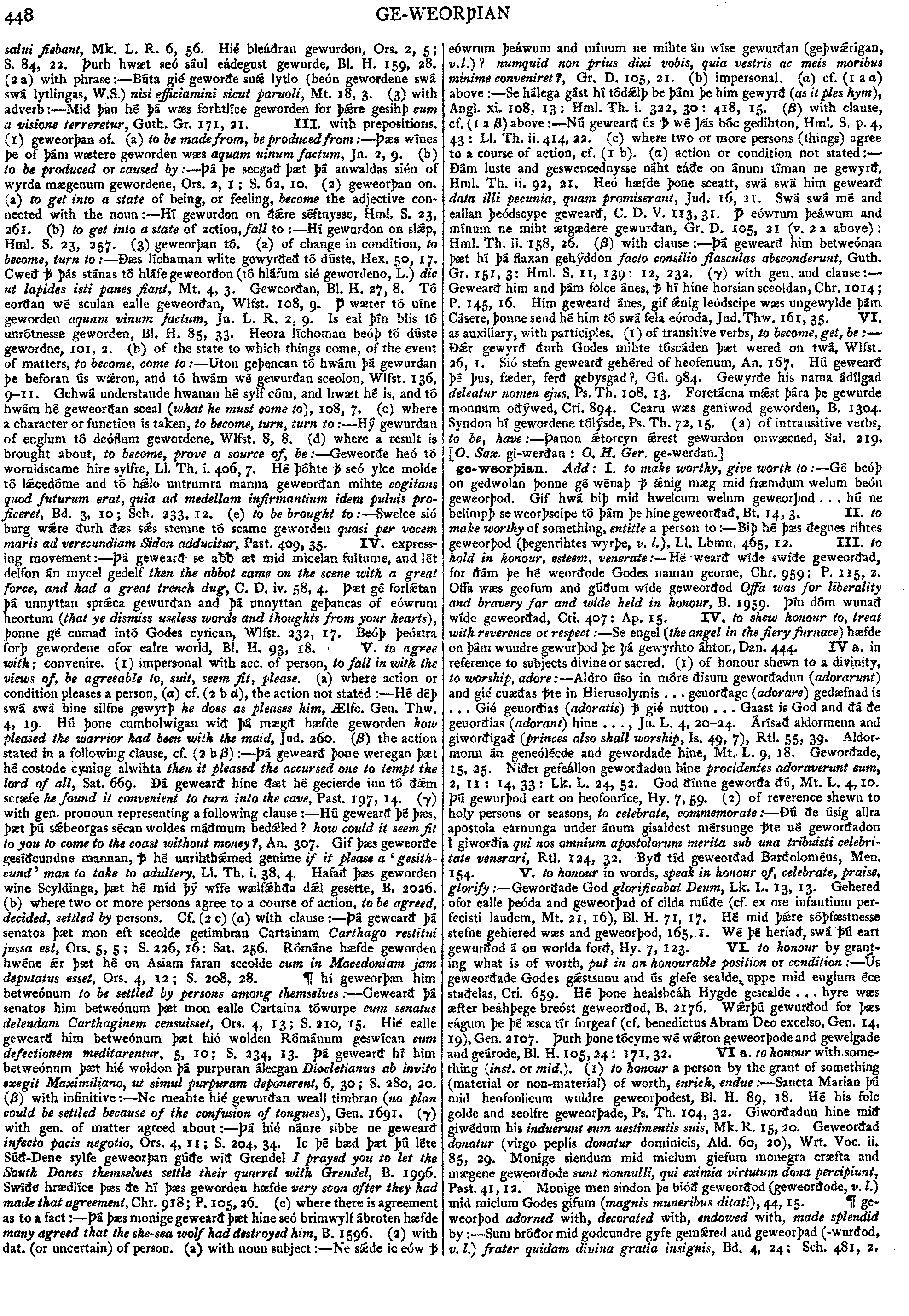
salui
fiebant,
Mk.
L.
R.
6,
56.
Hié
bleáðran
gewnrdon,
Ors.
2,
5;
S.
84,
22.
Þurh
hwæt
seó
sául
eádegust
gewurde,
Bl.
H.
159,
28.
(2
a)
with
phrase
:--
Búta
gié
geworðe
su
lytlo
(beón
gewordene
swá
swá
lytlingas,
W.
S.
)
nisi
efficiamini
sicut
paruoli,
Mt.
18,
3.
( )
with
adverb
:--
Mid
þán
hé
þá
wæs
forhtlíce
geworden
for
þre
gesihþ
cum
a
visione
terreretur,
Guth.
Gr.
171,
21.
III.
with
prepositions,
(l)
geweorþan
of.
(a)
to
be
made
from,
be
produced
from
:--
Þæs
wínes
þe
of
þám
wætere
geworden
wæs
aquam
uinum
factum,
Jn.
2,
9.
(b)
to
be
produced
or
caused
by
:--
Þá
þe
secgað
þæt
þá
anwaldas
sién
of
wyrda
mægenum
gewordene,
Ors.
2,
l
;
S.
62,
10.
(2)
geweorþan
on.
(a)
to
get
into
a
state
of
being,
or
feeling,
become
the
adjective
connected
with
the
noun
:--
Hí
gewurdon
on
ðre
séftnysse,
Hml.
S.
23,
261.
(b)
to
get
into
a
state
of
action,
fall
to
:--
Hí
gewurdon
on
slp,
Hml.
S.
23,
257.
()
geweorþan
tó.
(a)
of
change
in
condition,
to
become,
turn
to:
--
Ðæs
líchaman
wlite
gewyrðeð
to
dúste.
Hex.
50,
17.
Cweð
þás
stánas
tó
hláfe
geweoriton
(tó
hláfum
sió
gewordeno,
L.
)
dic
ut
lapides
isti
panes
fiant,
Mt.
4,
3.
Geweorðan,
Bl.
H.
27,
8.
Tó
eorðan
wé
sculan
ealle
geweorðan,
Wlfst.
108,
9.
Þ-bar;
wæter
tó
níne
geworden
aquam
vinum
factum,
Jn.
L.
R.
2,
9.
Is
eal
þín
blis
tó
unrótnesse
geworden,
Bl.
H.
85,
33.
Heora
líchoman
beóþ
tó
dúste
gewordne,
101,
2.
(b)
of
the
seate
to
which
things
come,
of
the
event
of
matters,
to
become,
come
to
:--
Uton
geþencan
tó
hwám
þá
gewurdan
þe
beforan
ús
wron,
and
tó
hwám
wé
gewurðan
sceolon.
Wlfst.
136,
9-11.
Gehwá
understande
hwanan
he
sylf
cóm,
and
hwæt
hé
is,
and
tó
hwám
hé
geweorðan
sceal
(what
he
must
come
to),
108,
7.
(c)
where
a
character
or
function
is
taken,
to
become,
turn,
turn
to
:--
Hý
gewurdan
of
englum
to
deóflum
gewordene.
Wlfst.
8,
8.
(d)
where
a
result
is
brought
about,
tó
become,
prove
a
source
of,
be
:--
Geweorðe
heó
tó
woruldscame
hire
sylfre,
Ll.
Th.
i.
406,
7.
Hé
þóhte
seó
ylce
molde
tó
lcedðme
and
tó
hlo
untrumra
manna
geweorðan
mihte
cogitans
quod
futurum
erat,
quia
ad
medellam
infirmantium
idem
puluis
proficeret.
Bd.
3,
10
;
Sch.
233,
12,
(e)
to
be
brought
to
:--
Swelce
sió
burg
wre
ðurh
ðæs
ss
stemne
tó
scame
geworden
guasi
per
vocem
mam
ad
verecundiam
Sidon
adducitur,
Past.
409,
35.
IV.
expressing
movement
:--
Þá
gewearð
se
a
æt
mid
micelan
fultume,
and
lét
delfon
án
mycel
gedelf
then
the
abbot
came
on
the
scene
with
a
great
force,
and
had
a
great
trench
dug,
C.
D.
iv.
58,
4.
Þæt
gé
forltan
þá
unnyttan
sprca
gewurðan
and
þá
unnyttan
geþancas
of
eówrum
heortum
(that
ye
dismiss
useless
words
and
thoughts
from
your
hearts),
þonne
gé
cumað
intó
Godes
cyrican,
Wlfst.
232,
17.
Beóþ
þeóstra
forþ
gewordene
ofor
ealre
world,
Bl.
H.
93,
18.
V.
to
agree
with;
convenire.
(1)
impersonal
with
acc.
of
person,
to
fall
in
with
the
views
of,
be
agreeable
to,
suit,
seem
fit,
please,
(a)
where
action
or
condition
pleases
a
person,
(
)
with
adverb
:--
Mid
þán
hé
þá
wæs
forhtlíce
geworden
for
þre
gesihþ
cum
a
visione
terreretur,
Guth.
Gr.
171,
21.
III.
with
prepositions,
(l)
geweorþan
of.
(a)
to
be
made
from,
be
produced
from
:--
Þæs
wínes
þe
of
þám
wætere
geworden
wæs
aquam
uinum
factum,
Jn.
2,
9.
(b)
to
be
produced
or
caused
by
:--
Þá
þe
secgað
þæt
þá
anwaldas
sién
of
wyrda
mægenum
gewordene,
Ors.
2,
l
;
S.
62,
10.
(2)
geweorþan
on.
(a)
to
get
into
a
state
of
being,
or
feeling,
become
the
adjective
connected
with
the
noun
:--
Hí
gewurdon
on
ðre
séftnysse,
Hml.
S.
23,
261.
(b)
to
get
into
a
state
of
action,
fall
to
:--
Hí
gewurdon
on
slp,
Hml.
S.
23,
257.
()
geweorþan
tó.
(a)
of
change
in
condition,
to
become,
turn
to:
--
Ðæs
líchaman
wlite
gewyrðeð
to
dúste.
Hex.
50,
17.
Cweð
þás
stánas
tó
hláfe
geweoriton
(tó
hláfum
sió
gewordeno,
L.
)
dic
ut
lapides
isti
panes
fiant,
Mt.
4,
3.
Geweorðan,
Bl.
H.
27,
8.
Tó
eorðan
wé
sculan
ealle
geweorðan,
Wlfst.
108,
9.
Þ-bar;
wæter
tó
níne
geworden
aquam
vinum
factum,
Jn.
L.
R.
2,
9.
Is
eal
þín
blis
tó
unrótnesse
geworden,
Bl.
H.
85,
33.
Heora
líchoman
beóþ
tó
dúste
gewordne,
101,
2.
(b)
of
the
seate
to
which
things
come,
of
the
event
of
matters,
to
become,
come
to
:--
Uton
geþencan
tó
hwám
þá
gewurdan
þe
beforan
ús
wron,
and
tó
hwám
wé
gewurðan
sceolon.
Wlfst.
136,
9-11.
Gehwá
understande
hwanan
he
sylf
cóm,
and
hwæt
hé
is,
and
tó
hwám
hé
geweorðan
sceal
(what
he
must
come
to),
108,
7.
(c)
where
a
character
or
function
is
taken,
to
become,
turn,
turn
to
:--
Hý
gewurdan
of
englum
to
deóflum
gewordene.
Wlfst.
8,
8.
(d)
where
a
result
is
brought
about,
tó
become,
prove
a
source
of,
be
:--
Geweorðe
heó
tó
woruldscame
hire
sylfre,
Ll.
Th.
i.
406,
7.
Hé
þóhte
seó
ylce
molde
tó
lcedðme
and
tó
hlo
untrumra
manna
geweorðan
mihte
cogitans
quod
futurum
erat,
quia
ad
medellam
infirmantium
idem
puluis
proficeret.
Bd.
3,
10
;
Sch.
233,
12,
(e)
to
be
brought
to
:--
Swelce
sió
burg
wre
ðurh
ðæs
ss
stemne
tó
scame
geworden
guasi
per
vocem
mam
ad
verecundiam
Sidon
adducitur,
Past.
409,
35.
IV.
expressing
movement
:--
Þá
gewearð
se
a
æt
mid
micelan
fultume,
and
lét
delfon
án
mycel
gedelf
then
the
abbot
came
on
the
scene
with
a
great
force,
and
had
a
great
trench
dug,
C.
D.
iv.
58,
4.
Þæt
gé
forltan
þá
unnyttan
sprca
gewurðan
and
þá
unnyttan
geþancas
of
eówrum
heortum
(that
ye
dismiss
useless
words
and
thoughts
from
your
hearts),
þonne
gé
cumað
intó
Godes
cyrican,
Wlfst.
232,
17.
Beóþ
þeóstra
forþ
gewordene
ofor
ealre
world,
Bl.
H.
93,
18.
V.
to
agree
with;
convenire.
(1)
impersonal
with
acc.
of
person,
to
fall
in
with
the
views
of,
be
agreeable
to,
suit,
seem
fit,
please,
(a)
where
action
or
condition
pleases
a
person,
( )
cf.
(2
b
),
the
action
not
stated
:--
Hé
déþ
swá
swá
híne
silfne
gewyrþ
he
does
as
pleases
him,
Ælfc.
Gen.
Thw.
4,
19.
Hú
þone
cumbolwigan
wið
þá
mægð
hæfde
geworden
how
pleased
the
warrior
had
been
with
the
maid,
Jud.
260.
(
)
cf.
(2
b
),
the
action
not
stated
:--
Hé
déþ
swá
swá
híne
silfne
gewyrþ
he
does
as
pleases
him,
Ælfc.
Gen.
Thw.
4,
19.
Hú
þone
cumbolwigan
wið
þá
mægð
hæfde
geworden
how
pleased
the
warrior
had
been
with
the
maid,
Jud.
260.
( )
the
action
stated
in
a
following
clause,
cf.
(2
b
)
:--
Þá
gewearð
þone
weregan
þæt
hé
costode
cy-ning
alwihta
then
it
pleased
the
accursed
one
to
tempt
the
lord
of
all,
Sat.
669.
Ðá
gewearð
hine
ðæt
hé
gecierde
inn
tó
ðm
scræfe
he
found
it
convenient
to
turn
into
the
cave,
Past.
197,
14.
(
)
the
action
stated
in
a
following
clause,
cf.
(2
b
)
:--
Þá
gewearð
þone
weregan
þæt
hé
costode
cy-ning
alwihta
then
it
pleased
the
accursed
one
to
tempt
the
lord
of
all,
Sat.
669.
Ðá
gewearð
hine
ðæt
hé
gecierde
inn
tó
ðm
scræfe
he
found
it
convenient
to
turn
into
the
cave,
Past.
197,
14.
( )
with
gen.
pronoun
representing
a
following
clause
:--
Hú
gewearð
þé
þæs,
þæt
þú
sbeorgas
sécan
woldes
máðmum
bedled
?
how
could
it
seem
pit
to
you
to
come
to
the
coast
without
money
?,
An.
307.
Gif
þæs
geweorðe
gesíðcundne
mannan,
hé
unrihthíémed
genime
if
it
please
a
gesith-cund'
man
to
take
to
adultery,
Ll.
Th.
i.
38,
4.
Hafað
þæs
geworden
wine
Scyldinga,
þæt
hé
mid
þý
wífe
wælfhða
dl
gesette,
B.
2026.
(b)
where
two
or
more
persons
agree
to
a
course
of
action,
to
be
agreed,
decided,
settled
by
persons.
Cf.
(2
c)
(a)
with
clause
:--
Þá
gewearð
þá
senates
þæt
mon
eft
sceolde
getimbran
Cartainam
Carthago
restitui
jussa
est,
Ors.
5,
5;
S.
226,
16:
Sat.
256.
Rómáne
hæfde
geworden
hwéne
r
þæt
hé
on
Asiam
faran
sceolde
cum
in
Macedoniam
jam
diputatus
esset,
Ors.
4,
12;
S.
208,
28.

hí
geweorþan
him
betweónum
to
be
settled
by
persons
among
themselves
:--
Gewearð
þá
senates
him
betweónum
þæt
mon
ealle
Cartaina
tówurpe
cum
senatus
delendam
Carthaginem
censuisset,
Ors.
4,
13;
8.
210,
15.
Hié
ealle
gewearð
him
betweónum
þæt
hié
wolden
Rómánum
geswícan
cum
defectionem
meditarentur,
5,
10;
S.
234,
13.
Þá
gewearð
hí
him
betweónum
þæt
hié
woldon
þá
purpuran
álecgan
Diocletianus
ab
invito
exegit
Maximiliano,
ut
simul
purpuram
deponerent,
6,
30;
S.
280,
20.
()
with
infinitive
:--
Ne
meahte
hié
gewurðan
weall
timbran
(no
plan
could
ie
settled
because
of
the
confusion
of
tongues),
Gen.
1691.
()
with
gen.
of
matter
agreed
about
:--
Þá
hié
nánre
sibbe
ne
gewearð
infecto
paces
negotio.
Ors.
4,
11;
S.
204,
34.
Ic
þé
bd
þæt
þú
léte
Suð-Dene
sylfe
geweorþan
guðe
wið
Grendel
I
prayed
you
to
let
the
South
Danes
themselves
settle
their
quarrel
with
Grendel,
B.
1996.
Swíðe
hrædlíce
þæs
ðe
hí
þæs
geworden
hæfde
very
soon
after
they
had
made
that
agreement,
Chr.
918;
P.
105.
26.
(c)
where
there
is
agreement
as
to
a
fact
:--
Þá
þæs
monige
geweard
þæt
hine
seó
brimwylf
ábroten
hæfde
many
agreed
that
the
she-sea
wolf
had
destroyed
him,
6.
1596.
(2)
with
dat.
(or
uncertain)
of
person,
(a)
with
noun
subject
:--
Ne
sde
ic
eów
eówrum
þeáwum
and
mínum
ne
mihte
an
wise
gewurdan
(geþwrigan,
v.
l.)
?
numquid
non
prius
dixi
vobis,
quia
vestris
ac
meis
moribus
minime
conveniret?,
Gr.
D.
105,
21.
(b)
impersonal,
()
cf.
(l
a
)
above
:--
Se
hálega
gást
hí
tódlþ
be
þám
þe
him
gewyrð
(as
it
ples
hym),
Angl.
xi.
108,
13
:
Hml.
Th.
i.
322,
30
:
418,
15.
()
with
clause,
cf.
(l
a
)
above
:--
Nú
gewearð
ús
wé
þás
bóc
gedihton,
Hml.
S.
p.
4,
43
:
Ll.
Th.
[1.
414,
22.
(c)
where
two
or
more
persons
(things)
agree
to
a
course
of
action,
cf.
(l
b).
()
action
or
condition
not
stated
:--
Ðám
luste
and
geswencednysse
náht
eáðe
on
ánum
tíman
ne
gewyrð,
Hml.
Th.
ii.
92,
21.
Heó
hæfde
þone
sceatt,
swá
swá
him
gewearð
data
illi
pecunia,
quam
promiserant,
Jud.
16,
21.
Swá
swá
mé
and
eallan
þeódscype
gewearð,
C.
D.
V.
113,
31.
Þ-bar;
eówrum
þeáwum
and
mínum
ne
miht
ætgædere
gewurðan,
Gr.
D.
105,
21
(v.
2
a
above)
:
Hml.
Th.
ii.
158,
26.
()
with
clause
:--
Þá
gewearð
him
betweónan
þæt
hí
þá
flaxan
gehýddon
facto
consilio
flasculas
absconderurt,
Guth.
Gr.
151,.
3:
Hml.
S.
11,
139:
12,
232.
()
with
gen.
and
clause
:--
Gewearð
him
and
þám
folce
ánes,
hí
hine
horsian
sceoldan,
Chr.
1014;
P.
145,
16.
Him
gewearð
ánes,
gif
nig
leódscipe
wæs
ungewylde
þám
Cásere,
þonne
send
hé
him
tó
swá
fela
eóroda,
Jud.
Thw.
161,
35.
VI.
as
auxiliary,
with
participles.
(l)
of
transitive
verbs,
to
become,
get,
be
:--
Ðr
gewyrð
ðurh
Godes
mihte
tóscáden
þæt
wered
on
twá,
Wlfst.
26,
l.
Sió
stefn
gewearð
gehéred
of
heofenum,
An.
167.
Hú
gewearð
þé
þus,
fæder,
ferð
gebysgad?,
Gú.
984.
Gewyrðe
his
nama
ádílgad
deleatur
nomen
ejus.
Ps.
Th.
108,
13.
Foretácna
mst
þára
þe
gewurde
monnum
oðýwed,
Cri.
894.
Cearu
wæs
geníwod
geworden,
B.
1304.
Syndon
hí
gewordene
tólýsde,
Ps.
Th.
72,
15.
(2)
of
intransitive
verbs,
to
be,
have
:--
Þanon
torcyn
rest
gewurdon
onwæcned,
Sal.
219.
[O.
Sax.
gi-werðan
:
O.
H.
Ger.
ge-werdan.]
)
with
gen.
pronoun
representing
a
following
clause
:--
Hú
gewearð
þé
þæs,
þæt
þú
sbeorgas
sécan
woldes
máðmum
bedled
?
how
could
it
seem
pit
to
you
to
come
to
the
coast
without
money
?,
An.
307.
Gif
þæs
geweorðe
gesíðcundne
mannan,
hé
unrihthíémed
genime
if
it
please
a
gesith-cund'
man
to
take
to
adultery,
Ll.
Th.
i.
38,
4.
Hafað
þæs
geworden
wine
Scyldinga,
þæt
hé
mid
þý
wífe
wælfhða
dl
gesette,
B.
2026.
(b)
where
two
or
more
persons
agree
to
a
course
of
action,
to
be
agreed,
decided,
settled
by
persons.
Cf.
(2
c)
(a)
with
clause
:--
Þá
gewearð
þá
senates
þæt
mon
eft
sceolde
getimbran
Cartainam
Carthago
restitui
jussa
est,
Ors.
5,
5;
S.
226,
16:
Sat.
256.
Rómáne
hæfde
geworden
hwéne
r
þæt
hé
on
Asiam
faran
sceolde
cum
in
Macedoniam
jam
diputatus
esset,
Ors.
4,
12;
S.
208,
28.

hí
geweorþan
him
betweónum
to
be
settled
by
persons
among
themselves
:--
Gewearð
þá
senates
him
betweónum
þæt
mon
ealle
Cartaina
tówurpe
cum
senatus
delendam
Carthaginem
censuisset,
Ors.
4,
13;
8.
210,
15.
Hié
ealle
gewearð
him
betweónum
þæt
hié
wolden
Rómánum
geswícan
cum
defectionem
meditarentur,
5,
10;
S.
234,
13.
Þá
gewearð
hí
him
betweónum
þæt
hié
woldon
þá
purpuran
álecgan
Diocletianus
ab
invito
exegit
Maximiliano,
ut
simul
purpuram
deponerent,
6,
30;
S.
280,
20.
()
with
infinitive
:--
Ne
meahte
hié
gewurðan
weall
timbran
(no
plan
could
ie
settled
because
of
the
confusion
of
tongues),
Gen.
1691.
()
with
gen.
of
matter
agreed
about
:--
Þá
hié
nánre
sibbe
ne
gewearð
infecto
paces
negotio.
Ors.
4,
11;
S.
204,
34.
Ic
þé
bd
þæt
þú
léte
Suð-Dene
sylfe
geweorþan
guðe
wið
Grendel
I
prayed
you
to
let
the
South
Danes
themselves
settle
their
quarrel
with
Grendel,
B.
1996.
Swíðe
hrædlíce
þæs
ðe
hí
þæs
geworden
hæfde
very
soon
after
they
had
made
that
agreement,
Chr.
918;
P.
105.
26.
(c)
where
there
is
agreement
as
to
a
fact
:--
Þá
þæs
monige
geweard
þæt
hine
seó
brimwylf
ábroten
hæfde
many
agreed
that
the
she-sea
wolf
had
destroyed
him,
6.
1596.
(2)
with
dat.
(or
uncertain)
of
person,
(a)
with
noun
subject
:--
Ne
sde
ic
eów
eówrum
þeáwum
and
mínum
ne
mihte
an
wise
gewurdan
(geþwrigan,
v.
l.)
?
numquid
non
prius
dixi
vobis,
quia
vestris
ac
meis
moribus
minime
conveniret?,
Gr.
D.
105,
21.
(b)
impersonal,
()
cf.
(l
a
)
above
:--
Se
hálega
gást
hí
tódlþ
be
þám
þe
him
gewyrð
(as
it
ples
hym),
Angl.
xi.
108,
13
:
Hml.
Th.
i.
322,
30
:
418,
15.
()
with
clause,
cf.
(l
a
)
above
:--
Nú
gewearð
ús
wé
þás
bóc
gedihton,
Hml.
S.
p.
4,
43
:
Ll.
Th.
[1.
414,
22.
(c)
where
two
or
more
persons
(things)
agree
to
a
course
of
action,
cf.
(l
b).
()
action
or
condition
not
stated
:--
Ðám
luste
and
geswencednysse
náht
eáðe
on
ánum
tíman
ne
gewyrð,
Hml.
Th.
ii.
92,
21.
Heó
hæfde
þone
sceatt,
swá
swá
him
gewearð
data
illi
pecunia,
quam
promiserant,
Jud.
16,
21.
Swá
swá
mé
and
eallan
þeódscype
gewearð,
C.
D.
V.
113,
31.
Þ-bar;
eówrum
þeáwum
and
mínum
ne
miht
ætgædere
gewurðan,
Gr.
D.
105,
21
(v.
2
a
above)
:
Hml.
Th.
ii.
158,
26.
()
with
clause
:--
Þá
gewearð
him
betweónan
þæt
hí
þá
flaxan
gehýddon
facto
consilio
flasculas
absconderurt,
Guth.
Gr.
151,.
3:
Hml.
S.
11,
139:
12,
232.
()
with
gen.
and
clause
:--
Gewearð
him
and
þám
folce
ánes,
hí
hine
horsian
sceoldan,
Chr.
1014;
P.
145,
16.
Him
gewearð
ánes,
gif
nig
leódscipe
wæs
ungewylde
þám
Cásere,
þonne
send
hé
him
tó
swá
fela
eóroda,
Jud.
Thw.
161,
35.
VI.
as
auxiliary,
with
participles.
(l)
of
transitive
verbs,
to
become,
get,
be
:--
Ðr
gewyrð
ðurh
Godes
mihte
tóscáden
þæt
wered
on
twá,
Wlfst.
26,
l.
Sió
stefn
gewearð
gehéred
of
heofenum,
An.
167.
Hú
gewearð
þé
þus,
fæder,
ferð
gebysgad?,
Gú.
984.
Gewyrðe
his
nama
ádílgad
deleatur
nomen
ejus.
Ps.
Th.
108,
13.
Foretácna
mst
þára
þe
gewurde
monnum
oðýwed,
Cri.
894.
Cearu
wæs
geníwod
geworden,
B.
1304.
Syndon
hí
gewordene
tólýsde,
Ps.
Th.
72,
15.
(2)
of
intransitive
verbs,
to
be,
have
:--
Þanon
torcyn
rest
gewurdon
onwæcned,
Sal.
219.
[O.
Sax.
gi-werðan
:
O.
H.
Ger.
ge-werdan.]
|
Source: Bosworth/Toller, page d0450, entry 2 View original page image as: [TIFF] [PNG] [View previous entry] [View next entry] |
[Comment on this entry] [View comments] |
The following entry has been hand-corrected once. |
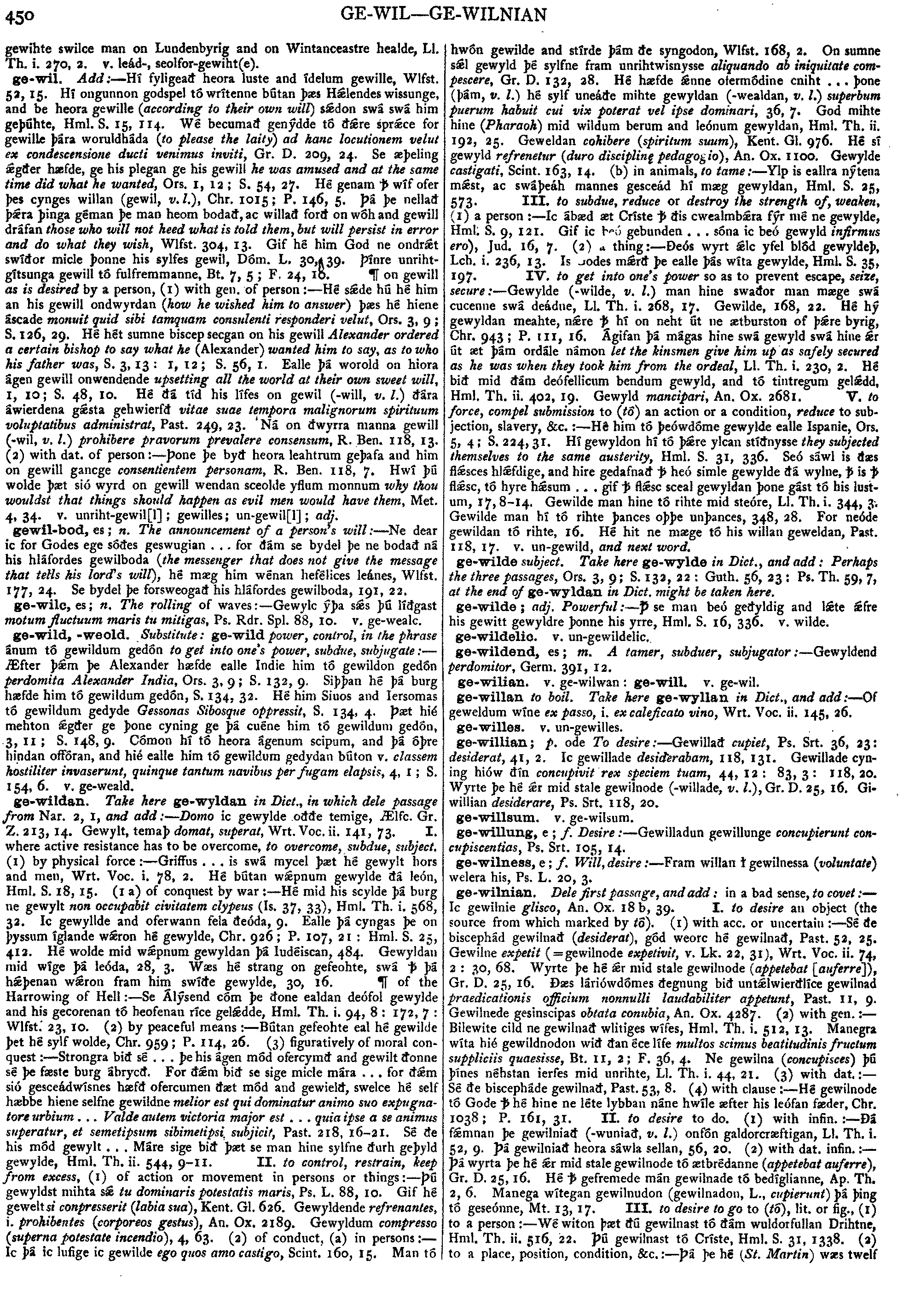
ge-wil.
Add:--Hí
fyligeað
heora
luste
and
ídelum
gewille,
Wlfst.
52,
15.
Hí
ongunnon
godspel
tó
wrítenne
bútan
þæs
Hlendes
wissunge,
and
be
heora
gewille
(according
to
their
own
will)
sdon
swá
swá
him
geþúhte,
Hml.
S.
15,
114.
Wé
becumað
genýdde
tó
ðre
sprce
for
gewille
þára
woruldháda
(to
please
the
laity)
ad
hanc
locutionem
velut
ex
condescensione
ducti
venimus
inviti,
Gr.
D.
209,
24.
Se
æþeling
gðer
hæfde,
ge
his
plegan
ge
his
gewill
he
was
amused
and
at
the
same
time
did
what
he
wanted,
Ors.
1,
12;
S.
54,
27.
Hé
genam
wíf
ofer
þes
cynges
willan
(gewil,
v.
l.),
Chr.
1015;
P.
146,
5.
Þá
þe
nellað
þra
þinga
géman
þe
man
heom
bodað,
ac
willað
forð
on
wóh
and
gewill
dráfan
those
who
will
not
heed
what
is
told
them,
but
will
persist
in
error
and
do
what
they
wish,
Wlfst.
304,
13.
Gif
hé
him
God
ne
ondrt
swíðor
micle
þonne
his
sylfes
gewil,
Dóm.
L.
30,
39.
Þínre
unrihtgítsunga
gewill
tó
fulfremmanne,
Bt.
7,
5;
F.
24,
10.

on
gewill
as
is
desired
by
a
person,
(1)
with
gen.
of
person:--Hé
sde
hú
hé
him
an
his
gewill
ondwyrdan
(how
he
wished
him
to
answer)
þæs
hé
hiene
áscade
monuit
quid
sibi
tamquam
consulenti
responderi
velut,
Ors.
3,
9;
S.
126,
29.
Hé
hét
sumne
biscep
secgan
on
his
gewill
Alexander
ordered
a
certain
bishop
to
say
what
he
(Alexander)
wanted
him
to
say,
as
to
who
his
father
was,
S.
3,
13:
1,
12;
S.
56,
1.
Ealle
þá
worold
on
hiora
ágen
gewill
onwendende
upsetting
all
the
world
at
their
own
sweet
will,
1,
10;
S.
48,
10.
Hé
ðá
tíd
his
lífes
on
gewil
(-will,
v.
l.)
ðára
áwierdena
gsta
gehwierfð
vitae
suae
tempora
malignorum
spirituum
voluptatibus
administrat,
Past.
249,
23.
'Ná
on
ðwyrra
manna
gewill
(-wil,
v.
l.)
prohibere
pravorum
prevalere
consensum,
R.
Ben.
118,
13.
(2)
with
dat.
of
person:--Þone
þe
byð
heora
leahtrum
geþafa
and
him
on
gewill
gancge
consentientem
personam,
R.
Ben.
118,
7.
Hwí
þú
wolde
þæt
sió
wyrd
on
gewill
wendan
sceolde
yflum
monnum
why
thou
wouldst
that
things
should
happen
as
evil
men
would
have
them,
Met.
4,
34.
v.
unriht-gewil[l];
gewilles;
un-gewil[l];
adj.
| Result Page: |  |
Previous | 1 2 3 4 5 | Next |  |
Germanic Lexicon Project (main page)
This search system was written by
Sean Crist
Please consider
volunteering
to correct the data in these online dictionaries.
No rights reserved. Feel free to use these data in any way you please.