|
|

Search for line again, using less strict matching (230 results)
|
Source: Bright's OE Grammar, page b0377, entry 2 View original page image as: [TIFF] [PNG] [View previous entry] [View next entry] |
[Comment on this entry] [View comments] |
The following entry has been hand-corrected once. |
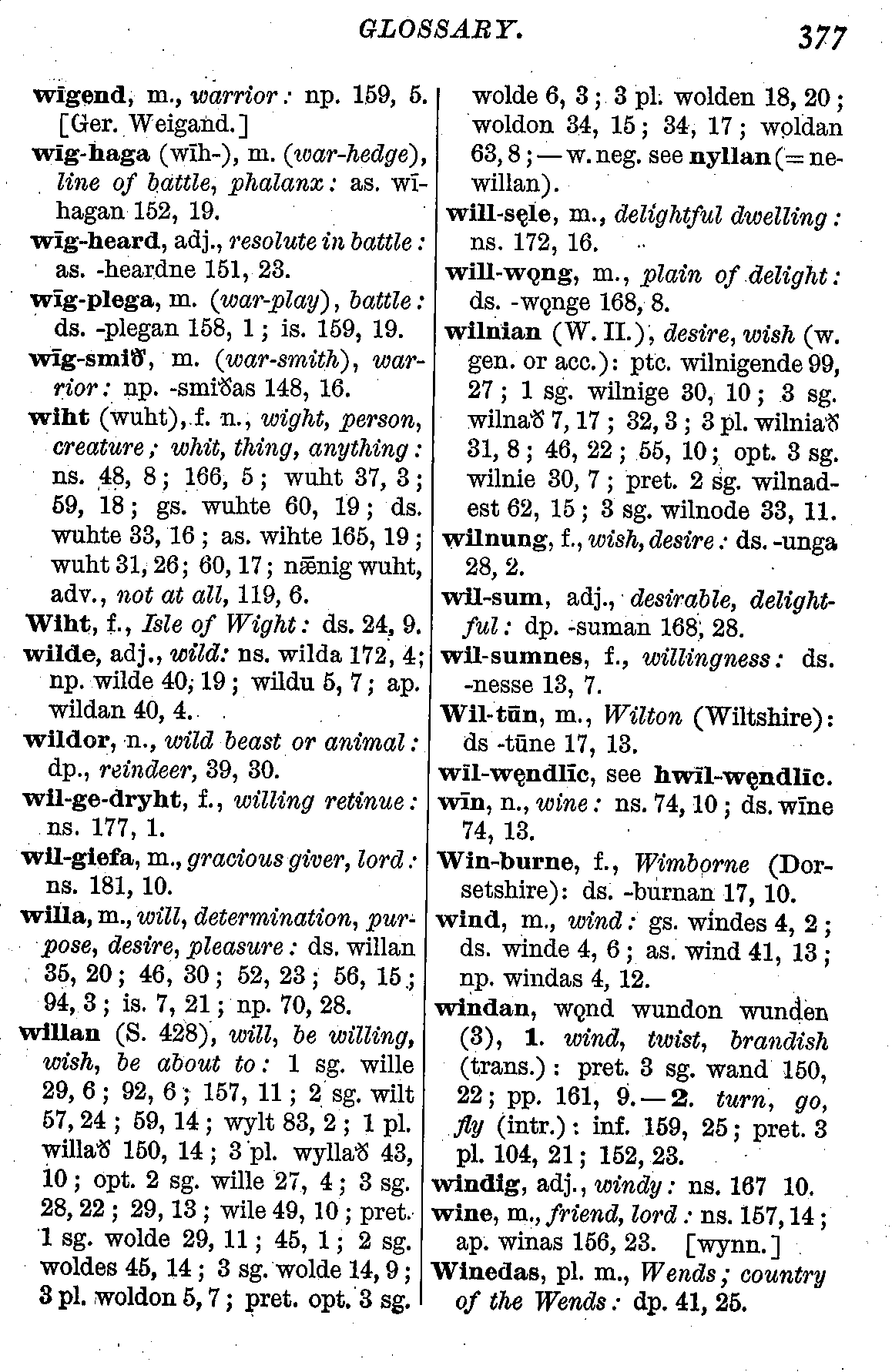
w g-haga
(wh-)
m
(war-hedge),
line
of
battle,
phalanx
g-haga
(wh-)
m
(war-hedge),
line
of
battle,
phalanx
|
Source: Cleasby/Vigfusson, page b0001, entry 1 View original page image as: [TIFF] [PNG] [View previous entry] [View next entry] |
[Comment on this entry] [View comments] |
The following entry has been hand-corrected once. |
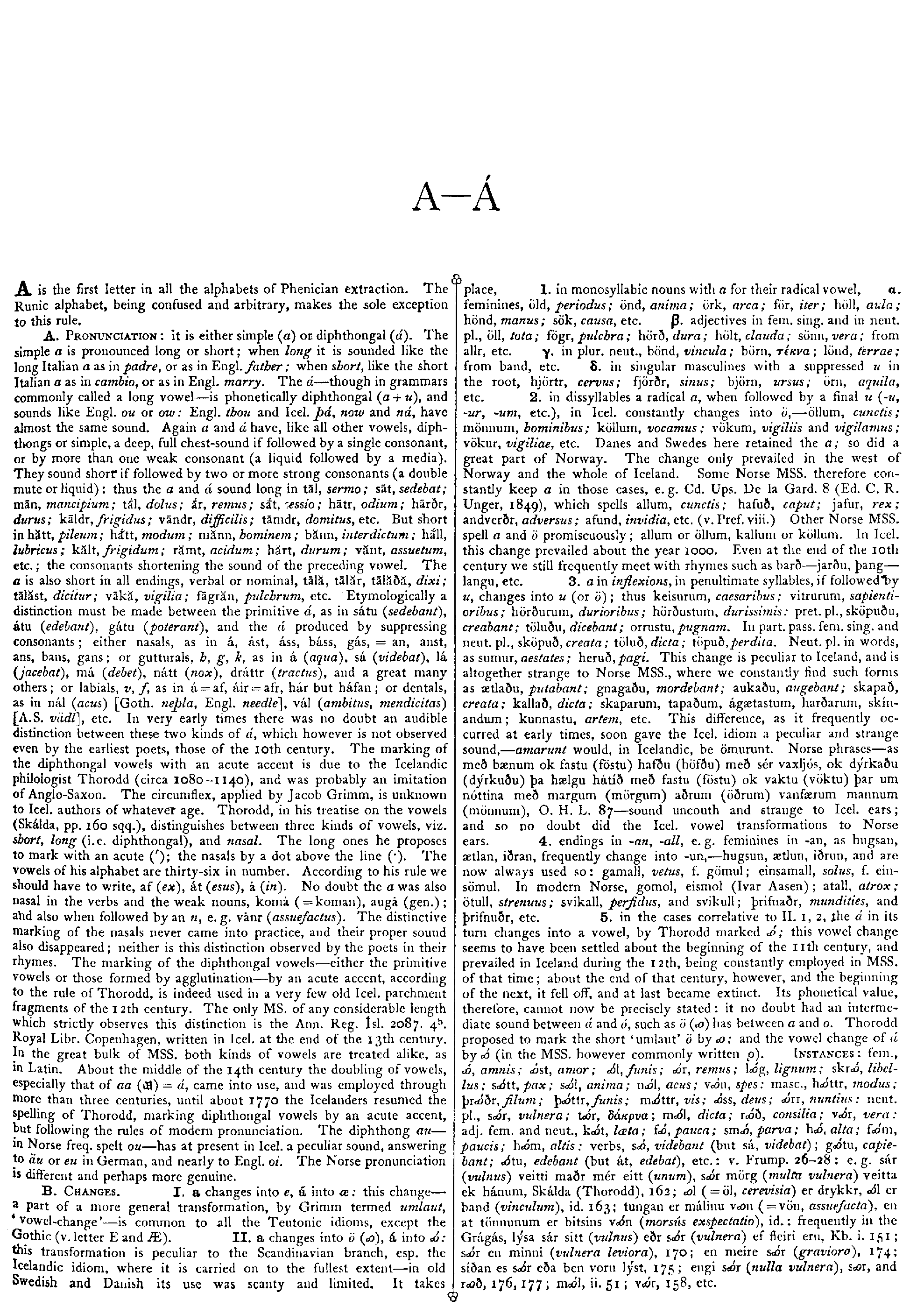
A.
is
the
first
letter
in
all
the
alphabets
of
Phenician
extraction.
The
Runic
alphabet,
being
confused
and
arbitrary,
makes
the
sole
exception
to
this
rule.
A.
PRONUNCIATION:
it
is
either
simple
(a)
or
diphthongal
(á).
The
simple
a
is
pronounced
long
or
short;
when
long
it
is
sounded
like
the
long
Italian
a
as
in
padre,
or
as
in
Engl.
father;
when
short,
like
the
short
Italian
a
as
in
cambio,
or
as
in
Engl.
marry.
The
á
--
though
in
grammars
commonly
called
a
long
vowel
--
is
phonetically
diphthongal
(a
+
u),
and
sounds
like
Engl.
ou
or
ow:
Engl.
thou
and
Icel.
þá,
now
and
ná,
have
almost
the
same
sound.
Again
a
and
á
have,
like
all
other
vowels,
diph-
thongs
or
simple,
a
deep,
full
chest-sound
if
followed
by
a
single
consonant,
or
by
more
than
one
weak
consonant
(a
liquid
followed
by
a
media).
They
sound
short
if
followed
by
two
or
more
strong
consonants
(a
double
mute
or
liquid):
thus
the
a
and
á
sound
long
in
tál,
sermo;
sát,
sedebat;
mán,
mancipium;
tál,
dolus;
ár,
remits;
sát,
sessio,
hátr,
odium;
hárðr,
durus;
káldr,
frigidus;
vándr,
difficilis;
támdr,
domitus,
etc.
But
short
in
hátt,
pileum;
hátt,
modum;
mánn,
bominem;
bánn,
interdictum;
háll,
lubricus;
kált,
frigidum;
rámt,
acidum;
hárt,
durum;
vánt,
assuetum,
etc.;
the
consonants
shortening
the
sound
of
the
preceding
vowel.
The
a
is
also
short
in
all
endings,
verbal
or
nominal,
tala,
talar,
talaða,
dixi;
talast,
dicitur;
vaka,
vigilia;
fagran,
pulchrum,
etc.
Etymologically
a
distinction
must
be
made
between
the
primitive
á,
as
in
sátu
(sedebant),
átu
(edebant),
gátu
(poterant),
and
the
á
produced
by
suppressing
consonants;
either
nasals,
as
in
á,
ást,
áss,
báss,
gás,
=
an,
anst,
ans,
bans,
gans;
or
gutturals,
h,
g,
k,
as
in
á
(aqua),
sá
(videbat),
lá
(jacebat),
má
(debet),
nátt
(nox),
dráttr
(tractus),
and
a
great
many
others;
or
labials,
v,
f,
as
in
á
=
af,
áir
=
afr,
hár
but
háfan;
or
dentals,
as
in
nál
(acus)
[Goth.
nepla,
Engl.
needle],
vál
(ambitus,
mendicitas)
[A.
S.
vädl],
etc.
In
very
early
times
there
was
no
doubt
an
audible
distinction
between
these
two
kinds
of
á,
which
however
is
not
observed
even
by
the
earliest
poets,
those
of
the
10th
century.
The
marking
of
the
diphthongal
vowels
with
an
acute
accent
is
due
to
the
Icelandic
philologist
Thorodd
(circa
1080-1140),
and
was
probably
an
imitation
of
Anglo-Saxon.
The
circumflex,
applied
by
Jacob
Grimm,
is
unknown
to
Icel.
authors
of
whatever
age.
Thorodd,
in
his
treatise
on
the
vowels
(Skálda,
pp.
160
sqq.),
distinguishes
between
three
kinds
of
vowels,
viz.
short,
long
(i.
e.
diphthongal),
and
nasal.
The
long
ones
he
proposes
to
mark
with
an
acute
( );
the
nasals
by
a
dot
above
the
line
(•).
The
vowels
of
his
alphabet
are
thirty-six
in
number.
According
to
his
rule
we
should
have
to
write,
af
(ex),
át
(esus),
ä
(in).
No
doubt
the
a
was
also
nasal
in
the
verbs
and
the
weak
nouns,
komå
(=
koman),
augä
(gen.);
and
also
when
followed
by
an
n,
e.
g.
vänr
(assuefactus).
The
distinctive
marking
of
the
nasals
never
came
into
practice,
and
their
proper
sound
also
disappeared;
neither
is
this
distinction
observed
by
the
poets
in
their
rhymes.
The
marking
of
the
diphthongal
vowels
--
either
the
primitive
vowels
or
those
formed
by
agglutination
--
by
an
acute
accent,
according
to
the
rule
of
Thorodd,
is
indeed
used
in
a
very
few
old
Icel.
parchment
fragments
of
the
12th
century.
The
only
MS.
of
any
considerable
length
which
strictly
observes
this
distinction
is
the
Ann.
Reg.
Ísl.
2087.
4b.
Royal
Libr.
Copenhagen,
written
in
Icel.
at
the
end
of
the
13th
century.
In
the
great
bulk
of
MSS.
both
kinds
of
vowels
are
treated
alike,
as
in
Latin.
About
the
middle
of
the
14th
century
the
doubling
of
vowels,
especially
that
of
aa
()
=
á,
came
into
use,
and
was
employed
through
more
than
three
centuries,
until
about
1770
the
Icelanders
resumed
the
spelling
of
Thorodd,
marking
diphthongal
vowels
by
an
acute
accent,
but
following
the
rules
of
modern
pronunciation.
The
diphthong
au
--
in
Norse
freq.
spelt
ou
--
has
at
present
in
Icel.
a
peculiar
sound,
answering
to
äu
or
eu
in
German,
and
nearly
to
Engl.
oi.
The
Norse
pronunciation
is
different
and
perhaps
more
genuine.
B.
CHANGES.
I.
a
changes
into
æ,
á
into
Æ:
this
change
--
a
part
of
a
more
general
transformation,
by
Grimm
termed
umlaut,
'vowel-change'
--
is
common
to
all
the
Teutonic
idioms,
except
the
Gothic
(v.
letter
E
and
Æ).
II.
a
changes
into
ö
(),
á
into
:
this
transformation
is
peculiar
to
the
Scandinavian
branch,
esp.
the
Icelandic
idiom,
where
it
is
carried
on
to
the
fullest
extent
--
in
old
Swedish
and
Danish
its
use
was
scanty
and
limited.
It
takes
place,
1.
in
monosyllabic
nouns
with
a
for
their
radical
vowel,
);
the
nasals
by
a
dot
above
the
line
(•).
The
vowels
of
his
alphabet
are
thirty-six
in
number.
According
to
his
rule
we
should
have
to
write,
af
(ex),
át
(esus),
ä
(in).
No
doubt
the
a
was
also
nasal
in
the
verbs
and
the
weak
nouns,
komå
(=
koman),
augä
(gen.);
and
also
when
followed
by
an
n,
e.
g.
vänr
(assuefactus).
The
distinctive
marking
of
the
nasals
never
came
into
practice,
and
their
proper
sound
also
disappeared;
neither
is
this
distinction
observed
by
the
poets
in
their
rhymes.
The
marking
of
the
diphthongal
vowels
--
either
the
primitive
vowels
or
those
formed
by
agglutination
--
by
an
acute
accent,
according
to
the
rule
of
Thorodd,
is
indeed
used
in
a
very
few
old
Icel.
parchment
fragments
of
the
12th
century.
The
only
MS.
of
any
considerable
length
which
strictly
observes
this
distinction
is
the
Ann.
Reg.
Ísl.
2087.
4b.
Royal
Libr.
Copenhagen,
written
in
Icel.
at
the
end
of
the
13th
century.
In
the
great
bulk
of
MSS.
both
kinds
of
vowels
are
treated
alike,
as
in
Latin.
About
the
middle
of
the
14th
century
the
doubling
of
vowels,
especially
that
of
aa
()
=
á,
came
into
use,
and
was
employed
through
more
than
three
centuries,
until
about
1770
the
Icelanders
resumed
the
spelling
of
Thorodd,
marking
diphthongal
vowels
by
an
acute
accent,
but
following
the
rules
of
modern
pronunciation.
The
diphthong
au
--
in
Norse
freq.
spelt
ou
--
has
at
present
in
Icel.
a
peculiar
sound,
answering
to
äu
or
eu
in
German,
and
nearly
to
Engl.
oi.
The
Norse
pronunciation
is
different
and
perhaps
more
genuine.
B.
CHANGES.
I.
a
changes
into
æ,
á
into
Æ:
this
change
--
a
part
of
a
more
general
transformation,
by
Grimm
termed
umlaut,
'vowel-change'
--
is
common
to
all
the
Teutonic
idioms,
except
the
Gothic
(v.
letter
E
and
Æ).
II.
a
changes
into
ö
(),
á
into
:
this
transformation
is
peculiar
to
the
Scandinavian
branch,
esp.
the
Icelandic
idiom,
where
it
is
carried
on
to
the
fullest
extent
--
in
old
Swedish
and
Danish
its
use
was
scanty
and
limited.
It
takes
place,
1.
in
monosyllabic
nouns
with
a
for
their
radical
vowel,
 .
feminines,
öld,
periodus;
önd,
anima;
örk,
arca;
för,
iter;
höll,
aula;
hönd,
manus;
sök,
causa,
etc.
.
feminines,
öld,
periodus;
önd,
anima;
örk,
arca;
för,
iter;
höll,
aula;
hönd,
manus;
sök,
causa,
etc.
 .
adjectives
in
fem.
sing,
and
in
neut.
pl.,
öll,
tota;
fögr,
pulchra;
hörð,
dura;
hölt,
clauda;
sönn,
vera;
from
allr,
etc.
.
adjectives
in
fem.
sing,
and
in
neut.
pl.,
öll,
tota;
fögr,
pulchra;
hörð,
dura;
hölt,
clauda;
sönn,
vera;
from
allr,
etc.
 .
in
plur.
neut.,
bönd,
vincula;
börn,
GREEK;
lönd,
terrae;
from
band,
etc.
.
in
plur.
neut.,
bönd,
vincula;
börn,
GREEK;
lönd,
terrae;
from
band,
etc.
 .
in
singular
masculines
with
a
suppressed
u
in
the
root,
hjörtr,
cervus;
fjörðr,
sinus;
björn,
ursus;
örn,
aquila,
etc.
2.
in
dissyllables
a
radical
a,
when
followed
by
a
final
u
(-u,
-ur,
-um,
etc.),
in
Icel.
constantly
changes
into
ö,
--
öllum,
cunctis;
mönnum,
hominibus;
köllum,
vocamus;
vökum,
vigiliis
and
vigilamus;
vökur,
vigiliae,
etc.
Danes
and
Swedes
here
retained
the
a;
so
did
a
great
part
of
Norway.
The
change
only
prevailed
in
the
west
of
Norway
and
the
whole
of
Iceland.
Some
Norse
MSS.
therefore
con-
stantly
keep
a
in
those
cases,
e.
g.
Cd.
Ups.
De
la
Gard.
8
(Ed.
C.
R.
Unger,
1849),
which
spells
allum,
cunctis;
hafuð,
caput;
jafur,
rex;
andverðr,
adversus;
afund,
invidia,
etc.
(v.
Pref.
viii.)
Other
Norse
MSS.
spell
a
and
ö
promiscuously;
allum
or
öllum,
kallum
or
köllum.
In
Icel.
this
change
prevailed
about
the
year
1000.
Even
at
the
end
of
the
loth
century
we
still
frequently
meet
with
rhymes
such
as
barð
--
jarðu,
þang
--
langu,
etc.
3.
a
in
inflexions,
in
penultimate
syllables,
if
followed
by
u,
changes
into
u
(or
ö);
thus
keisurum,
caesaribus;
vitrurum,
sapienti-
oribus;
hörðurum,
durioribus;
hörðustum,
durissimis:
pret.
pl.,
sköpuðu,
creabant;
töluðu,
dicebant;
orrustu,
pugnam.
In
part.
pass.
fem.
sing,
and
neut.
pl.,
sköpuð,
creata;
töluð,
dicta;
töpuð,
perdi/
a.
Neut.
pl.
in
words,
as
sumur,
aestates;
heruð,
pagi.
This
change
is
peculiar
to
Iceland,
and
is
altogether
strange
to
Norse
MSS.,
where
we
constantly
find
such
forms
as
ætlaðu,
putabant;
gnagaðu,
mordebant;
aukaðu,
augebant;
skapað,
creata;
kallað,
dicta;
skaparum,
tapaðum,
ágætastum,
harðarum,
skín-
andum;
kunnastu,
artem,
etc.
This
difference,
as
it
frequently
oc-
curred
at
early
times,
soon
gave
the
Icel.
idiom
a
peculiar
and
strange
sound,
--
amarunt
would,
in
Icelandic,
be
ömurunt.
Norse
phrases
--
as
með
bænum
ok
fastu
(fostu)
hafðu
(höfðu)
með
sér
vaxljós,
ok
dýrkaðu
(dýrkuðu)
þa
hælgu
hátíð
með
fastu
(föstu)
ok
vaktu
(vöktu)
þar
um
nóttina
með
margum
(mörgum)
aðrum
(öðrum)
vanfærum
mannum
(monnum),
O.
H.
L.
87
--
sound
uncouth
and
strange
to
Icel.
ears;
and
so
no
doubt
did
the
Icel.
vowel
transformations
to
Norse
ears.
4.
endings
in
-an,
-all,
e.
g.
feminines
in
-an,
as
hugsan,
ætlan,
iðran,
frequently
change
into
-un,
--
hugsun,
ætlun,
iðrun,
and
are
now
always
used
so:
gamall,
vetus,
f.
gömul;
einsamall,
solus,
f.
ein-
sömul.
In
modern
Norse,
gomol,
eismol
(Ivar
Aasen);
atall,
atrox;
ötull,
strenuus;
svikall,
perfidus,
and
svikull;
þrifnaðr,
mundities,
and
þrifnuðr,
etc.
5.
in
the
cases
correlative
to
II.
1,
2,
the
á
in
its
turn
changes
into
a
vowel,
by
Thorodd
marked
;
this
vowel
change
seems
to
have
been
settled
about
the
beginning
of
the
11th
century,
and
prevailed
in
Iceland
during
the
12th,
being
constantly
employed
in
MSS.
of
that
time;
about
the
end
of
that
century,
however,
and
the
beginning
of
the
next,
it
fell
off,
and
at
last
became
extinct.
Its
phonetical
value,
therefore,
cannot
now
be
precisely
stated:
it
no
doubt
had
an
interme-
diate
sound
between
á
and
ó,
such
as
ö
(oo)
has
between
a
and
o.
Thorodd
proposed
to
mark
the
short
'umlaut'
ö
by
;
and
the
vowel
change
of
á
by
(in
the
MSS.
however
commonly
written
).
INSTANCES:
fcm.,
,
amnis;
st,
amor;
l,
funis;
r,
remits;
lg,
lignum;
skr,
libel-
lus;
stt,
pax;
sl,
anima;
nl,
acus;
vn,
spes:
masc.,
httr,
modus;
þrðr,
fîlum;
þttr,
funis;
mttr,
vis;
ss,
deus;
rr,
nuntius:
neut.
pl.,
sr,
vulnera;
tr,
GREEK;
ml,
dicta;
rð,
consilia;
vr,
vera:
adj.
fem,
and
neut.,
koát,
læta;
f,
pauca;
sm,
parva;
h,
alta;
fm,
paucis;
hm,
altis:
verbs,
s,
videbant
(but
sá,
videbat);
gtu,
capie-
bant;
tu,
edebant
(but
at,
edebat),
etc.:
v.
Frump.
26-28:
e.
g.
sár
(vulnus)
veitti
maðr
mer
eitt
(unum),
sr
mörg
(multa
vulnera)
veitta
ek
hánum,
Skálda
(Thorodd),
162;
l
(=
öl,
cerevisia)
er
drykkr,
l
er
band
(vinculum),
id.
163;
tungan
er
málinu
vn
(=
vön,
assuefacta),
en
at
tönnunum
er
bitsins
vn
(morsils
exspectatio),
id.:
frequently
in
the
Grágás,
lýsa
sár
sitt
(vulnus)
eðr
sr
(vulnera)
ef
fleiri
eru,
Kb.
i.
151;
sr
en
minni
(vulnera
leviora),
170;
en
meire
sr
(graviora),
174;
síðan
es
sr
eða
ben
voru
lýst,
175;
engi
sr
(nulla
vulnera),
sr,
and
rð,
176,
177;
ml,
ii.
51;
vr,
158,
.
in
singular
masculines
with
a
suppressed
u
in
the
root,
hjörtr,
cervus;
fjörðr,
sinus;
björn,
ursus;
örn,
aquila,
etc.
2.
in
dissyllables
a
radical
a,
when
followed
by
a
final
u
(-u,
-ur,
-um,
etc.),
in
Icel.
constantly
changes
into
ö,
--
öllum,
cunctis;
mönnum,
hominibus;
köllum,
vocamus;
vökum,
vigiliis
and
vigilamus;
vökur,
vigiliae,
etc.
Danes
and
Swedes
here
retained
the
a;
so
did
a
great
part
of
Norway.
The
change
only
prevailed
in
the
west
of
Norway
and
the
whole
of
Iceland.
Some
Norse
MSS.
therefore
con-
stantly
keep
a
in
those
cases,
e.
g.
Cd.
Ups.
De
la
Gard.
8
(Ed.
C.
R.
Unger,
1849),
which
spells
allum,
cunctis;
hafuð,
caput;
jafur,
rex;
andverðr,
adversus;
afund,
invidia,
etc.
(v.
Pref.
viii.)
Other
Norse
MSS.
spell
a
and
ö
promiscuously;
allum
or
öllum,
kallum
or
köllum.
In
Icel.
this
change
prevailed
about
the
year
1000.
Even
at
the
end
of
the
loth
century
we
still
frequently
meet
with
rhymes
such
as
barð
--
jarðu,
þang
--
langu,
etc.
3.
a
in
inflexions,
in
penultimate
syllables,
if
followed
by
u,
changes
into
u
(or
ö);
thus
keisurum,
caesaribus;
vitrurum,
sapienti-
oribus;
hörðurum,
durioribus;
hörðustum,
durissimis:
pret.
pl.,
sköpuðu,
creabant;
töluðu,
dicebant;
orrustu,
pugnam.
In
part.
pass.
fem.
sing,
and
neut.
pl.,
sköpuð,
creata;
töluð,
dicta;
töpuð,
perdi/
a.
Neut.
pl.
in
words,
as
sumur,
aestates;
heruð,
pagi.
This
change
is
peculiar
to
Iceland,
and
is
altogether
strange
to
Norse
MSS.,
where
we
constantly
find
such
forms
as
ætlaðu,
putabant;
gnagaðu,
mordebant;
aukaðu,
augebant;
skapað,
creata;
kallað,
dicta;
skaparum,
tapaðum,
ágætastum,
harðarum,
skín-
andum;
kunnastu,
artem,
etc.
This
difference,
as
it
frequently
oc-
curred
at
early
times,
soon
gave
the
Icel.
idiom
a
peculiar
and
strange
sound,
--
amarunt
would,
in
Icelandic,
be
ömurunt.
Norse
phrases
--
as
með
bænum
ok
fastu
(fostu)
hafðu
(höfðu)
með
sér
vaxljós,
ok
dýrkaðu
(dýrkuðu)
þa
hælgu
hátíð
með
fastu
(föstu)
ok
vaktu
(vöktu)
þar
um
nóttina
með
margum
(mörgum)
aðrum
(öðrum)
vanfærum
mannum
(monnum),
O.
H.
L.
87
--
sound
uncouth
and
strange
to
Icel.
ears;
and
so
no
doubt
did
the
Icel.
vowel
transformations
to
Norse
ears.
4.
endings
in
-an,
-all,
e.
g.
feminines
in
-an,
as
hugsan,
ætlan,
iðran,
frequently
change
into
-un,
--
hugsun,
ætlun,
iðrun,
and
are
now
always
used
so:
gamall,
vetus,
f.
gömul;
einsamall,
solus,
f.
ein-
sömul.
In
modern
Norse,
gomol,
eismol
(Ivar
Aasen);
atall,
atrox;
ötull,
strenuus;
svikall,
perfidus,
and
svikull;
þrifnaðr,
mundities,
and
þrifnuðr,
etc.
5.
in
the
cases
correlative
to
II.
1,
2,
the
á
in
its
turn
changes
into
a
vowel,
by
Thorodd
marked
;
this
vowel
change
seems
to
have
been
settled
about
the
beginning
of
the
11th
century,
and
prevailed
in
Iceland
during
the
12th,
being
constantly
employed
in
MSS.
of
that
time;
about
the
end
of
that
century,
however,
and
the
beginning
of
the
next,
it
fell
off,
and
at
last
became
extinct.
Its
phonetical
value,
therefore,
cannot
now
be
precisely
stated:
it
no
doubt
had
an
interme-
diate
sound
between
á
and
ó,
such
as
ö
(oo)
has
between
a
and
o.
Thorodd
proposed
to
mark
the
short
'umlaut'
ö
by
;
and
the
vowel
change
of
á
by
(in
the
MSS.
however
commonly
written
).
INSTANCES:
fcm.,
,
amnis;
st,
amor;
l,
funis;
r,
remits;
lg,
lignum;
skr,
libel-
lus;
stt,
pax;
sl,
anima;
nl,
acus;
vn,
spes:
masc.,
httr,
modus;
þrðr,
fîlum;
þttr,
funis;
mttr,
vis;
ss,
deus;
rr,
nuntius:
neut.
pl.,
sr,
vulnera;
tr,
GREEK;
ml,
dicta;
rð,
consilia;
vr,
vera:
adj.
fem,
and
neut.,
koát,
læta;
f,
pauca;
sm,
parva;
h,
alta;
fm,
paucis;
hm,
altis:
verbs,
s,
videbant
(but
sá,
videbat);
gtu,
capie-
bant;
tu,
edebant
(but
at,
edebat),
etc.:
v.
Frump.
26-28:
e.
g.
sár
(vulnus)
veitti
maðr
mer
eitt
(unum),
sr
mörg
(multa
vulnera)
veitta
ek
hánum,
Skálda
(Thorodd),
162;
l
(=
öl,
cerevisia)
er
drykkr,
l
er
band
(vinculum),
id.
163;
tungan
er
málinu
vn
(=
vön,
assuefacta),
en
at
tönnunum
er
bitsins
vn
(morsils
exspectatio),
id.:
frequently
in
the
Grágás,
lýsa
sár
sitt
(vulnus)
eðr
sr
(vulnera)
ef
fleiri
eru,
Kb.
i.
151;
sr
en
minni
(vulnera
leviora),
170;
en
meire
sr
(graviora),
174;
síðan
es
sr
eða
ben
voru
lýst,
175;
engi
sr
(nulla
vulnera),
sr,
and
rð,
176,
177;
ml,
ii.
51;
vr,
158,
|
Source: Cleasby/Vigfusson, page b0004, entry 1 View original page image as: [TIFF] [PNG] [View previous entry] [View next entry] |
[Comment on this entry] [View comments (1)] |
The following entry has been hand-corrected once. |
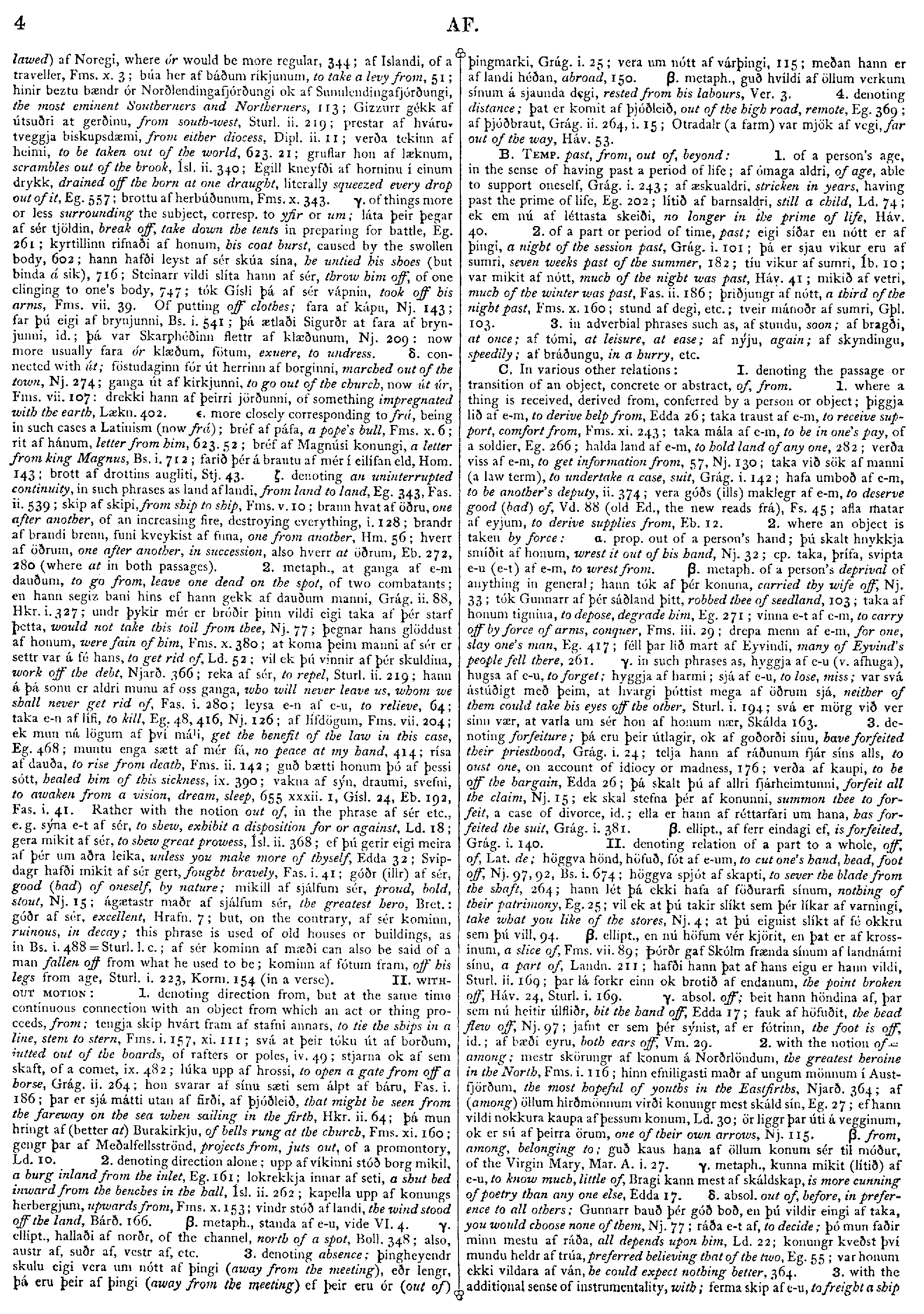
lawed)
af
Noregi,
where
ór
would
be
more
regular,
344;
af
Islandi,
of
a
traveller,
Fms.
x.
3;
búa
her
af
báðum
ríkjunum,
to
take
a
levy
from,
51;
hinir
beztu
bændr
ór
Norðlendingafjórðungi
ok
af
Sunnlendingafjórðungi,
the
most
eminent
Southerners
and
Northerners,
113;
Gizzurr
gékk
af
útsuðri
at
gerðinu,
from
south-west,
Sturl.
ii.
219;
prestar
af
hváru-
tveggja
biskupsdæmi,
from
either
diocess,
Dipl.
ii.
11;
verða
tekinn
af
heimi,
to
be
taken
out
of
the
world,
623.
21;
gruflar
hon
af
læknum,
scrambles
out
of
the
brook,
Ísl.
ii.
340;
Egill
kneyfði
af
horninu
í
einum
drykk,
drained
off
the
horn
at
one
draught,
literally
squeezed
every
drop
out
of
it,
Eg.
557;
brottuaf
herbúðunurn,
Fms.
x.
343.
of
things
more
or
less
surrounding
the
subject,
corresp.
to
yfir
or
um;
láta
þeir
þegar
af
sér
tjöldin,
break
off,
take
down
the
tents
in
preparing
for
battle,
Eg.
261;
kyrtillinn
rifnaði
af
honum,
his
coat
burst,
caused
by
the
swollen
body,
602;
hann
hafði
leyst
af
sér
skúa
sína,
he
untied
his
shoes
(but
binda
á
sik),
716;
Steinarr
vildi
slíta
hann
af
sér,
throw
him
off,
of
one
clinging
to
one's
body,
747;
tók
Gísli
þá
af
sér
vápnin,
took
off
his
arms,
Fms.
vii.
39.
Of
putting
off
clothes;
fara
af
kápu,
Nj.
143;
far
þú
eigi
af
brynjunni,
Bs.
i.
541;
þá
ætlaði
Sigurðr
at
fara
af
bryn-
junni,
id.;
þá
var
Skarphóðinn
flettr
af
klæðunum,
Nj.
209:
now
more
usually
fara
or
klæðum,
fötum,
exuere,
to
undress.
.
con-
nected
with
út;
föstudaginn
for
út
herrinn
af
borginni,
marched
out
of
the
town,
Nj.
274;
ganga
út
af
kirkjunni,
to
go
out
of
the
church,
now
út
úr,
Fms.
vii.
107:
drekki
hann
af
þeirri
jörðunni,
of
something
impregnated
with
the
earth,
Laekn.
402.
 .
more
closely
corresponding
to
frá,
being
in
such
cases
a
Latinism
(now
frá);
bréf
af
páfa,
a
pope's
bull,
Fms.
x.
6;
rit
af
hánum,
letter
from
him,
623.
52;
bréf
af
Magnúsi
konungi,
a
letter
from
king
Magnus,
Bs.
i.
712;
farið
þér
á
brautu
af
mér
í
eilífan
eld,
Hom.
143;
brott
af
drottins
augliti,
Stj.
43.
.
more
closely
corresponding
to
frá,
being
in
such
cases
a
Latinism
(now
frá);
bréf
af
páfa,
a
pope's
bull,
Fms.
x.
6;
rit
af
hánum,
letter
from
him,
623.
52;
bréf
af
Magnúsi
konungi,
a
letter
from
king
Magnus,
Bs.
i.
712;
farið
þér
á
brautu
af
mér
í
eilífan
eld,
Hom.
143;
brott
af
drottins
augliti,
Stj.
43.
 .
denoting
an
uninterrupted
continuity,
in
such
phrases
as
land
aflandi,
from
land
to
land,
Eg.
343,
Fas.
ii.
539;
skip
af
skipl.
from
ship
to
ship,
Fms.
v.
10;
brann
hvat
af
öðru,
one
after
another,
of
an
increasing
fire,
destroying
everything,
i.
128;
brandr
af
brandi
brenn,
funi
kveykist
af
funa,
one
from
another,
Hm.
56;
hverr
af
öðrum,
one
after
another,
in
succession,
also
hverr
at
öðrum,
Eb.
272,
280
(where
at
in
both
passages).
2.
metaph.,
at
ganga
af
e-m
dauðum,
to
go
from,
leave
one
dead
on
the
spot,
of
two
combatants;
en
hann
segiz
bani
hins
ef
hann
gekk
af
dauðum
manni,
Grág.
ii.
88,
Hkr.
1.
327;
undr
þykir
mér
er
bróðir
þinn
vildi
eigi
taka
af
þér
starf
þetta,
would
not
take
this
toil
from
thee,
Nj.
77;
þegnar
hans
glöddust
af
honum,
were
fain
of
him,
Fms.
x.
380;
at
koma
þeim
manni
af
sér
er
settr
var
á
fé
hans,
to
get
rid
of,
Ld.
52;
vil
ek
þú
vinriir
af
þér
skuldina,
work
off
the
debt,
Njarð.
366;
reka
af
sér,
to
repel,
Sturl.
ii.
219;
hann
á
þá
sonu
er
aldri
munu
af
oss
ganga,
who
will
never
leave
us,
whom
we
shall
never
get
rid
of,
Fas.
i.
280;
leysa
e-n
af
e-u,
to
relieve,
64;
taka
e-n
af
lífi,
to
kill,
Eg.
48,
416,
Nj.
126;
af
lífdögum,
Fms.
vii.
204;
ek
mun
ná
lögum
af
því
???,
get
the
benefit
of
the
law
in
this
case,
Eg.
468;
muntu
enga
sætt
af
mér
fá,
no
peace
at
my
hand,
414;
rísa
af
dauða,
to
rise
from
death,
Fms.
ii.
142;
guð
bætti
honum
þó
af
þessi
sótt,
healed
him
of
this
sickness,
ix.
390;
vakna
af
sýn,
draumi,
svefni,
to
awaken
from
a
vision,
dream,
sleep,
655
xxxii.
I,
Gísl.
24,
Eb.
192,
Fas.
i.
41.
Rather
with
the
notion
out
of,
in
the
phrase
af
sér
etc.,
e.
g.
sýna
e-t
af
scr,
to
shew,
exhibit
a
disposition
for
or
against,
Ld.
18;
gera
mikit
af
sér,
to
shew
great
prowess,
Ísl.
ii.
368;
éf
þú
gerir
eigi
meira
af
þér
um
aðra
leika,
unless
you
make
more
of
thyself,
Edda
32;
Svip-
dagr
hafði
mikit
af
sér
gert,
fought
bravely,
Fas.
i.
41;
góðr
(illr)
af
sér,
good
(bad)
of
oneself,
by
nature;
mikill
af
sjálfum
sér,
proud,
bold,
stout,
Nj.
15;
ágætastr
maðr
af
sjálfum
sér,
the
greatest
hero,
Bret.:
góðr
af
ser,
excellent,
Hrafn.
7;
but,
on
the
contrary,
af
sér
kominn,
ruinous,
in
decay;
this
phrase
is
used
of
old
houses
or
buildings,
as
in
Bs.
i.
488
=
Sturl.
l.
c.;
af
sér
kominn
af
mæði
can
also
be
said
of
a
man
fallen
off
from
what
he
used
to
be;
kominn
af
fotum
fram,
off
his
legs
from
age,
Sturl.
i.
223,
Korm.
154
(in
a
verse).
II.
WITH-
OUT
MOTION:
1.
denoting
direction
from,
but
at
the
same
time
continuous
connection
with
an
object
from
which
an
act
or
thing
pro-
ceeds,
from;
tengja
skip
hvárt
fram
af
stafni
annars,
to
tie
the
ships
in
a
line,
stem
to
stern,
Fms.
i.
157,
xi.
111;
svá
at
þeir
tóku
út
af
borðum,
jutted
out
of
the
boards,
of
rafters
or
poles,
iv.
49;
stjarna
ok
af
sem
skaft,
of
a
comet,
ix.
482;
lúka
upp
af
hrossi,
to
open
a
gate
from
off
a
horse,
Grág.
ii.
264;
hon
svarar
af
sínu
sæti
sem
álpt
af
baru,
Fás.
i.
186;
þar
er
sjá
mátti
utau
af
firði,
af
þjóðleið,
that
might
be
seen
from
the
fareway
on
the
sea
when
sailing
in
the
firth,
Hkr.
ii.
64;
þá
mun
hringt
af
(better
at)
Burakirkju,
of
bells
rung
at
the
church,
Fms.
xi.
160;
gengr
þar
af
Meðalfellsströnd,
projects
from,
juts
out,
of
a
promontory,
Ld.
10.
2.
denoting
direction
alone;
upp
af
víkinni
stóð
borg
mikil,
a
burg
inland
from
the
inlet,
Eg.
161;
lokrekkja
innar
af
seti,
a
shut
bed
inward
from
the
benches
in
the
hall,
Ísl.
ii.
262;
kapella
upp
af
konungs
herbergjum,
upwards
from,
Fms.
x.
153;
vindr
stóð
af
landi,
the
wind
stood
off
the
land,
Bárð.
166.
.
metaph.,
stauda
af
e-u,
vide
VI.
4.
.
ellipt.,
hallaði
af
norðr,
of
the
channel,
north
of
a
spot,
Boll.
348;
also,
austr
af,
suðr
af,
vestr
af,
etc.
3.
denoting
absence;
þingheyendr
skulu
eigi
vera
um
nótt
af
þingi
(away
from
the
meeting),
eðr
lengr,
þá
eru
þeir
af
þingi
(away
from
(be
meeting)
ef
þeir
eru
or
(out
of)
þingmarki,
Grág.
i.
25;
vera
um
nótt
af
várþingi,
115;
meðan
hann
er
af
landi
héðan,
abroad,
150.
.
metaph.,
gud
hvíldi
af
öllum
verkum
sínum
á
sjaunda
degi,
rested
from
his
labours,
Ver.
3.
4.
denoting
distance;
þat
er
komit
af
þjóðleið,
out
of
the
high
road,
remote,
Eg.
369;
af
þjóðbraut,
Grág.
ii.
264,
i.
15;
Otradalr
(a
farm)
var
mjök
af
vegi,
far
out
of
the
way,
Háv.
53.
B.
TEMP,
past,
from,
out
of,
beyond:
1.
of
a
person's
age,
in
the
sense
of
having
past
a
period
of
life;
af
ómaga
aldri,
of
age,
able
to
support
oneself,
Grág.
i.
243;
af
aeskualdri,
stricken
in
years,
having
past
the
prime
of
life,
Eg.
202;
lítið
af
barnsaldri,
still
a
child,
Ld.
74;
ek
em
nú
af
léttasia
skeiði,
no
longer
in
the
prime
of
life,
Háv.
40.
2.
of
a
part
or
period
of
time,
past;
eigi
síðar
en
nótt
er
af
þingi,
a
night
of
the
session
past,
Grág.
i.
101;
þá
er
sjau
vikur
eru
af
sumri,
seven
weeks
past
of
the
summer,
182;
tíu
vikur
af
sumri,
Íb.
10;
var
mikit
af
nótt,
much
of
the
night
was
past,
Háv.
41;
mikið
af
vetri,
much
of
the
winter
was
past,
Fas.
ii.
186;
þriðjungr
af
nótt,
a
third
of
the
night
past,
Fms.
x.
160;
stund
af
degi,
etc.;
tveir
mánoðr
af
sumri,
Gþl.
103.
3.
in
adverbial
phrases
such
as,
af
stundu,
soon;
af
bragði,
at
once;
af
tómi,
at
leisure,
at
ease;
af
nýju,
again;
af
skyndingu,
speedily;
af
bráðungu,
in
a
hurry,
etc.
C.
In
various
other
relations:
I.
denoting
the
passage
or
transition
of
an
object,
concrete
or
abstract,
of,
from.
1.
where
a
thing
is
received,
derived
from,
conferred
by
a
person
or
object;
þiggja
lið
af
e-m,
to
derive
help
from,
Edda
26;
taka
traust
af
e-m,
to
receive
sup-
port,
comfort
from,
Fms.
xi.
243;
taka
mála
af
e-m,
to
be
in
one's
pay,
of
a
soldier,
Eg.
266;
halda
land
af
e-m,
to
hold
land
of
any
one,
282;
verða
viss
af
e-m,
to
get
information
from,
57,
Nj.
130;
taka
við
sök
af
manni
(a
law
term),
to
undertake
a
case,
suit,
Grág.
i.
142;
hafa
umboð
af
e-m,
to
be
another's
deputy,
ii.
374;
vera
góðs
(ills)
maklegr
af
e-m,
to
deserve
good
(bad)
of,
Vd.
88
(old
Ed.,
the
new
reads
frá),
Fs.
45;
afla
matar
af
eyjum,
to
derive
supplies
from,
Eb.
12.
2.
where
an
object
is
taken
by
force:
.
prop.
out
of
a
person's
hand;
þú
skalt
hnykkja
smíðit
af
honum,
wrest
it
out
of
his
hand,
Nj.
32;
cp.
taka,
þrífa,
svipta
e-u
(e-t)
af
e-m,
to
wrest
from.
.
metaph.
of
a
person's
deprival
of
anything
in
general;
hann
tók
af
þér
konuna,
carried
thy
wife
off,
Nj.
33;
tók
Gunnarr
af
þér
sáðland
þitt,
robbed
thee
of
seedland,
103;
taka
af
honum
tignina,
to
depose,
degrade
him,
Eg.
271;
vinna
e-t
af
e-m,
to
carry
off
by
force
of
arms,
conquer,
Fms.
iii.
29;
drepa
menu
af
e-m,
for
one,
slay
one's
man,
Eg.
417;
fell
þar
lið
mart
af
Eyvindi,
many
of
Eyvind's
people
fell
there,
261.
.
in
such
phrases
as,
hyggja
af
e-u
(v.
afhuga),
hugsa
af
e-u,
to
forget;
hyggja
af
harmi;
sjá
af
e-u,
to
lose,
miss;
var
svá
ástúðigt
með
þeim,
at
livargi
þóttist
mega
af
öðrum
sjá,
neither
of
them
could
take
his
eyes
off
the
other,
Sturl.
i.
194;
svá
er
mörg
við
ver
sinn
vær,
at
varla
um
sér
hon
af
hoiuun
nær,
Skálda
163.
3.
de-
noting
forfeiture;
þá
eru
þeir
útlagir,
ok
af
goðorði
sínu,
have
forfeited
their
priesthood,
Grág.
i.
24;
telja
hann
af
ráðunum
fjár
síns
alls,
to
oust
one,
on
account
of
idiocy
or
madness,
176;
verða
af
kaupi,
to
be
off
the
bargain,
Edda
26;
þá
skalt
þú
af
allri
fjárheimtunni,
forfeit
all
the
claim,
Nj.
15;
ek
skal
stefna
þér
af
konunni,
summon
thee
to
for-
feit,
a
case
of
divorce,
id.;
ella
er
hann
af
rettarfari
um
hana,
has
for-
feited
the
suit,
Grág.
i.
381.
.
ellipt.,
af
ferr
eindagi
ef,
is
forfeited,
Grág.
i.
140.
II.
denoting
relation
of
a
part
to
a
whole,
off,
of,
Lat.
de;
höggva
hönd,
höfuð,
fót
af
e-um,
to
cut
one's
hand,
head,
foot
off,
Nj.
97,
92,
Bs.
i.
674;
höggva
spjót
af
skapti,
to
sever
the
blade
from
the
shaft,
264;
hann
lét
þá
ekki
hafa
af
föðurarfi
sínum,
nothing
of
their
patrimony,
Eg.
25;
vil
ek
at
þú
takir
slíkt
sem
þér
líkar
af
varningi,
take
what
you
like
of
the
stores,
Nj.
4;
at
þú
eignist
slíkt
af
fé
okkru
sem
þú
vili,
94.
.
ellipt.,
en
nú
höfum
vér
kjörit,
en
þat
er
af
kross-
inum,
a
slice
of,
Fms.
vii.
89;
þórðr
gaf
Skólm
frænda
sínum
af
landnámi
sínu,
a
part
of,
Landn.
211;
hafði
hann
þat
af
hans
eigu
er
hann
vildi,
Sturl.
ii.
169;
þar
lá
forkr
einn
ok
brotið
af
endanum,
the
point
broken
off,
Háv.
24,
Sturl.
i.
169.
.
absol.
off;
beit
hann
höndina
af,
þar
sem
nú
heitir
úlfliðr,
bit
the
hand
off,
Edda
17;
fauk
af
höfuðit,
the
head
flew
off,
Nj.
97;
jafnt
er
sem
þér
synist,
af
er
fótrinn,
the
foot
is
off,
id.;
af
bæði
eyru,
both
ears
off,
Vm.
29.
2.
with
the
notion
of
--
among;
mestr
skörungr
af
konum
á
Norðrlöndum,
the
greatest
heroine
in
the
North,
Fms.
i.
116;
hinn
efniligasti
maðr
af
ungum
mönnum
í
Aust-
fjörðum,
the
most
hopeful
of
youths
in
the
Eastfirths,
Njarð.
364;
af
(among)
öllurn
hirðmönnuni
virði
konungr
mest
skáld
sín,
Eg.
27;
ef
hann
vildi
nokkura
kaupa
af
þessum
konum,
Ld.
30;
ör
liggr
þar
útiá
vegginum,
ok
er
sú
af
þeirra
örum,
one
of
their
own
arrows,
Nj.
115.
.
from,
among,
belonging
to;
guð
kaus
hana
af
ollum
konum
sér
til
móður,
of
the
Virgin
Mary,
Mar.
A.
i.
27.
.
metaph.,
kunna
mikit
(lítið)
af
e-u,
to
know
much,
little
of,
Bragi
kann
mest
af
skáldskap,
is
more
cunning
of
poetry
than
any
one
else,
Edda
17.
.
absol.
out
of,
before,
in
prefer-
ence
to
all
others;
Gunnarr
bauð
þér
góð
boð,
en
þú
vildir
eingi
af
taka,
you
would
choose
none
of
them,
Nj.
77;
ráða
e-t
af,
to
decide;
þó
mun
faðir
minn
mestu
af
ráða,
all
depends
upon
him,
Ld.
22;
konungr
kveðst
því
mundu
heldr
af
trúa,
preferred
believing
that
of
the
two,
Eg.
55;
var
honum
ekki
vildara
af
ván,
he
could
expect
nothing
better,
364.
3.
with
the
additional
sense
of
instrumentality,
with;
ferma
skip
af
e-u,
to
freight
a
.
denoting
an
uninterrupted
continuity,
in
such
phrases
as
land
aflandi,
from
land
to
land,
Eg.
343,
Fas.
ii.
539;
skip
af
skipl.
from
ship
to
ship,
Fms.
v.
10;
brann
hvat
af
öðru,
one
after
another,
of
an
increasing
fire,
destroying
everything,
i.
128;
brandr
af
brandi
brenn,
funi
kveykist
af
funa,
one
from
another,
Hm.
56;
hverr
af
öðrum,
one
after
another,
in
succession,
also
hverr
at
öðrum,
Eb.
272,
280
(where
at
in
both
passages).
2.
metaph.,
at
ganga
af
e-m
dauðum,
to
go
from,
leave
one
dead
on
the
spot,
of
two
combatants;
en
hann
segiz
bani
hins
ef
hann
gekk
af
dauðum
manni,
Grág.
ii.
88,
Hkr.
1.
327;
undr
þykir
mér
er
bróðir
þinn
vildi
eigi
taka
af
þér
starf
þetta,
would
not
take
this
toil
from
thee,
Nj.
77;
þegnar
hans
glöddust
af
honum,
were
fain
of
him,
Fms.
x.
380;
at
koma
þeim
manni
af
sér
er
settr
var
á
fé
hans,
to
get
rid
of,
Ld.
52;
vil
ek
þú
vinriir
af
þér
skuldina,
work
off
the
debt,
Njarð.
366;
reka
af
sér,
to
repel,
Sturl.
ii.
219;
hann
á
þá
sonu
er
aldri
munu
af
oss
ganga,
who
will
never
leave
us,
whom
we
shall
never
get
rid
of,
Fas.
i.
280;
leysa
e-n
af
e-u,
to
relieve,
64;
taka
e-n
af
lífi,
to
kill,
Eg.
48,
416,
Nj.
126;
af
lífdögum,
Fms.
vii.
204;
ek
mun
ná
lögum
af
því
???,
get
the
benefit
of
the
law
in
this
case,
Eg.
468;
muntu
enga
sætt
af
mér
fá,
no
peace
at
my
hand,
414;
rísa
af
dauða,
to
rise
from
death,
Fms.
ii.
142;
guð
bætti
honum
þó
af
þessi
sótt,
healed
him
of
this
sickness,
ix.
390;
vakna
af
sýn,
draumi,
svefni,
to
awaken
from
a
vision,
dream,
sleep,
655
xxxii.
I,
Gísl.
24,
Eb.
192,
Fas.
i.
41.
Rather
with
the
notion
out
of,
in
the
phrase
af
sér
etc.,
e.
g.
sýna
e-t
af
scr,
to
shew,
exhibit
a
disposition
for
or
against,
Ld.
18;
gera
mikit
af
sér,
to
shew
great
prowess,
Ísl.
ii.
368;
éf
þú
gerir
eigi
meira
af
þér
um
aðra
leika,
unless
you
make
more
of
thyself,
Edda
32;
Svip-
dagr
hafði
mikit
af
sér
gert,
fought
bravely,
Fas.
i.
41;
góðr
(illr)
af
sér,
good
(bad)
of
oneself,
by
nature;
mikill
af
sjálfum
sér,
proud,
bold,
stout,
Nj.
15;
ágætastr
maðr
af
sjálfum
sér,
the
greatest
hero,
Bret.:
góðr
af
ser,
excellent,
Hrafn.
7;
but,
on
the
contrary,
af
sér
kominn,
ruinous,
in
decay;
this
phrase
is
used
of
old
houses
or
buildings,
as
in
Bs.
i.
488
=
Sturl.
l.
c.;
af
sér
kominn
af
mæði
can
also
be
said
of
a
man
fallen
off
from
what
he
used
to
be;
kominn
af
fotum
fram,
off
his
legs
from
age,
Sturl.
i.
223,
Korm.
154
(in
a
verse).
II.
WITH-
OUT
MOTION:
1.
denoting
direction
from,
but
at
the
same
time
continuous
connection
with
an
object
from
which
an
act
or
thing
pro-
ceeds,
from;
tengja
skip
hvárt
fram
af
stafni
annars,
to
tie
the
ships
in
a
line,
stem
to
stern,
Fms.
i.
157,
xi.
111;
svá
at
þeir
tóku
út
af
borðum,
jutted
out
of
the
boards,
of
rafters
or
poles,
iv.
49;
stjarna
ok
af
sem
skaft,
of
a
comet,
ix.
482;
lúka
upp
af
hrossi,
to
open
a
gate
from
off
a
horse,
Grág.
ii.
264;
hon
svarar
af
sínu
sæti
sem
álpt
af
baru,
Fás.
i.
186;
þar
er
sjá
mátti
utau
af
firði,
af
þjóðleið,
that
might
be
seen
from
the
fareway
on
the
sea
when
sailing
in
the
firth,
Hkr.
ii.
64;
þá
mun
hringt
af
(better
at)
Burakirkju,
of
bells
rung
at
the
church,
Fms.
xi.
160;
gengr
þar
af
Meðalfellsströnd,
projects
from,
juts
out,
of
a
promontory,
Ld.
10.
2.
denoting
direction
alone;
upp
af
víkinni
stóð
borg
mikil,
a
burg
inland
from
the
inlet,
Eg.
161;
lokrekkja
innar
af
seti,
a
shut
bed
inward
from
the
benches
in
the
hall,
Ísl.
ii.
262;
kapella
upp
af
konungs
herbergjum,
upwards
from,
Fms.
x.
153;
vindr
stóð
af
landi,
the
wind
stood
off
the
land,
Bárð.
166.
.
metaph.,
stauda
af
e-u,
vide
VI.
4.
.
ellipt.,
hallaði
af
norðr,
of
the
channel,
north
of
a
spot,
Boll.
348;
also,
austr
af,
suðr
af,
vestr
af,
etc.
3.
denoting
absence;
þingheyendr
skulu
eigi
vera
um
nótt
af
þingi
(away
from
the
meeting),
eðr
lengr,
þá
eru
þeir
af
þingi
(away
from
(be
meeting)
ef
þeir
eru
or
(out
of)
þingmarki,
Grág.
i.
25;
vera
um
nótt
af
várþingi,
115;
meðan
hann
er
af
landi
héðan,
abroad,
150.
.
metaph.,
gud
hvíldi
af
öllum
verkum
sínum
á
sjaunda
degi,
rested
from
his
labours,
Ver.
3.
4.
denoting
distance;
þat
er
komit
af
þjóðleið,
out
of
the
high
road,
remote,
Eg.
369;
af
þjóðbraut,
Grág.
ii.
264,
i.
15;
Otradalr
(a
farm)
var
mjök
af
vegi,
far
out
of
the
way,
Háv.
53.
B.
TEMP,
past,
from,
out
of,
beyond:
1.
of
a
person's
age,
in
the
sense
of
having
past
a
period
of
life;
af
ómaga
aldri,
of
age,
able
to
support
oneself,
Grág.
i.
243;
af
aeskualdri,
stricken
in
years,
having
past
the
prime
of
life,
Eg.
202;
lítið
af
barnsaldri,
still
a
child,
Ld.
74;
ek
em
nú
af
léttasia
skeiði,
no
longer
in
the
prime
of
life,
Háv.
40.
2.
of
a
part
or
period
of
time,
past;
eigi
síðar
en
nótt
er
af
þingi,
a
night
of
the
session
past,
Grág.
i.
101;
þá
er
sjau
vikur
eru
af
sumri,
seven
weeks
past
of
the
summer,
182;
tíu
vikur
af
sumri,
Íb.
10;
var
mikit
af
nótt,
much
of
the
night
was
past,
Háv.
41;
mikið
af
vetri,
much
of
the
winter
was
past,
Fas.
ii.
186;
þriðjungr
af
nótt,
a
third
of
the
night
past,
Fms.
x.
160;
stund
af
degi,
etc.;
tveir
mánoðr
af
sumri,
Gþl.
103.
3.
in
adverbial
phrases
such
as,
af
stundu,
soon;
af
bragði,
at
once;
af
tómi,
at
leisure,
at
ease;
af
nýju,
again;
af
skyndingu,
speedily;
af
bráðungu,
in
a
hurry,
etc.
C.
In
various
other
relations:
I.
denoting
the
passage
or
transition
of
an
object,
concrete
or
abstract,
of,
from.
1.
where
a
thing
is
received,
derived
from,
conferred
by
a
person
or
object;
þiggja
lið
af
e-m,
to
derive
help
from,
Edda
26;
taka
traust
af
e-m,
to
receive
sup-
port,
comfort
from,
Fms.
xi.
243;
taka
mála
af
e-m,
to
be
in
one's
pay,
of
a
soldier,
Eg.
266;
halda
land
af
e-m,
to
hold
land
of
any
one,
282;
verða
viss
af
e-m,
to
get
information
from,
57,
Nj.
130;
taka
við
sök
af
manni
(a
law
term),
to
undertake
a
case,
suit,
Grág.
i.
142;
hafa
umboð
af
e-m,
to
be
another's
deputy,
ii.
374;
vera
góðs
(ills)
maklegr
af
e-m,
to
deserve
good
(bad)
of,
Vd.
88
(old
Ed.,
the
new
reads
frá),
Fs.
45;
afla
matar
af
eyjum,
to
derive
supplies
from,
Eb.
12.
2.
where
an
object
is
taken
by
force:
.
prop.
out
of
a
person's
hand;
þú
skalt
hnykkja
smíðit
af
honum,
wrest
it
out
of
his
hand,
Nj.
32;
cp.
taka,
þrífa,
svipta
e-u
(e-t)
af
e-m,
to
wrest
from.
.
metaph.
of
a
person's
deprival
of
anything
in
general;
hann
tók
af
þér
konuna,
carried
thy
wife
off,
Nj.
33;
tók
Gunnarr
af
þér
sáðland
þitt,
robbed
thee
of
seedland,
103;
taka
af
honum
tignina,
to
depose,
degrade
him,
Eg.
271;
vinna
e-t
af
e-m,
to
carry
off
by
force
of
arms,
conquer,
Fms.
iii.
29;
drepa
menu
af
e-m,
for
one,
slay
one's
man,
Eg.
417;
fell
þar
lið
mart
af
Eyvindi,
many
of
Eyvind's
people
fell
there,
261.
.
in
such
phrases
as,
hyggja
af
e-u
(v.
afhuga),
hugsa
af
e-u,
to
forget;
hyggja
af
harmi;
sjá
af
e-u,
to
lose,
miss;
var
svá
ástúðigt
með
þeim,
at
livargi
þóttist
mega
af
öðrum
sjá,
neither
of
them
could
take
his
eyes
off
the
other,
Sturl.
i.
194;
svá
er
mörg
við
ver
sinn
vær,
at
varla
um
sér
hon
af
hoiuun
nær,
Skálda
163.
3.
de-
noting
forfeiture;
þá
eru
þeir
útlagir,
ok
af
goðorði
sínu,
have
forfeited
their
priesthood,
Grág.
i.
24;
telja
hann
af
ráðunum
fjár
síns
alls,
to
oust
one,
on
account
of
idiocy
or
madness,
176;
verða
af
kaupi,
to
be
off
the
bargain,
Edda
26;
þá
skalt
þú
af
allri
fjárheimtunni,
forfeit
all
the
claim,
Nj.
15;
ek
skal
stefna
þér
af
konunni,
summon
thee
to
for-
feit,
a
case
of
divorce,
id.;
ella
er
hann
af
rettarfari
um
hana,
has
for-
feited
the
suit,
Grág.
i.
381.
.
ellipt.,
af
ferr
eindagi
ef,
is
forfeited,
Grág.
i.
140.
II.
denoting
relation
of
a
part
to
a
whole,
off,
of,
Lat.
de;
höggva
hönd,
höfuð,
fót
af
e-um,
to
cut
one's
hand,
head,
foot
off,
Nj.
97,
92,
Bs.
i.
674;
höggva
spjót
af
skapti,
to
sever
the
blade
from
the
shaft,
264;
hann
lét
þá
ekki
hafa
af
föðurarfi
sínum,
nothing
of
their
patrimony,
Eg.
25;
vil
ek
at
þú
takir
slíkt
sem
þér
líkar
af
varningi,
take
what
you
like
of
the
stores,
Nj.
4;
at
þú
eignist
slíkt
af
fé
okkru
sem
þú
vili,
94.
.
ellipt.,
en
nú
höfum
vér
kjörit,
en
þat
er
af
kross-
inum,
a
slice
of,
Fms.
vii.
89;
þórðr
gaf
Skólm
frænda
sínum
af
landnámi
sínu,
a
part
of,
Landn.
211;
hafði
hann
þat
af
hans
eigu
er
hann
vildi,
Sturl.
ii.
169;
þar
lá
forkr
einn
ok
brotið
af
endanum,
the
point
broken
off,
Háv.
24,
Sturl.
i.
169.
.
absol.
off;
beit
hann
höndina
af,
þar
sem
nú
heitir
úlfliðr,
bit
the
hand
off,
Edda
17;
fauk
af
höfuðit,
the
head
flew
off,
Nj.
97;
jafnt
er
sem
þér
synist,
af
er
fótrinn,
the
foot
is
off,
id.;
af
bæði
eyru,
both
ears
off,
Vm.
29.
2.
with
the
notion
of
--
among;
mestr
skörungr
af
konum
á
Norðrlöndum,
the
greatest
heroine
in
the
North,
Fms.
i.
116;
hinn
efniligasti
maðr
af
ungum
mönnum
í
Aust-
fjörðum,
the
most
hopeful
of
youths
in
the
Eastfirths,
Njarð.
364;
af
(among)
öllurn
hirðmönnuni
virði
konungr
mest
skáld
sín,
Eg.
27;
ef
hann
vildi
nokkura
kaupa
af
þessum
konum,
Ld.
30;
ör
liggr
þar
útiá
vegginum,
ok
er
sú
af
þeirra
örum,
one
of
their
own
arrows,
Nj.
115.
.
from,
among,
belonging
to;
guð
kaus
hana
af
ollum
konum
sér
til
móður,
of
the
Virgin
Mary,
Mar.
A.
i.
27.
.
metaph.,
kunna
mikit
(lítið)
af
e-u,
to
know
much,
little
of,
Bragi
kann
mest
af
skáldskap,
is
more
cunning
of
poetry
than
any
one
else,
Edda
17.
.
absol.
out
of,
before,
in
prefer-
ence
to
all
others;
Gunnarr
bauð
þér
góð
boð,
en
þú
vildir
eingi
af
taka,
you
would
choose
none
of
them,
Nj.
77;
ráða
e-t
af,
to
decide;
þó
mun
faðir
minn
mestu
af
ráða,
all
depends
upon
him,
Ld.
22;
konungr
kveðst
því
mundu
heldr
af
trúa,
preferred
believing
that
of
the
two,
Eg.
55;
var
honum
ekki
vildara
af
ván,
he
could
expect
nothing
better,
364.
3.
with
the
additional
sense
of
instrumentality,
with;
ferma
skip
af
e-u,
to
freight
a
|
Source: Cleasby/Vigfusson, page b0013, entry 10 View original page image as: [TIFF] [PNG] [View previous entry] [View next entry] |
[Comment on this entry] [View comments] |
The following entry has been hand-corrected once. |
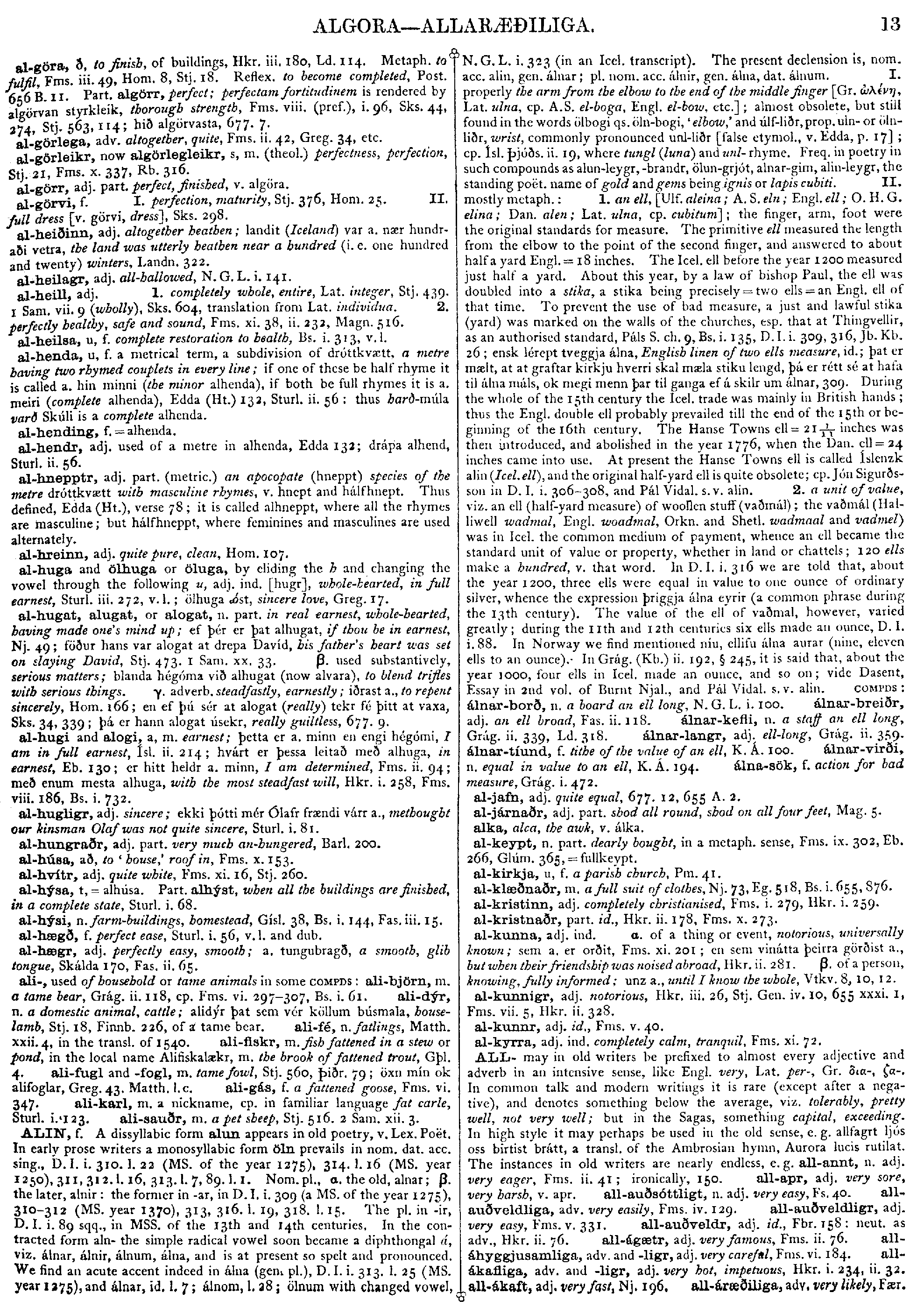
al-henda, u, f. a metrical term, a subdivision of dróttkvætt, a metre having two rhymed couplets in every line; if one of these be half rhyme it is called a. hin minni (the minor alhenda), if both be full rhymes it is a. meiri (complete alhenda), Edda (Ht.) 132, Sturl. ii. 56: thus harð-múla varð Skúli is a complete alhenda.
|
Source: Cleasby/Vigfusson, page b0016, entry 7 View original page image as: [TIFF] [PNG] [View previous entry] [View next entry] |
[Comment on this entry] [View comments] |
The following entry has been hand-corrected once. |
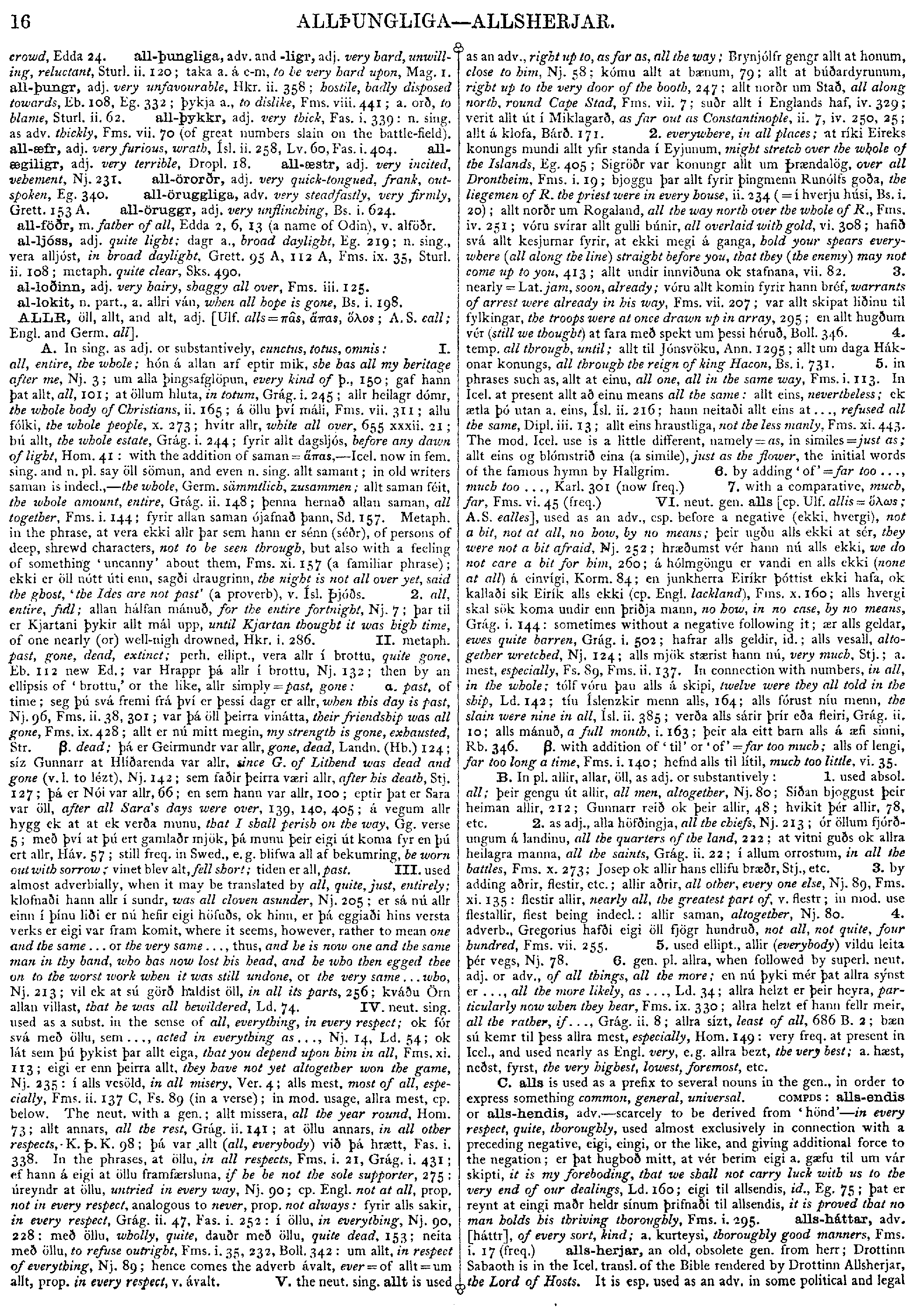
A.
In
sing,
as
adj.
or
substantively,
cunctus,
totus,
omnis:
I.
all,
entire,
the
whole;
hón
á
allan
arf
eptir
mik,
she
has
all
my
heritage
after
me,
Nj.
3;
um
alla
þingsafglöpun,
every
kind
of
þ.,
150;
gaf
hann
þat
allt,
all,
101;
at
öllum
hluta,
in
totum,
Grág.
i.
245;
allr
heilagr
dómr,
the
whole
body
of
Christians,
ii.
165;
á
öllu
því
máli,
Fms.
vii.
311;
allu
fólki,
thewhole
people,
x.
273;
hvitr
allr,
white
all
over,
655
xxxii.
21;
bú
allt,
thewhole
estate,
Grág.
i.
244;
fyrir
allt
dagsljós,
before
any
dawn
of
light,
Hom.
41:
with
the
addition
of
saman
=
GREEK
--
Icel.
now
in
fem.
sing.
and
n.
pl.
say
öll
sömun,
and
even
n.
sing.
allt
samant;
in
old
writers
saman
is
indecl.,
--
the
whole,
Germ,
sänmtlich,
zusammen;
allt
saman
féit,
thewhole
amount,
entire,
Grág.
ii.
148;
þenna
hernað
allan
saman,
all
together,
Fms.
i.
144;
fyrir
allan
saman
ójafnað
þann,
Sd.
157.
Metaph.
in
the
phrase,
at
vera
ekki
allr
þar
sem
hann
er
sénn
(séðr),
of
persons
of
deep,
shrewd
characters,
not
to
be
seen
through,
but
also
with
a
feeling
of
something
'uncanny'
about
them,
Fms.
xi.
157
(a
familiar
phrase);
ekki
er
oil
nótt
úti
enn,
sagði
draugrinn,
the
night
is
not
all
over
yet,
said
the
ghost,
'the
Ides
are
not
past'
(a
proverb),
v.
Ísl.
þjóðs.
2.
all,
entire,
full;
allan
hálfan
mánuð,
for
the
entire
fortnight,
Nj.
7;
þar
til
er
Kjartani
þykir
allt
mál
upp,
until
Kjartan
thought
it
was
high
time,
of
one
nearly
(or)
well-nigh
drowned,
Hkr.
i.
286.
II.
metaph.
past,
gone,
dead,
extinct;
perh.
ellipt.,
vera
allr
í
brottu,
quite
gone,
Eb.
112
new
Ed.;
var
Hrappr
þá
allr
í
brottu,
Nj.
132;
then
by
an
ellipsis
of
'brottu,'
or
the
like,
allr
simply
==
past,
gone:
.
past,
of
time;
seg
þú
svá
fremi
frá
því
er
þessi
dagr
er
allr,
when
this
day
is
past,
Nj.
96,
Fms.
ii.
38,
301;
var
þá
öll
þeirra
vinátta,
their
friendship
was
all
gone,
Fms.
ix.
428;
allt
er
mi
mitt
megin,
my
strength
is
gone,
exhausted,
Str.
.
dead;
þá
er
Geirmundr
var
allr,
gone,
dead,
Landn.
(Hb.)
124;
siz
Gunnarr
at
Hlíðarenda
var
allr,
since
G.
of
Lithend
was
dead
and
gone
(v.
l.
to
lézt),
Nj.
142;
sem
faðir
þeirra
væri
allr,
after
his
death,
Stj.
127;
þá
er
Nói
var
allr,
66;
en
sem
hann
var
allr,
100;
eptir
þat
er
Sara
var
öll,
after
all
Sara's
days
were
over,
139,
140,
405;
á
vegum
allr
hygg
ek
at
at
ek
verða
munu,
that
I
shall
perish
on
the
way,
Gg.
verse
5;
með
því
at
þú
ert
gamlaðr
mjök,
þá
munu
þeir
eigi
út
koma
fyr
en
þú
ert
allr,
Háv.
57;
still
freq.
in
Swed.,
e.
g.
blifwa
all
af
bekumring,
be
worn
out
with
sorrow;
vinet
blev
alt,
fell
short;
tiden
er
all,
past.
III.
used
almost
adverbially,
when
it
may
be
translated
by
all,
quite,
just,
entirely;
klofnaði
hann
allr
í
sundr,
was
all
cloven
asunder,
Nj.
205;
er
sá
nú
allr
einn
í
þínu
liði
er
nú
hefir
eigi
höfuðs,
ok
hinn,
er
þá
eggiaði
hins
versta
verks
er
eigi
var
fram
komit,
where
it
seems,
however,
rather
to
mean
one
and
the
same
...
or
the
very
same
...,
thus,
and
he
is
now
one
and
the
same
man
in
thy
band,
who
has
now
lost
his
bead,
and
he
who
then
egged
tbee
on
to
the
worst
work
when
it
was
still
undone,
or
the
very
same,
...
who,
Nj.
213;
vil
ek
at
sú
görð
häldist
öll,
in
all
its
parts,
256;
kváðu
Örn
allan
villast,
that
he
was
all
bewildered,
Ld.
74.
IV.
neut.
sing,
used
as
a
subst.
in
the
sense
of
all,
everything,
in
every
respect;
ok
for
svá
með
öllu,
sem
...,
acted
in
everything
as...,
Nj.
14,
Ld.
54;
ok
lát
sem
þú
þykist
þar
allt
eiga,
that
you
depend
upon
him
in
all,
Fms.
xi.
113;
eigi
er
enn
þeirra
allt,
they
have
not
yet
altogether
won
the
game,
Nj.
235:
í
alls
vesöld,
in
all
misery,
Ver.
4;
alls
mest,
most
of
all,
espe-
cially,
Fms.
ii.
137
C,
Fs.
89
(in
a
verse);
in
mod.
usage,
allra
mest,
cp.
below.
The
neut.
with
a
gen.;
allt
missera,
all
the
year
round,
Hom.
73;
allt
annars,
all
the
rest,
Grág.
ii.
141;
at
öllu
annars,
in
all
other
respects,
-
K.
Þ.
K.
98;
þá
var
allt
(all,
everybody)
við
þá
hrætt,
Fas.
i.
338.
In
the
phrases,
at
öllu,
in
all
respects,
Fms.
i.
21,
Grág.
i.
431;
ef
hann
á
eigi
at
öllu
framfærsluna,
if
he
be
not
the
sole
supporter,
275:
úreyndr
at
öllu,
untried
in
every
way,
Nj.
90;
cp.
Engl.
not
at
all,
prop.
not
in
every
respect,
analogous
to
never,
prop,
not
always:
fyrir
alls
sakir,
in
every
respect,
Grág.
ii.
47,
Fas.
i.
252:
í
öllu,
in
everything,
Nj.
90,
228:
með
öllu,
wholly,
quite,
dauðr
með
öllu,
quite
dead,
153;
neita
með
öllu,
to
refuse
outright,
Fms.
i.
35,
232,
Boll.
342:
um
allt,
in
respect
of
everything,
Nj.
89;
hence
comes
the
adverb
ávalt,
ever
=
of
allt
=
um
allt,
prop,
in
every
respect,
v.
ávalt.
V.
the
neut.
sing,
allt
is
used
as
an
adv.,
right
up
to,
as
far
as,
all
the
way;
Brynjólfr
gengr
allt
at
honum,
close
to
him,
Nj.
58;
kómu
allt
at
bænum,
79;
allt
at
búðardyrunum,
right
up
to
the
very
door
of
the
booth,
247;
allt
norðr
urn
Stað,
all
along
north,
round
Cape
Stad,
Fms.
vii.
7;
suðr
allt
í
Englands
haf,
iv.
329;
verit
allt
út
í
Miklagarð,
as
far
out
as
Constantinople,
ii.
7,
iv.
250,
25;
allt
á
klofa,
Bárð.
171.
2.
everywhere,
in
all
places;
at
riki
Eireks
konungs
mundi
allt
yfir
standa
í
Eyjunum,
might
stretch
over
the
whole
of
the
Islands,
Eg.
405;
Sigröðr
var
konungr
allt
um
Þrændalög,
over
all
Drontheim,
Fms.
i.
19;
bjoggu
þar
allt
fyrir
þingmenn
Runólfs
goða,
the
liegemen
of
R.
the
priest
were
in
every
house,
ii.
-234
(=
í
hverju
húsi,
Bs.
i.
20);
allt
norðr
um
Rogaland,
all
the
way
north
over
the
whole
of
R.,
Fms.
iv.
251;
vóru
svirar
allt
gulli
búnir,
all
overlaid
with
gold,
vi.
308;
hafið
svá
allt
kesjurnar
fyrir,
at
ekki
megi
á
ganga,
hold
your
spears
every-
where
(all
along
the
line)
straight
before
you,
that
they
(the
enemy)
may
not
come
up
to
you,
413;
allt
imdir
innviðuna
ok
stafnana,
vii.
82.
3.
nearly
=
Lat.
jam,
soon,
already;
vóru
allt
komin
fyrir
hann
bréf,
warrants
of
arrest
were
already
in
his
way,
Fms.
vii.
207;
var
allt
skipat
liðinu
til
fylkingar,
the
troops
were
at
once
drawn
up
in
array,
295;
en
allt
hugðum
vér
(still
we
thought)
at
fara
með
spekt
um
þessi
héruð,
Boll.
346.
4.
temp.
all
through,
until;
allt
til
Júnsvöku,
Ann.
1295;
allt
um
daga
Hák-
onar
konungs,
all
through
the
reign
of
king
Hacon,
Bs.
i.
731.
5.
in
phrases
such
as,
allt
at
einu,
all
one,
all
in
the
same
way,
Fms.
i.
113.
In
Icel.
at
present
allt
að
einu
means
all
the
same:
allt
eins,
nevertheless;
ek
ætla
þó
utan
a.
eins,
Ísl.
ii.
216;
hann
neitaði
allt
eins
at...,
refused
all
the
same,
Dipl.
iii.
13;
allt
eins
hraustliga,
not
the
less
manly,
Fms.
xi.
443.
The
mod.
Icel.
use
is
a
little
different,
namely
=
as,
in
similes
=
just
as;
allt
eins
og
blómstrið
eina
(a
simile),
just
as
the
flower,
the
initial
words
of
the
famous
hymn
by
Hallgrim.
6.
by
adding
'of'
=
far
too
...,
much
too
...,
Karl.
301
(now
freq.)
7.
with
a
comparative,
much,
far,
Fms.
vi.
45
(freq.)
VI.
neut.
gen.
alls
[cp.
Ulf.
allis
=
GREEK;
A.
S.
ealles],
used
as
an
adv.,
esp.
before
a
negative
(ekki,
hvergi),
not
a
bit,
not
at
all,
no
how,
by
no
means;
þeir
ugðu
alls
ekki
at
sér,
they
were
not
a
bit
afraid,
Nj.
252;
hræðumst
vér
hann
nú
alls
ekki,
we
do
not
care
a
bit
for
him,
260;
á
hólmgöngu
er
vandi
en
alls
ekki
(none
at
all)
á
einvigi,
Korm.
84;
en
junkherra
Eiríkr
þóttíist
ekki
hafa,
ok
kallaði
sik
Eirik
alls
ekki
(cp.
Engl.
lackland),
Fms.
x.
160;
alls
hvergi
skal
sök
koma
undir
enn
þriðja
mann,
no
how,
in
no
case,
by
no
means,
Grág.
i.
144:
sometimes
without
a
negative
following
it;
ær
alls
geldar,
ewes
quite
barren,
Grág.
i.
502;
hafrar
alls
geldir,
id.;
alls
vesall,
alto-
gether
wretched,
Nj.
124;
alls
mjök
stærist
hann
nú,
very
much,
Stj.;
a.
mest,
especially,
Fs.
89,
Fms.
ii.
137.
In
connection
with
numbers,
in
all,
in
the
whole;
tólf
vóru
þau
alls
á
skipi,
twelve
were
they
all
told
in
the
ship,
Ld.
142;
tíu
Íslenzkir
menn
alls,
164;
alls
fórust
níu
menn,
the
slain
were
nine
in
all,
Ísl.
ii.
385;
verða
alls
sárir
þrír
eða
fleiri,
Grág.
ii.
10;
alls
mánuð,
a
full
month,
i.
163;
þeir
ala
eitt
barn
alls
á
aefi
sinni,
Rb.
346.
.
with
addition
of
'til'
or
'of'
=
far
too
much;
alls
of
lengi,
far
too
long
a
time,
Fms.
i.
140;
hefnd
alls
til
lítil,
much
too
little,
vi.
35.
B.
In
pl.
allir,
allar,
öll,
as
adj.
or
substantively:
1.
used
absol.
all;
þeir
gengu
út
allir,
all
men,
altogether,
Nj.
80;
Síðan
bjoggust
þeir
heiman
allir,
212;
Gunnarr
reið
ok
beir
allir,
48;
hvikit
þér
allir,
78,
etc.
2.
as
adj.,
alla
höfðingja,
all
the
chiefs,
Nj.
213;
ór
öllum
fjórð-
ungum
á
landinu,
all
the
quarters
of
the
land,
222;
at
vitni
guðs
ok
allra
heilagra
manna,
all
the
saints,
Grág.
ii.
22;
í
allum
orrostum,
in
all
the
battles,
Fms.
x.
273;
Josep
ok
allir
hans
ellifu
bræðr,
Stj.,
etc.
3.
by
adding
aðrir,
flestir,
etc.;
allir
aðrir,
all
other,
everyone
else,
Nj.
89,
Fms.
xi.
135:
flestir
allir,
nearly
all,
the
greatest
part
of,
v.
flestr;
in
mod.
use
flestallir,
flest
being
indecl.:
allir
saman,
altogether,
Nj.
80.
4.
adverb.,
Gregorius
hafði
eigi
öll
fjögr
hundruð,
not
all,
not
quite,
four
hundred,
Fms.
vii.
255.
5.
used
ellipt.,
allir
(everybody)
vildu
leita
þér
vegs,
Nj.
78.
6.
gen.
pl.
allra,
when
followed
by
superl.
neut.
adj.
or
adv.,
of
all
things,
all
the
more;
en
nú
þyki
mér
þat
allra
sýnst
er
...,
all
the
more
likely,
as
...,
Ld.
34;
allra
helzt
er
þeir
heyra,
par-
ticularly
now
when
they
hear,
Fms.
ix.
330;
allra
helzt
ef
hann
fellr
meir,
all
the
rather,
if
...,
Grág.
ii.
8;
allra
sízt,
least
of
all,
686
B.
2;
bæn
sú
kemr
til
þess
allra
mest,
especially,
Hom.
149:
very
freq.
at
present
in
Icel.,
and
used
nearly
as
Engl.
very,
e.
g.
allra
bezt,
the
very
best;
a.
hæst,
neðst,
fyrst,
the
very
highest,
lowest,
foremost,
etc.
C.
alls
is
used
as
a
prefix
to
several
nouns
in
the
gen.,
in
order
to
express
something
common,
general,
universal.
COMPDS:
alls-endis
or
alls-hendis,
adv.
--
scarcely
to
be
derived
from
'hönd'
--
in
every
respect,
quite,
thoroughly,
used
almost
exclusively
in
connection
with
a
preceding
negative,
eigi,
eingi,
or
the
like,
and
giving
additional
force
to
the
negation;
er
þat
hugboð
mitt,
at
vér
berim
eigi
agæfu
til
um
vár
skipti,
it
is
my
foreboding,
that
we
shall
not
carry
luck
with
us
to
the
very
end
of
our
dealings,
Ld.
160;
eigi
til
allsendis,
id.,
Eg.
75;
þat
er
reynt
at
eingi
maðr
heldr
sínum
þrifnaði
til
allsendis,
it
is
proved
that
no
man
holds
his
thriving
thoroughly,
Fms.
i.
295.
alls-háttar,
adv.
[háttr],
of
every
sort,
kind;
a.
kurteysi,
thoroughly
good
manners,
Fms.
i.
17
(freq.)
alls-herjar,
an
old,
obsolete
gen.
from
herr;
Drottinn
Sabaoth
is
in
the
Icel.
transl.
of
the
Bible
rendered
by
Drottinn
AUsherjar,
the
Lord
of
Hosts.
It
is
esp.
used
as
an
adv.
in
some
political
and
legal
|
Source: Cleasby/Vigfusson, page b0025, entry 18 View original page image as: [TIFF] [PNG] [View previous entry] [View next entry] |
[Comment on this entry] [View comments] |
The following entry has been hand-corrected once. |
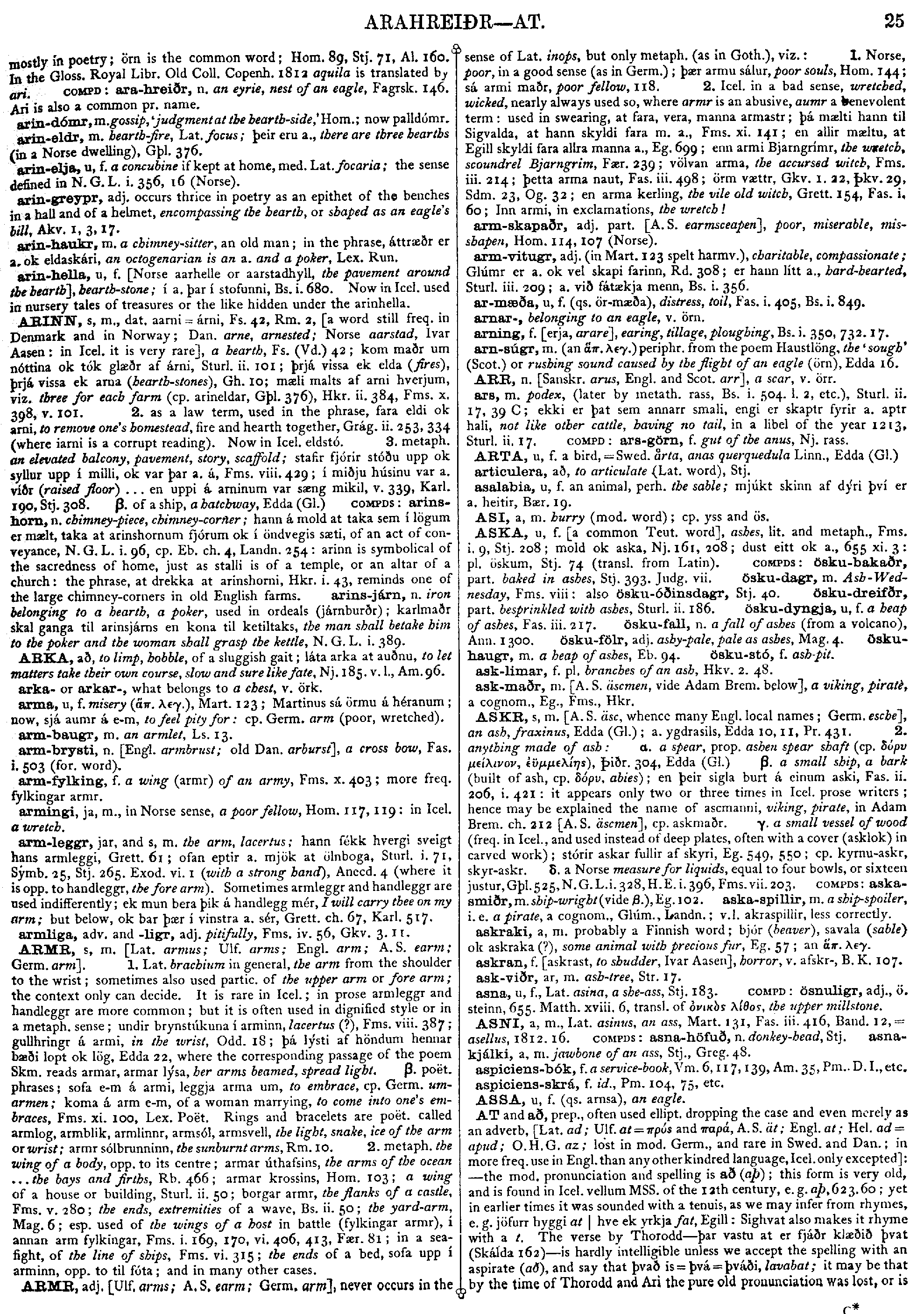
ARMR,
s,
m.
[Lat.
armus;
Ulf.
arms;
Engl.
arm;
A.
S.
earm;
Germ.
arm].
1.
Lat.
brachium
in
general,
the
arm
from
the
shoulder
to
the
wrist;
sometimes
also
used
partic.
of
the
upper
arm
or
fore
arm;
the
context
only
can
decide.
It
is
rare
in
Icel.;
in
prose
armleggr
and
handleggr
are
more
common;
but
it
is
often
used
in
dignified
style
or
in
a
metaph.
sense;
undir
brynstúkuna
í
arminn,
lacertus
(?),
Fms.
viii.
387;
gullhringr
á
armi,
in
the
wrist,
Odd.
18;
þá
lýsti
af
höndum
hennar
bæði
lopt
ok
lög,
Edda
22,
where
the
corresponding
passage
of
the
poem
Skm.
reads
armar,
armar
lýsa,
her
arms
beamed,
spread
light.
.
poët.
phrases;
sofa
e-m
á
armi,
leggja
arma
um,
to
embrace,
cp.
Germ.
umarmen;
koma
á
arm
e-m,
of
a
woman
marrying,
to
come
into
one's
embraces,
Fms.
xi.
100,
Lex.
Poët.
Rings
and
bracelets
are
poët.
called
armlog,
armblik,
armlinnr,
armsól,
armsvell,
the
light,
snake,
ice
of
the
arm
or
wrist;
armr
sólbrunninn,
the
sunburnt
arms,
Rm.
10.
2.
metaph.
the
wing
of
a
body,
opp.
to
its
centre;
armar
úthafsins,
the
arms
of
the
ocean
...
the
bays
and
firths,
Rb.
466;
armar
krossins,
Hom.
103;
a
wing
of
a
house
or
building,
Sturl.
ii.
50;
borgar
armr,
the
flanks
of
a
castle,
Fms.
v.
280;
the
ends,
extremities
of
a
wave,
Bs.
ii.
50;
the
yard-arm,
Mag.
6;
esp.
used
of
the
wings
of
a
host
in
battle
(fylkingar
armr),
í
annan
arm
fylkingar,
Fms.
i.
169,
170,
vi.
406,
413,
Fær.
81;
in
a
sea-fight,
of
the
line
of
ships,
Fms.
vi.
315;
the
ends
of
a
bed,
sofa
upp
í
arminn,
opp.
to
til
fóta;
and
in
many
other
cases.
|
Source: Cleasby/Vigfusson, page b0032, entry 21 View original page image as: [TIFF] [PNG] [View previous entry] [View next entry] |
[Comment on this entry] [View comments] |
The following entry has been hand-corrected once. |
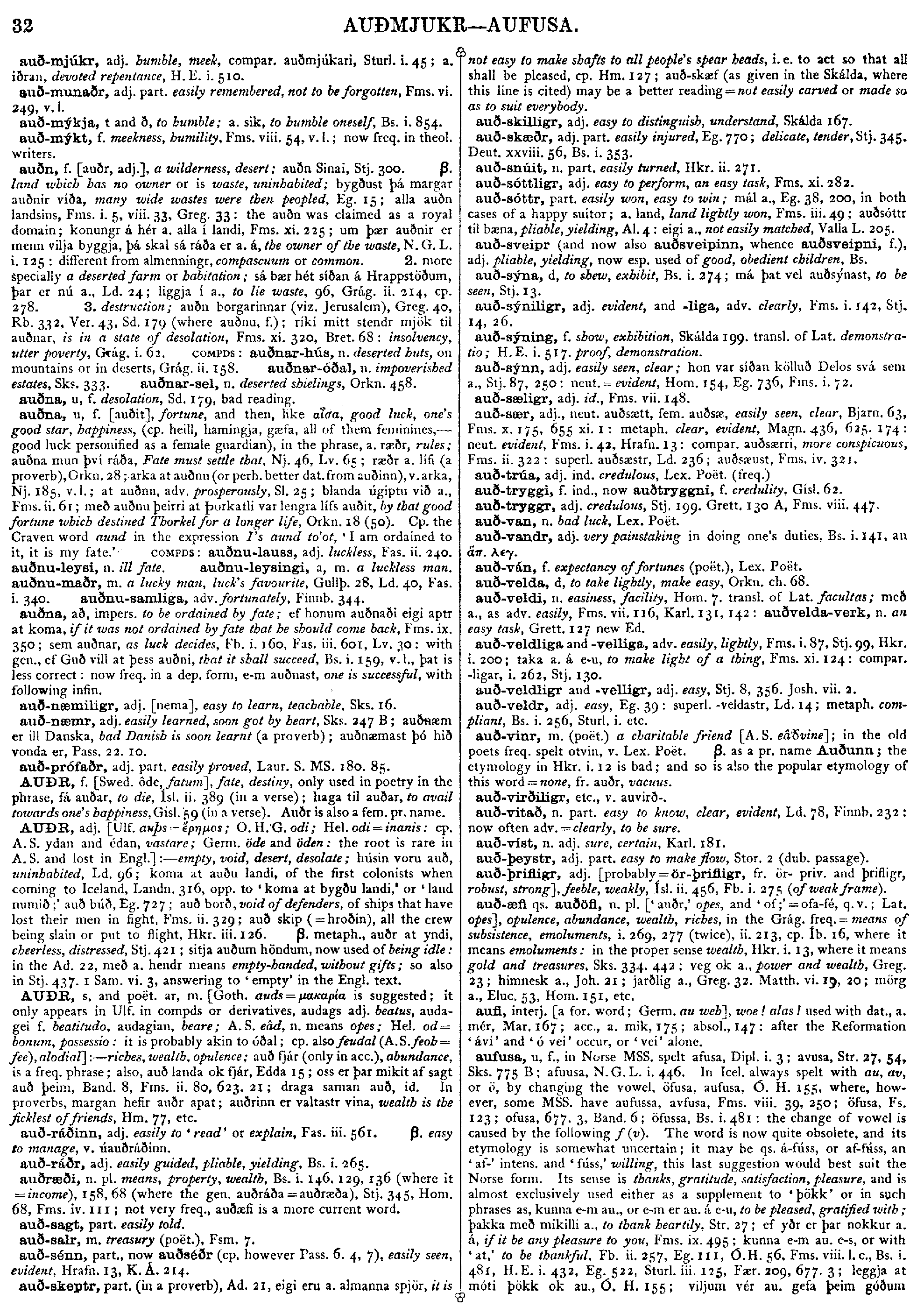
auð-skeptr, part. (in a proverb), Ad. 21, eigi eru a. almanna spjör, it is not easy to make shafts to all people's spear heads, i. e. to act so that all shall be pleased, cp. Hm. 127; auð-skæf (as given in the Skálda, where this line is cited) may be a better reading = not easily carved or made so as to suit everybody.
|
Source: Cleasby/Vigfusson, page b0041, entry 55 View original page image as: [TIFF] [PNG] [View previous entry] [View next entry] |
[Comment on this entry] [View comments] |
The following entry has been hand-corrected once. |
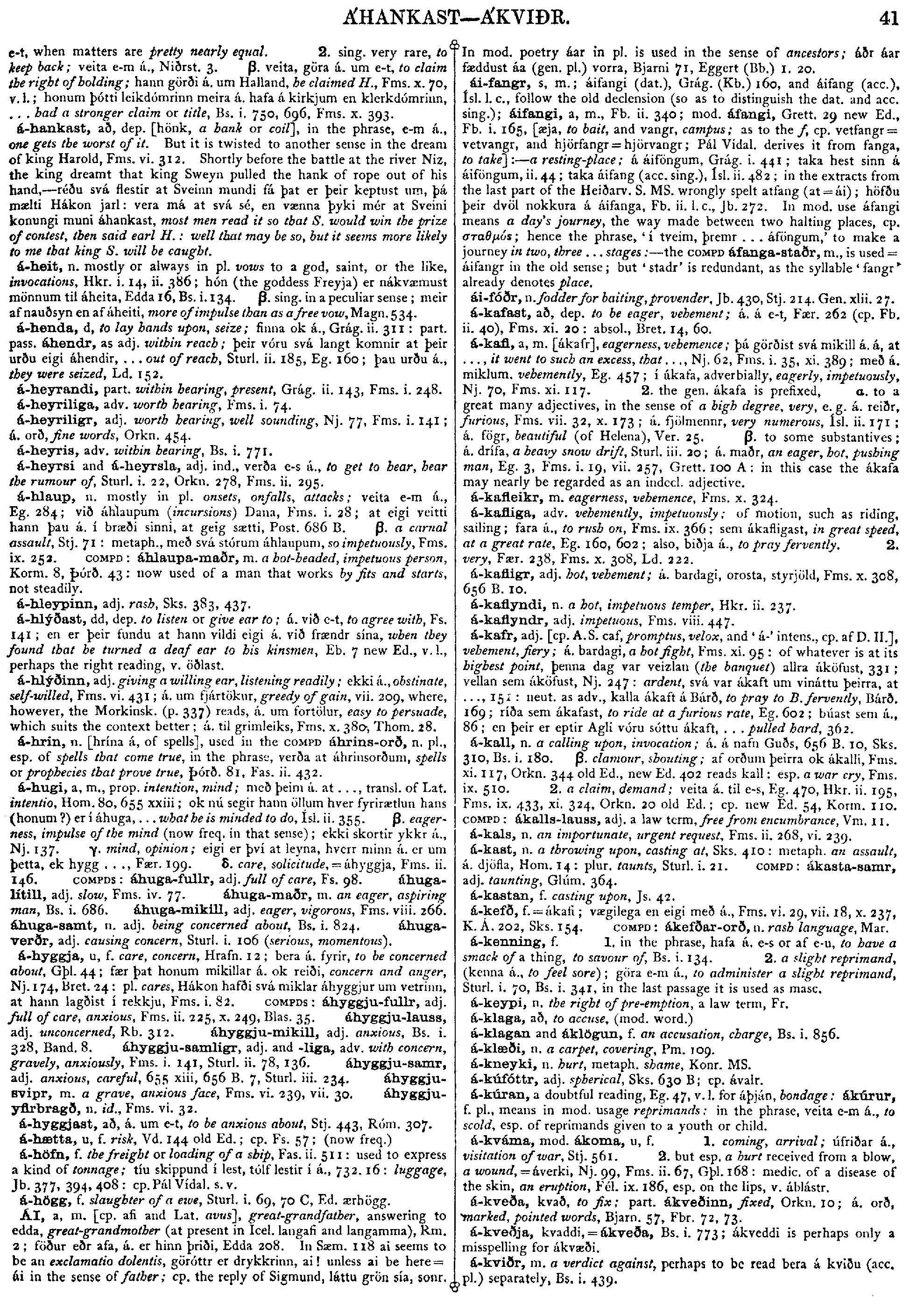
á-lag, n. and álaga, u, f. [ieggja á]; in some cases, esp. dat. pl., it is often difficult to decide to which of these two forms a case may belong; they are therefore best taken together. In the neut. pl. the notion of spell, in the fem. pl. that of tax, burden, hardship prevails. In sing, both of them are very much alike in sense. I. fem. pl. a tax, burden, burdensome impost; sagði at bændr vildi eigi hafa frekari álög (álögur?) af konungi en forn lög stæði til, Fms. xi. 224; undan þessum hans álögum ... liggja undir slíkum álögum, tyranny, yoke, Bárð. ch. 2; gangit til ok hyggit at landsmenn, at ganga undir skattgjafar Ólafs konungs ok allar álögur, burdens, taxes, Fms. iv. 282, in the famous speech of Einar þveræing, (Ó. H. ch. 134; bað jarl vægja möunum um álögur, Fms. iv. 216; jarl hélt með freku öllum álögum, Orkn. 40; hvárt mun konungr sá ekki kunna hóf um álögur ok harðleiki við menn, Fms. vi. 37; þórstcinn kvað ekki um at leita, at þórðr kæmist undan neinum álögum, burdens, oppressive conditions, Bjarn. 72. 2. a law term, an additional fine; með álögum ok leigum, duties and rents, Grág. i. 260; binda álogum, to charge, 384; hálfa fimtu mörk álaga, a fine of three marks, 391. 3. metaph. in plur. and in the phrase, í álögum, in straits, at a pinch, if needful, Vm. 18; vitr maðr ok ágætr í öllum álögum, a wise and good man in all difficulties, Fs. 120. 4. a metric. term, addition, supplement; þat er annat leyfi háttanna at hafa í dróttkvæðum hætti eitt orð eða tvau með álögum, cp. álagsháttr below, Edda 124. 5. theol. a visitation, scourge, Stj. 106, 647. 2 Kings xxi. 13 (answering to plummet in the Engl. transl.); sing. in both instances. II. neut. pl. álög, spells, imprecations. In the fairy tales of Icel. 'vera í álögum' is a standing phrase for being spell-bound, esp. for being transformed into the shape of animals, or even of lifeless objects; leggja a., to bind by spells, cp. Ísl. Þjóðs. by Jón Árnason; var því líkast sem í fornum sögum er sagt, þá er konunga börn urðu fyrir stjúpmæðra álögum (v. l. sköpum), Fms. viii. 18 (Fb. ii. 539): hóri lýstr til hans með úlfs hanzka ok segir at hann skyldi verða at einuni híðbirni, ok aldri skáltn or þessuni álögum fara, Fas. (Völs. S.) i. 50, 404: sing, (very rare), þat er álag mitt, at þat skip skal aldri heilt af hafi koma er hér liggr út, Landn. 250. At present always in pl., cp. forlög, örlög, ólög. COMPDS: álags-bœtr, f. pl. a kind of line, N. G. L. i. 311. álags-háttr, m. a kind of metre, the first syllabic of the following line completing the sentence, e. g. ískalda skar ek öldu | eik; Edda (Ht.) 129. álögu-laust, n. adj. free from imposts.
|
Source: Cleasby/Vigfusson, page b0041, entry 61 View original page image as: [TIFF] [PNG] [View previous entry] [View next entry] |
[Comment on this entry] [View comments] |
The following entry has been hand-corrected once. |
ál-burðr, m. mensuration with a line, N. G. L. i. 43, = vaðburðr.
|
Source: Cleasby/Vigfusson, page b0054, entry 27 View original page image as: [TIFF] [PNG] [View previous entry] [View next entry] |
[Comment on this entry] [View comments] |
The following entry has not been hand-corrected. However, the page is reserved and someone is correcting it. |
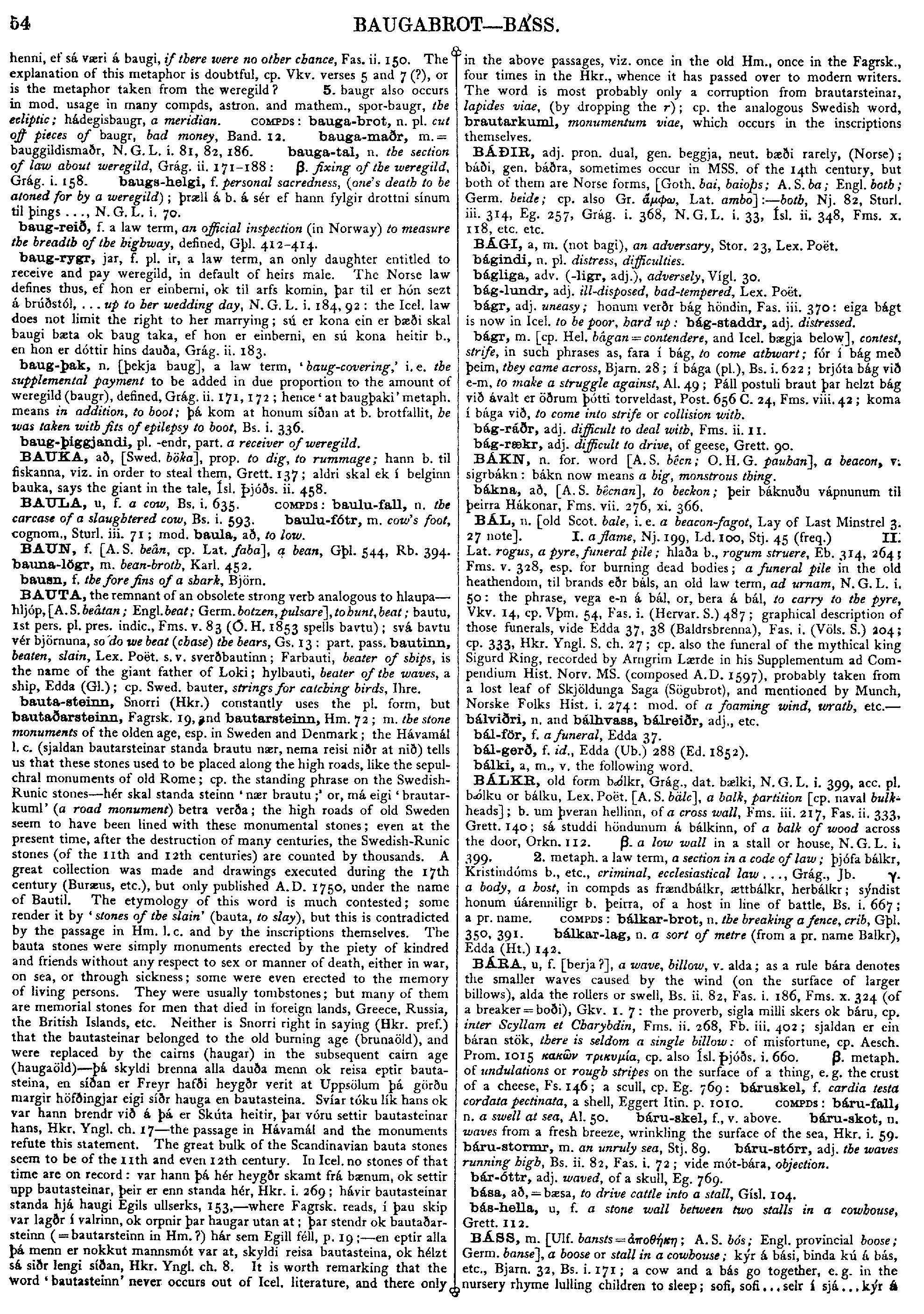
BÁLKR, old form b^lkr, Grág., dat. bselki, N. G. L. i. 399, acc. pl. bcólku or bálku, Lex. Poët. [A. S. b a l e], a balk, partition [cp. naval bulk- heads]; b. um þveran hellinn, of a cross w a ll, Fms. iii. 217, Fas. ii. 333, Grett. 140; sá studdi höndunum á bálkinn, of a balk of wood across the door, Orkn. 112. /3. a low wall in a stall or house, N. G. L. ú 399, 2. metaph. a law term, a section in a code of law; þjófa bálkr, Kristindóms b., etc., criminal, ecclesiastical law ..., Grág., Jb. y. a body, a host, in compds as frændbálkr, ættbálkr, herbálkr; s^ndist honum úárenniligr b. þeirra, of a host in line of battle, Bs. i. 667; a pr. name. COMPDS: balkar-brot, n. the breaking a fence, crib, Gpl. 350, 391. bálkar-lag, n. a sort of metre (from a pr. name Balkr), Edda (Hi.) 142.
| Result Page: |  |
Previous | 5 6 7 8 9 10 11 12 13 14 15 16 17 18 19 20 21 22 23 | Next |  |
Germanic Lexicon Project (main page)
This search system was written by
Sean Crist
Please consider
volunteering
to correct the data in these online dictionaries.
No rights reserved. Feel free to use these data in any way you please.