|
|

Tip: In the search results, you can click on any word or abbreviation for more information.
|
Source: Bosworth/Toller, page b0890, entry 28 View original page image as: [TIFF] [PNG] [View previous entry] [View next entry] |
[Comment on this entry] [View comments] |
The following entry has been hand-corrected once. |
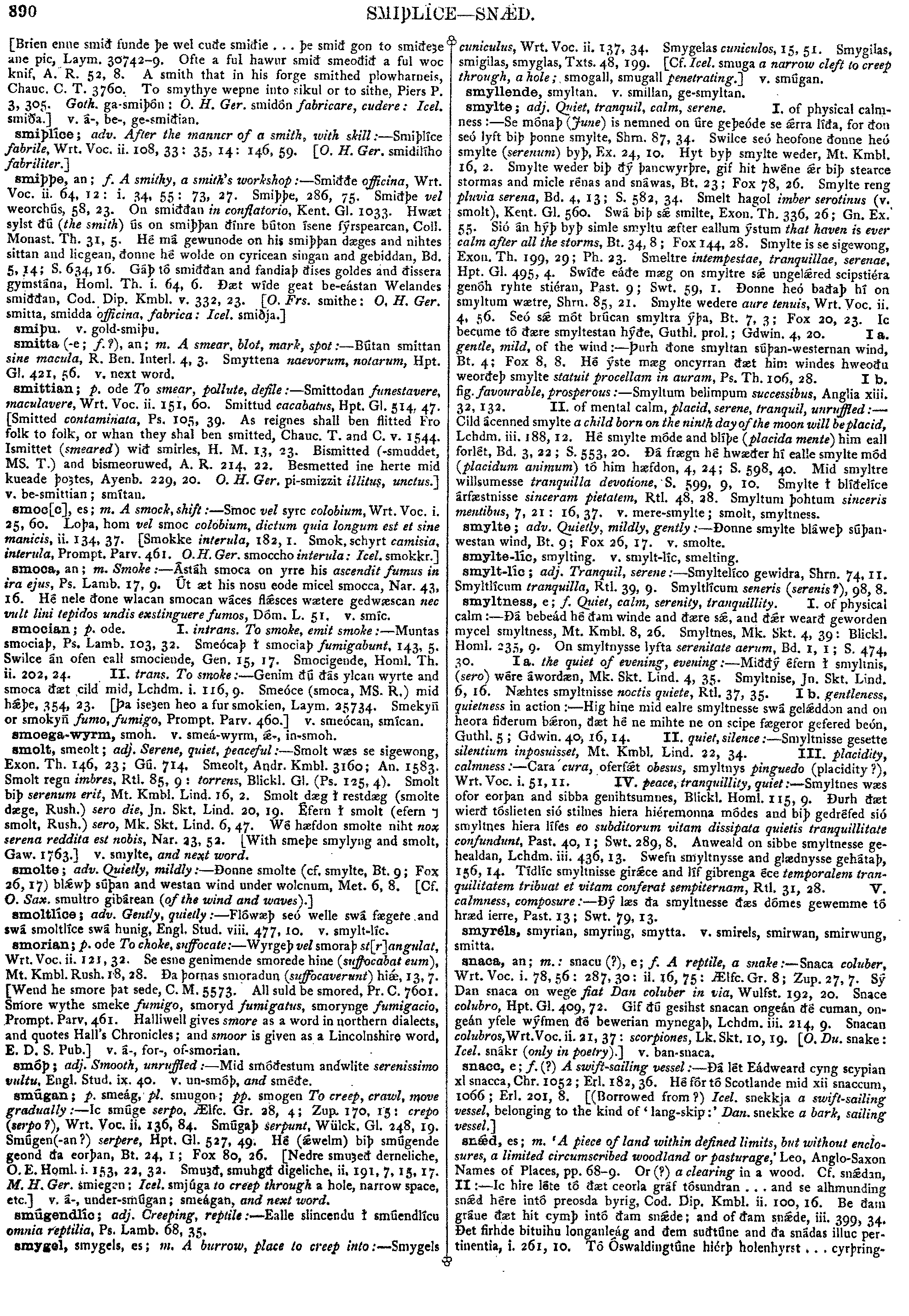
sn d,
es;
m.
'A
piece
of
land
within
defined
limits,
but
without
enclosures,
a
limited
circumscribed
woodland
or
pasturage,'
Leo,
Anglo-Saxon
Names
of
Places,
pp.
68-9.
Or
(?)
a
clearing
in
a
wood.
Cf.
sndan,
II:--Ic
hire
léte
tó
ðæt
ceorla
gráf
tósundran
.
.
.
and
se
alhmunding
snd
hére
intó
preosda
byrig,
Cod.
Dip.
Kmbl.
ii.
100,
16.
Be
ðam
gráue
ðæt
hit
cymþ
intó
ðam
snde;
and
of
ðam
snde,
iii.
399,
34.
Ðet
firhde
bituihu
longanleág
and
ðem
suðtúne
and
ða
snádas
illuc
pertinentia,
i.
261,
10.
Tó
Óswaldingtúne
hiérþ
holenhyrst
.
.
.
cyrþring-
d,
es;
m.
'A
piece
of
land
within
defined
limits,
but
without
enclosures,
a
limited
circumscribed
woodland
or
pasturage,'
Leo,
Anglo-Saxon
Names
of
Places,
pp.
68-9.
Or
(?)
a
clearing
in
a
wood.
Cf.
sndan,
II:--Ic
hire
léte
tó
ðæt
ceorla
gráf
tósundran
.
.
.
and
se
alhmunding
snd
hére
intó
preosda
byrig,
Cod.
Dip.
Kmbl.
ii.
100,
16.
Be
ðam
gráue
ðæt
hit
cymþ
intó
ðam
snde;
and
of
ðam
snde,
iii.
399,
34.
Ðet
firhde
bituihu
longanleág
and
ðem
suðtúne
and
ða
snádas
illuc
pertinentia,
i.
261,
10.
Tó
Óswaldingtúne
hiérþ
holenhyrst
.
.
.
cyrþring-
|
Source: Bosworth/Toller, page b0943, entry 13 View original page image as: [TIFF] [PNG] [View previous entry] [View next entry] |
[Comment on this entry] [View comments] |
The following entry has been hand-corrected once. |
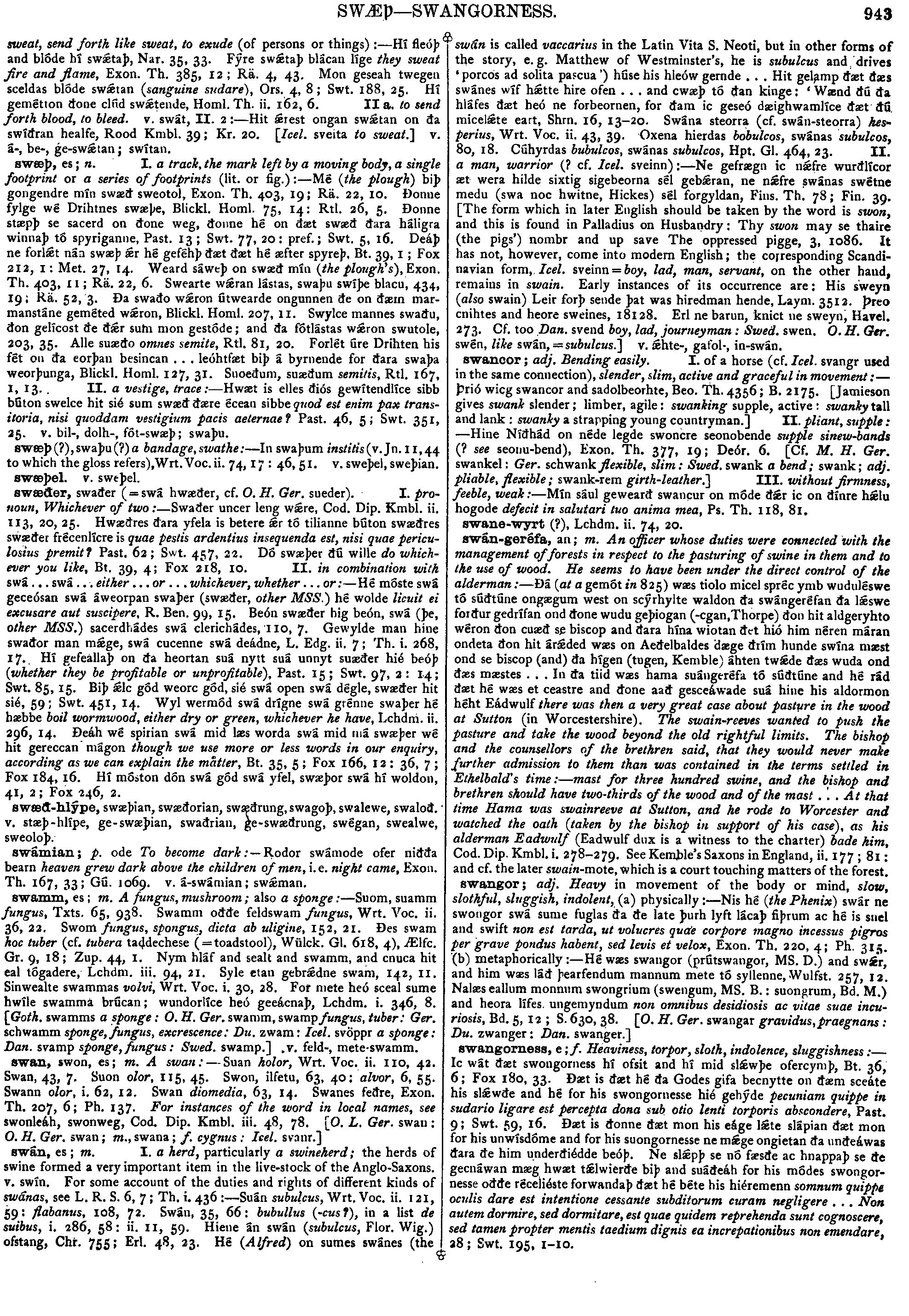
swán-geréfa,
an;
m.
An
officer
whose
duties
were
connected
with
the
management
of
forests
in
respect
to
the
pasturing
of
swine
in
them
and
to
the
use
of
wood.
He
seems
to
have
been
under
the
direct
control
of
the
alderman
:--
Ðá
(at
a
gemót
in
825)
wæs
tiolo
micel
spréc
ymb
wuduléswe
tó
súðtúne
ongægum
west
on
scýrhylte
waldon
ða
swángeréfan
ða
lswe
forður
gedrífan
ond
ðone
wudu
geþiogan
(-cgan,
Thorpe)
ðon
hit
aldgeryhto
wéron
ðon
cuæð
se
biscop
and
ðara
hína
wiotan
ðet
hió
him
néren
máran
ondeta
ðon
hit
árded
wæs
on
Aeðelbaldes
dæge
ðrím
hunde
swína
mæst
ond
se
biscop
(and)
ða
hígen
(tugen,
Kemble)
áhten
twæde
ðæs
wuda
ond
ðæs
mæstes
.
.
.
In
ða
tiid
wæs
hama
suángeréfa
tó
súðtúne
and
hé
rád
ðæt
hé
wæs
et
ceastre
and
ðone
aað
gesceáwade
suá
hine
his
aldormon
héht
Eádwulf
there
was
then
a
very
great
case
about
pasture
in
the
wood
at
Sutton
(in
Worcestershire).
The
swain-reeves
wanted
to
push
the
pasture
and
take
the
wood
beyond
the
old
rightful
limits.
The
bishop
and
the
counsellors
of
the
brethren
said,
that
they
would
never
make
further
admission
to
them
than
was
contained
in
the
terms
settled
in
Ethelbald's
time
:--
mast
for
three
hundred
swine,
and
the
bishop
and
brethren
should
have
two-thirds
of
the
wood
and
of
the
mast.
.
.
At
that
time
Hama
was
swainreeve
at
Sutton,
and
he
rode
to
Worcester
and
watched
the
oath
(taken
by
the
bishop
in
support
of
his
case),
as
his
alderman
Eadwulf
(Eadwulf
dux
is
a
witness
to
the
charter)
bade
him,
Cod.
Dip.
Kmbl.
i.
278-279.
See
Kemble's
Saxons
in
England,
ii.
177;
81:
and
cf.
the
later
swain-mote,
which
is
a
court
touching
matters
of
the
forest.
|
Source: Bosworth/Toller, page b0995, entry 12 View original page image as: [TIFF] [PNG] [View previous entry] [View next entry] |
[Comment on this entry] [View comments (1)] |
The following entry has been hand-corrected once. |
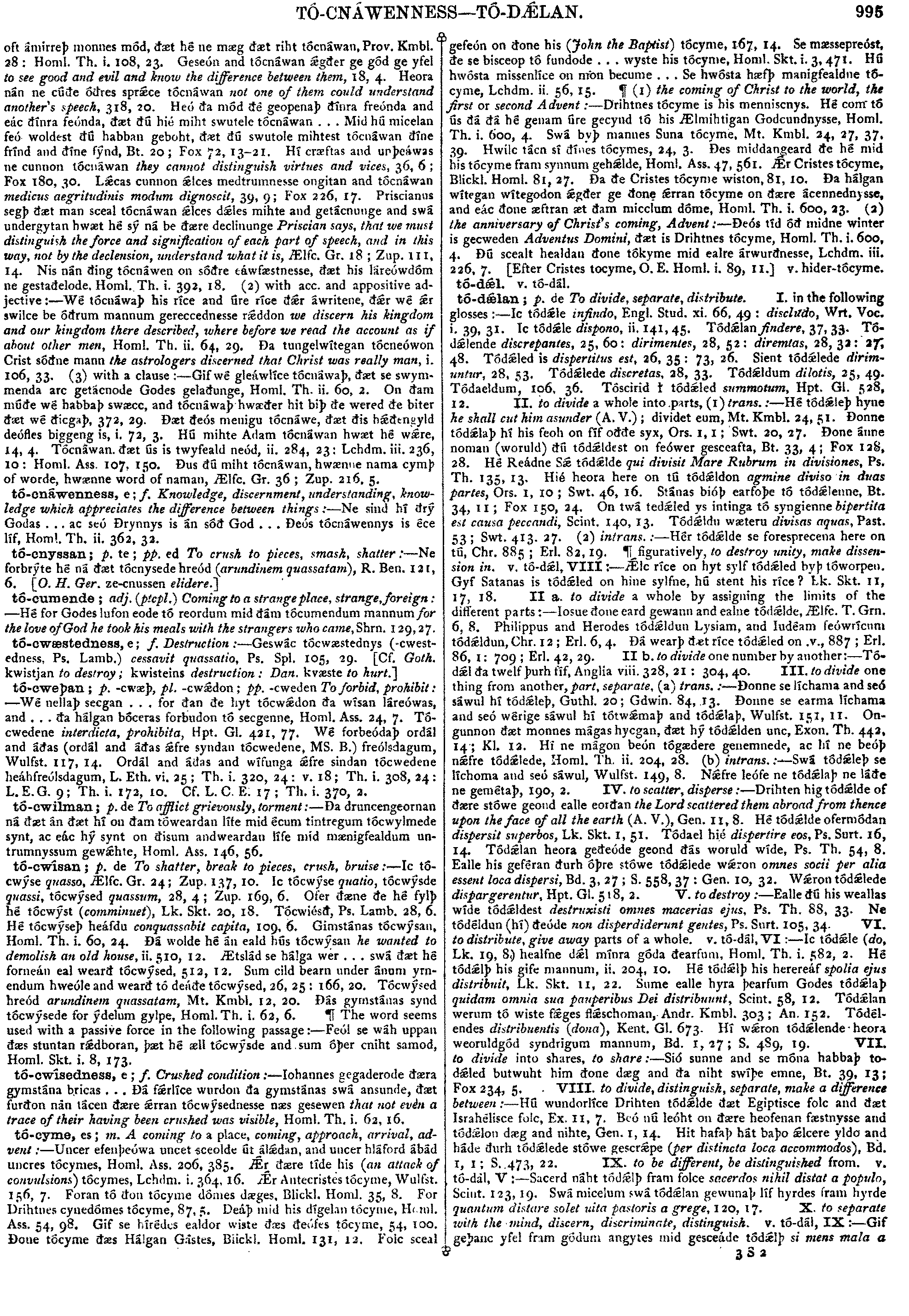
tó-dlan;p.
de
To
divide,
separate,
distribute.
I.
in
the
following
glosses
:--
Ic
tódle
infindo,
Engl.
Stud.
xi.
66,
49
:
disclado,
Wrt.
Voc.
i.
39,
31.
Ic
tódle
dispono,
ii.
141,
45.
Tódla
findere,
37,
33.
Tó-díende
discrepanles,
25,
60:
dirimentes,
28,
52:
diremtas,
28,
31:
27,
48.
Tódled
is
dispertitus
est,
26,
35
:
73,
26.
Sient
tódlede
dirim-untw,
28,
53.
Tódlede
discretas,
28,
33.
Tódldum
dilotis,
25,
49.
Tódaeldurn,
106,
36.
Tóscirid
RUNE
tódled
summotwm.
Hpt.
Gl.
528,
12.
II.
to
divide
a
whole
into
.
parts,
(l)
trans.
:--
Hé
tódleþ
hyne
he
shall
cut
him
asunder
(A.
V.)
;
dividet
eum,
Mt.
Kmbl.
24,
51.
Ðonne
tódlaþ
hí
his
feoh
on
fíf
oððe
syx.
Ors.
I;
Swt.
20,
27.
Ðone
ánne
noman
(woruld)
ðú
tódldest
on
feówer
gesceafta,
Bt.
33,
4;
Fox
128,
28.
Hé
Reádne
S
tódlde
qui
divisit
Mare
Rubrum
in
divisiones.
Ps.
Th.
135,
13.
Hié
heora
here
on
tú
tódldon
agmine
diviso
in
duas
partes,
Ors.
10
;
Swt.
46,
16.
Stánas
bióþ
earfoþe
tó
tðdlenne,
Bt.
34,
II;
Fox
150,
24.
On
twá
tedled
ys
intinga
to
syngienne
bipertita
est
causa
peccandi,
Scint.
140,
13.
Tódldn
wæteru
divisas
aquas,
Past.
53
;
Swt.
413.
27.
(2)
intrans.
:--
Hér
tódlde
se
foresprecena
here
on
tú,
Chr.
885
;
Erl.
82,
19.
¶
figuratively,
to
destroy
unity,
make
dissension
in.
v.
tó-dl,
VIII
:--
Æ-acute;lc
ríce
on
hyt
sylf
tódled
byþ,
tóworpen.
Gyf
Satanas
is
tódled
on
hine
sylfne,
hú
stent
his
ríce?
Bk.
Skt.
II,
17,
18.
II
a.
to
divide
a
whole
by
assigning
the
limits
of
the
different
parts
:--
losue
ðone
eard
gewann
and
ealne
tódlde,
Ælfc.
T.
Grn.
6,
8.
Philippus
and
Herodes
tódldun
Lysiam,
and
ludeám
feówrícum
tódldun.
Chr.
12
;
Erl.
6,
4.
Ðá
wearþ
ðæt
ríce
tódled
on
.v.,
887
;
Erl.
86,
1:
709
;
Erl.
42,
29.
II
b.
to
divide
one
number
by
another
:--
Tó-dl
ða
twelf
þurh
fíf,
Anglia
viii.
328,
21:
304,
40.
III.
to
divide
one
thing
from
another,
part,
separate,
(a)
trans.
:--
Ðonne
se
líchama
and
seó
sáwul
hí
tódleþ.
Guthl.
20;
Gdwin.
84,
13.
Ðonne
se
earma
líchama
and
seó
wérige
sáwul
hí
tótwmaþ
and
tódlaþ.
Wulfst.
151,
ll.
On-gunnon
ðæt
monnes
mágas
hycgan,
ðæt
hý
tó;dlden
unc,
Exon.
Th.
442,
14;
Kl.
12.
Hí
ne
mágon
beón
tógædere
genemnede,
ac
hí
ne
beóþ
nfre
tódlede,
Homl.
Th.
ii.
204,
28.
(b)
intrans.
:
--
Swá
tódleþ
se
líchoma
and
seó
sáwul,
Wulfst.
149,
8.
Nfre
leófe
ne
tódlaþ
ne
láðe
ne
gemétaþ,
190,
2.
IV.
to
scatter,
disperse
:--
Drihten
hig
tódlde
of
ðære
stówe
geond
ealle
eorðan
the
Lord
scattered
them
abroad
from
thence
upon
the
face
of
all
the
earth
(A.
V.),
Gen.
ii.
8.
Hé
tódlde
ofermódan
dispersit
superbos,
Lk.
Skt.
I.
51.
Tódael
hie
dispertire
eos,
Ps.
Surt.
16,
14.
Tódlan
heora
geðeóde
geond
ðás
woruld
wíde,
Ps.
Th.
54,
8.
Ealle
his
geféran
ðurh
óþre
stówe
tódlede
wron
omnes
socii
per
alia
essent
loca
dispersi,
Bd.
3,
27:
S.
558,
37
:
Gen.
10,
32.
Wron
tódlede
dispargerentur.
Hpt.
Gl.
518,
2.
V.
to
destroy
:--
Ealle
dú
his
weallas
wíde
tódldest
destruxisti
omnes
macerias
ejus.
Ps.
Th.
88,
33.
Ne
tódéldun
(hí)
ðeóde
nou
disperdiderunt
gentes,
Ps.
Surt.
log,
34.
VI.
to
distribute,
give
away
parts
of
a
whole,
v.
tó-dál,
VI
:--
Ic
tódle
(do,
Lk.
19,
8,)
healfne
dl
mínra
góda
ðearfum,
Homl.
Th.
i.
582,
2.
Hé
tódlþ
his
gife
mannum,
ii.
204,
10.
Hé
tocllþ
his
herereaf
spolia
ejus
distribuit.
Lk.
Skt.
ll,
22.
Sume
ealle
hyra
bearfum
Godes
todlaþ
quidam
omnia
sua
pauperibus
Dei
dislribuunt,
Scint.
58,
12.
Tódlan
werum
tó
wiste
fges
flschoman,
Andr.
Kmbl.
303
;
An.
152.
Tódélendes
distribuentis
(dona),
Kent.
Gl.
673.
Hí
wron
tódlende
heora
weoruldgód
syndrigum
mannum,
Bd.
1,
27;
S.
489,
19.
VII.
to
divide
into
shares,
to
share
:--
Sió
sunne
and
se
móna
habbaþ
tó-dæled
butwuht
him
ðone
dæg
and
ða
niht
swíþe
emne,
Bt.
39,
13;
Fox
234,
5.
VIII.
to
divide,
distinguish,
separate,
make
a
difference
between
:--
Hú
wundorlíce
Drihten
tódlde
ðæt
Egiptisce
folc
and
ðæt
Israhélisce
folc,
Ex.
11,
7-
Beó
nú
leóht
on
ðære
heofenan
fæstnysse
and
tódlon
dæg
and
nihte,
Gen.
l,
14.
Hit
hafaþ
hát
baþo
lcere
yldo
and
háde
ðurh
tódlede
stówe
gescrpe
(per
distincta
loca
accommodos).
Bd.
I.
I;
S.
.
473,
22.
IX.
to
be
different,
be
distinguished
from.
v.
tó-dál,
V
:--
Sacerd
náht
tócllþ
fram
folce
sacerdos
nihil
distal
a
populo,
Scint.
123,
19.
Swá
micelum
swá
tódlan
gewunaþ
líf
hyrdes
fram
hyrde
quantum
dktare
solet
uita
pastoris
a
grege,
120,
17.
X.
to
separate
with
the
mind,
discern,
discriminate,
distinguish,
v.
tó-dál,
IX
:--
Gif
geþanc
yfel
frim
gódum
angytes
mid
gesceáde
todlþ
si
mens
mala
a
|
Source: Bosworth/Toller, page b1090, entry 2 View original page image as: [TIFF] [PNG] [View previous entry] [View next entry] |
[Comment on this entry] [View comments] |
The following entry has been hand-corrected once. |
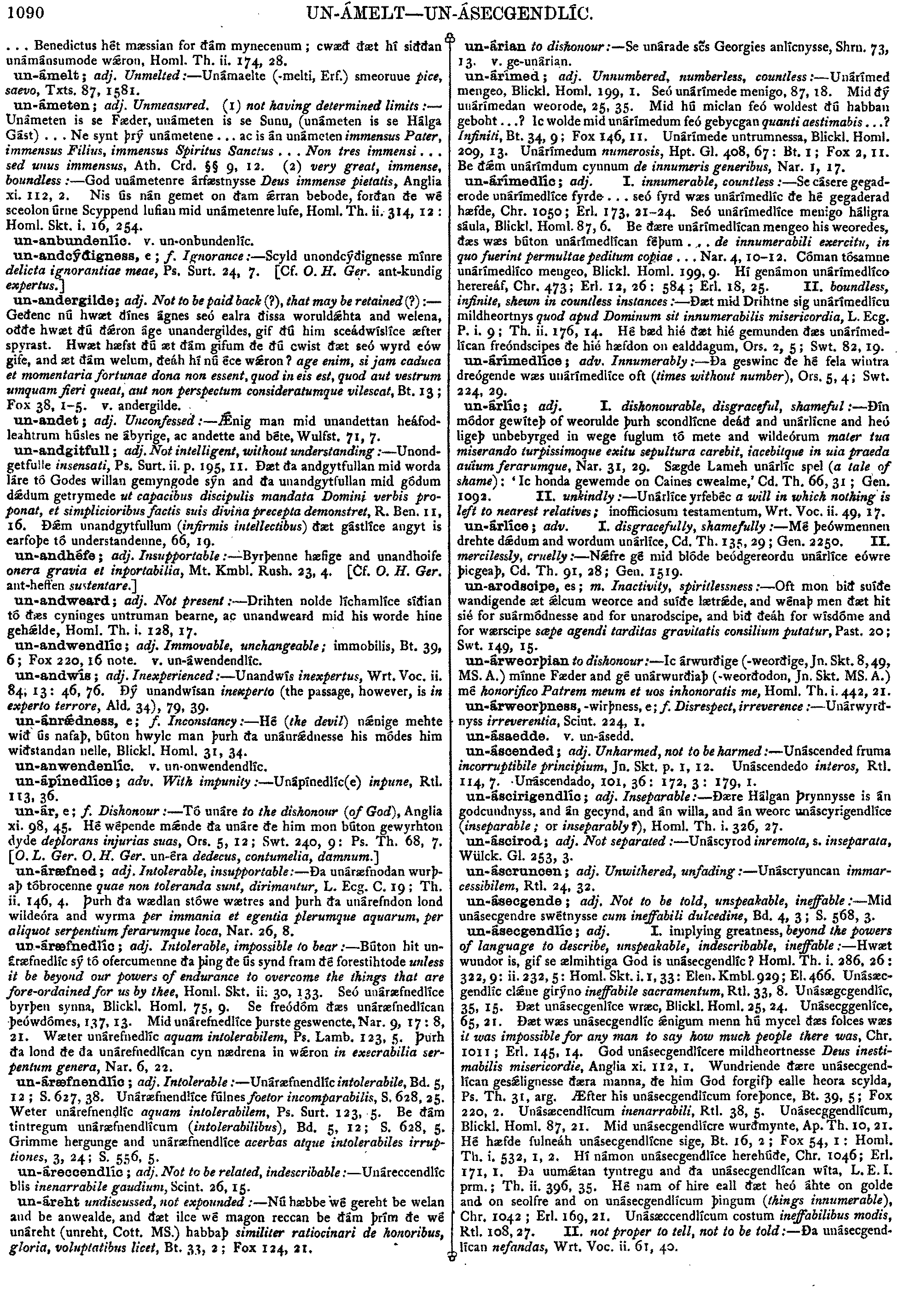
un-ámeten;
adj.
Unmeasured.
(1)
not
having
determined
limits
:--
Unámeten
is
se
Fæder,
unámeten
is
se
Sunu,
(unámeten
is
se
Hálga
Gást)
...
Ne
synt
þrý
unánetene
...
ac
is
án
unámeten
immensus
Pater,
immensus
Filius,
immensus
Spiritus
Sanctus
...
Non
tres
immensi
...
sed
unus
immensus,
Ath.
Crd.
§§
9,
12.
(2)
very
great,
immense,
boundless
:--
God
unámetenre
árfæstnysse
Deus
immense
pietatis,
Anglia
xi.
112,
2.
Nis
ús
nán
gemet
on
ðam
rran
bebode,
forðan
ðe
wé
sceolon
úrne
Scyppend
lufian
mid
unámetenre
lufe,
Honl.
Th.
ii.
314,
12:
Homl.
Skt.
i.
16,
254.
|
Source: Bosworth/Toller, page b1167, entry 1 View original page image as: [TIFF] [PNG] [View previous entry] [View next entry] |
[Comment on this entry] [View comments] |
The following entry has been hand-corrected once. |
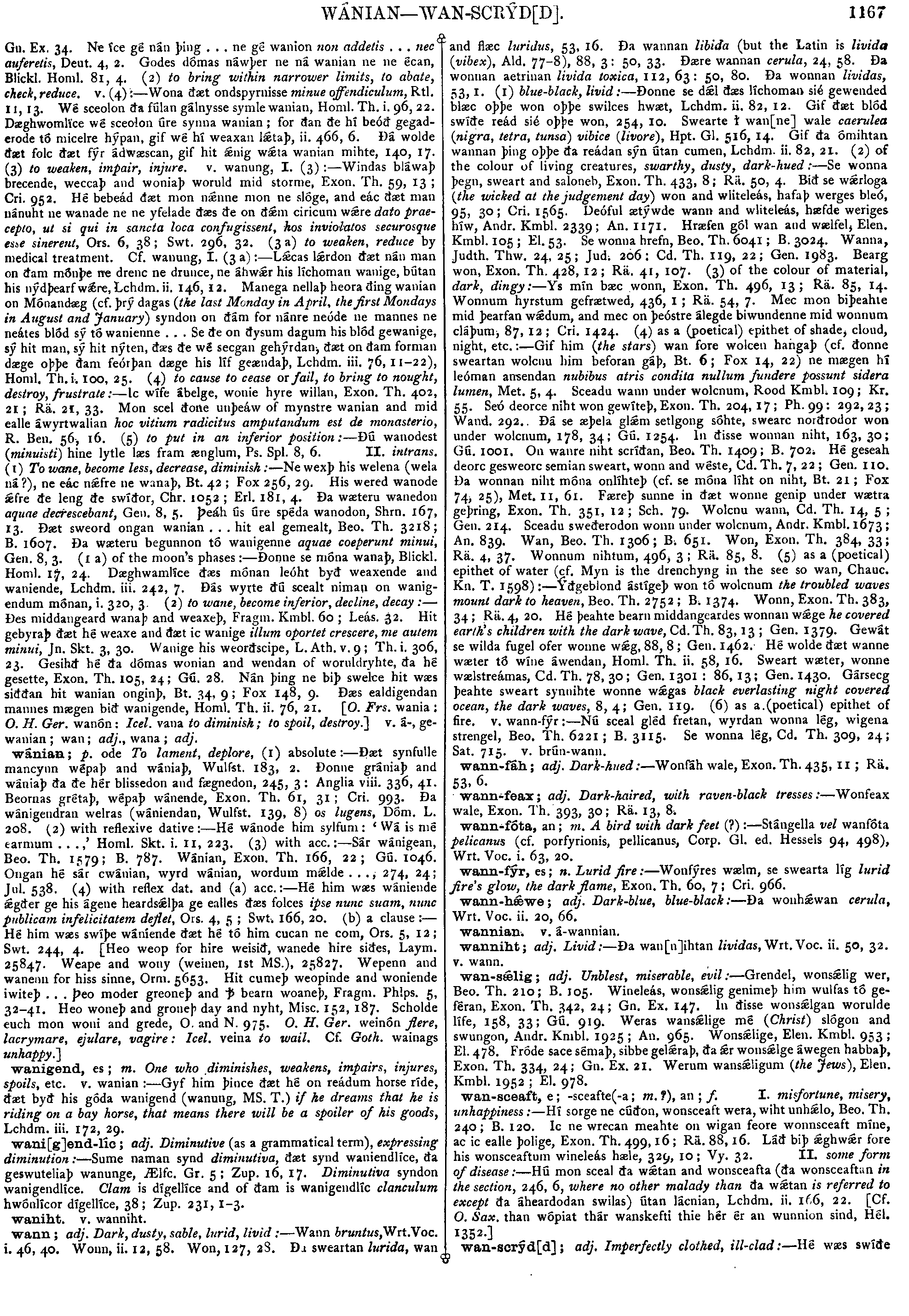
Gu.
Ex.
34.
Ne
íce
gé
nán
þing.
.
.
ne
gé
wanion
non
addetis
.
.
.
nec
auferetis,
Deut.
4,
2.
Godes
dómas
náwþer
ne
ná
wanian
ne
ne
écan,
Blickl.
Homl.
81,
4.
(2)
to
bring
within
narrower
limits,
to
abate,
check,
reduce,
v.
(4)
:--
Wona
ðæt
ondspyrnisse
minue
offendiculum,
Rtl.
11,
13.
Wé
sceolon
ða
fúlan
gálnysse
symle
wanian,
Homl.
Th.
i.
96,
22.
Dæghwomlíce
wé
sceolon
úre
synna
wanian
;
for
ðan
ðe
hí
beóð
gegad erode
tó
micelre
hýpan,
gif
wé
hí
weaxan
ltaþ,
ii.
466,
6.
Ða
wolde
ðæt
folc
ðæt
fýr
ádwæscan,
gif
hit
nig
wta
wanian
mihte,
140,
17.
(3)
to
weaken,
impair,
injure.
v.
wanung,
I.
(3)
:--
Windas
bláwaþ
brecende,
weccaþ
and
woniaþ
woruld
mid
storme,
Exon.
Th.
59,
13
;
Cri.
952.
Hé
bebeád
ðæt
mon
nnne
mon
ne
slóge,
and
eác
ðæt
man
nánuht
ne
wanade
ne
ne
yfelade
ðæs
ðe
on
ðm
ciricum
wre
dato
praecepto,
ut
si
qui
in
sancta
loca
confugissent,
hos
inviolatos
securosque
esse
sinerent,
Ors.
6,
38
;
Swt.
296,
32.
(3
a)
to
weaken,
reduce
by
medical
treatment.
Cf.
wanung,
I.
(3
a)
:--
Lcas
lrdon
ðæt
nán
man
on
ðam
mónþe
ne
drenc
ne
drunce,
ne
áhwr
his
líchoman
wanige,
bútan
his
nýdþearf
wæ;re,
Lchdm.
ii.
146,
12.
Manega
nellaþ
heora
ðing
wanian
on
Mónandæg
(cf.
þrý
dagas
(the
last
Monday
in
April,
the
first
Mondays
in
August
and
January)
syndon
on
ðám
for
nánre
neóde
ne
mannes
ne
neátes
blód
sý
tó
wanienne
.
.
.
Se
ðe
on
ðysum
dagum
his
blód
gewanige,
sý
hit
man,
sý
hit
nýten,
ðæs
ðe
wé
secgan
gehýrdanj
ðæt
on
ðam
forman
dæge
oþþe
ðam
feórþan
dæge
his
líf
geændaþ,
Lchdm.
iii.
76,
11-22),
Homl.
Th.
i.
100,
25.
(4)
to
cause
to
cease
or
fail,
to
bring
to
nought,
destroy,
frustrate
:--
lc
wife
ábelge,
wonie
hyre
willan,
Exon.
Th.
402,
21;
Rä.
21,
33.
Mon
scel
ðone
unþeáw
of
mynstre
wanian
and
mid
ealle
áwyrtwalian
hoc
vitium
radicitus
amputandum
est
de
monasterio,
R.
Ben.
56,
16.
(5)
to
put
in
an
inferior
position
:--
Ðú
wanodest
(minuisti)
hine
lytle
læs
fram
ænglum,
Ps.
Spl.
8,
6.
II.
intrans.
(1)
To
wane,
become
less,
decrease,
diminish
:--
Ne
wexþ
his
welena
(wela
ná?),
ne
eác
nfre
ne
wanaþ.
Bt.
42
;
Fox
256,
29.
His
wered
wanode
fre
ðe
leng
ðe
swíðor,
Chr.
1052
;
Erl.
181,
4.
Ða
wæteru
wanedon
aquae
decrescebant,
Gen.
8,
5.Ðeah
us
ure
spéda
wanodon,
Shrn.
167,
13.
Ðæt
sweord
ongan
wanian
.
.
.
hit
eal
gemealt,
Beo.
Th.
3218;
B.
1607.
Ða
wæteru
begunnon
tó
wanigenne
aguae
coeperunt
minui,
Gen.
8,
3.
(1
a)
of
the
moon's
phases
:--
Donne
se
móna
wanaþ,
Blickl.
Homl.
17,
24.
Dæghwamlíce
ðæs
mónan
leóht
byð
weaxende
and
waniende.
Lchdm.
iii.
242,
7.
Ðás
wyrte
ðú
scealt
niman
on
wanigendum
mónan,
i.
320,
3.
(2)
to
wane,
become
inferior,
decline,
decay
:--
Des
middangeard
wanaþ
and
weaxeþ,
Fragm.
Kmbl.
60
;
Leás.
32.
Hit
gebyraþ
ðæt
hé
weaxe
and
ðæt
ic
wanige
illum
oportet
crescere,
me
autem
minui,
Jn.
Skt.
3,
30.
Wanige
his
weorðscipe,
L.
Ath.
v.
9;
Th.
i.
306,
23.
Gesihð
hé
ða
dómas
wonian
and
wendan
of
woruldryhte,
ða
hé
gesette,
Exon.
Th.
105,
24;
Gú.
28.
Nán
þing
ne
biþ
swelce
hit
wæs
siððan
hit
wanian
onginþ,
Bt.
34,
9
;
Fox
148,
9.
Ðæs
ealdigendan
mannes
mægen
bið
wanigende,
Homl.
Th.
ii.
76,
21.
[O.
Frs.
wania
;
O.
H.
Ger.
wanón:
Icel.
vana
to
diminish;
to
spoil,
destroy.]
v.
á-,
gewanian
;
wan;
adj.,
wana;
adj.
erode
tó
micelre
hýpan,
gif
wé
hí
weaxan
ltaþ,
ii.
466,
6.
Ða
wolde
ðæt
folc
ðæt
fýr
ádwæscan,
gif
hit
nig
wta
wanian
mihte,
140,
17.
(3)
to
weaken,
impair,
injure.
v.
wanung,
I.
(3)
:--
Windas
bláwaþ
brecende,
weccaþ
and
woniaþ
woruld
mid
storme,
Exon.
Th.
59,
13
;
Cri.
952.
Hé
bebeád
ðæt
mon
nnne
mon
ne
slóge,
and
eác
ðæt
man
nánuht
ne
wanade
ne
ne
yfelade
ðæs
ðe
on
ðm
ciricum
wre
dato
praecepto,
ut
si
qui
in
sancta
loca
confugissent,
hos
inviolatos
securosque
esse
sinerent,
Ors.
6,
38
;
Swt.
296,
32.
(3
a)
to
weaken,
reduce
by
medical
treatment.
Cf.
wanung,
I.
(3
a)
:--
Lcas
lrdon
ðæt
nán
man
on
ðam
mónþe
ne
drenc
ne
drunce,
ne
áhwr
his
líchoman
wanige,
bútan
his
nýdþearf
wæ;re,
Lchdm.
ii.
146,
12.
Manega
nellaþ
heora
ðing
wanian
on
Mónandæg
(cf.
þrý
dagas
(the
last
Monday
in
April,
the
first
Mondays
in
August
and
January)
syndon
on
ðám
for
nánre
neóde
ne
mannes
ne
neátes
blód
sý
tó
wanienne
.
.
.
Se
ðe
on
ðysum
dagum
his
blód
gewanige,
sý
hit
man,
sý
hit
nýten,
ðæs
ðe
wé
secgan
gehýrdanj
ðæt
on
ðam
forman
dæge
oþþe
ðam
feórþan
dæge
his
líf
geændaþ,
Lchdm.
iii.
76,
11-22),
Homl.
Th.
i.
100,
25.
(4)
to
cause
to
cease
or
fail,
to
bring
to
nought,
destroy,
frustrate
:--
lc
wife
ábelge,
wonie
hyre
willan,
Exon.
Th.
402,
21;
Rä.
21,
33.
Mon
scel
ðone
unþeáw
of
mynstre
wanian
and
mid
ealle
áwyrtwalian
hoc
vitium
radicitus
amputandum
est
de
monasterio,
R.
Ben.
56,
16.
(5)
to
put
in
an
inferior
position
:--
Ðú
wanodest
(minuisti)
hine
lytle
læs
fram
ænglum,
Ps.
Spl.
8,
6.
II.
intrans.
(1)
To
wane,
become
less,
decrease,
diminish
:--
Ne
wexþ
his
welena
(wela
ná?),
ne
eác
nfre
ne
wanaþ.
Bt.
42
;
Fox
256,
29.
His
wered
wanode
fre
ðe
leng
ðe
swíðor,
Chr.
1052
;
Erl.
181,
4.
Ða
wæteru
wanedon
aquae
decrescebant,
Gen.
8,
5.Ðeah
us
ure
spéda
wanodon,
Shrn.
167,
13.
Ðæt
sweord
ongan
wanian
.
.
.
hit
eal
gemealt,
Beo.
Th.
3218;
B.
1607.
Ða
wæteru
begunnon
tó
wanigenne
aguae
coeperunt
minui,
Gen.
8,
3.
(1
a)
of
the
moon's
phases
:--
Donne
se
móna
wanaþ,
Blickl.
Homl.
17,
24.
Dæghwamlíce
ðæs
mónan
leóht
byð
weaxende
and
waniende.
Lchdm.
iii.
242,
7.
Ðás
wyrte
ðú
scealt
niman
on
wanigendum
mónan,
i.
320,
3.
(2)
to
wane,
become
inferior,
decline,
decay
:--
Des
middangeard
wanaþ
and
weaxeþ,
Fragm.
Kmbl.
60
;
Leás.
32.
Hit
gebyraþ
ðæt
hé
weaxe
and
ðæt
ic
wanige
illum
oportet
crescere,
me
autem
minui,
Jn.
Skt.
3,
30.
Wanige
his
weorðscipe,
L.
Ath.
v.
9;
Th.
i.
306,
23.
Gesihð
hé
ða
dómas
wonian
and
wendan
of
woruldryhte,
ða
hé
gesette,
Exon.
Th.
105,
24;
Gú.
28.
Nán
þing
ne
biþ
swelce
hit
wæs
siððan
hit
wanian
onginþ,
Bt.
34,
9
;
Fox
148,
9.
Ðæs
ealdigendan
mannes
mægen
bið
wanigende,
Homl.
Th.
ii.
76,
21.
[O.
Frs.
wania
;
O.
H.
Ger.
wanón:
Icel.
vana
to
diminish;
to
spoil,
destroy.]
v.
á-,
gewanian
;
wan;
adj.,
wana;
adj.
|
Source: Bosworth/Toller, page b1215, entry 10 View original page image as: [TIFF] [PNG] [View previous entry] [View next entry] |
[Comment on this entry] [View comments] |
The following entry has been hand-corrected once. |
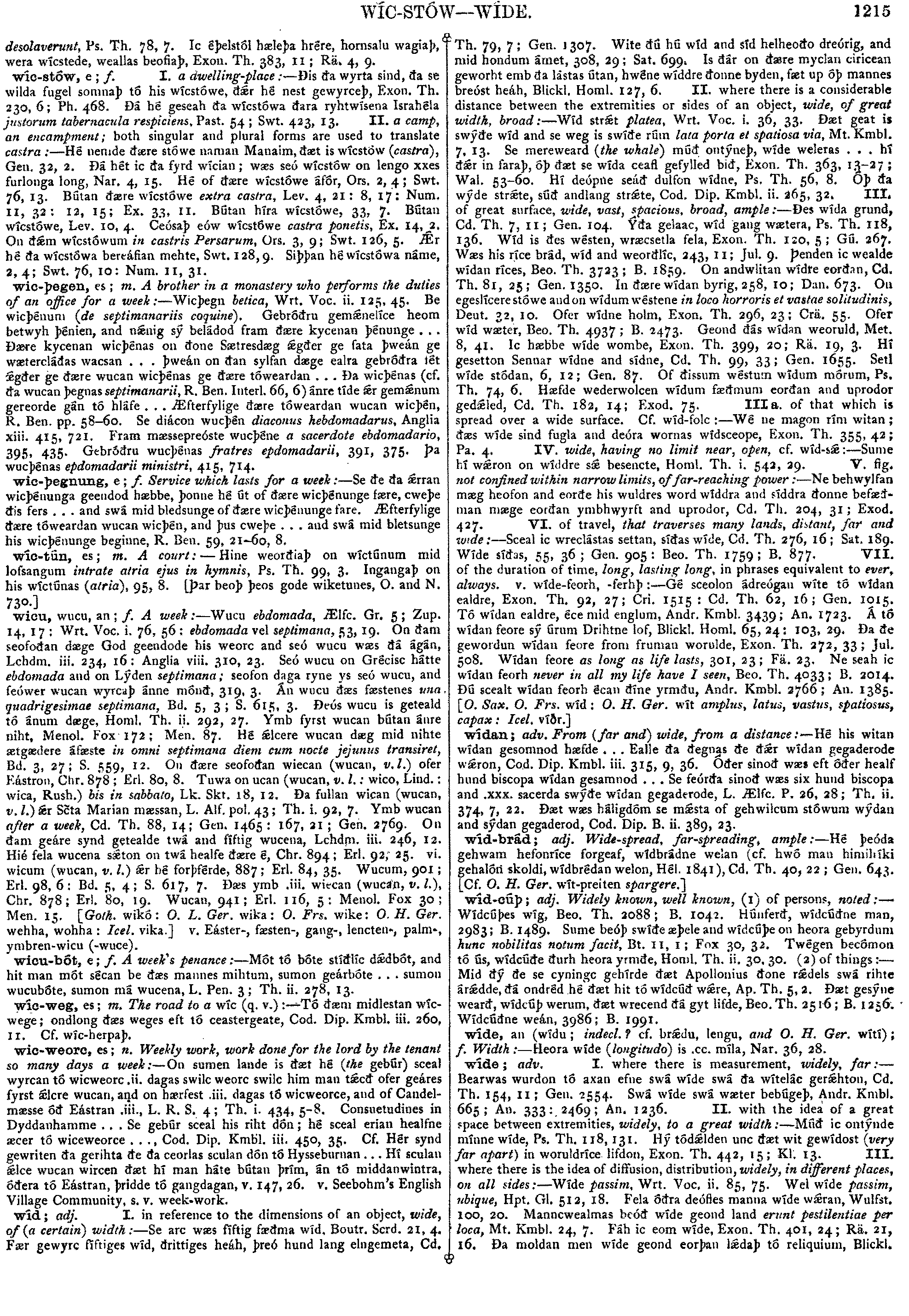
wíd;
adj.
I.
in
reference
to
the
dimensions
of
an
object,
wide,
of
(a
certain)
width
:--
Se
arc
wæs
fíftig
fæðma
wíd,
Boutr.
Scrd.
21,
4.
Fær
gewyrc
fiftiges
wíd,
ðrittiges
heáh,
þreó
hund
lang
elngemeta,
Cd.
Th.
79,
7;
Gen.
1307.
Wite
ðú
hú
wíd
and
síd
helheoðo
dreórig,
and
mid
hondum
ámet,
308,
29;
Sat.
699,
Is
ðár
on
ðære
myclan
ciricean
geworht
emb
ða
lástas
útan,
hwéne
wíddre
ðonne
byden,
fæt
up
óþ
mannes
breóst
heáh.
Blickl.
Homl.
127,
6.
II.
where
there
is
a
considerable
distance
between
the
extremities
or
sides
of
an
object,
wide,
of
great
width,
broad
:--
Wíd
strt
platea,
Wrt.
Voc.
i.
36,
33.
Ðæt
geat
is
swýðe
wíd
and
se
weg
is
swíðe
rúm
lata
porta
et
spatiosa
via,
Mt.
Kmbl.
7,
13.
Se
mereweard
(the
whale)
múð
ontýneþ,
wíde
weleras
.
.
.
hí
ðr
in
faraþ,
óþ
ðæt
se
wída
ceafl
gefylled
bið,
Exon.
Th.
363,
i.
13-27;
Wal.
53-60.
Hí
deópne
seúð
dulfon
wídne.
Ps.
Th.
56,
8.
Óþ
ða
wýde
strte,
súð
andlang
strte,
Cod.
Dip.
Kmbl.
ii.
265,
32.
III.
of
great
surface,
wide,
vast,
spacious,
broad,
ample
:--
Ðes
wída
grund,
Cd.
Th.
7,
11;
Gen.
104.
Ýða
gelaac,
wíd
gang
wætera,
Ps.
Th.
118,
136.
Wíd
is
ðes
wésten,
wræcsetla
fela,
Exon.
Th.
120,
5;
Gú.
267.
Wæs
his
ríce
brád,
wíd
and
weorðlíc,
243,
11;
Jul.
9.
Þenden
ic
wealde
wídan
ríces,
Beo.
Th.
3723
;
B.
1859.
On
andwlitan
wídre
eorðan,
Cd.
Th.
81,
25;
Gen.
1350.
In
ðære
wídan
byrig,
258,
10;
Dan.
673.
On
egeslícere
stówe
and
on
wídum
wéstene
in
loco
horroris
et
vastae
solitudinis,
Deut.
32,
10.
Ofer
wídne
holm,
Exon.
Th.
296,
23;
Crä.
55.
Ofer
wíd
wæter,
Beo.
Th.
4937
;
B.
2473.
Geond
ðás
wídan
weoruld,
Met.
8,
41.
Ic
hæbbe
wíde
wombe,
Exon.
Th.
399,
20;
Rä.
19,
3.
Hí
gesetton
Sennar
wídne
and
sídne,
Cd.
Th.
99,
33
;
Gen.
1655.
Setl
wíde
stódan,
6,
12;
Gen.
87.
Of
ðissum
wéstum
wídum
mórum,
Ps.
Th.
74,
6.
Hæfde
wederwolcen
wídum
fæðmum
eorðan
and
uprodor
gedled,
Cd.
Th.
182,
14;
Exod.
75.
IIIa.
of
that
which
is
spread
over
a
wide
surface.
Cf.
wíd-folc
:--
Wé
ne
magon
rím
witan;
ðæs
wíde
sind
fugla
and
deóra
wornas
wídsceope,
Exon.
Th.
355,
42;
Pa.
4.
IV.
wide,
having
no
limit
near,
open,
cf.
wíd-s:--
Sume
hí
wron
on
wíddre
s
besencte,
Homl.
Th.
i.
542,
29.
V.
fig.
not
confined
within
narrow
limits,
of
far-reaching
power
:--
Ne
behwylfan
mæg
heofon
and
eorðe
his
wuldres
word
wíddra
and
síddra
ðonne
befæð-man
mæge
eorðan
ymbhwyrft
and
uprodor,
Cd.
Th.
204,
31;
Exod.
427.
VI.
of
travel,
that
traverses
many
lands,
distant,
far
and
wide
:--
Sceal
ic
wreclástas
settan,
síðas
wíde,
Cd.
Th.
276,
16
;
Sat.
189.
Wíde
síðas,
55,
36;
Gen.
905:
Beo.
Th.
1759;
B.
877.
VII.
of
the
duration
of
time,
long,
lasting
long,
in
phrases
equivalent
to
ever,
always.
v.
wíde-feorh,
-ferhþ
:--
Gé
sceolon
ádreógan
wíte
tó
wídan
ealdre,
Exon.
Th.
92,
27;
Cri.
1515
:
Cd.
Th.
62,
16
;
Gen.
1015.
Tó
wídan
ealdre,
éce
mid
englum,
Andr.
Kmbl.
3439;
An.
1723.
Á
tó
wídan
feore
sý
úrum
Drihtne
lof,
Blickl.
Homl.
65,
24:
103,
29.
Ða
ðe
gewordun
wídan
feore
from
fruman
worulde,
Exon.
Th.
272,
33
;
Jul.
508.
Wídan
feore
as
long
as
life
lasts,
301,
23
;
Fä.
23.
Ne
seah
ic
wídan
feorh
never
in
all
my
life
have
I
seen,
Beo.
Th.
4033
;
B.
2014.
Ðú
scealt
wídan
feorh
écan
ðíne
yrmðu,
Andr.
Kmbl.
2766
;
An.
1385.
[O.
Sax.
O.
Frs.
wíd
:
O.
H.
Ger.
wít
amplus,
latus,
vastus,
spatiosus,
capax:
Icel.
víðr.]
|
Source: Bosworth/Toller, page b1267, entry 6 View original page image as: [TIFF] [PNG] [View previous entry] [View next entry] |
[Comment on this entry] [View comments] |
The following entry has been hand-corrected once. |
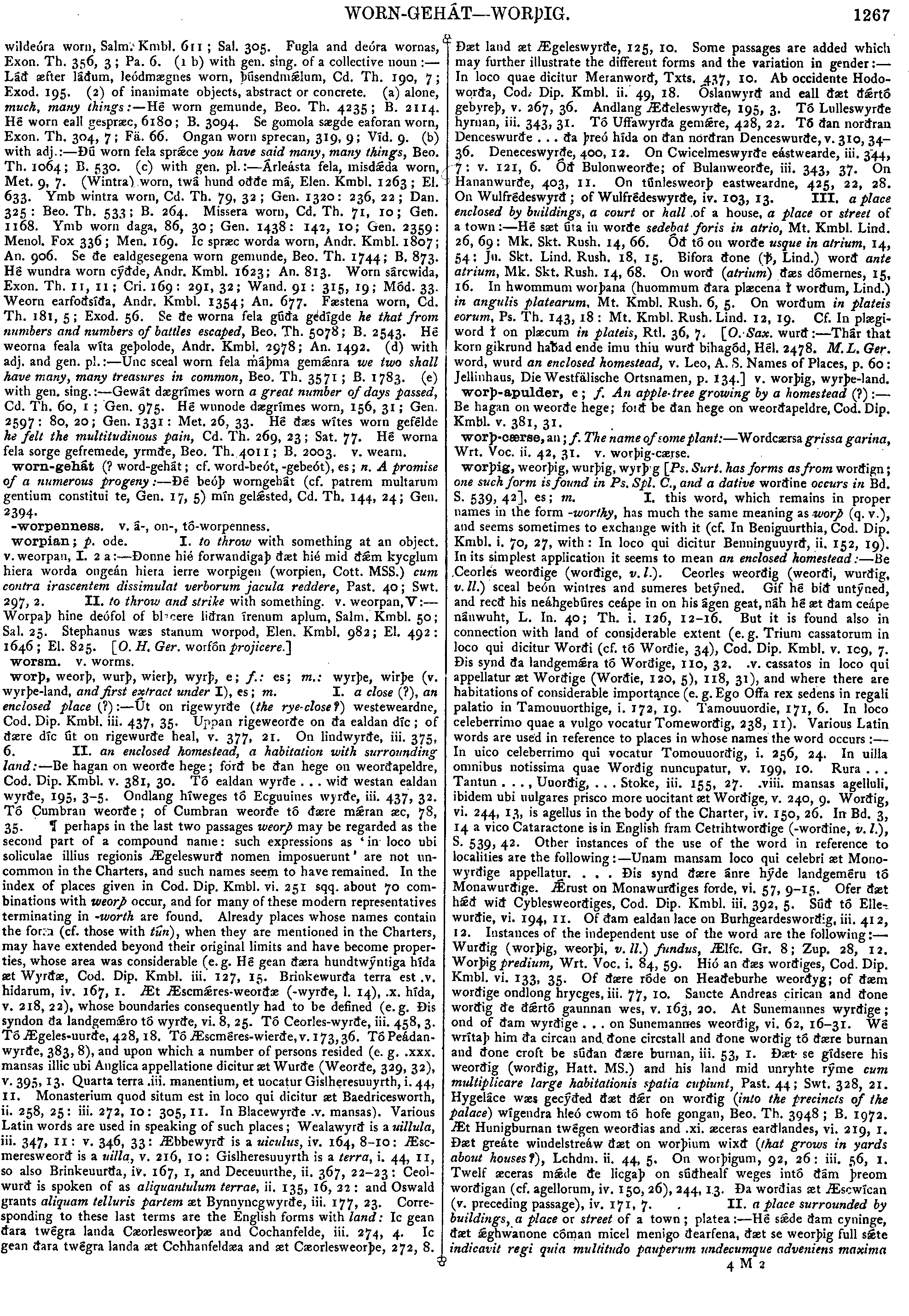
worþ,
weorþ,
wurþ,
wierþ,
wyrþ,
e;
f;
es;
m.
:
wyrþe,
wirþe
(v.
wyrþe-land,
and
first
extract
under
I),
es
;
m.
I.
a
close
(?),
an
enclosed
place
(?)
:--
Út
on
rigewyrðe
(the
rye-close
?]
westeweardne,
Cod.
Dip.
Kmbl.
iii.
437,
35.
Uppan
rigeweorðe
on
ða
ealdan
díc;
of
ðære
die
út
on
rigewurðe
heal,
v.
377,
21.
On
lindwyrðe,
iii.
375,
6.
II.
an
enclosed
homestead,
a
habitation
with
surrounding
land
:--
Be
hagan
on
weorðe
hege;
forð
be
ðan
hege
on
weorðapeldre,
Cod.
Dip.
Kmbl.
v.
381,
30.
Tó
ealdan
wyrðe
.
.
.
wið
westan
ealdan
wyrðe,
195,
3-5.
Ondlang
híweges
tó
Ecguuines
wyrðe,
iii.
437,
32.
Tó
Cumbran
weorðe;
of
Cumbran
weorðe
tó
ðære
mran
æc,
78,
35.
¶
perhaps
in
the
last
two
passages
weorþ
may
be
regarded
as
the
second
part
of
a
compound
name:
such
expressions
as
'in
loco
ubi
soliculae
illius
regionis
Ægeleswurð
nomen
imposuerunt'
are
not
uncommon
in
the
Charters,
and
such
names
seem
to
have
remained.
In
the
index
of
places
given
in
Cod.
Dip.
Kmbl.
vi.
251
sqq.
about
70
combinations
with
weorþ
occur,
and
for
many
of
these
modem
representatives
terminating
in
-worth
are
found.
Already
places
whose
names
contain
the
form
(cf.
those
with
tún),
when
they
are
mentioned
in
the
Charters,
may
have
extended
beyond
their
original
limits
and
have
become
properties,
whose
arca
was
considerable
(e.
g.
Hé
gean
ðæra
hundtwýntiga
hída
æt
Wyrðæ,
Cod.
Dip.
Kmbl.
in.
127,
15.
Brinkewurða
terra
est
.
v.
hidarum,
iv.
167,
1.
Æt
Æscmres-weorðæ
(-wyrðe,
1.
14),
.
x.
hída,
v.
218,
22),
whose
boundaries
consequently
had
to
be
defined
(e.
g.
Ðis
syndon
ða
landgemro
tó
wyrðe,
vi.
8,
25.
Tó
Ceorles-wyrðe,
iii.
458,
3.
Tó
Ægeles-uurðe,
428,
18.
Tó
Æscméres-wierðe,
v.
173,
36.
Tð
Peadan-wyrðe,
383,
8),
and
upon
which
a
number
of
persons
resided
(e.
g.
.xxx.
mansas
illic
ubi
Anglica
appellatione
dicitur
æt
Wurðe
(Weorðe,
329,
32),
v.
395,
13.
Quarta
terra
.
iii.
manentium,
et
uocatur
Gislheresuuyrth,
i.
44,
110.
Monasterium
quod
situm
est
in
loco
qui
dicitur
æt
Baedricesworth,
ii.
258,
25:
iii.
272,
10:
305,
ii.
In
Blacewyrðe
.v.
mansas).
Various
Latin
words
are
used
in
speaking
of
such
places;
Wealawyrð
is
a
uillula,
iii.
347,
ii:
v.
346,
33:
Æbbewyrð
is
a
uiculus,
iv.
164,
8-10:
Æscmeresweorð
is
a
uilla,
v.
216,
10
:
Gislheresuuyrth
is
a
terra,
i.
44,
11.
so
also
Brinkeuurða,
iv.
167,
1,
and
Deceuurthe,
ii.
367,
22-23
:
Ceolwurð
is
spoken
of
as
aliquantulum
terrae,
ii.
135,
16,
22
:
and
Oswald
grants
aliyuam
telluris
partem
æt
Bynnvncgwyrðe,
iii.
177,
23.
Corresponding
to
these
last
terms
are
the
English
forms
with
land:
Ic
gean
ðara
twégra
landa
Cæorlesweorþæ
and
Cochanfelde,
iii.
274,
4.
Ic
gean
ðara
twégra
landa
æt
Cohhanfeldæa
and
æt
Cæorlesweorþe,
272,
|
Source: Bosworth/Toller, page d0035, entry 34 View original page image as: [TIFF] [PNG] [View previous entry] [View next entry] |
[Comment on this entry] [View comments] |
The following entry has been hand-corrected once. |
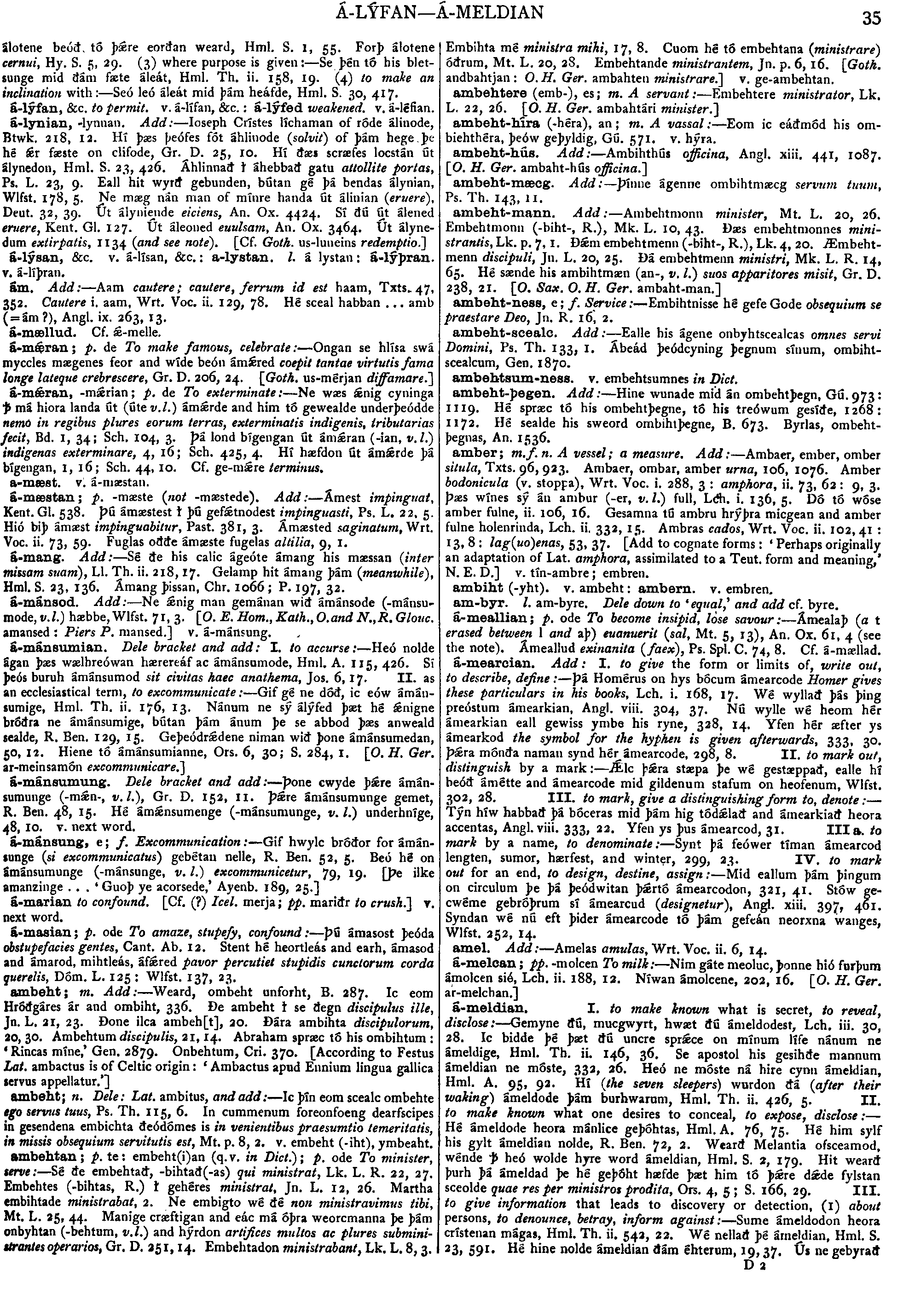
á-mearcian.
Add:
I.
to
give
the
form
or
limits
of,
write
out,
to
describe,
define:--Þá
Homérus
on
hys
bócum
ámearcode
Homer
gives
these
particulars
in
his
books,
Lch.
i.
168,
17.
Wé
wyllað
þás
þing
preóstum
ámearkian,
Angl.
viii.
304,
37.
Nú
wylle
wé
heom
hér
ámearkian
eall
gewiss
ymbe
his
ryne,
328,
14.
Yfen
hér
æfter
ys
ámearkod
the
symbol
for
the
hyphen
is
given
afterwards,
333,
30.
Þra
mónða
naman
synd
hér
ámearcode,
298,
8.
II.
to
mark
out,
distinguish
by
a
mark:--Æ-acute;lc
þra
stæpa
þe
wé
gestæppað,
ealle
hí
beóð
ámétte
and
ámearcode
mid
gildenum
stafum
on
heofenum,
Wlfst.
302,
28.
III.
to
mark,
give
a
distinguishing
form
to,
denote:--Týn
híw
habbað
þá
bóceras
mid
þám
hig
tódlað
and
ámearkiað
heora
accentas,
Angl.
viii.
333,
22.
Yfen
ys
þus
ámearcod,
31.
III
a.
to
mark
by
a
name,
to
denominate:--Synt
þá
feówer
tíman
ámearcod
lengten,
sumor,
hærfest,
and
winter,
299,
23.
IV.
to
mark
out
for
an
end,
to
design,
destine,
assign:--Mid
eallum
þám
þingum
on
circulum
þe
þá
þeódwitan
þrtó
ámearcodon,
321,
41.
Stów
gecwéme
gebróþrum
sí
ámearcud
(designetur),
Angl.
xiii.
397,
461.
Syndan
wé
nú
eft
þider
ámearcode
tó
þám
gefeán
neorxna
wanges,
Wlfst.
252,
14.
|
Source: Bosworth/Toller, page d0036, entry 7 View original page image as: [TIFF] [PNG] [View previous entry] [View next entry] |
[Comment on this entry] [View comments] |
The following entry has been hand-corrected once. |
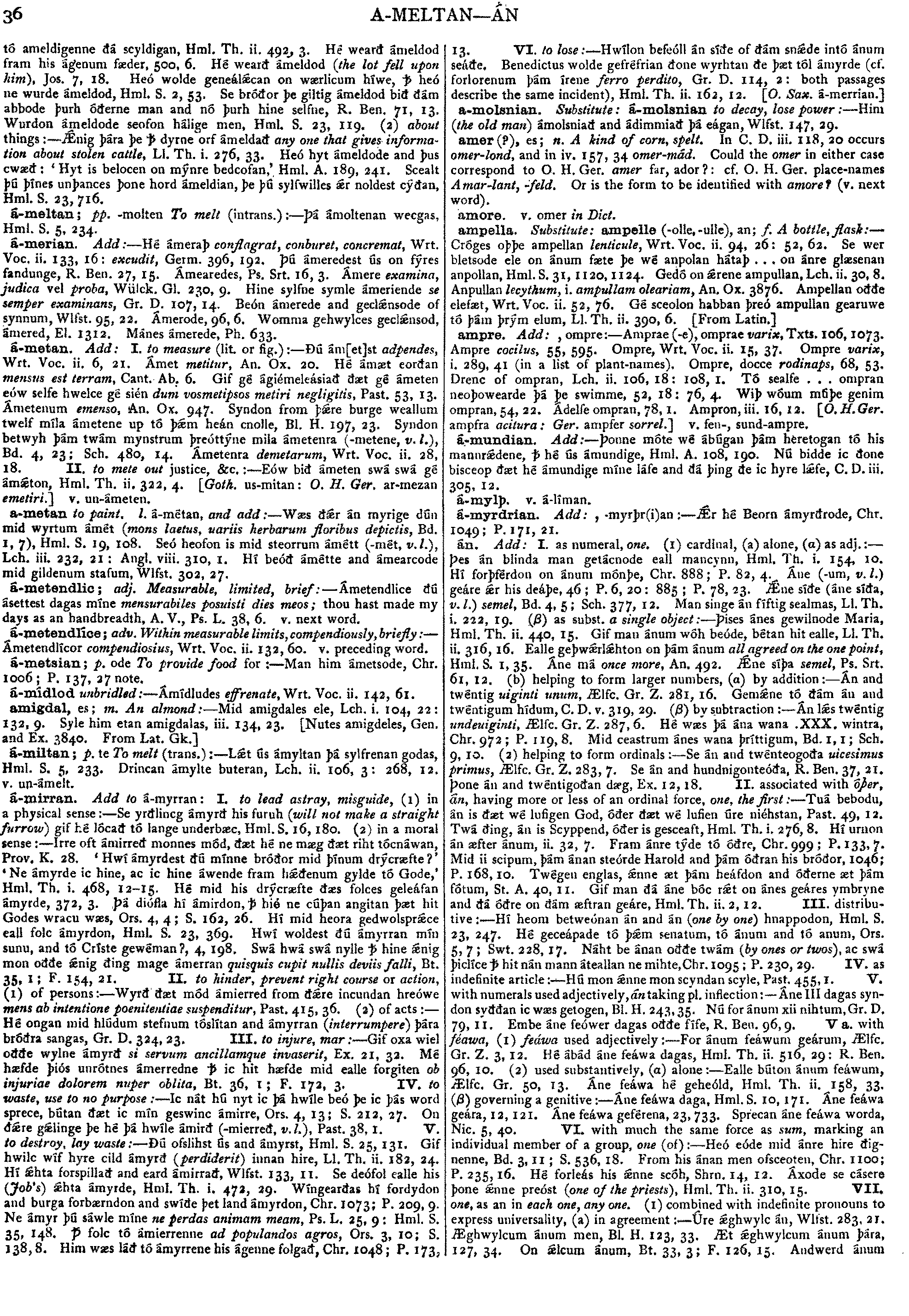
á-metendlíce; adv. Within measurable limits, compendiously, briefly:--Ámetendlícor compendiosius, Wrt. Voc. ii. 132, 60. v. preceding word.
|
Source: Bosworth/Toller, page d0077, entry 13 View original page image as: [TIFF] [PNG] [View previous entry] [View next entry] |
[Comment on this entry] [View comments] |
The following entry has been hand-corrected once. |
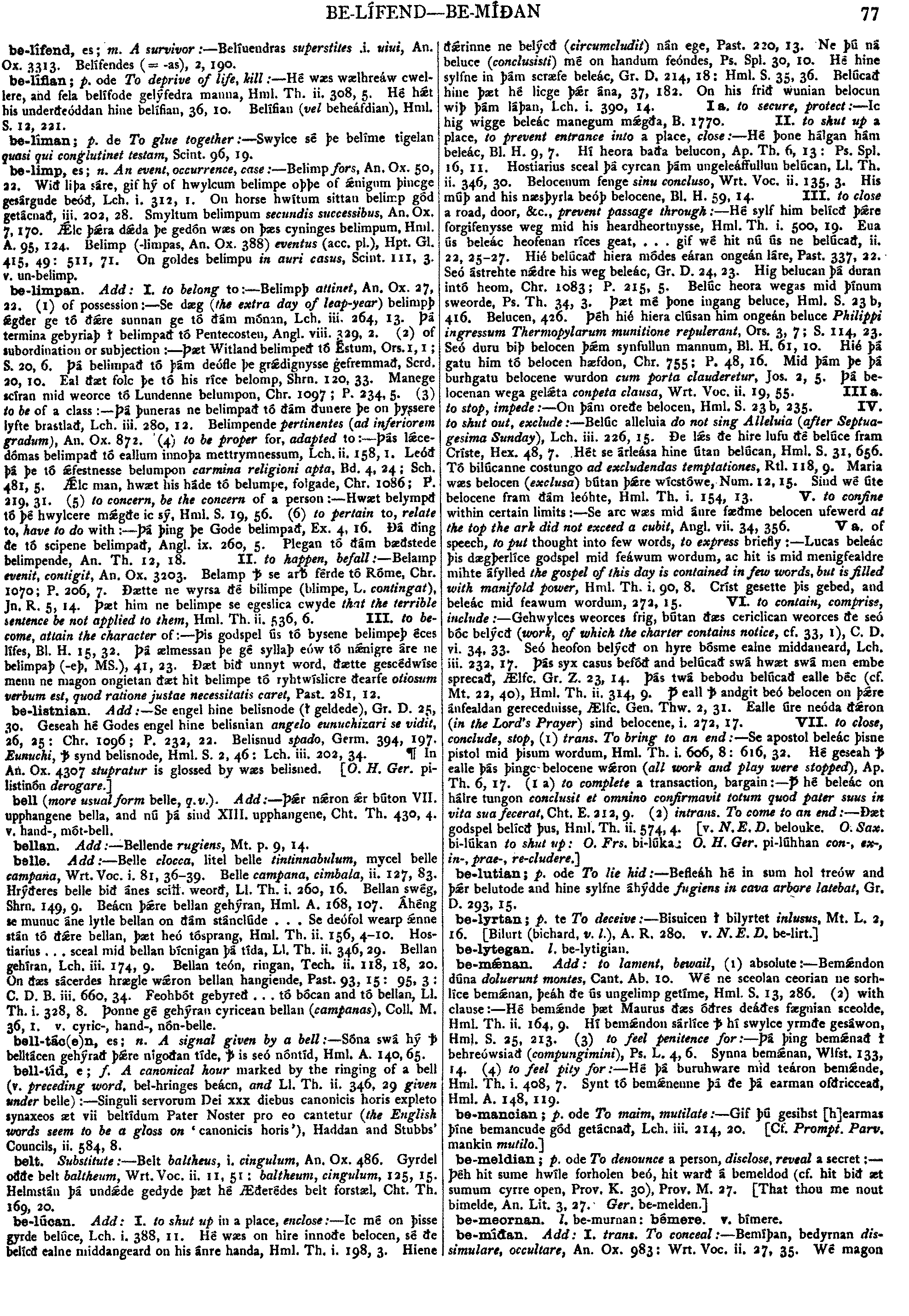
be-lúcan.
Add:
I.
to
shut
up
in
a
place,
enclose:--Ic
mé
on
þisse
gyrde
belúce,
Lch.
i.
388,
II.
Hé
wæs
on
hire
innoðe
belocen,
sé
ðe
belícð
ealne
middangeard
on
his
ánre
handa,
Hml.
Th.
i.
198,
3.
Hiene
ðrinne
ne
belýcð
(circumcludit)
nán
ege,
Past.
220,
13.
Ne
þú
ná
beluce
(conclasisti)
mé
on
handum
feóndes,
Ps.
Spl.
30,
10.
Hé
hine
sylfne
in
þám
scræfe
beleác,
Gr.
D.
214,
18:
Hml.
S.
35,
36.
Belúcað
hine
þæt
hé
licge
þr
ána,
37,
182.
On
his
frið
wunian
belocun
wiþ
þám
láþan,
Lch.
i.
390,
14.
Ia.
to
secure,
protect:--Ic
hig
wigge
beleác
manegum
mgða,
B.
1770.
II.
to
shut
up
a
place,
to
prevent
entrance
into
a
place,
close:--Hé
þone
hálgan
hám
beleác,
Bl.
H.
9,
7.
Hí
heora
baða
belucon,
Ap.
Th.
6,
13:
Ps.
Spl.
16,
II.
Hostiarius
sceal
þá
cyrcan
þám
ungeleáffullun
belúcan,
Ll.
Th.
ii.
346,
30.
Belocenum
fenge
sinu
concluso,
Wrt.
Voc.
ii.
135,
3.
His
múþ
and
his
næsþyrla
beóþ
belocene.
Bl.
H.
59,
14.
III.
to
close
a
road,
door,
&c.,
prevent
passage
through:--Hé
sylf
him
belícð
þre
forgifenysse
weg
mid
his
heardheortnysse,
Hml.
Th.
i.
500,
19.
Eua
ús
beleác
heofenan
ríces
geat,
.
.
.
gif
wé
hit
nú
ús
ne
belúcað,
ii.
22,
25-27.
Hié
belúcað
hiera
módes
eáran
ongeán
láre,
Past.
337,
22.
Seó
ástrehte
ndre
his
weg
beleác,
Gr.
D.
24,
23.
Hig
belucan
þá
duran
intó
heom.
Chr.
1083;
P.
215,
5.
Belúc
heora
wegas
mid
þínun.
sweorde,
Ps.
Th.
34,
3.
Þæt
mé
þone
ingang
beluce,
Hml.
S.
23
b,
416.
Belucen,
426.
Þéh
hié
hiera
clúsan
him
ongeán
beluce
Philippi
ingressum
Thermopylarum
munitione
repulerant,
Ors.
3,
7;
S.
114,
23.
Seó
duru
biþ
belocen
þm
synfullun
mannum,
Bl.
H.
61,
10.
Hié
þá
gatu
him
tó
belocen
hæfdon,
Chr.
755;
P.
48,
16.
Mid
þám
þe
þá
burhgatu
belocene
wurdon
cum
porta
clauderetur.
Jos.
2,
5.
Þá
be-locenan
wega
gelta
conpeta
clausa,
Wrt.
Voc.
ii.
19,
55.
IIIa.
to
stop,
impede:--On
þám
oreðe
belocen,
Hml.
S.
23b,
235.
IV.
to
shut
out,
exclude:--Belúc
alleluia
do
not
sing
Alleluia
(after
Septua-gesima
Sunday),
Lch.
iii.
226,
15.
Ðe
ls
ðe
hire
lufu
ðé
belúce
fram
Críste,
Hex.
48,
7.
Hét
se
árleása
hine
útan
belúcan,
Hml.
S.
31,
656.
Tó
bilúcanne
costungo
ad
excludendas
temptationes,
Rtl.
118,
9.
Maria
wæs
belocen
(exclusa)
bútan
þære
wícstówe,
Num.
12,
15.
Sind
wé
úte
belocene
fram
ðám
leóhte,
Hml.
Th.
i.
154,
13.
V.
to
confine
within
certain
limits:--Se
arc
wæs
mid
ánre
fæðme
belocen
ufewerd
at
the
top
the
ark
did
not
exceed
a
cubit,
Angl.
vii.
34,
356.
V
a.
of
speech,
to
put
thought
into
few
words,
to
express
briefly:--Lucas
beleác
þis
dægþerlíce
godspel
mid
feáwum
wordum,
ac
hit
is
mid
menigfealdre
mihte
áfylled
the
gospel
of
this
day
is
contained
in
few
words,
but
is
fitted
with
manifold
power,
Hml.
Th.
i.
90,
8.
Críst
gesette
þis
gebed,
and
beleác
mid
feawum
wordum,
272,
15.
VI.
to
contain,
comprise,
include:--Gehwylces
weorces
frig,
bútan
ðæs
cericlican
weorces
ðe
seó
bóc
belýcð
(work,
of
which
the
charter
contains
notice,
cf.
33,
I),
C.
D.
vi-
34.
33.
Seó
heofon
belýcð
on
hyre
bósme
ealne
middaneard,
Lch.
iii.
232,
17.
Þás
syx
casus
befóð
and
belúcað
swá
hwæt
swá
men
embe
sprecað,
Ælfc.
Gr.
Z.
23,
14.
Þás
twá
bebodu
belúcað
ealle
béc
(cf.
Mt.
22,
40),
Hml.
Th.
ii.
314,
9.
 eall
andgit
beó
belocen
on
þre
ánfealdan
gerecednisse,
Ælfc.
Gen.
Thw.
2,
31.
Ealle
úre
neóda
ðron
(in
the
Lord's
Prayer)
sind
belocene,
i.
272,
17.
VII.
to
close,
conclude,
stop,
(I)
trans.
To
bring
to
an
end:--Se
apostol
beleác
þisne
pistol
mid
þisum
wordum,
Hml.
Th.
i.
606,
8:
616,
32.
Hé
geseah
ealle
þás
þingc
belocene
wron
(all
work
and
play
were
stopped),
Ap.
Th.
6,
17.
(Ia)
to
complete
a
transaction,
bargain:--
hé
beleác
on
hálre
tungon
conclusit
et
omnino
confirmavit
totum
quod
pater
suus
in
vita
sua
fecerat,
Cht.
E.
212,
9.
(2)
intrans.
To
come
to
an
end:--Ðæt
godspel
belícð
þus,
Hml.
Th.
ii.
574,
4.
[v.
N.
E.
D.
belouke.
O.
Sax.
bi-lúkan
to
shut
up:
O.
Frs.
bi-lúka:
O.
H.
Ger.
pi-lúhhan
con-,
ex-,
in-,
prae-,
re-cludere.]
eall
andgit
beó
belocen
on
þre
ánfealdan
gerecednisse,
Ælfc.
Gen.
Thw.
2,
31.
Ealle
úre
neóda
ðron
(in
the
Lord's
Prayer)
sind
belocene,
i.
272,
17.
VII.
to
close,
conclude,
stop,
(I)
trans.
To
bring
to
an
end:--Se
apostol
beleác
þisne
pistol
mid
þisum
wordum,
Hml.
Th.
i.
606,
8:
616,
32.
Hé
geseah
ealle
þás
þingc
belocene
wron
(all
work
and
play
were
stopped),
Ap.
Th.
6,
17.
(Ia)
to
complete
a
transaction,
bargain:--
hé
beleác
on
hálre
tungon
conclusit
et
omnino
confirmavit
totum
quod
pater
suus
in
vita
sua
fecerat,
Cht.
E.
212,
9.
(2)
intrans.
To
come
to
an
end:--Ðæt
godspel
belícð
þus,
Hml.
Th.
ii.
574,
4.
[v.
N.
E.
D.
belouke.
O.
Sax.
bi-lúkan
to
shut
up:
O.
Frs.
bi-lúka:
O.
H.
Ger.
pi-lúhhan
con-,
ex-,
in-,
prae-,
re-cludere.]
| Result Page: |  |
Previous | 1 2 3 4 | Next |  |
Germanic Lexicon Project (main page)
This search system was written by
Sean Crist
Please consider
volunteering
to correct the data in these online dictionaries.
No rights reserved. Feel free to use these data in any way you please.