|
|

Tip: In the search results, you can click on any word or abbreviation for more information.
|
Source: Bosworth/Toller, page b0624, entry 19 View original page image as: [TIFF] [PNG] [View previous entry] [View next entry] |
[Comment on this entry] [View comments] |
The following entry has been hand-corrected once. |
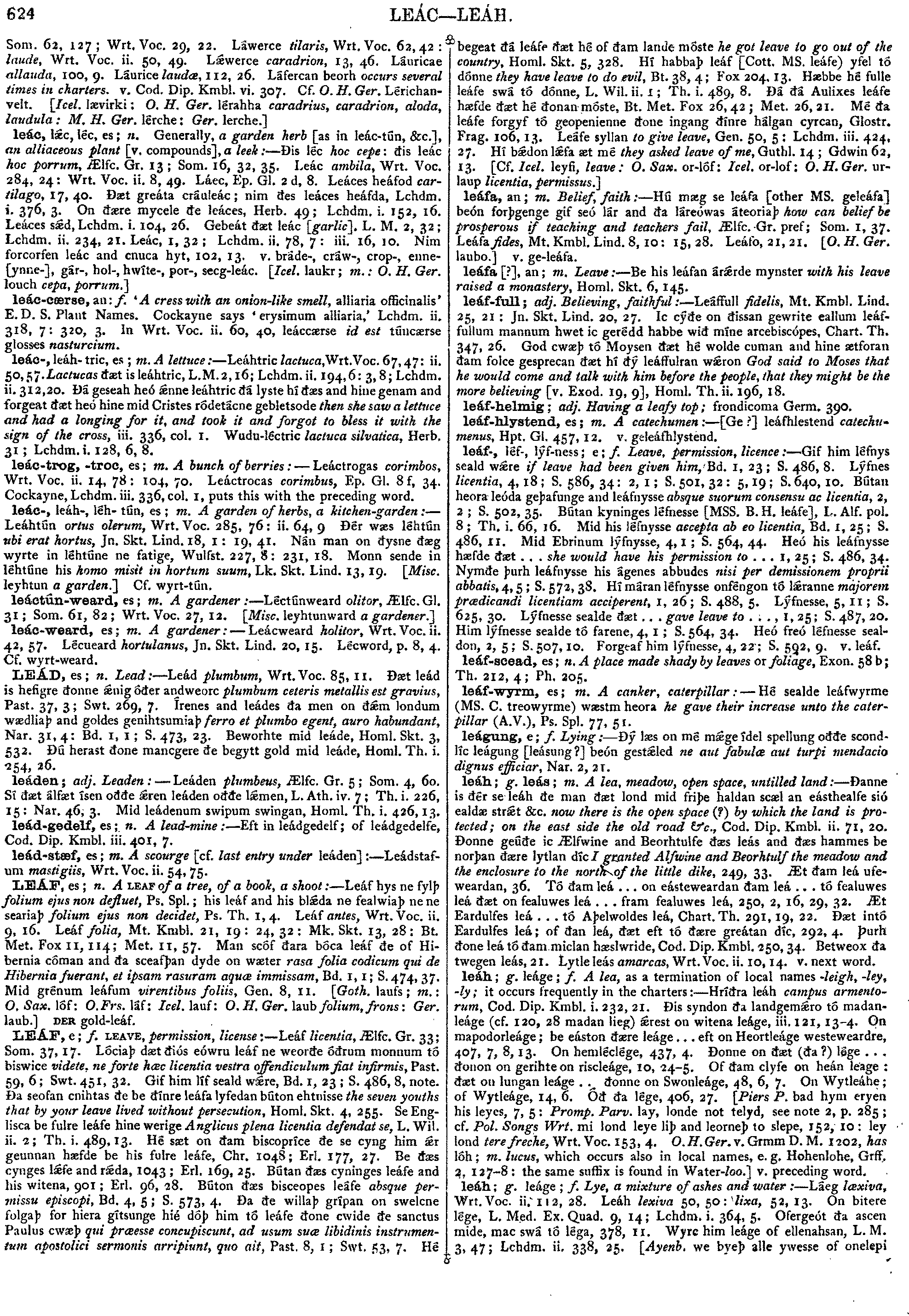
leáf-,
léf-,
lýf-ness;
e;
f.
Leave,
permission,
licence
:--
Gif
him
léfnys
seald
w re
if
leave
had
been
given
him,
Bd.
1,
23;
S.
486,
8.
Lýfnes
licentia,
4,
18;
S.
586,
34:
2,
1;
S.
501,
32:
5,
19;
S.
640,
10.
Bútan
heora
Ieóda
geþafunge
and
leáfnysse
absque
suorum
consensu
ac
licentia,
2,
2;
S.
502,
35.
Bútan
kyninges
léfnesse
[MSS.
B.
H.
leáfe],
L.
Alf.
pol.
8;
Th.
i.
66,
16.
Mid
his
léfnysse
accepta
ab
eo
licentia,
Bd.
1,
25;
S.
486,
11.
Mid
Ebrinum
lýfnysse,
4,
1;
S.
564,
44.
Heó
his
leáfnysse
hæfde
ðæt
...
she
would
have
his
permission
to
...
1,
25;
S.
486,
34.
Nymðe
þurh
leáfnysse
his
ágenes
abbudes
nisi
per
demissionem
proprii
abbatis,
4,
5;
S.
572,
38.
Hí
máran
léfnysse
onféngon
tó
lranne
majorern
prædicandi
licentiam
acciperent,
1,
26;
S.
488,
5.
Lýfnesse,
5,
11;
S.
625,
30.
Lýfnesse
sealde
ðæt
...
gave
leave
to...,
1,
25;
S.
487,
20.
Him
lýfnesse
sealde
tó
farene,
4,
1;
S.
564,
34.
Heó
freó
léfnesse
sealdon,
2,
5;
S.
507,
10.
Forgeaf
him
lýfnesse,
4,
22;
S.
592,
9.
v.
leáf.
re
if
leave
had
been
given
him,
Bd.
1,
23;
S.
486,
8.
Lýfnes
licentia,
4,
18;
S.
586,
34:
2,
1;
S.
501,
32:
5,
19;
S.
640,
10.
Bútan
heora
Ieóda
geþafunge
and
leáfnysse
absque
suorum
consensu
ac
licentia,
2,
2;
S.
502,
35.
Bútan
kyninges
léfnesse
[MSS.
B.
H.
leáfe],
L.
Alf.
pol.
8;
Th.
i.
66,
16.
Mid
his
léfnysse
accepta
ab
eo
licentia,
Bd.
1,
25;
S.
486,
11.
Mid
Ebrinum
lýfnysse,
4,
1;
S.
564,
44.
Heó
his
leáfnysse
hæfde
ðæt
...
she
would
have
his
permission
to
...
1,
25;
S.
486,
34.
Nymðe
þurh
leáfnysse
his
ágenes
abbudes
nisi
per
demissionem
proprii
abbatis,
4,
5;
S.
572,
38.
Hí
máran
léfnysse
onféngon
tó
lranne
majorern
prædicandi
licentiam
acciperent,
1,
26;
S.
488,
5.
Lýfnesse,
5,
11;
S.
625,
30.
Lýfnesse
sealde
ðæt
...
gave
leave
to...,
1,
25;
S.
487,
20.
Him
lýfnesse
sealde
tó
farene,
4,
1;
S.
564,
34.
Heó
freó
léfnesse
sealdon,
2,
5;
S.
507,
10.
Forgeaf
him
lýfnesse,
4,
22;
S.
592,
9.
v.
leáf.
|
Source: Bosworth/Toller, page b1089, entry 35 View original page image as: [TIFF] [PNG] [View previous entry] [View next entry] |
[Comment on this entry] [View comments] |
The following entry has been hand-corrected once. |
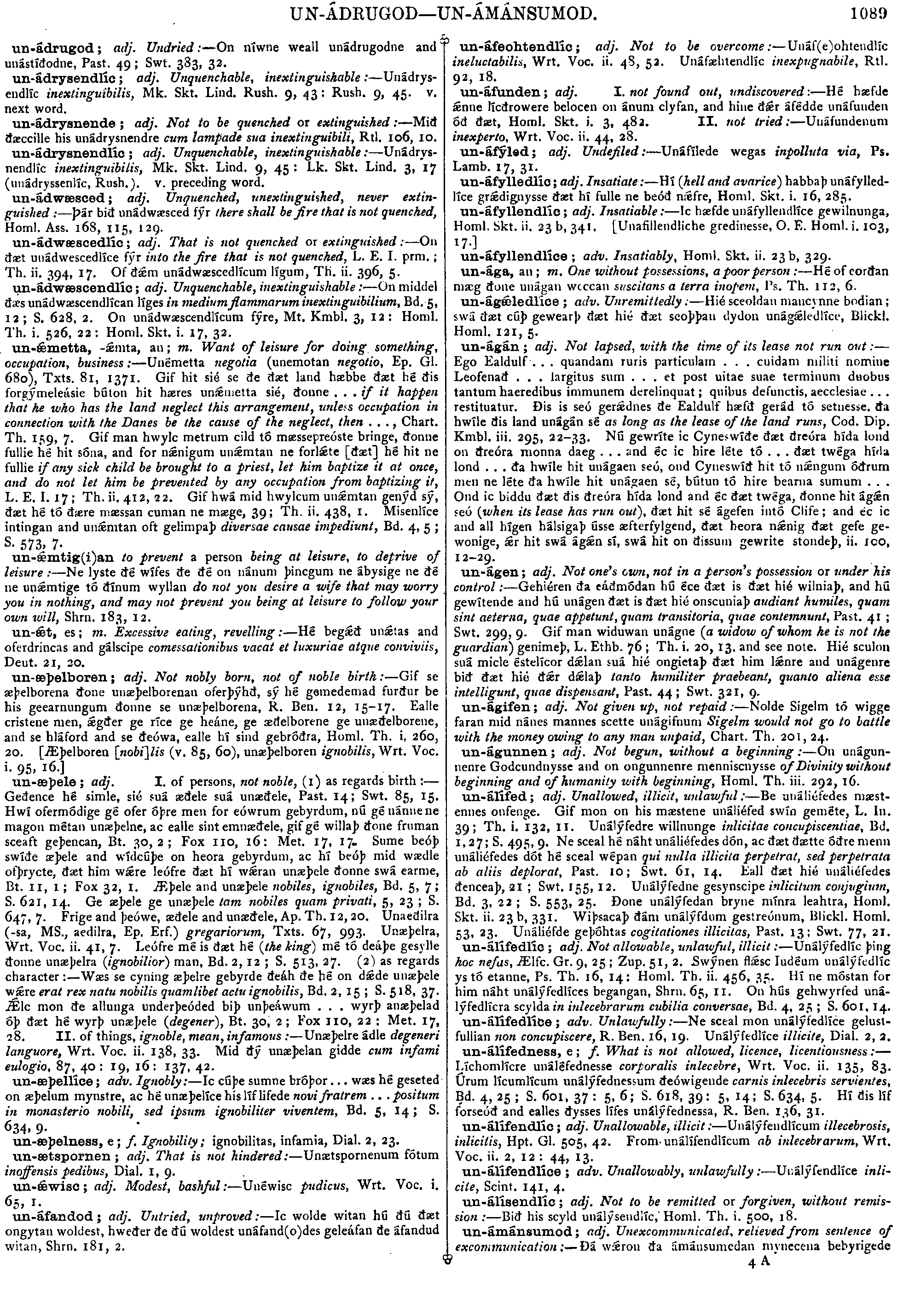
un-álífedness, e; f. What is not allowed, licence, licentiousness :-- Líchomlícre unáléfednesse corporalis inlecebre, Wrt. Voc. ii. 135, 83. Úrum lícumlícum unálýfednessum ðeówigende carnis inlecebris servientes, Bd. 4, 25; S. 601, 37: 5, 6; S. 618, 39: 5, 14; S. 634, 5. Hí ðís líf forseóð and ealles ðysses lífes unálýfednessa, R. Ben. 136, 31.
|
Source: Cleasby/Vigfusson, page b0063, entry 16 View original page image as: [TIFF] [PNG] [View previous entry] [View next entry] |
[Comment on this entry] [View comments] |
The following entry has been hand-corrected once. |
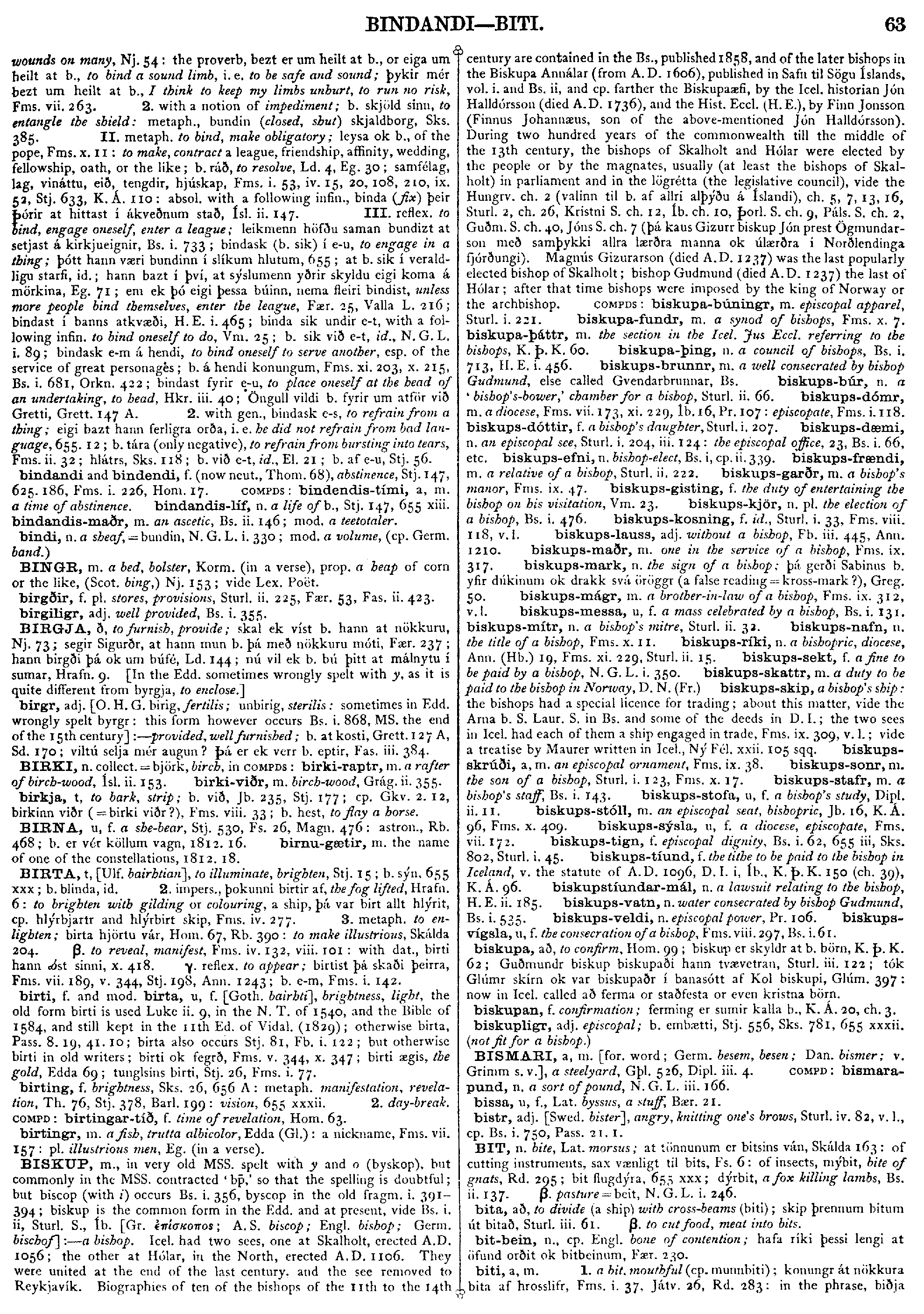
BISKUP, m., in very old MSS. spelt with y and o (byskop), but commonly in the MSS. contracted 'bUNCERTAIN,' so that the spelling is doubtful; but biscop (with i) occurs Bs. i. 356, byscop in the old fragm. i. 391-394; biskup is the common form in the Edd. and at present, vide Bs. i. ii, Sturl. S., Íb. [Gr. GREEK; A. S. biscop; Engl. bishop; Germ. bischof] :-- a bishop. Icel. had two sees, one at Skalholt, erected A.D. 1056; the other at Hólar, in the North, erected A.D. 1106. They were united at the end of the last century, and the see removed to Reykjavik. Biographies of ten of the bishops of the 11th to the 14th century are contained in the Bs., published 1858, and of the later bishops in the Biskupa Annálar (from A.D. 1606), published in Safn til Sögu Íslands, vol. i. and Bs. ii, and cp. farther the Biskupaæfi, by the Icel. historian Jón Halldórsson (died A.D. 1736), and the Hist. Eccl. (H. E.). by Finn Jonsson (Finnus Johannæus, son of the above-mentioned Jón Halldórsson). During two hundred years of the commonwealth till the middle of the 13th century, the bishops of Skalholt and Hólar were elected by the people or by the magnates, usually (at least the bishops of Skalholt) in parliament and in the lögrétta (the legislative council), vide the Hungrv. ch. 2 (valinn til b. af allri alþýðu á Íslandi), ch. 5, 7, 13, 16, Sturl. 2, ch. 26, Kristni S. ch. 12, Íb. ch. 10, Þorl. S. ch. 9, Páls. S. ch. 2, Guðm. S. ch. 40, Jóns S. ch. 7 (þá kaus Gizurr biskup Jón prest Ögmundarson með samþykki allra lærðra manna ok úlærðra í Norðlendinga fjórðungi). Magnús Gizurarson (died A.D. 1237) was the last popularly elected bishop of Skalholt; bishop Gudmund (died A.D. 1237) the last of Hólar; after that time bishops were imposed by the king of Norway or the archbishop. COMPDS: biskupa-búningr, m. episcopal apparel, Sturl. i. 221. biskupa-fundr, m. a synod of bishops, Fms. x. 7. biskupa-þáttr, m. the section in the Icel. Jus Eccl. referring to the bishops, K. Þ. K. 60. biskupa-þing, n. a council of bishops, Bs. i. 713, H. E. i. 456. biskups-brunnr, m. a well consecrated by bishop Gudmund, else called Gvendarbrunnar, Bs. biskups-búr, n. a 'bishop's-bower,' chamber for a bishop, Sturl. ii. 66. biskups-dómr, m. a diocese, Fms. vii. 173, xi. 229, Íb. 16, Pr. 107: episcopate, Fms. i. 118. biskups-dóttir, f. a bishop's daughter, Sturl. i. 207. biskups-dæmi, n. an episcopal see, Sturl. i. 204, iii. 124: the episcopal office, 23, Bs. i. 66, etc. biskups-efni, n. bishop-elect, Bs. i, cp. ii. 339. biskups-frændi, m. a relative of a bishop, Sturl. ii. 222. biskups-garðr, m. a bishop's manor, Fms. ix. 47. biskups-gisting, f. the duty of entertaining the bishop on his visitation, Vm. 23. biskups-kjör, n. pl. the election of a bishop, Bs. i. 476. biskups-kosning, f. id., Sturl. i. 33, Fms. viii. 118, v.l. biskups-lauss, adj. without a bishop, Fb. iii. 445, Ann. 1210. biskups-maðr, m. one in the service of a bishop, Fms. ix. 317. biskups-mark, n. the sign of a bishop; þá gerði Sabinus b. yfir dúkinum ok drakk svá öröggr (a false reading = kross-mark?), Greg. 50. biskups-mágr, m. a brother-in-law of a bishop, Fms. ix. 312, v.l. biskups-messa, u, f. a mass celebrated by a bishop, Bs. i. 131. biskups-mítr, n. a bishop's mitre, Sturl. ii. 32. biskups-nafn, n. the title of a bishop, Fms. x. 11. biskups-ríki, n. a bishopric, diocese, Ann. (Hb.) 19, Fms. xi. 229, Sturl. ii. 15. biskups-sekt, f. a fine to be paid by a bishop, N. G. L. i. 350. biskups-skattr, m. a duty to be paid to the bishop in Norway, D. N. (Fr.) biskups-skip, a bishop's ship: the bishops had a special licence for trading; about this matter, vide the Arna b. S. Laur. S. in Bs. and some of the deeds in D. I.; the two sees in Icel. had each of them a ship engaged in trade, Fms. ix. 309, v.l.; vide a treatise by Maurer written in Icel., Ný Fél. xxii. 105 sqq. biskups-skrúði, a, m. an episcopal ornament, Fms. ix. 38. biskups-sonr, m. the son of a bishop, Sturl. i. 123, Fms. x. 17. biskups-stafr, m. a bishop's staff, Bs. i. 143. biskups-stofa, u, f. a bishop's study, Dipl. ii. 11. biskups-stóll, m. an episcopal seat, bishopric, Jb. 16, K. Á. 96, Fms. x. 409. biskups-sýsla, u, f. a diocese, episcopate, Fms. vii. 172. biskups-tign, f. episcopal dignity, Bs. i. 62, 655 iii, Sks. 802, Sturl. i. 45. biskups-tíund, f. the tithe to be paid to the bishop in Iceland, v. the statute of A.D. 1096, D. I. i, Íb., K. Þ. K. 150 (ch. 39), K. Á. 96. biskupstíundar-mál, n. a lawsuit relating to the bishop, H. E. ii. 185. biskups-vatn, n. water consecrated by bishop Gudmund, Bs. i. 535. biskups-veldi, n. episcopal power, Pr. 106. biskups-vígsla, u, f. the consecration of a bishop, Fms. viii. 297, Bs. i. 61.
|
Source: Cleasby/Vigfusson, page b0280, entry 17 View original page image as: [TIFF] [PNG] [View previous entry] [View next entry] |
[Comment on this entry] [View comments] |
The following entry has been hand-corrected once. |
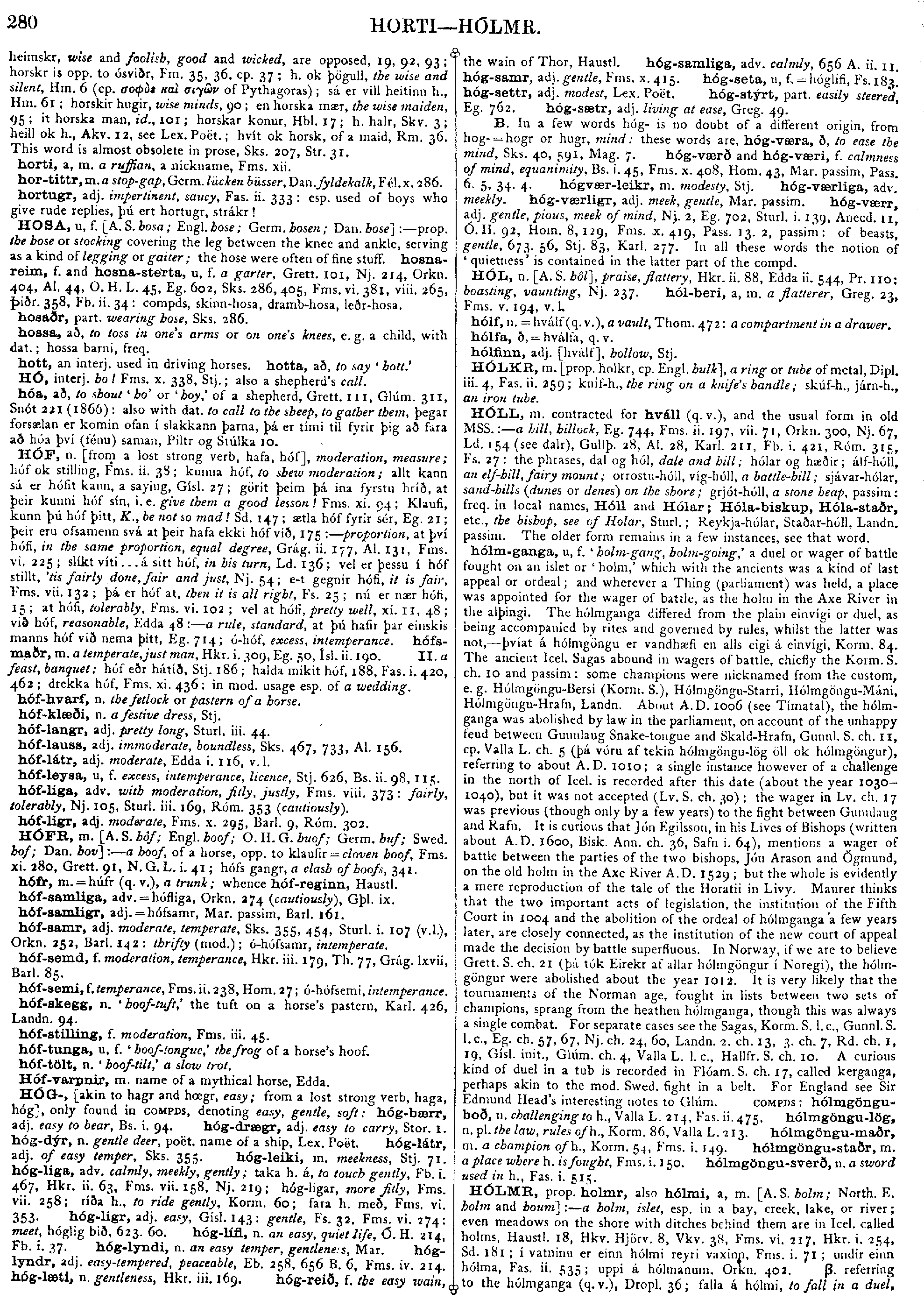
hóf-leysa, u, f. excess, intemperance, licence, Stj. 626, Bs. ii. 98, 115.
|
Source: Cleasby/Vigfusson, page b0312, entry 23 View original page image as: [TIFF] [PNG] [View previous entry] [View next entry] |
[Comment on this entry] [View comments] |
The following entry has been hand-corrected once. |
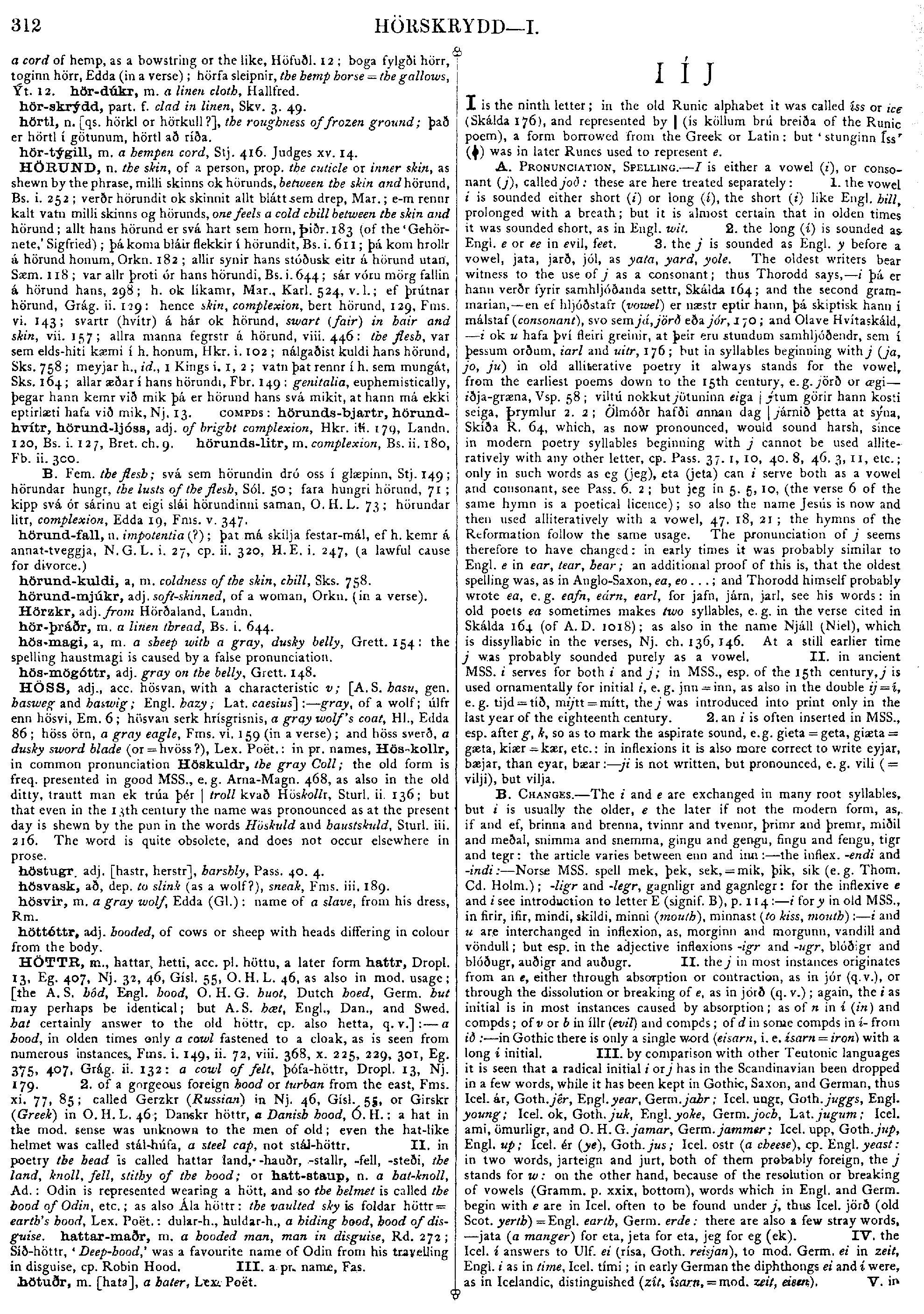
A. PRONUNCIATION, SPELLING. -- I is either a vowel (i), or consonant (j), called joð: these are here treated separately: 1. the vowel i is sounded either short (i) or long (í), the short (i) like Engl. hill, prolonged with a breath; but it is almost certain that in olden times it was sounded short, as in Engl. wit. 2. the long (í) is sounded as Engl. e or ee in evil, feet. 3. the j is sounded as Engl. y before a vowel, jata, jarð, jól, as yata, yard, yole. The oldest writers bear witness to the use of j as a consonant; thus Thorodd says, -- i þá er hann verðr fyrir samhljóðanda settr, Skálda 164; and the second grammarian, -- en ef hljóðstafr (vowel) er næstr eptir hann, þá skiptisk hann í málstaf (consonant), svo sem já, jörð eða jór, 170; and Olave Hvítaskáld, -- i ok u hafa því fleiri greinir, at þeir eru stundum samhljóðendr, sem í þessum orðum, iarl and uitr, 176; but in syllables beginning with j (ja, jo, ju) in old alliterative poetry it always stands for the vowel, from the earliest poems down to the 15th century, e.g. jörð or ægi -- iðja-græna, Vsp. 58; viltú nokkut jötuninn eiga | ýtum görir hann kosti seiga, Þrymlur 2. 2; Ölmóðr hafði annan dag | járnið þetta at sýna, Skíða R. 64, which, as now pronounced, would sound harsh, since in modern poetry syllables beginning with j cannot be used alliteratively with any other letter, cp. Pass. 37. 1, 10, 40. 8, 46. 3, 11, etc.; only in such words as eg (jeg), eta (jeta) can i serve both as a vowel and consonant, see Pass. 6. 2; but jeg in 5. 5, 10, (the verse 6 of the same hymn is a poetical licence); so also the name Jesús is now and then used alliteratively with a vowel, 47. 18, 21; the hymns of the Reformation follow the same usage. The pronunciation of j seems therefore to have changed: in early times it was probably similar to Engl. e in ear, tear, hear; an additional proof of this is, that the oldest spelling was, as in Anglo-Saxon, ea, eo ...; and Thorodd himself probably wrote ea, e.g. eafn, eárn, earl, for jafn, járn, jarl, see his words: in old poets ea sometimes makes two syllables, e.g. in the verse cited in Skálda 164 (of A.D. 1018); as also in the name Njáll (Niel), which is dissyllabic in the verses, Nj. ch. 136, 146. At a still earlier time j was probably sounded purely as a vowel. II. in ancient MSS. i serves for both i and j; in MSS., esp. of the 15th century, j is used ornamentally for initial i, e.g. jnn = inn, as also in the double ij = í, e.g. tijd = tíð, mijtt = mítt, the j was introduced into print only in the last year of the eighteenth century. 2. an i is often inserted in MSS., esp. after g, k, so as to mark the aspirate sound, e.g. gieta = geta, giæta = gæta, kiær = kær, etc.: in inflexions it is also more correct to write eyjar, bæjar, than eyar, bæar :-- ji is not written, but pronounced, e.g. vili ( = vilji), but vilja.
|
Source: Cleasby/Vigfusson, page b0386, entry 9 View original page image as: [TIFF] [PNG] [View previous entry] [View next entry] |
[Comment on this entry] [View comments] |
The following entry has not been hand-corrected. However, the page is reserved and someone is correcting it. |
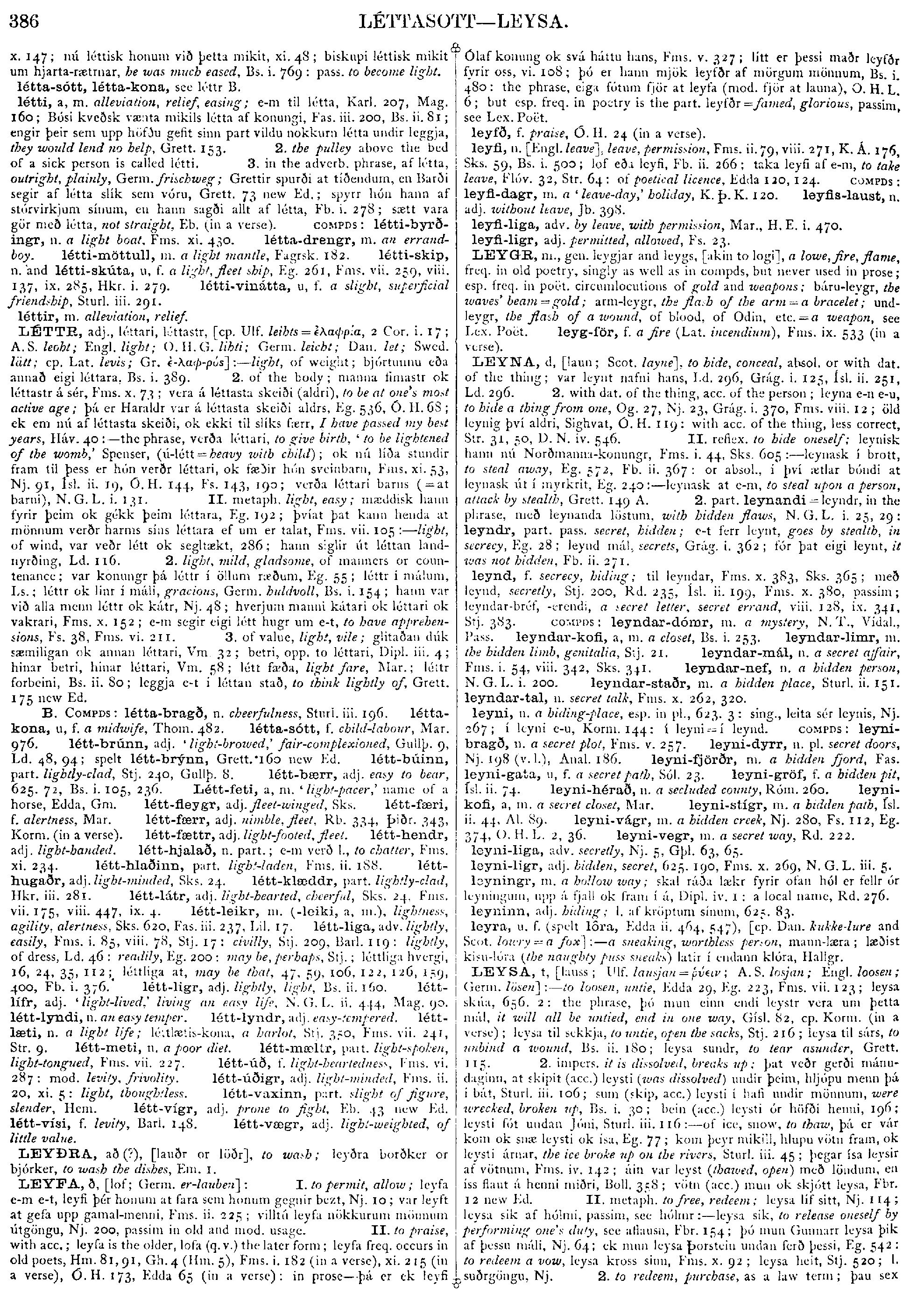
leyfi, n. [Engl. leave^. leave, permission, Fms. ii. 79, viii. 271, K. Á. 176, Sks. 59, Bs. i. 500; lof eð. í leyfi, Fb. ii. 266; taka leyfi af e-m, to take leave, Flóv. 32, Sir. 64: of poetical licence, Edda 120, 124. COMPDS: leyfi-dagr, m. a ' leave-day, ' holiday, K. þ. K. 120. leyfls-laust, n. adj. without have, Jb. 398.
|
Source: Cleasby/Vigfusson, page b0433, entry 7 View original page image as: [TIFF] [PNG] [View previous entry] [View next entry] |
[Comment on this entry] [View comments] |
The following entry has been hand-corrected once. |
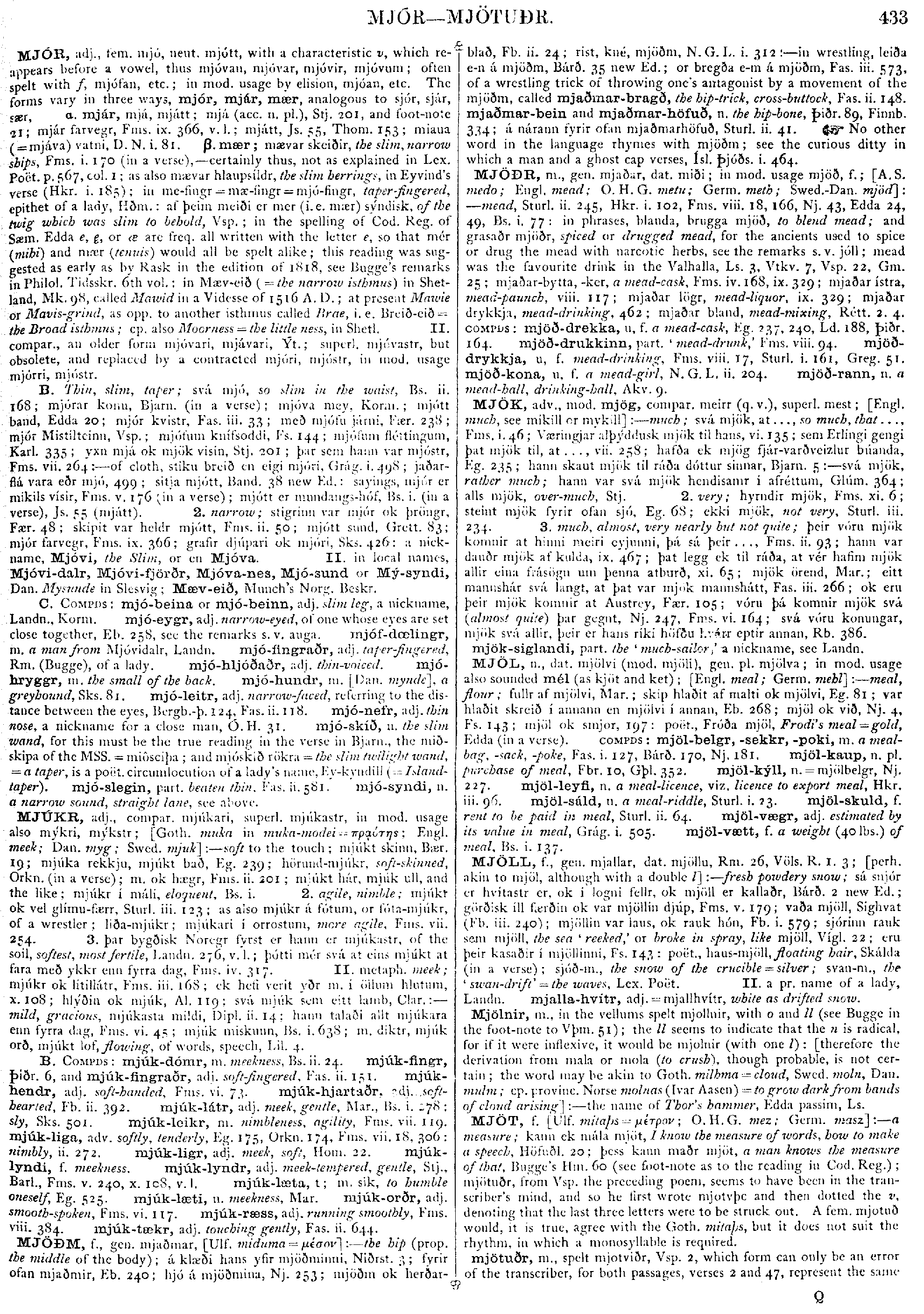
MJÖL, n., dat. mjölvi (mod. mjöli), gen. pl. mjölva; in mod. usage also sounded mél (as kjöt and ket); [Engl. meal; Germ. mehl] :-- meal, flour; fullr af mjölvi, Mar.; skip hlaðit af malti ok mjölvi, Eg. 81; var hlaðit skreið í annann en mjölvi í annan, Eb. 268; mjöl ok við, Nj. 4, Fs. 143; mjöl ok smjor, 197: poët., Fróða mjöl, Frodi's meal = gold, Edda (in a verse). COMPDS: mjöl-belgr, -sekkr, -poki, m. a meal- bag, -sack, -poke, Fas. i. 127, Bárð. 170, Nj. 181. mjöl-kaup, n. pl. purchase of meal, Fbr. 10, Gþl. 352. mjöl-kýll, n. = mjölbelgr, Nj. 227. mjöl-leyfi, n. a meal-licence, viz. licence to export meal, Hkr. iii. 96. mjöl-sáld, n. a meal-riddle, Sturl. i. 23. mjöl-skuld, f. rent to be paid in meal, Sturl. ii. 64. mjöl-vægr, adj. estimated by its value in meal, Grág. i. 505. mjöl-vætt, f. a weight (4Olbs.) of meal, Bs. i. 137.
|
Source: Cleasby/Vigfusson, page b0518, entry 1 View original page image as: [TIFF] [PNG] [View previous entry] [View next entry] |
[Comment on this entry] [View comments] |
The following entry has been hand-corrected once. |
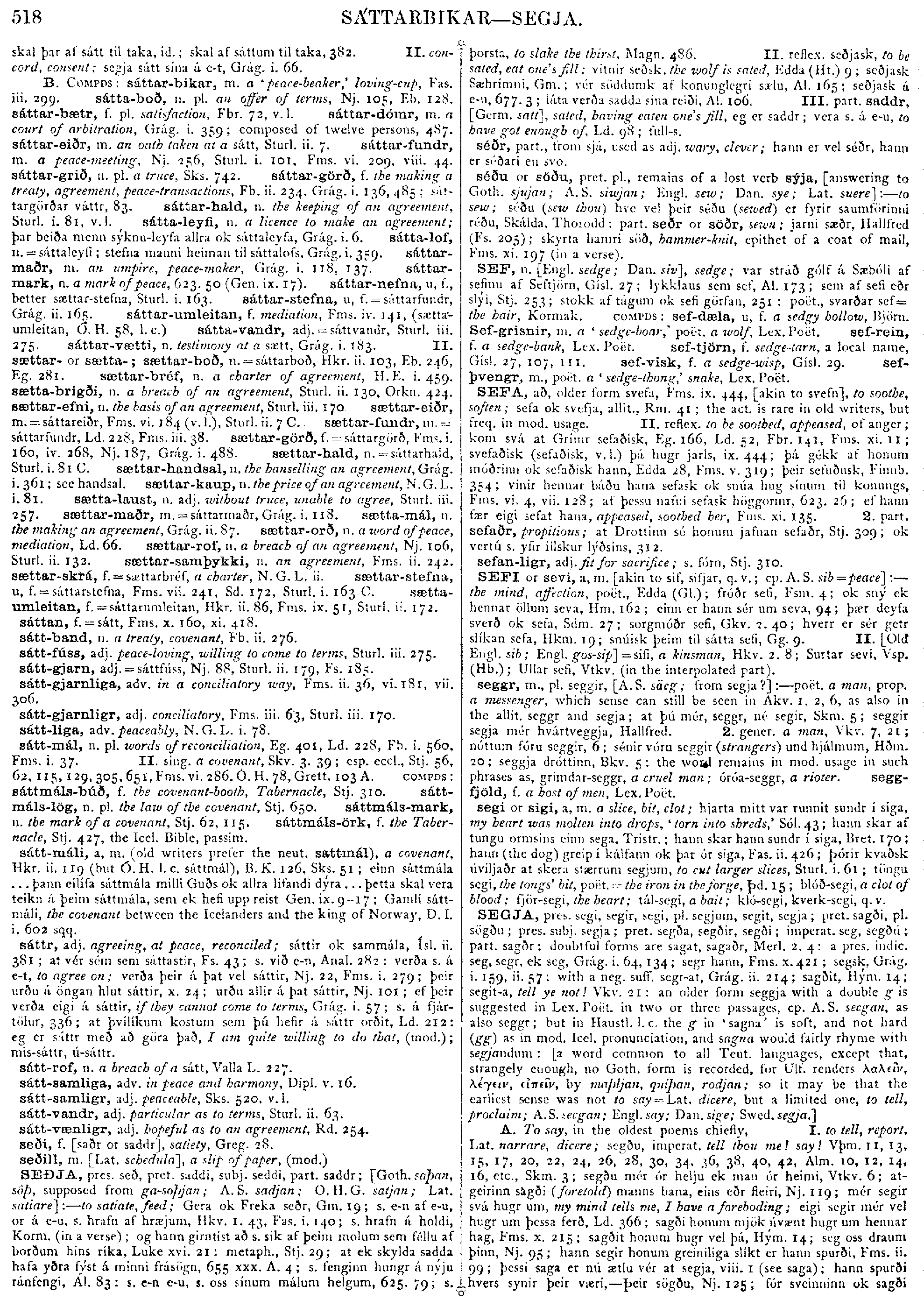
skal þar af sátt til taka, id.; skal af sáttum til taka, 382. II. concord, consent; segja sátt sína á e-t, Grág. i. 66. B.. COMPDS: sáttar-bikar, m. a 'peace-beaker,' loving-cup, Fas. iii. 299. satta-boð, n. pl. an offer of terms, Nj. 105, Eb. 128. sáttar-bætr, f. pl. satisfaction, Fbr. 72, v.l. sáttar-dómr, m. a court of arbitration, Grág. i. 359; composed of twelve persons, 487. sáttar-eiðr, m. an oath taken at a sátt, Sturl. ii. 7. sáttar-fundr, m. a peace-meeting, Nj. 256, Sturl. i. 101, Fms. vi. 209, viii. 44. sáttar-grið, n. pl. a truce, Sks. 742. sáttar-görð, f. the making a treaty, agreement, peace-transactions, Fb. ii. 234, Grág. i. 136, 485; sáttargörðar váttr, 83. sáttar-hald, n. the keeping of an agreement, Sturl. i. 81, v.l. sátta-leyfi, n. a licence to make an agreement; þar beiða menn sýknu-leyfa allra ok sáttaleyfa, Grág. i. 6. sátta-lof, n. = sáttaleyfi; stefna manni heiman til sáttalofs, Grág. i. 359. sáttar-maðr, m. an umpire, peace-maker, Grág. i. 118, 137. sáttar-mark, n. a mark of peace, 623. 50 (Gen. ix. 17). sáttar-nefna, u, f., better sættar-stefna, Sturl. i. 163. sáttar-stefna, u, f. = sáttarfundr, Grág. ii. 165. sáttar-umleitan, f. mediation, Fms. iv. 141, (sætta-umleitan, Ó.H. 58, l.c.) sátta-vandr, adj. = sáttvandr, Sturl. iii. 275. sáttar-vætti, n. testimony at a sætt, Grág. i. 183. II. sættar- or sætta-; sættar-boð, n. = sáttarboð, Hkr. ii. 103, Eb. 246, Eg. 281. sættar-bréf, n. a charter of agreement, H.E. i. 459. sætta-brigði, n. a breach of an agreement, Sturl. ii. 130, Orkn. 424. sættar-efni, n. the basis of an agreement, Sturl. iii. 170 sættar-eiðr, m. = sáttareiðr, Fms. vi. 184 (v.l.), Sturl. ii. 7 C. sættar-fundr, m. = sáttarfundr, Ld. 228, Fms. iii. 38. sættar-görð, f. = sáttargörð, Fms. i. 160, iv. 268, Nj. 187, Grág. i. 488. sættar-hald, n. = sáttarhald,Sturl. i. 81 C. sættar-handsal, n. the hanselling an agreement, Grág. i. 361; see handsal. sættar-kaup, n. the price of an agreement, N.G.L. i. 81. sætta-laust, n. adj. without truce, unable to agree, Sturl. iii. 257. sættar-maðr, m. = sáttarmaðr, Grág. i. 118. sætta-mál, n.the making an agreement, Grág. ii. 87. sættar-orð, n. a word of peace, mediation, Ld. 66. sættar-rof, n. a breach of an agreement, Nj. 106, Sturl. ii. 132. sættar-samþykki, n. an agreement, Fms. ii. 242. sættar-skrá, f. = sættarbréf, a charter, N.G.L. ii. sættar-stefna, u, f. = sáttarstefna, Fms. vii. 241, Sd. 172, Sturl. i. 163 C. sætta-umleitan, f. = sáttarumleitan, Hkr. ii. 86, Fms. ix. 51, Sturl. ii. 172.
|
Source: Cleasby/Vigfusson, page b0534, entry 22 View original page image as: [TIFF] [PNG] [View previous entry] [View next entry] |
[Comment on this entry] [View comments] |
The following entry has been hand-corrected once. |
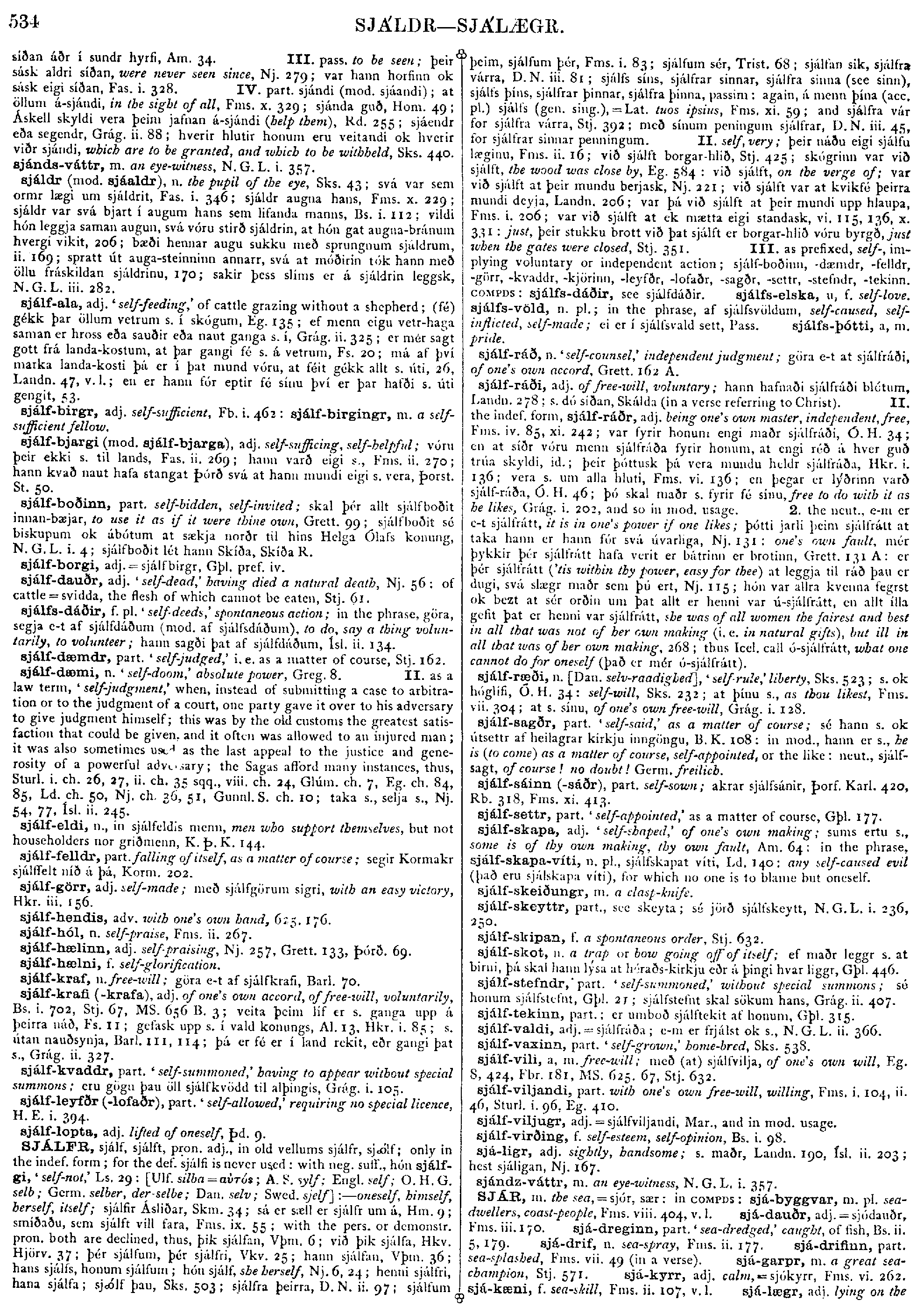
sjálf-leyfðr (-lofaðr), part. 'self-allowed,' requiring no special licence, H.E. i. 394.
|
Source: Cleasby/Vigfusson, page b0590, entry 2 View original page image as: [TIFF] [PNG] [View previous entry] [View next entry] |
[Comment on this entry] [View comments] |
The following entry has been hand-corrected once. |
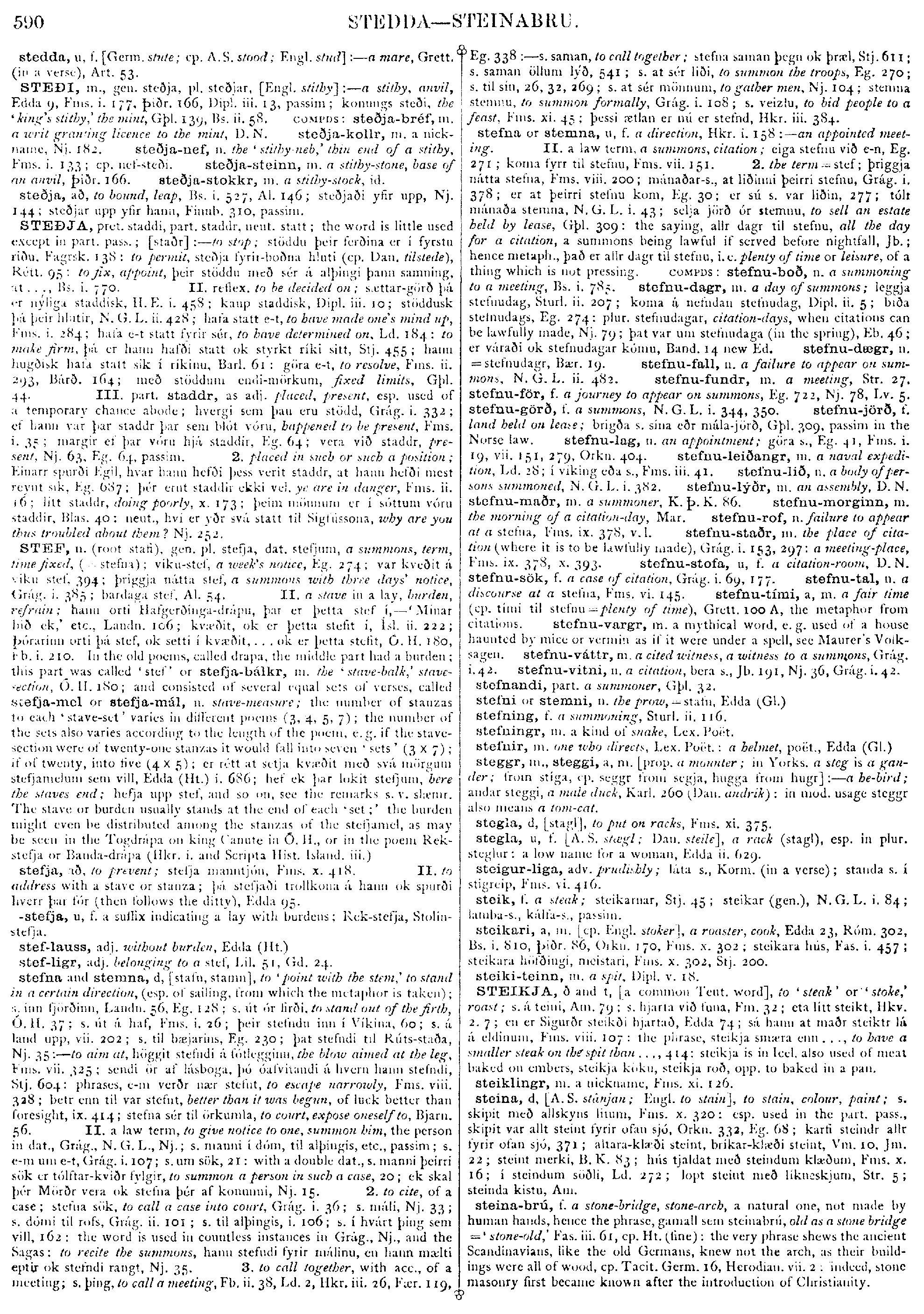
STEÐI, m., gen. steðja, pl. steðjar, [Engl. stithy] :-- a stithy, anvil, Edda 9, Fms. i. 177, Þiðr. 166, Dipl. iii. 13, passim; konungs steði, the 'king's stithy' the mint, Gþl. 139, Bs. ii. 58. COMPDS: steðja-bréf, m. a writ granting licence to the mint, D.N. steðja-kollr, m. a nick-name, Nj. 182. steðja-nef, n. the 'stithy-neb,' thin end of a stithy, Fms. i. 133; cp. nef-steði. steðja-steinn, m. a stithy-stone, base of an anvil, Þiðr. 166. steðja-stokkr, m. a stithy-stock, id.
| Result Page: | 1 2 | Next |  |
Germanic Lexicon Project (main page)
This search system was written by
Sean Crist
Please consider
volunteering
to correct the data in these online dictionaries.
No rights reserved. Feel free to use these data in any way you please.