|
|

Search for less again, using less strict matching (276 results)
|
Source: Cleasby/Vigfusson, page b0025, entry 35 View original page image as: [TIFF] [PNG] [View previous entry] [View next entry] |
[Comment on this entry] [View comments] |
The following entry has been hand-corrected once. |
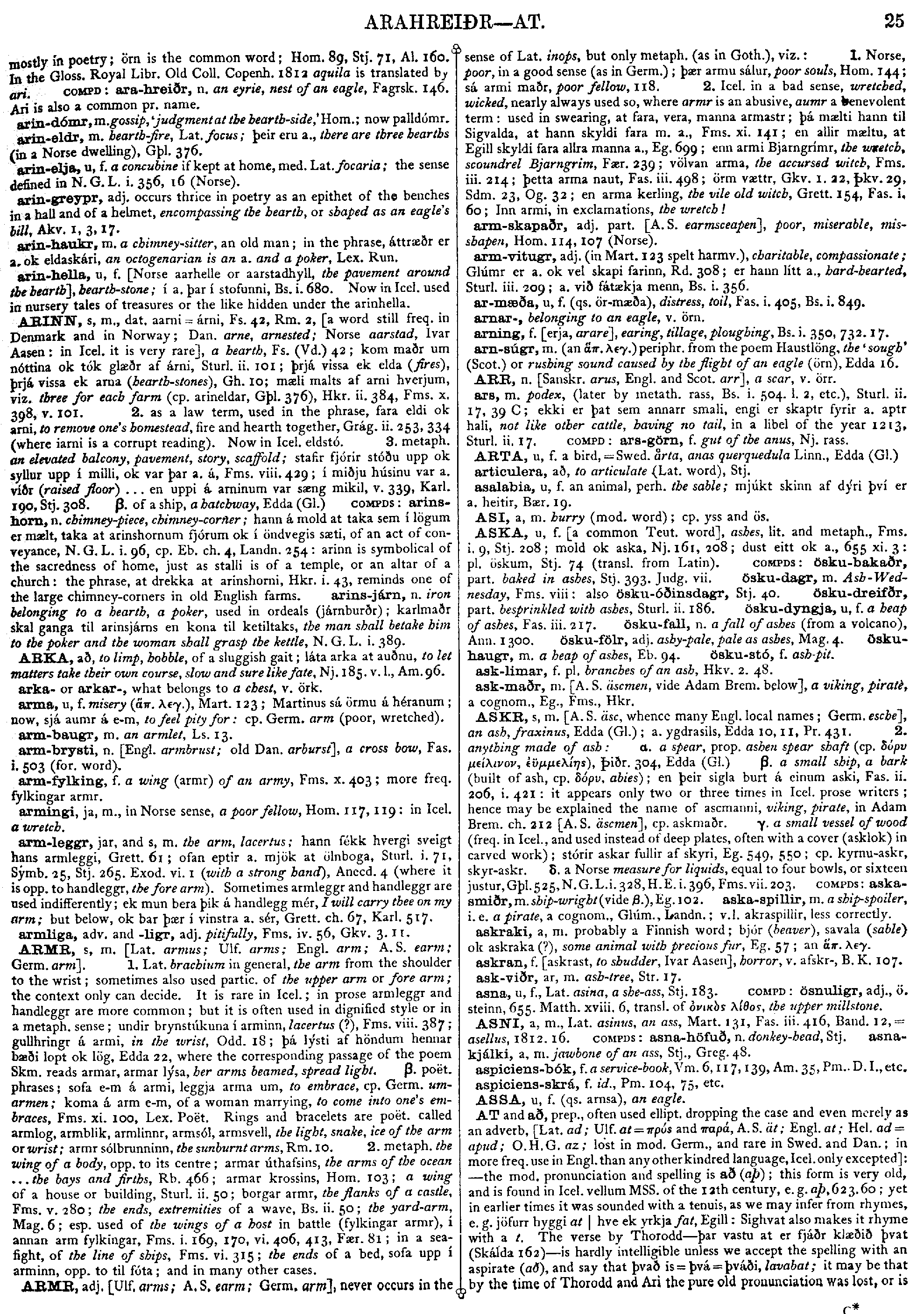
ASKR,
s,
m.
[A.
S.
äsc,
whence
many
Engl.
local
names;
Germ.
esche],
an
ash,
fraxinus,
Edda
(Gl.);
a.
ygdrasils,
Edda
10,
11,
Pr.
431.
2.
anything
made
of
ash:
 .
a
spear,
prop.
ashen
spear
shaft
(cp.
GREEK),
Þiðr.
304,
Edda
(Gl.)
.
a
spear,
prop.
ashen
spear
shaft
(cp.
GREEK),
Þiðr.
304,
Edda
(Gl.)
 .
a
small
ship,
a
bark
(built
of
ash,
cp.
GREEK,
abies);
en
þeir
sigla
burt
á
einum
aski,
Fas.
ii.
206,
i.
421:
it
appears
only
two
or
three
times
in
Icel.
prose
writers;
hence
may
be
explained
the
name
of
ascmanni,
viking,
pirate,
in
Adam
Brem.
ch.
212
[A.
S.
äscmen],
cp.
askmaðr.
.
a
small
ship,
a
bark
(built
of
ash,
cp.
GREEK,
abies);
en
þeir
sigla
burt
á
einum
aski,
Fas.
ii.
206,
i.
421:
it
appears
only
two
or
three
times
in
Icel.
prose
writers;
hence
may
be
explained
the
name
of
ascmanni,
viking,
pirate,
in
Adam
Brem.
ch.
212
[A.
S.
äscmen],
cp.
askmaðr.
 .
a
small
vessel
of
wood
(freq.
in
Icel.,
and
used
instead
of
deep
plates,
often
with
a
cover
(asklok)
in
carved
work);
stórir
askar
fullir
af
skyri,
Eg.
549,
550;
cp.
kyrnu-askr,
skyr-askr.
.
a
small
vessel
of
wood
(freq.
in
Icel.,
and
used
instead
of
deep
plates,
often
with
a
cover
(asklok)
in
carved
work);
stórir
askar
fullir
af
skyri,
Eg.
549,
550;
cp.
kyrnu-askr,
skyr-askr.
 .
a
Norse
measure
for
liquids,
equal
to
four
bowls,
or
sixteen
justur,
Gþl.
525,
N.
G.
L.
i.
328,
H.
E.
i.
396,
Fms.
vii.
203.
COMPDS:
aska-smiðr,
m.
ship-wright
(vide
.),
Eg.
102.
aska-spillir,
m.
a
ship-spoiler,
i.e.
a
pirate,
a
cognom.,
Glúm.,
Landn.;
v.l.
akraspillir,
less
correctly.
.
a
Norse
measure
for
liquids,
equal
to
four
bowls,
or
sixteen
justur,
Gþl.
525,
N.
G.
L.
i.
328,
H.
E.
i.
396,
Fms.
vii.
203.
COMPDS:
aska-smiðr,
m.
ship-wright
(vide
.),
Eg.
102.
aska-spillir,
m.
a
ship-spoiler,
i.e.
a
pirate,
a
cognom.,
Glúm.,
Landn.;
v.l.
akraspillir,
less
correctly.
|
Source: Cleasby/Vigfusson, page b0028, entry 1 View original page image as: [TIFF] [PNG] [View previous entry] [View next entry] |
[Comment on this entry] [View comments] |
The following entry has been hand-corrected once. |
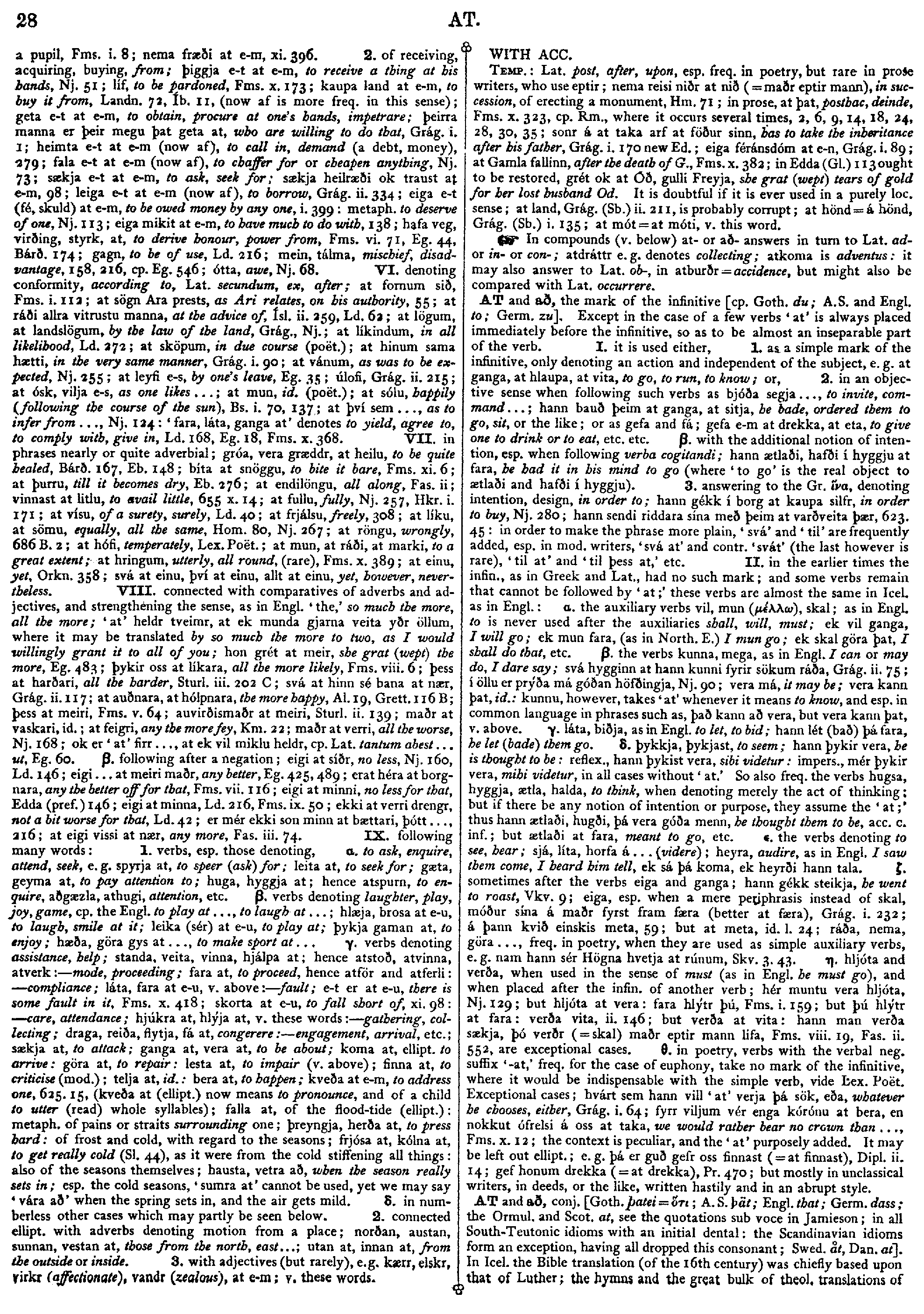
a
pupil,
Fms.
i.
8;
nema
fræði
at
e-m,
xi.
396.
2.
of
receiving,
acquiring,
buying,
from;
þiggja
e-t
at
e-m,
to
receive
a
thing
at
his
hands,
Nj.
51;
líf,
to
be
pardoned,
Fms.
x.
173;
kaupa
land
at
e-m,
to
buy
it
from,
Landn.
72,
Íb.
II,
(now
af
is
more
freq.
in
this
sense);
geta
e-t
at
e-m,
to
obtain,
procure
at
one's
hands,
impetrare;
þeirra
manna
er
þeir
megu
þat
geta
at,
who
are
willing
to
do
that,
Grág.
i.
I;
heimta
e-t
at
e-m
(now
af),
to
call
in,
demand
(a
debt,
money),
279;
fala
e-t
at
e-m
(now
af),
to
chaffer
for
or
cheapen
anything,
Nj.
73;
sækja
e-t
at
e-m,
to
ask,
seek
for;
sækja
heilræði
ok
traust
at
e-m,
98;
leiga
e-t
at
e-m
(now
af),
to
borrow,
Grág.
ii.
334;
eiga
e-t
(fé,
skuld)
at
e-m,
to
be
owed
money
by
any
one,
i.
399:
metaph.
to
deserve
of
one,
Nj.
113;
eiga
mikit
at
e-m,
to
have
much
to
do
with,
138;
hafa
veg,
virðing,
styrk,
at,
to
derive
honour,
power
from,
Fms.
vi.
71,
Eg.
44,
Bárð.
174;
gagn,
to
be
of
use,
Ld.
216;
mein,
tálma,
mischief,
disadvantage,
158,
216,
cp.
Eg.
546;
ótta,
awe,
Nj.
68.
VI.
denoting
conformity,
according
to,
Lat.
secundum,
ex,
after;
at
fornum
sið,
Fms.
i.
112;
at
sögn
Ara
prests,
as
Ari
relates,
on
his
authority,
55;
at
ráði
allra
vitrustu
manna,
at
the
advice
of,
Ísl.
ii.
259,
Ld.
62;
at
lögum,
at
landslögum,
by
the
law
of
the
land,
Grág.,
Nj.;
at
líkindum,
in
all
likelihood,
Ld.
272;
at
sköpum,
in
due
course
(poet.);
at
hinum
sama
hætti,
in
the
very
same
manner,
Grág.
i.
90;
at
vánum,
as
was
to
be
expected,
Nj.
255;
at
leyfi
e-s,
by
one's
leave,
Eg.
35;
úlofi,
Grág.
ii.
215;
at
ósk,
vilja
e-s,
as
one
likes...;
at
mun,
id.
(poet.);
at
sólu,
happily
(following
the
course
of
the
sun),
Bs.
i.
70,
137;
at
því
sem
...,
as
to
infer
from
...,
Nj.
124:'
fara,
láta,
ganga
at'
denotes
to
yield,
agree
to,
to
comply
with,
give
in,
Ld.
168,
Eg.
18,
Fms.
x.
368.
VII.
in
phrases
nearly
or
quite
adverbial;
gróa,
vera
græddr,
at
heilu,
to
be
quite
healed,
Bárð.
167,
Eb.
148;
bíta
at
snöggu,
to
bite
it
bare,
Fms.
xi.
6;
at
þurru,
till
it
becomes
dry,
Eb.
276;
at
endilöngu,
all
along,
Fas.
ii;
vinnast
at
litlu,
to
avail
little,
655
x.
14;
at
fullu,
fully,
Nj.
257,
Hkr.
i.
171;
at
vísu,
of
a
surety,
surely,
Ld.
40;
at
frjálsu,
freely,
308;
at
líku,
at
sömu,
equally,
all
the
same,
Hom.
80,
Nj.
267;
at
röngu,
wrongly,
686
B.
2;
at
hófi,
temperately,
Lex.
Poët.;
at
mun,
at
ráði,
at
marki,
to
a
great
extent;
at
hringum,
utterly,
all
round,
(rare),
Fms.
x.
389;
at
einu,
yet,
Orkn.
358;
svá
at
einu,
því
at
einu,
allt
at
einu,
yet,
however,
nevertheless.
VIII.
connected
with
comparatives
of
adverbs
and
adjectives,
and
strengthening
the
sense,
as
in
Engl.
'
the,
'
so
much
the
more,
all
the
more;
'at'
heldr
tveimr,
at
ek
munda
gjarna
veita
yðr
öllum,
where
it
may
be
translated
by
so
much
the
more
to
two,
as
I
would
willingly
grant
it
to
all
of
you;
hon
grét
at
meir,
she
grat
(wept)
the
more,
Eg.
483;
þykir
oss
at
líkara,
all
the
more
likely,
Fms.
viii.
6;
þess
at
harðari,
all
the
harder,
Sturl.
iii.
202
C;
svá
at
hinn
sé
bana
at
nær,
Grág.
ii.
117;
at
auðnara,
at
hólpnara,
the
more
happy,
Al.
19,
Grett.
116
B;
þess
at
meiri,
Fms.
v.
64;
auvirðismaðr
at
meiri,
Sturl.
ii.
139;
maðr
at
vaskari,
id.;
at
feigri,
any
the
more
fey,
Km.
22;
maðr
at
verri,
all
the
worse,
Nj.
168;
ok
er'
at'
firr...,
at
ek
vil
miklu
heldr,
cp.
Lat.
tantum
abest...
ut,
Eg.
60.
ß.
following
after
a
negation;
eigi
at
síðr,
no
less,
Nj.
160,
Ld.
146;
eigi...
at
meiri
maðr,
any
better,
Eg.
425,
489;
erat
héra
at
borgnara,
any
the
better
off
for
that,
Fms.
vii.
116;
eigi
at
minni,
no
less
for
that,
Edda
(pref.)
146;
eigi
at
minna,
Ld.
216,
Fms.
ix.
50;
ekki
at
verri
drengr,
not
a
bit
worse
for
that,
Ld.
42;
er
mér
ekki
son
minn
at
bættari,
þótt...,
216;
at
eigi
vissi
at
nær,
any
more,
Fas.
iii.
74.
IX.
following
many
words:
1.
verbs,
esp.
those
denoting,
a.
to
ask,
enquire,
attend,
seek,
e.
g.
spyrja
at,
to
speer
(ask)
for;
leita
at,
to
seek
for;
gæta,
geyma
at,
to
pay
attention
to;
huga,
hyggja
at;
hence
atspurn,
to
enquire,
aðgæzla,
athugi,
attention,
etc.
ß.
verbs
denoting
laughter,
play,
joy,
game,
cp.
the
Engl.
to
play
at.
..,
to
laugh
at..
.;
hlæja,
brosa
at
e-u,
to
laugh,
smile
at
it;
leika
(sér)
at
e-u,
to
play
at;
þykja
gaman
at,
to
enjoy;
hæða,
göra
gys
at...,
to
make
sport
at...
.
verbs
denoting
assistance,
help;
standa,
veita,
vinna,
hjálpa
at;
hence
atstoð,
atvinna,
atverk
:—mode,
proceeding;
fara
at,
to
proceed,
hence
atför
and
atferli
:—compliance;
láta,
fara
at
e-u,
v.
above
:—fault;
e-t
er
at
e-u,
there
is
some
fault
in
it,
Fms.
x.
418;
skorta
at
e-u,
to
fall
short
of,
xi.
98:
—care,
attendance;
hjúkra
at,
hlýja
at,
v.
these
words
:—gathering,
collecting;
draga,
reiða,
flytja,
fá
at,
congerere
:—engagement,
arrival,
etc.;
sækja
at,
to
attack;
ganga
at,
vera
at,
to
be
about;
koma
at,
ellipt.
to
arrive:
göra
at,
to
repair:
lesta
at,
to
impair
(v.
above);
finna
at,
to
criticise
(mod.);
telja
at,
id.:
bera
at,
to
happen;
kveða
at
e-m,
to
address
one,
625.
15,
(kveða
at
(ellipt.)
now
means
to
pronounce,
and
of
a
child
to
utter
(read)
whole
syllables);
falla
at,
of
the
flood-tide
(ellipt.):
metaph.
of
pains
or
straits
surrounding
one;
þreyngja,
herða
at,
to
press
hard:
of
frost
and
cold,
with
regard
to
the
seasons;
frjósa
at,
kólna
at,
to
get
really
cold
(SI.
44),
as
it
were
from
the
cold
stiffening
all
things:
also
of
the
seasons
themselves;
hausta,
vetra
að,
when
the
season
really
sets
in;
esp.
the
cold
seasons,
'sumra
at'
cannot
be
used,
yet
we
may
say
'vára
að'
when
the
spring
sets
in,
and
the
air
gets
mild.
.
in
num-
berless
other
cases
which
may
partly
be
seen
below.
2.
connected
ellipt.
with
adverbs
denoting
motion
from
a
place;
norðan,
austan,
sunnan,
vestan
at,
those
from
the
north,
east...;
utan
at,
innan
at,
from
the
outside
or
inside.
3.
with
adjectives
(but
rarely),
e.
g.
kærr,
elskr,
virkr
(affectionate),
vandr
(zealous),
at
e-m;
v,
these
words.
WITH
ACC.
TEMP.:
Lat.
post,
after,
upon,
esp.
freq.
in
poetry,
but
rare
in
prose
writers,
who
use
eptir;
nema
reisi
niðr
at
nið
(=
maðr
eptir
mann),
in
succession,
of
erecting
a
monument,
Hm.
71;
in
prose,
at
þat.
posthac,
deinde,
Fms.
x.
323,
cp.
Rm.,
where
it
occurs
several
times,
2,
6,
9,
14,
18,
24,
28,
30,
35;
sonr
á
at
taka
arf
at
föður
sinn,
has
to
take
the
inheritance
after
his
father,
Grág.
i.
170
new
Ed.;
eiga
féránsdóm
at
e-n,
Grág.
i.
89;
at
Gamla
fallinn,
after
the
death
of
G.,
Fms.
x.
382;
in
Edda
(Gl.)
113
ought
to
be
restored,
grét
ok
at
Oð,
gulli
Freyja,
she
grat
(wept)
tears
of
gold
for
her
lost
husband
Od.
It
is
doubtful
if
it
is
ever
used
in
a
purely
loc.
sense;
at
land,
Grág.
(Sb.)ii.
211,
is
probably
corrupt;
at
hönd
=
á
hönd,
Grág.
(Sb.)
i.
135;
at
mót
=
at
móti,
v.
this
word.
ILLEGIBLE
In
compounds
(v.
below)
at-
or
að-
answers
in
turn
to
Lat.
ad-
or
in-
or
con-;
atdráttr
e.
g.
denotes
collecting;
atkoma
is
adventus:
it
may
also
answer
to
Lat.
ob-,
in
atburðr
=
accidence,
but
might
also
be
compared
with
Lat.
occurrere.
|
Source: Cleasby/Vigfusson, page b0032, entry 8 View original page image as: [TIFF] [PNG] [View previous entry] [View next entry] |
[Comment on this entry] [View comments] |
The following entry has been hand-corrected once. |
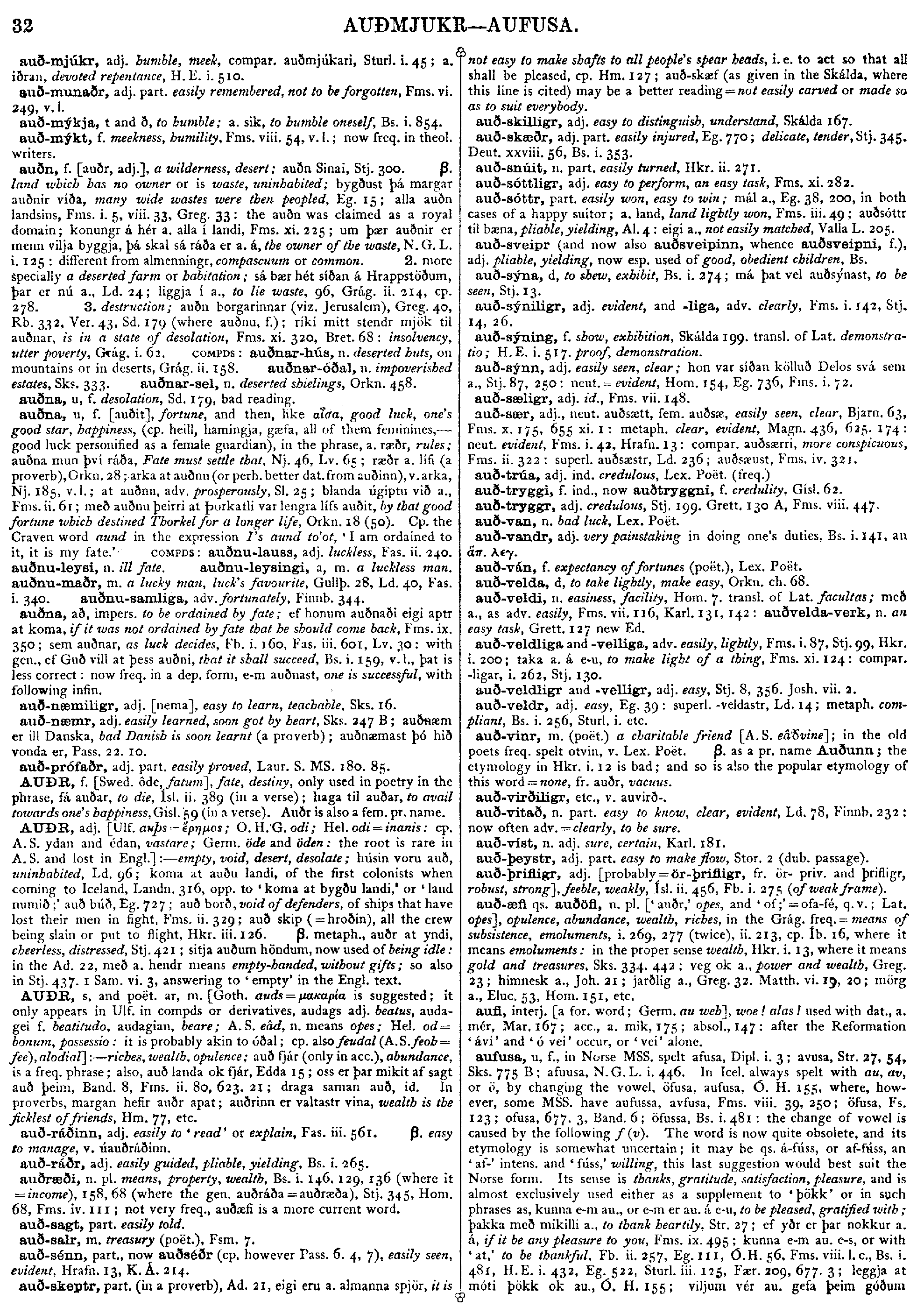
auðna, að, impers. to be ordained by fate; ef honum auðnaði eigi aptr at koma, if it was not ordained by fate that he should come back, Fms. ix. 350; sem auðnar, as luck decides, Fb. i. 160, Fas. iii. 601, Lv. 30: with gen., ef Guð vill at þess auðni, that it shall succeed, Bs. i. 159, v. 1., þat is less correct: now freq. in a dep. form, e-m auðnast, one is successful, with following infin.
|
Source: Cleasby/Vigfusson, page b0034, entry 6 View original page image as: [TIFF] [PNG] [View previous entry] [View next entry] |
[Comment on this entry] [View comments] |
The following entry has been hand-corrected once. |
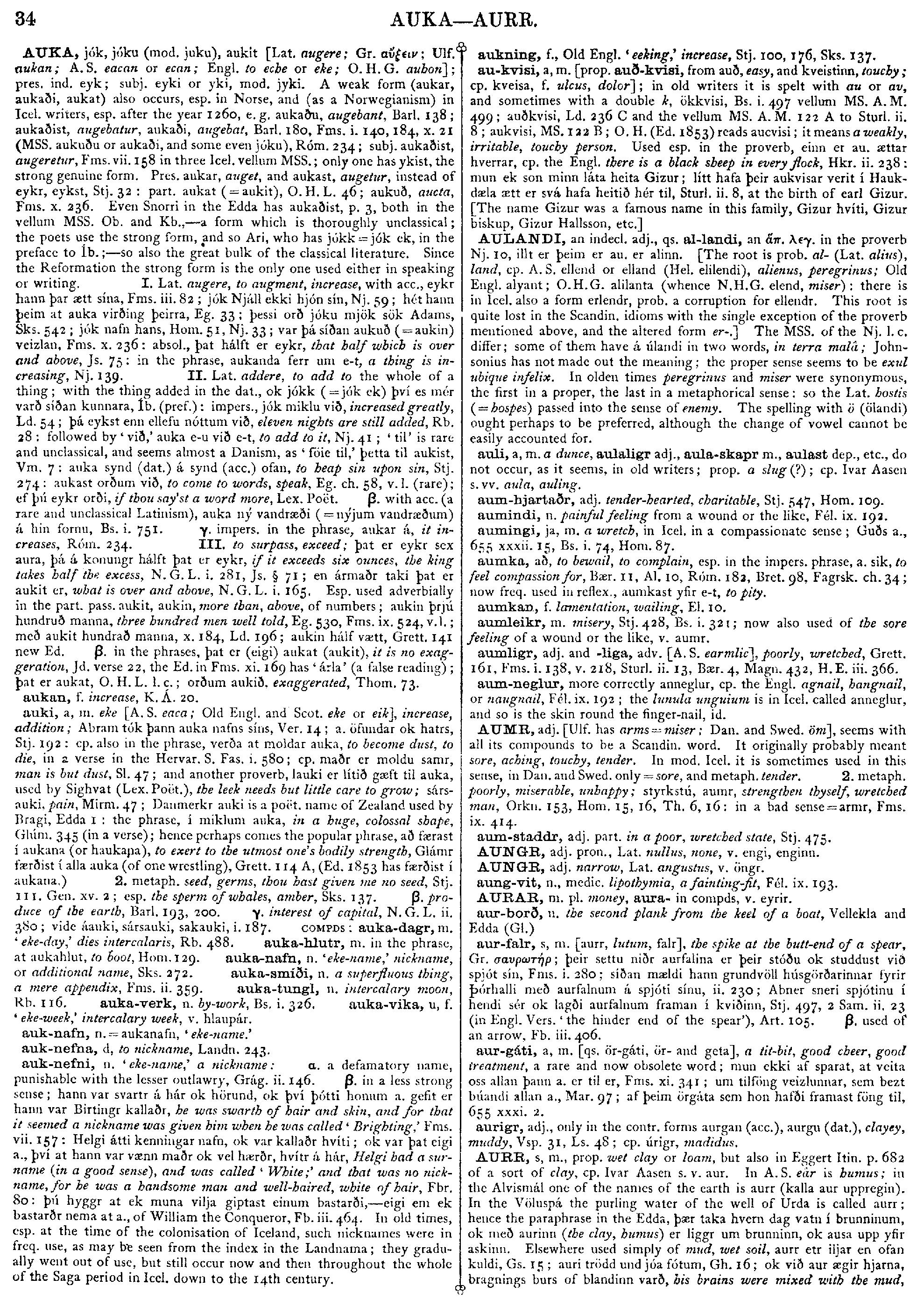
auk-nefni,
n.
'eke-name,'
a
nickname:
.
a
defamatory
name,
punishable
with
the
lesser
outlawry,
Grág.
ii.
146.
.
in
a
less
strong
sense;
hann
var
svartr
á
hár
ok
hörund,
ok
því
þótti
honum
a.
gefit
er
hann
var
Birtingr
kallaðr,
he
was
swarth
of
hair
and
skin,
and
for
that
it
seemed
a
nickname
was
given
him
when
he
was
called
'Brighting,'
Fms.
vii.
157:
Helgi
átti
kenningar
nafn,
ok
var
kallaðr
hvíti;
ok
var
þat
eigi
a.,
því
at
hann
var
vænn
maðr
ok
vel
hærðr,
hvítr
á
hár,
Helgi
had
a
surname
(in
a
good
sense),
and
was
called
'White;'
and
that
was
no
nickname,
for
he
was
a
handsome
man
and
well-haired,
white
of
hair,
Fbr.
80:
þú
hyggr
at
ek
muna
vilja
giptast
einum
bastarði,
--
eigi
em
ek
bastarðr
nema
at
a.,
of
William
the
Conqueror,
Fb.
iii.
464.
In
old
times,
esp.
at
the
time
of
the
colonisation
of
Iceland,
such
nicknames
were
in
freq.
use,
as
may
be
seen
from
the
index
in
the
Landnama;
they
gradually
went
out
of
use,
but
still
occur
now
and
then
throughout
the
whole
of
the
Saga
period
in
Icel.
down
to
the
14th
century.
|
Source: Cleasby/Vigfusson, page b0037, entry 3 View original page image as: [TIFF] [PNG] [View previous entry] [View next entry] |
[Comment on this entry] [View comments] |
The following entry has been hand-corrected once. |
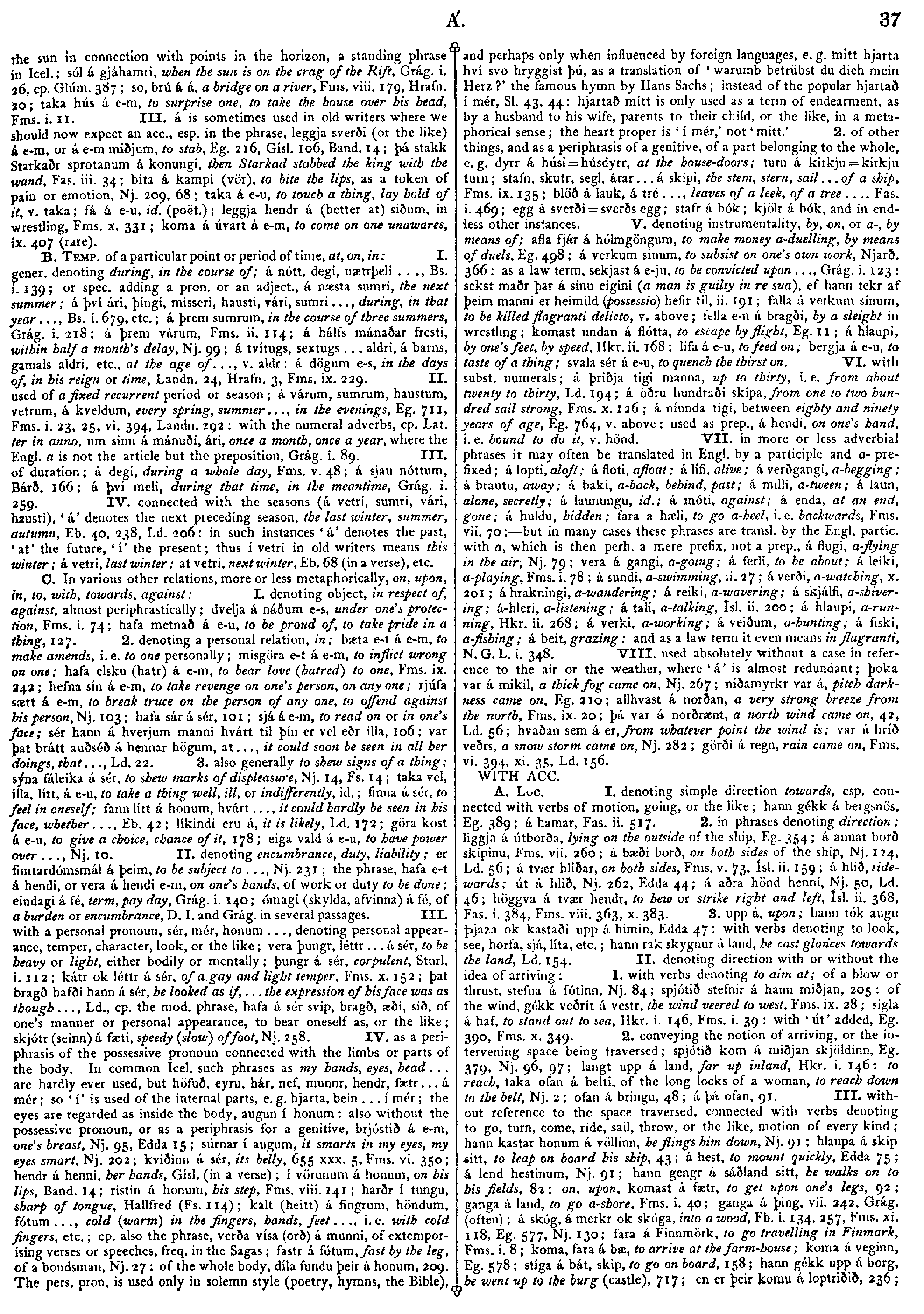
C. In various other relations, more or less metaphorically, on, upon, in, to, with, towards, against: I. denoting object, in respect of, against, almost periphrastically; dvelja á náðum e-s, under one's protection, Fms. i. 74; hafa metnað á e-u, to be proud of, to take pride in a thing, 127. 2. denoting a personal relation, in; bæta e-t á e-m, to make amends, i.e. to one personally; misgöra e-t á e-m, to inflict wrong on one; hafa elsku (hatr) á e-m, to bear love (hatred) to one, Fms. ix. 242; hefna sín á e-m, to take revenge on one's person, on anyone; rjúfa sætt á e-m, to break truce on the person of any one, to offend against his person, Nj. 103; hafa sár á sér, 101; sjá á e-m, to read on or in one's face; sér hann á hverjum manni hvárt til þín er vel eðr illa, 106; var þat brátt auðséð á hennar högum, at ..., it could soon be seen in all her doings, that ..., Ld. 22. 3. also generally to shew signs of a thing; sýna fáleika á sér, to shew marks of displeasure, Nj. 14, Fs. 14; taka vel, illa, lítt, á e-u, to take a thing well, ill, or indifferently, id.; finna á sér, to feel in oneself; fann lítt á honum, hvárt ..., it could hardly be seen in his face, whether ..., Eb. 42; líkindi eru á, it is likely, Ld. 172; göra kost á e-u, to give a choice, chance of it, 178; eiga vald á e-u, to have power over ..., Nj. 10. II. denoting encumbrance, duty, liability; er fimtardómsmál á þeim, to be subject to ..., Nj. 231; the phrase, hafa e-t á hendi, or vera á hendi e-m, on one's hands, of work or duty to be done; eindagi á fé, term, pay day, Grág. i. 140; ómagi (skylda, afvinna) á fé, of a burden or encumbrance, D. I. and Grág. in several passages. III. with a personal pronoun, sér, mér, honum ..., denoting personal appearance, temper, character, look, or the like; vera þungr, léttr ... á sér, to be heavy or light, either bodily or mentally; þungr á sér, corpulent, Sturl. i. 112; kátr ok léttr á sér, of a gay and light temper, Fms. x. 152; þat bragð hafði hann á sér, he looked as if, ... the expression of his face was as though ..., Ld., cp. the mod. phrase, hafa á sér svip, bragð, æði, sið, of one's manner or personal appearance, to bear oneself as, or the like; skjótr (seinn) á fæti, speedy (slow) of foot, Nj. 258. IV. as a periphrasis of the possessive pronoun connected with the limbs or parts of the body. In common Icel. such phrases as my hands, eyes, head ... are hardly ever used, but höfuð, eyru, hár, nef, munnr, hendr, faetr ... á mér; so 'í' is used of the internal parts, e.g. hjarta, bein ... í mér; the eyes are regarded as inside the body, augun í honum: also without the possessive pronoun, or as a periphrasis for a genitive, brjóstið á e-m, one's breast, Nj. 95, Edda 15; súrnar í augum, it smarts in my eyes, my eyes smart, Nj. 202; kviðinn á sér, its belly, 655 xxx. 5, Fms. vi. 350; hendr á henni, her hands, Gísl. (in a verse); í vörunum á honum, on his lips, Band. 14; ristin á honum, his step, Fms. viii. 141; harðr í tungu, sharp of tongue, Hallfred (Fs. 114); kalt (heitt) á fingrum, höndum, fótum ..., cold (warm) in the fingers, hands, feet ..., i.e. with cold fingers, etc.; cp. also the phrase, verða vísa (orð) á munni, of extemporising verses or speeches, freq. in the Sagas; fastr á fótum, fast by the leg, of a bondsman, Nj. 27: of the whole body, díla fundu þeir á honum, 209. The pers. pron. is used only in solemn style (poetry, hymns, the Bible), and perhaps only when influenced by foreign languages, e.g. mitt hjarta hví svo hryggist þú, as a translation of 'warumb betrübst du dich mein Herz?' the famous hymn by Hans Sachs; instead of the popular hjartað í mér, Sl. 43, 44: hjartað mitt is only used as a term of endearment, as by a husband to his wife, parents to their child, or the like, in a metaphorical sense; the heart proper is 'í mér,' not 'mitt.' 2. of other things, and as a periphrasis of a genitive, of a part belonging to the whole, e.g. dyrr á husi = húsdyrr, at the house-doors; turn á kirkju = kirkju turn; stafn, skutr, segl, árar ... á skipi, the stem, stern, sail ... of a ship, Fms. ix. 135; blöð á lauk, á tré ..., leaves of a leek, of a tree ..., Fas. i. 469; egg á sverði = sverðs egg; stafr á bók; kjölr á bók, and in endless other instances. V. denoting instrumentality, by, on, or a-, by means of; afla fjár á hólmgöngum, to make money a-duelling, by means of duels, Eg. 498; á verkum sínum, to subsist on one's own work, Njarð. 366: as a law term, sekjast á e-ju, to be convicted upon ..., Grág. i. 123; sekst maðr þar á sínu eigini (a man is guilty in re sua), ef hann tekr af þeim manni er heimild (possessio) hefir til, ii. 191; falla á verkum sínum, to be killed flagranti delicto, v. above; fella e-n á bragði, by a sleight in wrestling; komast undan á flótta, to escape by flight, Eg. 11; á hlaupi, by one's feet, by speed, Hkr. ii. 168; lifa á e-u, to feed on; bergja á e-u, to taste of a thing; svala sér á e-u, to quench the thirst on. VI. with subst. numerals; á þriðja tigi manna, up to thirty, i.e. from about twenty to thirty, Ld. 194; á öðru hundraði skipa, from one to two hundred sail strong, Fms. x. 126; á níunda tigi, between eighty and ninety years of age, Eg. 764, v. above: used as prep., á hendi, on one's hand, i.e. bound to do it, v. hönd. VII. in more or less adverbial phrases it may often be translated in Engl. by a participle and a- prefixed; á lopti, aloft; á floti, afloat; á lífi, alive; á verðgangi, a-begging; á brautu, away; á baki, a-back, behind, past; á milli, a-tween; á laun, alone, secretly; á launungu, id.; á móti, against; á enda, at an end, gone; á huldu, hidden; fara á hæli, to go a-heel, i.e. backwards, Fms. vii. 70; -- but in many cases these phrases are transl. by the Engl. partic. with a, which is then perh. a mere prefix, not a prep., á flugi, a-flying in the air, Nj. 79; vera á gangi, a-going; á ferli, to be about; á leiki, a-playing, Fms. i. 78; á sundi, a-swimming, ii. 27; á verði, a-watching, x. 201; á hrakningi, a-wandering; á reiki, a-wavering; á skjálfi, a-shivering; á-hleri, a-listening; á tali, a-talking, Ísl. ii. 200; á hlaupi, a-running, Hkr. ii. 268; á verki, a-working; á veiðum, a-hunting; á fiski, a-fishing; á beit, grazing: and as a law term it even means in flagranti, N. G. L. i. 348. VIII. used absolutely without a case in reference to the air or the weather, where 'á' is almost redundant; þoka var á mikil, a thick fog came on, Nj. 267; niðamyrkr var á, pitch darkness came on, Eg. 210; allhvast á norðan, a very strong breeze from the north, Fms. ix. 20; þá var á norðrænt, a north wind came on, 42, Ld. 56; hvaðan sem á er, from whatever point the wind is; var á hríð veðrs, a snow storm came on, Nj. 282; görði á regn, rain came on, Fms. vi. 394, xi. 35, Ld. 156.
|
Source: Cleasby/Vigfusson, page b0046, entry 16 View original page image as: [TIFF] [PNG] [View previous entry] [View next entry] |
[Comment on this entry] [View comments] |
The following entry has been hand-corrected once. |
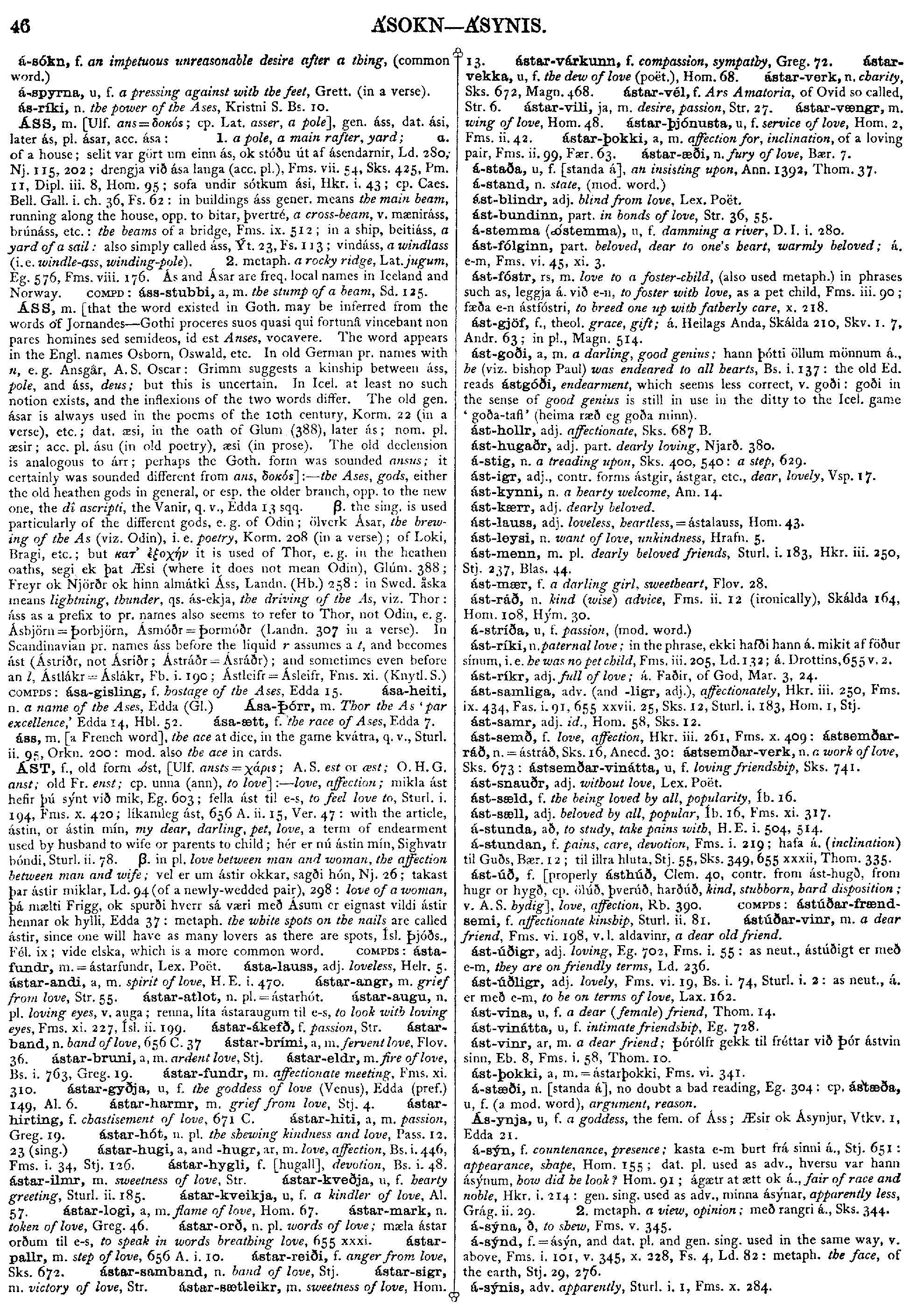
ást-goði, a, m. a darling, good genius; hann þótti öllum mönnum á., he (viz. bishop Paul) was endeared to all hearts, Bs. i. 137: the old Ed. reads ástgóði, endearment, which seems less correct, v. goði: goði in the sense of good genius is still in use in the ditty to the Icel. game 'goða-tafl' (heima ræð eg goða minn).
|
Source: Cleasby/Vigfusson, page b0046, entry 48 View original page image as: [TIFF] [PNG] [View previous entry] [View next entry] |
[Comment on this entry] [View comments] |
The following entry has been hand-corrected once. |
á-sýn, f. countenance, presence; kasta e-m burt frá sinni á., Stj. 651: appearance, shape, Hom. 155; dat. pl. used as adv., hversu var hann ásýnum, how did he look? Hom. 91; ágætr at ætt ok á., fair of race and noble, Hkr. i. 214: gen. sing, used as adv., minna ásýnar, apparently less, Grág. ii. 29. 2. metaph. a view, opinion; með rangri á., Sks. 344.
|
Source: Cleasby/Vigfusson, page b0067, entry 21 View original page image as: [TIFF] [PNG] [View previous entry] [View next entry] |
[Comment on this entry] [View comments] |
The following entry has been hand-corrected once. |
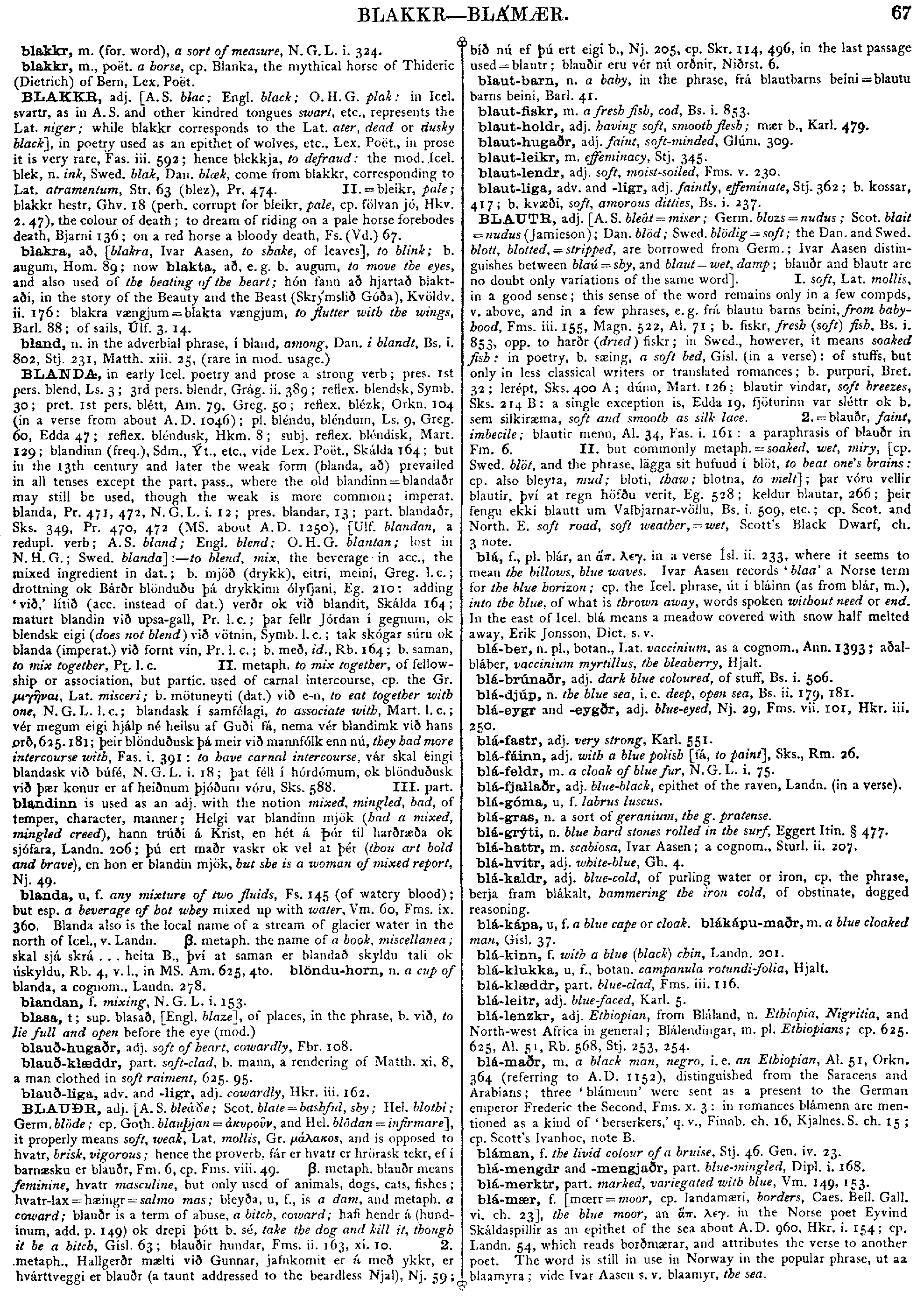
BLAUTR, adj. [A. S. bleât = miser; Germ. blozs = nudus; Scot. blait = nudus (Jamieson); Dan. blöd; Swed. blödig = soft; the Dan. and Swed. blott, blotted, = stripped, are borrowed from Germ.; Ivar Aasen distinguishes between blaú = shy, and blaut = wet, damp; blauðr and blautr are no doubt only variations of the same word]. I. soft, Lat. mollis, in a good sense; this sense of the word remains only in a few compds, v. above, and in a few phrases, e.g. frá blautu barns beini, from babyhood, Fms. iii. 155, Magn. 522, Al. 71; b. fiskr, fresh (soft) fish, Bs. i. 853, opp. to harðr (dried) fiskr; in Swed., however, it means soaked fish: in poetry, b. sæing, a soft bed, Gísl. (in a verse): of stuffs, but only in less classical writers or translated romances; b. purpuri, Bret. 32; lerépt, Sks. 400 A; dúnn, Mart. 126; blautir vindar, soft breezes, Sks. 214 B: a single exception is, Edda 19, fjöturinn var sléttr ok b. sem silkiræma, soft and smooth as silk lace. 2. = blauðr, faint, imbecile; blautir menn, Al. 34, Fas. i. 161: a paraphrasis of blauðr in Fm. 6. II. but commonly metaph. = soaked, wet, miry, [cp. Swed. blöt, and the phrase, lägga sit hufuud í blöt, to beat one's brains: cp. also bleyta, mud; bloti, thaw; blotna, to melt]; þar vóru vellir blautir, því at regn höfðu verit, Eg. 528; keldur blautar, 266; þeir fengu ekki blautt um Valbjarnar-völlu, Bs. i. 509, etc.; cp. Scot. and North. E. soft road, soft weather, = wet, Scott's Black Dwarf, ch. 3 note.
|
Source: Cleasby/Vigfusson, page b0069, entry 12 View original page image as: [TIFF] [PNG] [View previous entry] [View next entry] |
[Comment on this entry] [View comments] |
The following entry has been hand-corrected once. |
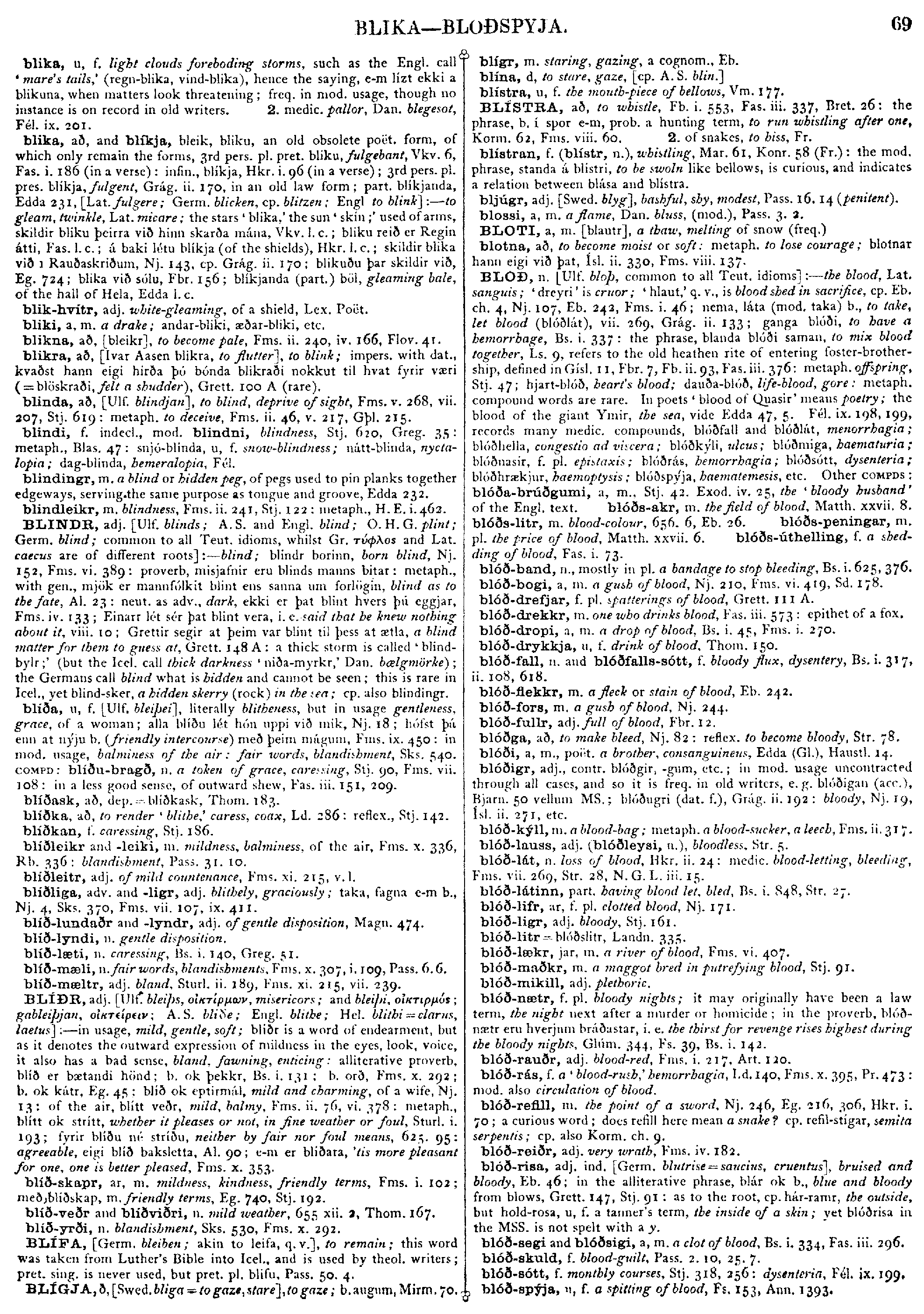
blíða, u, f. [Ulf. bleiþei], literally blitheness, but in usage gentleness, grace, of a woman; alla blíðu lét hón uppi við mik, Nj. 18; hófst þá enn at nýju b. (friendly intercourse) með þeim mágum, Fms. ix. 450: in mod. usage, balminess of the air: fair words, blandishment, Sks. 540. COMPD: blíðu-bragð, n. a token of grace, caressing, Stj. 90, Fms. vii. 108: in a less good sense, of outward shew, Fas. iii. 151, 209.
|
Source: Cleasby/Vigfusson, page b0070, entry 34 View original page image as: [TIFF] [PNG] [View previous entry] [View next entry] |
[Comment on this entry] [View comments] |
The following entry has been hand-corrected once. |
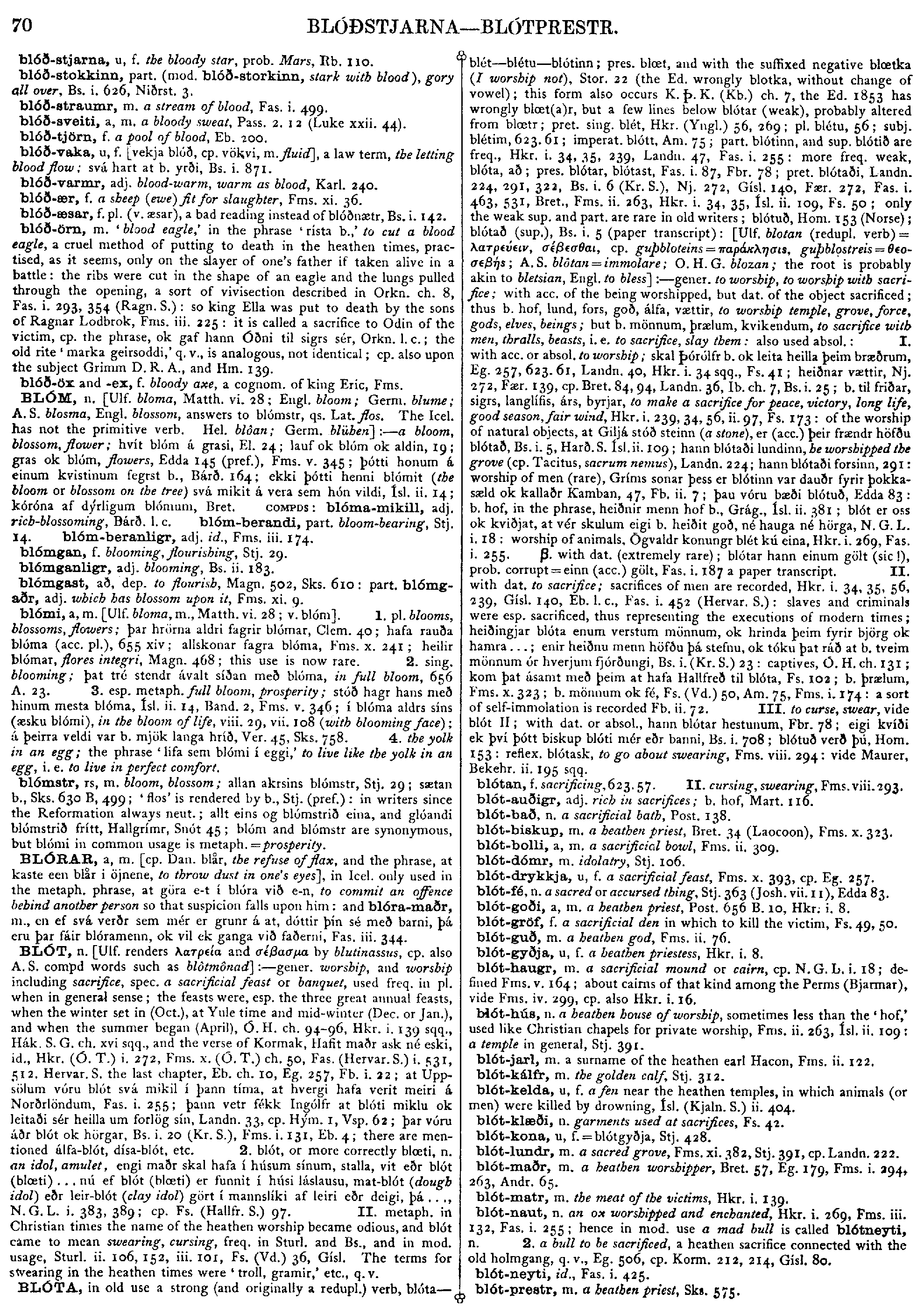
blót-hús, n. a heathen house of worship, sometimes less than the 'hof,' used like Christian chapels for private worship, Fms. ii. 263, Ísl. ii. 109: a temple in general, Stj. 391.
| Result Page: |  |
Previous | 3 4 5 6 7 8 9 10 11 12 13 14 15 16 17 18 19 20 21 | Next |  |
Germanic Lexicon Project (main page)
This search system was written by
Sean Crist
Please consider
volunteering
to correct the data in these online dictionaries.
No rights reserved. Feel free to use these data in any way you please.