|
|

Search for lapides again, using less strict matching (16 results)
|
Source: Bosworth/Toller, page d0570, entry 7 View original page image as: [TIFF] [PNG] [View previous entry] [View next entry] |
[Comment on this entry] [View comments] |
The following entry has been hand-corrected once. |
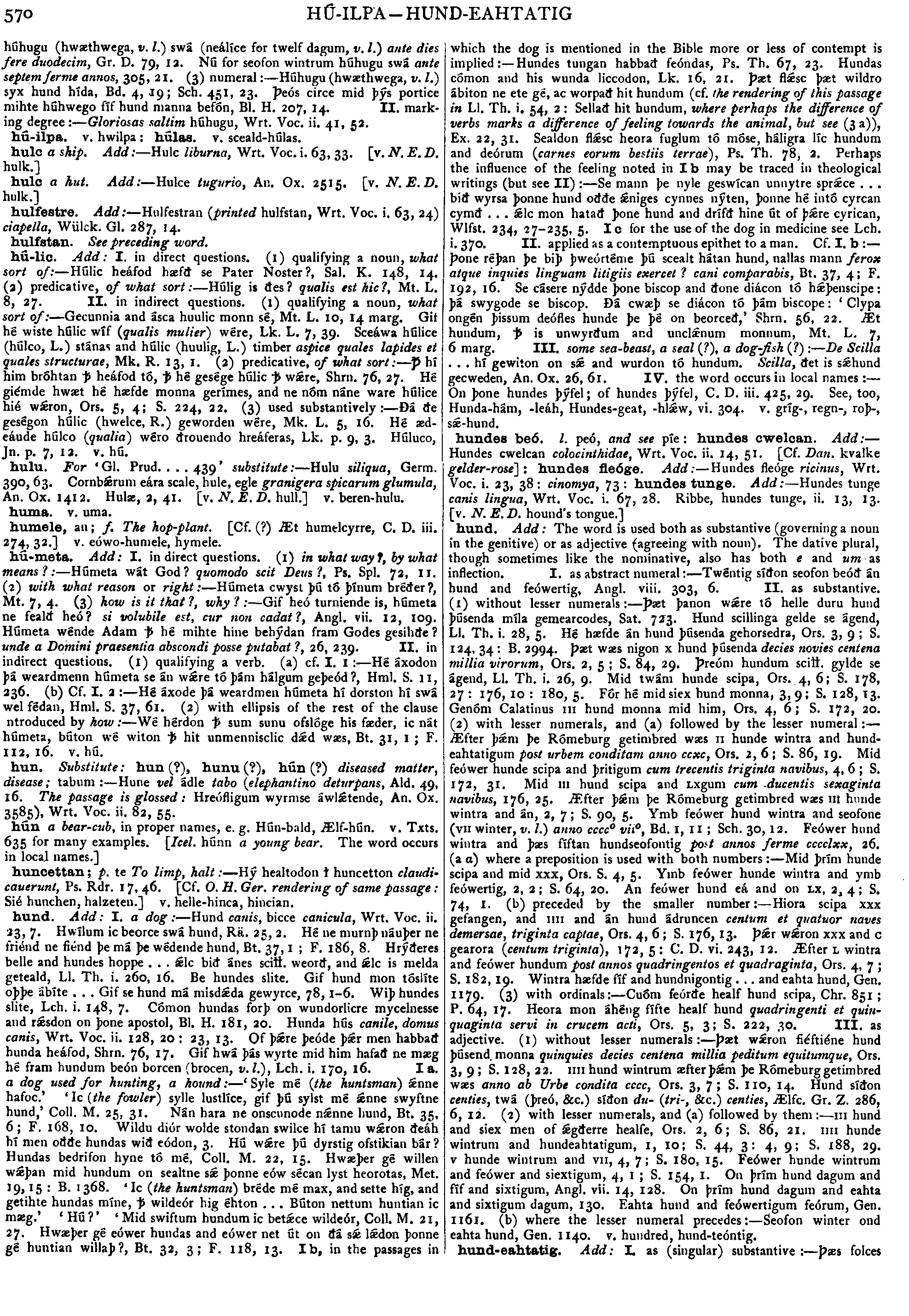
hú-lic.
Add:
I.
in
direct
questions.
(1)
qualifying
a
noun,
what
sort
of
:--
Húlic
heáfod
hæfð
se
Pater
Noster?,
Sal.
K.
148,
14.
(2)
predicative,
of
what
sort
:--
Húlig
is
ðes?
qualis
est
hic?,
Mt.
L.
8,
27.
II.
in
indirect
questions.
(1)
qualifying
a
noun,
what
sort
of
:--
Gecunnia
and
ásca
huulic
monn
sé,
Mt.
L.
10,
14
marg.
Gif
hé
wiste
húlic
wíf
(qualis
mulier)
wére,
Lk.
L.
7,
39.
Sceáwa
húlice
(húlco,
L.)
stánas
and
húlic
(huulig,
L.)
timber
aspice
quales
lapides
et
quales
structurae,
Mk.
R.
13,
1.
(2)
predicative,
of
what
sort
:--
Þ-bar;
hí
him
bróhtan
 heáfod
tó,
hé
gesége
húlic
w
heáfod
tó,
hé
gesége
húlic
w re,
Shrn.
76,
27.
Hé
giémde
hwæt
hé
hæfde
monna
gerímes,
and
ne
nóm
náne
ware
húlice
hié
wron,
Ors.
5,
4;
S.
224,
22.
(3)
used
substantively
:--
Ðá
ðe
geségon
húlic
(hwelce,
R.)
geworden
wére,
Mk.
L.
5,
16.
Hé
ædeáude
húlco
(qualia)
wéro
ðrouendo
hreáferas,
Lk.
p.
9,
3.
Húluco,
Jn.
p.
7,
1
2.
v.
hú.
re,
Shrn.
76,
27.
Hé
giémde
hwæt
hé
hæfde
monna
gerímes,
and
ne
nóm
náne
ware
húlice
hié
wron,
Ors.
5,
4;
S.
224,
22.
(3)
used
substantively
:--
Ðá
ðe
geségon
húlic
(hwelce,
R.)
geworden
wére,
Mk.
L.
5,
16.
Hé
ædeáude
húlco
(qualia)
wéro
ðrouendo
hreáferas,
Lk.
p.
9,
3.
Húluco,
Jn.
p.
7,
1
2.
v.
hú.
|
Source: Bosworth/Toller, page d0725, entry 4 View original page image as: [TIFF] [PNG] [View previous entry] [View next entry] |
[Comment on this entry] [View comments] |
The following entry has been hand-corrected once. |
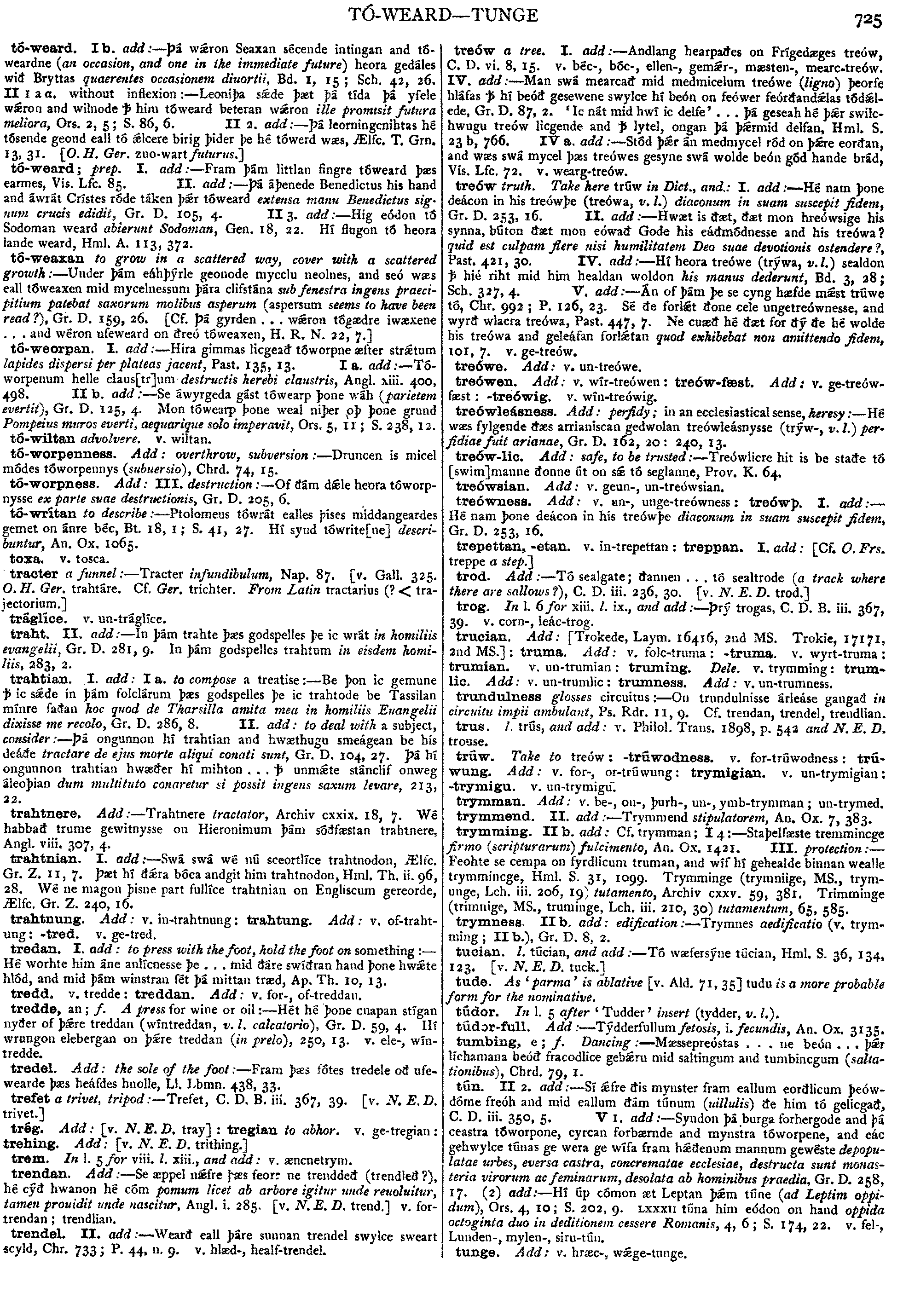
tó-weorpan.
I.
add
:--
Hira
gimmas
licgeað
tóworpne
æfter
strtum
lapides
dispersi
per
plateas
jacent,
Past.
135,
13.
la.
add
:--
Tó-worpenum
helle
claus[tr]um
destructis
herebi
claustris,
Angl.
xiii.
400,
498.
II
b.
add
:--
Se
áwyrgeda
gást
tówearp
þone
wáh
(parietem
evertit),
Gr.
D.
125,
4.
Mon
tówearp
þone
weal
niþer
oþ
þone
grund
Pompeius
muros
everti,
aequarique
solo
imperavit,
Ors.
5,
11;
S.
238,
12.
|
Source: Cleasby/Vigfusson, page b0049, entry 4 View original page image as: [TIFF] [PNG] [View previous entry] [View next entry] |
[Comment on this entry] [View comments] |
The following entry has been hand-corrected once. |
the
Scandinavian
and
Saxon-Teutonic
form
of
a
Greek-Latin
root
word
is
to
be
sought
for
under
the
next
letter
following
the
course
of
the
sun;
thus
the
Greek-Latin
f
( )
answers
to
Icel.
and
Teutonic
b;
the
Greek-Latin
b
(
)
answers
to
Icel.
and
Teutonic
b;
the
Greek-Latin
b
( ),
on
the
other
hand,
to
Teutonic
p.
Few
letters
present
so
many
connections,
as
our
b
(initial)
does
to
the
Greek-Latin
f,
either
in
whole
families
or
single
words;
some
of
the
instances
are
dubious,
many
clear:
GREEK,
cp.
Icel.
balkr;
GREEK,
Lat.
far,
cp.
barr;
GREEK,
GREEK,
Lat.
f
),
on
the
other
hand,
to
Teutonic
p.
Few
letters
present
so
many
connections,
as
our
b
(initial)
does
to
the
Greek-Latin
f,
either
in
whole
families
or
single
words;
some
of
the
instances
are
dubious,
many
clear:
GREEK,
cp.
Icel.
balkr;
GREEK,
Lat.
far,
cp.
barr;
GREEK,
GREEK,
Lat.
f rare,
cp.
bora;
GREEK,
cp.
barki;
GREEK,
GREEK,
cp.
bifa;
GREEK,
GREEK,
Lat.
f
rare,
cp.
bora;
GREEK,
cp.
barki;
GREEK,
GREEK,
cp.
bifa;
GREEK,
GREEK,
Lat.
f ro,
cp.
bera,
borinn;
GREEK,
cp.
byrðr;
GREEK,
GREEK,
Lat.
f
ro,
cp.
bera,
borinn;
GREEK,
cp.
byrðr;
GREEK,
GREEK,
Lat.
f gio,
cp.
beygja,
boginn,
bugr;
GREEK,
Lat.
f
gio,
cp.
beygja,
boginn,
bugr;
GREEK,
Lat.
f gus,
cp.
bók,
beyki;
GREEK,
GREEK,
Lat.
fulgere,
fulgur,
cp.
blik,
blika;
GREEK,
Lat.
flre,
cp.
blása,
bólginn,
Lat.
follis,
cp.
belgr;
GREEK,
Lat.
fl
gus,
cp.
bók,
beyki;
GREEK,
GREEK,
Lat.
fulgere,
fulgur,
cp.
blik,
blika;
GREEK,
Lat.
flre,
cp.
blása,
bólginn,
Lat.
follis,
cp.
belgr;
GREEK,
Lat.
fl s,
cp.
blóm;
GREEK,
GREEK,
GREEK,
cp.
bani,
ben;
GREEK,
cp.
barmr;
GREEK,
GREEK,
cp.
borg,
byrgja;
GREEK,
GREEK,
cp.
birta;
GREEK,
Lat.
frter,
cp.
bróðir;
GREEK,
cp.
brunnr;
GREEK,
cp.
brattr
(brant),
brandr;
GREEK,
cp.
brá;
GREEK,
GREEK,
cp.
brúk;
GREEK,
Lat.
f
s,
cp.
blóm;
GREEK,
GREEK,
GREEK,
cp.
bani,
ben;
GREEK,
cp.
barmr;
GREEK,
GREEK,
cp.
borg,
byrgja;
GREEK,
GREEK,
cp.
birta;
GREEK,
Lat.
frter,
cp.
bróðir;
GREEK,
cp.
brunnr;
GREEK,
cp.
brattr
(brant),
brandr;
GREEK,
cp.
brá;
GREEK,
GREEK,
cp.
brúk;
GREEK,
Lat.
f o,
fi,
cp.
búa,
bjó,
Engl.
to
be,
and
the
particle
be-
(v.
Grimm
s.v.
be-
and
bauen);
GREEK,
Lat.
flium,
cp.
blað;
GREEK,
Lat.
fcus,
cp.
baka:
moreover
the
Lat.
f
o,
fi,
cp.
búa,
bjó,
Engl.
to
be,
and
the
particle
be-
(v.
Grimm
s.v.
be-
and
bauen);
GREEK,
Lat.
flium,
cp.
blað;
GREEK,
Lat.
fcus,
cp.
baka:
moreover
the
Lat.
f cio,
-f
cio,
-f cio,
cp.
byggja;
fastigium,
cp.
bust;
favilla,
cp.
bál;
frio,
cp.
berja;
frox,
frus,
cp.
ber-,
björn;
fervere,
cp.
brenna;
fdus,
foedus,
cp.
binda;
findo,
fdi,
cp.
bíta,
beit;
flgellum,
cp.
blaka;
flectere,
cp.
bregða;
fluctus,
cp.
bylgja;
fdio,
cp.
bauta,
Engl.
to
beat;
fundus,
cp.
botn;
fors,
forte,
cp.
'burðr'
in
'at
burðr;'
frango,
fr
cio,
cp.
byggja;
fastigium,
cp.
bust;
favilla,
cp.
bál;
frio,
cp.
berja;
frox,
frus,
cp.
ber-,
björn;
fervere,
cp.
brenna;
fdus,
foedus,
cp.
binda;
findo,
fdi,
cp.
bíta,
beit;
flgellum,
cp.
blaka;
flectere,
cp.
bregða;
fluctus,
cp.
bylgja;
fdio,
cp.
bauta,
Engl.
to
beat;
fundus,
cp.
botn;
fors,
forte,
cp.
'burðr'
in
'at
burðr;'
frango,
fr gi,
frgor,
cp.
breki,
brak,
brjóta;
fraus
(fraudis),
cp.
brjóta,
braut;
fr
gi,
frgor,
cp.
breki,
brak,
brjóta;
fraus
(fraudis),
cp.
brjóta,
braut;
fr ges,
fructus,
cp.
björk;
fulcio,
cp.
búlki;
frmo,
cp.
brim;
frenum,
cp.
beisl,
Engl.
bridle;
frons
(frondis),
cp.
brum;
--
even
frons
(frontis)
might
be
compared
to
Icel.
brandr
and
brattr,
cp.
such
phrases
as
frontati
lapides;
--
ftum,
fma,
cp.
boð,
boða,
etc.
The
Greek
GREEK,
GREEK
might
also
be
identical
to
our
bl-
in
blíðr.
The
change
is
irregular
in
words
such
as
Lat.
pangere,
Icel.
banga;
petere
=
biðja;
parcere
=
bjarga;
porcus
=
börgr;
GREEK,
cp.
bekkr;
probably
owing
to
some
link
being
lost.
.
in
words
imported
either
from
Greek
or
Roman
idioms
the
f
sometimes
remains
unchanged;
as
the
Byz.
Greek
GREEK
is
fengari,
Edda
(Gl.);
sometimes
the
common
rule
is
reversed,
and
the
Latin
or
Greek
p
becomes
b,
as
episcopus
=
biskup;
leopardus
=
hlébarðr,
Old
Engl.
libbard;
ampulla
=
bolli;
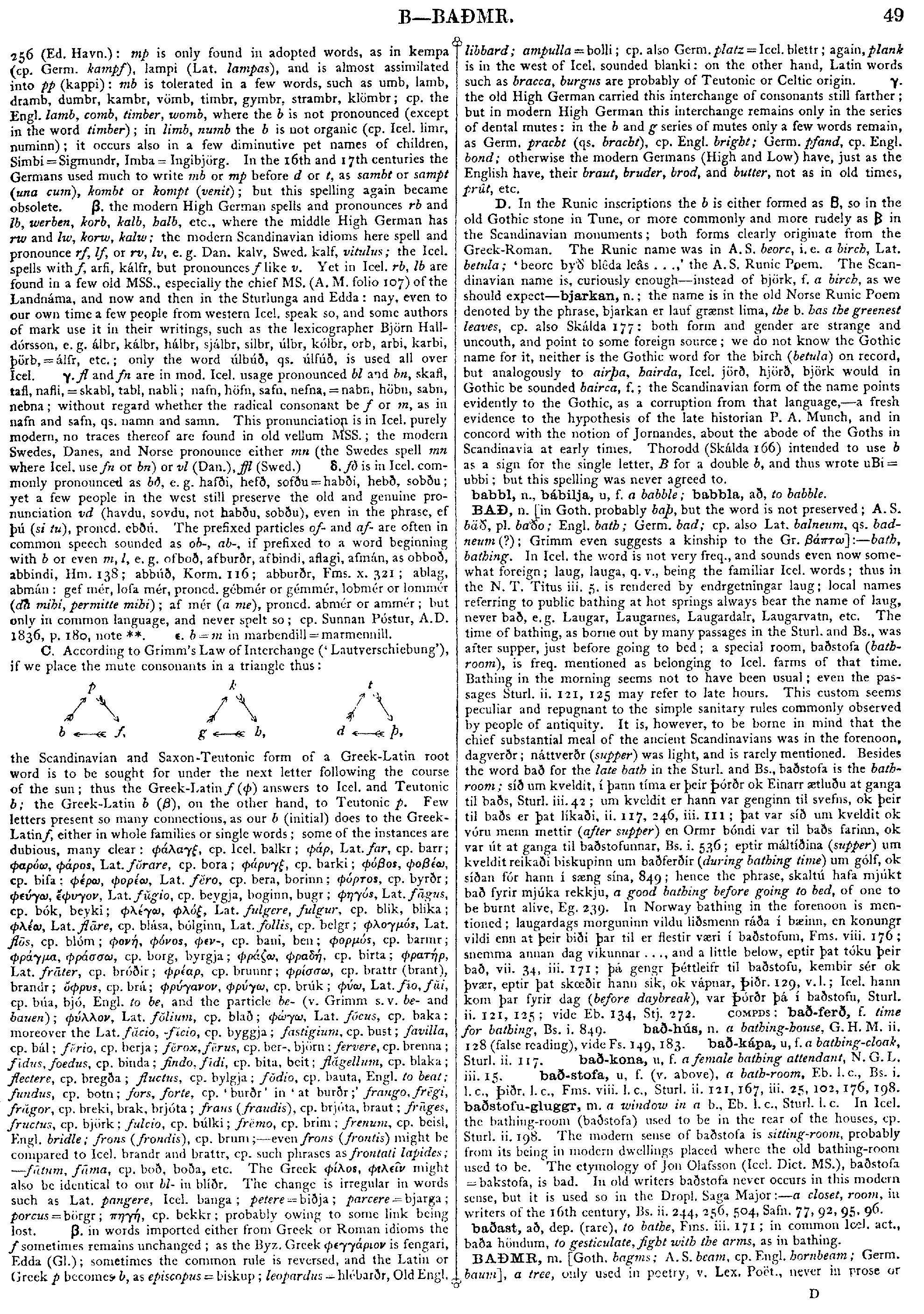
cp.
also
Germ.
platz
=
Icel.
blettr;
again,
plank
is
in
the
west
of
Icel.
sounded
blanki:
on
the
other
hand,
Latin
words
such
as
bracca,
burgus
are
probably
of
Teutonic
or
Celtic
origin.
ges,
fructus,
cp.
björk;
fulcio,
cp.
búlki;
frmo,
cp.
brim;
frenum,
cp.
beisl,
Engl.
bridle;
frons
(frondis),
cp.
brum;
--
even
frons
(frontis)
might
be
compared
to
Icel.
brandr
and
brattr,
cp.
such
phrases
as
frontati
lapides;
--
ftum,
fma,
cp.
boð,
boða,
etc.
The
Greek
GREEK,
GREEK
might
also
be
identical
to
our
bl-
in
blíðr.
The
change
is
irregular
in
words
such
as
Lat.
pangere,
Icel.
banga;
petere
=
biðja;
parcere
=
bjarga;
porcus
=
börgr;
GREEK,
cp.
bekkr;
probably
owing
to
some
link
being
lost.
.
in
words
imported
either
from
Greek
or
Roman
idioms
the
f
sometimes
remains
unchanged;
as
the
Byz.
Greek
GREEK
is
fengari,
Edda
(Gl.);
sometimes
the
common
rule
is
reversed,
and
the
Latin
or
Greek
p
becomes
b,
as
episcopus
=
biskup;
leopardus
=
hlébarðr,
Old
Engl.
libbard;
ampulla
=
bolli;
cp.
also
Germ.
platz
=
Icel.
blettr;
again,
plank
is
in
the
west
of
Icel.
sounded
blanki:
on
the
other
hand,
Latin
words
such
as
bracca,
burgus
are
probably
of
Teutonic
or
Celtic
origin.
 .
the
old
High
German
carried
this
interchange
of
consonants
still
farther;
but
in
modern
High
German
this
interchange
remains
only
in
the
series
of
dental
mutes:
in
the
b
and
g
series
of
mutes
only
a
few
words
remain,
as
Germ.
pracht
(qs.
bracht),
cp.
Engl.
bright;
Germ.
pfand,
cp.
Engl.
bond;
otherwise
the
modern
Germans
(High
and
Low)
have,
just
as
the
English
have,
their
braut,
bruder,
brod,
and
butter,
not
as
in
old
times,
prût,
etc.
.
the
old
High
German
carried
this
interchange
of
consonants
still
farther;
but
in
modern
High
German
this
interchange
remains
only
in
the
series
of
dental
mutes:
in
the
b
and
g
series
of
mutes
only
a
few
words
remain,
as
Germ.
pracht
(qs.
bracht),
cp.
Engl.
bright;
Germ.
pfand,
cp.
Engl.
bond;
otherwise
the
modern
Germans
(High
and
Low)
have,
just
as
the
English
have,
their
braut,
bruder,
brod,
and
butter,
not
as
in
old
times,
prût,
etc.
|
Source: Cleasby/Vigfusson, page b0054, entry 11 View original page image as: [TIFF] [PNG] [View previous entry] [View next entry] |
[Comment on this entry] [View comments] |
The following entry has not been hand-corrected. However, the page is reserved and someone is correcting it. |
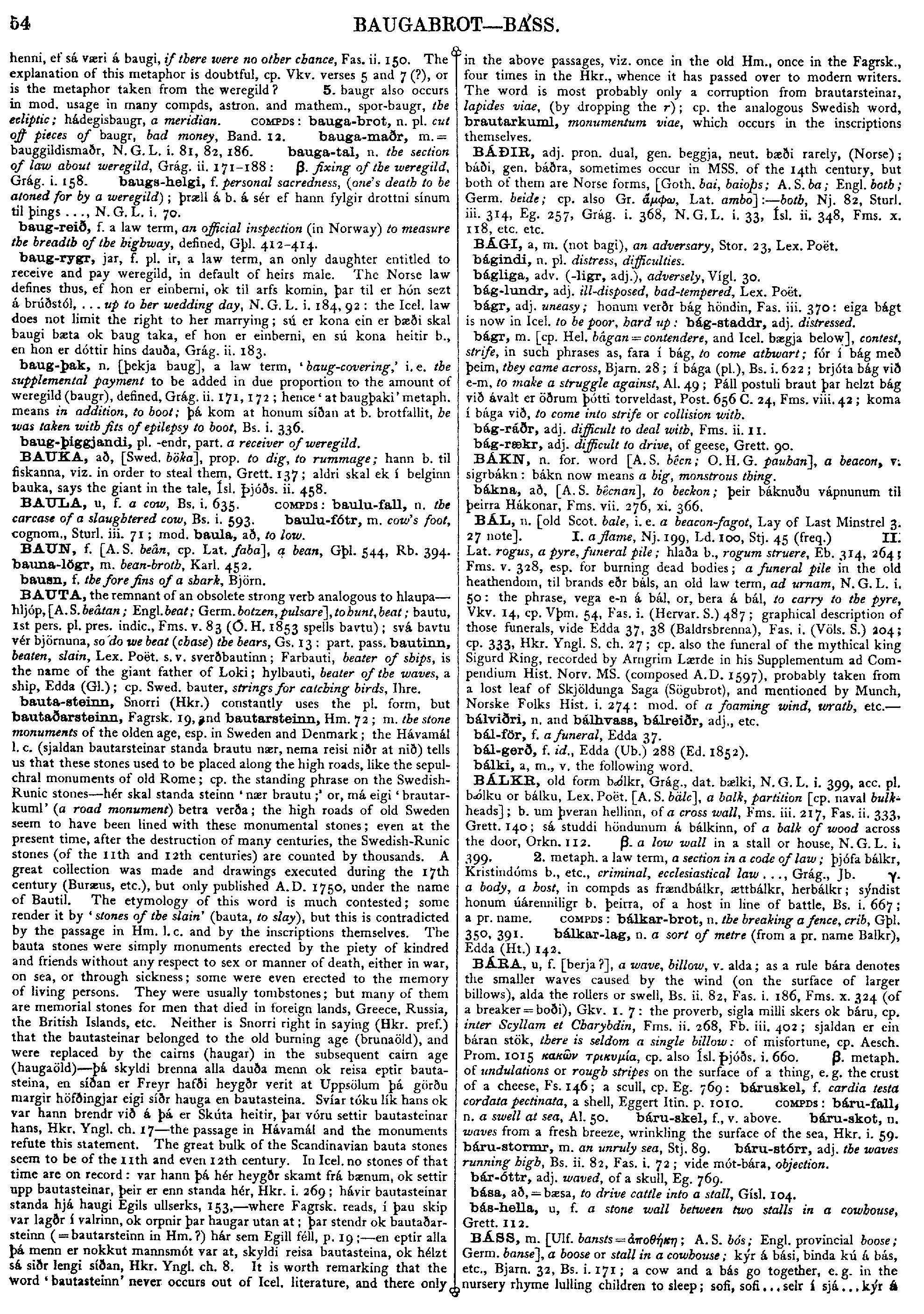
bauta-steinn, Snorri (Hkr.) constantly uses the pl. form, but bautaðarsteinn, Fagrsk. 19, ^nd bautarsteinn, Hm. 72; m. the stone monuments of the olden age, esp. in Sweden and Denmark; the Hávamál 1. c. (sjaldan bautarsteinar standa brautu nær, nema reisi niðr at nið) tells us that these stones used to be placed along the high roads, like the sepul- chral monuments of old Rome; cp. the standing phrase on the Swedish- Runic stones -- her skal standa steinn ' naer brautu;' or, má eigi' brautar- kuml' (a roa d monument) betra verða; the high roads of old Sweden seem to have been lined with these monumental stones; even at the present time, after the destruction of many centuries, the Swedish-Runic stones (of the nth and I2th centuries) are counted by thousands. A great collection was made and drawings executed during the I7*h century (Buræus, etc.), but only published A. D. 1750, under the name of Bautil. The etymology of this word is much contested; some render it by ' s t on e s of the slain' (bauta, to slay), but this is contradicted by the passage in Hm. 1. c. and by the inscriptions themselves. The bauta stones were simply monuments erected by the piety of kindred and friends without any respect to sex or manner of death, either in war, on sea, or through sickness; some were even erected to the memory of living persons. They were usually tombstones; but many of them are memorial stones for men that died in foreign lands, Greece, Russia, the British Islands, etc. Neither is Snorri right in saying (Hkr. pref.) that the bautasteinar belonged to the old burning age (brunaöld), and were replaced by the cairns (haugar) in the subsequent cairn age (haugaöld) -- þá skyldi brenna alla dauða menn ok reisa eptir bauta- steina, en síðan er Freyr hafði heygðr verit at Uppsölum þá görðu margir höfðingjar eigi síðr hauga en bautasteina. Svíar tóku lík hans ok var hann brendr við á þá er Skúta heitir, þar vóru settir bautasteinar hans, Hkr. Yngl. ch. 17 -- the passage in Hávamál and the monuments refute this statement. The great bulk of the Scandinavian bauta stones seem to be of the nth and even 12th century. In Icel. no stones of that time are on record: var hann þá her heygðr skamt frá bsenum, ok settir upp bautasteinar, þeir er enn standa her, Hkr. i. 269; hávir bautasteinar standa hjá haugi Egils ullserks, 153, -- where Fagrsk. reads, í þau skip var lagðr í valrinn, ok orpnir þar haugar utan at; þar stendr ok bautaðar- steinn (= bautarsteinn in Hm. ?) hár sem Egill fell, p. 19; -- en eptir alia þá menn er nokkut mannsmót var at, skyldi reisa bautasteina, ok hélzt sa siðr lengi síðan, Hkr. Yngl. ch. 8. It is worth remarking that the Word ' bautasteinn' never occurs out of Icel. literature, and there only in the above passages, viz. once in the old Hm., once in the Fagrsk., four times in the Hkr., whence it has passed over to modern writers. The word is most probably only a corruption from brautarsteinar, lapides viae, (by dropping the r); cp. the analogous Swedish word, brautarkuml, monumentum viae, which occurs in the inscriptions themselves.
|
Source: Cleasby/Vigfusson, page b0328, entry 2 View original page image as: [TIFF] [PNG] [View previous entry] [View next entry] |
[Comment on this entry] [View comments] |
The following entry has been hand-corrected once. |
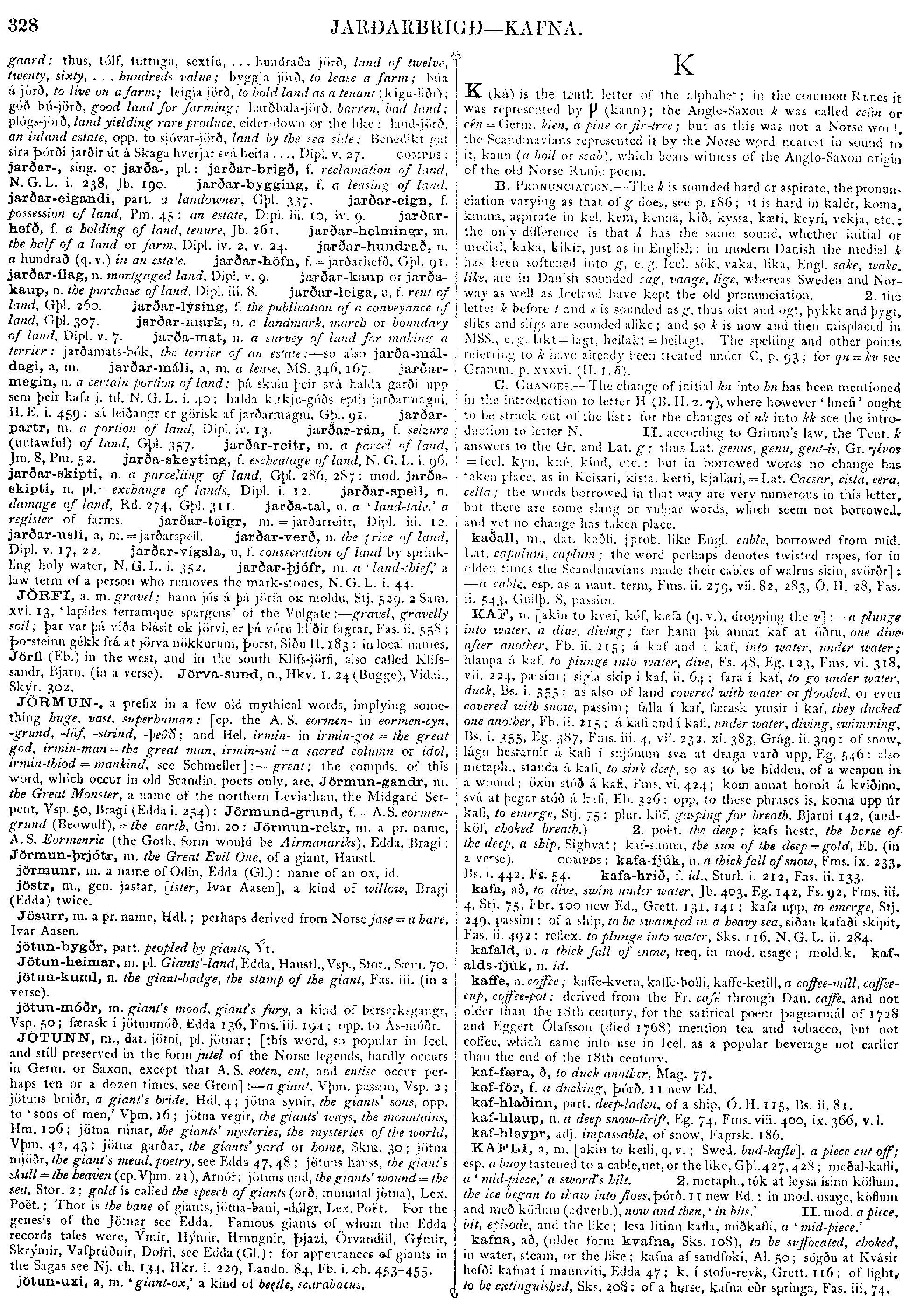
JÖRFI, a, m. gravel; hann jós á þá jörfa ok moldu, Stj. 529. 2 Sam. xvi. 13, 'lapides terramque spargens' of the Vulgate :-- gravel, gravelly soil; þar var þá víða blásit ok jörvi, er þá vóru hlíðir fagrar, Fas. ii. 558; Þorsteinn gékk frá at jörva nökkurum, Þorst. Síðu H. 183: in local names, Jörfi (Eb.) in the west, and in the south Klifs-jörfi, also called Klifs-sandr, Bjarn. (in a verse). Jörva-sund, n., Hkv. 1. 24 (Bugge), Vídal., Skýr. 302.
| Result Page: |  |
Previous | 1 2 |
Germanic Lexicon Project (main page)
This search system was written by
Sean Crist
Please consider
volunteering
to correct the data in these online dictionaries.
No rights reserved. Feel free to use these data in any way you please.