|
|

|
Source: Bosworth/Toller, page b0225, entry 19 View original page image as: [TIFF] [PNG] [View previous entry] [View next entry] |
[Comment on this entry] [View comments] |
The following entry has been hand-corrected once. |
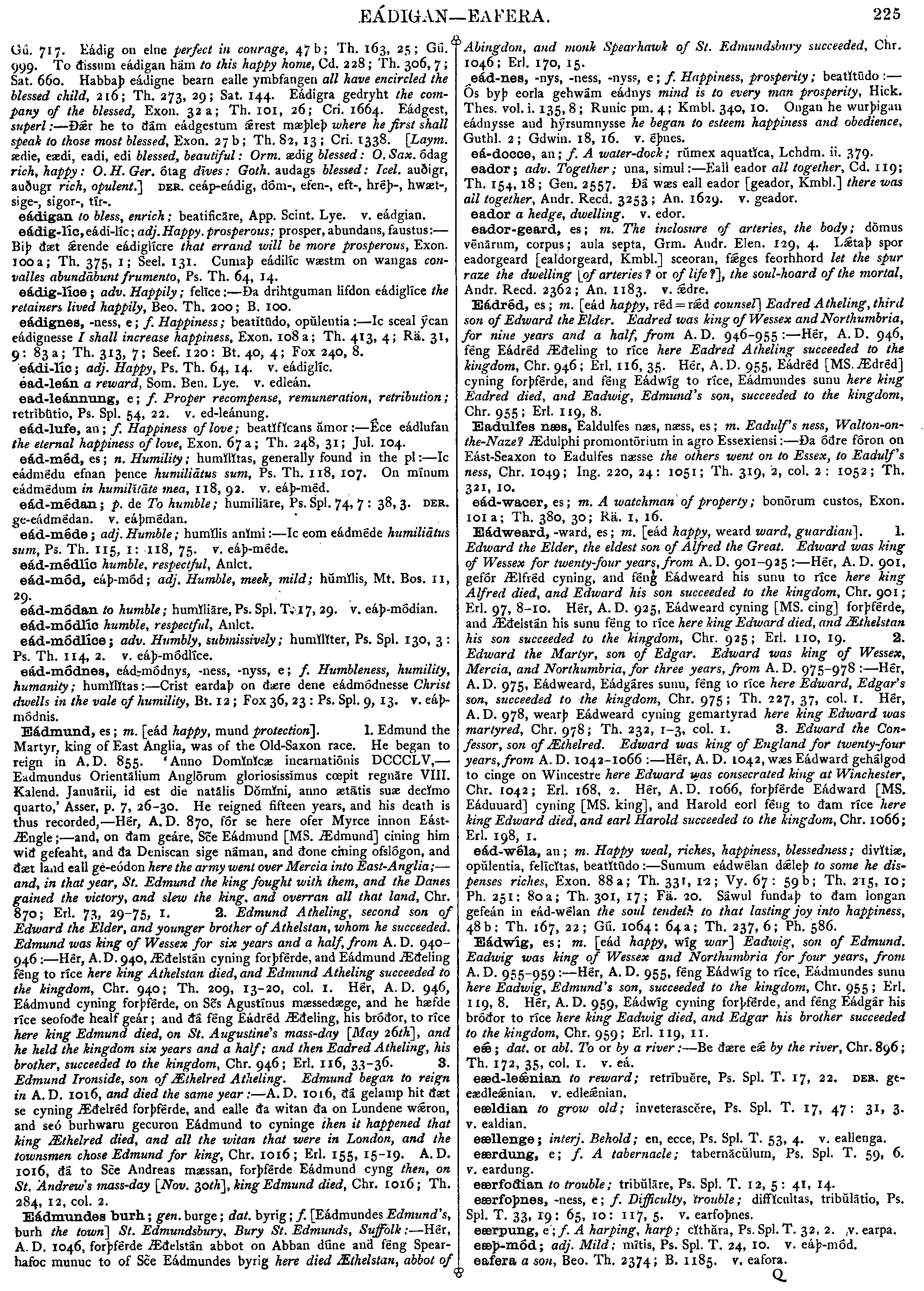
Eádmund,
es;
m.
[eád
happy,
mund
protection].
1.
Edmund
the
Martyr,
king
of
East
Anglia,
was
of
the
Old-Saxon
race.
He
began
to
reign
in
A.
D.
855.
'Anno
Dom ncæ
incarnati
ncæ
incarnati nis
DCCCLV,
--Eadmundus
Orient
nis
DCCCLV,
--Eadmundus
Orient lium
Anglrum
gloriosssimus
cœpit
regnre
VIII.
Kalend.
Janurii,
id
est
die
natlis
D
lium
Anglrum
gloriosssimus
cœpit
regnre
VIII.
Kalend.
Janurii,
id
est
die
natlis
D mni,
anno
ættis
suæ
decmo
quarto,'
Asser,
p.
7,
26-30.
He
reigned
fifteen
years,
and
his
death
is
thus
recorded,--Hér,
A.
D.
870,
fór
se
here
ofer
Myrce
innon
Eást-Ængle:--and,
on
ðam
geáre,
S
mni,
anno
ættis
suæ
decmo
quarto,'
Asser,
p.
7,
26-30.
He
reigned
fifteen
years,
and
his
death
is
thus
recorded,--Hér,
A.
D.
870,
fór
se
here
ofer
Myrce
innon
Eást-Ængle:--and,
on
ðam
geáre,
S e
Eádmund
[MS.
Ædmund]
cining
him
wið
gefeaht,
and
ða
Deniscan
sige
náman,
and
ðone
cining
ofslógon,
and
ðæt
land
eall
ge-eódon
here
the
army
went
over
Mercia
into
East-Anglia;--and,
in
that
year,
St.
Edmund
the
king
fought
with
them,
and
the
Danes
gained
the
victory,
and
slew
the
king,
and
overran
all
that
land,
Chr.
870;
Erl.
73,
29-75,
1.
2.
Edmund
Atheling,
second
son
of
Edward
the
Elder,
and
younger
brother
of
Athelstan,
whom
he
succeeded.
Edmund
was
king
of
Wessex
for
six
years
and
a
half,
from
A.
D.
940-946:--Hér,
A.
D.
940,
Æðelstán
cyning
forþférde,
and
Eádmund
Æðeling
féng
to
ríce
here
king
Athelstan
died,
and
Edmund
Atheling
succeeded
to
the
kingdom,
Chr.
940;
Th.
209,
13-20,
col.
1.
Hér,
A.
D.
946,
Eádmund
cyning
forþíerde,
on
Ss
Agustínus
mæssedæge,
and
he
hæfde
ríce
seofoðe
healf
geár;
and
ðá
féng
Eádréd
Æðeling,
his
bróðor,
to
ríce
here
king
Edmund
died,
on
St.
Augustine's
mass-day
[May
26th"]
,
and
he
held
the
kingdom
six
years
and
a
half;
and
then
Eadred
Atheling,
his
brother,
succeeded
to
the
kingdom,
Chr.
946;
Erl.
116,
33-36.
3.
Edmund
Ironside,
son
of
Æthelred
Atheling.
Edmund
began
to
reign
in
A.
D.
1016,
and
died
the
same
year:--A.
D.
1016,
ðá
gelamp
hit
ðæt
se
cyning
Æðelréd
forþférde,
and
ealle
ða
witan
ða
on
Lundene
w
e
Eádmund
[MS.
Ædmund]
cining
him
wið
gefeaht,
and
ða
Deniscan
sige
náman,
and
ðone
cining
ofslógon,
and
ðæt
land
eall
ge-eódon
here
the
army
went
over
Mercia
into
East-Anglia;--and,
in
that
year,
St.
Edmund
the
king
fought
with
them,
and
the
Danes
gained
the
victory,
and
slew
the
king,
and
overran
all
that
land,
Chr.
870;
Erl.
73,
29-75,
1.
2.
Edmund
Atheling,
second
son
of
Edward
the
Elder,
and
younger
brother
of
Athelstan,
whom
he
succeeded.
Edmund
was
king
of
Wessex
for
six
years
and
a
half,
from
A.
D.
940-946:--Hér,
A.
D.
940,
Æðelstán
cyning
forþférde,
and
Eádmund
Æðeling
féng
to
ríce
here
king
Athelstan
died,
and
Edmund
Atheling
succeeded
to
the
kingdom,
Chr.
940;
Th.
209,
13-20,
col.
1.
Hér,
A.
D.
946,
Eádmund
cyning
forþíerde,
on
Ss
Agustínus
mæssedæge,
and
he
hæfde
ríce
seofoðe
healf
geár;
and
ðá
féng
Eádréd
Æðeling,
his
bróðor,
to
ríce
here
king
Edmund
died,
on
St.
Augustine's
mass-day
[May
26th"]
,
and
he
held
the
kingdom
six
years
and
a
half;
and
then
Eadred
Atheling,
his
brother,
succeeded
to
the
kingdom,
Chr.
946;
Erl.
116,
33-36.
3.
Edmund
Ironside,
son
of
Æthelred
Atheling.
Edmund
began
to
reign
in
A.
D.
1016,
and
died
the
same
year:--A.
D.
1016,
ðá
gelamp
hit
ðæt
se
cyning
Æðelréd
forþférde,
and
ealle
ða
witan
ða
on
Lundene
w ron,
and
seó
burhwaru
gecuron
Eádmund
to
cyninge
then
it
happened
that
king
Æthelred
died,
and
all
the
witan
that
were
in
London,
and
the
townsmen
chose
Edmund
for
king,
Chr.
1016;
Erl.
155,
15-19.
A.
D.
1016,
ðá
to
Se
Andreas
mæssan,
forþférde
Eádmund
cyng
then,
on
St.
Andrew's
mass-day
[Nov.
30th],
king
Edmund
died,
Chr.
1016;
Th.
284,
12,
col.
2.
ron,
and
seó
burhwaru
gecuron
Eádmund
to
cyninge
then
it
happened
that
king
Æthelred
died,
and
all
the
witan
that
were
in
London,
and
the
townsmen
chose
Edmund
for
king,
Chr.
1016;
Erl.
155,
15-19.
A.
D.
1016,
ðá
to
Se
Andreas
mæssan,
forþférde
Eádmund
cyng
then,
on
St.
Andrew's
mass-day
[Nov.
30th],
king
Edmund
died,
Chr.
1016;
Th.
284,
12,
col.
2.
|
Source: Bosworth/Toller, page b0227, entry 7 View original page image as: [TIFF] [PNG] [View previous entry] [View next entry] |
[Comment on this entry] [View comments] |
The following entry has been hand-corrected once. |
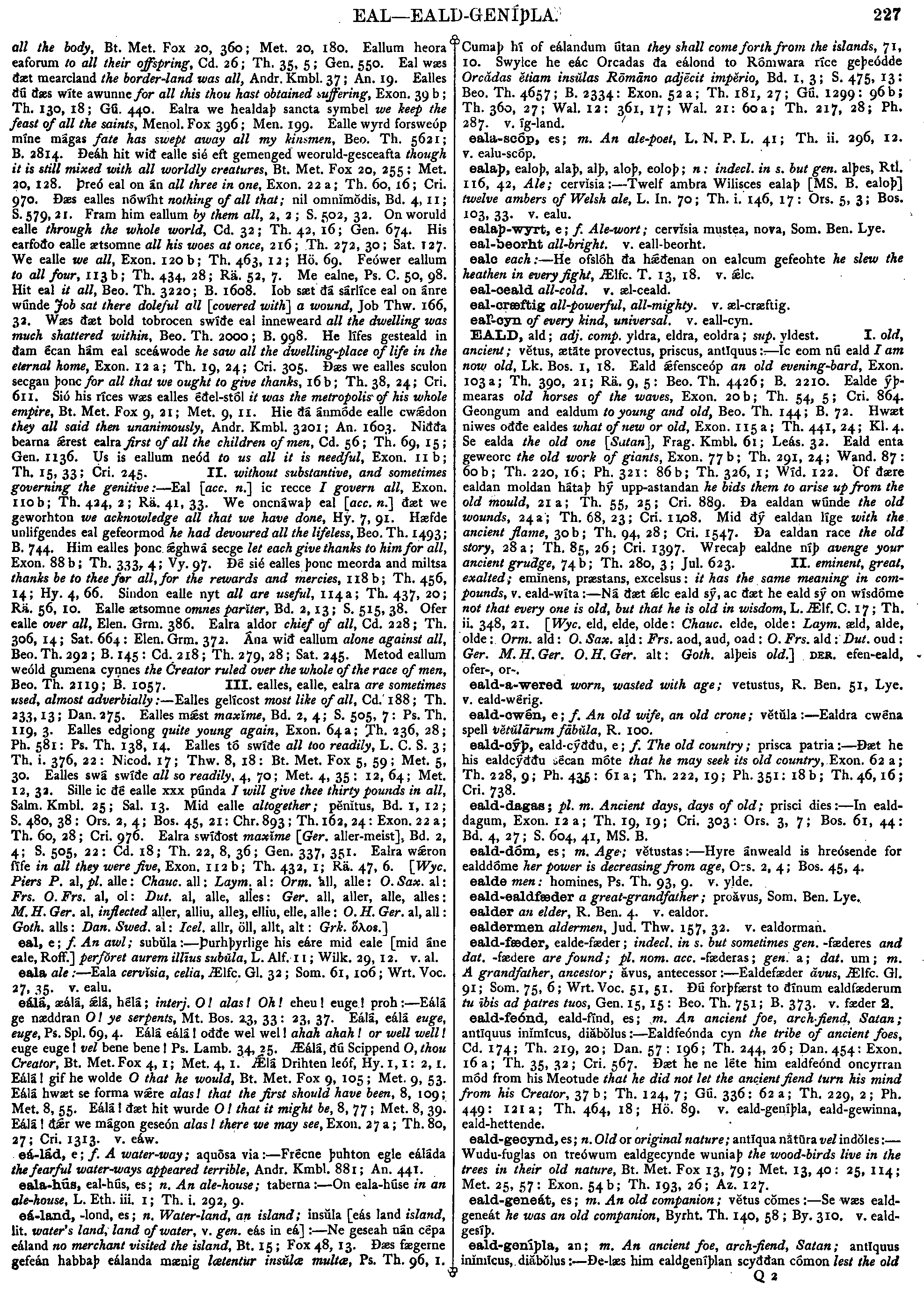
eá-land,
-lond,
es;
n.
Water-land,
an
island;
ins la
[eás
land
island,
lit.
water's
land,
land
of
water,
v.
gen.
eás
in
eá]
:--
Ne
geseah
nán
cépa
eáland
no
merchant
visited
the
island,
Bt.
15;
Fox
48,
13.
Ðæs
fægerne
gefeán
habbaþ
eálanda
mænig
latentur
inslæ
multæ,
Ps.
Th.
96,
1.
Cumaþ
hí
of
eálandum
útan
they
shall
come
forth
from
the
islands,
71,
10.
Swylce
he
eác
Orcadas
ða
eálond
to
Rómwara
ríce
geþeódde
Orc
la
[eás
land
island,
lit.
water's
land,
land
of
water,
v.
gen.
eás
in
eá]
:--
Ne
geseah
nán
cépa
eáland
no
merchant
visited
the
island,
Bt.
15;
Fox
48,
13.
Ðæs
fægerne
gefeán
habbaþ
eálanda
mænig
latentur
inslæ
multæ,
Ps.
Th.
96,
1.
Cumaþ
hí
of
eálandum
útan
they
shall
come
forth
from
the
islands,
71,
10.
Swylce
he
eác
Orcadas
ða
eálond
to
Rómwara
ríce
geþeódde
Orc das
das
 tiam
inslas
Rmno
adj
tiam
inslas
Rmno
adj cit
imprio,
Bd.
1.
3;
S.
475,
13:
Beo.
Th.
4657;
B.
2334:
Exon.
52a;
Th.
181,
27;
Gú.
1299:
96
b;
Th.
360,
27;
Wal.
12:
361,
17;
Wal.
21:
60a;
Th.
217,
28;
Ph.
287.
v.
íg-land.
cit
imprio,
Bd.
1.
3;
S.
475,
13:
Beo.
Th.
4657;
B.
2334:
Exon.
52a;
Th.
181,
27;
Gú.
1299:
96
b;
Th.
360,
27;
Wal.
12:
361,
17;
Wal.
21:
60a;
Th.
217,
28;
Ph.
287.
v.
íg-land.
|
Source: Bosworth/Toller, page b0229, entry 5 View original page image as: [TIFF] [PNG] [View previous entry] [View next entry] |
[Comment on this entry] [View comments] |
The following entry has been hand-corrected once. |
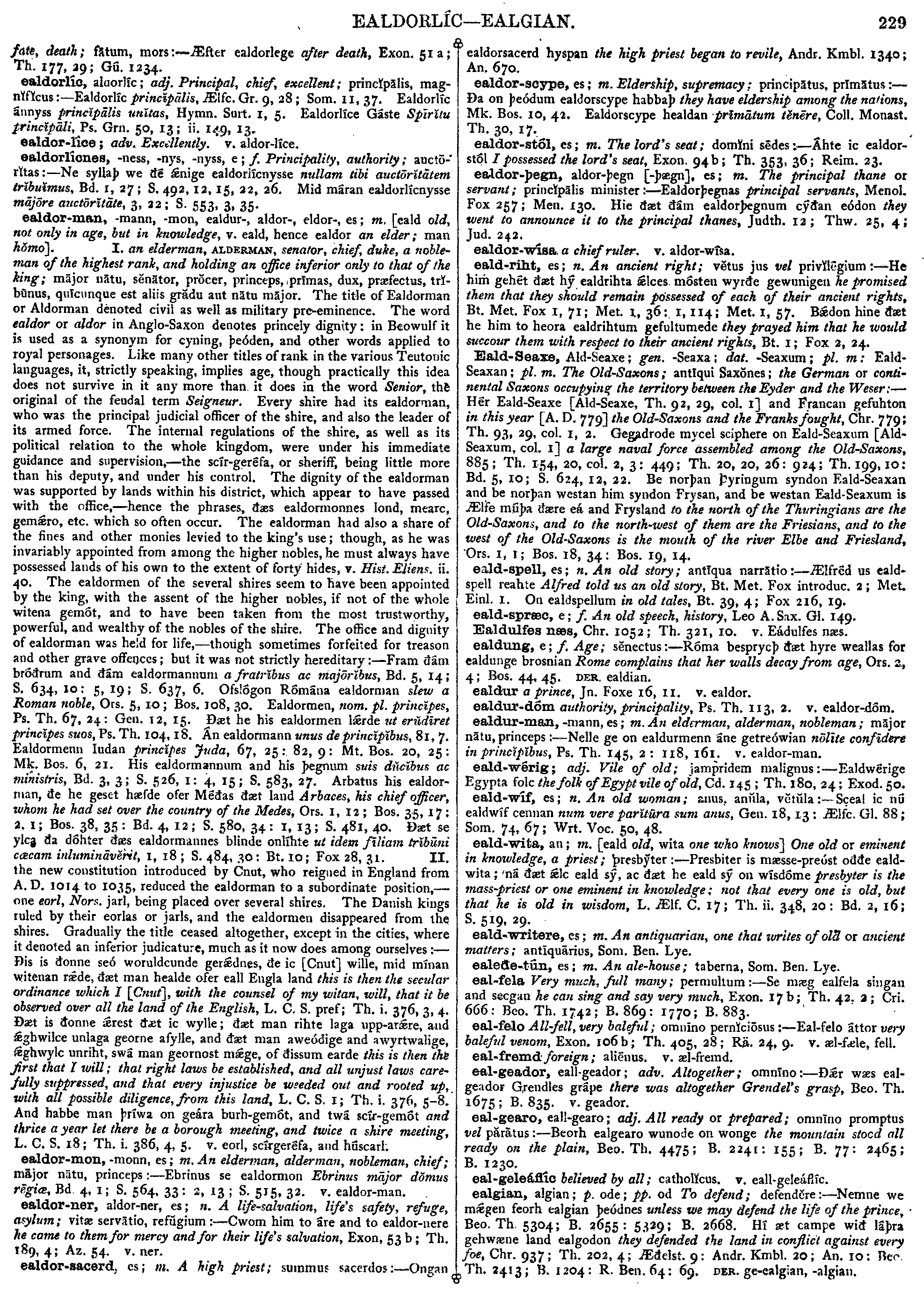
ealdor-man,
-mann,
-mon,
ealdur-,
aldor-,
eldor-,
es;
m.
[eald
old,
not
only
in
age,
but
in
knowledge,
v.
eald,
hence
ealdor
an
elder;
man
hmo].
I.
an
elderman,
ALDERMAN,
senator,
chief,
duke,
a
nobleman
of
the
highest
rank,
and
holding
an
office
inferior
only
to
that
of
the
king;
mjor
ntu,
sntor,
prcer,
princeps,
pr mas,
dux,
præfectus,
trb
mas,
dux,
præfectus,
trb nus,
qucunque
est
aliis
grdu
aut
ntu
mjor.
The
title
of
Ealdorman
or
Aldorman
denoted
civil
as
well
as
military
pre-eminence.
The
word
ealdor
or
aldor
in
Anglo-Saxon
denotes
princely
dignity:
in
Beowulf
it
is
used
as
a
synonym
for
cyning,
þeóden,
and
other
words
applied
to
royal
personages.
Like
many
other
titles
of
rank
in
the
various
Teutonic
languages,
it,
strictly
speaking,
implies
age,
though
practically
this
idea
does
not
survive
in
it
any
more
than
it
does
in
the
word
Senior,
the
original
of
the
feudal
term
Seigneur.
Every
shire
had
its
ealdorman,
who
was
the
principal
judicial
officer
of
the
shire,
and
also
the
leader
of
its
armed
force.
The
internal
regulations
of
the
shire,
as
well
as
its
political
relation
to
the
whole
kingdom,
were
under
his
immediate
guidance
and
supervision,--the
scír-geréfa,
or
sheriff,
being
little
more
than
his
deputy,
and
under
his
control.
The
dignity
of
the
ealdorman
was
supported
by
lands
within
his
district,
which
appear
to
have
passed
with
the
office,--hence
the
phrases,
ðæs
ealdormonnes
lond,
mearc,
gemro,
etc.
which
so
often
occur.
The
ealdorman
had
also
a
share
of
the
fines
and
other
monies
levied
to
the
king's
use;
though,
as
he
was
invariably
appointed
from
among
the
higher
nobles,
he
must
always
have
possessed
lands
of
his
own
to
the
extent
of
forty
hides,
v.
Hist.
Eliens.
ii.
40.
The
ealdormen
of
the
several
shires
seem
to
have
been
appointed
by
the
king,
with
the
assent
of
the
higher
nobles,
if
not
of
the
whole
witena
gemót,
and
to
have
been
taken
from
the
most
trustworthy,
powerful,
and
wealthy
of
the
nobles
of
the
shire.
The
office
and
dignity
of
ealdorman
was
held
for
life,--though
sometimes
forfeited
for
treason
and
other
grave
offences;
but
it
was
not
strictly
hereditary
:--
Fram
ðám
bróðrum
and
ðám
ealdormannum
a
fratrbus
ac
majrbus,
Bd.
5,
14;
S.
634,
10:
5,
19;
S.
637,
6.
Ofslógon
Rómána
ealdorman
slew
a
Roman
noble,
Ors.
5,
10;
Bos.
108,
30.
Ealdormen,
nom.
pl.
princpes,
Ps.
Th.
67,
24:
Gen.
12,
15.
Ðæt
he
his
ealdormen
lrde
ut
erdret
princpes
suos,
Ps.
Th.
104,
18.
Án
ealdormann
unus
de
princpbus,
81,
7.
Ealdormenn
Iudan
princpes
Juda,
67,
25:
82,
9:
Mt.
Bos.
20,
25:
Mk.
Bos.
6,
21.
His
ealdormannum
and
his
þegnum
suis
dcbus
ac
ministris,
Bd.
3,
3;
S.
526,
1:
4,
15;
S.
583,
27.
Arbatus
his
ealdorman,
ðe
he
geset
hæfde
ofer
Méðas
ðæt
land
Arbaces,
his
chief
officer,
whom
he
had
set
over
the
country
of
the
Medes,
Ors.
1,
12;
Bos.
35,
17:
2,
1;
Bos.
38,
35:
Bd.
4,
12;
S.
580,
34:
1,
13;
S.
481,
40.
Ðæt
se
ylca
ða
dóhter
ðæs
ealdormannes
blinde
onlíhte
ut
idem
fliam
trbni
cæcam
inluminvrit,
1,
18;
S.
484,
30:
Bt.
10;
Fox
28,
31.
II.
the
new
constitution
introduced
by
Cnut,
who
reigned
in
England
from
A.D.
1014
to
1035,
reduced
the
ealdorman
to
a
subordinate
position,--one
eorl,
Nrs.
jarl,
being
placed
over
several
shires.
The
Danish
kings
ruled
by
their
eorlas
or
jarls,
and
the
ealdormen
disappeared
from
the
shires.
Gradually
the
title
ceased
altogether,
except
in
the
cities,
where
it
denoted
an
inferior
judicature,
much
as
it
now
does
among
ourselves
:--
Ðis
is
ðonne
seó
woruldcunde
gerdnes,
ðe
ic
[Cnut]
wille,
mid
mínan
witenan
rde,
ðæt
man
healde
ofer
eall
Engla
land
this
is
then
the
secular
ordinance
which
I
[Cnut],
with
the
counsel
of
my
witan,
will,
that
it
be
observed
over
all
the
land
of
the
English,
L.
C.
S.
pref;
Th.
i.
376,
3,
4.
Ðæt
is
ðonne
rest
ðæt
ic
wylle;
ðæt
man
rihte
laga
upp-arre,
and
ghwilce
unlaga
georne
afylle,
and
ðæt
man
aweódige
and
awyrtwalige,
ghwylc
unriht,
swá
man
geornost
mge,
of
ðissum
earde
this
is
then
the
first
that
I
will;
that
right
laws
be
established,
and
all
unjust
laws
carefully
suppressed,
and
that
every
injustice
be
weeded
out
and
rooted
up,
with
all
possible
diligence,
from
this
land,
L.
C.
S.
1;
Th.
i.
376,
5-8.
And
habbe
man
þriwa
on
geára
burh-gemót,
and
twá
scír-gemót
and
thrice
a
year
let
there
be
a
borough
meeting,
and
twice
a
shire
meeting,
L.
C.
S.
18;
Th.
i.
386,
4,
5.
v.
eorl,
scírgeréfa,
and
húscarl.
nus,
qucunque
est
aliis
grdu
aut
ntu
mjor.
The
title
of
Ealdorman
or
Aldorman
denoted
civil
as
well
as
military
pre-eminence.
The
word
ealdor
or
aldor
in
Anglo-Saxon
denotes
princely
dignity:
in
Beowulf
it
is
used
as
a
synonym
for
cyning,
þeóden,
and
other
words
applied
to
royal
personages.
Like
many
other
titles
of
rank
in
the
various
Teutonic
languages,
it,
strictly
speaking,
implies
age,
though
practically
this
idea
does
not
survive
in
it
any
more
than
it
does
in
the
word
Senior,
the
original
of
the
feudal
term
Seigneur.
Every
shire
had
its
ealdorman,
who
was
the
principal
judicial
officer
of
the
shire,
and
also
the
leader
of
its
armed
force.
The
internal
regulations
of
the
shire,
as
well
as
its
political
relation
to
the
whole
kingdom,
were
under
his
immediate
guidance
and
supervision,--the
scír-geréfa,
or
sheriff,
being
little
more
than
his
deputy,
and
under
his
control.
The
dignity
of
the
ealdorman
was
supported
by
lands
within
his
district,
which
appear
to
have
passed
with
the
office,--hence
the
phrases,
ðæs
ealdormonnes
lond,
mearc,
gemro,
etc.
which
so
often
occur.
The
ealdorman
had
also
a
share
of
the
fines
and
other
monies
levied
to
the
king's
use;
though,
as
he
was
invariably
appointed
from
among
the
higher
nobles,
he
must
always
have
possessed
lands
of
his
own
to
the
extent
of
forty
hides,
v.
Hist.
Eliens.
ii.
40.
The
ealdormen
of
the
several
shires
seem
to
have
been
appointed
by
the
king,
with
the
assent
of
the
higher
nobles,
if
not
of
the
whole
witena
gemót,
and
to
have
been
taken
from
the
most
trustworthy,
powerful,
and
wealthy
of
the
nobles
of
the
shire.
The
office
and
dignity
of
ealdorman
was
held
for
life,--though
sometimes
forfeited
for
treason
and
other
grave
offences;
but
it
was
not
strictly
hereditary
:--
Fram
ðám
bróðrum
and
ðám
ealdormannum
a
fratrbus
ac
majrbus,
Bd.
5,
14;
S.
634,
10:
5,
19;
S.
637,
6.
Ofslógon
Rómána
ealdorman
slew
a
Roman
noble,
Ors.
5,
10;
Bos.
108,
30.
Ealdormen,
nom.
pl.
princpes,
Ps.
Th.
67,
24:
Gen.
12,
15.
Ðæt
he
his
ealdormen
lrde
ut
erdret
princpes
suos,
Ps.
Th.
104,
18.
Án
ealdormann
unus
de
princpbus,
81,
7.
Ealdormenn
Iudan
princpes
Juda,
67,
25:
82,
9:
Mt.
Bos.
20,
25:
Mk.
Bos.
6,
21.
His
ealdormannum
and
his
þegnum
suis
dcbus
ac
ministris,
Bd.
3,
3;
S.
526,
1:
4,
15;
S.
583,
27.
Arbatus
his
ealdorman,
ðe
he
geset
hæfde
ofer
Méðas
ðæt
land
Arbaces,
his
chief
officer,
whom
he
had
set
over
the
country
of
the
Medes,
Ors.
1,
12;
Bos.
35,
17:
2,
1;
Bos.
38,
35:
Bd.
4,
12;
S.
580,
34:
1,
13;
S.
481,
40.
Ðæt
se
ylca
ða
dóhter
ðæs
ealdormannes
blinde
onlíhte
ut
idem
fliam
trbni
cæcam
inluminvrit,
1,
18;
S.
484,
30:
Bt.
10;
Fox
28,
31.
II.
the
new
constitution
introduced
by
Cnut,
who
reigned
in
England
from
A.D.
1014
to
1035,
reduced
the
ealdorman
to
a
subordinate
position,--one
eorl,
Nrs.
jarl,
being
placed
over
several
shires.
The
Danish
kings
ruled
by
their
eorlas
or
jarls,
and
the
ealdormen
disappeared
from
the
shires.
Gradually
the
title
ceased
altogether,
except
in
the
cities,
where
it
denoted
an
inferior
judicature,
much
as
it
now
does
among
ourselves
:--
Ðis
is
ðonne
seó
woruldcunde
gerdnes,
ðe
ic
[Cnut]
wille,
mid
mínan
witenan
rde,
ðæt
man
healde
ofer
eall
Engla
land
this
is
then
the
secular
ordinance
which
I
[Cnut],
with
the
counsel
of
my
witan,
will,
that
it
be
observed
over
all
the
land
of
the
English,
L.
C.
S.
pref;
Th.
i.
376,
3,
4.
Ðæt
is
ðonne
rest
ðæt
ic
wylle;
ðæt
man
rihte
laga
upp-arre,
and
ghwilce
unlaga
georne
afylle,
and
ðæt
man
aweódige
and
awyrtwalige,
ghwylc
unriht,
swá
man
geornost
mge,
of
ðissum
earde
this
is
then
the
first
that
I
will;
that
right
laws
be
established,
and
all
unjust
laws
carefully
suppressed,
and
that
every
injustice
be
weeded
out
and
rooted
up,
with
all
possible
diligence,
from
this
land,
L.
C.
S.
1;
Th.
i.
376,
5-8.
And
habbe
man
þriwa
on
geára
burh-gemót,
and
twá
scír-gemót
and
thrice
a
year
let
there
be
a
borough
meeting,
and
twice
a
shire
meeting,
L.
C.
S.
18;
Th.
i.
386,
4,
5.
v.
eorl,
scírgeréfa,
and
húscarl.
|
Source: Bosworth/Toller, page b0229, entry 33 View original page image as: [TIFF] [PNG] [View previous entry] [View next entry] |
[Comment on this entry] [View comments] |
The following entry has been hand-corrected once. |
ealgian,
algian;
p.
ode;
pp.
od
To
defend;
defendre
:--
Nemne
we
mgen
feorh
ealgian
þeódnes
unless
we
may
defend
the
life
of
the
prince,
Beo.
Th
5304;
B.
2655:
5329;
B.
2668.
Hí
æt
campe
wið
láþra
gehwæne
land
ealgodon
they
defended
the
land
in
conflict
against
every
foe,
Chr.
937;
Th.
202,
4;
Æðelst.
9:
Andr.
Kmbl.
20;
An.
10:
Bec.
Th.
2413;
B.
1204:
R.
Ben.
64:
69.
DER.
ge-ealgian,
-algian.
|
Source: Bosworth/Toller, page b0230, entry 50 View original page image as: [TIFF] [PNG] [View previous entry] [View next entry] |
[Comment on this entry] [View comments] |
The following entry has been hand-corrected once. |
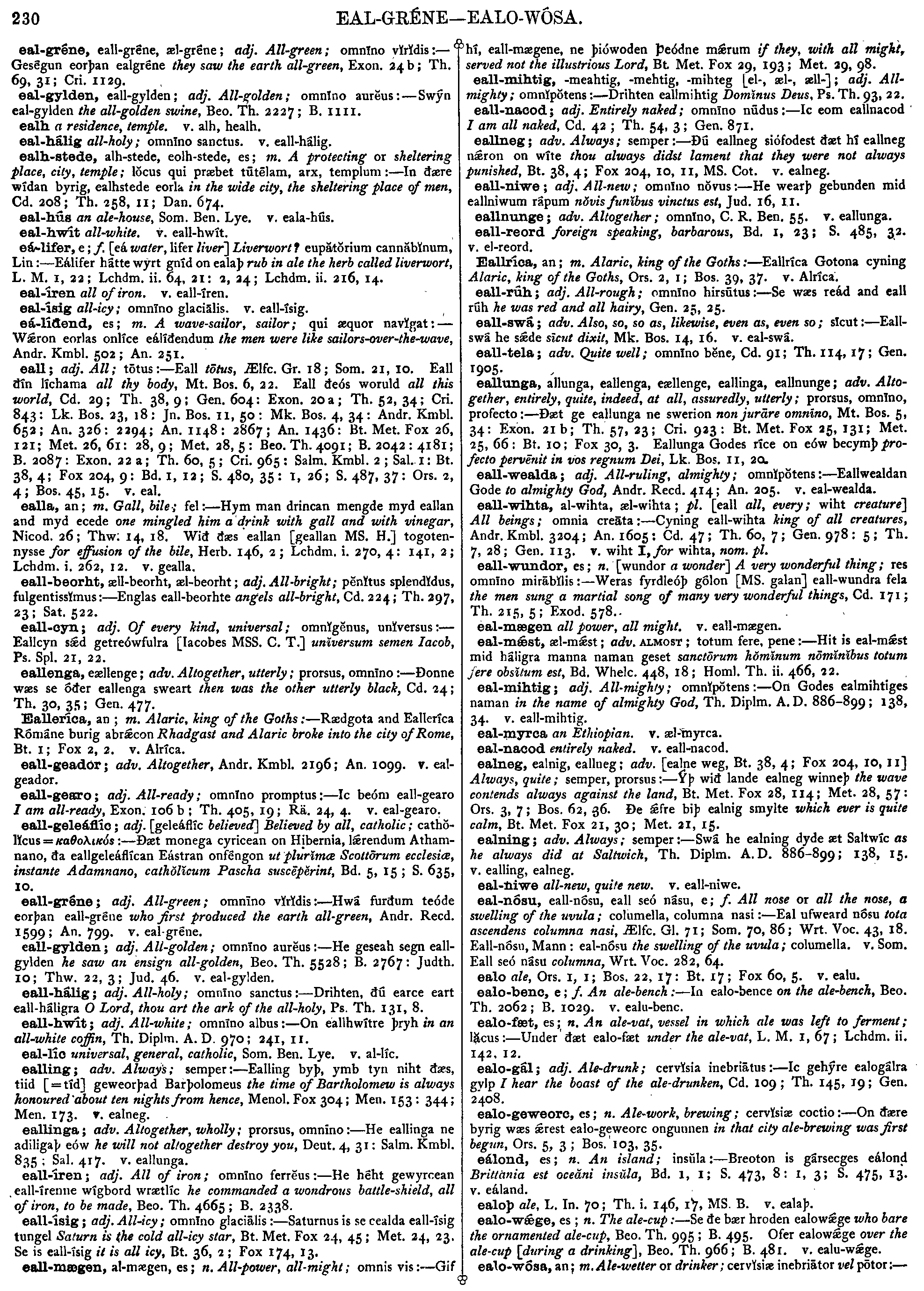
ealneg,
ealnig,
eallneg;
adv.
[ealne
weg,
Bt.
38,
4;
Fox
204,
10,
11]
Always,
quite;
semper,
prorsus
:--
Ýþ
wið
lande
ealneg
winneþ
the
wave
contends
always
against
the
land,
Bt.
Met.
Fox
28,
114;
Met.
28,
57:
Ors.
3,
7;
Bos.
62,
36.
Ðe
fre
biþ
ealnig
smylte
which
ever
is
quite
calm,
Bt.
Met.
Fox
21,
30;
Met.
21,
15.
|
Source: Bosworth/Toller, page b0231, entry 42 View original page image as: [TIFF] [PNG] [View previous entry] [View next entry] |
[Comment on this entry] [View comments] |
The following entry has been hand-corrected once. |
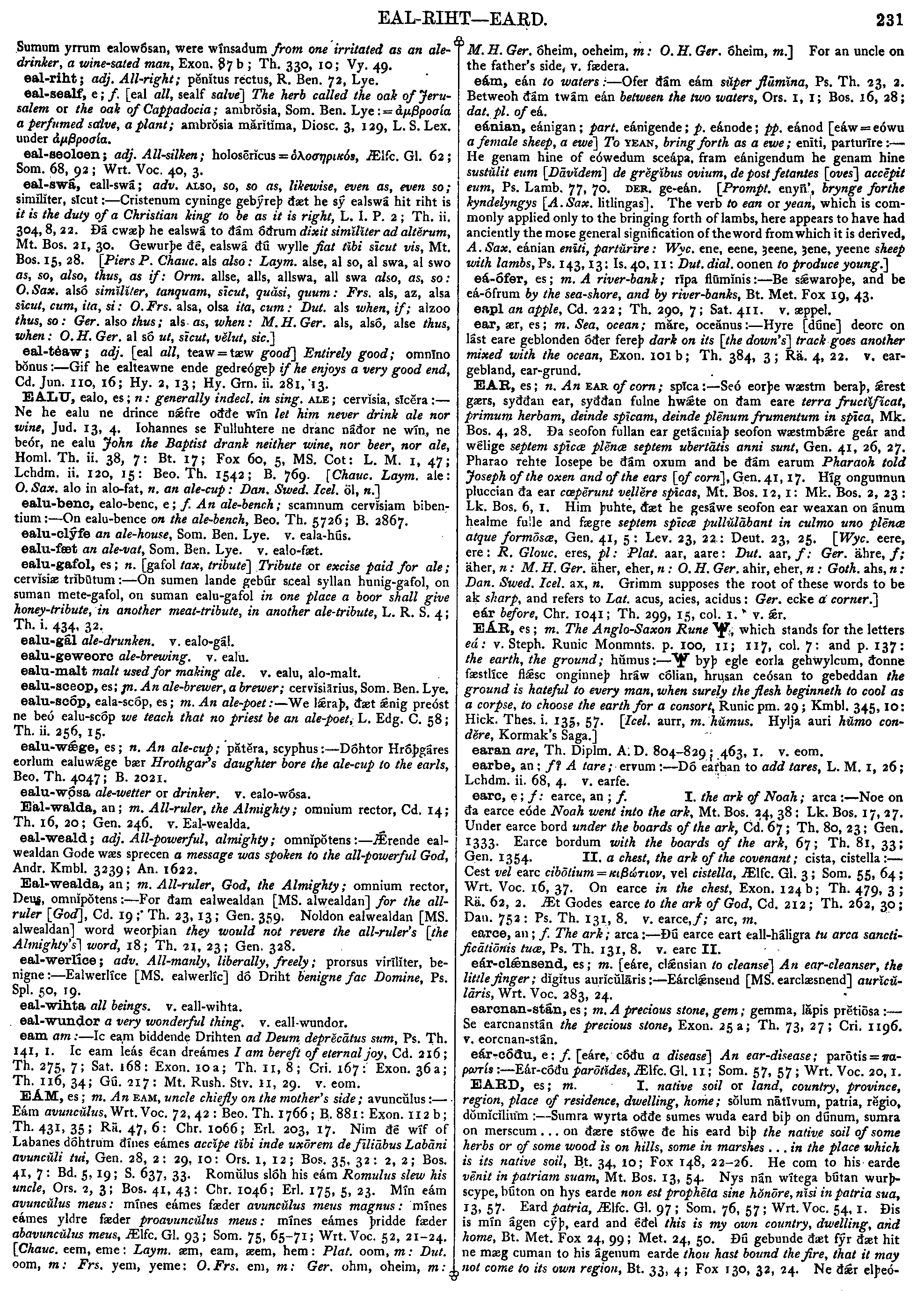
EARD,
es;
m.
I.
native
soil
or
land,
country,
province,
region,
place
of
residence,
dwelling,
home;
slum
ntvum,
patria,
rgio,
dmclium
:--
Sumra
wyrta
oððe
sumes
wuda
eard
biþ
on
dúnum,
sumra
on
merscum
...
on
ðære
stówe
ðe
his
eard
biþ
the
native
soil
of
some
herbs
or
of
some
wood
is
on
hills,
some
in
marshes
...
in
the
place
which
is
its
native
soil,
Bt.
34,
10;
Fox
148,
22-26.
He
com
to
his
earde
vnit
in
patriam
suam,
Mt.
Bos.
13,
54.
Nys
nán
wítega
bútan
wurþ-scype,
búton
on
hys
earde
non
est
prophta
sine
hnre,
nsi
in
patria
sua,
13,
57.
Eard
patria,
Ælfc.
Gl.
97;
Som.
76,
57;
Wrt.
Voc.
54,
1.
Ðis
is
mín
ágen
cýþ,
eard
and
éðel
this
is
my
own
country,
dwelling,
and
home,
Bt.
Met.
Fox
24,
99;
Met.
24,
50.
Ðú
gebunde
ðæt
fyr
ðæt
hit
ne
mæg
cuman
to
his
ágenum
earde
thou
hast
bound
the
fire,
that
it
may
not
come
to
its
own
region,
Bt.
33,
4;
Fox
130,
32,
24.
Ne
ðr
elþeó-
|
Source: Bosworth/Toller, page b0232, entry 1 View original page image as: [TIFF] [PNG] [View previous entry] [View next entry] |
[Comment on this entry] [View comments] |
The following entry has been hand-corrected once. |
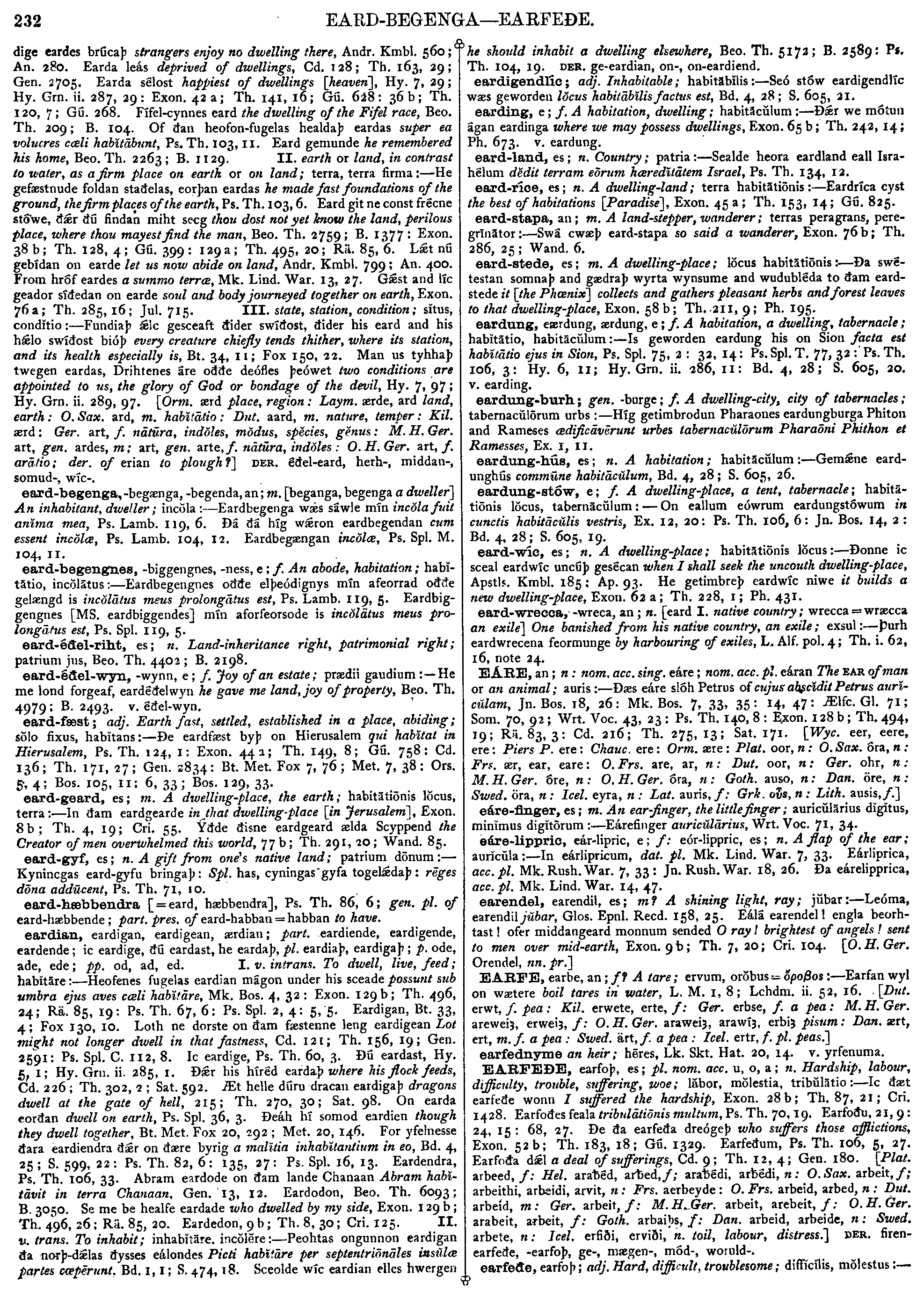
dige
eardes
brúcaþ
strangers
enjoy
no
dwelling
there,
Andr.
Kmbl.
560;
An.
280.
Earda
leás
deprived
of
dwellings,
Cd.
128;
Th.
163,
29;
Gen.
2705.
Earda
sélost
happiest
of
dwellings
[heaven],
Hy.
7,
29;
Hy.
Grn.
ii.
287,
29:
Exon.
42
a;
Th.
141,
16;
Gú.
628:
36
b;
Th.
120,
7;
Gú.
268.
Fífel-cynnes
eard
the
dwelling
of
the
Fifel
race,
Beo.
Th.
209;
B.
104.
Of
ðan
heofon-fugelas
healdaþ
eardas
super
ea
volucres
cœli
habtbunt,
Ps.
Th.
103,
11.
Eard
gemunde
he
remembered
his
home,
Beo.
Th.
2263;
B.
1129.
II.
earth
or
land,
in
contrast
to
water,
as
a
firm
place
on
earth
or
on
land;
terra,
terra
firma:--He
gefæstnude
foldan
staðelas,
eorþan
eardas
he
made
fast
foundations
of
the
ground,
the
firm
places
of
the
earth,
Ps.
Th.
103,
6.
Eard
git
ne
const
frécne
stówe,
ðr
ðú
findan
miht
secg
thou
dost
not
yet
know
the
land,
perilous
place,
where
thou
mayest
find
the
man,
Beo.
Th.
2759;
B.
1377:
Exon.
38
b;
Th.
128,
4;
Gú.
399:
129
a;
Th.
495,
20;
Rä.
85,
6.
Lt
nú
gebídan
on
earde
let
us
now
abide
on
land,
Andr.
Kmbl.
799;
An.
400.
From
hróf
eardes
a
summo
teræ.
Mk.
Lind.
War.
13,
27.
Gst
and
líc
geador
síðedan
on
earde
soul
and
body
journeyed
together
on
earth,
Exon.
76
a;
Th.
285,
16;
Jul.
715.
III.
state,
station,
condition;
stus,
condtio:--Fundiaþ
lc
gesceaft
ðider
swíðost,
ðider
his
eard
and
his
hlo
swíðost
bióþ
every
creature
chiefly
tends
thither,
where
its
station,
and
its
health
especially
is,
Bt.
34,
11;
Fox
150,
22.
Man
us
tyhhaþ
twegen
eardas,
Drihtenes
áre
oððe
deófles
þeówet
two
conditions
are
appointed
to
us,
the
glory
of
God
or
bondage
of
the
devil,
Hy.
7,
97;
Hy.
Grn.
ii.
289,
97.
[Orm.
ærd
place,
region:
Laym.
ærde,
ard
land,
earth:
O.
Sax.
ard,
m.
habttio:
Dut.
aard,
m.
nature,
temper:
Kil.
ærd:
Ger.
art,
f.
ntira,
indles,
mdus,
spcies,
gnus:
M.
H.
Ger.
art,
gen.
ardes,
m;
art,
gen.
arte,
f.
ntra,
indles:
O.
H.
Ger.
art,
f.
artio;
der.
of
erian
to
plough?]
DER.
éðel-eard,
herh-,
middan-,
somud-,
wíc-.
|
Source: Bosworth/Toller, page b0232, entry 5 View original page image as: [TIFF] [PNG] [View previous entry] [View next entry] |
[Comment on this entry] [View comments] |
The following entry has been hand-corrected once. |
eard-éðel-wyn, -wynn, e; f. Joy of an estate; prædii gaudium:--He me lond forgeaf, eardéðelwyn he gave me land, joy of property, Beo. Th. 4979; B. 2493. v. éðel-wyn.
|
Source: Bosworth/Toller, page b0232, entry 8 View original page image as: [TIFF] [PNG] [View previous entry] [View next entry] |
[Comment on this entry] [View comments] |
The following entry has been hand-corrected once. |
eard-gyf,
es;
n.
A
gift
from
one?s
native
land;
patrium
dnum:--Kynincgas
eard-gyfu
bringaþ:
Spl.
has,
cyningas
gyfa
togeldaþ:
rges
dna
addcent,
Ps.
Th.
71,
10.
|
Source: Bosworth/Toller, page b0233, entry 27 View original page image as: [TIFF] [PNG] [View previous entry] [View next entry] |
[Comment on this entry] [View comments] |
The following entry has been hand-corrected once. |
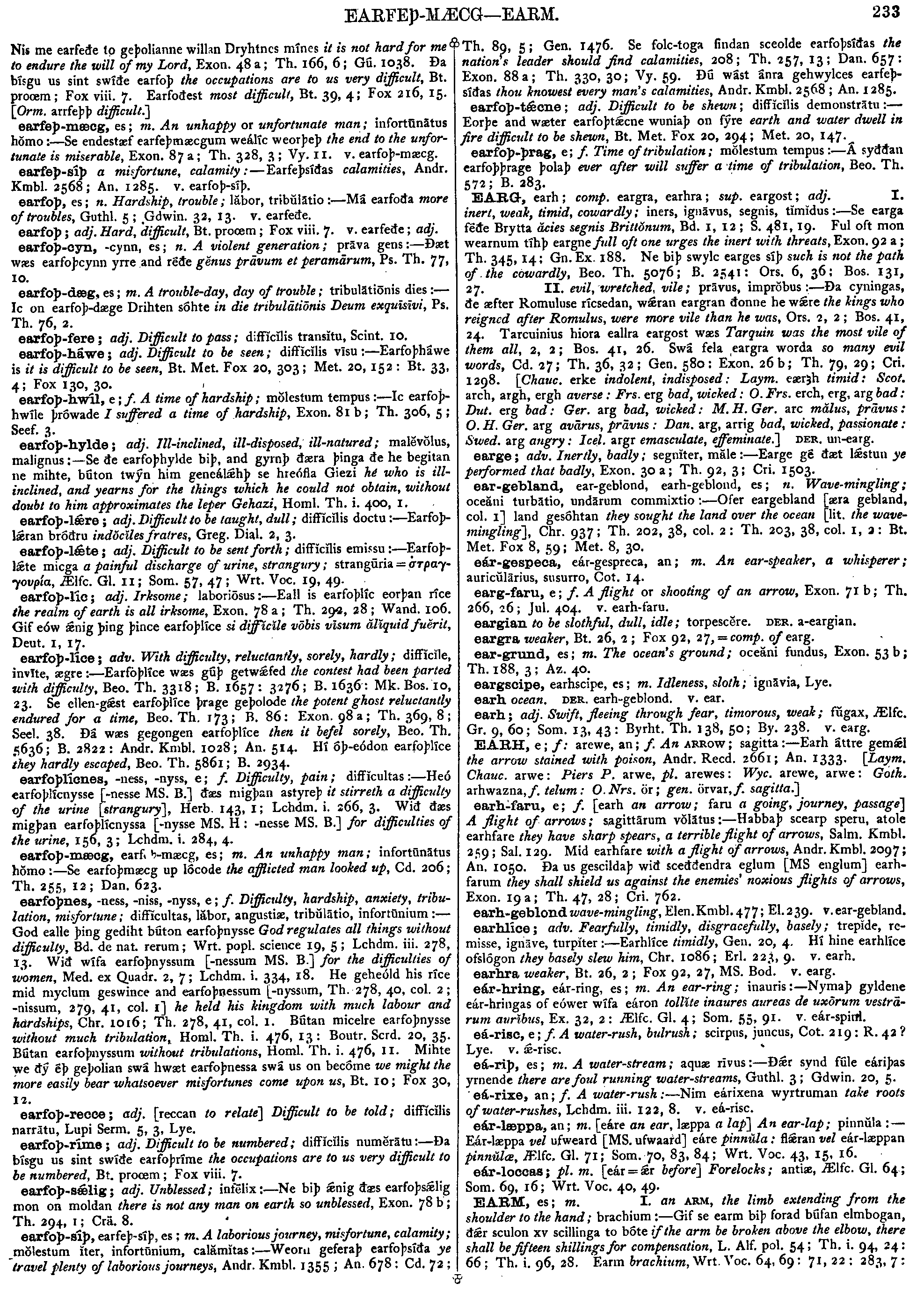
ear-gebland,
ear-geblond,
earh-geblond,
es;
n.
Wave-mingling;
oceni
turbtio,
undrum
commixtio
:--
Ofer
eargebland
[æra
gebland,
col.
1]
land
gesóhtan
they
sought
the
land
over
the
ocean
[lit.
the
wave-mingling],
Chr.
937;
Th.
202,
38,
col.
2:
Th.
203,
38,
col.
1,
2:
Bt.
Met.
Fox
8,
59;
Met.
8,
30.
| Result Page: |  |
Previous | 7 8 9 10 11 12 13 14 15 16 17 18 19 20 21 22 23 24 25 | Next |  |
Germanic Lexicon Project (main page)
This search system was written by
Sean Crist
Please consider
volunteering
to correct the data in these online dictionaries.
No rights reserved. Feel free to use these data in any way you please.