|
|

|
Source: Bosworth/Toller, page b1291, entry 8 View original page image as: [TIFF] [PNG] [View previous entry] [View next entry] |
[Comment on this entry] [View comments] |
The following entry has been hand-corrected once. |
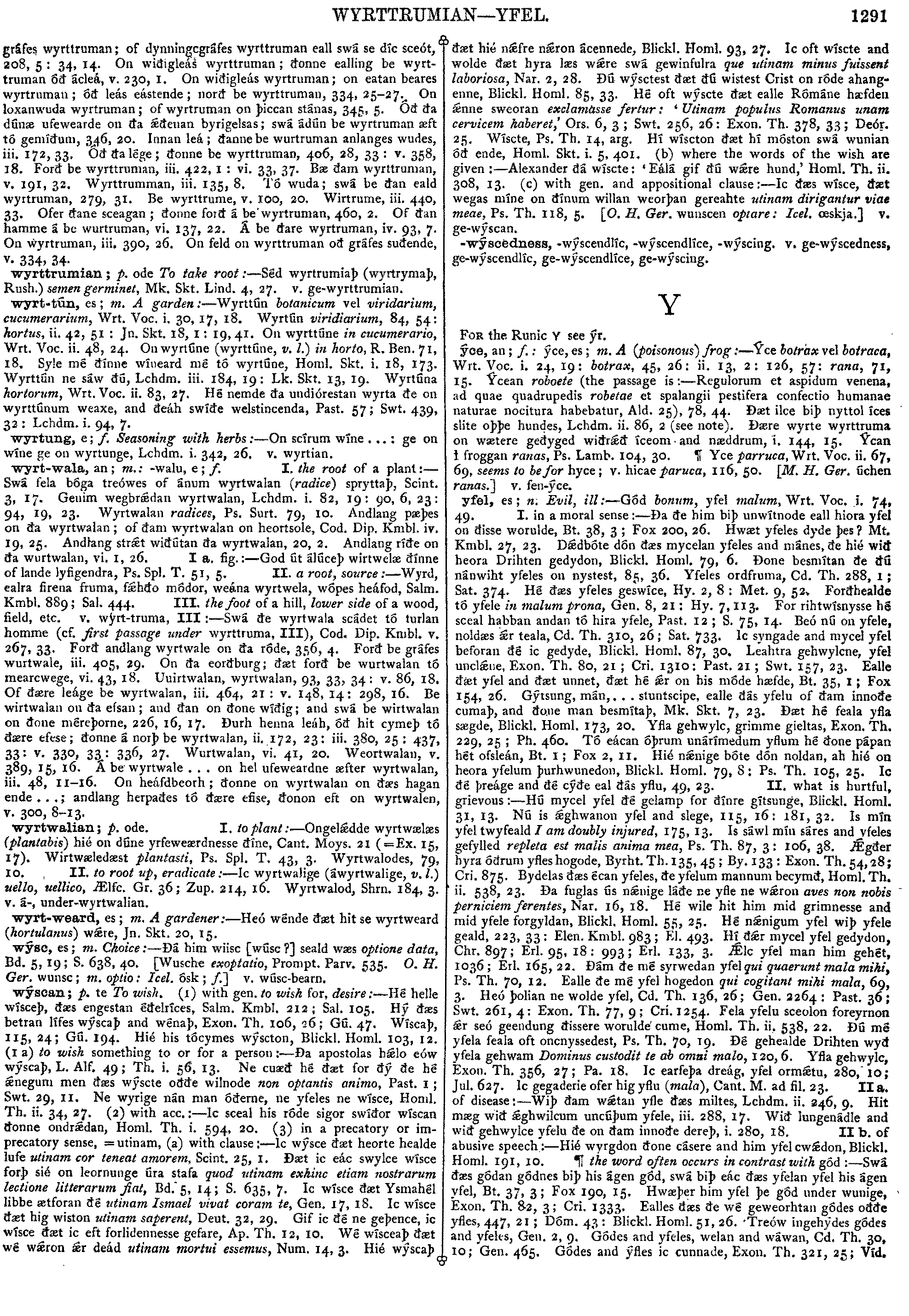
wýscan;
p.
te
To
wish.
(1)
with
gen.
to
wish
for,
desire
:--
Hé
helle
wísceþ,
ðæs
engestan
éðelríces,
Salm.
Kmbl.
212;
Sal.
105.
Hý
ðæs
betran
lífes
wýscaþ
and
wénaþ,
Exon.
Th.
106,
26;
Gú.
47.
Wíscaþ,
115,
24;
Gú.
194.
Hié
his
tócymes
wýscton,
Blickl.
Homl.
103,
12.
(1
a)
to
wish
something
to
or
for
a
person
:--
Ða
apostolas
h lo
eów
wýscaþ,
L.
Alf.
49;
Th.
i.
56,
13.
Ne
cuæð
hé
ðæt
for
ðý
ðe
hé
negum
men
ðæs
wýscte
oððe
wilnode
non
optantis
animo,
Past.
1;
Swt.
29,
11.
Ne
wyrige
nán
man
óðerne,
ne
yfeles
ne
wísce,
Homl.
Th.
ii.
34,
27.
(2)
with
acc.
:--
Ic
sceal
his
róde
sigor
swíðor
wíscan
ðonne
ondrdan,
Homl.
Th.
i.
594,
20.
(3)
in
a
precatory
or
imprecatory
sense,
=
utinam,
(a)
with
clause
:--
Ic
wýsce
ðæt
heorte
healde
lufe
utinam
cor
teneat
amorem,
Scint.
25,
1.
Ðæt
ic
eác
swylce
wísce
forþ
sié
on
leornunge
úra
stafa
quod
utinam
exhinc
etiam
nostrarum
lectione
litterarum
fiat,
Bd.
5,
14;
S.
635,
7.
Ic
wísce
ðæt
Ysmahél
libbe
ætforan
ðé
utinam
Ismael
vivat
coram
te,
Gen.
17,
18.
Ic
wísce
ðæt
hig
wiston
utinam
saperent,
Deut.
32,
29.
Gif
ic
ðé
ne
geþence,
ic
wísce
ðæt
ic
eft
forlidennesse
gefare,
Ap.
Th.
12,
10.
Wé
wísceaþ
ðæt
wé
wron
r
deád
utinam
mortui
essemus,
Num.
14,
3.
Hié
wýscaþ
ðæt
hié
nfre
nron
ácennede,
Blickl.
Homl.
93,
27.
Ic
oft
wíscte
and
wolde
ðæt
hyra
læs
wre
swá
gewinfulra
que
utinam
minus
fuissent
laboriosa,
Nar.
2,
28.
Ðú
wýsctest
ðæt
ðú
wistest
Crist
on
róde
ahangenne,
Blickl.
Homl.
85,
33.
Hé
oft
wýscte
ðæt
ealle
Rómáne
hæfden
nne
sweoran
exclamasse
fertur:
'Utinam
populus
Romanus
unam
cervicem
haberet,'
Ors.
6,
3;
Swt.
256,
26:
Exon.
Th.
378,
33;
Deór.
25.
Wíscte,
Ps.
Th.
14,
arg.
Hí
wíscton
ðæt
hí
móston
swá
wunian
óð
ende,
Homl.
Skt.
i.
5,
401.
(b)
where
the
words
of
the
wish
are
given
:--
Alexander
ðá
wíscte:
'Eálá
gif
ðú
wre
hund,'
Homl.
Th.
ii.
308,
13.
(c)
with
gen.
and
appositional
clause
:--
Ic
ðæs
wísce,
ðæt
wegas
míne
on
ðínum
willan
weorþan
gereahte
utinam
dirigantur
viae
meae,
Ps.
Th.
118,
5.
[O.
H.
Ger.
wunscen
optare:
Icel.
œskja.]
v.
ge-wýscan.
lo
eów
wýscaþ,
L.
Alf.
49;
Th.
i.
56,
13.
Ne
cuæð
hé
ðæt
for
ðý
ðe
hé
negum
men
ðæs
wýscte
oððe
wilnode
non
optantis
animo,
Past.
1;
Swt.
29,
11.
Ne
wyrige
nán
man
óðerne,
ne
yfeles
ne
wísce,
Homl.
Th.
ii.
34,
27.
(2)
with
acc.
:--
Ic
sceal
his
róde
sigor
swíðor
wíscan
ðonne
ondrdan,
Homl.
Th.
i.
594,
20.
(3)
in
a
precatory
or
imprecatory
sense,
=
utinam,
(a)
with
clause
:--
Ic
wýsce
ðæt
heorte
healde
lufe
utinam
cor
teneat
amorem,
Scint.
25,
1.
Ðæt
ic
eác
swylce
wísce
forþ
sié
on
leornunge
úra
stafa
quod
utinam
exhinc
etiam
nostrarum
lectione
litterarum
fiat,
Bd.
5,
14;
S.
635,
7.
Ic
wísce
ðæt
Ysmahél
libbe
ætforan
ðé
utinam
Ismael
vivat
coram
te,
Gen.
17,
18.
Ic
wísce
ðæt
hig
wiston
utinam
saperent,
Deut.
32,
29.
Gif
ic
ðé
ne
geþence,
ic
wísce
ðæt
ic
eft
forlidennesse
gefare,
Ap.
Th.
12,
10.
Wé
wísceaþ
ðæt
wé
wron
r
deád
utinam
mortui
essemus,
Num.
14,
3.
Hié
wýscaþ
ðæt
hié
nfre
nron
ácennede,
Blickl.
Homl.
93,
27.
Ic
oft
wíscte
and
wolde
ðæt
hyra
læs
wre
swá
gewinfulra
que
utinam
minus
fuissent
laboriosa,
Nar.
2,
28.
Ðú
wýsctest
ðæt
ðú
wistest
Crist
on
róde
ahangenne,
Blickl.
Homl.
85,
33.
Hé
oft
wýscte
ðæt
ealle
Rómáne
hæfden
nne
sweoran
exclamasse
fertur:
'Utinam
populus
Romanus
unam
cervicem
haberet,'
Ors.
6,
3;
Swt.
256,
26:
Exon.
Th.
378,
33;
Deór.
25.
Wíscte,
Ps.
Th.
14,
arg.
Hí
wíscton
ðæt
hí
móston
swá
wunian
óð
ende,
Homl.
Skt.
i.
5,
401.
(b)
where
the
words
of
the
wish
are
given
:--
Alexander
ðá
wíscte:
'Eálá
gif
ðú
wre
hund,'
Homl.
Th.
ii.
308,
13.
(c)
with
gen.
and
appositional
clause
:--
Ic
ðæs
wísce,
ðæt
wegas
míne
on
ðínum
willan
weorþan
gereahte
utinam
dirigantur
viae
meae,
Ps.
Th.
118,
5.
[O.
H.
Ger.
wunscen
optare:
Icel.
œskja.]
v.
ge-wýscan.
|
Source: Bosworth/Toller, page d0452, entry 1 View original page image as: [TIFF] [PNG] [View previous entry] [View next entry] |
[Comment on this entry] [View comments] |
The following entry has been hand-corrected once. |
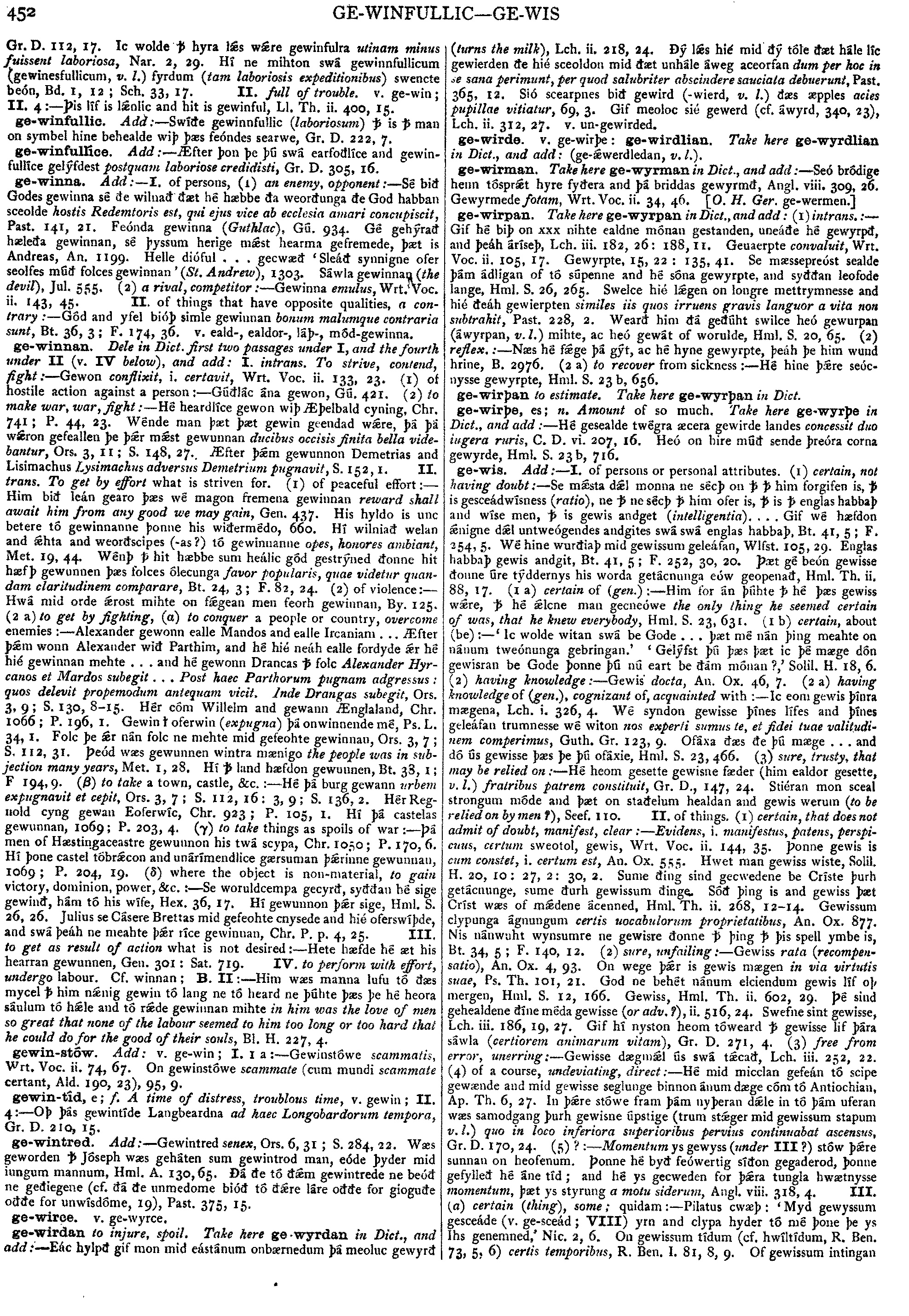
Gr.
D.
112,
17.
Ic
wolde
 hyra
ls
wre
gewinfulra
utinam
minus
fuissent
laboriosa,
Nar.
2,
29.
Hí
ne
mihton
swá
gewinnfullicum
(gewinesfullicum,
v.
l.)
fyrdum
(tam
laboriosis
expeditionibus)
swencte
beón,
Bd.
1,
12;
Sch.
33,
17.
II.
full
of
trouble.
v.
ge-win;
II.
4:--Þis
líf
is
lnlic
and
hit
is
gewinful,
Ll.
Th.
ii.
400,
15.
hyra
ls
wre
gewinfulra
utinam
minus
fuissent
laboriosa,
Nar.
2,
29.
Hí
ne
mihton
swá
gewinnfullicum
(gewinesfullicum,
v.
l.)
fyrdum
(tam
laboriosis
expeditionibus)
swencte
beón,
Bd.
1,
12;
Sch.
33,
17.
II.
full
of
trouble.
v.
ge-win;
II.
4:--Þis
líf
is
lnlic
and
hit
is
gewinful,
Ll.
Th.
ii.
400,
15.
Germanic Lexicon Project (main page)
This search system was written by
Sean Crist
Please consider
volunteering
to correct the data in these online dictionaries.
No rights reserved. Feel free to use these data in any way you please.