|
|

Tip: In the search results, you can click on any word or abbreviation for more information.
|
Source: Cleasby/Vigfusson, page b0366, entry 5 View original page image as: [TIFF] [PNG] [View previous entry] [View next entry] |
[Comment on this entry] [View comments] |
The following entry has been hand-corrected once. |
kylfa, ð, to stammer; k. til orðanna, Fms. vii. 165.
|
Source: Cleasby/Vigfusson, page b0366, entry 6 View original page image as: [TIFF] [PNG] [View previous entry] [View next entry] |
[Comment on this entry] [View comments] |
The following entry has been hand-corrected once. |
KYLFA, u, f. [Engl. club; Germ. kolbe; Dan. kolle] :-- a club, Fms. i. 177, xi. passim, Sd. ch. 14: the saying, láta kylfu ráða kasti, to take a chance, metaphor from the ball and the bat. kylfu-högg, n. a blow with a club, Fms. xi. 144, Fas. ii. 367. II. the club-formed beak on a ship's stem; svartar kylfur, Sighvat.
|
Source: Torp, page b0057, entry 3 View original page image as: [TIFF] [PNG] [View previous entry] [View next entry] |
[Comment on this entry] [View comments] |
The following entry has been hand-corrected once. |
kulba(n) m. Kolben, Keule. an. kolfr m. Pflanzenknollen, Bolzen, Pfeil, kylfa f. Keule, Knüttel; ahd. kolbo m. Kolben, Keule (als Waffe), Knüttel, nhd. Kolben.
[Translate the German words]
|
Source: Cleasby/Vigfusson, page b0366, entry 7 View original page image as: [TIFF] [PNG] [View previous entry] [View next entry] |
[Comment on this entry] [View comments] |
The following entry has been hand-corrected once. |
kylfi, n. = kylfa II; þá færðu konungsmenn stafnleá á skeiðar-kylfinu, ok héldu þeim, -- þá mælti jarlinn, at stafnbúar skyldu af höggva kylfinu, Ó. H. 40.
|
Source: Cleasby/Vigfusson, page b0516, entry 11 View original page image as: [TIFF] [PNG] [View previous entry] [View next entry] |
[Comment on this entry] [View comments] |
The following entry has been hand-corrected once. |
SÁ, fem, sú (neut. þat), demonstr. pron., see Gramm. p. xxi; an older form sjá is, esp. in old vellums, often used as common for masc. and fem. (sjá maðr, sjá kona), see the references below :-- that. A. As adj.: I. with a subst. this, that; sá hlutrinn, Fins, xi. 129; sjá maðr, that man, Fs. 5, 102, 143, Fms. ii. 28, Grág. i. 74, Nj. 6; sjá bók, Íb. (fine); sá kostr, Nj. 1; sá salr, Vsp. 44; sá staðr, Fb. i. 31; sá bær, Dropl. 5; ájs sveinn, Hom. 50; sjá hverr, that cauldron, Gkv. 3. 9; sjá bragr, Fms. iv. 12 (in a verse); sjá fótr, Ó.H. (in a verse); sjá kylfa, Fms. xi. (in a verse); sjá byrðr, etc. :-- placed after the noun, so giving emphasis, konungr sjá, Ó.H. 140; mær sjá, this maid, Nj. 2; minning sjá, Ld. 234; á sú, that water, 33 :-- with the reflex. particle er, sá er (he, she, that = which), þöll sú er stendr þorpi á, the pine 'she that' stands, i.e. which stands, Hm. 49; öld sú er, Fms. vi. 336 (in a verse): contracted sá's, Hallfred (Fs.); sú's = she that, Hkr. iii. 139 (in a verse); sá maðr er Sóti heitir, that man who is named Sóti, Nj. 5; er sá engi minn frændi at gangi í þetta mál, there is none of my kinsmen that ..., 31; sá sem, he, she, that, Stj. 178, passim :-- with the suff. article, sá dómarinn er allt veit, Barl. 32; var sá úkyrr hlutrinn er þat merkði, Fms. xi. 129; sú ein er sagan eptir, er ek þori eigi þér at segja, ... sú er ok svá sagan, at mér er mest forvitni á at heyra ..., this tale is just that which I should most like to hear, Fms. vi. 355. 2. such; varð sá fundr þeirra, at Egill felldi tvá menn, Eg. 572; vera kann at enn sé sá ríkismunr, Eg.; hann er sá heilhugi, at ..., Fb. ii. 318; hann er sá orðhákr, at ..., Fms. vi. 372. II. with an adjective: 1. in the indef. form; sjá móðr konungr, Og. 13, stands perh. alone in the whole literature, otherwise always, 2. in the def. form, with the prefixed article inn; sá inn máttki munr, Hm.; sá inn góði maðr, that good man, Barl. 74; sá enn sami maðr, Fms. iv. 122; sá inn sæti postuli, Post.; hyrnan sú in fremri, Nj. 198; sá inn þriði, the third, Gm. 6 :-- leaving out the article, sjá óhreini andi, the unclean spirit, Fms. v. 172; sá ungi maðr, the young man, Hom. 114; sú ílla atkváma, 122 :-- at last 'sá' was simply used as the definite article the instead of the ancient hinn, sá vísasti klerkr, the wisest clerk, Bs. ii. 223; sá fegrsti vínviðr, the fairest vine, Art. 80 (see foot-note 25), this is esp. freq. in mod. usage, e.g. sá bleikhári Menelás, sá ráða-góði, sá ágæti Odysseifr, sú vitra Penelopa, sú árborna, rósfingraða Morgungyðja, etc., in Dr. Egilsson's Translation of the Odyssey, as also in Vídal. B. As subst. used almost as a pers. pron. he, she (it), [cp. Engl. she; Germ, sie]; Slíðr heitir sú, she (it) hight Slid, Vsp. 42; en sá Brímir heitir, 43; ör liggr par, ok er sú (viz. ör) af þeirra örum, Nj. 115; samkunda, sú (viz. samkunda) var knýtt festum, Am. 1; skal tólptar-eiðr skilja, hvárt sjá eigi arf at taka, whether he is to inherit, Grág. i. 269; sömdu þeir þessa ráða-gjörð, at sjá (viz. ráðagörð) skyldi fram koma, Nj. 107: esp. 'kostr' understood, er þá sjá einn til, 227, Fms. vii. 265; þótti honum sá (viz. maðr) ærit hár er þat rúm var ætlað, Fs. 5; sjá mun vera sönn saga, Fms. ii. 87; sá (he) kemr í borgina, Þiðr. 11; sá er vel skygðr, 81; þar ríðr maðr, sá hefir skjöld mikinn, 101; sú er öll gulli búin, 189; almáttigr Guð, sá er einn í guðdómi, almighty God, he is one in Godhead, Fb. i. 30; sá (he) seðr oss með lífligu brauði, Hom. 59; sú var stjúp-dóttir konungsins, she was the king's step-daughter; sá er sæll, er ..., he is lucky, that ..., Hm.; sú er há kona er þar fór, Nj. 200; sá yðar er sik lægir, he of you who lowers himself, Hom. 50; sá er (he who) af öllum hug treystir Kristi, he that ..., Hom.; sá er leyndr syndum sínum, and so in countless instances, old and mod., except that the mod. usage prefers sá 'sem,' sú sem. C. As adv. = svá, q.v.; skrímingr lítill sá, Ísl. ii. 46; landnyrðingr léttr sá, Fms. viii. 335.
|
Source: Cleasby/Vigfusson, page b0542, entry 31 View original page image as: [TIFF] [PNG] [View previous entry] [View next entry] |
[Comment on this entry] [View comments] |
The following entry has been hand-corrected once. |
SKEIÐ, f., pl. skeiðr, Fb. i. 532. l. 1, ii. 42. l. 4, Fms. iv. 135, vi. 78, x. 54 (in a verse); the form skeiðar (see Lex. Poët.) seems to be erroneous: [akin to skíð and skeið, n.] :-- a kind of swift-sailing ship of war of the class langskip, but distinguished from dreki, freq. in the Sagas; Erlingr átti skeið mikla, hón var tvau rúm ok þrjátigi, Fms. iii. 41, Ó.H. passim, cp. Fms. i. 46, vi. 308; tuttugu langskip, tvær skeiðr ok tvá knörru, v. 169, cp. snekkja. II. the slay or weaver's rod, with which in former times the weft was beaten; sverð var fyrir skeið (cp. skulum slá sverðum sigrvef þenna), Nj. 275; vind-skeið, q.v. 2. a spoon, Dan. skee, freq. in mod. usage; a spoon made of silver is skeið of horn spónn, of wood sleif; the word is mod., but occurs in D.N. i. 895, ii. 627 (of the begin, of the 15th century). COMPDS: skeiðar-kinn, skeiðar-nef, a nickname, from the beaks of swift ships, Landn. skeiðar-kylfi, n. a club or beak on the skeið, Ó.H. 40 (Fb. ii. 44, where kylfa, f., as also in Sighvat's verse).
|
Source: Cleasby/Vigfusson, page b0645, entry 24 View original page image as: [TIFF] [PNG] [View previous entry] [View next entry] |
[Comment on this entry] [View comments] |
The following entry has been hand-corrected once. |
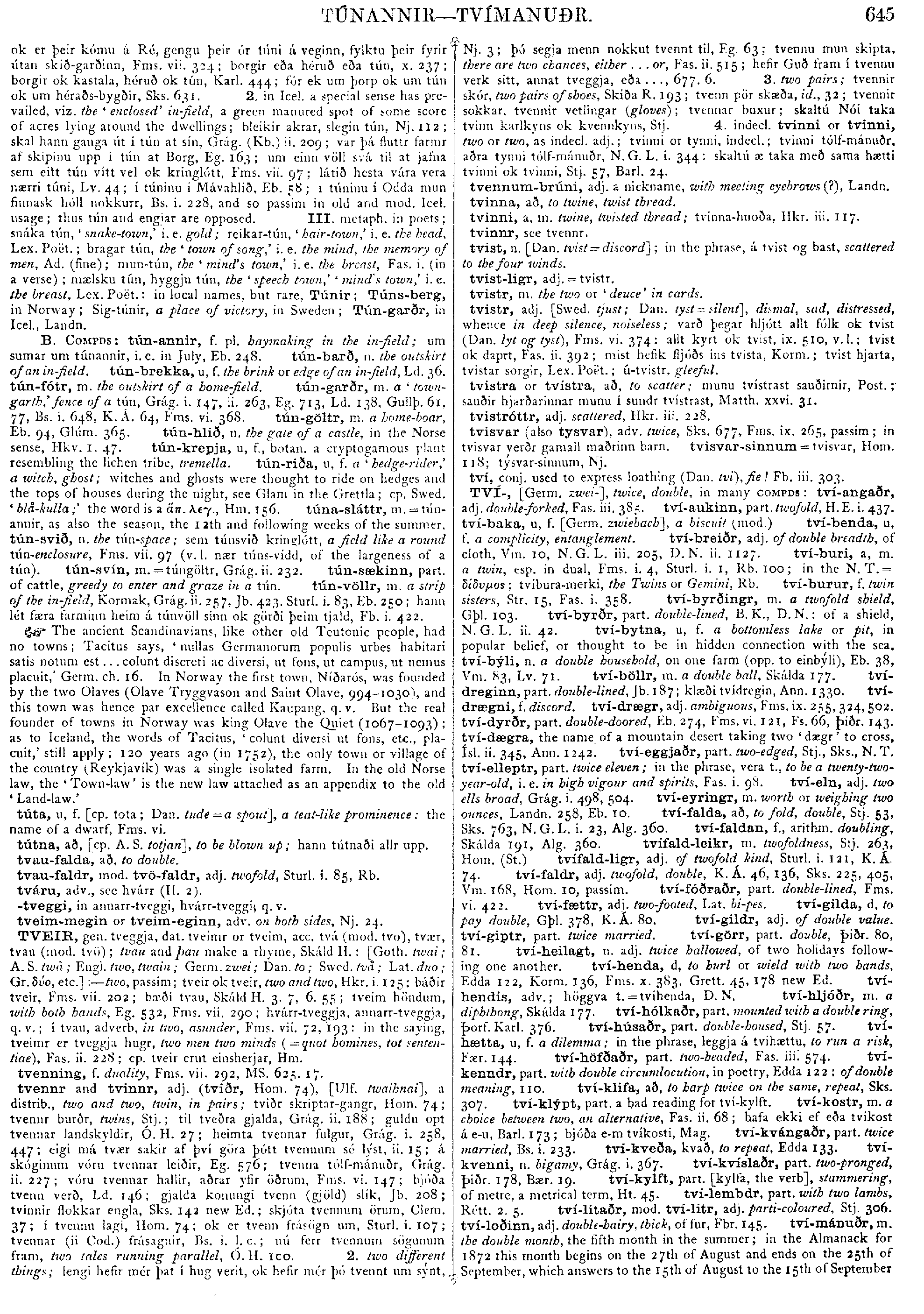
TVÍ-, [Germ. zwei-], twice, double, in many COMPDS: tví-angaðr, adj. double-forked, Fas. iii. 385. tví-aukinn, part. twofold, H.E. i. 437. tví-baka, u, f. [Germ. zwiebach], a biscuit (mod.) tví-benda, u, f. a complicity, entanglement. tví-breiðr, adj. of double breadth, of cloth, Vm. 10, N.G.L. iii. 205, D.N. ii. 1127. tví-buri, a, m. a twin, esp. in dual, Fms. i. 4, Slurl, i. 1, Rb. 100; in the N.T. = GREEK; tvíbura-merki, the Twins or Gemini, Rb. tví-burur, f. twin sisters, Str. 15, Fas. i. 358. tví-byrðingr, m. a twofold shield, Gþl. 103. tví-byrðr, part. double-lined, B.K., D.N.: of a shield, N.G.L. ii. 42. tví-bytna, u, f. a bottomless lake or pit, in popular belief, or thought to be in hidden connection with the sea. tví-býli, n. a double household, on one farm (opp. to einbýli), Eb. 38, Vm. 83, Lv. 71. tví-böllr, m. a double ball, Skálda 177. tví-dreginn, part. double-lined, Jb. 187; klæði tvídregin, Ann. 1330. tví-drægni, f. discord, tví-drægr, adj. ambiguous, Fms. ix. 255, 324, 502. tví-dyrðr, part. double-doored, Eb. 274, Fms. vi. 121, Fs. 66, Þiðr. 143. tví-dægra, the name of a mountain desert taking two 'dægr' to cross, Ísl. ii. 345, Ann. 1242. tví-eggjaðr, part. two-edged, Stj., Sks., N.T. tví-elleptr, part. twice eleven; in the phrase, vera t., to be a twenty-two-year-old, i.e. in high vigour and spirits, Fas. i. 98. tví-eln, adj. two ells broad, Grág. i. 498, 504. tví-eyringr, m. worth or weighing two ounces, Landn. 258, Eb. 10. tví-falda, að, to fold, double, Stj. 53, Sks. 763, N.G.L. i. 23, Alg. 360. tví-faldan, f., arithm. doubling, Skálda 191, Alg. 360. tvífald-leikr, m. twofoldness, Stj. 263, Hom. (St.) tvífald-ligr, adj. of twofold kind, Sturl. i. 121, K.Á. 74. tví-faldr, adj. twofold, double, K.Á. 46, 136, Sks. 225, 405, Vm. 168, Hom. 10, passim. tví-fóðraðr, part. double-lined, Fms. vi. 422. tví-fættr, adj. two-footed, Lat. bi-pes. tví-gilda, d, to pay double, Gþl. 378, K.Á. 80. tví-gildr, adj. of double value. tví-giptr, part. twice married. tví-görr, part. double, Þiðr. 80, 81. tví-heilagt, n. adj. twice hallowed, of two holidays following one another. tví-henda, d, to hurl or wield with two hands, Edda 122, Korm. 136, Fms. x. 383, Grett. 45, 178 new Ed. tví-hendis, adv.; höggva t. = tvíhenda, D.N. tví-hljóðr, m. a diphthong, Skálda 177. tví-hólkaðr, part. mounted with a double ring, Þorf. Karl. 376. tví-húsaðr, part. double-housed, Stj. 57. tví-hætta, u, f. a dilemma; in the phrase, leggja á tvíhættu, to run a risk, Fær. 144. tví-höfðaðr, part. two-headed. Fas. iii. 574. tví-kenndr, part. with double circumlocution, in poetry, Edda 122: of double meaning, 110. tví-klifa, að, to harp twice on the same, repeat, Sks. 307. tví-klýpt, part. a bad reading for tví-kylft. tví-kostr, m. a choice between two, an alternative, Fas. ii. 68; hafa ekki ef eða tvíkost á e-u, Barl. 173; bjóða e-m tvíkosti, Mag. tví-kvángaðr, part. twice married, Bs. i. 233. tví-kveða, kvað, to repeat, Edda 133. tví-kvenni, n. bigamy, Grág. i. 367. tví-kvíslaðr, part. two-pronged, Þiðr. 178, Bær. 19. tví-kylft, part. [kylfa, the verb], stammering, of metre, a metrical term, Ht. 45. tví-lembdr, part. with two lambs, Rétt. 2. 5. tví-litaðr, mod. tví-litr, adj. parti-coloured, Stj. 306. tví-loðinn, adj. double-hairy, thick, of fur, Fbr. 145. tví-mánuðr, m. the double month, the fifth month in the summer; in the Almanack for 1872 this month begins on the 27th of August and ends on the 25th of September, which answers to the 15th of August to the 15th of September
Germanic Lexicon Project (main page)
This search system was written by
Sean Crist
Please consider
volunteering
to correct the data in these online dictionaries.
No rights reserved. Feel free to use these data in any way you please.