|
|

Search for kona again, using less strict matching (182 results)
|
Source: Cleasby/Vigfusson, page b0040, entry 5 View original page image as: [TIFF] [PNG] [View previous entry] [View next entry] |
[Comment on this entry] [View comments] |
The following entry has not been hand-corrected. However, the page is reserved and someone is correcting it. |
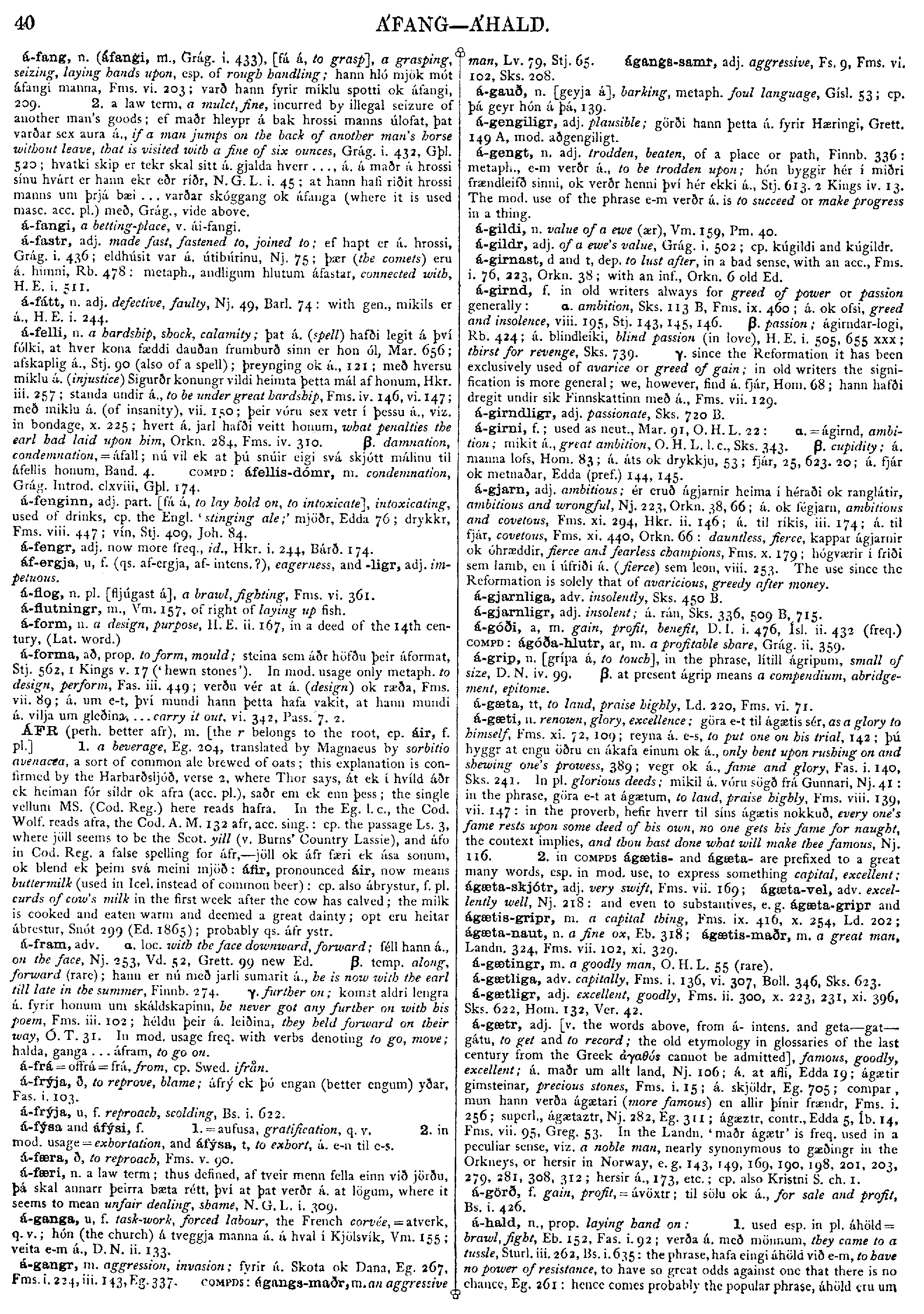
a-felli, n. a hardship, shock, calamity; þat á. (spell) hafði legit á því fólki, at hver kona fseddi dauðan frurnburð sinn er hon ol, Mar. 656; afskaplig á., Stj. 90 (also of a spell); þreynging ok á., 121; með hversu miklu á. (injustice) Sigurðr konungr vildi heimta þetta mál af honum, Hkr. iii. 257; standa undir a., to be wider great lordship, Fms. iv. 146, vi. 147; með miklu á. (of insanity), vii. i. ^o; þeir vóru sex vetr í þessu á., viz. in bondage, x. 225; hvert á. jarl hafði veitt honum, what penalties the earl bad laid upon him, Orkn. 284, Fms. iv. 310. |3. damnation, condemnation, = afall; nu vil ek at þú sniíir eigi svá skjótt málinu til áfellis honum, Band. 4. COMPD: áfellis-dómr, m. condemnation, Grág. Introd. clxviii, Gþl. 174.
|
Source: Cleasby/Vigfusson, page b0052, entry 17 View original page image as: [TIFF] [PNG] [View previous entry] [View next entry] |
[Comment on this entry] [View comments] |
The following entry has not been hand-corrected. However, the page is reserved and someone is correcting it. |
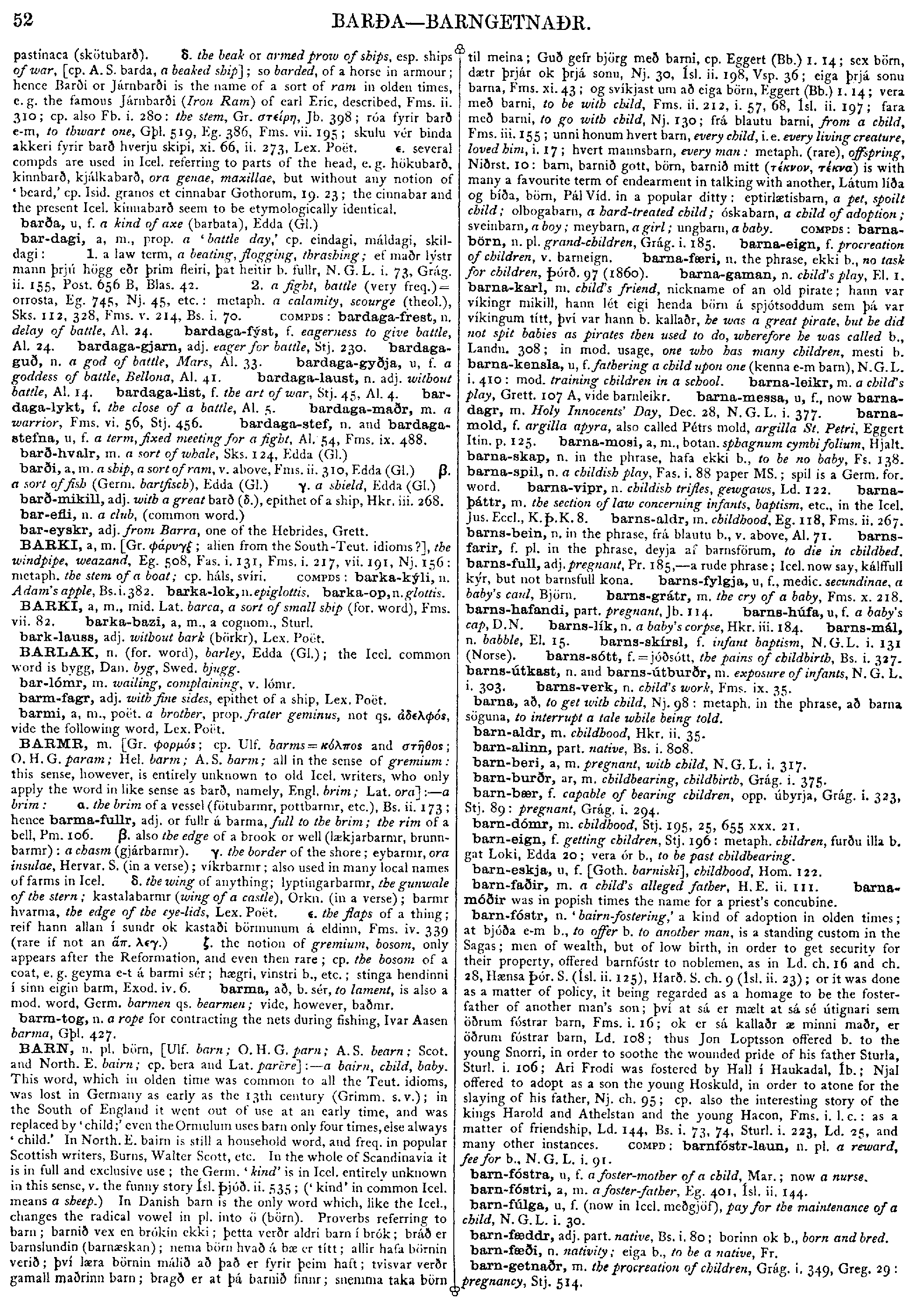
BARN, n. pl. born, [Ulf. barn; O. H. G. parn; A. S. beam; Scot, and North. E. bairn; cp. bera and Lat. parire] :-- a bairn, child, baby. This word, which in olden time was common to all the Teut. idioms, was lost in Germany as early as the 13th century (Grimm, s. v.); in the South of England it went out of use at an early time, and was replaced by ' child;' even the Ormulum uses barn only four times, else always ' child. ' In North. E. bairu is still a household word, and freq. in popular Scottish writers, Burns, Walter Scott, etc. In the whole of Scandinavia it is in full and exclusive use; the Germ. ' kind' is in Icel. entirely unknown in this sense, v. the funny story Ísl. jþjóð. ii. 535; (' kind' in common Icel. means a sheep.) In Danish barn is the only word which, like the Icel., changes the radical vowel in pl. into ö (born). Proverbs referring to barn; barnið vex en brókin ekki; þetta verðr aldri barn í brók; bráð er barnslundin (barnæskan); nema börn hvað ú bæ er titt; allir hafa börnin verið; því laera börnin málið að það er fyrir þeim hatt; tvisvar verðr gamall maðrinn barn; bragð er at þá barnið fmnr; snemnia taka börn til meina; Guð gefr björg með barni, cp. Eggert (Bb.) 1. 14; sex born, daetr þrjár ok þrjá sonu, Nj. 30, Ísl. ii. 198, Vsp. 36; eiga þrjá sonu barna, Fms. xi. 43; og svíkjast um að eiga börn, Eggert (Bb.) 1. 14; vera með barni, to be with child, Fms. ii. 212, i. 57, 68, Ísl. ii. 197; fara með barni, to gowith child, Nj. 130; frá blautu barni, from a child, Fms. iii. 155; unni honum hvert barn, every c hild, i. e. every living creature, loved him, i. 17; hvert mannsbarn, e very man: metaph. (rare), offspring, Niðrst. IO: barn, barnið gott, börn, barnið mitt (rticvov, TÍKVO) is with many a favourite term of endearment in talking with another, Látum líða og bíða, börn, Pal Vid. in a popular ditty: eptirlætisbarn, a pet, spoilt child; olbogabarn, a bard-treated child; oskabarn, a child of adoption; sveinbarn, a boy; meybarn, a girl; ungbarn, a baby. COMPDS: barna- börn, n. pl. grand-children, Grág. i. 185. bama-eign, f. procreation of children, v. barneign. barna-fœri, n. the phrase, ekki b., no task for children, fjórð. 97 (1860). barna-gaman, n. child's play, El. I. barna-karl, m. child's friend, nickname of an old pirate; hann var vikingr mikill, hann let eigi henda börn á spjótsoddum sem þá var víkingum títt, því var hann b. kallaðr, he was a great pirate, but he did not spit babies as pirates then used to do, wherefore he was called b., Landn. 308; in mod. usage, one who has many children, mesti b. barna-kensla, u, f. fathering a child upon one (kenna e-m barn), N. G. L. i. 410: mod. training children in a school. bama-leikr, m. a child's play, Grett. 107 A, vide barnleikr. barna-messa, u, f., now barna- dagr, m. Holy Innocents' Day, Dec. 28, N. G. L. i. 377. barna- mold, f. argilla apyra, also called Pétrs mold, argilla St. Petri, Eggert Itin. p. 125. barna-mosi, a, m., botan. sphagnum cymbifolium, Hjalt. barna-skap, n. in the phrase, hafa ekki b., to be nobab y, Fs. 138. barna-spil, n. a childish play, Fas. i. 88 paper MS.; spil is a Germ. for. word. barna-vipr, n. childish trifles, gewgaws, Ld. 122. barna- þattr, m. the section of law concerning infants, baptism, etc., in the Icel. Jus. Eccl., K. þ. K. 8. barns-aldr, m. childhood. Eg. 118, Fms. ii. 267. barns-bein, n. in the phrase, frá blautu b., v. above, Al. 71. barns- farir, f. pl. in the phrase, deyja af barnsförum, to die in childbed. barns-full, za] . pregnant, Pr. 185, -- a rude phrase; Icel. now say, kálffull kýr, but not barnsfull kona. barns-fylgja, u, f., medic, secundinae, a baby's caul, Björn. barns-gratr, m. the cry of a baby, Fms. x. 218. barns-hafandi, part, pregnant, Jb. 114. barn. 8-h. ufa, u, f. a baby's cap, D. N. barns-lik, n. a baby's corpse, Hkr. iii. 184. barns-mál, n. babble, El. 15. barns-skirsl, f. i/// awt baptism, N. G. L. i. 131 (Norse). barns-sótt, f. = jóðsótt, the pains of childbirth, Bs. i. 327. barns-útkast, n. and barns-útburðr, m. exposure of infants, N. G. L. i. 303. barns-verk, n. child's work, Fms. ix. 35.
|
Source: Cleasby/Vigfusson, page b0054, entry 3 View original page image as: [TIFF] [PNG] [View previous entry] [View next entry] |
[Comment on this entry] [View comments] |
The following entry has not been hand-corrected. However, the page is reserved and someone is correcting it. |
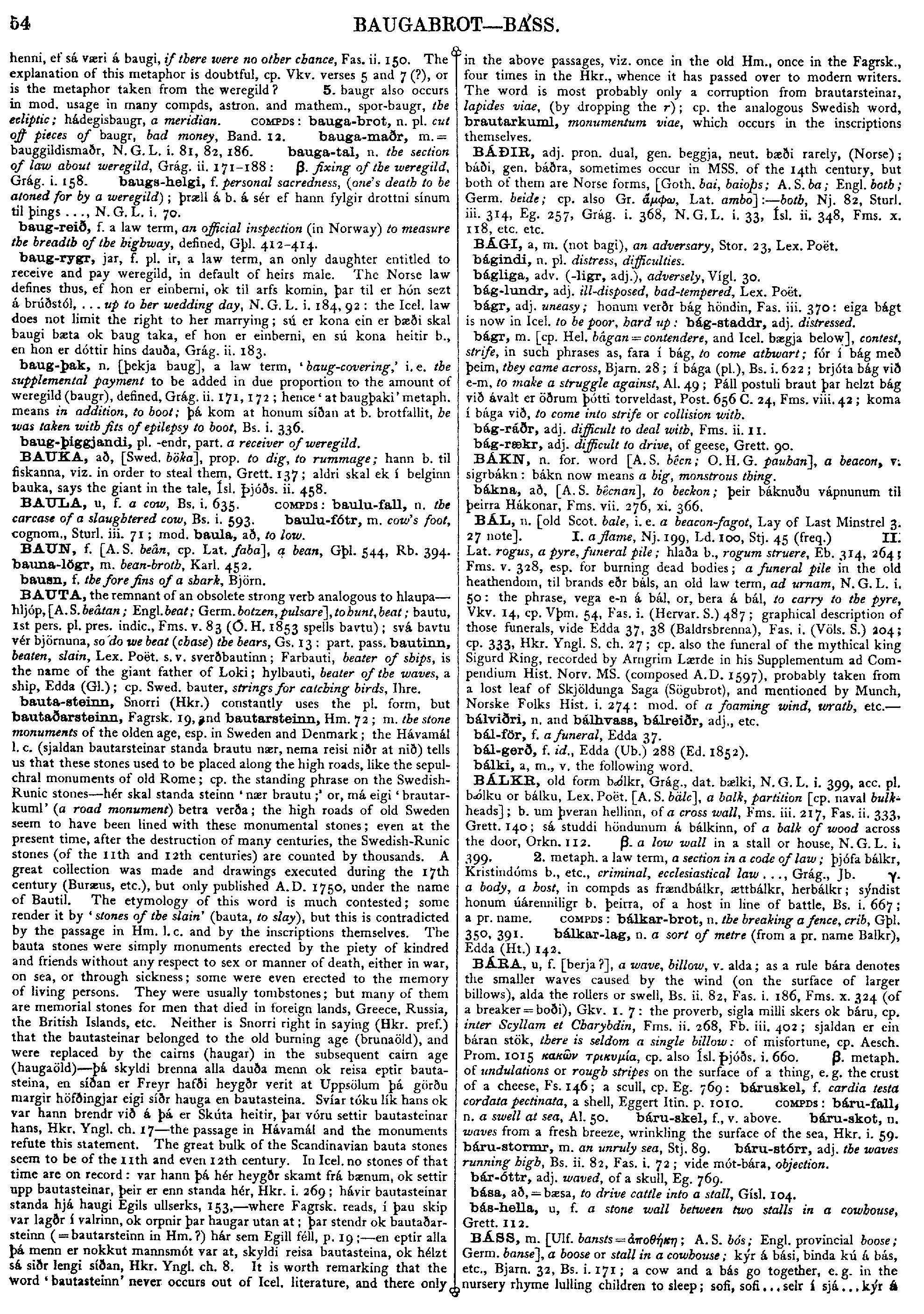
baug-rygr, jar, f. pl. ir, a law term, an only daughter entitled to receive and pay weregild, in default of heirs male. The Norse law defines thus, ef hon er einberni, ok til arfs komin, þar til er hón sezt á brúðstól, ... up to her wedding day, N. G. L. i. 184, 92: the Icel. law does not limit the right to her marrying; sú er kona ein er bæði skal baugi bæta ok baug taka, ef hon er einberni, en sú kona heitir b., en hon er dóttir hins dauða, Grág. ii. 183.
|
Source: Cleasby/Vigfusson, page b0071, entry 94 View original page image as: [TIFF] [PNG] [View previous entry] [View next entry] |
[Comment on this entry] [View comments] |
The following entry has been hand-corrected once. |
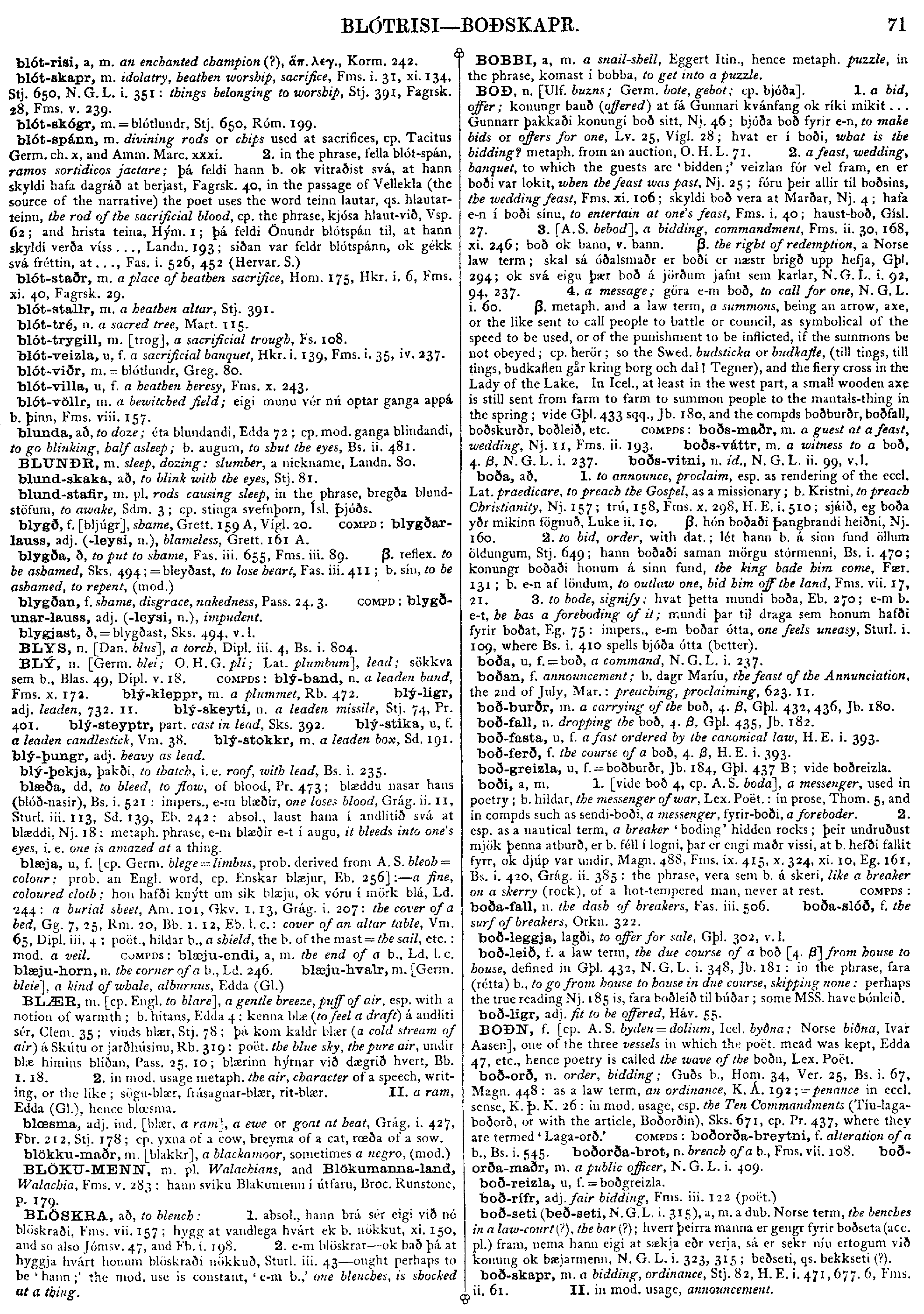
BORÐI, a, m. [cp. Engl. border; O.H.G. porto; Germ, borti; prob. akin to borð]:-- a border, Lat. limbus; byrða á borða (acc.), t o embroider, Gkv. 2. 16; bregða borða, to leave off embroidering, 17; rekja borða, to embroider, Heir. 1, Og. 18; b. ok hannyrðir, Fas. i. 430, 523; kona sat við borða, a lady sat embroidering, Fms. ii. 148; slá borða, to embroider, Fas. i. 113; cp. borða skögul, gná, etc., a poët. circumlocution of a lady, Lex. Poët.: tapestry, b. fimtigi alna, Dipl. iii. 4, Pm. 10, Bs. i. 77: of the tapestry of a church, esp. the choir, Nj. 6. 2. poët. a shield, Lex. Poët.
|
Source: Cleasby/Vigfusson, page b0082, entry 43 View original page image as: [TIFF] [PNG] [View previous entry] [View next entry] |
[Comment on this entry] [View comments] |
The following entry has been hand-corrected once. |
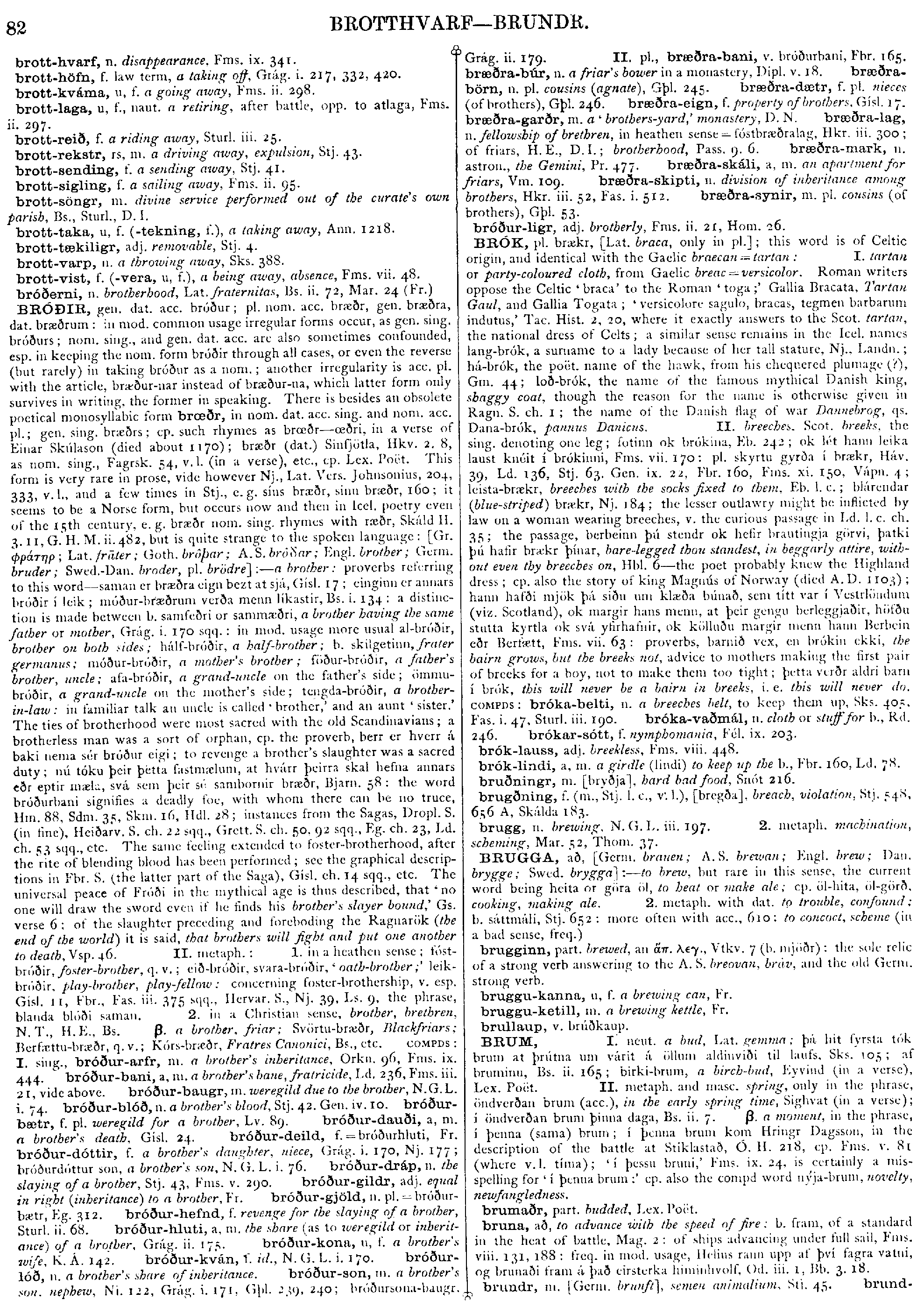
brúða, u, f. a doll, puppet, Fms. xi. 309; stól-brúða (literally chair-bride), the pillar in carved work on the side of an old-fashioned chair; in Fbr. 98 the head of Thor was carved on the chair; Gríma kona Gamla átti stól einn mikinn, en á brúðum stólsins var skorinn Þórr, ok var þat mikit líkneski, cp. the classical passage Eb. ch. 4; var hár hennar bundit við stólbrúðurnar, Bárð. 175 (in the vellum MS. distinctly bruðrnar UNCERTAIN): a distinction in form and inflexion is always made between brúðr, a bride, and brúða, puppet; hence the saying, 'to sit like a brúða,' i.e. motionless, not stirring a limb; bláum skrýddr skrúða, skikkanlegri en brúða, more quiet than a b., Sig. Pét. 229; the sense of GREEK and GREEK in Greek is analogous.
|
Source: Cleasby/Vigfusson, page b0091, entry 51 View original page image as: [TIFF] [PNG] [View previous entry] [View next entry] |
[Comment on this entry] [View comments] |
The following entry has been hand-corrected once. |
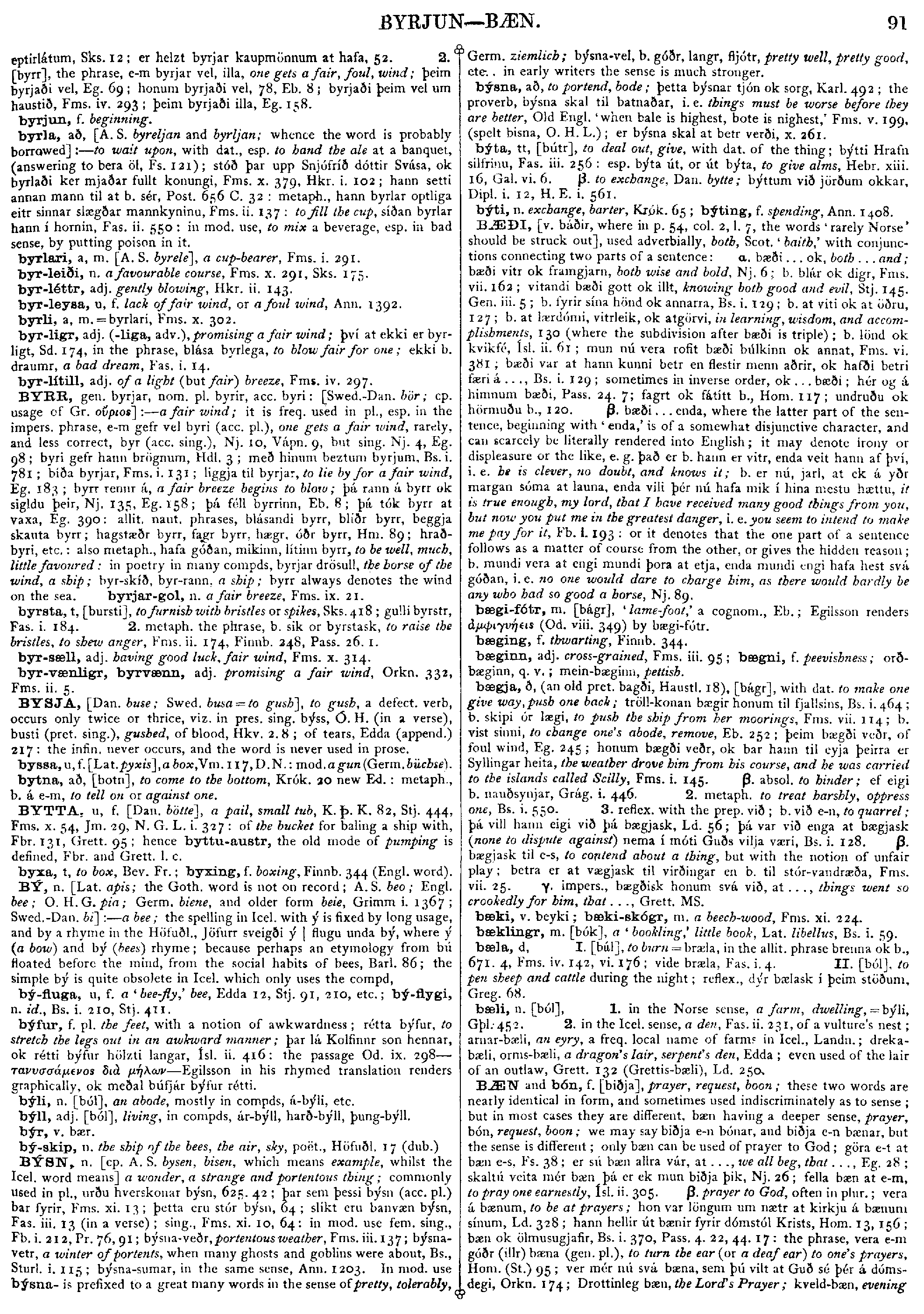
bæsingr, m., prop, one born in a báss (q.v.); hence, as a law term, the child of an outlawed mother; þat barn er ok eigi arfgengt (that child is also not entitled to inheritance), er sú kona getr er sek er orðin skógarmaðr, þó-at hon geti við bónda sínum úsekjum, ok heitir sá maðr bæsingr, Grág. i. 178. Is not the name Bastard, which first occurs as. the surname of the Conqueror, simply a Norman corruption of this Scandin. law term? The son of an outlawed father was called vargdropi, q.v. 2. poët. the name of a sword, Edda (Gl.)
|
Source: Cleasby/Vigfusson, page b0093, entry 1 View original page image as: [TIFF] [PNG] [View previous entry] [View next entry] |
[Comment on this entry] [View comments] |
The following entry has been hand-corrected once. |
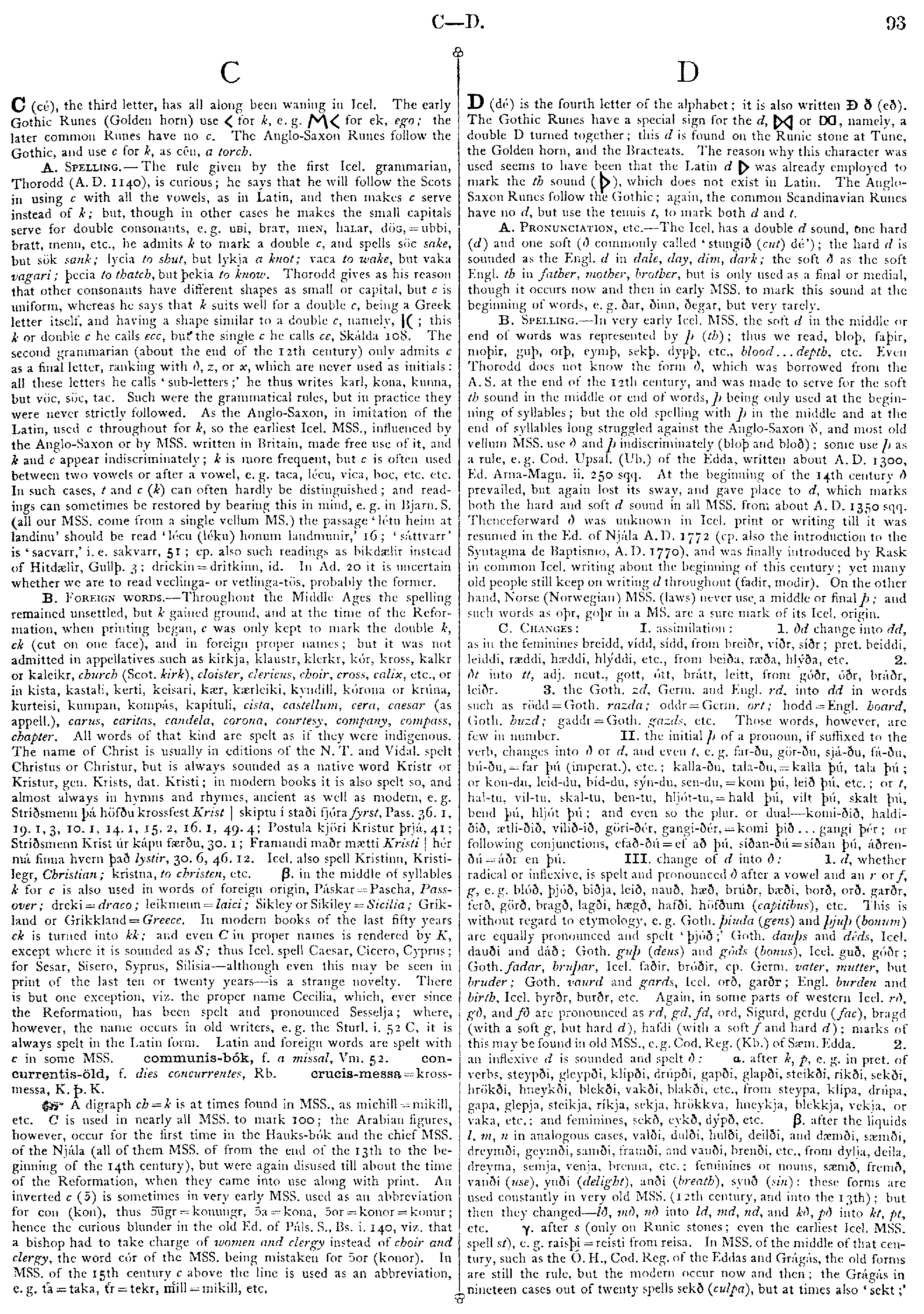
C
(cé),
the
third
letter,
has
all
along
been
waning
in
Icel.
The
early
Gothic
Runes
(Golden
horn)
use
RUNE
for
k,
e.g.
RUNE
for
ek,
ego;
the
later
common
Runes
have
no
c.
The
Anglo-Saxon
Runes
follow
the
Gothic,
and
use
c
tor
k,
as
cén,
a
torch.
A.
SPELLING.
--
The
rule
given
by
the
first
Icel.
grammarian,
Thorodd
(A.D.
1140),
is
curious;
he
says
that
he
will
follow
the
Scots
in
using
c
with
all
the
vowels,
as
in
Latin,
and
then
makes
c
serve
instead
of
k;
but,
though
in
other
cases
he
makes
the
small
capitals
serve
for
double
consonants,
e.
g.
uBi,
braT,
meN,
haLar,
döG,
=
ubbi,
bratt,
menn,
etc.,
he
admits
k
to
mark
a
double
c,
and
spells
söc
sake,
but
sök
sank;
lycia
to
shut,
but
lykja
a
knot;
vaca
to
wake,
but
vaka
vagari;
þecia
to
thatch,
but
þekia
to
know.
Thorodd
gives
as
his
reason
that
other
consonants
have
different
shapes
as
small
or
capital,
but
c
is
uniform,
whereas
he
says
that
k
suits
well
for
a
double
c,
being
a
Greek
letter
itself,
and
having
a
shape
similar
to
a
double
c,
namely,
RUNE;
this
k
or
double
c
he
calls
ecc,
but
the
single
c
he
calls
ce,
Skálda
108.
The
second
grammarian
(about
the
end
of
the
12th
century)
only
admits
c
as
a
final
letter,
ranking
with
ð,
z,
or
x,
which
are
never
used
as
initials:
all
these
letters
he
calls
'sub-letters;'
he
thus
writes
karl,
kona,
kunna,
but
vöc,
söc,
tac.
Such
were
the
grammatical
rules,
but
in
practice
they
were
never
strictly
followed.
As
the
Anglo-Saxon,
in
imitation
of
the
Latin,
used
c
throughout
for
k,
so
the
earliest
Icel.
MSS.,
influenced
by
the
Anglo-Saxon
or
by
MSS.
written
in
Britain,
made
free
use
of
it,
and
k
and
c
appear
indiscriminately;
k
is
more
frequent,
but
c
is
often
used
between
two
vowels
or
after
a
vowel,
e.g.
taca,
lécu,
vica,
hoc,
etc.
etc.
In
such
cases,
t
and
c
(k)
can
often
hardly
be
distinguished;
and
readings
can
sometimes
be
restored
by
bearing
this
in
mind,
e.g.
in
Bjarn.
S.
(all
our
MSS.
come
from
a
single
vellum
MS.)
the
passage
'létu
heim
at
landinu'
should
be
read
'lécu
(léku)
honum
landmunir,'
16;
'
sáttvarr'
is
'sacvarr,'
i.e.
sakvarr,
51;
cp.
also
such
readings
as
bikdælir
instead
of
Hitdælir,
Gullþ.
3;
drickin
=
dritkinn,
id.
In
Ad.
20
it
is
uncertain
whether
we
are
to
read
veclinga-
or
vetlinga-tös,
probably
the
former.
B.
FOREIGN
WORDS.
--
Throughout
the
Middle
Ages
the
spelling
remained
unsettled,
but
k
gained
ground,
and
at
the
time
of
the
Reformation,
when
printing
began,
c
was
only
kept
to
mark
the
double
k,
ek
(cut
on
one
face),
and
in
foreign
proper
names;
but
it
was
not
admitted
in
appellatives
such
as
kirkja,
klaustr,
klerkr,
kór,
kross,
kalkr
or
kaleikr,
church
(Scot,
kirk),
cloister,
clericus,
choir,
cross,
calix,
etc.,
or
in
kista,
kastali,
kerti,
keisari,
kær,
kærleiki,
kyndill,
kórona
or
krúna,
kurteisi,
kumpan,
kompás,
kapítuli,
cista,
castellum,
cern,
caesar
(as
appell.),
carus,
caritas,
candela,
corona,
courtesy,
company,
compass,
chapter.
All
words
of
that
kind
are
spelt
as
if
they
were
indigenous.
The
name
of
Christ
is
usually
in
editions
of
the
N.T.
and
Vidal.
spelt
Christus
or
Christur,
but
is
always
sounded
as
a
native
word
Kristr
or
Kristur,
gen.
Krists,
dat.
Kristi;
in
modern
books
it
is
also
spelt
so,
and
almost
always
in
hymns
and
rhymes,
ancient
as
well
as
modern,
e.g.
Stríðsmenn
þá
höfðu
krossfest
Krist
|
skiptu
í
staði
fjóra
fyrst,
Pass.
36.
I,
19.1,
3,
10.1,
14.1,
15.2,
16.1,
49.4;
Postula
kjöri
Kristur
þrjá,
41;
Stríðsmenn
Krist
úr
kúpu
færðu,
30.1;
Framandi
maðr
mætti
Kristi
|
hér
má
fínna
hvern
það
lystir,
30.6,
46.12.
Icel.
also
spell
Kristinn,
Kristilegr,
Christian;
kristna,
to
christen,
etc.
 .
in
the
middle
of
syllables
k
for
c
is
also
used
in
words
of
foreign
origin,
Páskar
=
Pascha,
Passover;
dreki
=
draco;
leikmenn
=
laici;
Sikley
or
Sikiley
=
Sicilia;
Grikland
or
Grikkland
=
Greece.
In
modern
books
of
the
last
fifty
years
ck
is
turned
into
kk;
and
even
C
in
proper
names
is
rendered
by
K,
except
where
it
is
sounded
as
S;
thus
Icel.
spell
Caesar,
Cicero,
Cyprus;
for
Sesar,
Sisero,
Syprus,
Silisia
--
although
even
this
may
be
seen
in
print
of
the
last
ten
or
twenty
years
--
is
a
strange
novelty.
There
is
but
one
exception,
viz.
the
proper
name
Cecilia,
which,
ever
since
the
Reformation,
has
been
spelt
and
pronounced
Sesselja;
where,
however,
the
name
occurs
in
old
writers,
e.g.
the
Sturl.
i.
52
C,
it
is
always
spelt
in
the
Latin
form.
Latin
and
foreign
words
are
spelt
with
c
in
some
MSS.
communis-bók,
f.
a
missal,
Vm.
52.
concurrentis-öld,
f.
dies
concurrentes,
Rb.
crucis-messa
=
kross-messa,
K.Þ.K.
&hand;
A
digraph
ch
=
k
is
at
times
found
in
MSS.,
as
michill
=
mikill,
etc.
C
is
used
in
nearly
all
MSS.
to
mark
100;
the
Arabian
figures,
however,
occur
for
the
first
time
in
the
Hauks-bók
and
the
chief
MSS.
of
the
Njála
(all
of
them
MSS.
of
from
the
end
of
the
13th
to
the
beginning
of
the
14th
century),
but
were
again
disused
till
about
the
time
of
the
Reformation,
when
they
came
into
use
along
with
print.
An
inverted
c
(&c-reversed-long;)
is
sometimes
in
very
early
MSS.
used
as
an
abbreviation
for
con
(kon),
thus
&c-reversed-long;ugr
=
konungr,
&c-reversed-long;a
=
kona,
&c-reversed-long;or
=
konor
=
konur;
hence
the
curious
blunder
in
the
old
Kd.
of
Páls.
S.,
Bs.
i.
140,
viz.
that
a
bishop
had
to
take
charge
of
women
and
clergy
instead
of
choir
and
clergy,
the
word
cór
of
the
MSS.
being
mistaken
for
&c-reversed-long;or
(konor).
In
MSS.
of
the
15th
century
c
above
the
line
is
used
as
an
abbreviation,
e.g.
t&c-super;a
=
taka,
t&c-super;r
=
tekr,
m&c-super;ill
=
mikill,
etc.
.
in
the
middle
of
syllables
k
for
c
is
also
used
in
words
of
foreign
origin,
Páskar
=
Pascha,
Passover;
dreki
=
draco;
leikmenn
=
laici;
Sikley
or
Sikiley
=
Sicilia;
Grikland
or
Grikkland
=
Greece.
In
modern
books
of
the
last
fifty
years
ck
is
turned
into
kk;
and
even
C
in
proper
names
is
rendered
by
K,
except
where
it
is
sounded
as
S;
thus
Icel.
spell
Caesar,
Cicero,
Cyprus;
for
Sesar,
Sisero,
Syprus,
Silisia
--
although
even
this
may
be
seen
in
print
of
the
last
ten
or
twenty
years
--
is
a
strange
novelty.
There
is
but
one
exception,
viz.
the
proper
name
Cecilia,
which,
ever
since
the
Reformation,
has
been
spelt
and
pronounced
Sesselja;
where,
however,
the
name
occurs
in
old
writers,
e.g.
the
Sturl.
i.
52
C,
it
is
always
spelt
in
the
Latin
form.
Latin
and
foreign
words
are
spelt
with
c
in
some
MSS.
communis-bók,
f.
a
missal,
Vm.
52.
concurrentis-öld,
f.
dies
concurrentes,
Rb.
crucis-messa
=
kross-messa,
K.Þ.K.
&hand;
A
digraph
ch
=
k
is
at
times
found
in
MSS.,
as
michill
=
mikill,
etc.
C
is
used
in
nearly
all
MSS.
to
mark
100;
the
Arabian
figures,
however,
occur
for
the
first
time
in
the
Hauks-bók
and
the
chief
MSS.
of
the
Njála
(all
of
them
MSS.
of
from
the
end
of
the
13th
to
the
beginning
of
the
14th
century),
but
were
again
disused
till
about
the
time
of
the
Reformation,
when
they
came
into
use
along
with
print.
An
inverted
c
(&c-reversed-long;)
is
sometimes
in
very
early
MSS.
used
as
an
abbreviation
for
con
(kon),
thus
&c-reversed-long;ugr
=
konungr,
&c-reversed-long;a
=
kona,
&c-reversed-long;or
=
konor
=
konur;
hence
the
curious
blunder
in
the
old
Kd.
of
Páls.
S.,
Bs.
i.
140,
viz.
that
a
bishop
had
to
take
charge
of
women
and
clergy
instead
of
choir
and
clergy,
the
word
cór
of
the
MSS.
being
mistaken
for
&c-reversed-long;or
(konor).
In
MSS.
of
the
15th
century
c
above
the
line
is
used
as
an
abbreviation,
e.g.
t&c-super;a
=
taka,
t&c-super;r
=
tekr,
m&c-super;ill
=
mikill,
etc.
|
Source: Cleasby/Vigfusson, page b0096, entry 3 View original page image as: [TIFF] [PNG] [View previous entry] [View next entry] |
[Comment on this entry] [View comments] |
The following entry has been hand-corrected once. |
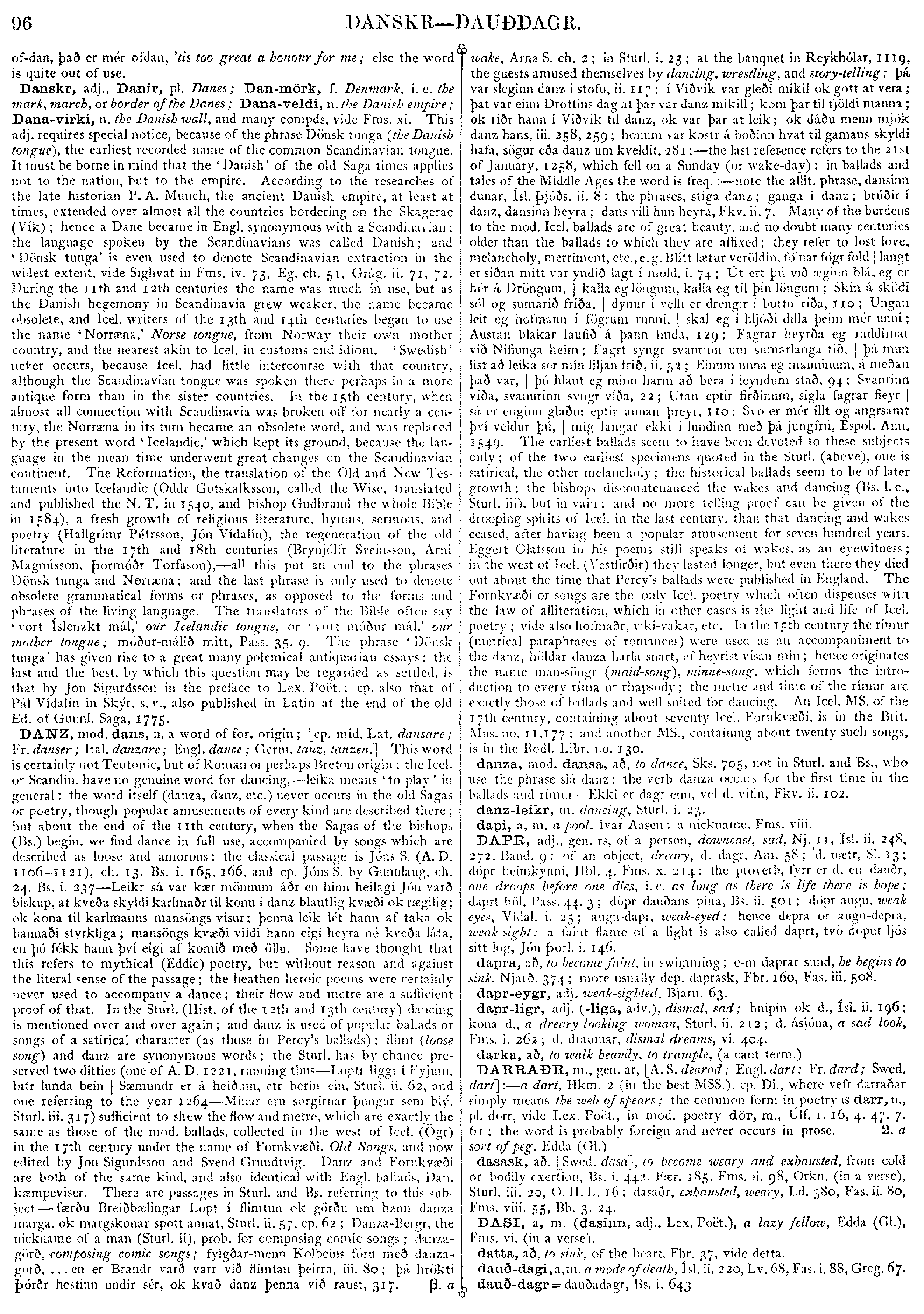
DANZ,
mod.
dans,
n.
a
word
of
for.
origin;
[cp.
mid.
Lat.
dansare;
Fr.
danser;
Ital.
danzare;
Engl.
dance;
Germ.
tanz,
tanzen.]
This
word
is
certainly
not
Teutonic,
but
of
Roman
or
perhaps
Breton
origin:
the
Icel.
or
Scandin.
have
no
genuine
word
for
dancing,
--
leika
means
'to
play'
in
general:
the
word
itself
(danza,
danz,
etc.)
never
occurs
in
the
old
Sagas
or
poetry,
though
popular
amusements
of
every
kind
are
described
there;
but
about
the
end
of
the
11th
century,
when
the
Sagas
of
the
bishops
(Bs.)
begin,
we
find
dance
in
full
use,
accompanied
by
songs
which
are
described
as
loose
and
amorous:
the
classical
passage
is
Jóns
S.
(A.D.
1106-1121),
ch.
13.
Bs.
i.
165,
166,
and
cp.
Júns
S.
by
Gunnlaug,
ch.
24.
Bs.
i.
237
--
Leikr
sá
var
kær
mönnum
áðr
en
hinn
heilagi
Jón
varð
biskup,
at
kveða
skyldi
karlmaðr
til
konu
í
danz
blautlig
kvæði
ok
rægilig;
ok
kona
til
karlmanns
mansöngs
vísur;
þenna
leik
lét
hann
af
taka
ok
bannaði
styrkliga;
mansöngs
kvæði
vildi
hann
eigi
heyra
né
kveða
láta,
en
þó
fékk
hann
því
eigi
af
komið
með
öllu.
Some
have
thought
that
this
refers
to
mythical
(Eddic)
poetry,
but
without
reason
and
against
the
literal
sense
of
the
passage;
the
heathen
heroic
poems
were
certainly
never
used
to
accompany
a
dance;
their
flow
and
metre
are
a
sufficient
proof
of
that.
In
the
Sturl.
(Hist.
of
the
12th
and
13th
century)
dancing
is
mentioned
over
and
over
again;
and
danz
is
used
of
popular
ballads
or
songs
of
a
satirical
character
(as
those
in
Percy's
ballads):
flimt
(loose
song)
and
danz
are
synonymous
words;
the
Sturl.
has
by
chance
preserved
two
ditties
(one
of
A.D.
1221,
running
thus
--
Loptr
liggr
í
Eyjum,
bítr
lunda
bein
|
Sæmundr
er
á
heiðum,
etr
berin
ein.
Stud.
ii.
62,
and
one
referring
to
the
year
1264
--
Mínar
eru
sorgirnar
þungar
sem
blý,
Sturl.
iii.
317)
sufficient
to
shew
the
flow
and
metre,
which
are
exactly
the
same
as
those
of
the
mod.
ballads,
collected
in
the
west
of
Icel.
(Ögr)
in
the
17th
century
under
the
name
of
Fornkvæði,
Old
Songs,
and
now
edited
by
Jon
Sigurdsson
and
Svend
Grundtvig.
Danz
and
Fornkvæði
are
both
of
the
same
kind,
and
also
identical
with
Engl.
ballads,
Dan.
kæmpeviser.
There
are
passages
in
Sturl.
and
B.S.
referring
to
this
subject
--
færðu
Breiðbælingar
Lopt
í
flimtun
ok
görðu
um
hann
danza
marga,
ok
margskonar
spott
annat,
Sturl.
ii.
57,
cp.
62;
Danza-Bergr,
the
nickname
of
a
man
(Stud,
ii),
prob.
for
composing
comic
songs;
danza-
görð,
composing
comic
songs;
fylgðar-menn
Kolbeins
fóru
með
danza-
görð,
...
en
er
Brandr
varð
varr
við
flimtan
þeirra,
iii.
80;
þá
hrökti
Þórðr
hestinn
undir
sér,
ok
kvað
danz
þenna
við
raust,
317.
.
a
wake,
Arna
S.
ch.
2;
in
Sturl.
i.
23;
at
the
banquet
in
Reykhólar,
1119,
the
guests
amused
themselves
by
dancing,
wrestling,
and
story-telling;
þá
var
sleginn
danz
í
stofu,
ii.
117;
í
Viðvík
var
gleði
mikil
ok
gott
at
vera;
þat
var
einn
Drottins
dag
at
þar
var
danz
mikill;
kom
þar
til
fjöldi
manna;
ok
ríðr
hann
í
Viðvík
til
danz,
ok
var
þar
at
leik;
ok
dáðu
menn
mjök
danz
hans,
iii.
258,
259;
honum
var
kostr
á
boðinn
hvat
til
gamans
skyldi
hafa,
sögur
eða
danz
um
kveldit,
281;
--
the
last
reference
refers
to
the
21st
of
January,
1258,
which
fell
on
a
Sunday
(or
wake-day):
in
ballads
and
tales
of
the
Middle
Ages
the
word
is
freq.
:--
note
the
allit.
phrase,
dansinn
dunar,
Ísl.
Þóðs.
ii.
8:
the
phrases,
stiga
danz;
ganga
í
danz;
brúðir
í
danz,
dansinn
heyra;
dans
vill
hun
heyra,
Fkv.
ii.
7.
Many
of
the
burdens
to
the
mod.
Icel.
ballads
are
of
great
beauty,
and
no
doubt
many
centuries
older
than
the
ballads
to
which
they
are
affixed;
they
refer
to
lost
love,
melancholy,
merriment,
etc.,
e.g.
Blítt
lætur
veröldin,
fölnar
fögr
fold
|
langt
er
síðan
mitt
var
yndið
lagt
í
mold,
i.
74;
Út
ert
þú
við
æginn
blá,
eg
er
hér
á
Dröngum,
|
kalla
eg
löngum,
kalla
eg
til
þin
löngum;
Skín
á
skildi
Sól
og
sumarið
fríða,
|
dynur
í
velli
er
drengir
í
burtu
riða,
110;
Ungan
leit
eg
hofmann
í
fögrum
runni,
|
skal
eg
í
hljóði
dilla
þeim
mér
unm;
Austan
blakar
laufið
á
þann
linda,
129;
Fagrar
heyrða
eg
raddirnar
við
Niflunga
heim;
Fagrt
syngr
svanrinn
um
sumarlanga
tíð,
|
þá
mun
list
að
leika
sér
mín
liljan
fríð,
ii.
52:
Einum
unna
eg
manninum,
á
meðan
það
var,
|
þó
hlaut
eg
minn
harm
að
bera
í
leyndum
stað,
94;
Svanrinn
víða.
svanurinn
syngr
viða,
22;
Utan
eptir
firðinum,
sigla
fagrar
fleyr
|
sá
er
enginn
glaður
eptir
annan
þreyr,
110;
Svo
er
mér
illt
og
angrsamt
því
veldur
þú,
|
mig
langar
ekki
í
lundinn
með
þá
jungfrú,
Espol.
Ann.
1549.
The
earliest
ballads
seem
to
have
been
devoted
to
these
subjects
only;
of
the
two
earliest
specimens
quoted
in
the
Sturl.
(above),
one
is
satirical,
the
other
melancholy;
the
historical
ballads
seem
to
be
of
later
growth:
the
bishops
discountenanced
the
wakes
and
dancing
(Bs.
l.c.,
Sturl.
iii),
but
in
vain:
and
no
more
telling
proof
can
be
given
of
the
drooping
spirits
of
Icel.
in
the
last
century,
than
that
dancing
and
wakes
ceased,
after
having
been
a
popular
amusement
for
seven
hundred
years.
Eggert
Olafsson
in
his
poems
still
speaks
of
wakes,
as
an
eyewitness;
in
the
west
of
Icel.
(Vestfirðir)
they
lasted
longer,
but
even
there
they
died
out
about
the
time
that
Percy's
ballads
were
published
in
England.
The
Fornkvæði
or
songs
are
the
only
Icel.
poetry
which
often
dispenses
with
the
law
of
alliteration,
which
in
other
cases
is
the
light
and
life
of
Icel.
poetry;
vide
also
hofmaðr,
viki-vakar,
etc.
In
the
15th
century
the
rímur
(metrical
paraphrases
of
romances)
were
used
as
an
accompaniment
to
the
danz,
höldar
danza
harla
snart,
ef
heyrist
vísan
mín;
hence
originates
the
name
man-söngr
(maid-song),
minne-sang,
which
forms
the
introduction
to
every
ríma
or
rhapsody;
the
metre
and
time
of
the
rímur
are
exactly
those
of
ballads
and
well
suited
for
dancing.
An
Icel.
MS.
of
the
17th
century,
containing
about
seventy
Icel.
Fornkvæði,
is
in
the
Brit.
Mus.
no.
11,177;
and
another
MS.,
containing
about
twenty
such
songs,
is
in
the
Bodl.
Libr.
no.
130.
|
Source: Cleasby/Vigfusson, page b0096, entry 10 View original page image as: [TIFF] [PNG] [View previous entry] [View next entry] |
[Comment on this entry] [View comments] |
The following entry has been hand-corrected once. |
dapr-ligr, adj. (-liga, adv.), dismal, sad; hnipin ok d., Ísl. ii. 196; kona d., a dreary looking woman, Sturl. ii. 212; d. ásjóna, a sad look, Fms. i. 262; d. draumar, dismal dreams, vi. 404.
|
Source: Cleasby/Vigfusson, page b0100, entry 26 View original page image as: [TIFF] [PNG] [View previous entry] [View next entry] |
[Comment on this entry] [View comments] |
The following entry has not been hand-corrected. However, the page is reserved and someone is correcting it. |
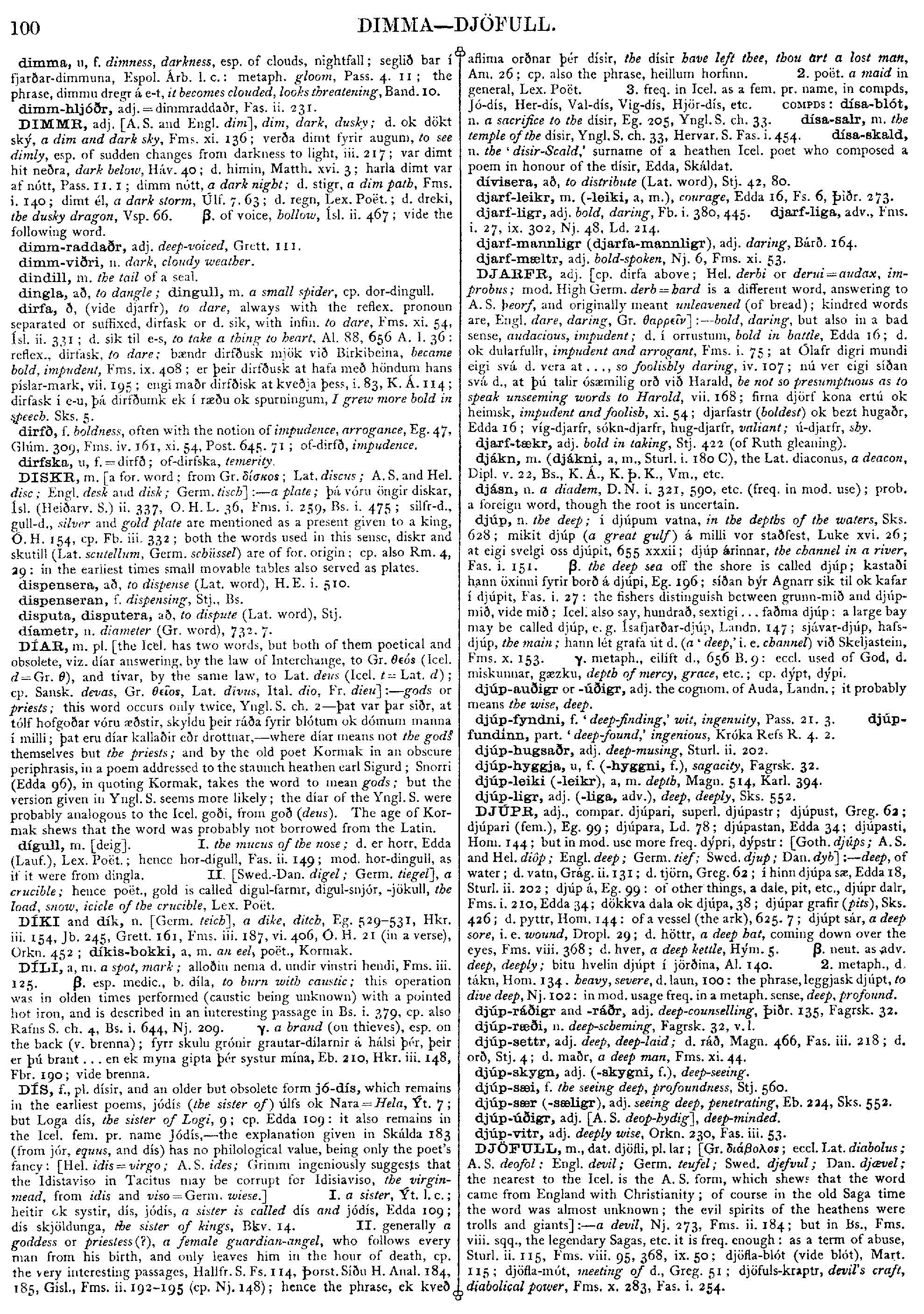
DJARFRj adj. [cp. dirfa above; Hel. derbi or derui -- audax, im- probus; mod. High Germ, derb -- hard is a different word, answering to A. S. *eorf, and originally meant unleavened (of bread); kindred words are, Engl. dare, daring, Gr. öappeíV] :-- bold, daring, but also in a bad sense, audacious, impudent; d. í orrustum, bold in battle, Edda 16; d. ok dularfullr, impudent and arrogant, Fms. i. 75; at Ólafr digri mundi eigi svá d. vera at..., sofoolishly daring, iv. 107; nú ver eigi síðan svá d., at þú talir ósæmilig orð við Harald, be not so presumptuous as to speak unseeming words to Harold, vii. 168; firna djörf kona ertii ok heimsk, impudent and foolish, xi. 54; djarfastr (boldest) ok bezt hugaðr, Edda 16; víg-djarfr, sókn-djarfr, hug-djarfr, valiant; u-djarfr, s h y.
| Result Page: |  |
Previous | 1 2 3 4 5 6 7 8 9 10 11 | Next |  |
Germanic Lexicon Project (main page)
This search system was written by
Sean Crist
Please consider
volunteering
to correct the data in these online dictionaries.
No rights reserved. Feel free to use these data in any way you please.