|
|

|
Source: Bosworth/Toller, page b0160, entry 8 View original page image as: [TIFF] [PNG] [View previous entry] [View next entry] |
[Comment on this entry] [View comments] |
The following entry has been hand-corrected once. |
CLÚD. es; m. A stone, rock, hill; saxum, rupes, collis :-- Clúdas feóllan of muntum stones fell from the mountains, Ors. 6, 2; Bos. 117, 12. Clúd rupes, Ælfc. Gr. 9, 27; Som. II. 24. Mid clúdum ymbweaxen surrounded with rocks, Ors. 3, 9; Bos. 67, 22. Sumra wyrta eard biþ on clúdum the soil of some herbs is on rocks, Bt. 34, 10; Fox 148, 24. Beorh oððe clúd collis, Ælfc. Gr. 9, 28; Som. Ii, 46. [Laym. clude, chlud a cliff, rock: Orm. cludess hills: Plat. kluut, klute, kloot: Dut. kluit, f; kloot, m: Kil. klot: Ger. klosz, m. gleba: M. H. Ger. klóz, m. a lump: O. H. Ger. kloz, m. massa: Dan. klode, m. f. a ball: Swed. klot, n: Icel. klót, n. knob on a sword's hilt: hence the Eng. CLOD.] DER. stán-clúd.
|
Source: Bosworth/Toller, page b0530, entry 16 View original page image as: [TIFF] [PNG] [View previous entry] [View next entry] |
[Comment on this entry] [View comments] |
The following entry has been hand-corrected once. |
heópe, an; f. A hip, seed-vessel of the dog-rose; also the plant on which the hip grows[?] :-- Heópe butunus [i.e. button, Fr. bouton, knob], Ælfc. Gl. 40; Som. 63, 90; Wrt. Voc. 30, 36. Genim brér ðe hiópan on weaxaþ take briar on which hips grow, L. M. 1, 38; Lchdm. ii. 96, 15. [Chauc. hepe.] v. heópa.
|
Source: Bosworth/Toller, page b0536, entry 55 View original page image as: [TIFF] [PNG] [View previous entry] [View next entry] |
[Comment on this entry] [View comments] |
The following entry has been hand-corrected once. |
hilt, es; m. n. Hilt, handle [the plural, as in much later times, e. g. Shakspere's, is used of a single weapon]:-- Ðá wæs gylden hilt gamelum rince on hand gyfen then was the golden hilt given into the old man's hand, Beo. Th. 3358; B. 1677. Ðæs swurdes mid ðam sylfrenan hylte the sword with the silver hilt. Chart. Th. 558, 11. Ic ðæt hilt ðanon ætferede I bore the hilt away from there, 3341; B. 1668. Hylt, 3379; B. 1687. Bíþ ða hiltas the hilt shines, Salm. Kmbl. 446; Sal. 223. Ða hilt since fáge the hilt many-coloured with treasure, Beo. Th. 3233; B. 1614. Be hiltum by the hilt, 3152; B. 1574. [Icel. hjalt; n. the boss or knob at the end of a sword's hilt; also the guard between the hilt and blade. For some account of the hilts of old swords see Worsaae's Primeval Antiquities, pp. 39, 49.] DER. fealo-, fetel-, hroðen-, wreoðen-hilt. v. next word.
|
Source: Bosworth/Toller, page b0568, entry 2 View original page image as: [TIFF] [PNG] [View previous entry] [View next entry] |
[Comment on this entry] [View comments] |
The following entry has been hand-corrected once. |
hún-þyrel, es; n. The hole in the mast-head through which the halyard went :-- Húnþyrlu carchesia, Wrt. Voc. 63, 49. [Icel. húnn a knob at the end of a staff, at the top of a mast; hún-bora the hole in the mast-head through which the halyard went.]
|
Source: Bosworth/Toller, page b0768, entry 13 View original page image as: [TIFF] [PNG] [View previous entry] [View next entry] |
[Comment on this entry] [View comments] |
The following entry has been hand-corrected once. |
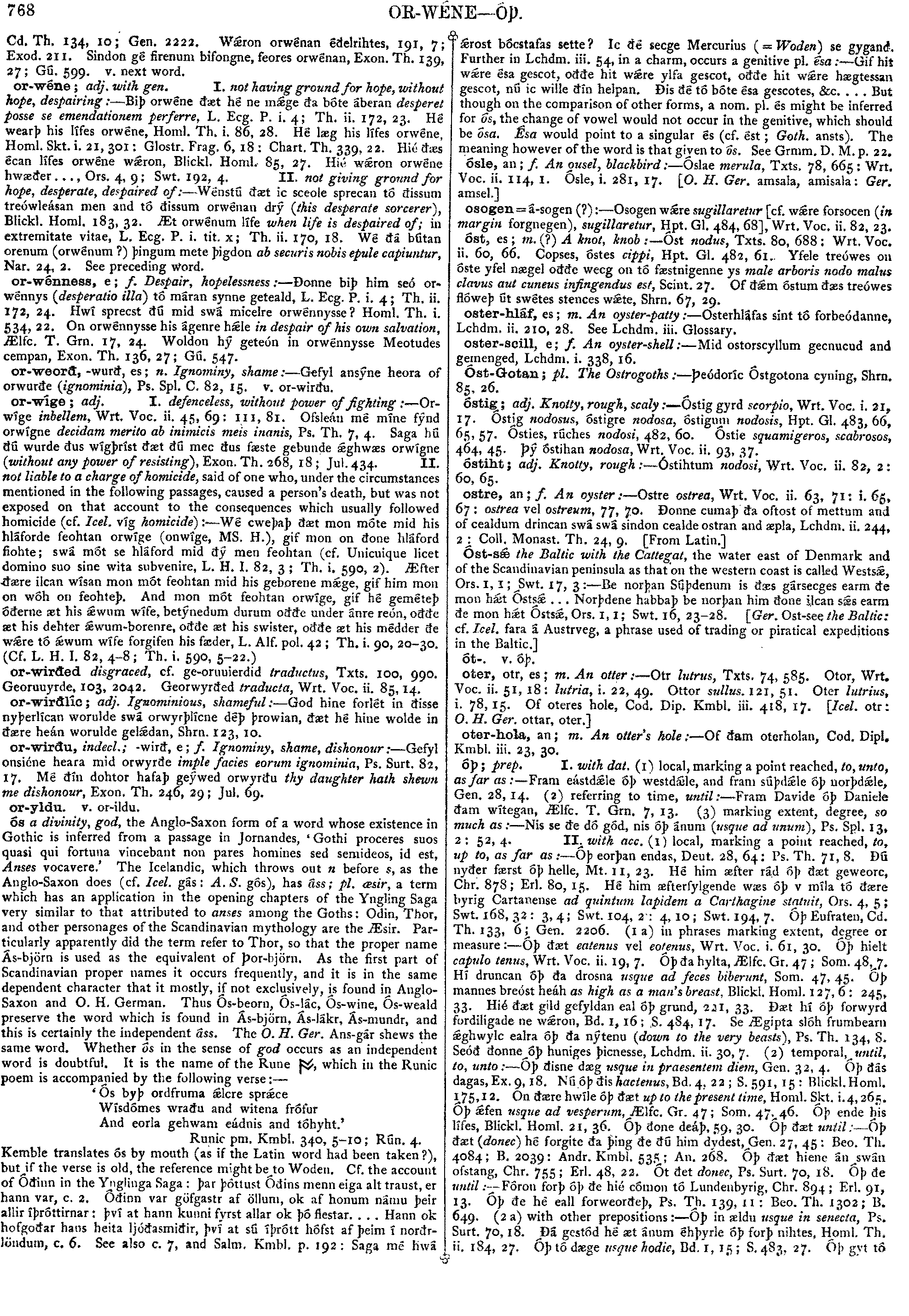
óst,
es;
m.
(?)
A
knot,
knob:--Óst
nodus,
Txts.
80,
688:
Wrt.
Voc.
ii.
60,
66.
Copses,
óstes
cippi,
Hpt.
Gl.
482,
61.
Yfele
treówes
on
óste
yfel
nægel
oððe
wecg
on
tó
fæstnigenne
ys
male
arboris
nodo
malus
clavus
aut
cuneus
infingendus
est,
Scint.
27.
Of
ð m
óstum
ðæs
treówes
flóweþ
út
swétes
stences
wte,
Shrn.
67,
29.
m
óstum
ðæs
treówes
flóweþ
út
swétes
stences
wte,
Shrn.
67,
29.
|
Source: Bosworth/Toller, page d0131, entry 6 View original page image as: [TIFF] [PNG] [View previous entry] [View next entry] |
[Comment on this entry] [View comments] |
The following entry has been hand-corrected once. |
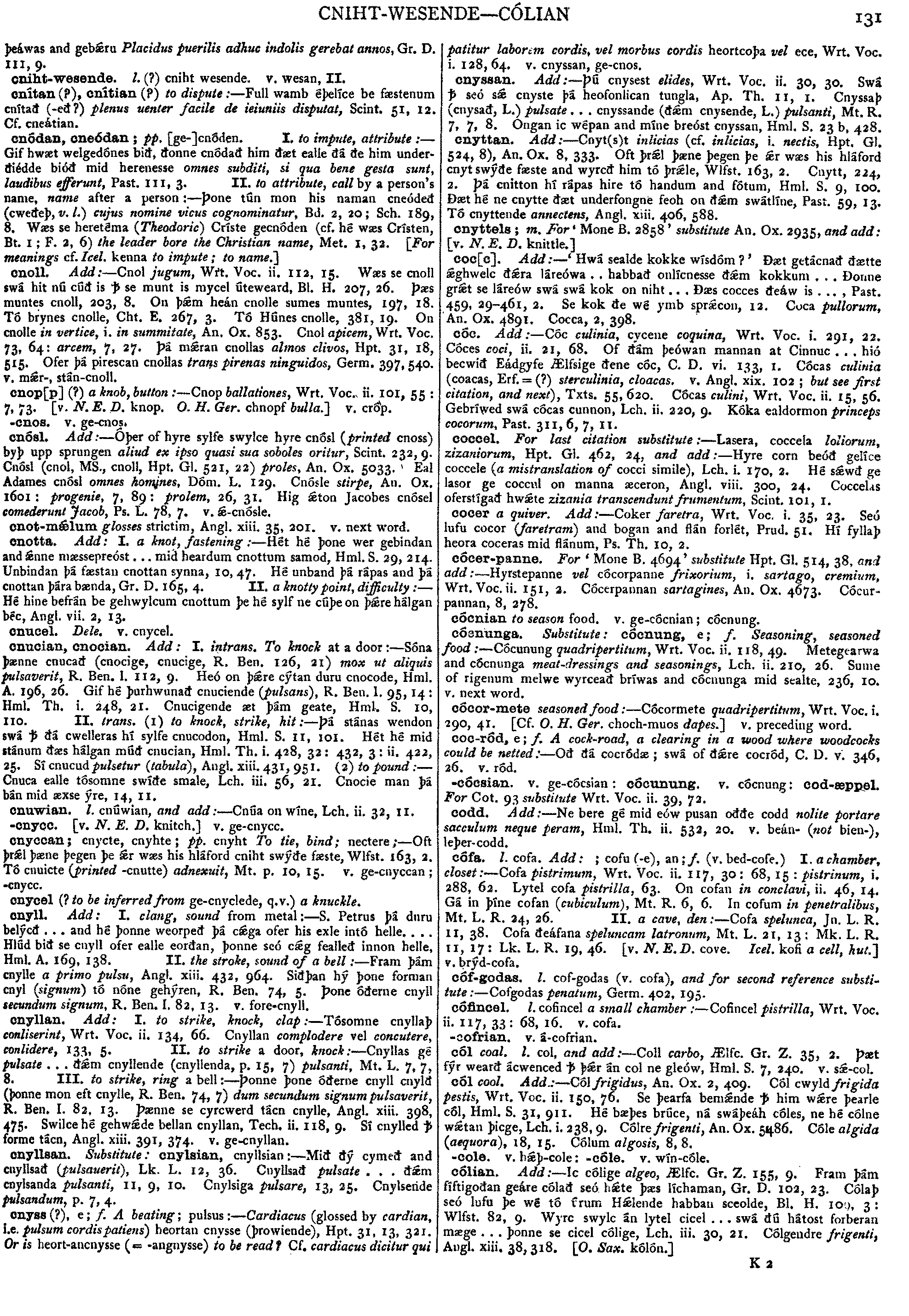
cnop[p] (?) a knob, button:--Cnop ballationes, Wrt. Voc. ii. 101, 55: 7, 73. [v. N. E. D. knop. O. H. Ger. chnopf bulla.] v. cróp.
|
Source: Cleasby/Vigfusson, page b0048, entry 28 View original page image as: [TIFF] [PNG] [View previous entry] [View next entry] |
[Comment on this entry] [View comments] |
The following entry has been hand-corrected once. |
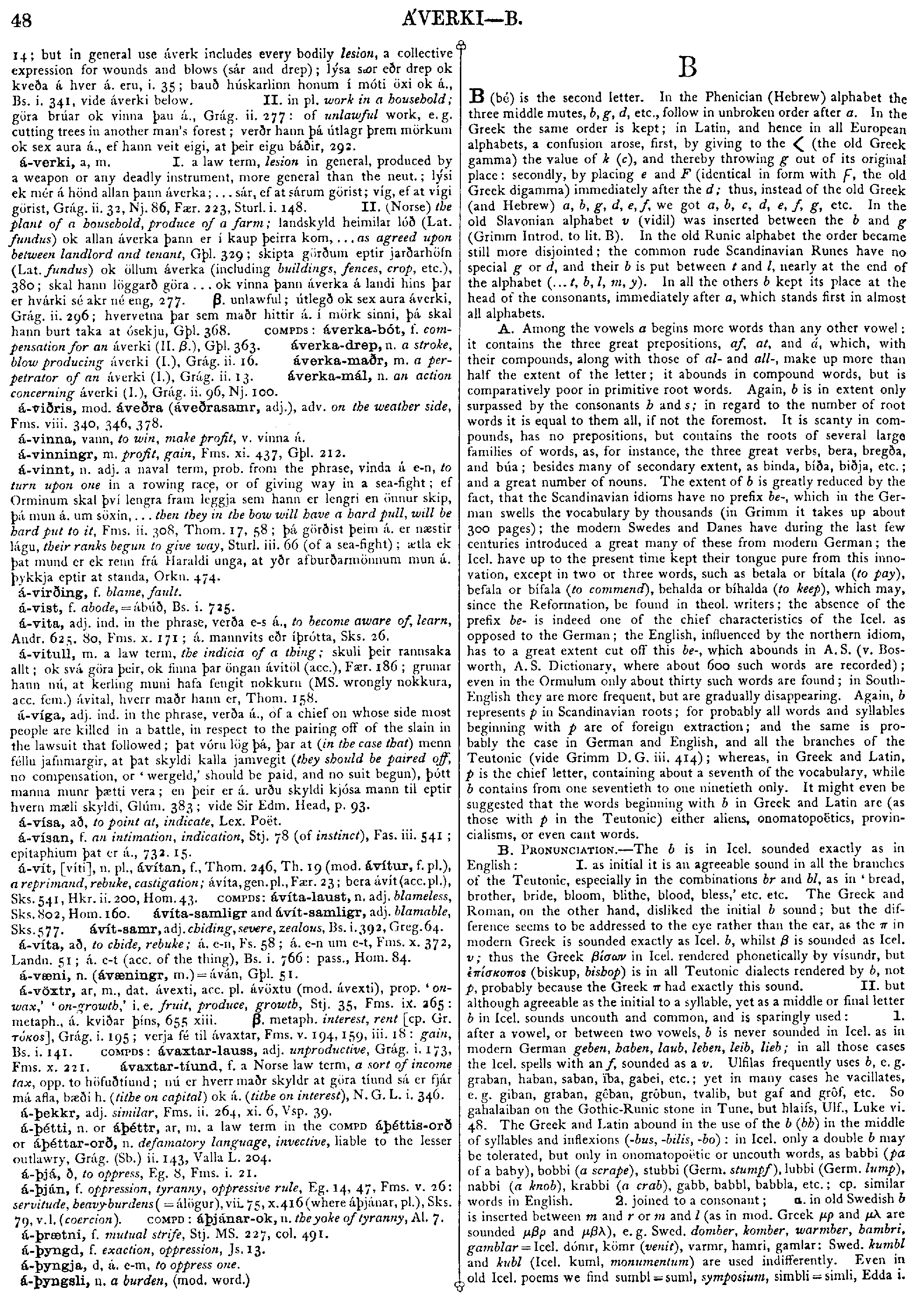
B.
PRONUNCIATION.
--
The
b
is
in
Icel.
sounded
exactly
as
in
English:
I.
as
initial
it
is
an
agreeable
sound
in
all
the
branches
of
the
Teutonic,
especially
in
the
combinations
br
and
bl,
as
in
'bread,
brother,
bride,
bloom,
blithe,
blood,
bless,'
etc.
etc.
The
Greek
and
Roman,
on
the
other
hand,
disliked
the
initial
b
sound;
but
the
difference
seerns
to
be
addressed
to
the
eye
rather
than
the
ear,
as
the
 in
modern
Greek
is
sounded
exactly
as
Icel.
b,
whilst
in
modern
Greek
is
sounded
exactly
as
Icel.
b,
whilst
 is
sounded
as
Icel.
v;
thus
the
Greek
GREEK
in
Icel.
rendered
phonetically
by
vísundr,
but
GREEK
(biskup,
bishop)
is
in
all
Teutonic
dialects
rendered
by
b,
not
p,
probably
because
the
Greek
had
exactly
this
sound.
II.
but
although
agreeable
as
the
initial
to
a
syllable,
yet
as
a
middle
or
final
letter
b
in
Icel.
sounds
uncouth
and
common,
and
is
sparingly
used:
1.
after
a
vowel,
or
between
two
vowels,
b
is
never
sounded
in
Icel.
as
in
modern
German
geben,
haben,
laub,
leben,
leib,
lieb;
in
all
those
cases
the
Icel.
spells
with
an
f,
sounded
as
a
v.
Ulfilas
frequently
uses
b,
e.g.
graban,
haban,
saban,
ïba,
gabei,
etc.;
yet
in
many
cases
he
vacillates,
e.g.
giban,
graban,
gêban,
grôbun,
tvalib,
but
gaf
and
grôf,
etc.
So
gahalaiban
on
the
Gothic-Runic
stone
in
Tune,
but
hlaifs,
Ulf.,
Luke
vi.
48.
The
Greek
and
Latin
abound
in
the
use
of
the
b
(bh)
in
the
middle
of
syllables
and
inflexions
(-bus,
-bills,
-bo):
in
Icel.
only
a
double
b
may
be
tolerated,
but
only
in
onomatopoëtic
or
uncouth
words,
as
babbi
(pa
of
a
baby),
bobbi
(a
scrape),
stubbi
(Germ.
stumpf),
lubbi
(Germ.
lump),
nabbi
(a
knob),
krabbi
(a
crab),
gabb,
babbl,
babbla,
etc.;
cp.
similar
words
in
English.
2.
joined
to
a
consonant;
is
sounded
as
Icel.
v;
thus
the
Greek
GREEK
in
Icel.
rendered
phonetically
by
vísundr,
but
GREEK
(biskup,
bishop)
is
in
all
Teutonic
dialects
rendered
by
b,
not
p,
probably
because
the
Greek
had
exactly
this
sound.
II.
but
although
agreeable
as
the
initial
to
a
syllable,
yet
as
a
middle
or
final
letter
b
in
Icel.
sounds
uncouth
and
common,
and
is
sparingly
used:
1.
after
a
vowel,
or
between
two
vowels,
b
is
never
sounded
in
Icel.
as
in
modern
German
geben,
haben,
laub,
leben,
leib,
lieb;
in
all
those
cases
the
Icel.
spells
with
an
f,
sounded
as
a
v.
Ulfilas
frequently
uses
b,
e.g.
graban,
haban,
saban,
ïba,
gabei,
etc.;
yet
in
many
cases
he
vacillates,
e.g.
giban,
graban,
gêban,
grôbun,
tvalib,
but
gaf
and
grôf,
etc.
So
gahalaiban
on
the
Gothic-Runic
stone
in
Tune,
but
hlaifs,
Ulf.,
Luke
vi.
48.
The
Greek
and
Latin
abound
in
the
use
of
the
b
(bh)
in
the
middle
of
syllables
and
inflexions
(-bus,
-bills,
-bo):
in
Icel.
only
a
double
b
may
be
tolerated,
but
only
in
onomatopoëtic
or
uncouth
words,
as
babbi
(pa
of
a
baby),
bobbi
(a
scrape),
stubbi
(Germ.
stumpf),
lubbi
(Germ.
lump),
nabbi
(a
knob),
krabbi
(a
crab),
gabb,
babbl,
babbla,
etc.;
cp.
similar
words
in
English.
2.
joined
to
a
consonant;
 .
in
old
Swedish
b
is
inserted
between
m
and
r
or
m
and
l
(as
in
mod.
Greek
.
in
old
Swedish
b
is
inserted
between
m
and
r
or
m
and
l
(as
in
mod.
Greek

 and
and
 are
sounded
and
,
e.g.
Swed.
domber,
komber,
warmber,
hambri,
gamblar
=
Icel.
dómr,
komr
(venit),
varmr,
hamri,
gamlar:
Swed.
kumbl
and
kubl
(Icel.
kuml,
monumentum)
are
used
indifferently.
Even
in
old
Icel.
poems
we
find
sumbl
=
suml,
symposium,
simbli
=
simli,
Edda
i.
are
sounded
and
,
e.g.
Swed.
domber,
komber,
warmber,
hambri,
gamblar
=
Icel.
dómr,
komr
(venit),
varmr,
hamri,
gamlar:
Swed.
kumbl
and
kubl
(Icel.
kuml,
monumentum)
are
used
indifferently.
Even
in
old
Icel.
poems
we
find
sumbl
=
suml,
symposium,
simbli
=
simli,
Edda
i.
|
Source: Cleasby/Vigfusson, page b0113, entry 30 View original page image as: [TIFF] [PNG] [View previous entry] [View next entry] |
[Comment on this entry] [View comments] |
The following entry has been hand-corrected once. |
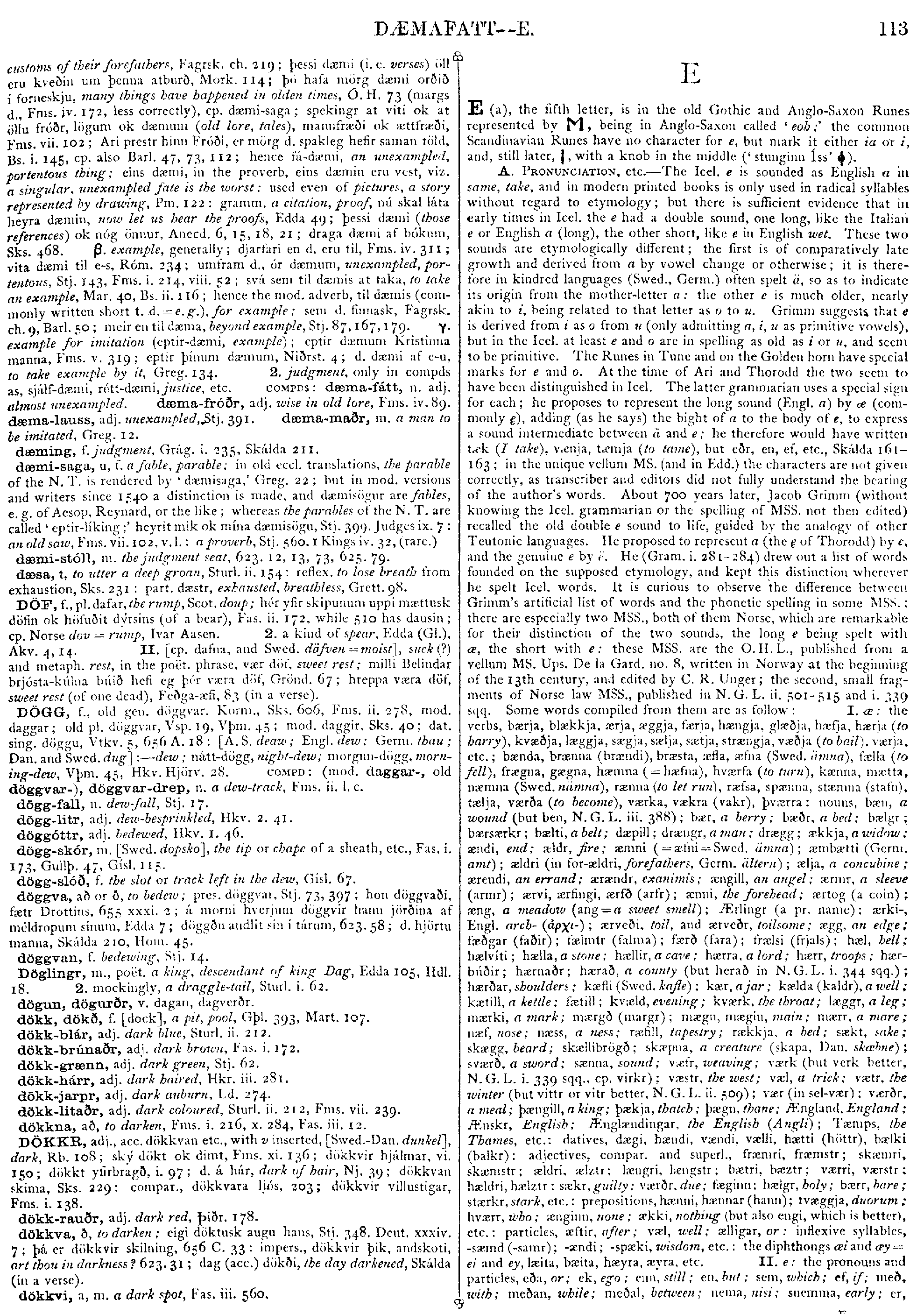
E (a), the fifth letter, is in the old Gothic and Anglo-Saxon Runes represented by RUNE, being in Anglo-Saxon called 'eoh;' the common Scandinavian Runes have no character for e, but mark it either ia or i, and, still later, RUNE, with a knob in the middle ('stunginn Íss' RUNE).
|
Source: Cleasby/Vigfusson, page b0206, entry 60 View original page image as: [TIFF] [PNG] [View previous entry] [View next entry] |
[Comment on this entry] [View comments] |
The following entry has been hand-corrected once. |
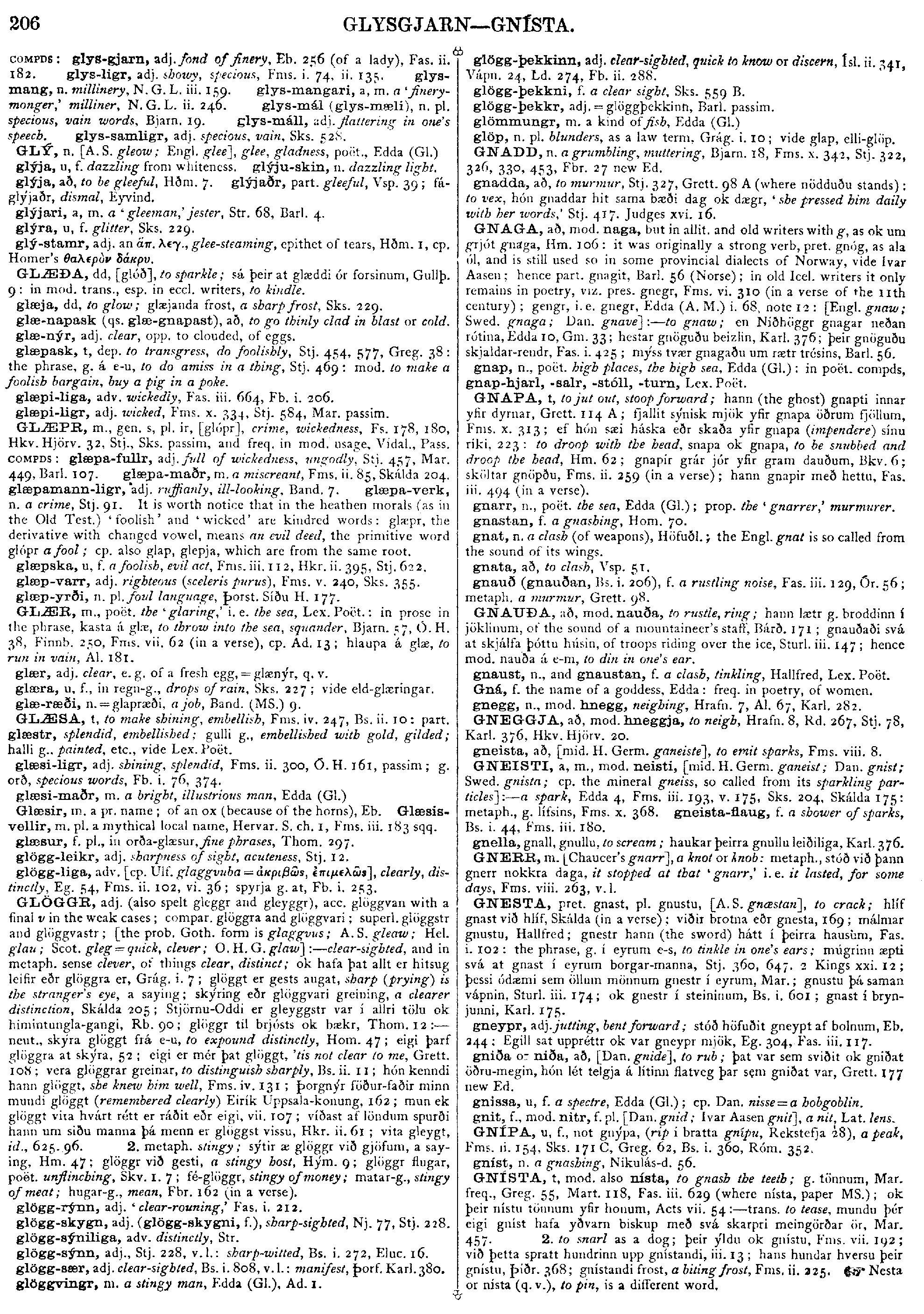
GNERR, m. [Chaucer's gnarr], a knot or knob: metaph., stóð við þann gnerr nokkra daga, it stopped at that 'gnarr,' i.e. it lasted, for some days, Fms. viii. 263, v.l.
|
Source: Cleasby/Vigfusson, page b0220, entry 14 View original page image as: [TIFF] [PNG] [View previous entry] [View next entry] |
[Comment on this entry] [View comments] |
The following entry has been hand-corrected once. |
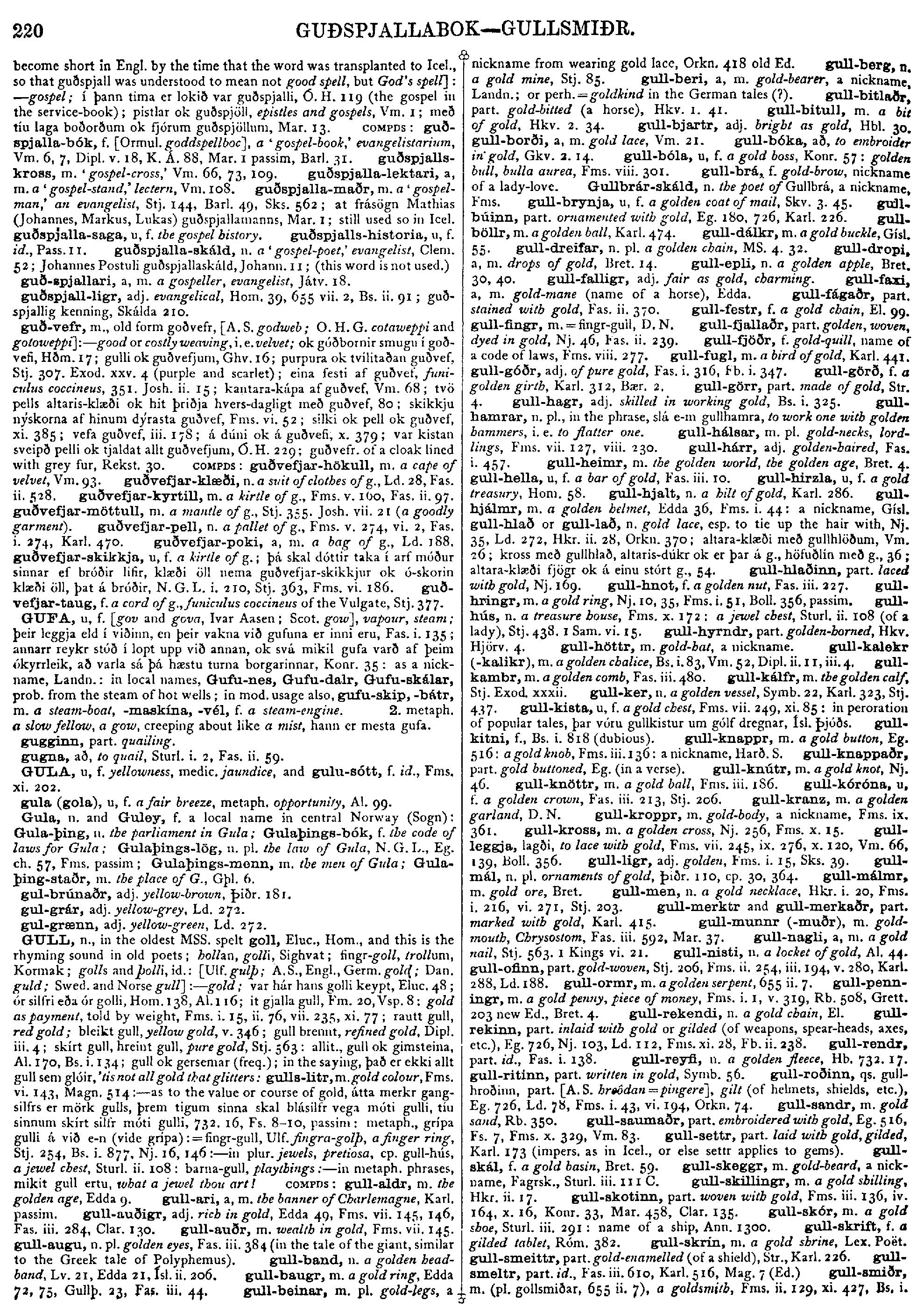
GULL, n., in the oldest MSS. spelt goll, Eluc., Hom., and this is the rhyming sound in old poets; hollan, golli, Sighvat; fingr-goll, trollum, Kormak; golls and þolli, id.: [Ulf. gulþ; A. S., Engl., Germ. gold; Dan. guld; Swed. and Norse gull] :-- gold; var hár hans golli keypt, Eluc. 48; ór silfri eða ór golli, Hom. 138, Al. 116; it gjalla gull, Fm. 20, Vsp. 8: gold as payment, told by weight, Fms. i. 15, ii. 76, vii. 235, xi. 77; rautt gull, red gold; bleikt gull, yellow gold, v. 346; gull brennt, refined gold, Dipl. iii. 4; skírt gull, hreint gull, pure gold, Stj. 563: allit., gull ok gimsteina, Al. 170, Bs. i. 134; gull ok gersemar (freq.); in the saying, það er ekki allt gull sem glóir, 'tis not all gold that glitters: gulls-litr, m. gold colour, Fms. vi. 143, Magn. 514 :-- as to the value or course of gold, átta merkr gangsilfrs er mörk gulls, þrem tigum sinna skal blásilfr vega móti gulli, tíu sinnum skírt silfr móti gulli, 732. 16, Fs. 8-10, passim: metaph., grípa gulli á við e-n (vide grípa) := fingr-gull, Ulf. fingra-golþ, a finger ring, Stj. 254, Bs. i. 877, Nj. 16, 146 :-- in plur. jewels, pretiosa, cp. gull-hús, a jewel chest, Sturl. ii. 108: barna-gull, playthings :-- in metaph. phrases, mikit gull ertu, what a jewel thou art! COMPDS: gull-aldr, m. the golden age, Edda 9. gull-ari, a, m. the banner of Charlemagne, Karl. passim. gull-auðigr, adj. rich in gold, Edda 49, Fms. vii. 145, 146, Fas. iii. 284, Clar. 130. gull-auðr, m. wealth in gold, Fms. vii. 145. gull-augu, n. pl. golden eyes, Fas. iii. 384 (in the tale of the giant, similar to the Greek tale of Polyphemus). gull-band, n. a golden head-band, Lv. 21, Edda 21, Ísl. ii. 206. gull-baugr, m. a gold ring, Edda 72, 75, Gullþ. 23, Fas. iii. 44. gull-beinar, m. pl. gold-legs, a nickname from wearing gold lace, Orkn. 418 old Ed. gull-berg, n. a gold mine, Stj. 85. gull-beri, a, m. gold-bearer, a nickname, Landn.; or perh. = goldkind in the German tales (?). gull-bitlaðr part. gold-bitted (a horse), Hkv. i. 41. gull-bitull, m. a bit of gold, Hkv. 2. 34. gull-bjartr, adj. bright as gold, Hbl. 30. gull-borði, a, m. gold lace, Vm. 21. gull-bóka, að, to embroider in gold, Gkv. 2. 14. gull-bóla, u, f. a gold boss, Konr. 57: golden bull, bulla aurea, Fms. viii. 301. gull-brá f. gold-brow, nickname of a lady-love. Gullbrár-skáld, n. the poet of Gullbrá, a nickname, Fms. gull-brynja, u, f. a golden coat of mail, Skv. 3. 45. gull-búinn, part. ornamented with gold, Eg. 180, 726, Karl. 226. gull-böllr, m. a golden ball, Karl. 474. gull-dálkr, m. a gold buckle, Gísl. 55. gull-dreifar, n. pl. a golden chain, MS. 4. 32. gull-dropi, a, m. drops of gold, Bret. 14. gull-epli, n. a golden apple, Bret. 30, 40. gull-falligr, adj. fair as gold, charming. gull-faxi, a, m. gold-mane (name of a horse), Edda. gull-fágaðr, part. stained with gold, Fas. ii. 370. gull-festr, f. a gold chain, El. 99. gull-fingr, m. = fingr-gull, D. N. gull-fjallaðr, part. golden, woven, dyed in gold, Nj. 46, Fas. ii. 239. gull-fjöðr, f. gold-quill, name of a code of laws, Fms. viii. 277. gull-fugl, m. a bird of gold, Karl. 441. gull-góðr, adj. of pure gold, Fas. i. 316, Fb. i. 347. gull-görð, f. a golden girth, Karl. 312, Bær. 2. gull-görr, part. made of gold, Str. 4. gull-hagr, adj. skilled in working gold, Bs. i. 325. gull-hamrar, n. pl., in the phrase, slá e-m gullhamra, to work one with golden hammers, i.e. to flatter one. gull-hálsar, m. pl. gold-necks, lordlings, Fms. vii. 127, viii. 230. gull-hárr, adj. golden-haired, Fas. i. 457. gull-heimr, m. the golden world, the golden age, Bret. 4. gull-hella, u, f. a bar of gold, Fas. iii. 10. gull-hirzla, u, f. a gold treasury, Hom. 58. gull-hjalt, n. a hilt of gold, Karl. 286. gull-hjálmr, m. a golden helmet, Edda 36, Fms. i. 44: a nickname, Gísl. gull-hlað or gull-lað, n. gold lace, esp. to tie up the hair with, Nj. 35, Ld. 272, Hkr. ii. 28, Orkn. 370; altara-klæði með gullhlöðum, Vm. 26; kross með gullhlað, altaris-dúkr ok er þar á g., höfuðlín með g., 36; altara-klæði fjögr ok á einu stórt g., 54. gull-hlaðinn, part. laced with gold, Nj. 169. gull-hnot, f. a golden nut, Fas. iii. 227. gull-hringr, m. a gold ring, Nj. 10, 35, Fms. i. 51, Boll. 356, passim. gull-hús, n. a treasure house, Fms. x. 172: a jewel chest, Sturl. ii. 108 (of a lady), Stj. 438. 1 Sam. vi. 15. gull-hyrndr, part. golden-horned, Hkv. Hjörv. 4. gull-höttr, m. gold-hat, a nickname. gull-kalekr (-kalikr), m. a golden chalice, Bs. i. 83, Vm. 52, Dipl. ii. 11, iii. 4. gull-kambr, m. a golden comb. Fas. iii. 480. gull-kálfr, m. the golden calf, Stj. Exod. xxxii. gull-ker, n. a golden vessel, Symb. 22, Karl. 323, Stj. 437. gull-kista, u, f. a gold chest, Fms. vii. 249, xi. 85: in peroration of popular tales, þar vóru gullkistur um gólf dregnar, Ísl. Þjóðs. gull-kitni, f., Bs. i. 818 (dubious). gull-knappr, m. a gold button, Eg. 516: a gold knob, Fms. iii. 136: a nickname, Harð. S. gull-knappaðr, part. gold buttoned, Eg. (in a verse). gull-knútr, m. a gold knot, Nj. 46. gull-knöttr, m. a gold ball, Fms. iii. 186. gull-kóróna, u, f. a golden crown, Fas. iii. 213, Stj. 206. gull-kranz, m. a golden garland, D. N. gull-kroppr, m. gold-body, a nickname, Fms. ix. 361. gull-kross, m. a golden cross, Nj. 256, Fms. x. 15. gull-leggja, lagði, to lace with gold, Fms. vii. 245, ix. 276, x. 120, Vm. 66, 139, Boll. 356. gull-ligr, adj. golden, Fms. i. 15, Sks. 39. gull-mál, n. pl. ornaments of gold, Þiðr. 110, cp. 30, 364. gull-málmr, m. gold ore, Bret. gull-men, n. a gold necklace, Hkr. i. 20, Fms. i. 216, vi. 271, Stj. 203. gull-merktr and gull-merkaðr, part. marked with gold, Karl. 415. gull-munnr (-muðr), m. gold-mouth, Chrysostom, Fas. iii. 592, Mar. 37. gull-nagli, a, m. a gold nail, Stj. 563. 1 Kings vi. 21. gull-nisti, n. a locket of gold, Al. 44. gull-ofinn, part. gold-woven, Stj. 206, Fms. ii. 254, iii. 194, v. 280, Karl. 288, Ld. 188. gull-ormr, m. a golden serpent, 655 ii. 7. gull-penningr, m. a gold penny, piece of money, Fms. i. 1, v. 319, Rb. 508, Grett. 203 new Ed., Bret. 4. gull-rekendi, n. a gold chain, El. gull-rekinn, part. inlaid with gold or gilded (of weapons, spear-heads, axes, etc.), Eg. 726, Nj. 103, Ld. 112, Fms. xi. 28, Fb. ii. 238. gull-rendr, part. id., Fas. i. 138. gull-reyfi, n. a golden fleece, Hb. 732. 17. gull-ritinn, part. written in gold, Symb. 56. gull-roðinn, qs. gull-hroðinn, part. [A. S. hreôdan = pingere], gilt (of helmets, shields, etc.), Eg. 726, Ld. 78, Fms. i. 43, vi. 194, Orkn. 74. gull-sandr, m. gold sand, Rb. 350. gull-saumaðr, part. embroidered with gold, Eg. 516, Fs. 7, Fms. x. 329, Vm. 83. gull-settr, part. laid with gold, gilded, Karl. 173 (impers. as in Icel., or else settr applies to gems). gull-skál, f. a gold basin, Bret. 59. gull-skeggr, m. gold-beard, a nickname, Fagrsk., Sturl. iii. 111 C. gull-skillingr, m. a gold shilling, Hkr. ii. 17. gull-skotinn, part. woven with gold, Fms. iii. 136, iv. 164, x. 16, Konr. 33, Mar. 458, Clar. 135. gull-skór, m. a gold shoe, Sturl. iii. 291: name of a ship, Ann. 1300. gull-skrift, f. a gilded tablet, Róm. 382. gull-skrín, m. a gold shrine, Lex. Poët, gull-smeittr, part. gold-enamelled (of a shield), Str., Karl. 226. gull-smeltr, part. id., Fas. iii. 610, Karl. 516, Mag. 7 (Ed.) gull-smiðr, m. (pl. gollsmiðar, 655 ii. 7), a goldsmith, Fms. ii. 129, xi. 427, Bs, i.
| Result Page: | 1 2 3 | Next |  |
Germanic Lexicon Project (main page)
This search system was written by
Sean Crist
Please consider
volunteering
to correct the data in these online dictionaries.
No rights reserved. Feel free to use these data in any way you please.