|
|

Tip: In the search results, you can click on any word or abbreviation for more information.
|
Source: Bosworth/Toller, page b0179, entry 4 View original page image as: [TIFF] [PNG] [View previous entry] [View next entry] |
[Comment on this entry] [View comments] |
The following entry has been hand-corrected once. |
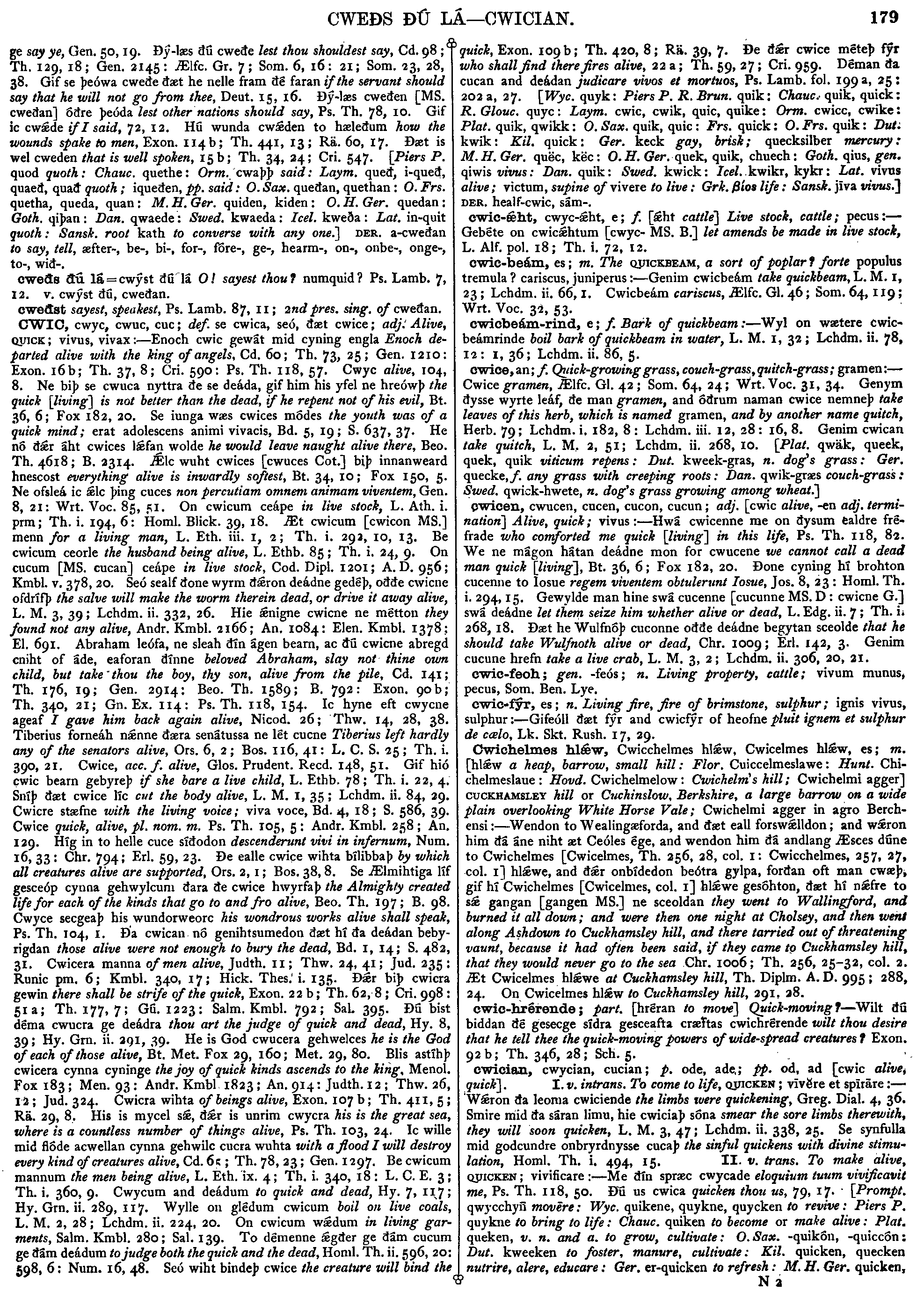
CWIC,
cwyc,
cwuc,
cuc;
def.
se
cwica,
seó,
ðæt
cwice;
adj.
Alive,
QUICK;
vivus,
vivax
:--
Enoch
cwic
gewát
mid
cyning
engla
Enoch
departed
alive
with
the
king
of
angels,
Cd.
60;
Th.
73,
25;
Gen.
1210:
Exon.
16b;
Th.
37,
8;
Cri.
590:
Ps.
Th.
118,
57.
Cwyc
alive,
104,
8.
Ne
biþ
se
cwuca
nyttra
ðe
se
deáda,
gif
him
his
yfel
ne
hreówþ
the
quick
[living]
is
not
better
than
the
dead,
if
he
repent
not
of
his
evil,
Bt.
36,
6;
Fox
182,
20.
Se
iunga
wæs
cwices
módes
the
youth
was
of
a
quick
mind;
erat
adolescens
animi
vivacis,
Bd.
5,
19;
S.
637,
37.
He
nó
ð r
áht
cwices
lfan
wolde
he
would
leave
naught
alive
there,
Beo.
Th.
4618;
B.
2314.
Æ-acute;lc
wuht
cwices
[cwuces
Cot.]
biþ
innanweard
hnescost
everything
alive
is
inwardly
softest,
Bt.
34,
10;
Fox
150,
5.
Ne
ofsleá
ic
lc
þing
cuces
non
percutiam
omnem
animam
viventem,
Gen.
8,
21:
Wrt.
Voc.
85,
51.
On
cwicum
ceápe
in
live
stock,
L.
Ath.
i.
prm;
Th.
i.
194,
6:
Homl.
Blick.
39,
18.
Æt
cwicum
[cwicon
MS.]
menn
for
a
living
man,
L.
Eth.
iii.
1,
2;
Th.
i.
292,
10,
13.
Be
cwicum
ceorle
the
husband
being
alive,
L.
Ethb.
85;
Th.
i.
24,
9.
On
cucum
[MS.
cucan]
ceápe
in
live
stock,
Cod.
Dipl.
1201;
A.
D.
956;
Kmbl.
v.
378,
20.
Seó
sealf
ðone
wyrm
ðron
deádne
gedéþ,
oððe
cwicne
ofdrífþ
the
salve
will
make
the
worm
therein
dead,
or
drive
it
away
alive,
L.
M.
3,
39;
Lchdm.
ii.
332,
26.
Hie
nigne
cwicne
ne
métton
they
found
not
any
alive,
Andr.
Kmbl.
2166;
An.
1084:
Elen.
Kmbl.
1378;
El.
691.
Abraham
leófa,
ne
sleah
ðín
ágen
bearn,
ac
ðú
cwicne
abregd
cniht
of
áde,
eaforan
ðínne
beloved
Abraham,
slay
not
thine
own
child,
but
take
thou
the
boy,
thy
son,
alive
from
the
pile,
Cd.
141;
Th.
176,
19;
Gen.
2914:
Beo.
Th.
1589;
B.
792:
Exon.
90b;
Th.
340,
21;
Gn.
Ex.
114:
Ps.
Th.
118,
154.
Ic
hyne
eft
cwycne
ageaf
I
gave
him
back
again
alive,
Nicod.
26;
Thw.
14,
28,
38.
Tiberius
forneáh
nnne
ðæra
senátussa
ne
lét
cucne
Tiberius
left
hardly
any
of
the
senators
alive,
Ors.
6,
2;
Bos.
116,
41:
L.
C.
S.
25;
Th.
i.
390,
21.
Cwice,
acc.
f.
alive,
Glos.
Prudent.
Recd.
148,
51.
Gif
hió
cwic
bearn
gebyreþ
if
she
bare
a
live
child,
L.
Ethb.
78;
Th.
i.
22,
4.
Sníþ
ðæt
cwice
líc
cut
the
body
alive,
L.
M.
1,
35;
Lchdm.
ii.
84,
29.
Cwicre
stæfne
with
the
living
voice;
viva
voce,
Bd.
4,
18;
S.
586,
39.
Cwice
quick,
alive,
pl.
nom.
m.
Ps.
Th.
105,
5:
Andr.
Kmbl.
258;
An.
129.
Híg
in
to
helle
cuce
síðodon
descenderunt
vivi
in
infernum,
Num.
16,
33:
Chr.
794;
Erl.
59,
23.
Ðe
ealle
cwice
wihta
bílibbaþ
by
which
all
creatures
alive
are
supported,
Ors.
2,
1;
Bos.
38,
8.
Se
Ælmihtiga
líf
gesceóp
cynna
gehwylcum
ðara
ðe
cwice
hwyrfaþ
the
Almighty
created
life
for
each
of
the
kinds
that
go
to
and
fro
alive,
Beo.
Th.
197;
B.
98.
Cwyce
secgeaþ
his
wundorweorc
his
wondrous
works
alive
shall
speak,
Ps.
Th.
104,
1.
Ða
cwican
nó
genihtsumedon
ðæt
hí
ða
deádan
bebyrigdan
those
alive
were
not
enough
to
bury
the
dead,
Bd.
1,
14;
S.
482,
31.
Cwicera
manna
of
men
alive,
Judth.
11;
Thw.
24,
41;
Jud.
235:
Runic
pm.
6;
Kmbl.
340,
17;
Hick.
Thes.
i.
135.
Ðr
biþ
cwicra
gewin
there
shall
be
strife
of
the
quick,
Exon.
22b;
Th.
62,
8;
Cri.
998:
51a;
Th.
177,
7;
Gú
1223:
Salm.
Kmbl.
792;
Sal.
395.
Ðú
bist
déma
cwucra
ge
deádra
thow
art
the
judge
of
quick
and
dead,
Hy.
8,
39;
Hy.
Grn.
ii.
291,
39.
He
is
God
cwucera
gehwelces
he
is
the
God
of
each
of
those
alive,
Bt.
Met.
Fox
29,
160;
Met.
29,
80.
Blis
astíhþ
cwicera
cynna
cyninge
the
joy
of
quick
kinds
ascends
to
the
king,
Menol.
Fox
183;
Men.
93:
Andr.
Kmbl
1823;
An.
914:
Judth.
12;
Thw.
26,
12;
Jud.
324.
Cwicra
wihta
of
beings
alive,
Exon.
107b;
Th.
411,
5;
Rä.
29,
8.
His
is
mycel
s,
ðr
is
unrim
cwycra
his
is
the
great
sea,
where
is
a
countless
number
of
things
alive,
Ps.
Th.
103,
24.
Ic
wille
mid
flóde
acwellan
cynna
gehwilc
cucra
wuhta
with
a
flood
I
will
destroy
every
kind
of
creatures
alive,
Cd.
65;
Th.
78,
23;
Gen.
1297.
Be
cwicum
mannum
the
men
being
alive,
L.
Eth.
ix.
4;
Th.
i.
340,
18:
L.
C.
E.
3;
Th.
i.
360,
9.
Cwycum
and
deádum
to
quick
and
dead,
Hy.
7,
117;
Hy.
Grn.
ii.
289,
117.
Wylle
on
glédum
cwicum
boil
on
live
coals,
L.
M.
2,
28;
Lchdm.
ii.
224,
20.
On
cwicum
wdum
in
living
garments,
Salm.
Kmbl.
280;
Sal.
139.
To
démenne
gðer
ge
ðám
cucum
ge
ðám
deádum
to
judge
both
the
quick
and
the
dead,
Homl.
Th.
ii.
596,
20:
598,
6:
Num.
16,
48.
Seó
wiht
bindeþ
cwice
the
creature
will
bind
the
quick,
Exon.
109b;
Th.
420,
8;
Rä.
39,
7.
Ðe
ðr
cwice
méteþ
fýr
who
shall
find
there
fires
alive,
22a;
Th.
59,
27;
Cri.
959.
Déman
ða
cucan
and
deádan
judicare
vivos
et
mortuos,
Ps.
Lamb.
fol.
199a.
25:
202a,
27.
[Wyc.
quyk:
Piers
P.
R.
Brun.
quik:
Chauc.
quik,
quick:
R.
Glouc.
quyc:
Laym.
cwic,
cwik,
quic,
quike:
Orm.
cwicc,
cwike:
Plat.
quik,
qwikk:
O.
Sax.
quik,
quic:
Frs.
quick:
O.
Frs.
quik:
Dut.
kwik:
Kil.
quick:
Ger.
keck
gay,
brisk;
quecksilber
mercury:
M.
H.
Ger.
quëc,
këc:
O.
H.
Ger.
quek,
quik,
chuech:
Goth.
qius,
gen.
qiwis
vivus:
Dan.
quik:
Swed.
kwick:
Icel.
kwikr,
kykr:
Lat.
vivus
alive;
victum,
supine
of
vivere
to
live:
Grk.
r
áht
cwices
lfan
wolde
he
would
leave
naught
alive
there,
Beo.
Th.
4618;
B.
2314.
Æ-acute;lc
wuht
cwices
[cwuces
Cot.]
biþ
innanweard
hnescost
everything
alive
is
inwardly
softest,
Bt.
34,
10;
Fox
150,
5.
Ne
ofsleá
ic
lc
þing
cuces
non
percutiam
omnem
animam
viventem,
Gen.
8,
21:
Wrt.
Voc.
85,
51.
On
cwicum
ceápe
in
live
stock,
L.
Ath.
i.
prm;
Th.
i.
194,
6:
Homl.
Blick.
39,
18.
Æt
cwicum
[cwicon
MS.]
menn
for
a
living
man,
L.
Eth.
iii.
1,
2;
Th.
i.
292,
10,
13.
Be
cwicum
ceorle
the
husband
being
alive,
L.
Ethb.
85;
Th.
i.
24,
9.
On
cucum
[MS.
cucan]
ceápe
in
live
stock,
Cod.
Dipl.
1201;
A.
D.
956;
Kmbl.
v.
378,
20.
Seó
sealf
ðone
wyrm
ðron
deádne
gedéþ,
oððe
cwicne
ofdrífþ
the
salve
will
make
the
worm
therein
dead,
or
drive
it
away
alive,
L.
M.
3,
39;
Lchdm.
ii.
332,
26.
Hie
nigne
cwicne
ne
métton
they
found
not
any
alive,
Andr.
Kmbl.
2166;
An.
1084:
Elen.
Kmbl.
1378;
El.
691.
Abraham
leófa,
ne
sleah
ðín
ágen
bearn,
ac
ðú
cwicne
abregd
cniht
of
áde,
eaforan
ðínne
beloved
Abraham,
slay
not
thine
own
child,
but
take
thou
the
boy,
thy
son,
alive
from
the
pile,
Cd.
141;
Th.
176,
19;
Gen.
2914:
Beo.
Th.
1589;
B.
792:
Exon.
90b;
Th.
340,
21;
Gn.
Ex.
114:
Ps.
Th.
118,
154.
Ic
hyne
eft
cwycne
ageaf
I
gave
him
back
again
alive,
Nicod.
26;
Thw.
14,
28,
38.
Tiberius
forneáh
nnne
ðæra
senátussa
ne
lét
cucne
Tiberius
left
hardly
any
of
the
senators
alive,
Ors.
6,
2;
Bos.
116,
41:
L.
C.
S.
25;
Th.
i.
390,
21.
Cwice,
acc.
f.
alive,
Glos.
Prudent.
Recd.
148,
51.
Gif
hió
cwic
bearn
gebyreþ
if
she
bare
a
live
child,
L.
Ethb.
78;
Th.
i.
22,
4.
Sníþ
ðæt
cwice
líc
cut
the
body
alive,
L.
M.
1,
35;
Lchdm.
ii.
84,
29.
Cwicre
stæfne
with
the
living
voice;
viva
voce,
Bd.
4,
18;
S.
586,
39.
Cwice
quick,
alive,
pl.
nom.
m.
Ps.
Th.
105,
5:
Andr.
Kmbl.
258;
An.
129.
Híg
in
to
helle
cuce
síðodon
descenderunt
vivi
in
infernum,
Num.
16,
33:
Chr.
794;
Erl.
59,
23.
Ðe
ealle
cwice
wihta
bílibbaþ
by
which
all
creatures
alive
are
supported,
Ors.
2,
1;
Bos.
38,
8.
Se
Ælmihtiga
líf
gesceóp
cynna
gehwylcum
ðara
ðe
cwice
hwyrfaþ
the
Almighty
created
life
for
each
of
the
kinds
that
go
to
and
fro
alive,
Beo.
Th.
197;
B.
98.
Cwyce
secgeaþ
his
wundorweorc
his
wondrous
works
alive
shall
speak,
Ps.
Th.
104,
1.
Ða
cwican
nó
genihtsumedon
ðæt
hí
ða
deádan
bebyrigdan
those
alive
were
not
enough
to
bury
the
dead,
Bd.
1,
14;
S.
482,
31.
Cwicera
manna
of
men
alive,
Judth.
11;
Thw.
24,
41;
Jud.
235:
Runic
pm.
6;
Kmbl.
340,
17;
Hick.
Thes.
i.
135.
Ðr
biþ
cwicra
gewin
there
shall
be
strife
of
the
quick,
Exon.
22b;
Th.
62,
8;
Cri.
998:
51a;
Th.
177,
7;
Gú
1223:
Salm.
Kmbl.
792;
Sal.
395.
Ðú
bist
déma
cwucra
ge
deádra
thow
art
the
judge
of
quick
and
dead,
Hy.
8,
39;
Hy.
Grn.
ii.
291,
39.
He
is
God
cwucera
gehwelces
he
is
the
God
of
each
of
those
alive,
Bt.
Met.
Fox
29,
160;
Met.
29,
80.
Blis
astíhþ
cwicera
cynna
cyninge
the
joy
of
quick
kinds
ascends
to
the
king,
Menol.
Fox
183;
Men.
93:
Andr.
Kmbl
1823;
An.
914:
Judth.
12;
Thw.
26,
12;
Jud.
324.
Cwicra
wihta
of
beings
alive,
Exon.
107b;
Th.
411,
5;
Rä.
29,
8.
His
is
mycel
s,
ðr
is
unrim
cwycra
his
is
the
great
sea,
where
is
a
countless
number
of
things
alive,
Ps.
Th.
103,
24.
Ic
wille
mid
flóde
acwellan
cynna
gehwilc
cucra
wuhta
with
a
flood
I
will
destroy
every
kind
of
creatures
alive,
Cd.
65;
Th.
78,
23;
Gen.
1297.
Be
cwicum
mannum
the
men
being
alive,
L.
Eth.
ix.
4;
Th.
i.
340,
18:
L.
C.
E.
3;
Th.
i.
360,
9.
Cwycum
and
deádum
to
quick
and
dead,
Hy.
7,
117;
Hy.
Grn.
ii.
289,
117.
Wylle
on
glédum
cwicum
boil
on
live
coals,
L.
M.
2,
28;
Lchdm.
ii.
224,
20.
On
cwicum
wdum
in
living
garments,
Salm.
Kmbl.
280;
Sal.
139.
To
démenne
gðer
ge
ðám
cucum
ge
ðám
deádum
to
judge
both
the
quick
and
the
dead,
Homl.
Th.
ii.
596,
20:
598,
6:
Num.
16,
48.
Seó
wiht
bindeþ
cwice
the
creature
will
bind
the
quick,
Exon.
109b;
Th.
420,
8;
Rä.
39,
7.
Ðe
ðr
cwice
méteþ
fýr
who
shall
find
there
fires
alive,
22a;
Th.
59,
27;
Cri.
959.
Déman
ða
cucan
and
deádan
judicare
vivos
et
mortuos,
Ps.
Lamb.
fol.
199a.
25:
202a,
27.
[Wyc.
quyk:
Piers
P.
R.
Brun.
quik:
Chauc.
quik,
quick:
R.
Glouc.
quyc:
Laym.
cwic,
cwik,
quic,
quike:
Orm.
cwicc,
cwike:
Plat.
quik,
qwikk:
O.
Sax.
quik,
quic:
Frs.
quick:
O.
Frs.
quik:
Dut.
kwik:
Kil.
quick:
Ger.
keck
gay,
brisk;
quecksilber
mercury:
M.
H.
Ger.
quëc,
këc:
O.
H.
Ger.
quek,
quik,
chuech:
Goth.
qius,
gen.
qiwis
vivus:
Dan.
quik:
Swed.
kwick:
Icel.
kwikr,
kykr:
Lat.
vivus
alive;
victum,
supine
of
vivere
to
live:
Grk.


 life:
Sansk.
jiva
vivus.]
DER.
healf-cwic,
sám-.
life:
Sansk.
jiva
vivus.]
DER.
healf-cwic,
sám-.
|
Source: Bosworth/Toller, page b0179, entry 14 View original page image as: [TIFF] [PNG] [View previous entry] [View next entry] |
[Comment on this entry] [View comments] |
The following entry has been hand-corrected once. |
cwician,
cwycian,
cucian;
p.
ode,
ade;
pp.
od,
ad
[cwic
alive,
quick].
I.
v.
intrans.
To
come
to
life,
QUICKEN;
v v
v re
et
spr
re
et
spr re
:--
Wron
ða
leoma
cwiciende
the
limbs
were
quickening,
Greg.
Dial.
4,
36.
Smire
mid
ða
sáran
limu,
hie
cwiciaþ
sóna
smear
the
sore
limbs
therewith,
they
will
soon
quicken,
L.
M.
3,
47;
Lchdm.
ii.
338,
25.
Se
synfulla
mid
godcundre
onbryrdnysse
cucaþ
the
sinful
quickens
with
divine
stimulation,
Homl.
Th.
i.
494,
15.
II.
v.
trans.
To
make
alive,
OUICKEN;
vivificare
:--
Me
ðín
spræc
cwycade
eloquium
tuum
vivificavit
me.
Ps.
Th.
118,
50.
Ðú
us
cwica
quicken
thou
us,
79,
17.
[Prompt.
qwycchy&n-long;
mov
re
:--
Wron
ða
leoma
cwiciende
the
limbs
were
quickening,
Greg.
Dial.
4,
36.
Smire
mid
ða
sáran
limu,
hie
cwiciaþ
sóna
smear
the
sore
limbs
therewith,
they
will
soon
quicken,
L.
M.
3,
47;
Lchdm.
ii.
338,
25.
Se
synfulla
mid
godcundre
onbryrdnysse
cucaþ
the
sinful
quickens
with
divine
stimulation,
Homl.
Th.
i.
494,
15.
II.
v.
trans.
To
make
alive,
OUICKEN;
vivificare
:--
Me
ðín
spræc
cwycade
eloquium
tuum
vivificavit
me.
Ps.
Th.
118,
50.
Ðú
us
cwica
quicken
thou
us,
79,
17.
[Prompt.
qwycchy&n-long;
mov re:
Wyc.
quikene,
quykne,
quycken
to
revive:
Piers
P.
quykne
to
bring
to
life:
Chauc.
quiken
to
become
or
make
alive:
Plat.
queken,
v.
n.
and
a.
to
grow,
cultivate:
O.
Sax.
-quikón,
-quiccón:
Dut.
kweeken
to
foster,
manure,
cultivate:
Kil.
quicken,
quecken
nutrire,
alere,
educare:
Ger.
er-quicken
to
refresh:
M.
H.
Ger.
quicken,
re:
Wyc.
quikene,
quykne,
quycken
to
revive:
Piers
P.
quykne
to
bring
to
life:
Chauc.
quiken
to
become
or
make
alive:
Plat.
queken,
v.
n.
and
a.
to
grow,
cultivate:
O.
Sax.
-quikón,
-quiccón:
Dut.
kweeken
to
foster,
manure,
cultivate:
Kil.
quicken,
quecken
nutrire,
alere,
educare:
Ger.
er-quicken
to
refresh:
M.
H.
Ger.
quicken,
|
Source: Bosworth/Toller, page b0181, entry 37 View original page image as: [TIFF] [PNG] [View previous entry] [View next entry] |
[Comment on this entry] [View comments] |
The following entry has been hand-corrected once. |
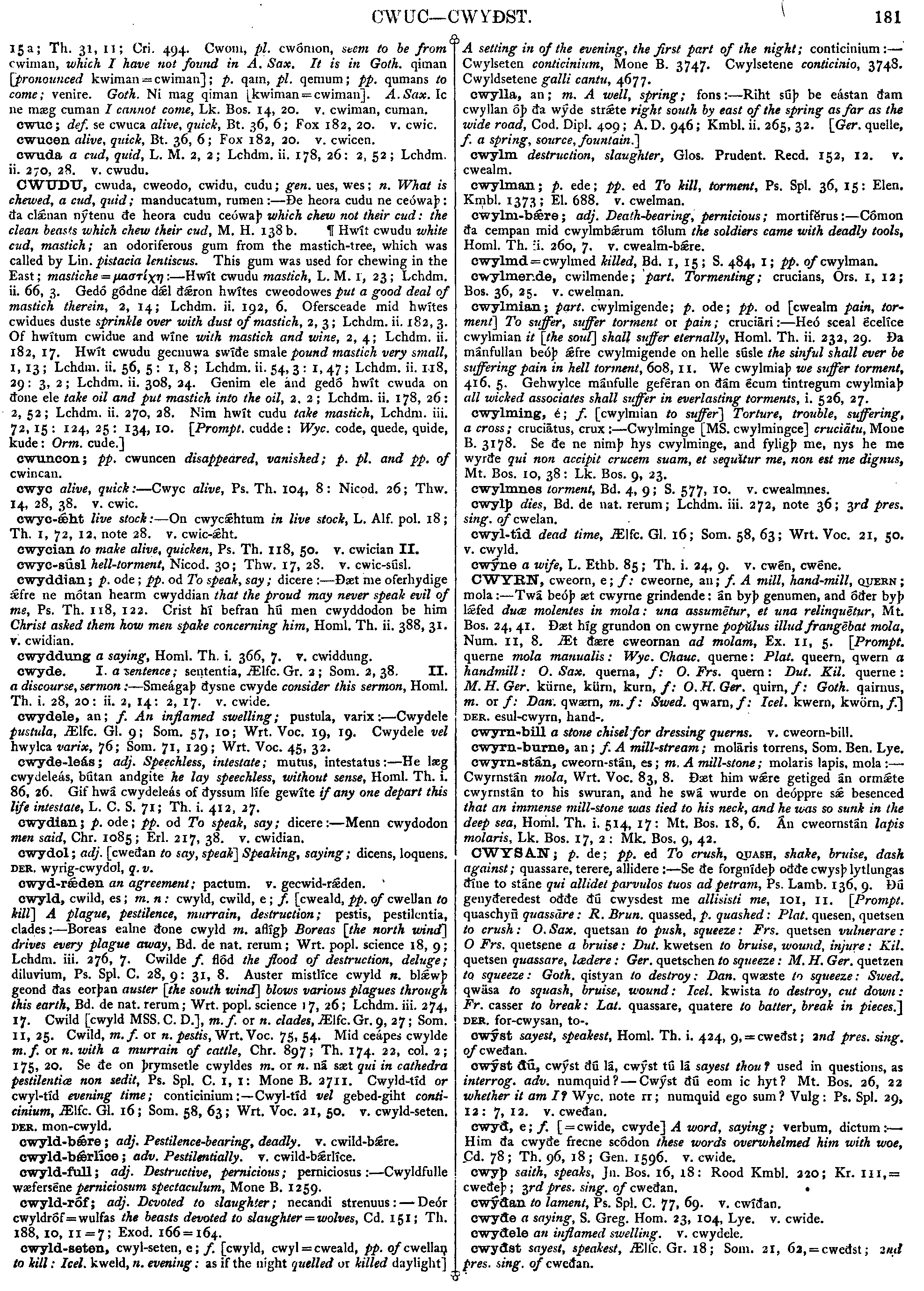
CWYRN,
cweorn,
e;
f:
cweorne,
an;
f.
A
mill,
hand-mill,
QUERN;
mola
:--
Twá
beóþ
æt
cwyrne
grindende:
án
byþ
genumen,
and
óðer
byþ
lfed
duæ
molentes
in
mola;
una
assumtur,
et
una
relinqutur,
Mt.
Bos.
24,
41.
Ðæt
híg
grundon
on
cwyrne
pop lus
illud
frangbat
mola,
Num.
11,
8.
Æt
ðære
cweornan
ad
molam,
Ex.
11,
5.
[Prompt.
querne
mola
manualis:
Wyc.
Chauc.
querne:
Plat.
queern,
qwern
a
handmill:
O.
Sax.
querna,
f:
O.
Frs.
quern:
Dut.
Kil.
querne:
M.
H.
Ger.
kürne,
kürn,
kurn,
f;
O.
H.
Ger.
quirn,
f:
Goth.
qairnus,
m.
or
f:
Dan.
qwærn,
m.
f:
Swed.
qwarn,
f:
Icel.
kwern,
kwórn,
f.]
DER.
esul-cwyrn,
hand-.
lus
illud
frangbat
mola,
Num.
11,
8.
Æt
ðære
cweornan
ad
molam,
Ex.
11,
5.
[Prompt.
querne
mola
manualis:
Wyc.
Chauc.
querne:
Plat.
queern,
qwern
a
handmill:
O.
Sax.
querna,
f:
O.
Frs.
quern:
Dut.
Kil.
querne:
M.
H.
Ger.
kürne,
kürn,
kurn,
f;
O.
H.
Ger.
quirn,
f:
Goth.
qairnus,
m.
or
f:
Dan.
qwærn,
m.
f:
Swed.
qwarn,
f:
Icel.
kwern,
kwórn,
f.]
DER.
esul-cwyrn,
hand-.
|
Source: Bosworth/Toller, page b0181, entry 41 View original page image as: [TIFF] [PNG] [View previous entry] [View next entry] |
[Comment on this entry] [View comments] |
The following entry has been hand-corrected once. |
CWYSAN;
p.
de;
pp.
ed
To
crush,
QUASH,
shake,
bruise,
dash
against;
quassare,
terere,
allidere
:--
Se
ðe
forgnídeþ
oððe
cwysþ
lytlungas
ðíne
to
stáne
qui
allidet
parvulos
tuos
ad
petram,
Ps.
Lamb.
136,
9.
Ðú
genyðeredest
oððe
ðú
cwysdest
me
allisisti
me,
101,
11.
[Prompt.
quaschy&n-long;
quassre:
R.
Brun.
quassed,
p.
quashed:
Plat.
quesen,
quetsen
to
crush:
O.
Sax.
quetsan
to
push,
squeeze:
Frs.
quetsen
vulnerare:
O.
Frs.
quetsene
a
bruise:
Dut.
kwetsen
to
bruise,
wound,
injure:
Kil.
quetsen
quassare,
lædere;
Ger.
quetschen
to
squeeze:
M.
H.
Ger.
quetzen
to
squeeze:
Goth.
qistyan
to
destroy:
Dan.
qwæste
to
squeeze:
Swed.
qwäsa
to
squash,
bruise,
wound:
Icel.
kwista
to
destroy,
cut
down:
Fr.
casser
to
break:
Lat.
quassare,
quatere
to
batter,
break
in
pieces.]
DER.
for-cwysan,
to-.
|
Source: Bosworth/Toller, page b0182, entry 2 View original page image as: [TIFF] [PNG] [View previous entry] [View next entry] |
[Comment on this entry] [View comments] |
The following entry has been hand-corrected once. |
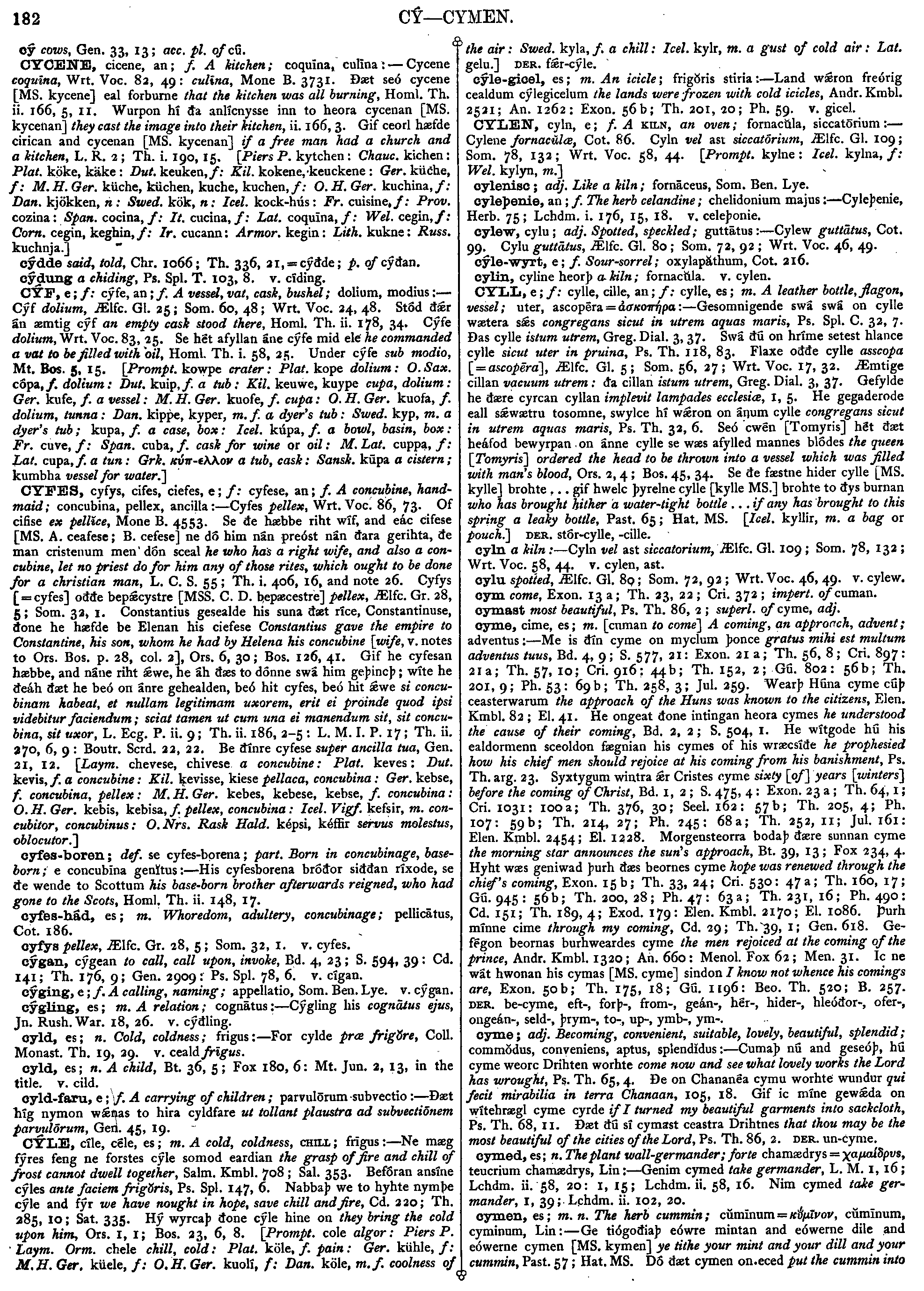
CYCENE,
cicene,
an;
f.
A
kitchen;
coquna,
culna
:--
Cycene
coquina,
Wrt.
Voc.
82,
49:
culna,
Mone
B.
3731.
Ðæt
seó
cycene
[MS.
kycene]
eal
forburne
that
the
kitchen
was
all
burning,
Homl.
Th.
ii.
166,
5,
11.
Wurpon
hí
ða
anlícnysse
inn
to
heora
cycenan
[MS.
kycenan]
they
cast
the
image
into
their
kitchen,
ii.
166,
3.
Gif
ceorl
hæfde
cirican
and
cycenan
[MS.
kycenan]
if
a
free
man
had
a
church
and
a
kitchen,
L.
R.
2;
Th.
i.
190,
15.
[Piers
P.
kytchen:
Chauc.
kichen:
Plat.
köke,
käke:
Dut.
keuken,
f:
Kil.
kokene,
keuckene:
Ger.
küche,
f:
M.
H.
Ger.
küche,
kuchen,
kuche,
kuchen,
f:
O.
H.
Ger.
kuchina,
f:
Dan.
kjökken,
n:
Swed.
kök,
n:
Icel.
kock-hús:
Fr.
cuisine,
f:
Prov.
cozina:
Span.
cocina,
f:
It.
cucina,
f:
Lat.
coquna,
f:
Wel.
cegin,
f:
Corn.
cegin,
keghin,
f:
Ir.
cucann:
Armor,
kegin:
Lith.
kukne:
Russ.
kuchnja.]
|
Source: Bosworth/Toller, page b0182, entry 5 View original page image as: [TIFF] [PNG] [View previous entry] [View next entry] |
[Comment on this entry] [View comments] |
The following entry has been hand-corrected once. |
CÝF,
e;
f:
cýfe,
an;
f.
A
vessel,
vat,
cask,
bushel;
dolium,
modius
:--
Cýf
dolium,
Ælfc.
Gl.
25;
Som.
60,
48;
Wrt.
Voc.
24,
48.
Stód
ðr
án
æmtig
cýf
an
empty
cask
stood
there,
Homl.
Th.
ii.
178,
34.
Cýfe
dolium,
Wrt.
Voc.
83,
25.
Se
hét
afyllan
áne
cýfe
mid
ele
he
commanded
a
vat
to
be
filled
with
oil,
Homl.
Th.
i.
58,
25.
Under
cýfe
sub
modio,
Mt.
Bos.
5,
15.
[Prompt.
kowpe
crater:
Plat.
kope
dolium:
O.
Sax.
cópa,
f.
dolium:
Dut.
kuip,
f.
a
tub;
Kil.
keuwe,
kuype
cupa,
dolium:
Ger.
kufe,
f.
a
vessel:
M.
H.
Ger.
kuofe,
f.
cupa:
O.
H.
Ger.
kuofa,
f.
dolium,
tunna:
Dan.
kippe,
kyper,
m.
f.
a
dyer's
tub:
Swed.
kyp,
m.
a
dyer's
tub;
kupa,
f.
a
case,
box:
Icel.
kúpa,
f.
a
bowl,
basin,
box:
Fr.
cuve,
f;
Span.
cuba,
f.
cask
for
wine
or
oil:
M.
Lat.
cuppa,
f:
Lat.
cupa,
f.
a
tun:
Grk.
GREEK
a
tub,
cask:
Sansk.
k pa
a
cistern;
kumbha
vessel
for
water.]
pa
a
cistern;
kumbha
vessel
for
water.]
|
Source: Bosworth/Toller, page b0182, entry 6 View original page image as: [TIFF] [PNG] [View previous entry] [View next entry] |
[Comment on this entry] [View comments] |
The following entry has been hand-corrected once. |
CYFES,
cyfys,
cifes,
ciefes,
e;
f:
cyfese,
an;
f.
A
concubine,
handmaid;
concubina,
pellex,
ancilla
:--
Cyfes
pellex,
Wrt.
Voc.
86,
73.
Of
cifise
ex
pell ce,
Mone
B.
4553.
Se
ðe
hæbbe
riht
wíf,
and
eác
cifese
[MS.
A.
ceafese;
B.
cefese]
ne
dó
him
nán
preóst
nán
ðara
gerihta,
ðe
man
cristenum
men
dón
sceal
he
who
has
a
right
wife,
and
also
a
concubine,
let
no
priest
do
for
him
any
of
those
rites,
which
ought
to
be
done
for
a
christian
man,
L.
C.
S.
55;
Th.
i.
406,
16,
and
note
26.
Cyfys
[
=
cyfes]
oððe
bepcystre
[MSS.
C.
D.
bepæcestre]
pellex,
Ælfc.
Gr.
28,
5;
Som.
32,
1.
Constantius
gesealde
his
suna
ðæt
ríce,
Constantinuse,
ðone
he
hæfde
be
Elenan
his
ciefese
Constantius
gave
the
empire
to
Constantine,
his
son,
whom
he
had
by
Helena
his
concubine
[wife,
v.
notes
to
Ors.
Bos.
p.
28,
col.
2],
Ors.
6,
30;
Bos.
126,
41.
Gif
he
cyfesan
hæbbe,
and
náne
riht
we,
he
áh
ðæs
to
dónne
swá
him
geþincþ;
wíte
he
ðeáh
ðæt
he
beó
on
ánre
gehealden,
beó
hit
cyfes,
beó
hit
we
si
concubinam
habeat,
et
nullam
legitimam
uxorem,
erit
ei
proinde
quod
ipsi
videbitur
faciendum;
sciat
tamen
ut
cum
una
ei
manendum
sit,
sit
concubina,
sit
uxor,
L.
Ecg.
P.
ii.
9;
Th.
ii.
186,
2-5:
L.
M.
I.
P.
17;
Th.
ii.
270,
6,
9:
Boutr.
Scrd.
22,
22.
Be
ðínre
cyfese
super
ancilla
tua,
Gen.
21,
12.
[Laym.
chevese,
chivese
a
concubine:
Plat.
keves:
Dut.
kevis,
f.
a
concubine:
Kil.
kevisse,
kiese
pellaca,
concubina:
Ger.
kebse,
f.
concubina,
pellex:
M.
H.
Ger.
kebes,
kebese,
kebse,
f.
concubina:
O.
H.
Ger.
kebis,
kebisa,
f.
pellex,
concubina:
Icel.
Vigf.
kefsir,
m.
concubitor,
concubinus:
O.
Nrs.
Rask
Hald.
képsi,
kéffir
servus
molestus,
oblocutor.]
ce,
Mone
B.
4553.
Se
ðe
hæbbe
riht
wíf,
and
eác
cifese
[MS.
A.
ceafese;
B.
cefese]
ne
dó
him
nán
preóst
nán
ðara
gerihta,
ðe
man
cristenum
men
dón
sceal
he
who
has
a
right
wife,
and
also
a
concubine,
let
no
priest
do
for
him
any
of
those
rites,
which
ought
to
be
done
for
a
christian
man,
L.
C.
S.
55;
Th.
i.
406,
16,
and
note
26.
Cyfys
[
=
cyfes]
oððe
bepcystre
[MSS.
C.
D.
bepæcestre]
pellex,
Ælfc.
Gr.
28,
5;
Som.
32,
1.
Constantius
gesealde
his
suna
ðæt
ríce,
Constantinuse,
ðone
he
hæfde
be
Elenan
his
ciefese
Constantius
gave
the
empire
to
Constantine,
his
son,
whom
he
had
by
Helena
his
concubine
[wife,
v.
notes
to
Ors.
Bos.
p.
28,
col.
2],
Ors.
6,
30;
Bos.
126,
41.
Gif
he
cyfesan
hæbbe,
and
náne
riht
we,
he
áh
ðæs
to
dónne
swá
him
geþincþ;
wíte
he
ðeáh
ðæt
he
beó
on
ánre
gehealden,
beó
hit
cyfes,
beó
hit
we
si
concubinam
habeat,
et
nullam
legitimam
uxorem,
erit
ei
proinde
quod
ipsi
videbitur
faciendum;
sciat
tamen
ut
cum
una
ei
manendum
sit,
sit
concubina,
sit
uxor,
L.
Ecg.
P.
ii.
9;
Th.
ii.
186,
2-5:
L.
M.
I.
P.
17;
Th.
ii.
270,
6,
9:
Boutr.
Scrd.
22,
22.
Be
ðínre
cyfese
super
ancilla
tua,
Gen.
21,
12.
[Laym.
chevese,
chivese
a
concubine:
Plat.
keves:
Dut.
kevis,
f.
a
concubine:
Kil.
kevisse,
kiese
pellaca,
concubina:
Ger.
kebse,
f.
concubina,
pellex:
M.
H.
Ger.
kebes,
kebese,
kebse,
f.
concubina:
O.
H.
Ger.
kebis,
kebisa,
f.
pellex,
concubina:
Icel.
Vigf.
kefsir,
m.
concubitor,
concubinus:
O.
Nrs.
Rask
Hald.
képsi,
kéffir
servus
molestus,
oblocutor.]
|
Source: Bosworth/Toller, page b0183, entry 11 View original page image as: [TIFF] [PNG] [View previous entry] [View next entry] |
[Comment on this entry] [View comments] |
The following entry has been hand-corrected once. |
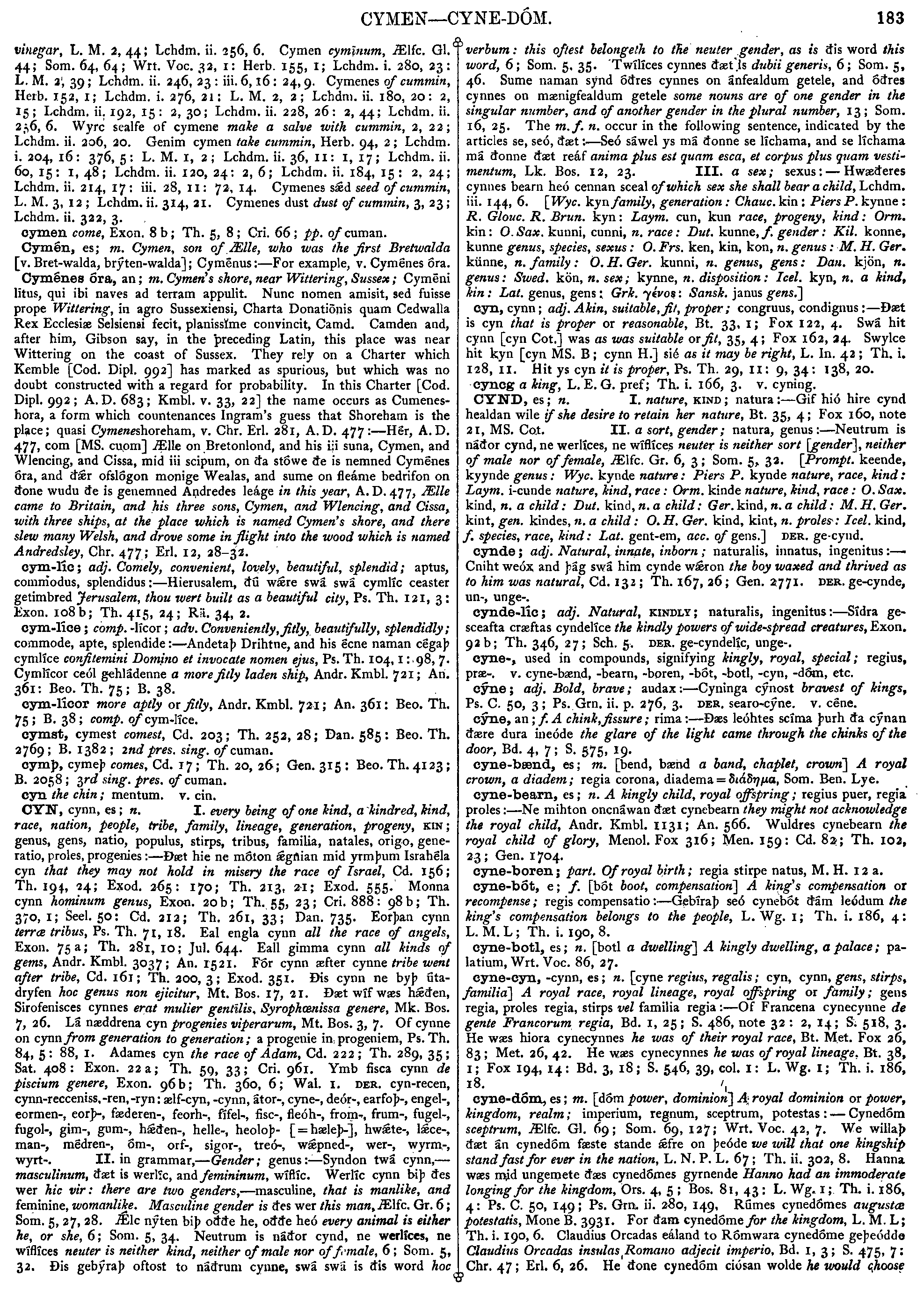
CYN,
cynn,
es;
n.
I.
every
being
of
one
kind,
a
kindred,
kind,
race,
nation,
people,
tribe,
family,
lineage,
generation,
progeny,
KIN;
genus,
gens,
natio,
populus,
stirps,
tribus,
familia,
natales,
origo,
generatio,
proles,
progenies
:--
Ðæt
hie
ne
móton
gnian
mid
yrmþum
Israhéla
cyn
that
they
may
not
hold
in
misery
the
race
of
Israel,
Cd.
156;
Th.
194,
24;
Exod.
265:
170;
Th.
213,
21;
Exod.
555.
Monna
cynn
hominum
genus,
Exon.
20b;
Th.
55,
23;
Cri.
888:
98b;
Th.
370,
1;
Seel.
50:
Cd.
212;
Th.
261,
33;
Dan.
735.
Eorþan
cynn
terræ
tribus,
Ps.
Th.
71,
18.
Eal
engla
cynn
all
the
race
of
angels,
Exon.
75a;
Th.
281,
10;
Jul.
644.
Eall
gimma
cynn
all
kinds
of
gems,
Andr.
Kmbl.
3037;
An.
1521.
Fór
cynn
æfter
cynne
tribe
went
after
tribe,
Cd.
161;
Th.
200,
3;
Exod.
351.
Ðis
cynn
ne
byþ
útadryfen
hoc
genus
non
ejicitur,
Mt.
Bos.
17,
21.
Ðæt
wíf
wæs
hðen,
Sirofenisces
cynnes
erat
mulier
gentlis,
Syrophœnissa
UNCERTAIN
genere,
Mk.
Bos.
7,
26.
Lá
næddrena
cyn
progenies
viperarum,
Mt.
Bos.
3,
7.
Of
cynne
on
cynn
from
generation
to
generation;
a
progenie
in,
progeniem,
Ps.
Th.
84,
5:
88,
1.
Adames
cyn
the
race
of
Adam,
Cd.
222;
Th.
289,
35;
Sat.
408:
Exon.
22a;
Th.
59,
33;
Cri.
961.
Ymb
fisca
cynn
de
piscium
genere,
Exon.
96b;
Th.
360,
6;
Wal.
1.
DER.
cyn-recen,
cynn-recceniss,
-ren,
-ryn:
ælf-cyn,
-cynn,
átor-,
cyne-,
deór-,
earfoþ-,
engel-,
eormen-,
eorþ-,
fæderen-,
feorh-,
fífel-,
fisc-,
fleóh-,
from-,
frum-,
fugel-,
fugol-,
gim-,
gum-,
hðen-,
helle-,
heoloþ-
[
=
hæleþ-],
hwte-,
lce-,
man-,
médren-,
óm-,
orf-,
sigor-,
treó-,
wpned-,
wer-,
wyrm-,
wyrt-.
II.
in
grammar,
--
Gender;
genus
:--
Syndon
twá
cynn,
--
masculinum,
ðæt
is
werlíc,
and
femininum,
wíflíc.
Werlíc
cynn
biþ
ðes
wer
hic
vir:
there
are
two
genders,
--
masculine,
that
is
manlike,
and
feminine,
womanlike.
Masculine
gender
is
ðes
wer
this
man,
Ælfc.
Gr.
6;
Som.
5,
27,
28.
Æ-acute;lc
nýten
biþ
oððe
he,
oððe
heó
every
animal
is
either
he,
or
she,
6;
Som.
5,
34.
Neutrum
is
náðor
cynd,
ne
werlíces,
ne
wíflíces
neuter
is
neither
kind,
neither
of
male
nor
of
female,
6;
Som.
5,
32.
Ðis
gebýraþ
oftost
to
náðrum
cynne,
swá
swá
is
ðis
word
hoc
verbum:
this
oftest
belongeth
to
the
neuter
gender,
as
is
ðis
word
this
word,
6;
Som.
5.
35.
Twílíces
cynnes
ðæt
Is
ILLEGIBLE
dubii
generis,
6;
Som.
5,
46.
Sume
naman
synd
óðres
cynnes
on
ánfealdum
getele,
and
óðres
cynnes
on
mænigfealdum
getele
some
nouns
are
of
one
gender
in
the
singular
number,
and
of
another
gender
in
the
plural
number,
13;
Som.
16,
25.
The
m.
f.
n.
occur
in
the
following
sentence,
indicated
by
the
articles
se,
seó,
ðæt
:--
Seó
sáwel
ys
má
ðonne
se
líchama,
and
se
líchama
má
ðonne
ðæt
reáf
anima
plus
est
guam
esca,
et
corpus
plus
quam
vestimentum,
Lk.
Bos.
12,
23.
III.
a
sex;
sexus
:--
Hwæðeres
cynnes
bearn
heó
cennan
sceal
of
which
sex
she
shall
bear
a
child,
Lchdm.
iii.
144,
6.
[Wyc.
kyn
family,
generation:
Chauc.
kin:
Piers
P.
kynne:
R.
Glouc.
R.
Brun.
kyn:
Laym.
cun,
kun
race,
progeny,
kind:
Orm.
kin:
O.
Sax.
kunni,
cunni,
n.
race:
Dut.
kunne,
f.
gender:
Kil.
konne,
kunne
genus,
species,
sexus:
O.
Frs.
ken,
kin,
kon,
n.
genus:
M.
H.
Ger.
künne,
n.
family:
O.
H.
Ger.
kunni,
n.
genus,
gens:
Dan.
kjön,
n.
genus:
Swed.
kön,
n.
sex;
kynne,
n.
disposition:
Icel.
kyn,
n.
a
kind,
kin:
Lat.
genus,
gens;
Grk.
GREEK
:
Sansk.
janus
gens.]
|
Source: Bosworth/Toller, page b0185, entry 9 View original page image as: [TIFF] [PNG] [View previous entry] [View next entry] |
[Comment on this entry] [View comments] |
The following entry has been hand-corrected once. |
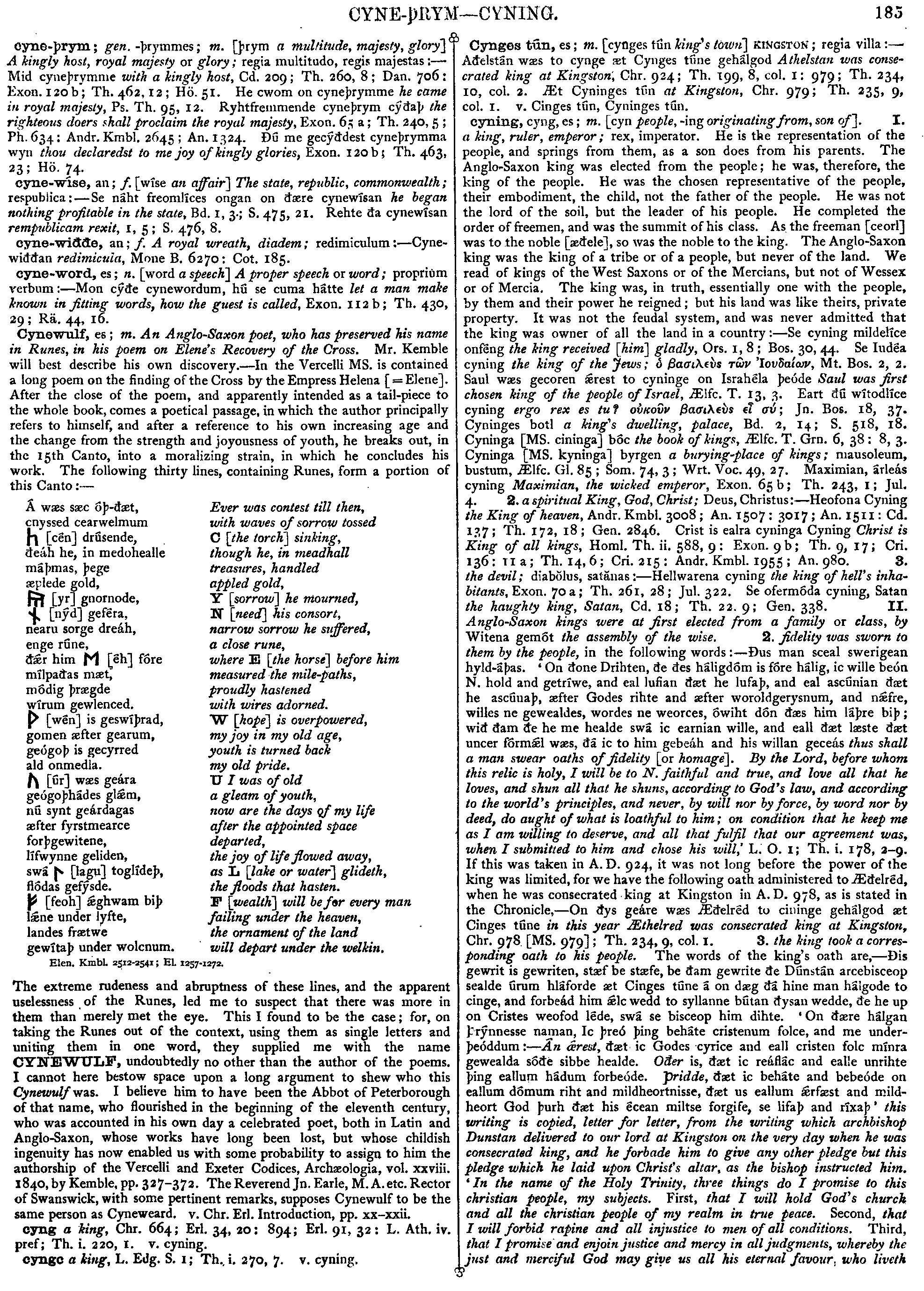
cyning,
cyng,
es;
m.
[cyn
people,
-ing
originating
from,
son
of].
I.
a
king,
ruler,
emperor;
rex,
imperator.
He
is
the
representation
of
the
people,
and
springs
from
them,
as
a
son
does
from
his
parents.
The
Anglo-Saxon
king
was
elected
from
the
people;
he
was,
therefore,
the
king
of
the
people.
He
was
the
chosen
representative
of
the
people,
their
embodiment,
the
child,
not
the
father
of
the
people.
He
was
not
the
lord
of
the
soil,
but
the
leader
of
his
people.
He
completed
the
order
of
freemen,
and
was
the
summit
of
his
class.
As
the
freeman
[ceorl]
was
to
the
noble
[æðele],
so
was
the
noble
to
the
king.
The
Anglo-Saxon
king
was
the
king
of
a
tribe
or
of
a
people,
but
never
of
the
land.
We
read
of
kings
of
the
West
Saxons
or
of
the
Mercians,
but
not
of
Wessex
or
of
Mercia.
The
king
was,
in
truth,
essentially
one
with
the
people,
by
them
and
their
power
he
reigned;
but
his
land
was
like
theirs,
private
property.
It
was
not
the
feudal
system,
and
was
never
admitted
that
the
king
was
owner
of
all
the
land
in
a
country
:--
Se
cyning
mildelíce
onféng
the
king
received
[him]
gladly,
Ors.
1,
8;
Bos.
30,
44.
Se
Iudéa
cyning
the
king
of
the
Jews;
&omicron-tonos;


 &upsilon-tonos;s


 'Io
'Io
 &iota-tonos;
 ,
Mt.
Bos.
2,
2.
Saul
wæs
gecoren
rest
to
cyninge
on
Israhéla
þeóde
Saul
was
first
chosen
king
of
the
people
of
Israel,
Ælfc.
T.
13,
3.
Eart
ðú
wítodlíce
cyning
ergo
rex
es
tu?
o&upsilon-tonos;
,
Mt.
Bos.
2,
2.
Saul
wæs
gecoren
rest
to
cyninge
on
Israhéla
þeóde
Saul
was
first
chosen
king
of
the
people
of
Israel,
Ælfc.
T.
13,
3.
Eart
ðú
wítodlíce
cyning
ergo
rex
es
tu?
o&upsilon-tonos; oû
&upsilon-tonos;s
&iota-tonos;
&upsilon-tonos;;
Jn.
Bos.
18,
37.
Cyninges
botl
a
king's
dwelling,
palace,
Bd.
2,
14;
S.
518,
18.
Cyninga
[MS.
cininga]
bóoc
the
book
of
kings,
Ælfc.
T.
Grn.
6,
38
:
8,
3.
Cyninga
[MS.
kyninga]
byrgen
a
burying-place
of
kings;
mausoleum,
bustum,
Ælfc.
Gl.
85;
Som.
74,
3;
Wrt.
Voc.
49,
27.
Maximian,
árleás
cyning
Maximian,
the
wicked
emperor,
Exon.
65
b;
Th.
243,
1;
Jul.
4.
2.
a
spiritual
King,
God,
Christ;
Deus,
Christus
:--
Heofona
Cyning
the
King
of
heaven,
Andr.
Kmbl.
3008;
An.
1507
:
3017;
An.
1511
:
Cd.
137;
Th.
172,
18;
Gen.
2846.
Crist
is
ealra
cyninga
Cyning
Christ
is
King
of
all
kings,
Homl.
Th.
ii.
588,
9
:
Exon.
9
b;
Th.
9,
17;
Cri.
136
:
11
a;
Th.
14,
6;
Cri.
215
:
Andr.
Kmbl.
1955;
An.
980.
3.
the
devil;
diab
oû
&upsilon-tonos;s
&iota-tonos;
&upsilon-tonos;;
Jn.
Bos.
18,
37.
Cyninges
botl
a
king's
dwelling,
palace,
Bd.
2,
14;
S.
518,
18.
Cyninga
[MS.
cininga]
bóoc
the
book
of
kings,
Ælfc.
T.
Grn.
6,
38
:
8,
3.
Cyninga
[MS.
kyninga]
byrgen
a
burying-place
of
kings;
mausoleum,
bustum,
Ælfc.
Gl.
85;
Som.
74,
3;
Wrt.
Voc.
49,
27.
Maximian,
árleás
cyning
Maximian,
the
wicked
emperor,
Exon.
65
b;
Th.
243,
1;
Jul.
4.
2.
a
spiritual
King,
God,
Christ;
Deus,
Christus
:--
Heofona
Cyning
the
King
of
heaven,
Andr.
Kmbl.
3008;
An.
1507
:
3017;
An.
1511
:
Cd.
137;
Th.
172,
18;
Gen.
2846.
Crist
is
ealra
cyninga
Cyning
Christ
is
King
of
all
kings,
Homl.
Th.
ii.
588,
9
:
Exon.
9
b;
Th.
9,
17;
Cri.
136
:
11
a;
Th.
14,
6;
Cri.
215
:
Andr.
Kmbl.
1955;
An.
980.
3.
the
devil;
diab lus,
sat
lus,
sat nas
:--
Hellwarena
cyning
the
king
of
hell's
inhabitants,
Exon.
70
a;
Th.
261,
28;
Jul.
322.
Se
ofermóda
cyning,
Satan
the
haughty
king,
Satan,
Cd.
18;
Th.
22,
9;
Gen.
338.
II.
Anglo-Saxon
kings
were
at
first
elected
from
a
family
or
class,
by
Witena
gemót
the
assembly
of
the
wise.
2.
fidelity
was
sworn
to
them
by
the
people,
in
the
following
words
:--
Ðus
man
sceal
swerigean
hyld-áþas.
'On
ðone
Drihten,
ðe
ðes
háligdóm
is
fóre
hálig,
ic
wille
beón
N.
hold
and
getríwe,
and
eal
lufian
ðæt
he
lufaþ,
and
eal
ascúnian
ðæt
he
ascúnaþ,
æfter
Godes
rihte
and
æfter
woroldgerysnum,
and
nfre,
willes
ne
gewealdes,
wordes
ne
weorces,
ówiht
dón
ðæs
him
láþre
biþ;
wið
ðam
ðe
he
me
healde
swá
ic
earnian
wille,
and
eall
ðæt
læste
ðæt
uncer
fórml
wæs,
ðá
ic
to
him
gebeáh
and
his
willan
geceás
thus
shall
a
man
swear
oaths
of
fidelity
[or
homage].
By
the
Lord,
before
whom
this
relic
is
holy,
I
will
be
to
N.
faithful
and
true,
and
love
all
that
he
loves,
and
shun
all
that
he
shuns,
according
to
God's
law,
and
according
to
the
world's
principles,
and
never,
by
will
nor
by
force,
by
word
nor
by
deed,
do
aught
of
what
is
loathful
to
him;
on
condition
that
he
keep
me
as
I
am
willing
to
deserve,
and
all
that
fulfil
that
our
agreement
was,
when
I
submitted
to
him
and
chose
his
will,'
L.
O.
1;
Th.
i.
178,
2-9.
If
this
was
taken
in
A.
D.
924,
it
was
not
long
before
the
power
of
the
king
was
limited,
for
we
have
the
following
oath
administered
to
Æðelréd,
when
he
was
consecrated
king
at
Kingston
in
A.
D.
978,
as
is
stated
in
the
Chronicle,
-
On
ðys
geáre
wæs
Æðelréd
to
cininge
gehálgod
æt
Cinges
túne
in
this
year
Æthelred
was
consecrated
king
at
Kingston,
Chr.
978.
[MS.
979];
Th.
234,
9,
col.
1.
3.
the
king
took
a
corresponding
oath
to
his
people.
The
words
of
the
king's
oath
are,
-
Ðis
gewrit
is
gewriten,
stæf
be
stæfe,
be
ðam
gewrite
ðe
Dúnstán
arcebisceop
sealde
úrum
hláforde
æt
Cinges
túne
á
on
dæg
ðá
hine
man
hálgode
to
cinge,
and
forbeád
him
lc
wedd
to
syllanne
bútan
ðysan
wedde,
ðe
he
up
on
Cristes
weofod
léde,
swá
se
bisceop
him
dihte.
'On
ðære
hálgan
Þrýnnesse
naman,
Ic
þreó
þing
beháte
cristenum
folce,
and
me
underþeóddum
:--
Án
rest,
ðæt
ic
Godes
cyrice
and
eall
cristen
folc
mínra
gewealda
sóðe
sibbe
healde.
Oðer
is,
ðæt
ic
reáflác
and
ealle
unrihte
þing
eallum
hádum
forbeóde.
Þridde,
ðæt
ic
beháte
and
bebeóde
on
eallum
dómum
riht
and
mildheortnisse,
ðæt
us
eallum
rfæst
and
mildheort
God
þurh
ðæt
his
écean
miltse
forgife,
se
lifaþ
and
ríxaþ'
this
writing
is
copied,
letter
for
letter,
from
the
writing
which
archbishop
Dunstan
delivered
to
our
lord
at
Kingston
on
the
very
day
when
he
was
consecrated
king,
and
he
forbade
him
to
give
any
other
pledge
but
this
pledge
which
he
laid
upon
Christ's
altar,
as
the
bishop
instructed
him.
'In
the
name
of
the
Holy
Trinity,
three
things
do
I
promise
to
this
christian
people,
my
subjects.
First,
that
I
will
hold
God's
church
and
all
the
christian
people
of
my
realm
in
true
peace.
Second,
that
I
will
forbid
rapine
and
all
injustice
to
men
of
all
conditions.
Third,
that
I
promise
and
enjoin
justice
and
mercy
in
all
judgments,
whereby
the
just
and
merciful
God
may
give
us
all
his
eternal
favour,
who
liveth
and
reigneth,'
Relq.
Ant.
W.
ii.
194.
4.
from
the
freedom
with
which
the
educated
spoke
of
the
Doom's
Day
Survey
of
William
the
Conquerer,
indicating
their
love
of
freedom,
we
have
no
reason
to
suppose
this
oath
was
the
first
oath
taken
by
kings
in
our
limited
monarchy.
The
spirit
of
the
monks
may
be
seen
in
the
following
extract
from
the
Chronicle
:--
Willelm,
Engla
landes
cyng,
ðe
ðá
wæs
sittende
on
Normandige,
forðig
he
áhte
gðer
ge
Engla
land
ge
Normandige
.
.
.
sende
ðá
ofer
eall
Engla
land
into
lcere
scíre
his
men
.
.
.
Swá
swýðe
nearwelíce
he
hit
lett
út
aspyrian,
ðæt
næs
án
lpig
híde,
ne
án
gyrde
landes,
ne,
furðon,
hit
is
sceame
to
tellanne,
ac
hit
ne
þuhte
him
nán
sceame
to
dónne,
án
oxa
[MS.
oxe],
ne
án
cú,
ne
án
swín
næs
belyfon,
ðæt
næs
gesæt
on
his
gewrite,
and
ealle
ða
gewrita
wron
gebroht
to
him
syððan
William,
king
of
England,
who
was
then
resident
in
Normandy,
for
he
owned
both
England
and
Normandy
.
.
.
then
sent
his
men
over
all
England
into
each
shire
.
.
.
So
very
narrowly
did
he
commission
them
to
trace
it
out,
that
there
was
not
one
single
hide,
nor
a
rood
of
land,
nay,
moreover,
it
is
shameful
to
tell,
though
he
thought
it
no
shame
to
do
it,
not
an
ox,
nor
a
cow,
nor
a
swine
was
left,
that
was
not
set
down
in
his
writ,
and
all
the
recorded
particulars
were
afterwards
brought
to
him,
Chr.
1085;
Erl.
218,
2-4
.
.
.
24,
25
.
.
.
33-38.
5.
the
Anglo-Saxon
king
had
royal
power
to
pardon
transgressors
:--
Gif
hwá
in
cyninges
healle
gefeohte,
oððe
his
wpn
gebrede,
and
hine
mon
gefó;
sié
ðæt
on
cyninges
dóme,
swá
deáþ,
swá
líf,
swá
he
him
forgifan
wille
if
any
one
fight
in
the
king's
hall,
or
draw
his
weapon,
and
he
be
taken;
be
it
in
the
king's
power,
either
death
or
life,
or
pardon,
L.
Alf.
pol.
7;
Th.
i.
66,
8,
9.
Sié
on
cyninges
dóme
hwæðer
he
líf
áge
ðe
náge
be
it
in
the
king's
power
whether
he
shall
or
shall
not
have
life,
L.
In.
6;
Th.
i.
106,
3,
4.
Búton
him
cyning
[MS.
kyning]
árian
wille
unless
the
king
will
be
merciful
to
him,
36;
Th.
i.
124,
19.
Ðæt
he
wre
his
feores
scyldig,
búton
he
cyng
gesóhte,
and
he
him
his
feorh
forgifan
wolde;
eall
swá
hit
r
æt
Greátan
leá
and
æt
Exan
ceastre
and
æt
Þunres
felda
gecweden
wæs
that
he
should
be
liable
in
his
life,
unless
he
should
flee
to
the
king,
and
he
should
give
him
his
life;
all
as
it
was
before
ordained
at
Greatley
and
at
Exeter
and
at
Thundersfield,
L.
Ath.
v.
§
1,
4;
Th.
i.
230,
6-9
:
L.
Edm.
S.
6;
Th.
i.
250,
11
:
L.
Edg.
ii.
7;
Th.
i.
268,
24,
25
:
L.
Eth.
iii.
16;
Th.
i.
298,
14
:
vii.
9;
Th.
i.
330,
24.
6.
of
all
forfeits
the
king
had
one
half
-
to
healfum
:--
Fó
se
cyng
to
healfum,
-
to
healfum
ða
men
ðe
on
ðære
ráde
beón
let
the
king
take
possession
of
half,
of
[the
other]
half
the
men,
who
may
be
in
the
riding
[shall
take
possession],
L.
Ath.
i.
20;
Th.
i.
210,
6,
7.
7.
treasure-trove,
or
treasure
or
money
found,
of
which
the
owner
was
unknown,
belonged
to
the
king.
It
is
designated
in
Anglo-Saxon
charters
by
the
words
-
ealle
hordas
búfan
eorþan,
and
binnan
eorþan
all
hoards
above
the
earth,
and
within
the
earth.
As
we
learn
from
Beowulf,
in
early
and
heathen
times,
much
treasure
was
buried
in
the
mound
raised
over
the
ashes
of
the
dead,
besides
what
was
burned
with
the
body
:--
Hí
on
beorg
dydon
bégas
[MS.
beg]
and
siglu,
forléton
eorla
gestreón
eorþan
healdan,
gold
on
greóte,
ðr
hit
nú
gén
lífaþ
yldum
swá
unnyt
swá
hit
r
wæs
they
placed
rings
and
jewels
in
the
mound,
they
left
the
treasure
of
earls
to
the
earth
to
hold,
gold
in
the
dust,
where
it
now
yet
remains
as
useless
to
men
as
it
was
before,
Beo.
Th.
6307-6318;
B.
3164-3169.
The
legend
of
Guthlac
[about
A.
D.
700,
v.
Crúland]
supplies
a
very
early
instance
of
the
search
for
gold
and
silver
in
the
mounds
:--
Wæs
ðr
on
ðam
eálande
sum
hláw
mycel
ofer
eorþan
geworht,
ðone
ylcan
men
iú
geára
for
feós
wilnunga
gedulfon
and
brcon
:
ðá
wæs
ðr
on
óðre
sídan
ðæs
hláwes
gedolfen
swylce
mycel
wæterseáþ
wre
there
was
on
the
island
a
great
mound
raised
upon
the
earth,
which
some,
men
of
yore
had
dug
and
broken
up
in
hopes
of
treasure
:
then
there
was
dug
up
on
the
other
side
of
the
mound
as
it
were
a
great
water-pit,
Guthl.
4;
Gdwin.
26,
4-8.
8.
Pastus
or
Convivium
=
Cyninges
feorm.
The
king
visited
different
districts
personally
or
by
deputy
to
see
that
justice
was
done
to
all
his
subjects.
In
these
periodical
journeys
the
king
received
support
and
entertainment
wherever
he
went.
Hence
perhaps
the
privileges
of
our
judges.
In
A.
D.
814
Cénwulf
released
the
bishop
of
Worcester
from
a
pastus
of
twelve
men,
whom
he
was
bound
to
find.
This
was
so
great
an
expense
that
the
exemption
was
worth
an
estate
of
thirteen
hides,
v.
Cod.
Dipl.
203;
A.D.
814;
Kmbl.
i.
256.
9.
Vigilia
=
heáfodweard
head
ward,
or
a
proper
watch
set
over
the
king,
which
he
claimed
when
he
came
into
any
district.
The
sweard
or
coast
guard
was
also
a
regal
right,
performed
by
the
tenants
of
those
land
owners
whose
estates
lay
contiguous
to
the
sea.
10.
the
mint
or
coinage
of
money.
The
king
exercised
a
superintendence
over
the
circulating
medium.
Æðelrd
not
only
enacted
that
there
should
be
no
moneyers
besides
the
king's,
but
that
their
number
should
be
diminished
:--
Nán
man
ne
áge
nnne
mynetere
búton
cyng
let
no
man
have
a
moneyer
except
the
king,
L.
Eth.
iii.
8;
Th.
i.
296,
15.
Ut
monetarii
pauciores
sint
quam
antea
fuerint,
iv.
9;
Th.
i.
303,
2.
11.
the
grant
of
a
market,
with
power
to
levy
tolls,
was
also
a
royalty,
Cod.
Dipl.
1075;
A.
D.
873-899;
Kmbl.
v.
142
:
1084;
A.
D.
904;
Kmbl.
v.
157.
v.
The
Rights
of
Anglo-Saxon
Kings,
explained
more
fully
in
Kemble's
Saxons
in
England,
2
vols.
8vo.
1849.
Bk.
ii.
chap.
2;
vol.
ii.
pp.
29-103.
[Prompt.
kynge
:
Wyc.
kyng
:
Piers
P.
Chauc.
king
:
R.
Glouc.
kyng
:
Laym.
Orm.
king
:
Plat.
könig
:
O.
Sax.
kuning,
cunig,
m
:
Frs.
kening
:
O.
Frs.
kining,
kinig,
kening,
keneng,
koning
:
Dut.
koning,
m
:
Kil.
koningh,
m
:
Ger.
könig,
m
:
M.
H.
Ger.
künic,
künec,
künc,
m
:
O.
H.
Ger.
kuning,
m
:
Dan.
konning,
konge,
m
:
Swed.
konung,
kong,
kung,
m
:
Icel.
konungr,
kóngr,
m
:
Lett.
kungs
dominus.]
DER.
æðel-cyning,
Angel-,
beorn-,
brýten-,
eorþ-,
éðel-,
folc-,
gást-,
geár-,
gúþ-,
hðen-,
heáh-,
heofon-,
leód-,
mægen-,
ródor-,
s-,
segn-,
self-,
sige-,
sóþ-,
swegl-,
þeóð-,
þrym-,
þryþ-,
woruld-,
wuldor-.
nas
:--
Hellwarena
cyning
the
king
of
hell's
inhabitants,
Exon.
70
a;
Th.
261,
28;
Jul.
322.
Se
ofermóda
cyning,
Satan
the
haughty
king,
Satan,
Cd.
18;
Th.
22,
9;
Gen.
338.
II.
Anglo-Saxon
kings
were
at
first
elected
from
a
family
or
class,
by
Witena
gemót
the
assembly
of
the
wise.
2.
fidelity
was
sworn
to
them
by
the
people,
in
the
following
words
:--
Ðus
man
sceal
swerigean
hyld-áþas.
'On
ðone
Drihten,
ðe
ðes
háligdóm
is
fóre
hálig,
ic
wille
beón
N.
hold
and
getríwe,
and
eal
lufian
ðæt
he
lufaþ,
and
eal
ascúnian
ðæt
he
ascúnaþ,
æfter
Godes
rihte
and
æfter
woroldgerysnum,
and
nfre,
willes
ne
gewealdes,
wordes
ne
weorces,
ówiht
dón
ðæs
him
láþre
biþ;
wið
ðam
ðe
he
me
healde
swá
ic
earnian
wille,
and
eall
ðæt
læste
ðæt
uncer
fórml
wæs,
ðá
ic
to
him
gebeáh
and
his
willan
geceás
thus
shall
a
man
swear
oaths
of
fidelity
[or
homage].
By
the
Lord,
before
whom
this
relic
is
holy,
I
will
be
to
N.
faithful
and
true,
and
love
all
that
he
loves,
and
shun
all
that
he
shuns,
according
to
God's
law,
and
according
to
the
world's
principles,
and
never,
by
will
nor
by
force,
by
word
nor
by
deed,
do
aught
of
what
is
loathful
to
him;
on
condition
that
he
keep
me
as
I
am
willing
to
deserve,
and
all
that
fulfil
that
our
agreement
was,
when
I
submitted
to
him
and
chose
his
will,'
L.
O.
1;
Th.
i.
178,
2-9.
If
this
was
taken
in
A.
D.
924,
it
was
not
long
before
the
power
of
the
king
was
limited,
for
we
have
the
following
oath
administered
to
Æðelréd,
when
he
was
consecrated
king
at
Kingston
in
A.
D.
978,
as
is
stated
in
the
Chronicle,
-
On
ðys
geáre
wæs
Æðelréd
to
cininge
gehálgod
æt
Cinges
túne
in
this
year
Æthelred
was
consecrated
king
at
Kingston,
Chr.
978.
[MS.
979];
Th.
234,
9,
col.
1.
3.
the
king
took
a
corresponding
oath
to
his
people.
The
words
of
the
king's
oath
are,
-
Ðis
gewrit
is
gewriten,
stæf
be
stæfe,
be
ðam
gewrite
ðe
Dúnstán
arcebisceop
sealde
úrum
hláforde
æt
Cinges
túne
á
on
dæg
ðá
hine
man
hálgode
to
cinge,
and
forbeád
him
lc
wedd
to
syllanne
bútan
ðysan
wedde,
ðe
he
up
on
Cristes
weofod
léde,
swá
se
bisceop
him
dihte.
'On
ðære
hálgan
Þrýnnesse
naman,
Ic
þreó
þing
beháte
cristenum
folce,
and
me
underþeóddum
:--
Án
rest,
ðæt
ic
Godes
cyrice
and
eall
cristen
folc
mínra
gewealda
sóðe
sibbe
healde.
Oðer
is,
ðæt
ic
reáflác
and
ealle
unrihte
þing
eallum
hádum
forbeóde.
Þridde,
ðæt
ic
beháte
and
bebeóde
on
eallum
dómum
riht
and
mildheortnisse,
ðæt
us
eallum
rfæst
and
mildheort
God
þurh
ðæt
his
écean
miltse
forgife,
se
lifaþ
and
ríxaþ'
this
writing
is
copied,
letter
for
letter,
from
the
writing
which
archbishop
Dunstan
delivered
to
our
lord
at
Kingston
on
the
very
day
when
he
was
consecrated
king,
and
he
forbade
him
to
give
any
other
pledge
but
this
pledge
which
he
laid
upon
Christ's
altar,
as
the
bishop
instructed
him.
'In
the
name
of
the
Holy
Trinity,
three
things
do
I
promise
to
this
christian
people,
my
subjects.
First,
that
I
will
hold
God's
church
and
all
the
christian
people
of
my
realm
in
true
peace.
Second,
that
I
will
forbid
rapine
and
all
injustice
to
men
of
all
conditions.
Third,
that
I
promise
and
enjoin
justice
and
mercy
in
all
judgments,
whereby
the
just
and
merciful
God
may
give
us
all
his
eternal
favour,
who
liveth
and
reigneth,'
Relq.
Ant.
W.
ii.
194.
4.
from
the
freedom
with
which
the
educated
spoke
of
the
Doom's
Day
Survey
of
William
the
Conquerer,
indicating
their
love
of
freedom,
we
have
no
reason
to
suppose
this
oath
was
the
first
oath
taken
by
kings
in
our
limited
monarchy.
The
spirit
of
the
monks
may
be
seen
in
the
following
extract
from
the
Chronicle
:--
Willelm,
Engla
landes
cyng,
ðe
ðá
wæs
sittende
on
Normandige,
forðig
he
áhte
gðer
ge
Engla
land
ge
Normandige
.
.
.
sende
ðá
ofer
eall
Engla
land
into
lcere
scíre
his
men
.
.
.
Swá
swýðe
nearwelíce
he
hit
lett
út
aspyrian,
ðæt
næs
án
lpig
híde,
ne
án
gyrde
landes,
ne,
furðon,
hit
is
sceame
to
tellanne,
ac
hit
ne
þuhte
him
nán
sceame
to
dónne,
án
oxa
[MS.
oxe],
ne
án
cú,
ne
án
swín
næs
belyfon,
ðæt
næs
gesæt
on
his
gewrite,
and
ealle
ða
gewrita
wron
gebroht
to
him
syððan
William,
king
of
England,
who
was
then
resident
in
Normandy,
for
he
owned
both
England
and
Normandy
.
.
.
then
sent
his
men
over
all
England
into
each
shire
.
.
.
So
very
narrowly
did
he
commission
them
to
trace
it
out,
that
there
was
not
one
single
hide,
nor
a
rood
of
land,
nay,
moreover,
it
is
shameful
to
tell,
though
he
thought
it
no
shame
to
do
it,
not
an
ox,
nor
a
cow,
nor
a
swine
was
left,
that
was
not
set
down
in
his
writ,
and
all
the
recorded
particulars
were
afterwards
brought
to
him,
Chr.
1085;
Erl.
218,
2-4
.
.
.
24,
25
.
.
.
33-38.
5.
the
Anglo-Saxon
king
had
royal
power
to
pardon
transgressors
:--
Gif
hwá
in
cyninges
healle
gefeohte,
oððe
his
wpn
gebrede,
and
hine
mon
gefó;
sié
ðæt
on
cyninges
dóme,
swá
deáþ,
swá
líf,
swá
he
him
forgifan
wille
if
any
one
fight
in
the
king's
hall,
or
draw
his
weapon,
and
he
be
taken;
be
it
in
the
king's
power,
either
death
or
life,
or
pardon,
L.
Alf.
pol.
7;
Th.
i.
66,
8,
9.
Sié
on
cyninges
dóme
hwæðer
he
líf
áge
ðe
náge
be
it
in
the
king's
power
whether
he
shall
or
shall
not
have
life,
L.
In.
6;
Th.
i.
106,
3,
4.
Búton
him
cyning
[MS.
kyning]
árian
wille
unless
the
king
will
be
merciful
to
him,
36;
Th.
i.
124,
19.
Ðæt
he
wre
his
feores
scyldig,
búton
he
cyng
gesóhte,
and
he
him
his
feorh
forgifan
wolde;
eall
swá
hit
r
æt
Greátan
leá
and
æt
Exan
ceastre
and
æt
Þunres
felda
gecweden
wæs
that
he
should
be
liable
in
his
life,
unless
he
should
flee
to
the
king,
and
he
should
give
him
his
life;
all
as
it
was
before
ordained
at
Greatley
and
at
Exeter
and
at
Thundersfield,
L.
Ath.
v.
§
1,
4;
Th.
i.
230,
6-9
:
L.
Edm.
S.
6;
Th.
i.
250,
11
:
L.
Edg.
ii.
7;
Th.
i.
268,
24,
25
:
L.
Eth.
iii.
16;
Th.
i.
298,
14
:
vii.
9;
Th.
i.
330,
24.
6.
of
all
forfeits
the
king
had
one
half
-
to
healfum
:--
Fó
se
cyng
to
healfum,
-
to
healfum
ða
men
ðe
on
ðære
ráde
beón
let
the
king
take
possession
of
half,
of
[the
other]
half
the
men,
who
may
be
in
the
riding
[shall
take
possession],
L.
Ath.
i.
20;
Th.
i.
210,
6,
7.
7.
treasure-trove,
or
treasure
or
money
found,
of
which
the
owner
was
unknown,
belonged
to
the
king.
It
is
designated
in
Anglo-Saxon
charters
by
the
words
-
ealle
hordas
búfan
eorþan,
and
binnan
eorþan
all
hoards
above
the
earth,
and
within
the
earth.
As
we
learn
from
Beowulf,
in
early
and
heathen
times,
much
treasure
was
buried
in
the
mound
raised
over
the
ashes
of
the
dead,
besides
what
was
burned
with
the
body
:--
Hí
on
beorg
dydon
bégas
[MS.
beg]
and
siglu,
forléton
eorla
gestreón
eorþan
healdan,
gold
on
greóte,
ðr
hit
nú
gén
lífaþ
yldum
swá
unnyt
swá
hit
r
wæs
they
placed
rings
and
jewels
in
the
mound,
they
left
the
treasure
of
earls
to
the
earth
to
hold,
gold
in
the
dust,
where
it
now
yet
remains
as
useless
to
men
as
it
was
before,
Beo.
Th.
6307-6318;
B.
3164-3169.
The
legend
of
Guthlac
[about
A.
D.
700,
v.
Crúland]
supplies
a
very
early
instance
of
the
search
for
gold
and
silver
in
the
mounds
:--
Wæs
ðr
on
ðam
eálande
sum
hláw
mycel
ofer
eorþan
geworht,
ðone
ylcan
men
iú
geára
for
feós
wilnunga
gedulfon
and
brcon
:
ðá
wæs
ðr
on
óðre
sídan
ðæs
hláwes
gedolfen
swylce
mycel
wæterseáþ
wre
there
was
on
the
island
a
great
mound
raised
upon
the
earth,
which
some,
men
of
yore
had
dug
and
broken
up
in
hopes
of
treasure
:
then
there
was
dug
up
on
the
other
side
of
the
mound
as
it
were
a
great
water-pit,
Guthl.
4;
Gdwin.
26,
4-8.
8.
Pastus
or
Convivium
=
Cyninges
feorm.
The
king
visited
different
districts
personally
or
by
deputy
to
see
that
justice
was
done
to
all
his
subjects.
In
these
periodical
journeys
the
king
received
support
and
entertainment
wherever
he
went.
Hence
perhaps
the
privileges
of
our
judges.
In
A.
D.
814
Cénwulf
released
the
bishop
of
Worcester
from
a
pastus
of
twelve
men,
whom
he
was
bound
to
find.
This
was
so
great
an
expense
that
the
exemption
was
worth
an
estate
of
thirteen
hides,
v.
Cod.
Dipl.
203;
A.D.
814;
Kmbl.
i.
256.
9.
Vigilia
=
heáfodweard
head
ward,
or
a
proper
watch
set
over
the
king,
which
he
claimed
when
he
came
into
any
district.
The
sweard
or
coast
guard
was
also
a
regal
right,
performed
by
the
tenants
of
those
land
owners
whose
estates
lay
contiguous
to
the
sea.
10.
the
mint
or
coinage
of
money.
The
king
exercised
a
superintendence
over
the
circulating
medium.
Æðelrd
not
only
enacted
that
there
should
be
no
moneyers
besides
the
king's,
but
that
their
number
should
be
diminished
:--
Nán
man
ne
áge
nnne
mynetere
búton
cyng
let
no
man
have
a
moneyer
except
the
king,
L.
Eth.
iii.
8;
Th.
i.
296,
15.
Ut
monetarii
pauciores
sint
quam
antea
fuerint,
iv.
9;
Th.
i.
303,
2.
11.
the
grant
of
a
market,
with
power
to
levy
tolls,
was
also
a
royalty,
Cod.
Dipl.
1075;
A.
D.
873-899;
Kmbl.
v.
142
:
1084;
A.
D.
904;
Kmbl.
v.
157.
v.
The
Rights
of
Anglo-Saxon
Kings,
explained
more
fully
in
Kemble's
Saxons
in
England,
2
vols.
8vo.
1849.
Bk.
ii.
chap.
2;
vol.
ii.
pp.
29-103.
[Prompt.
kynge
:
Wyc.
kyng
:
Piers
P.
Chauc.
king
:
R.
Glouc.
kyng
:
Laym.
Orm.
king
:
Plat.
könig
:
O.
Sax.
kuning,
cunig,
m
:
Frs.
kening
:
O.
Frs.
kining,
kinig,
kening,
keneng,
koning
:
Dut.
koning,
m
:
Kil.
koningh,
m
:
Ger.
könig,
m
:
M.
H.
Ger.
künic,
künec,
künc,
m
:
O.
H.
Ger.
kuning,
m
:
Dan.
konning,
konge,
m
:
Swed.
konung,
kong,
kung,
m
:
Icel.
konungr,
kóngr,
m
:
Lett.
kungs
dominus.]
DER.
æðel-cyning,
Angel-,
beorn-,
brýten-,
eorþ-,
éðel-,
folc-,
gást-,
geár-,
gúþ-,
hðen-,
heáh-,
heofon-,
leód-,
mægen-,
ródor-,
s-,
segn-,
self-,
sige-,
sóþ-,
swegl-,
þeóð-,
þrym-,
þryþ-,
woruld-,
wuldor-.
|
Source: Bosworth/Toller, page b0186, entry 1 View original page image as: [TIFF] [PNG] [View previous entry] [View next entry] |
[Comment on this entry] [View comments (1)] |
The following entry has been hand-corrected once. |
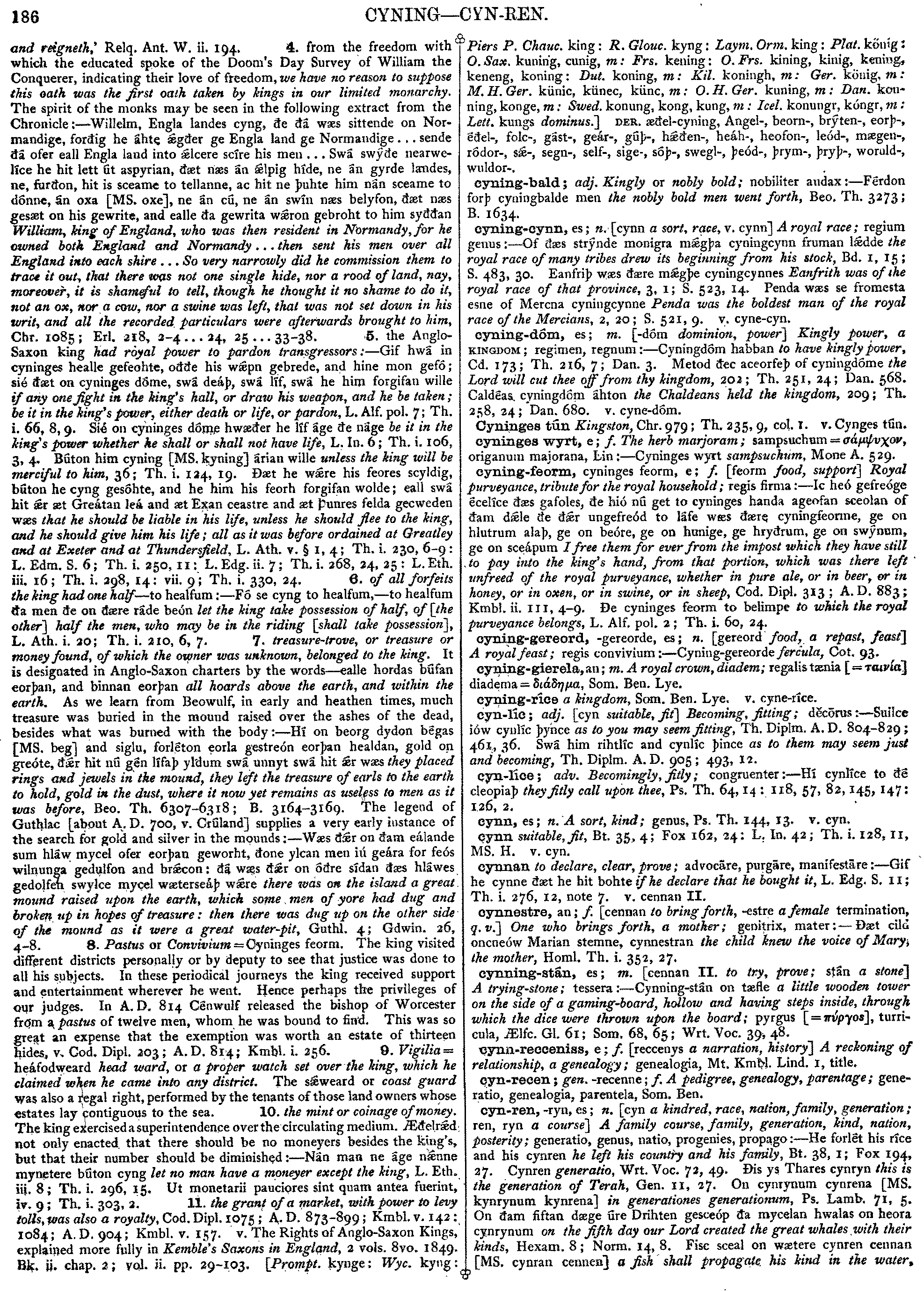
and
reigneth,'
Relq.
Ant.
W.
ii.
194.
4.
from
the
freedom
with
which
the
educated
spoke
of
the
Doom's
Day
Survey
of
William
the
Conquerer,
indicating
their
love
of
freedom,
we
have
no
reason
to
suppose
this
oath
was
the
first
oath
taken
by
kings
in
our
limited
monarchy.
The
spirit
of
the
monks
may
be
seen
in
the
following
extract
from
the
Chronicle
:--
Willelm,
Engla
landes
cyng,
ðe
ðá
wæs
sittende
on
Normandige,
forðig
he
áhte
gðer
ge
Engla
land
ge
Normandige
.
.
.
sende
ðá
ofer
eall
Engla
land
into
lcere
scíre
his
men
.
.
.
Swá
swýde
nearwe-líce
he
hit
lett
út
aspyrian,
ðæt
næs
án
lpig
híde,
ne
án
gyrde
landes,
UNCERTAIN
ne,
furðon,
hit
is
sceame
to
tellanne,
ac
hit
ne
þuhte
him
nán
sceame
to
dónne,
án
oxa
[MS.
oxe],
ne
án
cú,
ne
án
swín
næs
belyfon,
ðæt
næs
gesæt
on
his
gewrite,
and
ealle
ða
gewrita
wron
gebroht
to
him
syððan
William,
king
of
England,
who
was
then
resident
in
Normandy,
for
he
owned
both
England
and
Normandy
.
.
.
then
sent
his
men
over
all
England
into
each
shire
.
.
.
So
very
narrowly
did
he
commission
them
to
trace
it
out,
that
there
was
not
one
single
hide,
nor
a
rood
of
land,
nay,
moreover,
it
is
shameful
to
tell,
though
he
thought
it
no
shame
to
do
it,
not
an
ox,
nor
a
cow,
nor
a
swine
was
left,
that
was
not
set
down
in
his
writ,
and
all
the
recorded
particulars
were
afterwards
brought
to
him,
Chr.
1085;
Erl.
218,
2-4.
.
.
24,
25
.
.
.
33-38.
5.
the
Anglo-Saxon
king
had
royal
power
to
pardon
transgressors
:--
Gif
hwá
in
cyninges
healle
gefeohte,
oððe
his
wpn
gebrede,
and
hine
mon
gefó;
sié
ðæt
on
cyninges
dóme,
swá
deáþ,
swá
líf,
swá
he
him
forgifan
wille
if
any
one
fight
in
the
king's
hall,
or
draw
his
weapon,
and
he
be
taken;
be
it
in
the
king's
power,
either
death
or
life,
or
pardon,
L.
Alf.
pol.
7;
Th.
i.
66,
8,
9.
Sié
on
cyninges
dóme
hwæðer
he
líf
áge
ðe
náge
be
it
in
the
king's
power
whether
he
shall
or
shall
not
have
life,
L.
In.
6;
Th.
i.
106,
3,
4.
Búton
him
cyning
[MS.
kyning]
árian
wille
unless
the
king
will
be
merciful
to
him,
36;
Th.
i.
124,
19.
Ðæt
he
wre
his
feores
scyldig,
búton
he
cyng
gesóhte,
and
he
him
his
feorh
forgifan
wolde;
eall
swá
hit
r
æt
Greátan
leá
and
æt
Exan
ceastre
and
æt
þunres
felda
gecweden
wæs
that
he
should
be
liable
in
his
life,
unless
he
should
flee
to
the
king,
and
he
should
give
him
his
life;
all
as
it
was
before
ordained
at
Greatley
and
at
Exeter
and
at
Thundersfield,
L.
Ath.
v.
§
1,
4;
Th.
i.
230,
6-9:
L.
Edm.
S.
6;
Th.
i.
250,
11:
L.
Edg.
ii.
7;
Th.
i.
268,
24,
25:
L.
Eth.
iii.
16;
Th.
i.
298,
14:
vii.
9;
Th.
i.
330,
24.
6.
of
all
forfeits
the
king
had
one
half
--
to
healfum
:--
Fó
se
cyng
to
healfum,
--
to
healfum
ða
men
ðe
on
ðære
ráde
beón
let
the
king
take
possession
of
half,
of
[the
other]
half
the
men,
who
may
be
in
the
riding
[shall
take
possession],
L.
Ath.
i.
20;
Th.
i.
210,
6,
7.
7.
treasure-trove,
or
treasure
or
money
found,
of
which
the
owner
was
unknown,
belonged
to
the
king.
It
is
designated
in
Anglo-Saxon
charters
by
the
words
--
ealle
hordas
búfan
eorþan,
and
binnan
eorþan
all
hoards
above
the
earth,
and
within
the
earth.
As
we
learn
from
Beowulf,
in
early
and
heathen
times,
much
treasure
was
buried
in
the
mound
raised
over
the
ashes
of
the
dead,
besides
what
was
burned
with
the
body
:--
Hí
on
beorg
dydon
bégas
[MS.
beg]
and
siglu,
forléton
eorla
gestreón
eorþan
healdan,
gold
on
greóte,
ðr
hit
nú
gén
lífaþ
yldum
UNCERTAIN
swá
unnyt
swá
hit
r
wæs
they
placed
rings
and
jewels
in
the
mound,
they
left
the
treasure
of
earls
to
the
earth
to
hold,
gold
in
the
dust,
where
it
now
yet
remains
as
useless
to
men
as
it
was
before,
Beo.
Th.
6307-6318;
B.
3164-3169.
The
legend
of
Guthlac
[about
A.
D.
700,
v.
Crúland]
supplies
a
very
early
instance
of
the
search
for
gold
and
silver
in
the
mounds
:--
Wæs
ðr
on
ðam
eálande
sum
hláw
mycel
ofer
eorþan
geworht,
ðone
ylcan
men
iú
geára
for
feós
wilnunga
gedulfon
and
brcon:
ðá
wæs
ðr
on
óðre
sídan
ðæs
hláwes
gedolfen
swylce
mycel
wæterseáþ
wre
there
was
on
the
island
a
great
mound
raised
upon
the
earth,
which
some
men
of
yore
had
dug
and
broken
up
in
hopes
of
treasure:
then
there
was
dug
up
on
the
other
side
of
the
mound
as
it
were
a
great
water-pit,
Guthl.
4;
Gdwin.
26,
4-8.
8.
Pastus
or
Convivium
=
Cyninges
feorm.
The
king
visited
different
districts
personally
or
by
deputy
to
see
that
justice
was
done
to
all
his
subjects.
In
these
periodical
journeys
the
king
received
support
and
entertainment
wherever
he
went.
Hence
perhaps
the
privileges
of
our
judges.
In
A.
D.
814
Cénwulf
released
the
bishop
of
Worcester
fróm
UNCERTAIN
a
pastus
of
twelve
men,
whom
he
was
bound
to
find.
This
was
so
great
an
expense
that
the
exemption
was
worth
an
estate
of
thirteen
hides,
v.
Cod.
Dipl.
203;
A.
D.
814;
Kmbl.
i.
256.
9.
Vigilia
=
heáfodweard
head
ward,
or
a
proper
watch
set
over
the
king,
which
he
claimed
when
he
came
into
any
district.
The
sweard
or
coast
guard
was
also
a
regal
right,
performed
by
the
tenants
of
those
land
owners
whose
estates
lay
contiguous
to
the
sea.
10.
the
mint
or
coinage
of
money.
The
king
exercised
a
superintendence
over
the
circulating
medium.
Æðelrd
not
only
enacted
that
there
should
be
no
moneyers
besides
the
king's,
but
that
their
number
should
be
diminished
:--
Nán
man
ne
áge
nnne
mynetere
búton
cyng
let
no
man
have
a
moneyer
except
the
king,
L.
Eth.
iii.
8;
Th.
i.
296,
15.
Ut
monetarii
pauciores
sint
quam
antea
fuerint,
iv.
9;
Th.
i.
303,
2.
ll.
the
grant
of
a
market,
with
power
to
levy
tolls,
was
also
a
royalty,
Cod.
Dipl.
1075;
A.
D.
873-899;
Kmbl.
v.
142:
1084;
A.
D.
904;
Kmbl.
v.
157.
v.
The
Rights
of
Anglo-Saxon
Kings,
explained
more
fully
in
Kemble's
Saxons
in
England,
2
vols.
8vo.
1849.
Bk.
ii.
chap.
2;
vol.
ii.
pp.
29-103.
[Prompt.
kynge:
Wyc.
kyng:
Piers
P.
Chauc.
king:
R.
Glouc.
kyng:
Laym.
Orm.
king:
Plat.
köni'g:
O.
Sax.
kuning,
cunig,
m:
Frs.
kening:
O.
Frs.
kining,
kinig,
kening,
keneng,
koning:
Dut.
koning,
m:
Kil.
koningh,
m:
Ger.
könig,
m:
M.
H.
Ger.
künic,
künec,
künc,
m:
O.
H.
Ger.
kuning,
m;
Dan.
kouning,
konge,
m:
Swed.
konung,
kong,
kung,
m:
Icel.
konungr,
kóngr,
m:
Lett.
kungs
dominus.]
DER.
æðel-cyning,
Angel-,
beorn-,
brýten-,
eorþ-,
éðel-,
folc-,
gást-,
geár-,
gúþ-,
hðen-,
heáh-,
heofon-,
leód-,
mægen-,
ródor-,
s-,
segn-,
self-,
sige-,
sóþ-,
swegl-,
þeód-,
þrym-,
þryþ-,
woruld-,
wuldor-.
| Result Page: |  |
Previous | 2 3 4 5 6 7 8 9 10 11 12 13 14 15 16 17 | Next |  |
Germanic Lexicon Project (main page)
This search system was written by
Sean Crist
Please consider
volunteering
to correct the data in these online dictionaries.
No rights reserved. Feel free to use these data in any way you please.